The Watchtower, September 15, 1932
Download: PDF — The Watchtower, September 15, 1932
PRESERVATION
Jehovah has provided preservation for all who love him. Just at the time when the enemy is beginning his organized assault upon Jehovah’s witnesses our great heavenly Father gives to his people an understanding of certain prophecies concerning preservation, and which are given for their aid, encouragement and comfort. A new book entitled Preservation, containing 360 pages, forcefully illustrated, beautifully bound in silk cloth and embossed in gold, will be the next treat for the consecrated. We shall shortly go to press with the author’s edition of this new book, and shall be ready to fill orders promptly. To cover the initial cost the author’s edition will be sent postpaid to any address for fifty cents. You may send in your orders now.
WORLD-WIDE KINGDOM TESTIMONY PERIOD
We are mentioning at this time the Kingdom Testimony Period October 1 to 9, so as to give the offices in all countries ample time to make thorough preparations for what we hope will prove to be the greatest world-wide house-to-house witness yet given. Details for carrying on the witness will appear from time to time in the Bulletin. All branch offices are requested to arrange to forward to the Brooklyn office complete reports of the results at the earliest possible date after the last day of the special service.
NOTICE OF ANNUAL MEETING
Agreeable to the provision of the charter and by-laws of the Watch Tower Bible & Tract Society, notice is hereby given that the annual business meeting of said Society will be held in North Side Pittsburgh (formerly Allegheny), Pennsylvania, at ten o’clock a.m. Monday, October 31, 1932, at which the usual annual business will be transacted. This year there will also be the election of a board of directors, and officers for a term of three years.
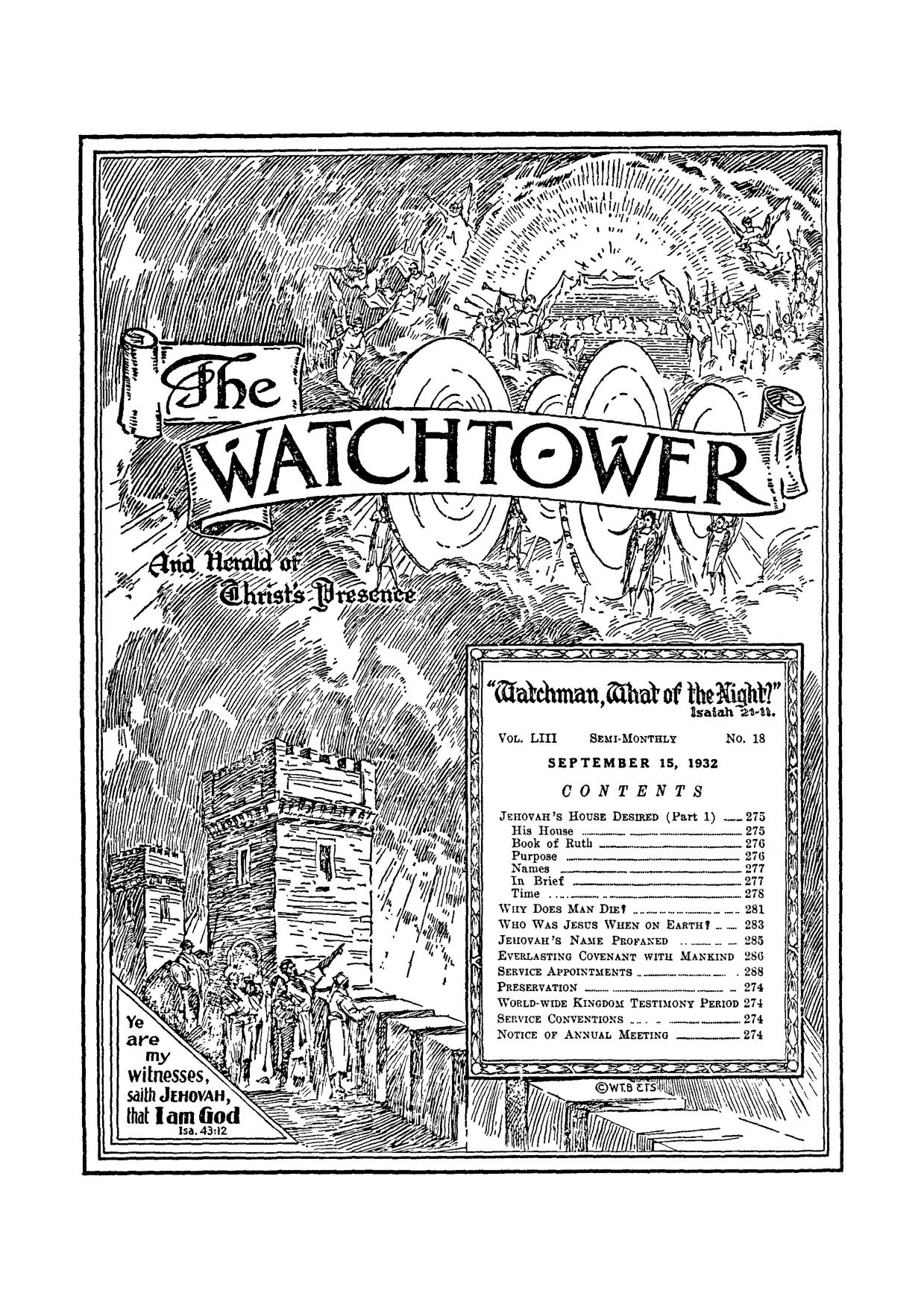
Vol. LIII
September 15, 1932
No. 18
JEHOVAH’S HOUSE DESIRED
“And Ruth said, Entreat me not to leave thee, or to return from following after thee: for whither thou goest, I will go; and where thou lodgest, I will lodge: thy people shall be my people, and thy God my God.”—Ruth 1:16.’
SYLLABUS
In this and subsequent issues of this publication consideration in detail is given to the book of Ruth. The purpose of the Bible record concerning Ruth is disclosed; the relationship between Naomi, Mordecai, Esther and Ruth is made to appear; it shows a selection of those who shall be members of the house of Jehovah, and what is required of them; it makes known the importance of the vindication of Jehovah’s name and who may have a part therein. Not only is the book historical, but it is prophetic, the fulfilment of which prophecy takes place in these present days, and it is therefore present truth and food convenient for God’s anointed people.
PART 1
JEHOVAH’S name is the all-important issue before creation. This fact God’s covenant people now on the earth have learned only in recent times. Keeping always in mind that the fulfilment of prophecy leads to the vindication of Jehovah’s great name will enable one who studies this prophecy to have a clearer understanding thereof. Says the psalmist: “I will worship toward thy holy temple, and praise thy name for thy lovingkindness and for thy truth: for thou hast magnified thy word above all thy name.”—Ps. 138:2.
2 Jehovah’s Word is always right, and in times past he has magnified his Word above his name, abiding his own time to make known and to vindicate his name. Now he discloses to his covenant people on the earth the deeper meaning of his Word, shows them that the fulfilment of his Word is the vindication of his name, and that the due time has arrived to vindicate his name. Seeing this the remnant now publishes his Word with joy, and delights to sing praises to the name of Jehovah God. In centuries past the Word of God has been, and yet is, a lamp unto the feet of his people. (Ps. 119:105) Now in the ‘‘day of the Lord’’ even greater light has come to the remnant because the lightnings of Jehovah flash from his temple and not only illuminate the pathway of the remnant but disclose God’s purpose to completely vindicate his name before all creation. One of the names of man’s Redeemer is “The Word of God”, and he it is that upholds and vindicates his Father’s name. Now the faithful remnant sing: “Thy word is true from the beginning: and every one of thy righteous judgments endureth for ever. My tongue shall speak of thy word: for all thy commandments are righteousness.” —Ps. 119:160,172.
HIS HOUSE
3 In times past God's covenant people on the earth have looked upon his house only as a place of security and safety from the enemy where they might enjoy selfish pleasures. They now see that it means that and much more; that his house is composed of those creatures of his hand who have maintained their integrity toward God, and who will remain on his side and praise his name for ever, and who now by his grace may have some part in the vindication of his name. Jehovah’s house is his dwelling place, and in it are only those who are righteous and true and faithful to him and who will remain thus forever if they abide in his house. It is of Jehovah’s building and will always honor his name. “Lord, I have loved the habitation of thy house, and the place where thine honour dwelleth.”—Ps. 26: 8.
4 They that do not honor the name of Jehovah will not be of his house. No greater honor could be bestowed upon any creature than to be made a pillar in the house of God, and hence it is one of the precious promises given to the faithful. “Him that overcometh will I make a pillar in the temple of my God.” (Rev. 3:12) “Blessed is the man whom thou choosest, and causest to approach unto thee, that he may dwell in thy courts: we shall be satisfied with the goodness of thy house, even of thy holy temple.” (Ps. 65:4) “Blessed are they that dwell in thy house: they will be still praising thee.” (Ps. 84:4) Members of the remnant now on the earth have the proof from the Lord that they have received the garments of salvation and are covered with the robe of righteousness, which Jehovah has furnished to his Son for that purpose, and with great gratitude and gladness they say: ‘‘Surely goodness and mercy shall follow me all the days of my life; and I will dwell in the house of the Lord for ever. ’ ’—Ps. 23: 6.
5 It is the wise that desire to be members of the Lord’s house and that choose to walk in his ways and in the light of his Word. ‘‘A wise man will hear, and will increase learning; and a man of understanding shall attain unto wise counsels.” (Prov. 1:5) He who hears the truth and is diligent to understand and obey the same is wise; and continuing in that way, and maintaining his integrity toward God to the end of his earthly course, he shall be in the Lord’s house. ‘‘The wise shall inherit glory.” (Prov. 3:35) In due time a knowledge of the truth must come to all men, and they that learn wisdom will give heed to and obey the truth. It is of great importance to the creature that he should learn wisdom, and it is to be expected that we may find in the Scriptures many apt illustrations. The course taken by Ruth is an apt illustration of those who take the wise course, but the book of Ruth contains much more than mere illustrations.
BOOK OF RUTH
6 Jehovah continues to bring forth to his covenant people corroborative proof that the Bible is his Word, and not the word of man. This he emphasizes in so many places that the importance of learning and heeding that truth cannot be overstated or too often repeated. Concerning the book of Esther the commentators, wise in their own conceits, have insisted that the book has no proper place in the Bible. The Lord God has put these worldly wise ones to shame by revealing to his people that the book of Esther is not only a part of his sacred Word of truth but that it is prophecy particularly foreshadowing things that are of very great importance to his anointed people now on the earth. The book of Ruth so clearly proves itself to be a part of the Bible that commentators have not attempted to prove to the contrary. Those who have commented on the book of Ruth have insisted that it is only historical and genealogical, and illustrative of important lessons to be learned, and that it contains nothing else. Such conclusions are further proof that no man can interpret the Word of God, but that Jehovah in his own good time and good way makes plain to his covenant people the meaning and application of his Word. God’s due time seems to have come for his people on earth to have an understanding of the book of Ruth. That being true, we may know it is for their good and encouragement.
7 It is of interest here to first take note of some of the comments that have been heretofore published concerning the book of Ruth, in order that such may be compared with the facts and the Scriptures, which now so clearly fit each other, and show that the prophecy is being fulfilled. As far back as 1867, fully seven years before the Lord Jesus began to ‘prepare the way before Jehovah’, a certain Bible dictionary published the following comment on the book of Ruth and accredits the comment to one Mr. Davidson, to wit:
“The scope of the book of Ruth is to set forth the origin of David, historically and genealogically showing how a heathen belonging to a people so hostile to the theocracy as the Moabites was honored to become the progenitor of the great and pious King David because she placed unlimited trust in the Lord and sought protection from the God of Israel.’’
8 But the dictionary does not make it clear whether the above comment was by Dr. Robert Davidson, who lived from 1750 to 1812, or from someone else. The probabilities are, however, that this is the Dr. Davidson. The same dictionary further says: Professor Busch thinks the leading design of the book was to pre-intimate, by the recorded adoption of the Gentile woman into the family through which Christ was to derive his origin, the final reception of the Gentile nations into the true church as fellow-heirs of the salvation of the gospel.
9 The Watchtower of November 15, 1902, said this: “While the book of Ruth is not prophetical, but merely historical, it is valuable to us in various ways. (1) It furnishes an important link in the chronological chain leading down to King David and, hence, a part of the chronological line leading down to the man Christ Jesus. (2) It gives a glimpse of the habits and customs of the Israelites in general as an agricultural people. ... (3) The story of Ruth points out the very valuable lesson of fidelity, sympathy and love among the people at that time, and inculcates a similar lesson of kindness of disposition amongst the spiritual Israelites, guaranteeing them, along this line, blessings both for the present and for the future. ’ ’
10 In the issue of The Watchtower of November 15, 1907, the following appears: “Manifestly the chief object in the brief narrative of Ruth and Naomi was to preserve an authentic record of a link in the chain of our Lord’s human ancestry.”
PURPOSE
11 While it is true, as stated in the foregoing comments, that the book of Ruth is historical and genealogical, and furnishes some beautiful illustrations, yet if such is God’s purpose in giving the book to his people it is of little value to the remnant. But such is not the real purpose of the book. The Scriptures plainly state that these things were written aforetime for the benefit of God’s people on earth at the end of the world. “Now all these things happened unto them for ensamples; and they are written for our admonition, upon whom the ends of the world are come.” (1 Cor. 10:11) “For whatsoever things were written aforetime were written for our learning, that we through patience and comfort of the scriptures might have hope.” (Rom. 15:4) “All scripture is given by in-spiration of God, and is profitable for doctrine, for reproof, for correction, for instruction in righteousness; that the man of God may be perfect, throughly furnished unto all good works.” (2 Tim. 3:16,17) Based upon this Scriptural authority we must conclude that the book of Ruth was made a part of God’s Word or message as a prophecy for the special benefit of the remnant in the last days. The physical facts that have come to pass in recent years fully support that conclusion, and this is the best means of determining that the book is a prophecy.
12 In recent years God’s covenant people on the earth have learned that the chief purpose of Jehovah’s dealing with mankind is the vindication of his name, and not merely the salvation of man. The first thing the book of Ruth brings to the attention of those who seek the truth is the need of the preserver or upholder of the name of Elimelech, the meaning of whose name is very significant. To supply this required need a redeemer or vindicator must be found who would be willing to serve in that capacity. The one who would cooperate with such vindicator must be fruitful, using the body to bring forth fruit that the name of Elimelech might be carried forward. The book shows that a breach was threatened in the royal lineage of Judah leading up to King David, and still further up to Jesus, “the King of kings,” whom David foreshadowed. The fruit must be born and must be in behalf of and in the interest of the kingdom. God had given his word, to wit: “The sceptre shall not depart from Judah, nor a lawgiver from between his feet, until Shiloh come; and unto him shall the gathering of the people be.” (Gen. 49:10) This word must be fulfilled. Taking this viewpoint of the book of Ruth, together with other events thereof, enables us to locate the time for the fulfilment of the prophecy therein contained.
13 The characters that stand forth prominently in the book of Ruth are these, to wit: Elimelech, Boaz, Naomi and Ruth. Others appear in the prophetic drama, but they are not of so much importance. Manifestly the chief purpose of the book of Ruth is to clearly identify the vindicator of Jehovah’s name and to show forth the company that is gathered unto Christ who will have a part in the vindication of his name and who will therefore be members of Jehovah’s house; and that this is accomplished chiefly at the time Christ Jesus appears at the temple of Jehovah, and shows that which is required of each one who shall be in the house of the Lord and participate in the vindication of Jehovah’s name. The prophecy has its particular fulfilment after Jehovah’s King is placed upon his throne in the year 1914 (A.D.).
NAMES
14 The names of the chief places and the names of the principal characters involved in the Bible account of Ruth are significant. There is a purpose in Jehovah ’s giving a name to a place or to a creature. The meaning of the names of the principal characters in the drama are here given that they may be kept in mind during the examination of the Bible story.
15 ‘ ‘ Bethlehem ’ ’ means ‘‘ the house of bread ”. “ Elimelech” means “God my King” or “Gol of [the] King”. “Naomi” means “pleasant”. “Boaz” means “fleetness, eagerness, alacrity”. “Ruth” means ‘ ‘ friend, a female associate ”. “ Orpah ’ ’ means ‘ ‘ nape ’ ’, or the back of the neck. “Mahlon” means “sickly”. “Chilion” means “pining, destructive”.
16 It is the tribe of Judah that is involved in the Bible account recorded in the book of Ruth; and it may be of interest at this point to mention the fact that there are ten generations named in the account, and which appear in the last chapter thereof. The record shows that the family of Pharez was favored in the tribe of Judah, and incidentally shows why Samuel was sent to the house of Jesse when God’s due time came to select the king through the tribe of Judah. “And the Lord said unto Samuel, How long wilt thou mourn for Saul, seeing I have rejected him from reigning over Israel? Fill thine horn with oil, and go; I will send thee to Jesse the Bethlehemite: for I have provided me a king among his sons.” (1 Sam. 16:1) The name “Judah” means “the praises of Jehovah God” by publishing his name and his kingdom in the very time in which we are now living.
IN BRIEF
17 A brief statement of the facts as set forth in the Bible account of Ruth is this, to wit: There was a famine in the land of Palestine which lasted over a period of about ten years. In the town of Bethlehem, which was small “among the thousands of Judah”, resided a man of the tribe of Judah by the name of Elimelech. With him lived his wife Naomi and his two sons Mahlon and Chilion. Because of the famine Elimelech took his family and went to sojourn in the land of Moab, which lay on the east side of the Jordan. There Elimelech died, leaving his widow and his two sons to mourn his loss. The two sons married women of the Moab country, one of them being Orpah, and the other one Ruth. Both Mahlon and Chilion then died, and there remained three widow women: the mother of the two dead sons, and the Moabitish women whom these had taken to wife.
18 Naomi heard that the land of Palestine was again favored by the Lord with food, and she determined to return to her native city of Bethlehem. Together with her two daughters-in-law she began the journey. After they had traveled some distance on the way Naomi said to her daughters-in-law: “Go, return each to her mother’s house.” After some argument Orpah turned back. Ruth refused to go back to her native land, but begged that she might remain with Naomi and continue with her as long as she lived. Naomi and Ruth proceeded on their journey, returning to Bethlehem. At Bethlehem Naomi had a kinsman whose name was Boaz, a man of large wealth and influence. Boaz was of the family of Elimelech, and therefore of the tribe of Judah. When Naomi and Ruth arrived at Bethlehem it was the time of the beginning of the harvest. Boaz was gathering his grain from the field. It was the custom among the Israelites, in obedience to the law of God, to permit the poor to follow the reapers and glean the grain that had been left in the field by the reapers. Ruth desired to go into the field and glean, and Naomi agreed that she should do so. She went forth to glean, and she chanced to do her gleaning in the field of Boaz. The net result was that Ruth was joined in lawful wedlock to Boaz and bore a son to Boaz.
19 The story, briefly told, has been regarded by many as merely a beautiful love story, as the world knows such things. If that were all there is to it God would not have caused a record to be kept thereof in his Word. In recent months Jehovah has graciously given to his covenant people an understanding of the book of Esther. This light from Jehovah, caused to shine upon the temple class, has illuminated the book of Ruth, and it is manifestly the time for the book of Ruth to be understood. In the book of Esther both Mordecai and Esther represent a class of people who have been brought into covenant relationship with God. Mordecai pictures those who were found faithful at the time Christ Jesus came to the temple of Jehovah for judgment, whereas Esther represents in particular those who came to a knowledge of the truth after the coming of the Lord to his temple and to which class it has been the privilege of the Mordecai class to minister aid and help. The two, Mordecai and Esther, finally in that drama represent God’s remnant on earth at the end of the world. If the book of Ruth is a prophecy, then we may expect to find that Naomi pictures a certain class of God’s anointed people and that Ruth also pictures a class of the faithful ones, and that the fulfilment of this prophecy would have its beginning at the time of the Lord’s coming to his temple. The preservation of God’s people is emphasized in the book of Esther, and likewise it will be found that the book of Ruth further corroborates the promise of God to preserve those that love him. With these observations it now seems it would be profitable to God’s remnant to carefully examine in detail the book of Ruth, and this is now here done.
TIME
20 The beautiful prophetic account opens with this statement: “Now it came to pass, in the days when the judges ruled [judged, margin], that there was a famine in the land. And a certain man of Beth-lehem- judah went to sojourn in the country of Moab, he, and his wife, and his two sons.’’ (1:1) The period of the judges was about four hundred and fifty years. “And when he had destroyed seven nations in the land of Chanaan, he divided their land to them by lot. And after that, he gave unto them judges, about the space of four hundred and fifty years, until Samuel the prophet.’’—Acts 13:19, 20.
21 This corresponds with and corroborates the latter part of the book of Ruth and shows that the book was written after the four-hundred-and-fifty-year period of the judges, and after David had become king, and after he had become famous as the Lord’s anointed. This opening of the book of Ruth suggests that the fulfilment of the prophecy of the book would be in the time of judgment which begins when Jehovah’s Messenger, Christ Jesus, appears at the temple for judgment work. (Mal. 3:1-5) It is difficult to know just when the prophetic events recorded in the book of Ruth took place, but it seems quite probable it was at the time of Judge Gideon. It is also reasonably possible that these things came to pass shortly after the death of Joshua and during the time of the judgeship of Othniel or of Ehud and Shamgar.—Judg. 1:12,13; 3:8-11,15,31.
22 The book of Genesis shows that during the time the heathen exclusively occupied the land of Canaan it was not unusual for the people there to be afflicted with famine (Gen. 12:10; 26:1; 42:5; 47:4,13); but at the time of the events recorded in the book of Ruth God’s covenant people, the Israelites, occupied the land. Hence we must conclude that the famine mentioned in the first verse must have been sent by the Lord God according to the terms announced to the Israelites and which are set forth in the law of God given to the Israelites. (See Leviticus 26:18-20; Deuteronomy 28:15-18,23,24.) It seems quite probable that this famine occurred during the eighteen years that the children of Israel served Eglon the king of Moab, because they ‘again did that which was evil in the sight of the Lord’.—Judg. 3:12-14.
23 From knowing that these things were written aforetime for the benefit of the remnant, that famine seems to well represent or picture the condition of scarcity that came upon the Lord’s covenant people on the earth between the years 1914 to 1918. The same thing is pictured in the prophecy of Ezekiel by Ezekiel’s being obliged to live on scant fare, the explanation of which is found in Vindication, Book One, pages 55 and 56. Jehovah was then King over the earth by reason of the fact that he had placed his beloved One, Christ Jesus, his Chief Executive, upon his throne on his holy hill of Zion. (Ps. 2:6) This corresponds to the fact that Jehovah was the King of Israel at the time of the coming to pass of the events mentioned in the book of Ruth.
24 The man first brought to the attention of the reader is “a certain man of Beth-lehem-judah’’. The suffix “judah’’ mentioned is doubtless for the purpose of distinguishing the place from the Bethlehem near the town of Nazareth and which belonged to the tribe of Zebulun. (Josh. 19:15,16) Furthermore it more particularly shows that it pertains to that company of people that give praise to the name of Jehovah. The meaning of the name “Beth-lehem-judah” is “the house of bread in the land of praise to Jehovah”. In Jacob’s time it was known as Ephrath. “And it came to pass, as her soul was in departing, (for she died,) that she called his name Ben-oni; but his father called him Benjamin. And Rachael died, and was buried in the way to Ephrath, which is Beth-lehem. And Jacob set a pillar upon her grave: that is the pillar of Rachel’s grave unto this day.”—Gen. 35: 18-20.
25 It is certain that Jehovah intervened through Boaz and Ruth to preserve in the divine record the name of this “certain man of Beth-lehem-judah” and that the name of that one must be vindicated. The two sons of that “certain man” had died without issue. That ‘ ‘ certain man ’ ’ had also died, and his widow did not remarry to raise up seed unto the dead. It is important to know that this “certain man” was of the tribe of Judah, through whom Shiloh, the Lawgiver, must come. Boaz was of the same tribe, was personally acquainted with that ‘ ‘ certain man ’ ’, and was, in fact, related to him. That “certain man” went to sojourn in the country of Moab, but his near kinsman Boaz remained at Bethlehem-Judah. If, as it seems probable, this was during the time of Eglon the king of Moab it would have made no difference whether Elimelech had remained in Bethlehem-Judah or sojourned in Moab. In either case he and his family would have been under the rule of the king of Moab. The country of Moab lay east of the Dead sea. To reach that country it was necessary for that “certain man” to cross the Jordan river, and it is probable that he crossed at the point near Jericho where the Israelites crossed under Joshua. “And the children of Israel set forward, and pitched in the plains of Moab, on this side Jordan by Jericho.”—Num. 22:1.
26 “Moab” means “from my father; seed of [mother’s] father; from her [the mother’s] father”. Moab was the son of Lot by Lot’s eldest daughter, and hence Moab was the grand-nephew of Abraham the Hebrew. Doubtless the languages of the Moabites and the Jews were similar. The Moabites had been very unfriendly to the Israelites when the latter were on their journey to the land of Canaan, and went so far as to hire Balaam the unfaithful prophet to curse the Israelites. (Deut. 23: 3, 4; Num. 22: 3-31; Mic. 6: 5) The Moabites practiced the devil religion, their national god being Chemosh. (1 Ki. 11:7) On a number of occasions the Moabites oppressed and assaulted the Israelites. Sanballat the Moabite later tried to prevent the rebuilding of the wall of the city of Jerusalem. (Neh. 2:19) The Moabites therefore pictured a self-centered, boastful, arrogant class of people, relying upon military power and indulging in war, and the haters of those who served Jehovah God. For this reason the Lord God condemned them to complete overthrow.— Ezek. 25:8-11.
27 In the land called “Christendom”, at the beginning of the World War, in 1914, there was just such a class, and which class still exists, and who rely upon their own wisdom, are advocates of evolution, children of the Devil, claiming to be able to bring themselves up out of difficulties to perfection, and to make the world a desirable place in which to live. It seems that the land of Moab was not affected by the famine that prevailed in the land of Canaan. Likewise, during the World War the modern Moabites, namely, the rich and influential people of “Christendom” and the ones well-favored by the Devil’s organization, had plenty of food and raiment and lived at ease. At the same time those who served God were ‘hated of all nations for Christ’s sake’ and suffered much inconvenience and oppression at the hands of the modern Moabites. This ‘ ‘ certain man ’ ’ of Bethlehem could not hope to escape the hostility and oppression of the Moabites by moving to Moab, whether there was a famine or not. Likewise those who love and serve Jehovah God, and did so during the World War, had no way of escaping the hostility and oppression of the modern Moabites, whether they lived in one land or in another.
28 The “certain man”, together with his wife and sons, went to Moab, as the record shows, because of the famine. The record is silent, however, as to which one of these four was the prime mover of the transfer of residence from Bethlehem to Moab. It seems, however, that the presumption must be indulged that the husband and head of the house was the one who led the movement or transfer of residence to Moab. The time of the fulfilment of the prophecy corresponds to the closing years of the Elijah work of the church, at which time the Jezebel spirit was rife and when women exercised much influence in the companies of God’s consecrated people. (Rev. 2:18-23; see Light, Book One, page 29) This might indicate that Naomi influenced her husband to go into the land of Moab in order that her two sons might be sure of the necessary food, but this conclusion does not seem to be supported by the facts. It has also been said that the fact that the woman lost her husband and her two sons would indicate the Lord’s displeasure with her and therefore that the thing that Naomi was trying to prevent really resulted to her sons.
29 But when we call to mind that the book of Ruth is a part of the Bible, the Word of God, and that these things were written aforetime for the special benefit of the remnant, then the only reasonable conclusion is that the famine in Canaan came upon the Israelites according to the will of Jehovah. (Lev. 26: 20; 2 Ki. 8:1) The chief purpose was to make a prophetic picture at that time, the meaning of which Jehovah would make known to his remnant people in the last days; hence the going of that “certain man” to Moab, together with his family, must have been a part of the divine drama and, that being true, no blame would attach either to Naomi or to her husband. We have the positive statement of the Scriptures that ‘ ‘ all these things happened unto [the Israelites] for ensamples” or typical pictures and that they were written for our admonition upon whom the ends of the world are come. That being true, we must view the characters that played in that drama as entirely blameless, knowing that they took their respective parts and played them according to the will of God. The part that each one played in the drama foreshadowed something of great importance to come to pass at a later date.
30 These prophetic pictures made in olden times by Jehovah’s using his covenant people Israel manifestly were made for the purpose of showing his faithful covenant people at the end of the world that it was the purpose of Jehovah from the beginning of the deflection in Eden to vindicate his word and his name, and that in his own due time; also to show that Jehovah could put human creatures on the earth that would maintain their integrity toward him and be faithful and true to him, and to show that the faithful ones taken from amongst men after the coming of Christ would have some part in the work of vindicating Jehovah’s name. The historical and genealogical part of this divine drama necessarily appears and is important, but that which is of greater importance is to disclose a vindicator and the work of the vindication of Jehovah’s name.
31 The book of Ruth discloses that Naomi and Ruth in times of stress were preserved by Jehovah, and that this preservation was granted to them because of their love for Jehovah, and that they had to do with the vindication of this “certain man’’ mentioned in the opening part of the book. This would therefore indicate that the class of people pictured by Naomi and Ruth would be preserved by Jehovah God and that their preservation would come by reason of their loving devotion to Jehovah, and that they would have some part in the vindication of the great name of Jehovah. The time of the fulfilment of the prophecy therefore seems clearly to be in the day of judgment when the great Judge has begun his reign and when the people who give praise to the name of Jehovah find themselves in the enemy’s country and are enabled by the light which comes to them from the temple of God to clearly discern the enemy organization and to see the means of preservation and escape. The prophecy also will enable God’s covenant people now on earth to have a keener appreciation of the great favor and privilege Jehovah has bestowed upon them by bringing them into his organization and making it possible for them to dwell for ever in his house. It discloses the wisdom of the course taken by those who seek the house of the Lord and the controlling motive that must induce one to seek to enter into the house of Jehovah.
32 The opening verse of the book of Ruth does not disclose the name of the “certain man of Beth-lehem-judah” who went and sojourned in Moab, but his name is later disclosed. Manifestly this is for the purpose of emphasizing the importance of the name. The prophetic drama opens with this “certain man’’ and his family, who were God’s covenant people, in an enemy’s country and under oppression and in distress. We may conclude that the husband and father was a comfort to his wife and sons and that this has an important bearing upon the matter. While it is true that the book of Ruth gives prominence to the genealogy leading up to David, and therefore to Jesus, whom David foreshadowed, it was pointing to the more important thing, to wit, the building of Jehovah’s capital organization that would vindicate his name. This point could not be appreciated until God’s time to give his people an understanding of the meaning of his name Jehovah and an understanding of what his chief purpose is concerning creation. Heretofore men have proceeded upon the theory that God was working out a well defined plan that would ultimately result in saving some in heaven and probably some on the earth, and that he permitted evil to exist in order that man might learn the bad results thereof. Now the truth more clearly appears and it is seen that wickedness in the earth is the result of rebellion, that the wicked one has builded a great organization which has defamed the name and word of Jehovah God; that Jehovah has permitted him to go unhindered in his wickedness; that Jehovah God is building his capital organization or house which in his own due time he will use to demonstrate to all creation that his Word is true, and that his name is worthy of all praise, and that no one can get life everlasting anywhere unless he loves and serves Jehovah God as his law provides.
33 Doubtless God sent the evil famine upon the land of Israel, but that does not at all mean that the ‘ ‘ certain man’’ who went out from Bethlehem-Judah was faithless. The fact that this man is made to boldly appear in the opening verse of the book of Ruth and his name later announced strongly indicates that he was an honorable and God-fearing man, high in the councils of the tribe of Judah, and one whom Jehovah God would use to disclose how he would build his house that in due time would vindicate and honor his name.
(To be continued)
QUESTIONS FOR BEREAN STUDY
1, 2. What is the all-important issue before creation? Why is it essential that God’s people keep that fact constantly in mind?
3-5. Compare the vision now had of Jehovah’s house by his covenant people with the view which they held in times past. Account for the clearer understanding. How and for whom does Jehovah provide opportunity to become members of his house? What is the purpose of Jehovah’s house?
6-10. Commentators hitherto have taken what position regarding the books of Esther and Ruth? Account for their not seeing the matter more clearly.
11-13. With scriptures, show that the book of Ruth is clearly within Jehovah’s purpose of the Bible as a whole. What is the particular purpose of the book of Ruth?
14-16. What are the names of the principal places and characters involved in the Bible account of Ruth? What of interest in this regard appears in the genealogy there recorded ?
17-19. Summarize the facts set forth in the book of Ruth. Briefly compare the books of Esther and Ruth as prophetic pictures and as to time of fulfilment thereof.20,21. Point out what seems to have been the time when these events recorded in the book of Ruth took place, as well as the time when the record was made.
22, 23. From the Scriptures show (a) whether the “famine in the land” (Ruth 1:1) was unusual and whether it involved God’s covenant people. (b) That the famine here mentioned was prophetic.
24. What is significant in the fact that this “certain man” was of ‘ ‘ Beth-lehem-judah ’ ’ ?
25. What were the circumstances, as related in the record, which serve to indicate Jehovah’s purpose in preserving the name of this “certain man”?
26, 27. Who were the Moabites? Account for their disfavor with God. Of whom were they a prophetic picture?
28. Why did this “certain man” and his family go to sojourn in the land of Moab? What incorrect views have been held as accounting for their experiences in that land?
29. How do we reasonably account for the famine in Canaan
at that time? Explain the responsibility for or the purpose of the experiences of this family.
30. What was Jehovah’s purpose in these prophetic pictures provided through his covenant people Israel?
31. Explain the significance of the time and of the circumstances in which, in this divine drama, Jehovah preserved Naomi and Ruth. What is the lesson contained therein for God’s covenant people now?
32, 33. What was the purpose in not disclosing the name of this “certain man” in the opening verse of the book of Ruth? Compare the understanding now enjoyed by God’s people concerning Jehovah’s name and his purpose with the view formerly held by them. Account for their present clearer understanding and greater appreciation.
WHY DOES MAN DIE?
HOW was man made? Is he immortal? Or is any part of man immortal? Why has there been such a wide divergence of opinion on these questions?
When the people study the Word of God for themselves and find the simplicity and beauty thereof they can see what great hypocrites are the clergymen. But these clergymen have kept the people in ignorance of the Bible. They refuse to teach the people themselves what the Bible says; they turn the mind of the people away from the Bible and warn them to read nothing concerning the Bible that does not come from the pen of one of these pious hypocrites.
The Lord has let them go to the limit, and now he is doing his marvelous work in the earth by teaching the people in his own good and loving way.
We need only to look at a man to see how marvelously he is made. The framework or skeleton is made of an exact number of bones which perform their function. There is not a superfluous one in the organism. These are held together by the sinews and muscles which move the bones at will in exact harmony. Covering the muscle and the flesh is a soft, delicate, silky substance we call skin, which gives beauty to the body. Of all intricate electrical systems man has devised, none can begin to compare with the wonderful nervous system of the human organism.
With precision and regularity the blood courses through the arteries and the veins, giving life to the creature. In the head is a brain, wherein is the seat of the will and mind. By the mind facts are considered and weighed and a decision reached, and then the will directs the action.
To the sober-minded, thinking man it is apparent that nothing short of the Infinite One could have formed man. Speaking of the marvelous knowledge displayed in the creation of man, the prophet of God exclaimed: “Such knowledge is too wonderful for me; it is high, I cannot attain unto it. I will praise thee; for I am fearfully and wonderfully made: marvellous are thy works: and that my soul knoweth right well.”—Ps. 139:6,14.
These inspired words of God’s prophet, written long before the wise savants came into existence, should put them to shame. When the people know the truth these so-called “wise” men will be in shame and disgrace and in contempt. As man begins to obtain knowledge of the great Jehovah God and his marvelous creation, and of his goodness and loving-kindness toward man, he desires to draw nigh unto God and to learn more about him. For his encouragement then the Lord caused to be written in his Word:
“Draw nigh to God, and he will draw nigh to you. Cleanse your hands, ye sinners; and purify your hearts, ye double minded.” (Jas. 4:8) Let the pretending Christian then cleanse his hands from dabbling in evolution. Let him purify his heart and cease to be double-minded. A man who claims to be a Christian and yet holds to the theory of evolution in any manner whatsoever is a double-minded man. Let him learn the truth of the Lord God and follow that.
These things are mentioned here not with hope or anticipation of arousing the modern clergymen out of their drunkenness and stupor to turn them to God, but for the benefit of the people in the common walks of life who love the things that are good and who desire to know God. Let all such with befitting humility and meekness come and seek knowledge at the Word of God and there learn how man was made and what are God’s gracious provisions for man’s future welfare and happiness.
How, then, was man made?
The earth may be properly said to be the mother of man, because from the elements of the earth the first man was made.
Jehovah God created him and gave him life. Therefore God is the Father or Life-giver of the first man.
Communing with his beloved Son, God said: “Let us make man in our own image, after our likeness; and let them have dominion over the fish of the sea, and over the fowl of the air, and over the cattle, and over all the earth, and over every creeping thing that creepeth upon the earth. So God created man in his own image, in the image of God created he him; male and female created he them.”—Gen. 1:26,27.The method of man’s creation is simply and beautifully stated in the Scriptures: “And the Lord God formed man of the dust of the ground, and breathed into his nostrils the breath of life; and man became a living soul.” (Gen. 2:7) These words of the inspired Word of God should be the end of all controversy as to man’s origin. No one, therefore, who believes Jehovah and that the Bible is his Word will for one moment seriously consider the wicked and God-dishonoring doctrine of the evolution of man.
It is easy to be seen, therefore, that for a Christian to enter into a discussion with an advocate of evolution of man is easting a foul stain upon the holy name of Jehovah and therefore giving countenance and fellowship to the wicked one in violation of the Scriptures.—Ps. 39:1.
And now mark the goodness of the great Creator. Purposing to create man he first made Eden and in the eastern part thereof planted a garden of perfection and unsurpassed beauty. It contained numerous flowers and fruits and its atmosphere was scented with sweet perfume. Birds of gorgeous plumage and sweet song were there. Beasts of the field and fowl of the air dwelt there together in perfect peace. There was no hot sun to blight the garden in summer, nor driving frozen sleet to mar it in winter. Its very name testifies that it was a paradise. It was a fit place for a perfect intelligent creature, who should be its caretaker and its lord, and who should love and adore the great Creator.
Then God directed his beloved Logos, his active agent, to take the elements of the earth and form the organism. The beautiful body, perfectly and wonderfully wrought, reposed silently and without life upon the ground. Then God breathed into the nostrils of that organism the breath of lives. The breath inflated the lungs and caused the blood to leap through the arteries. The body was animated and there was a moving, breathing, sentient creature which the Lord called a “soul”, which stood upon its feet and went about. That was the first man. That was the direct creation of Jehovah God. That man was perfect because all the works of Jehovah are perfect.—Deut. 32:4.
Then God made for man a woman to be his helpmate and his companion. To this perfect pair he gave the power and authority to produce and bring forth children, with the purpose of filling the earth with a happy race of people. The life of the human race proceeded from this first perfect pair which God made.
Adam, the prince, with Eve, his princess, graced the garden of the Lord. Sixty centuries ago that marvelous work was done. Had not sin entered into Eden to mar its beauty and destroy man’s life, what would we behold today? Thousands of millions of perfect human creatures on earth, all strong, vigorous, beautiful and happy, all praising Jehovah God, dwelling together in peace and being a comfort and joy to one another. Instead, the very opposite is seen.
It was ambitious Lucifer who destroyed the beauty of that paradise home. Since then his names have been and are, Satan, Serpent, Dragon and Devil. In Eden he became a liar and murderer, and he has practiced and instigated crime ever since. He it is that blinded man to the truth concerning God and his loving-kindness. God has suffered him to take his own wicked course until God’s due time to restrain him. That happy day is beginning and soon Satan will be completely restrained, and then all the people shall know the truth and be free.
Satan’s first lie, and that which caused the downfall of man, was, ‘There is no death.’ This was a means to induce the practice of evil, advising man that he would continue to live forever because immortal.
Today the clergy, who claim to represent God and who teach the people that every man has an immortal soul, are continuing to tell and to practice Satan’s first lie, ‘There is no death.’ It is apparent to anyone that evolution and inherent immortality are inconsistent doctrines. Notwithstanding the clergy teach both, either one of which discredits Jehovah in the mind of the student. Who would be specially interested in causing the people to believe this false doctrine? Satan the Devil, of course; because if man had never been created perfect and had not fallen, there would be nothing to reconcile.
If man had an immortal soul or were inherently immortal, there could be no such thing as reconciliation. If man were immortal and indestructible, the wicked would not care to be reconciled but would continue wicked forever, and the good would not need to be reconciled. Both doctrines so confuse the minds of honest people that they cannot understand that Jehovah has purposed to reconcile humanity to himself.
The great pivotal doctrine of the provision of God for man’s reconciliation is the death and resurrection of Jesus, whereby the redemptive price is provided. Both the doctrine of evolution and that of eternal torture are exactly opposed to the doctrine of redemption.
If the student can always keep in mind that the Devil’s chief purpose is to keep man alienated from God, then it is easy to understand why these false doctrines are promulgated. It may be laid down as a certain and absolutely safe rule that if a teaching or doctrine is inconsistent with the Bible, and particularly the redemption of man through Christ Jesus, that doctrine is false.
Another false doctrine that has grown out of ‘inherent immortality’ is that of eternal torture of the wicked. Of course, life must be perpetual in order for torment to be perpetual; hence the two doctrines of the immortality of the soul and eternal torture must stand or fall together. Both being false, they must fall. The Word of God is truth, and in due time must prevail.
God’s inspired prophet wrote concerning man:
“Thou hast made him a little lower than the angels.” This, being true, disproves the doctrine of evolution and the doctrine of inherent immortality. If man were inherently immortal, and the angels are higher than man, then it would follow that angels are immortal.
The Scriptures show that the angels are not immortal. Many of the angels in the day of Noah fell from the way of purity and became very wicked. (Gen. 6:2-4; 1 Pet. 3:19, 20) God imprisoned many of such angels. (Jude 6; 2 Pet. 2:4) God declared that in his own due time “all the wicked will he destroy”. (Ps. 145:20) The chief among these wicked ones is the Devil, that angel of once great light and power. The fact that these wicked angels will be destroyed is conclusive proof that they are not immortal. The Devil, the chief among them, it is expressly stated in the Scriptures, God will destroy. (Heb. 2:14; Ezek. 28:19) The fact that man is lower than the angels is another proof that man is not immortal.
If man were a creature of evolution, then the angels must also be creatures of evolution, because the Scriptures compare the creation of the two and state that man is on the lower plane. Besides, the Scriptures say that God made the angels and also made man, and the fact that God made them is proof that neither the angels nor men were evolved.
Human experience proves that man walks about, breathes, and performs his usual functions. If an accident befalls him his breath is taken away completely, the body no longer functions, and the man is dead. This experience, well known to be common to all men, is exactly in harmony with the Word of God. The Scriptures declare that God formed man of the dust of the ground and breathed into his nostrils the breath of lives, and a living soul resulted. Take away the breath of life and the blood ceases to circulate, action of the heart stops, and the man is dead. It was God’s holy power that made man and gave him the breath of life. The power of God exercised takes away the breath of life and therefore death ensues.
Upon this point note the scriptures, written in Job 33:4, “ The spirit of God hath made me, and the breath of the Almighty hath given me life.” Again, in Psalm 104:29 we read, ‘ ‘ Thou takest away their breath, they die, and return to their dust.”
That no part of man remains alive after breath goes out of the body is positively proven by the Scriptures. “His breath goeth forth, he returneth to his earth; in that very day his thoughts perish.”—Ps. 146:4.
The breath is invisible and powerful, even as the wind is invisible and powerful. It is the breath of life which God gave to man that moves into action his blood. Without the circulation of the blood there would be no life. This is true because the life is in the blood. (Lev. 17:14) Take away the blood of man and death results. That of itself proves that man is not immortal.
Man is a soul. The terms man, creature and soul mean the same thing. (Gen. 2:7) If immortal, of course, the soul could not die, because immortality means that which is not subject to death. On this point there is no room for doubt, because the Scriptures in plain phrase say: “The soul that sinneth, it shall die.” (Ezek. 18:4) “What man is he that liveth, and shall not see death? shall he deliver his soul from the hand of the grave?”—Ps. 89:48.
WHO WAS JESUS WHEN ON EARTH?
THE question of the relation of Jesus Christ to the human race and of his relation to creatures in heaven has for a long time puzzled many. And then, also, there is the larger question, What was the relation of Jesus to God?
In plain phrase the sacred record says: “The Word was made flesh, and dwelt among us (and we beheld his glory, the glory as of the only begotten of the Father), full of grace and truth.” (John 1:14) That a babe was born of a virgin, Mary, at Bethlehem, grew to manhood’s estate and died upon the tree at Jerusalem, both sacred and profane history abundantly testify.
Who was that man? The so-called “orthodox” clergy, in order to support their false dogma of the trinity, have been forced to accept from Satan and teach another lie, to wit, that the child born of the virgin Mary, which child grew to manhood and was crucified, was God himself; that while on earth he was a spirit and that the body of flesh that he used was merely an incarnation of the spirit creature; that is to say, that God took upon himself the form of man and went about in this body of flesh for thirty-three and one-half years, and that during that time he was known as the man Jesus Christ. Their contention is that by being born as a man child the second person of the trinity assumed a human body and that during all the time he was on earth Jesus was both God and man. Frequently, however, some of them say, ‘Jesus was very God and very man; he was God incarnate. ’
It seems strange that sensible men could ever be deceived by such an unreasonable teaching. Note the absurdities to which such doctrine leads. The doctrine is: God is one, made up of God the Father, God the Son, and God the Holy Ghost.
The logical conclusion then is that when God left heaven and took upon himself the form of man, which form he assumed for thirty-three and one-half years, during that time heaven was without God; therefore heaven must have operated itself. At the end of that period of time Jesus died an ignominious death, being hanged upon the tree, at which time he cried: “My God, my God, why hast thou forsaken me?’’ He did thus cry either sincerely or for a fraudulent purpose.
The Scriptures show that God is immortal and cannot die; therefore the trinity incarnation dogma leads to the unavoidable conclusion that the so-called dying upon the tree was merely a sham and that Jesus did not die at all; and furthermore, that the words of agony uttered by Jesus were merely a subterfuge to deceive the people. If the one dying upon the tree was really God, how would it be possible for him to cry unto himself: “My God, my God, why hast thou forsaken me?” If Jesus was God himself and the “Holy Ghost”, to whom was he crying when upon the tree? When these questions are propounded to the clergy they look wise and say: “It is a mystery.” The fact is, it not only is a mystery, but is a delusion and a snare and a greatly magnified untruth.
Furthermore, if Jesus at the time he was on earth and at the time he died was God, then he was more than a man and he could not be a corresponding price to the man Adam. His death could not furnish the ransom price as the basis for man’s reconciliation to God. Again the “cloven hoof” of Satan the Devil is made apparent. By Satan’s making it appear that Jesus was God, then, the reasonable mind must conclude that Jesus’ cries when hanging on the tree were a subterfuge, and that there was no real purchasing value in his death, and that therefore the whole scheme is unworthy of the consideration of an honest man.
The result of that conclusion would be to completely destroy faith in God and faith in the great ransom sacrifice and to blind man to God’s purpose and provision for the redemption and reconciliation of man. In view of the plain statement that Satan, the god of this world, blinds the minds of men lest God’s glorious purpose should shine into their minds (2 Cor. 4: 3, 4), it seems strange that men will continue to be deceived by such unreasonable doctrines as that of the trinity.
In truth, when Jesus was on earth he was a perfect man, nothing more and nothing less. Of all the names known to history, Jesus of Nazareth is the outstanding one. In the brief period of thirty-three and one-half years of his earthly pilgrimage he affected the course of the people more than any other man. The more intelligent people of the nations of earth count their years according to the birth of Jesus. The record of this truly great man is found in the Bible. God through his prophets foretold the birth of this mighty One. (Gen. 49:10; Deut. 18:15,18; Isa. 9:6,7) In due time God sent his angel Gabriel to Mary, then a resident of Nazareth, who told Mary that she, although a virgin, was the one of Israel chosen to be honored of God to be the mother of the mighty One who God through his prophets had promised should come. (Luke 1: 28-32) In due time the babe was born in Bethlehem, the city of David, even as the prophet of the Lord had foretold. (Mic. 5:2) On the night of the birth of Jesus, God’s holy angels bore witness thereto by bringing his message to the humble shepherds in the fields of the holy land. That the birth of this babe would have to do with the reconciliation of man to God, is testified to by the host of heaven which then and there sang: ‘ ‘ Glory to God in the highest, and on earth peace, good will toward men.” (Luke 2:14) God’s angel at that time bore witness to the fact that in due time the birth of Jesus would be good news to all the peoples of earth.
The child was subject to his mother and Joseph his foster-father. There is no reason to conclude that the home in which Jesus lived was anything more than the ordinary home of the little town of Nazareth. Joseph, his foster-parent, was a carpenter, and what evidence there is seems to indicate that Jesus worked with him and was known as a carpenter. (Matt. 13: 55) At the age of twelve the child came into some prominence for a moment. (Luke 2: 47-52) Otherwise little is said of him during the days of his youth. He “increased in wisdom and stature, and in favor with God and man ’ ’.
At the age of thirty years, having reached his legal majority, Jesus presented himself at the Jordan in consecration to his Father and to symbolize that consecration by baptism in the waters of the river. He was there a perfect man, holy, harmless, undefiled and separate from sinners. (Heb. 7:26) That was true for at least two separate reasons :
First, he was not begotten by a human father but begotten in the womb of Mary his mother by the holy spirit of God. The Scriptures do not give the details of how, but the fact is stated that he was begotten by the power of the holy spirit, which is God’s invisible power, and that is the end of all controversy.—Matt. 1:18.
Second, as a youth and as a man he had maintained his purity and had not sinned in thought, word or deed. Such was possible with him because of his perfection. It is evident that the care of God was about the child and the boy, and when his mind began to operate and reason Jesus kept himself free from the contaminations which were in the world about him. Those were thirty years of preparation for the work which God had for him to do. His existence on the spirit plane had been transferred by his Father to that of the human plane. He was born a man child and he grew to manhood’s estate clothed with the glory and honor of a perfect man.
When Jesus offered himself in consecration to do his Father’s will he was then and there fulfilling what the prophet of God had before written of and concerning him, namely, “Lo, I come: in the volume of the book it is written of me, I delight to do thy will, O my God: yea, thy law is within my heart.” (Ps. 40: 7, 8) Then and there at the Jordan God gave proof of his acceptance of the consecration of Jesus. Witnesses standing by heard a voice from heaven saying, ‘ ‘ This is my beloved Son, in whom I am well pleased. ’ ’
Supplement to The Watchtower, September 15, 1932
INSTRUCTIONS — PLEASE READ CAREFULLY
The annual meeting of the WATCH TOWER BIBLE & TRACT SOCIETY will be held at Pittsburgh, Pa., Monday, October 31, 1932. The triennial election of a board of seven Directors, and from the Board so elected the election of a President, a Vice-President, and a Secretary and Treasurer will take place at this meeting.
Each person or company that has contributed $10.00 or more at one time to the work of the Society is entitled to one vote for each $10.00 so contributed, if still in harmony with the work of the Society. Each company can indicate its vote by instructing its secretary to fill out a proxy and attach thereto a statement that such instructions were given at a regular meeting.
Each voter expecting to attend the meeting, whether in person or by proxy, will need a certificate of identification. This proxy, when properly filled out and signed by contributor and sent to the Secretary of the Society at Brooklyn, N. Y., and verified by him, will constitute the certificate. The Secretary of the Society will thereon certify to the number of votes credited to voter and deliver the proxies to the proper parties at the annual meeting in time for voting.
Fill out the blank in full and sign your name in the place indicated, and have someone witness your signature; then mail it promptly, addressed as follows: Secretary, WATCH TOWER BIBLE & TRACT SOCIETY, 124 Columbia Heights, Brooklyn, N. Y.
It is desired to keep our records as clear and up to date as possible, but we often encounter several difficulties. Parties living at different places have similar names. One may move to another place and not advise us of the change, and we do not know whether he is one whom we already have on our record or is someone else. Thus we may have John Smiths in various places, whereas several of them may be the same person. To assist in this matter we have arranged Question 2, on reverse side of this sheet
…