The Watchtower, September 1, 1932
Download: PDF — The Watchtower, September 1, 1932
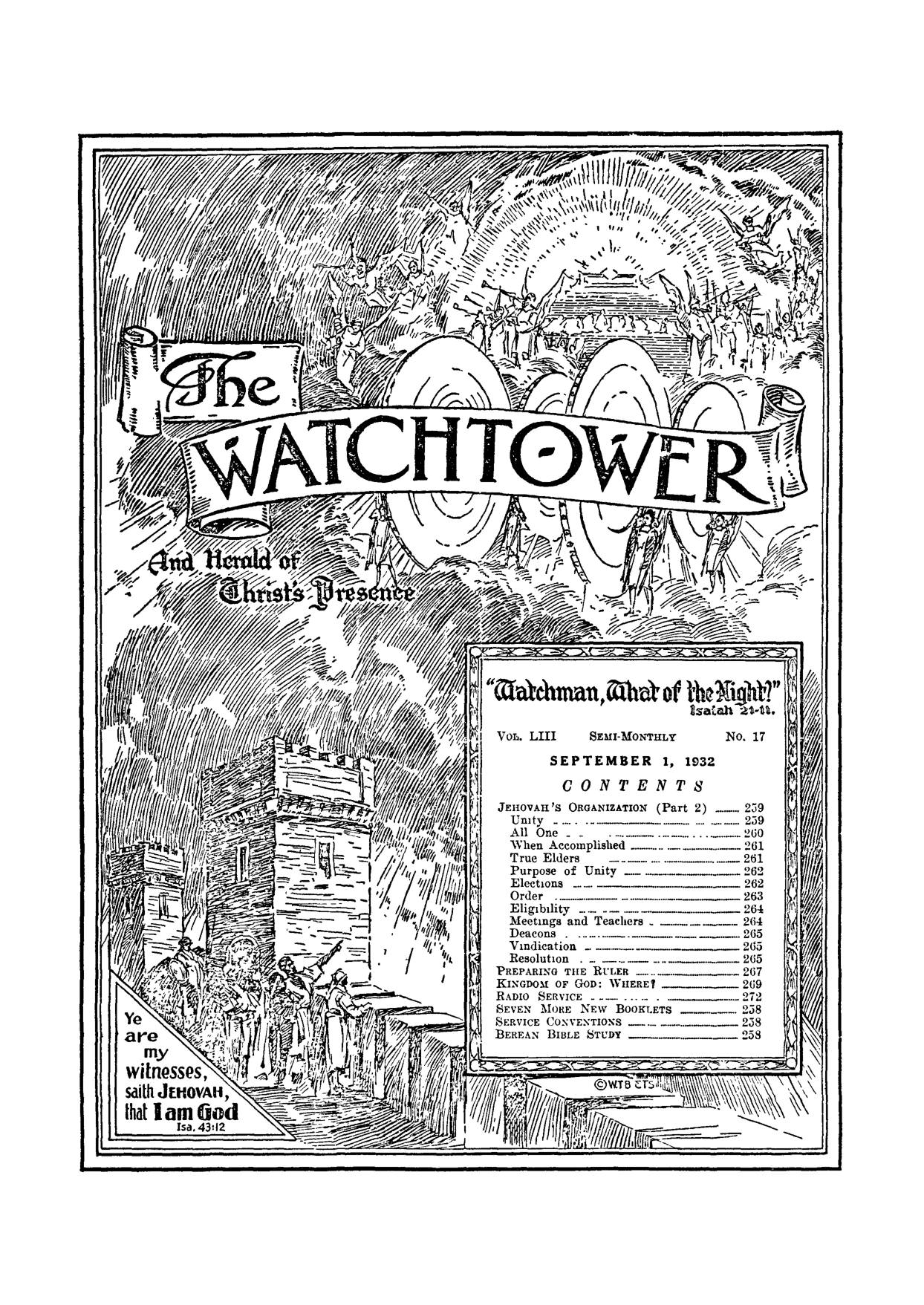
SEVEN MORE NEW BOOKLETS
We are pleased to announce that we now have ready for distribution by Jehovah’s witnesses the remaining seven booklets of the new set of thirteen, mentioned some time ago. The titles of these are: The Final War, What You Need, Health and Life, Home and Happiness, Keys of Heaven, Where are the Dead? and The Kingdom, the Hope of the World.
Green Bay, Wis. Sept. 23-25
Mrs. J. F. Schmidt, 316 Gray St.
Flint, Mich. Sept. 30-Oct. 2
Roy Arnold, 118 E. 9th St.
Attleboro, Mass. Sept. 30-Oct. 2
J. A. Payette, Walnut St.
SERVICE CONVENTIONS
(In each instance, address of company service director is given.)
Detroit, Mich. Sept. 2-5
P. C. Truscott, 4815 Grayton Av.
Glens Falls, N. Y. Sept. 2-5
E. A. Sovereign, 19 Marion Av.
Norfolk, Va. Sept. 2-5
L. R. Bennett, 165 Orleans Circle
Syracuse, N. Y. Sept. 9-11
E. L. Hoffman, 337 Woodbine Av.
Chicago, HI. Sept. 9-11
A. L. Seeley, 6944 Eberhart Av.
Baltimore, Md. Sept. 9-11
C. C. Fisher, 4648 Kernwood Av.
Dubuque, Iowa Sept. 16-18
L. O. Hillyard, 1504 Henion St.
BEREAN BIBLE STUDY by aid of THE WATCHTOWER
“Jehovah’s Executioner’’ (Part 3) Issue of August 1, 1932
Week beginning October 2.............. 1-16
Week beginning October 9.............. 17-33
Week beginning October 16............. 34-49
“Jehovah’s Organization’’ (Part 1) Issue of August 15, 1932
Week beginning October 23............. 1-13
Week beginning October 30............. 14-30
VOL III SEMPTEMBER 1, 1932 NO 17
JEHOVAH’S ORGANIZATION
PART 2
“That they all may he one; as thou, Father, art in me, and I in thee, that they also may be one in us: that the world may believe that thou hast sent me.”—John 17:21.
JEHOVAH’S capital organization when perfected must be in complete unity, that his word and name might be fully vindicated. That means that all of the heavenly creatures and all of those on the earth who are made a part of his organization and continue thus must be in complete oneness. When Satan challenged the word and name of Jehovah the purpose of Jehovah then began to be made known, to wit, that he would bring forth a kingdom or royal house which in due time will destroy the wicked one and his rule, vindicate Jehovah’s word and name, and prove to all creation that he is the only God. Jehovah sent his beloved Son Jesus into the world to bear witness to the truth concerning his purpose, and this Jesus did. The faithfulness of Jesus in bearing testimony to the truth led to his death, and because of his faithfulness Jehovah raised him up out of death and made him the Head of his capital organization.
UNITY
2 After Jehovah had made a covenant with Jesus to give him the kingdom he gave to Jesus twelve disciples whom he specially instructed in things pertaining to the kingdom. To the eleven thereof who proved faithful Jesus said: “And you are they who have continued with me in my trials. And I covenant for you, even as my Father has covenanted for me, a kingdom, that you may eat and drink at my table in my kingdom, and sit on thrones, judging the twelve tribes of Israel.’’ — Luke 22: 28-30, Diag.
3 Those to whom this promise was given, and with whom this covenant was made, must prove faithful and must be brought into complete unity with Christ Jesus and God. To this end Jesus prayed for them. He did not pray that they should be merely given a place of honor, but that they might be made one and in complete unanimity in the organization of Jehovah, even as Jehovah and Jesus are one or in complete unity. He therefore gave Jesus faithful men commissioned as his special ambassadors, and sent them into the world to bear testimony to the truth. “As thou hast sent me into the world, even so have I also sent them into the world.”—John 17:18.
4 Then the prayer of Jesus to Jehovah was made for and in behalf of others who should respond to the invitation to become members of the glorious organization of God. The burden of that prayer was that such might be perfected in union or unity in God’s great organization to the end that all creation might know that Jehovah is God. ‘Nor is it for them alone that I make petition, but also for those who trust in me through their teaching; that they may all be one, even as thou art in me, O Father, and I am in thee; that they also may be in us; that the world may believe that thou didst send me. And the glory which thou hast given me I have given them, that they may be one, just as we are one: I in them and thou in me; that they may stand perfected in union; that the world may come to understand that thou didst send me and hast loved them even as thou hast loved me.’ —John 17: 20-23, Weymouth.
5 The foregoing quotations from the Word of God prove beyond all doubt that the primary purpose of calling, instructing and forming the church is in order that those who are brought into God’s organization may be brought into complete unity with God and Christ and have some part in the vindication of the Word and name of Jehovah. Such was the reason for sending forth the apostles as special ambassadors of Christ, and such is the reason for the existence of other offices in the church while the church is in course of development. The apostle further gives proof of this purpose when he says: “And he [Jesus] himself appointed some to be apostles, some to be prophets, some to be evangelists, some to be pastors and teachers, in order fully to equip his people for the work of serving – for the building up of Christ’s body – till we all of us arrive at oneness in faith and in the knowledge of the Son of God, and at mature manhood and the stature of full-grown men in Christ. So we shall no longer be babes nor shall we resemble mariners tossed on the waves and carried about with every changing wind of doctrine according to men’s cleverness and unscrupulous cunning, [that makes] use of every shifting device to mislead.” (Eph. 4:11-14, Weymouth) This scripture also proves that such unity or oneness of God’s covenant people must be attained unto by the faithful remnant while on the earth that these may stand steadfast in Christ as faithful and true witnesses to God and to his kingdom, fully rooted and grounded in the truth, and together harmoniously give the testimony to the Word and name of Jehovah God. This unity with Christ must be in faith and in the knowledge of God and of his kingdom, and thus these faithful ones are brought to the point of mature manhood in Christ, to the stature of the fullness in Christ.
6 To bring about such unity a work must be done among those who believe on the Lord Jesus Christ. That this work might be accomplished Jesus Christ appointed and sent forth his apostles and also created the offices and prescribed the qualifications of prophets, evangelists, pastors and teachers; but the office of elder he did not provide. This he did not do for the very manifest reason that all who come to the point of unity are elders in truth and in fact within the Scriptural meaning of that term. Such are mature men in Christ, and, to be sure, this maturity could not be advanced in any manner whatsoever by the vote of other persons.
ALL ONE
7 The prayer of Jesus was that all might be made one, or brought to unity. The statement of the apostle is: ‘Till we all attain unto unity.’ This unity of all could not possibly have existed in the day when the apostle was on the earth, for at least two separate and distinct reasons: (1) because not all of the 144,000 had at that time been called; and (2) many of those who had at that time been called to the kingdom were still merely “babes”. The unity spoken of by Jesus and the apostle must be of the faith and of the knowledge of the Son of God. In order for all of the 144,000 to have complete faith all such, including his remnant people on earth, must be brought to a knowledge of the purpose of Jehovah God to complete his capital organization and to vindicate his great name. The apostles had attained unto that full unity in their day because the Lord had revealed to them his purpose and inspired some of them at least to write instructing others. Doubtless some others also reached that stage of unity, such as Timothy and Titus. There was not a unity, however, of all who believed on the Lord Jesus Christ and who were called to the kingdom, and this is shown by the fact that the apostles, especially Paul and Peter, were constantly engaged in setting forth the truth, which is the basis of faith, and in directing the various congregations as to the proper course they must pursue in order to gain the approval of Jehovah. The Apostle Paul could not have expected complete unity in his day, because such a thing was an impossibility. Complete unity could be had only when the entire number of those composing the capital organization of Jehovah God are called, have responded to the call, and are gathered together and begin to function under Christ Jesus the Head of that organization.
UNTIL
8 It is out from the class that is begotten of the spirit and called to the kingdom that the 144,000 must be taken and developed and brought to full and complete unity. These must advance from the stage of babes to mature manhood. To aid the called ones to advance to the state of “a full-grown man, unto the measure of the stature of the fulness of Christ” the Lord Jesus Christ gave certain offices and officers. These offices and the men to fill them are the provision of Jehovah God by his chief agent the Lord Jesus Christ to accomplish his purpose of the unity mentioned by the apostle. Their commission proceeds from Jehovah God. (Isa. 61:1,2) The “twelve apostles of the Lamb” were chosen and appointed and given unto Jesus before the holy spirit was sent as a comforter, guide and helper. (John 15:16; Matt. 10:1-5; Mark 3:13-19; John 17:6, 11; 14: 26) Therefore these offices and officers to the church did not come by the operation of the holy spirit as an advocate and helper. Matthias, who took the place of Judas, was appointed before Pentecost, at which time he received the holy spirit. (Acts 1:23-26; 2:1-4) Even though Paul was converted after the holy spirit had been sent as an advocate he was the direct appointee of the Lord Jesus Christ. (Acts 9:15; 26:16) The apostles were elders by reason of being the first ones and hence the oldest ones in the body of Christ, but were not such by reason of any human appointment or election. While a part of the duty of the apostles was and is the work of “perfecting the saints”, such is not the limitation of their work. Much of the New Testament was written by some of the apostles, and these writings stand as the inspired Word from Jehovah by Christ Jesus. This Word is needful for the instruction of the kingdom class, but is not limited to that class alone. The point here made is that when the 144,000 reach the point of maturity, unity or oneness in Christ, that docs not mean that the offices of the apostles cease, by any means, for the reason they have other duties to perform. The same would be true with regard to the other offices provided for and the appointments made thereto by the Lord. For instance, evangelists are preachers and are commissioned by the Lord to proclaim the message of his truth. The truth must continue to be proclaimed until every creature has an opportunity to receive a knowledge of the truth. (1 Tim. 2:3,4) The word “till” or ‘until’, as used by the apostle in Ephesians four, therefore must mean that the functions of these offices provided for the benefit of the saints must be used for the purpose of bringing all of the body members to maturity, because that is the great objective or announced purpose of the Lord. Whether these offices continue thereafter or cease at that point is not at all material so far as the 144,000 and their complete unity with Christ are concerned. The duties of these offices, however, must be performed or function in behalf of the 144,000 until the state of unity or oneness is reached. There must be no cessation until unity is accomplished.
WHEN ACCOMPLISHED
9 At what time is the state of oneness or unity reached? Manifestly not before the Lord Jesus Christ appears at the temple of God and gathers unto himself the faithful ones that form or make up the members of the “faithful and wise servant” class. Both the Scriptural and the extraneous evidence prove that the Lord Jesus appeared at the temple of God in 1918 and then shortly thereafter gathered unto himself the chosen ones. The Scriptures show that first the Lord awakens out of death those who had died in Christ, which would include the apostles and others who had faithfully served as prophets, evangelists, pastors and teachers, and all of which by virtue of growth had become elders. (1 Thess. 4:16) Then would follow those whom the Lord found faithful and true and to whom he committed all of his kingdom interests on earth and whom he made members of the “faithful and wise servant” class, and which class was foreshadowed or pictured by Mordecai. (Matt. 24: 45, 46) Then would follow those who were subsequently brought into the truth, begotten of the spirit, fully devoting themselves to God and his kingdom, having been called and responded and then been chosen, and who were foreshadowed or pictured by Esther and who are also made members of the “faithful and wise servant” class. All of such, being brought into the temple, receive the garments of salvation, which identifies them as a part of and in Jehovah’s organization; they are anointed and receive the robe of righteousness, which .denotes their approval by the Lord God, and are given a place in his organization, he having set them in the body according to his good pleasure. All these are in unity or oneness in the knowledge of the Lord and in the faith and service to the Lord. This oneness or unity takes place approximately at the time of the second outpouring of the holy spirit. — Joel 2: 28, 29.
10 Peter, in addition to being an apostle by divine appointment, also served in the offices of evangelist, pastor or shepherd, prophet and teacher. At Pentecost he prophesied that “it shall come to pass in the last days, saith God, I will pour out of my spirit upon all flesh: and your sons and your daughters shall prophesy, and your young men shall see visions, and your old men shall dream dreams; and on my servants and on my handmaidens I will pour out, in those days, of my spirit; and they shall prophesy.” (Acts 2:17, 18) This prophecy must apply to the remnant on earth when brought into unity with Christ Jesus. In this prophecy Peter uses the term “old men”, and undoubtedly these words mean and apply to those in the church who were advanced in years and in a knowledge of the Lord but who had used their knowledge largely for self-edification or aggrandizement. They were elders in the church; and as there were unfaithful and faithful elders in Israel, God’s typical organization, so there were and have been unfaithful and faithful elders in the church. This is clearly pointed out in the Scriptures. (Ezek. 8:1-12; 9:5, 6; Heb. 11:1, 2; Ps. 45:16; Ex. 24:1-14) All the faithful ones would recognize that they are privileged to be servants and witnesses of God, and this would be true with reference to both male and female; hence the Apostle Peter as God’s mouthpiece said: ‘‘And on my servants and on my handmaidens I will pour out, in those days, of my spirit; and they shall prophesy.” (Acts 2:18) Those who appreciate the great privilege of being the servants of Jehovah delight in declaring his message of truth, while the selfish ones fail or refuse to do so. It is the faithful class that is brought into unity or oneness with Christ Jesus and made a part of the ‘elect servant’ class. This unity or oneness is reached in the knowledge of the Lord and in faith and devotion to the Lord. This oneness has now been attained unto by all the remnant because these are in the temple, taught of God by the Head of the temple class, and they are all of one mind concerning God’s purpose to completely vindicate his name by and through Christ the Head of his capital organization. These see eye to eye the glorious truths of and concerning Jehovah and his kingdom and have reached that state of mature manhood in Christ described by the apostle.
TRUE ELDERS
11 Who now are truly elders in the organization of Jehovah? The Scriptural answer is, all the faithful ones who are made members of Jehovah’s capital organization, including the remnant now on the earth, who continue faithful for ever. All such are truly elders, not by reason of having received someone’s vote, but because they have advanced and been brought to maturity by being faithful unto God and to his kingdom. They have thus been brought to the fullness of the man in Christ Jesus. They have been brought into a state of unity and maturity. Such is the oneness or unity mentioned by Jesus and by the Apostle Paul in the foregoing scriptures. In further proof of this conclusion the following texts should be considered. Peter was an elder and so declared himself and as one who is “ a partaker of the glory that shall be revealed ’ ’. He admonished the elders in the church, meaning the elder ones in Christ, to feed the flock of God, and then he adds: “And when the chief Shepherd shall appear, ye shall receive a crown of glory that fadeth not away.” — 1 Pet. 5:1-4.
12 Christ Jesus is the Chief Shepherd, and he is now manifested or revealed at the temple of God as Head of Jehovah’s organization. (Heb. 13:20; 1 Pet. 2: 25; Ezek. 34:23; Jer. 23:4, 5) The crown of glory mentioned by the Apostle Peter in the above text means ‘‘a badge of royalty’’ denoting approval by the Lord and recognition as one in his organization. This “crown of glory’’ is not bestowed because one has been elected to an office by the votes of men, but is bestowed upon all the faithful, including the faithful pioneers, whom we sometimes call “colporteurs’’, and all others who are faithful and are made members of the ‘elect servant’. Jehovah says concerning such: “My glory will I not give to another,” but to the ‘elect servant’ class. (Isa. 42:8) To such, including the faithful remnant on earth, the Lord says: “Arise, shine; for thy light is come, and the glory of the Lord [Jehovah] is risen upon thee.”—Isa. 60:1.
13 At Revelation 4:2,4 it is written: “And immediately I was in the spirit: and, behold, a throne was set in heaven, and one sat on the throne. And round about the throne were four and twenty seats: and upon the seats I saw four and twenty elders sitting, clothed in white raiment; and they had on their heads crowns of gold.’’ Note that this scripture speaks of the twenty-four elders; and the number twenty-four’s being twice that of the “apostles of the Lamb” symbolically says: These twenty-four elders represent not only the apostles but picture also all the faithful who are made members of the capital organization of Jehovah. The members as a whole stand for or represent all those who died faithful and who have been resurrected to glory and also the remnant on the earth who have been brought into the temple and who continue faithful unto death. These of the remnant are under the robe of righteousness and in the secret place of the Most High, as described by the scripture; they have received the badge of royalty or crown of glory and are described by the Lord’s Word as those who are “joyful in glory”. (Ps. 149:5-9; Isa. 61:10; Ps. 91:1, 2) This is the class of faithful ones whom the apostle declared should receive the crown of glory or badge of royalty at the appearing of the great Head of Jehovah’s capital organization. In harmony with this it is written: “Thou settest a crown of pure gold on his head” (Ps. 21:3), meaning the entire organization. They receive this crown of glory or badge of honor by virtue of being brought into oneness and made a part of Christ. These faithful ones of the remnant on earth by Jehovah’s gracious provision are ‘ raised up together and made to sit together in heavenly places in Christ’. (Eph. 2:6) This is the vision given to the temple class and is seen and appreciated by none other on the earth. Those who have this vision are all Scripturally designated as elders, and they are elders because they have received Jehovah’s approval and delight to serve him. “The four and twenty elders fall down before him that sat on the throne, and worship him that liveth for ever and ever, and cast their crowns before the throne, saying, Thou art worthy, 0 Lord, to receive glory and honour and power: for thou hast created all things, and for thy pleasure they are and were created. ” (Rev. 4:10,11) It is these elders, including the anointed and faithful remnant on the earth, that see the birth or beginning of the kingdom and learn that it will vindicate Jehovah’s name, and they rejoice, giving praise to God. They are pictured as standing on Mount Zion with the Lord. (Rev. 14:1-3) “And the four and twenty elders, which sat before God on their seats, fell upon their faces, and worshipped God, saying, We give thee thanks, 0 Lord God Almighty, which art, and wast, and art to come; because thou hast taken to thee thy great power, and hast reigned." — Rev. 11:16, 17; see Light, Book One, pages 55-60, 225, 300-305.
PURPOSE OF UNITY
14 What is the purpose of oneness, union or unity, specially emphasized by Jesus and the Apostle Paul? Surely not merely to get someone into heaven. The purpose of such a oneness, union or unity is that all such called ones who are faithful may become members of the ‘elect servant’ and serve Jehovah God. Such is the only proper meaning of the words of Paul, to wit, “for the perfecting of the saints, for the work of the ministry.” (Eph. 4:12) “For the perfecting of the saints, unto the work of ministering.” (R.V.) “In order fully to equip his people for the work of serving.” (Weym.) Anyone who fails or refuses to take an active part in serving God by giving testimony as Jehovah’s witness at this time, or who opposes such service in proclaiming his name and kingdom, of necessity must be excluded from God’s organization. The “perfect [mature] man” is not for the service of men, but for the purpose of serving Jehovah God in the priestly office. That service means to give testimony to the name, to the Word and to the kingdom of God, and it must be given all together and in harmony.
ELECTIONS
15 Companies of the Lord’s people are now propounding the question: Shall we continue to elect men to the office of elder in the congregation or company ? The Scriptural answer to that question is emphatically No, for the reason that the office of elder does not Scripturally exist and no one can be made an elder by the vote of men. What Paul and the other brethren did was to appoint or select out from those brethren who were then elders by reason of their age and advancement in faith and knowledge of the Lord and to designate such men as the servants in the church.
16 Shall the company of God’s people elect bishops or overseers in the church? No; for the reason that the holy spirit, acting as advocate and helper, made certain of the elders overseers, but since the coming of the Lord Jesus to the temple of God the holy spirit as advocate and guide has ceased to function. The Lord Jesus himself is in charge of his organization.
17 What servants may be Scripturally elected in the church new? To answer this question we must have clearly in mind who compose Jehovah’s capital organization and what are the present duties of the members of that organization. Christ Jesus is the head of that organization. He is at his temple to execute the judgments of Jehovah. His present great work and that of the immediate future is the vindication of Jehovah’s Word and name. The holy spirit as an advocate and guide served the church in the absence of Christ Jesus, and now Christ Jesus having appeared at the temple himself, he is in complete charge and, to be sure, all in unity follow his lead. At the temple he is attended by his holy angels. (Matt. 25:31) “Behold, the Lord cometh with ten thousands [number symbolic of all] of his saints [his holy ones, R.V.] to execute judgment upon all.” (Jude 14,15) He is there to execute judgments already written, and for this reason he assigns to all his body members some part in that work. “This honour have all his saints.” (Ps. 149:9) Necessarily this includes the faithful apostles and others who died in faith and who have been raised up to glory. (1 Thess. 4:16) It includes all whom Jesus “received” and “gave” at his ascension and who served and who were subsequently taken away in death, and who are now raised and are now for ever with the Lord in glory. It also necessarily includes the “feet of him”, meaning the faithful members now on the earth.—Isa. 52:7, 8.
18 Who is directing the operations of Jehovah’s capital organization? The Head, Christ Jesus, of course, who is the Chief Officer acting under the direction of Jehovah the Most High, who is over or above all. The Scriptures clearly show that the holy angels are the ambassadors or servants of Christ Jesus to carry out his orders. (See “Angels in Zion” article, The Watchtower, June 1 and 15, 1930; also Revelation 8:6; Light, Book One, pages 105, 106.) There cannot be a question of doubt that Jesus Christ can and does direct every division of his organization and that he ean and does use his holy angels to carry into operation his orders and direct the course of the remnant on earth, regardless of the fact that the remnant cannot see these agents or ambassadors of the Lord and can have no direct or audible communication with them.
19 What are the present duties of Jehovah’s capital organization? Christ Jesus the King is sent forth to rule in the midst of his enemies, and to cause his own people to be gathered together and instructed, and to cause the message of the kingdom to be declared to the prisoners and notice of warning to be given to the rulers and to all the people, particularly of “Christendom”. (Isa. 42:6; Ezek. 3:11; 9:4) In brief, it is the work of giving testimony of and concerning Jehovah’s purpose, the chief purpose being the vindication of his name. Christ Jesus is Jehovah’s Chief Witness, and he declared that “every one that is of the truth heareth my voice”; and his voice at this time specifically commands the giving of the witness, which means that every one of the remnant must be a witness to the name and kingdom of Jehovah God. – John 18:37; Matt. 24:14.
20 The prayer of Jesus was that ‘ all be made one ’, that is to say, be brought to full unity, “that the world may know that thou hast sent me.” (John 17: 23) How could this be accomplished except a witness be given, as Jesus commanded? This is in full harmony with the inspired words of Paul, who wrote that Jesus gave these gifts ‘in order to fully equip his people for the work of service’. Why equip them for service unless they serve? What service must the remnant yet on earth perform ?
21 Jehovah answers that question: “Ye are my witnesses . . . that I am God.” (Isa. 43:10-12) “I have put my words in thy mouth.” (Isa. 51:16) “Go and tell [the] people.” (Isa. 6:9) The remnant being a part of Jehovah’s organization and having been made members of the “faithful and wise servant” class, to whom is committed the earthly interest of the kingdom of God, and hence a part of the ‘elect servant’, the present duty of such is plainly set forth by Jehovah’s prophet in the following texts: Isaiah 42:1, 6, 8. It was in 1922 that Jehovah’s people on the earth began to understand the vision of Isaiah, picturing Christ Jesus at the temple. (Isa. 6:1-8) That corresponded exactly with the outpouring of the holy spirit on all who were then of the faithful class, regardless of sex. (Joel 2: 28, 29) It was in that very year that the service organization of God’s people on earth began to take form and to function, and those who are really in present truth are now fully convinced that the Lord Jesus directed the matter of organization and work by the remnant and that he did so by his angels, or ambassadors. The witness work is the work that is now to be done by the remnant.
ORDER
22 Seeing the work which the remnant must now do on earth, consideration is now given to the question, Is it Scripturally proper to elect any servants in the company of God’s people now on earth? Jehovah is the God of order and not of confusion, and therefore everything in his organization must be done orderly and in order. (1 Cor. 14:33,40) “The steps of a good man [Jehovah’s remnant collectively] are ordered by the Lord.” (Ps. 37:23) The obligation is laid upon the remnant as a whole to give the testimony in the earth as the Lord has commanded. The companies of these are organized in harmony with God’s Word into a body which we call “the Society”. There are many companies of God’s people scattered throughout the earth that go to make up the Society as a whole. It is entirely Scriptural and proper therefore that the Society appoint some brethren in the organization to visit these companies and to help in the organization, and which are designated regional service directors. It is the privilege and duty of each of these companies to have a local service director. As Paul and Timothy and Titus acted with others of the congregation in appointing or selecting servants, so it is entirely Scriptural and proper that each local company should name or nominate certain ones possessing the qualifications to be service director. From among those named the Society headquarters should designate one to be service director, and in this manner both the Society headquarters and the local company act in harmony to accomplish the purpose desired. They are joined together in one body. In this way the work has been organized for service for several years past and the Lord has blessed it by showing his approval. Knowing that the Lord directs his own people, and where the company and those at headquarters are asking the Lord’s direction, we must conclude that the selection is according to the will of the Lord. There is therefore direct and harmonious connection of each company with the Society as a whole.
23 It is entirely orderly and therefore Scriptural that each company have a service committee to act with the service director and in behalf of the company for the purpose of orderly arranging and carrying on the witness work. This committee should be selected by the local company. The committee may consist of such a number as the company may decide upon, according to the size of the company. The company should have a secretary and treasurer, which it also should choose. It would be entirely in order and Scriptural for the company to empower the service committee to attend to the general business or detail affairs of the company and hence to perform such duties as are usually performed by an executive committee. There is no need to have an executive committee where there is a service committee. The company is one if in Christ, and everything should be done harmoniously.
ELIGIBILITY
24 Who is eligible to perform the duties of such office or service in the company? Only those who are of the temple class and who therefore are in full harmony with the service and who are doing what they reasonably can to have a part in that service. This excludes from the eligible class all of those who oppose or who fail or refuse to actively have a part in the service. It is written: “And in his temple doth every one speak of his glory.” (Ps. 29:9) Only those in unity should act in the organization to carry forward the work. Heretofore the companies have elected to the office of elder men who have failed, refused or opposed the witness work, and trouble and discord have resulted. Let the Scriptural way be followed and all such trouble-makers will be excluded.
25 Who may properly and Scripturally vote in the election or selection of such servants in the company ? Only those who are in fact of the company and who are in full harmony with the witness work the company and the Society as a whole are doing in obedience to God’s commandment. The practice heretofore indulged in of bringing in and permitting to vote for servants these who are not at all in sympathy with the service work the Lord has commanded, and who fail, and refuse, to engage in such service work, or who oppose the same, is entirely wrong. Let it be remembered that Jehovah has laid upon his anointed people the obligation of being witnesses now to his Word and to his name and anyone who opposes that work has no place amongst God’s anointed people so far as voting for the election of servants is concerned. Permitting every one who claims consecration to vote, regardless of his position concerning service, has resulted in much trouble and in the election of men who desire selfexaltation and not the Lord’s service. Let this be avoided if we would be faithful to God and to his kingdom.
MEETINGS AND TEACHERS
26 Regular meetings of the company of Jehovah’s people for study or for preparing plans to carry into operation their work are entirely Scriptural and proper, because things must be done orderly. At all such meetings a chairman should preside and keep order. (1 Tim. 5:17) Such chairman or leader should be chosen by the members of the company and, of course, should always be an elder in the meaning of the Scriptures, that is, one who is of the temple class. Would it be proper for a sister to preside as leader of a meeting, seeing that faithful sisters are Scripturally elders? No, for the reason that the woman should not fill this position where there are male members of the company present, the reason being plainly manifest from the language of the scripture. — 1 Tim. 2:12
27 One of the duties laid upon the anointed witnesses of Jehovah is to preach the truth to the ‘‘great multitude” class and to declare God’s truth to the people and rulers of the world. (Isa. 42: 6-8; Matt. 24:14) For this reason a public meeting addressed by one having natural and spiritual endowments to do so is Scripturally proper. The message of the kingdom, by the grace of God, is in printed form, and, since all of the temple class are preachers or witnesses, the house-to-house witness work is preaching the gospel of the kingdom and should be participated in by all as the Lord provides opportunity. “The Lord gave the word; great was the company of those that published it.” (Ps. 68:11) This company is great because going forth in the name and strength of the Lord, and all the members thereof are preachers of the good news of the kingdom and are duly commissioned so to do.— Isa. 61:1,2; 40:9; 52:7, 8.
28 All of the temple class are born of Jehovah’s woman, and all such are taught of Jehovah. (Isa. 54:13) Christ Jesus is the great Teacher under the direct supervision and direction of Jehovah. (Mic. 5: 2,4; Luke 12:37) When the Lord’s anointed people meet for study of his Word, as they should do regularly, is it Scripturally proper that some competent brother be selected to preside and lead the meeting? And is such leader a teacher? It is proper for such to preside and lead the meeting, but he is not a teacher as that term is generally used. The company study together, and Jehovah God through Christ Jesus and his Word teaches them. (Isa. 54:13) All the temple class are anointed, and these do not need any man to teach them. “But the anointing which you received from him abides in you, and you have no need that any one should teach you; but the same anointing teaches you concerning all things, and is true, and is not a lie; and as it taught you, abide in him.” (1 John 2: 27, Diag.) All members of the remnant class should be and are looking out for and helping each other; hence they all study together for the purpose of giving aid, comfort and help to one another. (See The Watchtower, December 15, 1928, page 376, paragraph 32.) As members of the body of Christ, and as under-shepherds or teachers, the remnant as a whole represent Christ Jesus the Chief Shepherd or Teacher in their service to the “great multitude” class. (Ezek. 34:22, 23; Jer. 23:3, 4) It is the duty of the remnant to teach and instruct the “great multitude” as opportunity is afforded. — Isa. 49:9.
DEACONS
29 Should deacons be elected by the various companies to fill places similar to that heretofore filled by those called ‘‘deacons’’? Paul wrote concerning bishops and deacons, describing the qualification of both as being the same. — 1 Tim. 3: 8-12.
30 The Greek word diakoneo at Acts 6:2 is translated serve, and is translated minister at Acts 19:22. The Greek word diakonos does not occur at all in Acts, but does occur at 1 Timothy 3:8 and is there rendered, in the Authorized Version, “deacons.” Strong renders this same word attendant, minister, servant. Seeing that the entire company of God’s people are now engaged in service ministering to each other and to others as required, there seems to be no good reason Scripturally or otherwise to now elect men to office of deacon as that term is generally used. The company by itself or its duly constituted committee may assign certain parts of the service to whomsoever it will. Where there is unity there must be harmony and all will delight to do whatever service is offered. Stephen served tables and also preached the truth with much power. “And Stephen, full of faith and power, did great wonders and miracles among the people. . . . And they [his enemies] were not able to resist the wisdom and the spirit by which he spake.” (Acts 6: 8-10) There is no Scriptural authority for saying that Stephen was a deacon as that office has long been used in the congregations. He never was elected an elder. Manifestly the meaning of the apostle’s words at 1 Timothy 3: 8-13 is that every one serving in the church should possess the qualifications that Paul there mentions. All in the temple being Scripturally elders, and all being willing to serve and participate in whatever service is offered, there appears to be no Scriptural reason for electing men to fill the so-called “office” of deacon.
31 The work now to be done is to bear testimony to the Word and name of Jehovah. All in the temple do this with joy. All are of one body and at unity, and each one performs whatsoever duties of service may be assigned by the Lord and by his remnant company. All are of Jehovah’s organization and go forward to the honor and vindication of his holy name.
VINDICATION
32 Let it be always in the mind of the remnant that the vindication of Jehovah’s name is the great purpose the Scriptures disclose. Christ Jesus came to earth to bear witness to the truth and for that very purpose of vindicating his Father’s name. All of the body members must likewise be witnesses to the truth, and for the same purpose. Jesus emphasized the importance of the vindication of the name of his Father when he said in his prayer: “That the world may know that thou hast sent me.” The world could not know without someone’s telling the people of the world, and Jehovah has sent forth his commissioned ones to tell the people of the world who will hear this great truth. To know that Jehovah sent Jesus to earth to be his witness, and that Christ Jesus was and is the “faithful and true Witness”, is a vindication of Jehovah’s name. Now the organization is in unity. Christ Jesus is at the temple and has gathered unto himself the faithful ones. The unity for which he prayed to Jehovah has been brought about. This harmonious organization is God’s capital organization, the chief work of which is to have part in the vindication of Jehovah’s great name.
RESOLUTION
33 The Watchtower suggests that all companies of Jehovah’s witnesses throughout the earth adopt a resolution similar to the following and proceed according thereto:
This company of Jehovah's witnesses at … … … see that Christ Jesus, the Head of Jehovah’s capital organization, is at the temple of God and that the faithful remnant of God on the earth are Jehovah’s witnesses and are all taught of God and are all commissioned preachers to give testimony to the name and purpose of Jehovah that all the world may know Jehovah is God and know of and concerning his King and kingdom.
Therefore be it resolved that there is no Scriptural authority for the existence of the elective office of elders in the church and that henceforth we will not elect any person to the office of elder; that all of the anointed of God are elders, as that term is defined by the Scriptures, and all are servants of the Most High.
That, to the end that our service may be orderly, we will select certain ones of our company to perform specific service that may be necessary, including the following, to wit: A service director who shall be nominated by us and confirmed by the Society’s executive or manager, and which service director shall be a member of the service committee of this company.
That we will have a service committee of not more than ten members, which members shall be selected from amongst the active service workers of this company, and that the duty of such service committee shall be to systematically arrange and carry forward our service work of giving testimony as Jehovah’s witnesses; that such service committee may assign any member of this company to any particular service as our company may require and such committee shall generally carry on the business affairs of our company, subject always to the approval of the company. Such service committee, aside from the service director, shall be selected by the majority vote of this company of Jehovah’s witnesses who are and who remain in full harmony with the work of bearing witness to Jehovah as he has commanded and which is now being carried forward by the Society. No one shall properly vote in our company except those who are in full harmony with such service work and who engage therein as opportunity is afforded them.
That we will have a chairman of our company, to be selected by a majority vote of the company, which chairman shall preside, keep order, and lead study meetings when the company so desires.
That we will have regular study meetings to be led by brethren who shall be designated by this company, or by the committee heretofore mentioned, and that the majority of the company may from time to time designate competent brethren to address or give discourse to the company, or to a public gathering of people, on Scriptural matters.
That we will have a secretary and treasurer of this company, to be elected by a majority vote of the company and who shall hold office for a period of one year, unless otherwise determined by the company, and who shall perform the duties usually performed by one holding the office of secretary and treasurer.
Recognizing that Jehovah’s witnesses on earth are commanded by him to be his witnesses and that we must give this testimony concerning the kingdom we will, by the grace of Jehovah and the Lord Jesus Christ, all work together in unity and in harmonious service of the Kingdom.
QUESTIONS FOR BEREAN STUDY
1, 2. What is meant by complete unity in Jehovah’s organization’? Why is it necessary? Up to the days of the apostles, what had been done in the development of Jehovah’s capital organization and the vindication of his name?
3, 4. For whom did Jesus pray? What was his petition for them?
5, 6. State and (with scriptures) prove Jehovah’s purpose in calling, instructing and forming the church. Show whether Jesus Christ provided for the “office” of elder, and why.
7. When, only, could this prayer of Jesus, “that they all may be one,” be answered? Why?
8. By whom were the "twelve apostles of the Lamb" chosen and appointed to office? What offices in the church were duly authorized according to the Scriptures? By whom were these provided? For what purpose?
9. When and how would the state of oneness or unity be reached?
10. Explain Peter’s words (Acts 2:17, 18) in application of Joel 2: 28, 29.
11-13. Who now are truly elders in Jehovah’s organization? Why? Apply the expression, “When the chief Shepherd shall appear.” Identify the “four and twenty elders”. What is meant by “Ye shall receive a crown of glory which fadeth not away”?
14. Point out the purpose of this oneness or unity here under consideration.
15, 16. Is it now proper, and why, for the congregations or companies (a) to elect men to the “office” of elder? (b) To elect bishops or overseers in the church?
17-19. What are the present duties of the members of Jehovah’s capital organization? Describe how the operations of that organization, which include the activities of the faithful members now on earth, are directed.
20, 21. In what manner only could ‘all be made one’? Show how the Scriptures provide basis for such conclusion.
22, 23. What is meant by ‘‘the Society’’? Point out the necessity for organization among the companies of God’s people throughout the earth, and how this may be accomplished in harmony with the Scriptures and so as to have direct and harmonious connection of each company with the Society as a whole.
24, 25. Who are eligible to appointment or selection as servants in the company? Who are Scripturally entitled to vote in the election or selection of such servants? Point out the importance of observing such requirements.
26. How should meetings be conducted? What points of qualification must here be considered and observed?
27. How are Matthew 24:14 and Psalm 68:11 having fulfilment at this time? Who are qualified to have part therein? Is such participation optional?
28. How should study meetings be conducted? Explain the nature and purpose of such meetings.
29, 30. Explain whether deacons should be elected. What provision is made for such service as these have hitherto performed? How does the record concerning Stephen serve to instruct God’s people at this time?
31. What, then, is now the privilege and duty of each one of the temple class?
32. What is the great purpose disclosed in the Scriptures? Describe how from the beginning Jehovah’s appointed witnesses have had a part in service to that end.
33. How may all companies of Jehovah’s witnesses throughout the earth now give expression of their unity of purpose and of their conclusion to proceed according to what is now revealed as the Scriptural order of service in the congregations of God’s faithful anointed people?
PREPARING THE RULER
GOD’S purpose in sending Jesus to earth to suffer and die may now be clearly understood. The future rulership of the peoples of all nations by Christ Jesus, as King of kings, is closely connected with the period of shame and ignominy through which Jesus passed while a man upon earth. How?
Seeing that the Logos, the Son of God, was originally a spirit and that his life was thereafter transferred to human, that he became a man, and that he died as a man and was raised from the dead as a spirit, and it being true that he will exercise his power as ruler while a spirit creature, could he have become the Head of the righteous government that God will establish and rule it without ever having come to earth?
Yes, he could have become the invisible ruler without becoming a man; but had he done so his rulership would never have resulted in the complete and full blessing of mankind. Why then did Jesus become a man and why did he die?
The purpose was to ransom or redeem the human race and to make it possible for man to become perfect mentally, morally and physically.
The Scriptures disclose God’s purpose to redeem and deliver mankind through the sacrificial blood of his beloved Son. But that is not his chief purpose.
The primary purpose of God is to decide the great issue to the vindication of his own word and name and for the benefit of creation.
The salvation of mankind, and the salvation of the church and exalting the members thereof to glory, is only secondary to the real primary purpose of God.
To understand the relationship that the death and resurrection of Jesus bear to his rulership enables the student to see some of the wonderful expressions of Jehovah’s loving-kindness toward man. The proper answer to the question as to why Jesus became a man can illuminate the matter. The sending of Jesus to earth as a man by Jehovah, the death and resurrection of Jesus, all were a part of God’s preparatory work for the great government that shall result in the vindication of the name of Jehovah and the eternal blessings of the human race.
Jehovah’s human creature Adam was a perfect man. His willful disobedience to God’s law brought upon him the sentence of death and expulsion from his perfect home in Eden. The perfect man and his perfect wife had no offspring. After man was under the sentence of death and after he had been expelled from Eden he begot and his wife gave birth to their children. Adam and Eve, being under the sentence of death and undergoing that sentence, were, of course, imperfect; and the natural result was that their offspring came into existence as imperfect creatures. These children were born in sin, because anything imperfect cannot keep God’s law perfectly, but will transgress it, and sin is the transgression of God’s law. (1 John 3:4) The recompense or wages of sin is death. (Rom. 6:23) It follows, then, that all of the children of Adam were born sinners. (Rom. 5:12) They were all ‘born in sin and shapen in iniquity’. (Ps. 51: 5) The ultimate destiny of all would therefore be destruction, which is death.
God purposed to redeem or ransom man from death and the grave, and he gave his word that this should be done. (Hos. 13:14) Being absolutely just, God could not reverse his own judgment and forgive man and release him. The infraction of the law which Adam committed demanded a perfect human life. If another perfect man would willingly take Adam’s place in death as Adam’s substitute, and thus meet the demands of the judgment, then God could with consistency release Adam and his offspring from the judgment and its effects. But there was no man who could even redeem himself, because of his own imperfection; and, of course, he could not give himself as a ransom for his brother. “None of them can by any means redeem his brother, nor give to God a ransom for him.’’ — Ps. 49: 7.
The disloyal son of God, Lucifer, now called Satan the Devil, was really the first who started sin in action. God’s purpose is to take away Satan’s lordship over man and institute a righteous government in the place and stead thereof and to give that government to one in full harmony with himself. God loved man and purposed to recover him. The perfect man was his creature; and he would give imperfect man an opportunity to be fully recovered. God would place in the hand of his beloved Son the Logos the government of righteousness that he would proceed to establish for man’s benefit. To the end that mankind might benefit fully therefrom, however, man must first be ransomed or redeemed from death and the grave. By willingly being made a man, and then willingly suffering death that God’s purposes might be carried out, his beloved Son would prove beyond possibility of a doubt that he would be forever loyal and faithful to God and would carry out God’s righteous purpose.
His beloved Son was the great delight of Jehovah. (Prov. 8:30) God is entirely unselfish, which means that God is love. He would deny himself, however, the delight and daily communion with his beloved Son in order that he might recover man and at the same time prepare his beloved Son for the most exalted position of rulership. Therefore God, to carry out his purposes and because of his love for humankind, sent Jesus to earth to die in behalf of the sinful race. “For God so loved the world, that he gave his only begotten Son, that whosoever believeth in him should not perish, but have everlasting life. For God sent not his Son into the world to condemn the world; but that the world through him might be saved.” (John 3:16,17) God would first save the human race from destruction and then establish with man a righteous government, that mankind might he fully restored to the condition of perfection and fully enjoy that perfect government.
When Jesus was thirty years of age he was a perfect man in every respect and fully qualified to become the ransomer of man. At that age he expressed his full desire to do the will of God his Father. Therefore Jehovah entered into a covenant with his beloved Son, which is the ‘covenant by sacrifice’, the carrying out of which would lead to the sacrifice of the man Jesus in order that he might take the place of Adam in death. That covenant was fully performed. Jesus said that he came to earth to give his life a ransom to the end that mankind might live. (Matt. 20:28; John 10:10) The death of the perfect man Jesus therefore provided the exact corresponding price, to wit, a perfect life for a perfect life which Adam had been compelled to give up because of sin.
Jesus became a man that God’s purpose to redeem man might be carried out. He was made a man for the tasting of death, and by giving his life he became a ransom for all. (Heb. 2:9; 1 Tim. 2:3-6) If Adam and his offspring are to profit by the death of the perfect man Jesus, then Jesus as a man must remain dead forever. This is true because the perfect man Jesus became a substitute in death for the perfect man Adam and the benefit thereof results to Adam and his offspring.
But why should Jesus die an ignominious death? Adam was a willful sinner and was driven from Eden because of sin. Whoever would provide the ransom price for Adam must take his place as a sinner and although being holy and without sin must die as a sinner. The manner of the death of the Redeemer was fixed in the penalty imposed upon the willful sinners of the Jewish nation. It was written in the Jewish law: “Cursed is every one that hangeth on a tree.” (Deut. 21: 23) The death of Jesus upon the tree removed that curse from the Jews. Jesus was holy, harmless and without sin, and indeed he must be in order to provide the ransom price; yet he must take the place of the sinner in death, and to that end he must die as a transgressor. Concerning him it is written: “But he was wounded for our transgressions, he was bruised for our iniquities: the chastisement of our peace was upon him; and with his stripes we are healed. ... He hath poured out his soul unto death: and he was numbered with the transgressors; and he bare the sin of many.” (Isa. 53:5, 12) The value of the life of the perfect man Jesus poured out in death as a sinner must be presented in Jehovah’s court to constitute an atonement for sin, or a sin-offering, on behalf of man.
Why did God raise Jesus out of death a spirit?
In the first place, because he was loyal and faithful even unto death (Phil. 2:5-11); and secondly, in order that Jesus might have access to heaven and there present the value of his human sacrifice as a sin-offering to make atonement for the sins of man; and thirdly, that he might in God’s due time assume the high office of Ruler or Governor over all the nations of earth, and of Vindicator of Jehovah’s name.
Jesus the beloved Son had been put to the test; he had been tempted by the Devil and proved faithful; he had been persecuted and had remained loyal to God; he had been unjustly accused and condemned to an ignominious death; and amidst all he had been absolutely loyal and faithful to his Father. He went to the death of ignominy with not even an unfaithful thought. God rewarded his faithfulness and thereby for ever established the rule that God will reward those who love him and who are faithful to him.— Ps. 31:23.
Had Jesus been raised out of death as a man the ransom price would have been of no value. If not raised at all, God would need to appoint someone else to present the value of the sacrifice in heaven as a sin-offering. To Jesus was granted that honor and therefore he entered heaven itself, there to appear in the presence of God on behalf of those who believe. There he appeared to put away sin by the sacrifice of himself. — Heb. 9:24, 26 *
God appointed his beloved Son Jesus to be Ruler of his coming righteous government. Had Jesus remained dead for ever he could never have filled that office. God raised him up as the great Prince or Ruler, that in due time he might carry out his purpose of establishing his righteous government. When he raised him up God committed into the hand of his beloved Son all power in heaven and in earth and clothed him with immortality, that he can never die; and gave to him the keys of death and hell, which means the power in due time to abolish death and the grave and to fully set man free.—Matt. 28:18; Rev. 1:18.
When Jesus was raised from the dead and ascended into heaven, if he was then King why did he not at once establish the government of righteousness and begin his reign? Because it was not then God’s due time. When he ascended on high he was commanded by Jehovah to wait: “The Lord said unto my Lord, Sit thou at my right hand, until I make thine enemies thy footstool.” (Ps. 110:1) In corroboration thereof Paul wrote: “But this man, after he had offered one sacrifice for sins for ever, sat down on the right hand of God; from henceforth expecting till his enemies be made his footstool.” — Heb. 10:12, 13.
The preparation for the establishment of God's righteous government was not yet complete. In the meantime Satan would continue to be the invisible ruler oppressing the people. At the same time some men under adverse conditions could avail themselves of the opportunity to prove their love and devotion to God and thereby maintain their integrity. During that further period of preparation for the establishment of God's righteous government Jesus must wait and not begin his operations against Satan to oust him from his rulership. In his own good time God would put the enemy Satan under Jesus’ feet. In that work his beloved Son, as Priest and King, would act as his Chief Officer. But the Son would take no action against Satan to destroy his rule until God should direct him so to do. Until that due time God through Christ would be selecting from amongst men those who would manifest a desire to follow in the footsteps of Jesus and who under the test would prove their love and loyalty and faithfulness unto God. It is written that there must ‘be taken out from amongst men a people for his name’ and that this must be done before the establishment of the righteous government and the beginning of the reign of the great King whom David foreshadowed.—Amos 9:11; Acts 15: 14-17.
* Full discussion of the philosophy of the ransom and sin-offering will be found in the book Creation, chapter VII.
KINGDOM OF GOD: WHERE?
AMONG the common misapprehensions concerning the kingdom of God is the idea that this kingdom was set up by Jesus in the hearts of men. The text of Scripture, ‘‘The kingdom of God is within you,” is quoted as proof by those who advocate this theory.
Is the righteous government over which Jesus Christ the Anointed will preside to be in heaven or in earth? Will that government be visible to man, or will man feel and see the good effects thereof ?
Christ, upon whose shoulder the government shall rest, is a spirit. He now is and ever will be invisible to man. The government will be for the benefit of man; and therefore its operations, by and through the official representatives of Christ, will be visible to man. It will not be the privilege of man to behold with the human eyes the glorious Ruler; but men will see the representatives of that heavenly government on earth and will observe the righteous operation of that government. Men will know the effects of that government and will be blessed under it. The words kingdom and government mean the same thing. Jesus taught his disciples to pray to God: ‘‘Thy kingdom come. Thy will be done in earth, as it is in heaven.” (Matt. 6:10) The governing power will be in heaven, where God’s will shall be done; and the operation of the government shall be on earth, where the will of God will likewise be done. The government must be a reality which will fully and completely establish righteousness among men.
…