The Watchtower, April 15, 1932
Download: PDF — The Watchtower, April 15, 1932
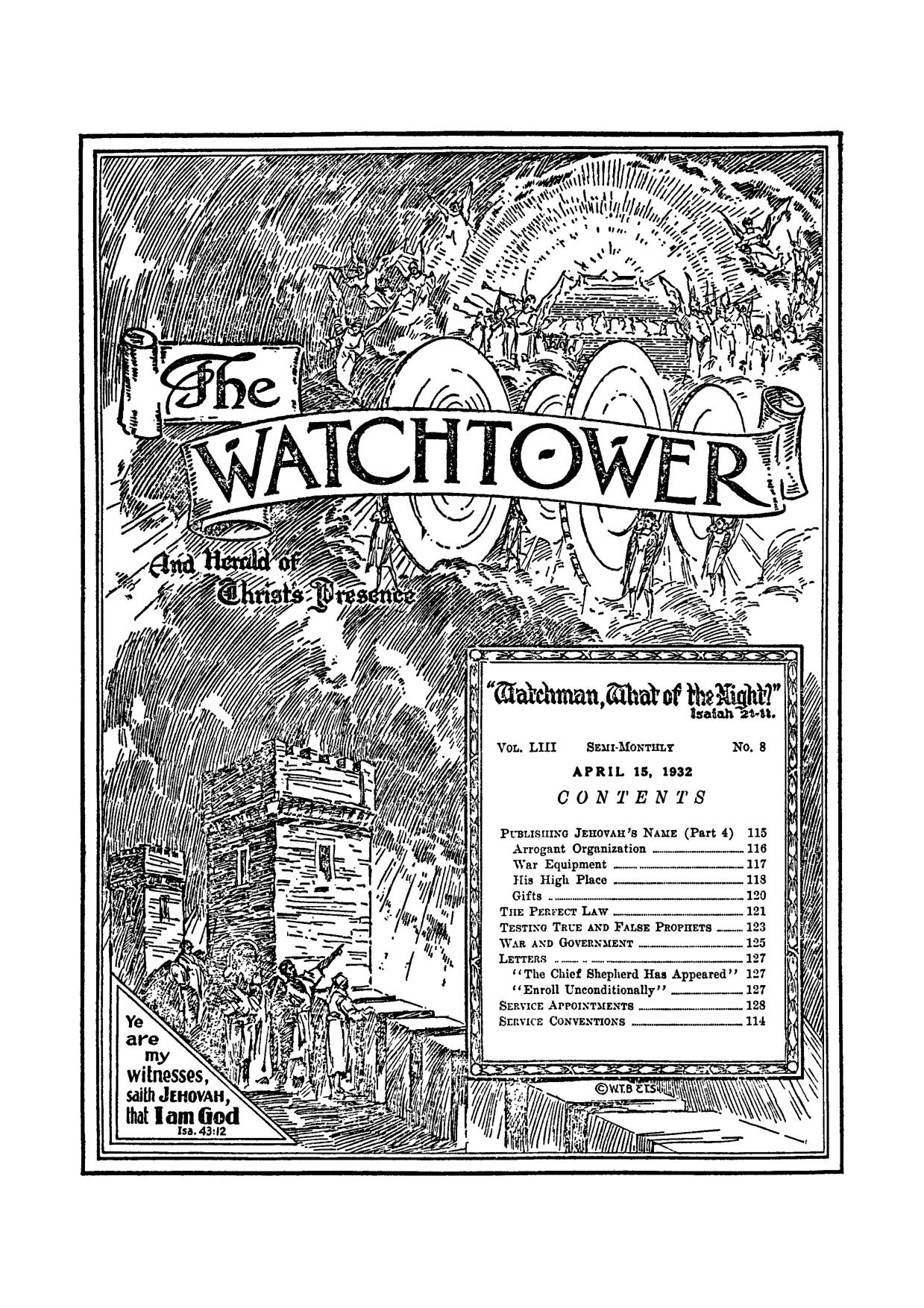
Vol. LIII
April 15, 1932
NO. 8
PUBLISHING JEHOVAH’S NAME
PART 4
“The chariots of God are twenty thousand, even thousands of angels: the Lord is among them, as in Sinai, in the holy place.”—Ps. 68:17.
JEHOVAH causes his faithful witnesses on earth to make publication of his name. This they do in a small way, to be sure. Many are given an opportunity to know that Jehovah is God. The Scriptures show that then follows the manifestation of Jehovah’s unlimited strength and power, by which he will compel all to know that he is the Supreme One; and therefore he says: “And they shall know that I am the Lord, and that I have not said in vain that I would do this evil unto them.” (Ezek. 6: 10) More than sixty times Jehovah causes his prophet Ezekiel to use an expression like to this text just quoted. All creation must know that Satan has reached his limit and now must go down. For the honor of his name and the good of all creation Jehovah will now teach all the reason why he has permitted wickedness to have a free hand in the earth and why the wicked must now be destroyed. The wicked one has builded up a powerful organization which no human agency could possibly destroy; but now the Lord God comes forward with war equipment which knows no defeat, and marches on to battle. The little earthly division of the Lord’s army is called “the remnant”, and each one therein is thrilled with the opportunity to have some part in the vindication of Jehovah’s great name. The Song of praise to Jehovah’s name rings out clear and plain. There is no compromise so far as the remnant is concerned. Jehovah God has given them his Word or message, and they must and will sing it forth. They do not fear man or devil, because each one of the remnant can now say, and each one does say: “Behold, God is my salvation; I will trust, and not be afraid; for the Lord JEHOVAH is my strength and my song; he also is become my salvation.”—Isa. 12: 2.
2 Returning now to the examination of the sixty-eighth Psalm, where in the former issue we left off, note verse fourteen says: “When the Almighty scattered kings in it, it was white as snow in Salmon.” While the Authorized Version appears to be in the past tense, verse one of the Psalm, and other scriptures, show that it has reference to the future. Another translator renders the text in this manner: “When the Almighty scattered kings therein, it was as when it snoweth in Zalmon.” This further shows that the text refers to the fact, and particularly to the time, of “the battle of that great day of God Almighty”. Illustrations of what shall then and there take place were given by the Lord when he scattered kings at battles fought for his covenant people on other occasions. (Josh. 10: 10-14; 2 Sam. 5: 17-25) It seems definitely certain that the text here under consideration refers to “the battle of that great day of God Almighty” and what shall come to pass there.
3 It is in a time of snow, or that which comes to pass is pictured by the white snow. Whether the climax of the battle will occur in the wintertime is not clear now, so far as is revealed, nor is that a very material point. Jesus referred to the wintertime or time of snow, advising those who will to flee before that time comes upon them. It is recorded that Benaiah, a valiant man of David’s organization, “slew two lionlike men of Moab: he went down also and slew a lion in the midst of a pit in [the] time of snow.” (2 Sam. 23: 20) This seems to have reference to the Devil and his lion-like organization that shall be destroyed.
4 Snow in the text, however, seems to be used as an illustration. ‘ ‘ It was as when it snoweth in Zalmon. ’ ’ (R.V.) The word rendered “Salmon” or “Zalmon” in this text means “shady”. When the white snow has fallen upon it, that shady color would change and have the appearance of white as wool is white. “He giveth snow like wool.” (Ps. 147: 16) “God thundereth marvellously with his voice; great things doeth he, which we cannot comprehend. For he saith to the snow, Be thou on the earth; likewise to the small rain, and to the great rain of his strength.” (Job 37: 5, 6) Salmon or Zalmon is derived from the Hebrew word meaning phantom, illusion or resemblance; hence is used as a figure of speech and is also translated image, vain show. The word Salmon therefore well illustrates or pictures the Devil’s organization, particularly the earthly part thereof. That organization is certainly a shady one; and it “hateth the light, neither cometh to the light”, but ‘loves darkness rather than light, because their deeds are evil’. Thus speaks the scripture concerning those who form Satan’s organization. Nothing could more aptly illustrate the official part of Satan’s organization, which has recently been served by Jehovah’s witnesses with his message of truth telling them of Jehovah and his kingdom and which they, and particularly the clergy, have hated. Jehovah has turned the searchlight of truth on this shady organization and now begins to show it up; and therefore it appears to be “leprous as snow”. (Ex. 4: 6) “The leprosy therefore of Naaman shall cleave unto thee, and unto thy seed for ever. And he went out from his presence a leper as white as snow. ” (2 Ki. 5: 27) Jehovah has sent forth his witnesses to serve notice and warning upon Satan’s organization, and these witnesses have served the notice and warning upon that wicked and shady organization; and this is likened unto cold and wintry snow falling upon the organization and giving it the appearance of snow. To produce this effect would be an act of God; and the illustration of snow shows that God’s wintertime of disapproval, and his judgment of condemnation, has come upon the enemy organization.—Matt. 24: 20.
5 In the margin of the Rotherham translation of this text appears this note: “The point of the comparison lies either in the booty being abundant as snowflakes and in brilliancy like the dazzling snow, or in the white, pale corpses. ’ ’ Doubtless the latter part of this sentence states the proper conclusion. Another authority says of the phrase ‘ ‘ white as snow ’ ’, that it means “to be snow-white (as with the linen clothing of the slain)”. Referring to the great battle of the “day of God Almighty” the prophet wrote: “He shall judge among the nations, he shall fill the places with dead bodies; he shall strike through the head in many countries.” (Ps. 110: 6, R.V.) And concerning this time it is written: “And the shepherds shall have no way to flee, nor the principal of the flock to escape. ’ ’ —Jer. 25: 35.
6 Some who claim to be devoted to God and to his kingdom still insist that these texts concerning the slaying that shall take place in the earth are entirely symbolic. Probably their selfish desire to live in ease and see no destruction is the father of such conclusion. It will be safer to accept God’s Word rather than the opinion of man. When Jesus refers to the time of trouble as the greatest “tribulation, such as was not since the beginning of the world . . . And except those days should be shortened, there should no flesh be saved”, then we may be absolutely certain that the battle of the great day of God Almighty, and the result, will be much more than merely symbolic. It will be real, and it is certain to fall upon Satan’s organization as soon as the witness work is completed. The kingdom is here, Jehovah’s witnesses are commanded to act promptly in announcing what shall speedily come to pass, and the faithful ones are thus doing. When the Almighty by his Chief Executive Officer strikes the ruling powers of Satan, that shady organization will look like snow, because death will be the result. That will be a cause for the heavens to greatly rejoice, and rejoicing will follow.
ARROGANT ORGANIZATION
7 “The hill of God is as the hill of Bashan: an high hill as the hill of Bashan.” (68: 15) The rendering by the Authorized Version of this verse does not convey the proper meaning, as will appear from what follows. Bashan is that country lying cast of the upper Jordan river. In Abraham’s day it was peopled by the Rephaims, a tribe of giants. (Gen. 14: 5; Deut. 3: 11) The king of Bashan and his army fought against God’s covenant people, and the Lord delivered them into the hands of Moses; and God then said unto Moses concerning the king of Bashan and his army: “Fear him not: for I have delivered him into thy hand, and all his people, and his land; and thou shalt do to him as thou didst unto Sihon king of the Amo- rites, which dwelt at Heshbon. So they smote him, and his sons, and all his people, until there was none left him alive: and they possessed his land.” (Num. 21: 34, 35) This shows that the land of Bashan represented God’s enemies. Bashan was a great grazing country and noted for its many cattle and sheep, and especially strong bulls. “Many bulls have compassed me: strong bulls of Bashan have beset me round.” (Ps. 22:12) In the mountains of Bashan were many walled towns built of basalt and with basaltic doors. “All these cities were fenced with high walls, gates, and bars; beside unwalled towns a great many.” (Deut. 3: 5) Many of these the Israelites destroyed. Its mountain or hill country was a mighty and strong country. Its rule was oppressive and cruel, further bespeaking the characteristics of the Devil’s organization: “Hear this word, ye kine of Bashan, that are in the mountain of Samaria, which oppress the poor, which crush the needy, which say to their masters, Bring, and let us drink.” (Amos 4:1) “And of Dan he said, Dan is a lion’s whelp; he shall leap from Bashan.” (Deut. 33: 22) It was also noted for its great trees. It was a shepherd country having many shepherds and herders of cattle, and was the pride of the upper Jordan. “Howl, fir tree; for the cedar is fallen; because the mighty are spoiled; howl, O ye oaks of Bashan; for the forest of the vintage is come down. There is a voice of the howling of the shepherds ; for their glory is spoiled; a voice of the roaring of young lions; for the pride of Jordan is spoiled.” (Zech. 11: 2, 3) These texts strictly prove that Jehovah God, in the language of the psalmist, was not comparing his hill with that of Bashan. All the supporting scriptures show that Bashan pictured Satan’s organization. The words of the Authorized Version, “the hill of God,” literally mean “the hill of gods [elohim] ”, and “gods” is the same as the word appearing in Psalm 82: 1, 6: “God standeth in the congregation of the mighty; he judgeth among the gods. I have said, Ye are gods; and all of you are children of the Most High. ’ ’
8 Satan’s organization is pictured as an organization of mighty ones or gods, tall, arrogant, overbearing, among whom are many prominent ones, and these are pictured by the peaks or hills of the mountain country of Bashan. The rendering of the text by Rotheram, therefore, seems to be the correct one: “A mountain of might is the mountain of Bashan, a mountain of peaks is the mountain of Bashan.”—Verse 15.
9 The organization of Satan, and particularly the prominent earthly members thereof, prance and leap about like an unruly studhorse, and arrogantly attempt to make a show in order to impress the common herd of their own greatness and importance. Satan's entire earthly organization is austere, severe, boastful, arrogant, harsh and oppressive. Addressing such God says, by the sixteenth verse of the Psalm: ‘‘Why leap ye, ye high hills? this is the hill which God desireth to dwell in; yea, the Lord will dwell in it for ever. ’ ’ The Revised Version of this text reads: ‘‘Why look ye askance, ye high mountains, at the mountain which God hath desired for his abode? Yea, the Lord will dwell in it for ever.” According to Rotherham the text is rendered: “Why steal ye envious glances, ye mountains, ye peaks, at the mountain which God hath coveted for his seat? Surely Jehovah will dwell [there] evermore!” These latter renderings of the text are entirely in harmony with the other part of the Psalm and other supporting scriptures.
10 Satan’s earthly organization not only deports itself in an arrogant manner, but looks with envy and hatred upon Jehovah’s organization and those on earth who represent his great organization. The words of the psalmist here are therefore addressed to Satan’s organization which in these latter days has molded “the image of jealousy” in the League of Nations, claiming it to be just as good as a substitute for the kingdom of Jehovah God, or better. (Ezek. 8: 3-5) (See Vindication, Book One, page 79.) At the present day Jehovah has appeared at his temple on Mount Zion and has rejected Satan’s organization, including particularly the religious element thereof, and has caused antitypical Bashan to become very mad, envious and jealous. Therefore, as the Psalm declares, Satan’s organization looks askance, and with envious glances, at God’s organization. Especially the clergy look at God’s witnesses who are part of his organization, and speak with hatred and ill will concerning them and loudly proclaim that God’s kingdom on earth is represented by the clergy, which, in fact, are of Satan’s organization. The psalmist, according to the text, then informs Satan’s organization that Jehovah has chosen Mount Zion for his kingdom, and the kingdom of his Christ, as his official seat and dwelling place; and that there he will abide forevermore; and that Satan’s organization must now suffer everlasting defeat. “For the Lord hath chosen Zion: he hath desired it for his habitation. This is my rest for ever: here will I dwell; for I have desired it.”—Ps. 132: 13, 14.
11 In the division of the land of Canaan Bashan was assigned to the tribe of Manasseh, which represented Joseph. Instead of selecting the mount of Bashan God selected Mount Zion for his dwelling place. In support of this, note Psalm 78: 67, 68: “Moreover, he refused the tabernacle of Joseph, and chose not the tribe of Ephraim; but chose the tribe of Judah, the mount Zion, which he loved.”
12 A part of God's Word or message which he has given to his earthly witnesses to proclaim is that message of verse sixteen of the psalm, above quoted. These faithful witnesses of Jehovah are now engaged in the publication of the name of Jehovah and of his kingdom; and they go throughout the land, declaring this unto the people, that Christendom, foreshadowed by Bashan, is not God’s choice for his kingdom or dwelling place, because Christendom has been rejected; that neither has God chosen the League of Nations as the ‘political expression of his kingdom on earth’, as the clergy of Christendom have falsely said, but that Jehovah God has chosen from out of his universal organization (which is pictured by Mount Zion) The Christ; and that Christ, God’s chosen One, is therefore earth's rightful Ruler. This is a part of the message that must now be delivered, and this cannot be delivered and one at the same time remain silent as to, and fail and refuse to expose, Satan’s organization.
13 The publication of Jehovah’s name and his kingdom necessarily exposes the false and fraudulent organization of Satan. Jehovah will now have the people to know the truth, which is that he is the supreme God, and that his kingdom is the hope of the world, and this information is given to the common people to the end that they may have the opportunity to flee from Satan’s organization, which will be destroyed, and to take their stand on the side of Jehovah God and receive that which he has prepared for those that love him. The people are now being given this information by Jehovah’s witnesses who go about making publication of his name and of his kingdom.
WAR EQUIPMENT
14 Chariots are symbols of war and suggest that the day of God’s wrath and the execution of his judgment against the enemy has come. Therefore the psalmist says: “The chariots of God are twenty thousand, even thousands of angels: the Lord is among them, as in Sinai, in the holy place.” (Vs. 17) In the margin of this text the statement is that the chariots are “many thousands”. The Revised Version reads: “The chariots of God are twenty thousand, even thousands upon thousands.” According to Rotherham: “The chariots of God are in myriads, thousands on thousands. ’ ’ That chariots in the Scriptures are used to symbolize war equipment, and the preparation for war as well as war itself, note the following: “[Pharaoh] took six hundred chosen chariots.” (Ex. 14: 7) “ [Jabin king of Canaan] had nine hundred chariots of iron.” (Judg. 4: 3) On one occasion the Philistines gathered thirty thousand chariots to tight against Israel. (1 Sam. 13: 5) The Ammonites had once hired thirty- two thousand chariots with which to fight against David and his army. (1 Chron. 19: 7) The enemy sent horses and chariots against Dothan, where Elisha was, and concerning which it is written: “And Elisha prayed, and said, Lord, I pray thee, open his eyes, that he may see. And the Lord opened the eyes of the young man; and he saw: and, behold, the mountain was full of horses and chariots of fire round about Elisha.” (2 Ki. 6: 17) Doubtless a host of angels were there also. Referring to the Lord at Armageddon it is written: “Who layeth the beams of his chambers in the waters; who maketh the clouds his chariot: who walketh upon the wings of the wind.” (Ps. 104: 3) “For, behold, the Lord will come with fire, and with his chariots like a whirlwind, to render his anger with fury, and his rebuke with flames of fire. For by fire and by his sword will the Lord plead with all flesh; and the slain of the Lord shall be many.” (Isa. 66: 15, 16) These texts and others prove that the fight at Armageddon will not be merely a symbolic affair, because Jehovah announces his purpose to clean Satan’s organization off the earth. Let “Bashan”, and those who would put on the soft pedal concerning that wicked organization of the Devil, beware. The invisible army of the Lord is marching on to victory. Knowing in advance that this victory is certain is a source of great courage and strength to his remnant and another cause for them to continue to sing.
15 The entire seventeenth verse of the Psalm, according to Rotherham, is: “The chariots of God are in myriads, thousands on thousands, the Sovereign Lord hath come from Sinai into the sanctuary.” The sanctuary of the Lord is on Mount Zion. At Sinai God wrought wonderful things. He will do much more at Zion. The proof is conclusive that the fearful and wonderful manifestation of divine power on Sinai was typical, and this proof is set forth in Hebrews 12: 1829. The real thing will be far greater than the type. Zion is the real thing, and the world’s greatest tribulation follows the coming of the Lord to his temple on Mount Zion. The psalmist here is saying that Jehovah moves from the typical manifestation of his presence and power on Mount Sinai down centuries in time to the real or antitypical manifestation of his presence and power on Mount Zion. He has placed his King upon his holy hill of Zion, and has laid the Chief Corner Stone in Zion. (Ps. 2: 6) It is time, therefore, for the execution of his judgment: “Therefore thus saith the Lord God, Behold, I lay in Zion for a foundation a stone, a tried stone, a precious corner stone, a sure foundation: he that believeth shall not make haste. Judgment also will I lay to the line, and righteousness to the plummet; and the hail shall sweep away the refuge of lies, and the waters shall overflow the hiding place. For the Lord shall rise up as in mount Perazim, he shall be wroth as in the valley of Gibeon, that he may do his work, his strange work; and bring to pass his act, his strange act.”—Isa. 28: 16, 17, 21.
16 At Mount Sinai Jehovah inaugurated the law covenant which was typical. The antitype is the inauguration of the new covenant, which takes place at Mount Zion and which is performed by the Lord “in the holy place”, the sanctuary or temple. As in the type, so it must be in the antitype. At the inauguration of the law covenant God stood on Mount Sinai and performed his wonderful and terrible acts. ‘ ‘ And so terrible was the sight, that Moses said, I exceedingly fear and quake.” (Heb. 12: 21) This shows that the great battle of Armageddon precedes the inauguration of the new covenant; therefore Jehovah marches to war with his “thousands upon thousands” of chariots of war. “The Lord also shall roar out of Zion, and utter his voice from Jerusalem; and the heavens and the earth shall shake; but the Lord will be the hope of his people, and the strength of the children of Israel. So shall ye know that I am the Lord [Jehovah].” (Joel 3: 16, 17) Let the nations and the people take warning now, for the Word of the Lord God is clear and plain and by it he gives notice and warning of what must speedily come to pass upon Satan’s organization. His faithful witnesses will be of good courage, full of faith, and, moved by an unselfish devotion to him, will continue to give publication to the name and to the kingdom of the Most High.
HIS HIGH PLACE
17 The greatest event in time, so far as God’s Word reveals to his people, will be the complete vindication of Jehovah’s name. That will be his high place in the mind and heart of all creation. He has always been the Most High, and ever will be, but this fact is not yet known by many peoples of earth. They must come to know that he is supreme, and then to such he will be in his high and rightful place.
18 The psalmist says: “Thou hast ascended on high, thou hast led captivity captive: thou hast received gifts for men; yea, for the rebellious also, that the Lord God might dwell among them.” (Vs. 18) The first and typical application of this prophecy was doubtless at the time when the ark of the covenant was carried to the top of Mount Zion and placed there in the tent prepared for it, thus showing the presence of Jehovah God on Mount Zion. (1 Chron. 15: 25) The first prophetic fulfilment of that poetical prophecy was when Jesus ascended from the earth to heaven and took his position at the right hand of the Most High. (Luke 24: 51; Acts 1: 9-11; Isa. 57: 15) Jehovah, being for ever the Most High, could not ascend higher than he is. The prophecy was fulfilled, therefore, when Christ Jesus, who is the express image of his Father and the chief representative of the Almighty, ascended on high; as stated, to wit: “Wherefore he saith, When he ascended up on high, he led captivity captive, and gave gifts unto men. (Now that he ascended, what is it but that he also descended first into the lower parts of the earth? He that descended is the same also that ascended up far above all heavens, that he might fill all things.)’’ (Eph. 4: 8-10) That, however, was not the complete fulfilment of the prophecy. Note the following texts:
19 ‘ ‘ God is gone up with a shout, the Lord with the sound of a trumpet.” (Ps. 47: 5) “Who hath ascended up into heaven, or descended? who hath gathered the wind in his fists? who hath bound the waters in a garment? who hath established all the ends of the earth? what is his name, and what is his son’s name, if thou canst tell?” (Prov. 30: 4) “And saviours shall come up on mount Zion to judge the mount of Esau; and the kingdom shall be the Lord’s. ’ ’ (Obad. 21) These scriptures and others support the conclusion that when Jesus ascended to the right hand of his Father he had not ascended to the highest point, and therefore his ascent was not then complete. His highest place is the active official work of vindicating Jehovah’s name. That is the greatest thing to be accomplished, and Jesus must sit down and wait until that time arrived, as the Scriptures plainly state. —Ps. 110: 1, 2; Heb. 10: 12, 13.
20 The laying of the chief foundation Stone in Zion in completion was a work still future from that time. It must be laid in completeness on the “height of mount Zion”, or holy hill of Zion. (See Jeremiah 31: 12.) The chief corner Stone, rejected by both houses of Israel, must be lifted up and become ‘ ‘ the Head of the corner”. (Ps. 118: 22) “The man-child” must be brought forth by God’s woman Zion and be caught up (ascend) unto God and to his throne. (Rev. 12: 5) This exactly agrees with the prophecy of the Lord by Ezekiel (17:22, 23). (See Vindication, Book One, page 232.) Satan coveted to ascend on high and was forced to descend to the earth from which Jesus Christ had ascended after his resurrection ; and now nineteen centuries thereafter Jesus Christ ascends to his highest place, and the name of his Father he will now vindicate. This he will do in the great victory that he will gain at the battle of Armageddon.
21 The eighteenth verse of the Psalm, according to the Rotherham, reads: “Thou hast ascended on high, hast captured a body of captives, hast accepted gifts consisting of men, yea even the stubborn; that thou mayest dwell [there], O Yah Elohim!” Captives are led in a procession. (1 Ki. 8:48) Such was the order with God’s typical people. At the time that Jesus ascended into heaven, was this prophecy in any wise fulfilled? The war for the vindication of Jehovah’s name not being due, and not even begun, could it be that Jesus had at that time “captured a body of captives”, according to the above translation? The time is now at hand for the war that will vindicate Jehovah’s name, and (concerning the fulfilment of the prophecy) he will now capture a body of captives; as it is written: “He that leadeth into captivity shall go into captivity; he that killeth with the sword must be killed with the sword.” (Rev. 13: 10) The prophecy, therefore, shows Christ Jesus, Jehovah’s great executive officer, taking captive Satan and his cohorts at the battle of Armageddon. “And the beast was taken, and with him the false prophet that wrought miracles before him, with which he deceived them that had received the mark of the beast, and them that worshipped his image. These both were cast alive into a lake of fire burning with brimstone.” (Rev. 19:20) Then follows the captivity of Satan himself: “And he laid hold on the dragon, that old serpent, which is the Devil, and Satan, and bound him a thousand years. ’ ’ —Rev. 20: 2.
22 Those captured or taken prisoners at Armageddon will not be preserved as such, alive in a prison house, but will be put to death and thus held captive in death until the end of the thousand-year reign of Christ. Doubtless the cohorts of Satan, and Satan himself before death at Armageddon, will come to a full realization that they are “all done up” and that the fight must put an end to the operations of Satan and his organization, who for centuries has been unhindered and unrestrained in his defiance of Jehovah God. Satan will be led in a procession of captives taken by Christ Jesus, and all the universe will see his shame and degradation. (Isa. 20:4) Jehovah’s judgment against Satan long ago uttered declares: “Yet thou shalt be brought down to hell, to the sides of the pit. They that see thee shall narrowly look upon thee, and consider thee, saying, Is this the man that made the earth to tremble, that did shake kingdoms: that made the world as a wilderness, and destroyed the cities thereof; that opened not the house of his prisoners ? ’ ’ —Isa. 14: 15-17.
23 As to the high ones of earth who exalt themselves and other creatures in support of Satan, and in defiance of Jehovah God, it is written: “And it shall come to pass in that day, that the Lord shall punish the host of the high ones that are on high, and the kings of the earth upon the earth. And they shall be gathered together as prisoners are gathered in the pit, and shall be shut up in the prison, and after many day’s shall they be visited.” (Isa. 24: 21, 22) “After many days,” as used in this text, means the end of the millennial reign of Christ, when Satan and his cohorts will be awakened out of death and then completely destroyed. (Rev. 20: 5, 7-10) (See Light, Book Two, page 205.)
24 Jacob foreshadowed the faithful remnant on earth who are of God's organization. For the comfort of the remnant it is written: “For the Lord will have mercy on Jacob, and will yet choose Israel, and set them in their own land [proper condition]: . . . and they shall take them captives, whose captives they were; and they shall rule over their oppressors.” (Isa. 14: 1, 2) Then, in that same prophecy just quoted, follows the lament over Satan and his organization, thus foreshadowing the destiny of the wicked and his organization.
GIFTS
25 The Authorized Version says: “Thou hast received gifts for men”; while Rotherham renders the text: “Thou .. . hast accepted gifts consisting of men, yea even the stubborn. ’ ’ The Apostle Paul shows that such gifts consist of men, when he says: “And [he] gave gifts unto men, . . . and he gave some to be apostles; and some, prophets; and some, evangelists; and some, pastors and teachers.” (Eph. 4: 8-11, R.V.) The words of the apostle are somewhat different, however, from the original appearing in the Psalm, and for that reason his words may convey a thought slightly different from that of the prophecy.
26 Paul said “gave gifts”, whereas the psalmist says “received [or, accepted] gifts”. The facts are that the “gifts”, which Jesus received and accepted from his Father nineteen centuries ago, he did give in behalf of his church. He said: “I have manifested thy name unto the men which thou gavest me out of the world: thine they were, and thou gavest them me; and they have kept thy word. I pray for them: I pray not for the world, but for them which thou hast given me: for they are thine. And now I am no more in the world, but these are in the world, and I come to thee. Holy Father, keep through thine own name those whom thou hast given me, that they may be one, as we are. . . . And none of them is lost, but the son of perdition.” (John 17: 6, 9, 11, 12) When the atoning blood of Jesus was presented before Jehovah these faithful disciples and others that believed on him became truly gifts, which Jesus had received and which he gave for the perfecting of the saints. (Eph. 4: 11, 12) This proves that the “men” to whom Jesus “gave gifts” were not mankind in general, but those who were and are made members of the Christ while yet in the flesh, and for the perfection of the saints.
27 Although Jesus died as a ransom for all, yet he must receive and accept mankind as a gift from Jehovah in due time. For this reason, at the end of his reign he will turn over the kingdom to Jehovah God. At the time of the ascent of Jesus into heaven, that was not the then due time for him to receive any as a gift except the obedient ones who would be his footstep followers, to wit, “the firstfruits unto God and to the Lamb.” (Jas. 1: 18 ; Rev. 14: 4) He must wait to receive the others of mankind, including the stubborn and rebellious ones, until a later day.
28 In quoting from Psalm 68: 18 the Apostle Paul omits the words “yea even the stubborn”, and there appears to be a good reason for his doing so, because it was not then the due time for Jesus to receive such. The end of the waiting period came, and Jehovah then set Christ Jesus upon his holy hill of Zion. Jesus must now ask for and receive the rest of the gifts which his blood bought; hence it is written: “Ask of me, and I shall give thee the [nations] for thine inheritance, and the uttermost parts of the earth for thy possession.” (Ps. 2: 8) The very next verse of the psalm reads: “Thou shalt break them [the stubborn and rebellious ones] with a rod of iron; thou shalt dash them in pieces like a potter’s vessel. ’ ’
29 The rebellious ones are the gifts which are ‘for the destruction’, whereas the others of mankind are “vessels of mercy”. (Rom. 9: 22, 23) Even these gifts which Jesus now receives he in turn gives to the members of his body in that he guarantees them a part in the destruction of the rebellious ones. (Rev. 2: 26, 27) “This honour have all his saints” while the Song is in progress. (Ps. 149: 9) The rebellious must include those that “dwell in a dry [or parched] land”, including the “man of sin”, “the son of perdition.” (Vs. 6) In due time the faithful will share with the Lord Jesus Christ in the privilege of blessing all the obedient ones of mankind, and therefore share in the gifts.—Luke 22: 28-30 ; Rev. 12: 5.
30 The words of the latter part of the eighteenth verse of the Psalm are “that the Lord God might dwell with them”. (R.V.) These words do not refer to the rebellious ones, but to the others, who are obedient to the law of God’s kingdom. “And I heard a great voice out of heaven, saying, Behold, the tabernacle of God is with men, and he will dwell with them, and they shall be his people, and God himself shall be with them, and be their God.” (Rev. 21: 3) This ‘dwelling among them or with them’ is during the thousand-year reign of Christ Jesus and therefore is representatively through “the tabernacle” or “temple ’ ’ which is upon Mount Zion.
31 The privilege of now sharing with Christ Jesus in carrying out the purposes of Jehovah in giving the testimony of Christ Jesus in proclaiming the message that Jehovah is God, that the day of his vengeance is here, because the kingdom is here, and that the kingdom is the hope of the world, is a great gift which Jesus has granted to his faithful followers, and which he has done according to the will of his Father, the Most High. It is therefore a great privilege to have some part in the vindication of Jehovah’s name, which privilege was given to Christ Jesus, and into which joyful service he has taken his faithful followers. As the faithful remnant increase in an appreciation of this great gift and privilege, these also increase in the joy of publishing the name of Jehovah and of his kingdom.
(To be continued)
QUESTIONS FOR BEREAN STUDY
1. For what purpose is Jehovah now causing publication of his name? He employs what means? What is the great privilege which he now grants to the remnant?
2. Apply the expression “When the Almighty scattered kings in it’’.
3-5. With scriptures to illustrate, make clear the meaning and application of the statement “It was white as snow in Salmon’’.
6. Show whether it is reasonable to construe as symbolic the texts regarding the slaying to take place in the earth in the battle of Armageddon.
7, 8. Show whether the statement that “the hill of God is as the hill of Bashan’’ conveys the proper meaning. What seems to be the correct rendering of verse 15?
9, 10. Justify and apply the ‘inquiry’ expressed in verse 16.
11-13. Point out how verse 16 is related to the message now being delivered by Jehovah’s witnesses.
14. With scriptures, prove that the tight at Armageddon will not be merely a symbolic affair.
15, 16. How does the prophetic statement of verse 17 have fulfilment ?
17. What is meant by “vindication of Jehovah’s name’’?
18,19. Explain the expression ‘‘Thou hast ascended on high’’, quoting related scriptures to support the conclusion.
20. Contrast the course of action taken by Jesus with that pursued by Lucifer, and the results thereof.
21-24. With corroborative scriptures from Isaiah and Revelation, make clear the application of the expression “ [Thou] hast captured a body of captives’’.
25, 26. In the light of other translation, and that contained in Ephesians and related scriptures, explain the statement appearing in the Authorized Version as “Thou hast received gifts for men”.
27-29. Account for Paul's omitting the words ‘yea even the stubborn’ when quoting from Psalm 68:18. Identify (a) the “vessels of wrath fitted to destruction” and (b) the “vessels of mercy . . . prepared unto glory”, referred to in Romans 9: 22, 23, and contrast the portion of the one class with the lot of the other.
30. What is the thought contained in the expression “that the Lord God might dwell with them”?
31. What great gift has been granted to the faithful followers of Christ Jesus? How will it be manifest that they truly appreciate this great gift and privilege?
THE PERFECT LAW
THE law of God is just and perfect. His statutes, or rules of action, are always right. The understanding thereof, and obedience thereto, always brings peace and joy. (Ps. 89: 14; 19: 7, 8) The people of Israel were God’s chosen people and were used by him to foreshadow his purposes concerning all mankind. The law which he gave to the Israelites announced his rules of action and foretold better things to come. Restitution is one of the great parts of God’s purpose definitely fixed by his law. Restitution was required as a matter of justice. If a man stole his neighbor’s ox, he was compelled to make restitution thereof. If such restitution was impossible because the offending one had no property, then the man himself must be sold for his wrongful act, and the price paid to the one who had been wronged.
If a man borrowed his neighbor’s animal and the animal died, the borrower was compelled to make restitution. “If the thief be found breaking in, and be smitten so that he dieth, there shall be no bloodguiltiness for him. If the sun be risen upon him, there shall be bloodguiltiness for him; he shall make restitution: if he have nothing, then he shall be sold for his theft. And if a man borrow aught of his neighbour, and it be hurt, or die, the owner thereof not being with it, he shall surely make restitution.”—Ex. 22: 2, 3, 14, R.V.
Under the law which God gave, if a man should carelessly or willfully cause the destruction of his neighbor’s property by fire, he was compelled to make restitution therefor. “If fire break out, and catch in thorns, so that the stacks of corn, or the standing corn, or the field, be consumed therewith; he that kindled the fire shall surely make restitution.”—Ex. 22: 6.
Furthermore, it was provided by the law of God which he gave to Israel, that if a man deceive his neighbor and thereby obtain possession of his property, or take it from his neighbor by violence; or have found that which was lost, and lie concerning the finding of same, in order to hold possession of it for himself ; in all of these things the man has sinned, and he must make restitution. “Then it shall be, because he hath sinned, and is guilty, that he shall restore that which he took violently away, or the thing which he hath deceitfully gotten, or that which was delivered him to keep, or the lost thing which he found, or all that about which be hath sworn falsely; he shall even restore it in the principal, and shall add the fifth part more thereto, and give it unto him to whom it appertaineth, in the day of his trespass offering.”—Lev. 6: 4, 5.
As provided by the law of God which he gave to Israel, if a man kill a beast belonging to another, he must make restitution therefor. If he injure his neighbor, or kill a man, he must suffer a like punishment. “And he that killeth any man shall surely be put to death. And he that killeth a beast shall make it good ; beast for beast. And if a man cause a blemish in his neighbor; as he hath done, so shall it be done to him; breach for breach, eye for eye, tooth for tooth; as he hath caused a blemish in a man, so shall it be done to him again. And he that killeth a beast, he shall restore it: and he that killeth a man, he shall be put to death. Ye shall have one manner of law, as well for the stranger, as for one of your own country: for I am the Lord your God.”—Lev. 24: 17-22.
If a man lost his property by reason of poverty, and another acquired that property, the one acquiring title could hold that property only until the time of the jubilee, and then restitution thereof must be made to the original owner who lost his property. “Then let him count the years of the sale thereof, and restore the overplus unto the man to whom he sold it, that he may return unto his possession. But if he be not able to restore it to him, then that which is sold shall re-main in the hand of him that hath bought it until the year of jubilee; and in the jubilee it shall go out, and he shall return unto his possession.”—Lev. 25: 27, 28.
The law of God is just; therefore God established by his law that restitution is that which his justice requires.
Restitution is a manifestation of the mercy of God toward his creatures. The mercy of God endures forever. (Ps. 118: 1) That divine rule was made known in God’s action toward the nation of Israel. That people repeatedly broke the covenant which God had made with them. To make clear his rule of action, and as a manifestation of his mercy, God sent his prophet to the Israelites and invited them to be restored to him. “Return, thou backsliding Israel, saith the Lord, and I will not cause mine anger to fall upon you; for I am merciful, saith the Lord, and I will not keep anger for ever. Turn [return, R.V.], O backsliding children, saith the Lord. . . . Return, ye backsliding children, and I will heal your backslidings. Behold, we come unto thee; for thou art the Lord our God. ’ ’ (Jer. 3: 12, 14, 22) Through his prophet God announced his purpose to have mercy on the offending ones and grant them opportunity for restitution blessings. “Let the wicked forsake his way, and the unrighteous man his thoughts: and let him return unto the Lord, and he will have mercy upon him; and to our God, for he will abundantly pardon.” (Isa. 55: 7) Hereby is proven God's mercy and loving-kindness toward men, and that restitution to life will be a great manifestation of his justice and mercy.
God’s gracious gift to man is life. A child is born, grows to manhood, endures much suffering and hardship, becomes sick, lingers, and dies. Many die early; others attain the age of threescore years and more, and then die. Comparatively, only a small number have lived for half a century. The great majority die when young. When God caused Moses to write, ‘ ‘ Thou turnest man to destruction, and sayest, Return, ye children of men” (Ps. 90: 3), what was the meaning thereof? Why should he be invited to return? The correct answer to these questions makes clear the great truth of restitution blessings which the Lord has provided for mankind. The correct answer is found only in God’s Word of truth.
God is the Creator of heaven and earth. ‘ ‘ The earth is the Lord’s, and the fulness thereof.” (Isa. 42: 5; Ps. 24: 1) God created the earth for man and man for the earth. (Isa. 45: 12, 18) God created first the earth; and then he “formed man of the dust of the ground, and breathed into his nostrils the breath of life; and man became a living soul”. (Gen. 2: 7) The means by which God gave life to man is plainly stated in these words. He did not give him an immortal soul. He made man a creature, a breathing, sentient person, which is a soul. In harmony therewith Job wrote: “The Lord gave, and the Lord hath taken away; blessed be the name of the Lord.” (Job 1: 21) In harmony with this, Moses stated that God turns man to destruction. But why did God take away from man that which he had given him, namely, life on earth?
The law of God means his rule of action, commanding the doing of that which is right and providing punishment for the doing of that which is wrong. The law could not be enforced against the wrongdoer unless there be a penalty attached and enforced for its violation. Whether the wrongful act be great or small, it is a violation of the law. The law being exact, the penalty must be enforced as announced. God had previously created a beautiful garden and named it Eden, and he put man in that garden to dress it and keep it. It was God’s garden, and not man’s. It was therefore entirely right that God should make a law or rule of action to govern man and his actions in that garden. It is therefore written: “And the Lord God commanded the man, saying, Of every tree of the garden thou mayest freely eat; but of the tree of the knowledge of good and evil, thou shalt not eat of it; for in the day that thou eatest thereof thou shalt surely die. ’ ’ —Gen. 2: 16, 17.
The manifest purpose of God was to teach man that full obedience to the law of his Creator was necessary in order for man to continue to live. The willful violation of God’s law would mean the taking away from man the right to live. God did not require man to do a great and laborious thing to keep his law. He required man to refrain from doing a certain thing. That certain thing was a small thing, and Adam could have easily refrained from doing what he was commanded not to do. By the willful disobedience of that law Adam proved his lack of appreciation of life, and the lack of love and appreciation for God, the great Giver of life. If Adam could with impunity disregard God’s law by eating fruit which he was forbidden to eat, then he could with impunity do any other wrongful act. Had Adam loved God, he would not even have considered violating his law. Adam showed by his course of action that he was extremely selfish. He preferred to have that which was forbidden rather than to have God’s approval. Not only did Adam willfully disobey God by eating the forbidden fruit, but he accused his wife of being responsible, and also laid blame to God who gave him his wife.
Above all other reasons is this one: God had announced his law and the penalty to be inflicted for the willful disobedience of that law. The word of God must stand. He must be and is consistent. It would be inconsistent for him to make a law, permit it to be violated, and then fail or refuse to inflict the penalty which he had announced. To enforce his law meant that he must take away from Adam life which he had given him. The right to that life depended upon Adam’s obedience to the Giver. The taking away of that life was because of disobedience on the part of Adam. Therefore God sentenced Adam to suffer the
prescribed penalty of the law. The words of that divine decree plainly set forth that Adam was taken from the dust and given life, and now that life must be taken away, and he must return to the dust.—Gen. 3:17-19.
The enforcement of that divine decree covered a period of 930 years, approximately. At the time the decree was announced, the right to life was taken away from Adam. The man was expelled from the garden of the Lord in Eden, compelled to feed upon the imperfect food outside thereof, became sick, and at the end of 930 years was dead. Within the period of time of the enforcement of that sentence of death, Adam’s children were begotten and born. God had given Adam the power to transmit life to his offspring; but the right to life being taken away from Adam before he begot children, it was therefore impossible for him to transmit the right to life to his offspring. Adam himself being under the sentence of death, and therefore a sinner, all his children were born sinners as a natural consequence. That rule was announced by the prophet of the Lord when he wrote: “Behold, I was shapen in inquity, and in sin did my mother conceive me. ’ ’—Ps. 51: 5.
The life of man was therefore lawfully and rightfully taken away from him. All men have for this reason been born without the right to life. All such have life upon the earth only by reason of sufferance or permission which God has granted. If man shall ever have life and the right thereto, then God alone must make the necessary provision. The fact that he caused Moses to write the prophecy concerning man’s return is of itself proof that God would make such provision.
After Job had said, “The Lord gave, and the Lord hath taken away; blessed be the name of the Lord, ’ ’ he also said: “If a man die, shall he live again? all the days of my appointed time will I wait, till my change come. Thou shalt call, and I will answer thee: thou wilt have a desire to the work of thine hands.” (Job 14: 14, 15) This, being a part of the Word of God, is further proof of God’s purpose to grant restitution of life to men.
TESTING TRUE AND FALSE PROPHETS
SAMUEL, the last of the judges of the nation of Israel, marked the beginning of the regular line of prophets which God sent unto that nation. Peter the apostle furnishes the proof of this when he says: “Yea, and all the prophets from Samuel, and those that follow after, as many as have spoken, have likewise foretold of these days.” (Acts 3: 24) Samuel was not the predictor of future events, but he served for the future as well as for the people of his time. It was Samuel who under the power and direction of Jehovah God made preparation for the kingdom of Israel. In his day and generation he was specially used by the Lord God to serve him. Before Samuel the first who had preeminence as a prophet and servant of God was Moses. While Moses’ work was used to guide the people of Israel, it took on a wider scope in that he predicted future things. He foretold generally what should come to pass with Israel. Speaking in the name of Jehovah he uttered some of the most important prophetic speech that is recorded. He prophesied concerning the coming of the great Prophet of which he, Moses, was a representation. He prophesied that such great Prophet was to be raised up from amongst his brethren, that is to say, he was to be an Israelite, and that in all things the people should hear him, and if they would be pleasing to God they must obey that great Prophet. (Deut. 18: 15, 18) Moses and Samuel were both spokesmen for Jehovah. To be merely a spokesman for the Lord, however, is not all that is required in order to be a prophet. In speaking for the Lord and for the immediate service of his people, and in interpreting the will of God concerning his people, Samuel was what the Scriptures call a “seer” before he became known as a prophet.
On this last point the Scriptures record an instance where the young man Saul and his servant were looking for Samuel, and then go on to say: “ (Beforetime in Israel, when a man went to enquire of God, thus he spake, Come, and let us go to the seer: for he that is now called a Prophet was beforetime called a Seer.) Then said Saul to his servant, Well said; come, let us go. So they went unto the city where the man of God was. And as they went up the hill to the city, they found young maidens going out to draw water, and said unto them, Is the seer here? And Samuel answered Saul, and said, I am the seer: go up before me unto the high place; for ye shall eat with me to day, and to morrow I will let thee go, and will tell thee all that is in thine heart.”—1 Sam. 9: 9-11, 19.
Israel was God’s chosen people and was used by way of illustration to set forth God’s purposes for his people in future days. Thus the people of Israel were used to foretell the future of spiritual Israel, that is to say, the people who should become God’s sons during the Christian era by reason of their faith and consecration of themselves to God to do his will. Israel was therefore used to foretell events of the future that would affect all the nations and peoples of the earth. The affairs of the people of Israel were so arranged that what came to pass with them furnished a storehouse of important knowledge for the future. In the formation of the planet our earth God caused a great treasure of coal and oil and mineral and metal to be stored up for man. In the history of Israel God provided a great storehouse of knowledge and truth for those who would seek the truth.
God sent messages by his servants or prophets to that people, which messages have been recorded for the benefit of those who should come after them, and particularly for the benefit of all the true followers of Christ Jesus. The messages thus sent, while frequently intended for immediate use, more particularly had an application to the future. Much thereof could not be used at the time, nor even understood by the prophets themselves. Only in God’s due time could those messages be understood. It seems that God’s due time is now coming for them to be understood, and hence the due time for the careful study of divine prophecy.
The day of the literary prophets, which the little company of sixteen prophets from Isaiah to Malachi may well be called, extended from the time when the kingdom of Israel was about to be broken up and the people scattered, to the time of their return from Babylon, when God sent the last message by his prophet Malachi. To be sure, those prophets mentioned in the Bible from Isaiah to Malachi were servants of God for their own generation. It is through their writings, however, that the common understanding of the word ‘ ‘ prophet ’ ’ arises, because they spoke particularly of future events. Those who lived before the exile of Israel to ancient Babylon foretold of the destruction of the Assyrian power and foretold of the Babylonish power that was yet to be destroyed. They also foretold the destruction of Jerusalem, which must have been a painful service for them. They also foretold of a time in the far distant future when the despised, dispersed and persecuted Israelites would be regathered and planted again in their homeland and fully restored to God’s favor. They also foretold of things which are coming to pass at this present time and which are seen by all who observe current events.
Because these prophecies are partially fulfilled and in course of fulfilment, he who is now on the Lord’s side can see approximately what is coming to pass in the very near future. These things affect the entire human race. Therefore the study of prophecy at this particular time of the world’s history is most wonderful, thrilling and awe-inspiring. These prophecies give one a broader conception of the Most High, and enable him to see some of the heights and depths and lengths and breadths of God’s marvelous love made manifest toward the children of men.
The prophets of Israel claimed to speak in the name of Jehovah. They began their message by saying, “Thus saith Jehovah.” Other men put themselves forward and spoke to the people, claiming to speak in the name and by the authority of the Lord, but having no commission from the Lord to speak. It was necessary for the people to be able to know whether a prophet was true or false. God provided a test by which the people might know, and that rule or test holds good at all times. The test is set forth in the Scriptures in these words: “And if thou say in thine heart, How shall we know the word which the Lord hath not spoken? When a prophet speaketh in the name of the Lord, if the thing follow not, nor come to pass, that is the thing which the Lord hath not spoken, but the prophet hath spoken it presumptuously; thou shalt not be afraid of him.” (Deut. 18: 21, 22) “If there arise among you a prophet, or a dreamer of dreams, and giveth thee a sign or a wonder, and the sign or the wonder come to pass, whereof he spake unto thee, saying, Let us go after other gods, which thou hast not known, and let us serve them; thou shalt not hearken unto the words of that prophet, or that dreamer of dreams: for the Lord your God proveth you, to know whether ye love the Lord your God with all your heart and with all your soul. . . . And that prophet, or that dreamer of dreams, shall be put to death; because he hath spoken to turn you away from the Lord your God. ... So shalt thou put the evil away from the midst of thee.”—Deut. 13: 1-5.
From these and other scriptures it will be observed that three things must obtain to prove that the one speaking was truly God’s prophet and representative: First, he must speak in the name of the Lord; second, the prophecy that applied to the immediate future must come to pass; and, third, his words must not tend to turn the people away from God but must teach them to be faithful and true to Jehovah. Even though a professed prophet spoke in the name of Jehovah and his prophecy came to pass, yet if it appeared from his words that his speech would induce the people to turn away from Jehovah God, then he was false and must be put away from the people and be put to death.
One instance is here mentioned. Jeremiah the prophet of God prophesied to Israel that the people should be taken captive and carried away to Babylon and that Babylon should dominate all the nations. Hananiah claimed to be a prophet of God and he prophesied before the people exactly contrary to the speech of Jeremiah and told the people that they were to have peace. Then Jeremiah answered and said: “The prophet which prophesieth of peace, when the word of the prophet shall come to pass, then shall the prophet be known, that the Lord hath truly sent him.” (Jer. 28:9) Thus Jeremiah restated the divine rule. God had already sent the Prophet Jeremiah before the people to be his true prophet. Hananiah now attempted to prove himself as a true prophet. “Then Hananiah the prophet took the yoke from off the prophet Jeremiah’s neck, and brake it. And Hananiah spake in the presence of all the people, saying, Thus saith the Lord; Even so will I break the yoke of Nebuchadnezzar king of Babylon from the neck of all nations within the space of two full years. And the prophet Jeremiah went his way.” (Jer. 28: 10, 11) The words spoken by Hananiah were contrary to Jeremiah’s words and tended to turn the people away from God.
The Lord directed his prophet then to prophesy: “Go and tell Hananiah, saying, Thus saith the Lord, Thou hast broken the yokes of wood; but thou shalt make for them yokes of iron. For thus saith the Lord of hosts, the God of Israel, I have put a yoke of iron upon the neck of all these nations, that they may serve Nebuchadnezzar king of Babylon; and they shall serve him: and I have given him the beasts of the field also. Then said the prophet Jeremiah unto Hananiah the prophet, Hear now, Hananiah; the Lord hath not sent thee; but thou makest this people to trust in a lie. Therefore thus saith the Lord, Behold, I will cast thee from off the face of the earth: this year thou shalt die, because thou hast taught rebellion against the Lord. So Hananiah the prophet died the same year, in the seventh month.” (Jer. 28: 13-17) Hananiah, being exposed as a false prophet, was put to death.
Even so it is at the present time. The clergy of today claim to speak in the name of Jehovah God. Their words, however, prove them to be false and untrue representatives of God. The Scriptures show that God is love. The clergy tell the people that God has provided a great lake of fire and brimstone in which to torture forever those who are not in harmony with what is taught in the churches. Their words therefore tend to turn honest people away from God. The clergy tell the people that many are in purgatory and it is possible to pray them out, and that the clergy can perform this work. Such words are also false and tend to turn away from God honest people not wishing to know a God who would torture a creature and then release him at the supplication of an imperfect man.
The clergy tell the people that the blood of Jesus had no purchasing value, and that the people can save themselves by merely looking upon Jesus as a good man and by becoming a member of the church and following what the church teaches. Those words are not true and they tend to turn honest people away from such a God as the clergy represent. Others of the clergy tell the people that God did not create man perfect, that man did not sin and fall, and that there is no truth in the ransom sacrifice. They tell men that man is a creature of evolution and can and will bring himself up to perfection by his own efforts. Those words are false and tend to turn the people away from Jehovah God.
Thus, from this much alone of their teachings it is clearly evident that the clergy of Christendom fail under the test and are nothing other than false prophets and unreliable spiritual guides for the people.
WAR AND GOVERNMENT
THE year nineteen hundred fourteen marked the turning point in the affairs of men. Since then, as never before, the people have appreciated the necessity for a stable government. Prior to that date the peoples of the leading nations had been induced to believe that all war was about done. The argument advanced was that commercial interests of the peoples of the various nations were such that no one nation would dare to go to war with another nation. Suddenly, in nineteen hundred fourteen, the fires of war were lighted; and, within a period of time incredibly short, millions of men were upon the battlefields slaying each other. Just why they were there no one was able to explain to them.
…