The Watchtower, March 15, 1932
Download: PDF — The Watchtower, March 15, 1932
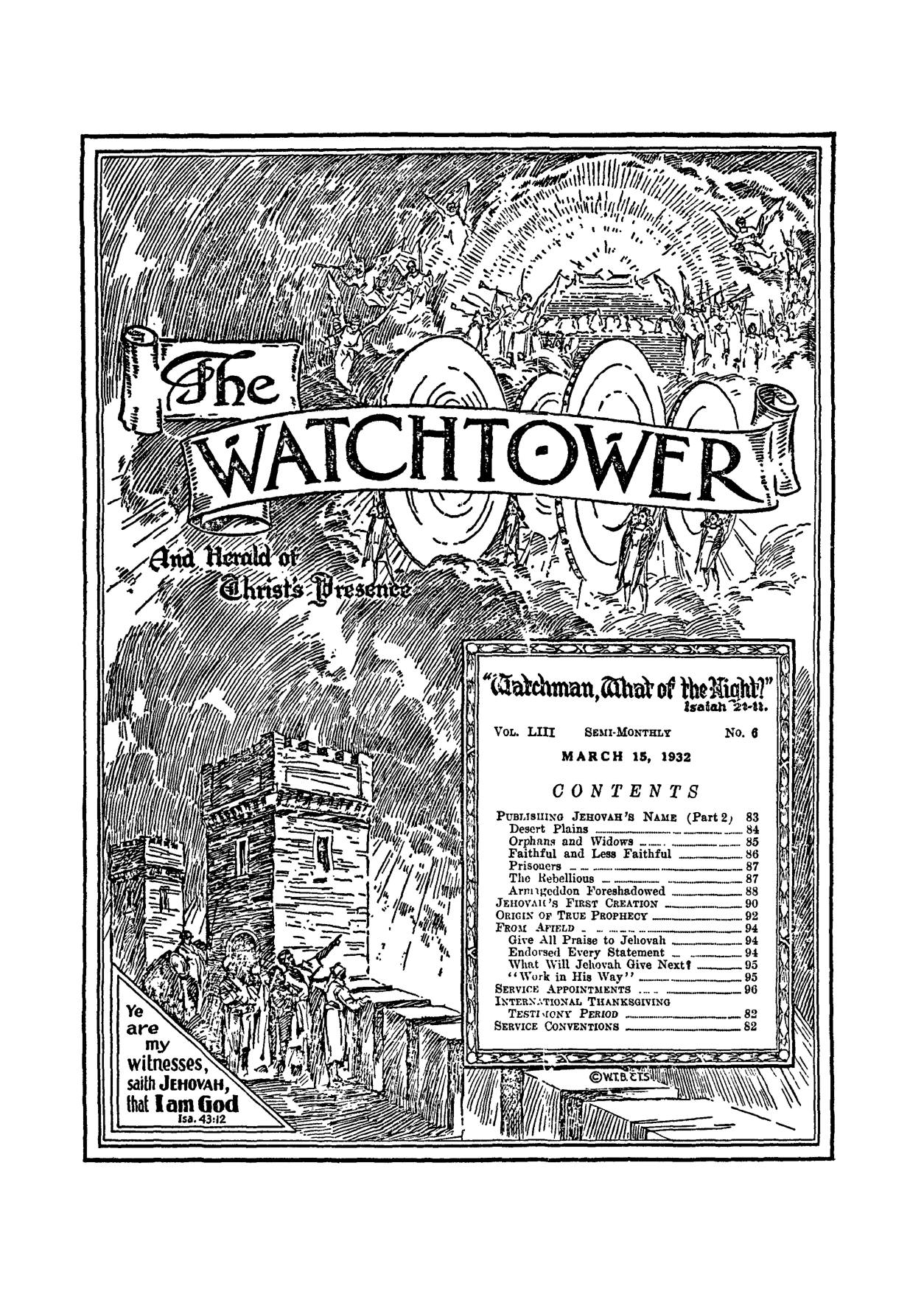
INTERNATIONAL THANKSGIVING TESTIMONY PERIOD
March 20 to 27
We feel sure that all Jehovah’s witnesses are looking forward with keen anticipation to the International Thanksgiving Testimony Period. The acceptance of the new name by the Lord’s anointed ones carried with it the responsibility of making honest, faithful efforts to really merit the name. As Jehovah held the Israelites to their side of the contract when, at Mount Sinai, they said, “All these things will we do,’’ so his covenant people at this time have bound themselves to do the things which the name implies. His true people appreciate the arrangements for special witness periods and make extraordinary efforts to put every hour possible into the field service. The Memorial is the special season for joy and thanksgiving unto the Lord, and the spirit of real gratitude will find its true expression in doing well what Jehovah has commanded shall be done. ‘ ‘ Ye are my witnesses, ’ ’ saith the Lord, “that I am God.’’
It will be an inspiration to every one to know that all the brethren in every place are joined together in the same work, presenting a united front to the enemy. We are sincerely hoping that at least two million people will hear the testimony during this special period. What a mighty witness that will be!
Vol. LIII
March 15, 1932
No. 6
PUBLISHING JEHOVAH’S NAME
PART 2
“Sing unto God, sing praises to his name; cast up a highway for him that rideth through the deserts; his name is JAH; and exult ye before him.”—Ps. 68:4, R.V.
JEHOVAH has chosen Zion the capital city of his great organization as his place of habitation. Representatively by his beloved King he has installed himself there. It is the time for glad song, that his name might be made known to those who will hear. All others will in due time be compelled to know that Jehovah is God. The fact that the command is to “sing praises to his name’’ clearly indicates that Jehovah would, at the time of the fulfilment of this prophecy, reveal to his people the significance of his name. He first declared his name “Jehovah” to Moses; and in this verse four of the psalm it is stated: “Extol him ... by his name JAH.” This is a contraction for the name Jehovah and means the same thing. This is therefore a part of the new Song having to do specifically with the significance of the name of Jehovah.
2 “O sing unto the Lord [Jehovah] a new song; sing unto the Lord [Jehovah], all the earth.” (Ps. 96:1) “O sing unto the Lord [Jehovah] a new song; for he hath done marvellous things: his right hand, and his holy arm, hath gotten him the victory.” (Ps. 98:1) “I will sing a new song unto thee, O God [Jehovah] : upon a psaltery, and an instrument of ten strings, will I sing praises unto thee.” (Ps. 144:9) “Praise ye the Lord [Jehovah]. Sing unto the Lord [Jehovah] a new song, and his praise in the congregation of saints.”—Ps. 149:1.
3 Not until after the coming of Christ Jesus to the temple of Jehovah God, and his revealing to the anointed ones the significance of the name Jehovah, was this Song due; and it was after that date that the remnant began The Song. It is not the general salvation of man that evokes this Song of praise, but it is some special work and victorious act that inspires and calls forth The Song. At the time the remnant begins The Song Jehovah had installed his anointed King on his holy hill of Zion and commanded his beloved King to oust Satan from heaven and to break his power in the earth. In 1919 the Lord delivered his remnant people from the bondage of Babylon, the earthly part of Satan’s organization, that they might go forward and publish his name and his kingdom. Then he revealed to them that Zion was built up, and he gave the remnant an understanding of the great issue raised by the enemy concerning his word and his name. He showed the remnant that the time would shortly arrive when this great issue would be for ever determined in favor of and to the glory of Jehovah God. He gave the remnant an understanding that the name Jehovah signifies his purpose concerning his people, and then he has shown the remnant that they must be his witnesses in the earth. It is these great truths revealed to the remnant that has evoked The Song, and they love Jehovah and delight to engage in The Song of praise to his name.
4 The Revised Version of verse four says: “Cast up a highway for him that rideth through the deserts.” By his prophet God shows that “there shall be an highway for the remnant of his people, which shall be left, from Assyria”, which after Isaiah’s day Babylon conquered and occupied. “And there shall be an highway for the remnant of his people, which shall be left, from Assyria; like as it was to Israel in the day that he came up out of the land of Egypt.” (Isa. 11:16) It was after the coming of the Lord to his temple that his remnant people on earth were permitted to enter the highway and return to Zion, where Jehovah now appears in his glory.
5 “That day,” which the Lord hath made, had now begun; and the duty of the remnant in that time is made clear, and concerning which it is written: “And in that day thou shalt say, O Lord, I will praise thee; though thou wast angry with me, thine anger is turned away, and thou comfortedst me. Behold, God is my salvation; I will trust, and not be afraid; for the Lord JEHOVAH is my strength and my song; he also is become my salvation. Sing unto the Lord; for he hath done excellent things: this is known in all the earth.”—Isa. 12:1, 2, 5.
6 Jehovah having builded up Zion and taken his position there, he is now great in Zion; hence it is written: “The Lord is great in Zion, and he is high above all the people. Let them praise thy great and terrible name; for it is holy.” (Ps. 99:2,3) This is further a corroborative proof that the sixty-eighth Psalm applies at the present time and is meat in due season for God’s anointed people at this time. To know this is a means of strength and encouragement.
DESERT PLAINS
7 The Revised Version of verse four reads: “Cast up a highway for him that rideth [upon the heavens] through the deserts.” Another translator renders this part of the text: “To him that rideth through desert plains.” (Roth.) The Authorized Version reads: “Extol him that rideth upon the heavens.” The word “heavens” here used is from the Hebrew arabah and is not the same as the word rendered “heavens” in verses eight and thirty-three of the psalm. It is only in this verse four that the word arabah is translated “heavens”, whereas in other places the same word is translated desert, plain, or wilderness. This indicates that the psalmist was drawing his picture from the past, when the pillar of cloud, representing Jehovah’s presence, and also the ark of the covenant borne upon the shoulders of the priests proceeded through the wilderness or desert toward Canaan. The priests bearing the ark of the covenant on their shoulders pictured in a small way how Jehovah God rides upon his priestly organization, known and designated as the Melchizedek priesthood. All the territory lying between Egypt and Canaan was desert or wilderness land and was the land inhabited by the enemies of Israel, and therefore pictured the condition of unbelief and disobedience to God. The Israelites must pass through this desert land on their way to the land of rest.
8 The Apostle Paul’s argument concerning this matter, as set forth in Hebrews 3:7-16 and 4:1-11, is that Canaan pictured the condition of faith and rest in Jehovah, and his provision made for his people, and that those who exercise faith in God and in Christ do now enter into complete rest. The Israelites marching through the desert land of Canaan with the ark of the covenant on the shoulders of the priests, therefore, pictured Jehovah riding upon and leading his organization through the desert condition. It is written: “And they departed from the mountains of Abarim, and pitched in the plains of Moab, by Jordan near Jericho. And they pitched by Jordan, from Beth-jesimoth even unto Abel-shittim in the plains of Moab. And the Lord spake unto Moses in the plains of Moab. ’ ’—Num. 33: 48-50.
9 The word “plains” appearing three times in the above texts is derived from the Hebrew arabah, which means desert or wilderness. The fulfilment of that part of the prophecy of the psalm, ‘him that rideth upon the heavens through the desert plains,’ therefore, must be Jehovah’s riding on his organization and leading it through the desert-like desolate country of the enemy, which is the world, and leading to and bringing his covenant people safely into Zion and unto the city of the living God, the heavenly Jerusalem, and to an innumerable company of angels, to the general assembly of the church of the firstborn, which are written in heaven. (Heb. 12:22,23) As the Israelites were in the desert land of the enemy, but no part of it, even so now God’s faithful remnant people are in the world, but no part of it; and which world or organization of the enemy is, to the remnant, unfriendly, uninviting and barren of life-giving food for them, and the remnant is encompassed about by danger and death. Jehovah, therefore, is their shield, their strength and song. The remnant is in a land or condition that is arid and unfruitful to God. Now God’s remnant must proceed on the journey through this desert condition and must proceed on the highway provided by the King Eternal for them, which ‘ highway is cast up ’ for their benefit; and in due time all others of the human kind that live everlastingly must go up on that highway. This great highway leads to Zion, whither Jehovah by his representative Christ Jesus has come.—Isa. 35:8; 62:10.
10 In the enemy’s country there are multitudes who are not of the official part of Satan’s organization, but who are under its power and influence. These must yet have an opportunity to partake of the waters of the river that flow out from the throne and temple of God. In harmony with this it is written: “Then said he unto me, These waters issue out toward the east country, and go down into the desert [arabah], and go into the sea; which [water of life] being brought forth into the sea, the waters shall be healed. ’ ’ (Ezek. 47:8) (See also Rev. 22:1,2; Light, Book Two, pages 255, 256.)
11 By faith and by the great favor of Jehovah God those of the remnant class now see these things and hence “raise a song” of praise to him that rides supreme and victorious through the enemy’s country. In joyful obedience to Jehovah’s commandments these “cast up the highway” for the people, lift up Jehovah’s standard, and lead the way to the kingdom. (Isa. 62:10) They extol the Supreme One “by [the] name JAH, and rejoice before him”. This seems to say in substance that the name JAH takes preeminence over all other names of the Deity. It calls attention to his purpose and suggests to his people that now the time has come for Jehovah to carry out the completion of all his purposes which he has set forth in the Bible for the guidance of man, and, above all, his purpose to vindicate his glorious name.
12 The rejoicing of the remnant before him is fully corroborated by the words of the prophet, to wit: “Rejoice greatly, O daughter of Zion; shout, O daughter of Jerusalem; behold, thy King cometh unto thee; he is just, and having salvation; lowly, and riding upon an ass, and upon a colt the foal of an ass.” (Zech. 9: 9) The riding on the ass by the ruler of Israel at the time of his coronation was symbolic of complete and willing submission to Jehovah God. The ass was the king’s mount when he appeared for coronation. (Judg. 5:10; 2 Chron. 23:9-11) Jesus fulfilled this prophecy in miniature when he rode into Jerusalem offering himself as King and appeared at the temple. (Matt. 21:2-9) When he came to the temple of Jehovah in 1918, and was presented as King, he fulfilled the prophecy on the wider scale, and that marks the beginning of the time of great rejoicing by the daughter of Zion, the children of God’s organization.
ORPHANS AND WIDOWS
13 A child separated from his father is subjected to reproach by others, and a widow is desolate. Jehovah is the Father of the orphan and the Advocate of the widow. The Psalm-Song, referring to Jehovah, says: “A father of the fatherless, and a judge of the widows, is God in his holy habitation.” (68: 5) Here God’s remnant are in the desolate condition of the world, and are mentioned by the psalmist as "fatherless” for the following reasons: (1) because such have obeyed the commandment to "forget also [your] own people, and [your] father’s house” (Ps. 45:10) ; (2) they are stripped of all earthly friends and look to Jehovah God for help and strength: "When my father and my mother forsake me, then the Lord will take me up. Teach me thy way, O Lord, and lead me in a plain path, because of mine enemies” (Ps. 27:10,11) ; and (3) because during the absence of Christ Jesus, and until his coming to the temple, these were left orphans, but God had sent the holy spirit as advocate and helper for them. (John 14:18) Now the holy spirit as a helper has been taken away and Jehovah by his Chief One, Christ Jesus, is with them. The fatherless need a vindicator and protector, and Jehovah makes it his purpose to be such to the remnant: “He doth execute the judgment of the fatherless and widow, and loveth the stranger, in giving him food and raiment.”—Deut. 10:18.
14 Another translator renders this text in Deuteronomy: "Executing the vindication of the orphan and the widow, and loving a sojourner, giving him food and raiment.” (Roth.) In harmony with this the psalmist says: "Oh arise, Jehovah! do not neglect the crushed one, do not forget the humbled ones. Thou hast seen! for thou travail and vexation dost discern, to lay them in thine own hand: unto thee doth the unfortunate one give himself up, to the fatherless thou thyself hast become a helper. To vindicate the fatherless and the crushed, that weak man of the earth may cause terror no more.”—Ps. 10:12,14,18, Roth.
15 The rulers of this world see God’s people being crushed, reproached and discredited, but lend no aid and comfort to them. Addressing them by his prophet, Jehovah says: "Defend the poor and fatherless; do justice to the afflicted and needy. Deliver the poor and needy: rid them out of the hand of the wicked. ’ ’—Ps. 82: 3,4.
16 But the rulers fail and refuse to do so, and Jehovah then takes over the task; and his prophet concerning it says: ‘ ‘ The Lord preserveth the strangers; he relieveth the fatherless and widow; but the way of the wicked he turneth upside down.” (Ps. 146:9) This God begins when he appears at his temple by his great representative Christ Jesus.
17 "Christendom” has many children who are both fatherless and rebellious, because they have been led into error by the clergy and the principal ones of their flock. Concerning them Jehovah by his prophet says: "For the leaders of this people cause them to err; and they that are led of them are destroyed. Therefore the Lord shall have no joy in their young men, neither shall have mercy on their fatherless and widows: for every one is an hypocrite and an evil doer, and every mouth speaketh folly. For all this his anger is not turned away, but his hand is stretched out still.” (Isa. 9:16,17) These rebellious ones have looked to men for strength, and their strength has failed. Those who look to the Lord and obey his commandments receive strength at his hands.
18 Jehovah is the Judge, Advocate and Vindicator of his faithful children. "Leave thy fatherless children, I will preserve them alive; and let thy widows trust in me.” (Jer. 49:11) The Hebrew word for "widow”, used by the psalmist in the first verse here under consideration, is in the plural number and in other places in the Scriptures is translated "desolate houses” and “desolate palaces”. (Isa. 13:22; Ezek. 19:7) The word means also a desolate place or condition. The great “widow”, whose advocate and vindicator Jehovah has become, is, of course, Zion, his organization. The time comes when her widowhood ceases and her reproach is taken away, and Jehovah says to her: “Fear not; for thou shalt hot be ashamed: neither be thou confounded ; for thou shalt not be put to shame: for thou shalt forget the shame of thy youth, and shalt not remember the reproach of thy widowhood any more. And all thy children shall be taught of the Lord: and great shall be the peace of thy children.”—Isa. 54:4,13. (See The Watchtower, 1931, page 323.)
19 During the period of persecution in 1917 to 1919 the earthly part of God’s organization became desolate, like a widow, and the cries of the faithful members thereof were expressed in the words of Lamentations: "Remember, O Lord, what is come upon us; consider, and behold our reproach. Our inheritance is turned to strangers, our houses to aliens. We are orphans and fatherless, our mothers are as widows. Our necks are under persecution: we labour, and have no rest.”—Lam. 5:1-3, 5.
20 Early in that period of persecution the Lord came to the temple to judge, and he advocated in be-half of the widow and the fatherless. “And the Lord, whom ye seek, shall suddenly come to his temple, even the messenger of the covenant, whom ye delight in: behold, he shall come, saith the Lord of hosts. And I will come near to you to judgment; and I will be a swift witness against the sorcerers, and against the adulterers, and against false swearers, and against those that oppress the hireling in his wages, the widow, and the fatherless, and that turn aside the stranger from his right, and fear not me, saith the Lord of hosts.’’—Mal. 3:1,5.
21 The time is at hand when the enemy and his organization must be destroyed. His house has been and is a proud, arrogant and oppressive one; hence it is written: “The Lord will destroy the house of the proud: but he will establish the border of the widow.’’ (Prov. 15:25) It was in 1918 that Jehovah began the building up of Zion, and when he made his widow fruitful and her children began to praise his name; and relating thereto it is written: “He maketh the barren woman to keep house, and to be a joyful mother of children. Praise ye the Lord.” (Ps. 113:9) The housekeeping of God’s woman that relates to earthly children as well as others began there, and it was a joyful time and the joy still continues.
22 The words of the fifth verse of Psalm sixty-eight, to wit, “God in his holy habitation,” seem to refer to Jehovah in his temple, and not to his general presence in heaven. (Hab. 2:20) The words show the manifestation of Jehovah’s love for those of his organization. It is his place of dwelling, and he is there in the representative capacity of his Chief Officer, Christ Jesus. (Ps. 132:13-15) In the Chronicles it is written that Jehovah “had compassion on his people, and on his dwellingplace”. (2 Chron. 36:15) As further proof that the reference is to the temple and the place where his name is honored, the psalmist says: “Lord, I have loved the habitation of thy house, and the place where thine honour dwelleth.” (Ps. 26:8) Jehovah is the Judge and the Vindicator of his people in Zion. The children being brought into the presence of their Father, the great Jehovah, and into his organization, which organization had previously been in the condition of a widow, but now is made fruitful and put to keeping house, there is joy in the organization. There is joy and singing and great peace among all the children of the organization. Jehovah is their Father and Teacher, and all of these now are taught of God.—Isa. 54:13.
FAITHFUL AND LESS FAITHFUL
23 Proceeding, The Song says: “God setteth the solitary in families: he bringeth out those which are bound with chains; but the rebellious dwell in a dry land.” (Ps. 68:6) The Watchtower of November, 15, 1926, discussing texts relating to the prisoners or great multitude class, limits the application of the words in this psalm, to wit, “God setteth the solitary in families,” to the great multitude class. Now the matter appears clearer, by the Lord’s grace. This verse of the psalm clearly seems to refer to three different classes, to wit: (1) the faithful remnant, or “faithful and wise servant” class; (2) the great multitude; and (3) the “man of sin”, “the son of perdition.” Manifestly these three classes here are set out that the ones devoted to God may see and appreciate his gracious provisions for those that love him. Another translator renders this text in this manner: “Who brings back lonely ones home.” (Roth., margin) This verse of the psalm is the only place where the Hebrew word ya-chid is rendered “solitary”. Concerning this word a recognized authority says that the word means united, i.e., sole; by implication, beloved, also lonely; the life; darling, desolate, and only child. An example, as a proof text, reads: “Take now thy son, thine only son [ya-chid] Isaac.” (Gen. 22:2,16) Another: “Deliver my soul from the sword; my darling [only one] from the power of the dog.” (Ps. 22:20) “Lord, how long wilt thou look on? rescue my soul from their destructions, my darling from the lions. ’ ’—Ps. 35:17.
24 The same word translated “only beloved” one appears in the following text: ‘ ‘ For I was my father’s son, tender and only beloved in the sight of my mother.” (Prov. 4:3) Also the same word is rendered “only son”, in Jeremiah 6:26. The same Hebrew word is rendered “only son” in Amos 8:10; Zechariah 12:10. The same Hebrew word is rendered “desolate” in the following text: “Turn thee unto me, and have mercy upon me; for I am desolate [lonely, Roth.] and afflicted.” (Ps. 25:16) These texts prove that the word “solitary” in verse six of the psalm under consideration has reference to the children of Zion, God’s faithful remnant class.
25 Following the birth of the “man child” (the kingdom, Rev. 12:5) Zion gave birth to her children. “For as soon as Zion travailed, she brought forth her children.” (Isa. 66:8) Then began the time of joy. God’s woman, symbolic of his organization, was barren of children until he placed his beloved King upon his throne, and then her children were brought forth. It was then that ‘the barren woman (Zion) began housekeeping’, as the Authorized Version says. “Who giveth an abiding home to the barren of the house, [now] mother of the sons to her joy!” (Ps. 113:9, Roth.) When the Lord came to his temple and builded up Zion, and these children were brought forth, then the Song of praise was raised and the joyful children began to make publication of the kingdom and the name of Jehovah, looking to the vindication of Jehovah’s name, in which now, by his grace, these faithful ones are privileged to have some part. The facts abundantly show that the “faithful servant” class, although greatly beloved of the Lord, was solitary, lonely, and in a desolate condition until the Lord began to reveal to these faithful ones that the kingdom had been born, and that these faithful followers of Christ Jesus were privileged to make publication of the King and the kingdom to the glory of Jehovah God’s name. These solitary ones Jehovah then sets “in families’’ or “in an house”, that is to say, in the organization of the Lord, in the house of the Lord; and he brought them into a condition of unity in Christ. Necessarily, then, these favored ones must and do see ‘ ‘ eye to eye ’ ’, and harmoniously they proceed to the publication of the good news of the kingdom and of the day of the vindication of Jehovah’s name. It is therefore quite clear that that part of the psalm, “God setteth the solitary in families,” applies to the faithful remnant class and shows their unity in a happy, joyful, united state and condition.
PRISONERS
26 According to the Revised Version this sixth verse of Psalm sixty-eight reads: “God setteth the solitary in families; he bringeth out the prisoners into prosperity: but the rebellious dwell in a parched land.” The Watchtower of November 15, 1926, properly applies “the prisoners” of this text to the “great multitude”. This conclusion is fully supported by the following texts: “I the Lord have called thee in righteousness, and will hold thine hand, and will keep thee, and give thee for a covenant of the people, for a light of the Gentiles; to open the blind eyes, to bring out the prisoners from the prison, and them that sit in darkness out of the prison house.” (Isa. 42:6,7) “Let the sighing of the prisoner come before thee; according to the greatness of thy power preserve thou those that are appointed to die.” (Ps. 79:11) “To hear the groaning of the prisoner, to loose those that are appointed to death.” (Ps. 102:20) “Such as sit in darkness and in the shadow of death, being bound in affliction and iron.” (Ps. 107:10) Those who compose the great multitude sigh and cry because they are held in restraint by the organization that fraudulently and falsely takes the name of Christ Jesus. The clergy and the principal ones of their flocks hold these timid ones as prisoners. They are appointed to die, because they have made a covenant with God to do his will, trusting in the merit of Christ Jesus, which covenant leads to their death as human creatures in order that they may live as spirit creatures. They must go into death as human creatures in order to be raised out of death on the spirit plane, at which time they will be granted the privilege of serving God before his throne.—Rev. 7:15.
THE REBELLIOUS
27 The Revised Version renders the latter part of this verse thus: “But the rebellious dwell in a parched land.” Rotherham renders this word, “sun-burnt land.” There was a rebellious class amongst the Israelites, God’s typical covenant people, and it is to be expected that a similar rebellious company would appear amongst those who have made a covenant by sacrifice to do the will of God. The Israelites were afflicted with both stubbornness and rebellion. It may be expected that we would find the same thing amongst those who had been invited into the kingdom. Jacob, being granted the birthright and receiving the favor at Jehovah’s hands, foreshadowed the faithful ones whom the Lord God uses to deliver the testimony of Jesus Christ, that is to say, that class of followers of Christ Jesus who go to make up “the faithful and true” servant class. Therefore it is written: “For he established a testimony in Jacob, and appointed a law in Israel, which he commanded our fathers, that they should make them known to their children: . . . that they might set their hope in God, and not forget the works of God, but keep his commandments: and might not be as their fathers, a stubborn and rebellious generation; a generation that set not their heart aright, and whose spirit was not stedfast with God.”—Ps. 78:5,7,8.
28 Jehovah has made it clear and plain in his Word that those whom he would approve must serve him and be moved to do so because of their love for him or unselfish devotion to him; that with the coming of his kingdom these must be witnesses for Jehovah and tell the good news to the nations of earth as a witness and give warning of God’s purpose, before the final end comes upon Satan’s organization. These must tell the peoples of the world that Jehovah is the only true God and that Satan and his organization is false, is anti-God and anti-kingdom, and must go down. They must bear testimony to Jehovah’s name and to his kingdom with joy, looking to the vindication of Jehovah’s name. Those taken into the covenant for the kingdom divide themselves into two classes: one class moved by an unselfish devotion to the Lord; and the other class looking always with selfishness to a position of honor and glory that might be theirs in some future time. This latter class refuses to believe that the kingdom was begun in 1914, which is symbolized by the birth of the “man child”. They also refuse to believe that the Lord came to his temple in 1918. They fail to keep their covenant and to perform their vows before the Lord, and fail to show an appreciation of favors bestowed upon them. “They kept not the covenant of God, and refused to walk in his law; and forgat his works, and his wonders that he had shewed them.”—Ps. 78:10,11.
29 All who have responded to the call for the kingdom were in line to become joint rulers with Christ Jesus, provided their motive in serving the Lord was love or unselfishness, and provided they continued faithful in that way to the end; and therefore such are spoken of as princes, and concerning which the Lord through the psalmist says: “He poureth contempt upon princes [those once in line to be kings in the kingdom with Christ Jesus], and causeth them to wander in the wilderness [a void place where there is no nourishment], where there is no way. Yet setteth he the poor [the poor in spirit who are wholly and unselfishly devoted to God] on high from affliction, and maketh him families [this faithful class] like a flock.” Then says the Lord: ‘ ‘ The righteous shall see it, and rejoice: and all iniquity shall stop her mouth. Whoso is wise, and will observe these things, even they shall understand the lovingkindness of the Lord.” (Ps. 107:40-43) Thus the Lord shows that the wise are those who give heed to his Word and are guided wholly by his Word and not by extraneous influence, not even by their own opinions or conclusions, nor by the wisdom and greatness of their fellow creatures.
30 To the rebellious ones Jehovah says: “I have spread out my hands all the day unto a rebellious people, which walketh in a way that was not good, after their own thoughts; a people that provoketh me to anger continually to my face; that sacrificeth in gardens, and burneth incense upon altars of brick [a man-made thing or teaching, and not upon Christ, the chosen elect Stone of Jehovah God].” (Isa. 65:2,3) The rebellious ones, although having received the call to the kingdom and responded thereto, insist that by their own efforts they can develop character that will make them meet for the kingdom, and that those who do not follow their course are much below their own standard; hence they speak of themselves as more holy than others, and concerning them Jehovah says: “These are a smoke in my nose, a fire that burneth all the day.” (Isa. 65:5) (See The Watchtower, 1930, page 344.) This is a class that refuse to expose Satan’s wicked organization by proclaiming the truth, but rather they tread softly lest they might fail to receive some help from the world, and to them the Lord God says: “Woe to the rebellious children, saith the Lord, that take counsel, but not of me; and that cover with a covering, but not of my spirit, that they may add sin to sin; that walk to go down into Egypt, and have not asked at my mouth; to strengthen themselves in the strength of Pharaoh, and to trust in the shadow of Egypt!”— Isa. 30:1, 2.
31 The same rebellious class is described as revolters and corrupters in the following texts: “But this people hath a revolting and a rebellious heart; they are revolted and gone.” (Jer. 5: 23) “They are all grievous revolters, walking with slanders; they are brass and iron; they are all corrupters.”—Jer. 6:28.
32 Of such the psalmist says ‘they slander their own mother’s son’. (Ps. 50:20) Jesus speaks of the same class as “workers of iniquity”; and again as the “evil servant”; and the apostle describes the same class as “workers of iniquity”, because they have not received the love of the truth and therefore fall away and are designated “the man of sin”, “the son of perdition.”—Matt. 13:41; 2 Thess. 2:2-12.
33 The proof texts above set forth clearly show that the Lord’s prophet describes, in verse six of the sixty-eighth Psalm, three classes into which the consecrated divide themselves. The faithful ones, who are beloved of the Lord, see these truths and raise a song of praise to the name of Jehovah and joyfully continue the publication of Jehovah as the only true God, that his kingdom will vindicate his name, and that his kingdom is the one and only hope of the human race.
ARMAGEDDON FORESHADOWED
34 In many places in the Bible Jehovah indicates what shall come to pass at Armageddon or the battle of the great day of God Almighty, and the following text is one of such proofs: “ O God, when thou wentest forth before thy people, when thou didst march through the wilderness [desert, Roth.] ; the earth trembled [quaked, Roth.], the heavens also dropped [dripped, Roth.] at the presence of God; even yon Sinai trembled [quaked] at the presence of God, the God of Israel.”—Ps. 68:7,8, R.V.
35 In these words of the psalm David evidently refers to Jehovah’s leading the Israelites out of Egypt to Mount Sinai and from there on to the land of Palestine, and mentions what took place at Mount Sinai, and which foreshadows other things to take place thereafter. Following the first battle of Megiddo, Deborah prophesied. (Judg. 5:19) The language used by the prophetess was very similar to that which David afterwards employed in this psalm, and shows that the words proceeded not from any human creature, but were directed and dictated by the Lord through his angel. The language of the prophecy uttered by Deborah reads: “Lord, when thou wentest out of Seir, when thou marchedst out of the field of Edom, the earth trembled, and the heavens dropped, the clouds also dropped water. The mountains melted from before the Lord, even that Sinai from before the Lord God of Israel.” (Judg. 5:4,5) It is manifest that this language of the prophetess was used because Jehovah had repeated his strange and wondrous acts at the battle of Megiddo, similar to this that had been made manifest at Sinai. Describing the battle of Megiddo the prophetess said: “They fought from heaven; the stars in their courses fought against Sisera. The river of Kishon swept them away, that ancient river, the river Kishon. O my soul, thou hast trodden down strength. Then were the horsehoofs broken by the means of the pransings, the pransings of their mighty ones. Curse ye Meroz, said the angel of the Lord; curse ye bitterly the inhabitants thereof; because they came not to the help of the Lord, to the help of the Lord against the mighty. ’ ’—Judg. 5:20-23.
36 Many of the consecrated have thought, and some yet hold to the conclusion, that the great battle of the day of God Almighty will be fought by human powers and agencies. The Scriptures, however, show that there is no supporting authority for such a conclusion. As the angel of the Lord directed the battle of Megiddo, acting as the representative of Jehovah God, even so Christ Jesus, his great executive officer, will direct the battle of the great day of God Almighty, acting as Jehovah’s representative. The words of the prophecy uttered by Deborah, and those of verses seven and eight of the sixty-eighth Psalm, support this conclusion abundantly. The Apostle Paul, in the twelfth chapter of Hebrews, refers to the same thing, and shows that the words of the prophecy uttered by Deborah and by David must be prophecies of what shall come to pass in this “the day of his preparation” and of the great and final battle. It must have appeared strange and wonderful to all who beheld when the armies of Israel, under Joshua, fought against the enemy at Gibeon. It must have been strange and wonderful to see the elements of heaven warring against the enemy and in behalf of God’s covenant people. It was there that Jehovah God, when the battle was raging, cast down great hailstones or chunks of ice from heaven by which many more were slain than were killed with the swords of Israel’s army. (Josh. 10:9-12) Likewise when the Israelites under Barak engaged the enemy at Megiddo, it must have seemed strange and wonderful to the spectators to see the power of Jehovah manifested against the enemy when ‘the stars from heaven’ fought against the enemy and the enemy was wholly defeated.
37 Isaiah has prophesied concerning the coming battle of Armageddon, or great battle of the day of God Almighty, and says: “For the Lord shall rise up as in mount Perazim, he shall be wroth as in the valley of Gibeon, that he may do his work, his strange work; and bring to pass his act, his strange act.” (Isa. 28: 21) Just what elements God will employ in that battle, we do not know, but from the prophetic pictures we do know that Jehovah God will employ his power to defeat Satan’s organization. In whatever manner that power is made manifest it will be strange and wonderful to those who behold it. The word “strange” used in the above-quoted prophecy of Isaiah means wonderful. By the prophet Zechariah Jehovah tells that in “the day of the Lord”, when Satan’s organization is assaulting his people, “then shall the Lord go forth, and fight against those nations, as when he fought in the day of battle.” (Zech. 14: 3) We know that Satan is gathering all his forces against the forces of righteousness, and that the powers of earth who are on the Lord’s side are too insignificant to give successful battle to the enemy; but the God of heaven will fight against the enemy and destroy him, and in the eyes of all who are privileged to see it that will be a strange or wonderful act.
38 Jehovah by his representative Christ Jesus came to his temple in 1918, and the shaking of the earth, that is, earthly condition of God’s people, began then and there. The remnant, which is the “tenth part of the city, fell, and in the earthquake were slain of men seven thousand”. These were cut off from Satan’s organization and counted as dead by Satan’s agents. (See Rev. 11:13 ; Light, Book One, page 214.) The translation of the above text of Psalm sixty-eight by Rotherham reads: “Earth quaked, yea, the heavens dripped, at the presence of the God of Sinai.” The great lesson to be learned by creation is that Jehovah is the only true and almighty God. All must in one way or another be informed of that fact. This latter rendering of the text by Rotherham makes it plain that he who made Mount Sinai tremble and quake at the giving of the law through Moses is the same God who fights the battle for his people and brings to them victory, and is the same God who comes to his temple, selects and brings his remnant into the secret place of the Most High, the place of safety, and the same God who will destroy the enemy and his organization at Armageddon. “The heavens also dropped” does not mean that the skies fell down, but that they “dripped” or dropped rain or refreshing showers of truth upon God's people while these are in the land or condition of the wilderness. That conclusion is supported by the following texts in which the same word is rendered, to wit, “The clouds also dropped [with] water.” (Judg. 5:4) “My hands dropped with myrrh.” (S. of S. 5:5) “Mountains shall drop down new wine.” (Joel 3:18) “The mountains shall drop sweet wine. ’ ’—Amos 9:13.
39 Since the coming of the Lord to his temple his heavens have dropped showers of refreshing truth upon his remnant people on the earth. By his grace the remnant receives these showers of prophetic truths, and as Jehovah’s witnesses they drop these truths toward all the nations and particularly toward the nations composing Christendom. “Son of man, set thy face toward the south, and drop thy word toward the south, and prophesy against the forest of the south field.” (Ezek. 20:46) “Son of man, set thy face toward Jerusalem, and drop thy word toward the holy places, and prophesy against the land of Israel ”—Ezek. 21:2.
40 Jehovah’s remnant are now made ‘to sit in heavenly places in Christ Jesus’, being in his temple. (Eph. 2:6) These faithful ones drop God’s prophecies toward Christendom in particular, publishing the name and the kingdom of Jehovah God.
(To be continued)
QUESTIONS FOR BEREAN STUDY
1, 2. What is the special occasion which calls for the singing of praises to Jehovah’s name? To whom has he made known his name? By whom will these praises be sung? What is the nature of the song they shall sing?
3. Point out some of the great truths which have been revealed to the remnant and which have called forth The Song of praise to the name of Jehovah.
4-6. What is the purpose of the highway here mentioned, and when was it opened to the remnant? What further proof is there that a detailed examination of the sixty-eighth Psalm at this time by God’s anointed people will be helpful?
7-9. Compare the position of Jehovah’s covenant people now with that of Israel on their way to Canaan, to show the application and fitness of the expression ‘him that rideth upon the heavens through the desert plains’.
10. How does Ezekiel 47: 8 come into consideration in this connection?
11, 12. What is the significance of the expression “His name is JAH”? How is the fulfilment of Zechariah 9: 9 related to Psalm 68: 4?
13-16. Identify the ‘ ‘ fatherless ’ ’ referred to in verse 5. Account for their being “orphans”. How does Jehovah protect and vindicate them?
17. Apply Isaiah 9: 16,17.
18-20. Apply the statement that ‘God is a judge of the widows ’.
21, 22. When and how will the Lord (a) “destroy the house of the proud”? (b) “Establish the border of the widow”? To what does the expression “God in his holy habitation” refer?
23, 24. With scriptures make clear the meaning of the statement ‘ ‘ God setteth the solitary in families ’ ’. Quote other texts which prove the identity of the class referred to as “the solitary”.
25. When and how was the 'setting in families’ accomplished! For what purpose was this done?
26. Point out other scriptures which prove the identity of “the prisoners”.
27, 28. Explain the statement that “he established a testimony in Jacob”. Apply Psalm 78:10,11.
29. In the expression “Whoso is wise” (Ps. 107:43), to whom is reference made? Observe what things? “They shall understand the lovingkindness of the Lord,” when and how?
30-32. How is Isaiah 65:2,3 having fulfilment?
33. Psalm 68: 6, then, is found to refer to what three classes?
34, 35. Account for the similarity of the expression used in Psalm 68: 7, 8 to that of Judges 5: 4, 5.
36, 37. By whom will Armageddon be fought? Describe the prophetic picture, to show how appropriate is the language of Isaiah 28: 21 as suggesting the nature of Armageddon.
38-40. Explain the statement that ‘the earth quaked’. Account for the reference here to “the God of Sinai”. Explain the expression ‘ ‘ The heavens dropped ’ ’.
JEHOVAH’S FIRST CREATION
IN THE land of Palestine the environment and conditions are such as to induce solemn meditation. Walking over the hills of Judea in the autumn season you are quickly convinced that here the rarity of the atmosphere and the clearness of the sky are unusual. At nighttime the stars appear in such great numbers that they seem to crowd each other for space in the heavens. You are reminded then that astronomers estimate that there are thirty thousand million astral bodies in our universe. Of course the human mind cannot fully grasp or appreciate that statement, but as you gaze into the heaven of bright shiners you conclude that astronomers have not overstated the matter. With admiration, wonder and reverential awe you behold them. Involuntarily you ask, Who made that myriad of marvelous stars that shed their gentle light to cheer the way of the weary traveler?
Knowing that you are a sensible person, endowed with reasoning faculties, you seek a sensible and reasonable answer to your question. You know of the theory of evolution, but at once you discard that theory as unworthy of consideration. It is not reasonable that those stars made themselves, nor that they came there by chance. Their very existence bears eloquent testimony that there is a Creator far greater than the stars and by whom they were made and hung in space.
You know that you have an honest and sincere desire for information concerning the wonders that you now behold. Who put that desire into your mind? Who clothed you with power to reason and the faculty to seek information? If there is a great Creator who made those wonderful astral bodies, and who made you, is it not reasonable that he would make it possible for you to obtain a true answer to your honest inquiry? If there is in existence a record giving the true answer concerning the origin of things visible, then that record must be consistent with itself and consistent with the great Maker.
All the books written at the dictation of man fail to measure up to the required standard, because they are merely the expressed opinions of imperfect men. They are not consistent with themselves, nor with the Creator, who must possess unlimited wisdom and power. The Bible meets every requirement. It is consistent with itself. It is not contradictory when understood. It is consistent with Him who is perfect in wisdom, justice, love and power. It answers your questions, and these answers will be found entirely satisfactory to the reasonable mind. It is the sacred Word of the Creator.
The Bible discloses that the name of the One who exercises supreme power in creation and in all things is God. He also has other names, as is shown by the Bible, all of which have a deep significance concerning his relationship to his creatures. A careful study of the Bible proves that it is absolutely true. As you progress in the examination of the sacred pages you marvel at the wonders there disclosed. You are forced to the conclusion that only the supreme mind of the great Eternal One could have dictated that Book. It not only proves the existence of the great God, and that he is the Author of creation, but discloses a marvelous purpose which the great Creator is working out in his own orderly and perfect way, and which shall ultimately result to the good of all his creatures and to the glory of the great Creator.
The reverential man pursues its study with the keenest interest. As his mind broadens and his vision of its great truths increases, instinctively he exclaims: “O the depth of the riches both of the wisdom and knowledge of God! ’ ’
The outworking of the divine purpose holds the greatest interest to anyone who diligently and honestly seeks knowledge. “A wise man will hear, and will increase learning; and a man of understanding shall attain unto wise counsels, ’ ’ says the proverb. ‘ ‘ When wisdom entereth into thine heart, and knowledge is pleasant unto thy soul, discretion shall preserve thee, understanding shall keep thee: to deliver thee from the way of the evil man, from the man that speaketh froward things. ’ ’—Prov. 1:5; 2:10-12.
But how shall I begin to learn wisdom? you ask. The fear of the Lord God is the beginning of wisdom. (Prov. 1:7; Ps. 111:10) Those who reverentially and diligently seek to understand the secrets of the Lord will be rewarded. The psalmist declares: “The secret of the Lord is with them that fear him; and he will shew them his covenant. ’ ’—Ps. 25: 4.
Faith means to obtain a truthful knowledge and then to confidently rely upon that knowledge. Faith in God means to acquire the truth and facts concerning God and then to confidently rely upon that. If you would know the Lord and receive his good pleasure, then you must believe that God, the great Eternal One, exists, and that he is the rewarder of those that diligently seek him. (Heb. 11: 6) You cannot believe without knowledge. That man might obtain knowledge God has endowed him with reasoning faculties, and then he invites man to use those faculties and reason upon the great truths revealed in the Scriptures. (Isa. 1:18) You will find that reason and the Scriptures are in exact harmony.
Now to the question which you propounded to yourself: Who made the stars? The Word of God answers: “And God made two great lights; the greater light to rule the day, and the lesser light to rule the night: he made the stars also.’’ (Gen. 1:16) Not only did he make them, but, so says the scripture (Ps. 147: 4), “he telleth the number of the stars; he calleth them all by their names. ’ ’ The eternal power and deity are clearly seen and may be understood by the things which God has made. (Rom. 1:20) Observation of these wonders beheld in the sky above induces sober meditation. And now, “come ... let us reason together” upon the things of creation.
There must have been a time when the great God was alone. There must have been a time when he began his creation. Does the Bible disclose what was the beginning of God’s creation? It does. The time of the beginning is not revealed; that is to say, no date is disclosed. Whether that time was a million or ten million years ago is not material to man. The fact of the beginning of creation is what man seeks. We may know that the mighty Eternal One who would create all things according to his sovereign will, and who would cause a record thereof to be written, would cause that record to be written truthfully.
The Word of God, the Bible, therefore imports absolute verity. There could be no inducement to have a false record. The men therefore who were used by the great God to write the Bible were directed by his unlimited power and perfect wisdom in making the Bible record true and right. “The works of his hands are verity and judgment; all his commandments are sure. They stand fast for ever and ever, and are done in truth and uprightness.” (Ps. 111: 7, 8) The Word of God is true, and he magnifies it above his name. (Ps. 138:2) The great Eternal One changes not, and what was once true is always true. The psalmist (Ps. 119:116) writes: “Uphold me according unto thy word, that I may live: and let me not be ashamed of my hope.” The Word of God is absolute authority concerning the beginning of creation. That authority is certain, and upon it the student may confidently rely.
The Word of God records the fact that long before the creation of the earth, when there was no sea, when there were no springs and lakes, before there were any mountains or hills, yea, before the sun and the moon and the stars were made, God began his creation; and that beginning was his beloved One, known in the holy record as the Logos. The word Logos is one of the names or titles given to the beloved Son of God, and carries with it a deep meaning. When God gives a creature or thing a name, that name bears much significance. Logos means the representative or spokesman for the great Creator. The title is therefore often translated WORD, because he who is the Logos is the express Word of the One whom he represents.
It pleased God to speak through the Logos, that his message might be conveyed to others of his intelligent creation. (Heb. 1:2) It is therefore appropriate that this mighty and beloved Son be called the Word of God. Concerning him it is written: “In the beginning was the Logos [Word], and the Logos [Word] was with the God, and the Logos [Word] was a god. This was in the beginning with the God.” (John 1:1,2, Diaglott, interlinear) This mighty One, the Logos, speaking as the authorized representative of the great Jehovah God concerning the question of the beginning of creation, said:
“The Lord possessed me in the beginning of his way, before his works of old. I was set up from everlasting, from the beginning or ever the earth was. When there were no depths, I was brought forth; when there were no fountains abounding with water. Before the mountains were settled, before the hills was I brought forth: while as yet he had not made the earth, nor the fields, nor the highest part of the dust of the world. When he prepared the heavens, I was there: when he set a compass upon the face of the depth; when he established the clouds above; when he strengthened the fountains of the deep; when he gave to the sea his decree, that the waters should not pass his commandment; when he appointed the foundations of the earth.”—Prov. 8:22-29.
This beloved One, the beginning of God’s creation, was the delight of the great God; and the Father, the Creator, took his beloved Son into his counsel, and thereafter operated through him in the creation of all things that have been created. ‘‘ All things were made by him; and without him was not any thing made that was made. ’ ’—John 1: 3.
In God’s due time this creature, the Logos, was transferred from heaven to earth and made in the likeness of man. “The Word [Logos] was made flesh, and dwelt among us.” (John 1:14) He was then known by his God-given name of Jesus, because the name Jesus means that he is the Savior. (Matt. 1:21) At the time of the beginning of his earthly ministry he was anointed by God’s holy spirit; and from that time forward he was known by the title Christ Jesus, because ‘ ‘ Christ ’ ’ means Anointed One. (Matt. 16:15,16; Luke 4:17,18) After he had represented Jehovah God faithfully on the earth, he was given, in addition to his other titles, the title of “Faithful and True”.—Rev. 19:11.
It is again stated in the Bible that the Logos was “the beginning of the creation of God”. (Rev. 3:14) After his creation God made the Logos his active agent in the creation of everything that was created. The great God placed his beloved One, the Logos, in a position of confidence and trust. He counseled with him; and all things were created at the direction of the Almighty God, by and through the work of his beloved One, the Logos. Concerning this it is written:
“ [He] is the image of the invisible God, the firstborn of every creature: for by him were all things created, that are in heaven, and that are in earth, visible and invisible, whether they be thrones, or dominions, or principalities, or powers: all things were created by him, and for him: and he is before all things, and by him all things consist.”—Col. 1:15-17.
As further proof that the Logos was God’s true and trusted One, it is written: “God . . . created all things by Jesus Christ.” (Eph. 3:9) Not that he was Jesus Christ at the time all things were created, but this mighty One who now holds the title of Jesus Christ, as well as other titles, was the One who created all things. Nothing was ever created by the Almighty God after the creation of the Logos, except by and through his beloved One.
Here then is the authoritative proof that the stars and all things visible and invisible were created by Jehovah God by and through his active Agent, the Logos. In this and in all other work the Logos has been at all times true and faithful in representing the great Jehovah God.
ORIGIN OF TRUE PROPHECY
JEHOVAH, the Almighty God, the Most High, is the Maker of all things good. He is from everlasting to everlasting, and there is none other. He covers himself with light for his garment, and all light proceeds from him. He created the heavens and stretched them out like a curtain and filled them with his reflected glory. He laid the chief corner stone and foundations of the earth and built it according to his sovereign will. In its youth he made the cloud for its garment of covering and the thick darkness for its swaddling-cloth. He set the sun in his heavens for the light of the earth by day, and the moon and the myriad of stars for its light by night. He even numbered the stars and gave each one a name. With him everything is order and there is no confusion. He causes the stars and the planets to take their respective places and move continuously in their assigned orbits. He has made the mountains to lift their heads high above the sea and has commanded the eagle to mount up above the rocky crag and to make her nest in the strong places. He has clothed the earth in verdure and filled the great forests with beasts and fowls of the air.
He created man in perfection and made him the prince of earth’s creation. The eternal destiny of all creation he holds in his mighty hand. The depth of the riches of his wisdom and knowledge, and the height of his power and love, are too great for the comprehension of man. The Almighty One, however, condescends to invite man to come and reason with him and to learn of his way. To know and to obey God means to have life everlasting in peace and happiness. Where then should man expect to find knowledge and wisdom except in the revelation of the Almighty God? His Word is a fountain of knowledge and wisdom, ever flowing to supply refreshment and life to those who drink therefrom. He is the Fountain of life everlasting.
Jehovah God is the origin and source of all true prophecy. In proof of this statement it is written m the prophecy given through Isaiah (44: 6, 7, A.R.V.): “Thus saith Jehovah, the King of Israel, and his Redeemer, Jehovah of hosts: I am the first, and I am the last; and besides me there is no God. And who, as I, shall call, and shall declare it, and set it in order for me, since I established the ancient people? and the things that are coming, and that shall come to pass, declare unto them.”—Margin.
Every man who loves righteousness and truth, and who loves God and has devoted himself to the Most High, can approach the study of God’s Word without fear, and with confidence that his efforts shall be richly rewarded. When he does so, he not only will rejoice but will sincerely desire to tell others about the goodness and loving-kindness of God. To those who are devoted to him the Lord says: ‘ ‘ Fear ye not, neither be afraid: have I not declared unto thee of old, and showed it ? and ye are my witnesses. Is there a God besides me ? Yea, there is no Rock; I know not any.”—Isa. 44:8, R.V.
Every one who understands and appreciates the prophecy of God will delight to bear the precious truths to others, that they too may rejoice and find the way to life. God is unselfish, and therefore ho loves the creatures which are the work of his hand. All his works are perfect. He made man perfect and in his own likeness and image. (Ps. 111: 3) God cannot look with approval upon sin, evil or wickedness. The sinner is one who breaks God’s law. God is merciful to the sinner who repents and seeks God's favor in the way appointed. Sin is always attended with sorrow. A wicked one is he who, having been enlightened, willfully and maliciously sins against that light. Satan is the wicked one, and became such because he willfully betrayed his sacred trust in order to accomplish his covetous purpose. In so doing he had no regard for the right of man and no consideration for his solemn duty to God. He therefore manifested a malicious heart or motive and acted deliberately and contrary to the light of truth. All who, after having been enlightened, knowingly and persistently go in the way of Satan are wicked. The wicked is ensnared with the work of his own hand. (Ps. 9:16) All the wicked will God destroy. This is the positive statement of God’s Word. (Ps. 34:16; 145:20) But it also contains this statement: ‘‘Good and upright is the Lord: therefore will he teach sinners in the way.” (Ps. 25:8) All men aside from Adam were born in sin and shapen in iniquity. (Ps. 51:5) Therefore God has provided the way for the sinner to return to him and to be fully reconciled to him.
The first prophecy was spoken by Jehovah while man was in Eden. That great prophecy covered the whole period of time from the beginning of the manifestation of evil until the recovery of obedient man. At the same time it foretold the destruction of the wicked one who had been the agency that caused man to fall by reason of sin. It reads: “And the Lord God said unto the serpent, Because thou hast done this, thou art cursed above all cattle, and above every beast of the field; upon thy belly shalt thou go, and dust shalt thou cat all the days of thy life: and I will put enmity between thee and the woman, and between thy seed and her seed; it shall bruise thy head, and thou shalt bruise his heel.”—Gen. 3:14-19.
The last great prophecy recorded in the Divine Record was one which Jehovah God gave by and through his beloved Son, it being recorded in the last book of the Bible, Revelation (21:1-7). It foretells the new and glorious government of righteousness in operation for the good of man. The first prophecy marks man’s way in sorrow, sickness, weeping and death. The last great prophecy tells of the blessed time coming when God will wipe away all tears, when sorrow and crying shall cease, when death and the grave shall be for ever destroyed, when all things shall be made new and all obedient ones restored and all humankind shall be the sons of God and for ever blessed.
…