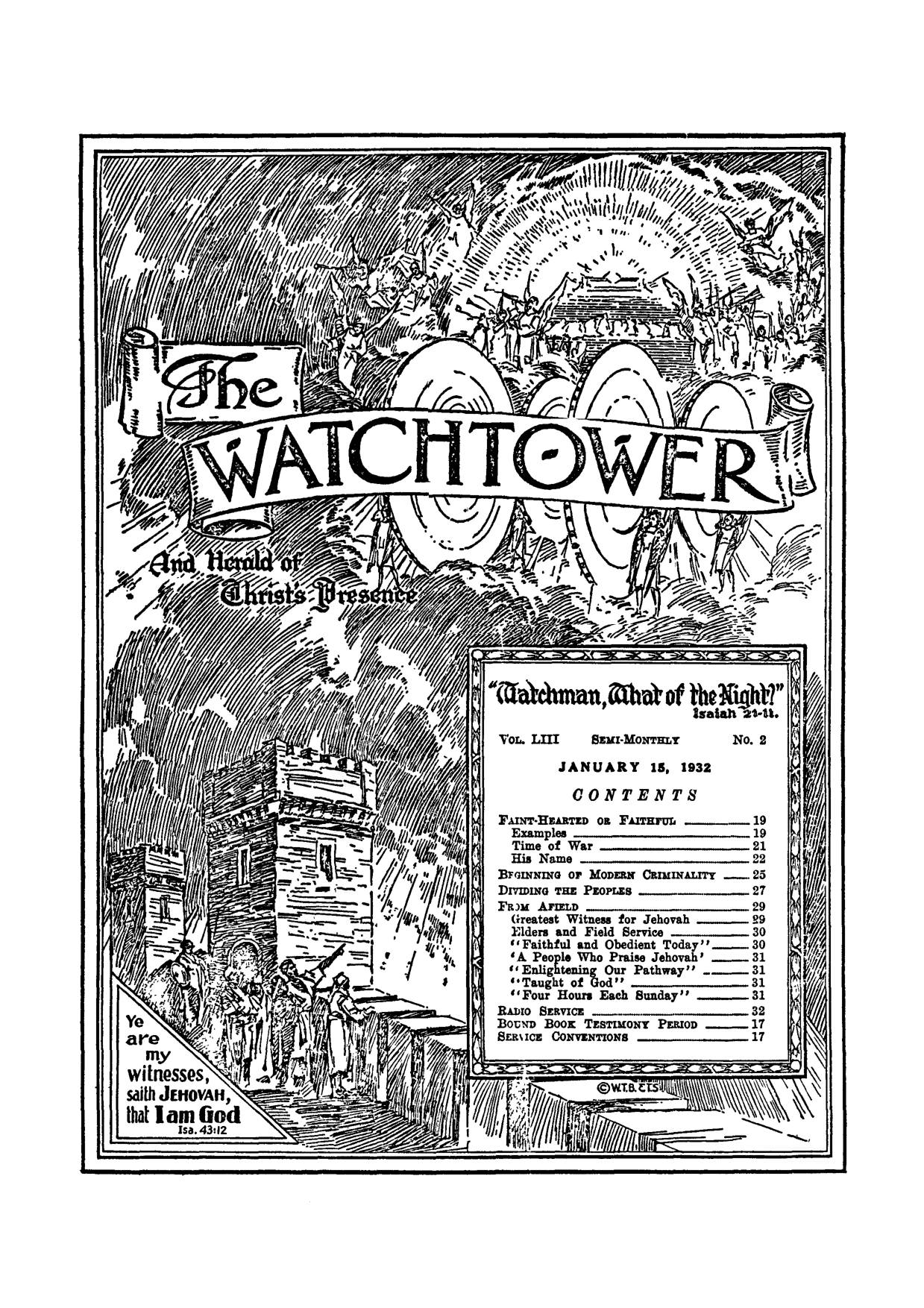
The Watchtower, January 15, 1932
Download: PDF — The Watchtower, January 15, 1932
BOUND BOOK TESTIMONY PERIOD
Special attention is here called to the Bound Book Testimony Period, to start on January 30 and end February 7. It is hoped that every one of the anointed will make extraordinary efforts to spend all of the designated period, or just as much as possible, in the field. The finest time of the whole year for the people to read is during the long evenings of February and March, and the continued depression and unemployment have done more to open their ears than has any other thing. Never before has the field been so ripe for our work, and never before has the public been offered so much for so little. Any four of the clothbound books for one dollar, or the entire set of ten for only $2.50. ‘Instant in season and out of season’ is the divine rule for the Lord’s witnesses. Most folks will invite you into their homes during the winter, and that is a very good thing.
Let us all strive to make the Bound Book Testimony Period the best midwinter effort thus far.
CALENDAR FOR 1932
We have them ready now, and we think the brethren will not mind the slight delay when they see how beautifully they have been made up to illustrate the year’s text, “They shall know that I am Jehovah.” As he caused the rulers of ancient Egypt to know that he is Almighty God, so Christendom shall know The painting on this year’s calendar shows Jehovah’s
judgment on Christendom, while the border, in Egyptian motif, shows the destruction of Pharaoh’s hosts. Single copies, 30c; in lots of five or more to the same address, 25c.
Vol. LIII
January 15, 1932
No. 2
FAINT-HEARTED OR FAITHFUL
“Ye approach this day unto battle against your enemies; let not your hearts faint; fear not, and do not tremble, neither be ye terrified because of them; for the Lord your God is he that goeth with you, to fight for you against your enemies, to save you.”—Deut. 20:3,4.
JEHOVAH purposed from the beginning to vindicate his word and his name. In carrying forward his purposes he selected the people of Israel, made with that nation a covenant, and offered them ample opportunities to trust implicitly in him and to prove their faithfulness to him. Only a few of that people maintained their integrity toward the Most High. The others failed, and the nation fell away from God because of unbelief or unfaithfulness. “For if God spared not the natural branches, take heed lest he also spare not thee. ’ ’—Rom. 11: 21.
2 The enemy Satan challenged God to put on earth men that would maintain their integrity toward God. Not only did Jehovah accept the challenge, but he gave his word that he would produce a “Seed” by his woman, that is to say, his organization, that in due time would destroy the enemy and his power. Had the Israelites been faithful and true to their covenant and trusted in and obeyed God, “The Seed” would have been taken exclusively from that people. Christ Jesus is “The Seed”, and those who are with him and made a part of him are also made a part of “The Seed”. (Gal. 3:16, 26-29) The Word of God lays down certain and specific rules which do not change. The rules governing the selection of “The Seed”, and which were announced to Israel, apply with equal force to those who are selected from amongst the Gentiles. The importance of these rules is emphasized to those who are in the covenant for the kingdom and who are now on the earth. What God said to the Israelites applies with greater force to God’s people now on earth, because the great climax has been reached.— 1 Cor. 10:11; Rom. 15: 4.
EXAMPLES
3 Jehovah has caused to be recorded in his Word the names of certain men whom he approved and some of the work they did, and every one that was approved by him the record discloses as faithful to God. Not one of those that God approved failed under the test because of fear. Some of them, like Elijah, manifested fear for a time; but by the Lord’s grace he overcame that fear and went boldly on in doing the work that God had assigned to him. Since the record was made in the Bible for the benefit of those of God’s people upon whom the end of the world has come, it follows that such record may now be reviewed with special profit to the anointed. When Jehovah makes special mention of a man, then we should look, not to the inherent qualities of that man, but to what he did in the sight of Jehovah that was pleasing to the Most High. These examples are for the purpose of instructing those who are in the way of righteousness.
4 Noah, Daniel and Job were greatly beloved by the Lord, and they are specially mentioned with approval in the Word of God. (Ezek. 14:14, 20) These three men were born sinners and were therefore imperfect, like all other men. (Rom. 5:12) There is nothing in the Scriptures to indicate that they were physically and mentally stronger than other men, and that had nothing to do with their approval. In fact, the wisest man mentioned in the Scriptures did not receive finally the approval of the Lord God. What was it, then, about these three men that called forth God’s approval and their special mention in his Word with commendation? It was fearlessness of the enemy and faithfulness in obedience to God’s commandment which had been given to them. They were uncompromising in their devotion to Jehovah. They were not men that were highly esteemed amongst other men of the world. They did not give their adulation and high esteem to other men. God sent Noah to warn the people of the world concerning the impending destruction by the great deluge of water that followed. By doing faithfully his duty Noah made himself unpopular with everyone aside from the members of his immediate family. The people mocked at him and jeered him, and year after year Noah steadfastly went forward telling the truth to the people. It was Noah’s faithfulness and devotion that pleased God.
5 Daniel was carried away a captive by the Babylonians. He was a young man of good appearance and intelligence, and by the reasonable application of himself and the use of his intelligence he might have been popular amongst all the people. In fact, Daniel was exalted to a high position in the kingdom of Babylon, and such was the result of his faithfulness to God. Thereafter came the great test upon him. At his request his three friends, Shadrach, Meshach, and Abed-nego, were placed in official positions in that kingdom. Evidently God permitted these things and what followed thereafter to show why he approves certain men.
6 God permitted the Devil’s crowd to put Daniel to the test. Darius the king was induced to make a royal statute or law which provided that for thirty days thereafter any man of the realm who would ask a petition of any god except the king should be cast into the den of lions. (Dan. 6:7) The purpose of this law was to get Daniel and to make of him food for the lions, and this conspiracy was worked up by the politicians and doubtless aided and abetted by the religionists. Daniel might have followed the course that some other men have since followed. Jehovah could have heard and answered his prayers if he made them in secret, just as well as if he made them openly. Daniel knew that, of course; and he knew that if he prayed to God that others might hear or know that he was doing so, he would be in danger of immediate death. Some other man would have reasoned like this: “Why should I make a fool of myself by praying in the open? I can pray secretly just as well. This is the law of the kingdom, and I must appear to be entirely obedient to the law.’’ Some of those today who claim to be consecrated to God would have said: “We are commanded in the Word to ‘be obedient to the higher powers’; and surely the law of the realm must be obeyed, because the rulers have said we must obey. We will therefore pray in secret for thirty days.” Not so with Daniel. He knew that “the higher powers” are Jehovah and those of his official organization acting under the direction of the Most High. His faith and confidence was wholly in God. Instead of trying to shield himself and to salve his own conscience by praying in secret, he would have everybody to know that he was putting his trust in Jehovah God, and him alone. Therefore three times each day he kneeled down by his open window and presented his petition of supplication to Jehovah God. He did not fear any part of the Devil’s organization, nor his own reputation amongst men; nor did he fear the wild beasts when doing his duty to the Lord God. He feared and trusted Jehovah. For violating the unchangeable law of the “ruling powers” Daniel was cast into the den of lions. Jehovah God stopped the mouths of the lions and delivered Daniel. It was Daniel’s uncompromising devotion and faithfulness to God that brought about his approval and deliverance.
7 Today there is a tendency among some of the consecrated of God’s people to compromise. For instance, there is in certain countries of Christendom an unwritten law or custom that, when the band of music or orchestra plays the tune “God Save the King”, every person present is expected to remove his hat and rise and stand at attention. Failure to do so subjects one to severe criticism and often to rough treatment at the hands of others. Some of the consecrated who claim to be serving God obey this unwritten law and excuse themselves by saying: “If I do not observe this custom I make myself obnoxious and conspicuous and I bring reproach upon the truth. ’ ’ Such is entirely false reasoning. The song “God Save the King” is in effect a petition or prayer of all persons present that God would preserve the kingdom now presided over by a certain man, which, of course, is a part of Satan’s organization. The petition or prayer is not for the individual who happens to fill the office, but for the ruler or government, and the purpose of which is to keep the people in an attitude of mind of always steadfastly standing for the government and to ask God to preserve that organization. The people in general do not know that Satan is the god of this world, the oppressor of the people, and the worst enemy of all men. They do not know that he has been God’s open and vile enemy for centuries and has builded his organization to reproach God’s name. The consecrated do know those facts. Jesus taught his followers to pray for the coming of God’s kingdom that his will might rule the world. Satan is the great enemy, and his organization, visible and invisible, opposes God. Jehovah shows his anointed people that it is proper for them to pray to him to destroy the enemy. “Let God arise, let his enemies be scattered; let them also that hate him flee before him. As smoke is driven away, so drive them away; as wax melteth before the fire, so let the wicked perish at the presence of God.” (Ps. 68:1, 2) “Man is like to vanity; his days are as a shadow that passeth away. Bow thy heavens, O Lord, and come down; touch the mountains [the kingdoms], and they shall smoke. Cast forth lightning, and scatter them; shoot out thine arrows, and destroy them. ’ ’—Ps. 144: 4-6.
8 Jesus Christ the King of the world has taken his power and begun his reign, and God has sent him forth to destroy the enemy and his organization. (Ps. 110: 2-5) Is it consistent for the anointed of God who are invited into the kingdom of Jehovah to publicly join with others in a request to save a part of Satan’s organization, and to do this in order to avoid criticism ? Is it consistent and faithful to God for the follower of Christ even to secretly say to the Lord: “I joined in that petition to save a part of Satan’s organization. I did it in secret, but I did not mean it.” Such a course is compromising with Satan’s organization, and is taken by faint-hearted ones who fear and who lack in faithful devotion to Jehovah God.
9 That this is the correct conclusion is proven from the Scriptures. Daniel’s three friends, who were placed in positions of responsibility in the government at his request, were put to the severe test. Being in the employ of the government might have been even a greater excuse for them to observe their law regardless of what it was. The record of this test of these three men manifestly was made and kept that it might appear what is the proper course for a consecrated one to follow and what is pleasing to Jehovah God. The laws of that realm then provided that, when the band of music played, the people must bow down before the golden image which the king had erected and which was an outward evidence of a petition. It is exactly similar to the unwritten law or petition “God save the king”. Meshach, Shadrach, and Abed-nego refused to bow down when they heard the music, and for their offense they were cast into the fiery furnace; and Jehovah God delivered them therefrom without even as much as a thread of their garments being scorched. (Dan. 3: 4-25) Their faith in God and their faithfulness to Jehovah brought forth his approval and their deliverance, and show what is pleasing to God It is not pleasing to God for men to take a compromising course and to excuse themselves on the ground that any other course would bring reproach upon his truth. Jehovah will take care of the truth; and what he commands is obedience of his people to him. It is not material what other people may think. That which is of all-importance is what God requires. One then will ask: “What shall I do when the band plays 'God Save the King?’ ” The best thing is to stay away from such assemblies. If, however, you are caught there, or circumstances put you in a crowd of people where the band does thus play, then be loyal to the Lord God. If taken to task because of your course, then calmly and plainly state that you are a child of Jehovah God and for his kingdom, because his kingdom will vindicate his name and bless the people; that the kingdoms of this world are Satan’s organization in opposition to God, and that you cannot and will not stultify yourself by joining in a petition, either directly or indirectly, that God should save a part of the Devil’s organization. Daniel, Meshach, Shadrach and Abed-nego were willing to put themselves in jeopardy, so far as Satan’s organization was concerned, in order that they might be witnesses to the name of Jehovah. Surely a follower of Christ could not do less.
10 Job was subjected to the most severe test. The Devil caused the destruction of his property and his family, and then inflicted upon him great bodily suffering and mental anguish. The worst of all, however, was when the three pious, sanctimonious frauds came to console Job, they claiming to represent God. Job might have said, if he had wanted to take a compromising course: “I must show these men that I am entirely submissive, and will agree with them, that they may know that God is my friend and that I am a good man. Otherwise I shall lose my good reputation which I have so long enjoyed in this land.” Job did not take any such compromising course. He cared nothing for the approval of men; but he cared everything for the approval of Jehovah God. and he unflinchingly held fast to his integrity and in his dire distress cried out: ‘ ‘ Though he slay me, yet will I trust in him.” Amidst all of his persecutions he remained true and steadfast in his devotion to God, and thereby received Jehovah’s approval.
11 These men are mentioned in the Scriptures for the manifest purpose of showing that those who please God and maintain their integrity toward him must do so by refusing to compromise with any part of Satan’s organization. These are some of the examples put forth in the Bible for the aid and comfort of those who are God’s witnesses in the world at this very day. There could have been no other reason for recording them in the Bible, and the specific statement of the Scriptures is that for this reason they were recorded.
12 Those today who oppose the proclamation of the message of the kingdom of God and the declaration of God’s vengeance against the enemy’s organization use a subtle argument in their attempt to cause the weaker ones to lay down their weapons of warfare. They say to those who are actually engaged in the witness work: “You should not say anything unkind or that would expose the duplicity of the clergymen, because some of them might be driven away from the truth. You should speak only of God’s love, that you might influence them to come to the Lord. You should not say anything about the rulers of Christendom, because these are the ‘higher powers’ ordained of God, and you must appear to be entirely obedient to the laws and edicts of these rulers; otherwise you will bring reproach upon the truth. In fact, you are engaged in a book-selling scheme, and for that reason some of you are arrested and imprisoned for peddling without license contrary to the law. What will the people think of your doing such as that to bring reproach upon the truth?” The Devil is a wily foe, and he uses all kinds of fraudulent means against the Lord’s people. Those who go to make up the “faithful servant” class will not be deceived by any such subtle and deceptive speech. “The servant” of God only wants to know what is the will of the Lord, and that he will do, trusting always in the Most High. Let those who desire to take a compromising course do so; but no one who loves God and his kingdom, and who will ever receive God’s approval, will take such a course or be influenced by those who thus do. There is no necessity to be rude or harsh, but let all who love God tell the truth as God has commanded it shall be told. Let their course of action be consistent with one who is in the covenant for the kingdom. No others will receive God’s approval. The faint-hearted and fearful will not be in the kingdom.
TIME OF WAR
13 Christ Jesus the King has been enthroned. The time has come when God sends forth his beloved Son to rule amongst his enemies, and the enemy must get out. (Ps. 110: 2) The great day of God Almighty is here, and the battle of Armageddon is soon to be fought. The testimony of Jesus Christ has been committed to the remnant of God’s people, and these constitute his witnesses upon the earth. Against these witnesses Satan is making war. (Rev. 12:17) The weapons of our warfare are not carnal, but, being the message of truth, the same are mighty to the pulling down of strongholds of wickedness. Jehovah has commanded his people to wield the weapons of warfare which he has placed in their hands. All those who will ever have God’s approval and be a part of the kingdom must have some part now in the warfare against the enemy. “Let the saints be joyful in glory; let them sing aloud upon their beds. Let the high praises of God be in their mouth, and a two-edged sword in their hand; to execute vengeance upon the [nations], and punishments upon the people; to bind their kings with chains, and their nobles with fetters of iron; to execute upon them the judgment written; this honour have all his saints. Praise ye the Lord.”—Ps. 149:5-9.
14 This is the day of the vengeance of our God, and those who now maintain their integrity toward him must declare his truth. (Isa. 61:1, 2) The faithful must give notice and warning to the rulers and to the peoples of the world, and particularly to the religionists, of God’s purpose to destroy Satan’s wicked organization by his kingdom. There is no alternative. Failure to be obedient to the Lord in this behalf will result in his disapproval and the loss of everything.—Ezek. 3:17-19.
15 The record of the wars in which Israel engaged, and the instruction of the Lord concerning the same, is not merely set forth as a historical fact, but the record is made and kept as a guide for the followers of Christ Jesus now on the earth. The anointed of the Lord now see that Satan’s organization, composed of the commercial, military, political and religious elements, is symbolized by horses and chariots, and that the people in battle array against the Lord and against his anointed symbolize Satan’s hordes aligned against God’s faithful witnesses. Therefore the words of instruction which Jehovah gave to the Israelites apply with stronger force to God’s people now, when he said: “When thou goest out to battle against thine enemies, and seest horses, and chariots, and a people more than thou, be not afraid of them; for the Lord thy God is with thee, which brought thee up out of the land of Egypt.”—Deut. 20:1.
16 Jehovah God has taken out from the world (Egypt) a people for his name, and he will give his approved ones some part in the work of vindicating his name. To those on the Lord’s side he now says: “And it shall be, when ye are come nigh unto the battle, that the priest shall approach, and speak unto the people, and shall say unto them, Hear, O Israel; ye approach this day unto battle against your enemies ; let not your hearts faint; fear not, and do not tremble, neither be ye terrified because of them; for the Lord your God is he that goeth with you, to fight for you against your enemies, to save you.” (Deut. 20:2-4) Those who have received the love of the truth will not now permit themselves to be deceived by the “[soft] words and fair speeches [used to] deceive the hearts of the simple”. The faithful who love God are familiar with the methods and workings of Satan, and they will have nothing to do therewith nor be influenced by any part thereof. (Rom. 16:17, 18; 2 Thess. 2:9-11) The final war is on; and those who love God will stand firmly on his side and battle for the right, and they will do it boldly and fearlessly. This is the day of God’s judgment; and all who love him will boldly declare his truth, and those who are fearful of heart show they do not love him. (1 John 4:17, 18) The faithful will not compromise or take the way of least resistance because of a desire to please men. Their lives must be a witness to Jehovah.
HIS NAME
17 The great issue that must now be determined is the name of Jehovah God. All religionists and all religious organizations that have ever existed or do now exist have defamed God’s holy name. Only the true followers of Christ Jesus do now honor, and delight to honor, God’s name. When the apostles were on the earth the church was then in unity and sought solely to honor God’s name. The faithful ones then did not hesitate to proclaim the truth, and they did it under adverse conditions and amidst much persecution. Those today who would “put on the soft pedal” or otherwise hinder the proclamation of God’s message against the enemy organization have not received the love of the truth; and what they have received is the truth in word only. Paul was a special messenger of the Lord to the nations, and under his leadership the faithful ones hesitated not to tell the truth. To them he wrote: “We give thanks to God always for you all, making mention of you in our prayers; remembering without ceasing your work of faith, and labour of love, and patience of hope in our Lord Jesus Christ, in the sight of God and our Father; knowing, brethren beloved, your election of God. For our gospel came not unto you in word only, but also in power, and in the holy [spirit], and in much assurance; as ye know what manner of men we were among you for your sake.” (1 Thess. 1:2-5) Nor did those early Christians confine their work to quietly meditating and calmly speaking to one another or by being careful not to offend those of the worldly spirit. They had taken their stand on the side of Jehovah God, and his name they declared. Furthermore Paul wrote to them: “For from you sounded out the word of the Lord not only in Macedonia and Achaia, but also in every place your faith to God-ward is spread abroad; so that we need not to speak any thing. For they themselves shew of us what manner of entering in we had unto you, and how ye turned to God from idols, to serve the living and true God.” (1 Thess. 1:8, 9) Their course was pleasing to God. The one who pleases God today can do no less.
18 In those early and strenuous days the fame of the witness to the Lord’s name and the fame of the witnesses were great, not because of their assumed sanctimoniousness, nor because of their efforts to tread softly to please men, but because of their boldness and fearlessness in declaring the truth. ‘‘Your faith is spoken of throughout the whole world.” (Rom. 1:8) Their faith was made known by what they did. God’s purpose is that his approval shall be of his witnesses who declare the truth to all creation. (Col. 1:23, R. V.) This cannot be done by remaining quiet and inactive. ‘‘For we are made a spectacle [a theater] unto the world, and to angels, and to men.” (1 Cor. 4:9) As players upon a stage of a theater exhibit themselves and their work to the audience, so God’s witnesses must make known their work in the name of the Lord to all who will hear. Let the world and all of the enemy organization think of God’s people what they please. That is immaterial. The day is not far distant when all will come to know that God has had on the earth at this time a class of men and women who are his faithful and true witnesses and who have not shunned to declare the truth, and who have thus maintained their integrity toward God. The weak and perverse will criticize now, and do so; but be sure to take the course of action that will call forth God’s approval: “Having your conversation honest among the Gentiles; that, whereas they speak against you as evil doers, they may by your good works, which they shall behold, glorify God in the day of visitation.”—1 Pet. 2:12.
19 Heathen religion is the Devil’s religion. All religions that are anti-kingdom of God are devilish, even though such bear the name of Christ and claim to be God’s people. The faithful and true witnesses of God, who honor his name and declare his Word and do so joyfully, are the only ones that please him. “For we are unto God a sweet savour of Christ, in them that are saved, and in them that perish; to the one we are the savour of death unto death; and to the other the savour of life unto life. And who is sufficient for these things?”—2 Cor. 2:15, 16.
20 God’s faithful witnesses are the ones who now hold forth the light of the truth that his name and Word might be known. It is such that receive his approval, because they are blameless before him. “That ye may be blameless and harmless, the sons of God, without rebuke, in the midst of a crooked and perverse nation, among whom ye shine as lights in the world; holding forth the word of life; that I may rejoice in the day of Christ, that I have not run in vain, neither laboured in vain.” (Phil. 2:15, 16) God’s witnesses are a peculiar people taken out from amongst men for his purposes, and their work is to show forth his praises, and not the praises of men. (1 Pet. 2: 9, 10; Acts 15:14) That which makes these a peculiar people and a theater to men and to angels is “the word of light”, which they hold forth to the honor of Jehovah’s name.
21 If it was important that Paul and other apostles boldly preach the gospel in their day, with stronger reasoning must the followers of Christ Jesus with boldness and fearlessness preach the gospel in this day. Those faithful men in the apostle’s day were laying the foundation of ‘ ‘ Christianity ’ ’ amongst the people. Today the judgment of all “professed Christianity” is on. It is the day of the vengeance of our God against all workers of iniquity. It is the day in which he will vindicate his name, and our part therein is to declare his truth. No one can today prove his faithfulness to God and maintain his integrity toward God unless he boldy takes his stand on God’s side and fearlessly and boldly speaks the truth, and thereby proves that he is of the class that compose God’s faithful and true witness, the “servant” class now on the earth.
22 Those who are opposed to the work of Jehovah’s witnesses and who declare that such are engaged in a book-selling scheme have not the love of the truth, though they once had a knowledge of the truth. Many of them at one time were in the ‘colporteur’ work. If it is wrong to “sell” books now, it was wrong to “sell” them then. They have lost the spirit of the Lord and wish some excuse to scandalize God’s witnesses. It was not wrong, either then or now, to put out the books in the manner in which they are put out. If these opponents had received the love of the truth and continued therein, they would now delight to bear the fruits of the kingdom to the people as witnesses to the word and name of Jehovah. Nothing is said here in an attempt to force anyone into God’s service. Obligation is laid upon God’s anointed to warn those who were once righteous and who turn to lawlessness, as well as to warn others who are in the way of the light. “Again, When a righteous man doth turn from his righteousness, and commit iniquity, and I lay a stumblingblock before him, he shall die; because thou hast not given him warning, he shall die in his sin, and his righteousness which he hath done shall not be remembered; but his blood will I require at thine hand. Nevertheless, if thou warn the righteous man, that the righteous sin not, and he doth not sin, he shall surely live, because he is warned; also thou hast delivered thy soul.” —Ezek. 3: 20, 21.
23 Those who have once been made righteous and who then become fearful and faint-hearted will not continue in the warfare and will not be of the kingdom. Such the Lord tells to go back home and quit the fight: "And the officers shall speak further unto the people, and they shall say, What man is there that is fearful and fainthearted? let him go and return unto his house, lest his brethren’s heart faint as well as his heart. ’ ’—Deut. 20: 8.
24 Paul warned the leaders of Ephesus, emphasizing the importance of their being examples of faithfulness to the flock. The Ephesus period of the church seems clearly to apply from the beginning of the Lord’s second presence until the second effusion of the holy spirit. In that period of time there were some faithful elders and some unfaithful ones. In harmony with God’s expressed will The Watchtower, in 1916, sounded the warning to the elders in the church. Those who did not heed that warning showed they had not received the love of the truth; and they fell away and became a part of the "evil servant" class. They became faint-hearted because looking too much to self and for the approval of men, and not looking wholly to the Lord. Those who did not faint, but who continued faithful unto the Lord’s commandments, he addresses thus: “I know thy works, and thy labour, and thy patience, and how thou canst not bear them which are evil; and thou hast tried them which say they are apostles, and are not, and hast found them liars; and hast borne, and hast patience, and for my name’s sake hast laboured, and hast not fainted. ’ ’—Rev. 2:2, 3.
25 Paul was privileged to see many things that it was not lawful for him to make plain at the time. But doubtless he had in mind the dangers lurking in the way, particularly with reference to selfishness and faint-heartedness, when he wrote to the people of God: “For if a man think himself to be something, when he is nothing, he deceiveth himself. But let every man prove his own work, and then shall he have rejoicing in himself alone, and not in another. And let us not be [fainthearted, Roth.] in well doing; for in due season we shall reap, if we faint not.” (Gal. 6:3, 4, 9) The faint-hearted have removed from them by the Lord the opportunities of serving him, just as the faint-hearted amongst the Israelites were directed to go to the rear.
26 Only the faithful will maintain their integrity toward God, and that faithfulness will not be made manifest by what is generally termed “character development”. Every one who is faithful must, from the time of being brought forth as a son of God, continue to grow in the likeness of Jesus Christ. That means that he must increase in his devotion and faithfulness to God, striving to come up to the point of perfection Jesus occupied. He must be pure in thought and word and action, and that means much more than ‘soft speech and good words’, pious looks and outward gentleness. Every Christian should do all he can to make himself as nearly perfect as possible; but after he has done all that he can, he finds that he comes far short of being entirely perfect in thought, word or action. To be pleasing to God he must use the faculties with which he is endowed and bear the fruits of the kingdom, and do it joyfully and fearlessly. Such fruits of the kingdom are the life-sustaining truths that are made known by the Lord for the salvation of men and for the vindication of Jehovah’s name. There is no one man mentioned in the Bible with approval (aside from Jesus Christ) who was a perfect character. On the contrary, every one of them was imperfect, but each one of the approved ones walked in the same way that Jesus Christ walked, to wit, without compromise, and unswerving in his devotion to Jehovah God. Such a course, and that alone, brings forth the approval of Jehovah.
27 Now the war is on to the finish, and those who are faint-hearted will drop back to the rear and get out of the ranks. Because they do not wholly trust in Jehovah they will become faint-hearted and fall. The faithful who completely trust in Jehovah and his King, who leads them, will go boldly and fearlessly on singing aloud the praises of the Most High. No one can actively engage the enemy in war without receiving the assaults of the enemy. The faithful must therefore expect to be slandered, lied about and abused by the enemy and his agents, but none of these things will they permit to deter them in their course of righteousness. They must expect to be threatened with bodily harm and probably subjected to some; but they know that Jehovah will see to it that the darts of the enemy do not injure them as long as they are in the line of duty. This is the war of God Almighty against the forces of the enemy, and Jesus is leading the army. The earthly division of his army must merely sing the praises of Jehovah, and in doing so will not fear either man or devil. “For the Lord your God is he that goeth with you, to fight for you against your enemies, to save you.” (Deut. 20:4) This promise is just as true today toward God’s anointed people as it was toward' the Israelites, and even more so. Jehovah has put his hand over his witnesses now on the earth, and has entrusted to that company the opportunity and privilege of delivering his message of truth; and no power of the enemy can check their onward march to victory.—Isa. 51:16.
28 These faithful witnesses are now maintaining their integrity toward God, and their “light affliction” that comes upon them by reason of faithfulness does not discourage them, because they know that such is working out for them “a far more exceeding and eternal weight of glory”. (2 Cor. 4:15- 17) Jehovah has selected from the world a people for his name and has called them to a heavenly place. “Faithful is he that calleth you, who also will do it.” (1 Thess. 5:24) Christ Jesus was and is Jehovah’s “Faithful and True Witness” and God has called the remnant to partnership with Christ Jesus in faithfulness and in truth; and the remnant must now deliver the testimony of Jesus Christ committed to them. The remnant may be fully assured that the Lord will direct them exactly in the way they should go. Continuing steadfastly following in that way, the remnant will have a part in the vindication of Jehovah’s name.
QUESTIONS FOR BEREAN STUDY
1, 2. Account for Jehovah’s special dealing with the people of Israel. To them was offered what great privilege ? Did they use the opportunity which was theirs ? Why, and with what result? What is the lesson therein for God’s covenant people now?
3. Why has Jehovah provided a record of certain persons whom he approved? How may we profit by a study of such record?
4. Name some of the men mentioned with approval. Compare these with other members of the human family. Just why, then, did they receive Jehovah’s approval and special mention in his Word? As to Noah, describe his circumstances, and the course he took by which he pleased God.
5, 6. How had Daniel and his three friends attained to the official positions which they occupied? Describe how Daniel was put to the test as to his loyalty to Jehovah. Contrast his line of reasoning and course of action with that usually chosen under similar circumstances. What were the results of his procedure?
7. 8. Illustrate how some of the consecrated, in observing certain customs, lend their influence and support to Satan’s organization. What of the expediency of “mental reservation” under such circumstances? In this respect compare the position of the consecrated with that of the people in general. Quote scriptures to show the proper attitude of the consecrated toward the enemies of God.
9. Relate the case of Shadrach, Meshach and Abed-nego, as illustrating the proper course for the consecrated. Describe some situations in our day which correspond to those in which Daniel and his three friends proved their faithfulness and received Jehovah’s approval. What is to be done in this respect by the consecrated?
10. Relate how Job maintained his integrity and gained Jehovah’s approval.
11. The records concerning the men mentioned above serve what important purpose?
12. Paraphrase the subtle argument advanced by those who oppose the proclamation of the message of the kingdom and the declaration of God’s vengeance against the enemy’s organization. What is the source of such argument? What course of action will be taken by those who will receive God’s approval? What will be their conduct toward those who oppose?
13, 14. From Psalm 110: 2 and Revelation 12: 17, what is the position of the remnant at this time? How do Psalm 149: 5-9 and Ezekiel 3: 17-19 define the duty of the anointed ?
15, 16. What was Jehovah’s purpose in providing record of Israel’s wars and of his instructions concerning them? Quote from that record, showing its present application and how it is now serving his purpose.
17, 18. From Paul’s first letter to the Thessalonians, show whether the early Christians confined their work to quiet meditation and discussing the truth among themselves or were careful not to offend those of worldly spirit. Point out from other scriptures that the faithful ones then were active in bearing to others God’s message of truth.
19, 20. How do 2 Corinthians 2: 15, 16 and Philippians 2: 15, 16 indicate the necessity and importance of bearing forth the truth to others? How only can the anointed be used for the purpose for which God has taken out a people from the nations?
21, 22. Compare the situation at the present time with that in the days of the apostles, as showing what is required of all who would be of the faithful and true witness class. Compare the present method of putting out the books containing the message of truth with that employed formerly. Account for present opposition by some who were at one time in the ‘colporteur’ work. Whom is Jehovah’s watchman to warn? Obedience in this matter serves what purposes, and how?
23, 24. Account for the existence now (a) of a class foretold in Deuteronomy 20: 8. (b) Of a class approved in the words of Revelation 2:2, 3.
25. What purpose was to be served by Paul’s words recorded as Galatians 6:3, 4, 9?
26. State definitely the course which must be pursued by every one who will maintain his integrity toward God and receive his approval.
27. What may the faithful expect as the result of their course of righteousness? Apply Deuteronomy 20: 4.
28. How will the faithful regard afflictions attending their course? What assurance is theirs? What great privilege?
BEGINNING OF MODERN CRIMINALITY
CAIN, the first man “born of a woman” on earth, was a tiller of the soil. He must labor among the thorns and thistles which grew outside of the garden of Eden, in his endeavor to produce food for himself and other members of the family. Of course his parents, Adam and Eve, had told him about their experience in Eden, and how God had provided that they should work to produce their food in the sweat of their brow; and as he fought with the thorns and thistles he would be inclined to grow morose and bitter. Cain had inherited from his fallen parents all the bad disposition possessed by each of them. They were both bad, because they had violated God’s law. We would understand, then, that Cain was morose, sour and bitter of heart.
Abel, the second son of Adam and Eve, was a shepherd. His name means “feeder”, or “nourisher”. He helped to provide for the family of his father and probably had a family of his own. From his parents he had also learned of their experience in Eden. They would have told him of their perfectly beautiful home, and how because of their disobedience God had expelled them from it, and that he had left a faint hope that some day they might have his blessing again.
Throughout the day Abel was in the broad fields herding his flocks and protecting them from the attack of wild beasts. At nighttime he would see to it that they were properly cared for and sheltered from harm; and then in the long and silent vigils he would meditate upon what he had learned from his parents concerning God, and what he saw about him manifested in God’s creation. He would reason that the great God who gave life to his father and mother also gave life to the sheep of his flock; and that if he, Abel, took pleasure in caring for and protecting dumb animals no doubt the great God would take pleasure in caring for all who would obey and serve him. He reverenced Jehovah God, and his faith in the Lord grew and he had a desire to do the will of Jehovah. Having learned from his mother concerning the “seed” which Jehovah God had said would bruise the serpent’s head, and prevail against the enemy thus, Abel would look forward to some future time when God would provide for the blessing of himself and all others who would serve him. His faith was pleasing to God and he grew in the Lord’s favor.
Satan, of course, would be keeping close account concerning these two sons, Cain and Abel. If one of them seemed to have the favor of Jehovah, to Satan that would mean that such one was his own enemy; and he would take steps to cause that one’s destruction.
In the process of time these two sons, Cain and Abel, brought their offerings unto the Lord God. The sour and grouchy Cain came with some fruit, the result of his labors. Being extremely selfish he would be thinking about how hard he had labored, and the great number of thorns and weeds he had to destroy in order to produce that fruit, and now he must sacrifice it unto the Lord and would get no profit for himself. He reasoned that he was conferring a great favor upon God by bringing this sacrifice unto him, especially when the Lord did not need it. He would conclude that, being the first son, he was the favored one of Jehovah. He was proud and arrogant, sour and mean; and the Devil had planted all these things in his heart.
At the same time came Abel, the kind and reverential man. He brought his sacrifice unto the Lord. He reasoned that all he had was a gift from God, and now he desired to show his appreciation by bringing the best he possessed unto the Lord. He slew the choicest one of his flock and brought the flesh, together with the fat, the latter representing the best endeavors, loving zeal, and unselfish devotion to God and to righteousness. It was a real sacrifice for him to give up the best animal, but he considered his best a very small thing to give to the Lord God. It is written in Genesis, chapter four, verses four and five: “And the Lord had respect unto Abel, and to his offering: but unto Cain, and to his offering, he had not respect.” Abel had faith and loved God. Cain had no faith and was selfish and sour. Abel, because of his faith, was counted righteous in the sight of God. Cain had an evil heart and was disapproved. In the eleventh chapter of Hebrews, verse four, it is stated: “By faith Abel offered unto God a more excellent sacrifice than Cain, by which he obtained witness that he was righteous, God testifying of his gifts: and by it he, being dead, yet speaketh.”
Seeing that God had no respect for a selfish and faithless offering, Cain grew very angry, and manifested his anger in his countenance. The opportune moment had arrived for Satan to act. He now induced Cain to conclude that he should put his brother out of the way, because he was a rival and threatened to become the most important one of the family. The selfish and sour Cain bided his opportunity; and when he found his brother in the field he slew him. To cover up his wicked deed he resorted to lying. Chapter four of Genesis, verses eight to eleven, describes the affair in these words: “And Cain talked with Abel his brother: and it came to pass, when they were in the field, that Cain rose up against Abel his brother, and slew him. And the Lord said unto Cain, Where is Abel thy brother? And he said, I know not: Am I my brother’s keeper? And he [the Lord] said, What hast thou done? the voice of thy brother’s blood crieth unto me from the ground. And now art thou cursed from the earth, which hath opened her mouth to receive thy brother’s blood from thy hand.” Cain had now wholly become a servant of the Devil, and like his master he had become a liar and a murderer. (John 8:44) Satan the Devil would reason that the death of the righteous Abel would not only rid him of an enemy but deter others from serving Jehovah God.
Years passed and many other children were born, both male and female. Among these was a son named Jabal, who headed the tribe of cattle-raisers and who dwelt in tents. Then came Jubal, who organized and trained musicians to play upon the harp and the organ. Then the record shows Tubal-cain, who was an instructor in the art of making brass and iron. Enos was a grandson of Adam, and by the time he came upon the scene there was a great number of human creatures on the earth; and all of these were under the influence of the Devil. The practice of mockery and hypocrisy was now introduced by the people’s calling themselves by the name of the Lord but in truth and in fact ridiculing and blaspheming his holy name.
When Adam went forth from Eden he was not physically weak, nor was he sickly. Although deprived of his right to life, yet he was in vigor and strength. Gradually he must pay the penalty for his wrongful act. When he was one hundred and thirty years old he begot another son in his own likeness and called his name Seth, because he was regarded as a substitute for Abel, who had been murdered by Cain. Then came other sons and daughters. Adam was past two hundred years old when he saw his great grandchildren in strength and vigor of manhood and womanhood, and himself still able to beget children. After he begot Seth he lived eight hundred years and begot many sons and daughters. Adam died at the age of nine hundred and thirty years.
The strength of man in his vigor, and his ability to fight against the elements of the earth, are indicated by the length of time that men survived, as recorded in the Scriptures. Seth lived for nine hundred and twelve years. Enos, the grandson of Adam, died at the age of nine hundred and five years. Cainan, the son of Enos, lived to be nine hundred and ten years of age. Mahalaleel lived for eight hundred and ninety- five years. Jared, when at the age of one hundred and sixty-two years, begat Enoch. Thereafter he lived eight hundred years, and died at the age of nine hundred and sixty-two years. Enoch loved God and served him. When he was three hundred and sixty-five years old, and while still in the vigor and strength of manhood, God took him away that he might not feel the pangs of death. His son Methuselah lived to the age of nine hundred and sixty-nine years.
But be it noted that neither Adam nor any of his offspring ever lived a full thousand years. Why was that so? Because the law of God, which was given to Adam, stated: “In the day that thou eatest thereof [that is, of the forbidden fruit of the tree of the knowledge of good and evil], dying thou shalt die.” (Gen. 2:17, margin) This is proof that Adam must gradually die and that by the end of the “day” he must be dead completely. All the other men just mentioned were Adam’s sons or grandsons, and were born without any right to live; and they must die within a ‘ ‘ day ’ ’, because they had inherited the result of Adam’s wrong-doing. A “day” is used to represent any fixed period of time, and when related to the earth’s creation the Scriptures show that each day is seven thousand years long. When related to the creation of man, and when speaking of time as related to man, a “day” in the Scriptures is one thousand years in duration of time, if computed in the manner that man computes time. It is written in Second Peter, chapter three, verse eight: ‘ ‘ One day is with the Lord as a thousand years, and a thousand years as one day. ’ ’
Enoch was the seventh generation from Adam; and during all that period of time of more than six hundred years only two men, Abel and Enoch, manifested faith in and love for God the Lord and served him. The Devil had caused Abel to be murdered, and God took away Enoch that he might not see death. No doubt the Devil would have caused him to be killed had not God protected him. All other men on earth were under the influence of Satan and were wicked. After the death of Enoch wickedness continued to increase, and the race degenerated year by year. There is no proof that until the birth of Noah there was on earth another God-fearing man, after Enoch was taken away. The name Noah means rest, or comfort, and evidently signified that during his time some change might take place which would be a comfort to him and increase his hope.
DIVIDING THE PEOPLES
LONG ago, through the utterances of his prophet (Isa. 62:10), Jehovah God gave the commandment for his witnesses: “Go through, go through the gates; prepare ye the way of the people; cast up, cast up the highway; gather out the stones; lift up a standard for the people.”
It was in obedience to the commandments of the Lord God to “lift up a standard for the people” that a company of Christians, wholly devoted to Jehovah, assembled at Detroit, Michigan, on August 5, 1928, and by unanimous vote adopted and sent forth to the peoples of the world the following declaration:
“DECLARATION AGAINST SATAN AND FOR JEHOVAH
“[Jehovah’s witnesses] in international convention assembled do declare themselves against Satan and wholly for Jehovah of hosts, and emphatically announce further these vital truths, to wit:
“First: That the peoples of earth, organized into forms of government and under the control of a superior and invisible ruler, constitute the world;
“Second: That Jehovah is the only true and Almighty God and the source of all just authority; that he is the King Eternal, the God of justice, wisdom, love and power, and the true friend and benefactor of all creation;
“Third: That Jehovah delegated to his son Lucifer the authority to be the overseer of man; that Lucifer became disloyal, rebelled against God and caused man to fall away from righteousness, and since that rebellion Lucifer has been known by the titles Dragon, Serpent, Satan and Devil; that Satan the Devil has caused strife amongst the nations and is responsible for all the cruel wars, wicked murders, all heinous crimes and other corrupt acts that have been committed; that until now Jehovah has not restrained Satan from the exercise of power and influence over man; that for many centuries Satan has been the invisible ruler of the world, constantly defaming the name of Jehovah God and working great injury to men and nations;
“Fourth: That Jehovah promised that in his due time he would restrain Satan and establish a righteous government in the earth that men might have an opportunity for life everlasting in happiness; and to that end he anointed his beloved Son Jesus to be the Redeemer and invisible Ruler of the world;
“Fifth: That Jehovah’s due time has come to fulfil his promise and to clear his reputation in the minds of all creation; that Christ Jesus has taken his high office as the executive of Jehovah and the great issue now is, Who is God, and who shall rule the peoples and nations?
“Sixth: That because Satan will not surrender his wicked rule over the nations and peoples of the earth, Jehovah of hosts with his anointed executive officer Christ Jesus will press the conflict against Satan and all of his forces of evil, and henceforth our battle-cry shall be, THE SWORD OF JEHOVAH AND OF HIS ANOINTED; that the great battle of Armageddon soon to begin will result in the full restraint of Satan and the complete overthrow of his evil organization, and that Jehovah will establish righteousness in the earth by and through Christ, the new Ruler, and will emancipate mankind from evil and bring everlasting blessings to all the nations of the earth;
“Seventh: Therefore the due time has come for all who love righteousness to take their stand on the side of Jehovah and obey and serve him with a pure heart, that they may receive the boundless blessings which the Almighty God has in reservation for them.”
There are those who claim to be consecrated to God who insist that in the proclamation of the truth nothing should be said about Satan’s organization, and particularly about the clergy as the representatives of Satan. The argument of such is that to speak of Satan’s organization and the clergy is liable to cause offense and hinder the spreading of the truth. Such argument and such course of action are pleasing to Satan and are vigorously denounced by Jehovah in his Word. How can the people know anything about God’s organization if they are not told? If God’s anointed witnesses do not tell them, who will tell the people? How can the people know anything about the great enemy Satan and his wicked organization that oppresses them if God’s witnesses do not tell them? If the clergy are not part of God’s righteous organization, and if they support the politicians and profiteers of this world, then they are on the Devil’s side and their course of action turns the people away from God and his righteous government. By so doing the clergy steal the thoughts, the allegiance, and the devotion of the people from Jehovah.
He who steals is a thief. It is far more reprehensible to steal the faith and allegiance and devotion of the people from Jehovah than to steal the people’s money. The profiteers steal the money of the people. The clergy steal the allegiance and the devotion of the people from Jehovah, and therefore they are much more reprehensible. When the clergymen tell the people that God did not create man perfect; that man did not fall because of sin ; that the Devil had nothing to do with man’s fall; that man is a creature of evolution and can bring himself to the desired condition; that the blood of Jesus was not shed for the purchase of man’s right to life; that God and Christ Jesus and the holy spirit are one; and then, further, add insult to injury by declaring that the present oppressive governments on earth, combined under a league or compact, are an expression of God’s kingdom, then the clergy are guilty of a crime in the sight of God far greater than that of highway robbery.
If the consecrated person, who claims to follow in the footsteps of Jesus and to obey God’s commandments, sees the clergy thus stealing the faith, the allegiance and devotion of the people away from God, and turning them against God and turning them to the side of the Devil, and such consecrated Christian fails or refuses to cry out and give warning to the people, then he also is a party to the crime. Such are they who hate instruction that comes from the Lord and prefer rather to have the approval of the clergy or some of their allies. They are fearful of losing their own reputation or standing or position amongst the people, and are not fully devoted to the Lord.
God, through his prophet, foretold this condition at the present time, and that some who claim to be his true followers would insist on putting on the “soft pedal” concerning the clergy and their allies. Concerning such, God says: “What hast thou to do to declare my statutes, or that thou shouldest take my covenant in thy mouth [thou that claimest to be my son and witness] ? seeing thou hatest instruction, and castest my words behind thee. When thou sawest a thief, then thou consentedst with him, and hast been partaker with adulterers.”—Ps. 50:16-18.
No one can be faithful to God and receive his approval by taking a compromising position. He must be wholly on the Lord’s side if he would have God’s approval. He can find more favor amongst men of the world by pursuing a compromising course and speaking easy concerning Satan and his organization, and particularly the clergy; but if he does so, by taking such a course of friendship with the world he becomes God’s enemy. God’s Word declares (Jas. 4:4): “Know ye not that the friendship of the world is enmity with God? whosoever therefore will be a friend of the world, is the enemy of God.” If the fear of man and the loss of prestige or material wealth causes him to take such compromising course, he should remember the instruction from the Lord, who says through his prophet: “He [Jehovah] shall be for a sanctuary [a place of safety]. . . . Sanctify the Lord [Jehovah] of hosts himself; and let him be your fear.”—Isa. 8:13,14.
Jehovah’s truth is that which divides the people. He is having it declared to afford the people an opportunity to take their stand before the great and terrible battle of God Almighty against Satan’s organization. He advises all people of good will to seek meekness and righteousness now, that by so doing they may provide for themselves a hiding-place in that time of terrible trouble which shall shortly come upon the world. (Zeph. 2:2,3) As the truth is now being declared by radio, by the wide publication and distribution of books, and by personally speaking to the people, multitudes of people are separating themselves from the Devil’s religious system called “organized Christianity”, and are fleeing therefrom as rats flee from a sinking ship. By so doing they take their stand on the side of Jehovah God, and wait upon him. So doing, they may have the hope of being brought through the trouble and being the ones with whom he shall begin his restoration blessings upon earth; and, being obedient, they shall live and never die.
The work of dividing the people of God is set forth in the prophecies. The works of the two prophets Elijah and Elisha were both prophetic. When Elijah, accompanied by Elisha, reached the Jordan river and would cross over, he smote the waters with his mantle, and the waters were divided. (2 Ki. 2:8) Elijah’s mantle represented the message of truth, and the smiting work he did foretold the work of the true church from the year eighteen hundred and seventy-eight to nineteen hundred and eighteen, during which time many people separated themselves from the denominational church systems and became the true followers of Christ Jesus. Then later Elisha picked up the mantle that had fallen from Elijah and, on returning to the Jordan river, smote the waters therewith, and they were divided. (2 Ki. 2:14) Thus was prophetically foretold a witness work of the church from nineteen hundred and nineteen forward; and the result is the dividing of the people according to the will of God. By “dividing the people” is meant affording the people an opportunity to choose whether they wish to place themselves on the side of a hypocritical religion or to honestly acknowledge Jehovah as their God.
Let it be understood that the testimony given by the witnesses of Jehovah is not a personal attack upon politicians, rich men or clergymen. Many of these men have high ideals and are conscientious, while there are many among them who are dishonest and hypocrites. But whether they are one or the other would make no difference so far as the giving of the testimony of the truth is concerned. It is for the best interest of all men to know the truth and to follow it. The purpose of giving the testimony which God has commanded is that the people may learn the truth.
…