The Watchtower, March 1, 1931
Download: PDF — The Watchtower, March 1, 1931
MEMORIAL FOR 1931
The beginning of the Jewish month Nisan, the ‘‘beginning of months” according to Jehovah, is dated from the appearance of the new moon nearest the Spring equinox, according to the authorities. Such new moon this year appears at 2:51 a.m., March 19. The first day of Nisan would begin, therefore, at 6 p.m., that evening, which time of day is the beginning of the Scriptural Jewish day.
Hence the fourteenth day of Nisan would commence at 6 p.m., April 1. It follows that the proper date for the celebration of the memorial of Jesus’ death would be after 6: 00 p.m., Wednesday, April 1, 1931. That will be the time at which the Lord’s anointed ones will desire to assemble together at their respective meeting places and celebrate the memorial instituted by our Savior.
Secretaries of classes are requested to report to The Watch Tower, immediately following celebration of the memorial, the number partaking in their respective places.
CONVENTIONS
For convenience of all readers of The Watch Tower throughout the world, announcement is now made of conventions of those who love and serve Jehovah, as follows:
May 23 to 26, 1931, Paris, France.
May 30 to June 1, 1931, Berlin, Germany.
June (exact date announced later), 1931, London, England.
July 24 to 30, 1931, Columbus, Ohio, U. S. A.
Let all in America and Canada, if possible, make arrangements for their vacations during the period of the Columbus convention, in order that they may attend. This promises to be a very important convention to the people of God, at which many blessings from Jehovah may be expected. The president of the Society hopes to attend all the above conventions. A more detailed announcement will be made in The Watch Tower shortly.
I.B.S.A. Berean Bible Studies
by means of
WATCH TOWER
“His Temple” (Part 1)
Issue of February 1, 1931
Week beginning April 5 1-21
Week beginning April 12 fl 22-45
“His Temple” (Part 2)
Issue of February 15, 1931
Week beginning April 19 fl 1-24
Week beginning April 26 fl 25-48
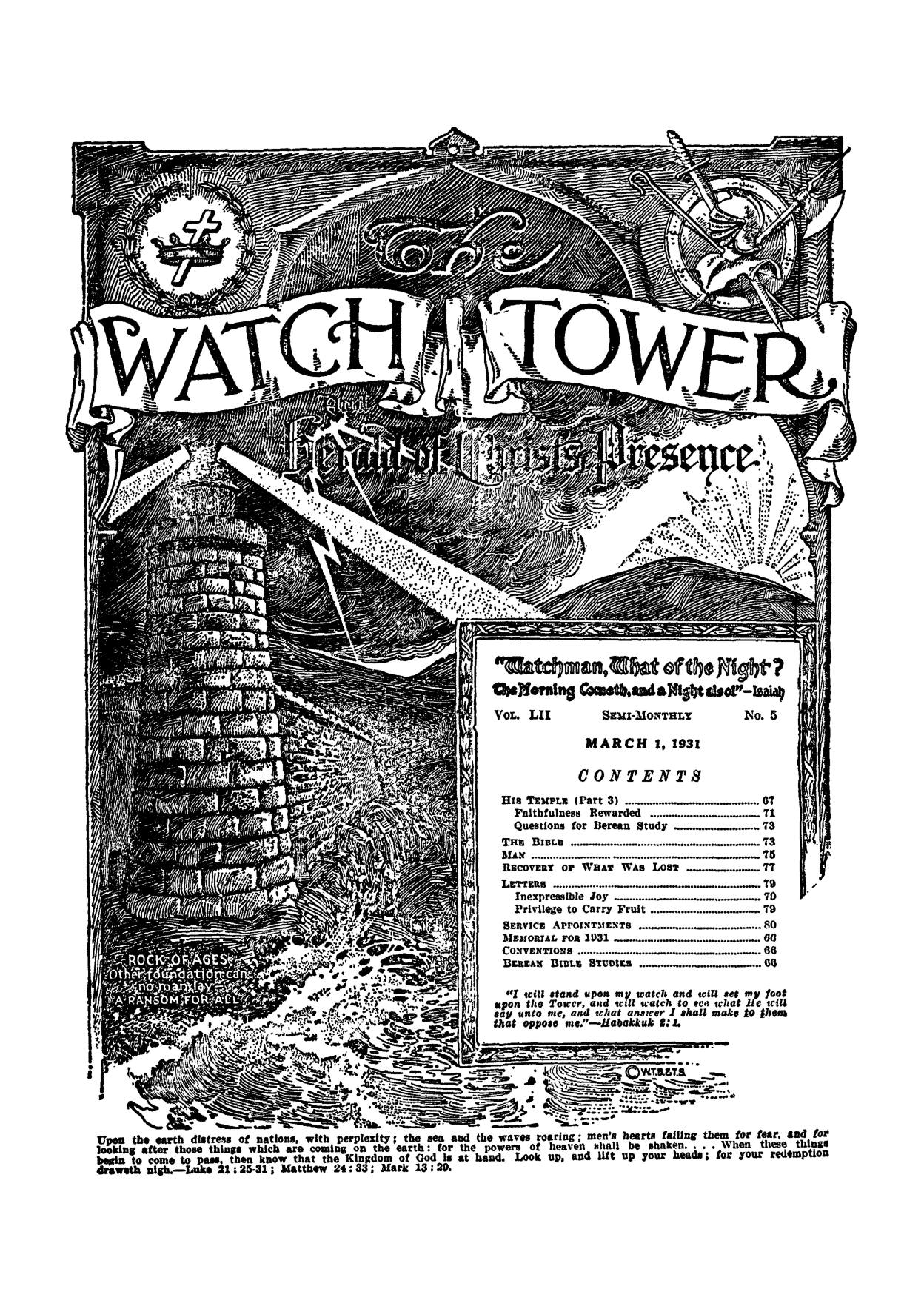
the WATCHTOWER
AND HERALD OF CHRIST'S PRESENCE
Vol. LII
March 1, 1931
No. 5
HIS TEMPLE
“And in this place will I give peace, saith the Lord of hosts.” — Hag. 2:9
PART 3
JEHOVAH has expressed his purpose to establish peace in the universe. That is an absolute and complete guarantee that it will be done. There can be no real peace while the workers of iniquity are about. God declares his purpose to destroy all the wicked; then peace shall follow. Jehovah declares war against Satan, the archenemy, the wicked, and all of his organization; and he will engage in war that peace may come to stay. Therefore he reveals himself by the name “Lord of Sabaoth”, meaning the Almighty God of battle. He also reveals himself by the name ‘‘Lord of hosts”, meaning the Almighty One, over and above his army or host, fighting against the workers of iniquity. He makes Christ Jesus the chief Field Marshal to lead his armies, and in God’s due time Christ leads the host to victory that there may be an everlasting peace.
2 Wars have ravaged the human race. The rulers, which are the visible parts of Satan’s organization, have provoked many wars, and the common people have suffered the result thereof. Now even the rulers of earth see that the common people are sick of the letting of human blood, and hence the rulers desperately seek a means of peace. Their efforts will all be without avail. Just prior to the World War the clergy were saying to their allies of the ruling class: ‘There shall be no more war, but we prophesy peace for the world.’ The war came and worked great havoc upon the nations. The clergy then appeared in the eyes of many as false prophets, which they are.
3 When the League of Nations was brought into existence the announcement was made by the rulers of the nations that the League would outlaw war and bring lasting peace. The clergy became the chief advocates of the League of Nations, and with feigned piety and great gravity announced that the League of Nations is ‘the political expression of God’s kingdom on the earth’. In this the clergy are false prophets; and their allies of the rulers and the people also now begin to see that they are false prophets. Many disarmament conferences or conventions are held and treaties are written upon paper, pledging the nations to peace. In this “the false prophet”, named in Revelation, takes the lead and utters great swelling words of what soon shall be accomplished. Again the hypocritical clergy come to the fore and prophesy ‘‘Peace, peace; when there is no peace”. (Jer. 6:14) It is to be expected that quite soon Satan’s representatives, and those whom such are still able to deceive and hoodwink, will together say, “Peace and safety”; and then ‘sudden destruction shall come upon them’, because the Lord has declared such shall come to pass.
4 There is now peace in heaven, but it was first necessary to have war in heaven before peace came. (Rev. 12:7-10) There will be no peace on the earth until the Lord of hosts mows down the army of the workers of iniquity. Such he will do by his Chief One, who is the Head of the temple. The temple at Jerusalem being completed, Jehovah announces through his prophet: “In this place I will give peace, saith the Lord of hosts.” That prophecy, without doubt, refers to the time when ‘Shiloh [the peaceful One] comes’ and all the affairs of earth are under the control of that Prince of Peace.
5 One of the titles which God gave to his mighty Executive Officer, and which he now possesses, is “The Prince of Peace’’; and of his peace there shall be no end. There will be no complete peace amongst the people of God until the workers of iniquity have been removed by the Prince of Peace. “For he [the Messenger of the covenant] is our peace.” “And I will cut off the chariot from Ephraim, and the horse from Jerusalem, and the battle bow shall be cut off: and he shall speak peace unto the heathen [nations].” (Zech. 9:10) Then the nations will realize that he who is their desire, to wit, the Prince of Peace, is come and all who desire to do right will receive peace and prosperity. One translator renders Haggai 2:9 thus: “In this place I will give prosperity.’’ Lasting peace amongst the people will open the way for them to devote their energies to righteousness and then God will prosper them. Their prosperity will come when they turn their hearts to Jehovah through his temple.
6 No one who loves God should now permit himself to be deceived for one moment into believing that any human agency can bring peace to the world. To even mentally sympathize with the worldly peace movements amongst men is contrary to the will and purpose of God. Peace and prosperity amongst the people cannot come through the League of Nations or from any other man-made peace arrangement, because God has decreed that it shall not thus come. Peace between God and man, and between man and man, and between man and beast, shall be realized and enjoyed only in God’s appointed way. That way God emphatically states is by and through his temple.
7 Three months and twenty-four days after Haggai began to prophesy he again stood before the leaders and the people and addressed them by the authority of the Lord. “In the four and twentieth day of the ninth month, in the second year of Darius, came the word of the Lord by Haggai the prophet, saying. . . ” (Hag. 2:10) The time would correspond with our December, and in Palestine the rainy season would then be on. Ezra prophesied approximately at the same time and shows that the rainy period was then upon the country. “Then all the men of Judah and Benjamin gathered themselves together unto Jerusalem within three days: it was the ninth month, on the twentieth day of the month; and all the people sat in the street of the house of God, trembling because of this matter, and for the great rain. But the people are many, and it is a time of much rain.”— Ezra 10:9, 13.
8 Haggai’s prophecy was at approximately the same time. The words of the prophet on this occasion show that it was an appropriate time to give careful consideration of the Lord’s dealings with his people. At that time the foundation of the restored temple was completed. The work on the temple was proceeding vigorously and the Jews permitted no interference on the part of their adversaries with the work they were doing. The Lord would now manifest, and did manifest, his approval of the faith of the remnant of the Jews for earnestly doing their work, and he sent Haggai before them again to prophesy for their encouragement.
9 Jehovah, by his prophet, first propounded a question to the priests that they might answer as to their understanding of the law of the Lord and what is holy and what is unclean. God had given his law to the Israelites that those serving in the priest’s office “may put difference between holy and unholy, and between unclean and clean [things]”. (Lev. 10:10) On this occasion Haggai was asking their priests to construe the law before the people.
10 Likewise at the present time God’s people need to be instructed in the law of God, which is his expressed will as to what is holy and what is unholy, what is clean in the sight of the Lord, and what is unclean. False standards of holiness deceive and mislead and cause many to fall. As an instance, some do not discern that Satan has a mighty organization and that he is fighting against God and God’s people, and they therefore do not avoid things unclean. On this occasion Haggai stood before the people at the command of the Lord and said: “Thus saith the Lord of hosts; Ask now the priests concerning the law, saying, If one bear holy flesh in the skirt of his garment, and with his skirt do touch bread, or pottage, or wine, or oil, or any meat, shall it be holy? And the priests answered and said, No.”—Vss. 11, 12.
11 This prophecy has an application at the present time. The priests of the Catholic organization claim that by some legerdemain and incantation, or other mysterious ceremony, they can on Friday turn beef roast into fish or fowl. They deceive themselves in this way to justify themselves in eating meat when they have made a rule that they should not. They give themselves credit for power that they do not possess. Likewise there are amongst those of the professed people of God, and who have made a covenant with God, some who think themselves so important that whatever spiritual provender they touch or whatever work they attempt to do that same immediately becomes holy because of their own virtue. They take themselves too seriously and impute to themselves virtue and power they do not possess, and because they are working contrary to the expressed will of God they are workers of iniquity. Thus doing, they do not have on the priestly wedding garments. This applies to that class who profess to be in the truth and yet who do work in their own appointed way and conclude that their chief work is making themselves holy and pious and hence that everything they touch or undertake is holy.
12 The priests answered the question propounded by Haggai the prophet, and their answer was correct; and therefrom the people of God in this day may learn that there is no intrinsic merit in any offering man brings unto the Lord and that the creature does not make holy or sanctify anything that he might touch. While it is the greatest privilege to be engaged in the service of the Lord, God does not need any of us in his work. No one should feel so self-important as to believe that he can lawlessly do works of his own choosing, even though he claims to do so in the name of the Lord, and then expect the Lord to approve such works. The fact that one claims to do anything and everything “as unto the Lord” does not make that thing acceptable unto the Lord, by any means. When the apostle says, “And whatsoever ye do, do it heartily, as to the Lord, and not unto men,’’ clearly he means that we must do it in God’s appointed way, and not in man’s way, and that it must be done joyfully to the praise of the Lord. Obedience unto the Lord is that which is required of the temple class in doing their work, and such obedience is more acceptable than any sacrifice that can be made or brought. Haggai’s examination of the priests on that occasion was for the benefit of God’s people at the present time.
13 Proceeding with the examination of the priests, Haggai the prophet of God said: “If one that is unclean by a dead body touch any of these, shall it be unclean? And the priests answered and said, It shall be unclean.” (Vs. 13) This proves that there is no inherent value possessed by the creature that can be brought to the Creator. Those who are now of the priestly order in the church were creatures once “dead in trespasses and sins” and “were by nature children of wrath, even as others”, and therefore by nature unclean. When one becomes the follower of Christ, instead of being able to make anything or everything holy unto the Lord by his “wonderful character” or other merit of his own, the very opposite is true to the facts. Being naturally dead and in a defiled condition the creature would defile everything of the Lord that he touches were it not for the fact that his justification and approval by Jehovah is granted by and through the merit of Christ Jesus. How foolish and unreasonable, then, for one to think that he could develop a beautiful and sweet character which is meritorious and acceptable before the Lord as something holy. The one who takes such a course denies the blood of Christ that bought him and the results therefrom. The answer of the priests before Haggai was a correct answer and shows that our selfdevelopment is not what is acceptable to the Lord as being a holy thing. Works of self-achievement are “dead works” and are, in the estimation of the Lord, defiled and unclean. It is the merit of Christ that cleanses, and our whole-hearted and complete devotion to the Lord is the evidence of our love for him, and this is what brings his approval.
14 God approves those whose affections are set upon him and who proceed in a manner consistent therewith. He does not approve those who set their affections on things of the earth or creatures of the earth. If the admiration or affection of a professed Christian is centered upon man, be that man self or some other man, such could not be pleasing to the Lord. Regardless of how good and devoted to Jehovah any man might be, and how greatly he is used by Jehovah, that is no excuse or justification for another to give praise and adoration and glory to the creature; and he who docs so does it at his own peril. If we divide our affections between God and things of this world we are thus touching unclean things and are thereby defiled. We cannot serve two masters and be pleasing to either. Especially is that true with one who claims to serve God. He must be wholly devoted to the Lord in order to please him.
15 The priests having answered, "It shall be unclean,” then answered Haggai and said: “So is this people, and so is this nation before me, saith the Lord; and so is every work of their hands, and that which they offer there is unclean.” (Vs. 14) This must mean that the creature is of himself unclean before the Lord, so that anything he touches “it shall be unclean” because contrary to the Lord’s commandment. For what reason unclean? is properly asked. Manifestly because of inactivity in the service of the Lord as the Lord has commanded, and doing work in a contrary way. For sixteen years those Jews, although given the great favor by the Lord to work on the temple, had neglected to do the work, and therefore no work done or performed by them could be pleasing or acceptable to God as holy. It was work on the temple they had been directed to do and had been sent to Jerusalem to do. There was nothing else that could be pleasing to the Lord.
16 It was even so with the people of God on earth when the time arrived for the building up of Zion and gathering God’s people together. Isaiah pictures the Lord’s saints on earth at that time. Isaiah, as for the people of God on earth, recognizing his uncleanness, cried out: “Woe is me! for I am undone; because I am a man of unclean lips, and I dwell in the midst of a people of unclean lips.” (Isa. 6:5) Everything of the world was dead, particularly from and after 1914, because there the King of glory took his power and reigned and Satan’s world had ended and the time had come to go up to God’s organization which is Zion. It was in 1919 and thereafter that the people of God realized that they had been negligent in performing their duties, and therefore of unclean lips, in this, that they had not been diligent in proclaiming the praises of the Lord. Then they awoke and began to work.
17 Isaiah pictures this same class appreciating the fact that the anger of the Lord toward them had ceased, and he therefore wrote: “And in that day thou shalt say, O Lord, I will praise thee; though thou wast angry with me, thine anger is turned away, and thou comfortedst me. Behold, God is my salvation; I will trust, and not be afraid; for the Lord JEHOVAH is my strength and my song; he also is become my salvation.” (Isa. 12:1, 2) There was reason to expect the increased blessings of the Lord upon his people from the time that they awoke and became active and zealous. Then it was that ‘they turned from their dead works to serve the living God’ and went about doing the work in connection with the temple and hence had reason to expect and to receive the continued blessings of the Lord. — Heb. 9:14.
18 The prophet then names a day certain from which time forward or upward the remnant should expect the blessings from God: ‘‘And now, I pray you, consider from this day and upward, from before a stone was laid upon a stone in the temple of the Lord.” (Vs. 15) Manifestly the meaning is that from the twenty-fourth day of the ninth month they were to consider and call to mind what conditions obtained or existed before the temple work was begun and to compare such with what would take place from then on. For sixteen years these Jews had remained inactive and not a stone was laid upon another stone in the temple foundation, and now this period of time should be compared with what would follow from and after the twenty-fourth day of the ninth month of the year in which the work on the temple was resumed.
19 To what extent had the Lord blessed this remnant of Israel within the period of sixteen years of inactivity? Haggai answers that question in the sixteenth verse. In that period of inactivity the Israelites feared the wrath of men and hence had engaged in secular work which took them away from the Lord’s temple, and therefore the blessing of the Lord was held back from them.
20 Let the Lord’s people now look back and compare the work of the church during the Elijah period with that of the Elisha period of the church’s activity, and especially compare the blessings from heaven upon those who have joyfully engaged in the Elisha work with what comes to those who have failed or refused to engage therein. By reason of the fear of men or of Satan’s organization, or for other selfish reasons, many have failed or refused to participate in the Elisha work, and they have suffered great loss because thereof. Upon those who have been joyfully diligent in the service of the Lord in connection with the temple, the Most High has showered his blessings.
21 Again referring to the period of indifferent waiting and inactivity the Prophet Haggai spoke for the Lord, saying: “So is this people, and so is this nation before me, saith the Lord; and so is every work of their hands; and that which they offer there is unclean.” (Vs. 14) The Lord had manifested his disapproval of the Jews because of their inactivity, and it surely must be expected that the Lord will likewise show his disapproval toward those who neglect or fail or refuse to participate in the work of his kingdom when they have opportunity. Those who have been set free from Satan and his organization are called upon to go up and do work in connection with the house of the Lord. Failing to obey this commandment such have not had the blessings of the Lord.
22 Even in this day some are too proud to make an effort to learn why God’s blessings are withheld from them. Their pride prevents them from ‘repenting and doing their first works’. (Rev. 2:5) They refuse even to read and thus partake of the food that the Lord has provided through his organization to instruct his people, and hence they miss the blessing of the Lord. Others have been slow to discern the lessons of reproof from the Lord. Foreknowing this, God caused the more zealous ones of his people to ‘Cry aloud, and spare not’, that his covenant people might be awakened to their privileges. “Cry aloud, spare not, lift up thy voice like a trumpet, and shew my people their transgression, and the house of Jacob their sins.” (Isa. 58:1) The fact that The Watch Tower during the past few years has repeatedly called attention to the necessity of diligence in the service of the Lord has greatly angered and embittered some instead of doing them good.
23 Jehovah marks the specific day from which time upward the Israelites were to count their increased blessings. “Consider now from this day and upward, from the four and twentieth day of the ninth month, even from the day that the foundation of the Lord’s temple was laid, consider it.” (Vs. 18) The work on the temple had been renewed and from that day forward the blessings of the Lord should be counted.
24 The same is true with reference to God’s temple workers in this day. It was on the eighth day of September, 1922, designated “The Day”, at a large assembly of God’s people, that a deeper realization came as to what the Lord would have them do. They saw that the kingdom message must be proclaimed. From that day forward there was increased activity in the Lord’s service, and the manifold blessings of the Lord are to be counted from that time. Then “the tried stone” for a sure foundation in Zion had been laid, the faithful and zealous workers were chosen by the Lord, and their approval was marked by their being brought under the robe of righteousness, and they have counted their blessings from that time on. Let this not escape the notice of God’s people now, because therein is found much encouragement for those who love Jehovah. The testimony of his witnesses abundantly proves that the blessings of the Lord have been showered upon his people from and after that day to the present time.
25 Haggai then propounds this question: “Is the seed yet in the barn? yea, as yet the vine, and the fig tree, and the pomegranate, and the olive tree, hath not brought forth: from this day will I bless you.” (Vs. 19) The rainy season was then on and it was manifested that there could be no seed in the barn. It was not time for the harvest of the vine and the fig tree. It was a good time for the Jews to count their blessings and prove the Lord’s favor to them in the future. They were to begin now to count and see, if they worked faithfully, what the Lord would do to them. The Lord would have his people then know that the most important thing for them to do was to be obedient to him in doing the work on the temple, which they had been sent there to do. Likewise the Lord definitely shows his people now what work he approves.
26 These things were written in the prophecy for the admonition of his people at the present time, and it is clear that the chief work of God’s people now is in connection with his temple as he has commanded. Service is therefore not only a privilege, but absolutely essential that one might be pleasing unto God. All who are in the temple will now show forth his glory and sing his praises, hence must be active in his service. — Ps. 29: 9
27 On that same day for the second time God commanded Haggai to prophesy. Probably Haggai appeared a second time that his speech might more fully impress the people; and if he did so he did it under God’s direction. The first time his prophecy referred to God’s provision for the blessing of his own in providing them with plenty and the spreading of a table for them in the presence of the enemy. That was an important lesson that must be impressed upon their minds; and it must be impressed upon God’s people now. The second time that the prophet appeared on that day his speech related to the vigorous expression of God’s vengeance against the enemy and his organization and of the exaltation of his faithful and true people. “And again the word of the Lord came unto Haggai in the four and twentieth day of the month, saying, Speak to Zerubbabel, governor of Judah, saying, I will shake the heavens and the earth.” — Vss. 20, 21.
28 How true are these facts to the present day. In very recent years Jehovah has spread a table of abundance for his people in the presence of the enemy and now (and before it comes to pass) God shows his own people what he will do to the enemy within a short time and what will be a manifestation of his goodness toward those who continue faithful to him unto the end.
29 The prophet of God speaks to Zerubbabel the governor concerning the shaking of the heavens and the earth. Clearly this shaking antitypically has reference to “the battle of that great day of God Almighty”, when Satan’s organization shall completely fall. “And I will execute vengeance in anger and fury upon the nations, such as they have not heard.” (Mic. 5:15) This great shaking appears in the morning of the Millennial day. Jehovah spoke of it to Job in hidden phrase, now due to be understood, because his light is shed upon his Word and makes it clear. To Job he said: ‘‘Hast thou commanded the morning since thy days; and caused the dayspring to know his place; that it might take hold of the ends [wings] of the earth, that the wicked might be shaken out of it? It [that is to say, the earth] is turned [changed as to appearance, given a new impression as a result of the increasing light] as clay [is changed in appearance] to the seal [that is to say, when clay is impressed by a seal]; and they [the various features of the earth] stand as [though clad with] a [new] garment. And from the wicked their light is withholden [or withdrawn], and the high arm [or raised arm] shall be broken.” — Job 38:12-15
30 Before this great time of trouble falls upon Satan’s organization God shows his faithful temple class what is about to come to pass and he says: “And I will overthrow the throne of kingdoms, and I will destroy the strength of the kingdoms of the nations; and I will overthrow the chariots, and those that ride in them; and the horses and their riders shall come down, every one by the sword of his brother.” (Vs. 22) The political and ecclesiastical elements of Satan’s visible organization now both claim that their rule is by divine right. These were pictured by Assyria and Babylon and both shall be proven liars. The financial or money element is the strength of the nations because these make provision for the commercial activities and the military forces; and these elements were pictured by Egypt. The “chariots” and “those that ride in them” definitely refer to the military power, all of which shall be destroyed in the great time of trouble. When the strength of Satan’s organization is destroyed and gone, then, as it were, the shades of his world powers or visible rulers will say to him: “Art thou also become weak as we? art thou become like unto us ?’’ — Isa. 14:10
31 All this military, cruel and wicked organization, being arrayed against God and his anointed people in the battle of Armageddon, will go down to destruction, as the words of the prophet foretell. The great antitypical Zerubbabel, the builder of the temple of God, will be victorious; and this shows that the completion of the antitypical temple occurs “in that day of God Almighty”.
32 The language of the Prophet Haggai is: “Every one by the sword of his brother.’’ From the beginning all of God's creatures were brothers, because all had life from one Father. The two “morning stars”, his sons, Lucifer and the Logos, sang together to the praise of the Father at the laying of the foundation of the earth. In the final conflict it will be the sword of the loyal Son against the disloyal brother, each side in the conflict being supported by his followers. In this great conflict the “morning stars” duel with the sword one against the other. The sword of the disloyal son will be broken by the sword of the loyal Son. That will be a fight such as was never had. Then “The father [Jehovah] shall be . . . against the son [Lucifer the traitor], and the son [the disloyal anointed one] against the father [Jehovah] ; the mother against the daughter [disloyal child of Zion], and the daughter against the mother [God’s organization] ”. – Luke 12: 53.
33 It will be a fight even to the finish; and God’s beloved Son will be crowned with complete victory, and those who love righteousness and hate iniquity and fight under his banner will stand victorious with him upon Mount Zion. In view of this positive and certain promise the temple builders are now bidden not to fear any creature, but to boldly, fearlessly and joyfully continue to sing forth the praises of the great Eternal God.
FAITHFULNESS REWARDED
34 Joshua the priest engaged in the building of the temple, and Satan resisted him, and because of Joshua’s faithfulness the Lord rebuked Satan. “Jehovah rebuke thee, O Satan, even Jehovah that hath chosen Jerusalem rebuke thee.” Joshua in the type was not and could not be approved by reason of his inherent righteousness, but he had the mark of approval from Jehovah, who said: ‘‘Take away the filthy garments from him. And unto him [Joshua] he said, Behold, I have caused thine iniquity to pass from thee, and I will clothe thee with change of raiment.” (Zech. 3:2-4) The faithfulness of Joshua God rewarded, and likewise he rewards those faithful ones who now do work in connection with the temple.
35 Zerubbabel seems clearly to foreshadow ‘the elect servant of Jehovah, in whom he delights’, and stands in direct contrast to the evil or unfaithful servant, the latter being foreshadowed by Jehoiachin. (Isa. 42:1; Jer. 22:24) The faithful remnant on earth at the very close of the witness work, and who remain faithful and true to the end, are hereby identified as a part of the ‘elect servant’. Haggai’s prophecy concludes with words of much encouragement to such, to wit: ‘‘In that day, saith the Lord of hosts, will I take thee, O Zerubbabel, my servant, the son of Shealtiel, saith the Lord, and will make thee as a signet; for I have chosen thee, saith the Lord of hosts.” – Vs. 23.
36 The time of the fulfilment of this prophecy is definitely fixed as ‘‘in that day”, meaning ‘‘the day of battle and war”, ‘‘that great day of God Almighty,” when ‘‘Jehovah, the mighty in battle”, smites the enemy down. (Ps. 24:8; Rev. 19:11-21) In that hour of great conflict, when the Lord through his mighty army overthrows the forces of the kingdoms of earth and destroys the power of Satan’s entire organization, he says to his faithful ones: ‘‘I will take thee, O Zerubbabel, my servant, the son of Shealtiel”; and these words evidently mean that the Lord will give special attention to his servant at that time and show his special approval upon his servant. The “servant” in this connection is definitely identified as the offspring of David through Nathan, the approved line. It seems that God takes this action toward his “servant” that all creation may see that he appreciates and is pleased with righteous devotion and continued faithfulness to him under all conditions.
37 The beautiful symbol of the signet ring is now used. The signet ring is placed upon the finger, and so the text is rendered by some of the translators in this form: “I will set thee as a signet ring on the finger.” (See Rotherham and Leeser translations.) This signet ring beautifully engraven would signify that the “servant” is wholly and completely devoted to Jehovah and is the instrument used by Jehovah for the vindication of his word and name. In support of this it is written: “With the work of an engraver in stone, like the engravings of a signet, shalt thou engrave the two stones with the names of the children of Israel; thou shalt make them to be set in ouches of gold. And thou shalt make a plate of pure gold, and grave upon it, like the engravings of a signet, HOLINESS TO THE LORD.” — Ex. 28:11, 36.
38 These concluding words of Haggai’s prophecy, and supporting texts, leave no doubt as to what is the destiny of the “faithful and true”, and surely are given for the special encouragement of the remnant people of God at this opportune time. The signet ring is a mark of identification and symbolizes a pledge of fidelity. (Gen. 38:18) That would mean that Zerubbabel would be marked as identified with Jehovah’s organization and as having received the pledge of fidelity from the Most High as the representative of his organization. It would also mean that Jehovah has given his pledge to forever use ‘the elect servant’ to carry out his purposes. A signet ring is also used for the purpose of sealing a document or letters of authority. (1 Ki. 21:8) That would signify that Zerubbabel would have engraven upon him the name of Jehovah God and be clothed with special authority from Jehovah God. In harmony it is thus written concerning the antitypical Zerubbabel, ‘the elect servant’: “Him that overcometh will I make a pillar in the temple of my God; and he shall go no more out; and I will write upon him the name of my God, and the name of the city of my God, which is new Jerusalem, which cometh down out of heaven from my God; and I will write upon him my new name.” (Rev. 3:12) The faithful servant class is sealed with the seal of the living God. (Rev. 7:2-4) The seal bears the name of the Father and his city, at a prominent place upon the sealed ones, that it may be seen. — Rev. 14:1.
39 This is a further identification of Zerubbabel as foreshadowing the ‘priest of God for ever after the order of Melchizedek’, the highest priesthood ever created or ever to be created by the Most High. This high office is given to God’s ‘elect servant’. The signet ring, being a symbol of authority, would signify that antitypical Zerubbabel is used by Jehovah to bind up and seal truths, and therefore shows that the ‘elect servant’ is the instrument of authority used by Jehovah in thus doing. “Is not this laid up in store with me, and sealed up among my treasures?” (Deut. 32:34) “Bind up the testimony, seal the law among my disciples.” (Isa. 8:16) Even now Jehovah says to the faithful remnant of the “servant” class: “Ye are my witnesses, saith the Lord, and my servant whom I have chosen: that ye may know and believe me, and understand that I am he; before me there was no God formed, neither shall there be after me.”—Isa. 43:10.
40 The “servant” class, seeing and growing in appreciation of the Father’s love, prays: “Set me as a seal upon thine heart, as a seal upon thine arm.” (Cant. 8:6) The one thus favored is the special recipient of Jehovah’s love; and this is in harmony with the words of Jesus to the faithful: “The Father himself loveth you, because ye have loved me.” (John 16:27) It is faithfulness to the end that proves perfect love. Jehovah declares to all creation his love for the faithful “servant class”, when he says: “I have chosen thee, saith the Lord of hosts.’’ The Scriptures seem fully to support the conclusion that God in his own good way and. manner will reveal and specially show his love to his faithful ones in the great battle of God Almighty. The closing words of Haggai’s prophecy are words of special encouragement to the workers that now work in the temple of the Lord. War and strife and turmoil afflict the earth and the peoples thereof. There is no way of establishing peace aside from God’s way, and that way is by and through his ‘elect servant’. This he will have made known.
41 If you realize and appreciate that the Most High, by and through his beloved Son, has granted to you the great privilege of now doing some work in the temple not made with creature hands, then permit nothing to discourage you in that work or to cause you to slack your hand. Faithfulness can be proven only under the test. The Lord has given his people specific instructions as to the manner of meeting these tests. Concerning the “evil servant” class, members of which come to you with soft words and fair speech, he instructs his people to avoid them. Do not engage them in controversy in any manner. Stand fast and hold to the precious truths the Lord has taught you, and continue to fight on the side of righteousness, doing his commandments. (Rom. 16:17,18; 2 Thess. 2:15-17) Being in the temple and doing the work therein you will thus continue faithfully to show forth the glory of Jehovah God. Thus doing, in a little while you shall witness the complete vindication of his name and behold his resplendent glory. In the ages of eternity Jehovah God will exhibit to his creation this signet ring upon his finger, namely, his faithful and elect servant, and thus he will forever show the exceeding riches of his grace to those that love him. Let all of the remnant now be of good courage and press on in the temple work, singing the praises of the Most High.
QUESTIONS FOR BEREAN STUDY
1. Account for Jehovah’s revealing himself as the “Lord of Sabaoth” and as the “Lord of hosts’’.
2, 3. Why should the rulers of earth now be desperately seeking to establish peace? What has been their policy and procedure? What is the prospect of their succeeding, and why?
4-6. What has already been accomplished in the establishment of peace in the universe! How only will peace and prosperity come to the nations! Why is it entirely inconsistent for any of God’s people to sympathize in any respect with the worldly peace movements among men!
7, 8. Point out the harmony of the records as to the time of the prophecy here under consideration.
9-14. What is the nature and purpose of the questions the prophet here propounds to the priests? Why to the priests? Point out clearly the application of each of the questions and of the answer thereto?
15-17. Explain and apply Haggai’s answer to the priests, as recorded in verse 14, showing also the harmony therewith of Isaiah’s prophecy.
18-21. What was the situation calling for the prophet’s words of verse 15? How does that prophetic situation have fulfilment at this time?
22. How and why is Isaiah 58:1 having application in recent years?
23-26. Describe the situation which called for the words of verse 18; also that which was there prophetically pictured.
27-33. Compare the message brought by Haggai when he spoke to the people the second time with that which he gave to them earlier on the same day. Apply the prophetic picture. Show how other scriptures clearly indicate the nature and the results of the “shaking” there referred to.
34, 35. What is the important lesson to be taken from Zechariah 3: 2-4?
36-40. “In that day” refers to what period of time, as indicated by other scriptures also? What is the meaning of the statement, “I will take thee, O Zerubbabel, my servant, the son of Shealtiel.” Explain and apply the symbolism of the “signet”, to show how appropriate is this expression of the love and favor Jehovah shows and will show to his faithful people. How is this an answer to the prayer of the “servant” class? Jehovah adds, “for I have chosen thee.” What does this mean to the ‘faithful servant’ class?
41. What, then, is the important and encouraging lesson Jehovah here gives to his faithful people through his prophet Haggai?
THE BIBLE
JEHOVAH God is the Creator of man. It is reasonable to expect that the Creator would give some revelation of himself and his purposes to man.
The Bible purports to be that Revelation. Is the Bible true, and is it the Word of God? Modernist clergymen say, “No,” and they say it is unreliable. Here is submitted some proof that the Bible is God’s Word of truth and that it is the only safe guide for man.
The physical facts prove beyond any question that there was once a great flood of water that covered this earth. Noah was brought over and saved from the world that was destroyed by that flood. Noah was the most important man on earth of his time. He possessed a personal knowledge of things that no other man on earth at that time could know so well. From the creation of Adam to the flood was a period of 1,656 years. In those days men lived for nearly a thousand years. Adam was on earth three hundred years after the birth of Enoch. Being a good man Enoch would gather from Adam all the facts he knew concerning Eden and what occurred there. Naturally Enoch would tell those things to his son Methuselah, who was the grandfather of Noah. From Methuselah and from Lamech his father, Noah would receive all the information then obtainable by man, the most important part of which would be that which took place in Eden and following thereafter. Noah lived 350 years after he came out of the ark. Only two years after his death Abraham was born, and naturally Abraham would learn the history of man from Shem his father, who was the son of Noah.
Abraham was the beginning of the people of Israel, otherwise called the Jews. He is designated the “father of the faithful”. No man could have faith without knowledge; therefore the conclusion must be that Abraham was informed of God’s dealings with man. Jacob was a grandson of Abraham, and the father of Joseph who became a mighty ruler in Egypt. Moses, an Israelite, was born in Egypt, and it is written of him that he was learned in all the wisdom of Egypt, which naturally would include all the information handed down by his ancestors. It is not unusual for an American boy to learn from his father the important facts of American history. With stronger reasoning Moses would learn from his father the history of his people. Moses was eminently qualified to write the history of man. Moses wrote the first five books of the Bible. It is therefore seen that this information could easily have been handed down from one generation to another.
Enoch, Noah, Abraham and Moses were men devoted to God and naturally would obtain all the information they could concerning God’s dealings with mankind. The New Testament mentions these men as being approved by Jehovah. If we had no other proof concerning the Bible except tradition, that would be sufficient proof to warrant us in accepting it as the history of the human race. We have much more than that, however.
It will be conceded that man is the most intelligent of earth’s creation. He has a natural tendency to keep a record of events for the benefit of himself and succeeding generations. This in itself is proof that his Creator desired man to keep such record and hence planted in his mind the inclination so to do. It logically follows that the great Creator would provide the means for keeping such record. Since it had to do with his own word and name he would supervise the keeping that it would be correct. If Jehovah had to do with the keeping of such record, then we may know that the record contains the truth.
Both tradition and the Bible agree that Moses was devoted to God and that he was sent to Egypt by Jehovah on a specific mission. He was the very kind of man that God would choose to make the record of his purposes concerning man. Moses, therefore, in writing was merely an amanuensis to write for Jehovah. The same is properly said of all the other writers of the Bible. God directed them what to write. Concerning such, David, the faithful king of Israel, said: “The spirit of the Lord spake by me, and his word was in my tongue.” The spirit of God means his power, which is invisible to man but which he causes to operate upon the mind of man and to direct him what to do.
Men of old who were faithful to God and who wrote portions of the Bible are called prophets. Concerning those men it is written, in 2 Peter 1: 21: “Prophecy came not in old time by the will of man: but holy men of God spake as they were moved by the holy spirit.” Those men wrote foretelling the coming of events which they did not understand and knew not about; which is proof that they were merely instruments in the hand of Jehovah used by him to write such prophecy. The prophecies written centuries ago are now being fulfilled by the facts coming to pass and which are well known to all who think seriously. That is conclusive proof that no human mind could conceive or formulate the words of the prophets, but that they were dictated by Jehovah and that those men wrote as God’s power moved upon their minds. Daniel, one of the prophets, asked God when these things would come to pass, and was told to close up the book of the prophecy and seal it until the time of the end and then it would be understood.
No one will dispute the fact that Jesus lived and died in Palestine about 1900 years ago. What he said surpasses in wisdom the sayings of any other man ever on earth. He spoke with authority from Jehovah, and his words concerning the prophets were words of approval, and he quoted their words with approval. Centuries before the birth of Jesus many of those prophets wrote concerning his birth, the course of action he would take, his persecution and his death and resurrection. The admitted facts concerning Jesus fully and completely support these prophecies and show that they were correct. This proves that no human mind formulated those prophecies but that they proceeded from Jehovah God.
Jesus repeatedly stated that he is the Son of God and that he was sent by Jehovah from heaven to perform a work in the name of his Father and for the benefit of man. He was born a man that he might be a witness for God and to speak the truth to men. His words recorded in John 18: 37 are these: “To this end was I born, and for this cause came I into the world, that I should bear witness unto the truth.” It was on that same day and shortly before his death that Jesus said concerning the Bible, God’s record: “Thy word is truth.” To reject the Bible means that we must reject Jesus as the Son of God and deny the truthfulness of his testimony. Anyone who believes that Jesus was and is the great Teacher must believe that the Bible is God’s Word of truth. That part of the Bible called the New Testament was written by men who personally associated with Jesus and who learned of him and who wrote under the power and direction of the spirit of God, and what they wrote is the truth.
The original manuscripts of the Bible were kept in the custody of God’s chosen people, the Israelites. The indisputable historical facts, aside from the Bible, show that from the time of Ezra forward there was a rewriting or copying of the original manuscripts and that this work continued until A. D. 900. Three of these manuscripts are in existence this day. The Alexandrine manuscript is in the British Museum. The Sinaitic is in the library at Leningrad, and the Vatican manuscript is in the Vatican at Rome. There have been many versions and translations of these ancient manuscripts made by faithful men. It is from these that we have the Bible that we use today. Every attempt that has been made to destroy the Bible has failed; which is proof that God has preserved it for man’s benefit.
That the Bible is the true guide for man it is written by one of the holy prophets in Psalm 119:105: “Thy word is a lamp unto my feet, and a light unto my path.” God’s law to man is set forth in the Bible. To know and obey that law means to walk in the way of righteousness. In Psalm 19:7, 8 it is written: “The law of the Lord is perfect, converting the soul; the testimony of the Lord is sure, making wise the simple. The statutes of the Lord are right, rejoicing the heart; the commandment of the Lord is pure, enlightening the eyes.”
The devout student may come with confidence to the Scriptures, knowing that these set forth the will of God concerning man and are given to man for his instruction in righteousness. Upon the Scriptures he can confidently rely. The Bible constitutes the basis of his faith in God and a knowledge thereof enables him to understand something of the great love of God toward the human family.
A full discussion of the origin and the authenticity of the Bible is found in the book Creation. The reason there is so much ignorance amongst the people concerning the Bible is because Satan the enemy of man and of God has interfered with the people’s understanding the truth. Satan through his agencies killed many of the men who faithfully performed their work in connection with the Bible, but not until after their work was done. Thousands of copies of the Bible were destroyed by those same evil agencies, but Satan with all of his efforts could not stop the progress of God’s unfolding purposes and the revelation of himself to the people through his Word. Being unable to stop the publication of the Bible the Devil has sought through his representatives to corrupt the meaning thereof and to put into the minds of the people an improper understanding of its text. He has used every power at his command to turn the minds of the people away from Jehovah and from his pure Word of truth. For centuries many of these wonderful truths were obscure and taken away from the people. In God’s due time these pure doctrines have been restored to the honest seekers after truth.
It is now God’s due time for the truth to be known and nothing Satan can do or will do can prevent the truth from being known. The time has come for the standard of Jehovah to be lifted up, that the people may know which way to go. This standard is found in the Bible. Around this divine standard the righteous and truly honest-hearted will rally. The tide of truth is rising higher and higher, and will continue so to rise until it has filled the whole earth as the waters fill the deep. All this shall be to the glory of Jehovah God.
The time has come for Jehovah to make known his name in the earth, and he will make this known through his Word and through the manifestation of his power. And be it noted that the truth does not belong to any man. It is God’s truth. God has used men or human instruments at different times for his own purposes and to his glory, but the truth has always been and always will be Jehovah’s. The Bible is his Word of truth given to guide those who seek righteousness.
MAN
JEHOVAH and his purpose should be man’s chief study. The truth thereof is found in the Bible. One of the first things for man to learn is his own relationship to God, the great Creator. The Bible states that God made man in his own image and likeness. That image and likeness could not have reference to the body, because God is the great Spirit, while man is of the earth. The Bible states that there is a spirit body and there is a human body and that no man knows the form of a spirit body.
What is meant by man’s being made in the image and likeness of God? The attributes of Jehovah God are justice, wisdom, love and power, all operating equally and in exact balance. The beasts of the field do not possess these attributes. The imperfect man we now see possesses a degree of justice, wisdom, love and power. The fact that these qualities are now incomplete in the imperfect man shows that the perfect man had these attributes in completeness, because it is written in the Bible that the first man was made a perfect creature.
Jehovah God has dominion over all the universe. In a similar manner the perfect man was given the dominion over all other animal creation of the earth. Therein was a likeness to his Creator. Man is the only earthly creature made in the likeness of God. It is an insult to the intelligence of man and a blasphemy of God’s holy name to contend that man evolved from an ape. God’s Word, which is the truth, states in Genesis 2:7: “The Lord God formed man of the dust of the ground, and breathed into his nostrils the breath of life; and man became a living soul.”
The statement is often made that God created man and then gave to man a soul. That statement is contrary to the Scriptures, and false. The word soul means a creature that lives, moves and breathes. Long before the creation of man animals of the lower order were created, and in Genesis 1: 20 these are called souls. God formed the body of man from the elements of the earth and then breathed into the nostrils of that body the breath that all animal creatures breathe and the man became a living, moving creature, which is a soul. Every man is a soul. No man possesses a soul separate and distinct from his body.
It is claimed by many that the soul of man is immortal and continues to live for ever. That statement is wholly false. “Immortality” means that which cannot die. The fact that men have been dying for many centuries proves the falsity of the ‘immortality’ of souls. In 1 Timothy 6: 16 it is stated that originally God only had immortality. The perfect man Jesus when on earth was not immortal, because he said that one of God’s promises to him was that he would give him immortality as a reward for his faithfulness. It is recorded in the second chapter of Philippians that at the resurrection of Jesus God highly exalted him and rewarded him with immortality. Thereafter Jesus said: ‘I am he that was dead, and, behold, I am alive for evermore.’
God said to Adam, the first man: ‘In the day that you sin you shall surely die.’ If man had possessed an immortal soul that statement could not be true, and we know that God’s Word is true. Adam did violate God’s law, and died, which is complete proof that he was not immortal. The breath which God breathed into the nostrils of man is not immortal. Both the body and the breath of life are required to constitute a living creature, or soul, and when the breath is taken away death immediately results. All right to life proceeds from God. The breath does not possess life. It is the breath that keeps the blood in circulation by which the body is animated and life sustained. In Deuteronomy 12:23 it is written: ‘The life is in the blood.’ All animals, including man, have blood, and must breathe in order to live. Take away the blood or the breath, and death results. That which dies is not immortal, but mortal. Every man is a soul, and when he dies it is the soul that dies. It is written in Ezekiel 18:4: “The soul that sinneth, it shall die.” The life of man and his right to life depend upon his obedience to God’s law. If man possessed an immortal soul, then God could not enforce the penalty of his own law.
God created the earth many centuries before the creation of man. The earth was provided as the everlasting home of perfect man. Concerning this it is written in Isaiah 45: “Thus saith the Lord, ... I have made the earth, and created man upon it, . . . God himself . . . formed the earth and made it; he hath established it, he created it not in vain, he formed it to be inhabited.”
God’s purpose is to have the earth filled in due time with a perfect and happy race. This great truth man will appreciate when he learns why the human race is now imperfect and suffers much, and when he learns of God’s purpose and means provided to restore the obedient ones of mankind to perfection and to make the earth a paradise home for man.
A portion of the earth called Eden was in the beginning the paradise home of Adam and his perfect wife, Eve, whom God had given him. It was a place of glory and beauty and contained everything for the ease, comfort and happiness of man. Adam and Eve lost that beautiful home, and were driven out of it and caused to earn their food by hard labor until they were dead. Such was the result of a rebellion against Jehovah God in which they willingly joined. The judgment against them was just and righteous. God could not have been true to himself had he not sentenced man to death. His wisdom and loving-kindness, however, immediately made provision for the redemption, deliverance and restoration of the obedient ones of mankind.
The right to life is a gift to those who obey God’s law. Jehovah had made man the crowning part of his earthly creation. He had given him life and the right to life, and in consideration thereof required of man full obedience to his law. A wilful disobedience of that law in the slightest manner would show a wrong motive on the part of man and a tendency to disloyalty. God did not lay a great and hard thing upon man, but plainly told him that there was a certain fruit in Eden of which he must not eat and that a violation of this order would result in taking away from man his life and the right thereto. To be sure, God could have made man so that he could not disobey; but had he done so, that would have taken away from man the opportunity of freely exercising his own will. God tells his creatures what they may or may not do, and lets them decide which course they wish to take and then to bear the consequences.
God had created man out of the dust or elements of the earth, and his judgment written in the Bible is that man, having been disobedient, should die and return to the dust from which he was taken. That judgment was in strict accordance with his law, and it took away from man the right to life, even though God permitted him to continue to live during the greater portion of a thousand-year day. To enforce his judgment he expelled man from Eden; and man, being compelled thereafter to feed upon the food produced by the unfinished earth, sickened and in due time died.
Between the time of expulsion from Eden and his death Adam and his wife brought forth children. The parents having no right to live, the children were therefore bom without the right to live. For this reason it is written, in Romans 5:12: “Wherefore, as by one man sin entered into the world, and death by sin; and so death passed upon all men, for that all have sinned.” Any creature that is imperfect is unable to keep the law of God and is therefore by nature a sinner. All human creatures are born imperfect.
Unless God should make some provision for the recovery of the human race all mankind in time would perish. At the very time of the expulsion of man from Eden God announced in cryptic phrase not then understood, but which now can be understood, the purpose to establish a government of righteousness which would prove his word to be true and completely vindicate his action and his name and which would furnish the means for the complete recovery and reconciliation of the human race to himself. Nothing could be of greater importance to man than a knowledge of these truths.
All sorrow and suffering and death that has befallen the human race has been due to sin. What is sin? The Scriptural answer is that sin is the transgression of God’s law. The great sin is disloyalty to God. The first act of disloyalty to the Most High was the rebellion by Satan, which rebellion led to the downfall of man. It marks the beginning of man’s sufferings and of all the trouble that has come upon the world. Satan has ever been the enemy of man and of God. On another occasion the Scriptural proof will be considered as to the origin of Satan the Devil, his wicked works, and what shall be his end.
Man’s everlasting friend is Jehovah God. A true friend is one who loves you all the time. God has always manifested his love for his creature man. When man receives an understanding of God’s provision for his recovery he desires to worship the great Eternal One. The enemy Satan has kept men in ignorance of the truth, but now God’s due time has come to let man see the truth. Those who understand and obey the truth will thereby prove that they are wise; hence it is written in his Word: “Happy is the man that findeth wisdom, and the man that getteth understanding: for the merchandise of it is better than the merchandise of silver, and the gain thereof than fine gold. She is more precious than rubies.” — Prov. 3:13-15.
…