The Watchtower, October 15, 1930
Download: PDF — The Watchtower, October 15, 1930
ADVERTISING WATCHTOWER CHAIN PROGRAM
To send the Sunday morning chain program to much of the most densely populated area of the country a large sum of money is being spent continually by the Society. The hour’s program is now broadcast over a chain of thirty stations, including
Reports of field workers indicate an intense and steadily growing interest among listeners. During the chain program, announcement is made regularly that further information in printed form “will be offered by a representative from The Watch Tower who will call at your home’’. As a result, workers find that many who have heard the program are eagerly waiting for the books.
On the other hand, millions of people in the area now served by this broadcasting DO NOT KNOW that there is such a program on the air. The most effective advertisement is the personal invitation. This can be given constantly by each field worker in a definite manner by use of the radio slip. Mere mention of the program when canvassing is good, of course, but uncertain, for the spoken word is soon forgotten.
The radio slip is an attractive folder, printed in two colors. It contains a list of the stations on one side and, on the other side, a brief description and illustration of the books. These slips are supplied by the Society at one dollar a thousand. They are for free distribution to every home by each worker while engaged in the house-to-house service.
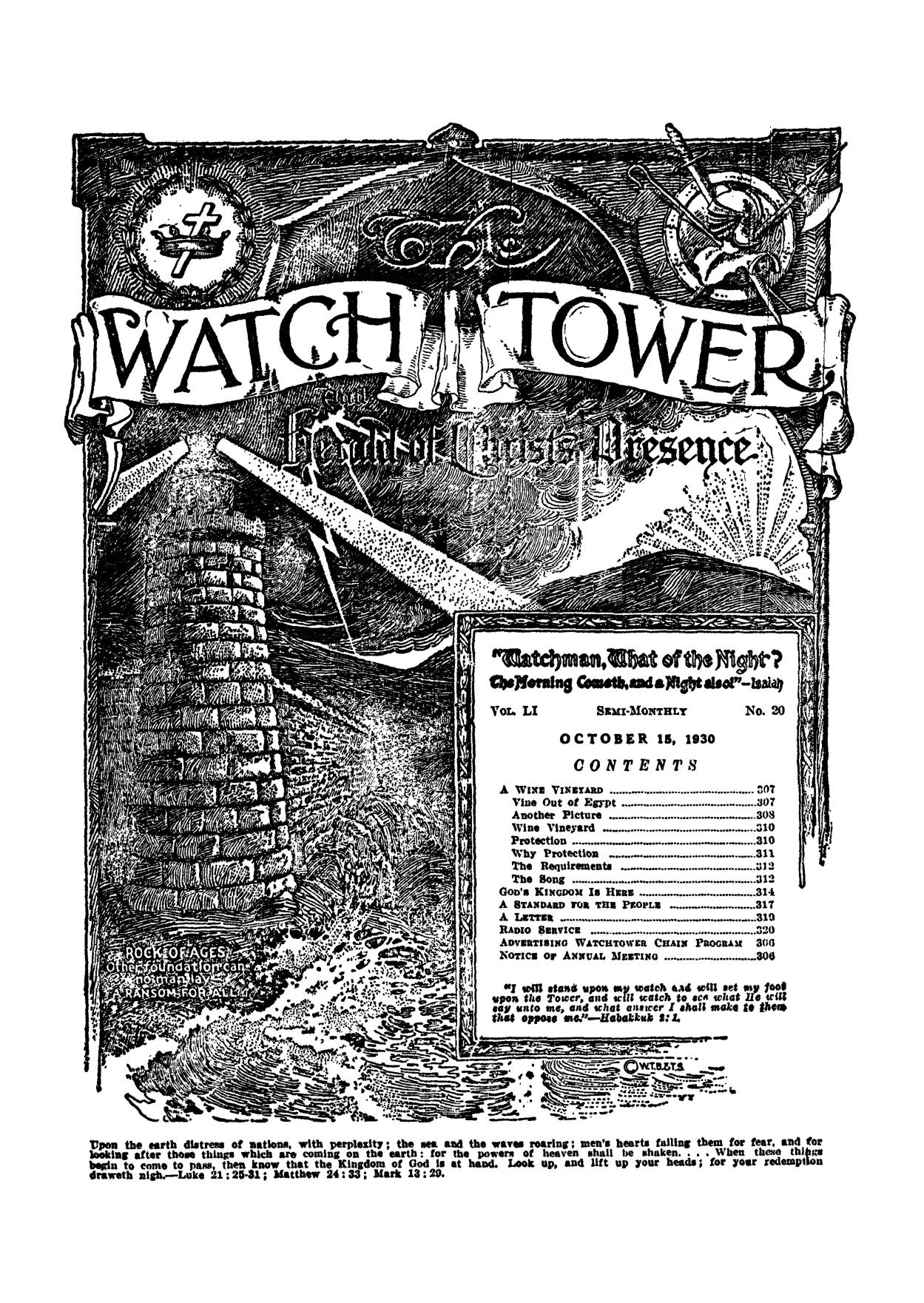
Vol. LI
October 15, 1930
No. 20
A WINE VINEYARD
‘‘In that day sing ye unto her, A vineyard of red wine.”—Isa. 27: 2.
JEHOVAH was challenged by the enemy to put a man on earth who under great stress would maintain his integrity. The challenge put at issue the word and name of Jehovah God. That challenge was accepted and God gave expression to his purpose that in his own good time he would have on earth a people that would under severe test hold fast to their integrity, be faithful and true witnesses to Jehovah, and sing forth the praise and honor of his name. This class of approved ones the Lord pictures as a wine vineyard.
2 Wine is often used symbolically in the Scriptures to picture good cheer, gladness and joy. Wine comes from the vineyard which God has planted to gladden the heart of man. (Ps. 104: 15) It is to be expected that Jehovah would have pleasure in those who maintain their integrity and uphold his word and name. The wise man is he who delights himself in the Lord and joyfully obeys his commandments, and in such God has pleasure. “My son, be wise, and make my heart glad, that I may answer him that reproacheth me.” (Prov. 27:11) A wine vineyard therefore fitly represents the one with whom God will be well pleased. Since the insolent challenge was flung in the face of Jehovah Satan has constantly reproached the word and name of God. God’s “faithful and wise servant”, pictured by the vineyard of good wine, has gladly shared such reproaches, and will make glad the heart of the Father. God’s method of developing this vine not only is of great interest, but shows the importance he attaches to his work in bringing it forth.
VINE OUT OF EGYPT
3 Instead of immediately vindicating his word and name, the Most High, who is perfect in. wisdom and limitless in power, permitted Satan to go on and do his worst against Jehovah and his creation. God abides his own good time to carry out his purposes. He first made many pictures foreshadowing his finished work, and these pictures he applies to his chosen ones. He used a vine to picture his people chosen for his purposes. Egypt is a symbol of the world wherein man dwells and which is under the supervision of Satan the enemy. God must take his ideal man out from the world, because man was to be found in no other place. Evidently for the purpose of making a picture God sent Jacob into Egypt and changed his name to Israel. Then in due time he brought the Israelites up out of Egypt and planted them in Canaan. They drove out the enemies and flourished in that land. Concerning this vine and the picture made thereby God caused his prophet to write:
4 “Thou hast brought a vine out of Egypt; thou hast cast out the heathen, and planted it. Thou preparedst room before it, and didst cause it to take deep root, and it filled the land. The hills were covered with the shadow of it, and the boughs thereof were like the goodly cedars. She sent out her boughs unto the sea, and her branches unto the river.” (Ps. 80: 8-11) Later the Israelites were made desolate by the enemy, and they cried unto the Lord: “Why hast thou then broken down her hedges, so that all they which pass by the way do pluck her ? The boar out of the wood doth waste it, and the wild beast of the field doth devour it.” (Vss. 12, 13) The picture of the Eightieth Psalm is a petition unto God for his favor. The psalm is surely prophetic, and both a miniature and a complete fulfilment follow.
5 In the first instance God planted the house of David and made it strong for himself, as stated in the psalm. “And the vineyard which thy right hand hath planted, and the branch that thou madest strong for thyself.” (Ps. 80: 15) It was by David that the covenant in respect to the land was performed. He conquered all the enemies of the Israelites. (Ps. 89: 1-20) David stood for “the Lion of the tribe of Juda”, which tribe of Israel was brought up out of the land of Egypt. In due time all but a small remnant of Israel fell away from their covenant and from God. They were broken down and their enemies plucked them out and they became a byword and an object of ridicule by those round about.
6 In due time Jesus, the natural descendant from the house of David, came and was made the true vine, the right hand planting of God. To his disciples that stood firm with him in his trials he said: “I am the vine, ye are the branches. He that abideth in me, and I in him, the same bringeth forth much fruit: for without me ye can do nothing.” (John 15:5) These were invited into the kingdom covenant and were told what they must do. It is clear from the words of Jesus that the vineyard and the fruits thereof represent God’s chosen people and God’s message that he is giving to others to the honor and glory of his name.
7 Jesus spoke a parable showing that God had planted Israel as his vineyard and let it out to the leaders of Israel as the husbandmen to care for it. Instead of bringing forth the fruits thereof and aiding others in Israel to do the same, these leaders and Pharisees used the vineyard for their own selfish purposes. God would not allow them to continue further; hence Jesus said to them: “The kingdom of God shall be taken from you, and given to a nation bringing forth the fruits thereof.” (Matt. 21: 43) Thus Jesus announced God’s unchangeable rule that the vineyard denotes God’s people and that only those who bring forth the fruits thereof can be approved and taken into the kingdom. The faithful disciples of Jesus did bring forth the fruits of the kingdom. At Pentecost and for some time thereafter there was a wide witness of the truth concerning the kingdom of God and many turned to that kingdom and gave glory to Jehovah’s name. Shortly after the apostles had finished their earthly course there was a departure from the faith and the stream of faithful ones became very thin. Briefly stated, this is a miniature fulfilment of the Eightieth Psalm.
8 The second advent of the Lord Jesus Christ dates from about A. D. 1875, when he began to ‘prepare the way before the Lord’. There were those who loved God and who were looking for the coming of Christ. They had been long oppressed and devastated by the forces of the world, and these faithful ones are well represented in the psalm: “Return, we beseech thee, O God of hosts: look down from heaven, and behold, and visit this vine; and the vineyard which thy right hand hath planted, and the branch that thou madest strong for thyself. It is burned with fire; it is cut down: they perish at the rebuke of thy countenance. Let thy hand be upon the man of thy right hand, upon the son of man whom thou madest strong for thyself. So will not we go back from thee: quicken us, and we will call upon thy name. Turn us again, O Lord God of hosts, cause thy face to shine, and we shall be saved.”—Ps. 80:14-19.
9 In harmony with this prayer Jehovah restored the vineyard, and the faithful again began to bring forth or bear the fruits of the kingdom, while many of the professed followers of Christ at the same time were attempting to develop and bear their own fruits. During that period of time known as the time of ‘preparing the way before the Lord’ there was a wide witness given to the truth, but it was not all unselfishly given. Many who looked for the kingdom and talked about its coming emphasized the importance of getting into it and reigning with Christ. The motive that caused them to take their course of action and thus speak was largely selfish. When the time came for judgment there was a great breaking down and falling away of those who professed to be Christ’s and who were counted in as a part of the vineyard.
10 The coming of the Lord to God’s temple dates from 1918. Some time prior thereto the selfish motives became more apparent, and these were manifested by many of those who claimed to be followers of Christ, and they fell away. There was a breaking down of the walls of the vineyard. From about 1917 to 1919 the church had many tears mingled with her bread. The Lord's people were in bad repute and the enemy laughed at them and scorned them. In their perplexity the faithful prayed: “O God of hosts: look down from heaven, and behold, and visit this vine; and the vineyard which thy right hand hath planted, and the branch that thou madest strong for thyself. ... So will not we go back from thee: quicken us, and we will call upon thy name.” (Ps. 80: 14-18) The faithful prayed for their own help and for the honor of Jehovah’s name, and the prayer is expressed with confidence that the Lord would hear. This is a larger fulfilment of the prophecy of the Eightieth Psalm.
ANOTHER PICTURE
11 In many instances the Prophet Isaiah pictured God’s faithful people. God gave Isaiah a vision of a vineyard and caused him to write concerning it these words: “Now will I sing to my well-beloved a song of my beloved touching his vineyard. My well-beloved hath a vineyard in a very fruitful hill: and he fenced it, and gathered out the stones thereof, and planted it with the choicest vine, and built a tower in the midst of it, and also made a winepress therein: and he looked that it should bring forth grapes, and it brought forth wild grapes. And now, O inhabitants of Jerusalem, and men of Judah, judge, I pray you, betwixt me and my vineyard. What could have been done more to my vineyard, that I have not done in it ? wherefore, when I looked that it should bring forth grapes, brought it forth wild grapes ? And now go to; I will tell you what I will do to my vineyard: I will take away the hedge thereof, and it shall be eaten up; and break down the wall thereof, and it shall be trodden down: and I will lay it waste; it shall not be pruned, nor digged; but there shall come up briers and thorns: I will also command the clouds that they rain no rain upon it. For the vineyard of the Lord of hosts is the house of Israel, and the men of Judah his pleasant plant: and he looked for judgment, but behold oppression; for righteousness, but behold a cry.”—Isa. 5: 1-7.
12 This prophecy of Isaiah seems to be particularly applicable to the “day of the Lord”. It is spoken of as the vineyard of Jehovah of hosts, and seemingly fixes the time when the Lord is preparing for battle. The vineyard was planted by Jehovah in a very fruitful hill, fenced and walled and shielded and protected, and yet it failed. God planted that vineyard with the choicest vine (Christ Jesus), built a tower in the midst of it, and made a wine-press therein. Instead of bringing the fruits of the kingdom, however, the prophet declares, it brought forth wild grapes.
13 It has been the custom to apply these pictures of Isaiah’s prophecy to nominal spiritual Israel, or the denominational church organizations. In this instance the picture and the nominal church systems do not fit. There is no reason to conclude that organized religion at any time or in any form represented God. Nominal church systems, therefore, do not seem to be the antitype of this vineyard described by the prophecy of Isaiah in the paragraph preceding. It clearly must have reference to a people that were especially recognized as God’s people.
14 The only real reformation amongst men since the days of the apostles is that reformation which began about 1878, approximately at the time of the establishment of The Watch Tower. That reformation movement the Lord used to restore to his people the fundamental truths of the Bible, and it is known as the Elijah work of the church. The Lord used some of his faithful servants to begin then and there the proclamation of the gospel of the second coming of Christ and his kingdom. During that period many broke away from the nominal church systems and joined themselves together in the study of God’s Word and his service. The stones of stumbling which had caused them to stumble from God’s Word and doctrines were gathered out and the fundamental truths were made clear to them. The church was then permitted to see and appreciate the philosophy of the great ransom sacrifice of Christ Jesus and that he is the true vine, and that his faithful members are branches and are planted with him.
15 The tower built in the midst of the vineyard would very fitly represent a work in which watchmen are looking out for the benefit of God’s flock, and this was done, by the Lord’s grace, by faithful men whom he put in his watchtower or organization on earth. The wine-press made therein seems well to denote that there was a work amongst the people of God in declaring Jehovah’s vengeance, and this was done to some extent during the period of the Elijah work of the church. When the time came for God to look for the fruit of the vineyard, however, as a whole, wild grapes had been brought forth. That which is denoted by the wild grapes must be the very opposite of the good fruits or orderly grapes. It must represent the fruit brought forth but not in the order designated by the Lord. What, then, could the wild grapes represent?
16 It is important here to notice again the rule that Jesus announced, to wit, that no one could be of the kingdom unless he brought forth the fruits of the kingdom. (Matt. 21: 43) The fruits of the kingdom would be and are the orderly or tame fruits brought forth according to the rule laid down by Jesus. The fruits of the kingdom consist of the life-sustaining message of truths that make known that Jehovah is supreme, that Christ is his King, and that the kingdom of God will vindicate the word and name of Jehovah God.
17 It should always be kept in mind that the very purpose of the kingdom is to provide the way for the complete vindication of Jehovah’s word and name. It proves that the challenge that Satan flung in the face of Jehovah was a wicked one and that Satan is the wicked one and that God is right and his word is true. The fruit or message brought forth that tends to anything else or to bring about any other result or to magnify any creature’s name would be wild grapes. It would therefore be such a fruit that the Lord could not approve and would not use.
18 From about 1878 forward until the coming of the Lord to his temple, in 1918, there were many who were given a knowledge of the truth. By far the greater number thereof, however, were looking forward to the year 1914 as the time when the Lord would set up his kingdom and that they would all be taken into the kingdom and the world would be destroyed. The burden of speech of the most of such at conventions and other gatherings was concerning the glory and honor that would be bestowed upon those who would reign with Christ and judge the world. Above all things else stressed within that period of time was the "development of character’’, and this was done with a view to making preparation for the kingdom so that God could take them into the kingdom and use them. So far as the majority were concerned, little or nothing was said or even thought about the vindication of the word and name of Jehovah God. There were, to be sure, many among them who were unselfishly devoted to the Lord, but even they looked upon the most important thing as being the preparation of themselves for the kingdom.
19 In view of the facts well known to many there was a large degree of selfishness manifested by those who had responded to the call and who were therefore expecting the kingdom. These had received the truth and reveled in their knowledge of the truth but they had not received the love of the truth. Those who had received the love of the truth were anxious to serve the Lord, but those who had received the truth but not the love of it were looking for exaltation of self and self-honor and glory in the kingdom. Such are the facts that relate to the vineyard, as described by the Prophet Isaiah in the fifth chapter.
20 In 1914 many were disappointed, because they had expected that Christ would set up the kingdom and that they would immediately be taken into it. These are represented by the words of Jesus as saying: "My Lord delayeth his coming.’’ The zeal of such immediately cooled off; therefore, when the Lord came to his temple for judgment, in 1918, he found this class, whom he described as the ‘unfaithful servant ’, or "wicked and slothful servant”, or "evil servant’’, end he sent forth his angels and gathered them out of the kingdom and broke down the vineyard. (Matt. 13: 41; Isa. 5: 5-7) The organization of God’s people was broken up, and not until 1919 was an effort made to bring it together again. Many who had prior thereto believed and advocated the truth then became opponents of the truth and the work of God in bringing forth the fruits of the kingdom. A separation work there began, and those who loved the Lord were separated from those who opposed his work. Such are the facts well known and this is the situation as we come to view another picture of the church represented by a vineyard.
WINE VINEYARD
21 Isaiah prophesied in the name of the Lord God concerning a “vineyard of red wine’’. According to other translators it is called “a wine vineyard’’. (Rotherham) It has the special care of Jehovah because of its fruitfulness. It is the vineyard that bears the fruits of the kingdom, and therefore must be composed of the true vine and his branches. Concerning this vineyard it is written: “In that day sing ye unto her, A vineyard of red wine. I the Lord do keep it; I will water it every moment: lest any hurt it, I will keep it night and day. Fury is not in me: who would set the briers and thorns against me in battle? I would go through them, I would burn them together. Or let him take hold of my strength, that he may make peace with me; and he shall make peace with me. ’ ’—Isa. 27: 2-5.
22 Without a doubt this is the same ‘vine and branches’ about which Jesus spoke to his disciples when he said: “I am the true vine, and my Father is the husbandman. Every branch in me that beareth not fruit he taketh away: and every branch that beareth fruit, he purgeth it, that it may bring forth more fruit. Now ye are clean through the word which I have spoken unto you. Abide in me, and I in you. As the branch cannot bear fruit of itself, except it abide in the vine; no more can ye, except ye abide in me. I am the vine, ye are the branches. He that abideth in me, and I in him, the same bringeth forth much fruit: for without me ye can do nothing.’’—John 15:1-5.
23 The words of Jesus, to be sure, apply to The Christ in the entirety, but there is a specific time in which the “vineyard of red wine”, or “wine vineyard”, is made manifest. Then they would have special application to those whom the Lord found faithful and gathered unto himself. The time is definitely located by the words of the prophet. He says: “In that day sing ye unto her, A vineyard of red wine.” “In that day” marks the time forward from which the Lord Jesus is placed by Jehovah upon his throne, and therefore began with 1914. It is the day that Jehovah has made, and it is a time of rejoicing for the church. When Jesus appeared at the temple of God and began to gather the remnant unto himself, that marked the beginning of the time of joy, and hence the time for the beginning of the song. When the remnant came to a realization that the “chief corner stone”, which had been rejected by others, including those who brought forth the wild grapes, had been laid by Jehovah in Zion, that marked the beginning of their joy. (Isa. 28: 16) Then the remnant began to sing: “I will praise thee: for thou hast heard me, and art become my salvation. The stone which the builders refused is become the head stone of the corner. This is the Lord’s doing; it is marvellous in our eyes. This is the day which the Lord hath made; we will rejoice and be glad in it. ’ ’—Ps. 118: 21-24.
24 It is also the beginning of the “day of judgment”. (Ps. 11: 4) The judgment being adverse to those who had not received the love of the truth and who therefore brought forth wild grapes, God removed the hedge or protection of the holy spirit from such, and the enemy proceeded to bring that class into his fold. The Lord gathers them out from his kingdom class, and the enemy takes them. Judgment proceeds and in that day God will destroy Satan and his wicked organization. “In that day the Lord with his sore and great and strong sword shall punish leviathan the piercing serpent, even leviathan that crooked serpent; and he shall slay the dragon that is in the sea.” (Isa. 27: 1) This definitely locates the period of time in which the commandment is given to “sing unto her, A vineyard of red wine”. It follows, then, that the “wine vineyard” here described by Isaiah is a picture of God’s faithful people constituting the visible part of his organization on earth at the time of preparation for Armageddon.
PROTECTION
25 Jesus Christ long ago proved his faithfulness unto God and held fast his integrity. The faithful apostles and those who followed their righteous course also held fast their integrity. The day of resurrection came and these were gathered unto the Lord. Upon earth the separating work progressed and the Lord Jesus continued to “gather together unto himself” the faithful ones. This he has done, and is doing, in defiance of the enemy. These faithful ones thus found faithful up to that point had held fast their integrity and proved their faithfulness and devotion to God and that they possessed the love of the truth. These, having taken their stand firmly on the side of Jehovah God, and continuing to joyfully obey his commandments, have been brought into the sanctuary, while others have stumbled over that “chief corner stone”.
26 The faithful remnant do not fear the reproach of man, nor do they desire to have the creature’s approval ; but they do fear God, and he has become their sanctuary and protection. (Isa. 8: 13, 14) Having received the garments of salvation and the robe of righteousness, and having been brought into the temple, these are saved while they remain in that happy condition. Concerning them it is written: “He that dwelleth in the secret place of the Most High shall abide under the shadow of the Almighty. I will say of the Lord, He is my refuge and my fortress: my God; in him will I trust. Surely he shall deliver thee from the snare of the fowler, and from the noisome pestilence.”—Ps. 91: 1-3.
27 The gathering together of the remnant unto Christ in these last days and the organization of such by Jehovah as his “vineyard of red wine” seems clearly to be a complete fulfilment of the prayer of the prophet concerning the vine, to wit: “Return, we beseech thee, O God of hosts: look down from heaven, and behold, and visit this vine; and the vineyard which thy right hand hath planted, and the branch that thou madest strong for thyself. Let thy hand be upon the man of thy right hand, upon the son of man whom thou madest strong for thyself. So will not we go back from thee: quicken us, and we will call upon thy name. Turn us again, O Lord God of hosts, cause thy face to shine; and we shall be saved.” (Ps. 80: 14, 15, 17-19) God heard the prayer of his faithful people, gathered together his remnant into the temple, and these collectively now are designated in his Word as 'the wine vineyard’.
28 To the prayer of those who love the Lord, and as set forth by the psalmist, Jehovah responds by the words of another prophet (Isa. 27: 2, 3):
“A vineyard of red wine.
I, the Lord, do keep it;
I will water it every moment:
Lest any hurt it, I will keep it night and day.”
29 Here is full assurance from Jehovah that regardless of the vicious assaults made by the enemy upon those of his vineyard he will provide and has provided all necessary protection and care for them. Such care and protection is proof that ‘the wine vineyard’ is that part of God’s organization on earth which faithfully serves him and magnifies his name. This, taken together with the other words spoken by the prophet (Isa. 5:7), shows the two classes that are made manifest at the time of judgment “in that day”, to wit, “the faithful and wise servant” and the “evil servant”.
30 Be it noted that while there was provided a fence or wall of protection for the vine described by Isaiah (fifth chapter), and which brought forth wild grapes, there is nothing of the kind mentioned in the twenty-seventh chapter concerning ‘the wine vineyard’. This is another evidence of judgment and separation. Prior to the coming of the Lord to his temple the holy spirit as a helper, comforter and advocate constituted the protection or wall or fence which the Lord had provided for all who are in line for the kingdom. When Jesus Christ came again and ‘gathered together unto himself’ his own faithful ones and they were made a part of the ‘elect servant’, then there was no need for such protection as the holy spirit as a helper. The ‘elect servant’, under the head Christ Jesus, is directly under Jehovah. Jehovah protects his own and each one who is a member thereof and who abides in Christ. In the following words he gives assurance thereof: “He shall cover thee with his feathers, and under his wings shalt thou trust; his truth shall be thy shield and buckler. Thou shalt not be afraid for the terror by night; nor for the arrow that flieth by day; there shall no evil befall thee, neither shall any plague come nigh thy dwelling. For he shall give his angels charge over thee, to keep thee in all thy wavs. ’ ’ —Ps. 91: 4, 5, 10, 11.
31 It is the strength of Jehovah that now protects his vineyard, and no enemy can prevail against his faithful ones. He gives his word of promise that he will keep it and water it every moment and will see that no one hurts it. His fury is manifested against the vine bringing forth the wild grapes, but now no fury is in him against this wine vineyard that is “in that day”. God declares that if anyone attempts to do injury to his wine vineyard he will ‘go through them and burn them’: “Fury is not in me [against the faithful]: who would set the briers and thorns against me in battle? I would go through them, I would burn them together.”—Isa. 27: 4.
32 It is the “day of God’s vengeance” and judgment, and no longer will he tolerate rebellion against him or oppression of his workers and permit the enemy to succeed in such oppression. Then the Lord seems to indicate by the words of the prophet that there will be some standing by debating as to which side they will take, whether they will listen to the “evil servant” class or listen to the others, and to such he says: “Let him take hold of my strength, that he may make peace with me; and he shall make peace with me.”—Isa. 27: 5.
WHY PROTECTION
33 Why would God furnish special protection to the remnant “in that day”? Jehovah permitted the Devil to put a great, burden upon Job, but he would not permit the Devil to kill Job. Under great stress Job continued to hold fast his integrity, and God protected his life. When Jesus came to his temple and found some diligently engaged in caring for the kingdom interests that had been committed to them he called such “the faithful and wise” because they had been faithful over a few things, and then he promised that they should have greater responsibilities and opportunities. They had been faithful over a few things committed to them and taken a wise course. Up to that time they had held fast their integrity against opposition. He took them unto himself and into the sanctuary, and thereafter others were brought into the sanctuary as they took a positive stand on the side of the Lord. All together these constituted the remnant separated from others who claimed to love the Lord.
34 To the remnant is delivered the opportunity and responsibility of giving the testimony of Jesus Christ. These are the chief enemies of Satan on earth; and Satan, knowing this, goes forth to make war against the remnant, and he does so with the wicked determination to kill the remnant. God puts his hand over the remnant and, in substance, says to Satan: ‘You may oppose this company, but do not kill them. ’ They are under the protection of the Lord God because they are his witnesses and his message he gives them to deliver. “I am the Lord thy God, that divided the sea, whose waves roared: The Lord of hosts is his name. And I have put my words in thy mouth, and I have covered thee in the shadow of mine hand, that I may plant the heavens, and lay the foundations of the earth, and say unto Zion, Thou art my people.” (Isa. 51: 15, 16) It is the day in which preparation is being made for battle, and the Lord of hosts is shielding his witnesses who sing forth his praises.
35 This scripture is proof that God furnishes the needed protection because the remnant class has wholly devoted itself to God and joyfully does his work, ‘‘Because he hath set his love upon me, therefore will I deliver him: I will set him on high, because he hath known my name. He shall call upon me, and I will answer him: I will be with him in trouble; I will deliver him, and honour him.”—Ps. 91: 14, 15.
36 It follows just as certainly, then, that to abide in the secret place of the Most High and to continue under the protection of the Lord each one must continue to faithfully and joyfully do the work which the Lord God has committed to him to do. Satan will use every means within his power to turn the faithful away from the work of the Lord, and his most effective instrument in so doing will be the “man of sin”. Such an instrument used by Satan employs fair speech, fraud and deception, and makes great claims to love for God, while at the same time slandering his work and the workers. Those who remain faithful to the Lord will abide in the secret place and will not and cannot be deceived. They must, however, with perseverance and faithfulness continue the work of singing forth the praises of Jehovah God. It is his message that he has put in the mouth of the remnant, and he put it there to be sung to his honor and glory!
THE REQUIREMENTS
37 Many have made the great mistake by assuming that they must produce the fruit that appears in the vineyard. That error led many to believe that “character development” constitutes the fruit. The vineyard is the Lord’s. He planted it and he gives to it his attention. The ‘true vine and branches’ is The Christ. Jehovah is the husbandman.
38 It follows then that no one could be of that vine ultimately without fully meeting the Lord’s requirements. Jesus says this is what is required of those who continue to be of the vine: ‘You must abide in me because otherwise you cannot bring forth the fruits that are acceptable to my Father. “He that abideth in me, and I in him, the same bringeth forth much fruit”; otherwise you will be taken away and destroyed.’ Jesus says that no one can do anything without him, and then adds: “If ye abide in me, and my words abide in you, ye shall ask what ye will, and it shall be done unto you.” (John 15: 7) This is further proof of identification and locating ‘the wine vineyard’ in the time of the ‘ ‘ day of Christ ’ ’ and the time of gathering together unto himself of his own. These ask and receive what they need because they ask in harmony with the Head of The Christ. The fruits that these bring forth are not their own fruits, but God’s fruit. These fruits the approved ones bear to the glory of the Lord God.
39 Jehovah planted Israel as his vine and he brought it up out of Egypt and set it out in the holy land and for a time it flourished. The enemy overreached its leaders and they fell away and dragged down with them all of the nation except a very small remnant. That remnant made up a part of the true wine vine. The Lord restored the truth to his people and set before them the kingdom and the opportunity of being a part of the kingdom upon condition that they would bear the fruits of the kingdom. When he came to his temple for judgment, however, he found many not only failing to bear the fruits of the kingdom but bringing forth selfish things designated as “wild” fruits. The remnant was taken from amongst them, and now these must abide in Christ and bring forth much fruit, otherwise they cannot be of the kingdom. The fruits of the kingdom consist of God’s life-giving and life-sustaining message of truth. It honors the word and name of Jehovah and declares his supremacy and the perfection of his works. It proclaims Christ Jesus as the One who held fast his integrity and proved God’s word true and right, and who provides redemption for man with his precious blood. It makes known the kingdom of God by and through which God’s name will be completely vindicated. It declares the “day of the vengeance of our God” upon the wicked organizations. These fruits of the kingdom must be brought forth in “that day”, and the same is done to the glory and honor of Jehovah’s name.
THE SONG
40 ‘In that day sing unto her,’ says the prophet. Why sing unto her? The song is sung to each other by those of the vineyard because God’s wine vineyard has come to maturity. It is come “unto a perfect man, unto the measure of the stature of the fulness of Christ”. (Eph. 4: 13) A wine vineyard is a cause for raising a song of joy. The Lord Jesus Christ has now returned and gathered together unto himself his faithful remnant, and with these he is drinking anew ‘the wine of the kingdom’, which is the joy of the kingdom. He has invited such to enter into his joy, and the wine of the vineyard is symbolic of that joy. He is come to his holy temple, and all of the temple class rejoice together and together lift up their voices in song unto Jehovah’s name. (Ps. 29: 9) This is the fruitful vineyard, and all of those who are a part of it must bear the fruits of the kingdom to others. They sing to each other and call each other's attention to the blessings of the kingdom, to the honor and glory of Jehovah’s name, and they sing unto the honor and glory of Jehovah God.
41 When the Israelites were in captivity to Babylon the Babylonians tried to induce them to ‘sing one of the songs of Zion’. (Ps. 137: 3) The Israelites declined to do so, saying they could not sing such a song in a strange land. Now the faithful have been brought into Zion and made a part thereof, and hence are in their own land. The Bridegroom is with them, and he is the Head of Zion and the chief one in it, and therefore all rejoice and sing. They sing to each other because they know that Jehovah is their God and Father and that they are of his vineyard of red wine, which is his joy. Because they bring forth the fruits of the kingdom Jehovah is pleased with such and assures them that he will afford his protection and blessing. They sing because they are safe from the enemy and have the privilege to honor God’s holy name. They begin their song and continue to sing it “in that day’’ when the Lord is preparing to punish the enemy. The song must begin before Armageddon, and the singers continue until the battle is fought and Christ is clothed with victory and Jehovah’s name and word are vindicated.
42 The “vineyard of red wine” is God’s chosen people who are faithfully performing the covenant. These are the ones whom he has selected for his name. These are the ones that bear his fruit to his honor and glory, and he takes pleasure in them. Concerning this time he caused his prophet to write: “For the Lord taketh pleasure in his people; he will beautify the meek with salvation. Let the saints be joyful in glory: let them sing aloud upon their beds. Let the high praises of God be in their mouth, and a two-edged sword in their hand.” (Ps. 149: 4-6) It is the time of God’s judgment, and shortly he will execute his judgment upon all his enemies. The part that his faithful remnant has therein is to sing while he does the work of binding and punishing by and through his beloved Executive Officer. Hence it is written: “To execute vengeance upon the [nations], and punishments upon the people; to bind their kings with chains, and their nobles with fetters of iron; to execute upon them the judgment written; this honour have all his saints. Praise ye the Lord.”—Ps. 149: 7-9.
43 Every one of the elect servant class will maintain and hold fast his integrity. He will be faithful to God and to Christ Jesus. Those who now see their privilege of thus holding fast their integrity and being faithful delight to have part in the song of praise to the name of Jehovah. The vineyard and its wine are symbolic of joy and song and of good cheer. It means a time of rejoicing because the day of the Lord is here, and those who really love him delight to sing the new song to his honor and praise.
QUESTIONS FOR BEREAN STUDY
1, 2. All who would have Jehovah’s approval must meet what test? Describe the situation from which this test arises. How is our text related thereto?
3, 4. How was Psalm 80: 8 fulfilled in miniature? Psalm 80:12?
5-7. Identify the “vineyard” and the “branch” referred to in Psalm 80: 15. In the miniature fulfilment, how were the ‘planting’ and the ‘making strong’ accomplished?
8-10. Describe how God answered the prayer of his people to ‘visit the vine, the vineyard, and the branch’, (a) at the time the ‘preparing of the way before the Lord’ was begun, (b) At the time of the Lord's coming to his temple.
11, 12. Relate Isaiah’s vision of the vineyard. What are the prominent points in the vision?
13-15. What objection is there to applying this picture to the nominal church systems? Point out the fulfilment of this prophetic picture.
16-20. Describe events and conditions leading up to the manifestation of the “wild grapes” and the “evil servant’’ class.
21-24. Identify the “vineyard of red wine”. How is it related to the vineyard mentioned in the parable recorded in John 15: 1-5? When and how is it made manifest?
25-27. Describe the situation to which Psalm 80: 14-19 applies.
28, 29. What is the response to the prayer in the scripture just cited, and how has Jehovah kept that word?
30, 31. As to protection provided, compare the position of ‘the wine vineyard’ with that of the vine bringing forth the “wild grapes”.
32. Apply Isaiah 27: 5.
33-36. Account for Jehovah’s providing special protection for the remnant. On what condition is this protection assured?
37, 38. What is meant by ‘the fruit of the kingdom’? What is pictured in ‘the vine and its branches’? How do the branches ‘bring forth fruit’?
39. How was the parable of the vineyard fulfilled upon natural Israel? How is it fulfilled upon spiritual Israel?
40, 41. Explain the symbology of the term “wine vineyard”, as here used. “In that day sing ye unto her.” When and how is this fulfilled?
42, 43. Show the fitness of the symbol “a vineyard of red wine”, as designating the remnant.
BLESSED
be the name of God for ever and ever: for wisdom and might are his: and he changeth the times and the seasons: he removeth kings, and setteth up kings: he giveth wisdom unto the wise, and knowledge to them that know understanding: he revealeth the deep and secret things: he knoweth what is in the darkness, and the light dwelleth with him.—Daniel.
GOD’S KINGDOM IS HERE
[Thirty-minute radio lecture]
NINETEEN hundred years ago Jesus taught his followers to pray, saying: ‘Thy kingdom come; thy will be done on earth as it is done in heaven.’ During these long centuries the true followers of Jesus have reverently and diligently repeated that prayer, and hopefully looked forward to the time when the kingdom would come and its blessings begin to be manifest. And now the kingdom is here, The evidences reveal that it began to function in the year 1914; and there is an abundance of such evidence.
To many people this assertion will sound fanatical, because they have been mistaught about the kingdom and its work. Some have been taught that the kingdom was established at the first advent, nearly nineteen centuries ago, and that it has been functioning ever since. These look upon the so-called “Christian” nations of today and consider them to be the kingdom of Christ. Others believe that the kingdom is in the heart of each professing Christian. Such base their belief on the words of Jesus found in Luke 17: 20, 21, which read: “The kingdom of God is within you.” Jesus spoke these words to the scribes and Pharisees, whom he called hypocrites. Surely he did not mean that the kingdom was within them. Jesus was speaking of himself. He was the head of the kingdom class, and, correctly translated, the text reads: “The kingdom is in your midst.”
In clear and positive language the Bible sets forth the fact that the kingdom would be established at the second advent of the Lord, and that it would operate right here on earth, for the blessing of mankind; gives the exact date of its establishment and the length of its existence, and the kind of blessings it will bestow; and finally, paints a most magnificent and inspiring picture of its finished work.
The necessity for such a kingdom lies in the fact repeatedly stated in the Scriptures, namely, that Adam, by his sin, in Eden, brought the entire race under the curse of sin and death. That one act of disobedience brought the condemnation of death upon every member of the human family. This death curse brought innumerable other evils on the race, including all forms of sickness and disease; and these in turn brought pain and suffering, and made necessary all the doctors, surgeons, dentists, hospitals, nurses, drug stores, undertakers, cemeteries and tombstones, grim reminders of the fact that people are born and live and die under a terrible curse.
But this is not all of the result of the curse. The sin of Adam plunged the race into selfishness, and almost completely obliterated the “image of God” in which Adam was created. Under the spur of selfishness the race went from bad to worse; and the results of this selfishness are seen today, in all the injustices, lies, frauds, dishonesty, crimes, wars, thefts, hatred, malice, envy, jealousy, hypocrisy, cruelty and oppression which man has heaped upon his fellow men. These wicked practices have, in turn, brought the further curse of jails, penitentiaries, poorhouses, courthouses, judges, courts, juries, policemen, departments of justice, the gallows and the electric chair.
And even this is not all of the result of this curse. Mankind lost the favor of God; they lost reverence for God; they neglect Bible study, and prayer. They have even lost faith in God and have come to worship idols of gold, silver, wood, stones, beasts, birds, fish, sun, moon, stars, snakes, relics, man-made institutions, and even men. Under these various forms of Devil worship mankind has sunk to the lowest condition of degradation, until the words of the prophet are literally true, which read thus: “Now we call the proud happy; yea, they that work wickedness are set up; yea, they that tempt God are even delivered.”—Mal. 3: 15.
The fact of the curse cannot be denied by anybody; and once acknowledged, the necessity for the kingdom becomes apparent to all.
The purpose of the kingdom of Christ is to remove the curse and all the effects of the same. This being true, it would seem that everybody would welcome the advent of the kingdom. On the contrary, there are many who resent the suggestion that such a kingdom is to be established in the earth soon. Such try to hinder the announcement of the kingdom, and if they had the power to hinder its establishment it would never come.
The question might be asked, Who would oppose such a kingdom? The answer is, Those who love to exploit their fellow men and to profit at the expense of others; those who love to profit by traffic in needless, useless and harmful things; those who love to oppress their fellow men; and those who are teaching false doctrines about God, and love to do so because of some pecuniary reward or for the reward of fame, influence or popularity. All such will oppose the kingdom and oppose those who announce the kingdom at hand. On the other hand, all who love righteousness and hate iniquity; all who love their fellow men; all who love God; all who love mercy, truth and unselfishness, will gladly hail the advent of the kingdom and welcome its blessings.
God has decreed that such a kingdom shall come, and no power in heaven or in earth can stay or hinder its advent. The lifting of the curse and all its effects will place mankind right where Adam was before he sinned. It will result in filling the earth with a race of sinless men and women, unselfish, happy and contented; each one will have back the “image of God” in which the first man was created. This was God’s original purpose, when he told Adam to “multiply and increase and fill the earth”; and the privilege of sharing in these blessings not only will be extended to those living when the kingdom is established, but will be given to “all in their graves” as well. That explains why a resurrection of the dead is necessary.
Several texts indicate that the kingdom will be a thousand years long; that Satan will be bound during that thousand years; that Jesus will be the great King; and that he will have associated with him, in the kingdom work, 144,000 others, who will have been chosen from among men. (Kev. 20: 6; 3: 21; 14: 1) Both Jesus and his associates, called “the bride, the Lamb’s wife’’, will be invisible to men. Jesus said: “The world seeth me no more’’ (John 14: 19) ; and in 2 Corinthians 5: 16 we read: “Yea, though we have known Christ after the flesh, yet now henceforth know we him [so] no more.’’ Christ will exercise his power and authority exactly as God now does.
For six thousand years God has permitted selfish and imperfect, fallen men to try their hand at bringing blessings to the race. What a miserable failure they have made of it! They have tried every experiment they could devise. They have tried many different forms of governments, and over two hundred different kinds of religion; they have tried to legislate righteousness into men’s hearts, and they have tried to shoot it in with cannon and gattling gun; they have tried to bless the race with the use of medicines, serums, blood transfusions, skin grafting, massage, adjustments, electricity, divine healing, dope, surgery, diet, germ killing and the transplanting of monkey glands into the human system. Notwithstanding all their efforts, people continue to sin and die. New crimes come into existence almost every day, and new and unheard-of diseases are attacking the race almost daily. Man is at his wits’ end.
Under the stress of the failure of all their efforts, men are driven to suggest wild and radical measures to bring in the blessings which they see that the world needs. The latest proposition suggested by human wisdom is to have one world-wide autocratic form of government, called a “League of Nations”, which is intended to force the nations of earth to do justly with each other and to end wars; to put out over the radio just one kind of religious teaching, and to let some one or two or three clergymen do the preaching; to deprive the so-called “unfit” of the right and power to procreate, hoping thereby to improve the mental and moral quality of the race by eliminating the imbecile, the degenerate and the vicious. If these propositions carry, it will mean that the people are deprived of the God-given right of free moral agency; the right to worship God after the dictates of their own conscience; and the right to change their own government, if they perceive that it is desirable so to do. A little handful of self-appointed guardians of the people’s liberties will control and dictate to the masses everything pertaining to politics, morals and religion.
This will mean a world-wide tyranny. It is man’s last effort to bless himself. Satan is the author of the scheme, and the Bible foretells the attempt to foist it on the poor groaning creation, and of the failure of the attempt to do so. Such a plot is mentioned in Isaiah 8: 9-13, in these words: “Associate yourselves, O ye people, and ye shall be broken in pieces;. . . gird yourselves, and ye shall be broken in pieces. Take counsel together and it shall come to nought; speak the word, and it shall not stand: . . . for the Lord . . . instructed me that I should not walk in the way of this people, saying, Say ye not, A confederacy [which means “league”, “federation,” “conspiracy”], to all them to whom this people shall say, A confederacy; neither fear ye their fear, nor be afraid. Sanctify the Lord of hosts himself; and let him be your fear, and let him be your dread. ’’
It is fear that present so-called “civilization” will collapse that is spurring those in power to take such a course and to form a “federation” and “league”. It is just at this time, when men are at their wits’ end, that God arises and for ever ends their unwise, unjust and tyrannical efforts to bless themselves, by setting up his kingdom on earth; by setting his king, King Jesus, on the throne and delivering the people from the power of their oppressors, from the bondage of sin and death, and from the inherited weaknesses and imperfections which resulted from Adam’s sin, as well as all false teachings which misrepresent God and his work and purpose with respect to the race. Only God’s kingdom can accomplish this deliverance ; and only that kingdom can set up a righteous government which will bless all the families of the earth with liberty, peace, happiness and everlasting life; and nothing but that kingdom can resurrect the billions of the dead and give them the same blessings.
When that kingdom begins to function on earth it will find all these man-made institutions, laws and teachings in operation. This being true, it is manifest that the first work of that kingdom must be the destruction of these useless, unjust and cumbersome schemes of men. This will mean trouble, for men will fight for their schemes and institutions; and since Satan is the real author of these, he will urge them on to fight against the establishment of the kingdom and to oppose those who are announcing that kingdom. This fight will be in vain, however, as we are shown in Psalm 2: 2, 4, which reads: “The kings of the earth set themselves, and the rulers take counsel together, against the Lord, and against his anointed,” but “the Lord shall have them in derision”.
Both Bible chronology and time prophecy point to the year 1914 as the time when the kingdom would begin to function. There Jesus took his power and began to destroy Satan’s institutions and schemes. There the trouble began. Now let us note some of the many texts that foretell the destruction of Satan’s organization on earth. This time of trouble is called “the day of God’s wrath”; “the day of God’s vengeance”; the day when he ‘pours out his indignation, even all his fierce anger on the nations’; the day when he ‘smites the nations’ and dashes them “in pieces as a potter’s vessel”.
This time of trouble covers a period of several years, beginning with the World War in 1914 and ending in what men call “the battle of Armageddon”, just a little farther along. Daniel mentions the beginning of that trouble in 1914 as follows: “At that time shall Michael [meaning Christ] stand up, . . . and there shall be a time of trouble, such as never was since there was a nation, even to that same time.” (Dan. 12: 1) Again, in Revelation 11: 17, 18, Jesus mentions the beginning of that trouble as follows: “We give thee thanks, O Lord God Almighty, . . . because thou hast taken to thee thy great power, and hast reigned. And the nations were angry, and thy wrath is come.” Here again the date 1914 is clearly marked.
Jesus mentioned the beginning of this trouble again, in Matthew 24: 7. The disciples had asked Jesus for some sign which would prove that his kingdom was in power. Jesus gave the sign, saying: “Nation shall rise against nation, and kingdom against kingdom: and there shall be famines, and pestilences, and earthquakes, in divers places.” In verse 8 Jesus adds: “All these are the beginning of sorrows.” This text had its fulfilment in 1914-1918, in the great World War, which was followed by the worst famines, pestilences and earthquakes in earth’s history. Jesus declared that these would be the beginning of the trouble. In verse 14 he declares that the good news of the presence of the King and the establishment of the kingdom would be preached throughout the whole earth, and adds these words: ‘‘Then shall the end come.”
The end of this trouble will be the battle of Armageddon. Jesus mentioned this last battle in these words: ‘‘Then [after the announcement of the kingdom throughout the whole earth] shall be great tribulation, such as was not since the beginning of the world to this time, no, nor ever shall be.” (Matt. 24: 21) Thus we see that this battle will be the last one. This last battle is mentioned again in Revelation 16: 14. There we read that “the spirits of devils ... go forth unto the kings of the earth and of the whole world, to gather them to the battle of that great day of God Almighty”. Thus we see that the battle is between God Almighty and the kings of the earth, the great financial, political and religious kings.
This last battle is mentioned again by Daniel, chapter 2, verse 44, as follows: “In the days of these kings [that is, while kings are still in power and reigning] shall the God of heaven set up a kingdom which shall never be destroyed; and the kingdom shall not be left to other people, but it shall break in pieces and consume all these kingdoms, and it shall stand for ever.”
Still again, this last battle is mentioned in Isaiah 34: 1, 2 as follows: “Come near, ye nations, to hear; and hearken, ye people; let the earth hear, and all that is therein, . . . for the indignation of the Lord is upon all nations, and his fury upon all their armies: he hath utterly destroyed them, he hath delivered them to the slaughter. ’ ’ Many other texts confirm these, and assure us of the complete destruction of helpless, useless man-made institutions.
At the conclusion of this final battle Satan is to be bound for a thousand years (Rev. 20: 1-3), so that he shall deceive the nations no more. After Armageddon, “nation shall not lift up sword against nation, neither shall they learn war any more,” but “they shall beat their swords into plowshares, and their spears into pruninghooks”, instruments of peace and blessing. Nothing will be permitted to hinder the work of that kingdom, which will begin first with the living, and extend on until all in their graves have shared in its blessings.
But what will be the kingdom blessings? The answer is that all the willing and obedient will be fully and completely delivered from the great curse which Adam brought on the race; it will be physical, mental and moral deliverance. They will have God’s law written on their hearts, until all shall know him from the least unto the greatest of them; and they will get back again their beautiful earthly home which God gave to Adam, and which he lost because of disobedience, namely, the earth, which will ultimately be like the garden of Eden, a paradise. The willing and obedient will also get perfect liberty, perfect peace, perfect happiness and everlasting life; but they will get these right here on this earth. Nothing but God’s kingdom can ever bestow these blessings. The Scriptures clearly indicate that some of the millions of Adam’s posterity will prove stubborn and wilful and will not accept these blessings, will not become obedient to the law of God, and that these will be destroyed in the second death, which is symbolized by “the lake of fire and brimstone”.
The kingdom will for ever end all rebellion against God, and all slanderous and false teachings about him ; it will end sin and death, disease, pain and tears; and it will end poverty and oppression, as well as wars. The prophet says: “They shall obtain joy and gladness, and sorrow and sighing shall flee away.”—Isa. 35: 10.
When God would destroy the wicked and corrupt “world that was” before the flood, he sent Noah to forewarn the people of his purpose. For many years Noah was warning the people and building an ark for his own safety and deliverance. The people ridiculed and sneered and refused to believe the message. The record is that “they knew not, until the flood came and took them all away”. They knew not because they refused to believe or investigate Noah’s message.
When God was about to deliver the Israelites from Egyptian bondage he sent Moses to tell Pharaoh of his purpose. Pharaoh resisted the message, and died for his obstinacy.
When God would destroy Sodom he sent angels to warn Lot and his family to get out of the city.
It is now God's purpose to destroy all the wicked, corrupt, selfish and oppressive institutions of men, so that he can set up a righteous government on earth, and he has purposed to warn all the people of his determination. Not only has he decreed that an announcement of the destruction of Satan’s wicked manmade organization shall be made, but he has also decreed that an announcement shall be made of the blessings which shall follow its destruction. The information about these subsequent blessings is called “gospel”, “good news,” “good tidings.”
The announcement of the coming battle, and the good news of the blessings to follow that battle, must be “preached in all the world”; must be “published” everywhere so that all people of good will, all lovers of righteousness, can take their stand on the Lord’s side, and not be found opposing the Lord and his work by resisting the establishment of the kingdom. Those who take their stand for the Lord will be blessed, and those who oppose the establishment of the kingdom will be destroyed in the battle of Armageddon. Thus the announcement of the kingdom is a warning for the people to get into harmony with God. The time for this announcement and this warning to be given is between the time when the trouble began, which was in 1914, and the time when the final battle begins.
In Matthew 24: 7, 8 Jesus mentions the world war, famines, pestilences and earthquakes of 1914 and onward, and says: “All these are the beginning of sorrows.” In verse 14 he adds: “This gospel of the kingdom shall be preached in all the world for a witness unto all nations: and then shall the end come.” Thus we can see that the warning must be given before the end comes. In Isaiah 52: 7, the Lord’s people are pictured as bringing good tidings, publishing peace, and declaring to the people the good news that “thy God reigneth!” Again, in Psalm 96:10, we read the command: “Say among the heathen that the Lord reigneth.” And Psalm 99: 1 says: “The Lord reigneth; let the people tremble.” Again, in Psalm 97: 1 we read: “The Lord reigneth, let the earth rejoice.”
…