The Watchtower, May 1, 1930
Download: PDF — The Watchtower, May 1, 1930
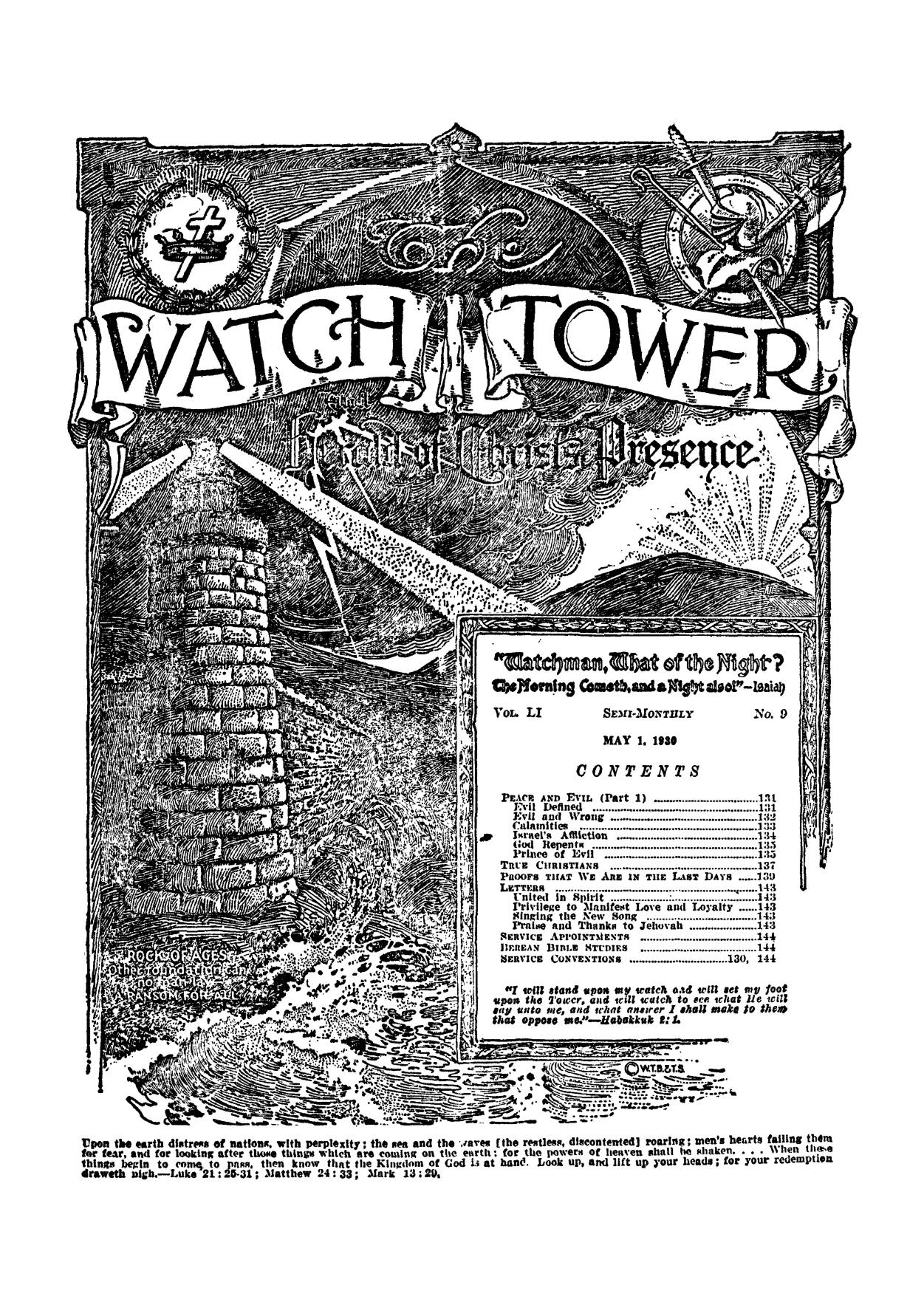
Vol. LI
May 1, 1030
No. 9
PEACE AND EVIL
“I form the light, and create darkness; I make peace, and create evil. I the Lord do all these things.”— Isa. 45:7.
JEHOVAH is the God of peace. His Word says: “The God of peace shall bruise Satan under your feet shortly.” (Rom. 16:20) The words of this text imply also that he is the God of war, because he will make war against Satan and destroy him and his organization. In response to the cries of his oppressed people God expresses his righteous indignation against the oppressor, and is therefore called the military God, or Lord of sabaoth. (Jas. 5: 4) Jehovah fought for his people Israel, and will fight for those of his organization in his own due time. (2 Chron. 20:15; Ps. 110: 5, 6) With equal certainty the Scriptures say that Jehovah will bless his people with peace. (Ps. 29:11) His kingdom will bring peace to the peoples of earth only after the greatest of all wars, and the peace then established shall continue for ever.—Ps. 72:3-7; Isa. 2: 4.
2 While war and peace are exactly opposite, there is not the least inconsistency in Jehovah’s being the God of peace and the God of war. Everything that Jehovah does is absolutely consistent and right. There is a proper time and occasion both for peace and for war. “To every thing there is a season, and a time to every purpose under the heaven. A time to love, and a time to hate: a time of war, and a time of peace.” (Eccl. 3:1, 8) When creatures do contrary to the law of Jehovah it becomes necessary for him, in his own due time and way, to make war upon them. When his creatures seek his face in his appointed manner, he makes peace for them.
3 Jehovah is good, and all his ways are right. (Ps. 25:8) Every good and perfect thing proceeds from him. But there is no inconsistency in the statement made in the Scripture text first above cited, to wit: “I make peace, and create evil.” This text has been much misunderstood, and by reason thereof God has been misrepresented. Many have taught that it would be impossible for Jehovah God to create anything that would be evil. The difficulty arises from improper understanding of the term “evil”.
4 Worldly lexicographers have defined evil in these words: “Anything having bad moral qualities, corrupt, wicked or wrong.” To be sure, God could not create anything or practice anything that possesses bad moral qualities or that is corrupt or that is wicked or that is wrong, because ‘all his works are perfect’. (Deut. 32:4) Worldly lexicographers cannot always give the correct definitions of words used in the Bible because they know not God and have not his spirit and therefore do not understand his Word. God is his own interpreter, and when we search the Scriptures in the spirit of Christ we find that everything in the Bible is consistent, and by the Lord's spirit his children are enabled to arrive at a correct definition.
EVIL DEFINED
5 Another translator renders the foregoing text in this manner :“I am Jehovah, there is none else; forming light and creating darkness, making prosperity and creating misfortune.” (Rotherham) That God creates evil there cannot be the slightest doubt, because his Word so says. There is a wide difference, however, between evil and that which is morally wrong or wicked. According to the Scriptures “evil’’ means that which brings adversity or hurt, affliction or sorrow. It is not necessarily morally wrong.
6 Death is a great evil. It is the very opposite of life, and no greater misfortune could befall any creature than to lose his life. Death brings adversity, hurt, affliction and sorrow to those who were the friends of the deceased. It was Jehovah God who provided death as the penalty for the violation of his law. (Gen. 2:17) It was not wrong for him to do so, but it was right for him to fix the severest punishment for the deliberate violation of his law. He created man, and his creative work “was very good”. (Gen. 1:31) It was God’s will that adversity should not befall his creature man; therefore he commanded him not to eat of the fruit of a certain tree and informed man that if he wilfully violated God’s law evil would befall him, which evil or adversity would be death. The evil which God had created, and which fell so heavily upon Adam, was not wrong, but right. It was a just punishment for the wilful violation of God's word. The rightful and just enforcement of that law brought the greatest adversity, sorrow and affliction upon Adam and upon his offspring and lias affected the entire human race.
7 Jehovah God, as the scripture states, created light, which is sown or made for those who do right. (Ps. 97:11) He created darkness, which is the portion of those who wilfully continue in wrongdoing. (Ps. 82: 5-7; 107:10; Jude 13; 2 Pet. 2:4) To those who are obedient to him he opens his hand and fills them with that which is good. (Ps. 104: 28) “For the Lord God is a sun and shield: the Lord will give grace and glory: no good thing will he withhold from them that walk uprightly.” (Ps. 84:11) “The Lord trieth the righteous; but the wicked, and him that loveth violence, his soul hateth. Upon the wicked he shall rain snares, fire and brimstone, and an horrible tempest: this shall be the portion of their cup. For the righteous Lord loveth righteousness; his countenance doth behold the upright.”—Ps. 11: 5-7.
8 This divine rule Jehovah plainly announced to Israel when he directed Moses to state to that people the terms of his covenant with them. If that people would keep his commandment and obey his voice they should prosper and have his blessing; and if they would turn away from Jehovah and disobey him evil would befall them. “See, I have set before thee this day life and good, and death and evil; in that I command thee this day to love the Lord thy God, to walk in his ways, and to keep his commandments and his statutes and his judgments, that thou mayest live and multiply: and the Lord thy God shall bless thee in the land whither thou goest to possess it. But if thine heart turn away, so that thou wilt not hear, but shalt be drawn away, and worship other gods, and serve them; I denounce unto you this day, that ye shall surely perish, and that ye shall not prolong your days upon the land, whither thou passest over Jordan to go to possess it.”—Deut. 30:15-19.
9 After God had given the Israelites his law, as stated in the covenant, they were rebellious, and Moses told them that evil would come upon them later and would come at the hand of the Lord God. (Deut. 31:27-29) By his prophets God repeatedly warned the Israelites that he would bring evil upon them for their wrongdoing. (Jer. 6:19) The Israelites were God’s covenant people and were bound by the terms thereof to obey and serve God. Because of their wrongdoing, and as a punishment therefor, God did bring evil upon them. “And they forsook the Lord, and served Baal and Ashtaroth. And the anger of the Lord was hot against Israel, and he delivered them into the hands of spoilers that spoiled them, and he sold them into the hands of their enemies round about, so that they could not any longer stand before their enemies. Whithersoever they went out, the hand of the Lord was against them for evil, as the Lord had said, and as the Lord had sworn unto them: and they were greatly distressed.”—Judg. 2:13-15.
10 Surely it cannot be contended that it was wrong for God to punish the Israelites for a violation of their covenant. It was not wrong, but exactly right, for the reason that they had deliberately violated their solemn agreement with Jehovah. God created the evil that befell the Israelites for their wrongdoing, and his action in bringing that evil upon the Israelites was right.
11 What was God’s purpose in thus bringing the evil upon the Israelites? Was it merely to give them some experience with evil, that they might learn the baneful effects thereof? No, such was not the reason. The Scriptures plainly state that the “children of Israel did evil in the sight of the Lord” by forsaking God and serving the Devil. (Judg. 2:11) The evil that they did was a gross sin, and therefore wrong. The Israelites, by the terms of their covenant, were promised life if they would obey God’s law, and were told that death would follow a deliberate violation thereof. The only way creatures can possess and hold eternal life is to know and to obey God. By departing from their covenant the Israelites were destroying their opportunity for life. The name and word of God were involved; and, for their good, Jehovah God would keep before them that he is the only true God and the Giver of life. The action of Jehovah in bringing evil upon the Israelites was not selfish, but was because of his love for them and for the upholding of his word and name. He would have them know that they could not follow or worship the Devil and receive that which they so much desired, namely, life and happiness.
12 The law of God was expressed to Israel in these words: “Thou shalt have no other gods before me.” His commandment to them was: “Thou shalt love the Lord thy God with all thy heart, with all thy soul, and with all thy mind.” Knowing this clear and positive statement of the law and of the commandment of God and then going contrary thereto revealed to the true Israelites the hideousness of sin. Sin is a transgression of God’s law, and to know his law and his commandment and to deliberately violate the same increases the enormity of the wrongdoing and makes this manifest. Such is the argument of Paid in Romans 7:12-14. The Israelites had agreed to obey God’s law and his commandments, and by taking an opposite course they broke their solemn covenant and also broke the law and the commandment. For such wrongdoing on their part, and as a punishment therefor, and for their own good, God brought evil upon them; and, in so doing, that evil was right.
EVIL AND WRONG
13 There is a wide difference between evil and wrongdoing. All wrong or wrongdoing is evil, but not all evil is wrong. An act of injustice is always wrong, and also usually works evil upon another. The administration of justice is right, and often brings evil upon the person against whom it is enforced. Wrong or wrongdoing is always attended by injustice. Evil may be the result of the enforcement of justice or result therefrom. But wrong could never result from the strict enforcement of justice. Jehovah is the just God. (Isa. 45:21) The dwelling place of justice is with him. "Justice and judgment are the habitation of thy throne: mercy and truth shall go before thy face.” (Ps. 89:14) In the administration of justice to his creatures evil or affliction must of necessity result to the wrongdoer. But that does not at all argue that it is wrong. On the contrary, it fully supports the scripture that God creates evil.
14 Justice means that which is right and in full harmony with God’s law. Judgment means the judicial determination or decree rendered by one having the rightful authority to do so. When the Scriptures declare that ‘justice and judgment are the habitation of Jehovah’s throne’ the meaning is that all the judicial determination or decrees rendered or made by Jehovah are right, and this is true even though such judicial decrees for the enforcement of justice bring suffering and sorrow, and therefore evil, upon the ones against whom they are enforced. It is the exclusive right of Jehovah to delegate authority to others to render judgment. In delegating such authority to certain ones in his organization of Israel, and commanding that they should administer justice, God declared that there should be no discrimination in so doing. "Ye shall not respect persons in judgment; but ye shall hear the small as well as the great; ye shall not be afraid of the face of man; for the judgment is God’s: and the cause that is too hard for you, bring it unto me, and I will hear it.”— Deut. 1:17.
15 Any judgment or decree made or rendered and enforced because of ill will, hatred or malice is wrong and evil. On the contrary, a decree or judgment made or rendered and enforced by one possessing the rightful authority and only in the honest administration of justice is right even though it results in suffering on the part of the one against whom the decree is enforced. Because the enforcement of a just judgment does bring suffering and affliction it is evil and is in full harmony with God’s law. Such judgment or decree, however, must always be made and enforced by the one having full power and authority thus to do.
16 The Israelites were God’s people chosen by him for his organization and they were given instruction in righteousness. What he required of them he requires of all whom he approves, to wit, "to do justly, and to love mercy, and to walk humbly with thy God.” (Mic. 6:8) Men have formed nations, made laws, provided for tribunals which have rendered and enforced judgments, but have failed to do so justly because of the imperfection of man and because the nations and peoples of the earth have been and are under the influence and control of Satan. When God’s kingdom is in full sway in the earth, then Christ the King and just Judge will do justly and render all decrees in justice and righteousness. (Isa. 11:4) All his judgments will be right, but they will work evil to the wicked.—Ps. 145: 20.
17 It is wrong for any one to render or to attempt to render and to enforce against others a judgment or decree that would result in evil, unless the person so rendering such judgment or decree has full authority thus to do. It is therefore clearly seen that evil or punishment administered without authority is wrong, whereas evil resulting from a judgment made or enforced by the rightful authority is right and proper. Any judgment or decree that is made, rendered and enforced contrary to God’s law is therefore wrong and evil. At once it becomes apparent that to know God and his law is of paramount importance, and then it becomes necessary to obey him.
CALAMITIES
18 A calamity is an evil because it results in suffering, distress and loss to those upon whom it falls. At stated times God sent calamities upon certain peoples, and in each instance that evil was a righteous act. The Israelites, who were God’s chosen people, were domiciled in Egypt. God had greatly favored the Egyptians by saving them from starvation in a time of famine. Because thereof, and because God’s people were in Egypt, the Egyptians, and particularly the ruling powers, had reason to know the great Jehovah God and to know of his name. The Egyptians oppressed the people of Jehovah and continued to increase their burdens. The Egyptians therefore wrongfully afflicted the Israelites with evil.
19 God heard the cries of the Israelites, and he sent Moses and Aaron to appear before the ruler of Egypt and request that the Israelites be permitted to depart from that land. This request was refused by Pharaoh, who arrogantly replied: "Who is Jehovah, that I should obey his voice?” Then God sent certain plagues or calamities upon the peoples of Egypt, which resulted in evil to them, and finally he completely overthrew the Egyptians in the Red Sea and caused the ruling power to perish. Such calamity was a very great evil upon the Egyptians, and it was a righteous one that fell upon them. Why did God bring that evil upon the Egyptian people? Was it to teach them the sinfulness of sin? Was it for the purpose of venting his ill will against them? The Lord caused the proper answer to these questions to be written in his Word when he said: "And what one nation in the earth is like thy people, even like Israel, whom God went to redeem for a people to himself, and to make him a name?” (2 Sam. 7:23) Satan the enemy had defamed the name of Jehovah and turned the peoples away from him and caused those who should have known better to defy Jehovah God. Jehovah's expressed purpose was to keep his name before man-kind until his own due time to completely vindicate his word and name.
20 When the Israelites were in the wilderness and on their journey to Canaan, the Amalekites, who were a part of Satan’s organization, illtreated the Israelites. The Amalekites were the descendants of Esau, were the kinsmen of the Israelites, and had reason to know that the Israelites were God’s chosen people, and the presumption is they did know; yet they deliberately illtreated them. Later God sent Saul, the king of Israel, with an army to destroy the Amalekites. Most of that people were destroyed. That was a disaster or a calamity that fell upon them; and it was right, for the reason that the Amalekites had illtreated God’s chosen people, brought reproach upon the name of Jehovah God, and attempted to interfere with the operation of God’s purposes. At the same time God showed kindness to the Kenites because they had showed kindness to his people Israel and thereby recognized the name of Jehovah God.— 1 Sam. 15: 2-7.
21 The Assyrian army appeared before the city of Jerusalem and defied the name of Almighty God. The Assyrians were worshipers of the Devil and were instruments used by the Devil to reproach the name of Jehovah and to turn mankind away from Jehovah God. The embassy that appeared before the walls of Jerusalem not only defied Jehovah, but diligently attempted to draw all the people of Israel away from God and their covenant. Then God brought a great disaster or calamity upon the army of the Assyrians. He sent his angel and smote 185,000 of them in one night. (Isa. 36, 37) This calamity was an evil, but rightfully enforced, that the name of Jehovah God might be kept before his creatures.
22 Jehovah God brought a great disaster upon the peoples of Sodom and Gomorrha, and such was an evil upon them; but his action in destroying them was right, for the same reason as stated above. It will not do to say that the Amalekites, the Egyptians, the Assyrians and the peoples of Sodom and Gomorrha were destroyed because they were already convicts and under the sentence of death. They were not under the sentence of death, for the reason they had never been tried and sentenced. They were all born in sin by reason of the fact that they were descendants of Adam, who was sentenced to death. They were under condemnation because disapproved; but if for that reason they were executed, then we should expect Jehovah God to execute every one of the human race, because every child is born in sin. (Rom. 5:12) The question of the imperfection of the Amalekites, Egyptians, Assyrians and Sodomites was not involved.
23 Those people had turned away from Jehovah God and worshiped the Devil, opposed God’s anointed people, and brought reproach upon God’s holy name; and for the good of all creation God slew them. He did so for the same reason that he went down to Egypt, to wit, to make a name for himself or keep his name before creation until his own good time to completely vindicate it. Ho would have the people know that Satan is not the Almighty, but that Jehovah is the Almighty God. His action in overthrowing the Egyptians and others also foreshadowed his purpose in due time to completely destroy Satan’s organization that all creation may know that Jehovah is the only true God and that his Word is true and that his name is the only one whereby life may be obtained.
ISRAEL’S AFFLICTION
24 The nation of Israel constituted the typical organization of Jehovah which he used to foreshadow his purposes. He chose the Israelites and placed his name upon them and made them his peculiar treasure above all people upon condition that they would obey him. (Ex. 19:5, 6) As his people among the other nations round about they were God’s representatives and stood for Jehovah. The other nations were under the control of Satan and practiced the Devil religion and reproached the name of Jehovah. The Israelites became unfaithful, defamed the name of Jehovah, and followed after false gods; and then Jehovah God brought a great calamity upon them. Ho caused their city to be laid low and the people thereof that remained after a great slaughter to be carried away captive to a foreign land. His punishment upon them was for his name's sake. (Jer. 44: 26-28) He has promised that for his great name’s sake and in due time he will restore Israel and show to all nations that he is the only true and living God and that there is none other.—Ezek. 36: 21-23.
25 That calamity which fell upon Israel was a great evil to that people; but it was right, and was administered justly as a punishment for their wrongdoing, and more particularly as a vindication of the name of Jehovah God. The issue was then, and is now, between Jehovah and the adversary Satan. Jehovah has not prevented Satan from carrying on his wicked ways and works, nor has he prevented the people from following after Satan. He has from time to time brought calamities or disasters upon certain peoples that his name might not entirely perish from the sight of creation; and this he does for the good of creation. Therefore all the evil which God has caused to come upon creatures has been right and just, whether that evil be in the form of individual punishment or as a great calamity upon a people or peoples.
26 The Israelites, being God’s covenant people and responsible to him, were more reprehensible because of bringing reproach upon Jehovah’s name. To them he said: “Hear this word that the Lord hath spoken against you, O children of Israel, against the whole family which I brought up from the land of Egypt, saying, You only have I known of all the families of the earth: therefore I will punish you for all your iniquities.” (Amos 3:1, 2) The city of Jerusalem stood for his organization; hence he said: ‘‘Shall there be evil in a city, and the Lord hath not done it?” (Amos 3:6) In other words, the punishment that fell upon the Israelites, God's chosen people, he cither permitted to come or sent it to carry out his righteous purposes. The iniquity of that people consisted in their breaking his law and commandment and doing contrary to their covenant, and therefore the evil which God brought upon them was right and his judgment and the enforcement thereof was righteous.
GOD REPENTS
27 The Scriptures state that God repents. For instance, it is written: ‘‘And the Lord repented of the evil which he thought to do unto his people.” (Ex. 32:14) And again: ‘‘If that nation, against whom I have pronounced, turn from their evil, I will repent of the evil that I thought to do unto them.” (Jer. 18:8) This does not mean that God, by repenting, acknowledges that his course of action was wrong. On the contrary, it means that God reverses his course of action or changes it, and that for the good of his creatures.
28 In the case of the Israelites God was justly indignant toward them because they had set up a golden calf to worship, and that at the Devil’s instance; but at the supplication of Moses God changed his course of action and did not destroy the Israelites, which he might have justly done. On another occasion he directed Jeremiah to state that if the nation against whom he had pronounced a decree should turn away from their wrongful course, then he would reverse his action or determination to afflict them with evil or punishment.
PRINCE OF EVIL
29 A prince is one who has power with God or man; one who has authority to govern, to rule, or to exercise delegated power. Lucifer was placed in the organization of Jehovah with authority and certain delegated powers granted to him. He was made the overseer of man. He was therefore a prince, and was made so by Jehovah. (Ezek. 28:13-15) He was given the power of death. (Heb. 2:14) That evidently means that God delegated to him the power to inflict death upon man for the violation of God's law.
30 As Jehovah's anointed officer it was the duty of Lucifer to put man to death for a wilful violation of God’s law. It is written that Lucifer ‘was perfect until iniquity was found in him’. That means that he departed from God’s law and took a lawless course. Manifestly he reasoned that if Adam did sin, he, Lucifer, would not exercise his delegated power and put Adam to death, and that if God did exercise the power and put Adam to death such would be an admission on God’s part that he could not make a creature that would maintain his integrity with Jehovah. Furthermore, that if Adam violated God's law and then God declined to put him to death, that would make God a liar in the eyes of all creatures, and in any event his (Lucifer’s) purpose to bring the name of Jehovah into disrepute would succeed. It was evidently Lucifer’s purpose to turn the creatures away from the Creator and thereby to obtain for himself that which he coveted, to wit, the worship of creatures. Lucifer therefore became Satan the wicked one, and hence the wicked prince.
31 The Scriptures do not disclose that God deprived Satan of the power to inflict death. On the contrary, he must still have possessed that power and authority at the time of the great test that came upon Job, because God commanded that he should not kill Job. (See Job 2:6.) There is no reason to believe that he has yet been deprived of the power to inflict death. From the time of Satan’s deflection all power that he has exercised has been exercised by him wrongfully. God could have restrained him, but he did not choose to do so.
32 Since the tragedy of Eden Satan has been, and now is, that wicked prince that has persisted in going contrary to God’s law. When Jesus was on earth he spoke of him as ‘‘the prince of this world”. (John 12:31) Jesus described him as the one opposed to Jehovah and to himself. Satan is also designated in the Scriptures as the prince of devils, which means that he is the chief one among the devils or wicked ones. He is also designated ‘‘the prince of the power of the air” (Eph. 2:2), which must mean that ho possesses and exercises power that is invisible to man and that is great. Such fact is within the common knowledge of all who really discern the truth as revealed in God’s Word. As ‘‘prince of the power of the air” Satan would have power to generate storms, hurricanes, floods and like things that would bring great calamities upon the people. When Jesus was on the sea of Galilee, without doubt it was Satan, the prince of the power of the air, that brought up the storm in an effort to destroy the Master. (Mark 4: 37) Jehovah would not have brought on that windstorm, which put in jeopardy the lives of his chosen men. Since Satan possesses such power, and since he made repeated attempts to destroy the Lord Jesus, he must have been responsible for that storm on the sea of Galilee. The Scriptures are explicit in the statement that Satan produced the great storm that destroyed the children and the property of Job.—Job 1:12-19).
33 From time to time there have befallen the peoples of earth great calamities in the way of storms, hurricanes, cyclones, typhoons, floods and fires, and the like. Since there would be no occasion or reason for Jehovah to bring such disasters upon the people, the one responsible therefor must be Satan. Since God overthrew Israel, his typical people, there is no evidence that he has brought calamities or been responsible for the calamities that have befallen the peoples of the earth. On the contrary, the Scriptures point out that he abides his own good time to bring the great battle of God Almighty which will completely and for ever vindicate his name.
34 What would be the purpose of Satan in bringing calamities upon the people? Manifestly for the reason that he would cause such to be charged against Jehovah God and thereby cause the people to curse God. Knowing that Satan has a set policy which has ever been to turn man away from Jehovah, and knowing there has been instilled into the minds of men that storms and floods and the like are the acts of God, it is easy to sec that these calamities are a part of Satan’s subtle scheme to reproach Jehovah and turn the people away from him. The so-called civilized nations of the world have put it into their laws and written it into their contracts, at least by implication, that Jehovah God is responsible for all the floods and storms and like disasters that befall the human race. In this they are wrong, even though ignorantly so. The Devil himself is responsible for such calamities. Jesus is authority for the statement that at the conclusion of the ‘preaching of this gospel of the kingdom’ God will then bring a great calamity upon the earth and the peoples thereof for the vindication of his name. It is manifestly the purpose of Satan to cause all the people prior to that time to curse God and turn from him.
35 The wicked creature is one who has been first enlightened and who turns away from righteousness and pursues a course of unrighteousness. Lucifer was an officer of great light and power. He knew God and knew his law. He deliberately rebelled and became the wicked one. He is the chief of the rulers of the darkness of this world. (Eph. 6:12) Satan brings great evils upon the peoples and causes them to suffer greatly, and all such evils are wrong, and are therefore wicked. It has been very difficult for the people to discern between the evil which God rightly inflicts upon wrongdoers for the purpose of vindicating his name and the evil which Satan wickedly and maliciously causes to come upon the people to turn them away from God. Satan has assumed the control of organized bodies of men and caused them to adopt the practice of evil, and particularly the practice of his Devil religion. He causes them to worship demons or devils, of which he is the chief. Early in the days of the Christian era he obtained control of men who were the leaders of organized Christianity, or the organization formed in the name of Christ. Since then be has caused men and organizations in the name of Christ to practice and carry on extensive wickedness and has charged the same up to God and has thereby brought great reproach upon the name of Jehovah God.
36 For centuries crime has run riot in the earth, and the record of every nation is smeared with human blood unrighteously shed, for all of which Satan is responsible. He has caused the persecution and death of many people and has used professed followers of Christ to commit such crimes. For instance, he has inveigled the professed Christian people of America to enact the so-called prohibition law and to attempt to enforce it and to resort to all kinds of wickedness to enforce this law. Many harmless people have been deliberately murdered under the pretext of upholding this so-called moral law. It is the policy of the clergy, as a rule, to insist that the prohibition law is really the law of God. By this means adopted by Satan he has brought the name of Jehovah into reproach and turned many men and women away from the great eternal God.
37 It seems to be the due time at least for the followers of Christ Jesus and for all order-loving people to have a proper understanding of evil, wrongdoing and wickedness, and the distinction among the same. While wickedness continues to increase in the world the clergy continue to harangue the people and say: ‘The world is growing better.’ Therefore, in the mind of the one who thinks, the question arises: Has the world ever learned valuable lessons by reason of evil ? Other related questions are pertinent, to wit: Have the followers of Christ learned lessons by reason of evil? Is experience the best teacher? Is the Christian ever justified in employing evil? To whom has Jehovah God delegated power to render judgment?
(To be continued)
QUESTIONS FOR BEREAN STUDY
1, 2. With scriptures, show the consistency in Jehovah's being the God of peace and the God of war.
3, 4. Harmonize the statements that 'all the ways of Jehovah are right’ and that he ‘creates evil’.
5, 6. What is death? For what purpose was it ordained, and by whom? Explain the justice in such provision.
7-9. Define “light” and “darkness” as the terms are here used. What is their source? For whom was each created?
10-12. Point out the seriousness of Israel’s iniquity. Show that the punishments which God visited upon the Israelites were just and were peculiarly for their benefit.
13. Illustrate the truth of the statement, “All wrong or wrongdoing is evil, but not all evil is wrong.”
14, 15. What is the meaning of the Scriptural statement that ‘justice and judgment are the habitation of Jehovah’s throne’? Who may properly render judgment and administer justice? When, in the affairs of Israel, Moses delegated to others the authority to render judgment, why did he particularly emphasize impartiality? What constitutes true judgment?
16, 17. What is God’s requirement of every person who will ever have his approval, as stated through Micah to Israel? To what extent has this rule been observed among men, and why? When and by whom will justice be perfectly administered, and how will the people be affected thereby?
18, 19. Point out the particular facts in which lay the Egyptians’ definite accountability to Jehovah for their oppressing and afflicting the Israelites. Describe and justify the evil which God brought upon the Egyptians in delivering Israel.
20. Show that the destruction of the Amalekites was right. Account for God’s kindness to the Kenites.
21. Relate how God dealt with the army of the Assyrians. Why was it right for him to do so?
22. Describe the disaster which Jehovah brought upon Sodom and Gomorrha. Why was such action right?
23. What was the purpose in Jehovah’s thus dealing with Egypt, Assyria, and others, and what did such action foreshadow?
24. Account for Jehovah’s special care over Israel. What great evil did he later bring upon Israel, and why? What, however, is yet the divine purpose concerning Israel, and why will God thus deal with that people?
25, 26. Point out, then, the principle clearly justifying Jehovah’s bringing evil upon certain peoples in the past.
27, 28. Explain and illustrate what is meant by God's ‘repenting of an evil which he had thought to do’.
29, 30. Who was Lucifer? Describe his relationship and office as a prince, and his misuse thereof. Since his deflection how has ho been identified?
31, 32. Describe Satan’s present status as a prince. Show the fitness of his titles “the prince of this world’’ and “the prince of the power of the air’’.
33, 34. Account for the calamities brought upon the people since the days of Israel.
35, 36. Describe the activities of Satan, to show that he is most fitly called “the wicked one’’.
37. With “evil’’, “wrongdoing,” and “wickedness” prevalent and increasing in the world, why is it now particularly important to make a clear distinction in the use of these terms?
TRUE CHRISTIANS
[Fifteen-minute radio lecture]
THE mere fact that a person claims to be a Christian does not prove that he is such. Jesus mentioned a class whom he called “hypocrites”, in Matthew 15:7, 8, saying: “This people draweth nigh unto me with their mouth, and honoureth me with their lips: but their heart is far from me.” Jesus also mentioned another class of those who thought they were Christians, in John 16:2, saying: “Yea, the time cometh that whosoever killeth you will think that he doeth God service.” Again, in Matthew 7:21, Jesus said: “Not every one that saith unto me, Lord, Lord, shall enter into the kingdom of heaven.” In Luke 6:46, also, we find these words of the Master: “Why call ye me Lord, Lord, and do not the things which I say ?’’
In Luke 13: 25-27, Jesus mentioned others who professed to be his followers and were not, in these words: “When once the master of the house is risen up, and hath shut to the door, and ye begin to stand without, and to knock at the door, saying, Lord, Lord, open unto us; and he shall answer and say unto you, I know you not whence ye are.” Some of those, who are not true Christians, are blinded and deceived by the great adversary, and have a zeal but not according to knowledge, and verily think they are doing God service. Others are wilfully using their religion as a cloak to cover their covetousness and sham. The latter are the hypocrites.
The Lord warned all true Christians to be on guard against the false, and gave certain evidences by which it would be possible to determine who are true and who are false Christians. Jesus said, on one occasion: “Ye shall know them by their fruits.” It is entirely possible to know who are the Lord’s meek, humble, and submissive sheep, and who are those who profess to be sheep and yet are stubborn and wilful goats and, goat-like, refuse to eat and assimilate the food provided by the Lord in his Word but seek out pastures of their own and try to fit themselves for heaven by obeying and teaching for doctrines the commandments of men.
All true Christians have entered into 'a covenant by sacrifice’ with the Lord. This means that they have renounced their right to live on earth, and have accepted an invitation, extended by the Lord, to follow in his footsteps, do his will, and, eventually, be ‘for ever with the Lord’ in heaven. If they would be in the heavenly kingdom, with our Lord Jesus, they must follow a certain course of action, which Jesus has definitely outlined in his Word. Briefly, that course of action is this: To a reasonable degree they must deny themselves earthly good things, earthly blessings and earthly hopes, in order that they may have time to do the will of the Lord, which they have covenanted to do.
The will of the Lord is that they shall search the Scriptures, to ascertain what he wants them to do, and that then they shall do those things, regardless of what relatives, friends, and neighbors shall say or think. They soon learn that God has purposed that Jesus shall have a thousand-year kingdom, during which Satan shall be bound and Jesus shall bless all the families of the earth, both the living and the dead. They learn that it is his will that they shall preach that kingdom; that the only way to carry out their covenant by sacrifice is to preach that coming kingdom and its blessings. This is the course of action marked out for them in the Word of Truth. Only those who do this are true Christians.
These true Christians were not authorized to preach politics, or social or moral reforms. Such a course of action is not mentioned in the Scriptures. It is quite popular to preach politics, reforms, and good works; and be it noticed that such a course of action never brings reproach or persecution upon the preacher. The true Christian, who will continually and persistently preach the coming kingdom, not only is doing just what Jesus did, but will have experiences exactly like those which Jesus had. Thus we have a rule, laid down in the Scriptures, by which one can determine who are true Christians and who are not. First, they will be preaching the coming kingdom and its blessings. Secondly, they will be reproached, slandered, and persecuted for so preaching.
Jesus repeatedly warned those who would be his followers that they would be thus treated for their fidelity in preaching the truth. He said, in Luke 6:22, 23: “Blessed are ye, when men shall hate you, and when they shall separate you from their company, and shall reproach you, and cast out your name as evil, for the Son of man’s sake. Rejoice ye in that day, and leap for joy: for, behold, your reward is great in heaven: for in the like manner did their fathers unto the prophets.”
Speaking to his followers, Jesus said: “If ye were of the world, the world would love his own: but because ye are not of the world, but I have chosen you out of the world, therefore the world hateth you. Remember the word that I said unto you, The servant is not greater than his lord. If they have persecuted me, they will also persecute you.” (John 15:19, 20) Thus we can identify those who have God’s approval.
God permits these reproaches, for the purpose of testing and preparing his children, and as a proof that they are his and have his approval. Thus even the reproaches become a source of encouragement to true Christians. That is why Jesus admonished his followers to ‘count it all joy when ye fall into divers trials’. In 1 Peter 4:12-14 we read: “Beloved, think it not strange concerning the fiery trial which is to try you, as though some strange thing happened unto you: but rejoice, inasmuch as ye are partakers of Christ’s sufferings; that, when his glory shall be revealed, ye may be glad also with exceeding joy. If ye be reproached for the name of Christ, happy are ye; for the spirit of glory and of God resteth upon you: on their part he is evil spoken of, but on your part he is glorified.”
It is written of Jesus that he learned obedience by the things which he suffered. (Heb. 5:8, 9) Likewise, those who will be his associates in the kingdom must be partakers of the same sufferings. (1 Pet. 2:21) Paul, under inspiration, wrote to Christians as follows: “The spirit itself beareth witness with our spirit, that we are the children of God: and if children, then heirs; heirs of God and joint-heirs with Christ; if so be that we suffer with him, that we may be also glorified together. ’’
Paul was a man of unusual attainments. He was a member of a great and popular religious organization of his day. That organization claimed to worship Jehovah God and to be looking for the coming Messiah. Paul became a true Christian and withdrew his support from the sect of the Pharisees, and thereafter suffered reproach and persecution, even unto death, for his faithfulness to the Lord. He always preached the coming kingdom and its blessings. In Philippians 3:7, 8, speaking of his former position of influence and honor, as a Pharisee, he said: “What things were gain to me, those I counted loss for
Christ. Yea, doubtless, and I count all things but loss, for the excellency of the knowledge of Christ Jesus my Lord: for whom I have suffered the loss of all things, and do count them but dung, that I may win Christ.” His course and experience are the course and experience of everyone who is true and faithful unto the Lord.
A true Christian, however, is not discouraged by these experiences. He expects to have them, and remembers that it is written: “We know that all things work together for good to them that love God, to them who are the called according to his purpose.” (Rom. 8:28) Thus he is confident that God orders his course and overrules all his experiences for his good.
Bearing in mind that “the world” means Satan’s great organization, which men call “Christendom”, we are enabled to better understand what the apostle meant when he wrote these words: “Love not the world, neither the things that are in the world. If any man love the world, the love of the Father is not in him.” (1 John 2:15) Again, in 1 John 5: 4 we are told that a Christian must overcome the world; and, in John 16: 33, Jesus said: “Be of good cheer: I have overcome the world.” Still again, in James 4:4 we read: “Know ye not that the friendship of the world is enmity with God? whosoever therefore will be a friend of the world, is the enemy of God. ’ ’
These texts being true, it becomes a matter of most vital importance as to what constitutes “the world”; for every true Christian must overcome “the world”. This is exactly the point at which those fail who are not true Christians. They fail because they have an improper idea of what constitutes “the world”. They think that “the world” means bad habits or evil deeds. This is a mistake. Jesus never overcame any bad habits, and he declares that he overcame “the world ’’.
What is meant, then, by the statement, “Overcome the world”? The answer is, It means to abstain from cooperating in the methods and schemes of the world, for the reason that they are contrary to God’s methods and purposes. God purposes to convert the world and institute a righteous government on the earth, by Jesus Christ, and during the thousand-year reign of Christ. Mankind can never hope to receive a blessing in any other way than by and through that kingdom.
Satan’s organization constantly tempts the true Christian to try its schemes for converting the world. It proposes to convert the world and bless the people by setting up a league of nations; by establishing a federation of churches; by making drastic legislation, similar to the much vaunted prohibition law, and by instituting moral and social reforms.
The true Christian perceives that these methods are methods of force, and that they can never succeed. The Bible points out their utter failure. But these methods, set forth by Satan and his organization, are popular, and anyone who dares to take issue with them is called a “red”, a “bolshevist”, and an “anarchist”, and denounced as a traitor to his country. Hence the true Christian, who preaches that none of these man-made schemes will accomplish any thing in the way of blessing, and urges the people to look forward to the kingdom of Christ as their only hope of deliverance from poverty, high cost of living, profiteering and oppression, not only is ridiculed, but is reviled and persecuted.
The true Christian gives heed to the words of the prophet, which say: “Rest in the Lord, and wait patiently for him: fret not thyself because of him that prospereth in his way, because of the man that bringeth wicked devices to pass.” “Fret not thyself because of evil doers.” (Ps. 37:7, 1) Overcoming the world, then, means to overcome the satanic idea that we can bring in the Millennium and its blessings by reform movements; by legislation; by militarism; by new forms of government or any other man-made scheme. Those who are not true Christians cannot endure the reproach and persecution incident to taking their stand against that which is popular and orthodox; and that is why the Lord says to them, “I never knew you: depart from me, ye that work iniquity.” (Matt. 7:23) Only the overcomers are the true Christians.
PROOFS THAT WE ARE LIVING IN THE LAST DAYS
[Thirty-minute radio lecture]
EVERYONE who loves Jehovah God, and who believes that the Bible is the Word of God, should be interested in the subject of “the last days”. These words occur in many Scripture texts, and refer to the same period of time that the Bible calls “the end of the world” and “the judgment day”.
Other texts indicate that “the last days” will be a time of intense trouble on the earth, because of which the hearts of those who do not understand the situation will be filled with doubts, perplexity and forebodings. These texts which refer to “the last days” clearly show that the world will not be converted at that time, but that wickedness, violence, crime, oppression and lawlessness will specially prevail, and that the Lord will use those who understand the situation to explain to others just what the trouble means, and thus to comfort and help them and enable them to get into harmony with God and have his blessing and approval.
The Apostle Paul, in his letter to Timothy (2 Tim. 3:1-5) says: “This know also, that in the last days perilous times shall come, for men shall be lovers of their own selves, covetous, boasters, proud, blasphemers, disobedient to parents, unthankful, unholy, without natural affection, trucebreakers, false accusers, incontinent, fierce, despisers of those that are good, traitors, heady, highminded, lovers of pleasures more than lovers of God; having a form of godliness, but denying the power thereof.” Had Paul lived in our day he could not have better described the conditions now existing.
These facts make the subject of “the last days” a most important one, and hence no apology is necessary for discussing it. What is said in this and following lectures is intended to be helpful, constructive, uplifting and comforting. It is not propaganda. No attempt will be made, either directly or indirectly, to get your money or to get you to join anything.
Watch Tower programs are not intended to stir up acrimonious debate, but to provoke study, thought and investigation. Neither can they be called a “new religion”. The word “religion” carries with it the thought of rites, ceremonies, forms, and a set creed, as well as the thought of joining some organization. The only purpose of these programs is to plant a hope of better things to come in the minds and hearts of the people; to make the Bible the most interesting and best-loved book on earth; and to exalt the name of Jehovah God so that the people can properly reverence and worship him.
In our day it is customary to avoid any discussion of doctrines, lest someone who disagrees with the thoughts presented should become offended. It is considered polite and proper to discuss only the moral precepts set forth in the Bible, and to urge people to “be good”, to “live right”, and to tell them that it does not make any difference what they believe if they only live right. This is a great mistake. It sacrifices the truth for the sake of being polite. To be sure, moral precepts are good, as far as they go; but be it noticed that Jesus had much to say about doctrines and very little to say about moralities. He continually emphasized doctrines, and so did the apostles. They always talked about “the kingdom”, “judgment,” “resurrection,” “end of the world,” “second coming of the Lord,” “second death,” and “the last days”. They emphasized doctrines, for the reason that God’s purposes toward the race are found in doctrines, and not in moral precepts; his messages of comfort and hope are hidden in doctrines, and a man’s salvation depends on believing and teaching certain doctrines.
When God created the earth, he had a definite purpose in connection with it; and that purpose is stated in Isaiah 45:18: “God himself . . . formed the earth and made it; he hath established it, he created it not in vain, he formed it to be inhabited.” Again, in Psalm 115:16 we read: “The earth hath he given to the children of men.” If God created the earth to be inhabited by men, it is entirely unreasonable to think that he would destroy it; and in Ecclesiastes 1:4 we read as follows: “One generation passeth away, and another generation cometh: but the earth abideth for ever.” These three texts briefly outline God's purpose respecting the earth itself; namely, it “abides for ever”, and it is to be inhabited by man.
Our Lord Jesus taught his people to pray for the time to come when God’s will would “be done in earth, as it is in heaven”; and if this prayer is ever answered, then the earth will never be destroyed. The Bible tells us of a time when every knee shall bow, both of things on earth and of things in heaven; of a time when the nations shall learn war no more, but, on the contrary, will beat their swords into plowshares and their spears into pruning hooks. (See Isaiah 2:2-4.) Therefore let us once and for ever get the thought out of our minds that the earth is to be destroyed. On the contrary, it is to be the everlasting dwelling-place of a happy, sinless and perfect race of human beings, enjoying God's blessing and favor for ever.
When God created Adam, he commissioned him to fill the earth with his posterity. That commission is found in Genesis 1:28, and reads: “And God . . . said unto them, Be fruitful, and multiply, and replenish the earth, and subdue it; and have dominion over the fish of the sea, and over the fowl of the air, and over every living thing that moveth upon the earth.” God said not one word to Adam about going to heaven. His home, and the home of his children, was to be the earth.
The record is that God placed a beautiful and wise spirit being, called Lucifer, over Adam and Eve as their guardian and protector. In Ezekiel 28:14 Lucifer is called the “anointed cherub that covereth”. His mission was to cover and protect Adam and Eve and guard them against any unseen dangers. Lucifer became ambitious to have a kingdom of his own and to have the worship and reverence of other creatures. With treason in his heart he sought to alienate Adam and Eve from the service of God and to make them his servants and get them to do his will, knowing that if he could lead the parents into sin he would also have control of the children through the law of heredity. Thus he would have a kingdom of his own, and his subjects and servants would be fallen, sinful humanity. (See Isaiah 14:12-15.)
God had told Adam that he would surely die if he ate of a certain fruit. Lucifer wilfully and premeditatedly lied to Eve, by saying, ‘God doth know that ye shall not surely die.’ He further poisoned her mind against God by telling her that the fruit not only was pleasant to the eye and good for food, but was much to be desired to make one wise. (Gen. 3:6) Eve believed Lucifer, ate of the fruit, and thus turned against God, her Creator and Benefactor, and tempted Adam to do the same. God cast them off as undeserving of further favor, drove them out of Eden, and enforced the death penalty against them by leaving them alone to die. The record is that ‘Adam lived 930 years, and he died’.
At this time God changed the name of Lucifer to Satan, and Devil, and ever after he has been the enemy of both God and man. Having obtained control of the race, he began the work of organizing mankind against God and against his work. He did this by appealing to human selfishness. God is love; Satan is selfish; and the followers of each have the spirit of their master. The children of God have the loving, generous, merciful and helpful spirit of God. Satan’s children have the cruel, selfish, merciless, oppressive and wicked spirit of their master.
Many times does the Bible speak of “the end of the world”, and always has reference to the end of the rule of Satan; the end of all oppressive, selfish institutions of earth, the end of graft and corruption, the end of hypocrisy and sham; in fact, the end of all those things which good men hate and would be delighted to see come to an end.
When Satan secured control of mankind, and seduced them into selfish ways, God purposed not to hinder or restrain Satan in his work of deception for approximately 6,000 years, However, he determined not to let Satan interfere in the least with his original purpose of filling the earth with a happy and sinless race. On the contrary, he determined that there should be a ‘second Adam’, who would do the work that the first Adam failed to do; namely, ‘fill the earth.’ This second Adam is the resurrected Lord Jesus Christ. (1 Cor. 15:45-47) God has set apart a thousand years for Jesus to accomplish this work. Men call this thousand years the Millennium. The Bible calls it the “day of Christ”, the “judgment day”, and the “day of salvation”. It is the time when the race will be delivered from the wicked reign and power of Satan.
It is clearly manifest that when Jesus takes his power, and that thousand-year reign of righteousness begins, the first work he must do is to destroy Satan’s evil organization; and since Satan’s organization is composed of all the evil man-made organizations of earth, it is also clearly manifest that the destruction of these will mean trouble in the earth, for the reason that Satan will not yield without a fight, neither will selfish men yield without a struggle. The end of the world will mean the end of Satan’s wicked reign, and does not at all refer to the destruction of the earth.
Now we are prepared to examine the words, “the last days.” What do they mean? The answer is that they refer to the last days of Satan's reign, the last days of graft, fraud, corruption, hypocrisy, autocracy, profiteering, wars, and selfishness of all kinds. The last days of Satan’s reign are also the first days of Christ’s reign. Satan is not to be ousted until Christ takes his power and begins his work. Thus does the Bible emphasize the thought that the beginning of Christ's kingdom will be a ‘time of trouble such as was not since the beginning of the world’.— Dan. 12:1; Rev. 11:17, 18.
According to Bible chronology, “signs of the times,” and the physical facts, “the last days” began in 1914 and will end in the very near future in what the Bible calls “the battle of that great day of God Almighty”, otherwise called “the battle of Armageddon”. This battle will accomplish the complete destruction of the Devil’s empire. It will also result in the binding of Satan for a thousand years. (Rev. 20: 1-7) This will be God’s first restraint of Satan; and it will be a complete restraint. Hundreds of texts in both the Old and the New Testament refer to this battle and the destruction of Satan’s organization and power.
Thus seen, the first work that Jehovah God will do during “the last days” will be a work of ridding the earth of the Devil’s organization, also of the Devil and his agents. This explains why a time of trouble is necessary.
Thus all those texts which refer to “the end of the world”, “the judgment day,” and “the last days”, picture a great time of trouble on the earth, including great destruction. With this thought in mind let us examine some of these texts.
Isaiah 13:4-9 reads: “A tumultuous noise ... of the kingdoms of nations gathered together: the Lord of hosts mustereth the host of the battle. . . . Howl ye; for the day of the Lord is at hand; it shall come as a destruction from the Almighty. Therefore shall all hands be faint, and every man’s heart shall melt: and they shall be afraid: pangs and sorrows shall take hold of them . . . Behold, the day of the Lord cometh, cruel both with wrath and fierce anger, to lay the land desolate; and he shall destroy the sinners thereof out of it.” The “day of the Lord” here mentioned is the first part of the thousand-year day of Christ. The “sinners” who will be destroyed are those people who reject the word of the Lord and oppose the establishment of Christ’s kingdom. Only those who love unrighteousness will take a stand of opposition.
Again, Isaiah 34:2, 8, 9 reads: “For the indignation of the Lord is upon all nations, and his fury upon all their armies: he hath utterly destroyed them, he hath delivered them to the slaughter.” “It is the day of the Lord’s vengeance, and the year of recompences for the controversy of Zion. And the streams thereof shall be turned into pitch, and the dust thereof into brimstone, and the land thereof shall become burning pitch.” Thus the Lord in highly symbolic language pictures to our minds a fire so hot that it utterly destroys the Devil’s organization; not a literal fire, but a time of destruction. That this is not a literal fire is amply proven by a reading of the next five verses, which tell us that the cormorant, the bittern, the owl, wild beasts and satyrs shall dwell in the very midst of that fire, and that the great owl shall make her nest in the fire and lay her eggs and hatch her young. Manifestly, then, it is not a literal fire.
Again, in Malachi 4:1 we read: “Behold, the day cometh that shall burn as an oven; and all the proud, yea, and all that do wickedly, shall be stubble: and the day that cometh shall burn them up, saith the Lord of hosts, that it shall leave them neither root nor branch.” If the proud and wicked are so completely destroyed that there is neither root nor branch left, then it is manifest that they are not in eternal torment. This is only one of the many proofs that eternal torment is not taught in the Bible.
Since “the last days” refer to the last days of the reign of Satan and to the time of the destruction of his organization, and not to the destruction of the earth itself, an interesting question arises; namely, What is God’s work after Satan is bound and his empire has ended? The Bible answer is as follows:
Jesus Christ will be King over all the earth in that day. There will be no power opposing him and the work of righteousness which he will begin. His work will be to “bless all the families of the earth”. As God’s representative in the earth, clothed with “all power in heaven and in earth”, he will do the work which all the prophets have foretold. In Jeremiah 31:33, 34 we read of that work, as follows: “After those days, saith the Lord, I will put my law in their inward parts, and write it in their hearts; and will be their God, and they shall be my people. And they shall teach no more every man his neighbour, and every man his brother saying, Know the Lord: for they shall all know me, from the least of them unto the greatest of them, saith the Lord; for I will forgive their iniquity, and I will remember their sin no more. ’’
…