The Watchtower, April 15, 1930
Download: PDF — The Watchtower, April 15, 1930
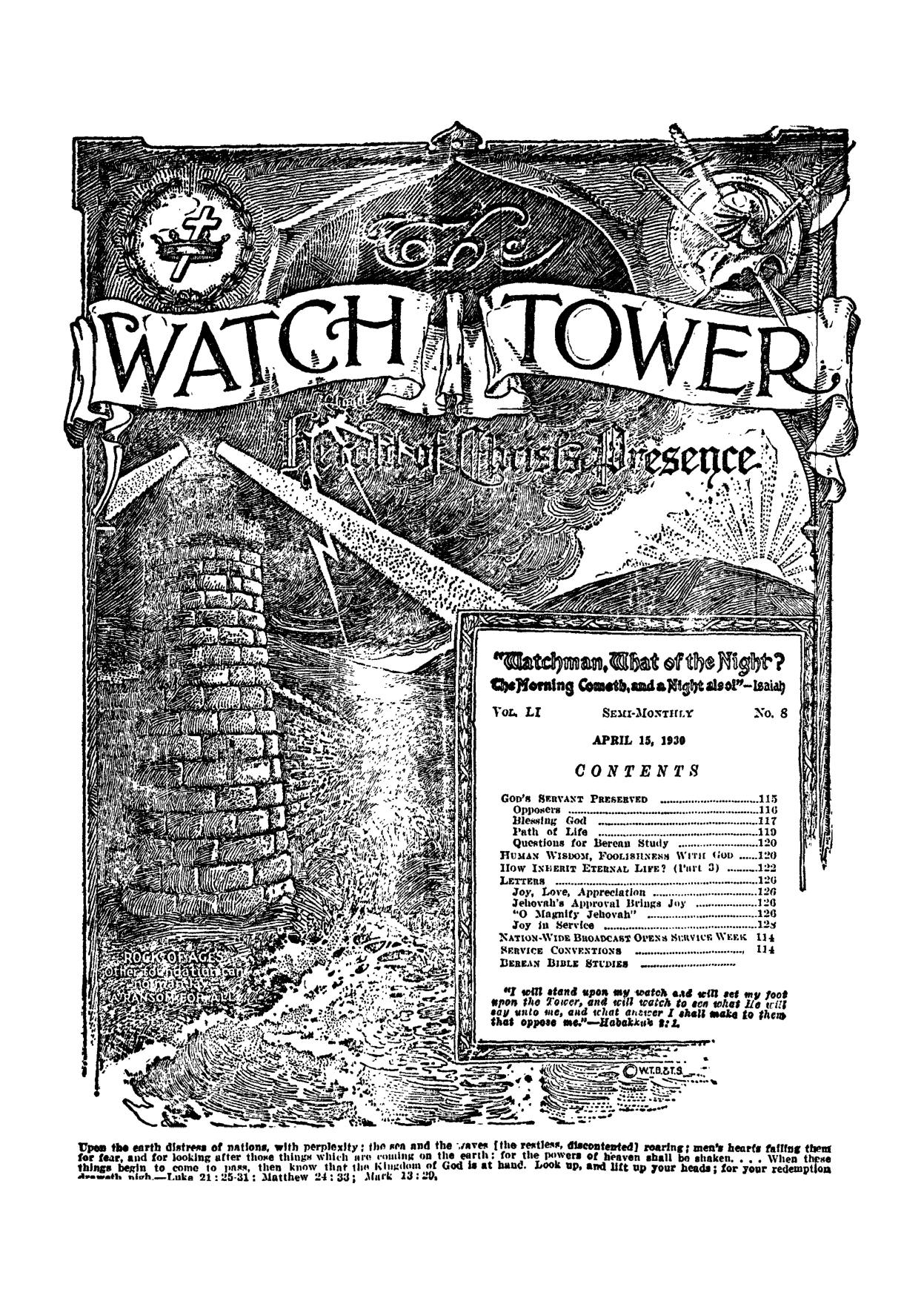
Vol. LI
April 15, 1930
No. 8
GOD’S SERVANT PRESERVED
“Preserve me, O God, for I have taken refuge in thee.”—Ps. 16:1, Rotherham.
JEHOVAH delights in his “servant” because that “servant” has the spirit of his Father and is entirely devoted to the Most High. For this reason “the servant” is holy. With full confidence “the servant” looks up into his Father’s face and reverentially says: “Jehovah, my Sovereign Lord art thou.” Such is another way of saying: ‘Jehovah, I am at thy disposal; whatsoever is thy will concerning me, that I shall delight to do.’ “The servant” is Christ Jesus and the members of his body, because the body members are anointed of the Father through Christ the Head.
2 Those of the remnant, and who are therefore in the temple, are at this time receiving a clearer light pertaining to the Scriptures because it is God’s due time. The “perfect day” (that is to say, the high- noon of the understanding of the Word by the anointed people of God) is now being approached. It is the most difficult time and yet the most blessed time for the church, but it seems certain that for them God has provided his Word and an understanding thereof that they may receive courage and comfort and have strong hope.
3 Students of the Word of God once looked upon certain scriptures as being entirely fulfilled in the life and work of John the Baptist and of Jesus. Now it is seen that those fulfilments were only partial, and what we call miniature fulfilments. The greater fulfilments come to pass during and after the second presence of Christ Jesus our Lord. It is even startling to the church now, when coming to a realization of the fact that there is a second fulfilment of these prophecies and the faithful remnant is involved in such fulfilment. When seen and appreciated, such knowledge and appreciation brings the greatest comfort and encouragement to the remnant and aids them to walk humbly and with fear and trembling before God.
4 A striking instance of such second fulfilment is that of the sixteenth Psalm. It shows, to be sure, that it has a direct reference to Jesus and what came to pass at the time of his first appearing and when he became the great ransom sacrifice. It also shows that it is directly and definitely concerned with the “servant” of God, which includes the members of the body of Christ. Peter quotes from the psalm and applies it to what came to pass upon Jesus, and we have understood that the reference was alone to Jesus at his first coming. Because thereof the attention of the student has been diverted from the enlarged fulfilment of the prophecy. The psalm is apparently a message now due to be understood by the remnant, for the blessing and comfort of such. This is a further manifestation of the loving-kindness of our God to his own.
5 There seems to be a real need for the church at this time to get a proper view of the Word of God. While we have looked back upon the fulfilment as in the past, we now find that much of the fulfilment of prophecy is at the present and in the future. Followers after Christ have generally looked back to the cross as the chief thing in the outworking of God's purposes. It is now more clearly seen that the kingdom is of even greater moment, because it is by and through the kingdom that Jehovah’s name will be fully vindicated and made known to all creation. This great work he will do, and is doing, by and through his elect servant Christ.
6 For a long while Christian people made the New Testament supplant the Old Testament. Now in the light that God sheds upon his Word there is a readjustment, and the people of God are getting a broader vision of the Old Testament. They see that the record thereof greatly magnifies Jehovah's name, when understood, and furnishes a special guide for God's anointed in this most difficult time. The sixteenth Psalm being one of these precious parts of the Bible, it may be of profit to here consider it verse by verse.
7 The song opens with a prayer: “Preserve me, O God, for I have taken refuge in thee.” (Vs. 1) The singer or speaker is one of importance, even though he cries for help. He is the one who has the privilege of acting as a priest and has hopes of the greatest things in God’s purposes. In the first instance these words could apply to none other than Jesus Christ. He was engaged in his Father’s work and was surrounded by enemies and saw that death awaited him, but his confidence was in Jehovah that he would bring him through the difficulties and to complete deliverance. The cry, “Preserve me,” cannot be understood to mean to keep him from persecution or from death, because the words of the song show that complete preservation is beyond the human life and is that which is enjoyed at the right hand of Jehovah. The confidence shown by Jesus is likewise what will be shown by the remnant, who now see that they must fight, being opposed by the enemy, and that they must go down into death; but their confidence in God is complete and they see that in due time they shall triumph by Jesus Christ in the resurrection.
8 In verse two the speaker declares his relationship to Jehovah. The Authorized Version reads: “O my soul, thou hast said unto the Lord, Thou art my Lord: my goodness extendeth not to thee.” But this rendering of the text does not convey the correct thought. According to Rotherham’s marginal reading it is: “I have said to Jehovah, My Sovereign Lord art thou, [I have] no well-being apart from thee.” The speaker is the willing servant of Jehovah and recognizes that he has no well-being without Jehovah or apart from him and he does not desire any other. Declaring his full devotion to and complete confidence in Jehovah, and that his pleasure is to serve him, the speaker, who is the “servant”, further says: “To the holy ones who are in his land Jehovah is making wonderful his delight in them.” (Vs. 3, Rotherham) Such is in harmony with Isaiah 42:1, wherein Jehovah expresses his delight in his “servant”, and which prophecy shows that the entire “servant” is involved and is the instrument in God’s hands at the present time. The “servant” lives for the glory and honor and service of Jehovah and for the good of the people who love God. The fact that Jehovah is using those who compose the remnant and form a part of the “servant” shows his approval and delight in them. He makes known his delight by illuminating his Word and enabling the remnant to understand his purposes concerning the church and concerning all creation.
OPPOSERS
9 Those who are diligently and humbly putting forth their efforts to serve Jehovah know that they are strongly opposed by others who claim to be serving God. The speaker or singer of the song then says: “Their sorrows shall be multiplied that hasten after another god; their drink offerings of blood will I not offer, nor take up their names into my lips.” (Vs. 4) The speaker is none other than the antitypical Melchizedek, the Priest of the Most High God. This text indicates that those mentioned are worshiping a god other than Jehovah. If, however, that were the correct rendering of the text the Lord would have no consideration for their service at all. The better rendering of this text appears to be: “They will multiply their sorrows who backwards do hurry: I will not pour out their drink-offerings, because of bloodshed, nor will I take their names upon my lips.” (Vs. 4, Rotherham) The group here described are shown as hurrying backward. They claim to worship Jehovah, but are doing it hypocritically.
10 God’s commandment to his chosen people is: “Thou shalt not make unto thee any graven image, or any likeness of any thing that is in heaven above.’’ (Ex. 20:4) Jeroboam, the ruler of Israel, caused the ten tribes to sin, and in the Scriptures his act is spoken of as “the sin of Jeroboam” and the “sin of Samaria”. Fearing that if they went up to Jerusalem to worship in the way Jehovah had appointed, all the people would return to the house of Judah, therefore Jeroboam made two golden calves, or images, and put one at Bethel and the other at Dan as objects through which Jehovah would be worshiped. Then he said to the people that it was too much for them to go up to Jerusalem, and pointing to these golden calves he said: ‘Behold your gods, which brought thee up out of the land of Egypt.’ (1 Ki. 12: 27-29) Such is the “sin of Samaria”.— Amos 8:14.
11 There are groups of professed Christian people claiming to worship God who have taken a similar course. The Lutherans set up Martin Luther as their leader, and the Lutheran church organization as their graven image, and insist that God must be worshiped by and through them only. Henry the Eighth was the first British ruler to assume the title “Defender of the Faith,” which title the rulers of that world power claim to this day, and the Church of England claims that the only proper worship of God is through this “golden calf”, or image. Others have set up Wesley and the organization of the Wesleyans as a “golden image” for worship.
12 From 1878 to 1916 the Lord gave his people much truth, restoring much that had long been hidden from view, and greatly used C. T. Russell, who was a faithful follower of Christ, to bring the truth to the attention of the people. What he wrote and published was wonderfully used of the Lord to aid others to know God and see his purposes. When he finished his earthly course many who had been walking apparently in the narrow way began to go backward. They formed themselves into groups and claimed that the sum total of truth revealed to God's people is found in what Brother Russell did and wrote and that he is ‘that faithful and wise servant whom the Lord has made ruler over all his goods’; and they insist that the only true worship is by and through him and his works, and thereby they set up for themselves an image for worship.
13 Today there are no Lutherans in present truth, no Episcopalians, no Wesleyans, no Russellites, nor the followers of any other man. And why? The reason is that the Lord is pleased to reveal his truth henceforth to those who give honor and glory to the great Creator and not to creatures. (Job 32:21, 22) When the Lord came to his temple he put a test upon his professed followers, which test was made to the end that the approved ones might offer unto the Lord an offering in righteousness. That group of persons, however, who ignore God’s appointed way and insist upon worshiping the Lord in their own appointed manner could not be pleasing to the Lord. It seems quite clear that these are the ones referred to by the psalmist when he says: ‘‘They multiply their sorrows who [go] backward: I will not pour out their drink offerings, because of blood-shed, nor will I take their names upon my lips.”—Rotherham.
14 The facts show that this verse four pertains to judgment and had no fulfilment at the first advent of the Lord Jesus. There was no occasion for judgment at that time. The Scriptures show that judgment must begin at the house of God and at the time when the Lord comes to his temple. (1 Pet. 4:17) Other scriptures show that approximately at the time the Lord came to his temple there would be in the land, and there was, a famine of the hearing of the Word of God, that is to say, many ‘running to and fro seeking the Word of the Lord and shall not find it’. The reason given is that such swear by the “sin of Samaria”. (Amos 8:11-14) This means that such insist on worshiping God through the image of their own making. They did not humble themselves under the mighty hand of God, but worshiped the work of one whom they idolized. It is written that God pushes away from him those who take this course.— 1 Pet. 5: 5, 6.
15 God has made “this day”, and in it his “servant” rejoices and exalts the name of Jehovah. Those who follow a way different from what Jehovah has appointed are not pleasing to him. The faithful remnant see this and take it as a warning. Concerning those who take a wrongful course the Lord says that their offerings poured out, even though they appear in their own sight as precious as blood, will not be acceptable to him, nor will he take their names upon his lips. The Lord will have those who worship him do so in spirit and in truth. The remnant, seeing the Lord’s way, and desiring not to indulge in controversy with those who decline to be obedient to God’s commandment, turn to Jehovah and say:
16 “Jehovah is my share, my portion, and my cup; Jehovah is the maintainer of my lot for me: The measuring lines have fallen for me in pleasant places, verily! mine inheritance is mighty over me.” (Ps. 16:5, 6, Rotherham) These words, of course, apply to Christ Jesus the Head, but they also apply to the body members at the present time. Here the speaker manifestly is “the servant”, which clearly includes all of the temple class who are yet on earth. Declaring that others may take whatsoever course they may desire, the “servant” says he has chosen that which Jehovah has for him and he delights therein. ‘The joy of the Lord is my strength.’ ‘His cup runs over,’ and he drinks it with delight. (Neh. 8:10; Ps. 23: 5) For the faithful “servant” God has marked out his inheritance, both present and future. The “servant” sees that his present happy position is that of service and if he is faithful there is, beyond, everlasting joy with endless service. The “servant”, seeing God’s gracious ends toward him, says: “The lines are fallen unto me in pleasant places.” God has selected for his “servant” the lot or portion intended for him and he puts the measuring lines about it and they are pleasant to the “servant” because they place the “servant” in a position or condition of joy. One might induce himself to believe that he is the servant of God, but unless he serves God in the way which Jehovah has appointed he cannot be pleasing to the Most High.
17 Concerning the measuring lines God’s prophet wrote: “For the Lord’s portion is his people; Jacob is the lot [margin, cord, lines] of his inheritance.” (Deut. 32: 9) Jehovah has fixed the place for his people, and no one can be in that place unless he accepts and does the will of God. He thus proves his love for the will of God by joyfully keeping his commandments. (1 John 5:3) Those who occupy that place and continue to do so in God’s appointed way constitute the sanctuary class.
BLESSING GOD
18 One of the reasons assigned by the “servant” for blessing Jehovah is that he receives counsel from the Lord. “I will bless the Lord, who hath given me counsel: my reins also instruct me in the night seasons.” (Vs. 7) The word “bless” here used means the act of worship and adoration and humble and joyful obedience of the “servant” to his Lord and Master. The spirit of the Lord God instructs and gives counsel to the faithful sons of God. The counsel comes to the “servant” by reason of his being enabled to understand and appreciate the Word of God. Through the goodness of the Lord arrangements are made to give such counsel to his church, and by this arrangement the “servant” class understands the purposes of Jehovah and also appreciates the great privilege of having a part in his service. No one upon whom the holy spirit rests is found complaining and murmuring against the service of the Lord. To the faithful servant class God gives counsel and directs how his service shall be done, and the servant praises and adores Jehovah for this great privilege.
19 “My reins also instruct me in the night seasons.” The word “reins” is sometimes translated “kidneys”, meaning the region of the loins, and has been considered the seat of affection, while loins were considered the place of strength. According to Rotherham this text reads: “In the dark night have mine impulses admonished me.” The dark night may refer to the opposition against the Lord’s “servant”, which at times makes it seem almost impossible to go on with the Lord’s work. The agencies employed by Satan slander the work and cause the arrest of the workers, and conditions about them at times are dark. But those who have the spirit of the Lord are joyfully moved, even by their impulses, to press on amidst the darkest conditions and the greatest opposition. There are seasons when those of the “servant” class are almost overwhelmed by the adverse conditions; and yet, remembering their blessed position in the Lord’s army, the spirit of the Lord moves them to continue joyfully in action. Jesus, amidst great opposition, pressed on. The body members, being of the “servant”, must do likewise.
20 The “servant” is determined to continue faithfully devoted to the service of the Lord, regardless of all opposition. Therefore he says: “I have set Jehovah always before me; because he is at my right hand, I shall not be moved.” (Vs. 8) Jesus Christ, the Head of the ‘‘servant’’ class, when on earth, even though hard pressed by the enemy, always had the full assurance of his Father’s loving protection. That is also true of the body members now on earth, in these times of peril and when the enemy attempts their destruction. They confidently say of Jehovah: “He is my refuge, and my fortress; my God; in him will I trust.” The Lord God gives to such these assuring words of promise: “Because thou hast made the Lord, which is my refuge, even the Most High, thy habitation; there shall no evil befall thee, neither shall any plague come nigh thy dwelling. Because he hath set his love upon me, therefore will I deliver him: I will set him on high, because he hath known my name.” (Ps. 91:9, 10, 14, 15) All the faithful members of the remnant class on earth appreciate this blessed relationship with the Lord Jehovah and therefore are determined that they will permit nothing to shake them. They resolve to maintain their integrity with the Lord, and do so.
21 Members of the “servant” class, well knowing that they are in the secret place of the Most High, that they have God’s favor, and are faithfully doing what is within their power to magnify his name, and appreciating their happy relationship with him, sing: “Therefore doth my heart rejoice in Jehovah and my glory exulteth in my God, even my flesh shall dwell securely.”—Vs. 9, Rotherham.
22 The affection of the “servant” is set upon Jehovah; therefore his heart rejoices in Jehovah. The rich treasure of the “servant” is Jehovah and his loving kindness. He has a keen appreciation of the honorable place he has in God’s organization; and for that reason he exults, not in himself, but in his God. No human creature could ever be exalted to a position so honorable and blessed as that of being an ambassador of the great Creator, clothed with the splendor and copiousness of the high office of bearing the name of the Most High to others. When Jesus was on earth he occupied that blessed and honorable position; and now the members of his body likewise occupy a position of honor and glory, because they stand forth as the only witnesses of Jehovah on earth. Being of The Christ, and hence of the “servant”, they are ambassadors by whom God speaks, and they bear his message of reconciliation to the world. (2 Cor. 5:19, 20) The physical organism of each one of the remnant is weak, and each one realizes that he is surrounded by the enemy and his agencies, and that the enemy would instantly destroy him; but appreciating the fact that he is one of God's anointed sons, he knows he is safe and secure. With confidence, therefore, he says: “Even my flesh shall dwell in security.” This verse is also a direct proof of life beyond the present existence in the earth. The “servant”, who is the speaker, sees that his change must come and that the change will come from human to divine nature to those who are faithful. There must be an exodus or passing out of the church in death, but the faithful have confidence in an instantaneous resurrection. Hence the “servant” says:
23 ‘‘For thou wilt not leave my soul in hell; neither wilt thou suffer thine Holy One to see corruption.” Most certainly this prophecy was fulfilled in Jesus. God’s beloved Son went into sheol, but death could not hold him there. It was the will of God that he should be resurrected, and therefore God raised him out of death on the third day. The spirit of the Lord came upon Peter at Pentecost and he spoke with authority, quoting this psalm, and applied it to Jesus. He there made known that David was then dead and in the tomb but that the words spoken by David were spoken prophetically concerning Jesus Christ and his resurrection. “Therefore being a prophet, and knowing that God had sworn with an oath to him, that of the fruit of his loins, according to the flesh, he would raise up Christ to sit on his throne; he, seeing this before, spake of the resurrection of Christ, that his soul was not left in hell, neither his flesh did see corruption. This Jesus hath God raised up, whereof we all are witnesses.” (Acts 2:30-32) Jesus was put to death; but it was not possible for death to hold him, since it was God’s purpose to raise him out of death. ‘‘Whom God hath raised up, having loosed the pains of death: because it was not possible that he should be holden of it.”—Acts 2:24.
24 Some contend that this is proof that in the resurrection the soul and body will be reunited; but we know that there can be no existence without an organism and that a human organism cannot have a place in the kingdom of God. We also know that Jesus was raised out of death with a glorious body. Others have said that the text proves that the flesh body of Jesus is preserved somewhere. That would be equivalent to saying that the body of Jesus is a mummy somewhere. Satan has caused some of his servants to be embalmed and made mummies and thereby preserved for the evident purpose of disputing the effect of death and contradicting Jehovah’s decree. The more reasonable explanation of the above scripture is that God dissolved the body of Jesus into the dust and it was not permitted to take the course of decay common to dead bodies. While Jesus was without sin, he must die and take the sinner’s place, and the judgment was upon man: “Dust thou art, and unto dust shalt thou return.”
25 But how can the text apply to the body members of Christ now on earth? It seems quite clear that the text does apply to the “servant”. Christ Jesus is the great “servant” of Jehovah God. Those who died prior to his coming slept in death until the day of resurrection; but there is a time when the faithful do not sleep, and of that time and condition Paul wrote. With the coming of the Lord to his temple in 1918 the robe of righteousness was provided for the approved ones, and such are made a part of the “servant”. The elect servant is God’s ideal “man of kindness”. Another translation gives a better rendering of this text: “For thou wilt not abandon my soul to hades, neither wilt thou suffer thy man of kindness to see the pit.” (Vs. 10, Rotherham) Every member of the “servant” must reach the height of glory through death, but it is impossible for death to hold the faithful.
26 The words of Jesus here seem to apply, to wit: “And I heard a voice from heaven, saying unto me, Write, Blessed are the dead which die in the Lord from henceforth: Yea, saith the Spirit, that they may rest from their labours; and their works do follow them.” (Rev. 14:13) This text must have its fulfilment while some of the saints remain in the flesh. With the coming of the Lord to his temple the proof seems to establish the fact that the faithful dead were raised out of death and made a part of The Christ in glory and that those remaining on the earth and who continue faithful even unto the end must go into death but are granted an instantaneous resurrection. The sixteenth Psalm seems to have been the basis of Paul’s inspired argument when he wrote: “Behold. I shew you a mystery: We shall not all sleep, but we shall all be changed, in a moment, in the twinkling of an eye, at the last trump: for the trumpet shall sound, and the dead shall be raised incorruptible, and we shall be changed. For this corruptible must put on incorruption, and this mortal must put on immortality.”—1 Cor. 15:51-53.
27 The proof is furnished that when the “servant” class is made up God preserves his elect “servant” and even though some of that “servant” class on earth must go into death those remaining and faithful are guaranteed a resurrection. (1 Thess. 4:13-16) Furthermore it seems that the words of the psalm (16) were the basis for Paul’s writing: “And the very God of peace sanctify you wholly; and I pray God your whole spirit and soul and body be preserved blameless unto the coming of our Lord Jesus Christ.” (1 Thess. 5:23) The words of Paul, as shown by the context, apply to the people of God in “the day of the Lord”, which had its beginning with the coming of Christ to his temple and the making up of the “servant” class. (Ps. 118:24) The “man of kindness” surely is that class mentioned by the Prophet Isaiah (55:3, Rotherham). It is also the “servant” class mentioned by the same prophet whom God will carry to complete victory. (Isa. 42: 1-6; 49:3) Members of the “servant” class on earth today are comforted, encouraged, and strengthened in hope with a better understanding of these prophecies which make it clear that those who are of the “servant” and who thus continue faithful shall not await in death but shall be changed immediately, by death and the resurrection, into the glorious likeness of Jesus Christ, the Head of God’s “servant”.
PATH OF LIFE
28 The path of life appears to be the pathway of the just, or approved ones, that shines more and more unto the fulness of the perfect day. The opening of that day began with 1918, when the Lord came to his temple, and it continues to shine until the exodus of the “servant” class into complete and everlasting glory. When those of the “servant” class on earth have finished the work which Jehovah has given them to do while in the flesh, and being faithful unto the end, they will enter into the perfect, glorious day. After the Lord came to his temple and the “servant” class was made up, those on earth had a better understanding of the pathway of life than they had in previous times. Such see now that it is not God’s purpose merely to have men ‘develop a perfect character’ in order that God might take them to heaven. They see that their entrance into heavenly glory depends upon faithful devotion to God and an earnest and joyful performance of the covenant into which God has invited them. Such now have visions of the glory of Jehovah and the kingdom, and they delight to sing unto him the new song. The ‘‘servant’’ is now shown by the prophet as saying: “Thou wilt shew me the path of life: in thy presence is fulness of joy; at thy right hand there are pleasures for evermore.” (Vs. 11) Truly God has shown his “servant” the path to life.
29 The “servant” is now “in the presence of Jehovah” because in the temple of God. The joy of such is now full because all do rejoice to their full capacity. (Isa. 61:10) Jehovah God has spread a feast for his “servant” in the presence of the enemy, and the cup of the “servant” now overflows. The oil of joy is upon his head, and his heart is filled with gladness. (Ps. 23: 5) While these are now rejoicing to the fulness of their capacity it is clear from the text that such is not the complete joy which will be had when their glorious change conies to pass. The prophet adds: “At thy right hand there are pleasures for evermore.” The “servant” is now on the right hand of Jehovah and has his favor and is the instrument which Jehovah uses to do his work, and, continuing in this place faithfully to the end, his pleasures now begun will never end.
30 To the “servant” class the sixteenth Psalm now becomes more than a mere historic record of Jesus Christ. The prophecy had its fulfilment in Christ Jesus, to be sure, but it seems clear that the purpose is to apply also to his body members when the “servant” is made up. It is for the members of the body now on earth that the Scriptures are written, and were written aforetime for their comfort and encouragement, that their hope might be strong. (Rom. 15:4) Seeing the ever-increasing beauty of God’s unfolding Word and his great loving-kindness extended to the works of his hand, the “servant” class joyfully takes up the new song and with enthusiasm and gladness sings it unto the Lord.
QUESTIONS FOR BEREAN STUDY
1. Why does Jehovah delight in his “servant”? Identify “the servant”.
2. Where does God’s remnant now stand with respect to “the perfect day”? What is the purpose of the greatly increased light now given to the “servant” class?
3, 4. How are the life and work of Jolin the Baptist and of Jesus related to the fulfilment of prophecy? How is this illustrated in the fulfilment of Psalm 16?
5, 6. In all God’s purposes revealed to man, what is the work of greatest moment? How will that work be accomplished ?
7. Who spoke the words of Psalm 16: 1? For whom? Explain the expression, ‘‘ Preserve me,” as here used.
8. Point out the relationship and devotion expressed in verses 2 and 3, and Jehovah’s manifest approval of the remnant.
9, 10. Describe the procedure referred to in the Scriptures as ‘the sin of Jeroboam’. “The sin of Samaria.’’
11-13. What are the facts which clearly indicate image worship by many professed Christians in the past and even at the present time?
14, 15. When have these facts become particularly manifest, and why? How will the Lord regard the “offerings” of those involved therein? How is this confirmed in their present situation?
16, 17. Apply verse 5 of this psalm. What is meant by “the measuring lines”? How have they “fallen in pleasant places”, and for whom?
18. “I will bless the Lord.” How will the “servant” do this? How has the “servant” been ‘given counsel’?
19. Explain, “My reins also instruct me in the night watches.’’
20-22. Show the appropriateness of verse 8 as the words of the “servant” class. Quote other scriptures as expressions of the “servant's” firmness of purpose and confidence in Jehovah.
23. Point out the fulfilment of the prophecy, “Thou wilt not leave my soul in hell.’’
24, 25. What seems to be the Scriptural explanation of the words, ‘‘neither wilt thou suffer thine holy one to see corruption”?
26, 27. How are Revelation 14: 13, 1 Corinthians 15: 51-53, and 1 Thessalonians 5:23 related to verse 10 of this psalm?
28. Explain how the “path of life” (Ps. 16: 11) is related to “the perfect day” (Prov. 4: 18). To whom does Jehovah show the path of life? How? Why?
29. Referring to verse 11: What is meant by “thy presence”? “Fulness of joy”? “At thy right hand”? “Pleasures for evermore”?
30. Their clearer understanding of Jehovah’s Word and his loving-kindness brings what response from those who are truly of the “servant” class?
HUMAN WISDOM, FOOLISHNESS WITH GOD
[Fifteen-minute radio lecture]
EVER since the creation of man, certain men have challenged the wisdom of Jehovah God. They have done this by setting forth certain schemes and theories of their own, and claiming that these were superior to the purposes and teachings of God as set forth in the Bible. To win favor and approval for their own theories, they have reproached, ridiculed, and belittled the Bible, which sets forth the wisdom of God. Those men who question the wisdom of God are blinded by their own self-esteem, and also lack a proper reverence for their Creator. This same self-esteem creates a prejudice in their minds, which hinders them from properly understanding the purpose and work of Jehovah.
The wise man wrote, saying: “Wisdom is the principal thing: therefore get wisdom.” (Prov. 4:7) The majority of mankind would agree to that statement, but would disagree as to where to get the wisdom. A very few of earth’s millions would advise to go to the Word of God to get it, while the majority would recommend some books written by so-called famous authors, known as great and wise men.
Repeatedly does the Bible mention the “wisdom of men” and the “wisdom of God”; “the wisdom of this world” and “the wisdom that cometh from above”. It also tells us that “the wisdom of this world is foolishness with God”. (1 Cor. 3:19) By this is meant that the statements, teachings, and theories of earth’s wisest men are foolishness with God. The Bible also tells us that “the foolishness of God is wiser than men”. (1 Cor. 1:25) This means that the simplest and most easily understood feature of God's purpose and work is wiser than man's wisest proposition.
This contest between human and divine wisdom is soon to end in the complete vindication of Jehovah God and his wise and loving arrangements. His Word assures us that the time is coming when the wisdom of this world will appear to be foolishness to the majority. (1 Cor. 1:20) He tells us through his Word that “the wisdom of their wise men shall perish” (Isa. 29:14), and that ‘the wisdom of the princes of this world shall come to naught’. (1 Cor. 2:6) Thus the time is coming when the majority of the race will acknowledge that the only true wisdom is that which comes from above. Without doubt many of those who are wise in their own conceits and who have ridiculed and belittled Jehovah God, will die the second death for their wilfulness and folly. Speaking of these the prophet says: “Seest thou a man wise in his own conceit? there is more hope of a fool than of him.” (Prov. 26:12) Hence the same prophet advises, saying: “Be not wise in thine own eyes.”—Prov. 3:7.
The wise man says: “Better is it to get wisdom than gold.” (Prov. 16:16) Yet men consider it wise to get the gold first; and we are witnessing, in our day, a mad scramble for the filthy lucre, while real wisdom is spurned. Another prophetic statement is that “wisdom is better than weapons of war”. (Eccl. 9:18) But the wisdom of this world says, Our safety lies in “preparedness”, so let us get the weapons of war first.
In contending for their various theories and schemes, men consider it proper to indulge in strife and wrangling, and use bitter epithets one toward another. They are often selfish, unmerciful, and hypocritical. The Apostle James mentions these things as follows: “Who is a wise man and endued with knowledge among you? ... if ye have bitter envying and strife in your hearts, glory not; and lie not against the truth. This wisdom descendeth not from above, but is earthly, sensual, devilish. . . . But the wisdom that is from above is first pure, then peaceable, gentle, and easy to be entreated, full of mercy and good fruits, without partiality, and without hypocrisy.”— Jas. 3:13-17.
When God required Adam and Eve to obey, and not eat a forbidden fruit, his requirement was a wise one, even if they could not see that it was. Satan tempted Eve to eat of the fruit, by saying that the fruit was to be desired to make one wise. This suggestion, that she would gain some wisdom, led her to doubt God’s wisdom in advising her to abstain from eating the fruit. As a result, she ate thereof, and her act has resulted in all the sickness, disease and death from then till now, as well as all the crime, wars, oppression, selfishness and injustice on earth. Had she obeyed the heavenly wisdom, both she and Adam would have been alive today and enjoying God's blessing and favor.
Many people think it is wise to teach eternal torment to ‘scare people into heaven’, but the Bible tells us that it is the ‘goodness of God that leadeth men to repentance’. (Rom. 2:4) The Bible teaches that the only hope of salvation is by believing that Jesus Christ by the grace of God tasted death for every man; it teaches that it was necessary for Jesus to die as man’s redeemer. On the contrary, the wisdom of the wise men of earth denies that Jesus had to die in order that mankind might be saved. These ‘wise men’ substitute other ways of salvation. Some claim that good works will save anybody, and so set forth their human wisdom in these words: 'It doesn’t make any difference what you believe, if you only live right.’ Thus do they deny that it is necessary to believe on the Lord Jesus Christ to be saved.
Jehovah in his wisdom says: “The friendship of the world is enmity with God. Whosoever therefore will be a friend of the world, is the enemy of God.” These words are addressed to true Christians, but the ‘wise men’ of earth claim that a Christian should mingle with the world, take an interest in its affairs, participate in its politics, and, in general, make himself a genial fellow-with the worldly. The result is that the various churches are filled with a large membership of wicked and hypocritical people.
Jehovah has wisely deferred the conversion of the world and the correcting of evil conditions on the earth until Christ shall set up his kingdom on earth and, clothed with all power in heaven and in earth, proceed to do the work wisely and well. In the mean-time Jehovah God exhorts his people, “Fret not thyself because of evil doers, . . . [but] rest in the Lord, and wait patiently for him.” (Ps. 37:1, 7) Jesus also, in Matthew 5:39, urges that “ye resist not the evil”. But human wisdom refuses to abide by the divine exhortation, and has proceeded, and is proceeding, to convert the world in its own way and before. God’s time. The result is that after a hundred years of intensive effort and money-begging there are five hundred million more heathen in the earth than before they began their foolish effort.
Repeatedly the Bible tells us that “the fear of the Lord is the beginning of wisdom”. The word “fear” has the double thought of fear and reverence: fear to disobey Jehovah God, and reverence for him, his wisdom, justice, love, and power. The very first thing necessary, to acquire wisdom, is to have this proper fear and reverence for Jehovah God. It is self-evident that anyone who criticizes him, or his methods and work, is entirely lacking in proper fear and reverence. The psalmist says: “The secret of the Lord is with them that fear him; and he will shew them his covenant. ”—Ps. 25:14.
Jesus also told us that the Lord hides his purposes from those who are endowed with too much of their own wisdom and who have too much prudence. His words are: “I thank thee, O Father, Lord of heaven and earth, because thou hast hid these things from the wise and prudent, and revealed them unto babes.” (Matt. 11:25) Thus we discern that the arrogant, the conceited, the proud, the stubborn, and the selfish cannot understand Jehovah’s purposes. He permits them to go on in their course of opposition and wickedness until the kingdom is in power, when these will be rewarded for their wickedness, by being destroyed in second death, as enemies of God, enemies of man, enemies of truth and righteousness.
The time is coming when their pride and haughtiness will be rebuked before all the people and they will be exposed as “fools”, just what the Bible calls them. The time will soon come when people will learn the truth of the Scriptural statement that “great men are not always wise”. (Job 32: 9)’ They will also learn the truth of another Scriptural statement, namely, that “the holy scriptures . . . are able to make thee wise unto salvation through faith which is in Christ Jesus”.— 2 Tim. 3:15.
The kingdom of Christ is soon to be fully established on earth, and all men will be aware of that fact in the very near future. That kingdom will proceed to convert the world of mankind. To accomplish this result, it will be necessary to remove all hindrances first. These hindrances consist of laws, institutions, and doctrines which man’s wisdom has conceived and forced on the human family. Men conceived the idea of dividing the race into nations and governments. This scheme appeared and still appears to be wise to earth’s so-called wise men, and they are now directing their attention to the perpetuation of these man-made governments, by means of a “league of nations”. Jehovah God has decreed the destruction of all the nations of earth in “the battle of that great day of God Almighty”, which lies just ahead.—Ps. 2:8, 9; Dan. 2:44; Rev. 11:15.
The destruction of these governments will for ever end national jealousies, strife, war, hypocritical and lying diplomacy, nonsensical discussions on such subjects as “tariff”, “free trade,” “foreign exchange,” import duties, and hundreds of like subjects, which are a barrier to “peace on earth and good will toward men”.
Man’s wisdom has conceived and foisted on the people about two hundred different religious sects, or denominations, which produce confusion, strife, persecution, intolerance, religious bigotry, contradictory doctrines, and even wars. This condition also hinders the condition of peace, righteousness, justice, and love among the peoples of earth. In the coming battle Jehovah will wisely destroy all these contradictory creeds.
All arbitrary and sumptuary laws, which restrict human liberty and conscience, and which tend to produce ill-will, resentment, anger, strife, and anarchy (of which we have a good illustration in the modern prohibition law), will be done away with, for the reason that they are not conducive to that condition of peace, good will, and brotherly love which must prevail when the world is converted. Such arbitrary laws seem to be very wise to many men, but they are foolish in God's sight.
All false doctrines will likewise come to an end, and it will no longer be thought wise or prudent to teach the lies of eternal torment, trinity, human immortality or the divine right of kings or clergy.
With man-made governments, provocative of strife and war; man-made religious systems, provocative of persecution and intolerance; man-made laws, suppressive of liberty and conscience; and man-made doctrines, blaspheming God and contradicting his Word, gone, and gone for ever, the earth will be swept clean of human wisdom and folly, and the way prepared for all mankind to learn of the “wisdom that cometh from above”.
WHAT SHALL I DO THAT I MAY INHERIT ETERNAL LIFE?
PART 3
[Thirty-minute radio lecture]
THE Scriptures teach that sooner or later every man who will gain eternal life must get a knowledge of the only true God, give God the first place in his heart, obey God’s commands to the best of his ability, get a knowledge of Jesus Christ, God’s Son, accept Jesus as the bread from heaven, the Savior of us all, hear and listen to his voice, become one of his sheep, do the work Jesus gives him to do, give earthly possessions a secondary place in his heart, and show love and mercy toward all men.
In your own Bible may be found the evidence that the translators of all versions knew that hell and the grave are one and the same thing, and fifty-seven of the world’s most eminent doctors of divinity concur in that statement.
The opportunity to see this evidence is open to all who now listen. Please take a pencil and paper and jot down the following texts, then look them up in your Bible and note the marginal readings and see for yourself how people have been deceived. Psalm 49:15, Psalm 55:15, Psalm 86:13, Isaiah 14: 9, Jonah 2:2, 1 Corinthians 15: 55, Revelation 20:13. In the face of this evidence the day is gone when any man can support the fraudulent doctrine of eternal torture and retain the respect of his fellows.
One of the worst things about the doctrine is that, holding it, it is impossible to know God, and this knowledge, as we have seen, is one of the conditions precedent to the gaining of eternal life.
Let us consider now the subject of God’s love for man, his unselfish and generous interest, not in a few men, but in all men. And what a wealth of evidence we have before us! We shall select some of it from the book of nature and some of it from the Scriptures.
Think for a moment about the gift of life which we now share. The bringing of even one man into existence was a wholly unselfish act of love on God’s part. God knew that this man would take keenest delight in the exercise of the mere physical functions of his body, which he shares in common with all the lower animals, and made him so that he would.
The first separate act of our lives is to breathe; and from that moment while life exists, and conditions are at all normal, there is genuine pleasure in every breath of pure, fresh, sweet, invigorating air that a human being takes into his lungs. People go to the mountains and to the seashore largely that they may enjoy the delights of breathing the kind of air that suits them best. The Creator made the salt-laden breezes of the ocean no less than the ozone of the mountain tops, and made them both for man.
“The heaven, even the heavens, are the Lord’s: but the earth hath he given to the children of men. ’’ (Ps. 115:16) It was and is a good gift, an act of unselfish love. Almost everybody appreciates the gift of life even if he never does think of the Giver.
About the next thing that humanity thinks of when it arrives in this world is to get something to eat, and the food prepared for him is just perfect, warm, sweet, nourishing, laxative, and fully satisfying. Does man enjoy his food from that time forth for ever, as long as he keeps well? You know he does. Most of his waking hours are occupied either in eating or in getting something ready to eat, and, oddly enough, the harder he has to work to get food for his appetite, the keener his appetite when he gets something to satisfy it, and the more enjoyment he gets out of it.
Spend a few minutes thinking about the delicious flavors, and the varieties too, of bananas, oranges, grapefruit, lemons, cherries, peaches, plums, pears, figs, dates, olives, pawpaws, persimmons, apricots and apples: and see how plainly the love of the Creator is manifested in these provisions to gratify the appetite of man. Let us think more particularly of just one of these fruits, perhaps the commonest of all, the apple.
Surely it is no accident that mankind here in America has 338 varieties of apples, every one of which has its devotees. Some of these apples it is impossible to mention without the mouth’s watering. What recollections rise at the mere mention of the words McIntosh, Baldwin, Northern Spy, Winesap, Newton Pippin, Yellow. Transparent, Greening, Belmont, Delicious, Strawberry Apple and Golden Russet. The Creator made them all, and knew when he made them just how they would affect the palates of those for whom they were designed.
But this is not all. The Lord could have limited himself to fruit which grows on trees, if he had seen fit to do so. But some of his creatures cannot climb trees: and so for them and for all he made strawberries, raspberries, gooseberries, blackberries, currants, cranberries and grapes, Concord, Catawba, Niagara, Malaga and a host of others, all passing comprehension how they could have been so pleasing to our taste. In every one of these fruits we may see the hand of our Creator.
In the wintertime, and more or less at all times, we enjoy the harder fruits, pecans, brazil nuts, almonds, hazel nuts, hickory nuts, walnuts, peanuts, and others in great variety which the Creator made for us. We eat the wheat, oats, corn, buckwheat, rye, barley, sugar, cocoa, and spices, and some of us never think what the world would be like without them.
The Lord could have made one vegetable and let it go at that; but now we have asparagus, beans, cabbage, cauliflower, celery, sweet corn, cucumbers, eggplant, horseradish, kale, lettuce, okra, parsley, peas, peppers, spinach, squash, tomatoes for our regular side dishes, and, for dessert, cantaloupes, watermelons and last, but by no means least, pumpkins. Do we ever think of the love that is back of all this?
The Lord’s bounty for our appetites does not end with the things that grow above ground. What an important part potatoes and sweet potatoes play in our lives, along with other root crops, beets, carrots, parsnips, onions, radishes, rutabagas and turnips! The Creator made them all, and they serve an important place in his provisions for man.
We would not like to say anything to offend vegetarians, a class of people for whom we have great respect, but there are many people who enjoy a good rich steak, a leg of lamb, a pot roast, a veal cutlet or a rasher of bacon, to say nothing of fried chicken or roast turkey, and, for the present at least, the Creator allows the use of this food, and those who do enjoy it should at least be thankful that the flavors are all different and all agreeable.
Besides enjoying the food which has to be masticated, man also enjoys those other foods that slip down his neck with less effort. Dietitians would be offended if we mentioned some of these foods, and prohibition officers might be around trying to collect hush money if we mentioned others, so we will just say that most people, when they are really thirsty, enjoy a good drink of pure cold water just as it bubbles up out of the earth. Water is the gift of the Creator. Without it, in a few hours we are in misery, and in a few days cease to be. With it, and with plenty of it about us, we are happy. The taking in of plenty of water is as necessary as the taking in of plenty of air and food, and as enjoyable.
While thinking of the pleasures of the table, can we shut our eyes to the Designer of the tongue and palate and masticating and swallowing apparatus that we use so constantly? The fools that say in their hearts that “there is no God’’ have never brought forward anything superior to take its place, nor is there any likelihood that they ever will.
Then think how marvelously those same organs may be used in speech and song! Orators are passing, but there have been orators that could sway vast audiences like the leaves of the forest by the power of their speech. Henry Ward Beecher brought thousands of antagonists to tears within a few moments from the time lie began to speak. When Jenny Lind, the Swedish Nightingale, sang her Negro melodies back in the days of the Civil War her voice was so inexpressibly sweet that she sang to audiences of sobbing men and women.
Now think back of these things to the Creator. Those same gifts are undeveloped in all men. Jesus spake as never man spake. His ministry was short. It was but a foretaste of what is to be. There will come a time when truth, not error, not cant, not hypocrisy, will turn many to righteousness. It is coming! It is coming! Wait for it! And when it comes, all the past glories of human speech will seem as nothing by comparison. In that day men will know the Lord. They will all be taught to know him, from the least even unto the greatest of them. And the ones that render that service will seem to their fellow men to be as gods. But back of all their ability is and will be the love of the Creator in making such service possible. Caruso’s larynx was a gift. It was the Creator that made it and gave it to him.
The infant is fed and sleeps, and so does the hard- worked man and woman. When utterly worn with the burdens of the day, what looks more desirable than the pillows upon which we lay our weary heads, or the sheets and blankets beneath which we spend so large a part of our lives, and a happy part too? Did you ever think what a life it would be if the Creator had not included sleep as a restorative? And aren’t you glad he did it? And don’t you feel like thanking him for it?
The child is lulled to sleep by mother’s lullabies. It is the beginning of the stirring into action of those two exquisite pieces of workmanship, the harps of 2,700 strings, which it has in either ear. As it grows to maturity what pleasures await the ear! There are nearly two billion people in the world, and no two of them with voices alike. Intimate friends can detect the nice shades between any two of them; and thousands of other sounds besides. And we can hear them or not, as we please. We can be in a room with a clock and hear every tick, or we can exclude the ticking entirely. The trained ear will catch and understand and appreciate sounds that are indistinguishable or unintelligible to others.
The joys of touch and smell are real enough, and they too are marks of the Creator’s love; but the joys of vision are still more so and we would speak of them. The heavens declare the glory of God. Suns of varied hues and of appalling size, variable stars, comets millions of miles in length, planets with no moons, planets with one moon, planets with several moons, some revolving in one direction and some in another; planets with belts and bands, meteors and meteoroids, all speak of a Creator to those who have eyes to sec and who will use them.
The dainty blue of the sky is not an accident, nor are the clouds which make the soil productive, the rainbows which span the heavens with their gorgeous hues, the auroras, the eclipses, the sunrises and the sunsets. If one is willing to enjoy all these without recognizing the Creator of them, he may do so, but even a dog will recognize an eclipse.
The snow, which falls in hexagonal crystals of infinite beauty, when viewed under the microscope, the sleet, the hail, the thunder and the lightning, the torrential downpour, the still small rain, the fogs, the mists, the winds, the calms, the sunshine and the bracing cold, are evidences of a Creator’s love, if we will see it. Variety is indeed the spice of life. We never know how much we love the sunshine until we have a month of murky days, nor how much we love the clear blue of a perfect sky until it has been hidden from us for a time.
Note the dress of the earth. Think of the Creator as the One who made the trees, and consider his thoughtfulness as respects the interests of his creatures. The trees of the forest are beautiful at any time: in the early spring, when they are putting forth their primrose leaves; in midsummer, when the hillsides are a mass of green leaves, but of a hundred different hues; in fall, when they present combinations of colors rich beyond the power of words to express; and even in winter, when they are resting for the next great effort of their useful lives.
It is worth noting, too, how the Creator provided for the perpetuation of plants of all kinds so that even in their wild state they would not die out, but would be preserved until such time as man could get acquainted with them and learn how properly to care for them. Ingenious indeed are the means which the Creator uses to disperse the seeds of things which are either beautiful or useful.
But there is another world all about among the plants that is of more interest than the plants themselves. These creatures are of so great variety that it is said that there are fifteen thousand kinds of beetles alone. Then, of course, there are the domestic animals and the animals that we have all seen at the zoo, hundreds of them, of every different size and shape and habit of life, each fitting into its own place and making this earth the most interesting abode of which we could possibly conceive.
Beneath the waters is a life as varied and as rich as that which appears upon the surface. There are fishes, countless in form; and aquatic plants, of almost infinite variety. There is a deep-sea life of which only certain scientists have any knowledge worth while, but to them it is fascinating, awe-inspiring. You will not find one of these real scientists to doubt the existence of a personal Creator. It is impossible for a man to be a great biologist and doubt the existence or the wisdom or the power of God.
Beneath the surface of the earth are some of the things which are of the greatest value to man. Here he gets the iron, copper, zinc, tin, antimony, cement, clay, stone, coal, petroleum, gold, silver, precious stones, marbles, onyxes, limes, and other things with which he is transforming the earth into a paradise. All of these speak of the work of the Creator.
What a benevolent thing it was for God to store up the coal and oil which we now find so necessary in our work, and to give us the light, heat, electricity, radio and other vibrations which enable us to accomplish such prodigies. Shall we accept all these gifts from him and then deny the Giver? A thousand times, No!
God could have made but the one man Adam and stopped the creative process there, but most of us have been glad that he did not. The Presbyterian Bible scholar, Robert Young, translates Genesis 2: 22, 23, as follows: “And Jehovah God buildeth up the rib which He had taken out of the man into a woman, and bringeth her in unto the man: and the man saith, This is the proper step! bone of my bone and flesh of my flesh,” etc. What Adam thought was the proper step for him Adam’s sons continue to think is the proper step for them, and the women seem very well satisfied too.
The further work of creation, while it has brought some trials to both men and women, has been fraught with great blessings too. It would be hard to assess the benefits which come to the world annually with the arrival of millions of fresh, new, sweet, innocent faces. They have a softening and uplifting effect that cannot be measured. What the world would be like without them is hard to imagine.
It would need only a few changes to make the earth an ideal permanent home for the children of men. If some great and loving friend would just take away unemployment, poverty, sickness, old age, sorrow, and death, it would be a wonderful place. No one, surely, would wish to go elsewhere.
Dear friends, humanity has just such a friend, and that friend is none other than the Creator who originally designed all man’s present blessings for him. In the time which we have left we will quote a few scriptures that show God’s love for man and His purpose to give him his heart’s desire.
Concerning God’s erring children he says: “Nevertheless my lovingkindness will I not utterly take from him, nor suffer my faithfulness to fail.” (Ps. 89:33) This is just what we might expect of a loving God. “The Lord is merciful and gracious, slow to anger, and plenteous in mercy. He will not always chide: neither will he keep his anger for ever. He hath not dealt with us after our sins, nor rewarded us according to our iniquities. For as the heaven is high above the earth, so great is his mercy toward them that fear him. As far as the east is from the west, so far hath he removed our transgressions from us. Like as a father pitieth his children, so the Lord pitieth them that fear him. For he knoweth our frame; he remembereth that we are dust.” (Ps. 103: 8-14) What could be a greater message of comfort than a message like that ?
“Behold, for peace I had great bitterness; but thou hast in love to my soul delivered it from the pit of corruption: for thou hast cast all my sins behind thy back.” (Isa. 38:17) Does not that sound good?
“God so loved the world, that he gave his only begotten Son, that whosoever believeth in him should not perish, but have everlasting life.” (John 3:16) That means just what it says, and says what it means.
“God commendeth his love toward us. in that, while we were yet sinners, Christ died for us.” (Rom. 5: 8) This is another way of saying the same thing. Salvation comes as a gift to sinners, not saints.
“I have blotted out, as a thick cloud, thy transgressions, and, as a cloud, thy sins: return unto me; for I have redeemed thee.” (Isa. 44:22) What could sound better to a weary soul than that?
You know how stiff-necked and hard-hearted fleshly Israel were when they were traveling through the wilderness. Their condition then represents the condition of the whole world now. Here is what the prophet says about them and about God’s attitude toward them. “In all their affliction he was afflicted, and the angel of his presence saved them: in his love and in his pity he redeemed them: and he bare them, and carried them all the days of old.” (Isa. 63:9) That speaks for itself. He is still the same God.
Here is another good one. It is addressed to natural Israel, but you may have it too, whoever you are, if you will but take it. “Turn, O backsliding children, saith the Lord; for I am married unto you; and I will take you one of a city, and two of a family, and I will bring you to Zion: and I will give you pastors according to my heart, which shall feed you with knowledge and understanding.”—Jer. 3:14, 15.
…