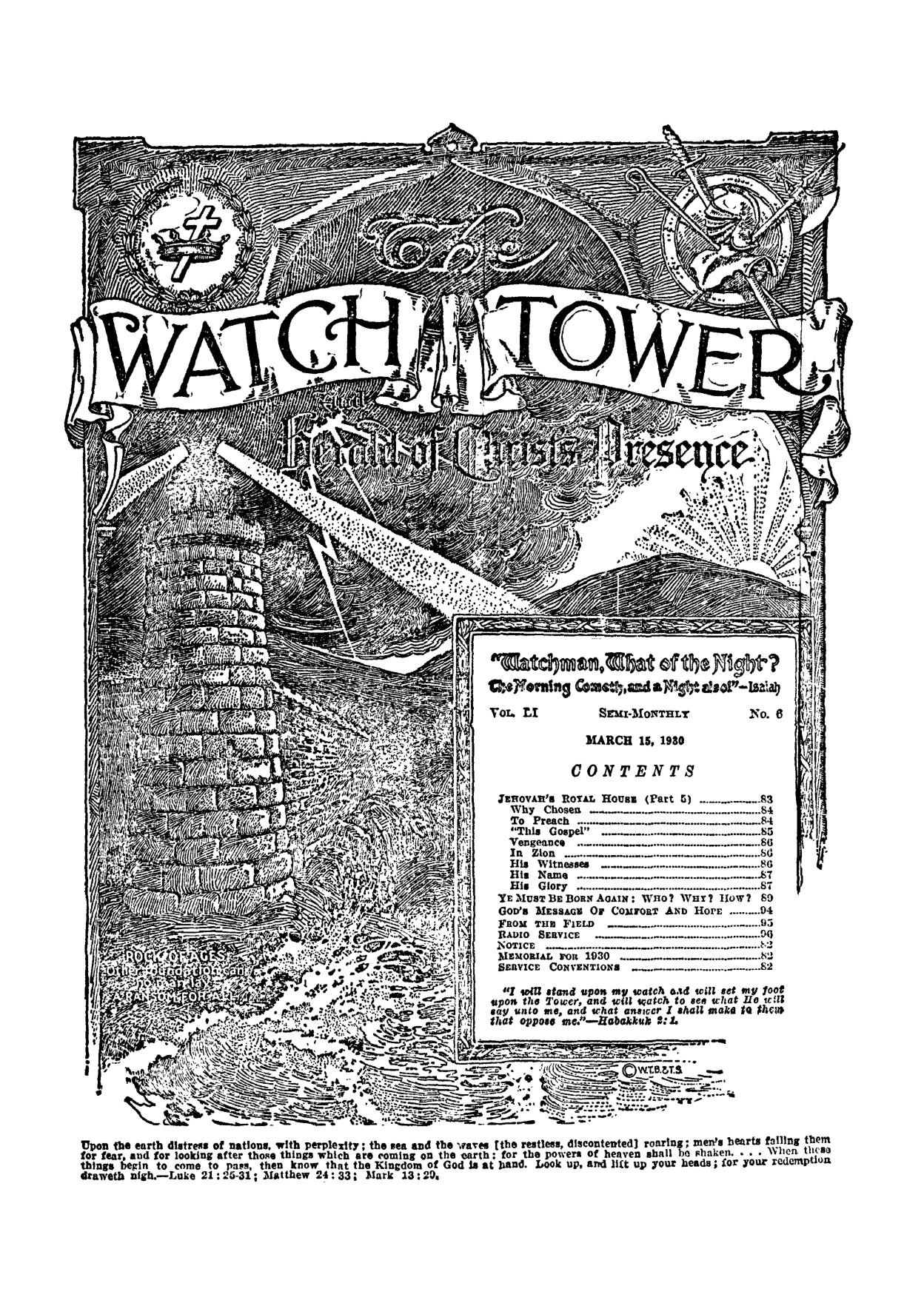
The Watchtower, March 15, 1930
Download: PDF — The Watchtower, March 15, 1930
NOTICE
Where the radio is used to broadcast the Truth, it would be well to announce the local meeting place of the class for Bible study. Permission to so announce should be obtained from the manager of the radio, and, since the time is paid for, it is presumed that this may be done. This will enable the interested to find a place for study and further consideration of the Lord’s Word.
MEMORIAL FOR 1930
The beginning of the month of Nisan is determined in this manner: The appearance of the new moon nearest to the spring equinox according to the authorities. The new moon appearing nearest to the spring equinox in the year 1930 is at 12: 46 p.m., March 30.
The rule is to omit the first day and count the last. Fourteen days thereafter, or, to wit, the fourteenth day of Nisan, would begin after 6: 00 p.m. of April 12. Therefore the proper date for the celebration of the Memorial would be after 6: 00 p.m., Saturday, April 12, 1930. That will be the time at which the anointed of the Lord in various parts of the earth will desire to assemble together at their respective places of meeting and celebrate the memorial of our Lord’s death.
Immediately following the celebration of the Memorial the secretaries of the classes are requested to report to The Watch Tower the number partaking in their respective places.
Vol. LI
March 15, 1930
No. 6
JEHOVAH’S ROYAL HOUSE
“These shall war against the Lamb, and the Lamb shall overcome them, for he is Lord of lords, and King of kings; and they also shall overcome that are with him, called and chosen and faithful.”—Rev. 17:14, R. V.
PART 5
JEHOVAH’S royal house occupies the most exalted place in all of his arrangement, is next to the Eternal One, and first in importance of all his creation. He has given Christ Jesus, his beloved One, and who is Head of that house, a name that is above all others, himself alone excepted. He ordains that every creature shall bow to that name and that the house and all in connection therewith shall be to the glory of God the great Creator. It is God who made provision for his royal house, and that at great cost to himself. He has brought forth many from among men and made them his sons and set before them the opportunity of becoming members of his royal house. Some of such he has chosen and anointed, and in his own due time that seed royal will be his instrument for the blessing of all the families of the earth.
2 It was unfaithfulness on the part of some of his creatures that made it necessary for him to sacrifice his beloved Son; and now, God having called out from amongst men those who shall be associated with his beloved Son in the reconstruction of the world, it is certain that of all such he will require absolute faithfulness. That means, therefore, that although one is begotten of God, is called, chosen, and anointed by and with the spirit of Jehovah, before his exaltation to membership in the royal house that creature must prove his faithfulness to Jehovah and to Christ. Faithfulness cannot be too greatly stressed. The promise of glory and exaltation is only to the faithful. To the called, chosen and anointed it is said: “Be thou faithful unto death, and I will give thee a crown of life.’’ — Rev. 2:10.
DAILY LIVING
3 Many who have been begotten of God as his sons have believed that they could prepare themselves for heavenly exaltation by merely taking a course of honesty, purity, cleanliness and uprightness. Addressing the church at Corinth, Paul wrote: “Know ye not that the unrighteous shall not inherit the kingdom of God? Be not deceived: neither fornicators, nor idolaters, nor adulterers, nor effeminate, nor abusers of themselves with mankind, nor thieves, nor covetous, nor drunkards, nor revilers, nor extortioners, shall inherit the kingdom of God.” (1 Cor. 6: 9,10) And, again, the apostle wrote: “For, brethren, ye have been called unto liberty; only use not liberty for an occasion to the flesh, but by love serve one another.” (Gal. 5:13) And, further, to the church it is written: “But now ye also put off all these; anger, wrath, malice, blasphemy, filthy communication out of your mouth.” (Col. 3:8,9) In another place the church is admonished: “Follow peace with all men, and holiness, without which no man shall see the Lord.” (Heb. 12:14) These texts need little comment because they are plain statements in themselves and show what will prevent one from entering into the kingdom of God.
4 Many of the consecrated have induced themselves to believe that if they would refrain from doing the evil things mentioned in the above text, daily living a sincere and honest life, be clean in thought, in word, and in conduct, dwell in peace with all men and do that which is right between man and man, by so doing a perfect character could be developed that would assure them an abundant entrance into the kingdom of God. In this they are deceived. Every person who has made a covenant with God must refrain from the evils mentioned by the apostle, above. He must follow the admonition of the Scriptures to lead a pure, honest and upright life; he must daily put forth his best efforts to keep himself up to the standard of righteousness and righteous living; but he may do all these things and yet not even start in the race for the prize of the high calling of God in Christ Jesus.
5 Because The Watch Tower has stated that it is impossible for one in the flesh to develop a perfect character some have construed this to mean that the. Christian can pursue a loose course of daily living, just so he is actively engaged in some part of the work in the Lord’s name. Nothing is further from the truth and from the statement of The Watch Tower.
6 What has been stressed in The Watch Tower is that daily living a clean and pure life will not of itself assure one a place in the kingdom. He must do that, and much more. He must do in a positive way what the Scriptures command him to do. He cannot rely on his own self-righteousness; because his righteousness is from God, through the merit of Christ Jesus. If he relies upon his own righteousness he thinks more highly of himself than he ought to think and forgets why God has called men to the high calling. After he is begotten as the son of God and he hears and responds to the call, he must then show his devotion to God and his righteous cause before he is chosen and anointed. After he is chosen and anointed, he must then prove his faithfulness before he can be made a member of God’s royal house.
7 Addressing the elect, Peter puts it in this wise: "As obedient children, do not conform yourselves to the former lusts in your ignorance; but as he who called you is holy, do you also become holy in all your conduct; for it has been written, ‘You shall be holy, because I am holy.’ ’’ (1 Pet. 1:14-16, Diaglott) While in the flesh one cannot be perfect in words or acts or even in his thoughts. If he says he can bring himself to the point of perfection where he has no sin, the apostle says, he deceives himself and the truth is not in him. — 1 John 1: 8.
8 God does require perfection in love; and that means an unselfish devotion to God. (Col. 3:14) A new creature in the flesh can be perfect in that regard. When God calls and chooses and anoints one, that means that such creature is called and placed on the Lord’s side; henceforth he must be holy, that is to say, entirely and completely devoted to God and his righteous cause. He must be faithful to God; and he cannot be faithful unless he is faithful to the commission that he has received by reason of his anointing with the spirit of Jehovah. His anointing carries with it a commission and duty to do some things while on earth; and he must be faithful in doing such things before God will make him a member of his reigning house. It is of first importance, then, that the one called, chosen and anointed understand what his commission commands him to do while on earth, and then to put forth his efforts faithfully to do that.
WHY CHOSEN
9 Why has God chosen some and anointed them? Is it merely that he might save them and get them into heaven to reign with his beloved Son ? The Apostle Peter answers the question in these words: "But ye are a chosen generation, a royal priesthood, an holy nation, a peculiar people; that ye should shew forth the praises of him who hath called you out of darkness into his marvellous light.’’ (1 Pet. 2:9) Called out of darkness, the new creature must "cast off the works of darkness, and . . . put on the armour of light’’ and ‘cleanse himself from all filthiness of the flesh and spirit, perfecting holiness in the fear of God’. (Rom. 13:12; 2 Cor. 7:1) To accomplish such the new creature must devote himself to God and show forth the praises of God who hath called him out of darkness.
10 It is nowhere stated in the Scriptures that one is called that he might develop a perfect character suitable to be used in heaven. He is told that he must cast away the works of darkness and then devote himself wholly to the Lord and pursue a course of righteousness. He must walk worthy of the vocation whereunto he is called. (Eph. 4:1) But he cannot do this by merely looking at his own admirable qualities and trying to make them better. He is chosen and anointed for a specific purpose.
TO PREACH
11 The anointed ones are commissioned and therefore commanded to preach the gospel of truth. "The spirit of the Lord God is upon me; because the Lord hath anointed me to preach good tidings unto the meek: he hath sent me to bind up the brokenhearted, to proclaim liberty to the captives, and the opening of the prison to them that are bound.” (Isa. 61:1) There is no exception to this fixed rule. There is no sex distinction of those who are of the anointed. (Gal. 3:28) Nor is this fact in any wise in conflict with the statement of the Apostle Paul, to wit: "For I do not permit a woman to teach, or to assume authority over a man, but to be quiet.”—1 Tim. 2:12, Diag.
12 In the latter text Paul is merely discussing the order in the church. There he says that the woman is not permitted to teach the man. The Lord has a reason for this. That, however, in no wise precludes any man or woman that is anointed of the spirit from telling the message of God’s kingdom to others. Preaching is not done merely by the use of spoken words. In this present time the most effective way of preaching the gospel of the kingdom is by placing the printed message in the hands of the people. It is a well known fact at this time that most of such preaching is being done by the women who are of the anointed. Some of the men have seemed to regard themselves as more important than the Scriptures warrant and have declined to carry the printed message to the people by going from door to door. The Lord is giving the greater portion of this privilege to the women, and is blessing them.
13 Both the Scriptures and the facts show that the obligation is laid upon every one who is anointed of the Lord to prove his faithfulness by preaching the word of truth as opportunity is afforded. There are some, of course, who are physically or otherwise hindered from having an active part in this work. The Lord knows the circumstances, and doubtless requires of such only according to their opportunities. Each one must examine and judge himself in this respect.
14 If one indulges in preaching that he may thereby exhibit his own learning and thus show forth his own importance, he is not fulfilling his commission. The anointed are chosen and commissioned to show forth the praises of God, who has called and anointed them. As one of God’s anointed, Paul said: “For though I preach the gospel, I have nothing to glory of: for necessity is laid upon me; yea, woe is unto me, if I preach not the gospel!’’ (1 Cor. 9:16) This statement is to the effect that the anointed ones cannot be faithful unto God if they either fail or refuse to preach the gospel as opportunity is offered. At the same time Paul wrote to his brethren: “Be ye followers of me, even as I also am of Christ.” (1 Cor. 11:1) Jesus said that Jehovah had anointed him to preach the gospel, and he did so. (Luke 4:18) Every one who has the anointing of God in Christ Jesus must do the same thing as the Lord opens to him the opportunity to perform.
RESPONSIBILITY
15 Greater responsibility rested upon the apostles because of their confidential relationship to God and to Christ. That relationship was created by reason of their anointing, which clothed them with authority to declare the message of God’s kingdom. Because of the light of truth that they had, and because they were specially commissioned to preach, they must do so. From their day until the second coming of the Lord responsibility rested upon others that received the anointing, in proportion to the light they had. When the world had ended, and the Lord Jesus having returned to take account with his servants, he began to take such account, and some being found faithful, they were brought into the temple and greater responsibility then rested upon them. These were not approved and brought into the temple because of self-righteousness, but because they were found faithfully doing what they had been asked to do. (Matt. 24:45,46; 25:21) The unprofitable or unfaithful servant was sent into outer darkness. It was to be expected that the approved, or the ones found faithful, would then be given greater light; and this expectation has come to pass.
16 God’s anointed King, pictured by the perfect “Stone”, was laid before the chosen ones, and upon that “Stone” Jehovah has caused his perfect light to shine. That light is reflected upon those of the temple, and therefore they have greater light. (See Zechariah 3:9.) What, then, is the purpose of granting those of the temple greater light? Is it that they might merely have a vision of their own coming glory? Surely not merely that. It is true that they do rejoice greatly in the increased light and the prospective glories of the kingdom; but they likewise see that the increased light has brought upon them greater responsibility.
17 Every one of the anointed stands now in a peculiarly confidential relationship unto God and unto Christ Jesus. Unto these anointed ones on earth the Lord has committed all his goods, which means his kingdom interests. If faithfulness was required from the servant before the servant was brought into the temple, with stronger reasoning we may know that faithfulness would henceforth be required of all in the temple. It must follow, then, that the anointed must faithfully carry out the terms of the commission. Manifestly the greater light is now given to the anointed that they might see what duties and obligations are laid upon them. God sends to them his flashes of lightning, thereby revealing to them more clearly what he has for them to do. It is necessary for the anointed to keep before them the things that they are expected to do. The sacred mission of The Watch Tower is to call the attention of the anointed to these things and to remind them what the Lord’s Word requires. The purpose is not merely to get books into the hands of the people. The purpose is to encourage the anointed to perform the terms of the commission.
“THIS GOSPEL”
18 The words of Jesus more specifically define a part of the commission given to the anointed one, when he said: “And this gospel of the kingdom shall be preached in all the world for a witness unto all nations: and then shall the end come.” (Matt. 24:14) This declaration is positive that the witness shall be given and finished before the final end. To whom would the Lord commit this work of giving the witness? To his anointed servant, of course; because the servant is the one who must look after the kingdom interests. The Lord requires faithfulness in this work. There is more than one purpose in having this gospel of the kingdom preached. This scripture, above quoted, specifically mentions that it shall be a witness; and other scriptures indicate more particularly to whom the witness is to be given.
“STANDARD FOR THE PEOPLE”
19 For many years Satan has been the god of the world. He has used his various agencies to blind the people to the truth and to turn them away from Jehovah. God’s announced purpose is to bring the people to a knowledge of the truth that in due time all may have a chance to obey him. He begins to give some of the people a knowledge now. For many years the people have been taught false doctrines, and over these they have stumbled. To his anointed God reveals the fact that now he has placed his King upon his throne and that the time has arrived to establish his kingdom. He therefore says to his anointed ones: “Go through, go through the gates; prepare ye the way of the people; cast up, cast up the highway; gather out the stones; lift up a standard for the people.’’ — Isa. 62:10.
20 This is a part of the commission to preach the gospel. The anointed are told to take that course which is in the way to the kingdom, represented by “the gates”. Their course of action directs the attention of the people to the kingdom, and they are told to prepare the way of the people by telling them of God’s kingdom and his purposes of relieving them and blessing them. They are told to gather out the stumbling stones of false doctrines by acquainting the people with the truth.
21 Further, they are commanded to lift up a standard for the people by pointing them to the fact that their relief from oppression can come only through God’s appointed way. In order that this might be done, the Lord has arranged machines, material and men to prepare and manufacture books and other literature for distribution, and has put these forth in many languages, that the witness might be given to the people. It is the blessed privilege of the anointed to distribute the Lord’s message of truth. Faithfulness is required in so doing.
VENGEANCE
22 It is written in the commission that someone must ‘declare the day of the vengeance of our God’. It is the anointed that must do this. God’s vengeance against all unrighteousness, and against Satan and his organization in particular, must be declared. One of the first great truths revealed to the temple class upon the opening of the temple was the fact that Satan has a wicked organization and that Jehovah God has an organization of which Christ Jesus is the Head. Why would God reveal these great truths to the anointed ? Manifestly for the purpose of enabling them to intelligently tell others about the two organizations and of God’s purpose to destroy the wicked organization and establish righteousness in the earth.
23 Being commissioned to tell the people about Satan’s organization, and God’s purpose to destroy it, the anointed must be faithful in delivering that message. The anointed see that Satan’s visible organization is made up of three primary elements, to wit, commercial, political and religious parts united together to oppress the people. To refuse or fail to call attention to this would, in the light of God’s commandment, be unfaithfulness. In pointing out Satan’s organization the anointed witnesses bring against themselves the expressed indignation of the enemy and his agents. But let it be remembered that it is Satan’s organization that makes war upon the King, and that they that are with Christ the King in the war, and in the victory, not only must be of the called and chosen, but also must be faithful in the performance of the commission. The Lord expressly states that where one who knows the truth stands by and secs Satan’s agents turning the people away from God and fails to give the warning is himself a party to the crime.—Ps. 50:17-19.
“PRISONERS”
24 The commission given to the anointed specifically provides that the anointed must “proclaim liberty to the captives, and the opening of the prison to the bound ones”. This they are to do by preaching the truth. The prisoners are not anointed, but they are the begotten children of God and are held as captives in the religious prison houses. They see the unrighteousness there and cry unto the Lord, and he hears their cries and expresses his determination to deliver them. (Ps. 79:8-13; 102:20) The Lord has provided the printed message concerning his kingdom, and has provided the radio also as a means of telling the prisoners the truth, and then he sends his anointed messengers from door to door to further comfort them. The Lord has laid upon the anointed the obligation and privilege of thus proving their faithfulness unto him and to the commission of anointing. They must be faithful in this work.
IN ZION
25 The commission also shows that there must be a work done to aid even those who are in Zion. It is an easy matter to become negligent of one’s privileges. Negligence is a transgression against the Lord and an infraction of the terms of the covenant with him. Therefore the Lord says to his anointed: “Cry aloud, spare not; lift up thy voice like a trumpet, and shew my people their transgression, and the house of Jacob their sins.” (Isa. 58:1) This and other scriptures indicate that there must be some in Zion who may yet be awakened and take advantage of their privileges, and hence the warning is given. The anointed must be faithful in this part of their work.
HIS WITNESSES
26 At the present time there are doubtless more people on earth that are deluded by Satan than at any other time in the history of man. Millions who even claim to be followers of Christ Jesus are entirely in the dark. Men pose as teachers of God’s Word and yet openly and brazenly deny the supremacy of God and the blood of Jesus Christ and the divine purpose of salvation. These false teachers put forth their own theories concerning man’s ability to save and uplift himself. The various religious systems are, of course, a part of Satan’s organization, and God has expressed his determination to destroy all such.
27 Jehovah does nothing by stealth or in secret. He would have the world advised of his purposes and therefore he declares his purpose to have a witness given to the people that they may have the opportunity to know that he is the only true God, the eternal and supreme One, the Savior and Deliverer of man. His anointed are commissioned to do that work. It is the testimony of Jesus Christ which he has committed to the anointed remnant. It is that class that keep the commandments of Jehovah that must give the witness and that receive the attacks of the enemy. (Rev. 12:17) They refuse to compromise in any way with any part of Satan’s organization, because they are wholly for Jehovah. Therefore God tells his anointed ones: ‘There is no strange God among you [because you are mine anointed] ; therefore ye are my witnesses, saith the Lord, that I am God.’—Isa. 43:12.
28 This and other scriptures show that such testimony must be given by the anointed just before the great battle of God Almighty in which Christ Jesus will be the victor. To the same anointed God says: “I have put my words in thy mouth, and I have covered thee in the shadow of mine hand, that I may plant the heavens, and lay the foundations of the earth, and say unto Zion, Thou art my people.” (Isa. 51:16) Thus the Lord assures his anointed not only that they are duly commissioned as his witnesses in the earth, but that he has provided all the needed protection. He has brought them into his ‘‘secret place”; and there abiding, they are entirely safe. (Ps. 91:1, 2) In order for them to continue in safety, and in order to be granted the great privilege of being with Christ Jesus in his victory, these witnesses for Jehovah must be faithful in giving the testimony.
29 When the Lord Jesus Christ had finished his work on earth one of the titles given to him was ‘‘The faithful and true witness”. Those who will stand with him must also be faithful and true witnesses unto God and unto Christ.
HIS NAME
30 In the early time of the selection of the members of the royal house God caused one of his faithful witnesses to write: ‘‘Simeon hath declared how God at the first did visit the Gentiles, to take out of them a people for his name. . . . After this I will return, and will build again the tabernacle of David, which is fallen down; and I will build again the ruins thereof, and I will set it up.” (Acts 15:14,16) The Lord has now set up Zion, brought his anointed into the temple, made them his witnesses, and commanded that they shall proclaim his majesty and his holy name. The anointed must be faithful. On another occasion Peter declared that the very purpose of taking them out, calling and choosing them, is that such should be God’s witnesses and show forth his praises. (1 Pet. 2:9) We are now in the ‘‘day of the Lord” so often mentioned in the Scriptures as ‘‘that day”. The anointed see it, and see that the battle is approaching, and they rejoice and pray the Lord for prosperity. ‘‘This is the day which the Lord hath made; we will rejoice and be glad in it. Save now, I beseech thee, O Lord: O Lord. I beseech thee, send now prosperity. ’’—Ps. 118: 24,25.
31 The anointed cannot content themselves by merely leading an honest, pure, and upright life, as these terms are generally understood. Many of the prisoners do that much, and they dwell among idols. To his anointed the Lord says: "And what agreement hath the temple of God with idols? for ye are the temple of the living God; as God hath said, I will dwell in them, and walk in them: and I will be their God, and they shall be my people. Wherefore come out from among them, and be ye separate, saith the Lord, and touch not the unclean thing; and I will receive you, and will be a Father unto you, and ye shall be my sons and daughters, saith the Lord Almighty.”—2 Cor. 6:16-18.
32 The anointed must be wholly and unreservedly on the Lord’s side. Having the greater light, because being in the temple, with joy they are drawing the truths out of the wells of salvation. To them the Lord Jehovah now says through his prophet: “And in that day shall ye say, Give thanks unto Jehovah, call upon his name, declare his doings among the peoples, make mention that his name is exalted. Sing unto Jehovah; for he hath done excellent things: let this be known in all the earth. Cry aloud and shout, thou inhabitant of Zion; for great in the midst of thee is the Holy One of Israel.” (Isa. 12:4-6, R. V.) The anointed of God are now fulfilling this prophecy, by the Lord’s grace, and doing so by going up and down the earth proclaiming the great and holy name of Jehovah God and telling the people of his mighty works and that the time for his kingdom is at hand.
33 When the prophet speaks of the “feet of him”, without a question of doubt he has reference to the feet of the anointed of God. Therefore the following prophecy means, and is applied to, the feet members of Christ, the temple class, those who are anointed and who have and manifest the spirit of the Lord: “How beautiful upon the mountains are the feet of him that bringeth good tidings, that publisheth peace; that bringeth good tidings of good, that publisheth salvation; that saith unto Zion, Thy God reigneth! Thy watchmen shall lift up the voice; with the voice together shall they sing; for they shall see eye to eye, when the Lord shall bring again Zion.” (Isa. 52:7, 8) It is the anointed of God, and these only who continue thus faithfully to serve unto the end, that will be permitted to stand with the King of kings in that great battle and victory that is near.
HIS GLORY
34 The Scriptural evidence and facts well known overwhelmingly prove that the Lord is in his holy temple and that the final testing time of the chosen ones is now. (Ps. 11:4, 5; 1 Pct. 4:17; Mal. 3:1-3) Under that test it will be determined who is faithful and who will therefore be of the kingdom. What, then, are those of the temple class now expected to do? or what are they doing?
35 The prophet of God answers the question, and says: “In his temple doth every one speak of his glory.” (Ps. 29:9) Is not this Scripturally a sure criterion by which one may measure himself and determine where he is? The apostle mentions a class of persons who ‘commend themselves by measuring themselves by themselves, and comparing themselves among themselves, and thereby show that they do not understand’. (2 Cor. 10:12) The anointed must not fall into this error. It is not the prerogative of one to judge another; but each one may properly examine and judge himself. It is a time for solemn self-examination.
36 If one finds himself disposed to take a course of least resistance and to say nothing about Satan and his organization and about God’s expressed determination to destroy it and to establish righteousness, he may begin to wonder if he has the spirit of the Lord. If one finds in his mind an objection or opposition to the organized effort now being put forth to give the witness of Jehovah God and his kingdom, is not that strong circumstantial evidence that he is not of the temple? If he finds himself opposed to manufacturing books containing the message glorifying God’s name and advertising his King and kingdom, and opposed to carrying them from door to door and putting them in the hands of the people, would it not be well for him to ask himself, Am I one of the Lord’s anointed and in the temple? If he finds himself provoked at what The Watch Tower has published concerning the greater light that God is giving to his people, fails to see or appreciate that light himself and opposes others who are trying to use it to the Lord’s glory, such he should take into consideration in determining whether or not he is of the temple.
37 On the other hand, if one has wholly devoted himself to the Lord God; finds that he has no sympathy with the wicked organization of Satan, and finds that he has a vision of God’s organization and the enemy’s organization; finds that he is moved with a zeal for the Lord and that he is striving daily to lead a clean and pure life, consistent with the high calling; finds that he is rejoicing in the ever-increasing light upon God’s Word and anxious to have a part in passing the message on to others, and that he is putting forth his best endeavors to give the testimony of Jesus Christ, and finding great joy therein, then would not this be strong proof that he is of the temple class and therefore one of God’s anointed? All such who are thus singing the praises of Jehovah in harmony with his Word may have reason to believe that they are of the anointed.th
38 Jesus said: “Fear not, little flock, for it is your Father’s good pleasure to give you the kingdom.” (Luke 12:32) In harmony with this, is it not now plain that the number of the anointed ones is small and that only those who continue faithful to the commission of their anointing unto the end will be of the kingdom? The great multitude have been begotten of God, and before them the call has been placed. Many have not responded to that call. Probably many of those who accepted the call and started in the race have not been chosen. Those who responded to the call and have been chosen have received the anointing of the holy spirit. They have the spirit of Christ and are his. Now they must be faithful to the test, and that test requires every one to earnestly and carefully safeguard the kingdom interests that have been committed to the commissioned, anointed ones. Such must be and are entirely out of sympathy with the beastly organization of the enemy, and must be and are entirely devoted to the Lord; and thus continuing faithful unto the end, they shall receive the great reward. They will stand with the King of kings in his great victory. Concerning the victorious it is written: “They shall be priests of God and of Christ, and shall reign with him a thousand years.”
QUESTIONS FOR BEREAN STUDY
1,2. Jehovah’s royal house enjoys what great honor? How exalted is the position which Jehovah has given to Christ Jesus? How and for what purpose was provision made for this royal house? By what sacrifice was the foundation laid? Why was sacrifice necessary? State the standard of faithfulness for those who shall be exalted to membership in that house.
3,4. Point out from the Scriptures the proper course of daily conduct.
5. State whether it is possible to follow perfectly the course mentioned, and whether such fact affects the importance of earnest effort in that direction.
6, 7. On the other hand, what is the tendency of devoting oneself exclusively to that standard? What, then, is the nature and the measure of devotion expected (a) of one who is begotten as a son of God? (b) Of one who is chosen and anointed?
8. Define the ‘perfection’ and ‘holiness’ which God requires of those who would have his approval.
9,10. Quote the Apostle Peter on the purpose of God’s calling and choosing some and anointing them. What does Paul say in this regard?
11,12. State the commission of the anointed, as contained in Isaiah 61: 1-3. Explain whether 1 Timothy 2:12 places a limitation upon this commission.
13. How is responsibility related to circumstance and condition? How is each one’s responsibility to be ascertained?
14. With scriptures, show whether, having been anointed, one may regard this commission as an optional matter. What procedure only, and what motive, will have God’s approval?
15-17. Compare the responsibility of the anointed from the day of the apostles to the present time, stating the basis of your comparison. Account for the greatly increased light now enjoyed by those of the temple class. How does this greater light affect their responsibility? The Watch Tower serves what special purpose?
18. What is the specific witness which Jesus declared must be given in the end of the age? To whom is this witness work committed?
19-21. Explain Isaiah 62:10, and point out its fulfilment. Why is the witness necessary? The Lord has provided what means for giving this witness to the people?
22,23. Describe the organization against which God's vengeance is to be declared. Why is such declaration required? Point out the responsibility in this respect of all who have a knowledge of the truth.
24. Describe the conditions which call for ‘proclaiming liberty to the captives and the opening of the prison to the bound ones’. How is this work to be accomplished?
25. What is the work to be done ‘in Zion’? How is this to be done?
26, 27. In view of the fact that there are millions of professed followers of Christ, why should it now be necessary to teach the people even the simple truths regarding the salvation of man? Who, only, can and will give a true witness to the people? Why does Jehovah now have this special witness given?
28, 29. Apply Isaiah 51:16. Under what conditions only may one claim the security expressed in Psalm 91:1, 2?
30. When was it that “God at the first did visit the Gentiles, to take out of them a people for his name”? How did he do so? Point out the fulfilment of Acts 15:16.
31, 32. In the light of Isaiah 12:4-6, and with the truth which God has been revealing to his people, will honesty, purity and uprightness alone fully meet the conditions of one’s covenant? What further is required?
33. Isaiah 52:7, 8 expresses what activity of the “feet of him”, and what harmony?
34-37. The chosen ones are now facing what important test? According to Psalm 29:9, what distinguishes those of the temple class? Give further details for self-examination as to one’s being of the temple class.
38. How has the call been regarded by those before whom it has been placed? What is the present opportunity and responsibility of each of these classes? Describe the stand now to be taken by all who would share with the King of kings in his great victory.
YE MUST BE BORN AGAIN: WHO? WHY? HOW?
[Thirty-minute radio lecture]
THE transatlantic steamer “Montnairn” was about to cast off from the Prince’s Dock, in Glasgow, Scotland. Most of the passengers were on the starboard side of the vessel, interestedly watching the crowd gathered on the wharf below. Some of that crowd were waving farewell to loved ones setting out for other shores, not knowing whether they would ever see one another again in this life. On the wharf one stocky Scotch woman was giving a rather odd word of farewell to the ship’s passengers. She held up constantly before her a large white placard on which was painted in large, somber black letters, “Ye Must Be Born Again.” Suddenly the ship’s whistle shrieked out a warning signal. The wharf policemen began to order the crowds back, and at length succeeded in shutting them off the wharf behind a long swinging gate with tall palings. But this persistent sign-bearer managed to get right next to the gate, and thrust her hands and arms out between the gate palings and held up that sign with its unusual message. The ship began to pull away from the wharf, but still the sign remained held aloft. Soon the ship swung around and out into the Clyde, and the wharf and the crowd behind the gate passed out of the perspective of the ship’s passengers. But a young man aboard the ship had observed the woman and her queer farewell sign, and the memory thereof lingered in his mind.
“Ye must be born again!” What a strange sign and message, he thought, to hold before people putting out to sea, without any additional word of explanation! No doubt most of those reading the sign would suspect that the words thereof were of some sacred source. Of course, if any had been reared orthodox Scotchmen, they would not have to be told that the words were those of Jesus, spoken to the Jewish ruler Nicodemus, and recorded in John’s gospel, chapter 3; but even then, how few, few people reading these bare words on the sign would understand them! The learned Nicodemus had been puzzled, and asked Jesus: “How can a man be born when he is old? can he enter the second time into his mother’s womb, and be born? . . . How can these things be? Jesus answered and said unto him, Art thou a master of Israel, and knowest not these things? ... If I have told you earthly things, and ye believed not, how shall ye believe if I tell you of heavenly things ? ’’ —John 3:4-12.
Jesus’ words, “Ye must be born again” (or, born from above, margin), are really a wonderful and gracious invitation. But the woman holding the sign at the wharf applied the words as a threat; they were scare words of most solemn warning. Such is indeed the way most orthodox religious people view Jesus’ statement, that unless all of us earthly creatures are born again there is no hope of eternal life for us, but only forebodings of a horrible eternal future. But must everybody on earth be “born again” or “born from above” in order to gain everlasting life in happiness? If so, then how may they or must they be born again? If, however, it is not necessary for everyone, then who are they that must be born again, and how? And why must they be born again? It is certainly worth while, yes, important, that we know the answers to these questions; and if we are at all worried over the subject or uncertain about it, then it is most essential to our present happiness, and who but God knows what bearing it may have on a most happy future in the ages to come?
Adam, the first man on earth, and his wife Eve were not born. “For,” says the Apostle Paul, “Adam was first formed, then Eve.” (1 Tim. 2:13) Adam was created by the power of God direct from the dust of the earth, when as yet there was no woman on earth. The scripture (Gen. 2:7) reads: “And . . . God formed man of the dust of the ground, and breathed into his nostrils the breath of life; and man became a living soul.” In order that Adam’s wife might be “bone of [his] bones, and flesh of [his] flesh”, God chose to remove a rib from Adam’s side while he was sound asleep, and with this as a foundation God’s power formed the first woman, Eve. Thus 1 Corinthians 11: 8, 9 states: “The man is not of the woman; but the woman of the man; neither was the man created for the woman; but the woman for the man.” After that all human creatures coming into life on our planet must be bora to the man and by the woman, according to the marvelous course of things God had arranged for his human creatures. And so it is written: “For as the woman is of the man, even so is the man also by the woman: but all things of God.” (1 Cor. 11:12) For this reason Adam called his wife’s name Eve, which means, living, life, or life-giving, because he knew she was to be “the mother of all living”. (Gen. 3:20) But sin made the privilege of motherhood one of great pain and sorrow.—Gen. 3:16.
The birth of any babe is a wonderful thing, but what a wonderful object that first baby born on this earth must have been in the eyes of Adam and Eve. That was the first natural seed born to a woman. There was nothing heavenly about this seed, or offspring, or child; neither was it ‘‘ born from above ’’; and it could be nothing more than earthly or fleshly, because its mother was earthly, human, fleshly, and Jesus himself stated the rule: “That which is born of the flesh is flesh.” (John 3:6) Its father also was fleshly, “of the earth, earthy.” (1 Cor. 15:47) Had Adam and Eve not sinned but remained in their original perfection, integrity, and immaculateness, their first seed or child would have been born unblemished, without sin, a perfect baby, with every opportunity to grow up a perfect man like its father Adam. But that the first child born was brought forth in sin and shapen in iniquity (Ps. 51: 5) is apparent from the fact that he turned out to be a hater of his own brother and eventually the bloody murderer of him. Who can deny the truthfulness of Job 14:1, 3, which reads: “Man that is born of a woman, is of few days, and full of trouble. Who can bring a clean thing out of an unclean? not one”? There is not a single one of us, therefore, that has escaped being born with faults, defects, disabilities, and the process of sin and death working in us. “As it is written, There is none righteous, no, not one. For all have sinned, and come short of the glory of God.”—Rom. 3:10,23.
The wisdom of God says further, in Ecclesiastes 7:20: “For there is not a just man upon earth, that doeth good, and sinneth not”; and 1 John 1:8,10 says: “If we say that we have no sin, we deceive ourselves, and the truth is not in us. If we say that we have not sinned, we make him a liar, and his word is not in us.” Hence we must all pay the wages of sin, which is death, not eternal torment in fire and brimstone. (Rom. 6: 23) To this general condition obtaining among the human family there has been but one exception, and that was “the man Christ Jesus”. Jesus said to his enemies who were trying in every way to condemn him: “Which of you convinceth me of sin?” (John 8:46) He made this challenge to them in answer to their broad hint that he, Jesus, had been “born of fornication”, and that he was an illegitimate child. Now if Jesus’ claims were not true, if he is not the one genuine exception, then the hopes of mankind of ever attaining everlasting life in joy and prosperity are blasted and vain.
That a wonderful birth should occur which should lead to the undoing of all the enemy’s work against mankind Jehovah God positively stated to our original parents in the garden of Eden, immediately after sin had entered into the world, dragging in death in its train. Man’s enemy, who is also God’s enemy, had used the subtle serpent to lure Eve, and with her, Adam, into sin against God. Hence, addressing the serpent as being a symbol of the real deceiver, the Devil, Jehovah spoke words of curse and of hope. “And the woman said, The serpent beguiled me, and I did eat. And the Lord God said unto the serpent, Because thou hast done this, thou art cursed above all cattle, and above every beast of the field: upon thy belly shalt thou go, and dust shalt thou eat all the days of thy life. And I will put enmity [hatred] between thee and the woman, and between thy seed and her seed; it [the woman’s seed] shall bruise thy head, and thou shalt bruise his [the seed’s] heel.” (Gen. 3:13-15) This statement of God meant a coming blessing for the human family who have suffered from the wrongdoing of “that old serpent, which is the Devil, and Satan”.— Rev. 20: 2.
Ecclesiastics and religious teachers have given the people to understand that the woman to whom God referred was the virgin Mary and that the seed was Jesus. True, Jesus was born to the virgin not by any human procreative power, but the holy power or spirit of God transferred the life of the only begotten Son of God from heaven into the virgin’s womb in order that thus Jesus might be “born of a woman” and be “made flesh”. However, neither the virgin Mary nor any woman on earth is the woman spoken of in this the first prophecy God ever gave to mankind. It can not be stated correctly that God put enmity between any particular woman, or even womankind, and the serpent, the Devil. Can it be claimed, on the basis of what the holy Scriptures show, that womankind has hated the serpent more than men have, or that the serpent has hated womankind more than it hates men? Certainly the Apostle Paul did not have the virgin Mary in mind when he wrote to Christians and practically quoted God’s first prophecy to men, saying: “And the God of peace shall bruise Satan under your feet shortly. The grace of our Lord Jesus Christ be with you.” (Rom. 16:20) It is plain that the serpent is symbolic: no one will deny that. Just so the woman to which God referred is symbolic, as is also her seed. The serpent symbolizes the one whom the book of Revelation calls “that old serpent, which is the Devil, and Satan”. The symbolic woman is pictured in the same book of Revelation, chapter twelve, verse one, which reads: “And there appeared a great wonder in heaven; a woman clothed with the sun, and the moon under her feet, and upon her head a crown of twelve stars. And she being with child cried, travailing in birth, and pained to be delivered.” This language could in no possible way refer to the virgin Mary, for she was never in heaven, nor was she ever crowned with twelve stars, nor was she standing on the moon, when Jesus was born at Bethlehem, a little town down here on earth.
The “seed” of this woman is pictured in verses five and seventeen of this same chapter, reading: “And she brought forth a man child, who was to rule all nations with a rod of iron: and her child was caught up unto God, and to his throne. And the dragon [that old serpent, which is the Devil, and Satan] was wroth with the woman, and went to make war with the remnant of her seed, which keep the commandments of God, and have the testimony of Jesus Christ.” Most commentators, Catholic and Protestant, will contend that Mary remained a virgin, her offspring being Jesus only; if then she had no other children, it could not be Mary of whom it could be said that there was a “remnant of her seed, which keep the commandments of God, and have the testimony of Jesus Christ”. Undeniably here God, who gave the book of Revelation containing his last prophecies, used ‘the woman’ symbolically even as he used “the woman” symbolically in his first prophecy to man. Who ‘the woman’s seed’ is becomes clear from the statement that “her child” was ordained to “rule all nations with a rod of iron”. This rulership does not apply to Jesus alone, because Jesus said to his Christian followers: “He that overcometh, and keepeth my works unto the end, to him will I give power over the nations: and he shall rule them with a rod of iron; . . . even as I received of my Father.” (Rev. 2:26,27) This makes it clear that “the seed of the woman” which is to rule all nations with the rod of iron must mean the righteous government, “the kingdom of heaven”, or “holy nation”, of which Christ Jesus is the Head, or chief member, and his faithful followers who overcome and make up his true, church, and who thus share the governmental powers with him, are the body.
Several scriptures describe this seed in these words: “For as the body is one, and hath many members, and all the members of that one body, being many, are one body; so also is Christ. For by one spirit are we all baptized into one body, whether we be Jews or Gentiles, whether we be bond or free; . . . Now ye are the body of Christ, and members in particular.” (1 Cor. 12:12,13, 27) “For as we have many members in one body, and all members have not the same office: so we, being many, are one body in Christ, and every one members one of another.” (Rom. 12: 4, 5) Each faithful disciple of Jesus is a branch in him “the true vine”. (John 15:1,5) Jesus spoke of the oneness of his followers with himself, when, just before his betrayal to his enemies, he prayed: “Holy Father, keep through thine own name those whom thou hast given me, that they may be one, as we are. I pray for them: I pray not for the world, but for them which thou hast given me: for they are thine. Neither pray I for these alone, but for them also which shall believe on me through their word; that they all may be one; as thou, Father, art in me, and I in thee, that they also may be one in us.”—John 17:11, 9, 20,21.
Thus it becomes plain to us how the seed of the woman applies to and takes in both Jesus and all his faithful followers, and also how the seed of the woman can be pictured or symbolized by one man child. All the members of this seed are the children of one symbolic mother. Even as Hebrews 2:11 says: “For both he [Jesus] that sanctifieth and they who are sanctified, are all of one: for which cause he [Jesus] is not ashamed to call them brethren.” Hence the woman whose seed is to bruise the serpent’s head could not be the virgin Mary or any human mother. The Apostle Paul sets forth how a covenant of God gives origin or birth to a seed or offspring, and hence how God sometimes uses the figure of a woman to symbolize such a covenant or solemn agreement of God. In explaining these difficult things the Apostle Paul writes, saying: “For it is written, that Abraham had two sons; the one by a bondmaid, the other by a freewoman. But he who was of the bondwoman was born after the flesh; but he of the freewoman was by promise. Which things are an allegory: for these [two women] are the two covenants; the one [made with the Hebrews through Moses] from the mount Sinai, which gendereth to bondage, which is Agar [the bondwoman]. But Jerusalem which is above is free, which is the mother of us all. Now we, brethren, as Isaac was, are the children of promise. So then, brethren, we are not children of the bondwoman, but of the free. ” (Gal. 4:22-24, 26, 28, 31) Thus God’s written Word interprets its own symbolic language and shows that ‘the seed of the woman' embodies both Jesus and his Christian brethren; it shows that “the woman” stands for a covenant, as foreshadowed by Sarah, the true wife of Abraham, or that “the woman” stands for God’s organization, or the organization joined unto him, such as “Jerusalem which is above”, “which is Zion.”—1 Ki. 8:1.
In his explanation God’s apostle quotes from the fifty-fourth chapter of Isaiah’s prophecy, which is addressed to Zion, God’s organization. Note how God addresses Zion, his organization, as “a woman”; in verses five and thirteen he says: “For thy Maker is thine husband; The Lord of hosts is his name; and thy Redeemer the Holy One of Israel; The God of the whole earth shall he be called. And all thy children shall be taught of the Lord; and great shall be the peace of thy children.” Jesus quoted these latter words of the prophecy and showed that these 'children of Zion’ are his true Christian brethren; he said: “No man can come to me, except the Father which hath sent me draw him: and I will raise him up at the last day. It is written in the prophets, And they shall be all taught of God. Every man therefore that hath . . . learned of the Father, cometh unto me.” (John 6:44,45) Since, therefore, God’s organization Zion, or “Jerusalem which is above”, was pictured by Sarah, the wife of Abraham, it becomes further certain that ‘the seed of the woman’ in question is the same as ‘the seed of Abraham’ of which God spoke when he said to Abraham: “ In thy seed shall all the nations of the earth be blessed, because thou hast obeyed my voice.” (Gen. 22:18) Abraham’s wife being used to foreshadow God’s organization, Abraham would therefore represent Jehovah God, the great heavenly Father of the seed. That Abraham's seed is the same as the seed of the woman, God’s own Word makes sure, saying: “For ye [Christians] are all the children of God by faith in Christ Jesus. For as many of you as have been baptized into Christ, have put on Christ. . . . For ye are all one in Christ Jesus. And if ye be Christ’s, then are ye Abraham’s seed, and heirs according to the promise. ’ ’—Gal. 3:26-29.
Now we are better able to appreciate why the ruler Nicodemus did not understand Jesus’ dark sayings, but asked: “How can a man be born when he is old? How can these things be?” Nicodemus could not understand our Savior’s words, “Except a man be born again, he cannot see the kingdom of God,” but we can understand them. Jesus meant that any man who had been born of an earthly or human mother must be born again of God’s organization, Zion, if he would enter into and see the kingdom of God. Why? Because man that is born of a human mother is born of the flesh and hence is flesh. One has to be more than a fleshly human being if he is to succeed in getting to heaven and becoming a member of the kingdom of God which is to rule all nations with a rod of iron and which is to bless all the families of the earth with peace, health, prosperity, life, and reconciliation with God. For 1 Corinthians 15:50 states the fact that “flesh and blood cannot inherit the kingdom of God”. That is why God’s Word tells us that the heirs of the kingdom, who are taken from among men, must have a change of nature, and this change of nature is the result of being born again, born of the spirit: “that which is born of the spirit is spirit.”
When Jesus was born of the virgin Mary, he “was made flesh” (John 1:14), because his mother was of flesh; and thus Jesus was “born of the flesh”. He was “flesh and blood”, and as such he himself could not cither “see the kingdom of God” or “enter into the kingdom of God” or “inherit” it. It was first at Jesus’ baptism in the River Jordan that, to quote Matthew 3:16. “the heavens were opened unto him,” that is, the mystery of the kingdom of God was opened to his understanding, and he saw or discerned it and appreciated that God was opening unto him the way to return to heaven and thus get back to the glory which he had had with the heavenly Father before the world was. (John 17:5) Hence, even though born from the womb of the virgin Mary, yet it was necessary for Jesus to be born again if he would see and enter and inherit God’s heavenly kingdom. God’s will was not for Jesus to remain “flesh and blood” for ever, which would have confined Jesus to living on this earth for ever. Jesus had become flesh merely that he might provide a sacrifice of the same value as the human life and nature which Adam had in perfection in the garden of Eden. As Jesus said: “I am the living bread which came down from heaven: if any man eat of this bread, he shall live for ever: and the bread that I will give is my flesh, which I will give for the life of the world.” (John 6: 51) All the types and prophecies of the Old Testament showed that God purposed that Jesus should die and return to heaven and be made the glorious heavenly King who should ‘bruise the serpent’s head’, and give the fallen human race a perfect government, raise all their dead, regenerate and lift mankind up out of the pit of sin and imperfection, restore them to relationship with God, and completely heal them of the deadly sting of “that old serpent, which is the Devil”. Isaiah’s prophecy (9:6,7) said of Jesus: “Unto us a son is given, and the government shall be upon his shoulder; and his name shall be called Wonderful Counsellor, The mighty God, The everlasting Father, The Prince of Peace. Of the increase of his government and peace there shall be no end, . . . to establish it with judgment and with justice, from henceforth even for ever.”
When Jesus came to John the Baptist for baptism he came as a man thirty years of age (Luke 3: 21-23), free of legal obligations binding him to his fleshly mother Mary, and independent and free to do God’s will, whatever God should reveal his will to be after Jesus’ baptism. (Heb. 10: 5-7) There and then Jesus placed his flesh and his human life at the disposal of God. To symbolize this he was submerged beneath Jordan’s waters by John the Baptist. On being lifted up from beneath the waters, then it was that Jesus was begotten again, this time not through a mother offlesh, but by the spirit of God and according to God’s covenant; for there God confessed Jesus as his beloved Son, and the prophecy began to be fulfilled which says: “The Lord said unto me, Thou art my Son; this day have I begotten thee.’’ (Ps. 2:7) Jesus was there begotten, not as the seed of the virgin Mary, but as “the seed of the woman’’, God's symbolic woman, God’s covenant, or Zion. That evidence might be given at once that Jesus was there begotten of God’s spirit or invisible power, God symbolized the matter for us. He caused a vision which none of the by-standers saw, but only Jesus and John, namely, “the spirit descending from heaven like a dove, and it abode upon [Jesus].’’-John 1: 32-34; Matt. 3:16,17.
Thus Jesus was introduced into the kingdom of heaven class, as the Head and first member thereof; he entered into the kingdom of God, because he had now been brought forth of water and of the spirit (John 3:5), thereby fulfilling the rule which he himself stated: “Except a man be born of water and of the spirit, he cannot enter into the kingdom of God.” The Scriptures use water to symbolize God’s truth; and it was God’s spirit or holy power, operating together with divine truth, which brought forth Jesus as the chief member of the seed which should ‘bruise the serpent’s head’. Was ‘the seed of the serpent’, or Satan’s servants, at enmity with Jesus? Yes, they were the ones, who put Jesus to the death of the cross. But Jesus was raised from death as “the firstborn from the dead’’. (Col. 1:18) God did not resurrect Jesus as a flesh being; the Apostle Peter plainly says that Jesus was put to death flesh, but raised to life spirit. (1 Pet. 3:18, R. V.) Jesus had been begotten of God’s spirit at his baptism; hence he must be born from the dead as a spirit being: “that which is born of the spirit is spirit.” The Apostle Paul on one occasion referred to this, saying: “The promise which was made unto the fathers, God hath fulfilled the same unto us their children, in that he hath raised up Jesus again: as it is also written in the second psalm, Thou art my Son, this day have I begotten thee.” —Ps. 2:7; Acts 13: 32, 33.
To whom, then, do Jesus’ words apply, “Ye must be born again”? Not to the world of mankind as a whole, but only to those who have any hope of seeing, entering into and inheriting the heavenly kingdom of God. The human family, both the dead and the living, will not inherit that kingdom of God, because they are flesh and blood; but they will become its subjects when Jesus has bound the Devil, overthrown his empire, and establishes God’s kingdom over mankind. Then the human race will be regenerated back from death and the grave unto human perfection in God’s image and likeness on this earth. Only the wicked, the unreformable, and rebellious amongst men will be permanently destroyed in the second death. (Ps. 145:20) Thus regenerated mankind will have a natural or earthly resurrection. Christians, however, who are to share in “the first resurrection”, which is a spiritual, heavenly resurrection (Rev. 20: 6), and to reign with Christ as members of “the kingdom of God”, all such “must be born again”, they must be “born of water [divine truth] and of the spirit”. For they are the servants of Christ, and hence are not above their Lord. (Matt. 10:24) They must follow Jesus and undergo the same process of perfecting them as divine, heavenly creatures that Jesus underwent. God “did predestinate [that they should] be conformed to the image of his Son, that he might be the firstborn among many brethren”. (Rom. 8: 29) They must not only repent of sin and be converted or turned away therefrom, but also dedicate themselves or consecrate themselves without any reservations whatsoever to do God’s will. (Matt. 16:24) They must receive justification or clearing from sin through the value or merit of Jesus’ ransom sacrifice; they must be born again, from above, according to the will of God and by his spirit; as it is written: “Of his own will begat he us with the word of truth, that we should be a kind of firstfruits of his creatures.” (Jas. 1:18) They must thus become part of ‘the seed of the woman’, members of God’s organization, Zion, responding to God’s call to service as his witnesses, that they may receive God’s anointing. Thus chosen and anointed of God, they must be faithful to him, his truth, and his service, until death, for only to those thus doing did Jesus say: “Be thou faithful unto death, and I will give thee the crown of life.” ‘‘To him that overcometh will I grant to sit with me in my throne, even as I also overcame and am set down with my Father in his throne.” (Rev. 2:10, R. V.; 3:21) Thus they must be planted together in the likeness of Christ’s death, that they may be in the likeness of his resurrection and be born from the dead as spirit beings and thus bodily enter into and inherit the kingdom of God (Rom. 6:5) and reign with Christ a thousand years and be for ever with the Lord.—1 Thess. 4:16; Rev. 20: 4, 6.
…