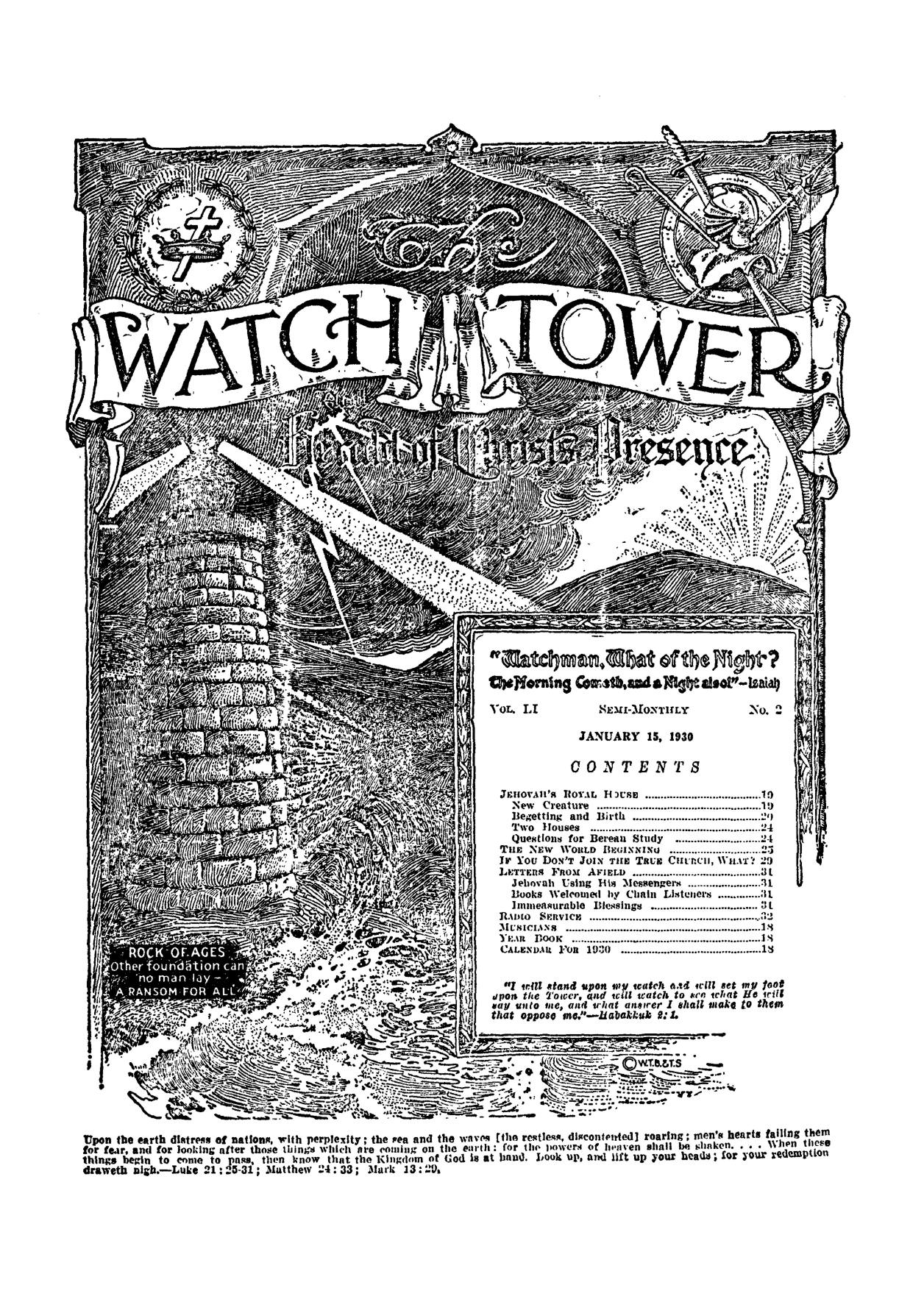
The Watchtower, January 15, 1930
Download: PDF — The Watchtower, January 15, 1930
MUSICIANS
Any of the brethren who are fully devoted to the Lord and who are competent musicians, please write to the Society at 124 Columbia Heights, Brooklyn, stating what instrument you play and what experience you have had.
‘PROPHECY’ CAMPAIGN
January 25 to February 2, inclusive, has been determined as a period in which all class workers are to concentrate on distribution of the new book, Prophecy. Our hope is that many thousands of this book will be disposed of during the time that in the past has been set aside for work with the five-cent booklets.
A consignment of Prophecy will be made to each class so as to be delivered in time for this special one-book campaign.
Pioneer and auxiliary colporteurs will find instructions for their part in this particular work in a special bulletin now in course of preparation.
1930 YEAR BOOK
The new Year Book is in stock and ready for distribution.
The conventioners recently assembled at Philadelphia, after hearing the president of the Society read a portion of his annual report, were so thrilled by the evidence of the Lord’s rich blessing on the work done by his devoted people during the past year, that they unanimously requested that the report bo put in print as has been the custom. In addition to the complete report, there is a text of Scripture and explanation thereof for each day of the coming year. The limited edition makes necessary the usual price of 50c a copy.
CALENDAR FOR 1930
We have designed and now have in stock a calendar for the new year. Six scenes, all apropos to the text for 1930, done in four colors, will prove, we reel sure, each day an inspiration and pleasing reminder of our relationship to Jehovah.
In lots of fifty or more to one address, 25c each; single copies, 30c each.
OPPORTUNITY FOR SERVICE
It seems likely that we shall find it necessary to increase our factory force at Brooklyn to care for the increasing work. Any unencumbered brothers desiring to participate in this branch of the service will be sent questionnaires. When returned to us they will be filed for call when required.
Vol. LI
January 15, 1930
No. 2
JEHOVAH’S ROYAL HOUSE
“For he is Lord of lords, and King of kings: and they that are with him are called, and chosen, and faithful.” —Rev. 17:14.
JEHOVAH himself is the King eternal. (Jer.10:10) By his Word he makes it plain that he has an anointed King and that in due time he has placed his King upon his throne and established his house. (Ps. 2:6) There are others of his sons whom Jehovah associates with his anointed King and makes them members of the royal family. (Heb. 3:6; Rev. 1:6; 5:10; 20:4) The Scriptures also seem to make it clear that the number in that royal house, aside from the Head thereof, is limited to 144,000. (Rev. 7:4-8; 14:1) It is also stated in his Word that there is a great multitude, the number of which is not definitely stated, that agree to do God’s will, are changed in the resurrection from human to spirit creatures and serve at the royal house before the throne. (Rev. 7: 9-17) It is apparent that at this time there are upon earth many persons who sincerely profess to be followers of Christ which company of persons now on earth probably outnumber those who will compose the royal house. In comparing the scriptures in this regard certain questions arise which may properly be considered by the student of God’s Word. These questions may not be vital to one’s eternal welfare, but since all scriptures are given for the benefit of the church a candid consideration of these questions arising may be edifying and helpful. Since it is stated that the number who are with Christ the Head of the royal house are called, chosen and faithful, the following questions are therefore pertinent, to wit:
2 How does a man become a new creature in Christ ? Is there a distinction between “begotten of God’’ and “born of God”? Who are embraced within the “call”, and how and when are they called? Is everyone that is begotten and called anointed? Does the new creature in Christ once anointed ever lose that anointing ? Are there any whom God has justified and begotten who have never been anointed ? What is meant by the “chosen”, and what degree of faithfulness is required of those who will be members of the royal family? Other questions will be propounded and considered as this study progresses.
3 In the outset let it be understood that there is no desire to merely overturn what has heretofore been published as related to the above questions. There is no desire or disposition to criticise what has heretofore been published. The light which God sheds upon his Word is progressive. The lightnings are from Jehovah. The illumination that he gives to his sons is for their good. If a more recent flash of lightning from the Lord more clearly discloses the meaning of his Word, then all who love God will be glad for the increased light even though some preconceived opinions or former conclusions long held must be upset. The truth is Jehovah’s and he reveals it to his people in his own good time, and way. One of the best evidences of his dealing with his people on earth is the fact that he continues to give them a clearer vision of his purposes, and this he does through the illumination of his Word. If we approach the study of his Word reverentially and with an honest and sincere desire to know our Father’s Word we may be sure that profit will result. It is certain from God’s Word that the remnant will continue to have increased light while on earth, and that being true they will be compelled to see some things differently from what they have formerly understood them, and as they get a better understanding the joy of each one will increase.
NEW CREATURE
4 The Scriptures apply the term “praise” to those who will go to make up the royal house because they praise Jehovah God. To enable the reader to more easily follow the arguments herein set forth, and for convenience, we call a man “Praise” who is seeking a place in the royal family and use him to illustrate all who are taking such a course. By the term “new creature in Christ”, as herein used, is meant one who once had the right to life as a human creature which right ceased to exist after his consecration and that such creature has been granted the right to live conditionally as a spirit creature. The right to life is the point of determination as to whether one is a human creature or a spirit creature, so far as this subject matter is concerned, and this is true regardless of the nature of the organism. The perfect man Jesus was a natural man. He had a right to live as a man because he was perfect and perfectly obeyed God’s law. It was that life of the man Jesus that was given as a ransom price. He became a new creature when God gave him the right to live as a spirit creature. He was there and then given preeminence over all creation, and faithfulness under the test was the condition attached thereto. Jesus proved faithful and true even unto death and received at the hand of Jehovah the highest reward.
5 Members of the royal house are taken from amongst men, and since all men are born sinners because of inheritance it follows that no one can even start on the way to become a new creature until he has the right to existence as a man. Being born in sin and shapen in iniquity he has no right to life but the existence of his life is merely by the permission of Jehovah. The first thing essential for him is to know that God has provided redemption and salvation through the great sacrifice of Christ Jesus the value of which has been presented as an offering for sin. The man Praise must now avail himself of the benefits of that ransom sacrifice, and this he does by having faith in God and in the shed blood of Christ Jesus and then by agreeing to do the will of Jehovah. From the words of the Lord he learns that he must take this step. It was Jesus who said: ‘If any man will come after me, let him deny himself, and take up his cross, and follow me; for I am the way, the truth, and the life, and there is no other way to come unto the Father.’ (Matt. 16:24; John 11:6) The exercising of faith in God and in Christ Jesus on the part of Praise and then the surrendering of himself unto the Lord by unconditionally agreeing to do God’s will we call consecration. It represents the devotion of oneself unto God. It is God who justifies or makes right the man. God judicially determines that the man Praise is right before him by reason of what has been done for him through the great sacrifice of Christ Jesus and his faith therein. Such justification is not a subterfuge, but is a real thing, because it means that now the man stands before God as a perfect man. God does not indulge in subterfuges.
6 Because the blood of Jesus has been applied as a sin-offering and because the man Praise learned this fact, believes it and voluntarily agrees to do God's will, God decides that the man is right with him and therefore at peace with him. (Rom. 5:1,9) Praise therefore stands before God as a righteous man by reason of such judicial determination and the result to him is the right to life as a man. All righteous creatures have the right to life. Before Jehovah the man is therefore transferred from an imperfect to a justified condition. The unconditional devotion of the man Praise to God means that Praise is doing what he can to start following in the footsteps of Jesus. When Jesus attained his legal majority he presented himself unto his Father declaring, as it had been written of him, his determination to do the will of God. In order for the man Jesus to become the Head of Jehovah’s royal house he must die as a man. Such was the will of God. All who will be made members of that royal house must likewise die. Hence it is written: “So many of us as were baptized into Jesus Christ were baptized into his death. Now if we be dead with Christ, we believe that we shall also live with him.” (Rom. 6:3,8) When the consecration of the man Praise is accepted by Jehovah and he has been brought forth as God’s son, his right to live as a human being has ceased and now his right to live as a spirit creature obtains by the gift of God and which right shall become irrevocable in due time if Praise meets the conditions. Hence it is written: “There is, therefore, now no condemnation to them which are in Christ Jesus, who walk not after the flesh, but after the spirit.” (Rom. 8:1) Although the man Praise now still has a human organism his right to life as a human is gone, but his right to live as a spirit creature exists conditionally. He is therefore Scripturally and properly called a new creature.
BEGETTING AND BIRTH
7 The use of the words “begetting” and “born” has not been as clearly understood by any of us as we would like. It may be that it is the Lord’s due time to give us a little better understanding. If so, to him alone is the credit due. The English word “beget” means to cause to exist, that is to say, to begin an existence. How is the new creature caused to exist? The Scriptures answer: “Of his own will begat he us with the word of truth, that we should be a kind of firstfruits of his creatures.” (Jas. 1:18) The beginning of existence of the new creature is therefore the result of the will of God made sure by his Word of truth. It is his will that the creature shall come into existence and he gives his Word that it shall be so; therefore the begetting is that which flows from or results from God’s contract or covenant with the creature. The creature’s part of the covenant is an unconditional agreement to do God's will. As applied to the lower animals the word “beget” is used to show that there is a beginning of the fetus in the womb of the mother which develops for a period of time and then is born. This rule or order has been applied to the bringing forth of the new creature. The thought was long held that there is a period of gestation and in due time a birth of the faithful. Hence it was said that as long as one is in the body of flesh he is a kind of dual creature. Such conclusion is not supported by the Scriptures. If there were a period of gestation, as applied to the new creature, and later the birth there would be no responsibility attached to the creature during that period of gestation, whereas the Scriptures show that responsibility begins with the beginning of the existence of the new creature. If the birth takes place at the resurrection and the time preceding that birth is a period of gestation, then there would be no responsibility upon the creature prior to the resurrection. Such a conclusion is contrary to the Scriptures because it is while the new creature is on the earth that he passes through the period of test in order to meet the conditions attached to his right to live as a spirit creature.
8 The Scriptures show beyond all doubt that the new creature does exist while on the earth and that the creature has a human organism. His right to live is not as a human being, but he has a conditional right to live as a spirit creature. Because the begetting is the result of a contract or covenant the right to live as a spirit creature exists from the time God so wills and gives his word. (Jas. 1:18) From that time the man Praise is a new creature.
9 Both the Old and New Testament scriptures use the term “begotten” and “born” to mean one that is brought forth from the womb into existence. While it is not expected that many of the Watch Tower readers understand the Hebrew and Greek languages, yet reference to the original words in those languages may enable the reader to get a better understanding. The Hebrew word yah-lad is applied to the father as the one who begets and also to the mother as the one who bears or brings forth the child. In support of this conclusion the following texts from the Old Testament are here considered.
10 “Unto the woman he said, I will greatly multiply thy sorrow, and thy conception: in sorrow thou shalt bring forth [yah-lad] children.” (Gen. 3:16) In this and in other texts following it is seen that the clear distinction is made between the fact of conception and the fact of birth. In the lower animal generation the fact of conception takes place months before the birth, but such is not true with reference to the new creation. “Adam knew Eve his wife; and she conceived, and bare [yah-lad] Cain. . . .And she again bare [yah-lad] his brother Abel.”—Gen. 4:1,2.
11 “And thy servant my father said unto me, Ye know that my wife bare [yah-lad] me two sons.” (Gen. 44:27) The same Hebrew word is translated “delivered”, which means to give birth. “Because the Hebrew women are not as the Egyptian women; for they are lively, and are delivered [yah-lad] ere the midwives come in unto them.”—Ex. 1:19.
12 The covenant of God concerning the seed is symbolized by the woman, and concerning such it is written: “Sing, O barren, thou that didst not bear [yah-lad] ; break forth into singing, and cry aloud, thou that didst not travail with child.” (Isa. 54:1) Zion gives birth to the kingdom and to those who make up the royal family, and concerning such it is written: “Before she travailed, she brought forth [yah-lad], . . . Shall a nation be born [yah-lad] at once? for as soon as Zion travailed, she brought forth [yah-lad] her children.” (Isa. 66:7,8) Concerning the babe Jesus it was written by the prophet: “Unto us a child is born [yah-lad], unto us a son is given.” (Isa. 9:6) “And of Zion it shall be said, This and that man was born [yah-lad] in her.”—Ps. 87:5.
13 The same Hebrew word is used concerning the mountains: “Before the mountains were brought forth [yah-lad], or ever thou hadst formed the earth and the world.” (Ps. 90: 2) It will be noted that the use of the word above is applied to the mother.
14 Now take note that, the same Hebrew word yah- lad is used concerning the father of the child and when so used is translated “begotten”. “The days of Adam, after he had begotten [yah-lad] Seth, were eight hundred years; and he begat [yah-lad] sons and daughters.” (Gen. 5:4) Surely this text which applies the Hebrew word yah-lad to the father does not mean that the father fertilized the mother, but does mean that the child was brought forth to the father. Concerning the Almighty God, the Creator, the same Hebrew word is translated “begat”. “Of the Kock that begat [yah-lad] thee thou art unmindful, and hast forgotten God that formed thee.” (Deut. 32:18) The psalmist speaks as for Jesus and says: “The Lord [Jehovah] hath said unto me, Thou art my Son ; this day have I begotten [yah-lad] thee. ” (Ps. 2: 7) It seems quite clear that the word “begotten”, as used in the last above quoted text, may be properly applied at three different times, to wit: (1) At the Jordan when God brought forth his Son and gave him his oath that he should be a Priest for ever under the order of Melchizedek and at which time the voice from heaven was heard saying: “This is my beloved Son, in whom I am well pleased”; (2) at the time that God brought him forth from the grave and exalted him to heaven (Acts 13: 33) ; and (3) at the time God directed Jesus Christ to begin his reign.— Ps. 2:6; 110:2.
15 These scriptures show that the word means the. bringing forth by the Father. There is no intimation here that there is a period of gestation prior to the birth. On the contrary, these scriptures show that God brings forth and identifies his beloved as his Son. When he brought him forth at the Jordan and identified him as his Son the responsibility of Jesus as a new creature or spirit creature began immediately. The same must be true with reference to those who are made members of his body.
16 The New Testament texts support the above conclusion. The Greek word gennaoo in the New Testament is translated both “begotten” and “born” and is applied more frequently to the father than to the mother. Some of the texts involved are here considered: “Abraham begat [gennaoo] Isaac: and Isaac begat [gennaoo] Jacob. . . . And Jacob begat [gennaoo] Joseph the husband of (Mary, of whom was born [gennaoo] Jesus, who is called Christ.” (Matt. 1 : 2, 16) In Acts 13:33 and Hebrews 1:5 and 5:5 the quotation is from the second Psalm. These texts show that the Greek word gennaoo corresponds exactly with the Hebrew word yah-lad. It is the Father Jehovah who brought forth Jesus, the Head of the new creation. It was the father Jacob who begat Joseph, the husband of Mary, and it was the woman Mary who gave birth to Jesus, and in each instance the same original word is used and no intimation is made of a period of gestation. The following further texts are used to prove that the Greek word gennaoo is also translated both “begotten” and “born”.
17 “Thy wife Elisabeth shall bear [gennaoo] thee a son, and thou shalt call his name John.” (Luke 1:13) “The [holy spirit] shall come upon thee, and the power of the Highest shall overshadow thee; therefore also that holy thing which shall be born [gennaoo] of thee shall be called the Son of God.” (Luke 1:35) “Now Elisabeth’s full time came, that she should be delivered; and she brought forth [gennaoo] a son.” (Luke 1: 57) “Blessed are the barren, and the wombs that never bare [gennaoo].” (Luke 23:29) “Now when Jesus was born [gennaoo] in Bethlehem of Judaea.” (Matt. 2:1) “A woman when she is in travail hath sorrow, because her hour is come; but as soon as she is delivered [gennaoo] of the child, she remembereth no more the anguish.”—John 16:21.
18 It is written: ‘‘ For the children being not yes born, neither having done any good or evil, that the purpose of God, according to election, might stand, not of works, but of him that calleth.” (Rom. 9:11) The context here shows that Rebecca had conceived by the father Isaac and before the birth or bringing forth [gennaoo] of the child it was said the elder should serve the younger, thus showing that the word “begat” or “born” has no reference to the act of the father, or to the conception or to the period of gestation.
19 The English lexicographers define the word ‘‘ beget” thus: “to procreate, as a father or sire, to generate, and is commonly said of the father.” But the word “begat”, as it appears in the Bible, is not so defined and used. In our literature we have used the expression “begotten of God” and applied it to the new creature while in the flesh and on the earth and made it mean to us that the new creature was not yet born or brought to life but that the birth must apply at the time of the resurrection. Such use of the expression is clearly out of harmony with the Scriptural use thereof. It is sometimes said that the expression “born of God”, as applied to the new creature yet on earth, is a poor or improper translation of the text and should be properly translated or rendered “begotten of God” in order to signify that the new creature is still in the flesh. Such a conclusion is also out of harmony with the Scriptural use of the expression. In proof thereof it is written: “God so loved the world, that he gave his only begotten [monogenees] Son, that whosoever believeth in him should not perish, but have everlasting life.” (John 3:16) From the Jordan to the resurrection Jesus could not in any manner be likened unto a fetus undergoing the process of gestation. He was brought forth at the Jordan the real Son of God and his responsibility as such dated from that moment. It was at the Jordan that the voice of God was heard saying: “This is my beloved Son.” He was there brought forth or begotten and definitely identified as the Son of God. When Jesus went to the Jordan he had the right to life as a perfect man and that life God accepted as a sacrifice and the very moment of so doing the right to life as a man for ever ceased and God gave to him the right to live as a spirit creature. He was a spirit creature from that time forward because it was there that God brought him forth, and it is properly said of him that he was there born of God. This is proof that the words in the Scripture, and according to the Scriptural use, “begotten” and “born” are identical. That the new creature this side the vail or while in the flesh may be properly spoken of as “begotten” or “born” is proven by the fact that the same Greek word gennaoo is in the same text translated both ways. “Whosoever believeth that Jesus is the Christ, is born of God: and every one that loveth him that begat, loveth him also that is begotten of him. We know that whosoever is born of God sinneth not; but he that is begotten of God keepeth himself, and that wicked one toucheth him not.”— 1 John 5:1,18.
20 The Apostle Peter as God's witness writing said: “Blessed be the God and Father of our Lord Jesus Christ, which according to his abundant mercy hath begotten [Greek, anagenaaoo] us again unto a lively hope . . . Being born again [anagennaoo], not of corruptible seed, but of incorruptible, by the word of God, which liveth and abideth for ever.” (1 Pet. 1: 3, 23) In the above quoted text the same original word is translated both “begotten” and “born” and it is expressly stated that we are born again “by the word of God”, which is further proof that God brings forth his sons under the terms of the covenant or contract and according to his will and Word. The creature’s part in the contract of first importance is that he believe on God and Christ and fully submit himself to God and agree to do his will, then God according to his will and by his Word brings forth such a one as a son. When these texts show that the words “begotten” and “born” are both used and are both applied to the same time and thing it would hardly do to say that some of the texts thus rendered are a mistranslation.
21 In further support of the conclusion that the new creatures while in the flesh and on earth are Scripturally spoken of as “born of God” the apostle, addressing members of the church, says: “As newborn babes [Greek, artigenneeta], desire the sincere milk of the word, that ye may grow thereby.” (1 Pet. 2: 2) If the new creature is merely a fetus or likened unto a fetus in process of gestation and not to a creature of intelligence how could it be possible for such to grow up by feeding upon the Word of God ? The new creature grows up by the upbuilding of the mind and it is the mind of the creature that searches out the truth in God's Word and feeds upon such truth.—Rom. 12:2,3.
22 That the new creature this side the vail is born and begins as a babe and grows up Paul proves when he says to the Corinthians: ‘I speak to you as babes in Christ; I have fed you with milk, and not with meat.’ (1 Cor. 3:1-3) One could not be a babe and grow up if he is not actully brought forth as a creature that could grow. By feeding his mind upon the Word of the Lord he grows more efficient in ascertaining and doing the will of God.
23 Paul shows a distinction in growth between the one who has just been brought forth and one who has fed upon the Word when he says: “For when for the time ye ought to be teachers, ye have need that one teach you again which be the first principles of the oracles of God; and are-become such as have need of milk, and not of strong meat. For every one that useth milk is unskilful in the word of righteousness: for he is a babe. But strong meat belongeth to them that are of full age, even those who by reason of use have their senses exercised to discern both good and evil.’’—Heb. 5:12-14.
24 On another occasion Paul, addressing the church, sets forth the fact that the Lord has provided teachers in the church “for the perfecting of the saints, for the work of the ministry, for the edifying of the body of Christ’’ and that this must continue “till we all come in the unity of the faith, and of the knowledge of the Son of God, unto a perfect man, unto the measure of the stature of the fulness of Christ: that we henceforth be no more children’’.—Eph. 4:12-15.
25 Unless one is actually brought forth as a creature he could not be taught and brought to this point of a perfect man in Christ. There are degrees of development of the new creature: he is first a babe, and if he grows up into Christ he becomes a strong young man and then he may grow into maturity. The Apostle John when he had grown to maturity wrote to the church and his words show that some were children, some young men and some mature ones, all of whom were born but yet in the flesh and had grown: “I write unto you, fathers, because ye have known him that is from the beginning. I write unto you, young men, because ye have overcome the wicked one. I write unto you, little children, because ye have known the Father. I have written unto you, fathers, because ye have known him that is from the beginning. I have written unto you, young men, because ye are strong, and the word of God abideth in you, and ye have overcome the wicked one.’’—1 John 2:13,14.
26 To Nicodemus Jesus said: “Except a man be born again [from above, margin], he cannot see the kingdom of God.’’ In response to the question of Nicodemus, Jesus said: “Except a man be born of water and of the spirit, he cannot enter into the kingdom of God.” (John 3:3,5) Is not this the meaning of the words of the Master spoken to Nicodemus, namely, that he could not see the kingdom of God except he be brought forth by the power from above, which is God’s power? He must know the truth, symbolized by the water, because it is by reason of the truth and the power of God exercised toward the creature that he enters into the kingdom. Paul seems to have thus understood it when he wrote: “That we henceforth be no more children, tossed to and fro, and carried about with every wind of doctrine, by the sleight of men, and cunning craftiness, whereby they lie in wait to deceive; but, speaking the truth in love, may grow up into him in all things, which is the head, even Christ: from whom the whole body fitly joined together, and compacted by that which every joint supplieth, according to the effectual working in the measure of every part, maketh increase of the body unto the edifying of itself in love.”—Eph. 4:14-16.
27 He must become a new creature while on the earth being brought forth by the will and Word of God; he must have a training as a new creature while on earth and grow up into the full stature of the man Christ Jesus before he can have an entrance into the kingdom of glory. While on the earth the new creature has an organism of flesh, of course. When he is abundantly ushered into the kingdom of glory he shall be granted a glorious body and will then be a new creature brought forth in glory. That he is a new creature while on earth the following words of the apostle clearly state: “Therefore if any man be in Christ, he is a new creature: old things are passed away; behold, all things are become new.”—2 Cor. 5:17.
28 All the scriptures considered, the conclusion is irresistible that the word “begat” or “begot” is applied to the father of the child and means that the child is brought forth as the father’s child; that the word “born” applies particularly to the mother and also means that the child is brought forth, and both words are derived from the same root word. The words “begat”, “begot” and “begotten”, as used in the Scriptures, never apply to that which takes place in the lower animal creation before or at the time of conception. The period of gestation from the time of conception in the lower animal creation to the birth cannot in any wise be applied to the new creation even as an illustration.
29 When the human child is born the mother cannot possibly deny that she is the mother of the babe, but the question might arise as to who is the father. The mother, by her course of action, says: “This is my son.” The father stands by and looks upon the newborn babe and says: “This is my son, and I am glad he is mine.” At that very moment it would be proper to say the mother has given birth to the son and the father has begotten the son, both meaning that the son has been brought forth and identified as the child of the man and the woman. The act of conception or gestation is not at all involved. The words apply at the time and then only of the bringing forth of the child. In this manner the words are used in the Scriptures, as applied to the new creatures in Christ.
30 The man Praise hears the truth and believes on God and on Christ Jesus and fully surrenders himself unto God, agreeing to do his will; he is presented to Jehovah by Christ Jesus and Jehovah accepts and justifies Praise and there results to him the right to live as a man; it is the will of God that this human being must die in order that he might have the opportunity to become a member of the royal house. Therefore by his will and his Word Jehovah gives him the conditional right to live as a spirit creature. He is now a new creature because given that conditional right to live. At that moment, the Scriptures declare, he is begotten of God the Father and therefore he is then and there born of God by the covenant (the mother) which God has made to bring forth the seed. There is an important condition to the new creature's living, which condition is obedience unto God. For him thereafter to follow the right course of living in honesty and truth and righteousness is not only proper but commanded. He must do more than that, however. He must devote himself entirely to the Lord and be on the Lord’s side in order to receive God’s final approval and be granted the blessings of eternal life promised. “For as many as are led by the spirit of God, they are the sons of God.”—Rom. 8:14.
31 By his spirit or power invisible to man God has brought forth the new creature and acknowledged him as his son and, as the apostle puts it, ‘Ye have received the spirit of adoption, whereby we may call Jehovah our Father.’ (Rom. 8:15) Henceforth such a one must be led by the spirit of the Lord. Responsibility begins at this point and the new creature must now be transformed and grow up into Christ if ho will ever be of the royal house of God. The Scriptures were written for the benefit of the new creatures, and those who would grow up into the likeness of Christ Jesus must feed upon the Word of the Lord and be obedient thereto. (Rom. 12: 2, 3; 15: 4; 1 Pet. 5: 2-4) God’s covenant with the creature imposes upon the creature an obligation that must be performed. Whether the new creature will die the second death, or be of the great multitude, or ultimately be of the royal house of Jehovah depends upon the progressive steps taken and the performance of the full obligation imposed upon him by the terms of his covenant and the Word of God.
TWO HOUSES
32 The word “house”, as used in the Scriptures, often applies to God’s organization. “I was glad when they said unto me, Let us go into the house of the Lord. Our feet shall stand within thy gates, O Jerusalem.” (Ps. 122:1,2) “Except the Lord build the house, they labour in vain that build it; except the Lord keep the city, the watchman waketh but in vain.” (Ps. 127:1) It is often specifically applied to the official part of God's organization: “Behold, bless ye the Lord, all ye servants of the Lord, which by night stand in the house of the Lord.” (Ps. 134:1) God organized the people of Israel with Moses as the leader thereof. That was his typical organization and foreshadowed the real organization that will stand for ever with Christ as Head. Scripturally, then, it can be said that God organized two houses, one that was typical and one that is everlasting.
33 It has been suggested that the typical house, over which Moses was made head, was “the house of servants”, as distinguished from the other which is called the “houses of sons”. The Scriptures do not support this conclusion. What the Scriptures do say is that God set up a typical house and in that house Moses was a servant and was faithful. Faithfulness is then cited as the condition precedent to be performed by those who will become members of God’s everlasting organization over which Jesus is made Head. The apostle’s words are: “For this man was counted worthy of more glory than Moses, inasmuch as he who hath builded the house hath more honour than the house. For every house is builded by some man; but he that built all things is God. And Moses verily was faithful in all his house, as a servant, for a testimony of those things which were to be spoken after; but Christ as a son over his own house; whose house are we, if we hold fast the confidence and the rejoicing of the hope firm unto the end. ’’—Heb. 3: 3-6.
34 As a servant in God’s typical house or organization Moses was faithful, and what he did served as a testimony of what must be done later. To be sure, Christ Jesus is the Son of God and is the Head over his own house, but he is also, together with those who are faithful and who will ultimately stand with him, spoken of by Jehovah as “my servant, whom I uphold, mine elect, in whom my soul delighteth”. (Isa. 42:1-6) Members of the royal house of Jehovah are called kings. Christ Jesus is the Head over that house and therefore the King of kings. (Rev. 1:6; 3:21) These scriptures show that every one who will ultimately become a member of the royal house of Jehovah must be a servant of the Lord and as such must prove faithful. When a man is brought forth as a new creature and therefore the son of God is he henceforth the servant of God or is the way open for him to become a servant of God? This necessarily involves the question of the call and the response thereto. Consideration of these points is next in order.
(To be continued)
QUESTIONS FOR BEREAN STUDY
1. Of whom does Jehovah's royal house consist? Identify the “great multitude’’. Why so named? What is their future inheritance?
2. What are some of the questions which logically come into consideration here?
3. With scriptures, prove that the light sited upon God’s Word is progressive. How is this supported by fact? In this regard, what position will be taken by those who truly love God and his Word? What must reasonably be expected as to some former conclusions?
4. Define the term “new creature’’. Illustrate, as in the case of Jesus.
5, 6. What knowledge is essential, and what action then necessary, that a member of the human family may become a member of Jehovah’s royal house? Explain and illustrate how consecration is related to justification. Make clear how one now a new creature came into the right to live as a human being and now has the conditional right to live as a spirit creature.
7. What is the meaning of “begotten”, and how does it apply as to the new creature? Prove whether the begetting or bringing forth of the new creature has a parallel in animal life.
8. Explain how the new creature can have, and has, a human organism.
9-13. Does the Hebrew word yah-lad apply to the father, to the mother, or to both? With scriptures, show whether it has reference to any fact prior to that of bringing forth.
14, 15. Show in like manner how the same word is used concerning the father of the child. Apply the word “begotten” as used in Psalm 2: 7.
16-18. With scriptures, point out that the New Testament supports the foregoing conclusion.
19, 20. Point out clearly what took place at Jordan with respect to Jesus, according to John 3: 16. What does this prove as to the meaning of “begotten” and “born”? Show the harmony therewith of 1 John 5: 1, 18 and 1 Peter 1: 3, 23.
21-23. Apply further scriptures to show whether the new creature is fully brought forth, an intelligent and responsible being, while in the flesh and on earth.
24, 25. According to the Scriptures, what provision has God made for the growth and perfecting of the new creature? 1 John 2: 13 indicates what as to development of the new creature?
26. Explain what is meant by Jesus’ words in response to the question asked him by Nicodemus. Give Paul’s illustration of the growth or development of the “body” of which Christ is the Head.
27. Apply 2 Corinthians 5: 17 to show the present position of those “begotten of God”.
28, 29. Scripturally, then, when is the new creature actually born or brought forth?
30, 31. In the light of the scriptures herein considered, describe what must take place that one first hearing the truth may in due time have God’s final approval and by him be exalted to life divine.
32. Distinguish between the two “houses” mentioned in Hebrews 3:5, 6. What in particular is emphasized in the statement there made? What is the lesson therein for Jehovah's anointed today?
THE NEW WORLD BEGINNING
[Thirty-minute radio lecture]
DIVINE prophecy tells that it would some day be announced to the people that a new world had begun on earth, at which time there would still be nations, or national groups of people, living on the earth. In Psalm 93:1 you will read these words: “The Lord reigneth, he is clothed with majesty; the Lord is clothed with strength, wherewith he hath girded himself: the world also is stablished, that it cannot be moved.’’ Psalm 96:10 reads: “Say among the heathen [nations], that the Lord reigneth: the world also shall be established that it shall not be moved. ’’
This must refer to the new world, “the world to come.” It could not refer to the world as existing before 1914 A.D., because Scripture declares that the old world would come to an end; whereas the psalms just quoted frankly state that the new world is to be fixed so firmly that it “cannot be moved” and “it shall not be moved”. Sacred Scripture therefore calls it the “world without end”.—Eph. 3: 21.
When the scientists of the sixteenth century had established the fact that the earth is round and that it moves around the sun, the great German reformer, Martin Luther, referred to the Bible text, “The world also is stablished, that it cannot be moved,” and then thundered against the scientists and insisted that this science was against Bible theology. Poor Martin Luther! He thought that the Bible word “world” meant the earth, and therefore that the Bible taught that the earth was fixed that it could not be moved. He seemed not to have noticed that the book of Job, chapter 26, verse 7, says of God the Creator: “He stretcheth out the north over the empty place, and hangeth the earth upon nothing.” The book of Job is scientifically correct: astronomers know that our earth hangs upon nothing but is suspended in space by what are thought to be the forces of gravitation.
The priests and preachers have led most people to believe as Martin Luther did, namely, that the word “world” in the Bible signifies our planet earth. In fact, though, rarely does “world” mean the earth. Remember Jesus’ touching words: “God so loved the world, that he gave his only begotten Son, that whosoever believeth in him should not perish, but have everlasting life.” But why should God out of love for the world give his Son to die? Because the “world” had sin, as John the Baptist showed when he said: “Behold the Lamb of God, which taketh away the sin of the world.” It would be absurd to think of the inanimate earth as having sin, and that God so loved the planet that he sent his Son to die for its sin. It is plain to the reasonable mind that the word “world” means the people.
When we investigate further, we find that the Greek substantive translated “world” in our English Bible signifies “order” or “arrangement”. We thus grasp the thought that “world” means the people existing on earth in an arranged way or order. Another Greek word translated “world” is the word aion, which really means an age or period of time. The New Testament of the Bible speaks of the “aion” or period of time from the flood of Noah’s day up to the establishment of Christ’s kingdom as “this present evil world”. Jesus pointed out that Satan is “the prince of this world”, and Paul termed Satan “the god [that is, the mighty one] of this world”. Satan being evil and unrestrained in his evil course, the world which he controls would, logically, be an evil world. Satan is an invisible spirit being.
Bringing the foregoing facts together in an endeavor to give an all-inclusive definition of the Bible word “world”, we now perceive it to mean the arrangement of the peoples of earth under governments, all these governments being subject to the supervision of a great invisible, spiritual suzerain, or lord superior. With this understanding of the matter, let us proceed with the argument.
How did the age and order of human society described as “this present evil world” become evil? How did Satan become its overlord ? God is all-powerful, and Proverbs 15:3 says that “the eyes of the Lord are in every place, beholding the evil and the good”. Consequently the conditions of “this present evil world” must exist only because God has not yet restrained evil. Surely they did not proceed direct from God, because James writes that 'every good and perfect gift cometh down from above, and is from the Father of lights’; and then he asks: “Doth a fountain send forth at the same place sweet water and bitter? ” No; neither is Jehovah God, the Supreme One, the author of evil, that is, sin. Such evil proceeds from some other source. That source is invisible to human sight. It is Satan.
Originally the spirit being whom God’s Word now calls Satan was a glorious and beautiful son of Jehovah, possessing the rank of a cherub. This was long before ever the earth was prepared for the habitation of man. His name was then Lucifer, which means “shining one” or lightbearer. The Prophet Ezekiel informs us that Lucifer was “full of wisdom” and “perfect in [his] ways from the day [he] was created until ... ”, but let us note the Bible account.
In the beginning our planet earth was without form and void; for how long a time we do not know: the Bible merely says, “In the beginning the earth was.” About 48,000 years ago (according to Bible chronology) God began to prepare conditions on the earth to make it fit for a race of human creatures to inhabit it. For thereunto had God created the earth, as Isaiah 45:18 asserts: “He created it not in vain, he formed it to be inhabited.” Toward the close of the six days of preparatory work, covering a period of 42,000 years, God created man, creating him “upright”, “very good,” a “perfect work”, in God’s image and likeness. God had previously planted a perfect garden spot in the region of earth called Eden, and there he put the perfect man, commissioning him and his lovely companion Eve to be “fruitful and multiply and fill the earth and subdue it, and have dominion” over all other earthly creatures. Luke 3:38 tells us that Adam was then a “son of God”.
Living was, of course, a new experience for man, who had never existed before. Just how Adam would live, whether in obedience to his Creator or in rebellion against him, was a point to be determined. God would naturally desire him to go in the right way, for as Proverbs 19:23 states: “The fear of the Lord tendeth to life; and he that hath it shall abide satisfied; he shall not be visited with evil”; and Proverbs 11:19 adds: “As righteousness tendeth to life; so he that pursueth evil pursueth it to his own death.” God made man, not to die, but to live for ever and ever on this planet earth. The race of mankind will never live anywhere else; they need never have fear of going to heaven when they die.
To the end that Adam might be aided in choosing the right way and live for ever, God placed Lucifer, the beautiful and wise one, to cover and safeguard Adam, and to shine upon man’s pathway during the early years of his life. Addressing Lucifer, God speaks through the prophet Ezekiel, chapter 28, verses 13 and 14, saying: “Thou hast been in Eden the garden of God; . . . thou art the anointed cherub that covereth; and I have set thee so: thou wast upon the holy mountain of God.”
The record discloses that God held communion with man in Eden, evidently by means of seraphim acting as his representatives. In the course of things Adam would fear or reverence the Lord God his Maker and Blesser and would worship him. This happy and pleasing condition continued until an evil heart condition manifested itself in, whom do you think? In Lucifer, the covering cherub. Searching that one's heart Jehovah detected that Lucifer was saying in his heart: “I will be like the Most High,” a god. There iniquity was found in him, Ezekiel tells us, and there Lucifer lost his perfection and God named him Satan, the Devil.
With the craftiness of a professional politician and the sanctimonious air of a priest, Satan laid plans to step in between God and man in the attempt to have man worship and fear and serve him instead of Jehovah God. Using a serpent as his tool, Satan belied God and deceived Eve into believing that God was untruthful and had lied in warning that if Adam and Eve disobeyed God they would literally die. Then tugging at the heart strings of Adam’s strong love for his wife, Satan drew Adam into joining Eve in eating the forbidden fruit. There Adam and Eve sinned and lost the rigid to life, and God sentenced Adam, not to go to “purgatory” or to eternal torment in fire and brimstone, but to return to the dust whence he was taken. There Satan led man captive at his will, and the entire human race has been his subjects and worshipers ever since. Only a few in all ages have gotten away from under his control that they might worship and serve the true and only God, Jehovah.
In the days of Adam’s grandson; Enos, Satan led men to set up a hypocritical or make-believe worship of Jehovah. Genesis 4: 26 tells us that then men began to call upon the name of the Lord; but it was merely a pretense to case their consciences, because Paul informs us that during all that long period of time Enoch and also Noah and his family were the only ones who pleased God because of their faith in him.
Fourteen hundred and twenty-one years after this beginning of religious hypocrisy, Jehovah God brought the great flood upon the earth because of the great wickedness and lasciviousness which had developed among mankind. All the religious hypocrites and ungodly were wiped out. Only Noah’s family, who were the sole worshipers of Jehovah left in the earth, were carried through the flood waters. Peter, referring to that world catastrophe, writes: “God . . . spared not the old world, but saved Noah, the eighth person, a preacher of righteousness, bringing in the flood upon the world of the ungodly.” Thus is proven that as a result of the great deluge the “old world”, or “world of the ungodly”, ended; but the earth did not perish. Logically, when Noah and his family moved out of the ark and came down from Mount Ararat and began to fill the earth with their offspring, another world began; not another earth, of course. This second world that sprang up on earth is what Paul brands as “this present evil world”.
Satan was still unbound and bent on evil both in heaven and in earth. When men began to organize governments to try to rule themselves, Satan overreached them all and invisibly regulated and controlled them. Recall how when Satan was tempting Jesus, he showed him all the kingdoms of the world in a moment of time and laid claim to them, and Jesus did not dispute Satan’s claim to world rulership. Jesus even called Satan “the prince of this world”. —John 12:31; 14:30.
The evil of the world of which Satan is god has reached its pinnacle of corruption in our day. Thank God that he has decreed that there should be a limit or end to the duration of that world. Much more thank God that that evil world is passing out in our day.
‘How so?’ you say. ‘Are not our governments and world religions still with us? Prove your statement.’
According to the Scriptures, the fact that human governments are still doing business on earth does not disprove that the world ended in 1914; but rather, the fact that these governments are still here and are suffering what they are proves that a new world has begun and that their present course was foretold in God’s inspired Word.
Let us consider first the Scripture truths that Christ is now a divine being, invisible to man, and that therefore his second coming would be unseen by human eyes; also that his kingdom would bring in a new world on earth; that this kingdom would be invisible, heavenly, and hence be symbolically called “new heavens”, and would establish what is symbolically called “a new earth”.
The Scriptures indisputably show that the “new heavens” would first be established, utterly displacing the old heavens dominated by Satan and the fallen angels associated with him. The trouble in which these evil heavens are destroyed is likened by the Apostle Peter to a destroying fire in which the heavens being on fire pass away with a great noise.
The twelfth chapter of the book of Revelation pictures the beginning of the trouble upon these evil heavens. There a woman, having the sunlight of God’s approval, is pictured as giving birth to a man child. A “great red dragon” tries to devour the child at birth, but God catches it away to safety and it becomes the ruler of all the nations of earth. Immediately a war in heaven follows; terrific trouble ensues; in the conflict Michael and his angels win and the dragon and his angels are deposed from heavenly position and thrust down to earth. Infuriated at his abasement, the writhing dragon makes war upon and persecutes the woman who gave birth to the man child.
The meaning of this picture is clear since 1914 A.D. The birth of the man child is the pivotal point of the picture. It means the birth of God’s new government for mankind in 1914. In that year Bible chronology marked the end of the times of Gentile supremacy. These the time arrived for the Lord Jesus to fulfil Revelation 11, verse 17, namely, to take his great power, as delegated to him by Almighty God, and to reign over earth.
Now it is not unusual to speak of the birth of the American nation. How did this birth come about? The American people through their organization, the Continental Congress, declared themselves a free and independent people on July 4, 1776, and the birth took place. The birth of the nation was attended by an eight-year warfare with Great Britain.
Likewise, in the picture of Revelation 12. It is womankind that gives birth to children; consequently, God's true organization that gives birth to the new nation or government, namely, Christ’s kingdom, is pictured as a woman, standing in the light of the great Sun, which is Jehovah. The man child brought forth pictures that government which is laid upon the shoulder of him who is called “the man Christ Jesus”. The gory red dragon is said to be “that old serpent, the devil, and Satan”. When the man child, the new government of earth, was born, at the end of the times of the Gentiles, in 1914, Satan, like a dragon, tried to devour or destroy the new ruling power but the man child was caught away by God’s power to a safe place and enthroned as ruler of earth. This means that Satan forthwith declared war against the new government in order to maintain his own rule in heaven and in earth. The new government did not back down, but took up the war, and the fight that followed is pictured as a war between Michael with his angels and the dragon, Satan, with his angels.
Michael is one of the names that our Lord bore in heaven before he became the man Jesus. “Michael” means the godlike one; and since his resurrection Jesus is ‘the express image of the Father's person', so Paul states in Hebrews 1: 3. How terrific the battling in heaven was, human imagination can not visualize; but the book of Revelation describes Satan as suffering defeat, and that he and his angelic army were cleared out of heavenly station and hurled to our earth, where they are still permitted to carry on their activity before Satan is finally bound tight.
Satan’s defeat and being cast down from heaven means that the new heavens under Christ have now come into control over earth.
‘But,’ some one objects, ‘you are describing things which the Bible sets forth as taking place in heaven, invisible to us. How then can you prove that the new heavenly government has come into power and the old evil heavens of Satan have been shaken, and consequently a new world has begun ? ’
This can be Scripturally proven in the light of what every one knows has taken place upon earth, beginning in 1914 A.D.
Now to the question actually at issue. Proof of the Bible’s prophecies must be found in the events known to be facts. Jesus taught his disciples that he would establish his kingdom in order to bless all families of the earth. His disciples were inquisitive and asked: “Tell us, when shall these things be? and what shall be the sign of thy coming, and of the end of the world?” (The word “world” here is translated from the Greek word aion meaning age.)
Listen now to Jesus’ prophecy: ‘Nation shall rise against nation, and kingdom against kingdom: and there shall be famines, and pestilences, and earthquakes in divers places. . . . Upon the earth distress of nations with perplexity; . . . men’s hearts failing them for fear, and for looking after those things which are coming on the earth: for [mark what he says: for] the powers of heaven shall be shaken. . . . All these are the beginning of sorrows. . . . And this gospel of the kingdom shall be preached in all the world for a witness unto all nations.’
Do the world events since 1914 A.D. bear out the truthfulness of Jesus’ prediction? What is the record which is available to the public throughout the earth? Here is a press dispatch from Washington, D. C., dated June 4, 1928. It reads:
Fifty-two million lives were taken from 1914 to today in wars and disasters, T. B. Kittredge, Bed Cross relief leader, told the Pan-American Red Cross Conference today: The toll [of these wars and disasters] is as follows:
War………………………………………………………… 9,000,000
Civil strife ............................................................................. 6,000,000
Epidemics ............................................................................. 40,000,000
Earthquakes and other disasters…………………………… 2,000,000
One hundred forty million persons were injured, making a total of more than 10 percent of the world’s population dead or injured from unnatural [mark you: from unnatural] means.
Another from St. Louis, dated October 22, 1925, reads:
New census figures show the mortality of the influenza epidemic of 1918 throughout the world was nearly 20,000,000, the worst catastrophe of the sort since the black death of the middle ages.
Do these figures mean anything? Are they ghastly enough to convince that something out of the ordinary began in 1914? Shall we let these facts slip, forget them, and draw no conclusion from them? Did we always have wars like or comparable to this, civil strife like this, earthquakes like this, famines like this? Incidentally also, is the gospel or good news of Christ's kingdom, now established, being preached throughout the earth? and are you, for one, hearing it proclaimed over the radio? Are the rulers and the ruled of the world in distress today, and is the worst feared? And if Jesus called these things the beginning of sorrows, can we appreciate what that “great tribulation such as never was since the beginning of the world” will be, which Jesus predicted will come in due time after the war and which will never need to be repeated?
These facts and conditions must mean something. Who can interpret them for us? What conclusion shall we draw from them?
Jesus said: “When ye see these things come to pass, know ye [he did not say, guess ye, or, doubt ye, but know ye] that the kingdom of God is nigh at hand.” Jesus said that the distress of the nations organized under Satan would come, because “the powers of heaven shall be shaken”. He said all these startling things crowding in thick and fast on our day would be the signs or visible evidences of the end of the old world and of his invisible presence as the new King.
In the light of these universally-known facts and of Jesus’ standard of determination, namely, his prophecy, let us consider the case. Let the people rejoice that the powers of heaven have been shaken and that Satan’s activities now on earth will soon terminate with his being bound. Let all who desire a better order rejoice because the new world is begun, the new heavens in Christ have come into power and soon the present evil earthly system will be displaced by the “new earth”. Let all the oppressed wait upon the Lord Jehovah God, knowing that shortly he. with his great Field Marshall, Christ Jesus, will fight the “battle of that great day of God Almighty” and completely wreck Satan's earthly organization and deliver groaning mankind from bondage to it.
Let all rejoice because the new world, wherein dwell righteousness, life, health, peace, plenty, and joy for all the people, will be established so that it can not be moved. Let all who hear and believe the message of God’s Word “say among the nations” that “the Lord reigneth, let the earth rejoice; let the multitude of isles be glad thereof”.—Ps. 97:1.
IF YOU DON’T JOIN THE TRUE CHURCH, WHAT?
[Fifteen-minute radio lecture]
ANXIOUS for her child's welfare, a mother asks: ‘‘ My son is a moral young man, has not joined any church, either Catholic or Protestant, and was never baptized. Should I worry about him ? ’’ Another disturbed questioner asks: ‘‘ Does one have to belong to a Catholic or a Protestant church, to be a Christian?”
The first inquirer shows that she believes the clergy teaching that there is no salvation except by joining the true church. The second inquirer shows doubt as to whether the Catholic and Protestant churches are truly Christ ’s church or Christian. Can any one blame him for his doubt ?
For now many centuries of the Christian era the peoples, particularly of Christendom, have been taught that there is no salvation outside of Christ's true church, and that eternal suffering in literal fire and brimstone at the hands of devils is the doom of all outside the church. How many millions of people have been induced, yea frightened, into joining one of the many denominational church systems by reason of such teaching! How many infants have been sprinkled or baptized due to such doctrine! What mental torment and anguish and worry it has caused billions of people!
…