The Watchtower, November 15, 1929
Download: PDF — The Watchtower, November 15, 1929
PROPHECY
That is the title of a new book now being published by the Society. Jehovah’s wonderful provision for his people is again manifested in giving them this remarkable explanation of the prophecies of the Bible. Not only will the anointed receive enlightenment and joy in the study of this book, but the Lord has put in their hands another means of witnessing to all the people that he is God.
A prompt and careful study of Prophecy will fill all of Jehovah’s witnesses with enthusiasm and eagerness to carry it to the people.
We are making a limited first-run, or author’s edition, for the consecrated. This edition will contain a personal message to each one of the anointed. We shall consign to each class a sufficient number of these just as soon as they are ready for shipment. Readers of The Watch Tower not located where there are regularly organized classes may order direct from the Society. The charge of fifty cents for this first-run edition will cover the expense of original typesetting and plate-making.
Our plans for distribution of Prophecy to the public will be sent to all ecclesias, through their service directors, as soon as we have printed a sufficient stock.
1930 YEAR BOOK
About the middle of December we expect to have the new Year Book ready for distribution.
The conventioners recently assembled at Philadelphia, after hearing the president of the Society read a portion of his annual report, were so thrilled by the evidence of the Lord’s rich blessing on the work done by his devoted people during the past year, that they unanimously requested that the report be put in print as has been the custom. In addition to the complete report, there is a text of Scripture and explanation thereof for each day of the coming year. It will assist us greatly in determining how many copies of the Year Book to print if the classes, through their stockkeeper or secretary, will send in their orders as early as possible. The limited edition makes necessary the usual price of 50c a copy.
CALENDAR FOR 1930
We have designed and are now printing a calendar for the new year. Six scenes, all apropos to the text for 1930, done in four colors, will prove, we feel sure, each day an inspiration and pleasing reminder of our relationship to Jehovah.
In lots of fifty or more to one address, 25c each; single copies, 30c each.
TRUTH FOR THE BLIND
Several of the Society’s books and The Watch Tower are published for the benefit of the blind. The Braille method is used. The books are loaned to the blind without charge. They are also sold at prices to cover the cost of manufacture. For further information address Watch Tower Bible & Tract Society, Branch for the Blind, Logansport, Indiana.
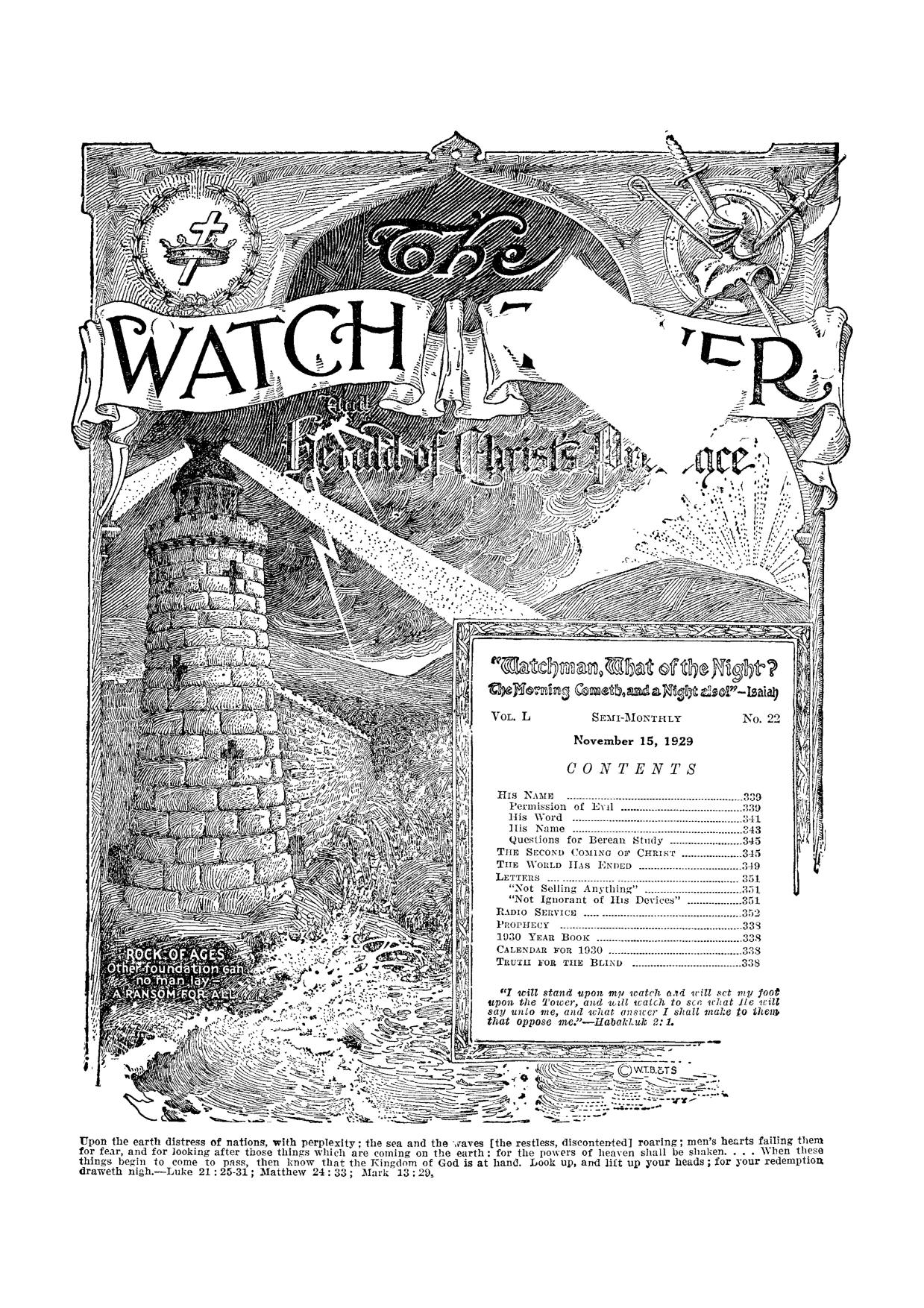
THE WATCH TOWER
AND HERALD OF CHRIST'S PRESENCE
VOL. L NOVEMBER 15, 1929 No. 22
HIS NAME
"I am Jehovah; that is my name; and my glory will I not give to another, neither my praise to graven images." - Isa. 42:8.
JEHOVAH'S name is the most vital issue before all creation. A few have settled the question by taking an unequivocal stand on the side of Jehovah and now give all honor and glory to his name. All who will ever enjoy life everlasting must do likewise. Speaking by his prophet concerning his anointed, to whom he will give the divine nature and the highest position in his organization, Jehovah says: "I will set him on high, because he hath known my name." (Ps. 91:14) As the same anointed ones approach the consummation of their hopes the prophet of God foretells their saying: "In that day shall this song be sung in the land of Judah [the condition of those who give their unstinted praise to Jehovah's name]: We have a strong city [organization]; salvation will God appoint for walls and bulwarks. Open ye the gates, that the righteous nation which keepeth the truth may enter in." (Isa. 26:1, 2) Then, addressing Jehovah God, the same anointed ones, in the language of the prophet, say: "The way of the just is uprightness: thou, most upright, dost weigh the path of the just."--Isa. 26:7, 8.
2 There is a mutual love between Jehovah and the anointed ones of his organization. These have fought against all opposition and triumphed in righteousness, and will witness the downfall of the enemy organization. Referring thereto the prophet of Jehovah says: "In that day the Lord [Jehovah], with his sore and great and strong sword [his mighty executive officer], shall punish leviathan the piercing serpent, even leviathan that crooked serpent; and he shall slay the dragon that is in the sea [amidst the restless elements of the world]. In that day sing ye unto her [Zion, God's blessed organization], A vineyard of red wine. I the Lord do keep it; I will water it every moment: lest any hurt it, I will keep it night and day." (Isa. 27:1-3) Thus does the prophet speak of and concerning them that are 'taken out for God's name' and who show forth his praises by declaring his name.--Acts 15:14; 1 Pet. 2:9, 10; Isa. 2:4.
3 Those who have trusted in Jehovah and his provision for salvation through the blood of his beloved Son; who have devoted their lives exclusively to him, and who have overcome the world, rejoice and say: "Our soul is escaped as a bird out of the snare of the fowlers; the snare is broken, and we are escaped. Our help is in the name of the Lord, who made heaven and earth." (Ps. 124:7, 8) Appreciating the precious privilege of knowing his name they say: "Thy name, O Lord, endureth for ever; and thy memorial, O Lord, throughout all generations."--Ps. 135:13.
4 When Jehovah God gives a name to a creature, that name is significant. With stronger reasoning, when he reveals himself by a name, that name is of the greatest importance to his creatures. He reveals himself by his name God, which means the Creator of heaven and earth and of all things that are good, and the Giver of life to all that obey. He reveals himself by the name Jehovah, which means his purposes concerning his creation.
5 He reveals himself by the name Almighty God, which means that his power is unlimited and that none can stand against it.
6 He reveals himself by the name the Lord of hosts, which means the Almighty God of war that destroys those that persist in wrong-doing.
7 When Jesus came to earth Jehovah revealed himself as the heavenly Father of the new creation, meaning that he is the source of life to all who live for ever in the heavenly realm.
8 He reveals himself by the name Most High, which means that he is above and over all, is moved always by love, and rules the universe in justice and righteousness. Understanding these truths, then man begins to appreciate the force of the words of Jesus, who said: "And this is life eternal, that they might know thee the only true God, and Jesus Christ, whom thou hast sent."--John 17:3.
PERMISSION OF EVIL
9 Evil has been active in the world for many centuries. Satan is the very embodiment of evil, and the one who has persisted in carrying on evil. He has builded a powerful organization, drenched the earth with human blood, caused crime and wickedness to run riot, and has dragged down men and angels to the depths of woe. Almighty God is supreme, as his name implies, and could long ago have destroyed Satan and all other workers of iniquity. Why has he not done so? By not destroying the evil workers and not preventing the operation of evil, God has permitted evil to persist. What is the reason?
10 The answer often given is, ‘That man by experience might learn the exceeding sinfulness of sin, and that angels also might learn by observation.’ That answer does not assign an adequate reason for the permission of evil. The statement: “That through the commandment sin might become exceedingly sinful” occurs only one time in the Bible. The statement was made by Paul concerning the relation of the Jews to the law covenant, which statement was made approximately four thousand years after man had been going into death and evil had been in operation.
11 It is true that man learns by experience that wrong-doing leads to suffering and death; but those who have put forth their best endeavors to do good have also suffered and died. A very large proportion of those going into death have died as infants, without the mental capacity to learn the effect of sin, and therefore they could not have learned. A large proportion have died infants mentally, even though mature in years, and they have learned nothing by experience. When these are awakened out of death and learn of God, and then any disobey, they will be destroyed, and therefore their experience will have brought them no profit. As to the angels, many of them have had experience with sin, and yet there is no scripture to prove that they will profit by their experience or observation.
12 While it is true that those creatures who are granted life everlasting because of full obedience to God will learn that wrong-doing leads to death, that does not seem to be an adequate reason for the permission of such great wickedness as Satan has wrought during the centuries past. There must be a more potent reason.
13 A reason for the permission of evil, more potent, and consistent with the Scriptures and supported thereby, appears to be this: That Jehovah, in his due time, might fully demonstrate to all intelligent creation his own supremacy in power, his exact justice, his perfect wisdom, and his complete unselfishness, and thereby open the way, to all who love him and who maintain their integrity, for a full opportunity for faith and confidence in him and for gaining and receiving the blessings of life everlasting. His word and his name are the great questions involved, and the vindication thereof must be the paramount reason for the permission of evil.
14 The rebellion of Lucifer at once raised the issue: Who is the supreme God? The word and name of Jehovah were necessarily involved in that issue. God created the perfect man and told him that death would be the penalty for the infraction of his law. Lucifer was appointed man’s overlord and immediately set up his own wisdom and power as equal to that of Jehovah God. Lucifer concluded that he was wise enough and powerful enough to prevent the death of man, or that, should God kill the man, God would thereby demonstrate his own imperfect wisdom, because the infliction of the death penalty would prove God’s inability to create a man that would maintain his integrity with God. The Bible record concerning Job is strong proof in support of this conclusion.
15 To be sure, God could have immediately killed Adam and Lucifer, created another perfect man, and placed another spirit being in Eden as man’s overlord, and have begun anew to people the earth. Had he done so, that would have demonstrated only his supreme power and his justice. Other creatures in his realm would have insisted that the failure of man was evidence of imperfect wisdom on the part of the Creator, and the basis for complete faith and confidence would have been shaken. There would have been no opportunity to show that God is both ‘just toward man and the justifier of man’. Neither would there have been opportunity to demonstrate the complete unselfishness of Jehovah, that creatures might know that “God is love”.
16 Satan pitted his own wisdom and power against that of Jehovah God. Satan, after his rebellion, was devoid of justice and love; therefore he could not pit his justice and love against that of Jehovah. If Satan could convince others of creation that Jehovah is not supreme in wisdom and power, then he would destroy the confidence of such creatures in Jehovah; and when these suffered, they would become unfaithful to God and turn from him. The indisputable facts show that Satan has convinced the greater number of men that God is not supreme in power nor the possessor of all wisdom. He has also convinced the major portion of men that God is unjust and that he is not loving. He convinced many of the angels to the same effect and induced them to follow his course of wickedness.
17 Satan has used various methods to accomplish his purposes. He has caused many to believe the first lie, to wit, that man has an immortal soul and therefore can not die, and by this he has made God appear to be a liar and imperfect in wisdom and power. Satan has caused many to believe that God has prepared a place of torture wherein he will eternally torment multitudes of mankind, and by this Satan has intended to prove, and has proved to many, that God is void of justice and love.
18 At any moment since the rebellion, God could have destroyed Satan and all his works and all other wicked creatures. The fact that he has not done so is no proof that God is at all responsible for the evil in the world. God is in no wise responsible for the sorrow, suffering, sickness, calamities and death that have fallen upon humankind. These things are the natural results that flow from sin, which is the violation of God’s law. He has permitted the operation of evil and wickedness in that he has not prevented it. That, however, is no argument that he will not end it in his own due time. It is not the slightest argument that God favors evil for a moment. On the contrary, his Word declares that he hates evil and the workers of iniquity. (Ps. 5:5; 45:7; Prov. 6:16-19) The proof of his Word is plain, that in his due time God will destroy all the wicked and completely annihilate the workers of iniquity.—Ps. 145:20; Nah. 1:9.
19 The great ransom sacrifice of the man Christ Jesus is not involved in the question of the duration of the permission of evil. The ransom sacrifice is God’s loving provision made for the recovery of man. The ransom sacrifice could have been made available for the restoration of man immediately following its presentation as a sin-offering in heaven, as well as later, and yet evil has gone on until now. From the time of the presentation of the ransom price as an offering for sin, God has been selecting and gathering his church, which is the body of Christ. The duration of the permission of evil has not necessarily been affected by the selection of the church, but the church has been selected in spite of the evil. What God has done is this: He has permitted Satan to pursue his own course of wickedness, but in his own due time God will cut Satan and his evil agencies short in exact justice. The course of Satan has at all times been a challenge to Jehovah God. Satan said to God concerning Job: ‘Put him to the test of suffering and he will curse you to your face.’ God permitted Satan to try his hand on Job and to put Job to the test, and amidst all the suffering Job remained steadfast in his integrity and held the confidence of Jehovah God.
20 Satan knows that God has said that he created the earth for man, and man to have dominion over the earth. He knows that it was God’s announced purpose to fill the earth with a perfect race of human beings, and that God had declared that the condition was that man must be obedient to him. (Isa. 45:12, 18; Gen. 1:28; 2:17) In substance he said to Jehovah: ‘You can not put a man on earth who will maintain his integrity, and who, according to your law, will receive your blessing of life everlasting on earth.’ Satan therefore put in issue the word of Jehovah God. God declares: “My word . . . shall not return unto me void, but it shall accomplish that which I please, and it shall prosper in the thing whereto I sent it.” (Isa. 55:11) Therefore the issue upon the word of God was joined; and with what result? Otherwise stated, God said to Satan: ‘You may do your worst and I will prove my word is true.’
HIS WORD
21 Jehovah’s faithful servant and prophet wrote: “I will bow down towards thy holy temple, and thank thy Name for thy lovingkindness and for thy faithfulness, for thou hast magnified above all thy Name thy word.” (Ps. 138:2, Rotherham) From the very beginning of man’s experience God gave his word that he would raise up a “seed” that would destroy Satan and his works. That word he will keep inviolate. God called Abraham and gave to him his word and promise that he would raise up a “seed” by which he would redeem and bless all the families of the earth. To Moses Jehovah gave his word that he would raise up a great Prophet, foreshadowed by Moses, who would be the Deliverer of the people. He sent forth his prophets to whom he committed his word, and they faithfully declared the word of God, prophesying that there should come to earth a man who would be faithful to God; who would be subjected to great persecution because of his faithfulness; who would bear the sins of the people; who would suffer an ignominious death, and that not for his own wrong; who would be raised up out of death and exalted to heaven; and who by his death would provide the redemptive price for man and open the way for the justification of men to life. (Gen. 22:17; Deut. 18:15-18; Hos. 13:14; Mic. 5:4; Ps. 16:10; Isa. 53:1-12; 55:1-4) These prophecies have been fulfilled in Jesus Christ, the beloved Son of God.—John 3:16; Matt. 20:28; John 10:10; 1 Tim. 2:3-6.
22 To say that God permitted evil in order that by experience man might learn the exceeding sinfulness of sin would necessarily mean that evil has been carried on by the consent of Jehovah. If by his consent, then there would attach a responsibility to God for the practice of evil in the world. Such could not be true, because he has no pleasure in wickedness, neither does evil dwell with him. (Ps. 5:4) He hates evil, and he can not consent to that which he hates.
23 Paul said nothing about God’s permitting evil that man might by experience learn the exceeding sinfulness of sin. Paul was discussing the law and the commandment of God. (Rom. 7:7-13) To Israel God had given his law and his commandment. The statement of the Lord’s law is embodied in these words: “Thou shalt have no other gods before me. Thou shalt not make unto thee any graven image, or any likeness of anything that is in heaven above, or that is in the earth beneath, or that is in the water under the earth.”—Exod. 20:3, 4.
24 The commandment of first importance Jesus declared to be this: “Thou shalt love the Lord thy God with all thy heart, and with all thy soul, and with all thy mind. This is the first and great commandment.”—Matt. 22:37, 38.
25 The law and the commandment of God made manifest what great sinners men are who attempt to divide their allegiance between God and the Devil. The Jews were under obligation to obey God’s law and commandment, because they had agreed so to do. They had not been faithful thereto, and because of their unfaithfulness God cast them away. Paul’s argument is that he would not have known the evils of sin except by the law, but that now the law and commandment had manifested how exceedingly evil those who claim to know and do God's will and yet who do contrary thereto.
26 God would have it understood that he approves no one who divides his allegiance between him and the Devil, because Jehovah is the only true God. He who loves God with his whole heart, mind and being, is unreservedly devoted to Jehovah God. The rule that Paul was laying down is that those who are pleasing to the Lord God are the ones who love him without reservation and serve him joyfully. That rule, then, would mean that every one must in due time come to a knowledge of the truth and have an opportunity to take his stand unreservedly on one side or the other, either for Jehovah or against him.
27 It will not do to say that God willingly permitted the operation of evil, and therefore assented to it, in order that he might provide redemption through the sacrifice of his beloved Son. The wisdom of Jehovah, being perfect, was sufficient to enable him to meet any contingency that might arise; and when sin entered into the world by the disobedience of man, God’s wisdom was equal to the occasion, and did provide for all such conditions.
28 The facts, as shown by the Scriptures, are these: Adam was a perfect man, and he was told that a violation of God’s law would be punished by death. Lucifer challenged that statement by saying: ‘You shall not surely die if you violate God’s law.’ Because of Adam’s selfishness and lack of love for his Creator, he followed the advice of Satan, and did so knowingly. Satan now reasoned: ‘If God kills Adam, he admits his imperfect wisdom and his inability to make a man that will maintain his integrity. If he does not kill him, he is a liar.’ The word of God was therefore put at issue. The word of God and his name, and the vindication thereof, are more important than all the lessons that creatures might learn by experience.
29 The course of action taken by Jehovah, and which is shown by the Scriptures, is this: Satan had rebelled and put evil into operation, and challenged God’s word and name. God said: ‘Satan has challenged my word and my name; let him do his worst; my Son the Logos loves me and will gladly do my will. By and through him I will provide the redemption for man. He shall be made a man and be given the opportunity to sacrifice himself to provide the redemptive price for man.’ That is exactly what came to pass. It was the love of God that moved him to take action and to exercise his wisdom in carrying out his purposes in providing for the ransom sacrifice. He knew of his ability to raise Jesus out of death; and he did so.
30 All men, by reason of Adam’s sin, inherited death. (Rom. 5: 12) In the exercise of his love God gave his beloved Son to die, that those who believe on him might live for ever. (John 3: 16) In due time the knowledge of this loving course taken by Jehovah shall be given to all men, that all through Christ may have the opportunity of obeying the Lord, and receiving the free gift, and being justified to life.—Rom. 5: 18; 6: 23.
31 Centuries before the coming of Jesus to earth, God gave his word that Jesus would come, and what he would do. He has kept that word and magnified it. This proves conclusively that Jehovah knew from the beginning that he would put the man Jesus on earth, who would steadfastly maintain his integrity at all times and under all conditions. Thereby God would prove and did prove his word true and right, and settled entirely on the side of Jehovah the issue which Satan raised.
32 Satan was permitted by Jehovah to go the very limit in his effort to cause Jesus to fall and prove unfaithful to Jehovah, even as he had caused Adam to do. Adam was in every respect a perfect man, and Jesus also was in every respect a perfect man. One was exactly equal to the other. Otherwise Jesus could not have become the ransom sacrifice for Adam. Adam failed to maintain his integrity, and that without any excuse. Jesus did remain steadfast in his integrity, and Jehovah made him the Savior of the world and exalted him to the highest place in his universe.
33 Jehovah thereby proved his word; proved that his power is supreme; proved that he is just and the justifier of them that believe in his provision for salvation; proved his complete and perfect wisdom, and gave the greatest exhibition of love that can ever be given. Those who trust in Jehovah God know that he has proven his word true and that the issue which Satan raised concerning the word of God is settled in God’s own favor and to his eternal glory.
34 Jehovah first spoke by his prophets, and then, when he sent Jesus his great Prophet, by him he declared his word of truth, which was fully corroborated in what the prophets had previously testified. (Heb. 1: 1, 2) Since then God has taken out from the world a class of men and women who have devoted themselves willingly unto God by being taken into the covenant of sacrifice with Christ Jesus, and because thereof they have been the object of great persecution by Satan and his agencies.
35 Of those called, many fell away to Satan, but the required number of those called have maintained their integrity and have held fast to God’s word and his name, and have the confidence of and protection from Jehovah. Now these faithful ones joyfully say: “Sing unto him [Jehovah] a new song . . . For the word of the Lord is right; and all his works are done in truth.” (Ps. 33: 3, 4) “The grass withereth, the flower fadeth; but the word of our God shall stand for ever.”—Isa. 40: 8.
36 From Abel to John the prophet there appeared on earth a few men who were made the servants and prophets of Jehovah, and to whom he committed his word. Those men were subjected to all manner of persecution by Satan and his agencies, and yet amidst all they maintained their integrity and held stedfastly to God. They believed his Word and trusted implicitly in him. Those men God will make the visible rulers in all the earth, while Christ Jesus rules invisibly and brings blessings to humanity. (Heb. 11: 1-40; Ps. 45:16; Isa. 32:1) Thereby God again proves his word and magnifies it and settles the issue concerning his word in his own favor and to his own glory.
HIS NAME
37 Jehovah’s name has been reproached by Satan from the very beginning. In derision and mockery Satan caused the people to call themselves by the name of the Lord. (Gen. 4:26, margin) Satan organized Babylon, Egypt, Assyria, and all other world powers, and saturated them with his Devil religion, and has used them, and particularly the false religious element, to bring reproach upon the name of Jehovah God. Today every organized religion under the sun either openly or covertly reproaches the name of Jehovah God. The holy prophet wrote: “Blessed is the nation whose God is Jehovah.” (Ps. 33:12, A.R.V.) But where is there a nation on earth in the year 1929 whose God is Jehovah and which nation and people are devoted wholly to God and to the honor of his name? Let the people answer. The answer must be that there is not one. The religion and politics and commerce of the world are united to rule in every nation under the sun; and they have Satan for their god, even though outwardly calling themselves by the name of the Lord.—2 Cor. 4:3, 4; John 14:30; Gen. 4:26, margin.
38 In times past God has magnified his word above his name, but the time has come for him to exalt his name as well as his word. Both his name and his word are now exalted in Zion, which is his own organization. (Ps. 102:16; 132:13) Upon earth there is now a remnant of those whom the Lord God has called, and to such he has committed his word and the honor of bearing testimony to his name. These God has taken out as “a people for his name”. (Acts 14:15) To such Jehovah says: “I have put my words in thy mouth, and I have covered thee in the shadow of mine hand, that I may plant the heavens, and lay the foundations of the earth, and say unto Zion, Thou art my people.”—Isa. 51:16.
39 The time is at hand when the great issue, Who is the Almighty One? must be for ever settled. Jehovah has permitted the evil one to carry on his evil work throughout all the centuries. At given times, and for the benefit of those who love God, he has brought his own name prominently to the fore. (2 Sam. 7:23; Isa. 37:1-36) Today men who claim to be Christians and teachers of the Christian religion deny the Word of God concerning his creation of man, the disobedience and fall of man, and the provision for redemption through the blood of Christ; and in doing so they cast reproach upon the name of Jehovah God. They teach doctrines that dishonor his name, and openly declare their allegiance to Satan’s organization. Their course of action is a mockery and a reproach to the Lord. “As Jannes and Jambres withstood Moses, so do these also resist the truth: men of corrupt minds, reprobate concerning the faith,” because Satan is their god. Jehovah says concerning them: “But they shall proceed no further; for their folly shall be made manifest unto all.” (2 Tim. 3:8, 9) There is a limit to the practice of evil, and that limit has been reached by Satan and his agencies. The issue of the almighty Name is now to be settled for ever. Who, then, is the Almighty God?
40 Jehovah says: “I am the Lord [Jehovah]; that is my name; and my glory will I not give to another.” (Isa. 42:8) Jehovah will now make known to the blinded people his supreme power, his wisdom, justice, and love. He causes all the people and nations to be gathered together, and demands that the Devil’s witnesses speak and justify their course of action or else acknowledge the truth that Jehovah is the only true God. Then addressing his faithful remnant he says: “Ye are my witnesses, ... that I am God; ... before me there was no God formed, neither shall there be after me.”—Isa. 43:8-12.
41 This great issue will now be settled finally, and Jehovah declares that he will settle it by destroying Satan and his evil organization. Before that great war of destruction, he causes his faithful witnesses to serve notice upon the nations and peoples of the earth of his purpose to end the practice of evil. Jehovah assembles the nations of earth for decision. (Joel 3:14) The nations are now assembled. He pronounces upon them his judgment, and then pours upon them his righteous indignation and destroys Satan and his organization. (Zeph. 3:8) That is the end of the permission of evil.
42 Instead of destroying Satan at the very beginning, God has permitted him to pursue his course of wickedness and do everything within his power to oppose God. In the meantime God has kept his Word and his name before those who have sincerely desired to know and to do righteousness, and such he has preserved from the assaults of the enemy. When Satan has done all that he can possibly do to dispute the supremacy, the power, the wisdom and justice, and the love of Jehovah God, then Jehovah, in the great war, stops Satan’s operations of evil in the earth. Jehovah thereby proves himself to be supreme in power, the Almighty Eternal God, the Most High, besides whom there is none other. By so doing, Jehovah stops for ever the mouths of all creatures from saying that there is another like unto Jehovah God. This is the most effective way to teach creation that there is but one Almighty God.
43 Jehovah removes the blindness of the people, that they may know him and that they may know that there is no way of obtaining everlasting life besides the way which Jehovah God has prepared, and that that way is through the sacrifice of Jesus Christ his beloved Son. By this course of action Jehovah opens the way for full faith and confidence in him, that all creation may come to know that he is the Almighty God, that he is perfect in wisdom, that he is just and has made provision for the justification of men, and that he is love because he is the perfect expression of unselfishness.
44 All creation will then come to know that Satan is the enemy of God and of every creature that wants to do right, and that Satan is the one who has been and is responsible for all the evil and wickedness that has been practised in the world. Concerning him the Lord God long ago caused his prophet to write: "Yet thou shalt be brought down to hell, to the sides of the pit. They that see thee shall narrowly look upon thee, and consider thee, saying, Is this the man that made the earth to tremble, that did shake kingdoms; that made the world as a wilderness, and destroyed the cities thereof; that opened not the house of his prisoners? All the kings of the nations, even all of them, lie in glory, every one in his own house. But thou art cast out of thy grave like an abominable branch, and as the raiment of those that are slain, thrust through with a sword, that go down to the stones of the pit; as a carcase trodden under feet. Thou shalt not be joined with them in burial, because thou hast destroyed thy land, and slain thy people; the seed of evildoers shall never be renowned.'' (Isa. 14:15-20) "All they that know thee among the people shall be astonished at thee; thou shalt be a terror, and never shalt thou be any more.''—Ezek. 28:19.
45 The people will come to know that Jehovah is the only true God and that he is their true and Almighty Friend. Through his prophet he says to the people: "Look unto me, and be ye saved, all the ends of the earth: for I am God, and there is none else. I have sworn by myself, the word is gone out of my mouth in righteousness, and shall not return, That unto me every knee shall bow, every tongue shall swear.''—Isa. 45:22, 23.
46 The prophet wrote foretelling also what the people shall say when they come to know the truth: "And it shall be said [by the people] in that day, Lo, this is our God; we have waited for him, and he will save us; this is the Lord; we have waited for him, we will be glad and rejoice in his salvation.'' (Isa. 25:9) "And the Lord shall be king over all the earth: in that day shall there be one Lord, and his name one.''—Zech. 14:9.
47 The prophet represents those who have come to know God, and who have full faith and confidence in him, as saying: "O Lord, thou art my God; I will exalt thee, I will praise thy name; for thou hast done wonderful things; thy counsels of old are faithfulness and truth.'' (Isa. 25:1-4) Thus will the people manifest their appreciation of the almighty power, the perfect wisdom, the exact justice, and the unfathomable love of the Almighty God.
48 As further proof that the vindication of God's Word and name is the chief reason for the permission of evil and the recovery of the human race therefrom, his prophet wrote: "Therefore say unto the house of Israel, Thus saith the Lord God; I do not this for your sakes, O house of Israel, but for mine holy name's sake, which ye have profaned among the heathen, whither ye went. And I will sanctify my great name, which was profaned among the heathen, which ye have profaned in the midst of them; and the heathen shall know that I am the Lord, saith the Lord God, when I shall be sanctified in you before their eyes.''—Ezek. 36:22, 23.
49 It was Satan who caused Israel to prove unfaithful to God, and it was the same wicked rebel that is responsible for the evil amongst all the nations and peoples of the earth. The Israelites were God's chosen people, and therefore necessarily dear to him. If he would recover them not for their own sakes but for his name's sake, then with stronger reasoning has he permitted evil in the world, not merely to teach his creatures the exceeding sinfulness of sin, but that he might establish for ever his glorious name before creation. When this is accomplished, then the lovers of righteousness will join with the prophet in saying: "Give unto the Lord, O ye mighty, give unto the Lord glory and strength. Give unto the Lord the glory due unto his name; worship the Lord in the beauty of holiness.''—Ps. 29:1, 2.
50 It is the name of Jehovah that the faithful remnant of the followers of Christ now on earth exalt and praise. (Isa. 12:4-6) It will be the name of Jehovah, the Almighty God, that the people will honor for ever when they know him and learn of his love. God's prophet foretold the song of praise that will flow from the lips of the people to the glory of his name when they are settled in peace in his kingdom: "Make a joyful noise unto God, all ye lands; sing forth the honour of his name: make his praise glorious. Say unto God, How terrible art thou in thy works! through the greatness of thy power shall thine enemies submit themselves unto thee. All the earth shall worship thee, and shall sing unto thee; they shall sing to thy name.''—Ps. 66:1-4.
51 The present is the most blessed time since the days of Jesus that a Christian has ever been permitted to live on earth. It is now the blessed privilege of those who are wholly devoted to God to be witnesses for and to the name of Jehovah the Most High. Another great prophecy is now in course of fulfilment, to wit: "The spirit [Jehovah the great Spirit, and his Beloved Son of the same spirit (2 Cor. 3:17)] and the bride [in the temple giving praise to God (Ps. 29: 9)] say, Come, and let him that heareth say, Come; and let him that is athirst come, and whosoever will, let him take the water of life freely.'' (Rev. 22: 17) And now let all the peoples of earth who love that which is right come and take their stand on the side of Jehovah God. Let those who love Jehovah God tell others about him and his wondrous works. ''O give thanks unto the Lord; call upon his name: make known his deeds among the people. Sing unto him, sing psalms unto him: talk ye of all his wondrous works. Glory ye in his holy name: let the heart of them rejoice that seek the Lord.''—Ps. 105: 1-3.
QUESTIONS FOR BEREAN STUDY
¶ 1-3. What is now the most vital issue before all creation? How important is a proper conclusion as to this issue? How do the faithful anointed respond to the prospect and privilege set before them? Psalm 91: 14 contains what promise to them? What is the song that these shall sing 'in the land of Judah in that day'? What is the work which Jehovah will perform? How does he care for Zion, as described in Isaiah 27: 2, 3?
¶ 4-8. What is peculiar of the names which God gives to his creatures? Give the significance of the different names by which he reveals himself.
¶ 9-12. Where lies the responsibility for the operation of evil in the earth? To what extent has it prevailed? In what sense only may it be said that God has permitted evil to persist? What is the reason sometimes assigned for the permission of evil? Explain whether it serves such purpose, and whether the reason is adequate.
¶ 13, 14. State a reason apparently more potent and consistent. What is the issue supporting this reason? Account for such issue's having been raised.
¶ 15. What different action could God have taken? Point out the inherent limitations of such a course.
¶ 16, 17. Which of the attributes of God had Satan now challenged? What were Satan's limitations in this respect? To what extent has Satan adversely influenced others as to the supremacy of God? What are some of the methods Satan has used to accomplish his purpose?
¶ 18. Explain whether God's not destroying Satan makes God responsible for the afflictions and death of mankind.
¶ 19, 20. Show whether the permission of evil has been essentially related to the availability of the ransom sacrifice or to the selection of the church.
¶ 21. When and how did God make known his purpose to provide for man's redemption? How were these prophecies fulfilled?
¶ 22-25. Did God permit evil that by experience man might know the nature and results of sin? What, then, is to be understood from the statement, 'that through the commandment sin might become exceedingly sinful'?
¶ 26. How important is full allegiance to Jehovah? How and to whom will the test of allegiance come, and when?
¶ 27-29. Did the entering of sin into the world modify the purposes of Jehovah? What position did Satan assume on this occasion? How did Jehovah meet the challenge?
¶ 30. How far-reaching has been the effect of Adam's sin? The knowledge of God's purpose of redemption and restoration, and the opportunity for justification to life, will be extended to whom?
¶ 31. Show whether God foreknew the ministry and fidelity of Jesus.
¶ 32, 33. Compare Adam and Jesus (a) as to nature and perfection; (b) in point of fidelity, and the result thereof to themselves and to others and in vindicating the power, justice, wisdom and love of Jehovah.
¶ 34-36. Whom did Jehovah use as his witnesses prior to his sending Jesus into the world? Who have been his witnesses since then? Compare these two classes of witnesses as to their testimony, their fidelity, their experiences, their being used in proving and magnifying the word of Jehovah, and in their future inheritance as God's expression of his ultimate approval.
¶ 37, 38. To what extent has Jehovah's name been recognized and honored among men? Account for such condition. What momentous change is now due in this regard? By what means will the glad news thereof be heralded to the world?
¶ 39. Point out from the Scriptures that Jehovah has at given times brought his name into prominence. Why has he done so? How has the great issue been obscured? What is the importance of the present time in this respect?
¶ 40-43. What is Jehovah's purpose in gathering together the peoples and nations? How will the issue be settled, finally? How will this redound to the glory of Jehovah's name and the blessing of the people?
¶ 44. Describe the abasement of Satan (Lucifer), and his ultimate portion, as foretold through God's prophet Isaiah.
¶ 45-47. When the people shall be given a knowledge of the truth, what will be the response of those who come to know God and have faith and confidence in him?
¶ 48, 49. What evidence is found in Ezekiel 36: 22, 23 as to the reason for the permission of evil? Account for Israel's and Christendom's profaning the name of Jehovah.
¶ 50. How do the remnant now regard the name of Jehovah? How will his name be received among the people when they see his kingdom of righteousness in operation?
¶ 51. What is the position of the true Christian at the present time? How important to him is a proper appreciation of his privilege and responsibility?
THE SECOND COMING OF CHRIST: WHY NECESSARY?
[Thirty-minute radio lecture]
JEHOVAH God never does anything without some good reason for doing it, and the Bible never makes a statement without some good reason for making it. This explains why the Lord spoke these words by the mouth of his holy prophet: "Come now, and let us reason together, saith the Lord." (Isa. 1: 18) The reasons why God says and does certain things are always recorded in the Bible; and consequently when God invites us to reason together with him, it is an invitation to study the Bible. Jesus said: "Search the scriptures; for . . . they are they which testify of me"; and Paul said that 'the scriptures are able to make us wise unto salvation'.
However, the Scriptures clearly teach that a wicked man can not understand the Bible even if he does study it. Let us note just a few of the many texts on this point. Daniel 12: 9, 10 says: "Go thy way, Daniel; for the words are closed up and sealed till the time of the end. Many shall be purified, and made white, and tried; but the wicked shall do wickedly; and none of the wicked shall understand; but the wise shall understand." Paul the apostle says: "The natural man receiveth not the things of the spirit of God; for they are foolishness unto him; neither can he know them, because they are spiritually discerned." (1 Cor. 2: 14) Another very pointed text is found in
Psalm 50:16, 17, which reads: "Unto the wicked God saith, What hast thou to do to declare my statutes, or that thou shouldest take my covenant in thy mouth? seeing thou hatest instruction, and castest my words behind thee."
But who are the wicked people of earth? Of course, the thief, the liar, the murderer, the adulterer, the hypocrite, and those who oppress, deceive and defraud their fellow men are acknowledged to be wicked by everybody. But there are many people who are wicked in God's sight yet highly esteemed among men. The man who teaches doctrines contrary to the doctrines of the Bible is a wicked man, because he misrepresents both God and the Bible. The man who denies the inspiration of the Bible is a wicked man, for the reason that he charges God with misstating facts, or denies that God is the author of the Bible.
The man who is so indoctrinated in creeds that he will not believe those texts of Scripture which contradict his creed is either stubborn or dishonest, and therefore a wicked man. Many of those high in the councils of men, and loved and honored by men, are an abomination in God's sight. The reason for this is plainly stated by the Lord in these words: "Man looketh on the outward appearance, but Jehovah looketh on the heart." This means that God judges people by their motives, and not by their deeds, while men judge almost entirely by what people do. Let us bear in mind, then, that the Lord says, "None of the wicked shall understand."
Who, then, can understand the Bible when they study it? Most emphatically do the Scriptures answer this question. Let us consider a few of these answers. Psalm 25:14: "The secret of the Lord is with them that fear him." Proverbs 3:32: "The froward is abomination to the Lord; but his secret is with the righteous." 1 Peter 3:12: "The eyes of the Lord are over the righteous, and his ears are open unto their prayers; but the face of the Lord is against them that do evil."
In view of these texts, we can see that only those who love the Lord, who are righteous, honest, reverent; those who study the Word of truth and believe it implicitly, the Lord will honor with an understanding of his purposes and his truth.
Now let us approach our subject in this reverent, honest, and teachable frame of mind. Why is the second coming of Christ necessary?
To answer this question properly, we must first ascertain why the first coming was necessary, because both comings stand related to each other, and yet both are for different purposes. There could have been no second advent had there been no first advent.
Many texts refer to the second advent. Among them is John 14:2, 3: "I go to prepare a place for you. And if I go . . . I will come again." Also Luke 12:37, which reads: "Blessed are those servants, whom the lord, when he cometh, shall find watching." Hebrews 9:28: "Unto them that look for him shall he appear the second time"; and Matthew 25:31, "When the Son of man shall come in his glory, and all the holy angels with him, then shall he sit upon the throne of his glory." Special attention is called to the fact that this last text says that it will be at his second coming that Christ will sit upon the throne of his glory. Many more texts could be cited, but these suffice to prove the point.
Some people claim that the second coming of the Lord took place when he was raised from the dead, three and one-half years after his first coming. This is a mistake, and in this lecture proof will be given that it is a mistake. Several years after our Lord's resurrection, the Apostle Paul said that the second coming was far in the future. In 2 Thessalonians 2:1, 3 we read: "Now we beseech you, brethren, [concerning] the coming of our Lord Jesus Christ, . . . Let no man deceive you by any means: for that day shall not come, except there come a falling away first, and that man of sin be revealed, the son of perdition." According to the Bible, the second coming of the Lord is definitely and positively foretold, and is to occur at some time future from the first advent. Over sixty years after our Lord's death, Jesus himself, speaking by the mouth of his servant John, said, "Behold, I come quickly." — Rev. 22:12.
But why was the first advent necessary? God's purpose was to fill the earth with a race of perfect human beings and give them everlasting life on the earth. He did not intend to take them to heaven. Therefore he told Adam to multiply and increase and fill the earth. (Gen. 1:26) Adam, however, committed sin and brought condemnation on himself and his unborn posterity, and so failed to beget perfect children. On the contrary, by the law of heredity, his children were born imperfect and dying, as a result of Adam's sin. This is proved by many texts, only two of which are quoted here. Romans 5:18: 'By the offence of one condemnation came upon all.' 1 Corinthians 15:22: "In Adam all die." This last text tells us that before they were born they were condemned to die, while they were still in Adam. Thus the entire race came under a curse.
God did not propose to let Adam's sin interfere with the carrying out of his purpose, and so, through the prophet, God had said: "My counsel shall stand, and I will do all my pleasure." Noting the failure of the first Adam, God decreed that there should be a second Adam, who would carry out the divine purpose, namely, fill the earth with a race of sinless and perfect men and women. He decreed that the second Adam should resurrect and regenerate the children of the first Adam and give them life on the earth.
But who was to be the second Adam? The apostle answers in most emphatic language. In 1 Corinthians 15:45, 47, we read: "The first man Adam was made a living soul; the last Adam . . . a quickening spirit."
The first man is of the earth, earthy; the second man is the Lord from heaven.’’ Thus seen, the second Adam is the resurrected, glorified Lord Jesus, after his ascension, when he was given all power in heaven and in earth.
Having in mind the fact that all the dead would be resurrected and the obedient would be given life on the earth, God inspired all his prophets to foretell this fact hundreds of years before it would occur. A few of these prophecies are now quoted. Psalm 37: 29, ‘‘The righteous shall inherit the land, and dwell therein for ever.’’ Proverbs 2: 21, ‘‘The upright shall dwell in the land, and the perfect shall remain in it.’’ And Isaiah 60: 21 says, ‘All thy people shall be righteous; they shall inherit the land for ever.’ Addressing the nation of Israel, God said: ‘‘I will open your graves, and cause you to come up out of your graves, and bring you into . . . your own land.’’ But who is to do this great work? The answer is, The resurrected, glorified Lord Jesus Christ, the second Adam.
But before this resurrection work can begin, the race must be ransomed, redeemed from that condemnation which the first Adam brought on the entire race. And so God had his holy prophets foretell the need of a ransom. In Hosea 13 : 14 we read: ‘‘I will ransom them from the power of the grave; I will redeem them from death.’’ Yes, the entire race were under condemnation, under the sentence of death, and could not deliver themselves, as the prophet had said: ‘‘None of them can by any means redeem his brother, nor give to God a ransom for him.’’—Ps. 49 : 7.
What is meant by the word ‘‘ransom’’? It is used many times in the Bible. It means, in the original, a price to correspond; that is, an exact equivalent. To illustrate: If a bullock had sinned, an exact equivalent would be another bullock. If an angel had sinned, it would require another angel to be an exact equivalent, a ransom. In this case it was a man that had sinned, and it would require another man; and to be an exact equivalent, he must of necessity be a perfect man, just as Adam was before he sinned. There was not such a perfect man in all the wide universe, and that is why God said that ‘no man can by any means redeem his brother or give to God a ransom for him’. No man was perfect, and therefore there was no exact equivalent.
It took divine wisdom and love and power to provide the ransom. No man could do it. There was no other way for the race to be released from the Adamic condemnation. Another perfect man must be found who would voluntarily give his perfect life for the stricken race. Most plainly does the Bible declare that ‘‘without shedding of blood is no remission’’. (Heb. 9 : 22) Again, the apostle tells us that ‘‘since by man came death, by man came also the resurrection of the dead’’. (1 Cor. 15 : 21) Since there was no perfect man, God himself provided one.
The Bible reveals the fact that the only begotten Son of God, that One who later came to earth and by his parents was named Jesus, had an existence with the Father before the world began. (John 17 : 5) By him God created all things. (Col. 1 : 15, 16; Eph. 3 : 9) Jehovah laid the matter before this obedient and well beloved Son, and he consented to come to earth and be man’s redeemer, a ransom price.
Speaking of the love and condescension which Jesus manifested in laying aside his heavenly, spiritual glory, and coming down to earth to be man’s redeemer, the apostle says: ‘‘Though he was rich, yet for your sakes he became poor, that ye through his poverty might be rich.’’ (2 Cor. 8 : 9) Again concerning Jesus, the apostle says: ‘‘Who, being in the form of God, . . . took upon him the form of a servant, . . . humbled himself, and became obedient unto death, even the death of the cross. Wherefore God also hath highly exalted him, and given him a name which is above every name: that at the name of Jesus every knee should bow, . . . and that every tongue should confess that Jesus Christ is Lord, to the glory of God the Father.’’—Phil. 2 : 6-11.
Let us note the wonderful way by which Jesus became a man. God chose a noble woman, Mary, and by the power of the holy spirit begat a child in her womb. This child was born, and was named Jesus. At thirty years of age Jesus was a full-grown, mature man, the exact equivalent of Adam. He was a human being because he was born of a human mother; for, says Jesus himself, ‘‘That which is born of the flesh is flesh.’’ He was a sinless man because his life proceeded and came from God, and did not come from the fallen and sinful Adamic race. At thirty years of age he was the exact equivalent of Adam, and immediately went to Jordan and offered his life for the race. At the cross he completed the sacrifice, and cried, ‘‘It is finished; and he bowed his head, and gave up the spirit.’’ He was the Lamb of God that taketh away the sin of the world. Jehovah laid on him the iniquity of us all. He tasted death for every man. What an act of love it was! Reviled, jeered, persecuted, crucified, that the race might have life, and that they might have it more abundantly. He said that he could call twelve legions of angels to protect his life, but refused to do it. Instead, he gave his life a ransom for all. The Apostle John said, ‘‘The Father sent the Son to be the Saviour of the world’’; and again, Jesus said, ‘I am come that I might give my life a ransom for many.’
Now we can see very clearly the necessity for the first advent of the Lord. It was to give his life as a ransom. He finished this work at the cross. They took him down from the cross, dead. They buried him in the tomb of Joseph of Arimathæa, and there he remained for three days, dead. But if Jesus should remain dead, his death would not avail for the race. They would get no benefit from his dying. Knowing this, God had provided that he should be raised from the dead. On the third day after his burial, God raised him from the dead. Here let it be specially noted that God raised Jesus from the dead. He could not raise himself. Read the following texts, which say that God raised him: Acts 2:24-32; Acts 3:15, 26; Acts 4:10, 33; Acts 5:30. And there are fourteen other texts.
Now we come to an important question. Did God bring Jesus forth from the tomb as a man again? Many conclude that Jesus was a man again, because he appeared several times in human form after his resurrection. This is a mistake; for if he was again a man, then the ransom price was not given. More than this, the Scriptures are explicit in their statements that he was no longer a man, but a divine, immortal, spirit being, just like his Father. The proof is found in Hebrews 1:3, which says that Jesus is now 'the brightness of the Father's glory, and the express image of the Father's person'. In 1 Corinthians 15:45 we are told that "the last Adam was made a quickening spirit". And in 1 Peter 3:18 we read that Jesus was 'put to death flesh, and made alive spirit'.
Several times Jesus appeared in human form after his resurrection, but always with different bodies and different clothing. His purpose was to convince his disciples that he was alive. There was no other possible way to convince them. Spirit beings have this power of materialization, and angels had appeared in a similar manner many times before this. These appearances do not prove that Jesus was then a man; rather they prove to the contrary, for had he been a man he could not have disappeared again, as he did.
It is this highly exalted Jesus, exalted above angels, principalities, powers, and every name that is named (except Jehovah's), who is the second Adam. He has all power in heaven and in earth. He said: "I am the resurrection, and the life." The apostle says that "there is none other name under heaven given among men" whereby we can get life; and still again, the apostle says that the Father hath "given to us eternal life, and this life is in his Son". Jesus said, "God so loved the world, that he gave his only begotten Son, that whosoever believeth in him should not perish, but have everlasting life."
If any man ever gets life it must be through Jesus Christ. He must believe in Jesus Christ to be saved. To believe on him means to believe that he died on the cross for our sins, and that he was raised for our justification. It will not do to believe that he did not die, but only seemed to die. This would deny the ransom; for if he did not die for our sins, then the Bible is untrue and we are yet in our sins, without any possibility of escape.
Thus seen, the first advent of Jesus was that he might give his life a ransom price, and the second advent is to resurrect and regenerate the race, and fill the earth with a happy, sinless and perfect race of human beings. For this work God has set apart one thousand years, during which Satan will be bound, that he may deceive the nations no more. The second advent of the Lord is to do a judgment work, as the apostle tells us, saying, "The Lord Jesus Christ, . . . shall judge the quick [living] and the dead at his appearing and his kingdom." (2 Tim. 4:1) The judgment work is a judicial determination as to whether or not people are worthy to live for ever. To arrive at such a decision it is necessary that God shall give to every man an understanding of what is required of him. In other words, each person must know the truth. Very few people on earth have ever known the truth. Hundreds of millions have died without having seen a Bible or without having heard of Jehovah God. They could not do his will, because they never knew what his will was.
The second advent of Jesus is to bring them to an accurate knowledge of God's will, and then to apply certain tests, which will determine whether they will love and do that will, or will be wilful and obdurate for ever. If the tests develop the fact that they will be obedient and loyal, they will get the gift of God, eternal life, but right here on the earth, and not in heaven, as most people suppose.
Let us now consider a text that has been overlooked by most people. It tells us of God's purpose to deliver the race from the Adamic sin first, and later to give them a knowledge of the truth. It is found in 1 Timothy 2:3, 4, and reads: "God . . . will have all men to be saved, and to come unto the knowledge of the truth." This text states the matter correctly, exactly as God intended it. Since all came under condemnation as a result of the one sin by father Adam, God purposed to ransom all from that condemnation and later awaken them from the sleep of death and give every member of the race an accurate knowledge of the truth. Let us read this text again, exactly as it is given in the original Greek: "God . . . desires all men to be saved, and to come to an accurate knowledge of the truth."
After having come to an accurate knowledge of the truth, responsibility begins; and each member of the race will be held strictly to account for the way he will honor the truth and obey it. If any one should dishonor it, and refuse to obey it, and persistently do this, he will die again, which in the Bible is called "the second death". There would be no hope for such a sinner, because his sin would be wilful. There would be no resurrection for him, for the reason that Christ will not die to ransom the race a second time.
The apostle refers to this second death, in Hebrews 10:26, 27, saying, "If we sin wilfully after that we have received the knowledge of the truth, there remaineth no more sacrifice for sins, but a certain fearful looking for of judgment, and fiery indignation, which shall devour the adversaries"; not torment them, but devour them, destroy them, in what Paul calls “everlasting destruction from the presence of the Lord”.-2 Thess. 1: 9.
On the contrary, all who will learn to love righteousness and hate iniquity; all who will obey the Lord; all who will profit by the experience with sin and the Devil which they have had in this life; all who will prove loyal and faithful will get just what God promised the first Adam, namely, ‘dominion over the beasts of the field, over the fowls of the air, and over everything that passes through the sea, and over the earth.’
…