The Watchtower, June 15, 1929
Download: PDF — The Watchtower, June 15, 1929
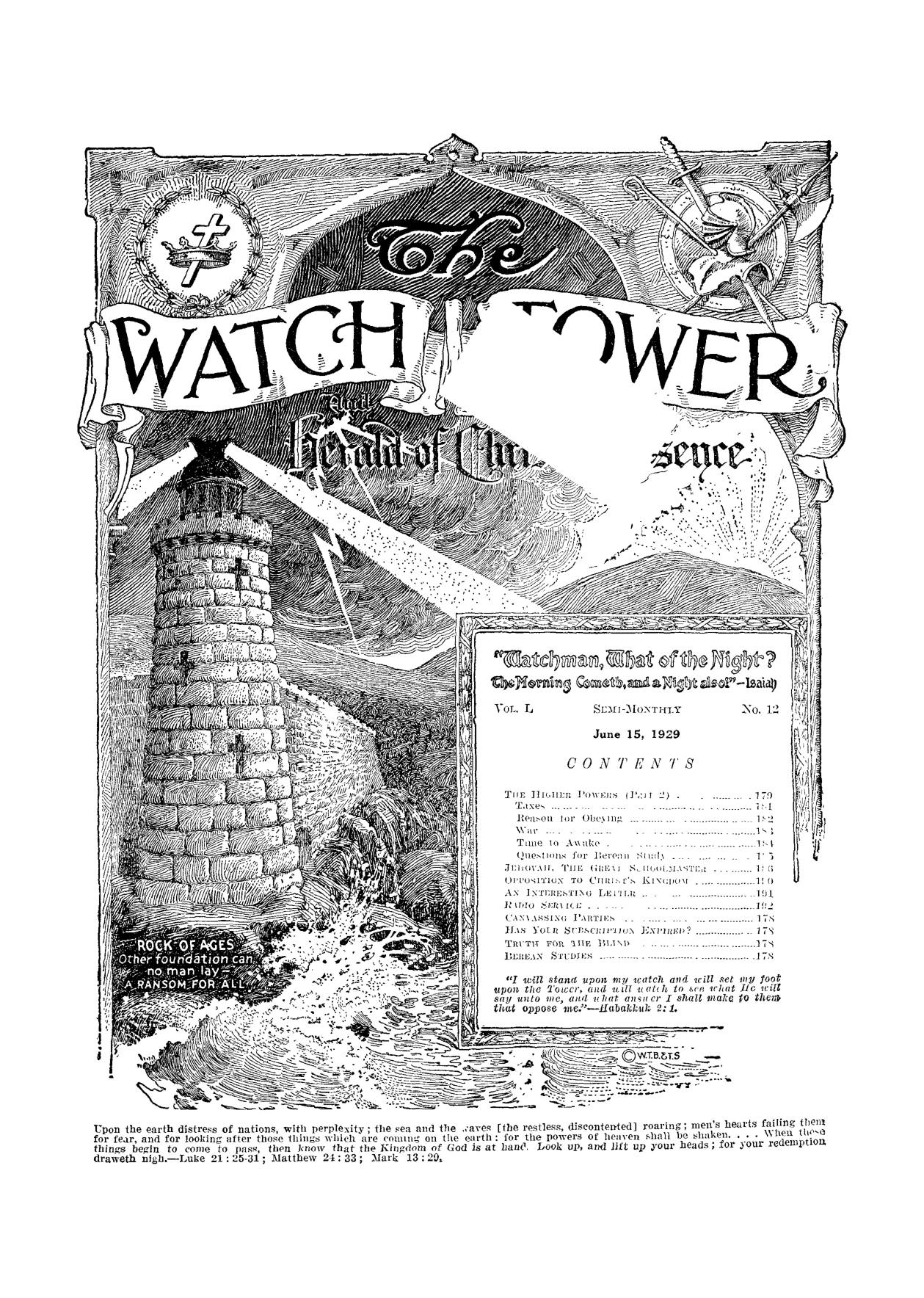
THE HIGHER POWERS
CANVASSING PARTIES
All canvassing parties and all individuals who canvass should mention the radio station in that vicinity that is broadcasting the truth. This often proves a means of opening the way to place the books in the hands of the people. Have in mind that the chief purpose of the radio is to call the people's attention to the truth and then furnish the opportunity for them to get a wider understanding of the truth by reading what is being printed.
Every one engaged in the house-to-house work in territory now served by broadcasts of the WATCHTOWER network program may have a share in telling the people that this unique service is available every Sunday. The "Radio Slip" supplied by the Society, described more particularly in The Watch Tower for March 1, 1929 (page 66), is proving to be a convenient and effective method of giving public notice of this chain program.
HAS YOUR SUBSCRIPTION EXPIRED?
From time to time the subscription department receives an expression of surprise from a subscriber who discovers that his name has been "dropped" from the Watch Tower list. For the benefit of subscribers it is here repeated, by way of explanation, that discontinuance of an expired subscription is accomplished mechanically in every case. Machinery used to print address on label or wrapper is so constructed that the plate bearing address is automatically "dropped" from the list at expiration. A renewal blank (carrying also notice of expiration) is sent with the journal one month before the subscription is due to expire. On foreign subscriptions the expiration notice is sent with the journal two months in advance.
TRUTH FOR THE BLIND
Several of the Society's books and The Watch Tower are published for the benefit of the blind. The Braille method is used. The books are loaned to the blind without charge. They are also sold at prices to cover the cost of manufacture. For further information address Watch Tower Bible & Tract Society, Branch for the Blind, Logansport, Indiana.
I.B.S.A. Berean Bible Studies
by means of
The Watch Tower
"Delight Thyself in Jehovah"
Issue of May 1, 1929
Week beginning July 7 . . . . . . . 1-22
Week beginning July 14 . . . . . . . 23-42
"Jehovah Supreme"
Issue of May 15, 1929
Week beginning July 21 . . . . . . . 1-18
Week beginning July 28 . . . . . . . 19-32
THE WATCH TOWER
AND HERALD OF CHRIST'S PRESENCE
VOL. L | JUNE 15, 1929 | No. 12
THE HIGHER POWERS
"Whosoever therefore resisteth the power, resisteth the ordinance of God: and they that resist shall receive to themselves damnation."—Rom. 13: 2.
PART 2
JEHOVAH is the supreme power, Christ Jesus and Jehovah the higher powers, and the arrangement concerning the church proceeds from Jehovah and by Christ. All in the church who are pleasing to Jehovah and to Christ Jesus must be willingly submissive or obedient to that divine arrangement. There is no exception to this rule; and therefore it should at all times be held in mind by the anointed of the Lord, and strictly followed. There is no conflict, of course, between the higher power and the supreme power, because Christ and God are always exactly in harmony. One translator renders the text: “Let every person be submissive to the superior authorities.” (Diaglott) The apostles may be embraced in the superior authorities, because they are superior to all others in the church, aside from Christ and Jehovah. This scripture has been long applied by Christians to the Gentile governments and the powers thereof. It is manifest, however, that no such thought was in Paul’s mind when he wrote the words.
2 The word “damnation” (Verse 2) in the above text is from the Greek word krima and means judgment, and is so rendered in the Revised Version. In the Diaglott it is rendered “punishment”. Surely all Christians can now see that the arrangement or ordinance of God mentioned in the text does not have reference to the Gentile ordinance or arrangement. It is true that God has not interfered with the nations of earth in their making laws and enforcing them, but the responsibility for their so doing is not upon Jehovah. He has permitted it in that he has not prohibited it. The text says that it is God’s ordinance; therefore we must understand that Jehovah assumes a responsibility for the same.
3 It could not be said that God was judging the world in Paul’s day, because Paul himself wrote that ‘God hath appointed a day [future] in which he will judge the world in righteousness’ (when unrighteous governments will not exist), and that such judgment would be by Christ Jesus. (Acts 17:31; Rev. 20:4) The judgment referred to by Paul, in Romans 13:2, must apply to the church, and that judgment must be by the power which God has ordained shall judge the church. In support thereof note the following: “For the time is come that judgment must begin at the house of God: and if it first begin at us, what shall the end be of them that obey not the gospel of God?” (1 Pet. 4:17) Note Paul’s words to the Galatians (5:10), “I have confidence in you through the Lord, that ye will be none otherwise minded [concerning circumcision]; but he that troubleth you shall bear his judgment [krima], whosoever he be.”
4 If the “judgment” mentioned in Romans 13:2 is to be rendered and enforced by the powers of the Gentile governments, then such judgment must be rendered and enforced by some man as the judge; and that is contrary to the Word of God, regardless of who the man is. No man in the church or outside of the church is authorized to judge one who is in the church: “Therefore thou art inexcusable, O man, whosoever thou art that judgest; for wherein thou judgest another, thou condemnest thyself; for thou that judgest doest the same things. And thinkest thou this, O man, that judgest them which do such things, and doest the same, that thou shalt escape the judgment of God?” (Rom. 2:1, 3) Therefore we must conclude that the “judgment” referred to in Romans 13:2 is the judgment for which the Lord has arranged in his own organization and by the Head of that organization or by those whom the Lord has appointed so to do.
5 The substance of Paul’s statement (Rom. 13:2) is this: That whosoever in the church resists the arrangement which God has made for the governing of his church is resisting God, and therefore shall receive punishment from God through Christ Jesus for so doing. Whether or not the Gentile powers inflict punishment upon evil-doers often depends upon how much influence the one charged with the crime has with the one who does the judging. There is no partiality in God’s judgment. The text says: “Whosoever therefore resisteth,” and therefore applies to every one, without any exception. This alone would confine the judgment to God's organization by the authorities in God's organization constituted to do judging.
6 "For rulers are not a terror to good works, but to the evil. Wilt thou then not be afraid of the power? do that which is good, and thou shalt have praise of the same." (Verse 3) Who are the rulers here mentioned? The word "ruler" is derived from the Greek archoon, and is also translated prince or princes. Satan is the chief ruler or prince of this world. If the word "rulers" used by Paul in Romans 13:3 does not apply to the arrangement in the church, then the word must apply to Satan and his organization. Is Satan, the prince of evil, or any part of his organization a terror to evil workers in the church? Most assuredly not. If a man in the church does that which is evil and therefore against God’s organization, that is the very thing that Satan the prince of this world would have him do. Did not the rulers of the Gentile powers induce members of the early church to do evil by joining alliance with the Devil’s organization? Instead of the Devil’s organization or Gentile powers’ punishing men for so doing, they were commended and exalted for so doing.
7 Furthermore, can it be said that the rulers of the present governments of earth "are not a terror to good works"? Fully consecrated and anointed ones of God go about the country doing good by preaching the good news concerning God and his kingdom, and the rulers of the Gentile powers arrest, fine and imprison them for so doing good. Do faithful colporteurs and class workers, who go from door to door and thus do good by carrying the message of the kingdom to the people of the earth, "receive praise" from the princes or rulers of this world? No one ever heard of their receiving praise for so doing. When Paul says, "Wilt thou then not be afraid of the power?" can it be said that he meant that the anointed of God are to fear the princes of this world and the rulers in his organization? If that be true, then every one would refrain from being a witness to the glory of God. That is exactly what the Devil would want them to do.
8 As an illustration: Recently the Society’s representative, and one of God’s children, in the far away country of Liberia, Africa, began to preach the gospel by word of mouth and by placing in the hands of the people of that land the printed books containing the gospel. The government informed him that he must desist, that he must circulate no books or pamphlets or literature, or give any public addresses, until such time as the ruling powers should grant a permit therefor. He went on anyway and placed in the hands of the people a great number of books. Had he obeyed the Gentile powers, he would not have preached the gospel. He obeyed the Lord and was protected. He did good, but he received no praise from the Gentile governors.
9 It is therefore apparent that Paul's words mean this: You who are anointed of God should fear the power (Christ the Judge); that the rulers (Christ, and those who act under his direction) are not terrors to good works but to evil, and if you do that which is good you will receive praise of that power (Christ, and those of his organization clothed with authority to praise). One may ask, Are we to expect praise of the powers in the church for doing good? In answer to such question, and in proof that the apostles had authority to praise the doers of good, and did praise them, and that the doers of good shall have praise, note the following texts: "Therefore judge nothing before the time, until the Lord come, who both will bring to light the hidden things of darkness, and will make manifest the counsels of the hearts: and then shall every man have praise of God." (1 Cor. 4:5) "And we have sent with him the brother, whose praise is in the gospel throughout all the churches." (2 Cor. 8: 18) "Now I praise you, brethren, that ye remember me in all things, and keep the ordinances, as I delivered them to you."—1 Cor. 11:2.
10 When the members of the church come together for any purpose other than to do good, they do not receive praise, as the apostle stated: "Now in this that I declare unto you, I praise you not, that ye come together, not for the better, but for the worse." (1 Cor. 11:17) It is therefore manifest from the scriptures above cited that the evil-doers receive judgment by God’s arrangement, and that those who do good receive praise by the same arrangement.
11 "For he [the power] is the minister of God [God’s servant: see Diaglott and Rotherham translations] to thee for good. But if thou do that which is evil, be afraid: for he [the power] beareth not the sword in vain: for he is the minister of God [God’s servant], a revenger to execute wrath upon him that doeth evil." (Rom. 13:4) This text could have no reference to the power that the Gentiles execute. Surely God has not committed to Satan or any one in Satan’s organization the power to act as God’s servant or minister for good in the church. Nor has he appointed any of that same wicked organization to act as avenger to execute wrath upon him that doeth evil in the church. What, then, do the words of Paul in this text mean?
12 The answer is, that the authority and order in the church is arranged by the Lord for good to those who are of the church and for the judgment of those who do evil. (2 Cor. 10:8; 13:10) What is evil in the church is illustrated by the following scriptures: "Alexander the coppersmith did me much evil; the Lord reward him according to his works." (2 Tim. 4:14) "For he that will love life, and see good days, let him refrain his tongue from evil, and his lips that they speak no guile: let him eschew evil, and do good; let him seek peace, and ensue it." (1 Pet. 3:10, 11) "But and if that evil servant shall say in his heart, My lord delayeth his coming; and shall begin to smite his fellowservants, and to eat and drink with the drunken; the lord of that servant . . . shall cut him asunder."—Matt. 24: 48-51.
13 The Gentile powers use the sword to kill. If the text is applied to the Gentile powers, then it means that such are clothed with power and authority over the Lord’s people to literally kill those who are in the church, and that such are avengers of God. Jesus was charged with the evil of sedition, was unjustly judged and killed. In so doing surely the Devil was not acting as God’s avenger there. The words of the apostle mean that the sword represents the power which God uses to punish those in the church who do evil and who therefore do contrary to his law by which the church is governed. The creature (or creatures) whom God uses to exercise such power is the avenger to execute wrath upon the evil-doers.
14 This does not mean that every individual in the church may punish at will one or many who he thinks may be doing evil. The Scriptures expressly prohibit a member of the church from so doing. "That no man go beyond and defraud his brother in any matter: because that the Lord is the avenger of all such, as we also have forewarned you and testified." (1 Thess. 4: 6) The Lord did commit unto others the power to judge and to execute judgment in certain cases. This power he committed to his apostles because they were his special representatives. Paul says that it was reported to him that there was evil in the congregation, and then adds: "For I verily, as absent in body, but present in spirit, have judged already, as though I were present, concerning him that hath so done this deed, in the name of our Lord Jesus Christ, when ye are gathered together, and my spirit, with the power of our Lord Jesus Christ, to deliver such an one unto Satan [cut him off as with a sword from the ecclesia of God and turn him over to Satan] for the destruction of the flesh, that the spirit [of the church, which is holiness and complete devotion to God] may be saved in the day of the Lord Jesus [at the second coming of the Lord and the gathering of his people]." (1 Cor. 5: 1-5; see also Acts 5: 1-11; 8: 20-22) Christ and the apostles are the rulers in the church, and were already set at the time Paul wrote these words, and to the ecclesia is committed some authority. None of these are a terror to good works; but that power which the Lord uses is a terror to evil works and bears not God’s punishing instrument in vain.
15 "Wherefore ye must needs be subject, not only for wrath, but also for conscience sake." (Rom. 13: 5) God has not called his people to set them aside to be victims of his wrath. He called them to be his faithful witnesses and to receive salvation through Christ Jesus. (1 Thess. 5: 9) But God’s wrath is visited upon those who are disobedient and who do evil. (Eph. 5: 5, 6) Let no one for a moment believe that God has appointed so-called "spiritual policemen" to avenge evil-doers in the church. Any punishment that results from anger or personal resentment is entirely wrong.—Col. 3: 8; Matt. 5: 22.
16 Paul’s statement is that if one in the church does evil he shall suffer, and he should refrain from evil for that reason; but he should also for conscience’ sake refrain from evil or wrong-doing in the church. If he refrains from evil merely in order that he may escape punishment, his motive is not proper and unselfish. If he refrains from evil because he knows that it is right so to do, and pleasing to God for him to refrain from evil, then he does so because he loves God, and his motive is right and pure and he has a clear conscience. "Now the end of the commandment is love, from a pure heart, and a good conscience, and an undissembled faith."—1 Tim. 1: 5, Diaglott.
TAXES
17 "For this cause pay ye tribute also; for they are God’s ministers, attending continually upon this very thing." (Verse 6) The fact that the apostle speaks of paying taxes has been considered a strong argument and has been used to prove that the entire chapter has reference to the Gentile powers. That argument is unsound, and the conclusion is not warranted. The rendering of this text as given by different translators is here set out for the purpose of comparison.
18 "For because of this are ye paying tribute also." (Rotherham) "For the same reason as you pay taxes." (Moffatt) "Why, this is really the reason you pay taxes also." (Weymouth) "For on this account also you pay taxes."—Diaglott.
19 The apostle does not command the payment of taxes or customs to anybody in the church. The epistle was addressed to those Christians who had once been Jews (Rom. 7: 1) and who were familiar with the law of the Jews requiring the payment of a poll tax and other taxes imposed for the support of Israel’s government. (Ex. 30: 11, 13) They would understand and did understand that the payment of taxes was a proper thing to do. When Paul wrote to them those Christians were residing in Rome and were paying taxes to the Roman government because not wishing to incur the wrath of Rome, and also for the sake of their own conscience, knowing that they were doing right. 'For this cause,' says the apostle, 'you pay taxes; and moved by the same good reason you should render your dues to Jehovah.' The words of the text, 'for this cause you pay taxes also,' appear to be a parenthetical statement and put in merely to strengthen the force of the apostle's argument. For what cause do you pay taxes? For conscience’ sake, for the reason that it is right to pay for what service you receive.
20 Then reverting to the rulers he says: "For they are God's ministers [servants, not Satan's servants, which they would be if the officials of earthly governments were meant.” The word “ministers,” as used in this text, is from the Greek leitourgos, and is the same word used to derive the English word “liturgy”. Who, then, are God’s leitourgos (ministers)? The word ministers is used to translate the word leitourgos in the following texts also, which texts prove beyond all doubt that they are God’s anointed ministers ministering in and for the church. (Heb. 1:7; 8:1, 2, 6; 9:21; 10:11; Acts 13:2; Rom. 15:16; Phil. 2:17, 25.) Then adds the apostle: “These ministers of God are attending upon this very thing.” Thereby he clearly means that the office of such ministers is to maintain order and authority in the church. His argument is, then, that there might be order and peace, and for conscience’ sake the laws of the land should be obeyed where they do not conflict with God’s law.
21 “Render therefore to all [whether inside the church or outside thereof] ... tribute to whom tribute is due; custom to whom custom.” The words “tribute” and “custom” both refer to a commercial or financial obligation which the government may lay upon those who reside thereunder to meet the governmental expenses. Jesus and his disciples paid such tax. In reply to the question as to whether or not it was proper to pay taxes to the Roman government Jesus said: “Render therefore unto Caesar the things that are Caesar’s; and unto God the things that are God’s.” — Matt. 22:18-21.
22 But what does the apostle mean when he says in the same verse: “Fear to whom fear [is due]”? Does he mean that it is the will of God that the Christian is to stand in awe of or in fear of the appointed servants of the church? The clergy, elders and others of congregations have used this scripture as an authority for demanding that reverence and fear be given to them by the congregation. Such application of the text is wrong. Whom, then, do the members of the church properly fear? The following scriptures give answer.
23 “Submitting yourselves one to another in the fear of God.” (Eph. 5:21) “Be respectful to all; love the brotherhood; fear God; honor the King. Let household servants be subject with all fear to their masters; not only to the good and gentle, but also to the perverse.” (1 Pet. 2:17, 18, *Diaglott*) “But even if you suffer on account of righteousness, you are blessed. And fear not with their fear, nor be alarmed; but sanctify the anointed Lord in your hearts, and be always prepared with defence for every one demanding an account of the hope that is in you; but with meekness and fear.” (1 Pet. 3:14, 15, Diaglott) “Sanctify the Lord of hosts himself; and let him be your fear, and let him be your dread.” — Isa. 8:13.
24 The Christian is not to fear man. “The fear of man bringeth a snare; but whoso putteth his trust in the Lord shall be safe.” (Prov. 29:25) Those who have an abiding confidence in God do not fear what man may do unto them. “By faith Moses, when he was born, was hid three months of his parents, because they saw he was a proper child; and they were not afraid of the [Gentile] king’s commandment. By faith he forsook Egypt, not fearing the wrath of the [Gentile] king; for he endured, as seeing him who is invisible.” — Heb. 11:23, 27.
25 It is entirely scriptural, and therefore right, for Christians to show respect for one another in the church, because the Lord has set the members there. The apostle speaks of those in the church who follow a selfish course and “despise government,” and whom the Lord will punish. Of such it is written: “Presumptuous are they, selfwilled, they are not afraid to speak evil of dignities.” (2 Pet. 2:10) “Likewise also these filthy dreamers defile the flesh, despise dominion, and speak evil of dignities.” — Jude 8.
26 Says the apostle: “Honour to whom honour [is due].” What does he mean by those words? The Scriptures make it clear as to whom the Christian should honor. “For the Father judgeth no man, but hath committed all judgment unto the Son: that all men shall honour the Son, even as they honour the Father. He that honoureth not the Son honoureth not the Father which hath sent him.” (John 5:22, 23) “Be respectful to all; love the brotherhood; fear God; honour the King [Christ].” (1 Pet. 2:17, Diaglott) If an elder in the church labors according to the Word of truth for the interests of the kingdom, then he is entitled to double honor or respect. If he opposes the work of the Lord and the instruction concerning the Lord’s work, then he is not entitled to any honor. (1 Tim. 5:17) “Wherefore the Lord God of Israel saith, I said indeed that thy house, and the house of thy father, should walk before me for ever; but now the Lord saith, Be it far from me; for them that honour me I will honour, and they that despise me shall be lightly esteemed.” — 1 Sam. 2:30.
27 “Owe no man any thing, but to love one another: for he that loveth another hath fulfilled the law.” (Verse 8) Here is laid down the rule that Christians owe a duty to one another to love one another; that is to say, to unselfishly safeguard the interests of one another in the church. They should diligently seek to do good one unto another. Herein is found the real reason why Christians should be obedient unto all laws that are right.
REASON FOR OBEYING
28 “For this, Thou shalt not commit adultery, Thou shalt not kill, Thou shalt not steal, Thou shalt not bear false witness, Thou shalt not covet; and if there be any other commandment, it is briefly comprehended in this saying, namely, Thou shalt love thy neighbour as thyself.” (Verse 9) When the apostle here says "For this", For what cause? may be properly asked. The answer is, Because of love, thou shalt not commit adultery, kill, steal, bear false witness or covet. The things here mentioned which the Christian is not to do are crimes against the law of God. It is true that in most of the Gentile nations these same things are denounced by the law as wrong. If, however, a Christian would refrain from committing the crimes here mentioned merely because the law of the land would punish and does punish those who commit such crimes, then the Christian’s motive is wrong.
29 What would induce any person to commit the crime of adultery, murder, theft or perjury? Selfishness, of course; and selfishness is the very opposite of love. If the person loves God and his fellow man he will not commit these wrongs. If he loves his neighbor he will do no injury to his neighbor. It is to satisfy some selfish or wrongful desire that leads men to do these wrongful acts. If a man loves his neighbor as himself he will be unselfish toward his neighbor and therefore will not wilfully do any wrong against his neighbor. For this reason the Christian obeys every law of the land that is in harmony with God’s law. He does not obey merely because it is the law of the land, but because to obey is right.
30 "Love worketh no ill to his neighbor; therefore love is the fulfilling of the law." (Verse 10) In this verse the apostle could not have been referring to the laws of the Gentiles or so-called Christian nations, for the reason that not all the laws of all the nations could be fulfilled by one who is prompted wholly by love. If a nation commands that a Christian shall go to war and kill, love could not be a fulfilment of that law. If a nation commands that a man shall not hand to his neighbor, who is sick and suffering, a glass of wine which would relieve him, love could not fulfil that law.
31 But every law of God is fulfilled by love or complete unselfishness because all the laws of God are right. Every law of every nation of earth that is in harmony with God’s law should be gladly obeyed by the Christian whether he be a citizen of that nation or not. But where the law of the nation or government is contrary to God’s law, then there is no compromise by the Christian: he must obey the law of God. If he does obey the law of God he will do no wrong or injury.
WAR
32 What, then, is the proper attitude of the anointed sons of God toward and with reference to participating in war where the purpose of so doing is to kill human beings? The thirteenth chapter of Romans and the words of Peter (1 Pet. 2: 13, 17) have been repeatedly used to prove that Christians are compelled to engage in the deadly combat of war because the law of the land says so. Such application is entirely wrong. Neither of these scriptures has any reference to the laws of the nations, as the foregoing proof clearly establishes. Both of these scriptures have reference to the government, order and discipline in the organization of the Lord. Applying these words to earthly governments has been misleading and wrongful so far as Christians are concerned. The Word of God is explicit concerning his people when he says to them: "Thou shalt not kill." The Christian who kills in war breaks not only the expressed command of God, as above set forth, but breaks also God’s everlasting covenant and therefore receives the disapproval of God and is barred from having a part in his kingdom.—Gen. 9: 5, 7; Ex. 20: 13; Matt. 5: 21; Isa. 24: 5; 1 John 3: 15.
33 Those who compose "the Society", within the meaning of that term as defined herein, and who are therefore of God’s anointed on earth, and which company of Christians is otherwise spoken of as International Bible Students, while still in the flesh must be governed by the law of God. His laws as expressed in his Word are therefore the rules of the Bible Students, and these rules absolutely forbid such anointed ones to engage in warfare with carnal weapons. For this reason the Bible Students are misunderstood by the ruling powers of this world. They have no desire to interfere with worldly governments or the action thereof, nor can they willingly break God’s law. It is not the prerogative of the Bible Students as Christians to say that the nations and peoples of earth shall not engage in war. That is none of their affair. It would be wrong for them to attempt to interfere with the nations' engaging in war or drafting men to engage in war. So far as the action of a nation is concerned in selecting and drilling an army, no Christian has a right to interfere. That is a matter that the nation itself must determine.
34 No truly consecrated Christian, however, can engage in literal warfare and at the same time maintain his integrity toward God. His duty is to hold aloof from the affairs of the nations that are carrying on war amongst themselves and to devote himself to the Lord and be obedient to his commandments. If commanded by the ruling powers of the nation to go to war and kill, in order to be faithful to the commandment of God he must refuse to go to war. That refusal will in all probability bring down upon the Christian the wrath of the government commanding him to go to war. The wrath of an earthly government is to be preferred by the Christian rather than to be subjected to the wrath of God for disobeying his law.
35 The consecrated and anointed Christian knows that he must die in order to be made a member of the glorious body of Christ. If he dies because of his faithfulness unto God and his covenant it will be well with him. If he disobeys God and willingly obeys rather an earthly ruling power, goes to war and dies therein, his opportunity for a place in the kingdom of God is for ever gone. He must therefore choose to obey man or to obey God, well knowing the results. The Lord has caused a record to be made of a company of men who proved their faithfulness by martyrdom before the beginning of the selection of the church. Because they refused to obey the commands of Satan’s organization, and because of their faithfulness to God, they “had trial of cruel mockings and scourgings, yea, moreover, of bonds and imprisonment: they were stoned, they were sawn asunder, were tempted, were slain with the sword: they wandered about in sheepskins and goatskins; being destitute, afflicted, tormented; (of whom the world was not worthy;) they wandered in deserts, and in mountains, and in dens and caves of the earth.” — Heb. 11:36-38.
36 The apostle then adds that because of their faithfulness they obtained a good report and approval of God. The Scriptures show that the Lord will reward these faithful men by making them the visible rulers under the kingdom of Christ. It was their faithfulness unto God that the Lord will reward. Surely God will not require less of those to whom he will grant the unspeakable privilege of being with Christ in his throne and having a part with him in blessing all the families of the earth. — Rev. 2:10; 3:21.
37 The attitude of the true Christian toward war is not because of his animosity to men who have to do with earthly governments, but is because of his love for God and his obedience and faithfulness unto the Lord. God has called his anointed for his purposes and has made them his witnesses to honor his name. They must stand out separate and apart from the world. (Acts 15:14; 1 Pet. 2:9, 10; Isa. 43:10, 12) These anointed ones have a warfare in which they must engage, but it is not a warfare with carnal weapons. “For though we walk in the flesh, we do not war after the flesh: (for the weapons of our warfare are not carnal, but mighty through God to the pulling down of strong holds).” (2 Cor. 10:3, 4) The duty of the anointed of God is to do evil to no man but to render good unto all as opportunity is offered and to faithfully represent Jehovah. — Luke 3:14; Gal. 6:10.
TIME TO AWAKE
38 For a long time Christians have been in a condition of sleep concerning their duty of service in the Lord’s organization. They have tried to please the rulers of this world, and to do so they have taken a course of action that is a compromise between faithfulness to the Lord and faithfulness to the world. They have said in effect: “We must let the world see that we are so sweet and inoffensive that the rulers will observe that we have been with Jesus and learned of him.” The Scriptures have been wrested to justify that position. There is no scripture in support thereof. The apostles were bold and fearless, and when told that they must be obedient to the laws of the land rather than to obey the laws of God, they replied: “Whether it be right in the sight of God to hearken unto you more than unto God, judge ye. For we cannot but speak the things which we have seen and heard.” (Acts 4:19-20) Even so now God is pleased only with those who are bold and fearless in representing his cause and declaring his name. — 1 John 4:17, 18.
39 “And that, knowing the time, that now it is high time to awake out of sleep: for now is our salvation nearer than when we believed.” (Verse 11) The anointed now know the time. They well know that the Lord is in his holy temple and that every one who is of the temple must now show forth the glory of God. (Ps. 29:9) The completion of the church, and therefore the salvation of the church, is nearer than ever before. It is now no time to be sleeping and dreaming and indifferent concerning the Lord’s cause. It is now the time to be wide awake, that we may see and appreciate the prophecies of God which he is unfolding, and his lightnings that illuminate them. Those of Zion now awake must serve joyfully, singing the praises of Jehovah’s name. They must now obey the commandment of God and continue to remind their indifferent brethren of the importance of anointing their eyes that they may see and appreciate present truth and be obedient to its demands. (Rev. 3:14-21) Those who are of the remnant are now commanded, “Cry aloud, spare not; lift up thy voice like a trumpet, and shew my people their transgression.” (Isa. 58:1) Those who are asleep and indifferent are committing the transgressions here mentioned.
40 The anointed now discern God’s organization as they never saw it before. They now discern Satan’s organization as they never saw that before. They see that the “seed” of the serpent and the “seed” of promise are brought forth and are directly opposed to each other, and that the deadly conflict is on. There is no concord of Christ with Satan’s organization. There is no part that the believer has with the infidel. “And what agreement hath the temple of God with idols? for ye are the temple of the living God; as God hath said, I will dwell in them, and walk in them; and I will be their God, and they shall be my people.” — 2 Cor. 6:15, 16.
41 Surely God expects his anointed to obey his commandments rather than to yield to the rules of Satan’s organization that are opposed to God’s commands. There is no excuse or justification to longer misapply the Scriptures in an effort to cause the anointed of God to bow to the dictates of Satan’s agencies and, particularly, to the ordinances thereof that would prevent the proclamation of the truth concerning God’s name and his kingdom. Now is the time when God says to his own people: “Ye are my witnesses to declare that I am Jehovah.” (Isa. 43:10, 12) “And I have put my words in thy mouth, and I have covered thee in the shadow of mine hand, that I may plant the heavens, and lay the foundations of the earth, and say unto Zion, Thou art my people.'—Isa. 51: 16.
42 We know that Christ Jesus is the Head of God's organization and that he is present directing the work of the anointed on earth. He has not two organizations on earth. There is but one. That organization of the Lord, or the body of Christians who are devoted to him, is known under the generic term of "the Society". God, through Christ, is now giving orders to his people which they must obey. These orders he makes clear by the flashes of lightning upon his Word, and discloses to his people the facts in fulfilment of prophecy which show that the time of fulfilment is at hand and the time for the setting up of the kingdom. Let every one who claims to be of the anointed of God keep abreast with the present truth and keep in step with Christ, the Head of God's organization. Therefore says the apostle to the anointed of God: "Let every soul [every one of God's organization] be subject to the higher powers," because this is God's organization and Christ Jesus now present is in command thereof. Then the apostle adds:
43 "The night is far spent, the day is at hand: let us therefore cast off the works of darkness, and let us put on the armour of light." (Verse 12) The day is at hand because Satan has been cast out of heaven and the forces are rapidly forming into battle array for the final conflict which will destroy darkness, completely sweep away the refuge of lies, and reveal the perfect light of day. (Isa. 28: 17) The works of darkness are the works of the prince of evil, Satan the Devil. There can be no compromise with any of his works or his agencies. The anointed must be for the Lord, wholly and completely. Holiness means an absolute devotion to the Lord. Any claiming to be the anointed of the Lord who now stand by and see the clergy, who are enemies of God because they are a part of the world, steal or rob God of the devotion of the people, and refuse to cry out in warning thereby become a party to the crime and prove their unfaithfulness unto God. Those who claim to be anointed of the Lord and who now refuse or fail to tell the truth because of fear of offending some of Satan's organization show thereby that they hate the instruction of the Lord and have his disapproval.—Ps. 50: 17, 18.
44 As further proof that the Lord is displeased with any compromise being made by his anointed with Satan's organization, his inspired witness says: "Wherefore come out from among them, and be ye separate, saith the Lord, and touch not the unclean thing; and I will receive you and will be a Father unto you, and ye shall be my sons and daughters, saith the Lord Almighty." (2 Cor. 6: 17, 18) God's anointed must put on and henceforth keep on the armor of light and let that light so shine that no one can doubt as to where he stands.
45 "Let us walk honestly, as in the day; not in rioting and drunkenness, not in chambering and wantonness, not in strife and envying. But put ye on the Lord Jesus Christ, and make not provision for the flesh, to fulfil the lusts thereof." (Verses 13, 14) These words of the apostle make clear the proper course of the anointed ones. None such can walk in honesty who tries to compromise with the enemy. There must be peace and complete harmony in the ranks of the Lord's army, and all who look well to the goods or kingdom interests which the Lord has committed unto his servant class will work together in harmony. Those who oppose the action of the Lord's people in carrying on his witness work are not walking honestly, but are walking in rioting and drunkenness and wantonness, strife and envying, within the meaning of the apostle's words.
46 God's anointed are within the walls of his organization. Therefore let every one who is of that organization say: "Peace be within thy walls, and prosperity within thy palaces. For my brethren and companions' sakes, I will now say, Peace be within thee. Because of the house of the Lord our God I will seek thy good." (Ps. 122: 7-9) Let all controversies cease amongst the Lord's people, and let those who do not desire to have any part in the work of the Lord withdraw and remain quiet and not attempt to hinder the Lord's work.
47 The Lord Jesus is at the head of Jehovah's army. He is leading on to complete victory. Of the remnant on earth the singers are in the van, and in obedience to God's commands are proclaiming Jehovah's name and singing forth his praises. (Isa. 12: 5, 6) God is safeguarding those in the van of the army. He warns the sleeping ones to arouse themselves out of their sleep and join the rear-guard. For the encouragement of those who so do he says: "Then shall thy light break forth as the morning, and thine health shall spring forth speedily: and thy righteousness shall go before thee; the glory of the Lord shall be thy reward [rear-ward]."—Isa. 58: 8.
48 Those who thus awake and join the army of the Lord and march on shall be safeguarded in the rear, as the Lord has promised, even as those in the front part of the army are safeguarded. Let the anointed now appreciate their privilege of being faithful and true witnesses in singing forth the praises of Jehovah.
QUESTIONS FOR BEREAN STUDY
¶ 1. State the arrangement which we find to constitute "the powers that be", to which all in the church who would have the Lord's approval must be willingly submissive and obedient.
¶ 2. Show whether the existence and operation of the governments of the world would prove them to be ordained of God.
¶ 3. What does Acts 17: 31 indicate as to God's having been judging the world during the Christian era? How does 1 Peter 4: 17 support this conclusion?
¶ 4, 5. How does Romans 2: 1, 3 preclude application of Romans 13: 2 to powers of the Gentile governments? How does the expression "Whosoever resisteth" confine the judgment to God's organization?
¶ 6. Show whether the word "rulers" used here by Paul refers to the church or to Satan and his organization.
¶ 7. Prove, by illustration of their attitude toward good works and toward evil works, that the "rulers" referred to are not those of the governments of the world.
¶ 8-10. Relate circumstances which prove that applying the term "power" (here used) to the princes of this world, and acting accordingly, would be inconsistent with the very purpose for which God has been taking out a people for his name. To what power, therefore, must it refer? Describe the outworking of verse 3, in its correct application.
¶ 11-13. Is it reasonable that God would commit to Satan or any of Satan's agencies the power to act as God's minister for good or as his servant to execute wrath upon any in the church? Quote scriptures to illustrate the operation of Romans 13: 4 in the church.
¶ 14. Explain whether individuals are empowered to judge and to execute judgment in the church.
¶ 15, 16. What is the nature of the "wrath" mentioned in verse 5, and the meaning of being subject "for conscience' sake"?
¶ 17. Explain verse 6, and quote various translations to confirm such application of the apostle's statement.
¶ 18-20. An examination of the various texts cited clearly indicates what as the meaning of the apostle's statement that "they are God's ministers"?
¶ 21-24. What are the tribute and custom here mentioned, and to whom are these to be rendered? What does the apostle mean when he says, 'Render fear to whom fear is due'?
¶ 25-27. Apply the words "honor to whom honor". How may it be known to whom to give honor in the church? How does love for one another meet the requirement of the law?
¶ 28, 29. To what does the apostle refer (in verse 9) when he says "For this", then mentioning several commandments? How does love operate in the keeping of God's law toward our fellow man?
¶ 30, 31. Why could not love always be the motive for keeping the law of nations? To what law, then, does the apostle refer, by which the Christian must always be governed?
¶ 32, 33. Clearly, then, how is the Christian to meet the question of participating in war? Identify those, as a group, to whom this rule of conduct applies. What shall these say as to others' engaging in war, whether those be nations or individuals?
¶ 34-36. State the position the Christian must take in regard to the affairs of the nations. What is to be expected from the earthly ruling powers by one who is faithful to God? Describe the experiences of some of pre-Christian times who under similar conditions proved their unswerving devotion to God. What is to be their reward? Point out the lesson in their example.
¶ 37. On what principle, and because of what relationship, does the true Christian decline to participate in the affairs of the world?
¶ 38. Describe the circumstances calling forth the expression recorded in Acts 4: 19, and the lesson therein for the people of God at thus time.
¶ 39-41. Apply Romans 13: 11. Point out the importance of the present time and circumstance as urging the Christian to be appreciative of present truth and to accept the responsibility and privilege of service. What facts of present truth should enable one to discern clearly the proper course of action for the anointed of God?
¶ 42. Is it reasonable to think that God has more than one organization on earth? How should all who claim to be of the anointed of God be able to discern readily in what organization lies their privilege of having a part in the work the Lord is doing in the earth at this time?
¶ 43, 44. To what "night" does the apostle refer in verse 12? To what "day"? How does one "cast off the works of darkness"? How "put on the armor of light"?
¶ 45, 46. How may it be known whether one is walking honestly? What only reasonable procedure is there for those who do not desire to have part in the Lord's work?
¶ 47, 48. The remnant on earth enjoy what privilege in Jehovah's army? State the purpose of the warning given to those not now awake to their opportunity to engage in the service as witnesses. What blessings await those who respond?
JEHOVAH, THE GREAT SCHOOLMASTER
[Thirty-minute radio lecture]
A SCHOOLMASTER is one who gives instruction to pupils. A wise schoolmaster exercises patience and forbearance toward the pupil, and makes allowance for his ignorance and the many failures resulting from this ignorance. A wise schoolmaster not only teaches the pupil the rules and laws that explain why certain results follow certain courses and action, but he gives the pupil some practical illustrations, realizing that experience is the best teacher. He demonstrates to his pupil that the rules or laws are just and accurate, and will continue this demonstration until the pupil is fully convinced and has learned the lesson well.
According to the Bible, Jehovah God is the greatest schoolmaster in the universe. His school has already been in operation for over six thousand years and will continue to operate for another thousand years. His pupils are the whole human family. The Bible is the book of rules and laws, all of which must be learned and obeyed. For the past six thousand years Jehovah has been giving illustration after illustration of the operation of these laws, demonstrating to his creatures that they are just and right, and convincing his pupils that violation of the rules or laws always brings punishment and that obedience to them always brings blessings. The most wonderful demonstrations that his laws are right lie just ahead of us and in the near future.
Like a wise schoolmaster, Jehovah God is in no hurry. He does not get excited and nervous, nor does he scold the pupils. He has manifested a most wonderful and commendable patience and forbearance toward them.
Through all these centuries of patience and forbearance he has suffered and grieved over the course and conduct of his pupils, and yet has borne with them, has considered their ignorance, and has taken no note of their failures unless these failures were due to wilfulness and perversity. Errors of ignorance and stupidity have his kindliest sympathy, and the doers thereof will be objects of his most tender mercy and love. Wilfulness, obstacy and rebellion, however, merit and will receive the severest condemnation and punishment that Jehovah God can give, namely, everlasting destruction, called in the Scriptures second death. In order to impress this lesson that everlasting destruction is his penalty for wilfulness. Jehovah God has given many illustrations, which are recorded in his Word. The Bible does not say that God will eternally torment anybody, and that is why there are no illustrations of eternal torment found in the Bible. Such illustrations are found in man-made creeds and in books like Dante’s Inferno.
What are the lessons which God wishes to teach the race of mankind? There are many of them; too many, in fact, to list them all in one lecture. But here is a partial list.
God desires all men to know that he is the only God; that he is the creator of everything; that nothing but good and perfect gifts ever come from his hand; that he is entirely unselfish and has nothing but the best interests of his creatures at heart; that he is wise, just, loving and powerful, and that he never uses any of these attributes to the injury of his creatures; that obedience to his laws and arrangements brings peace, happiness, liberty and everlasting life, while disobedience to the same brings sorrow, regret, suffering and, eventually, everlasting death or destruction.
He is also teaching the race that when either men or angels follow their own wisdom, their own devices, their own ways and their own schemes, no matter how wise and proper these may seem, they always get into difficulty. He is showing up the wisdom of this world and revealing that it is foolishness with God. He is teaching the race that there is no other way to get blessings, no other way to get everlasting life, liberty, peace and happiness, except by obedience to his laws and fullest submission to his plans and arrangements.
All these lessons are clearly stated in his Word, but Jehovah knows, as every wise schoolmaster knows, that it is not sufficient simply to commit to memory certain rules and laws, but that practical experiences are necessary to so impress the lessons that they will never be forgotten. Hence he has set apart seven thousand years for the purpose of giving these experiences.
Chief among these practical experiences for man is that God has considered it wise to let mankind try their own ways, plans and schemes, knowing full well that every one of them would be a failure. For over six thousand years God has let man try out his wisest schemes, financial, political and religious. Those six thousand years are strewn with the wrecks of man’s schemes, man’s hopes and plans. Every financial, political and religious scheme that earth’s wisest men could conceive has been a failure, and yet mankind has not learned the lesson so clearly and pointedly stated in God’s Word, namely, that “the wisdom of this world is foolishness with God”.
The reason that men’s schemes fail is because they are selfish, while God’s plans are founded on love; for Jehovah himself has decreed that “Thou shalt love the Lord thy God with all thy heart, and with all thy soul, and with all thy strength, and thou shalt love thy neighbor as thyself”. Any scheme or plan for the blessing of the race, if founded on any other basis than love, is doomed to failure, with its accompanying sorrow, disappointment and regret. Six thousand years of man’s wisdom, with all its failures, disappointments and heartaches, have not yet taught man the lesson that God’s law and plan is best.
Why is mankind so slow to learn these lessons? The answer is that since man is fallen as a result of sin he has become proud, arrogant, boastful, obtuse, perverse, stiff-necked and hard-hearted, wilful and rebellious. This condition hinders him from profiting by his experiences. All this can be summed up in the one word, selfishness. Selfishness is of Satan, and is the opposite of love, which is of God. Fallen men, even the best of them, are controlled by selfishness.
God planned to have a race of sinless and happy beings live for ever on the earth. He started this race in Adam and told him to multiply and increase and fill the earth. He told him in plain and emphatic language that if he obeyed he would live, and that if he disobeyed he would die. Adam was not ignorant of what God required of him. Paul says: “Adam was not deceived.” (1 Tim. 2:14) He had God’s spoken word, but did not have any practical experiences to confirm it; and so when a crisis came, he lacked a proper confidence, reverence and devotion to his Creator, and deliberately chose to follow his own course. Doubtless he thought he was choosing wisely, and God let him do as he chose. The result was that sin and death, wars, crimes and every evil thing came into existence.
God executed the penalty against Adam by driving him out of the garden and leaving him alone to follow out his own plans and devices. After 930 years of futile effort he died. But what a terrible legacy he left his posterity! It is recorded in Romans 1:21-31. I quote in part:
“When they knew God, they glorified him not as God, neither were thankful; but became vain in their imaginations, and their foolish heart was darkened. Professing themselves to be wise, they became fools, and changed the glory of the uncorruptible God. . . . Wherefore God also gave them up to uncleanness, . . . who changed the truth of God into a lie, and worshipped and served the creature more than the Creator. . . . For this cause God gave them up unto vile affections; . . . and even as they did not like to retain God in their knowledge, God gave them over to a reprobate mind, to do those things which are not convenient, being filled with all unrighteousness, fornication, wickedness, covetousness, maliciousness; full of envy, murder, debate, deceit, malignity; whisperers, backbiters, haters of God, despiteful, proud, boasters, inventors of evil things, disobedient to parents, without understanding, covenant-breakers, without natural affection, implacable, unmerciful.''
What a terrible picture of the entire human family! And yet every one must acknowledge that it is a true one. Now the point to be noted is this: God is not to blame for these conditions. Mankind have no one to blame but themselves. The first blame is chargeable to Adam. He headed the race on its downward course, and each one of his posterity has only increased the downward momentum. Men are trying to stop this downward tendency in the race, but they are doing it in the wrong way. They are trying to do it in their own way and ignoring God's way. Man uses his wisdom and power selfishly. He strives to bring about righteousness by the use of force. He uses the strong arm of class legislation, military authority, and the power of propaganda to mold public opinion along false and selfish lines, and persuades himself that these will bring about a condition of righteousness in the earth.
The attempt to force righteousness on people has always resulted in failure, and always will.
In the face of six thousand years of failure, man is still confident of the success of his own schemes, is boastful of his own power and skill, optimistically predicts the success of his plans, and continues to make sumptuary laws and establish governments by dictatorship and bureaus and other methods of force. Seemingly he is not profiting by the lessons which Jehovah has given him along the lines of experience in the past.
But the Scriptures assure us that, just a little farther along, Jehovah God is going to interfere for the benefit of the race, and that he will destroy with a complete and everlasting destruction all the sumptuary laws, dictatorships, bureaucracies, and every other means of force, cruelty and oppression from the earth. This destruction is called the ''battle of the great day of God Almighty''. It will be a victory of righteousness over unrighteousness, of love over selfishness, of justice over oppression, and of truth over falsehood.
That battle will convince the majority of mankind that their way is the wrong way, their plans are the wrong plans, and that their wisdom is foolish. It will also convince them that there is a God, and that he is wise, just and powerful, and has been permitting man to follow his own devices only to teach him the futility of the same.
Now let me summarize some of the lessons which Jehovah God, as a great schoolmaster has been giving the race throughout the six thousand years of human history.
The first great lesson is the one already mentioned, namely, that in Eden God withdrew his power over and control of the race and let them follow their own devices in order to teach them the lesson that his Word is true, that violation of God's law is sin and will bring its own retribution, in the way of poverty, more sin, distress, crime, war, suffering, doubt, fear, oppression, profiteering, murder, hatred, selfishness, etc. God desires all the race to learn this lesson, and so will continue the lesson until all of Adam's children are born, that they may profit thereby.
Mankind followed his own way for the first 1,656 years of earth's history, until the flood, and the result of man's wisdom is stated in Genesis 6: 5, 7, in these words: ''And God saw that the wickedness of man was great in the earth, and that every imagination of the thoughts of his heart was only evil continually. And the Lord said, I will destroy man, whom I have created.'' Accordingly God sent a flood and destroyed everybody except righteous Noah and his family. Many people blame God for this flood, and charge him with cruelty and wickedness in connection with it. On the contrary, to destroy such wicked and corrupt people is a merciful act. Civilized nations mercifully end the lives of murderers for their own good and the good of others.
But the great lesson behind this exhibition of power is overlooked by almost everybody. God, as a great schoolmaster, was teaching the people the lesson that he could destroy sin and evil and all sinners in a moment if he so wished. He was also teaching another lesson, which is taught all through his Word, namely, that he will never permit sinners to enjoy everlasting life, but will destroy them in second death. God was simply illustrating in the flood just what his Word teaches, that he is all-powerful and will destroy sinners. In permitting these conditions to exist for 1,656 years God was also illustrating the fact that he is longsuffering, patient, merciful and forgiving. In saving Noah and his family he was illustrating the fact that only the righteous are to have life and the blessings of Jehovah God.
The time came in the divine plan when Jehovah would give an illustration of the kind of faith which would please him and entitle one to his favor and blessing. He used Abraham to make this illustration. He asked him to leave his own people and his father's house and go into a strange land, and told him that after he arrived there he would make a covenant with him. Abraham went 1500 miles to this land, and there God covenanted, or agreed, to make him the father of many nations, and to give him the land of Palestine, a promise which will be fulfilled to Abraham when he is raised from the dead. He also used Abraham's faith as a sample of the faith which his people must have to please God. Thus Abraham is called ''the father of the faithful''.
It is written that 'Abraham believed God and his faith was counted for righteousness'. There are few people on earth today who have a faith like Abraham's.
When God delivered the children of Israel from the power of Pharaoh, he was simply teaching another lesson. Pharaoh pictures the Devil. Pharaoh oppressed God's chosen people. The Devil has oppressed all the peoples of earth. God purposes to deliver all people from the power of the Devil and utterly destroy the Devil. His Word tells us these facts, but God illustrated his purpose when he delivered his people from the proud, haughty and defiant Pharaoh and drowned the hosts of Pharaoh in the Red Sea. This means that Jehovah will deliver everybody from Satan and his power and destroy Satan.
God repeatedly fought the battles of his chosen people, the Israelites, and repeatedly destroyed great numbers of their enemies in sudden and violent deaths. Skeptics, professors and others, guided by their own human wisdom, see only cruelty and injustice in this and charge God with evil intents and purposes. But the great Schoolmaster was only teaching a lesson, which these men are hindered from learning by their own human wisdom, their own self-conceit.
The enemies of Israel were also God's enemies. His Word declares that he will destroy all his enemies in the second death. Jehovah desired to give illustrations of the fact that he had the power to destroy his enemies and that he would eventually do it; hence these great destructions of life by hailstones, pestilence, and in other ways.
…