The Watchtower, March 1, 1929
Download: PDF — The Watchtower, March 1, 1929
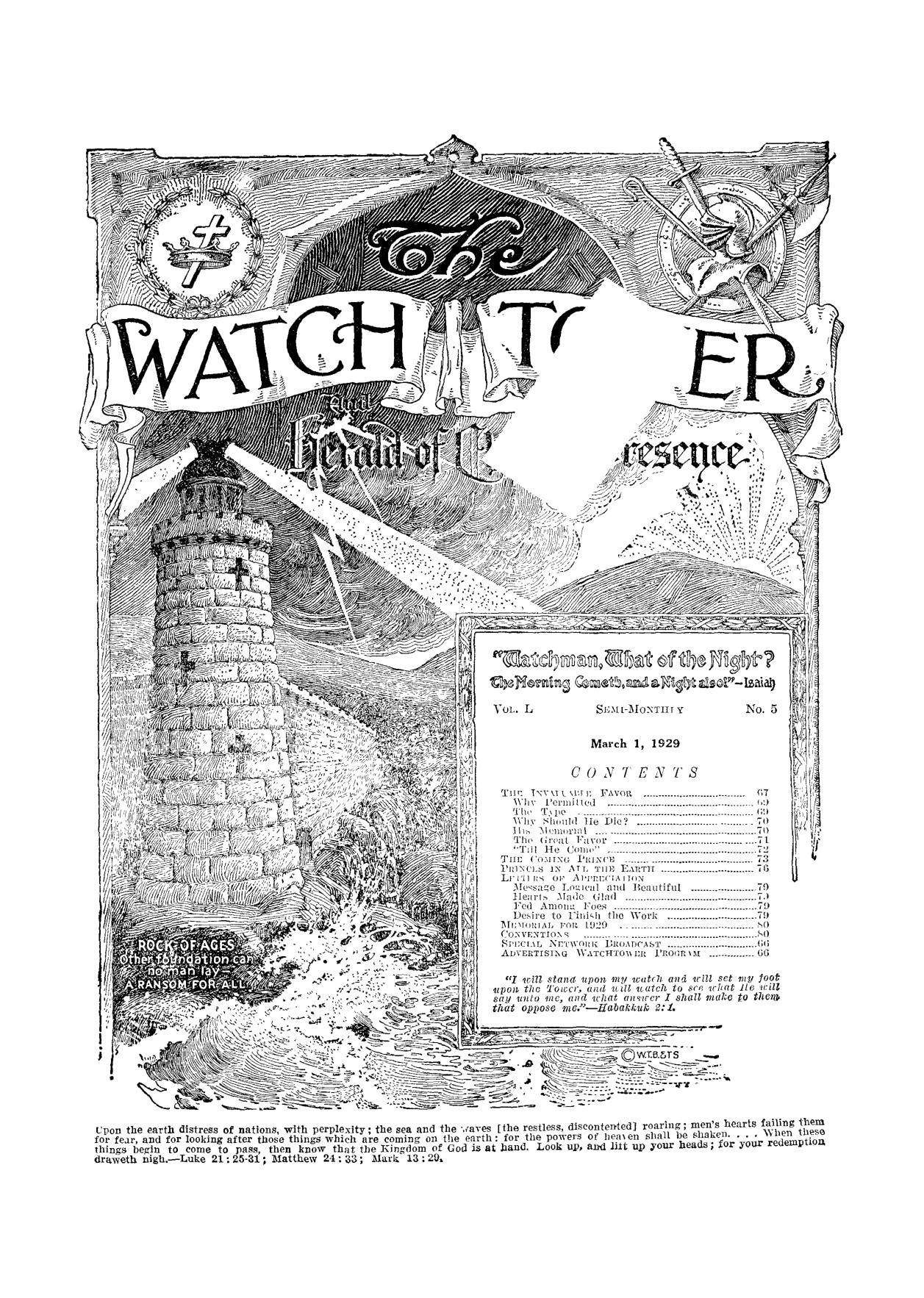
SPECIAL NETWORK BROADCAST
The president of the Society will speak in Los Angeles, California, Sunday morning, March 17. His address, and probably some of the songs of praise to Jehovah immediately preceding or following, will be broadcast simultaneously over an extensive network of radio stations, during the hour beginning at 10 o’clock, Pacific Standard time.
Stations along the Pacific coast, others in the Rocky Mountain region, and possibly others in the Mississippi Valley, are expected to participate in this broadcast; so that the program will be audible in the Mountain time zone (beginning at 11 a. m.) and in the Central time zone (beginning at 12 noon), as well as in the fur West.
Among the stations now engaged for tins broadcast are KMTR (Los Angeles), KYA (San Francisco), KFWM (Oakland), KEX (Portland), KJR (Seattle), KGA (Spokane). Newspaper announcements, it is expected, will give a lull list of the stations in due time. Watch the news columns of jour local papers for this information. We suggest that friends throughout the area to be covered by tills broadcast arrange at once to give notice a day of two in advance through their local papers, and also over local radio stations during the week before.
ADVERTISING WATCHTOWER NETWORK PROGRAM
Every one engaged in the house-to-house work in territory now served by broadcasts of the WATCHTOWER network program may have a share in felling the people that this new radio service is available every Sunday.
The newspapers, as is well known, can not lie expected to convey reliable information to the people with respect to tin’s broadcasting service. It is therefore again suggested that classes arrange to distribute the Society's new “Radio Slip” while canvassing.
This slip, of beautiful design printed in colors, similar to our question slip, lists the stations associated in the network and also carries tin invitation to hear the program and read the books.
Wording of the invitation and the station list are changed from time to time as additional stations join the network or when special program features can be announced. It is well, for tills reason, to order only such quantity of the slips as can lie promptly distributed; and then to reorder, so as to gain the advantage of having an up-to-date edition of the “Slip". We can print these slips for any class at $1.30 a thousand. These are not charged to class accounts.
Stations now broadcasting this WATCHTOWER network program every Sunday morning, 10 to 11 (Eastern Standard time), are, WBBR New York, N. Y. WOV New York, N. Y. WLBZ Bangor, Me.
WLSI Providence, R. I.
WOKO Poughkeepsie, N. Y.
WFBL Syracuse, N. Y.
WODA Paterson, N. J.
WGBI Scranton, Pa.
WMBS Harrisburg, Pa.
KQV Pittsburgh, Pa.
WHK Cleveland, Ohio
WAIU Columbus, Ohio
WKBF Indianapolis, Ind.
WGBF Evansville, Ind.
WFIW Hopkinsville, Ky.
WORD Chicago, Ill.
WMAL Washington, D. C.
WOL Washington, D. C. WTAR Norfolk, Va.
WBT Charlotte, N. C. CKOC Hamilton, Ont.
Vol. L March 1, 1929 No. 5
THE INVALUABLE FAVOR
“You are they who have, continued with me in my trials. And I covenant for you, even as my Father hets covenanted for me, a kingdom, that you may eat and drink at my table in my kingdom, and sit on thrones, judging the twelve tribes of Israel.” — Luke 22:28-30, Diaglott.
THE time was the fourteenth day of the first month. The day of great crisis had arrived. The passover commanded by the law had been eaten. No other man aside from Jesus knew that Jesus was to die the same day. It was then past six o’clock in the evening, for it was the beginning of the day, and before another day he would be dead. Wonderful events were to come to pass that would never be forgotten. Jesus was about to confer upon others a favor which would be accompanied by much tribulation; but to the ones to whom it was granted it would finally bring boundless joy.
2 Only a few days before the eventful hour on the fourteenth day of the first month Jesus had ridden into the city of Jerusalem and presented himself as Israel’s King. A great multitude of the common people had received him with enthusiasm and had long and loudly shouted his praises. They hailed him as the great Son of David about whom the prophets had said much. The people of Israel were then smarting under the yoke of their oppressors and they looked upon Jesus as the One who would deliver them and save them. They acclaimed him with gladness and adoration as the mighty One coming in the name of the Most High.
3 With the scribes, priests and Pharisees, composing the clergy, it was far different. They were greatly angered, as well as much disturbed, by the manner in which the common people receded Jesus of Nazareth. For more than three years these clergymen and the principal ones of their flocks had hated Jesus without a cause, and now their malice knew no bounds. For some time they had been in a conspiracy to kill Jesus, and now they were stirred with venom and they hurried on to complete the arrangements for his death. Like all such malicious ones, those clergymen were moral cowards. They feared the people, and so they reasoned that some way must be found to turn the people against Jesus and to cause him to appear in the people’s eyes as one guilty of treason.
THE REASON
4 Why should the clergy want to kill the Son of God? Did not the clergy represent God on earth amongst the Jews? It is true that by the law covenant with Israel God made provision for the priests. In fact, he set aside the entire tribe of Levi to instruct and serve the people, and provided that the priests must be taken from amongst that tribe. He laid upon the priests the obligation to instruct the people in the law. “For the priest’s lips should keep knowledge, and they should seek the law at his mouth: for he is the messenger of the Lord of hosts.” (Mal. 2: 7) The men filling the office of priests and clergy in Jesus time had wofully degenerated and had departed from the instructions that the Lord had given them and were unfaithful to the covenant.
5 Had not the holy prophets foretold the coming of Messiah who would save the people? and did not the Pharisees and priests know this fact and have reason to believe that Jesus was the One? God, through his holy prophets, had repeatedly informed the clergy of the coining of the Messiah. They were informed that he should be born at Bethlehem and as Ruler should come forth from Bethlehem. (Mic. 5: 2; Matt. 2: 5, 6) From the evidence before them the clergy had every reason to believe that Jesus was the promised Messiah. Upon this point there seems to be little doubt of the fact that many of the clergy class knew that Jesus was the Son of God. Then why should they want to kill him?
6 The priests of Israel were selected to serve in the name of Jehovah and to aid the people. For a time men filled those offices faithfully; but by the time of the coming of Jesus to earth these men had commercialized the religion of the Jews and looked to self and had no interest in the people. They sought the approval of men and did not seek the approval of God. They used their office to extract money from the people. The rich and influential were their favored ones because they expected something in return. The common people and the poor they hated. When Jesus came he fed the people and taught them. They looked for more from his gracious hand. They hoped for a better time to come. They knew they got nothing from the priests. To the priests God said: “Will a man rob God? Yet ye have robbed me. But ye say, Wherein have we robbed thee? Tn tithes and offerings. Ye are cursed with a curse: for ye have robbed me, even this whole nation.”—Mal. 3:8, 9.
7 The clergy were hypocrites, and Jesus had publicly told them as much. They were practising a fraud upon the people for their own personal gain, and Jesus had not hesitated to so declare. (Matt. 23:13-32) This greatly angered the clergy. The Devil had brought forth these men as his sons and representatives, and Jesus told them that also. (John 8:42-14) Because of their selfishness and unfaithfulness to God, they had become the sons of the Devil. Being sons of the Devil, the clergy would do his bidding, and did it. The Devil wanted Jesus killed, and he inspired the clergy to carry out his wicked purpose.
8 But why should the Devil want Jesus to be killed? Lucifer was once given the position of overseer of man. It was his duty to direct man in harmony with God’s will. Lucifer, because of his ambition, became unfaithful to God. He had an ambitious desire to be like the Most High and to establish a kingdom of his own. (Isa. 14:13, 14) Because of Lucifer’s evil course God debased him and named him Satan, the Devil. God did not interfere, however, with his power and influence to rule men. Then God made promise to faithful men that in his own due time he would establish amongst men a righteous government and that the One who should rule that government would honor Jehovah and bring blessings to the people.—Gen. 12: 3; Gal. 3:8.
9 Time and again Jehovah sent his prophets to testify to the people his purpose and intention of establishing a righteous government for men, which government should rest upon the shoulder of the Prince of Peace and would be administered in behalf of the poor as well as the rich. (Isa. 9: 6, 7; 11:1-4; 32:1) God had repeatedly stated through the prophets that all the wicked should be destroyed and that the earth would be made a fit place for men to abide. Satan, being the wicked one who ruled by wicked methods, knew that if the prophecy of God should be carried out he would lose control over men and his organization would completely fall. He put it into the minds of his servants, the clergy of the Jews, to cause Jesus to be killed, to the end that his own wicked government should not be interfered with. Jesus knew of this purpose and told the clergy as much.— Matt. 21: 33-40.
10 God, through his prophets, had pronounced his decree of death against Satan, which would in due time be carried out. (Ezek. 28:14-19) Satan well knew that following the establishment of God’s righteous government his wicked reign would then end, and also that in due time his death would follow. The apostles have so stated; and no doubt Satan had some information to this end. (Heb. 2:14; 1 John 3:8) Satan would therefore put forth his efforts to prevent the setting up of the righteous government. Knowing that Jesus was the beloved Son of God, Satan sought to have the babe killed before birth; and again he sought Jesus’ death when a mere child. (Matt. 1:19; 2:16) Satan himself made an attempt to induce Jesus to violate his covenant with God, knowing that he would thereby cause Jesus’ self-destruction.—Matt. 4:1-10.
11 Further carrying out his wicked purposes Satan would now use his sons the clergy, lie instilled into the minds of those selfish men the conclusion that if Jesus should become more popular amongst the people the clergy would lose their own place of ease and comfort and their opportunity to fleece the people would be gone. The more the common people gave praise to Jesus, the greater was the fear put in the minds of the clergy of their losing-everything. Therefore they fell the easy victims to Satan's seductive methods, and they repeatedly held counsel together and entered into the conspiracy originally formed by the Devil to destroy Jesus.
12 When Jesus had done a good deed and brought comfort and joy to the hearts of the sorrowful, by raising Lazarus from the dead, his popularity grew and the clergy decided that it was time for them to act. “Then gathered the chief priests and the Pharisees a council, and said, What do we? for this man doeth many miracles. If we let him thus alone, all men will believe on him: and the Romans shall come and take away both our place and nation. And one of them, named Caiaphas, being the high priest that same year, said unto them, Ye know nothing at all, nor consider that it is expedient for us, that one man should die for the people, and that the whole nation perish not. And this spake he not of himself: but being high priest that year, he prophesied that Jesus should die for that nation.”—John 11 : 47-51.
13 The Devil wanted Jesus killed. Judas had become angered, and wanted him killed, and was therefore willing to enter into the conspiracy and accepted a bribe from the clergy to betray Jesus into their hands. Such was the condition that prevailed at the time the feast of the passover drew nigh.—Luke 22:1-6.
14 When the time for the passover came Jesus assembled with his disciples to eat the passover with them. Jesus was fully aware of what was going on amongst the enemy, and he knew that in a few hours he would be put to an ignominious death. “And he said unto them, With desire I have desired to eat this passover with you before I suffer.” (Luke 22:15) Within a short time thereafter, and at the instance of the clergy, Jesus was seized as a transgressor, brought into the courts of the clergy and the principal of their flock, was there unlawfully tried upon false and perjured testimony, and by that august tribunal of pious frauds he was declared guilty of crime punishable by death. They sought confirmation of that wicked sentence by the Roman governor, and obtaining it, they proceeded with their wicked work, and on that same dry the Son of God was put to death upon the cross.
WHY PERMITTED
15 The power of Jehovah is without limitation. Why then would he permit his beloved Son to be put to death by Satan and his representatives? In his Word it is written by one of his prophets: “Surely the wrath of man shall praise thee.” (Ps. 76:10) The wrath that man has and expresses proceeds from the Devil. God permitted the wrath of man and the Devil to be exhibited to the extreme against his beloved Son, and he will cause that wrath to work out to his own praise. It was the will of Jehovah that his beloved Son should die. That, however, would give no cause or excuse for Satan and the clergymen to put him to death. God withheld his restraining hand and permitted the wrath of these evil ones to be expressed. To be sure God could have prevented them. The ultimate result will show, however, that Jehovah is the Most High, and that there is none before him. The Devil reasoned that the putting of Jesus to death would prevent Jehovah from carrying out his purposes. Jehovah will demonstrate that the act of the evil one and his allies will in no wise prevent him from carrying out his purposes.
16 That it was the will of God that Jesus should die, there remains not the slightest doubt. Jesus knew that fact, and therefore he said: “Therefore doth my Father love me, because I lay down my life, that I might take it again. No man taketh it from me, but I lay it down of myself. I have power to lay it down, and I have power to take it again. This commandment have I received of my Father.” (John 10:17, 18) This proves that no creature could have taken Jesus’ life without the permission of Jehovah and that God permitted it, knowing that in due time he would raise Jesus from the dead. This also testifies to the supremacy of Jehovah God.
THE TYPE
17 Long centuries before that memorable fourteenth day of the first month, God’s chosen people Israel were residing in Egypt. They were being greatly oppressed by the ruler of Egypt. The government of Egypt pictured Satan’s organization, while the ruler of Egypt represented Satan himself. Hearing the cries of his people because of the oppression, God sent his servant Moses to Egypt to be the deliverer of the Israelites. Moses was accompanied by Aaron. The two appeared before the ruler of Egypt and made request that God’s chosen people be permitted to go therefrom and worship him. The request was granted, only to be immediately denied again.
18 This was done repeatedly, and Jehovah determined that now Pharaoh and his hosts should know that God is the Most High and that his will must be obeyed. He would teach all creation that he is the supreme One. At the same time he would make a picture foreshadowing the sacrifice of his beloved Son and testify to the real purpose thereof.
19 Jehovah therefore commanded Moses to prepare the people of Israel for the great passover. “And the Lord spake unto Moses and Aaron in the land of Egypt, saying, This month shall be unto you the beginning of months: it shall be the first month of the year to you. Speak ye unto all the congregation of Israel, saying, In the tenth day of this month they shall take to them every man a lamb, according to the house of their fathers, a lamb for an house; and if the household be too little for the lamb, let him and his neighbour next unto his house take it according to the number of the souls: every man, according to his eating, shall make your count for the lamb. Your lamb shall be without blemish, a male of the first year: ye shall take it out from the sheep, or from the goats: and ye shall keep it up until the fourteenth day of the same month: and the whole assembly of the congregation of Israel shall kill it in the evening. And they shall take of the blood, and strike it on the two side posts, and on the upper door post of the houses, wherein they shall eat it. And they shall cat the flesh in that night, roast with fire, and unleavened bread; and with bitter herbs they shall eat it. Eat not of it raw, nor sodden at all with water, but roast with fire; his head with his legs, and with the purtenance thereof. And ye shall let nothing of it remain until the morning; and that which remaineth of it until the morning, ye shall burn with fire. And thus shall ye eat it; with your loins girded, your shoes on your feet, and your staff in your hand; and ye shall eat it in haste: it is the Lord’s passover. For I will pass through the land of Egypt this night, and will smite all the firstborn in the land of Egypt, both man and beast; and against all the gods of Egypt I will execute judgment: I am the Lord. And the blood shall be to you for a token upon the houses where ye are: and when I see the blood, I will pass over you, and the plague shall not be upon you to destroy you, when I smite the land of Egypt. And this day shall be unto you for a memorial; and ye shall keep it a feast to the Lord throughout your generations; ye shall keep it a feast by an ordinance for ever. ’’ — Ex. 12:1-14.
20 The passover there arranged for, and which was observed on the fourteenth of Nisan, must become a perpetual rule to be annually observed by the Israelites. “And ye shall observe this thing for an ordinance to thee and to thy sons for ever. And it shall come to pass, when ye be come to the land which the Lord will give you, according as lie hath promised, that ye shall keep this service. And it shall come to pass when your children shall say unto you, What mean ye by this service? that ye shall say, It is the sacrifice of the Lord’s passover, who passed over the houses of the children of Israel in Egypt, when he smote the Egyptians, and delivered our houses. And the people bowed the head and worshipped.”—Ex. 12: 24-27.
21 Preparation was made in obedience to this command. At midnight God’s angel passed over the land of Egypt, and every house where the blood of the lamb was found sprinkled the angel passed over and left its first-born unharmed. In every house where the blood did not appear, the first-born died. By obeying this commandment of God to kill the lamb and sprinkle the blood over the door the Israelites proved that they trusted in Jehovah and would faithfully obey at that time. The blood of the lamb therefore formed the basis of a covenant that God made with the Israelites to make them his own people and establish with them his government. The covenant was afterward confirmed at Sinai. The blood of the lamb was therefore the basis for the law covenant made in Egypt, in which covenant Moses was the mediator between God and the people. In that picture Moses represented Christ Jesus, the beloved Son of God, and foreshadowed a better covenant to be made by a better sacrifice.
22 On that occasion in Egypt either Moses must die or some creature must die instead of Moses. Therefore; a Iamb was selected and was killed. Primarily the lamb represented Moses; but it also, and in a wider way, represented Jesus Christ. In prophetic phrase it foretold that the only moans whereby the sin of the world can be taken away is by faith in the blood of Christ Jesus. Therefore when Jesus came, Jolin, his forerunner and one of the prophets, said: "Behold the Lamb of Cod, which taketh away the sin of the world.” (John 1:29) Therefore what God caused to be enacted by the Jews foreshadowed other things of greater importance to come to pass. (1 Cor. 10:11; Heb. 10:1) The death of the lamb foreshadowed the death of Jesus. The picture pointed forward to the time when the Savior of the world would come and die for the benefit of men. It was therefore the will of God that he should die. But this furnished no excuse for the Devil or clergy to have any part in putting him to death.
WHY SHOULD HE DIE?
23 Comparatively few people have seemed to have any understanding of the reason for the death of Jesus. God’s Word makes it plain. Because of the rebellion that started in Eden the perfect man Adam was sentenced to death. By reason of that divine decree Adam must die, and all his offspring, inheriting the disability, must in due time likewise die. If every man should have an opportunity for life everlasting, redemption must be provided from the original judgment entered because of sin. This could be done only by another perfect man voluntarily dying instead of, or as a substitute for Adam. All men being descendants of Adam, all were born imperfect and none therefore could redeem himself, and certainly he could not redeem his brother. (Ps. 49:7) How then could man ever have an opportunity for life? The loving-kindness of God made the necessary provision by sending his beloved Son to earth and permitting him to die and provide the redemptive price for the human race. “For God so loved the world, that he gave his only begotten Son, that whosoever believeth in him should not perish, but have everlasting life. For God sent not his Son into the world to condemn the world; but that the world through him might be saved.”—John 3:16, 17.
24 It was impossible for the blood of animals to take away sin. God prepared One who could take away sin. His beloved Son was sent to earth, his life being transferred from spirit to that of human. He was made flesh and dwelt amongst men. (John 1: 14) He came for the purpose of doing his Father’s will; arid it being the will of his Father that he must die in order to provide the ransom price, he was willing to die.—Heb. 10:4-10.
25 Because of Jesus’ full and complete obedience even unto death, God raised him out of death an exalted him far above all creation and gave him a name that shall be sung with praise throughout the ages of eternity. The death of Jesus upon the cross provided the redemptive price for man, making it possible for all men to be saved and thereafter to live. God raised him out of death, and Jesus the divine ascended into heaven and presented the value of that perfect sacrifice as a sin-offering for men. He therefore became the great Mediator between God and men; and all who shall ever be saved at all must be saved through the blood of Christ. (1 Tim. 2: 3-6) It was necessary that Jesus die in order that men might live. He was rich in power and glory, but he became poor that the poverty-stricken human race might have an opportunity for riches. ‘‘For ye know the grace of our Lord Jesus Christ, that though he was rich, yet for your sakes he became poor, that ye through his poverty might be rich.”—2 Cor. 8: 9.
HIS MEMORIAL
26 Jesus must be obedient to the law; therefore he must eat the passover on the fourteenth day of the first month. If it was important to keep the feast of the passover, which was the type, then it must be of far greater importance to keep in memory the fulfilment of that type. Jesus was the antitypical Lamb, and his death upon the cross fulfilled the type and put an end to the provision of the law for the passover. Jesus knew that he must die on that day, and before he died he would institute the memorial of his death that his followers might keep it in mind and understand its importance and that they should observe it annually. At the conclusion of the passover supper, Jesus “took bread, and gave thanks, and brake it, and gave unto them [his disciples], saying, This is my body, which is given for you: this do in remembrance of me. Likewise also the cup after supper, saying, This cup is the new testament in my blood, which is shed for you.’’—Luke 22:19, 20.
27 Christ is the passover for the church, the members of his body. It is only those who trust in his shed blood and remain in that faithful attitude to the end that can possibly share with him in his glory and blessings. The apostle says: “For even Christ our passover is sacrificed for us: therefore, let us keep the feast.” (1 Cor. 5:7, 8) What Jesus did at the institution of the memorial of his death means more to his true follower than merely the opening of the way to life for him. All people who shall ever be blessed with life everlasting must, receive that blessing by reason of the shed blood of Christ Jesus, but the body members receive more than a mere existence.
THE GREAT FAVOR
28 Jesus on that occasion invited his disciples to drink that which represented his blood. Under the terms of God's law to the Israelites the drinking of blood was punishable with death. The invitation Jesus gave to his followers then was one of death. Could Jesus bestow a favor upon his true disciples by inviting them to participate in his death? He could; and in no other wry could a greater favor be bestowed upon man. Up to this time few have seemed to appreciate this great truth; but those who have seen and appreciated it have much reason to rejoice.
29 Without a doubt God's purpose was from the beginning to have a world composed of mankind under the immediate supervision of an invisible overlord or governor always in harmony with himself. The ambition of Lucifer had caused the loss of everything to man and entailed upon mankind a long period of suffering and sorrow. The governments of men, presided over by Satan the Devil, have ever been oppressive. God would establish a righteous world. But before he would grant the lordship even to his beloved Son he would make his Son perfect through sufferings, even the suffering of an ignominious death. To this end Jesus was made in the likeness of men. He was made, a perfect man. His death as a perfect man provided the ransom price for man. His complete faithfulness won for him the rulership of the world. When at Jordan Jesus made his consecration, God promised him, among other things, a kingdom or great government. In order to prove his complete obedience and faithfulness unto his Father, Jesus was willing to die.
30 It was also the will of God that others should be taken from amongst men and have the opportunity of being associated with Jesus in his righteous government. If suffering and tribulation was the condition precedent to Jesus’ having the kingdom, then it follows that all who might be associated with him in that government must pass through a similar experience of suffering. It was the will of God that Jesus, as Jehovah’s representative, should extend the invitation to men to join with him. in his suffering and in his glory. Therefore, at the institution of the memorial of his death Jesus invited his disciples to be broken with him and to drink of his blood, that is to say, to surrender everything human to the will of God and to participate in Jesus’ sacrificial death.
31 They must be baptized into his death in order to share in his kingdom. On a former occasion Jesus put the question to them: “Are ye able to drink of the cup that I shall drink of, and to be baptized with the baptism that I am baptized with? They say unto him, We are able.” (Matt. 20: 22) They agreed that they were able so to do. This being the will of God, at the conclusion of the feast of the passover the hour had arrived for Jesus to tell his disciples upon what terms they might be for ever with him. Therefore he said to them: “You are they who have continued with me in my trials. And I covenant for you, even as my Father has covenanted for me, a kingdom, that you may eat and drink at my table in my kingdom, and sit on thrones, judging the twelve tribes of Israel.”— Luke 22: 28-30, Diaglott.
32 This was an invitation to come into his covenant by sacrifice and to die a sacrificial death. All others who will ever be associated with Jesus in his kingdom must take a similar course. To merely believe on the Lord Jesus Christ is not sufficient. To be baptized into his death, and then to be faithful to the end, is also essential. Paul understood the matter thus, and therefore he said: “Because to you it was graciously given on behalf of Christ, not only to believe into him, but also to suffer on his account.”—Phil. 1:29, Diaglott.
33 In order to be a member of the body of Christ, and therefore to be associated with him in his government. the body members must fill up the suffering that is left behind and which suffering is given as a great favor (Col. 1:24); and the one who understands it thus, rejoices to fill up, or to participate in, such suffering. In this connection Paul declares that for this reason he is made a minister according to the dispensation of God, which is given to him to fulfil his Word. (Col. 1:25) It means furthermore, then, that one having been brought into the covenant by sacrifice must be God’s faithful minister even unto death in order to be associated in the government.
34 Many have been deceived as to what is required of a Christian. Many have believed that Jesus is the Savior and accepted this truth because they thought such would save them from torment or eternal death. Many others have made a covenant with the Lord God to do his will and then straightway set about to develop a beautiful character and thereby prepare themselves to go to heaven. Others have made a consecration to God and have understood that in order to be with the Lord the terms of their covenant must, be followed and faithfully performed. The last is the class to which Paul belonged, and he sets forth the requirements of all who will be in the government.
35 The faithful and obedient Christian well knows that he could never so develop himself that, he would be fit for God’s use. He knows that he can be faithful to the Lord God and his beloved Son, bear the reproaches with Christ, and gladly conform himself to God’s way, in obedience to his commandments. With him it is not what other men think about him. It is not whether he shall please men and have them say, ‘He is a Christian and a beautiful character.’ The whole concern of the faithful one is to do what is pleasing to God. It was because of the faithful obedience of Jesus unto death that God raised him out of death and exalted him to the highest place. (Phil. 2:1-11) It is because of the faithfulness of those; who follow in his footsteps that God has guaranteed that they shall participate with Jesus in his righteous government and enjoy the blessings of immortality. — Lev. 2: 10; 3:21.
30 The eleven faithful disciples whom Jesus invited to share in his covenant by sacrifice, and therefore in the kingdom, are the same ones for whom Jesus offered a special prayer to his Father that same night. His prayer was: “I have given them thy word; and the world hath hated them, because they are not of the world, even as I am not of the world. I pray not that thou shouldest take them out of the world, but that thou shouldest keep them from the evil. They are not of the world, even as I am not of the world. Sanctify them through thy truth: thy word is truth.” — John 17:14-17.
37 The rule is therefore clearly fixed that those who will share with Jesus in his government must be entirely separate from the world. These have been brought into the kingdom of light, and their complete entrance as immortal creatures into, and their becoming sharers of, the glorious government depend upon their faithfulness to God unto the end. That means there can be no compromise with any part of the Devil’s organization, which is the world. These must be entirely set aside for the use of the Lord; and this is done by the truth, which they must learn and obey. A mere head knowledge is wholly insufficient. There must be a course of action in harmony with God’s commandments. They must be in the world, but must be no part of the world. They must resist the world and overcome the world even as Jesus did.—John 16:33.
38 Those who are brought into the covenant by sacrifice, and then continue faithful and true to the Lord and stand out boldly against the Devil’s organization, shall in due time share the glories of God’s righteous government with Christ Jesus the great King. Therefore it is the greatest privilege and favor that could be bestowed upon man to be invited to drink the blood with Christ, meaning thereby to share with him in his death; because the reward is the greatest that could be given to any creature.
“TILL HE COME”
39 Paul, a faithful follower of Jesus and the inspired witness of Jehovah, wrote: ‘‘As often as ye eat this bread, and drink this cup, ye do shew the Lord’s death till he come.” (1 Cor. 11: 26) We understand his words to mean in substance this: ‘There are those who have made a covenant with God to do his will. Each time these observe the Memorial they show that the death of Jesus was necessary in order to have the kingdom, and that no one will be associated with him in that kingdom save those who likewise die; that the ones eating the bread and drinking the wine thereby say, We understand this to represent the death of our Lord in which we are permitted to participate as an invaluable favor to us. Thus we show forth his death until he come and receive us to himself.’—John 14: 1-4.
40 No one can truly partake of the Memorial who at the same time is having any part with the world or the Devil’s organization. He could not be in sympathy with Satan’s organization and at the same time worthily partake of the Memorial. If one is in sympathy with the Devil’s organization, or participating in it, and while doing so partakes of the Memorial of Christ’s death, he does so in violation of the covenant. Therefore Paul says to such: ‘‘Ye cannot drink the cup of the Lord, and the cup of devils; ye cannot be partakers of the Lord’s table, and of the table of devils.”—1 Cor. 10: 21.
41 Those who prove faithful unto the Lord must be entirely on his side. When one examines himself he may determine, according to the rules laid down by the Scriptures, whether or not he has made a covenant with the Lord and whether or not he is devoting himself wholly to the Lord. If so, then he should gladly join in the Memorial.
42 On the night of the Memorial, Jesus said to his disciples, in substance: ‘My Father has made a covenant with me to give me a kingdom that shall bless mankind. He has appointed me to rule the world. Before I can have the great privilege I must prove my faithfulness unto my covenant and I must be broken and must pour out my life-blood. The breaking of this bread represents that I am broken, and this wine in the cup represents my blood poured out. As my Father has marked out the course that I shall take, I gladly take it. For the past three and one- half years I have had much tribulation. In all these trials you have been standing faithfully with me. Now I offer you the great privilege of sharing with me that kingdom upon condition that you be broken with me and that you drink of this blood of mine, which represents your share in my death. If you do this, you shall share with me in my kingdom and glory.’ Never was another so valuable a favor conferred upon man as to be invited to enter into this covenant of sacrifice and into the glorious government.
45 Now the remnant of the church is on the earth. The members thereof see the great privilege of being baptized into the death of Christ and the necessity of faithfulness to the end. Already they recognize that the Lord Jesus has returned, that he is in his holy temple, and that he has gathered the faithful ones into the temple condition. These have entered into the joy of the Lord. They have begun to drink anew of the wine. They see that the kingdom is near, and now they know that they have continued faithful and true to the Lord and henceforth they shall soon enter completely into the gates of the glorious kingdom, share in its boundless blessings, see the Lord in all his beauty and glory, appear with him in his likeness, and see the face of the Most High. This unspeakable favor set before them is all by the grace of Jehovah God.
QUESTIONS FOR BEREAN STUDY
When and where were the words of our text spoken? What important hour for Jesus had come? For his disciples? 1.
Relate the events of the few days prior. Contrast the attitude of the common people toward Jesus with that of the clergy. Account tor the difference in motive, and for the failure of cither class to carry out their intended purpose. 2, 3.
Show that the religious leaders of Israel were in a position particularly favorable to their recognizing Jesus as the Messiah. 4, 5.
By whom and for what purpose was the priesthood of Israel provided? How had they degenerated to the condition in which Jesus found them? What was Jesus' manner of dealing with them? 6, 7.
Identify the master mind back of the clergy’s activities. Explain how lie became the great adversary. Account for his persistently opposing the servants of God, and especially Jesus. 8-10.
Why should Satan expect the clergy to be willing and effective instruments for his purposes? Show by scriptures what effect Jesus’ favor with the common people had upon the minds of the Devil’s agents. 11, 12.
Why did Satan seek for a medium better acquainted with Jesus’ affairs? Relate how the Devil thereafter succeeded in having Jesus put to death. 13, 14.
Account for Jehovah’s permitting this extreme persecution oven of his beloved Son. Show that Jesus himself could have foiled all Satan’s efforts to do him harm. 15, 16.
Describe Israel’s experiences in Egypt prior to the passover. 17, 18.
Relate the story of the passover. Of what important arrangement was it the basis, and what did the picture foreforeshadow? 19-22.
Why was it necessary for Jesus to die? Quote scriptures to show the purpose of this feature of Jehovah’s plan. 23.
Why could not Israel obtain life on the basis of the atonement-day sacrifices? How was the circumstance met, not only for Israel, but for all mankind? Explain what Jesus’ absolute faithfulness in doing his Father's will availed for Jesus himself. 24, 25.
Explain how Jesus knew that ‘his hour had come’. How’ was the Jewish passover brought to an end, and what took its place? How far-reaching is the benefit of what Jesus there memorialized? 26, 27.
Why was Jesus’ invitation to his disciples to drink of his cup the greatest favor ever bestowed upon man? 28.
Lucifer’s commission as overlord in Eden indicates what divine intention as to world government? What change of dispensation marked the end of the age (1914)? How and when did Jesus win the right to rule the world? 29.
What gracious provision has been made for others to be associated in that government? On what condition may they enter into that glorious privilege? 30-33.
What erroneous idea has prevailed respecting the duty of a Christian? Explain God's purpose in the ‘high calling’. Describe the course necessary for the Christian to pursue that he may enter into that for which the heavenly calling was intended. 34, 35.
Quote Jesus’ prayer for his faithful disciples, and point out therein the rule by which his true followers must be governed under their covenant by sacrifice. 36-3S.
Apply 1 Corinthians 11:26. Explain Paul's statement in 1 Corinthians 10:21. How may one know whether he can partake of the Memorial worthily? 39-41.
What was the substance of Jesus’ words to his disciples on the night of instituting the Memorial? Give reasons why the remnant should find a special joy in presuit circumstances and privileges. 42, 43.
THE COMING PRINCE
A PRINCE is one of the highest rank in a state. He may indeed be the highest, for the name may be used of the king. Usually, however, it is given to the king’s son, the heir to the throne. The term “The Coming Prince” has been used by students of prophecy as referring to the one which all prophecy tells shall come, one whose dominion shall be over all the earth, and who shall rule all people. The term is taken from Daniel’s prophecies. He tells of the prince that shall come, and definitely says that he is Messiah, the Prince. — See Daniel 9: 25, 26.
Ever since there have been kingdoms in the earth men have always been interested in princes, the sons of the king. The world has always loved a good prince, one who has shown interest in the people over whom he might be called to rule. It is probably not without some connection with this universal feeling among the nations that the Bible has much to say about the coming Prince over all the earth, whose dominion is to be over all, who shall never lose it to any foe, who shall have all the nations for his inheritance, and the uttermost parts of the earth for his possession.
The Bible is the most human book in the world. There is none like it for touching human nature. It certainly discloses human nature at its worst, but both by its examples and by its promises it ennobles it and dignifies it so that it may be seen worthy of being of God. The Bible shows that everything good in human nature has its counterpart in the divine nature, in that of Him who made man. But whether of such design or not, the fact is that the story of the coming Prince of earth is one of the most interesting phases of the Bible's story. It tells of the coming of a prince who shall deliver all the human family from the Dragon, who has had the power of sin and of death and who has been the constant enemy of men, seeking to deceive them as to the good disposition of their Creator toward them.
God was compelled to punish man for his sin; that is, he must fulfil his word as to what should be done in case of man's transgression: that he would take the privilege of life from the man when by his wilfulness he should prove to be unworthy of that favor. Satan, the Dragon, took occassion thereby to deceive men, and has succeeded, lie has deceived almost all men concerning God.
The Bible tolls of the birth of a child to be born to men, of the great and good things he would do for them. His coming is always associated with life and. happiness for the peoples of earth; but only after he has defeated the Dragon, and has slain and destroyed all those who helped the Dragon or supported his reign which hurt the people. The coming Prince is ever presented as the friend of the peoples, bringing them gifts from God, and who will enable them to live in constant peace and happiness and without fear.
But the Prince must suffer before he can do this. He is permitted to suffer at the hands of his enemy and must learn full obedience, and gain confidence in his God and Father by reason of his sufferings; besides that he gains sympathy with those who have been under the bondage of the Dragon, and under the bondage of the law of sin and death. In God’s due time he is endowed with divine power and the right to operate against all the forces of evil. He overcomes them to the glory of God and to the good of all humanity. Such is the Bible story.
Who is the coating Prince? We have already said that Daniel names him Messiah, that is, the Anointed One. The Messiah is Jesus the Son of God. Jesus has many titles of authority, reaching even to the one "King of kings, and Lord of lords". He is also named “Prince of the kings of the earth’’. - Rev. 1: 5.
The titles of Jesus are used with exactness, just as the various names of Jehovah are used. Thus while Jesus is named Prince, he was never so called when he was a man upon earth, though twice while a man he accepted the title of king: once when he presented himself as king to Jerusalem, “Blessed be the King that cometh in the name of the Lord; peace in heaven, and glory in the highest” (Luke 19:38); and when he accepted the title from Pilate, as when “Pilate therefore said unto him, Art thou a king then? Jesus answered, Thou sayest that I am a king. To this end was 1 born, and for this cause came I into the world, that I should bear witness unto the truth. Every one that is of the truth heareth my voice”. (John 18:37) It was only on his exaltation after his ascension that he was made Prince, when also he received the title of Savior. We quote, “Him hath God exalted with his right hand to be a Prince and a Saviour, for to give repentance to Israel, and forgiveness of sins.” — Acts 5:31.
It is in the visions of the Revelation that Jesus is shown as a Prince in power. (See Revelation 1:5.) Jesus had the title, but it did not go into full effect till the “due time” came. When Jesus was received into heaven he was bidden to be seated at Jehovah's right hand till a certain time when his enemies should be made his footstool. (Heb. 10:13) To be seated there was merely as betokening honor; he was to wait, for the time when he should receive his full honor as Prince had not come.
The Old Testament, like the New, carries the thought of the coming one as one who should be both Prince and King; but in the Old Testament the office of Prince is emphasized. This is because in the Old Testament Jehovah is King in Israel. (See Psalms 74: 12; 89:18; Deuteronomy 33: 26) When Samuel mourned that Israel wanted a king and apparently thought less of the judicial arrangement he had instituted for their welfare, Jehovah bade Samuel remember that the people did not reject Samuel; it was he, Jehovah, whom they rejected as their king. — 1 Sam. 8: 7.
David was God’s representative; hence he was set as king upon God's holy hill of Zion. It was said of him that he sat upon the throne of Jehovah (1 Chron. 29: 23), and hence he became a type of the company who should come fulfilling the second Psalm. The coming Prince was to bless Israel, and to rule over the whole earth. — Isa. 9: 6, 7; 11: 1-5.
But it is to be noted that neither the Old Testament in its prophecies of the coming Prince, nor the New Testament in all it has to say about him, carries the thought that Jesus is to be King or Prince for ever. His reign is limited between definite points of time. The fact, of course, is that the reign of the Prince is for a special purpose, namely, that of restoring Israel and the whole world to righteousness, to happiness in harmony with the will of Jehovah God.
But why has the rule of the Prince been delayed for so long? The chief outward reason is the simple but effective one, that the place of power or authority has been that occupied by a prince, appointed by Jehovah, and two could not rule at one and the same time.
Satan had, by permission of Jehovah, become prince of this world (John 16: 11), and Jesus must wait till Jehovah’s time came when that prince should be cast out from his place of power and authority.
Jesus, however, has been Prince as he has been King, to some, namely, to all those who have come to God by him. He said, “All power is given unto me in heaven and in earth.’’ (Matt. 28:18) There is no reason why he should not exercise princely power and authority over all who would render allegiance to him. But his authority was limited to his Father’s plan. His kingdom during the waiting time might therefore be called a kingdom of grace; the subjects of Jesus are translated out of the kingdom of darkness into the kingdom of God's dear Son. — Col. 1: 13.
But, this phase of the power of Jesus is not by any means the reign of the Prince of Peace. That reign will be exercised over all men in all the earth. It is in Jehovah’s due time according to his arranged plan that the reign of the Prince over all the earth begins. Till that time Jesus, so far as that picture or phase of his office is concerned, sits at his Father’s right hand. In another office he has been Jehovah’s great priest, ministering to those who have come to God by him; for it could not be that he should be idle, doing nothing. When the due; time came the work of establishing the kingdom must be entered upon. This meant the casting out and casting down of all opposing forces. Jesus must now assume the aggressive. As Satan was an opposer, he must be dislodged. Hence there was Avar in heaven. The ruling “prince of this world’’ was cast out. — Rev. 12: 9.
At the same time strife began on earth; the nations of the earth were thrown into warfare. This was the natural result of their own foolish policies, a fruitage which Jehovah h: s allowed Io ripen, but which hitherto had been kept from ripening. Then came the aftermath of the war, trouble which first brings into union every possible force which can be rallied to oppose the coming of the kingdom of heaven in the person of its rightful Prince, but which will destroy the earth as it is now organized.
There are two main phases of the coming of Jesus revealed in the New Testament. There is his coming as Prince and King, and there is his coming as general of Jehovah’s armies. This is the picture of the nineteenth chapter of Revelation where he is shown as Jehovah’s great general leading his army to the battle of God Almighty. There he is called the Word of God; he is King of kings and Lord of lords, equipped for the great, war of God against all those who oppose him and the setting up of his kingdom. The battle opens, and Satan's armies are conquered and destroyed.
As it has pleased Jehovah to allow Satan to be prince of this world till an appointed time, he could not have Jesus reign over the earth till that time has expired. Events have shown that that time was 1914, and this is in various ways confirmed by the Scriptures. From that date the rule of the Prince foretold must begin to be exercised in the earth.
It is to be expected that his coming will be accompanied with a strict examination into all those things which have been professed before men as serving the interests of Christ, and that there will be swift, judgment upon everything that is in opposition to the will of God.
It is because of this that the Scriptures show that judgment must begin at the house of God (1 Pet. 4: 17); also that there is judgment, upon the nations which have professed to be Christ’s kingdom (Christendom), but which have wofully misrepresented him.
The teaching of the churches about, the coming of Christ to reign and to judge has created a great fear in men. The coming of the one, who is called the Prince of Peace and foretold as man’s great Deliverer, has been made by these falsifiers of truth to be the most, terrible thing the world could know, and to be the most unfortunate thing that could happen to men and to the earth, their home. His coming, which it is said will take men altogether unawares, would mean that at that moment all those who are not members of churches would be cut, off from all hope of adjusting themselves, and from that day would be shut off from human life, henceforth to live with the Devil and all evil beings in the hell of orthodoxy’s imagination, and that the earth itself would be destroyed.
The Bible certainly does say that the coming of Jesus Christ is to be accompanied with a time of trouble such as men have never known. But the teachers of Christendom, the clergy, have been false witnesses concerning this. They have taught that the trouble was to come upon those who made no profession of being Christian, who either rejected the clergy or were careless as to what the clergy had to say.
The Scriptures show that Jesus comes as the Messiah, the Anointed One, to be the great Savior promised, and comes to save the poor and needy. That the poor anti needy of the earth are those who have suffered at the hands of those who have had the use of the best things of the earth, seems plain. The judgments of Jesus begin with the house of God. The Master reckons with his servants, as is shown in the parables of the Pounds and the Talents. Jesus also judges those who have professed to be servants of Jehovah anti to do work for him. The great systems and their leaders are examined, and are found wanting: they have used the name of God as a cloak for serving their own ends. They are found lacking, and are deprived of their services.
The great church systems have professed before the world that their mission was to convert the world and make it ready for the coming of Jesus. Mistaken though they were, they have not even tried to do as they profess; but, like the Pharisees of old, they have used their privileges for their own purposes.
They, too, have had the key of knowledge, and would neither use it nor allow others to do so. The world knows that the great church systems have been opposers of increase of knowledge among men.
After the churches have been judged and have heard the sentence, “I never knew you [you were never mine] : depart from me” (Matt. 7: 23), a sentence which is now openly disclosed before all the world, for all see the church systems discredited, then judgment follows upon all those systems which are of the present world arrangement, and must necessarily follow upon all those who support them as against the new kingdom of righteousness which Christ has come to establish in the earth.
As soon as the disrupture and the destructive work have been accomplished there will begin those blessings to all the human family of which the prophets have spoken. All men will be compelled to acknowledge the Prince of Peace as the ruler who represents Jehovah, the Creator, the Most High over all the earth.
The coming of the Prince is not without its herald, its witness. Not only has there been much said for many years in certain circles of the religious world about the return of activity on the part of Jesus in the world, which has in great measure served as a witness to Christendom, but the changes in the earth have turned men’s minds to the thought that possibly the world events were evidences of the fact that the Creator was moving in human affairs. Some men, prominent in the religious world, avowed this in the early days of the World War, witnessing thus to all the world. But besides these general “noises” God has had his special witnesses calling definite attention to the fact of the Lord's presence, and that Jehovah had set his King upon his holy hill of Zion, and that all men should render allegiance to the King. Failure to do this means that such must sooner or later be treated as an act of rebellion. Already some are being so treated, and must be destroyed. The many do not yet understand. But the message of the kingdom goes forward with vigor and with assurance, and it can not be long before all men will know that God has set his kingdom in authority in the earth.
PRINCES IN ALL THE EARTH
THR Psalms visualize conditions in the earth which have never yet obtained; they tell of things which should come to pass in the purpose of God which have never been realized. Questions naturally arise, How are we to take what is said? Are we to suppose that the sweet singer of Israel spoke only the thoughts of his mind, or are we to accept as a fact that he spoke by the holy spirit of God, and that the things written must all be fulfilled? For ourselves there is no question that the things written were of the spirit of God, and we are confirmed in this because some of the things written by the psalmist were fulfilled in the life of Jesus. Evidently some things were to be fulfilled at the first advent; and some, the greater, and more extensive, were to be fulfilled at the time when the Christ of God conies into his kingdom.
In Psalm 45 we read: “Instead of thy fathers shall be thy children, whom thou mayest make princes in all the earth.” To whom is reference made in this Psalm? Who are the fathers ? and who is the one who may make his fathers princes in all the earth? There can be little question about the chief person of this Psalm, the prince; for the psalmist indicates him when he says, “Thy throne, O God, is for ever and ever.” (Ps. 45:6) That he is Christ, the King, we are certain, for the Apostle Paul quotes these words when telling of the high exaltation of Jesus, seated at the right hand of the Majesty on high. — See Hebrews 1: 3.
There is an apparent difficulty, however, as to the fathers who may be made princes, and whose authority is to be in the earth. Yet when the purpose of God in the various ages is seen, all difficulties vanish; and in this case also it is seen that the enigmatical and so-called difficult passages of the Word of God become bright lights in the heavens of God’s Word.
As a man, Jesus, the Son of God, was the son of David, and therefore of Abraham. Thus he had many fathers in the line of descent from Abraham. But the record of some of these fathers in this royal line is not such as to commend them as men worthy of being rewarded by future favors. It must therefore be understood that only those who in sincerity endeavored to keep their covenant with Jehovah, and who served him in faith, should be considered as the fathers.
But how can these be made as children? and how are they to become princes in all the earth? If we are compelled to take the ordinary orthodox view of the purpose of God in relation to man and the earth, there is no satisfactory answer to these questions. It is in part because the teachers of organized religion know they entirely lack an understanding of the Old Testament that they were so ready to give place to the critics. They have no answer to the difficulties which modern thought has forced upon them. In consequence they have completely lost faith in the Old Testament as being part of the divine revelation. Therefore beyond the fact that orthodoxy, of whatever phase of thought, has misstated the Old Testament, it must now be acknowledged that Protestant orthodoxy has put that treasure store of God's Word away from it as being of no moral value beyond that which may be accorded to good literature.
We repeat that when the plan of God in the ages is seen, then each of these things falls into its natural place in the grand scheme of the divine revelation. The common idea about the earth and its future which is held by the followers of the clergy is that it is to be burned up when Christ comes again. They presume that the earth will have served its purpose. There are, however, some who differ from this in that they see that the Bible very definitely tells that Christ must reign on the earth for a thousand years after his return. But these do not break from the orthodox creeds; they merely put forward the destruction of the earth for the period of the reign of Christ.
As orthodoxy has taught that the earth is to be burned up, and as it has also taught that all men are immortal, and therefore must continue to live somewhere, its creed-makers came to the conclusion that all good men, of whatever degree of goodness, are taken to heaven on the death of the human body. But this is altogether contrary to the Scriptures, a totally wrong conception of the purpose for which God made the earth. The Prophet Isaiah, speaking by the spirit of God, says, “Thus saith Jehovah that created the heavens; the God that formed the earth and made it, that established it and created it not in vain, that formed it to be inhabited: I am Jehovah, and there is none else.”—Isa. 45: 18, A.R.V., margin.
We know that up to the days of Jesus on earth no man had ascended into heaven; for he himself so said. (John 3; 13) Therefore it is certain that these faithful men of old had not been rewarded by being taken to heaven. Nor is their reward the same as that given to the church; for the faithful in Christ are to be made joint-heirs with Jesus when he is established in his kingdom. (Rom. 8:17) The Apostle Peter says of these that there is reserved for them an inheritance incorruptible and undefiled. (1 Pet. 1:4) Jesus said to his disciples before his death, “I go to prepare a place for you” (John 14:2); and he promised that they should be rewarded “at the last day”, the day when he should rule in power.—John 6: 44.
…