The Watchtower, May 15, 1928
Download: PDF — The Watchtower, May 15, 1928
SUMMER SERVICE WEEK
Many have indicated their purpose to participate in giving the witness in the field during the first 1928 service week, May 13 to 20. The summer service week, August 26 to September 3, will afford an even more favorable opportunity for all the anointed everywhere to join their voices in singing forth the honor of Jehovah's name. Let us make it a 100 percent witness.
"SONGS OF PRAISE TO JEHOVAH"
Songs of Praise to Jehovah is the title of a new song book which is now ready for shipment. On its 300 pages are many new songs and tunes, as well as old favorite selections. Retail price of the book, cloth-bound, is 75c, postpaid. Price to classes in lots of 20 or more, 69c each.
(Continued from page 160)
STATION CITY AND PROGRAM PERIODS K/C METERS WATTS
WNBZ Saranac Lake, N. Y. ........................................1290 232.4 10
Sun am 10.15-10.45
WNOX Knoxville, Tenn. ........................................1130 265.3 1000
Fri pm 7.30-8
WNRC Greensboro, N. C. ........................................1340 223.7 500
Fri pm 6.15-6.45
WOBU Charleston, W. Va. ........................................1120 267.7 50
Wed pm 9-9.30
WODA Paterson, N. J. ........................................1020 293.9 1000
Sun am 10-10.30
WOKO Poughkeepsie, N. Y. ........................................1390 216 500
Sun pm 12.30-1; Thu pm 8.30-9
WOO Philadelphia, Pa. ........................................ 860 348.6 500
Mon am 11.30-12
WOOD Grand Rapids, Mich. ........................................1150 260.7 500
Sun pm 9-10
WORD Chicago (Batavia), Ill. ........................................1190 252 5000
Sun am 10-12, pm 2-4, 6-7.30
Mon Tue Wed Thu Fri Sat pm 6-7
WRAW Reading, Pa. ........................................1260 238 100
Sun pm 7.30-8.30
WREC Memphis, Tenn. ........................................1200 249.9 500
Sun pm 5-5.30
WRHF Washington, D. C. ........................................ 930 322.4 150
Sun pm 5.30-6, Wed pm 6-6.30
WRHM Minneapolis, Minn. ........................................1150 260.7 1000
Sun am 9.15-10.30
WRK Hamilton, Ohio ........................................1460 205.4 100
Mon pm 7-7.15
WRR Dallas, Tex. ........................................ 650 561.3 500
Sun pm 2.15-3; Thu pm 8.30-9
WSMK Dayton, Ohio ........................................1010 296.9 200
Tue pm 8-8.20
WSPD Toledo, Ohio ........................................1250 239.9 250
Sun pm 1.30-2
WTAR Norfolk, Va. ........................................1090 275.1 500
Sun pm 7-7.30
WWRL New York (Woodside), N. Y. ........................1500 199.6 100
Sun pm 8-8.45
WWVA Wheeling, W. Va. ........................................ 580 516.9 250
Sun pm 1-2
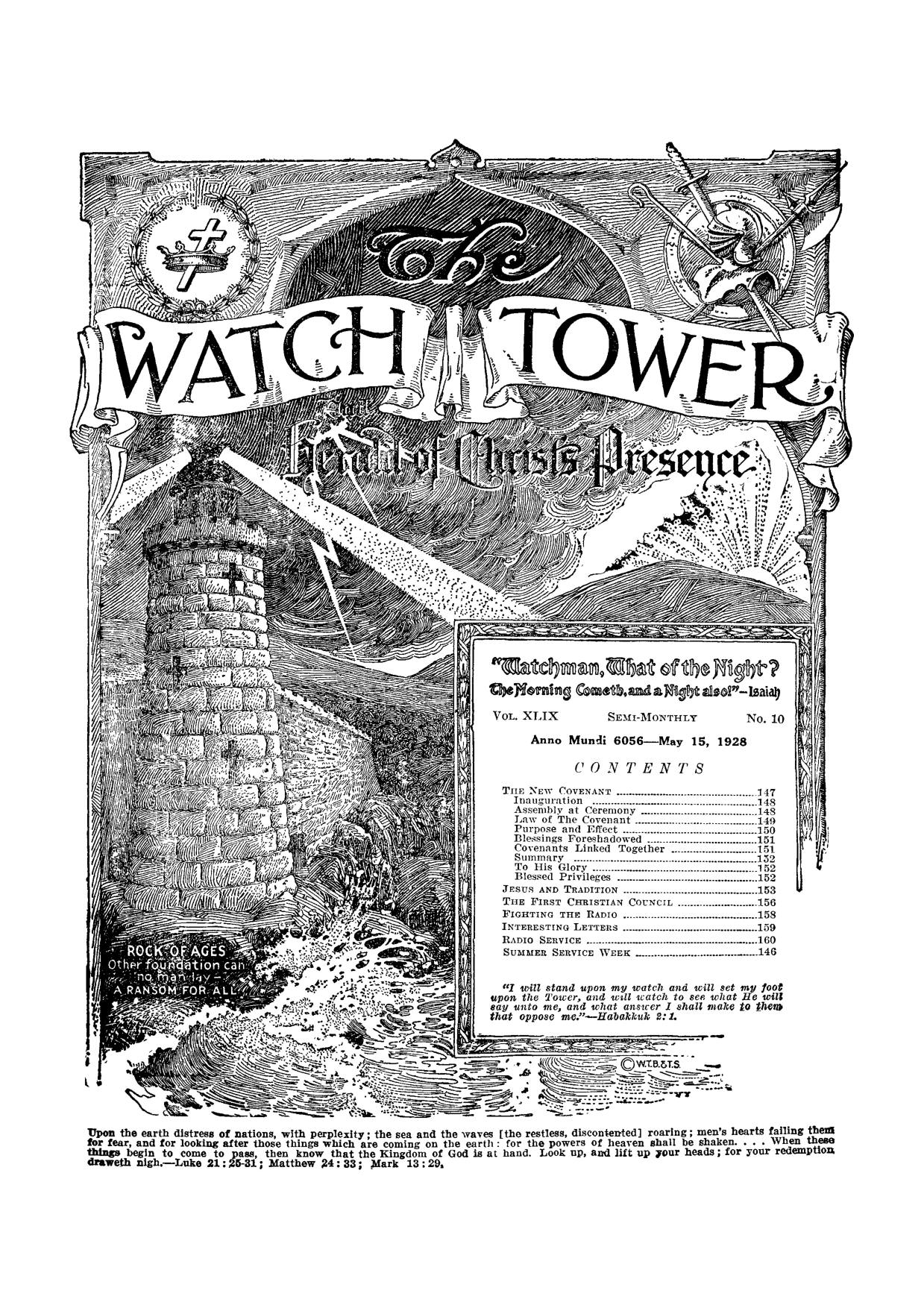
THE WATCH TOWER
AND HERALD OF CHRIST'S PRESENCE
VOL. XLIX MAY 15, 1928 No. 10
THE NEW COVENANT
(Continued from previous issue)
"But ye are come unto mount Sion, and unto the city of the living God, the heavenly Jerusalem, and to an innumerable company of angels, to the general assembly and church of the firstborn, which are written in heaven, and to God the Judge of all, and to the spirits of just men made perfect, and to Jesus the mediator of the new covenant, and to the blood of sprinkling, that speaketh better things than that of Abel."–Hebrews 12: 22-24.
JEHOVAH caused the tabernacle to be erected in the wilderness and for divine service to be performed in connection therewith. On Israel’s atonement day the high priest went alone into the Most Holy, there to make atonement for sin. The Most Holy pictured heaven itself. After Christ Jesus was raised from the dead he ascended on high, appearing in heaven itself, there to make an offering for sin. “For Christ is not entered into the holy places made with hands, which are the figures of the true; but into heaven itself, now to appear in the presence of God for us. . . . But now once . . . hath he appeared, to put away sin by the sacrifice of himself.”–Hebrews 9: 24, 26.
2 The ransom price was provided by the death of the man Jesus. It was the value of that sacrifice, represented in his poured-out blood, that the great High Priest Christ Jesus took away to heaven, there to use in harmony with the will of God. How may we determine what is the will of God concerning the use of the value of that sacrifice?
3 Knowing that the divine services of the tabernacle in the wilderness foreshadowed the divine services of the real tabernacle, we may use the figure to ascertain what is the true meaning of the reality. On the annual atonement day of Israel a bullock was slain and the high priest took its blood and entered the Most Holy and there sprinkled the blood to make atonement for himself and his house. (Leviticus 16: 6) “For himself” means in behalf of those who shall compose the members of his body, the under priesthood. By the term “his house” is meant those of the household of faith which shall include all who are justified and spirit-begotten aside from those composing the members of his body, the under priesthood. With that ceremony performed then the high priest returned to the court, killed the goat of the sin-offering which was for the people, and carried its blood into the Most Holy and there made atonement for the sins of the people by sprinkling that blood as he did the blood of the bullock.–Leviticus 16: 15.
4 These sacrifices were repeated annually on Israel’s atonement day. At this sacrifice the bullock represented the poured-out life-blood of Jesus Christ alone. The blood of the goat represented the body members of Jesus Christ taken into the covenant by sacrifice and made a part of the sacrifice of Jesus Christ. Therefore it essentially represented the blood of Christ in both instances, but it is the goat in which the church is represented in Christ. Both the bullock and the goat were slain in the court, picturing that that which they represented would be slain on earth; and the blood was sprinkled in the Most Holy, picturing heaven itself.
5 Following the picture to the reality, it is seen that when Jesus ascended into heaven he presented the value of his own sacrifice, represented by the blood of the bullock, and sprinkled it upon the mercy seat to make atonement for his body members and the members of the household of faith. At Pentecost the selection and slaying of the Lord’s goat began, and this has continued throughout the Christian era or time of sacrifice.
6 During that period of time what is being done concerning the new covenant? The body members are ministering to the spirit thereof by proclaiming the message of God’s plan relative to the blessing of all the families of the earth. When the period of sacrifice is complete, as represented by the Lord’s goat, then, as shown by the picture, the blood of Christ, including the body members’, is presented and used to make atonement for the sins of the people. What then is to be done concerning the new covenant? Will the blood then be used as a basis for making the new covenant? No, because that covenant was made when Jesus was on the earth. Will the blood be used then to seal the new covenant? To be sure not! Because the covenant was made sure at the time it was made, and Jesus was made surety for it even before. Nowhere in the Scriptures is the covenant spoken of as being sealed.
7 What then is to be done at the end of the period of sacrifice? Paul answers: "Ye are come [approached] unto mount Sion, . . . and to Jesus the mediator of the new covenant, and to the blood of sprinkling, that speaketh better things than that of Abel." (Hebrews 12: 22, 24) The covenant had been established when Paul wrote: "But now hath he obtained a more excellent ministry, by how much also he is the mediator of a better covenant, which was established upon better promises."–Hebrews 8: 6.
INAUGURATION
8 When the atonement for sin is made for the people then the time is due for the inauguration of the new covenant. The law covenant was made in Egypt and inaugurated at Mount Sinai, which represented Mount Zion. (Hebrews 12: 22) That picture shows that the new covenant is made on earth and must be inaugurated at Mount Zion, in heaven itself. It is in heaven that the sprinkling of the blood for the inauguration takes place. (Hebrews 12: 24) At the inauguration of the law covenant at Mount Sinai Moses sprinkled the blood both on the book and on the people. "For when Moses had spoken every precept to all the people according to the law, he took the blood of calves and of goats, with water, and scarlet wool, and hyssop, and sprinkled both the book, and all the people." (Hebrews 9: 19) (See Exodus 24: 6-8.) The book of the law represented God's expressed will, because he dictated it. As Moses read the book of the covenant to Israel, likewise will Christ publish the terms of the new covenant to Israel and to all mankind and thereby open up the highway of life. Until the covenant by sacrifice is completed only the church is subject to the expressed will of God. His law will be issued for mankind when the new covenant is inaugurated.
9 When the law covenant was inaugurated the people of Israel were at the foot of Mount Sinai, having previously been delivered from Egypt. When the inauguration of the new covenant takes place the people will have been delivered from the world, Satan's organization foreshadowed by Egypt, and will be at the foot of Mount Zion, which is the mountain of God, to wit, his kingdom, subject to the instruction of God.
ASSEMBLY AT CEREMONY
10 Who will be present at the inauguration of the new covenant? Addressing the church, Paul says: "But ye are come unto mount Sion, and unto the city of the living God, the heavenly Jerusalem, and to an innumerable company of angels." (Hebrews 12: 22) Mount Zion, we must remember, represents the place for the inauguration of the new covenant, corresponding to Mount Sinai. "The city of the living God" is his organized kingdom of righteousness. The Scriptures indicate that there will be present an innumerable company of angels. Throughout the development of the divine plan these pure, holy, mighty and loyal angels, wholly devoted to God, have been performing their service. It is like God to have these faithful ones present at the inauguration of the covenant that is to reconcile mankind to himself. Then Paul says it will be the general assembly of the church of the firstborn, which shows that the church will then be complete. There the great Jehovah God, the Judge over all, will manifest his presence. Jesus, the Mediator of the new covenant, the most exalted one of the universe next to Jehovah, will be there. Thus are shown Jehovah and Jesus, the two competent contracting parties to the covenant, at its inauguration. The 144,000 faithful overcomers, at that time joint-heirs with Christ Jesus in glory, will be joined with him as one composite Mediator. That glorious company will be made up of 144,000, Jesus and his official family. These will be under-priests of Jesus acting with him and under his direction. These under-priests seem to be foreshadowed by Aaron, Nadab and Abihu, who were associated with Moses at the inauguration of the law covenant.
11 How about Abraham, Isaac, Jacob and the others of the faithful heroes whom we call ancient worthies? Will they be present and have a part in the ceremony? Would it be necessary for the new covenant to be inaugurated and in operation before these faithful ones are raised from the dead? No, because it is the great ransom sacrifice applied as a sin-offering that guarantees their resurrection. The new covenant has nothing to do with awakening them out of death. Those worthy men, faithful to the end, received a good report from God because of their faith. By faith they saw the day of Jesus Christ and rejoiced. Paul says: "They without us [the church] should not be made perfect." (Hebrews 11: 40) It follows then that when the church is completed, when all who have been taken into the covenant by sacrifice have finished their course, then is the due time for the bringing forth of the ancient worthies.
12 Since the Scriptures show that there is to be a general assembly of the church of the firstborn at the inauguration of the new covenant, it seems certain that the church must be completed some time prior to that. Why should not the ancient worthies be present and in some manner participate in the ceremonies on that grand occasion? At the inauguration of the law covenant not only were Aaron and others who were in line for the priesthood present and participating with Moses, but there were "seventy of the elders of Israel" also present. "Then went up Moses, and Aaron, Nadab and Abihu, and seventy of the elders of Israel: and they saw the God of Israel: and there was under his feet as it were a paved work of a sapphire stone, and as it were the body of heaven in his clearness. And upon the nobles of the children of Israel he laid not his hand: also they saw God, and did eat and drink."--Exodus 24: 9-11.
13 These seventy were men of importance and are called in this text "nobles", which means chief men or chosen men. Whom could these foreshadow if not the faithful worthies mentioned in the Old Testament and by Paul in his epistle to the Hebrews? Those faithful worthies were not all of Israel. Some of them lived before Israel was chosen. Therefore they would be featured at the inauguration of the new covenant to represent Israel and all others of mankind. Be it noted that in the above text it is stated: "Also they saw God, and did eat and drink," not that they could see with natural eyes God's glorious body, but that they could see a manifestation of his power and fully understand the meaning thereof.
14 In describing the assembly Paul says: "To the spirits of just men made perfect." (Hebrews 12: 23) Those faithful men of old were justified because of their faith and loyalty to God. When the ransom sacrifice is applied as a sin-offering for the people, to remove the legal disability, that is the time when the spirit or power of life of these justified men will be made perfect. This is a further corroboration that the ancient worthies will be present at the inauguration of the new covenant. They will not be in heaven; but on earth, performing some specific function at the inauguration of the covenant.
MARVELOUS CEREMONY
15 At the inauguration of the law covenant at Horeb, the mount of God, the ceremonies foreshadowed the inauguration of the new covenant at Mount Zion, or mount of God, or God's organization. About that there does not seem to be any occasion for doubt. Paul directly links the two together. As to whether there will be a grand and mighty ceremony, we have but to look at what happened at Mount Sinai. At that time Jehovah manifested his presence in a great cloud upon the mountain and "there were thunders and lightnings, . . . and the voice of the trumpet exceeding loud." (Exodus 19: 16) Referring to this same matter, Paul says: "And the sound of a trumpet, and the voice of words; which voice they that heard intreated that the word should not be spoken to them any more: (for they could not endure that which was commanded, And if so much as a beast touch the mountain, it shall be stoned, or thrust through with a dart: and so terrible was the sight, that Moses said, I exceedingly fear and quake)."--Hebrews 12: 19-21.
16 What then should be expected at the inauguration of the new covenant? The angels of heaven will be assembled there. The church of the firstborn will be there. Jesus the glorious Mediator with his under-priests will be there; and above all, Jehovah God. None of these will be visible to human eyes, but God has often manifested his presence by a demonstration of his power. The ancient worthies, then resurrected as perfect men on the earth (probably at that time at Jerusalem), will be there to represent both houses of Israel and all mankind. All there would see the presence of the Lord God made manifest in the cloud, the tempest, the storm and fire, which demonstration will surely be given in a far more marvelous manner than human phrase can describe. Then all shall know that Jehovah is the great God and that his kingdom is established and can never be moved. The new covenant then inaugurated, the peoples of earth shall begin to learn of its terms and purposes.
17 Furthermore Paul, with authority, wrote: "For when Moses had spoken every precept to all the people according to the law, he took the blood of calves [picturing the blood of Jesus given as a ransom] and of goats [picturing the church having communion in the blood of Christ], with water [symbol of truth, because the people must be brought to a knowledge of the truth], and scarlet [margin, purple] wool [referring to the slain Lamb who now reigns, as represented by royal purple], and hyssop [used in purging sin (Psalm 51: 7)], and sprinkled both the book, and all the people, saying, This is the blood of the testament [covenant] which God hath enjoined unto you. Moreover [in addition thereto] he sprinkled with blood both the tabernacle and all the vessels of the ministry." (Hebrews 9: 19-21) What was there foreshadowed evidently will take place in reality when the new covenant is inaugurated, because that which took place regarding the law covenant foreshadowed the new covenant and its ceremonies.
LAW OF THE COVENANT
18 The new covenant is made for and in behalf of sinners and will be inaugurated to bring man into reconciliation with God; therefore it will have need of statutory laws directing the people in the right way. "Knowing this, that the law is not made for a righteous man, but for the lawless and disobedient, for the ungodly and for sinners, for unholy and profane, for murderers of fathers and murderers of mothers, for manslayers." (1 Timothy 1: 9) The people then will have a sure and certain guide, and there will be no occasion for them to mistake as to what is the right way. By that time the whole of mankind will have received a thorough and convincing lesson in the baneful effects of sin and the great need of being directed in the right course. They will seek Zion for instruction as to the way to go. "In those days, and in that time, saith the Lord, the children of Israel shall come, they and the children of Judah together, going and weeping: they shall go, and seek the Lord their God. They shall ask the way to Zion with their faces thitherward, saying, Come, and let us join ourselves to the Lord in a perpetual covenant that shall not be forgotten."--Jeremiah 50: 4, 5.
19 They will be learning the law of God and having it explained to them in its proper manner. "And many people shall go and say, Come ye, and let us go up to the mountain of the Lord, to the house of the God of Jacob; and he will teach us of his ways, and we will walk in his paths: for out of Zion shall go forth the law, and the word of the Lord from Jerusalem." (Isaiah 2:3)
The law will be promulgated by Christ the King and Head of Zion and by and through the agencies of the new government represented by "New Jerusalem". The people will receive the message of truth and will learn to obey and serve the true God.–Revelation 21:1-3.
SINS
20 The ransom price for man, accepted by man upon the terms offered, will wipe away all sins that have been due to inheritance from Adam. "And their sins and iniquities will I remember no more. Now where remission of these is, there is no more offering for sin." (Hebrews 10:17, 18) That will mean a finality of their iniquities that they inherited.
21 The apostle applies the words of the prophet to the reign of Christ and the administration of the new covenant: "For Moses truly said unto the fathers, A prophet shall the Lord your God raise up unto you of your brethren, like unto me; him shall ye hear in all things whatsoever he shall say unto you. And it shall come to pass, that every soul, which will not hear that prophet, shall be destroyed from among the people."–Acts 3:22, 23.
22 These sins seem clearly to refer to the deliberate violation of the law of the new covenant, that is to say, sins wilfully committed after one is brought to a knowledge of God's plan. For such there is no forgiveness, because "where remission of these [sins] is, there is no more offering for sin."–Hebrews 10:18.
23 To the same effect it is written: "The soul that sinneth, it shall die. The son shall not bear the iniquity of the father, neither shall the father bear the iniquity of the son: the righteousness of the righteous shall be upon him, and the wickedness of the wicked shall be upon him." (Ezekiel 18:20) That will be the time when will apply the words of the prophet: "The sinner, being an hundred years old, shall be accursed." (Isaiah 65:20) God will bring the obedient ones back into harmony with him, but the wilful wrongdoers shall be destroyed. (Revelation 21:7, 8) "The Lord preserveth all them that love him: but all the wicked will he destroy." (Psalm 145:20) Those who love the Lord will be glad to obey him. The others will not.
PURPOSE AND EFFECT
24 The purpose of the new covenant is to reconcile man to God. The effect of the new covenant will be the reconciliation to God of all men who obey the law of that covenant. During the long dark night of Satan’s regime selfishness has controlled the people. That condition will be changed. The heart of man is the seat of motive showing either a selfish or an unselfish reason for action. The heart of fallen man has been cruel and as hard as stone. Under the new covenant the conditions will be changed. "And I will give them one heart, and I will put a new spirit within you; and I will take the stony heart out of their flesh, and will give them an heart of flesh: that they may walk in my statutes, and keep mine ordinances, and do them: and they shall be my people, and I will be their God." (Ezekiel 11:19, 20) To the same effect Paul writes: "I will put my laws into their mind, and write them in their hearts: and I will be to them a God, and they shall be to me a people."–Hebrews 8:10.
25 When God's righteous rules of action are written in the minds and hearts of men they will no longer need to have laws written upon stones or upon books. Moved by unselfishness they will delight to obey their righteous Mediator and the great Eternal God. "Then judgment shall dwell in the wilderness, and righteousness remain in the fruitful field. And the work of righteousness shall be peace; and the effect of righteousness, quietness and assurance for ever. And my people shall dwell in a peaceable habitation, and in sure dwellings, and in quiet resting places."–Isaiah 32:16-18.
26 During the administration of the new covenant it seems quite evident that the beasts of the field and the fowls of the air and the creeping things will no longer show fear of man, nor will man need to be afraid of them. "And in that day will I make a covenant for them with the beasts of the field, and with the fowls of heaven, and with the creeping things of the ground: and I will break the bow, and the sword, and the battle out of the earth, and will make them to lie down safely." (Hosea 2:18) The earth then will present a scene of quietness, peace and happiness.
27 The new covenant shall be a faultless one, due to the precious blood of Jesus that makes it sure, and to the perfection of Christ Jesus its glorious Mediator. "For if that first [law] covenant had been faultless, then should no place have been sought for the second."–Hebrews 8:7.
BENEFITS
28 The new covenant shall result beneficially to all mankind. The Jews will be the first in favor because they are beloved for their fathers' sakes (Abraham and others). (Romans 11:28) The Gentiles shall also be received by and reconciled unto God under the terms of the new covenant. Then they will know and serve Jehovah, the only true God.
29 Under the terms of the new covenant the Lord will clean them up and give them pure hearts. "Then will I sprinkle clean water upon you, and ye shall be clean: from all your filthiness, and from all your idols, will I cleanse you. A new heart also will I give you, and a new spirit will I put within you: and I will take away the stony heart out of your flesh, and I will give you an heart of flesh. And I will put my spirit within you, and cause you to walk in my statutes, and ye shall keep my judgments, and do them. And ye shall dwell in the land that I gave to your fathers; and ye shall be my people, and I will be your God."–Ezekiel 36: 25-28.
ALL TO BE BLESSED
30 The blood of Jesus shed for all is a guarantee that all shall have an opportunity to receive like benefits of the new covenant. "For this is my blood of the new testament [covenant], which is shed for many for the remission of sins." (Matthew 26: 28) His blood will cleanse as many as are willing to be cleansed. By the grace of God he tasted death for all and in due time all must have an opportunity for these blessings. (Hebrews 2: 9; Acts 3: 21) Corroborating this statement God's prophet wrote: "Then thou shalt remember thy ways and be ashamed, when thou shalt receive thy sisters, thine elder and thy younger: and I will give them unto thee for daughters, but not by thy covenant. And I will establish my covenant with thee; and thou shalt know that I am the Lord."–Ezekiel 16: 61, 62.
31 The peoples of the various nations then having had their blindness removed will seek the Lord, that they may obey him and receive the blessings. "And the inhabitants of one city shall go to another, saying, Let us go speedily to pray before the Lord, and to seek the Lord of hosts; I will go also. Yea, many people and strong nations shall come to seek the Lord of hosts in Jerusalem, and to pray before the Lord."–Zechariah 8: 21, 22.
BLESSINGS FORESHADOWED
32 When Isaac was born Abraham was approximately one hundred years old and Sarah was ninety years old. The Scriptures say they were "as good as dead". Therefore Isaac was a child of promise by faith. (Galatians 4: 23) Abraham lived seventy-five years and Sarah thirty-seven years thereafter. After the death of Sarah Abraham married Keturah. At the time Abraham was approximately 140 years old. By Keturah Abraham had six sons. (Genesis 25: 1-4) If Abraham was "as good as dead" when Isaac was begotten, then the same thing must be said of him forty years later. Therefore the conclusion that except for God's power these six sons of Abraham by Keturah never would have lived. Seeing that Keturah represents the new covenant, it may well be said that those who will become the offspring of the new covenant were "as good as dead", but by the miraculous power of God through Christ they are brought to live. By Hagar Abraham had one son and this, together with six by Keturah, makes seven, which is a symbol of completeness.
33 Abraham made some gifts to these seven sons and sent them away into the east country out from Canaan, and he made Isaac heir of all he had. (Genesis 25: 1-6) Ishmael, the son of Hagar, represented the nation of Israel. (Galatians 4: 24) The six sons by Keturah would well represent the Gentile nations or all non-Jews. The seven sons therefore who receive blessings from Abraham well represented all who shall receive blessings under the terms of the new covenant. After making these provisions for his seven sons Abraham died. That would seem to foreshadow that when the blessings under the new covenant are complete, that will mark the execution of the Abrahamic covenant and that covenant will pass into history. Then will be completely fulfilled God's unconditional promise: "In thee and thy seed shall all the families and nations of the earth be blessed." Abraham representing God, all the blessings proceed from him. Isaac the seed, representing Christ, all the blessings will be by Christ, and the great work of reconciliation will be completed.
COVENANTS LINKED TOGETHER
34 Jehovah commanded Moses to make holy garments for the high priest. As a part of his glorious apparel God commanded the making of the ephod. "And they shall make the ephod of gold, of blue, and of purple, of scarlet, and fine twined linen, with cunning work. It shall have the two shoulder-pieces thereof joined at the two edges thereof; and so it shall be joined together. And the curious girdle of the ephod, which is upon it, shall be of the same, according to the work thereof; even of gold, of blue, and purple, and scarlet, and fine twined linen." (Exodus 28: 6-8) The two parts of the ephod were fastened together by shoulder-straps and rested upon the shoulders of the high priest.
35 The breastplate of judgment was made of the same material as the ephod, and in the breastplate were placed twelve precious stones set in gold. "And thou shalt make the breastplate of judgment with cunning work; after the work of the ephod thou shalt make it; of gold, of blue, and of purple, and of scarlet, and of fine twined linen, shalt thou make it. Foursquare it shall be, being doubled; a span shall be the length thereof, and a span shall be the breadth thereof. And thou shalt set in it settings of stones, even four rows of stones; the first row shall be a sardius, a topaz, and a carbuncle; this shall be the first row. And the second row shall be an emerald, a sapphire, and a diamond. And the third row a ligure, an agate, and an amethyst. And the fourth row a beryl, and an onyx, and a jasper: they shall be set in gold in their inclosings. And the stones shall be with the names of the children of Israel, twelve, according to their names, like the engravings of a signet; every one with his name shall they be according to the twelve tribes."–Exodus 28: 15-21.
36 There are three great covenants specifically involved in the reconciliation of the human race; and all of these contracts are laid upon the shoulders of the beloved Son of God, who is Priest of the Most High. Knowing that the law foreshadowed better things to come, and looking at the beautiful garments of the high priest above described, they seem to say: The forepart of the ephod symbolized the Abrahamic covenant; the beautiful breastplate containing the twelve precious stones bearing the names of the twelve tribes symbolized the covenant by sacrifice; while the back part of the ephod hanging upon the shoulder of the high priest and fastened to the forepart fitly symbolized the new covenant.
37 Jesus the great High Priest, is therefore the pivot upon which these covenants swing. But does not the breastplate represent the law covenant? That conclusion does not seem to be consistent with the facts. The law covenant produced nothing that is beautiful. It would seem more fitting for these twelve precious stones to represent the full and complete members of the 144,000 that go to make up the body of Christ and which are described as in twelve divisions. (See Revelation 7: 4-8.) Of these Christ Jesus, the great High Priest, is the Head and the One that is altogether lovely. To him is committed all judgment in heaven and in earth. (John 5: 22) Those who make up the 144,000 will sit with him in his throne of judgment, according to the words of Jesus. (Matthew 19: 28) These together with Christ Jesus compose the temple of God, the glorious official organization named Zion, which is the kingdom or ruler of the people. These are all prepared by sacrifice and all depend upon the faithful performance by Jesus of his office as great High Priest.
SUMMARY
38 Briefly summed up, there are four covenants involved in the reconciliation of man, to wit: (1) The Abrahamic covenant, made unconditionally by Jehovah to Abraham while he was in Haran, and which became binding and effective upon Abraham immediately when he set his foot upon the land of Canaan, which covenant produces the Seed through which all the nations of the earth shall be blessed. Abraham in the picture represented God; Sarah his wife pictured the covenant; while Isaac pictured the seed through which the blessings must come.
39 (2) The law covenant, made 430 years after the Abrahamic covenant, which was made because of transgressions, defining sin, and hedging about the Israelites, and which served as a schoolmaster to lead them until the coming of Christ Jesus. It foreshadowed better things to come. That covenant made by Jehovah on one side, with Moses as mediator in behalf of Israel on the other side, was made in Egypt and inaugurated in Sinai. The covenant was symbolized by Hagar and produced only one son, and that unto bondage, representing the Israelites.
40 (3) The covenant by sacrifice, which was made between the two competent parties, Jehovah and Christ Jesus, at the time of the consecration of Jesus at the Jordan. Into this covenant the body members of Christ are taken and offered up as his own body. That covenant needed no mediator, and had none; and that covenant by sacrifice prepares the "seed of promise", and the fulfilling of its terms results in the glorious reward of immortality and the kingdom to the "seed" itself. This "seed" becomes the Judges and Blessers of all the families of the earth.
41 (4) The new covenant, made by Jehovah on one side and Jesus on the other; made at the time of the death of Jesus and made binding and firm by his own blood; made on earth and to be inaugurated in heaven itself. This covenant was made by Jesus as the Mediator for Israel and for all mankind, and the members of his body become ministers of the covenant and officiate with him in the mediatorial work. This covenant was pictured in Keturah, the third wife of Abraham; and his sons by her, who together with the son of Hagar, picturing Israel, represent all the families of the earth that will receive the blessings. All the blessings come from Jehovah, and all of them come by Christ the great High Priest; and the covenants are the means of putting the promises of God into operation and bringing back the human race into harmony with him.
TO HIS GLORY
42 The new covenant will bring honor and glory to the name of Jehovah God. During its ministration the peoples of earth will learn that Jehovah is the true God; that he is the God of love; that he unselfishly has made provision for the reconciliation of man; and that all of his actions have been prompted by unselfishness. Then the knowledge of the glory of God will fill the whole earth as the waters fill the deep and all shall know the Lord from the least to the greatest.–Habakkuk 2: 14.
43 Speaking of the blessings that will come through this covenant and the honor that it will confer upon God's name the prophet writes: "And I will cause the captivity of Judah, and the captivity of Israel, to return, and will build them as at the first. And I will cleanse them [by and through the operation of the new covenant] from all their iniquity [for the Deliverer shall come out of Zion and turn away ungodliness from them], . . . and I will pardon all their iniquities [on the basis of the shed blood of Christ Jesus, for the remission of sins and which is the blood of the new covenant], whereby they have sinned, and whereby they have transgressed against me. And it shall be to me a name of joy, a praise and an honour before all the nations of the earth, which shall hear all the good that I do unto them: and they shall fear and tremble for all the goodness and for all the prosperity, that I procure unto it."–Jeremiah 33: 7-9.
BLESSED PRIVILEGES
44 Jehovah's Servant, in whom he delights, is Christ. (Isaiah 42: 1) All who have been brought unto Christ by the covenant by sacrifice, and who are now faithful, are greatly blessed by seeing more clearly their relationship to Jehovah God than heretofore. Now it is more clearly discerned by them that they have fellowship with God and with Christ Jesus because of being in Christ and because they walk in the light, and they also have fellowship with one another. (1 John 1: 5-7) They now appreciate the fact that God and Christ Jesus have taken them into partnership, which means true fellowship in the work of the reconciliation of the world of mankind to Jehovah God. Never could any creatures have a greater privilege than this.
45 The holy angels of heaven have been faithful to Jehovah and have enjoyed many marvelous privileges but none like unto that of those who have been brought into the covenant by sacrifice and are made members of The Servant. It is now the blessed privilege of these to sing forth the praises of Jehovah’s name. Let no one now slack his hand! All who are truly of the Servant class will from this time forward be showing forth the praises of Jehovah God as opportunities are offered.
QUESTIONS FOR BEREAN STUDY
What was the purpose of the tabernacle in the wilderness? What took place in the Most Holy of the tabernacle on Israel’s atonement day, and what was pictured thereby? How has the ransom price for man’s redemption been provided, and how may we know in what manner God will use the value of that sacrifice? In the picture, what was done with the Lord’s goat, and what did that signify? ¶ 1-4.
What was foreshadowed by the slaying of these animals in the court? How and when is that part of the picture fulfilled? ¶ 5-7.
Explain what was signified by the law covenant’s being made in Egypt but inaugurated at Mount Sinai, and by Moses’ sprinkling the blood upon the book of the law and upon the people at the foot of that mountain. ¶ 8, 9.
What great feature of the divine plan closely follows the completion of the period of sacrifice, where will it take place, and who will be there? Show whether the ancient worthies will have a part therein. ¶ 10-14.
What scriptures suggest the grandeur of the new covenant inauguration ceremony? Apply Hebrews 9: 19-21. ¶ 15-17.
What provision will be made for the instruction and guidance of mankind under the ministration of the new covenant, and how will past experience serve as a factor therein? ¶ 18, 19.
Tell what will be the result of accepting the ransom price as offered. Explain one’s personal responsibility thereafter. How will Psalm 145: 20 then apply? ¶ 20-23.
Distinguish between the purpose of the new covenant and its effect. How will the heart of man be prepared to receive and obey God’s righteous rules, and what will result from true obedience? In this connection what may be said of man’s original dominion over the lower animals? Apply Hebrews 8: 7. ¶ 24-27.
For whom are the benefits of the new covenant made available, and on what conditions? ¶ 28-31.
Why is Isaac referred to as a ‘child of promise’, and what is pictured thereby? His being made sole heir of Abraham signifies what? Who were Hagar and Keturah, and what did each represent? Ishmael and Abraham’s six sons by Keturah represented whom? What is pictured by Abraham’s having these sons after he was “as good as dead”, and by their receiving gifts from Abraham? What seems to be foreshadowed by Abraham’s dying after making provision for his seven sons? ¶ 32, 33.
By whom and to whom were the directions given for making the ephod worn by the high priest? Why was it so important that these directions be followed exactly? Describe the ephod and show the fitness of the symbolism of the parts thereof. ¶ 34-37.
Name the covenants involved in the reconciliation of man, and briefly tell of each (a) when it was made, where, with whom, and for what purpose; (b) whether it required a mediator, why, and (where necessary) in whose behalf the mediator served; (c) when the covenant began (or will begin) to function; (d) the result of its operation. ¶ 38-42.
To whom is reference made as Jehovah’s ‘servant in whom he delights’? Who are included therein, and what is the special blessing of knowledge and fellowship they enjoy? How great is the privilege extended to them, and why granted? What test is involved therein, and how important is the joyful use of the opportunities Jehovah offers? ¶ 43-45.
JESUS AND TRADITION
WHEN the time had come that God would more fully reveal himself to men, he sent his own beloved Son, whom he made his apostle for that purpose. Jesus was sent to God’s chosen people, the Jews. That people had then a great history behind them. Their position among the nations was unique. The Roman nation, which then ruled the world, had begun its history only seven centuries before the day of Jesus; and the Grecians, who, in civilization and world power, had preceded the Romans, had begun their history only a little earlier. But neither the Grecians, nor Rome, nor any of the earlier nations, Egypt, Assyria and Babylon, had such a continued history and tradition as the Jews.
This, of course, is in harmony with the Bible’s presentation of Israel as God’s chosen people. It declares that comparatively early in the history of the nations God took the growing number of the sons of Jacob and chose them to be a special nation for himself. (See Exodus 19: 3-5.) Nor was the choice said to be for a time only: it was to be permanent. It further declares that though through their unfaithfulness to their covenant with Jehovah, and as a punishment for their transgressions, there should come a long interval in their history when they should have no outward marks of being the people of God, yet he would, in his own time, bring them back to his favor. In view of this, the fact that for nearly 2,000 years the Jews have persisted, and that without any of those things which hold a people together as a unit, is the strongest proof among the nations that the Bible is God’s revelation of his purposes.
The Jews had never been governed like the other nations. In the very earliest days they had lived in their God-given land for well nigh 500 years without either king or central government. There was nothing in the nature of a general parliament or congress. In theory the people were the subjects of Jehovah, the God of heaven, and he was their King. Then in the days of their kings, a period of more than 500 years, none of their rulers exercised the despotic power which was seen at its worst in the monarchs of Egypt, Assyria and Babylon.
That which bound them together as a people was not self-protection against the aggression of other nations, nor because they themselves were aggressive; for the Israelites were never great adventurers, nor traders; nor did philosophy develop amongst them. They were a self-contained people. Their chief power of cohesion was their priesthood. The priest was the representative of Jehovah, and provision for communion with Jehovah was made through him by the Urim and Thummim, which was always in the high priest's care. Even in the days of the kings this arrangement was maintained. When the priesthood proved unfaithful then God raised up his prophets to speak his words, sometimes to the king, sometimes to the people.
As Israel fell from their fidelity to Jehovah the priests magnified their office, and assumed an importance and authority which made them virtual rulers, contrary to Jehovah's intention. The Prophet Jeremiah said, "The prophets prophesy falsely, and the priests bear rule by their means." But they were helped in this by the people themselves, for, Jeremiah continues, "My people love to have it so."–Jeremiah 5:31.
As might be expected there was always a tendency to leave the simplicity of the law of Moses, and to add to it. Even Moses himself found that occasions arose which called for some instruction over and above that which was contained in the statutes which God had given to Israel in connection with the Law. Thus it came about as Israel developed that the priests made regulations of their own, and false prophets found profit in aiding them. Schools of interpretation grew, and then scribes and lawyers arose to teach and interpret the many accretions.
In Jesus' day the simplicity of the law of Sinai was entirely lost, and the people who were ever the sufferers were burdened by these means and were bowed down heavily. The people noticed the difference between Jesus' manner of teaching, and that of the scribes. He spoke as one having authority, not as they who had no certainty but could only refer the people to what this or that rabbi had said; and as there were so many who had spoken, and as they differed amongst themselves, none knew what to believe.–See Matthew 7:29.
But despite all the heavy burdens which were upon the backs of the people, and despite that they were always in ignorance and uncertainty as to the meaning of Jehovah's dealings with them, the people had a very considerable amount of self-satisfaction. Even by these things they knew they were a separate people; and they loved to have it so.
The priests and the leaders made the people feel they were very religious, and their rulers taxed them heavily in order to keep up the régime. Religious practices and observances were multiplied; but the people were pleased, for these things flattered their pride. It was thus to a people embedded in tradition and religious observances that Jesus came. How did he bear himself toward all this outward semblance of worship of Jehovah, his Father? Did he give the elders of the people credit for their meticulous care in interpreting the many teachings of their fathers, or give those fathers credit for having made so many differing interpretations of the law of Moses? He did not. He condemned them. Jesus had no use for those things which had been added to the Word of God; nor for those observances which had filled the people with pride, but which had turned them away from a desire for the truth.
Jesus never condemned any arrangements made from time to time to accommodate the needs of the people, but that was a very different thing from acknowledging the traditions of the elders as those traditions interpreted the Word of God wrongly. Had Jesus no respect for the great men of Israel? He had respect only for those who had sought the honor of Jehovah. But could it be doubted that the fathers of Israel, the men of old time, had not the honor of Jehovah in mind when they interpreted the law of God and fastened traditions upon the people? It can easily be determined that they had not the honor of God before them. Moses had specifically declared as a commandment before God: "Ye shall not add unto the word which I command you, neither shall ye diminish ought from it, that ye may keep the commandments of the Lord your God which I command you" (Deuteronomy 4:2); and any man who would do as they had done, namely, so interpret the words of God as to add thereto, was disobedient to Jehovah, and an enemy.
The attitude of Jesus toward the tradition of the elders and toward those who lived by that system which they had fastened on the people is to the Bible student more than a matter of historical interest: it has an immediate bearing upon the lives of Jesus' true followers of this present day. For this reason, namely, that those conditions which Jesus met when he appeared to the Jews are duplicated now in organized religion, only on a much larger scale, and because God is sending these, his messengers, the faithful disciples of Jesus, to the representatives of organized religion of this day, even as he sent Jesus as a witness to the Jews.
The scribes and Pharisees who realized that their system was in danger through the teaching of Jesus, but who could not directly lay any charge against him, said to him on an occasion, "Why do thy disciples transgress the tradition of the elders?" He replied, "Why do ye also transgress the commandment of God by your tradition?" and, giving them an instance, added, "Thus have ye made the commandment of God of none effect by your tradition." (Matthew 15:2, 6) Thus the leaders of the Jews had added to the Word of God, and had altogether confused and darkened the minds of the people.
What is not generally discerned is the fact that in the same way and by similar means the ecclesiastics of organized religion have added to the Word of God, and similarly have darkened the minds of the peoples of Christendom. It should be understood by all that in the various statements of belief known as the creeds and catechisms, and in those accepted doctrines which form the basis for the establishment of the various sects, there are definite additions to the Word of God. The dogma of eternal torment, which has had so great a place in Christendom, but which is now in disrepute, not indeed because the churches themselves want to drop it, but because they are losing standing with the people who refuse longer to believe them about it; the doctrine of the trinity, which has claimed to be the foundation truth of the Christian religion; the dogma of the immortality of the human soul: all are absolute and bold additions to the Word of God. These are devastating errors, and belief in them is ruinous to the understanding of the Bible, and God's purpose revealed therein. Once again it must be said, this time by the disciples of Jesus, and to the Pharisees of today, "Ye have made the Word of God of none effect by your tradition."
In neither case was there any pretence or claim of adding to the Word of God, for that would have been too bold a move on Satan's part; rather the pretence was of stating what the Word of God meant, of explaining and elucidating the truths declared: in the case of the Jews, the words of Moses and the prophets were dealt with; in the case of Christendom, it was those spoken by the Lord and the apostles, as well as those of the law and the prophets, which were amplified.
It becomes, therefore, a necessity for the faithful servant of the Lord to join in tearing down this veil of darkening teaching, that the Word of God may be seen and understood in its simplicity. In Jesus' case it may be said that his call was, 'Back to the Word of God.' In the present day the same word may be expressed, but in more familiar language, 'Back to the Bible.' It is there that both safety and salvation are to be found.
It is claimed by the modernist, and it is thought by many others, that Jesus not only waived aside the traditions of the fathers of Israel as a hindrance to truth, but he also taught that his teaching entirely superseded the law of Moses. In proof his words, 'Ye have heard that it was said by them of old time,' are quoted as if he referred to Moses. But apart from the improbability that Jesus would refer to Moses in those terms, and proof that he did not so refer to him, but to those men of old time who would improve upon Moses, is his word spoken, "Think not that I am come to destroy the law, or the prophets: I am not come to destroy, but to fulfil." (Matthew 5: 17) Jesus could not be supposed to teach at one and the same time that the law should be put away, and also that it be held. That a time of change was being announced was clear. On one hand the veil of tradition of human wisdom attempting to amend the divine, must be torn down; on the other hand the law of Moses must be vindicated. Thus Jesus would destroy the one, and more definitely set the other as the standard of Jehovah. It was prophesied of Jesus that he would magnify the law and make it honorable. (Isaiah 42: 21) In the latter case Jesus did not say that by his teaching the law was put out of date. Rather he showed that from that time there would be a stricter reading of the law for all those who desired to receive the favors of Jehovah. He instanced the case of lust. The law said, "Thou shalt not commit adultery." But Jesus said that if a man should look on a woman with desire he had already committed sin in his heart. Also the law said, "Thou shalt not kill." But Jesus showed that thoughts of evil against a brother, if not cleansed by repentance, would lead to a murderer's condemnation; and John who voiced his Master's teaching said, "Whosoever hateth his brother is a murderer."–1 John 3: 15.
It was foretold of the servant of Jehovah that he should magnify the law and make it honorable. As Jesus set this sharp interpretation on the law, he must perforce live up to his own standard. This he did. He showed by his sinlessness (which was acknowledged by his Father in his acceptance of his Son) that he had kept the law in its spirit as well as its letter. He loved God with all his heart and mind and soul and strength; and he proved that he loved his neighbor as himself by giving his life for him.
The disciples of Jesus are called upon to live according to their Master's high standard. This they are able to do because of the help provided in the gift of the holy spirit; here is God's special help provided for the cleansing of the heart from evil and to quicken it to desires of righteousness, so that the disciple has the spirit of righteousness within him causing him to want to do right. He has the spirit of the law within him that he may do that which is well pleasing in God's sight. For the mistakes and failures he has the constant provision of the advocacy of his Redeemer, so that his standing before God is not marred by reason of his failures.
The time is now come when all the truth sent by Jesus must be made plain. The professed disciples of Jesus are to be fully tested by the truth, and organized religion which professes to represent God is to be brought to judgment. The refuge of lies which organized religion has erected for itself is being destroyed by the hail of truth. (Isaiah 28: 17) The church systems will no longer provide shelter either for those who erected the shelter or for others. Indeed, they must be torn down, for it is far to be preferred for their own sakes that men should know that all this great system of organized religion in which they have trusted is of no more value than was that mass of traditional teaching in which the Jews trusted, but which Jesus so ruthlessly swept away. Happy is he who in these things knows and does the will of God.
THE FIRST CHRISTIAN COUNCIL
THROUGH the course of the centuries since the early days of church history the great church systems have held many general councils, and each has very considerably affected succeeding generations. The great Roman Catholic church takes first place in this, as in almost all other so-called Christian affairs; for in point of time and in the scope of its influence and power it has no compeer amongst the churches. In the course of its history that system has held about twenty councils.
The Roman church claims that it is the only church; it says, therefore, that such general councils as have been called and held by other religious systems or associations claiming to be churches have no authority to determine either faith or practice in the Christian life. As for itself, it views its councils as part of the arrangement which is made by Christ, working through it, for the carrying on of his work in the earth. In practice in the churches a general council is called to decide questions of doctrine or practice which have arisen upon which no decision has previously been made. The theory is that the church has the mind of Christ, and also has the authority of Christ to bind or to loose in all matters relative to the welfare of the church; that in the name of Christ it can do as it will.
It follows that whatever doctrine is set, or dogma promulgated thereby, the church for all time is bound by the decision or pronouncement of such authoritative council. This amounts in effect to a claim to infallibility in the conclusions of a council. That being the case, it means that the Word of God itself becomes second to the decision of the church represented in a council called by itself. This is indeed the claim; namely, that the church is superior to the Bible in that upon it rests the responsibility of interpreting, and thus deciding and determining for the believer, what is or is not to be considered as the truth of the revelation of God.
The Bible student will agree with Rome when it says that the councils held by the various Protestant systems are, at the best, no more than mere regulations for the guidance of their domestic affairs, and that under no circumstances may they be considered as having any authority in respect to the way in which God should be served.
But the Bible student has a difference with Rome, a difference large and wide and vital, namely, he avers that in the sight of God Rome has no more standing or authority than the smallest of the Protestant sects whom she contemptuously waives out of court. Enlightened by the Word of God, the lamp which God has now lighted for the feet of all the faithful followers of Jesus Christ, the Bible student sees that none of these systems has any authority whatsoever to hold any council in the name of Christ or his church, nor has standing in the sight of God. He sees that each is entirely a human organization; and that if there is a difference between Rome and the Protestant systems it is in this, that Rome is more a product of Satan’s scheming against truth than they. Rome is the great mother system. Of the many harlot systems Rome is the parent, as is shown in the book of Revelation, which describes the wickedness of the system that has brought such a harmful progeny into the world. Of Babylon the great we read that she is “the mother of harlots and abominations of the earth”. – Revelation 17:5.
There was one authoritative council of the true church. It was held in Jerusalem in the earliest days. It must have had a great and lasting effect upon the brethren. No doubt some would be disturbed by its decision, but the many loyal and faithful brethren who were really wanting to know and do the will of the Lord were helped into a clearer and fuller understanding of his will for them. It is impossible for us to know what God would have done to guide the church if it had kept the faith; but, so far as it is possible to see his will from the things revealed, there would never have been the need for another council.
The circumstance which brought about the council was a very definite dispute which had arisen over the question of circumcision. So strong had feeling become that the church was in no small danger of being torn asunder. However, the chance of division was in itself only the secondary or lesser danger, for the dispute was really not a mere matter of opinion: it resolved itself into the question as to whether or not the sacrifice which Jesus made for sin, and God’s Word concerning the believer, were all-sufficient as the means of salvation, or whether circumcision was also necessary. The Judaizing party in the church who taught that the law of Moses must still be kept by the believer in Christ were very persistent among the brethren. Some of these were persons slow to understand, because unready to learn.
The apostles and the brethren were troubled by these false brethren who sought also to retain some of the forms and ceremonies of the Jewish priestly service. Undoubtedly some of these were the servants of evil men who had “planted” them amongst the little companies of true brethren so that the cause of Christ might be hindered. Back of those evil men was that ever ready enemy of God and the truth, namely, Satan, the destroyer. (See Matthew 13:38, 39.) But many of the brethren got free from that bondage; for they saw that if the real sacrifice which was efficacious for the putting away of sins had been offered in heaven, there was nothing to be gained by offering a sacrifice of an animal in the temple courts. They thus saw that by the fact that God had accepted the true sacrifice for sins both their sacrifices and their priesthood, and indeed the temple itself, were made things of the past.
But circumcision was a more difficult question to them, for that was the one thing which distinguished a son of Abraham from all other men; and it seemed not to be merely a matter of the law, but as to whether or not one was in covenant relationship with Jehovah. The Apostle Paul, blessed of the Lord with both clearness of mind and a true vision of the completeness of the work done by Christ, preached faith in Jesus alone, without the aid of any outward thing, as all that was necessary for man’s redemption.
As the dispute threatened the life of the church it was decided by the apostles that representatives of the churches should be gathered to Jerusalem, to confer upon this matter. This course makes it apparent that the apostles themselves were not clear; had they been they would at once have upheld Paul and have let all the churches hear the certain sound of their voice. This lack of the apostles’ clarity of vision in what to us now seems a simple matter, tells two things: (1) that God had made no special revelation to the apostles of all the truth which was to be preached concerning Jesus; (2) that they were not as clear as Paul about the completeness of Christ’s atoning sacrifice.
…