The Watchtower, April 15, 1927
Download: PDF — The Watchtower, April 15, 1927
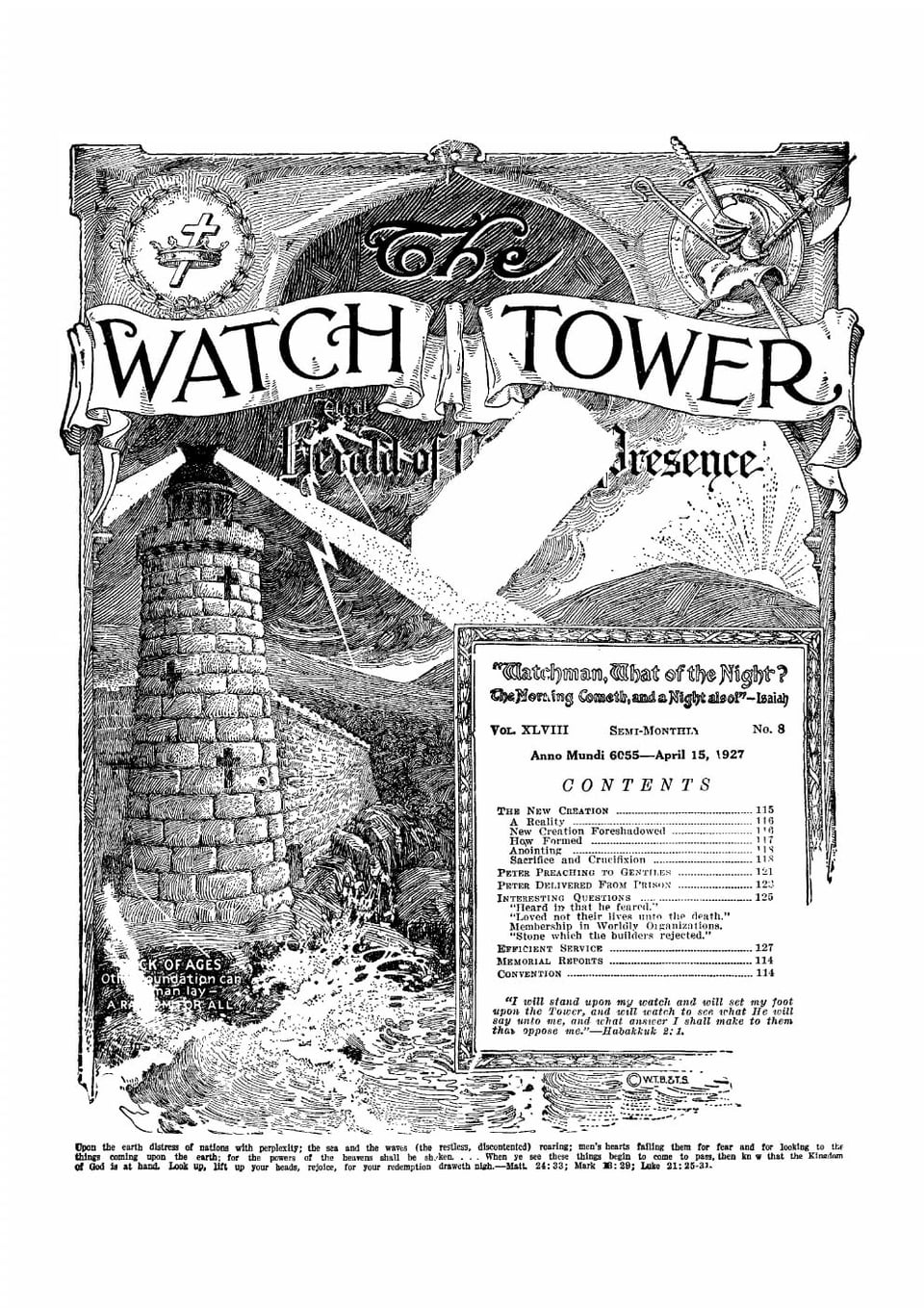
THE WATCH TOWER
"Watchman, What of the Night?
The Morning Cometh, and a Night also!"—Isaiah
VOL. XLVIII SEMI-MONTHLY No. 8
Anno Mundi 6055—April 15, 1927
CONTENTS
THE NEW CREATION .................................................. 115
A Reality ............................................................. 116
How Formed .......................................................... 117
Assimilation .......................................................... 118
Sacrifice and Crucifixion ............................................. 118
PETER PREACHING TO GENTILES ................................. 121
PETER DELIVERED FROM PRISON ............................... 123
INTERESTING QUESTIONS .......................................... 125
"Put not your trust in princes."
"Loved not their lives unto the death."
Members in Worldly Organizations.
Stone which the builders rejected.
EFFICIENT SERVICE .................................................. 127
MEMORIAL REPORTS ................................................ 114
CONVENTION .......................................................... 114
"Thou wilt stand upon my watch, and will set my foot upon the Tower, and will watch to see what He will say unto thee."—Habakkuk 2:1.
Upon the earth distress of nations with perplexity; the sea and the waves (the restless, discontented) roaring; men's hearts failing them for fear and for looking to the things coming upon the earth; for the powers of the heavens shall be shaken.... When ye see these things begin to come to pass, then know that the Kingdom of God is at hand. Look up, lift up your heads, rejoice, for your redemption draweth nigh.—Matt. 24:33; Mark 13:28; Luke 21:25-27.
THIS JOURNAL AND ITS SACRED MISSION
This journal is published by the WATCH TOWER BIBLE AND TRACT SOCIETY for the purpose of aiding the people to understand the divine plan. It provides systematic Bible study in which all its readers may regularly engage. It gives announcement of the visits made to Bible classes by traveling speakers, announces conventions, and gives the reports thereof. The International Sunday School lessons are treated in harmony with the Scriptures.
It adheres strictly to the Bible as God's revealed Word of Truth. It stands firmly upon the great ransom sacrifice as the fundamental doctrine by which all doctrines are measured. It is free from parties, sects, and creeds of men. It does not assume a dogmatic attitude, but confidently invites a careful examination of its utterances in the light of the Infallible Word of God. It does not indulge in controversies, and its columns are not open to personalities.
TO US THE SCRIPTURES CLEARLY TEACH
THAT JEHOVAH is the only true God, the Maker of heaven and earth, and is from everlasting to everlasting; that the Logos was the beginning of his creation; that the Logos became a man; that he is now the Lord Jesus Christ in glory, clothed with all power in heaven and earth.
THAT GOD created the earth for man, created perfect man for the earth and placed him upon it; that man willfully disobeyed God's law and was sentenced to death; that by reason of Adam's wrongful act all men are born sinners and without the right to life.
THAT JESUS was made a human being in order that he might become the Redeemer of man; that he gave his life a sacrifice for mankind thereby produced the ransom price that Jesus the divine Person from the dead, ascended into heaven, and presented the value of his human sacrifice as the redemptive price for man.
THAT for many centuries God, through Christ, has been selecting from amongst men the members of his church, which constitutes the body of Christ; that the mission of the church is to follow in the footsteps of her Lord Christ Jesus, grow in his likeness, give testimony to the name and plan of Jehovah God, and ultimately be glorified with Christ Jesus in his heavenly kingdom; that Christ, Head and body, constitutes the "seed of Abraham" through which all the families of the earth shall be blessed.
THAT THE WORLD HAS ENDED; that the Lord Jesus has returned and is now present; that Jehovah has placed Christ Jesus upon his throne and now commands all nations and peoples to hear and obey him.
THAT THE HOPE of the peoples of earth is restoration to human perfection during the reign of Christ; that the reign of Christ will afford opportunity to every man to have a fair trial for life, and those who obey will live on earth for ever in a state of happiness.
PUBLISHED BY
117 ADAMS STREET . . . BROOKLYN, N. Y. U. S. A.
OFFICERS
J. F. RUTHERFORD President
W. E. VAN AMBURGH Secy & Treas.
YEARLY SUBSCRIPTION PRICE: UNITED STATES 1.00; CANADA AND MISCELLANEOUS FOREIGN,1.50; GREAT BRITAIN, AUSTRALASIA AND SOUTH AFRICA, 75c. American remittances should be made by Express or Postal Money Order, payable to Watch Tower Society, Brooklyn, N. Y. South African and Australasian remittances should be made to branch offices only. Remittances from scattered foreign territory may be sent to the Brooklyn office, but by International Postal Money Orders only.
(Foreign translations of this journal appear in several languages.)
TERMS TO THE LORD'S POOR: All Bible Students who, by reason of old age or other infirmity or adversity, are unable to pay for this journal, will be supplied free if they send a postal card each May stating their case and requesting such provision. We are not only willing but anxious, that all such be on our list continually and in touch with the Brethren studies.
Notice to Subscribers: We do not, as a rule, send a card of acknowledgment for a renewal or for a new subscription. A renewal blank (carrying notice of address change) will be sent with the journal one month before the subscription expires. Change of address, when requested, may be expected to appear on address label within one month.
Entered as Second Class Mail Matter at Brooklyn, N. Y. Postoffice Act of March 3rd, 1879.
CONVENTION
Again the friends are reminded that the international convention of the consecrated will be held at Toronto, July 18th to 20th. This will be a wonderful opportunity for encouraging one another in the service, and it is hoped that as many as possible may attend. Arrangements are being perfected for special trains from all parts of the country. Within a short time these trains will be announced in THE WATCH TOWER. Let all the brethren get ready for this convention. All should go who can do so reasonably, and those who cannot do so should encourage others who are going; and let all take the matter constantly before the Lord in prayer, asking that this convention may be a great witness to his Name.
Rooming accommodations will be handled by the Society's Toronto office. More detailed information concerning this will be given later.
EDITORIAL COMMITTEE
J. F. RUTHERFORD
W. E. VAN AMBURGH J. HEMERY R. H. BARBER E. J. COWARD
FOREIGN OFFICES: British: 34 Craven Terrace, Lancaster Gate, London W. 2; Canadian: 38-40 Irwin Avenue, Toronto, Ontario; Australasian: 495 Collins St, Melbourne, Australia; South Africa: 6 Lele St, Cape Town, South Africa. Please address the SOCIETY in every case.
MEMORIAL REPORTS
Immediately following the celebration of the Memorial each class is requested to report the number partaking. The class secretary should give this attention, addressing the letter or card to Watch Tower Bible & Tract Society, 117 Adams St., Brooklyn, N. Y.
CANVASSING PARTIES
All canvassing parties and all individuals who canvass should mention the radio station in that vicinity that is broadcasting the truth. This often proves a means of opening the windows of the soul into the hearts of the people. Have in mind that the chief purpose of the radio is to call the people's attention to the truth and then furnish the opportunity for them to get a wider understanding of the truth by reading what is being printed.
SPECIAL PUBLIC MEETINGS
Instead of having a public meeting every week arrangements might be made at stated intervals, after consulting the office, for public meetings well advertised. But these should be held once from time to time and then held a great effort should be put forth to get the people out. After radio has served a community for some time, then arrangements might be made for a well-advertised meeting in a public hall, and the announcement made over the radio. This might lead then to the organization of a class for Bible study.
PILGRIM SERVICE
An effort will be made to have the regular pilgrim brethren serve the classes in districts that are not yet favored with the use of a radio. These pilgrim brethren will respectively be special service organizers for the district when serving it, and will put forth an effort to organize the service work in a more efficient manner and encourage the brethren to participate in it.
The WATCH TOWER
AND HERALD OF CHRIST'S PRESENCE
Vol. XLVIII APRIL 15, 1927 № 8
THE NEW CREATION
"Therefore if any man be in Christ, he is a new creature: old things have passed away; behold, all things are become new."—2 Corinthians 5:17.
WHEN God created man in his own image he then "rested" from all his work which he created and made. (Genesis 2:2) Of course, this must be understood to mean that he rested from all his work insofar as that work relates to things made and created which pertain to the earth. Man was the crowning result of God's earthly creation, and was perfect.—Deuteronomy 32:4.
2 It is not necessary to conclude that God foreknew and foreordained that man would sin. As the human mind reasons, had God foreordained and foreknown that man would sin, then man was not a free agent to take whatsoever course he might choose. God invites us through his Word to reason with him, and we understand that the reasoning employed must be such as man is capable of doing. Within the scope of human reasoning the following conclusion would seem to be right, to wit:
3 The Almighty God possessed the power to foreknow and to foreordain and predestinate everything pertaining to man. The fact that he could know what course man would take also leads to the conclusion that God possesses the power to withhold from himself knowledge of what man would do under certain conditions; and therefore that instead of foreordaining and foreknowing that man would take a certain course, God made his plan in the alternative so that he could meet either emergency. By this is meant that God said to man, in substance: 'All these things you may have and do; certain other things you must not have and you must not do; if you take one course you shall be always in harmony with me and live; if you take the other course you shall die.' Man was then free to take either course.
4 Of his own volition man chose the evil way. Consistently with his law God put him to death. Had man chosen the right course and done that which was pleasing to God, he would have filled the earth with a perfect race of happy people, all to the glory of God. In that event it would not have been necessary for the Lord to provide for redemption and to carry out the plan of redemption. Having chosen the evil course Adam and his offspring must perish unless God did something in man's behalf. The plan of God therefore must have been that in the event man took the evil course provision for his recovery would be put in operation.
5 Man took the evil course, and God's provision for his recovery is through a new creation. This was implied in the promise God gave to Abraham: "In thy seed shall all the families of the earth be blessed." "The seed" must be produced first, then the blessing. "The seed" is the new creation. That new creation for many long centuries remained a "hidden mystery", until God's due time to make it known to his saints. (Colossians 1:26) Even today only those who have the spirit of the Lord can understand and appreciate that mystery of God.
THE BEGINNING
6 The Logos lived and had the right to life on the spirit plane. He was the beginning of God's creation. Thereafter he was the active agent of Jehovah in the creation of all things. The Logos did not die. Life means existence and the right to exist in harmony with Jehovah's will. The life and the right to life of the Logos were transferred from the spirit to the human plane. By the power of Jehovah he was begotten and brought forth a human child. (Matthew 1:18) One of the purposes of his being born and brought into the world was that he might bear witness to God's truth.—John 18:37.
7 That the Logos as an entity did not die during the transfer from spirit to human nature is proven by the testimony of Jesus himself: "Before Abraham was, I am." (John 8:58) These words imply a continuous existence. To die means to go out of existence, with the right to existence gone. Hence when Jesus said, "Before Abraham was, I am," he meant that from the time of the beginning of creation until that moment he had existed and had the right to exist.
8 When Jesus was thirty years of age as a man, he came to John and was baptized. By this he signified that he had agreed to do his Father's will, as it was previously written of him in the Book. (Psalm 40:8; Luke 3: 21-23) It was the will of God that the perfect man Jesus should be a sacrifice, that the redemptive price might be thereby provided for the recovery of Adam and his offspring.
Jesus laid down his life as a man, and laid down the right to life as a man, but retained the power to take it up again and use it in harmony with the divine will. This is proven by his words: "I have power to lay it down, and I have power to take it again."—John 10: 18.
9 At the time of his consecration Jesus was begotten and anointed by the holy spirit of God as a creature on the divine plane. That was the beginning of God's new creation. At that same time the foundation of the new world was laid. (Revelation 13: 8) Before that time it was God's purpose and plan that his new creation should be composed of many members, with Christ Jesus as the Head. This does not imply that he predestinated the individuals who make up the new creation, but that he did predestinate the class composed of the members thereof. "According as he hath chosen us in him before the foundation of the world, that we should be holy and without blame before him in love: having predestinated us unto the adoption of children by Jesus Christ to himself, according to the good pleasure of his will, to the praise and glory of his grace, wherein he hath made us accepted in the beloved."—Ephesians 1: 4-6.
A REALITY
10 The statement of the apostle is positive that "if any man be in Christ he is a new creature". He did not say that he is a reckoned new creature, with an existence counted unto him, but in positive and plain terms he says that the new creature is a real thing. The scripture does not say that the new creature is merely a gestated thing that ultimately comes to the birth. It does not say that it is an embryo, which is quickened and developed and born in the form that a human creature is born. If a creature is being gestated, or in the process of gestation, then there could be no responsibility of that creature during that period.
11 The so-called orthodox system of religion teaches that the new creature is given the seed of God or the seed of immortality, and that this seed is perambulating about in the human creature. If that doctrine were true, then it would be impossible for the new creature to ever die, because that which is immortal cannot die. If such an one thus begotten should become wicked the result would be endless wickedness, and from this thought grows the eternal torment theory.
12 Others have taught that "the 'inner man' is the new creature, which is given a seed of incorruptibility within". Such is practically the same as saying that man has a soul within him which is separate and distinct from himself. Both of these doctrines are wrong and unscriptural. The thought that the natural begetting, gestation, quickening and coming to the birth illustrate the development of the new creature is not at all in harmony with the Scriptural teachings concerning the new creation. The Scriptures show that from the time the new creature is begotten and anointed he is a new creature, and that his responsibility begins as such from that time.
NEW CREATION FORESHADOWED
13 Israel after the flesh was selected as the people of God. That people in truth and in fact foreshadowed the new creation, which is also the people of God selected and elected for a purpose. Israel after the flesh was a moving picture provided by Jehovah; and it foreshadowed the real thing, which is the true people of God, to wit, the new creation or spiritual Israel. Jacob, whose name was changed to Israel, was the beginning of the Israelites after the flesh. Jacob's seed was born to their favor under the terms of the Law Covenant. The new creation is spiritual Israel, begotten and brought forth under the terms of a covenant by sacrifice.
14 Moses was a mediator or a go-between for God and Israel. He was the spokesman of God to the Israelites. Through him God said to the people of Israel: "Now therefore, if ye will obey my voice indeed, and keep my covenant, then ye shall be a peculiar treasure unto me above all people: for all the earth is mine: and ye shall be unto me a kingdom of priests, and an holy nation. These are the words which thou shalt speak unto the children of Israel. And Moses came and called for the elders of the people, and laid before their faces all these words which the Lord commanded him. And all the people answered together, and said, All that the Lord hath spoken we will do. And Moses returned the words of the people unto the Lord."—Exodus 19: 5-8.
15 The Israelites agreed to do all the things spoken to them by the Lord through Moses. Thereby they bound themselves to the terms of that covenant, to be obedient to God. The Law Covenant served as a schoolmaster, to safeguard and lead the obedient of Israel after the flesh, until God's due time to begin the new creation, with Christ Jesus as the Head. The nation as a whole failed in obedience, therefore failed to keep the terms of the covenant, and lost everything that the covenant provided.
16 A small remnant, however, continued in faith, and such of these as were living at the first advent accepted Christ Jesus and became a part of the new creation. (Romans 11: 5) To such and to all others who have come into Christ, St. Peter says: "But ye are a chosen generation, a royal priesthood, an holy nation, a peculiar people; that ye should show forth the praises of him who hath called you out of darkness into his marvellous light: which in time past were not a people, but are now the people of God; which had not obtained mercy, but now have obtained mercy." (1 Peter 2: 9, 10) Thus is shown that Israel after the flesh foreshadowed Israel after the spirit; that the latter were at one time not a people, but have now become the people of God for his purposes.
HOW FORMED
17 The new creation, mentioned as spiritual Israel, is begun and is completed by the terms of a covenant. Jesus, the Head thereof, made a covenant with Jehovah at the Jordan to do his Father's will. That covenant entailed upon Jesus the sacrificing of himself as a man. All persons thereafter becoming a part of the new creation must do so by and through a covenant of sacrifice. (Psalm 50: 5) Before a Jew or any one else could be in line for membership in the new creation it was necessary for Jesus to die as a man and be resurrected as a divine being, and then to take up the value of that perfect human life laid down and present it to Jehovah as the redemptive price for mankind.
18 The beginning of the selection of the members of the new creation through Christ therefore dates from Pentecost, when the disciples were begotten of the holy spirit. Their part of the covenant of sacrifice, however, had been made prior to that time; to wit, when they accepted Jesus as the Messiah and became his followers. God's part of the covenant with them was made at the time they were justified, begotten and anointed of the holy spirit, which was at Pentecost. Then and there they became new creatures or members of the new creation.
19 The new creation is a select or elect company taken out from amongst men, who are then adopted into the family of God through Jesus Christ. The new creation complete is The Christ complete. Christ means anointed of God. It is God's Christ or God's anointed. Christ is the active agency of Jehovah God, used and to be used for ever for his own good purposes. God's manner of selecting and forming the new creation is important. His Word tells in what manner he selects and develops the members thereof.
20 Seeing that all the human race is born in sin, and that no one can approach God who is a sinner, what can a sinner do to come into harmony with God? The first thing essential is for that man to realize that he is a sinner, needs help, and that he is unable to help himself. He must have a desire in his mind for righteousness. He learns that he was born a sinner and was so born because of the sin of the parent of the human race, Adam. He learns that Jehovah is God and that Jesus is God's beloved Son. He wants to learn more about Jesus and come into harmony with him, because he knows that the beloved Son is in harmony with his Father.
21 To such Jesus says: "No man can come unto me, except the Father which hath sent me draw him." (John 6: 44) How does God draw the sinner to Jesus? By the knowledge which the sinner is enabled to obtain concerning Jesus and his relationship to Jehovah. Many a Christian can recount experiences in his life, before becoming a Christian, wherein it seems that the Lord's hand must have been supervising his affairs in some particular way. It is not unreasonable that God, seeing a man who possesses an honest desire for righteousness, would cause such circumstances to arise in his affairs as would attract him to the Lord Jesus; and thus he would be drawn to Jesus.
22 Proof of this is found in the experiences of Cornelius. He knew nothing of the plan of salvation through Jesus Christ, but he had faith in and reverence for Jehovah. He had an honest and righteous desire to be in harmony with God. In due time God sent Peter to tell him concerning God's plan of salvation through Jesus Christ. (Acts 10: 1-48) It was the faith of Cornelius and his desire for righteousness that God rewarded. It was because of this righteous desire in his heart that God provided the circumstances for him to get the truth. What is true of Cornelius must in some measure be true of all who have come to the Lord.
23 In coming to the Lord an honest heart and faith in God are first essentials. (Hebrews 11: 6) A man who believes that God exists, that he is the rewarder of those who diligently seek him, is favored by that knowledge and by the circumstances that are thrown around him which draw him to Jesus. When he learns that Jesus Christ, by his death and resurrection, provided the great redemptive price for man, he learns that the only way back to God and to life is through Christ Jesus. (John 14: 6) Jesus says to such an one, in substance: 'If you desire to come to God and to follow in the way that I go you must deny yourself, then take up your cross and follow.' (Matthew 16: 24) Self-denial, within the meaning of this scripture, is consecration. That means an agreement unconditionally to do the will of Jehovah God.
FAITH
24 Faith means to have knowledge concerning God and his plan and his promises, and then to confidently rely thereupon. Progressing to this point in knowledge and belief that Jesus is the Redeemer of man, and confidently relying thereupon, such an one who thus does has faith. He exercises that faith by making a consecration by which he agrees to do the will of God. That is man's part of the covenant. He puts himself wholly into the hands of the Lord. The blood of Jesus shed for man, and faith of the man in the value of that sacrifice, is the basis whereupon God takes action with the man.
25 God then justifies the man thus consecrating. Justification means to be made right with God. It is the judicial act of Jehovah whereby he determines that the man who has exercised faith in the ransom sacrifice by making a consecration is just, or right, and at peace with God. The three things operating in justification are these, to wit: First, by faith are ye justified (Romans 5: 1); second, by the blood of Jesus are ye justified (Romans 5: 9); third, "it is God that justifies."—Romans 8: 33.
26 The man making the consecration has agreed to do God's will. It is the will of God that he be brought into the divine family as a member of God's new creation. For this purpose God justifies him in order that the man might be an acceptable sacrifice as a member of his beloved One.
What does man sacrifice? His right to live as a human being. Since he was born a sinner, where did he get that right to live as a human being? When God justifies man, that entitles him to live as a human being; because all who are right with God have the right to life. The justification of man constitutes the call or invitation to the high calling, otherwise designated the heavenly calling. Recognition of the fact that God would justify one, of itself constitutes God's call. (Romans 8:30) The members of the new creation are called to one hope, and that is a hope of life in heaven.—Ephesians 4:4; 1 Peter 1:4.
27 Begetting of the new creature is the next step. "Of his own will begat he us with the word of truth, that we should be a kind of firstfruits of his creatures." (James 1:18) God, in the exercise of his will by his Word of Truth, gives to the called one his exceeding great and precious promises whereby the Lord agrees that if the one called is faithful to his part of the covenant he shall ultimately be a partaker of the divine nature. (2 Peter 1:4-11) The called one is therefore begotten to a hope of life on the divine plane, reserved in heaven for those who are kept by the power of God. (1 Peter 1:1-4) Thereby the called one is inducted into Christ by the spirit of Jehovah. Having now been adopted into the family of God, the called one can address Jehovah as Father, because God has begotten him as a new creature.—Romans 8:15.
ANOINTING
28 Anointing means to designate one to a place of authority to do and to act for and in behalf of and under the direction of the one conferring the authority. Christ Jesus was anointed by the holy spirit of Jehovah to be Head of the new creation. (Colossians 1:18, 19; John 1:32) All who are adopted into Christ receive the anointing of the holy spirit of God through the Head, Christ Jesus. This was pictured in the manner of anointing the typical high priest. (Psalm 133:1-3) It is God who does the anointing; and he anoints the called one through the Head, Christ Jesus. (1 John 2:20) Thus begotten and anointed of God the creature is now new. He is now in Christ Jesus and is, for that reason a part of the new creation.
29 Of what does the new creation consist? A creature is possessed of a mind, will, heart, and organism. The new creature consists of these, all of which are devoted to the Lord. When he was of the Adamic creation, the holy spirit of God did not work in his mind. But as a new creature the invisible power of God, which is his holy spirit, is now working in the mind and transforming the same in harmony with the will of God.
30 Adam was made of the elements of the earth without the exercise of his will power. The new creature is made of willing earthly material in the hands of God, and by the exercise of the creature's will power he is led to a full and complete surrender of self and agrees to do God's will. In the creation of Adam the body was first formed from the elements of the earth, and then God breathed into his nostrils "the breath of lives" and a living, moving, sentient being resulted. In the new creation the order is reversed. The mind is transformed as the spirit of God operates thereupon.
31 But while this transformation process is going on the mind must have a body in which to function. God and all his spirit creation necessarily have bodies. No creature can exist without an organism. The body of sinful man is dominated by the will of the flesh. The new creature, now begotten, must have a body or organism suited to its environment. God therefore counts the body of flesh of the consecrated person as the body of the new creature, and counts it righteous. "But if the spirit of him that raised up Jesus from the dead dwell in you, he that raised up Christ from the dead shall also quicken your mortal bodies by his spirit that dwelleth in you."—Romans 8:11.
32 This text last quoted does not say and does not mean that the new creature is begotten or conceived like an animal creature and then progresses until the foetus gives signs of life. It says and it means that he who is the new creature in Christ by reason of the indwelling of the holy spirit is stimulated to activity in the service of the Lord and to the Lord's glory. This text is the only one in the Scriptures referring to the organism of the new creation as quickened, and it does not have the thought of the quickening like unto an animal creature in embryo. The new creature must be the servant of God, and the body of that creature must be used to the glory of God and will be so used in proportion to the spirit of the Lord possessed by him.
33 He who is now of the new creation in Christ must give all diligence to the making of his calling and election sure. (2 Peter 1:10) He must give diligence in the performance of his part of the covenant. The body of flesh, being a part of the new creature, must serve God. To make his calling and election sure means that he must make it firm, stable and certain; and this is done by the joyful performance of the will of God in harmony with the terms of his covenant. Therefore serving the Lord with mind, will, heart and body is essential to the well-being of the new creature. In no other way can one grow into the likeness of the Head, Christ Jesus. It is the being of the consecrated one that is the new creature or new creation, and his body is a part thereof. "Know ye not that your bodies are the members of Christ?" (1 Corinthians 6:15) For this reason the apostle forbids the consecrated person to marry an unconsecrated person. The relationship to be pleasing to God must be between those who are in Christ.
SACRIFICE AND CRUCIFIXION
34 The justified human being becomes a part of the sacrifice of our Lord. Christ Jesus offers such as a part of his sacrifice. The human body or body of flesh is the organism of the new creature while in the flesh.
The new creature must deport himself according to the will of the Lord; therefore the justified human body must be used as the Lord directs. The consecrated called one does not sacrifice himself. The priest does the sacrificing; but the new creature must keep the sacrifice willingly presented to the High Priest, Christ. His love for the Lord causes him to do so. "Bind the sacrifice with cords, even unto the horns of the altar."—Psalm 118:27.
35 In harmony with this the Apostle Paul says to the spirit-begotten and anointed ones, in substance: 'Brethren, by the mercies of God, you have been given the greatest privilege that any creatures could have, and that is the privilege of being a part of the new creation of God. Your bodies are holy, because God counts them such; and they are acceptable unto the Lord God, because he has justified you. Your reasonable service is to see to it that your bodies are presented to the High Priest and used to the Lord's glory.' (Romans 12:1) For the reason here stated every consecrated one is bound by his covenant to use the faculties which endow his organism, for the service of the Lord as opportunity affords. To be in opposition to the service of the Lord therefore means to be in opposition to the new creature's own interests.
36 The mind is that faculty of the creature which searches out the facts, weighs them, and reaches a conclusion upon such facts. The will is that faculty of the creature which, when knowing the facts, determines to do or not to do a certain thing. The heart is that faculty of the creature wherein is the seat of affection and from which emanates the motive in the performance of an act. The natural tendency of the flesh is evil. But the flesh, now counted right because of justification, and being the organism of the new creature, must now be brought into complete subjection to the will that is in harmony with God.
37 The will of the new creature must always be in harmony with God, because the creature has agreed to do God's will without reservation. The mind of the new creature searches the Word of God and thereby ascertains God's will. The unregenerate creature uses his mind and will for the gratification of his flesh and selfish desires. That evil tendency and course of action is called the "old man", because that was the tendency of Adam. The "new man" is the new creature in Christ, with the mind, will, heart and organism devoted to the Lord. As such he is growing forward and upward into a perfect stature of a man in Christ Jesus.—Ephesians 4:13.
38 To accomplish that desired end the apostle said: "If so be that ye have heard him, and have been taught by him, as the truth is in Jesus; that ye put off, concerning the former conversation [behavior, course of action], the old man [depraved man], which is corrupt according to the deceitful lusts: and be renewed [made over] in the spirit [invisible power] of your mind [intellect]; and that ye put on the new man, which after God is created in righteousness and true holiness."—Ephesians 4:21-24.
39 Members of the new creation are not "dual" creatures. The body of flesh, being the organism of the creature which is now new, leads to some confusion, however, if the words of the apostle are misunderstood. The apostle says: "But though our outward man perish, yet the inward man is renewed day by day." (2 Corinthians 4:16) The "outward man" means that which is seen by all. The "inward man" means that which God looks upon; to wit, the mind, will and heart devoted to him, in harmony with the terms of the covenant. Man looks upon and judges from the outward appearance. God sees the heart, mind and intent of man, and judges him accordingly. (Hebrews 4:12) What the apostle means here is that the "outward man", which other creatures on earth see, is perishing; but that if it is being used up in harmony with the terms of his covenant with God the "inward man", namely, the mind, will and heart, is growing day by day more and more into the likeness of the Lord.
40 In writing to the church at Colosse the Apostle Paul makes the clear distinction between the old man and the new. In this statement he says: "Mortify therefore your members which are upon the earth." (Colossians 3:5) The word "mortify" means to deaden or put to death. The apostle then says, in substance: 'If you are a new creature in Christ, then seek the things which are above; set your affections on things above and not on things earthly. As a man you are dead, but as a new creature your life is hid with God in Christ.'
41 "Mortify therefore your members which are upon the earth; fornication, uncleanness, inordinate affection, evil concupiscence, and covetousness, which is idolatry: for which things' sake the wrath of God cometh on the children of disobedience: in the which ye also walked some time, when ye lived in them. But now ye also put off all these; anger, wrath, malice, blasphemy, filthy communication out of your mouth." Here the apostle defines the "old man", plainly stating that it is the one who takes the wrongful course of action as taken by Adam and those who follow in the same way.—Colossians 3:3, 5-9.
42 Then the apostle shows the course of action of the "new man", and says that the "new man" is renewed by knowledge of the Lord: "And have put on the new man, which is renewed in knowledge after the image of him that created him. . . . Put on therefore, as the elect of God, holy and beloved, bowels of mercies, kindness, humbleness of mind, meekness, longsuffering; forbearing one another, and forgiving one another, if any man have a quarrel against any: even as Christ forgave you, so also do ye. And above all these things put on charity, which is the bond of perfection. And let the peace of God rule in your hearts, to the which also ye are called in one body; and be ye thankful."—Col. 8:10, 12-15.
TRANSFORMATION
43 The new creature must make progress. The mind is the battle-ground. It is the mind that is transformed. The new creature searches out the truth of God's Word, sees the same and reaches a conclusion as to what is the will of God. For this reason it is necessary for the new creature to study the Word of God, not only occasionally but constantly. As his mind is renewed he has a clearer vision of what God's will is concerning him, and then he exercises his own will in harmony with God's will and to the pleasure of the Lord. This is the apostle's argument in Romans 12: 2: "Be not conformed to this world; but be ye transformed by the renewing of your mind, that ye may prove what is that good, and acceptable, and perfect, will of God."
44 When Moses was in the mountain he received into his face the reflected glory of God. Moses there represented Christ. The Israelites after the flesh could not look upon the face of Moses, because they did not have the spirit of the Lord that had been imparted to Moses. Therefore when Moses spoke to the Israelites officially, he put a veil over his face. When the Jews even now read the law, there is a veil or covering both over their eyes and over their heart; that is to say, they have no vision or understanding, because they have not the spirit of the Lord. Their hearts or faces are not set upon the Lord God but on self. But all who receive the spirit of the Lord as new creatures have the liberty to look with unveiled faces; that is, they have a vision of the things pertaining to the spirit of the Lord.
45 In harmony with the foregoing statement the apostle says: "And not as Moses, which put a vail over his face, that the children of Israel could not steadfastly look to the end of that which is abolished: but their minds were blinded; for until this day remaineth the same vail untaken away in the reading of the old testament; which vail is done away in Christ. But even unto this day, when Moses is read, the vail is upon their heart. Nevertheless, when it shall turn to the Lord, the vail shall be taken away. Now the Lord is that spirit; and where the spirit of the Lord is, there is liberty. But we all [the entire new creation], with open face beholding as in a glass the glory of the Lord, are changed into the same image from glory to glory, even as by the spirit of the Lord."—2 Corinthians 3: 13-18.
46 As the Christian looks into the face of Christ, as shown in the Word of God, it is as though he were looking into a glass or mirror. There he sees not his own selfishness reflected but sees Christ reflected, because he has the spirit of Christ as a new creature and his heart is right. His affection being set upon the Lord, as he thus beholds Christ the transformation proceeds from one degree of the Lord's likeness to an increased degree of that likeness. Otherwise stated, the new creature has a mental vision of Christ; and having the spirit of Christ, and his heart being set upon the Lord, he sees Christ reflected as though he were looking into a mirror; and he is thereby changed into the likeness of the Lord gradually.
47 This change consists of the new creature's growing more into the likeness of the Lord Jesus Christ, to wit, becoming more unselfishly devoted to God and to the ministry which the Lord has committed unto the creature. He unselfishly gives attention to the interests of the kingdom committed to him. More clearly he sees that the Lord has given to him the holy spirit, that he might represent the Lord's interests. This transformation continues as the new creature uses the faculties with which he is endowed to unselfishly serve the Lord's cause. As he thus does the "outward man" continues to be consumed, and is consumed in due time; and while this is going on the "inner man" is growing more like the Lord, and in the resurrection the creature will be clothed upon with a new and glorious body suitable to his new environments in heaven. This is exactly in harmony with the apostle's argument in 2 Cor. 5: 1-4.
48 It is manifest from these scriptures that he who is in Christ is now a new creature, upon whom there rests great responsibility to perform the terms of the covenant which he agreed to at the time he was begotten. To each one thus begotten and anointed the Lord has committed the work of the ministry of reconciliation. In order to perform their obligations each and every one must participate in the service of the Lord insofar as opportunities are offered them. Not every one can do the same thing; but every one is expected to perform his "reasonable service", in harmony with what the Scriptures designate as reasonable. It now seems clearly to be the will of the Lord God that all of the new creation on earth shall be his witnesses, declaring that he is God, and that they shall lift up his standard for the people and tell the people that Jehovah has placed his King upon his throne, that the kingdom of heaven is here, and that deliverance is at hand!
QUESTIONS FOR BEREAN STUDY
How and from what did God rest, as mentioned in Genesis 2: 27? Did God foreknow that man would sin? Had provision been made for man's recovery in event he should sin, and if so what? ¶ 1-5.
How do we know that Jesus had a prehuman existence? Was his existence interrupted when he was transferred to the human plane? Was it interrupted at the cross? When did the new creation begin? In what sense has God "chosen us in him before the foundation of the world"? ¶ 6-9.
Is the Christian a "reckoned" new creature? Is he now a new creature in embryo? Is it correct to say that the "inner man" is or possesses a seed of incorruptibility? ¶ 10-12.
How was the new creation foreshadowed? How was fleshly Israel bound as God's people? Were they obedient? How and to whom was the Law Covenant a schoolmaster? ¶ 13-16.
Under what covenant is the new creation brought forth, and what are its terms? Did the apostles enter into such a covenant before Pentecost? By what other names is the new creation Scripturally known? ¶ 17-19.
How can a sinner approach God who does not look upon sin? How can he be drawn up? Give a Biblical illustration of the point. What primary qualities must the drawn one possess? ¶ 20-23.
What Is faith and how is it exercised? What is justification and how is it accomplished? What is its purpose? How and to what are we called? ¶ 24-26.
Define the begetting and anointing of the new creature. ¶ 27, 28.
Of what does the new creature consist? How does its beginning compare with the creation of Adam? What body does it now have? Explain the word "quicken" as used in Romans 8:11. How can the new creature make his calling and election sure? ¶ 29-33.
Is our justified humanity a part of the sacrifice of Christ Jesus? Do we sacrifice ourselves? How do we "bind the sacrifice to the horns of the altar"? ¶ 84, 85.
Define mind, will and heart. ¶ 86, 87.
What is the "old man" and the "new man" of Ephesians 4:21-24? What is the "outward man" and the "inward man" of 2 Corinthians 4:16? Explain Colossians 3:5-15 in this connection. ¶ 38-42.
How is the new creature "transformed"? Explain 2 Corinthians 3:13-18. Of what does the change from glory to glory consist? ¶ 43-47.
Summarize the principal points in this study, and show what the Lord expects of each member of the new creation. ¶ 48.
PETER PREACHING TO GENTILES
——JUNE 5—ACTS, CHAPTERS 10, 11——
"For there is no distinction between Jew and Greek: for the same Lord is Lord of all, and is rich unto all that call upon him."—Romans 10:12.
ALTHOUGH Jesus had told Peter that he should have the keys of the kingdom of heaven, Peter does not appear to have known how or when they were to be used. Probably after Pentecost he knew that his privilege of declaring that any of Israel who accepted Jesus would receive the holy spirit even as the apostles had done was the first use of the keys; but he does not appear to have then realized that he was to do a similar work which should be as the opening of a door by which the Gentiles also might enter the kingdom.
2 It appears that Peter traveled round Judea and Samaria; and from time to time he would visit Galilee, his native parts where there were many disciples. One considerable journey of visiting service ended in Joppa on the coast; and there he stayed for a time, lodging in the house of a tanner named Simon. Whether this Simon was a brother in the faith is not stated, but it is probable that Peter would seek accommodation amongst the brethren wherever possible. It was during his short stay there that the time came for the long foreshadowed entrance of Gentiles into the favor of God, hitherto held so exclusively by Israel.
3 Long ago, in the earliest days of Israel's history as a chosen people, Moses had indicated that the Gentiles should eventually come into favor with God's people Israel; for when referring to the full blessings which were to come upon Israel he said, "Rejoice, O ye nations, with his people." (Deuteronomy 32:43) And Abraham, the father of the faithful, was chosen to be the blesser of the families of the earth, Gentiles as well as Jews; of the goyim as well as of the chosen.
4 No doubt the apostles, remembering the Lord's words, often questioned among themselves what nation it would be which would be favored by God when Israel was cast off, and which would give to God the fruits of his husbandry. (Matthew 21:43) But it was not till many years had passed that Peter and the others of The Twelve understood. Then they learned that it was none of the nations of the earth, but a new people gathered out from all the nations, a holy nation, a people who were separated to God in the faith of Jesus Christ.
5 When Peter was in Joppa, about A. D. 36, helping the brethren and perhaps waiting for an indication of what he should do, Cornelius, a Roman soldier in Cesarea, had a vision. He was a good man who for a time had been praying, evidently for light to do the will of God and not merely as worship or for the care and protection of God. Some think he was the centurion mentioned in the Gospels whose sick servant Jesus healed. (Luke 7:2-10) Whether this be so or not, it is evident that he was well disposed toward God's people; he was no despiser of the Jews. He had taught his household to share his prayers.
6 How long Cornelius had prayed is not told, but none of his prayers had been wasted. The angel who appeared to him in the vision told him that his prayers had come up for a memorial before God. (See Acts 10:31.) That is, the time had now come when God would answer; they had been preserved till the due time came when God would have them before him for his notice. The simple fact is that the time had come when the truth must go to the Gentiles.
7 All God's works are done in order. It was in "the fulness of time" when God sent his Son into the world (Galatians 4:4); it was exactly on time that Jesus died; likewise, the entrance of the nations into the favor of God was fixed according to God's schedule. The chronology of the Bible shows that the promise to Abraham, that all the nations of the earth should be blessed in him, was made exactly at the half-way point between the fall of man and the time when God sent Peter to Cornelius to open the kingdom of heaven to the nations.
8 But the blessings of the kingdom were then only for those who sought, as Cornelius did; the real fulfilment of the promise comes with the return of Jesus when he brings the blessings of God to all mankind. During the first period (of 2081 years), from Adam's fall to Abraham, the way to God was open to those who sought him, and was found by Abel and a few others; but during the second period (of 2081 years), from Abraham to Cornelius, God reserved his favor to the chosen family.
Then again the way was open to those who would seek after God; but the way has been narrow, and few have found it. Now the time is upon the world when God will have all men know him, and the responsibility of their salvation will be upon themselves.—1 Timothy 2:4.
9 About three o'clock one afternoon Cornelius had a vision. Probably he had made that hour, the Jews' hour of prayer, his own hour. He was told to send men to Joppa for one Simon Peter, who lodged with Simon a tanner, whose house was at the seaside. As Cornelius was a man under authority, accustomed both to do things on time and to have them done in time and order, he lost no time in obeying the angel's instruction. Calling two personal servants and a soldier who waited on him, he told them fully of the vision and at once sent them to Joppa.
10 On the morrow, as the servants of Cornelius approached Joppa, Peter went on the housetop to pray. Becoming hungry, he went to ask for food to be prepared; returning while they made ready, he fell into a trance. In a vision heaven was opened and food supplied him. He saw a great sheet let down from heaven, wherein were all kinds of living things. He heard a voice saying, "Rise, Peter; kill, and eat." Peter's orthodox regularity prevailed. He said, "Not so, Lord; for I have never eaten anything that is common or unclean." The command came again with the added word, "What God hath cleansed, that call not thou common." (Acts 10:13-15) Peter still hesitated. For the third time the command came to him; and as he was still slow, he lost his chance; the sheet was lifted to heaven.
11 Peter was perplexed. It was just then that the men whom Cornelius had sent the previous evening arrived at Simon's door and asked for Peter. Still thinking upon the vision the spirit spoke to him to say that he was to go with the men, nothing doubting. He went down to them and inquired of them the cause of their call; and they related this to him. During the afternoon Peter arranged for two or three of the local brethren to accompany him. Next morning they started for Cesarea.
12 Arriving at Cesarea they found Cornelius and his kinsmen and some friends waiting for Peter; Cornelius had been active in his desire to help his friends as well as his household. Peter at once addressed them, stating first of all the difficulty he would have had as a Jew of entering into fellowship with Gentiles, but that God had taught him not to call anything unclean. After hearing how the angel had spoken to Cornelius, and that Cornelius had known nothing about Peter's being in Joppa, or probably of Peter himself, the latter said that he perceived that God was no respecter of persons in regard to nationality.
13 Peter went on to address the little assembly. He was aware that they knew about Jesus of Nazareth, who had gone about ministering, healing the sick, and teaching the people. He told them that the apostles were witnesses of all that Jesus had done, and of what the Jews had done to him—how they had hanged him. He told how Jesus had been raised from the dead, and had shown himself to the apostles, his chosen witnesses, who did eat and drink with him after the resurrection. He said that Jesus had commanded them to speak to the people and to testify that it was he who was ordained of God to judge the quick and the dead. He further said that to Jesus all the prophets had given witness, that through this Man all who believed should receive forgiveness of sins.—Acts 10:42, 43.
14 As soon as Peter had gotten to this point his discourse was interrupted by the same demonstration of the holy spirit upon that little company as had been upon the apostles in the upper room at Pentecost. These Roman soldiers and others began to speak with tongues and to magnify God, to the great astonishment of all the Jews present; for such a manifestation upon the Gentiles was altogether unexpected. Then, realizing that baptism was the outward confession of belief, Peter said: "Can any man forbid water, that these should not be baptized, which have received the holy spirit as well as we?" Those upon whom the holy spirit fell were then immersed in the name of the Lord.—Acts 10:45-48.
15 There are four main points of importance to here notice: (1) This coming of the holy spirit was not the result of Peter's argument; (2) there was no waiting for a declaration that these men had given themselves to God; (3) they were baptized after they had received the holy spirit, making it clear that baptism is not "the door of the church"; (4) the fact of baptism, even though they now already had the spirit, signified that baptism was considered important to all the followers of Jesus Christ.
16 The noise of this event carried to Jerusalem, and they in Jerusalem "heard that the Gentiles had also received the word of God". (Acts 11:1) As soon as Peter got there on his return those disciples who held for circumcision contended with him, because he had eaten with uncircumcised Gentiles. To these contenders the fact that God had done something for the Gentiles was as nothing. Peter meekly rehearsed the matter to them, detailing everything; and then he asked them, intending his words as a rebuke: "What was I, that I could withstand God?" (Acts 11:17) This was indeed what they were doing. They then held their peace and glorified God. They acknowledged that God had granted repentance unto life unto the Gentiles also.
17 This happening opened the eyes of the Jerusalem brethren to the work of the Lord. They also heard that the brethren who had been scattered abroad by the persecution which arose with Stephen's death were telling the truth about Jesus to listening ears, and that a number of brethren from amongst the Greeks were being gathered in Antioch.
With a real pastoral care the apostles sent Barnabas, who was one of the early disciples, to Antioch. He was a good man and full of the holy spirit.
18 Many more believed, and Barnabas saw that there was need for help; and having befriended Paul in Jerusalem he went to Cilicia to seek him. Finding him they returned together, and in Antioch the first church including Gentiles was gathered. Those were great days for the church, days of gladness, days of unrest, too; for the urge of the growing church kept them all moving. The corn of wheat which fell into the ground when Jesus died was now beginning to bring forth fruit from amongst the nations.—John 12:24.
QUESTIONS FOR BEREAN STUDY
Did Peter realize the significance of "the keys of the kingdom of heaven" committed to him? What were those keys? How was Peter's time occupied following Jesus' ascension? ¶1, 2.
Did Jews expect that Gentiles would eventually come into divine favor? How did the disciples view this question? ¶3, 4.
Who was Cornelius, and what vision did he have? Why did his prayers only now come up as a memorial before God? ¶5-8.
What vision did Peter have at Joppa? Narrate what followed. How was Peter's discourse at Caesarea interrupted, and what did he then say and do? ¶9-14.
What four main points should be specially noted in this lesson? What effect did Cornelius' conversion have upon the brethren at Jerusalem? ¶15-18.
PETER DELIVERED FROM PRISON
—JUNE 12—ACTS 12:1-17—
"Many are the afflictions of the righteous: but Jehovah delivereth him out of them all."—Psalm 34:19.
JUST when the church in Antioch was gaining some influence by reason of the increase in its numbers and the prominence of some of its members, and when the message of the gospel was spreading abroad as far as Cyprus and Cilicia in Asia, what appeared to be a calamity fell on the church in Jerusalem. Herod the king, grandson of Herod the Great, thought to do hurt to the church. He imprisoned some of the brethren; and James the brother of John he caused to be slain, probably by being beheaded. He saw that this pleased the Jews; and to get more favor for himself he had Peter arrested, intending to kill him also. But because Passover was immediately upon them he held Peter in prison till the season was over.
2 As the Jews of Jesus' day did not want to have the victim of their malice on the cross while they were professing holiness in eating the Passover supper and during the special sabbath, so no doubt Herod considered himself too religious to have a man murdered at Passover. It is possible that his desire to vex the church by this ruthless taking of the leaders was a policy of provocation; if this law-abiding community would make a commotion he would have an excuse for repressive measures.
3 In all probability the taking and slaying of James was done suddenly. Perhaps the church thought that the Lord would miraculously release James. When they found that he did not do so, and that Peter was taken, they were alarmed and stirred to action. They made no agitation in the city nor any appeal to the rulers, but began to pray. The Lord did not answer them at once, and they continued in prayer through the week.
4 In the night, when the last watch had been set before the day when Herod would have slain Peter, the angel of the Lord visited the prison. Peter was well guarded; he was bound with two chains, evidently a soldier on each side was bound to him, and guards were set at the prison doors. The rulers would recall that some years before the whole company of apostles were mysteriously taken out of the temple prison when locked up for the night.
5 The prison was lit by the angel's presence. (See Matthew 28:3.) Smiling Peter on his side the angel gave him a helping hand, bidding him rise up quickly. As he rose his chains fell from his hands. He was told to gird himself, to bind on his sandals, cast his outer garment about him, and follow the angel. There was no undue haste; but time was not to be lost, for Peter must soon attend to himself. They went out, Peter as in a vision, not knowing that what was happening was real. Past two sets of guards they went; and as they approached the iron gate which led into the city the great gate opened of its own accord, as if another angel were gatekeeper for them.
6 The angel took Peter the length of one street and, giving no instructions, immediately departed. The angel's work was done. Peter was free; he must now look after himself. Left there Peter "came to himself". Now fully awake and free he realized that it was no dream or vision he had. He stopped to consider what he should do, and decided to go to the house of John Mark, the young disciple who in later days was so closely associated with him as helper in the Lord's work.
7 Knocking at the gate he was heard by a young girl who, because of this incident, has her name, Rhoda, enrolled in the Scriptures. Hearing Peter's well-known voice as he called for entrance she, too excited to open the door, ran back to tell the company who were continuing in supplication through the night for Peter's release, that Peter was at the door. They were as unbelieving as the apostles were when the women reported that Jesus was raised and had appeared to them.
Perhaps they continued to pray; but Peter, whose energy was never in doubt, and who was not afraid to call attention to himself, made himself heard by loud knocking.
8 When they had received him and would have rejoiced with him, he, lifting up his hand, asked for quietness. He told them how he had been delivered and, instructing them to tell James the Lord's "brother", he left them to go into another place. And thus, so quietly, closes the account of Peter's ministry. To what place he went we do not know; that he was always busy in the service of his beloved Master and of the God and Father of Jesus we are sure. He was in Jerusalem at the general conference (Acts 15:7), and in Antioch when Paul was there; for Paul records a disagreement which they had respecting Peter's fear of eating with the Gentiles. The holy spirit was not used to record his further movements, for the reason that the time had come when the other and wider ministry of the gospel to the Gentiles must be recorded.
…