The Watchtower, January 1, 1927
Download: PDF — The Watchtower, January 1, 1927
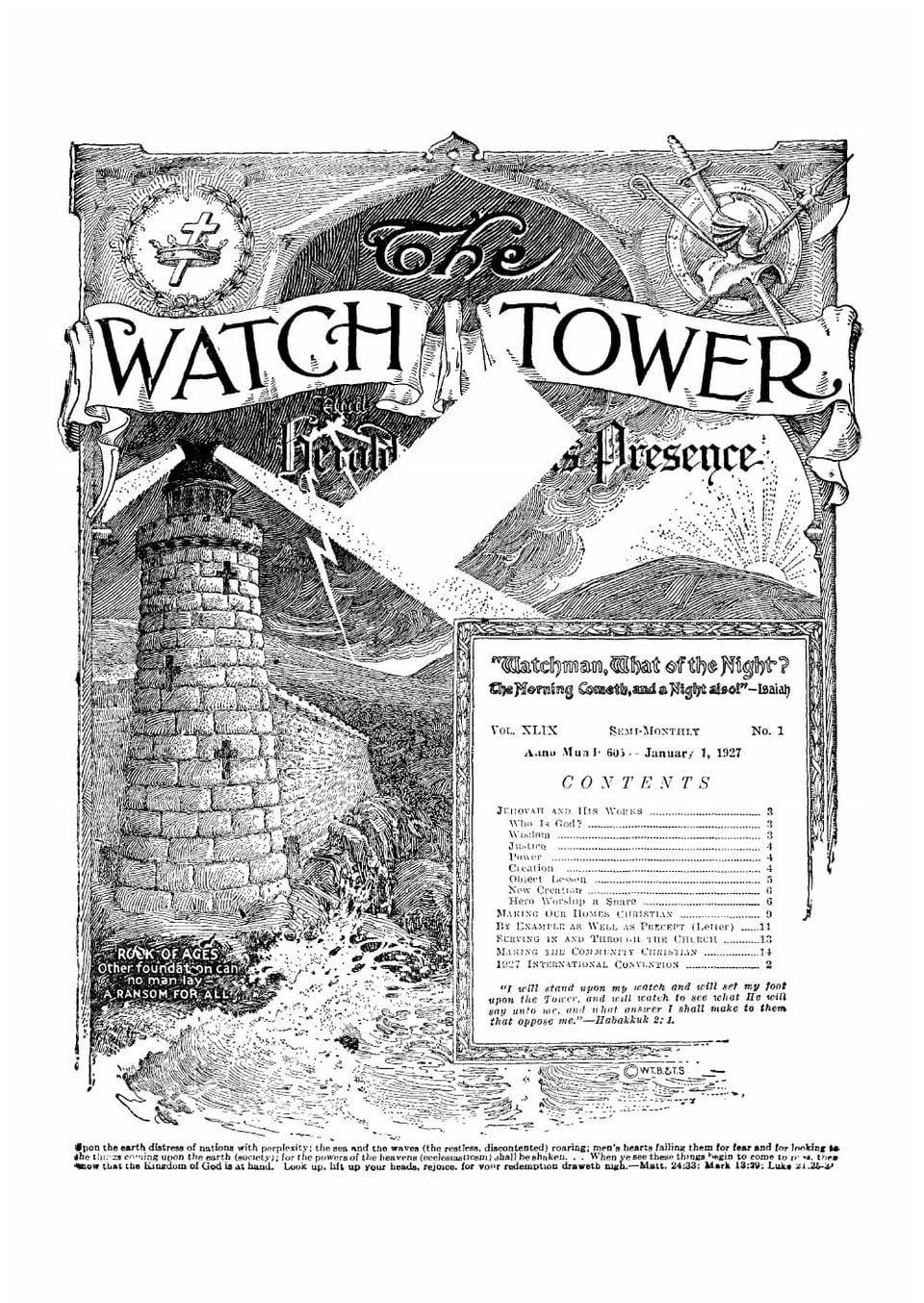
THIS JOURNAL AND ITS SACRED MISSION
THIS journal is one of the prime factors or instruments in the system of Bible instruction, or "Seminary Extension", now being presented in all parts of the civilized world by the WATCH TOWER BIBLE & TEACH SOCIETY, chartered A.D. 1848. "For the Provision of the Bible to our students, our Bible students may meet in the study of the divine Word but also as a channel of communication through which they may be received in theology's conventions and the coming of its traveling representatives, styled "Girlimps", and refreshed with reports of its conventions.
Our "Hearen Lessons" are topical rehearsals or reviews of our Society's published STUDIES most entertainingly arranged, and very helpful to all who would merit the only honorary degree which the Society accords, viz., Verha Dei Munster (V, D, M.), which translated into English is Master of God's Word. Our treatment of the International Sunday School Lessons is specially for the older Bible students and teachers. By some this feature is considered indispensable.
This journal stands firmly for the defense of the only true foundation of the Christian's hope now being so generally repudiated — redemption through the precious blood of "the man Christ Jesus, who gave himself a ransom [a corresponding price, a substitute] for all".
1 (Peter 1:10; 1 Timothy 2:6) Building up on this foundation the gold, silver and precious stones (1 Corinthians 3:11; 2 Peter 1:51; 4 of the Word of God, its further mission to "make all see what is the fellowship of the mystery which... has been hid in God, . . . to the intent that now might be made known by the church the manifold wisdom of God"—"which in other ages was not made known unto the sons of men as it is now revealed"—Ephesians 3:5-9, 10.
It stands free from all parties, sects and creeds of men, while it seeks more and more to bring its every utterance into fullest subjection to the will of God in Christ, as expressed in the holy Scriptures. It is thus free to declare boldly whatsoever the Lord Lath spoken—according to the divine wisdom granted unto us to understand his utterances. Its attitude is not dignomatic, but contentious; it is not a mere expression of our faith, but a declaration of our faith; service; our deeds relative to what may and what may not appear in its columns must be according to our judgment of his good pleasure, the teaching of his Word, for the upbringing of his people in grace and knowledge. And we not only invite but urge our readers to prove all its utterances by the invaluable Word to which reference is constantly made to facilitate such testing.
TO US THE SCRIPTURES CLEARLY TEACH
That the church is the "temple of the Living God", peculiarly "his workmanship"; that its construction has been in progress throughout the gospel age—ever since Christ became the world's Redeemer and the Chief Corner Stone of his temple, through which, when finished, God blessing shall come "to all people", and they find access to him.—1 Corinthians 3:16, 17; Ephesians 2:29:22; Genesis 2:11; Galatians 3:29.
That meanine the chiseling, shaping, and polishing of consecrated believers in Christ's atonement for sin, progresses; and when the last of these "living stones", "elect and precious," shall have been made ready, the great Master Workman will bring all together in the first resurrection; and the temple shall be filled with his glory, and be the meeting place between God and men throughout the Millemum—Revelation 15:5-8.
That the task of hope, for the church and the world, lies in the fact that "Jesus Christ, by the grace of God, tasted death for every man," "a ransom for all," and will be "the true light which lighteth every man that cometh into the world," "in due time."—
That the hope of the church is that she may be like her Lord, "see him as he is" be 'partakers of the divine nature', and share his glory as his joint-heir.—1 John 3:2; 1 John 17:24; Romans 8:17; 1 Peter 1:4.
That the present mission of the church is the perfecting of the saints for the future work of service; to develop in herself every
moment of the world; and to prepare to be kings and priests in the next age.—Iphrasis 4, 12; Matthew 24:
14; Revelation 1 6; 20, 6;
That the hope for the world lies in the blessings of knowledge and opportunity to be brought to all by Christ's Millennial kingdom, when all the wilfully wicked will be destroped. Acts 3: 19-23; Isaiah 35.
PUBLISHED BY
WATCH TOWER BIBLE & TRACT SOCIETY
18 CONCORD STREET BROOKLYN, NY, U.S.A.
FOREIGN OFFICES; British; 34 Craven Terrace, Lancaster Gate, London W. 2; Canadian; 38-40 Irrain Avenue, Toronto, Ontario; Australasian; 495 Collins St., Melbourne, Australia; South African; 6 Leile St., Cape Town, South Africa.
PLEASE ADDRESS THE SOCIETY IN EVERY CASE
YIALLY SUBSCRIPTION PRICE: U.S. NEW STATES, $1.00; CANADA
AND MISCELLANEOUS FOREIGN, $1.50; GREAT BRITAIN, AUSTRALISIA,
AND SOUTH AFRICA; T. American remittances should be made by
to the Brooklyn office, but by International Postal Money Orders only.
(Foreign translations of this journal appear in several languages.)
EDITORIAL COMMITTEE: This journal is published under the
Editorial Committee and is published and approved as truth each and every article appearing in these columns. The names of the editorial committee are: J. F. RUTHERFORD,
W. E. VAN AMBROGH, H. I. HUMERY, R. H. HARRIS, J. E. COWARD,
possion of old TITLE or other infirmity or infirmity under
pay for this journal, will be supplied free if they send a postal
card each may sentiing their case and requesting such provisions
to be on our list continually and in touch with the Berean studies.
Nature to Subscribers: We do not, as a rule, send a card of acknowledgment for a curial or for a new subscription. A removal blank (carrying notice of expiration) is required for all subscriptions of address, when requested, may be expected to appear on address label within one month. Entered as Second Class Matter at Brooklyn, N. Y. Postage of March 18, 1879.
I.B.S.A. BEREAN BIBLE. STUDIES ByMeans of "The Watch Tower"
“Holiness into the Lord”
“Sacrifice and Service”
Z May 15, 1926
Z June 1, 1826
Week of Jan 5
Week of Jan 16
Week of Jan 6
20-40
Week of Jan 15
Week of Jan 30
15-40
Week of Jan 14
1927 INTERNATIONAL CONVENTION
Toronto is the capital of Ontario and has a population of more than five hundred thousand, with another hundred thousand in the vicinity. It is a railway center. It is only a short distance from Niagara Falls. The city has provided its beautiful fair grounds and all its buildings for the Ontario Fair. The buildings are situated on ten thousand. The grounds are situated on the lake front, segregated from the busy travel, and in a very pleasant location. It is expected that the entire proceedings of the convention will be broadcast from our own station, remote control being installed at the concert auditorium.
The general convention of the International Bible Students Association for 1927 will be held July 18th to 26th, at 11am. The meeting is made now to permit the friends throughout the earth to get ready. Brettens are expected from many countries.
This will be the only large convention during the year. All classes desiring to hold local conventions should notify the Society as early as possible so that pilgrims may be routed in that way if at all possible.
RADIO PROGRAMS
The following stations are broadcasting the kingdom message:
Tuesday, Tues., Tues., Tues., Thurs., Fr.
WORD, Batavia, IL, 275 meters, daily.
CKCK, Toronto, Ont., 291 meters, daily.
Saskatoon, Saskatchewan, 390 meters, Sun., Tue., Thursday.
KTCU, Kitchener, 390 meters, Sun., Tue., 9 to 10 p.m.
HKQ, Spokane, Wash., 394.5 meters, Sunday, 9 to 19 p.m.
KFVM, Oakland, Calif., 207 meters, Sun., Mon., Sat.
BETHEL HYMNS FOR JANUARY
</div>
Sunday
Monday
Tuesday
Wednesday
Thursday
Friday
Sat.
The WATCH TOWER AND HERALD OF CHRIST'S PRESENCE
Vol. XLIX
JANUARY 1, 1927
No.1
JEHOVAH AND HIS WORKS
"O Lord, how manifold are thy works! in wisdom hast thou made them all: the earth is full of thy riches." — Psalm 101; 24.
WITH approval and commendation many clergymen and others quote from Pope's philosophic poem these word: "The proper study of mankind is man." That so-called philosophical statement is not true. It has served as a means of deception for many years. It is a sample of worldly wisdom. In the sight of God, worldly wisdom is foolishness. The true Christian must look at it from the same viewpoint. It has ever been the rule among the worldly-wise to ignore the Creator and magnify the creature. (Romans 1:25) This is further evidence that man has been overreached by the cunning influence of the Devil.
2 The policy of Satan has ever been to turn the minds of men away from God, and one of his ways of doing so has been to magnify the name of man. But the time for the change has come, and that change will cause men to magnify the name of the Creator. "For it is written, I will destroy the wisdom of the wise, and will bring to nothing the understanding of the prudent. Where is the wise? where is the scribe? where is the disputer of this world? hath not God made foolish the wisdom of this world?"—1 Corinthians 1:19, 20.
3 The proper study of mankind is Jebovah God and his works. Such course alone leads to life. "This is life eternal, that they might know the only true God, and Jesus Christ, whom thou hast sent." (John 17:3) Jebovah God is the source of life. His works mark out the way and the means of attaining life.—Proverbs 8:22; John 14:6.
WHO IS GOD?
4 How can man study God? The Eternal One reveals himself through his Word and through his works. The Bible is the Word of God and is written for the instruction of man. Concerning himself God caused to be written in his Word that he is "from everlasting-to everlasting". (Psalm 90:2) "Whose name alone is Jehovah." (Psalm 83:18) That name signifies self-existing and eternal One. It was the name by which he declared himself to his chosen people and signified his purpose toward them.—Exodus 6:3-8.
5 Jehovah is the immortal One, dwelling in the light to which none can approach. No man has seen him nor can see him. (1 Timothy 6:16) God is the name by which he is known in connection with his creation. (Gene-is 1:1) He is the one who made heaven and earth. (Isaiah 12:5) He assumes responsibility for all creation. While he acts through his duty commissioned representative, he is the great Creator.
WISDOM
6 The wisdom of God is expressed in his creation, "Known unto God are all his works, from the beginning of the world." (Acts 15: 18) There is no limitation to his knowledge, and he applies that knowledge always in the right way. It is impossible for him to make a mistake. Possessing the wisdom to know everything in advance, he likewise has the wisdom and ability to withhold from himself all things that he does not want to know, until his due time to know them. He is above, before and beyond all his works. His majesty he reveals outside of himself. For a mantle he wraps himself with the light; he stretches out the heavens like a curtain, and thereon makes his abiding place.
7 There is none to give God a voice. (Isaiah 40:14) "The counsel of the Lord standeth for ever, the thoughts of his heart to all generations." (Psalm 33:11) So completely is his wi-dem expressed in his works that "whatsoever God doeth it shall be for ever; nothing can be put to it, nor any thing taken from it". (Ecclesiastes 3:14) In his own due time he reveals the deep and secret things of his plan, and until then no man can find them out. — Daniel 2:22; Ecclesiastes 3:11.
8 It is worse than foolishness to try to run ahead of Johovah. He numbers the stars and calls them all by name. (Psalm 147:4) 'The very hairs of your head are numbered, and not even a sparrow tells to the earth without his notice. (Matthew 10:29,30) "The Lord by wisdom hath founded the earth; by understanding hath he established the heavens. By his knowledge the depths are broken up, and the clouds drop down the dew." (Proverbs 3:19,20) It is no wonder that the wisdom of imperfect man is foolishness in the sight of God.
JUSTICE
9 Law is a rule of action, commanding that which is right and prohibiting that which is wrong. With man law and justice are not synonymous terms. The laws are not always administered or even made in harmony with justice. With God law and justice are always equal. Justice means that which is right. God is always right. His laws or rules of action for the government of his creatures are always right and true. In justice he executes his law. "Justice and judgment are the habitation of thy throne: mercy and truth shall go before thy face." - Psalm 89:14.
10 God is no respecter of persons. His law and his justice are administered the same to all, and always without partiality. (1 Peter 1:17; James 3:17) He is absolutely unchangeable, and therefore always and for ever dependable. (Malachi 3:6) Having made a promise to do anything he is certain to carry it out. His Word is never void; it always accomplishes his purposes. (Isaiah 46:11; 55:11) He always judges righteously amongst his creatures. (Isaiah 11:4) His judgments are always true. (Proverbs 19:9) “Righteous art thou, O Lord, and upright are thy judgments.” (Psalm 119:13) “Thy righteousness is like the great mountains; thy judgments are a great deep: O Lord, thou preservest man and beast.”—Psalm 36:6.
POWER
11 The power of God is without limitation. When we speak of the holy spirit we understand that it means the invisible power of God exercised according to his pleasure. God has but to will, and his power is exercised. The waters stood round about the earth and above the earth, enclosing the new earth in a canopy. On the earth it was dark. "The spirit of God moved upon the face of the waters. And God said. Let there be light: and there was light." (Genesis 1:2, 3) Thus he exercises his power. It is but necessary for him to will a thing to be done, and it is done. Nothing can withstand Jehovah. Men build governments and nations and boast of their greatness, and other men sing the praises of the builders. What man does, when compared with the power of God, is as nothing.
12 "Behold, the nations are as a drop of a bucket, and are counted as the small dust of the balance: behold, he taketh up the isles as a very little thing. . . . All nations before him are as nothing; and they are counted to him less than nothing, and vanity. To whom then will ye liken God? or what likeness will ye compare unto him? . . . It is he that sitteth upon the circle of the earth, and the inhabitants thereof are as grasshoppers; that stretcheth out the heavens as a curtain, and spreadeth them out as a tent to dwell in." (Isaiah 40: 15, 17, 18, 22) He has complete and absolute power over all matter and things, and makes one creature to honor and another creature of less honor.—Rom. 9: 21.
LOVE
13 It is written in his Word: "God is love." Love is the perfect and complete expression of unselfishness. Every act of God toward his creatures is for the good of such creatures, and is unselfishly performed. His love for his creatures is exercised regardless of whether there is a response or reciprocity. When the creature comes to know his God and appreciate him, he revels in his love and in his kindness bestowed upon the creature. Resting in the love of God and under his protecting care the creature is at perfect peace and ease.
14 "How excellent is thy lovingkindness, O God! therefore the children of men put their trust under the shadow of the thy wings." (Psalm 36:7) "Because thy lovingkindness is better than life, my lips shall praise thee." (Psalm 63:3) "God commendeth his love toward us, in that, while we were yet sinners, Christ died for us." (Romans 5:8) He stoops to aid the erring one and bestows his loving kindness upon all.
13 The wisdom, justice, love and power of God are always exercised in equal and exact balance. These attributes of the Divine One are made manifest in his manifold works.
CREATION
15 When man begins to learn something of God, and is properly exercised thereby, he has reverence for his great Creator. Such reverence really marks the beginning of wisdom in man. Wisdom really means to have correct knowledge and then to apply that knowledge in the right way, which is according to the divine rule. (Psalm 111:10) The man of wisdom will seek out the works of Jehovah God. "The works of the Lord are great, sought out of all them that have pleasure therein."—Psa. 111: 2.
17 As the student reverentially seeks to know the works of Jehovah his pleasure therein grows. His efforts are rewarded, because it is only to those who reverence the Lord that he reveals his deep and secret things. "The secret of the Lord is with them that fear [reverence] him; and he will show them his covenant." (Psalm 25:14) Is it not appropriate then that we, as students of his Word, begin 1927 with a study of Jehovah and his works, and that throughout the year we keep this uppermost in our minds?
18 The natural man cannot understand and appreciate the wonders of God's creation. It is only when one has become justified and begotten of the spirit of God that his mind begins to open to an understanding of the precious things that God has created and now holds in reservation for them that love him. (1 Corinthians 2:9, 10, 14) The true Christian delights to seek out and study the works of Jehovah. Then he begins to walk in the light of the Lord, which light shines with increased brilliancy as he advances along the pathway that God has prepared for those who delight to do his will.
19 There must have been a time when God was alone, because there was a time when he began his works of creation.
The time of that beginning is nowhere revealed to man. The first one created, "the beginning of the creation of God" (Revelation 3:14), was the Logos, who thereafter was the spokesman and representative of God. That time, though unknown to us, was many long centuries ago. Concerning that great event the Logos himself, speaking, says:
20 "The Lord possessed me in the beginning of his way, before his works of old. I was set up from everlasting, from the beginning, or ever the earth was. When there were no depths, I was brought forth; when there were no fountains abounding with water. Before the mountains were settled, before the hills was I brought forth: while as yet he had not made the earth, nor the fields, nor the highest part of the dust of the world. When he prepared the heavens, I was there: when he set a compass upon the face of the depth; when he established the clouds above; when he strengthened the fountains of the deep; when he gave to the sea his decree, that the waters should not pass his commandment; when he appointed the foundations of the earth: then I was by him, as one brought up with him, and I was daily his delight, rejoicing always before him."—Proverbs 8: 22-30.
21 Then the Logos, as the active agent of the great Creator, proceeded with the creation of all things that were created. (John 1:1-3) Next came the creation of spirit creatures, aside from the Logos. Among these created ones was Lucifer, who was conspicuous for his beauty. He was a part of the holy organization of God. He was clothed with authority to do work in the name of his Creator. He was perfect in all his appointments and ways, and thus he continued until lawlessness found a place in him.
22 Then came the creation of the cherubim, the seraphim, and the host of angels, each of whom was assigned to his respective duty. The Logos occupied a confidential relationship to the great Creator and was always the delight of the Mighty One, and it reasonably follows therefore that he would be taken into the secret purposes of God in the creation of things. Immumerable planets were made; the sun and the moon and the stars; and then came the time for the creation of the earth.
23 It is not unreasonable to us that God would inform the beloved Logos of his purpose in creating the earth. The record does show that he conversed with the Logos concerning the creation of man. God created the earth for man and intended that man should reside thereon. (Isaiah 45:12-18) It is reasonable then that he would tell his beloved Logos that he was about to create man in his own image and likeness, to be the king of earth.
24 The Scriptures indicate that some information as to man's creation was given out in heaven; because it is recorded that when God laid the foundation of the earth, which was to be man's future home, the morning stars sang together and all the sons of God shouted for joy. (Job 38:4-7) The two Morning Stars, the Logos and Lucifer, joined in a duct of praise to the great and mighty Jehovah; and the chorus of millions of beautiful voices of glorious angels joined in the glad refrain. Why was this praise given? Evidently it was then made known that there was to be a departure from the creation of inanimate things, and that now there was to be the creation of an animate and intelligent earthly creature who should be made ruler and be given dominion over the earth.
25 Then the great Creator furnished the plans and specifications for building Adam. All the minutiae were worked out. Every bone, each and every sinne and nerve, was assigned to its respective place; and even the hairs of the head were numbered. Then the Logos carried out the plan by taking the elements of the earth and therefrom making man in the image and likeness of God, and into whose nostrils God then breathed the breath of life and man became a sentient being. God was pleased with this work and pronounced it "very good".
26 There is no sham, imitation nor imperfection in the works of Jehovah. They are true works, and always bear the closest search and scrutiny. All of his works are perfect. (Deuteronomy 32:4) It follows therefore that all the works of creation accomplished by the Logos have God's approval. The Bible is a record of his works. It was written by holy men of old, who by God's invisible power were inspired to write. Therefore the words of the Bible disclose the works of Jehovah.
27 Now the time has come for God to more fully reveal his works to those who diligently seek to know them, and thus he does. In recent years the great God has opened wider the door of understanding, that the vision of his people may be greater and that they may behold more of his great and marvelous works. The confidence of the Lord's children in the great Creator therefore continues to grow stronger. "For the word of the Lord is right; and all of his works are done in truth." (Psalm 33: 4) "His work is honourable and glorious; and his righteousness endure for ever. He hath made his wonderful works to be remembered: the Lord is gracious and full of compassion. . . . He hath shewed his people the power of his works, that he may give them the heritage of the nations."—Psalm 111: 3, 4, 6.
OBJECT LESSON
28 Between the date of the creation of man and the present day many marvelous things have transpired. Many of them have been recorded in the Word of God. Many of these events have been attended with much sorrow and with some joy. What things have transpired and have been recorded in the Word of God were there recorded for the benefit of the Christian, that he might learn the needed lessons.—Romans 15:4; 1 Corinthians 10:11.
29 The first sin committed of which there is a record made was the disloyal thought in the mind of Lucifer, when he resolved to be like the Most High God.
(Isaiah 14:13, 14) That is the time when iniquity was found in him. (Ezekiel 28:9) It was presumptuous on the part of Lucifer to think of putting himself in a position to which God had not assigned him. To accomplish his selfish and wicked purpose Lucifer was willing to disrupt the sweet and beautiful relationship between man and his Creator, turn man away from God, and cause him to become a slave. Above all, Lucifer was willing to be disloyal to Jehovah. Since his first disloyal act he has ever attempted to turn God's creatures away from their Creator.
30 The first law which God gave to his chosen people was: "Thou shalt have no other gods before me." (Exodus 20:3) God's wisdom and loving kindness caused him to make that law. Man's only place of safety is to have Jehovah for his God. To go in the way of the evil one means complete destruction. The disloyalty of Lucifer was the great error of the wicked one. God would have his people now learn that lesson fully, lest they should fall into the same pit. "Ye therefore, beloved, seeing ye know these things before, beware lest ye also, being led away with the error of the wicked, fall from your own stedfastness." (2 Peter 3:17) This warning is to those in present truth.
31 The greatest and most important lesson therefore for the creature to learn is absolute and complete loyalty to the great Jchovah God. Object lessons of disloyalty, and with dire results, are set forth in the Word of God as object lessons for the new creation. The study of "mankind" by man tends to disloyalty to God. The study of God and his works tends to loyalty and faithfulness.
NEW CREATION
32 When finished, that which will most completely reflect the glory of God is and will be the new creation of which Christ Jesus is the crowning glory. The new creation in fact is The Christ. The body members are but a part of him. The question is not whether you have been begotten to the divine nature and thereby called to an heavenly calling; but now the question is, Will you be faithful unto the end and receive the crown of life? Who will have an abundant entrance into the kingdom of the Lord? The answer is, Those who love God and who for that reason are faithful. These he will preserve and bring safely into his house of glory.
33 The new creation is the work of Jehovah God. The members of the body of Christ are taken from among men. God will use the new creation to establish his kingdom of righteousness, which will supplant the kingdom of the evil one. Of course the Devil diligently puts forth every effort to bring about the destruction of those who are prospective members of the new creation and therefore of the kingdom of righteousness. Satan works in divers and numerous ways to accomplish the destruction of the Christian. One of his favorite methods is to turn the mind of the creature away from the great Creator. This he does by inducing the creature to laud, magnify or worship anything other than God, and to forget God. Hence the study of God and his works is the only safe course for man.
HERO WORSHIP A SNARE
34 Many creatures worship the Devil. It is the policy of the Devil to induce others to worship some creature, in order that their minds may be turned away from Joshovah God. The Christian should always keep this fact in mind. To accomplish his purpose the Devil not only resorts to fraud but induces others to become hypocrites. He began this practice in the days of Enos, when he induced men at that time to call themselves by the name of the Lord, who in truth and in fact were the dupes of the Devil. (Genesis 4:26, margin) The cunning and wicked policy of the Devil is here disclosed.
35 Nimrod was one of the wickedest men that ever lived on earth. He was an instrument of the Devil. Students of the Bible are somewhat acquainted with the wicked course of Nimrod. "He was a mighty hunter before the Lord: wherefore it is said, Even as Nimrod the mighty hunter before the Lord." (Genesis 10:9) This statement of the Scripture does not mean that Nimrod walked in the presence of the Lord, or before the Lord in honor; but it does mean that he was preferred by the people before or instead of the Lord God. The wild beasts were a terror to the people. Nimrod became a great hunter and slayer of these beasts; and through Satan's deceptive manipulations the people worshiped Nimrod above Jehovah God. To them he was a mighty hunter and protector, to be preferred before, or instead of, the great Jehovah.
36 At all times the Devil has practised this method of deceit upon mankind. No people nor organization has ever been free therefrom. Not even those of present truth have escaped this snare' of the Devil. Of course the Christian could not so clearly see the Devil's methods until he had a clearer vision of Satan's organization. Now being privileged to have this better understanding it behooves him to studiously avoid everything that tends to aid Satan in his wicked work against those who love righteousness.
37 The Christian is righteous and godly by virtue of being in Christ. "The Lord hath set apart him that is godly for himself." (Psalm 4:3) When a man is begotten and anointed of the holy spirit he is sanctified or set aside for the use of the Lord. The subtle and deceptive policy of the Devil is now to devise ways and means to turn the mind of that one to anything or any creature or object, and away from Jehovah God. This he accomplishes indirectly, and by fraud and deceit.
38 It is only necessary to glance at the history of the Papal system to see that the people of that system have at all times been induced to honor, worship and magnify the names of men rather than the name of Jehovah God.
Some of the leaders in this great system, even though very wicked in their day, have afterwards been canonized as saints and thereby made objects of worship by the deluded people. Members of the Papal system, even though honest and sincere, are induced to worship images and men, and to pray to Mary and to address her as "the mother of God". The Devil himself induces this to keep the people in his snare.
39 The same condition has existed at all times in the Protestant system. The names of Arius, Calvin, Luther, Wesley, and numerous others, are recorded with reverence; and their sayings are quoted as authority, even though in direct contradiction to the Word of God. Members of the Protestant church have stood in great fear and reverence of these men and their memories. Many have put their trust in these men instead of trusting in the Lord. For this reason they have exposed themselves to the snare of the Devil.
40 "The fear of man bringeth a snare: but whose putteth his trust in the Lord shall be safe." (Proverbs 29:25) The word "fear" used in this text is from the same original root from which comes the word fear in the text: "The fear of the Lord is the beginning of wisdom." This means that a reverential fear of the Lord is the beginning of wisdom; and the reverential fear or dread of man is a snare of the Devil, to turn man away from God.
41 Satan began to operate this scheme in the early days of the church. The congregation at Corinth was divided because of trouble. Some said: 'I am of Apollos'; and others said: 'Paul is the mighty one who brought me into the truth.' This condition caused the apostle, under inspiration, to write to the church at Corinth and say to them in substance: 'Apollos and I are merely ministers being used to bring the truth to you. It is God who gives you the knowledge and the increase. We are merely laborers with you and with God. You are God's building. Self-constituted wise men will appear among you and tell you what to do, but do not be deceived by them. Such wisdom as they manifest is foolishness in the sight of God. Let no man glory in men. God, the great Creator, is entitled to all honor and glory. The adoration and worship of men, and the practice of calling them great heroes, is the Devil's scheme to turn away the minds of men from God.'
42 "Who then is Paul, and who is Apollos, but ministers by whom ye believed, even as the Lord gave to every man? I have planted, Apollos watered; but God gave the increase. So then neither is he that planteth any thing, neither he that watereth; but God that giveth the increase. . . . For we are labourers together with God: ye are God's husbandry, ye are God's building. . . . Let no man deceive himself. If any man among you seemeth to be wise in this world, let him become a fool, that he may be wise. For the wisdom of this world is foolishness with God: for it is written, He taketh the wise in their own craftiness. And again, The Lord knoweth the thoughts of the wise, that they are vain. Therefore let no man glory in men: for all things are yours:"—1 Corinthians 3: 5-7, 9, 18-21.
43 The church has never been free from this subtle influence of the enemy. It is not an unusual thing for some man, prominent amongst the brethren in present truth, to be exalted amongst his brethren. He possesses, possibly, more than the ordinary ability; he shows much devotion to the Lord, and the Lord uses him; some of his special admirers give him much glory and honor; he loves the adulation and receives it gladly from his brethren; he begins to think more highly of himself than he should think, and his brethren have their minds upon him as a great example and forget to look to the Lord.
44 This course persisted in results in dilemption of the temple of God. (1 Corinthians 3:17) The one who receives the plaudits of the others usually becomes impressed with his own importance, takes himself too seriously, becomes proud, and makes himself an easy victim of the Devil's scheme. Hence it is written: "Pride goeth before destruction, and an haughty spirit before a fall." (Proverbs 16:18) The worship of heroes, whether in the church or out of it, is surely of the Devil. It is the enemy's scheme to turn man away from God, by inducing man to reverence some other man; and thereby many fall into the Devil's snare.
45 There is nothing that man has done or can do that is worthy of glory. If he has a clear understanding of the truth, and expresses it for the benefit of others, he is not entitled to any credit or glory therefore. Men should view themselves in the right light, and not think too highly of themselves. When compared with the greatness of God and his higher creation man is a very insignificant thing. When David thought upon the mighty creation of God he exclaimed: "When I consider thy heavens, the work of thy fingers; the moon and the stars, which thou hast ordained; what is man, that thou art mindful of him? and the son of man, that thou visitest him?" (Psalm 8:3,4) This is a proper view of the matter.
46 Let no Christian glory in his own wisdom, nor deceive himself nor be deceived by glorying in some other man's wisdom or greatness. No truly great man have ever lived on earth since Jesus' time. It is unsafe to magnify the names of men. Men are never so wise that they can glory in their own wisdom, and no man is so wise that he is entitled to the glory and reverence of other men. "Thus saith the Lord, Let not the wise man glory in his wisdom, neither let the mighty man glory in his might, let not the rich man glory in his riches: but let him that glorieth glory in this, that he understandeth and knoweth me, that I am the Lord which exercise lovingkindness, judgment, and righteousness, in the earth: for in these things I delight, saith the Lord."—Jeremiah 9:23, 24.
47 Since the Lord has been pleased to permit the Christians now on earth to have a clearer vision of the Devil's organization and his wicked methods of operation, greater is the responsibility of each one to look well to his own course and see to it that he does nothing to aid the Devil in his fight against the new creation.
The study of God and his works is the safe course for man.
48 The Lord used David and caused him to write for the benefit of the church. In many respects he is a type of the church. David knew that he could not create even a blade of grass, nor the meek little lily that sweetly blossoms beside the babbling brook. He took a right view of matters and is an example for those whom he represented; namely, the Christians. The creation of God so impressed David that he forgot himself as he reudred his adoration and devotion to the Eternal One. We do not find him lauding and magnifying the name of some one amongst men who had preceded him, but always praising Jehovah God. The Christian should follow his example.
49 When David beheld the mighty creation of Jehovah he was overwhelmed. His words of adoration give some conception of what was in his mind and how he regarded the great Creator. From the high hills of Judae he looked far to the east, where the lofty mountains lift their hoary heads heavenward, and like silent sentinels stand as watchmen guarding the entrance to the promised land. He saw the domestic flocks feeding peacefully in the sheltered places along the green valleys. He was conscious of the fact that it was the mighty and loving Creator who had provided the high and rugged hills as a refuge for the wild beasts.
50 Turning his face northward the Psalmist behold the great evergreens of Lebanon full of sap and vigor, symbols of perfect manhood and eternal life, waving their mighty arms and joyfully clapping their hands to the praise and honor of their great Master Maker. In their boughs the wild birds had come to make their nests, to nurture their young and to dwell in security and in peace. He saw the mighty fountains spring out from the mountain side and ripple down the valleys, hurrying on to be met and embraced by the majestic waves of the great deep blue sea. He considered the sun, the moon and the stars, which God had hung in the heavens; and seemingly he heard them sweetly singing anthems of praise to the glory of the great Creator.
51 Then David forgot himself as a mighty warrior and as the anointed king of God's chosen people. His thoughts were only of his great Maker and his mighty works. Like a little child, filled with wonder and ecstasy in the presence of its adorable father, he cried out: "Bless the Lord, O my soul. O Lord my God, thou art very great: thou art clothed with honour and majesty. Who coverest thyself with light as with a garment; who stretchest out the heavens like a curtain; who layeth the beams of his chambers in the waters; who maketh the clouds his chariot; who walketh upon the wings of the wind; who maketh his angels spirits: his ministers a flaming fire."—Psalm 104:1-4.
52 Some of the class whom David represented are now on the earth. These are entering 1927 with a keen desire to do whatsoever the great God has for them to do. They want to pursue the right and the safe course. With their faces turned heavenward they mark the divine plan unfolding before their eyes and majestically progressing in obedience to Jehovah's will. With the passing of the tribulation on earth, of 1914 to 1918, they have seen some of the great wonders in heaven. (Matthew 24:30) One of these wonders is the Devil's powerful organization, long used by him to defame the name of Jehovah God. Another of the wonders is the birth of the kingdom of God, also the expulsion of Satan from heaven and the hastening of the development of events when Satan shall be shorn of his power and can no longer blind mankind to the goodness of Jehovah.
53 They see that Jehovah is the only true God; that he has made the planets, the sun, the moon, and the innumerable stars; the hills and the mountains, the rivers and the mighty deep; that he has made man to be king of the earth; that he has begun, and is bringing to a near completion, the new creation, the crowning feature of his work, which will reflect his glory and be his means of blessing all the families of the earth.
54 Filled with awe, reverence and wonderment, love and praise, they exclaim: "O Lord, how manifold are thy works! in wisdom thou hast made them all." (Psalm 104:24) This text chosen for the year seems a fitting one for the members of the body of Christ this side the vail to keep before the mind. Studying Jehovah God and his mighty works and ultimately, by his grace, bringing themselves into harmony with his expressed will, they may dwell in his house and behold his beauty and continue to learn of him for ever.
55 The new creation now sees that God resists the proud ones who pose as heroes, and likewise turns his face from those who are hero worshipers. They see that he shows his favor to the obedient ones, because they are earnestly desirous of being in harmony with his holy will. They see that it is their privilege now to be his witnesses, and to declare his name and his glory in the earth. As his witnesses the great Jehovah God bids these faithful ones to go and tell the glad news to the sorrowing world, and to advise mankind that he is God, that Jesus is the King of kings, and that the day of deliverance is at hand.
56 In obedience to the divine command let the Christians magnify the name of Jehovah God, lift up his standard for the people and point them to the way that leads to life and endless joy. So doing, and continuing thus faithful to the end, will guarantee to such an abundant entrance into his everlasting kingdom.
57 The members of the church are commanded to love one another. It is vitally essential that they do love each other.
That means that each one will unselfishly watch for the interest of his brethren. If one loves adulation and willingly receives it from his brethren, he is not safeguarding his brethren's interests. It is the solemn duty of each one to encourage every other member with whom he comes in contact to magnify and worship Jehovah God. Honor the Creator and not the creature. Stand shoulder to shoulder and help each other to stand.
58 The proper study of mankind is God and his works. The anointed "Servant Class" must set this example, because Jehovah has told us to do so. "Ye are my witnesses that I am God." The true Christian will magnify the name of Jehovah and not give glory to his creatures. (Isaiah 42:5-8) "Whose tru-teth in the Lord shall be safe." (Proverbs 29:25) "Thou wilt keep him in perfect peace, whose mind is stayed on thee: because he tru-teth in thee. Trust ye in the Lord for ever: for in the Lord Jehovah is everlasting strength." —Isaiah 26:3, 4.
QUESTIONS FOR BEREAN STUDY
Cite an example of worldly philosophy that has misled many Christians. What has every been Satan's policy and purpose? § 1-3.
How can we study God? What may we know of his wisdom? § 4-8.
Define law and justice. What may we know of God's justice? § 9, 10.
How does Jehovah exercise his power? Paraphrase Isaiah 40:15-22. § 11, 12.
What is love? Cite scriptures and examples showing God's love for his creatures. Summarize Jehovah's attributes and show how they are equal. § 13-15.
Why is reverence for God the beginning of wisdom? Who only can appreciate God's wonderful works? § 16-18.
When did God's creative work begin? Paraphrase Proverbs 8:22-30. Of what did the work of creation consist prior to the creation of the earth? § 19-22.
What was God's purpose in creating the earth, and why did the sons of God shout for joy at that time? Who were the "morning stars" that sang together on that occasion? § 23, 24.
How was man created? How do we know that he was ever created? How did the Psalmist sing of God's works, and how much did he know of them compared with what the new creation knows about them now? § 25-27.
What is the purpose of the Bible's historic records? When did sin begin? Why did God command that he alone should be worshiped? What is "the error of the wicked" (2 Peter 3:17), and how may it be avoided? § 28-31.
What eventually will most fully reflect the glory of God, and who will participate therein? How does Satan seek to thwart this crowning work of Jehovah? § 32, 33.
When and why did Satan originate hypocrisy among men and hero worship? Why was the wicked Nimrod called a mighty hunter before the Lord? § 34, 35.
Has mankind ever been free from hero worship? How has Satan overreached Christians in this respect? § 36-39.
What is meant by "the fear of man brings a snare"? How did the Apostle Paul rebuke the Corinthian church concerning man worship? § 40-42.
Show how the temple of God may become defiled. Is there any particular place that is worthy of glory? Why does special responsibility rest upon us now? § 43-47.
Of whom is David a type? How and why did he so exultingly praise the name of the Lord? § 48-51.
What wonders do the David class now behold? What exclamation of the Psalmist now fittingly voices their attitude? § 52-54.
What commands have they received from the Lord and how are they obeying these? What is the proper study of mankind? § 55-58.
MAKING OUR HOMES CHRISTIAN
—FEBRUARY 13—EPHESIANS 5:25; 6:4—
"Let us love one another: for love is of God."—1 John 4:7.
WHEN Jesus was on earth he said about domestic happiness, "Think not that I am come to send peace on earth: I came not to send peace, but a sword. For I am come to set a man at variance against his father, and the daughter against her mother, and the daughter in law against her mother in law." (Matthew 10:34, 35) Yet when he was born the angels sang of him as God's Messenger of Peace: "On earth peace, good will toward men." (Luke 2:14) It is certain that the essence of Jesus' ministry is peace; and the effect in the heart of those who receive it is to bring that "peace of God, which passeth all understanding". (Philippians 4:7) Of course Jesus did not contemplate a violent division in every family, but he knew that sharp divisions would arise between those who would receive his message and those who would receive it not. However, he must have contemplated many a home where father and mother and children would be his disciples, and where his peace would dwell.
2 In his ministry Jesus gave no particular instructions to his followers as to how they should conduct themselves in the particular circumstances of life. He sowed the seeds of truth and gave the principles of conduct; but he gave no guidance as to how home life should be conducted, nor direction for communal life. Nor did he give guidance for the Jews as to how they might rearrange their national life to advantage, nor for better relationships with the Romans, their governors. Nor did he give any direction for the nations amongst whom his disciples were soon to be sent.
3 Further, it is to be noted that, save in the matter of settling disputes amongst themselves, the Lord gave no particular guidance for his church. (See Matthew 18:15-18.) It is evident from all this that Jesus did not contemplate the establishment of a Christian community, much less did he make any attempt to reform the world.
4 The ministry of the apostles, at Pentecost and immediately after, resulted in a great increase in the number of believers; thousands then believed in Christ because of what they saw and heard.
(Aces 2:41) This great movement would certainly mean that many husbands and wives, fathers and mothers of children, would jointly become disciples, and that these would assuredly make an attempt to train their children in their newfound faith and hope. Further, as the truth spread abroad in the earth the same thing would in a measure happen amongst the Gentiles, and so it became necessary to give some direction for these. It is of such homes that Paul writes in his Epistle to the Ephesians, in the passage from which today's portion of Scripture is taken.
5 It should not be thought that any Jewish home, now Christian, could in itself be more devout because of acceptance of Jesus than such a home had been in the days of the law and the prophets, though added knowledge of God would increase their love for him. God-fearing parents under the law had as much obligation to train their children as they had as disciples of Jesus. Also the relationship between husband and wife could be as ideal in the older days as in the new. But the home life was sanctified by the added knowledge which Jesus brought, and by the relationship which he revealed of his loving devotion to his Father, and by this relationship which Paul now, for the first time in his writings, shows exists between the Lord and his church, his bride.
6 After speaking of the need for the saints of God in Christ Jesus to walk with each other in love, "as Christ also hath loved us." and to avoid all uneasiness and looseness of conversation because of its tendency to injure the mind, the apostle bids the disciples to redeem the time; he bids them to be filled with the spirit, giving thanks always unto God, and to submit themselves one to another in the fear of God.—See Eph. 5: 20, 21.
7 The Epistle to the Ephesians touches the highest points of Christian life and experience. Yet it is in this epistle more than in any other than Paul dwells upon the disciple's need for care in his Christian course, for right living in the more human side of his life and its experiences; and with considerable measure of particularity he dwells on the need of the disciple to be clean in himself.—Ephesians 5: 5.
8 There is no evidence that Paul any more than his Master expected to see a Christian community established, or the world to be converted to the teachings of Christ by the ministry of Jesus and his church. In those days the world was pagan, and the standard of morality was very low. The pagan convert needed training in the Christian life; and the believing Jew also needed reminding that though the law covariant of Sinai was no longer operative to the believer in Christ, yet the truths which it embodied were unchanged.
9 Paul proceeds to address the brother particularly in relation to their home life. He speaks to wives, husbands, children, fathers, servants and masters. Beginning with the wives he bids them to submit themselves to their own husbands as unto the Lord; and the reason he advances for this is that the husband is the head of the wife in the same way that Christ is head of the church; in both cases the head is the savior or caretaker of the body. It is clear, therefore, that any consideration of this passage must be in the light of the fact that Paul is addressing true Christians only, and is making no attempt to regulate an ordinary worldly home on general Christian principles.
10 He next bids husbands to love their wives as Christ loved the church and gave himself for it; true disciples should love their wives as their own bodies. In support of his words, which set a true union of husband and wife on the highest possible plane of communion, he quotes God's ordination of marriage at the beginning, when God said, "For this cause shall a man leave his father and mother, and shall cleave to his wife; and they twain shall become one flesh." (Ephesians 5:31, R. V.) There is much more in this than the union of man and woman in marital relationship for the propagation of children. The union here contemplated is that of a close copy of the original union which God presented in Adam. Eve was formed out of Adam, that though separate they might be considered as one.
11 So with the children of that first pair; the ideal union of marriage would be that, as closely as possible, the twain would be one flesh. Paul brings this union into prominence because, while giving instruction as to Christian home life, he would make use of it to show the close relationship which exists between Christ and his church. He is not merely their Lord and Captain, or princely Leader; he is not merely the Head of the church his body; the church is married to him, and he and they are one in the most absolute sense possible to human life and thought. It is in this relationship particularly that Christ's love for the church finds outlet, and the church also finds expression for its love. There might be loving loyal submission to the Head, but that of the marriage union brings a greater possibility, a closer union.
12 It is impossible however to consider Paul as saying that under all circumstances a husband must love his wife as himself. The wife might not be of the same mind as her husband, and indeed might be opposed to him. In this case Paul's injunction could not apply. Nor can it apply if the wife does not submit herself as enjoined by Paul. There is no suggestion of woman's inferiority, but it is the relationship which the church has to Jesus which must determine the situation. To the Lord and in their standing before him there is no difference made between male and female; but in service for God it has pleased the Lord to make a difference, and if there is an agreement to marriage of two who are already "in the Lord" the above difference is to be maintained.
13 As the true husband can and does love a true wife, so Christ loves and cherishes the church. It is impossible for us to consider that the love of Jesus for his Father could ever lessen; and yet, following the illustration, we may consider that having the church given to him he must give of his love to the church, and that the church would call for and receive some of that love and attention which otherwise would be given entirely to the Father. Paul says that this is a great mystery. It is part of God's gift to Jesus and the church.—Eph. 5:32.
14 Paul now proceeds to enjoin obedience in children to their Christian parents. (Ephesians 6:1-4) He says, "Obey your parents in the Lord." It is manifest that a child cannot under all circumstances be expected to obey every command given by a parent who is ungodly. Christian parents must not provoke their children to wrath. Paul reminds his hearers of the first (and only) commandment of the law which is accompanied by a promise. The fifth commandment was, 'Honour thy father and thy mother that it may be well with thee, and thou mayest live long on the earth.'
15 In the eyes of their children parents are not always wise, and there is ever the tendency in parents to despise the growing knowledge and intelligence of their children. But in the eyes of the Lord no child who despises his parents may expect to be pleasing to God. It is frequently found in human experience that the son and the daughter who consistently give respect to their parents rarely go wrong in later life.
16 The bringing of children into the world, and their training to maturity that they also may take their place as the fathers and mothers of the next generation, and as those who may receive the truth in the love of it, is a great responsibility. It is not sufficient that parents provide a Christian home for their children; there must be constant watchfulness and care in training if the best is to be gained. The objective is to nurture them in the chastening and admonition of the Lord.
17 The tendency of the present day, and indeed the spirit of the times, may be said to be in entire opposition to such unity in the marriage tie as Paul speaks of, or to such relationship between children and parents as he says should exist. Too frequently a marriage is the union of two lives for companionship, without respect to the relationship intended by God and described by the apostle.
18 One of the marks of the present day is that of disobedience to parents. On the one hand it is an observable fact that parents of today take very little control over their children, professing to act on the theory that the child should have its liberty and learn to express itself; which is really to allow the child to run wild, and is contrary to all experience indicative of what is good for the child. It is a foolish experiment. On the other hand there is today a marked disrespect for parents, and the rising generation has no reverence or respect for what has gone before.
19 The conditions outlined by Paul as conducive to happiness in the home are simple; but they are hard for fallen human nature, and can be gained only where there is a strong determination to serve the Lord, and a desire to live before him to his praise. If life is lived as though one had the right to do what he would with it, it is impossible but that selfishness should rule. But if the Christian father and mother truly recognize that their joint life is to be lived in consecration, there is every reason for expecting the ideal to be closely approximated.
QUESTIONS FOR BEREAN STUDY
If Jesus is the Prince of Peace why did he say, "I came not to send peace, but a sword"? Did Jesus instruct his disciples or the Jewish people as to their home or national affairs? ¶ 1-3.
What effect did Christian faith have upon Jewish home-life? ¶ 4, 5.
What is the purport of Paul's instruction in today's study, and in the epistle generally? Was he trying to establish Christian communism or reform the world? ¶ 5-8.
What is his argument respecting the marital relationship, and is it applicable to the worldly? Can it apply where one of the twain is not a Christian? Does the urge vividly submission on the part of inferior? What is the reason? What is the "mystery" of Ephesians 5:32? ¶ 9-13.
In Ephesians 6:1-4 was the apostle giving instructions to the world? Is his advice there good for the world? What is one of the marks of the present day mentioned in this lesson? ¶ 14-19.
AN INTERESTING LETTER
BY EXAMPLE AS WELL AS PRECEPT
DEAR BROTHER RUTHERFORD:
Three hundred brethren assembled in local convention at Wausau, Wisc., by unanimous vote directed us to convey to you a message of appreciation and love. We rejoice to send you this message, and to add to it our own fervent love which we are endeavoring to prove day by day by zealously and loyally engaging in the work as mapped out.
We would like to tell you of the beautiful spirit which prevailed throughout the entire convention. At the conclusion of it all seemed much more than ever to be jubilant with the spirit of service and the determination to be loyal to the Lord and his arrangements unto the end. Several of the classes, misunderstanding the announcement about pilgrims canvassing during the two-day appointments, have also held canvassing parties on the one-day appointments. This has given us both the privilege of an earlier start, and at this convention some of the "first fruits" were visible.
One elder from a nearby class, who had been inactive, testified that he had formerly had no intention of canvassing, but that when he saw the pilgrim start out he thought he would go along. He made sales even in the first two houses, and appreciated the many blessings he received, and said he intends to keep on in the canvassing work.
Daily we remember you at the throne of grace, and ask an interest in your prayers.
H. E. HAZLETT.
W. J. THORN.
SERVING IN AND THROUGH THE CHURCH
—FEBRUARY 20—MATTHEW 5:13-16; ACTS 2:42-47—
“We are God’s fellow-workers.”—1 Corinthians 3:9, R. V.
PAUL’S words, “We are God’s fellow-workers,” taken for our golden text, are more familiarly rendered in the Authorized Version, “We are labourers together with God.” In these days this is a much-used text in religious circles, especially amongst the clergy. But if these leaders are asked, What is the object of the labor? What is God doing? there is no reply. On their own showing the leaders of organized Christianity do not know what God’s purpose is for his church, what he is doing by his church, or what the end is toward which his providences are moving.
2 There is amongst the clergy as much diversity of opinion about colaboring with God as there is a diversity of churches. None knows; none understands. Generally, or most frequently, this text is made to mean little more than that men should have good desires, be kindly in their actions one to another, keep some ideal of kindness before their minds; and in this way they say that they are helping in the general scheme of things and bringing nearer the time when all men will be of good will. Many of those who preach these things are themselves doubtful as to the personality of God, and would rather consider him as merely a great force than as the living God and Father of Jesus Christ.
3 The four verses from Matthew (chapter 5:13-16) are generally taken as the guide to God’s purpose in the church, and a statement of what the results of its faithfulness on the part of the church will be. Jesus said to his disciples, “Ye are the salt of the earth,” and “Ye are the light of the world”. He added that men do not light a lamp and put it under a bushel, but place it where it may so shine as to give its light to all in the house; and then he said, “Let your light so shine before men, that they may see your good works, and glorify your Father which is in heaven.”—Matthew 5:16.
…