The Watchtower, May 15, 1926
Download: PDF — The Watchtower, May 15, 1926
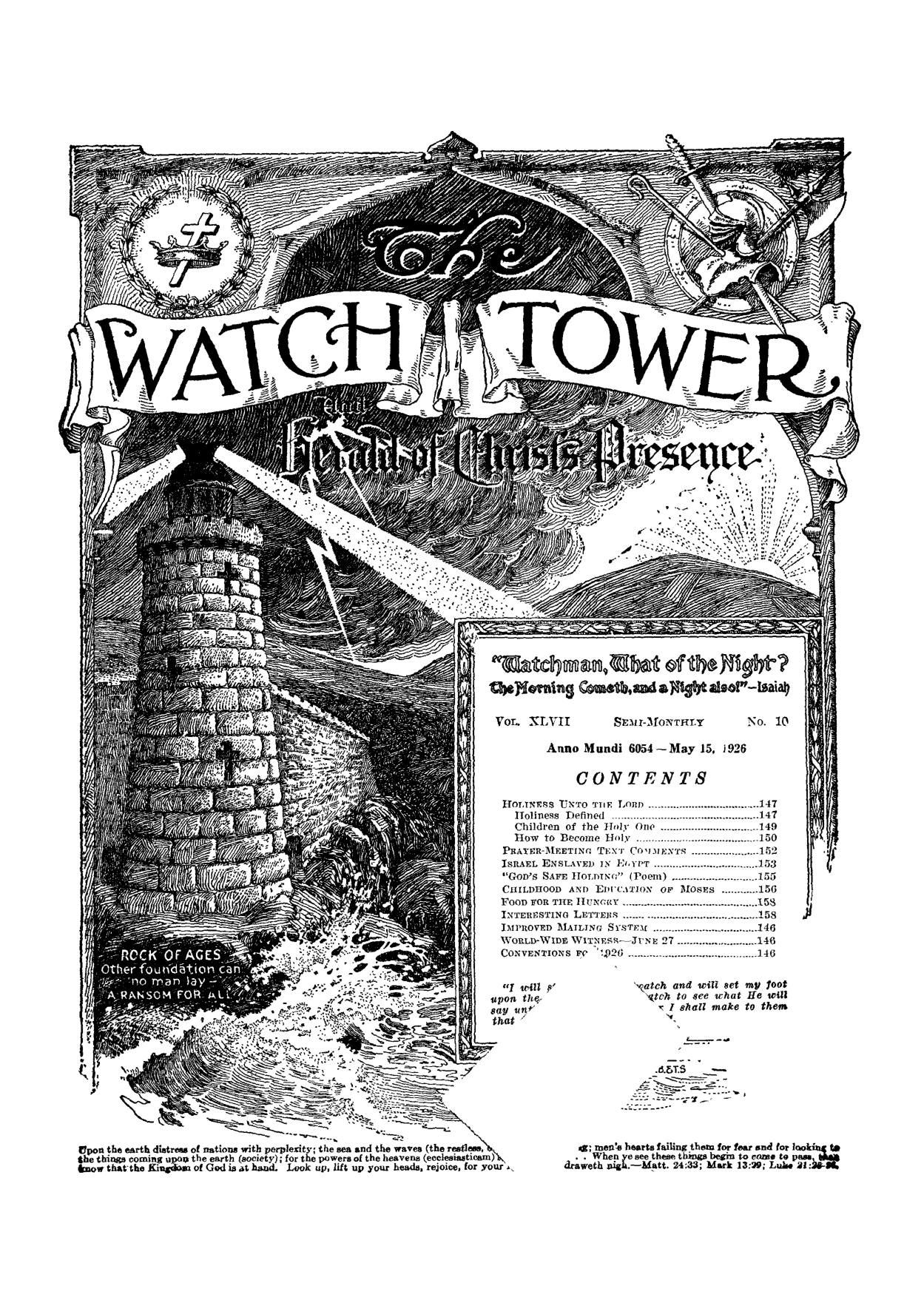
“I will ? upon thfy say unf that '
No. 10
SEJII-MONTHI-Y
Anno Mundi 6054 —May 15, 1926
CONTENTS
Ji
.d.5T.S
f
'qatch and will set my foot \tch to see what He will x Z shall make to them
^g; men’s hearts failing them for fear and for looku . . When ye see these things begin to come to pass, draweth nigh.—Matt. 24:33; Mark 13:39; Lube 21:3
tbejfaming C«B«tb,aBdaJ®ghtd®®r-teaia^
Vol. XLVII
' ’ ROCK'OF AGES
Other foundation can' '-'t rt no man Say -
A RANSOM FOR All''/
Holiness Unto the Lord......................
Holiness Defined ..................................
Children of the Holy Ono ..................
How to Become Holy ..........................
Prayer-Meeting Tent Comments ........
Israel Enslaved in Egypt....................
“God's Safe Holding” (Poem) ...............
Childhood and Education of Moses Food for the Hungry...............................
Interesting Letters..............................
Improved Mailing System .....................
World-Wide Witness—June 27.............
Conventions fc ’4)26.............................
..147 .147 .149 .150 ..152 .153 .155 .150 .158 .158 .146 .146 .146
tTpon the earth distress of nations with perplexity; the sea and the waves (the restlees, the things coming upop the earth (society); for the powers of the heavens (ecdesiagticam) know that the Kingcfcai of God is at hand. Look up, lift up your heads, rejoice, for your <
THIS JOURNAL AND ITS SACRED MISSION
THIS Journal is one of the prime factors or instruments in the system of Bible instruction, or “Seminary Extension”, now betas presented in all parts of the civilized world by the Watch Tower Bible & Tract Society, chartered A. D. 1884, “For the Promotion of Christian Knowledge”. It not only serves as a class room where Bible students may meet in the study of the divine Word but also as a channel of communication through which they may be reached with announcements of the Society’s conventions and of the coming of its traveling representatives, styled “Pilgrims”, and refreshed with reports of its conventions.
Our “Berean Lessons” are topical rehearsals or reviews of our Society’s published Studies most entertainingly arranged, and very helpful to all who would merit the only honorary degree which the Society accords, viz., Verbi Dei Minister (V. D. M.), which translated into English is Minister of God's Word. Our treatment of the International Sunday School Lessons is specially for the older Bible students and teachers. By some this feature is considered indispensable.
This journal stands firmly for the defense of the only true foundation of the Christian’s hope now being so generally repudiated —redemption through the precious blood of “the man Chnst Jesus, who gave himself a ransom [a corresponding price, a substitute] for all”. (1 Peter 1:19; 1 Timothy 2:6) Building up on this sure foundation the gold, silver and precious stones (1 Corinthians 3: 1115; 2 Peter 1:5-11) of the Word of God, its further mission is to “make all see what is the fellowship of the mystery which. . .has been hid in God, ... to the intent that now might be made known by the church the manifold wisdom of God”—“which in other ages ■was not made known unto the sons of men as it is now revealed”.—Ephesians 3: 5-9,10.
It stands free from all parties, sects and creeds of men, while it seeks more and more to bring its every utterance into fullest subjection to the v>Hl of God in Christ, as expressed in the holy Scriptures. It is thus free to declare boldly whatsoever the Lord hath spoken—according to the divine wisdom granted unto us to understand his utterances. Its attitude is not dogmatic, but confident; for we know whereof we affirm, treading with implicit faith upon the sure promises of God. It is held as a trust, to be used only in his service; hence our decisions relative to what may and what may not appear in its columns must be according to our judgment of his good pleasure, the teaching of his Word, for the upbuilding of his people in grace and knowledge. And we not only invite but urge our leaders to prove all its utterances by the infallible Word to which reference is constantly made to facilitate such testing.
TO US THE SCRIPTURES CLEARLY TEACH
That the church is “the temple of the living God”, peculiarly “his workmanship” ; that its construction has been in progress throughout the gospel age—ever since Christ became the world’s Redeemer and the Chief Corner Stone of his temple, through which, when finished, God’s blessing shall come “to all people”, and they find access to him.—1 Corinthians 3:16, 17; Ephesians 2:20:22; Genesis 28 :14 ; Galatians 3 : 29.
That meantime the chiseling, shaping, and polishing of consecrated believers in Christ’s atonement for sin, progresses ; and when the last of these “living stones”, “elect and precious,” shall have been made ready, the great Master Workman will bring all together in the first resurrection ; and the temple shall be filled with his glory, and be the meeting place between God and men throughout the Millennium.—Revelation 15:5-8.
That the basis of hope, for the church and the world, lies in the fact that “Jesus Christ, by the graee- of God, tasted death for every man.” “a ransom for all,” and wLl be “the true light which lighteth every man that cometh inta the world”-, ‘fin due time”.— Hebrews 2:9; John 1:9; 1 Timothy 2:5, 6.
That the hope of the church is that she may be like her Lord, “see him as he is,” be “partakers of the divine nature’,* and share his glory as his joint-heir.—1 John 3:2; John 17:24; Romans 8:17; 2 Peter 1:4.
That the present mission of the church is the perfecting of the saints for the future work of service; to develop in herself every grace: to be God’s witness to the world ; and to prepare to be kings and priests in the next age.—Ephesians 4:12; Matthew 24: 14 ; Revelation 1:6; 20 : 6.
That the hope for the world lies in the blessings of knowledge and opportunity to be brought to all by Christ’s Millennial kingdom, the restitution of all that was lost in Adam, to all the willing and obedient, at the hands of their Redeemer and his glorified church, when all the wilfully wicked will be destroyed.—Acts 3: 19-23; Isaiah 35.
PUBLISHED BY
WATCH TOWER. BIBLE. G TRACT SOCIETY 18 CONCORD STREET a a BROOKLYN, NX U S A-FOREIGN OFFICES : British: 34 Craven Terrace, Lancaster Gate, London W. 2; Canadian: 38-40 Irwin Avenue, Toronto, Ontario; Australasian: 495 Collins St., Melboui ne, Australia; South African: 6 Lelie St., Cape Town, South Africa.
Please Address the Society in Every Case
YEARLY SUBSCRIPTION PRICE : United States, $1.00 ; Canada and Miscellaneous Foreign, $1.50; Great Britain, Australasia, and South Africa, 7s. American remittances should be made by Express or Postal Money Orders, or by Bank Draft. Canadian, British, South African, andAustralasian remittances should be made to branch offices only. Remittances from scattered foreign territory may be made to the Brooklyn office, but by International Postal Money Orders only. (Foreign translations of this journal appear in several languages.)
EDITORIAL COMMITTEE : This journal is published under the supervision of an editorial committee, at least three of whom have read and approved as truth each and every article appearing in these columns. The names of the editorial committee are: J. F. Rutherford, W. E. Van Amburgh, J. Hemer y, R. H. Barber, E. J. Coward. TERMS TO”THE LORD’S POOR: All Bible Students who,"by reason of old age or other infirmity or adversity, are unable to pay for this journal, will be supplied free if they send a postal card each May stating their case and requesting such provision. We are not only willing, but anxious, that all such be on our list continually and in touch with the Berean studies.
Notice to Subscribers: We do not, as a rule, send a card of acknowledgment for a renewal or for a new subscription A renewal blank (carrving notice of expiration) will be sent with the journal one month before the subscription expires. Change of address, when requested, may be expected to appear on address label within one month.
EnteredasSecondClassMatterat Brooklyn, N. Y. Postoffice. Act of March 3rd. 1879.
IMPROVED MAILING SYSTEM
A new addressing and mailing system has been recently installed at the Brooklyn office. Subscriptions for The Watch Tower, both new and renewal, will be entered as heretofore, a card of acknowledgment being sent only when requested.
Special attention is called to the fact that hereafter, instead of the expiration date being shown on the wrapper label for each Issue, a renewal blank (carrying also a notice of expiration) will be sent with the journal one month before the subscription expires. Prompt return of this blank with your renewal order will insure the subscription being continued in force without Interruption.
WORLD-WIDE WITNESS—JUNE 27
The year 1926 has thus far been marked by unusual activity on the part of the Lord’s people, both at home and abroad. So pronounced have been the general results of the special witness days that the Society has been asked to designate another Sunday before midsummer for a further world-wide proclamation of the kingdom message. Accordingly we have set aside Sunday, June 27th, for that purpose, and suggest that every speaker use as his topic: “A STANDARD FOR THE PEOPLE.” Let the brethren everywhere be prepared to make this special simultaneous witness fully as effective as any past effort, and even more so, asking the Lord’s blessing upon us to that end.
CONVENTIONS
It does not seem the Lord’s will that we should have a geneial convention this year. There will be a convention in Chicago, July 29th to August 1st inclusive, and efforts are being made to arrange for a convention in New York City early in October. It is also expected that there will be a four-day convention at Pittsburgh, Pa., the latter part of October. We hope to arrange for some conventions in the middle west early in the Autumn season. This announcement Is made now in order that the friends may arrange their vacations accordingly.
A general convention of the Colored brethren has been arranged for September 3rd to 6th at Washington, D. C. All inquiries for information, etc., should be addressed to R. E. Wesley, 1300 W St., N. W-„ Washington, D. C.
BROTHER RUTHERFORD’S MAIL
Mall addressed to Brother Rutherford at 124 Columbia Heights, Brooklyn, N. Y., will be answered by some of his office assistants during his three months absence in Europe.
AND HERALD OF CHRISTS PRESENCE
Vol. XLVII May 15, 1926 No. IC
HOLINESS UNTO THE LORD
"As obedient children, not fashioning yourselves according to the former lusts in your ignorance: but as he which hath called you is holy, so be ye holy in all manner of conversation; because it is written, Be ye holy; for I am holy.”—1 Peter 1: 1^-16.
HOLINESS is required of those who shall see the Lord. To understand the Scriptural meaning of holiness is therefore of greatest importance to the Christian. An incorrect definition and improper understanding of this subject not only result in confusion but often lead into great error, causing the Christian to miss the very important thing that he should learn.
2 “Holiness is moral purity.” Such is the definition often given by Christians as well as others. The definition is good as far as it goes; but it is insufficient; it does not go far enough. Moral purity is defined as “manner of living as regards right and wrong; clean, pure, guileless and chaste; freedom from indecency in act or in speech”.
3 The adversary has taken advantage of this limited definition and has blinded many to the true meaning of holiness. The standard of decent society requires that a man or a woman should be chaste and pure in thought and in act, particularly with reference to the opposite sex; that they should carefully and faithfully observe the laws of the land; that they should do that which is right and avoid doing that which is wrong. This standard requires that a man shall not cheat his neighbor, shall not rob him of his property or his wife or his good name or reputation; and that he should do good unto all even as he would have his neighbor do good unto him.
4 The laws of the nations of the earth provide severe punishment for those who are guilty of lewd, unchaste, indecent conversation or conduct in the presence of others or with each other, and for acts that result in injury to another; and there are millions of people on earth who diligently strive to live up to the above described moral standard. They are kind and considerate with others; they are chaste in their relationship with the opposite sex; they observe the laws of the land; they diligently shun evil and try to do good, and are therefore those of the earth who may well be called nature’s noblemen. Many believe that such a course of conduct guarantees for them eternal happiness in heaven. Many of the world who make no pretense of being Christians may come nearer to keeping this standard than do some who profess to be consecrated Chiis-tians.
5 That there may be no misunderstanding of what is here said, we wish to emphasize that The Watch Tov er holds that all honest men and women should keep, insofar as possible, all of the above mentioned regulations, whether they be professed Christians or not. But we also emphasize the fact that if every one kept that standard perfectly it would not constitute holiness unto the Lord within the meaning of the Scriptures. Those who have carefully weighed the matter realize that it is practically impossible for a man to be perfect in thought, word and deed; and for this reason many have been deterred from attempting to be Christians; and many Christians, having a misunderstanding of God’s Word, have become discouraged. Some will say, however, that what the Lord really requires of a man is that he must be perfect in intention. We answer that many good, noble people of the world habitually intend to do right and not to do wrong. Something more than merely a good intent is required by the Lord.
HOLINESS DEFINED
6 Holiness, within the meaning of the Scriptures, means an unreserved consecration, absolute dedication and continued unselfish devotion to God. It means to be set apart to the worship and service of God. It means to be completely reserved from profane or common use. Holiness means to be whole, unimpaired and sound from every wrongful affection. It means an unselfish zeal toward God as his true and faithful servant. The antonym of the term is “impure, fractional, divided or impaired”. When we speak of “the whole solar system” we mean the entire, complete solar system, not a part thereof. Likewise, holiness unto the Lord means to be wholly, completely and absolutely devoted to the Lord, in the faithful performance of duty and obligation that is laid upon the creature.
7 This holiness was foreshadowed in the garments of glory and beauty worn by the high priest. “And thou shalt make a plate of pure gold, and grave unon it like the engravings of a signet, HOLINESS TO THE LORD.” (Exodus 28:36) The following quotation is from Tabebnacle Shadows, paragraph forty-nine:
8 Upon the golden plate was inscribed “Holiness to the Lord”, thus proclaiming, This High Priest is entirely devoted to the accomplishment of Jehovah’s purposes. The golden crown also proclaimed his royalty: Christ is to be “a priest upon his throne”—“a priest for ever after the order of Melchisedec.”—Zechariah 6:13 ; Psalm 110: 4; Heb. 7:17.
THE ETERNAL ONE
8 The Eternal One is holy. “Exalt the Lord our God, and worship at his holy hill: for the Lord our God is holy.” (Psalm 99:9) Jehovah God the Eternal One has always and will always pursue a course of righteousness and perfection. “The Lord is righteous in all his ways, and holy in all his works.” (Psalm 145:17) His course is always the same. There is no change in him. “Every good gift and every perfect gift is from above, and cometh down from the Father of lights, with whom is no variableness, neither shadow of turning.” (James 1:17) From the course of righteousness he never deviates. (Numbers 23:19) “As for God, his way is perfect: the word of the Lord is tried; he is a buckler to all those that trust in him.” (Psalm 18: 30) His rule of action is always perfect. (Psalm 19:7) Every act of God is unselfish; therefore God is love.— 1 John 4: 8.
THE HOLY SON
10 There is no record as to the time of the beginning of the Son, the Logos. The record only discloses that he was the beginning of God’s creation. (John 1: 1, 2) “The Lord possessed me in the beginning of his way, before his works of old. I was set up from everlasting, from the beginning, or ever the earth was. . . . Then I was by him, as one brought up with him: and I was daily his delight, rejoicing always before him.”—Proverbs 8: 22, 23, 30.
11 The course of action of the beloved Son has always been in harmony with Jehovah; therefore he has always been God’s holy and beloved Son. At all times he has delighted to do his Father’s will. (Psalm 40: 8) When he was on the earth even the demons recognized that he was the Holy One of God. (Mark 1:24) He was always perfect, harmless and without spot or blemish. His holiness however consisted of more than perfection of organism, mind, heart and will. The stedfast course of righteousness which he pursued in harmony with his Father’s will led him to the most ignominious death. He was completely consecrated and wholly dedicated to the performance of the obligations laid upon him by his Father. Regardless of his perfection of nature he could not have been holy without being always in accord with his Father. By being fully obedient to his Father even unto death he was exalted to the highest position in God’s great universe. The members of the body of Christ are called to follow in his steps.—1 Peter 2: 21.
UNHOLY SON
12 Lucifer was created perfect, which means that at that time he was holy. (Deuteronomy 32:4) He was the bearer of light and was entrusted with great power and responsibility. He became unholy when he determined to take a course different from that which had been provided for him by Jehovah his Father. Up to that time he was perfect, as it is written: “Thou wast perfect in thy ways from the day that thou wast created, till iniquity w'as found in thee.” (Ezekiel 28:15) “Pride goeth before destruction, and an haughty spirit before a fall.” (Proverbs 16:18) Pride is the very opposite of humility, which means complete submissiveness to the will of God. “Whosoever exalteth himself shall be abased.” (Luke 14:11) To his sons the Lord, through his witnesses, said: “Humble yourselves under the mighty hand of God, that he may exalt you in due time.” —1 Peter 5: 6.
13 Lucifer violated this fixed rule, became proud and ambitious, and fell. He dragged down many of the pure angels of heaven. He debauched and corrupted the human race and turned all the world to unholiness. He became the adversary of God; and his wickedness is expressed by his names, Dragon, Devil, Satan and Serpent. Only a comparatively few in the world have ever escaped the wicked influence of Satan. He has turned the minds of the people away from God and caused men to walk in the way of unrighteousness. He has blinded the minds of men lest they should know the way of holiness. (2 Corinthians 4: 3, 4) His subtle influence has even blinded Christians as to their proper relationship with Jehovah God.
THE NEW CREATION
14 Long centuries ago the plan of God provided for his new creation. To Abraham he said: “In thy seed shall all the families of the earth be blessed.” Who should constitute that seed and how and when it would be developed was God’s great secret which he kept unto himself throughout the ages. In due time he revealed to the saints this mystery, and by his grace they learned that “the seed of promise” is the Christ, Head and body. When Chiist Jesus was raised out of death and given the divine nature he took his position at the right hand of Jehovah God, being exalted above all principalities and powers and dominions, and was then given a name greater than all other names. God made of his beloved Son the Head of his new creation. (Ephesians 1:21-23) “And he is before all things, and by him all things consist. And he is the head of the body, the church: who is the beginning, the firstborn from the dead; that in all things he might have the preeminence. For it pleased the Father that in him should all fulness dwell.” —Colossians 1: 17-19.
13 Eleven of the apostles whom Jesus had chosen remained faithful to him. These did not even understand the meaning of the new creation until Pentecost, at which time they were begotten as new creatures and their minds became illuminated by the holy spirit. The great mystery of God, which had been hid for ages and generations, was now made manifest unto these saintly men begotten and anointed of the holy spirit. (Colos-sians 1: 26, 27) They learned that this mystery is Christ the Head and the church his body, who constitute the new creation of God for the carrying out of his plans and purposes. They learned that the new creation is the royal priesthood, of whom Melchisedec was a type; that this priesthood is one of the titles given to the new creation. St. Peter was one of the faithful who were begotten and anointed of the holy spirit, and he became an inspired witness of Christ and cf God. It was to the new creation that he addressed his epistles, including the text under consideration herein. In this text he admonishes the followers of Christ to be holy. He addresses them as children of God.
CHILDREN OF THE HOLY ONE
16 How did these become children of God, the Holy One? The mystery is thus revealed. When Jesus arose from the dead he ascended on high and presented the merit of his sacrifice unto God, as a sin offering on behalf of those who would come to God in his appointed way during the acceptable time of sacrifice, which is the Gospel Age. This presentation of the merit of his sacrifice was foreshadowed in the sprinkling of the blood of the bullock in the Most Holy on the typical day of atonement.
17 A man coming into Christ first learns that he was born a sinner by reason of the disobedience of Adam; then he learns that Jesus Christ, by the grace of God, provided the great ransom sacrifice, to the end that whosoever believes upon him and obeys shall live and not die. (Romans 5:12; Hebrews 2:9; 1 Timothy 2:3-6; John 3: 16) Believing these great truths he agrees to do God’s will, which means his full consecration, based upon the merit of Jesus’ great sacrifice. Their God justifies him. (Romans 5 : 1, 9 ; 8: 33) This justification is for the purpose of making the man an acceptable sacrifice as a part of the body of Christ Jesus. God accepts his consecration, through the merit of Christ, and begets him to a hope of life on the divine plane. This he does by his own will, through his Word of Truth, and gives to the consecrated one his promise that he shall be a partaker of the divine nature.—James 1 : 18; 2 Peter 1: 3-11.
18 Now being brought into the family of God by adoption he becomes a child of God. (Romans 8:15-17) He learns that God is taking out from the nations a people for his name, and that he now has the prospect of being one of these. To those who have taken the step of full consecration the Apostle Paul says: “Blessed be the God and Father of our Lord Jesus Christ, who hath blessed us with all spiritual blessings in heavenly places in Christ: according as he hath chosen us in him before the foundation of the world, that we should be holy and without blame before him in love: having predestinated us unto the adoption of children by Jesus Christ to himself, according to the good pleasure of his will, to the praise of the glory of his grace, wherein he hath made us accepted in the beloved: in whom we have redemption through his blood, the forgiveness of sins, according to the riches of his grace; wherein he haih abounded toward us in all wisdom and prudence; having made known unto us the my.-tery of his will, according to his good pleasure which lie hath purposed in himself.” (Ephesians 1:3-9) This is the class that the Apostle Peter addresses when he says in the text under consideration: ‘You are now the children of God, and as obedient children you must not fashion yourselves according to the former lust in your ignorance.’ His words clearly show that there must be a change of course and of action of the one who has become a child of God.
FORMER LUSTS
19 Lust, as that word is here used, means desire. The new creature, as a child of God, to be pleasing unto God must not conform himself to the things which he desired before he became a new creature. The question is, What is meant here by the things he formerly desired? It is manifest that the things which he desired before he knew the Lord were not necessarily evil things, because the apostle says he desired them ignorantly. If he desired to steal, to rob, or to be lewd, or to commit some other crime, or to do injury to his neighbor, he would have known such to be wrong and could not plead ignorance. ' (Romans 2: 14,15) It is also manifest that the proper course which a child of God is to take must be one of holiness, and that holiness is something contrary to or different from the things he ignorantly desired before he became a new creature. This brings us back then to a consideration of the true meaning of holiness, as defined by the Scriptures.
TRUE HOLINESS
20 “Holiness is moral purity.” That definition is incomplete, because it does not include all that the Scriptures mean when they use this term. There are many noble-minded people in the world who are morally pure, as that term is generally understood. Not many of these noble persons are even called to the heavenly calling. Rather those of less nobility by nature are called. (1 Corinthians 1:26-29) It is quite apparent that the inspired apostle is in our text (1 Peter 1:14-16) saying in substance to the child of God: ‘When you were of the world there were certain things which you desired, which things appeared to you to be entirely right and proper. You were then ignorant of God’s purposes, and as to how he works out his plan; consequently it was not then wrong in itself for you to desire those things, as men view right and wrong. But now you are a child of God, and if you will please him you must be obedient; an to be obedient you must be holy even as he is holy. Su< !i holiness will require your complete dedication to him and your absolute devotion to him and to his cause.’
21 If a definition of holiness be limited to moral purity, then we see how easy it is for the adversary to make many noble people of the world believe and say: “If I do that which is right I know my God will receive me into heaven.” It is only when a child of God comes to understand and appreciate what a wonderful privilege it is to follow in Jesus’ footsteps that he can understand the meaning of true holiness.
OPPOSING ORGANIZATIONS
22 The Devil’s visible organization is the world, of which he is the prince or ruler. (John 12: 31; 2 Corinthians 4: 3, 4) At one time Israel was God’s typical organization; but that nation turned away from God, fell under the wiles of the Devil and became a part of his organization. Then God laid the foundation of Zion. This foundation is Christ Jesus his beloved Son, the Head of the new creation. From then till now Satan the Devil has opposed Zion, God’s organization, and has used every possible means to turn the people away from God and to destroy those who have declared themselves on the side of the Lord. To accomplish his purpose the adversary has resorted to fraud and deceit, and has even deceived many of those who have made a consecration unto the Lord.
23 Is it not true that during the greater portion of the Gospel Age most professed Christians have thought it entirely proper and in fact a duty for them to participate in politics, to seek office and hold office in the various branches of the governments; to participate in temperance organizations, and to promote like reforms ? Is it not also true that almost all such professed Christians have honestly believed that what is required of them in order to be holy is for them to be morally pure, chaste, virtuous, honest; not to rob, steal or commit other crimes; and at the same time to grow patient, kind, pious and read their Bibles much ? Is it not true that this is what many have called “character development’’ ; and that many of them have believed that they could perfect a character while in the flesh? And have not many others, having such a conception of holiness, become discouraged because they could not reach the perfect standard?
24 Thus Satan has deceived many, causing some to be exalted in their minds and to assume an attitude of “more holy than thou”; while others have fallen away because of discouragement. Thus the adversary has turned the faces of these away from the perfect pattern, causing them to look to themselves, some going to one extreme and some to another extreme. The difficulty all along was that they did not understand their duty and obligation unto God, nor the necessity of keeping away from all entanglements laid for them by the adversary.
HOW TO BECOME HOLY
25 “As he which hath called you is holy, so be ye holy.” Jehovah God is holy because all of his ways are right. (Psalm 18: 30) The Lord Jesus is holy because he has always been in harmony with Jehovah God, and his ways have therefore always been right. Everything that is out of harmony with God is unholy. Satan and his organization are not only out of harmony with God but oppose God; therefore they are unholy. There can be no partnership or fellowship between holiness and unholiness. Jesus plainly said: “No man can serve two masters.” (Luke 16:13) No one can devote part of himself to God and the remainder to Satan’s organization. The Christian can have no sympathy with the Devil’s organization, or any part thereof.
26 When one becomes a Christian he may think for a time that it is right and proper for him to participate in and pursue a course similar to that of the respectable part of the world. But he cannot do this and be holy. He must leave the politics, the reformations, the temperance organizations and every similar thing and become absolutely and completely dedicated to the Lord, and use his faculties with which he is endowed to the Lord’s glory; in no other way can he become holy. The Apostle Paul confirms this when he says: “Be not conformed to this world: but be ye transformed by the renewing of your mind, that ye may prove what is that good, and acceptable, and perfect, will of God.”—Romans 12:2.
27 The Devil has led some to believe that sanctimoniousness is holiness or saintliness. It is really a hypocritical devoutness. A hypocrite may look pious and speak piously, be quiet and submissive in the presence of others, and be regarded by them as very saintly; but he does not deceive the Lord. What is really required of us is to, as far as possible, live up to the highest standard of purity and righteousness and also to be dedicated to the Lord, absolutely and completely using our faculties to the Lord’s glory and refusing to make any compromise with the Devil’s organization. The true sentiment of the Christian’s heart is thus expressed: “For thou art great, and doest wondrous things; thou art God alone. Teach me thy way, 0 Lord; I will walk in thy truth: unite my heart to fear thy name.” “Lead me in the way everlasting.”—Psalms 86: 10,11; 139 : 24.
28 He who thus earnestly prays will diligently seek to know the Lord's way and will refuse to conform himself to the way of the Devil’s organization. The way of the world at its best is a false way. Its good things the Christians desired before they became God’s children. Now they must have no sympathy therewith. “Through thy precepts I get understanding: therefore I hate every false way.” (Psalm 119:104) To walk in the right way the affections of a Christian cannot be divided between the Lord’s organization and something that is included in the Devil’s organization.
29 To become holy the Christian must set his affections on things above and not on things in the earth. (Colos-sians 3:2) To be holy the child of God must %e conformed to the image” of God’s holy Son, (Romans 8: 29) The word image here means likeness or resemblance. The Lord Jesus withstood the temptations of Satan and remained firm and stedfast in his devotion to God. (Matthew 4:1-11) The world is the Devil’s organization. The Christian is in the world. Jesus overcame the world by being faithful to his Father. He said: “In the world ye shall have tribulation: but be of good cheer: I have overcome the world.”—John 16: 33.
so «j>c ye }10]y ;1n manner of conversation.” The
word “conversation” used by St. Peter in our text means course of action or conduct. Our course of action or conduct, therefore, must be in harmony with God’s organization and contrary to the Devil’s organization. Thus the Christian must grow up into Christ in all things.— Ephesians 4:15.
31 The apostles were holy, because they were absolutely and completely devoted to God. The Apostle Paul declared that he was determined to know nothing except Jesus Christ and him crucified. (1 Corinthians 2:2) Again he said: “Forgetting those things that are behind, and reaching forth unto those things that are before, I press toward the mark for the prize of the high calling of God in Christ Jesus.” (Philippians 3: 13,14) Saul of Tarsus was a man of affairs in the world, but when he became a Christian he desired them no more. The same was true of St. Peter, and of all others who have followed in the footsteps of Jesus and have proved faithful.
32 The apostle says: We “are built upon the foundation of the apostles and prophets, Jesus Christ himself being the chief comer stone; in whom all the building, fitly framed together, groweth unto an holy temple in the Lord: in whom ye also are builded together for an habitation of God through the spirit.” (Ephesians 2: 20-22) This growing up into Christ Jesus means that we must be wholly dedicated and devoted to God and his righteous cause. The Lord God is building a habitation for himself which is Zion, and those of Zion can have no sympathy or fellowship with the Devil’s organization. Is it not apparent then that to be holy means to be unreservedly on God’s side ?
33 The apostle further says: “Having therefore these promises, dearly beloved, let us cleanse ourselves from all filthiness of the flesh and spirit, perfecting holiness in the fear of God." (2 Corinthians 7:1) The adversary has deceived many into believing that all that is required by this text is to clean up oneself from filthy habits of the flesh and filthy thoughts and words. That must be done, of course; yet the noble people of the world clean themselves up from filthiness of the flesh, filthiness of the mind and filthiness of speech and conduct. But note that the apostle goes further and says: “Perfecting holiness in the fear of God.” This means an absolute and complete separation of oneself from everything that has to do with the Devil’s organization, and to be completely and absolutely devoted to God.
34 We must be in the world, of course; but we must be fearless and faithful witnesses for the Lord while in the world. We must be completely and unreservedly devoted to God, and the inducing cause for so being must be our love for God. About this there can be no doubt: “According as he hath chosen us in him before the foundation of the world, that we should be holy and without blame before him in love.” (Ephesians 1:4) This does not mean merely perfection in intention. A man may deceive himself by saying: “I intend to be faithful to the Lord, I intend to be a true Christian,” and yet hide his light under a bushel or speak softly concerning the Devil’s organization for fear he might offend some one; and thus fail or refuse to be a true witness for the Lord.
35 If a child of God loves his Father he will keep his commandments and keep them joyfully. (1 John 5:3) No one can keep the commandments of God at this time without engaging in the Lord’s service. The Watch Toweb has been severely criticized by some for urging service upon the brethren. It is apparent that such criticism comes either from those who are “more holy than thou” or from those who have sympathy with the Devil’s organization. The Watch Tower stresses service because of its great importance to the Christian at this time. One of God’s commandments to his children is: “Ac are my witnesses that I am God.” (Isaiah 43: 10, 12) There are no other witnesses for the Lord on earth, except his children. God expects those who are consecrated to him to dedicate themselves to his service and to serve joyfully. It is the solemn duty of every Christian to point out these things to his brethren.— Romans 12: 1.
30 In corroboration of the foregoing St. Jude says: “But ye, beloved, building up yourselves on your most holy faith, praying in the holy spirit, keep yourselves in the love of God, looking for the mercy of our Lord Jesus Christ unto eternal life.” (Jude 20, 21) Our “most holy faith” is complete confidence in the divine plan. We know that the kingdom is at hand, also that the Devil is striving to destroy the seed of promise, and that our only safety from his wiles is to abide in Christ and keep God’s commandments. (Revelation 12:17) Only those who love the Lord and who prove their love for him are holy in his sight.
37 A long list of faithful men is mentioned in Hebrews, the eleventh chapter. It includes the holy prophets. These men were counted holy by the Lord, not because they were perfect in the flesh, not because they had “developed a character”, but because of their unswerving and absolute devotion to God. These are set forth as examples to the Christian. The Bible records stern truths about these men and women; and, judged by the false standard that the Devil holds up by his representatives, they could never be counted holy. Amongst these was David. Although he had weaknesses, yet God calls him “a man after mine own heart”. And why ? Because there never was any question about his devotion to God.
38 God’s course is one of stedfastness in righteousness, always was and always will be. Remember that the apostle says that ‘without holiness no man can see God’. The holy ones, those who shall see God, will be those who love him and who are faithful to his cause. “0 love the Lord, all ye his saints; for the Lord preserveth the faithful.”—Psalm 31: 23.
39 God has furnished the Christian at this time with a clearer vision of the adversary’s organization than ever before, and shows us our privilege of being on the Lord’s side. If at one time the Christian in ignorance desired certain things of the Devil’s organization which appeared to be good, no longer shall these be desired; now will every child of God be holy even as God is holy. The new creature will be counted holy if prompted by love, which is unselfishness. Such devote themselves faithfully and earnestly to the cause of the Lord as his true and faithful witnesses.
40 Holiness is not merely a standard which the mind can reach up to and endorse, but it must be attained. Absolute holiness, w’ithin the meaning of the Scriptures, must be attained by the overcoming Christian on this side the vail. It means that he must be pure in his thoughts, words and actions, insofar as that is possible w’ith his imperfect organism; but it means much more than this. It means a complete and absolute devotion to God’s cause, prompted by love; the faithful performance of the Christian’s covenant as a witness of the Lord. A Christian can, on this side the vail, refuse to sympathize with or support in any way the Devil’s organization, and can devote every faculty that he has to the support of and witness for God’s organization; and thus doing he will attain to the standard of holiness. Continuing in this attitude faithfully until death he shall have an abundant entrance into “the everlasting- kingdom of our Lord and Saviour Jesus Christ”.—2 Peter 1:11.
QUESTIONS FOR BEREAN STUDY
Is holiness required of the Christian? How is the term usually defined? Why is it to Satan’s interest to have such a definition of holiness emphasized? II 1-3.
Should we not strive to live up to such a standard? If we do, shall we inherit the kingdom ? f 4,5.
What is true holiness? How was it typically foreshadowed? H 6-8.
How is the Eternal One holy? How is his beloved Son holy? II 9-11.
Was Lucifer originally holy? If so, when and how did he become unholy? II 12,13.
What is the “mystery” and when was it first revealed? To whom is our text addressed? U 14,15.
How do we become children of God? Explain In detail. H 16-18.
What does the apostle mean by “former lusts in your ignorance”? Why is the usual definition of holiness incomplete? Paraphrase 1 Peter 1:14-16. II 19-21.
What is Satan’s visible organization? When and how did God lay the foundation of Zion? How does Satan war against it, and with what success has he met? 11 22-24.
How can we be holy as God is holy? How has Satan trapped many and fostered ecclesiastical hypocrisy? H 25-27.
Why should we not cooperate in the “good” works of humanity? How shall we be “conformed to the image” of God’s holy Son? fl 28,29.
What is meant by “be ye holy in all manner of conversation”? What examples of holiness did the apostles leave us? U 30-32.
Does 2 Corinthians 7:1 refer to character building? Explain. How can we be “holy and without, blame before him in love”? Is holy intent sufficient? U 33,34.
Is pious and chaste living sufficient to show proper love for God? If not, what more is required? II 35,36,38.
Why are the prophets called “holy men of old”? fl 37.
Briefly summarize: (1) The importance of holiness; (2) what it is; (3) what it is not; (4) how it may be attained. II 38-40.
PRAYER-MEETING TEXT COMMENTS
TEXT FOR JULY 7
"'The heavens declare the glory of God."—Psalm 19:1.
JEHOVAH being perfect is preparing his creatures so that when his plan concerning man is finished everything pertaining to man will be in harmony with the great Creator. All his creation will respond to his praise. The inanimate things of creation he made to his own praise. David, the servant of God, beholding the marvelous things of God’s creation, composed a song describing how these inanimate parts of creation give glory to God. He says that in the day the sun sheds forth his light speaking with powerful eloquence the praise of the Eternal One. When the day has ended, then the night takes up the song and proclaims the great knowledge and wisdom of God. These witnesses forever put to silence the fool who says that there is no God, and the egotist who says that there is a God but that he has no plan.
David was a type of the church. The church is the creation of God, yea the very highest part of his creation. Those who compose the members thereof are given an intelligent understanding of Jehovah and of his great plan. Moreover those who are now on the earth are made witnesses of God and are commanded to give intelligent testimony to his glory and praise. As surely as the sun and the moon and the myriads of stars testify to the glory of God, just so surely must all of the new creation sing the praises of Jehovah.
Now is the time when God will have the witness given on earth that the people may not forget entirely that he is God; that they may understand, when restitution begins, that all their blessings must come from the gracious hand of the Eternal Creator. Now in the hands and into the mouths of these anointed witnesses God has placed instruments with which to proclaim his praises. The faithful ones are singing, and will continue to sing: “Blessed be the Lord out of Zion.” When the plan is finished every creature and every part of creation, everything that hath breath, will be praising Jehovah God. Those of Zion must do it now!
TEXT FOR JULY 14
"'The government shall he upon his shoulder.”—Isa. 9: 6.
THE prophet shows conclusively that it is the purpose of God to have a government for the benefit of man; that such government will rest upon the shoulder of his beloved Son; that the Son is wonderful and his name is holy; that his Son shall establish the earth and be privileged to be the executive officer of Jehovah in extending life to the obedient ones of the human race; that he shall establish everlasting peace on earth and that he will cause all intelligent creatures to praise Jehovah.
Now in the end of the age God has revealed to his people, as never before, that it is their great privilege to represent him and his beloved Son, Christ Jesus; that those who faithfully represent him, and who thus continue until death, shall be associated with the great King in his kingdom. He further reveals to them that in the ages to come this faithful class will be the everlasting recipients of the grace of God through Jesus Christ. Knowing that the day of the deliverance of the church has come, that the time of the deliverance of the people is also near, and that the time is here for the vindication of the name of God, these faithful saints on earth joyfully proclaim the praises of Jehovah. This they do, by lifting up God’s standard to the people and pointing them to the way that leads to life and happiness.
The joy of the Lord, which they now share, impels them to urge upon their brethren, whom they love, the necessity of likewise joining with others of Zion in proclaiming the majesty, wisdom, love, justice and power of the great Creator. Happy are they that the new government is at hand and that the mighty Governor will bring relief to the groaning creation!
ISRAEL ENSLAVED IN EGYPT
---July 4—Exodus 1:1-14--
"Jehovah will not cast off his people.”—Psalm 91r- 1'/.
THE last quarter-year series of lessons concluded with the record of the union of Joseph and his father and family in Egypt, and the restoration of Egypt by the means which were employed by Joseph, guided thereto by the wisdom given to him by God, and in which almost certainly he was helped by his wise, aged father. That record concludes the first book of Moses, known to us familiarly as Genesis.
2 Our present studies are taken from Exodus, otherwise known as the second book of Moses. Exodus means “going out”. It gives a new phase of the divine revelation. The purpose of Genesis is to record the beginnings of all things connected with man and his home and of the divine plan of human redemption. But by its types Genesis also tells of the development and the carrying out of the divine purpose until realized in the restoration of the earth and man, typified, as we have seen, by the restoration of Egypt which in the Bible consistently represents the world.
3 Exodus, on the other hand, tells of the deliverance, by the direct intervention of God, of the chosen people from the hard bondage which in later years they experienced in Egypt; and thereby are furnished us (1) a type of the deliverance of God’s people from the bondage under sin and Satan, and (2) an illustration of the great deliverance which is to come to all the world at the inauguration of the Prince of Peace as God’s ruler, when men will be delivered from the bondage of evil and will be free to “go out” into the liberty of the sons of God.—Romans 8: 21.
4 Also, as our studies will show, Exodus discloses that this deliverance will be by means of redemption. The Bible knows nothing of deliverance by evolution; nor in all human history is there any evidence of man’s evolution to a higher plane of life, except in material things. He never finds “the God within him”, nor ever discovers the way to transmute his earthly life into the spiritual. Exodus shows that deliverance comes only through the mercy and power of God and by man’s accepting this favor at his hand. Further, it tells of the establishment of the law of God, and of his worship according to this law, representing the establishment of the kingdom of heaven upon earth and the help which will then be given to men to know and to do God’s will.
5 We know from later portions of the Scripture that it was not God’s purpose to have the chosen family grow up and increase into a nation in Canaan, the land of promise. The patriarchs Abraham, Isaac, and Jacob were given that land as a temporary home, with the promise that ultimately it should.be their everlasting possession and permanent home. In this way even the land of promise was a strange land to them, and the patriarchs were but strangers and pilgrims waiting for the realization of their hope. This was in general fulfilment of the purpose of God, but also served as a type of the followers of Christ who hold the promises of God but who must, through patient endurance, prove their fidelity to God.—1 Peter 2: 11; Hebrews 11:13.
6 When confirming the covenant of the land God told Abraham that his seed should be strangers in a land not theirs and should be brought into hard bondage and be afflicted, and that a period of 400 years should pass before the nation that they served should be judged and his seed delivered. There were many reasons in the divine purpose for this. One was stated to Abraham at that time. God said, “The iniquity of the Amorites is not yet full.’’ (Genesis 15:16) Ged had brought Abraham into a land where there was much wickedness. Indeed, the cities of the plain not far distant from Abraham’s settlement are set forth in the Scriptures as examples in degradation, and their ultimate destruction pictured the vengeance of God which shall come upon all who wilfully degrade themselves.—Ezekiel 1G: 50; Jude 7.
7 It is manifest that the divine purpose for Abraham did not include any attempt on his part to bring these wicked people to the knowledge of God; he made no attempt to tell them of the hope which God had given him, nor even to guide them into cleaner and better ways of living. Abraham’s residence and example amongst the Amorites ought to have helped them, and it is clear that in that land there was some witness to the true worship of God—Melchizedek’s priesthood proves that—but the time had not yet come when God could judge them. Hence Abraham was not commissioned to convert them.
8 Here is a picture which should have guided Christendom, which holds that the disciples of Jesus are expected to bring about the conversion of the world. That is the theory on which Christendom does its work, but there is nothing in the Scriptures to support it. Christendom expects to witness, preach and teach in an evil world and bring the world to righteousness. But Christendom’s theory is lost when it comes to practice; on the one hand the preachers do not live up to their theory, and on the other hand the world is fast disregarding churchianity.
9 The land of Canaan, made to Abraham the land of promise, represents thereby (in its final occupation) the kingdom of God upon earth. That kingdom will be established not by a gradual growth of righteousness such as Christendom claims, but by a sudden display of the power of God when the wickedness of the earth has been brought to the full; that is, when men have had such an opportunity of learning of God and have misused their chances until judgment is due.
10 As it was God’s purpose that his kingdom in Canaan should be established in power by his chosen people, it is evident that they must needs be separated for a time from the peoples of Canaan. How God brought this about was shown by our last studies. Jacob and his fastgrowing family went down into Egypt to dwell while the famine was on and, so far as they knew at least, until the end of Jacob’s life. Under divine guidance they were given a separate portion of the land of Egypt, because the Egyptians abominated a pastoral people. This also served to keep them together.
11 The Bible is careful to give in detail the number of the chosen family who went down into Egypt. Counting Joseph and Jacob’s two sons who were already there, they were numbered as seventy (Exodus 1:5; Genesis 46:27); though it should be noted that Stephen said that Joseph’s kindred when presented to Pharaoh numbered seventy-five. (Acts 7 : 13,14) This difference need not be considered as a contradiction; for Stephen speaks of Joseph’s “kindred”, and may have included some not recorded in the Genesis account.
12 Bishop Colenso, the advance leader of the British higher critics, made a reputation for himself by raising objections to the truthfulness of this Genesis record. No doubt the objection could be sustained literally; for it includes two grandsons of Judah, and it is a moral uncertainty and almost a physical impossibility that they were born prior to the going down into Egypt. Also Benjamin, whom Judah called “a little one” (Genesis 44:20), is seemingly referred to as having taken ten sons with him into Egypt. (Genesis 46:21) However, though the scripture does not specifically so state, it is almost certain that this twenty-first verse is parenthetical, and is intended to be read in relation to the death of Jacob, or as a chronicle of the family with which Benjamin was later blessed, rather than as a description of his household at the time of the actual going down into Egypt; and if this be granted all the difficulties vanish.
13 Furthermore, as is pointed out in Scbiptukb Studies, Volume Two, page 213, the death of Jacob (17 years after his arrival in Egypt) was the dividing line between the Patriarchal Age and the Jewish Age. It was then that Israel was first counted as a nation. Hence it is more than reasonable to conclude that the Scriptures reckon that date as marking the official settling of Jacob’s family in Egypt. This would allow sufficient time for the birth of Benjamin’s ten song in Egypt.
14 The Scriptures should be read with reason, and should not be discarded as inaccurate because every historical statement does not appear to agree with every other relative statement. In Genesis 35: 26, after Jacob’s sons have been enumerated, it appears to declare that they were dll born to him in Padan Aram, though only a few verses earlier there is record of Benjamin’s birth and his mother’s death at Bethlehem, long after Jacob had left Padan Aram. These apparent slips give opportunity for the higher critical theologians to display their lack of faith in the Bible as God’s Word.
15 Those who are acquainted with the Bible’s method of teaching by types, and who know of its consistency of detail in connection with its typical teachings, readily understand that the number seventy is typical or symbolical. The number is repeatedly associated with the house of Israel; and in later days at Sinai God, through Moses, chose seventy elders of the people who were to be associated with Moses, representing him as he represented God. This in still later days became the basis of the Sanhedrin, composed of seventy members, who were known as rulers in Israel.—John 7: 26.
16 Jacob’s family lived very happily in Egypt; for Joseph’s position as governor enabled him to look after his brethren. The reconciliation had been complete; and Jacob’s sons had learned to live in harmony with their covenant, and thus to become worthy of being counted the heads of the tribes of Israel. It was no doubt in the providence of God that nearly all of Jacob's children were sons. They would marry amongst their relatives— the daughters of Ishmael, of Keturah, and perhaps of Esau. They were all very fruitful, and children were boro to them quickly. Apparently they married when quite young, and some of them had large families. Agreeable to Jacob’s prophecy Joseph became like a fruitful bough; he saw Ephraim’s children of the third generation.
17 Joseph’s prosperity in Egypt was in itself as nothing to him. He lived to serve his God. Before he died he avowed his faith in the God of his fathers, according to the oath which God had made to Abraham, Isaac and Jacob. And he took oath of his people, saying, “God will surely visit you, and ye shall carry up my bones from hence.” (Genesis 50: 24, 25) He died at the age of 110 years—eighty years after he had stood before Pharaoh.
18 The policy Joseph instituted in Egypt seems to have obtained for many years after his death, but as time passed the increase in numbers and wealth of the children of Israel became an important factor in the life of Egypt. It was according to the purpose of God that the Israelites had been settled in the land of Goshen. The land being fruitful, all their needs were met; and they became not only great in numbers, but rich in cattle and goods.
19 Eventually a king arose who saw possible danger to the Egyptians in the increase of the children of Israel. He called attention to the fact that these people were more and were mightier than the Egyptians. (Exodus 1: 10; Psalm 105:24) He suggested that if a war with enemies occurred Israel might join with the enemies and so get themselves out of the land of Egypt, a statement which implies that the Israelites were profit-aide to Egypt. They did not want to get Israel out of the land, but to keep them in it, but under subjection.
It was then agreed to set over the Israelites taskmasters who should afflict them in their burdens. Treasure cities were built for the new Pharaoh, and they were set to do the hardest and most menial work; but the more the Israelites were afflicted the more they multiplied and grew. The Egyptians were vexed and grieved because of this, but continued their policy with rigor, till the lives of the Israelites were made bitter with hard bondage. It is evident that they were treated as slaves, and at least some were scattered abroad in Egypt. All of this was in accordance with the purpose of God for that people.
QUESTIONS FOR BEREAN STUDY
What portion of Israelitish history is covered in Genesis? What does the word Exodus mean? What is the purpose of these two books respectively? U 1-4.
How and why were the patriarchs strangers in the land of promise? How were they strangers in Egypt? Why were they oppressed, and why did God wait 400 years before punishing their oppressors? U 5,6,10.
Why did not Abraham seek to convert the wicked people around him? What lesson should this teach us? H 7-9.
How many of Jacob’s family migrated to Egypt? What seeming discrepancies in the account have higher critics stumbled over? How can these matters be explained? f 11-15.
How did the Lord bless Jacob’s family in Egypt? How long did Joseph live, and what did he prophesy? 11 16-18.
How did the Israelites alarm the Egyptians? Did they want Israel to emigrate? What policy concerning them did 1’haraoh finally adopt? II 19,20.
GOD’S SAFE KEEPING
“Hold thou me up, in Christ in heavenly places, To view my life from that triumphant height, So shall my soul grow’ strong with patient courage rl’o run the race and wage the daily fight.
How light and brief the present conflict seemeth, And short the way to that eternal rest,
When eyes of faith gaze smiling from the shelter Of love’s safe holding to my Father’s breast!
“Hold thou me up, in Christ with full dominion O’er my weak flesh and subtle self-desire, Spurning each snare, sweet-baited by the tempter, Guarding my robe from spot of earthly mire.
Held by thy pow’er, no darkness can confound me, Nor haunting fears my trusting heart alarm, Thy grace and strength are perfected in weakness, And none can pluck me from thy ’circling arm.
“Hold thou me up, in Christ my righteous cov’r.’ng, Till crowned immortal I in glory shine;
For now I live through his life pulsing in me, As lives the branch by dwelling in the vine.
Father, I yield in grateful heart-submission To thy keen blade of purging pain and woe;
Prune as thou wilt, and perfect love’s fruition; From luscious grapes sweet wine of joy will flow.
“Hold thou me up, in Christ a living member, Swift to obey the promptings of his will, My words and deeds his mind alone expressing As I with joy my task of love fulfil.
If I would reign with him, a king in glory, Here I must share his sacrifice and shame. So, Father, help me bear the cross with Jesus Till life will end in praise to thy dear name. '
…