The Watchtower, September 1, 1925
Download: PDF — The Watchtower, September 1, 1925
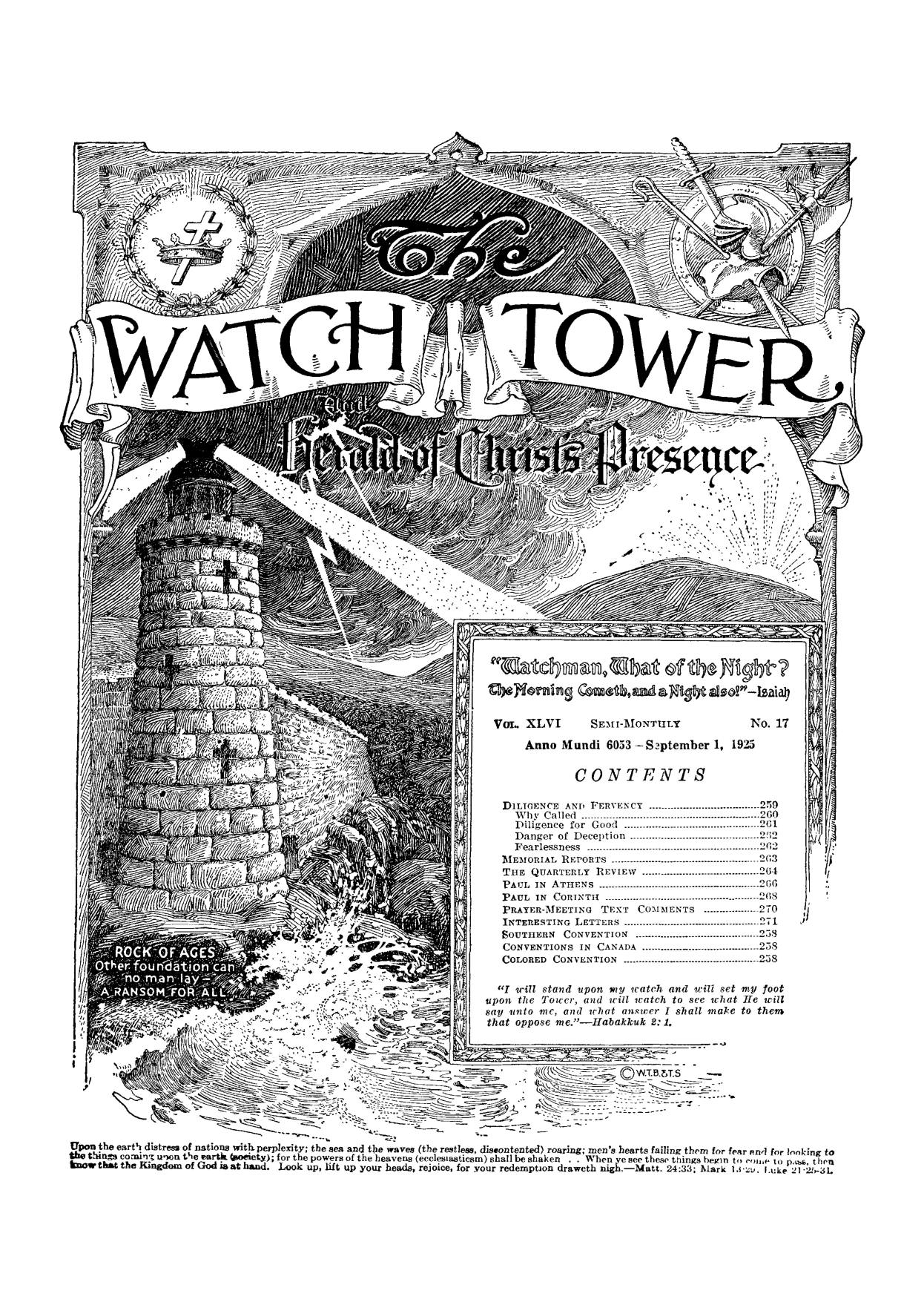
No. 17
is
>
259 .260
.258
.258
Upon the earth distress of nations with. perplexity; the sea and the waves (the restless, discontented) roaring; men’s hearts failing them for fear end for looking to
*25 u?ca f°r t,he powers of the heavens (ecclesiastiesm) shall be shaken . . When ye see these things begin to come to n.tss then
KBOW’tfcnt the Kingdom of God jb at hand. Look up, lift up your heads, rejoice, for your redemption draweth nigh.—Matt. 24:33; Mark Luke 21-25-31.
©I>ej5fornfrig wtffl®ib,aaid&JJigl!^allsd!w-feaial;
Vol.. XLVI
Semi-Monthly
Anno Mundi 6053 — Ssptember 1, 1925
CONTENTS
ROCK OF ACES
Other, fourelation can 'j tfr no man lay : A,RANSOM FOR ALL<’ ►
Diligence and Fervency ...............
Why Called .....................................
Diligence for Good ........................
Danger of Deception ......................
Fearlessness ...................................
Memorial Reports ............................
The Quarterly Review ..................
Paul in Athens ................................
Paul in Corinth ..............................
Prayer-Meeting Text Comments Interesting Letters ........................
Southern Convention ...................
Conventions in Canada .................
Colored Convention ...............~.......
“I will stand upon my watch and will set my foot upon the Tower, and will watch to see what He will say unto me, and what answer I shall make to them that oppose me”—Hahakkuk 2:1,
THIS JOURNAL AND ITS SACRED MISSION
THIS journal is one of the prime factors or instruments in the system of Bible instruction, or “Seminary Extension**, now being presented in all parts of the civilized world by the Watch Tower Bible & Tract Society, chartered A. D. 1884, “For the Promotion of Christian Knowledge”. It not only serves as a class room where Bible students may meet in the study of the divine Word but also as a channel of communication through which they may be reached with announcements of the Society’s conventions and of the coming of its traveling representatives, styled “Pilgrims”, and refreshed with reports of its conventions.
Our “Berean Lessons” are topical rehearsals or reviews of our Society’s published Studies most entertainingly arranged, and very helpful to all who would merit the only honorary degree which the Society accords, viz., Verbi Dei Minister (V. D. M.), which translated into English is Minister of God’s IFord. Our treatment of the International Sunday School Lessons is specially for the older Bible students and teachers. By some this feature is considered indispensable.
This journal stands firmly for the defense of the only true foundation of the Christian’s hope now being so generally repudiated —redemption through the precious blood of “the man Christ Jesus, who gave himself a ransom [a corresponding price, a substitute] for all”. (1 Peter lj 19 ; 1 Timothy 2 : 6) Building up on this sure foundation the gold, silver and precious stones (1 Corinthians 3: Illa ; 2 Peter 1: 5-11) of the Word of God, its further mission is to “make all see what is the fellowship of the mystery which . . .has been hid in God, ... to the intent that now might be made known by the church the manifold wisdom of God”—“which in other ages was not made known unto the sons of men as it is now revealed”.—Ephesians 3 : 5-9,10.
It stands free from all parties, sects and creeds of men. while it seeks more and more to bring its every utterance into fullest subjection to the will of God in Christ, as expressed in the holy Scriptures. It is thus free to declare boldly whatsoever the Lord hath spoken—according to the divine wisdom granted unto us to understand his utterances. Its attitude is not dogmatic, but confident; for we know whereof we affirm, treading with implicit faith upon the sure promises of God. It is held as a trust, to be used only in his service; hence our decisions relative to what may and what may not appear in its columns must be according to our judgment of his good pleasure, the teaching of his Word, for the upbuilding of his people in grace and knowledge. And we not only invite but urge our leaders to prove all its utterances by the infallible Word to which reference is constantly made to facilitate such testing.
TO US THE SCRIPTURES CLEARLY TEACH
That the church is “the temple of the living God”, peculiarly “his workmanship” ; that its construction has been in progress throughout the gospel age—ever since Christ became the world’s Redeemer and the Chief Corner Stone of his temple, through which, when finished, Gods blessing shall come “to all people”, and they find access to him.—1 Corinthians 3:16, 17; Ephesians 2:20-22; Genesis 28 :14 ; Galatians 3 : 29.
That meantime the chiseling, shaping, and polishing of consecrated believers in Christ’s atonement for sin, progresses ; and when the last of these “living stones”, “elect and precious,” shall have been made ready, the great blaster Workman will bring all together in the first resurrection ; and the temple shall be filled with his glory, and be the meeting place between God and men throughout the Millennium.—Revelation 15 : 5-8.
That the basis of hope, for the church and the world, lies in the fact that “Jesus Christ, by the grace of God, tasted death for every man,” “a ransom for all,” and will be “the true light which lighteth every man that cometh into the ivorld”, “in due time”.— Hebrews 2:9; John 1: 9 ; 1 Timothy 2:5, 6.
That the hope of the church is that she may be like her Lord, “see him as he is,” be “partakers of the divine nature*,’ and share his glory as his joint-heir.—1 John 3:2; John 17:24; Romans 8:17; 2 Peter 1:4.
Tnat the present mission of the church is the perfecting of the saints for the future work of service; to develop in herself every graee; to be God’s witness to the world; and to prepare to be kings and priests in the next age.—Ephesians 4:12; Matthew 24; 14 ; Revelation 1:6; 20 ; 6.
That the hope for the world lies in the blessings of knowledge and opportunity to be brought to all by Christ’s Millennial kingdom, the restitution of all that was lost in Adam, to all the willing and obedient, at the hands of their Redeemer and his glorified church, when all the wilfully wicked will be destroyed.—Acts 3 :19-23 ; Isaiah 35.
Published ay
WATCH TOWER. BIBLE &- TRACT SOCIETY
18 CONCORD STREET a h BROOKLYN, NY, USA-
Foreign Offices : British: 34 Craven Terrace, Lancaster Gate, London W. 2; Canadian: 38-40 Irwin Avenue, Toronto, Ontario; A ust) alasian: 495 Collins St.. Melbourne, Australia; South African: 6 Lelie St., Cape Town, South Africa.
Please Address the Society in Every Case.
YEARLY SUBSCRIPTION PRICE: United States, $l.C0 ; Canada and Miscellaneous Foreign, $1.50; Great Britain, Australasia, and South Africa, 7s. American remittances should be made by Express or Postal Money Orders, or by Ban1: Draft. Canadian, British, South Ati ican, and Australasian remittances should be made to branch offices only. Remittances from scattered foieign territory may be made to the Brooklyn office, but by International Postal Money Orders only. (Foteifjn translations of this journal appear in sei ci al lanf/uayes)
Editorial Committee: This journal is published under the supervision of an editorial committee, at least three of whom have read and approved as truth each and every article appearing in these columns. The names of the editorial committee are: J. F. Rutherford, W. E. Van Amburgh, J. IIemery, l< II Barber, C. E Stewart. Terms to the Lord Poor: All Bible students who, by reason of old age or other iniirmily or adversity, are unable to paj’ for this journal, will be supplied tree if they send a postal card each May stating their case and requesting such provision. We are not only willing, but anxious, that all such be on our list continually and in touch with the Berean studies.___________________________________
Notice to Subsc) ibers: We do not, as a rule, send a card of acknowledgment for a renewal or for a new subscription. Receipt ana entry of renewal are indicated within a month by change in expiration date, as shown on wrapper label.
Entered as Second Class Matter at Brooklyn, N.Y. Postoffice., Act of March j-d 1879. n 1 — — .....—.... — .... ■ —■ ■ ■—
SOUTHERN CONVENTION
As heretofore announced the Society will hold a convention at Wilmington, N. C., October 22nd to 25th, inclusive. It is expected that this convention will be addressed by Brothers Rutherford, Wise, Van Amburgh, Martin, Barber, and others. It will serve for the fellowship and benefit of the brethren living in the South. Its is held at a season of the year when the climate is delightful. For the benefit of those who may wish to arrange their railroad transportation we make the following announcement:
Special rates of one full fare going and half fare returning have been granted bv the railroads in the following territory; viz: Alabama, Florida, Georgia, North Carolina, South Carolina, Virginia and from Washington, D. C. Going ticket must be purchased on the dates October 19th to 24th, and all tickets expire at midnight, October 28th. At the time of purchase of going ticket be sure to ask the ticket agent for a certificate for each member of your party, including children between the ages of five and twelve years. (Do not ask for a receipt.) This certificate will be endorsed by Brother R. H. Barber at the convention and validated by the special agent of the railroads, Mr. C. M. Acker, depot ticket agent at Wilmington. N. C. The validation dates are October 22nd to 24th. When properly endorsed these certificates will entitle the holder to purchase a return ticket at one-half of going fare, over the same route traversed on going trip. Children between five and twelve years will be charged one-half of the adult fare, but must have a certificate in order to secure the special return rate. No certificates will be validated after October 24th.
Some of the smaller railroad stations will not have the certificates on hand. In such cases you will need to purchase a full fare ticket to the nearest point where ticket agent will have certificates on hand. Ask your ticket agent about this in advance. It will also be necessary to be at the ticket office early so as to give the agent time to make out the special tickets and fill in the necessary information on the certificates.
For information concerning board and lodging write Miss Mary L. Orrell, 606 Orange St., Wilmington, N. C.
CONVENTIONS IN CANADA
Four three-day conventions have been arranged for In Canada as follows:
Winnipeg, Man., September 4 to 6. For further information write: L. W. Burgess, 539 Newman St., Winnipeg, Man., Canada.
Saskatoon, Sask., September 5 to 7. For further information write: Geo. P. Naish, 702 - 29th St. West, Saskatoon, Sask., Canada.
Edmonton. Alta., September 7 to 9. For further information write: Geo. A. Ware, Suite 5, Condell Block, Edmonton, Alta., Canada.
Vancouver, B. C., September 11 to 13. For further information write: K. Harris, 244 Dunsmuir St., Vancouver, B. C., Canada.
COLORED CONVENTION
The colored brethren of the International Bible Students Association will hold their convention at Washington from September 4th to 7th inclusive. Those desiring accommodations should address R. E. Wesley, 1300 W Street, N. W., Washington, D. G.
AND HERALD OF CHRISTS PRESENCE
Vol. XLVI
September 1, 1925
No. 17
DILIGENCE AND FERVENCY
“My sons, be not now negligent: for the Lord hath chosen you to stand before him, to serve him, and that ye should minister unto him, and burn incense.”—2 Chronicles 29:11.
GOD encourages his sons in diligence, and commands diligence. He looks with disfavor upon negligence. Negligence shows lack of appreciation of God’s gracious provisions. Diligence and fervency show a heart appreciation of the favors of the Lord and a loving devotion to him.
2 Diligence means a devoted, painstaking effort to accomplish what is undertaken. It means carefulness in the performance of duty. Diligence is the very opposite of negligence. Diligence leads to faithfulness. Faithfulness is rewarded with victory. Negligence means the omission of duty. It means_ that the negligent one is careless, heedless and thoughtless. It shows a lack of appreciation of duty and responsibility. He who is negligent is deceived, allured or overreached. Indifference and negligence lead to defeat and disaster.
3 Since God commands diligence to be shown by those whom he approves, then it follows that he who loves his brother will at the opportune time admonish his brother to be diligent. This is based upon the theory that each member of the body of Christ has a real interest in every other member. The members of the bod) of Christ cannot live separate one from another. They cannot ignore each other’s interests. The Apostle Pa-ul makes this clear in his first epistle to the Corinthians, the twelfth chapter, wherein he shows that each member is placed in the body for a purpose and that each is indispensable to the other members. Some have misunderstood why The Watch Tower from time to time has called attention to diligence in the service of the Lord. The words in this paragraph are given as a reason therefor.
4 The work of the church foreshadowed by Elisha must of necessity be done with diligence. Elisha was favored with a double portion of the spirit. The Elisha work must be done by the church with fervency of spirit. Indeed, the spirit of fervency has been the special mark of the church and the work done by it during the past few years. It is gratifying and encouraging to see that the members of the church this side the vail during that period of time have done the Elisha work with the proper spirit. Time and again The Watch Tower has urged upon the brethren the necessity of diligence and fervency in the work, and these admonitions have been prompted by an unselfish desire to see the brethren grow in the likeness of our Lord and receive his approval.
5 The end of 1925 is about here. Some have expected to see the work of the church in the flesh completed this year. Probably this expectation has been induced somewhat by the desire to end earth’s journey of toil and to sit at ease in glory. If so, then is not there a measure of selfishness in such a desire and expectation? Selfishness could not be pleasing to the Lord. It is the very opposite of love. Love is essential to moulding the child of God into the likeness of the beloved Son of Jehovah, the Head of his house of sons. And we may be sure that God permits his church to have all the light necessary and all the necessary trying experiences, and in due time to develop and test their unselfish devotion to him. It is for him to determine when these experiences of earth shall cease and when he shall bring the last member of the church into the fulness of the light of the perfect day.
6 During the past few years, for the encouragement of his children, God has permitted a clearer vision of certain features of his plan, amongst which may be counted the parables of the Pounds and Talents. We have seen that the Lord committed to his people the interests of his kingdom, and that the accounting time would come in which each one -would be required to give an account of the manner in which he has safeguarded those kingdom interests. We have seen that this accounting began to be taken at the time the King came to his temple. We have abundant proof that the Lord came to his temple in 1918. Since then it seems manifest that the Lord has found some to be faithful; and to these he has said, according to the parable: ‘You have been faithful over a few things; I will make you ruler over many things. Enter [now] into the joy of your Lord.’—Matthew 25 : 23.
7 Since that time there has been great rejoicing in the church by those who have been, and are, faithfully looking well to the interests of the kingdom committed to them. These appreciate the fact that the joy of the Lord is their strength. If the joy of the Lord is the Christian’s strength now, such must be true to the very end
of his earthly journey. It follows that it will be necessary for the overcomcrs to continue joyfully and faithfully in the Lord’s service to the end.
8 During the past few years the church this side the vail has had a deeper appreciation than ever before of the blessedness of the Lord’s presence and of the sweet fellowship the bride has with the Bridegroom. With great joy the members of the bride class have gone forward proclaiming the presence and the glory of the Bridegroom. Furthermore, during the past few years the church this side the vail had a clearer vision than heretofore of the Devil’s organization, of its wickedness and its malicious determination to destroy the seed of promise, and to oppose Jehovah and nullify his name in the minds of the people. At the same time we have had a clearer vision of God’s organization and how this, headed by the great Christ Jesus, is marching on to certain and complete victory. All these things have acted as a stimulus to the church.
0 Heretofore Bible chronology has been a great stimulus to keep the mind of the Christian fixed on the time of the King’s presence, the coming of his kingdom, and the taking of his power to reign. The physical facts show conclusively that our expectations that 1914 would mark the end of the world were correct. The facts also show that 1918 marks the time of the Lord’s coming to his temple, and that thereafter the church should expect a clearer and brighter vision of God’s wonderful arrangements. What more could we ask! The Lord has never told us just what year, day nor hour we might expect the last members to be taken into heavenly glory. Why should he inform us before his time, and why should we even desire to possess this knowledge before the Lord’s due time? If we are keeping his commandments and have the testimony that we are his, we shall greatly rejoice and continue to do with our might and with diligence what our hands find to do until he sees well to call us into the heavenly realm.
10 Because 1925 is about ended and, as we believe, many of the members of the church are still on earth, there is likely to be a tendency on the part of some to become negligent concerning the interests of the kingdom and of the work that is yet to be done. Herein lies a danger. Against this danger we should safeguard ourselves if it is possible, and we are sure that it is possible because the Lord has promised to guide his church and to lead it in the way it should go.
WHY CALLED
11 God has not called the church merely in order to take a limited number into heaven. True, the heavenly glory will be the great reward to the faithful. But let no one overlook the fact that faithfulness must be first proven. Faithfulness is a condition precedent and one which is required to be made manifest before the one w'.n possesses it can be taken into-the heavenly glory. The apostle plainly states that God has called his church out of darkness into marvelous light that the members thereof might show forth his praises. It follows therefore that by the faithfulness of the members they must show forth his praises, and this must be done at least to a degree while this side the vail.
12 No one can prove his faithfulness by being negligent. Diligence is essential to faithfulness. The preservation of the saints means that they will receive the reward of salvation which the Lord has in reservation for them that are loving and faithful. This is in harmony with the statement of the prophet: “0 love the Lord, all ye his saints; for the Lord preserveth the faithful.” (Psalm 31:23) All the trials, all the experiences through which the church this side the vail passes, and all the privileges of service either to comfort the world or to comfort those in Zion, are for the purpose of affording opportunities to each one to prove his love and faithfulness.
13 The Apostle Paul declares that love is the principal thing. (1 Corinthians 13: 13) Why then do we say that it is only the faithful whom the Lord will preserve? The answer is: Because no one can be faithful without love, and he who is perfect in love will be faithful. Therefore love is the principal thing. To love the Lord we must be unselfishly devoted to him. If unselfishly devoted to him we will be faithful to him. To be faithful to him means that we must be faithful to the interests of his kingdom which he has committed to us. If we are negligent concerning these interests we cannot be faithful. If love is the moving cause, and diligence is pursued in carrying into action what we have to do, faithfulness will result and the great reward will be our portion. Therefore the importance of love, faithfulness and diligence cannot be overstated.
EXAMPLES
14 Now let us note the text first above cited: “My sons, be not now negligent: for the Lord hath chosen you to stand before him, to serve him, and that ye should minister unto him, and burn incense.” (2 Chronicles 29: 11) All examples and admonitions recorded in the Bible are there for the benefit of the church. (Romans 15: 4) Israel after the flesh finds a parallel in Israel after the spirit. Those who arc begotten and anointed of the holy spirit are the sons of God. Therefore the rule laid down in the text here quoted applies to the church.
15 Hezekiah, the king of Israel, was a good man. He pleased the Lord. His predecessors had not pleased the Lord. He now desired to take action toward doing the Lord’s will. He called before him the priests and the Levites, gave them instructions, and urged upon them diligence in the performance of duty. He told them that God had chosen them to stand before him and to serve him, and to minister to him and burn incense. Likewise and in a broader sense God has chosen his sons, the anointed Christ, to stand before him to serve him, and their loving devotion to him rises as a sweet incense to Jehovah. These sons are now, while on earth, to be witnesses that Jehovah is God (Isaiah 43:10), and later to be associated with the great King, God’s beloved Son, in the reconstruction and blessing of the world; and then in the future ages to be the recipients of the exceeding riches of the grace of God.
16 The negligent will not be the ones ivho are to be partakers of these great riches. The Scriptures lay down the rule as to who will receive these great riches: “Ho becometh poor that dealeth with a slack hand, but the hand of the diligent maketh rich.” (Proverbs 10 : 4) “The hand of the diligent shall bear rule: but the slothful shall be under tribute.” (Proverbs 12: 24) “The soul of the sluggard desireth, and hath nothing: but the soul of the diligent shall be made fat.”—Prov. 13 : 4.
17 The church is called to stand before the Lord now and hereafter, and to minister in his name. Diligence is required to prove one worthy of this great honor, and diligence prompted by love will lead to faithfulness, which will guarantee the reward. Concerning this we have, the sure word of God: “Seest thou a man diligent in his business? he shall stand before kings; he shall not stand before mean men.”—Proverbs 22: 29.
18 It must be apparent to all of the anointed ones this side the vail that we have now come to the great a,nd crucial test of the last members of the church on earth. Therefore the text applies with stronger reasoning and stronger force at the present time than ever before. To those thus anointed Jehovah now says: “My sons, be ye not now negligent.” This means that each one must now be diligent.
DILIGENCE FOR GOOD
19 The diligence here referred to is not limited exclusively to activity in service. Some have erroneously thought that activity in the service would excuse negligence in their general course of moral conduct. Some even think that they might do injury to one who claims to be a brother, and that the wrong would go unnoticed by the Lord if they would be diligent in some part of the service. It must be apparent that all service that is acceptable to the Lord must be prompted by love for the Lord, for his cause and for his brethren. This the apostle makes clear in 1 Corinthians 13 : 1-5. The Christian must be diligent in seeking to do good unto all and especially unto his brethren. “He that diligently sccketh good procureth favor: but he that seeketh mischief, it shall come unto him.”—Proverbs 11: 27.
20 He who loves the Lord Jesus loves the Lord’s brethren. In proportion as he loves his brethren the Christian will unselfishly look after the interests of his brethren. He will not only be diligent to avoid that which would injure his brother but will be diligent to seize upon and use that which will be beneficial to his brother. To this end he will be careful in his conduct, careful in his words and careful in his treatment of his brother. He -well knows that the Devil seeks the destruction of all the faithful, and he will see to it that he at no time and in no sense lends himself as an instrument of the adversary with which his brother might be injured. He will be diligent in striving to grow in the likeness of his Lord and Master. To this end he will strive diligently to preserve the peace and unity of the church and to follow peace himself.
21 That such a course is essential the Apostle Paul makes clear when he says: “Follow peace with all men, and holiness, without which no man shall see the Lord: looking diligently lest any man fail of the grace of God; lest any root of bitterness springing up trouble you, and thereby many be defiled.” (Hebrews 12:14, 15) By diligently obeying this admonition of the apostle one will be giving a faithful witness of God’s goodness before others. The Apostle Peter also emphasizes the importance of diligence at this particular time. After describing the disintegration of the elements of the earth that is now in progress he says to the church: “Wherefore, beloved, seeing that ye look for such things, be diligent that ye may be found of him in peace, without spot, and blameless.”—2 Peter 3 :14.
FERVENCY
22 Fervency means warmth of feeling and devotion. It means to be earnestly and zealously trying to do good. It is derived from a Greek root word which means to boil, or glow with heat. Fervency and diligence in the Lord’s service go hand in hand. The apostle says: “Not slothful in business; fervent in spirit; serving the Lord.” (Romans 12: 11) What is the business of the anointed ones of the Lord at this time? The great Jehovah answers: 'Ye are my witnesses to give testimony that I am God. I have put my words in thy mouth, and covered thee with the shadow of my hand, that I may plant the heavens, and lay the foundation of the earth and say unto Zion, Thou art my people.’—Isaiah 43: 10; 51: 16.
23 These scriptures just quoted are in the nature of a command to the anointed ones. They lay upon each of us the duty to be fervent and diligent in the Lord’s service. Those who are indifferent or negligent now concerning the advertising of the King and his kingdom are ignoring and missing the greatest opportunities that have ever been offered to any creatures. Such opportunities are offered for the benefit of the creature and not for the benefit of the Creator. Each one, therefore, who claims to be a son of God should ask himself seriously: Am I becoming negligent and indifferent to my opportunities of service, to my opportunities of growing in grace and knowledge of the Lord, or am I diligently putting forth my best endeavors to grow in the fruits of the spirit and to serve my Lord and my King? Am I seizing all opportunities to be a witness that Jehovah is God, that Jesus is the King of kings, and that his kingdom is here? Then let each one who propounds to himself these questions call to mind that the Lord has graciously provided his message in such printed form that each and every one of the anointed ones may have some opportunity in using this message to the glory of the Lord and thus to the carrying out of the Christian’s commission.
DANGER OF DECEPTION
24 Note the marginal reading of the text, 2 Chronicles 29:11. It says: “My sons, be not now deceived.” One who is negligent is deceived or ensnared by the Devil or by some of his agencies. The adversary will try to inject into the minds of some the thought that their physical condition will not warrant them in further activity in the Lord’s service, and thereby will ensnare such a one. Most of the ailments that induce such to cease activity in .the Lord’s service are in the mind and not particularly physical ailments. Remember our consecration is to be faithful in service even unto death. Better by far would it be to die in the active service of the Lord than to imagine ourself ill and thereby be ensnared by Satan, who would lead us into such idleness and negligence which may result in the loss of everything. If the adversary can lull some to sleep on any pretext and cause them to become indifferent to their own course of action, indifferent to the giving of the testimony for the King and for Jehovah’s cause, he will thereby gain the victory.
25 It is to be expected that Satan will try to inject Into the minds of the consecrated the thought that 1925 should see an end of the work, and that therefore it would be needless for them to do more. This conclusion is warranted by the words of the Master. Referring to these very perilous times in the end, Jesus said: ‘If it were possible they would deceive the very elect? It is not likely that any will now be deceived concerning the fundamental doctrines; these are clearly settled in the minds of the anointed ones. But it seems quite clear that there is danger of being lulled into a state of indifference, carelessness and negligence, both in conduct and in service of the Lord, and thereby being deceived by the adversary. Diligence now and to the end seems absolutely essential to victory.
26 The anointed ones should now reason thus: ‘I have gladly severed my connection with Satan’s organization; I have fled to Christ for refuge; I have been received into the family of God; I am now a son of God and abiding in his temple; I know that my Lord and King is here; I have enlisted upon his side; I know that Satan is now seeking my destruction because I am striving to keep the commandments of my God and have the testimony that I am the Lord’s; I know that my preservation and ultimate victory depend upon my faithfulness to him, not for a short time only but to the very end. Therefore with me time is no more. I am irrevocably and forever on the Lord’s side, and by his grace I will stand before him and serve him and shall show forth his praises now, henceforth and forever? It seems that the anointed in such an attitude would not be at all anxious about what may or may not transpire in 1925. They will see that they have everything to lose by becoming negligent and indifferent, and everything to gain by remaining stedfast, diligent and faithful.
27 The Apostle Peter, addressing himself to the anointed, to whom the exceeding great and precious promises are given, says: “Brethren, give diligence to make your calling and election sure: for if ye do these things ye shall never fall.” (2 Peter 1: 10,11) It follows then that either negligence in our course of conduct or unfaithfulness in the Lord’s service would cause us to fail in the race for the high calling and to miss the blessedness of the kingdom. Therefore diligence and fervency in spirit should mark the Christian’s activity and course of conduct every day.
FEARLESSNESS
28 He who is thus fervent and diligent will be without fear. Perfect love knows no fear, and perfect love means an unselfish devotion to the Lord and his cause. If the Christian is perfect in love he is like our Lord was when on earth. Jesus expresses this condition in these words: ‘Of my own self I can do nothing. I came to do the will of my Father? (John 5: 30) He did not mean that he had no power to do anything of himself. What he did mean was that he was so thoroughly devoted to his Father that he could not do anything contrary to his Father’s will. He could not do violence to himself and to his covenant and do God’s will at the same time.
29 The Apostle Paul expressed the same thought when he said: “This one thing I do.” As it was with Jesus so must it be now with the members of his body. They know nothing and can do nothing except what is commanded of the Lord. The words of our text thus come forcibly to us at this time: “My sons, be not now negligent.” Each member of the body who will win the prize must now have in mind the one thing he must do, and that one thing is to diligently, earnestly and zealously press on, marking well his course as a follower in the footsteps of Jesus and joyfully proclaiming the message of the King and his kingdom.
80 The church is now entering the portals of the now order under the great King of righteousness. The remaining members are the only witnesses on earth that Jehovah is God. All the nominal professed Christians have failed to give the witness that Jehovah is God. Great therefore is the privilege of those who are called out of darkness into the marvelous light of Jehovah, to testify that he is the Most High. The time has come for God to make for himself a name. The diligent, fervent and zealous ones will seize every opportunity to give the testimony to this fact. This testimony may be given by word of mouth or by the printed message which the Lord has put into our hands for that purpose.
31 Having in mind then the responsibility of the position that we occupy by virtue of the Lord’s favor, let us each with diligence and fervency go joyfully forward proclaiming the praises of our God, and lifting high the standard of the Lord that the people may find a rallying place and be turned unto the Lord. He who thus does, prompted by love, will be strong in the Lord and in the power of his might. He will be joyful, and the joy of the Lord will be his strength.
QUESTIONS FOR BEREAN STUDY
Define diligence and negligence as used in the Scriptures. Why does God command diligence of his people? T 1, 2.
Is it proper to admonish each other along this line? If so, how should it be done? 1f 3.
What is illustrated by Elisha’s receiving a double portion of the spirit? What is fervency of spirit? If 4, 22.
Is there a possibility of expectations of glory being prompted by selfishness? If 5.
Ilns the Lord recently permitted further clarification of his plan? If so, why? What are the proofs that the Lord came to his temple in 1018? What has resulted from this event ? ? 6, 7.
Name some recent blessings which have come to the church? What has stimulated the church throughout the harvest period? What stimulates us now? IT 8,9.
What may now cause some of the Lord’s people to become negligent? How may we safeguard ourselves and prove our faithfulness? If 10,11,12.
Is faithfulness a secondary matter? What does love fer the Lord invariably imply? If 13.
How may we know that the admonition of our text applies to the church now? What lesson may we learn from King Hezekiah’s course? U 14,15,18.
Who shall partake of the future riches of God’s grace? Cite scriptures in support. If 16,17.
Does diligence merely call for activity in the Lord’s service? Will service compensate for monal laxity? V 19, 20,21.
What is our present mission on earth? Does the Lord need our services? Do we need the service? If 22,23.
How might we now become deceived by Satan ? V 24, 25.
What attitude of mind will serve as a protection against the wiles of the adversary? If 26, 27.
How does perfect love cast out fear and give strength? 1f 28, 29.
Who now are Jehovah’s only witnesses on earth? If we realize our responsibility what will be our constant endeavor? If 30,31.
MEMORIAL REPORTS
(Continued from Watch
Tower of August 15.)
THE Memorial Report for 1925 will be found in our issues of July 1st and Aug. 15th, and the concluding instalment will be found below. Heretofore we have published the names of the ecclesias which reported 20 or over participating, but this year only those classes reporting 25 or more are published. Instead of running all the countries together, they are shown separately, which may be looked upon as an improvement by some of the brethren. Notwithstanding our request for prompt reports they were very slow coming in. We are pleased that the number participating in the Memorial is so great, because it manifests much interest in the truth everywhere, and this is as it should be. The grand total reported to date is 90,431, which is 25,329 more than were reported a year ago.
Bistrita, Rumania
Vad, Rumania
Brebi, Rumania
Bilca §1 jur, Rumania
Saruta, Rumania
Ortelec, Rumania
Vioara, Rumania
Lara de Jog §i jur, Rumania 45
Petro?eni, Rumania
Ilva-Mare, Rumania .............. 43
Cucerdea rom., Rumania ....43
Fratautul-Vechiu, Rumania .. 42
F oitinel §i jur, Rumania
Bauconi, Rumania
Stremti, Rumania
Ortelic, Rumania
Lupeni, Rumania
Turda jur, Rumania
Boulida, Rumania
Jule§ti, Rumania ....
Valea-Mare, Rumania
Mana§turul rom., Rumania .. 32
Arduzel, Rumania
Bra?ov §i jur, Rumania
Abrud, Rumania
Cehul Silvaniei, Rumania .... 30
Coco?i, Rumania
Craciune^ti, Rumania
Arad, Rumania
Sacadat, Rumania ....
Zagon, Rumania
Suciuc. Rumania
Brownsville, Pa., (Russian) ..42
Glasgow, Scotland
Dundee, Scotland .......—-
Kirkcaldy, Scotland —..41
Hamilton, Scotland
Coatbridge, Scotland
Cleveland, O. (Slovak)
Teplitz, Slovakia ...............„...49
Kranovce, Slovakia
Krajnom, Slovakia
Oberleutensdorf, Slovakia
Stockholm, Sweden.......
Gothenburg, Sweden
Orebro, Sweden .......—
Malmo, Sweden
Norrkbping, Sweden
Hjo-Grevback, Sweden
Lulea-Gammelstad, Sweden -32
Segmon-Saffle, Sweden
Gavle, Sweden
Eskilstuna-Bjorsund, Sweden..29
Zurich, Switzerland
Basle, Switzerland
Bern, Switzerland .......-
St. Gallen, Switzerland
Thun, Switzerland ..................68
Schaffhausen, Switzerland ....64
Rorschach, Switzerland
Lutzenberg-Rheineck, Switz. 51
Thalwil, Switzerland
Schlieren, Switzerland .....
Biel, Switzerland
Stafa-Rapperswil, Switz.
Winterthur, Switzerland .
Lausanne, Switzerland
Wildegg-Lenzburg, Switz. .„^.39
Beringen, Switzerland
Frauenfeld, Switzerland
Olten-Oftringen, Switzerland 36
Aarau-Entfelden, Switz
Solothurn, Switzerland
Baden, Switzerland
Luzern, Switzerland ...
Liestal ti Baselland, Switz
Geneva, Switzerland
Wadenswil, Switzerland
Bulach, Switzerland
Brugg, Switzerland
Arbon, Switzerland
Langan, Switzerland .....
Bien, Switzerland
Weinfelden, Switzerland
Dogersheim-Wattwil, Switz. ..25
Zurach, Switzerland
British Guiana, S. A
Johannesburg, S. Af. (Nat.) 131
Cape Town, So. Africa
Shamva, S. Af. (Native)
Ndwedwe, So. Africa (Native) 39
Durban, Natal, So. Africa ....38 Johannesburg, So. Africa .. 36
Kokstad, So. Africa (Native) 32
W. Rand, So. Africa (Native) 31
Salima, Beirut, Syria (Armenian)
Chicago, Ill. (Ukrainian)
Hamtramck, Mich. (Uk)
Akron, Ohio (Ukrainian)
Cleveland, O. (Ukrainian) ....34
New York, N. Y. (Ukrainian) 26
Cardiff, Wales
Dowlais, Wales ...............-.......27
Retort of Less Than 25
Miscellaneous, Argentina .
.......2
” Armenian ...
....19
” Australia ...
.274
" Austria .....
....27
” Belgium .....
.....63
” Brit. Guiana -.15
” Bulgaria .....
...13
” Canada .......
.5342
” China .........
.......2
” Colored .......
.201
” Costa Rica
...71
” Cuba ...........
.....25
” Czecho-SIov.
” Denmark ...
..326
” Finland .....
.437
” France .......
.502
” German .....
" Gt. Britain
” Greek .........
.216
” Hungarian .
..237
” India .........
..112
*’ Italian .......
..195
” J ugoslavia .
.....25
” Lithuanian
....Hl
” Norway ____
..121
” Polish ........
” Rumania _.
” Russian ____
—.91
” S. Africa.....
..187
” Sweden ......
..786
” Switzerland
-391
” Ukrainian ..
....70
" U. S. A.___
.7083
THE QUARTERLY REVIEW
---September 27---
GOD BLESSES HIS SERVANTS—HEATHEN GODS ARE AS NOTHING--PAUL’S MINISTRY SPREADS TO EUROPE.
"Whom not having seen ye love: on whom, though now ye see him not, yet believing, ye rejoice greatly with joy unspeakable and full of glory."—1 Peter 1:8, A. 8. V.
OUR studies for the past twelve weeks have taken us through the second most important part of the history of the early church, the time when the gospel was sent out to the Gentiles. In reviewing the studies we remind ourselves that of this history we must •ay that which Paul says concerning the earlier Old Testament writings: “Whatsoever things were written aforetime were written for our learning, that we through patience and comfort of the scriptures might have hope.’” (Romans 15: 4) Without doubt the Acts of the Apostles was written to give the church of God illustrative instruction in the conduct of its affairs, even as the epistles were written to give instruction in doctrine.
2 The studies began with what is commonly called the beginning of foreign missions, and with Paul’s first recorded missionary journey when the kingdom of grace was first preached to the Gentiles. When Jesus stopped him on the Damascus road he told Paul of this purpose to use him; and three days later he was told by Ananias that his witness should be unto all men. (Acts 22:14, 15) But for long Paul received no intimation as to when he was to start his special work; and even the work he had begun to do in his loneliness in Cilicia was stopped by the call of Barnabas to go with him to Antioch. (Acts 11:25, 26) His call and the starting of the work came through a company of noble servants Of the Lord in Antioch who joined in prayer. They charged themselves with the Lord’s interests and sought his guidance. This prepared Barnabas and Paul as well as enriched them all. The two were sent forth to serve the Lord.—Acts 13 : 2.
GOD BLESSES HIS SERVANTS
’Bible students who are acquainted with the present developments of God’s plan, who realize that the Lord has returned even as he said, and who know that with his return the gospel of the kingdom in power must be preached in the whole world, see a correspondency in the present day. They know that this present world-wide mission had a similar origin. A company of men who sought the face of the Lord saw something in the Bible which was not ordinarily noticed or which was shunned by the clergy. His second presence was discerned, and out of that company came a faithful messenger upon whom God’s blessing was so abundantly manifested that no one who knows of it can say other than that his work was God’s own arrangement.
* When Barnabas and Paul and John Mark, whom they took with them, left Antioch they took ship to go to Cyprus, Barnabas’ own country. Some interest was aroused, but the most notable incident of the visit was the action of the sorcerer Elymas, who withstood the apostles and the truth which they proclaimed. Through Paul this man was blinded for a season, that the people might know the power of the living God over Satan and his willing servants. There is no record that any church was established in Cyprus.
5 Afterwards they crossed to the mainland and went on to Antioch in Pisidia. Here Paul delivered his first recorded address. He declared to the Jews that God had begun to fulfil his word spoken hundreds of years before by his prophets. Paul preached Jesus as the one who should come, and who, though rejected by the Jews and killed, had been raised from the dead, thus being proved to be the anointed one who should not sea corruption. (Psalm 16:10) Others had been raised from the dead, but had gone back to corruption; but Jesus was raised from the dead and had ascended to heaven. Paul did not then preach the return of the Lord; for he knew that the immediate purpose was to bring Israel to God in order that the full seed of Abraham might be prepared. Many believed, but the Jews stirred up the city, and Paul and Barnabas were driven out.
HEATHEN GODS ARE AS NOTHING
• They went on to Lystra where, because Paul healed a crippled man, they had the unusual experience of being considered as gods come down amongst men. The miracle was indeed so notable as to astonish the people beyond measure. Paul boldly proclaimed to the people that their gods were as nothing and their worship only vanity. This, coupled with the fact that the Jews came from Antioch speaking evil of Paul, resulted in a revulsion of feeling; and Paul was stoned, dragged out of the city, and left for dead. But their ministry there was not fruitless; for there also they left a little company of faithful men and women who received the truth gladly.
7 They went on to Derbe and then retraced their steps, returning to Antioch in Syria. Soon after their return a set attack was made by Satan upon the whole church. Earlier he had tried to destroy it by persecutions; but the attempt was turned into a means of spreading the truth. (Acts 8:4) Satan now instigated professed brethren who were false at heart to try to pervert the minds of the brethren from the truth. These taught that salvation could not be gained by faith in Christ alone, but that every Gentile believer must be circumcised and must also strictly keep the law of Moses. As most of the believers were Jews this teaching appealed to them;
for they reverenced Moses and had believed that circumcision was necessary to show that they were God’s covenanted people. This teaching which seemed to give a true place for Christ really made him subservient to the Law, which was the object desired by these false teachers.
8 Paul became the champion of the truth; it was chiefly by his means that the council was called in Jerusalem to discuss these things. The result of the council was definite: the whole church got clear light. Circumcision of the flesh was seen to be a figure of the cleansing of defilement from the heart, and the Law of Moses was seen to be a Jewish, temporary arrangement till Christ came and the holy spirit should be given, which would be the power of God in the heart turning it to righteousness.—See Romans 8: 1, 2.
9 After the council Paul and Barnabas, accompanied by Silas and Judas, returned to Antioch. Before long Paul, whose fatherly spirit moved him, suggested to Barnabas that they should visit the brethren to whom they had preached the gospel, and see how they fared. This suggestion disclosed something that evidently had been in Barnabas’ mind for a time. He agreed to Paul’s suggestion, but was not ready to submit to Paul’s direction of the work and the journey. On the previous journey it had become manifest that neither had Barnabas been chief speaker nor had God worked any miracles through him.
10 Now Barnabas wanted to impress his will upon Paul in the matter of John Mark, his nephew, who soon after starting with them on the first journey had left them unexpectedly. Paul disagreed with Barnabas’ suggestion; and there was a contention, which Barnabas settled by making himself a leader, taking Mark with him to go the journey which Paul and he had designed to travel.
11 Paul then chose Silas and started overland for Galatia, and the Lord blessed their ministry. When at Lystra Paul arranged to take young Timothy to minister to him, and henceforth the two were linked in the bonds of love and service. Our study showed that Paul purposed after visiting the Galatians to go into the cities of Asia and, being prevented, then to go into Bithynia. He says: “But the spirit suffered them not.”—Acts 16: 7.
PAUL’S MINISTRY SPREADS TO EUROPE
12 Going on they arrived at Troas on the coast; and the same night Paul had a vision of a man from Macedonia across in Europe saying, “Come over and help us.” (Acts 16:9) Considering the circumstances they decided this was of the Lord; and joined by Luke, the writer of Acts, they went into Macedonia and made their way to Philippi, the chief city of those parts. This was the entrance of the gospel into Europe, and our study told how it was received. Lydia and a few of like mind who regularly met for prayer, crying to the God of Israel, the God of their fathers, were in a heart condition to receive it. There was also seeming agreement by’ a woman whom Satan used. She cried of Paul and the others: “These men are the servants of the most high God, which show unto us the way of salvation.” (Acts 16:17) Paul realized that this attempt at cooperation was of the Devil, and he commanded the evil spirit to come out of her. This immediately brought persecution. Paul and Silas were openly beaten and thrust into prison on a false charge and without a proper hearing.
13 The Lord manifested his displeasure by breaking the foundations of the prison at midnight; and he used the incident to break into the heart of the jailer, who there and then with his family believed Paul’s message concerning the Lord, and all were baptized. On Paul’s demanding the recognition of their Roman rights, the magistrates came personally to request the departure of the two faithful ministers; and from thence they went on to Thessalonica, where they preached the gospel of the kingdom. Many heard and believed; but the Jews, the religious people of the day, stirred up bitterness against them, causing a riot in the town, and the apostles soon went on to Berea, where a company of men and women heard the word with gladness.
14 The epistles to the Philippians and the first to the Thessalonians, which come under review, help to reveal the great heart of the apostle. When he wrote to the Thessalonians he had not long left them, and he yearned for these children in grace as a father yearns for his offspring. His epistle to the Philippians was written long afterwards, and under far different conditions. They were his earliest acquaintances in Europe, and the result of his first work; but they had always kept in touch with him, and had seen to his temporal needs as they had opportunity. To them he wrote as mutual sharers with him in the grace of the Lord Jesus, and yet as their father in the truth urging them on as he urged himself. These letters are in part written that, taking Paul as an example, we might know how to conduct ourselves in the household of faith.
QUESTIONS FOR BEREAN STUDY
Where have our studies this last quarter taken us? Are these things written for our learning? Where did the lessons start? What were the circumstances which brought about this journey of Paul? U 1,2.
What is the correspondency in the preaching of today? What truth is shunned by the clergy? If 3.
What is the outstanding event at Cyprus? Where was Paul’s first recorded address delivered? What was his message? If 4,5.
What took place at Lystra? What did Satan do after Paul and Barnabas returned to Antioch in Syria? Why ia circumcision not a Christian doctrine? 1f 6-8.
What was the result of the council at Jerusalem? What was Paul moved to do after the council? Whom did Paul choose for his companion after Barnabas left him? f 9-11.
What was the vision that Paul had at Troas? What brought on the persecution at Philippi? How was the displeasure of the Lord manifested at the imprisonment of Paul and Silas? How is God’s providence shown in permitting the imprisonment? If 12,13.
In what epistles is the great heart of the Apostle Paul best shown? What is our lesson? If 14.
PAUL IN ATHENS
---October 4—Acts IT: 16-34----
ATHENIANS WERE RELIGIOUS SPECULATORS—WORLDLY WISDOM BRINGS SELF-PLEASURE—"ORTHODOXY’S" BELIEFS ARE PAGAN.
"In him we live, and move, and have our being.”—Acts 17: 28.
WHEN" trouble threatened in Berea it was considered wise that Paul should depart without delay. He was therefore conducted out of the town by some of the brethren, and accompanied by them he went on to Athens, apparently by sea. While there Paul seems to have sent them back to Berea as quickly as possible because he wanted to have Silas and Timothy with him. He seems to have felt his loneliness, and it is very probable Timothy was already of such service to him as to make it almost imperative that he should be at Paul’s side. Paul was self-contained in the sense that he had so much in his heart and mind as to be able to stand loneliness, but he needed those services which could be supplied only by his helpers.
2 While waiting for them Paul spent such time as was possible in the synagogue, and during the daytime he was out in the market-place in Athens or wherever he found a company of men, and with these as with the Jews he reasoned about Christ. He sought to find any of devout mind; for it was to these he would speak of the good news of the purpose of God. After a time the attention of some philosophers was drawn to this man who always had something of interest to say, and who himself was interesting. The philosophers of Athens were ever curious, but some were contentious and scornful about Paul. They said: What does this babbler say ? What does he mean by talking about the resurrection?
8 As the Athenians thought that Paul was a missionary of some strange god of whom they knew nothing they were ready to listen to him; not indeed for any good they expected to get, but because they were curious. They invited him to the Areopagite Court on Mars Hill to hear him set forth his facts and give his reason for being there. Self-satisfied they did not expect to learn anything that would help them. In those days Athens might be said to have been the exchange for new ideas. Its wise men were its speculators. There were indeed to be found there, as in other pagan centers, men who were to some extent separate from the foolishness of their philosophies. The best of the sect of the Stoics, who are mentioned, were men who sought by hardening themselves against the lusts and pleasures of life to attain some measure of virtue. But their “Stoicism” resulted in little more than a measure of pride and further self-satisfaction. The others who are mentioned, the Epicureans, took the opposite view of life, and were rather inclined to find the easiest ways of life, even to self-indulgence.
* Paul took the opportunity which was thus presented to him and went with them at an appointed time to Mars Hill. There he preached the good news of the goodness of God as manifested in all things revealed, and of the purpose of God in the resurrection. Luke records the main points of his speech. Evidently he thought it wise to meet these men as far as possible on their own ground. And he would be courteous to them. He acknowledged their reverence toward the gods, and their desire to give every god the true measure of worship. He said that he had noticed in coming to the place an altar erected to the unknown God. He declared that he was the representative of that God. He would not for a moment admit that his God was merely the equal of the gods they worshiped, but declared him to be the God of gods, who made all things and who was the giver of all life; and that “in him we live, and move, and have our being”.—Acts 17: 28.
6 Paul declared the good purpose of God toward all men, and their deliverance from that which held them in bondage. The fact of death puzzled the Athenians and their philosophers as it had men from the earliest days. But with all their powers of thought—and their meditations have come down to us witnessing their brain power—they had no solution of the human problem. They claimed that man is immortal, but had no comfort concerning death; they could only believe the Devil’s lie that the dead were not really dead. To them Paul preached the resurrection from the dead, declaring boldly that one who died had been seen alive, and that by him God purposed to deliver the human family from death. He declared that there is to be a resurrection of both the just and the unjust.
6 It was a bold thing for this unknown man, a member of a race which, however ancient its history, had been isolated from the thought and development of the human family. Who was this Jew that he should teach the Greeks, and in Athens the center of civilization and learning, and address the greatest men in Athens on the things which appertained to their own philosophies ? But Paul had no difficulty in stretching himself to their measure; for in erecting an altar to the unknown God they admitted the limitation of their knowledge, and in their worship of a multiplicity of gods they had no place for the Supreme Being. At the utmost the greatest of their gods could be only measurably superior to the others.
7 Paul lifted his eyes and thought, and would have lifted theirs beyond the glories of the Parthenon which reared itself so beautifully and gloriously before them, a building which in some respects was the most magnificent the world has ever seen. He did not despise the craftmanship and the skill which had erected that glorious building; but glorious as it was as a human design he declared that these things were only vanity, because God who made all things in heaven and earth “dwelleth not in temples made with hands”, and he who gave life and breath and all things had no need that he should be served by any material thing. (Acts 17: 24, 25) He further declared that all men, barbarian as well as Grecian and Roman, were all one family, and that out of one blood God had made all nations to dwell on the face of the earth. Not only this, but God had also appointed times and seasons, the rise and fall of peoples, and had L.mself appointed the bounds of their habitation.—Acts 17: 26.
8 In other words the Grecians were in their country by the will of God, and all the various peoples who had descended from the one stock were in this sense under the care as well as under the jurisdiction of the Almighty. He was the living and true God, who held all things in the hollow of his hand. He had arranged these things in this way that men might seek after him if haply they might find him. It had not pleased God to reveal himself fully, though he had done this partially to his chosen people; but had there been real desire to know him and to conform to his will he would have been found; for “he be not far from every one of us”.—Acts 17:27.
9 The Greeks had used their wisdom, but not for the purpose of seeking God. It was rather for the joy in the exercise of their knowledge and ability to reason, and for the pleasure they had in themselves. They used their reason for the pleasure of it. To them it was as if a man given an automobile in order to carry on a business used the machine for the pleasure of riding, and forgot the purpose for which it was given. Paul showed that this nearness and close relationship of God had been realized by some of their best; for he quoted one who said: “We are also his offspring.” (Acts 17:28) He boldly declared that all the past times of ignorance of himself God had winked at; that is, he had not charged carelessness against the human family. But now, because he had appointed a day in which he will judge the world in righteousness by one whom he hath ordained for that purpose, he commanded all men everywhere to repent. All men were to be brought into responsibility. Paul used no threat, but said that God had given assurance of this, the assurance being that the appointed one had been raised from the dead. This declaration, and the assertion that the man ordained had been raised from the dead, were too much for the Athenians. At one stroke it destroyed the foundation of all their philosophies. Many believed in the immortality of the human soul; indeed, it was from Greece that the dogma of human immortality was first formulated into a doctrine.
10 PauFs declaration meant that the dead were dead and could be raised therefrom only by the power of God. Some did not believe in the persistence of life after death, and therefore were not in any need to consider responsibility for the present. But if God had raised one from the dead, and in him given an assurance that all men should be raised from the dead, their philosophy also lost its foundation. The one fact of death and resurrection having been accepted, all the philosophies of the wise men of the world dissolve into thin air. The best the Athenians could do was to laugh and mock, and this they did. However, some believed, and thus a little company of believers was gathered in Athens. Paul did not beat the air.
11 Though the Christian world looks down upon the Athenians because that in their pagan darkness they bowed down to gods of wood and stone, it has itself made little advancement in true knowledge of God. It is not pleasant to “orthodoxy” to have to be reminded that its two main doctrines relating to God and to man are pagan and not Biblical. To be “orthodox” it is necessary to believe in a trinity of Gods which however is to be accepted as only one in actuality; for it is as essential to believe in only one Being as to believe that there are three persons. This doctrine is pagan and was adopted directly into churchianity, partly in order to make it easy for the peoples who were not converted to the teaching of Jesus to become “Christian”. In the same way the Grecian philosophy concerning human immortality was made a foundation truth of churchianity.
…