The Watchtower, August 1, 1924
Download: PDF — The Watchtower, August 1, 1924
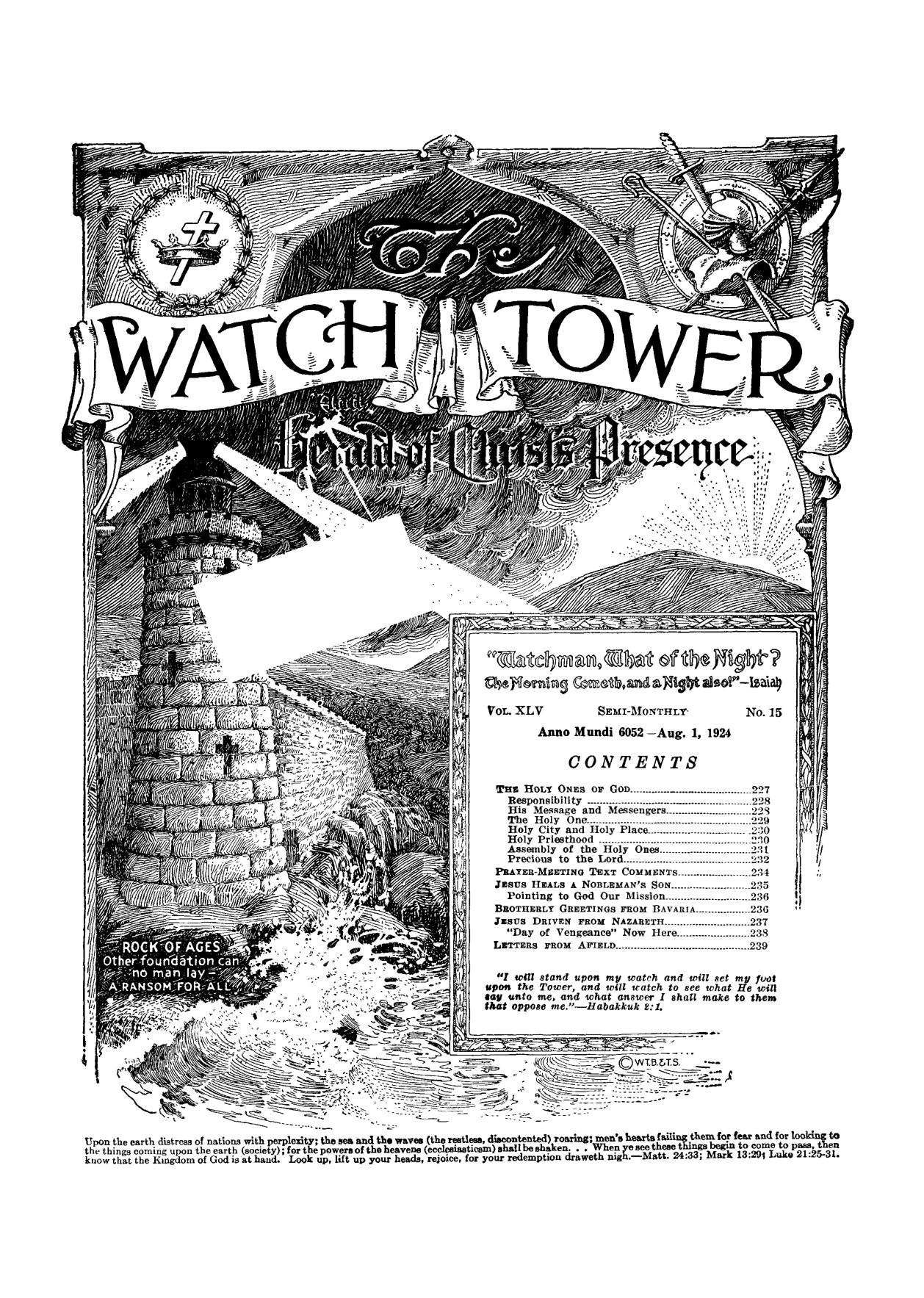
wchIWe
®5>®y?©rait5)g ais&r-Isaiaty
Vol. XLV
Semi-Monthly
No. 15
Anno Mundi 6052 —Aug. 1, 1924
CONTENTS
Tira Holy Ones of God....................
Responsibility ..................................
His Message and Messengers..........
The Holy One....................................
Holy City and Holy Place................
Holy Priesthood ................................
Assembly of the Holy Ones.............
Precious to the Lord........................
Prayer-Meeting Text Comments.......
Jesus Heals a Nobleman's Son.........
Pointing to God Our Mission...........
Brotherly Greetings from Bavaria. Jesus Driven from Nazareth...........
“Day of Vengeance” Now Here.......
Letters from Afield...........................
Other fou n'd at ip n ca n '''<
...227
...228
.229 .230 .230 231 .232
.235 .236 .236 .237 .238 .239
a ran'somJfosJai.W^
"I will stand upon my watch and will set my fuot upon the Tower, and will watch to see what He will tay unto me, and what answer I shall make to them that oppose me.”—Habakkuk 2:1,
(QWT.B.5T.S.
THIS JOURNAL AND ITS SACRED MISSION
THIS journal Is one of the prime factors or instruments, in the system of Bible Instruction, or "Seminary Extension”, now being presented in all parts of the civilized world by the Watch Tower Bible & Tract Society, chartered A. D. 1884, “For the Promotion df Christian Knowledge”. It not only serves as a class room where Bible students may meet In the study of the divine Word but also as a channel of communication through which they may be reached with announcements of the Society’s conventions and of the coming of its traveling representatives, styled “Pilgrims”, and refreshed with reports of its conventions.
Our “Berean Lessons” are topical rehearsals or reviews of our Society’s published Studies most entertainingly arranged, and very helpful to all who would merit the only honorary degree which the Society accords, viz., Verbi Dei Minister (V. D. M.), which translated into English is Minister of God’s Word. Our treatment of the International Sunday School Lessons is specially for the older Bible students and teachers. By some this feature Is considered indispensable.
This journal stands firmly for the defense of the only true foundation of the Christian’s hope now being so generally repudiated —redemption through the precious blood of “the man Christ Jesus, who gave himself a ransom [a corresponding price, a substitute] for all”. (1 Peter 1:19; 1 Timothy 2:6) Building up on this sure foundation the gold, silver and precious stones (1 Corinthians 3: 1115; 2 Peter 1:5-11) of the Word of God, its further mission is to “make all see what is the fellowship of the mystery which. . .has been hid in God, ... to the Intent that now might be made known by the church the manifold wisdom of God”—“which in other ages was not made known unto the sons of men as it is now revealed”.—Ephesians 3: 5-9,10.
It stands free from all parties, sects and creeds of men, while it seeks more and more to bring its every utterance into fullest subjection to the will of God in Christ, as expressed in the holy Scriptures. It is thus free to declare boldly whatsoever the Lord hath spoken—according to the divine wisdom granted unto us to understand his utterances. Its attitude is not dogmatic, but confident; for we know whereof we affirm, treading with Implicit faith upon the sure promises of God. It is held as a trust, to be used only in his service; hence our decisions relative to what may and what may not appear in its columns must be according to our judgment of hit good pleasure, the teaching of his Word, for the upbuilding of his people in grace and knowledge. And we not only invite but urge our readers to prove all Its utterances by the infallible Word to which reference is constantly made to facilitate such testing.
TO US THE SCRIPTURES CLEARLY TEACH
That the church is “the temple of the living God”, peculiarly “his workmanship”; that its construction has been in progress throughout the gospel age—ever since Christ became the world’s Redeemer and the Chief Corner Stone of his temple, through which, when finished, God’s blessing shall come “to all people”, and they find access to him.—1 Corinthians 3:16, 17; Ephesians 2:20-22; Genesis 28 :14 ; Galatians 3:29.
What meantime the chiseling, shaping, and polishing of consecrated believers in Christ’s atonement for sin, progresses; and when the last of these “living stones”, “elect and precious,” shall have been made ready, the great Master Workman will bring all together in the first resurrection; and the temple shall be filled with his glory, and be the meeting place between God and men throughout the Millennium.—Revelation 15 : 5-8.
That the basis of hope, for the church and the world, lies in the fact that “Jesus Christ, by the grace of God, tasted death for every man,” “a ransom for all,” and will be “the true light which lighteth every man that cometh into the world”, “in due time”.— Hebrews 2:9; John 1: 9 ; 1 Timothy 2:5, 6.
That the hope of the church is that she may be like her Lord, “see him as he is,” be “partakers of the divine nature’,’ and share his glory as his joint-heir.—1 John 3:2; John 17:24; Romans 8:17; 2 Peter 1:4.
That the present mission of the church is the perfecting of the saints for the future work of service; to develop in herself every grace; to be God’s witness to the world; and to prepare to be kings and priests in the next age.—Ephesians 4:12; Matthew 24: 14 ; Revelation 1:6; 20 : 6.
That the hope for the world lies in the blessings of knowledge and opportunity to be brought to all by Christ’s Millennial kingdom, the restitution of all that was lost in Adam, to all the willing and obedient, at the hands of their Redeemer and his glorified church, when all the wilfully wicked will be destroyed.—Acts 3:19-23; Isaiah 35.
^ublishbo er
WATCH TOWER. BIBLE & TRACT SOCIETY
18 CONCORD STREET O 0 BROOKLYN, NY. U SA
Foreign Offices ; British: 34 Craven Terrace, Lancaster Gate, London W. 2; Canadian: 88-40 Irwin Avenue, Toronto, Ontario; Australasian: 495 Collins St., Melbourne, Australia; South African; 6 Lelie St., Cape Town, South Africa.
Please Address the Society in Every Case.
YEARLY SUBSCRIPTION PRICE: United States, $1.00; Canada and Miscellaneous Foreign, $1.50; Great Britain, Australasia, and South Africa, 7s. American remittances should be made by Express or Postal Money Orders, or by Ban': Draft. Canadian, British, South African, and Australasian remittances should be made to branch offices only. Remittances from scattered foreign territory may be made to the Brooklyn office, but by International Postal Money Orders only. (Foreign translations of this journal appear in several languages)
Editorial Commitlee: This journal is published under the supervision of an editorial committee, at least three of whom have read and approved as truth each and every article appearing in these columns. The names of the editorial committee are: J. F. Rutherford, W. E. Van Amburgh, J. Hemeby, R. H. Barber, C. E. Stewart. Terms to the Lord’s Poor: All Bible students who, by reason of old age or other infirmity or adversity, are unable to pay for this journal, will be supplied ftee if they send a postal card each May stating their case and requesting such provision. We are not only willing, but anxious, that all such be on our list continually and in touch with the Berean studies. _____________________________
Notice to Subscribers: We do not, as a rule, send a card of acknowledgment for a renewal or for a new subscription. Receipt and entry of renewal are indicated within a month by change in expiration date, as shown on wrapper label. ____________
Entered as Second Class Matter at Brooklyn, N.Y. Postoffice., Act of March 3rd 1879.
CONVENTION AT ST. LOUIS, MO.
A convention of Bible Students will be held in St. Louis, Missouri, Saturday and Sunday, August 30 and 31. Brother Rutherford will be present. For further information address Mr. J. B. Bernoudy, 7033 Lindell Avenue, St. Louis, Mo.
SPECIAL SERVICE
Appreciating the privilege the Lord has granted to us to deliver the message of his kingdom to mankind, a special service week has been arranged for the week of August 17, and special service days as follows: October 4, November 1, and December 6.
Service directors will please take notice and organize all the workers for these special days. We hope every one of the consecrated will be in the field.
If some are able to have their vacation during the third week in August above mentioned, it would be well to arrange to devote the entire week to the service.
CONVENTION REPORT
The Ohio State Journal will carry a four-page report daily of the Convention. Subscription price, twenty-five cents for the entire issue of eight days. Send subscriptions for yourself and friends to the Convention Committee, 52 N. Front Street, Columbus, Ohio.
SPECIAL TRAINS TO COLUMBUS CONVENTION
Please note that the “Bethel Special” will leave Pennsylvania Terminal, New York City, Friday evening, July 18, at 7: 50, Eastern Standard Time, which is twenty-five minutes earlier than previously announced. The time of departure from other points on the route remains unchanged.
A special train from Atlanta, Ga., is scheduled to leave there over the L. & N. R. R. at 1:00 P.M., July 19; leaving Knoxville, Tenn., 6:15 P.M.; Richmond, Ky., 11:00 P.M.; Winchester, Ky., 11: 40 P.M.; Cincinnati, Ohio, 3: 00 A.M., and arriving at Columbus 6: 00 A.M., July 20. The Florida delegation will leave Jacksonville over the A. C. L. Ry. at 8:20 P.M., July 18, joining the Atlanta friends the next morning.
sAVATCH TOWER.
AND HERALD OF CHRISTS PRESENCE
Vol. XLV August 1, 1924 No. 15
THE HOLY ONES OF GOD
"Ye should earnestly contend for the faith which was once delivered unto the saints."—Jude 8.
SAINTS means holy or purified ones. Holy means complete or perfect. We know that there is no one in the flesh who is perfect from that standpoint; but God counts those begotten and anointed of the holy spirit as perfect, because he looks at them through the perfection of his beloved Son Christ Jesus. These are called saints because they are members of his family, he having assigned each one a place in his house.
2 Our Lord Jesus came to earth long centuries ago as the Father’s representative; and when he was finishing his earthly course he committed unto his representatives on earth the interests of his kingdom. Since then each one who has been begotten and anointed of the holy spirit has been taken into a confidential relationship with the Lord. Each one has been entrusted with certain interests of the kingdom, according to the measure of faith granted unto him by the Lord.
3In this text St. Jude reminds us of the great responsibility resting upon one who has been made the receptacle of God’s plans and purposes. It is not a small thing, even from God’s viewpoint, that he bestows his grace upon human beings to such a degree as to take man into his confidence. It is a far greater thing from man’s viewpoint. We stand all astonished in wonderment and awe when we remember that the great Creator of the universe, acting through his beloved Son, has taken us into his confidence, and that there have been committed to us mighty interests concerning his kingdom. This fact should cause us to be humble and not heady. It should cause us to fear and tremble, and to watch with every degree of caution to do properly the things that our Lord would have us to do.
‘As it is among the affairs of men, that not many are willing to assume responsibility for an enterprise with which they are connected, so it is, and has always been, with the saints concerning the Lord’s arrangement. It may be conclusively determined that those who are unwilling to assume little responsibilities of the present will never be entrusted with the vast responsibilities of the future. While the present responsibilities are great to us, they are comparatively small as to the future. But he who is willing to assume these responsibilities now, not in his own strength, but in the strength of the Lord, and who is anxious to walk humbly before God, deal justly, love righteousness and hate iniquity, and faithfully and loyally represent the Lord, may rest assured that the Lord has some greater things for him in the future.
“The Lord lays down this rule of action before us when he states: “He that is faithful in that which is least, is faithful also in much.” (Luke 16:10) Then in an argumentative style he says: “If ye have not been faithful in that which is another man’s, who shall give you that which is your own?” (Luke 16:12) In support of these statements the apostle Paul significantly says: “It is required in stewards, that a man be found faithful.” (1 Corinthians 4:2) Faithful means to be full of faith, full of integrity; to make manifest the principle of fidelity; to be loyal to God and to his cause under all conditions.
“The prominent part of the argument of St. Jude in his epistle to the Church is to the effect that, because a person has once been in the truth and the Lord’s representative, this is not to be taken as evidence conclusive of his present acceptability with God. He calls attention to things in the past in proof of this contention. He reminds his readers that the Israelites were God’s people when they were led forth from Egypt; yet they did not remain God’s chosen ones. All but two persons who left Egypt were destroyed before the crossing of the Jordan.
’Again, the Apostle strengthens his argument by calling attention to the angels of heaven, once holy, once privileged to look upon God’s face, who because of their disloyalty were cast out from his presence and have been confined in darkness, waiting for their final judgment, to be pronounced by Jehovah through his beloved Son Christ Jesus. There was a reason for St. Jude’s setting out these facts. It is apparent that his conclusion is that there are within the Church some who are unfaithful, even as the Israelites after the flesh were unfaithful and as some of the angels were unfaithful; that these are they who separate themselves from the other saints and become sensual, not having the spirit of the Lord, and that they are reserved for the same fate that befell the disobedient angels.
RESPONSIBILITY
^Responsibility always accompanies knowledge; and where knowledge is accompanied by a relationship of trust between the giver and the receiver of the knowledge, greater is the responsibility. It is interesting and profitable for us to trace some of the steps that place man in a position where there are such possibilities ahead as await the Lord’s saints. Before these saints is placed extinction or infinite exaltation.
9How do we come to know of the future possibilities ? It was because God graciously permitted us, after we had come into existence, to be taken into his confidence and shown some of the wonders of his creation. Had he not done this we should never have known anything of the possibilities of the future; and not knowing it, there would not rest upon us the responsibility that now does.
10Few people even consider the greatness of Jehovah. None can have a full conception of his greatness. The most exalted ideas a human being can have of the majesty and greatness of God are far beneath the facts as they really exist, even as far as the earth is beneath the heavens. The immensity of the visible universe appeals to us, and we stand in awe of the greatness of creation.
11 We marvel at our own organism; how fearfully and wonderfully it is made. But we need the assistance of the inspired Word to realize that “holy, holy, holy is the Lord of hosts.” It is through the Bible that we learn that every heavenly being delights in saying of Jehovah, “Blessing, and honor, and glory, and power, be unto him that sitteth upon the throne.” (Isaiah 6:3; Revelation 5:13) The Lord would have us understand his own greatness that we might have a proper appreciation of him; and for the benefit of the saints he caused his prophet to write: “Who hath directed the Spirit of the Lord, or being his counselor hath taught him? With whom took he counsel, and who instructed him, and taught him in the path of judgment, and taught him knowledge, and showed to him the way of understanding? Behold, the nations are as a drop of a bucket, and are counted as the small dust of the balance: behold, he taketh up the isles as a very little thing. All nations before him are as nothing; and they are counted to him less than nothing, and vanity. To whom then will ye liken God? or what likeness will ye compare unto him? It is he that sitteth upon the circle of the earth, and the inhabitants thereof are as grasshoppers; that stretcheth out the heavens as a curtain, and spreadeth them out as a tent to dwell in.”—Isaiah 40:13-15,17,18, 22.
12The word holy as applied to Jehovah carries with it the thought of sacredness and awfulness, such as would befit our attitude of mind toward the One who holds the universe in the palm of his hand, and to whom we owe all that we have, all that we are, all that we shall ever be.
13When Jesus approached the throne of heavenly grace he addressed Jehovah in reverential terms. In his last night upon earth, when he knew that he had been faithfully serving Jehovah, in reverential prayer he used the endearing term, “Holy Father.” (John 17:11) It is passing strange why any human being should want to take this title; yet some have. It shocks the sensibilities of a true Christian that any human being should be so misguided and so mentally deficient as to be willing to receive at the hands of anybody the title “Holy Father,” which belongs to God alone.
3 4Men bring dishonor upon the name of God by applying to themselves titles that belong to him alone.
15Mary was a humble, truly devoted woman. Her name is now misused and surely in a way that she would not approve. As a woman she possessed the fine sense of proportion which made her prompt to say when told that she was to be the mother of the world’s Redeemer: “My spirit hath rejoiced in God my Savior.” She did not take the honor to herself, but gave the honor to him to whom it belonged. Continuing she said: “For he hath regarded the low estate of his handmaiden: for, behold, from henceforth all generations shall call me blessed. For he that is mighty hath done to me great things; and holy [sacred, awful] is his name.”—Luke 1:47-49.
16It is not a common or ordinary thing to be honored as the saint of God. It is a wonderful thing beyond description of human words. Referring to this St. John said: “Ye have an anointing from the Holy One, and ye all know it.” (1 John 2:20, Diaglott) St. Paul makes reference to Jehovah and the saints’ relationship to him, saying, “He which . . . hath anointed us is God.” (2 Corinthians 1:21) Surely then the Christian should in awe and reverence and godly fear strive to walk before Jehovah in the way that he has appointed.
HIS MESSAGE AND MESSENGERS
17To be sure, any message which would proceed from the great Jehovah God would partake of his own characteristics, and be as much a part of him as his own organism, and as much worthy of reverence. His Word, therefore, is to be revered and magnified. His law is his rule of action, given for the government of men. His will is his law, whether expressed or unexpressed. St. Paul, speaking of the law covenant, says: “The law is holy, and the commandment is holy, just, and good.” (Romans 7:12) And why? Because it proceeds from the Holy One.
18It is proper for Christians, as well as Jews, to think reverentially of the Mosaic law covenant, because therein is an expression of Jehovah’s will. While the Christian is not under the letter of that Mosaic law, each one should strive diligently to keep the spirit thereof. Jesus gave us this thought when he said: “Whosoever therefore shall break one of these least commandments, and shall teach men so, he shall be called the least in the kingdom of heaven: but whosoever shall do and teach them, the same shall be called great in the kingdom of heaven. For I say unto you, That except your righteousness shall exceed the righteousness of the scribes and Pharisees, ye shall in no case enter into the kingdom of heaven.”—Matthew 5:19, 20.
19This covenant that Jehovah made with Israel is a holy one because it proceeds from him. Zacharias, the father of John the Baptist, under inspiration of the holy spirit referred to it as “the holy covenant.” It originated with Jehovah, proceeds from him, and is therefore holy.
“Because Jehovah is holy and everything that proceeds from him is holy, the Apostle refers to the Bible, God’s Word, as “the holy scriptures.” (Romans 1: 2) What fools, then, the mortals of the present time be— they who “despise dominion, and speak evil of dignities,” and refer to the Bible in disrespectful terms! These are they whom the Lord foretold through his prophet, saying, “Lo, they have rejected the word of the Lord; and what wisdom is in them?” (Jeremiah 8:9) How foolish for any man so far to forget himself as to reject the Word of God! Particularly is this true with reference to him who once believed upon the Word of God.
21The deepest riches of God’s holy Word are for his children. These precious truths are not to be cast before everybody. For this reason Jesus said: “Give not that which is holy unto the dogs, neither cast ye your pearls before swine, lest they trample them under their feet, and turn again and rend you.” (Matthew 7:6) The message of Jehovah is sacred. It should be regarded and treated thus by all who claim to know the Lord. The time will come when every creature that is granted the privilege of life will realize that God’s Word is holy. Jesus said: “This is life eternal, that they might know thee the only true God, and Jesus Christ, whom thou hast sent.” (John 17: 3) Thus the rule is laid down that those who are blessed with life everlasting must know that the Word of God is holy, even as our Father in heaven is holy.
2 2 The term holy angels often refers to a special class differing from the heavenly messenger that waited upon Cornelius and instructed him to send for Peter. The evidence is clear that this holy angel was a heavenly messenger direct from the presence of God. (Acts 10: 20) Others, however, are spoken of in the Bible as holy aside from those who are of the angelic host.
“The mystery of God was hid from ages and generations. The angels of heaven sought diligently to know about it, but it was not God’s due time for them to understand. The prophets made diligent inquiry, but it was not for them. Hence the Apostle writes: “Which in other ages was not made known unto the sons of men, as it is now revealed unto his holy apostles and prophets by the spirit.” (Ephesians 3:5) The apostle Paul was specially favored of the Lord by the Lord’s revealing to him the great secret of his plan. The other apostles likewise came to a knowledge of the truth, and since then others have been selected and illuminated with an understanding of the plan. But the holy apostles are probably termed holy because Jehovah used them to write down his Word for the instruction and guidance of the man of God, that he might be made perfect. However, their message has not been heeded by many who claim to be Christians. On the contrary, it has been superseded by forms and ceremonies and teachings that are far astray from the holy words contained in the Scriptures.
“These holy men of God loved his Word more than their own lives. Hence he blessed them with a great vision of his plan. The Scriptures strongly support the view that the Lord came to his temple in 1918; and that since then he has been examining those who claim to be of the temple class, casting away the disapproved, commending those who have been faithful, and inviting them to enter into his joy. It is only those who love God and who revere his Word, who look upon him with worship and devotion, and likewise upon his Word, that continue to rejoice in his presence. It is quite apparent that spirituality has departed from the worldly organizations calling themselves churches. Likewise the spirit of the Lord has departed from those who give not proper reverence to the Word of God.
25St. Peter at Pentecost delivered a remarkable sermon. He told his hearers that the times of restitution of all things would come, and that such was shown by the testimony “which God hath spoken by the mouth of all his holy prophets since the world began.” (Acts 3:21) St. Peter was familiar with what the prophets had written. They all did speak of restitution. Zacharias uses practically the same language. Thus it is proven that the messengers of God were counted by him as holy.
26Again, St. Peter tells us that “holy men of God spake as they were moved by the holy spirit,” and explains that his object in writing his second epistle was to “stir up your pure minds by way of remembrance ; that ye may be mindful of the words which were spoken before by the holy prophets.” (2 Peter 1:21; 3:1) Jesus through the Revelator spoke of the prophets as holy men. (Revelation 18:20) The prophets were holy, not because they were perfect men. They were far from coming up to the Lord’s high standard; but they were holy because they were messengers of the Holy God, sent by him for that purpose and entitled to be called holy ones because of that fact.
THE HOLY ONE
!TThe Lord Jesus occupied such a unique place in the Father’s plan that it requires in the original Greek four words to point out the several senses in which he was designated “the Holy One of God.” Our Lord was holy (hosios) in the sense that he was hallowed because of his relationship to the Father. He was holy (akakos) in the sense that he was free from sin. He was holy (amiantos) in the sense that he was unstained by his contact with sinners. And he was holy (hagios) in the sense that he was the child of the One that inhabiteth eternity. It is in the latter sense that the angel described him to Mary as “that holy thing which shall be born of thee.”—Luke 1: 35.
28In harmony with the Jewish law and its reasonable requirement that every male should be considered holy unto the Lord, Jesus was duly presented unto the Father before the temple in Jerusalem. We can imagine with what infinite tenderness Jehovah, the Holy One from above, looked down into the face of that little boy whom he loved so dearly, knowing that later he would tread the winepress alone; that in no unmeasured terms he would denounce the hypocrisy of the Pharisees; that he would pass his Gethsemane and Calvary experiences, and then would arise triumphant over all to the glory of God. During all his experiences the Lord Jesus was the special recipient of his Father’s love. That beloved child was ever holy unto Jehovah. He is the fairest of ten thousand and altogether lovely. There is everything in him to be admired.
29The apostles were taught by the Lord and lived close to him. When they spoke of him it was in such a way as to convey the thought that he was different from other men, as indeed he was. He was holy, harmless, separate from sinners, without guile, without deceit. St. Peter on the day of Pentecost quotes from the Prophet concerning Jesus: “Thou wilt not suffer thine Holy One to see corruption.” (Acts 2:27) Shortly thereafter St. Peter again, in reproving those who had caused the death of Jesus, spoke of him as the Holy One, saying, “Ye denied the Holy One and the Just and desired a murderer to be granted unto you; and killed the Prince of life, whom God hath raised from the dead.”—Acts 3:14,15.
80The apostles always held Jesus in great reverence and love. Peter and John had been threatened because of healing a man who had been lame from his birth. They went to Jehovah in prayer. Twice in that prayer they used the affectionate term in addressing the Father concerning Jesus, thus: “Thy holy child Jesus.” It is quite manifest that the heavenly Father was pleased; for it is written: “And when they had prayed, the place was shaken where they.were assembled together; and they were all filled with the holy spirit, and spake the word of God with boldness.”—Acts 4: 31.
81 Jesus was holy to the Father in another sense, that he was the Father’s special representative, whom Jehovah sent from heaven to earth on the great mission of providing the redemptive price and purchasing the human race. For this reason Jesus often said that he came not to do his own will, but the will of his Father who sent him. He said furthermore that he gave not testimony of himself, but that he testified concerning Jehovah.
THE HOLY CITY AND THE HOLY PLACE
82Jerusalem is called the holy city. One visiting it is not much impressed with it as being a particularly beautiful place. It is beautiful for location, but the city itself is no more than other cities. Why, then, should it be called the holy city? The answer is, Because of its intimate association with the plans and purposes of God; that it is the city of the Lord chosen for a purpose, and is holy unto him.
S3A place represents a condition, so Jerusalem represented the condition of God’s spirit-begotten people. It refers to God’s organization on earth. It is mentioned as “the holy city,” which they shall tread under foot forty and two months (Revelation 11:2), picturing, as we understand, the time of Papal persecution of the true saints. St. John the Revelator speaks of it as the holy city, the new Jerusalem, coming down from God out of heaven prepared as a bride adorned for her husband. Again, he was expressly told, when he saw a vision of the holy city, that he was witnessing the future state of the bride of Christ. There is a sense in which the holy city represents all of God’s creatures assembled under one Head, Christ Jesus. The time will come when all the saints, the bride of Christ, the great company, the ancient worthies, the millions now on earth who may be restored, and the resurrected millions of earth’s people who will likewise be restored, shall be gathered together under Christ Jesus, the Head over all.
34As the city of Jerusalem is designated a holy city because of its identification with Jehovah, so the precincts of the temple were referred to as the “holy place.” When the scribes and Pharisees accused Stephen of speaking blasphemous words against “this holy place,” Stephen’s main line of defense was that the temple at Jerusalem ought not to be considered the real dwellingplace of God, because “the Most High dwelleth not in temples made with hands.” (Acts 7:43-50) Thus he proves that a place represents a condition. Further proof is given of this when St. Paul was accused of polluting the temple by bringing an Ephesian into it. The charge against him was that “he hath polluted this holy place.” St. Paul subsequently explained that the place represented a condition, saying concerning the Church, “Ye are the temple of God.” (1 Corinthians 3:16,17) Again, he said that the whole Church of Christ is a building, fitly framed together, growing into a holy temple in the Lord.—Ephesians 2: 21.
HOLY PRIESTHOOD
88As we examine the Scriptures we shall see that those who specially represent the Lord are holy unto the Lord. The apostle Peter describes these as “a royal priesthood, a holy nation.” The Christian knows that this holy nation or royal priesthood this side the vail is referred to, made up of those who are begotten and anointed of the holy spirit, and led by the spirit, being devoted to the Lord and faithfully representing his cause. This royal or holy priesthood is composed of all the “holy brethren”; those who are partakers of the heavenly calling, and who prove this by daily presenting their bodies a living sacrifice, holy, acceptable unto God. (1 Thessalonians 5:27; Hebrews 3:1; Romans 12:1) This is the class mentioned by the Apostle as a chosen race, a royal priesthood, a holy nation, built up a spiritual house, a holy priesthood, to offer sacrifices acceptable to God.—1 Peter 2: 5, 9.
36Again, the Church is spoken of as holy in this, that Jehovah “hath saved us, and called us with a holy calling, not according to our works, but according to ais own purpose and grace, which was given us in Christ Jesus before the world began.”—2 Timothy 1: 9.
37The privilege of being partakers of the kingdom and with the Lord of extending blessings to others is frequently mentioned in the Scriptures as an inheritance. Thus does the Apostle speak: “The inheritance of the saints [holy ones] in light.” (Colossians 1:12) The saints or holy ones are those who are entrusted by the Most Holy Ones, Jehovah and the Lord Jesus, with the work of grace. The apostle Paul refers to these as having obtained an inheritance and being predestinated (as a class), according to the purpose of him who worketh all things after the counsel of his own will. —Ephesians 1:11.
38Jehovah has graciously provided for the development of these chosen ones. The object of the Scriptures is largely to “give unto you the spirit of wisdom and revelation in the knowledge of him; the eyes of your understanding being enlightened; that ye may know what is the hope of his calling, and what the riches of the glory of his inheritance in the saints.” —Ephesians 1:18.
38These holy ones proving faithful to the end shall come fully into their inheritance. They shall act with the Lord Jesus as magistrates, sitting with him in his throne, to judge men and angels. (Matthew 19:28) It is written concerning them: “Blessed and holy is he that hath part in the first resurrection: . . . they shall be priests of God and of Christ, and shall reign with him a thousand years.” (Revelation 20:6) When the saints come into their full inheritance, blessed indeed will be their portion.
ASSEMBLY OF THE HOLY ONES
“The members of the early Church were frequently spoken of as saints, or holy ones. They earnestly desired that honor. Frequently they are spoken of in the Scriptures as the saints. By this we understand that the various assemblies or ecclesias of the consecrated were holy unto the Lord, because they were his representatives in the performance of things committed to their hands.
"The Lord wishes his representatives to be like himself. Concerning this the Apostle says: “As obedient children, not fashioning yourselves according to the former lusts in your ignorance: but as he which hath called you is holy, so be ye holy in all manner of conversation: because it is written, Be ye holy; for I am holy.” (1 Peter 1:14-16) The Lord Jehovah is holy, complete. He is perfect in wisdom, justice, love and power. The consecrated are called and admonished to pursue such a course of action as will increase in them these divine attributes. Because they are chosen of the Lord and are thus striving to follow in his footsteps they are holy. But as they advance or progress in his likeness they grow in actual holiness, and at the end will reach a real or complete holiness.
42 St. Paul plainly shows that it is the purpose of God that these should be holy when he says: “He hath chosen us in him before the foundation of the world, that we should be holy and without blame before him in love.”—Ephesians 1: 4.
“Those who expect to reach that complete state of holiness with the Lord must try to be holy now. Their course of action ot conduct must be such as becomes saints, free from reproach as respects everything that is unclean.—Ephesians 5:1-3.
"One of the ways that the Lord has for developing those who are to be his joint-heirs is by instructions to be given by suitable teachers. This instruction is given to the end that “Christ may dwell in your hearts by faith; that ye, being rooted and grounded in love, may be able to comprehend with all saints [holy ones], what is the breadth, and length, and depth, and height; and to know the love of Christ, which passeth knowledge, that ye might be filled with all the fulness of God.” —Ephesians 3:17-19.
45 Our Lord has chosen his own way to develop his saints, and his way is right. Patience, which means cheerful endurance, must be developed in the one who is a Christian. He must wield the sword of the spirit deftly and with love, cheerfully waiting upon the Lord for the good results. At the same time he may expect the literal sword or carnal force against himself. He must not resort to such force. Concerning this it is written: “He that killeth with the sword must be killed with the sword. Here is the patience and the faith of the saints.” (Revelation 13:10) The Church has been persecuted throughout the age by the visible seed of Satan. These have made war with the saints and overcome them. They have been drunken with the blood of saints and martyrs, and in due time the Lord will take account of all those who have been guilty of misdeeds against those who are holy unto him.
MINISTRATIONS
“Each member of the body of Christ occupies a position of responsibility toward every other member. Amongst these responsibilities is that of ministering unto those who are holy unto the Lord. This ministration takes various forms. One form is that of supplication for all saints. A supplication means a petition or a special request earnestly presented. The apostle Paul specially emphasizes this as an obligation laid upon the Christian, which he is duty-bound to perform, particularly in the trying period at the close of the Gospel Age. He writes: “Praying always with all prayer and supplication in the spirit, and watching thereunto with all perseverance and supplication for all saints.” (Ephesians 6:18) He who possesses the holy spirit will manifest it by his interest in others of like precious faith. We may not know just what our brother needs; but we can pray for him earnestly, remembering that “he that searcheth the hearts knoweth what is the mind of the spirit,” and he knoweth what things we have need of.—Romans 8: 27.
‘7It is entirely proper, then, that we should ask the Lord to grant unto each one of the saints the things that would be best for his upbuilding and preparation for the kingdom. These prayers before the throne of divine grace are not merely perfunctory recitations. It is evidently arranged that the members of the body should pray for each other in order that their keen interest may be manifested before the Lord in behalf of one another.
PRECIOUS TO THE LORD
48When the Lord Jesus went away to heaven he committed to those who are faithfully following him the interests of his kingdom. Involved in these interests are the great fundamental truths of the divine plan, and the obligation upon him who has a knowledge thereof to teach it to his fellow creature. Each one is appointed to this position when he is anointed of the holy spirit; for anointing means a designation to office. The relationship established between him and the Head, Christ Jesus, and the heavenly Father makes such representatives holy unto the Lord. They are saints now, purified because of the merit of Christ Jesus, which is the basis for their justification by Jehovah. They are anointed by the heavenly Father.
49Each one thus set in the body by the Father becomes an ambassador of Christ to represent Christ. If he is holy unto the Lord, every other member of the body ought to regard him as such. A proper appreciation of each one in the body of Christ of necessity has a tendency to make one be more particular and careful not only to refrain from stumbling his brother but to aid him to grow like his Master. The more fully this is appreciated, the less one Christian will be inclined to judge another,
60St. Paul says: “Who art thou that judgest another man’s servant? To his own master he standeth or falleth. Yea, he shall be hoi den up: for God is able to make him stand.” (Romans 14: 4) There is often a difficulty amongst the ecclesias of our time which sometimes leads to a division, some members harshly judging other members, not only surmising evil but speaking evil one of another. Doubtless they do not stop to think that they are speaking against the Lord; for each one who is anointed of the Lord is holy unto the Lord in the sense that he represents the Lord and must be judged by the Lord and not by man. Concerning this St. James says: “Speak not evil one of another, brethren. He that speaketh of his brother, and judgeth his brother, speak-eth evil of the law, and judgeth the law: but if thou judge the law, thou are not a doer of the law, but a judge.” (James 4:11) The law means the expressed will of God. His law governing the new creation means his rule of action directing what they shall do and what they shall not do. To judge means judicially to determine whether a brother is meeting the divine requirements or not. For one to attempt to judge his brother, then, and to speak evil of him, is judicially to determine in his own mind whether or not his brother is pleasing to the Lord; and that he cannot do. It is rather presumptuous on the part of a Christian to do that. It is a sin. It is a presumptuous sin about which the Prophet speaks when he says: “Keep back thy servant from presumptuous sins; let them not have dominion over me: then shall I be upright, and I shall be innocent from the great transgression.”—Psalm 19:13.
51We may be sure that he who is anointed of the Lord is the special recipient of the Lord’s favor. The Psalmist tells us that the angel of the Lord encampeth round about such a one. Seeing that the Lord makes such provision for each one of his saints, we can understand then why the Lord would say through his prophet: “Touch not mine anointed, and do my prophets no harm.”—Psalm 105:15.
E2There is a particular tie that binds together the saints; and that tie is love divine. It is otherwise spoken of as brotherly love. It is love divine and brotherly love because it is a love that binds together the members of the house of sons, of which Jesus is the Head. Speaking to the Church, and applying his words particularly at the end of the earthly course, St. Paul says: “Let brotherly love continue”—that is to say, regardless of anything else that may arise, see to it that that family, reciprocal love, a special unselfish interest one for another, continues amongst those who are of the saints.
63It was the love of God that provided redemption for us. It was the love that Jesus had for us that caused him to die for us. It is love that prompted the Lord to call from amongst men those whom he has made his special representatives therefore saints, therefore holy unto him. St. John says: “Beloved, if God so loved us, we ought also to love one another.” The Apostle further emphasizes it when he says: “If a man say, I love God, and hateth his brother, he is a liar: for he that loveth not his brother whom he hath seen, how can he love God whom he hath not seen?”—1 John 4:11, 20
S4It is the will of the Lord that the saints should love each other, as St. Paul writes: “Love unto all the saints.” (Ephesians 1:15) Proper expressions of love toward the brethren are not to be withheld. We must understand that perfect love means a perfect expression of unselfishness. The proper attitude for each one who is a prospective member of the bride of Christ is to be especially interested in every other one who is a prospective member.
"One special mark indicating a Christian is the disposition to contribute to the necessity of the saints. (Romans 12:13) This requirement includes both temporal and spiritual needs. Where it is within the power to contribute to the need in a material way that should be done. The Apostle assures us that one of the grounds of our confidence of approval from the Lord is the disposition to minister to the saints. He says: “For God is not unrighteous to forget your work and labor of love, which ye have shewed toward his name, in that ye have ministered to the saints, and do minister.” (Hebrews 6:10) This is pleasing to the Lord because it is a recognition of those who are his; and love manifested toward those that are his is counted as though it were manifested to him. It is of primary importance that the holy ones minister one unto another the supplies of truth which the Lord has so abundantly given unto his people.
56We are living in a time when there is a great famine in the land for the hearing of the Word of God, because of the unfaithfulness of many who have pretended to be his. Now the Lord has graciously provided us with an explanation of his plan as set forth in the Studies in the Scriptures and accompanying publications. It becomes the privilege and duty, then, of each of the consecrated to see to it that every hungry soul is sup-supplied that he can supply. The Apostle, admonishing Timothy as to what shall be done toward the saints, which admonition applies to all of this time, says: “Meditate upon these things; give thyself wholly to them; that thy profiting may appear to all. Take heed unto thyself, and unto the doctrine; continue in them: for in doing this thou shalt both save thyself, and them that hear thee.”—1 Timothy 4:15,16.
57The Lord has permitted Satan and his representatives to buffet the saints, to ill-treat them, to persecute them. He has permitted it in this, that he has not prevented it. But he has overruled the matter by permitting these experiences to develop in the saints patient endurance and loving kindness; and in his own due time he will avenge them by administering the proper recompense of punishment upon the ones who have persecuted his holy ones.
58For this reason, the apostle Paul, who had passed through many such trying experiences, addressing himself to the saints, said: “You who are troubled, rest with us; when the Lord Jesus shall be revealed from heaven with his mighty angels.” (2 Thessalonians 1:7) Otherwise, to wait upon the Lord confidently in faith; for he will take proper notice of all the ill-treatment of the saints.
59The day is fast approaching when all the saints shall be through with their trying experiences. No longer will they be misunderstood or misrepresented, ill-treated or abused. No longer will they be in obscurity and counted as the offscourings of the earth. They are holy to the Lord now and ever will be; and when the record is written up, the people will know which of them have weathered the storm, gained the victory, and are bom in Zion.
60At this time when there is such a great falling away from the faith once delivered to the saints, when many who have pretended to represent the Lord now misrepresent him, it is the great privilege of the saints to contend earnestly for this faith, boldly and fearlessly representing the Lord. What a marvelous privilege to be a member of the Lord’s organization on earth 1 How much more wonderful will it be to enter the house of the Lord beyond the vail and there dwell, beholding his beauty and inquiring in his temple! Such is the prospect of the holy ones journeying toward their habitation in the heavens. Our love and devotion for our great God and Father and our Lord Jesus Christ will be manifested in proportion to our earnestness in representing the great divine plan and placing it before the minds of the people that they may learn that Jehovah is God and that Jesus is the King of kings and Lord of lords.
QUESTIONS FOR BEREAN STUDY
How is one perfect in the sight of God while still in the flesh? 11. What did Jesus commit unto his followers? 1 2.
What has the Lord done for us that should make us very humble?
II 3*
Should we draw back from assuming responsibilities? T 4, 5.
If once a representative of the Lord, is one necessarily always so?
As we continue in the truth, does our responsibility increase? $ 8, 9. Do many people consider the greatness of Jehovah? 110.
What are we at best, in comparison with God? What member of the human family directs the spirit of God? U 11.
Define the word holy, as applied to Jehovah. U 12.
What endearing term should be addressed only to God Almighty? H 13, 14.
How did Mary show her devotion to God? T 15.
What should be the attitude of the saints toward God? U 16.
Are God’s Word and Covenants expressive of his character? 7 17-20. For whom are the deepest riches of truth? Are we justified in guarding those things which are most precious ? 1 21.
Are the holy angels always the same class? U 22.
Could the angels in their own wisdom delve into the deep things of God ? To whom are the deep things revealed ? | 23, 24.
What was St. Peter's message at Pentecost? Why are the prophets referred to as holy ? U 25, 26.
How does the Bible show that Jesus occupied a unique place when he was here in the flesh? 7 27.
Is it reasonable that God the Father looked down upon the babe Jesus with admiration and tender love? 7 28.
Was Jesus different from other men? Was he different from God? U 29-31.
Is Jerusalem a beautiful place? Why is it called holy? 7 32-34. Who are the royal family? Why are they collectively a holy nation? 7 35-37.
Why should we read and ponder over the Scriptures ? 7 38, 39. Why are the members of Christ’s body appropriately called saints?
1 40-43.
How is the Lord developing those whom he has chosen ? 7 44, 45. Do these saints have a responsibility toward each other? What is a supplication? 7 46, 47.
What is involved in the interests the Lord has committed unto us? 748, 49.
Is it proper for one to judge another? What is a presumptuous sin ? 7 50-.
Who are they who are the special recipients of the Lord’s favor? 1 51.
What Is brotherly love and how does it operate? 7 52-54.
What is a mark of Christian love? How does the Lord view the love that is bestowed upon another fellow member of the body of Christ? 1 55, 56.
Why are the saints buffeted by the adversary? How is this overruled? 1 57-59.
What is the special necessity of contending for the faith at the present time? What is the prospect before those who lovingly show their devotion without wavering ? 7 60.
PRAYER-MEETING
TEXT COMMENTS
TEXT FOR SEPTEMBER 3
"They shall he mine, . . . when I make up my jewels."—Malachi 3:17.
IN THIS text and the context, the prophet of God is describing a class that is peculiarly favored by Jehovah. There were twelve precious stones or jewels in the breastplate worn by the high priest of Israel. These jewels were imbedded in gold, and fastened to the ephod by means of a golden chain. They were bound over the heart of the priest, thus indicating that they were precious to him. On these jewels, respectively, were engraved the names of the twelve tribes of Israel.
The Revelator gives a description of the kingdom, symbolized by a city, the foundation walls of which were garnished with precious stones or jewels. The description seems peculiarly to represent the organization of the kingdom of God. In the completed body of Christ in glory there will be 144,000 stars, or glorified members of the royal line, over whom Christ Jesus is the Head.
The prophecy here mentioned seems to fix the time when this class of devoted ones shall be especially claimed by the Lord; and that time is, “when I make up my jewels.” This seems to cover the period of time during our Lord’s second presence when he sets his kingdom in order and begins his reign.
The condition precedent to being counted in as members of this number is that they think upon his name and fear (are reverently devoted to) the Lord, and speak often one to another concerning the Lord and his gracious plan. Creatures speak often of things that are dear to their hearts, and their hands move according as their hearts are filled with love. These think on the Lord, of his kingdom, of the blessings it will bring; and they speak often of it, and the Lord hearkens unto them and blesses them with his approving smile.
Clearly the words of this text imply an active, unselfish devotion to the Lord and his cause; that is to say, faithfulness in representing his interests; and such is the theme of their converse together. It pictures a class whose hearts are set upon the Lord and who are absolutely devoted to him. Of such the Lord keeps a book of remembrance, and in that day (during the period of time when he is making up his jewels) he remembers these faithful ones and owns them as his peculiar and blessed people. This text is another given for the encouragement and heart-comfort of those who have turned to the Lord to learn of him and who are striving to do his holy will.
TEXT FOR SEPTEMBER 10
"We shall he like him; for we shall see him as he is."—1 John 3: 2.
Christ Jesus, the great King divine, is a glorious spirit being. No human eye will ever behold his resplendent glory and beauty. Saul of Tarsus saw the light reflected by his glory, which he describes as “a light from heaven above the brightness of the sun”; but he did not see the glorified Christ. Jehovah has reserved that feast for a limited number of his creatures.
When the reverential mind now views the vastness of God’s visible creation, and beholds its grandeur and beauty, he is filled with admiration and awe. But the glory of the unseen things in heaven are beyond all the dreams of human philosophy. The glory of the Lord Jesus is like unto that of the great Creator of all; he is the express image of the Father.
We are overwhelmed when we hear the Apostle, under inspiration, saying to those who are followers in the Master’s footsteps that the class faithful unto death shall be like our Lord and see him as he is. What an inspiration to faithfulness unto the Lord! That faithfulness means an unselfish devotion to the Lord and to his purposes and to be loyal, tried and true representatives of the kingdom. It is such faithfulness to the cause of righteousness that will be rewarded by being made into the likeness of Jesus, to dwell forever with him in the home eternal in the heavens not made with hands.
When Jesus was on earth he said: “Of mine own self I can do nothing. I seek not mine own will but the will of my Father.” (John 5: 30) It was this absolute devotion to his Father that won for him the reward of exaltation far above powers and principalities and every name that is named.
Those who will be of the glorified body of Christ must have and show forth, while in this wicked world, a like spirit of devotion to the cause of God and our King. Here must be perfected love toward God, which means an unselfish devotion to him and his cause. “As he is, so are we in this world” (1 John 4:17) ; and if faithful unto death, so shall we forever be in glory.
“Go labor on; ’tis not for naught;
Thy earthly loss is heavenly gain.
Men heed thee, love thee, praise thee not; The Master praises—what are men?
“Go labor on; enough, while here, If he shall praise thee—if he deign Thy willing heart to mark and cheer.
No toil for him shall be in vain.
“Men sit in darkness at thy side, Without a hope beyond the tomb.
Take up the torch and wave it wide, The torch that lights the thickest gloom.
“Go labor on; thy hands are weak, Thy knees are faint, thy soul cast down, Yet falter not The prize ye seek
Is near—a kingdom and a crown 1”
JESUS HEALS A NOBLEMAN’S SON
----Septembeb 7---John 4: 46-54----
FAITH IN THE W0BDS OF JESUS-WISDOM IN THE STERNNESS OF JESUS-COURAGE A NECESSARY PABT OF CHARACTER—POINTING
TO GOD IS OUB MISSION.
"I am the way,
AFTER two days’ stay In Sychar with the Samaritans Jesus continued his journey northward. He did not L take the road that led more directly to Nazareth, but vent by the east road, which led him towards the south end ,f the lake of Galilee. Our Lord did this because, as he him-lelf said, “A prophet Is not without honor, save in his own jountry, and In his own house.” (Matt. 13:57) It Is apparent that he had then no expectation that he could serve his Father’s Interests by going at once to Nazareth, where he had been brought up. He came once again to Cana, where in his first miracle he had turned water into wine. Probably he stayed at the house where that miracle was performed, and where evidently his mother was a welcome visitor. The Galileans received him gladly; for many of them had been to the Passover In Jerusalem, and had seen the things which he did there. (John 4:45) The miracles excited them; and they had gone back to Galilee, carrying the news of the miracle worker of Nazareth. But the things he did, rather than the words he spoke, were of Interest to them.
FAITH IN THE WORDS OF JESUS
’Jesus had not been long at Cana when he was visited by a ruler of Herod’s household, from Capernaum, twenty miles away. It has been suggested, and with probability, that this man was Chuza, Herod’s steward, the husband of Joanna, who later ministered to Jesus. (See Luke 8:3) His son was very sick; hearing in Capernaum that Jesus had returned to Galilee and was at Cana, he at once started on the twenty-mile journey. Coming to Jesus he besought him that he would at once come down; for his son was at the point of death. Jesus never refused a request for help, but he did not always respond at once to requests such as this. He did not do so in this Instance; but, with a measure of rebuke In his words he said to the father—and, we must suppose, his words were intended for others who were present—“Except ye see signs and wonders, ye will not believe.”—John 8:44.
3The father was urgent, as if he would remind Jesus that his boy’s life was in the balance between life and death, and he said: "Sir, come down ere my child die.” The earnest plea of the father prevailed. But Jesus had gained his point. He did not need to go to Capernaum to give the boy renewed life; and now he simply said to the father: ‘Go thy way: thy son liveth.” The father’s faith in Jesus was quickened. He had not been set back by the apparent rebuff; on the contrary, he had realized that Jesus had a helpful purpose in his words. In confidence he started back for Capernaum, believing that he would find his boy restored or well on the way to health.
♦On his way home his servants met him, saying, “Thy son liveth,” thus using the same words which Jesus had spoken to him. His inquiry elicited the fact that the boy had begun to get better the day before, at the moment when Jesus had spoken to him. He had believed before in the sense of accepting Jesus as a good man who was doing a good work for God. Now In a fuller sense, he believed that Jesus was what he claimed to be, not merely a miracle worker, but the Son of God sent to declare his Father’s will. His whole house also believed—his wife, his restored boy, and his servants; for evidently he was a good man and guided his household in the fear of God.
and the truth, and the life."—John H:
6.
WISDOM IN THE STERNNESS OF JESUS
’John says that this is the second miracle which Jesus di 1 when he was come out of Judea into Galilee. (John 4:54) When first the petition was made to Jesus, he seemed rather stern. There was some necessity for this attitude apparent to him; for It is evident that he had no thought of refusing the father’s request. His words at first sight do not seem as if he had any special desire to increase the father’s faith. It was necessary for the Jews to be told plainly the reaso i why any of them sought him. In Jerusalem the people woul I have accepted Jesus If he had made himself their leader to bring about their own desires; and even now in this earnest request so urgently put to him It was necessary for him to point out that it was made for a selfish end. There is no reason for thinking that the father had any thought beyond getting his son restored to health and his family brought back to Its normal happiness.
6 At this time Jesus had just come from Sychar, in Samaria, where he had stayed two days with people who had gladly listened to his word and believed on him for the things he said. The Samaritans were ready to receive him because of the truth he brought But his own people were not ready. They would, as we have before said, take the miracles lie performed for them; but they had no use for his teaching. This lesson gives an example of how trouble prepares the heart for the acceptance of Jesus. The miracles in Jerusalem left the hearts of the people untouched; but this man, thrown Into sore trouble, was so grateful to the Lord when his distress was removed that he was ready to accept Jesus as One sent from God, and did accept him, and became one of the earliest believers in Jesus.
…