The Watchtower, November 15, 1923
Download: PDF — The Watchtower, November 15, 1923
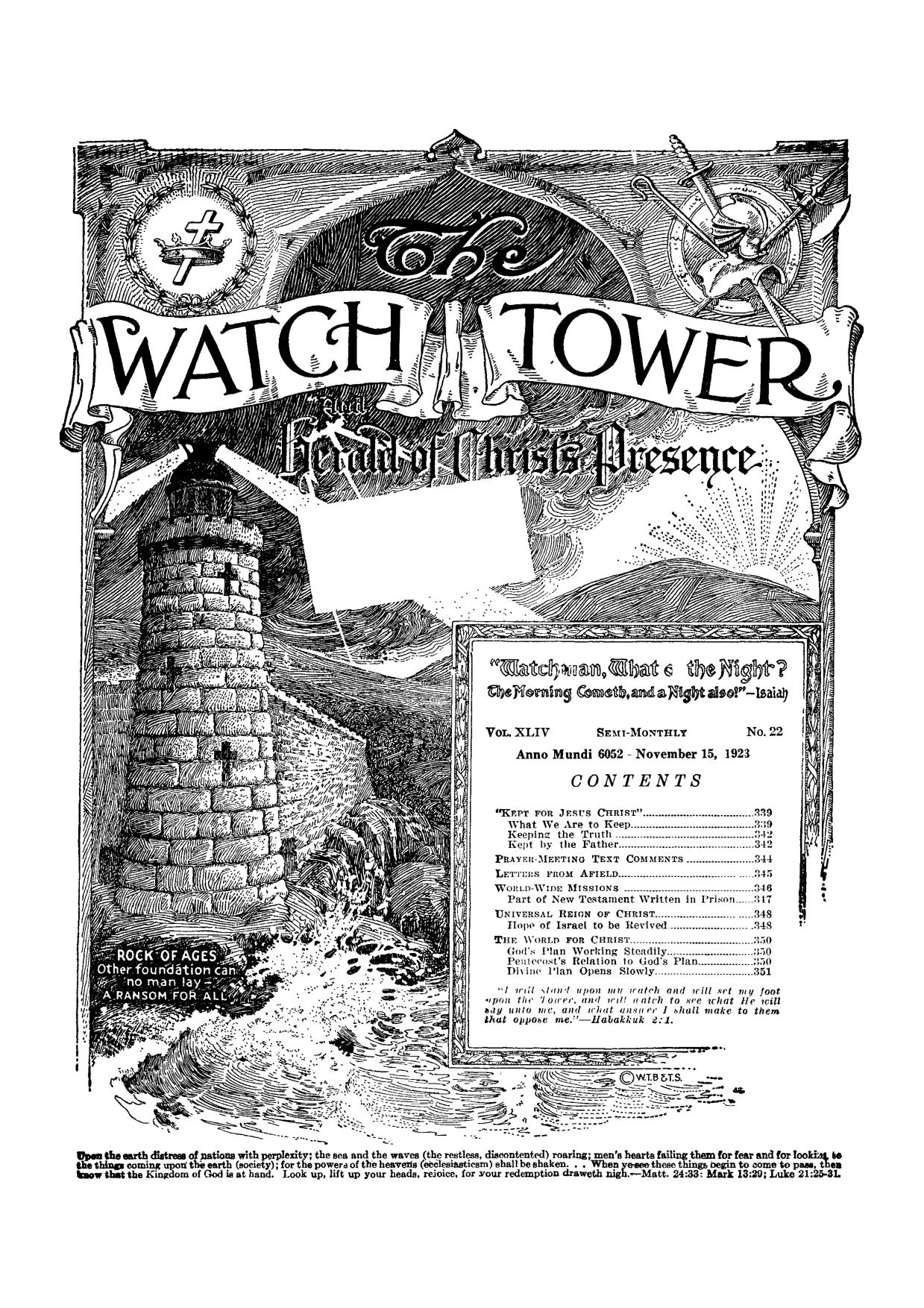
Vpea Che earth distress of nations with perplexity; the sea and the waves (the restless, discontented) roaring; men's hearts failing them for fear and for looking to Che things coming upon* the earth (society); for the powers of the heavens (ecclesiasticsm) shall be shaken. . . When veeee these things begin to come to pass, then know that the Kingdom of God is at hand. Look up, lift up your heads, rejoice, for vour redemption draweth nigh.’—Matt. 24:33: Mark 13:29; Luke 21:25-31.
THIS JOURNAL AND ITS SACRED MISSION
nrtHIB Journal is one of the prims factors or Instruments in the system of Bible Instruction, or “Seminary Extension”, now being A presented in all parts of the civilized world by the Watch Tower Bible & Tract Society, chartered A.D. 1884, “For the Promotion of Christian Knowledge”. It not only serves as a class room where Bible students may meet in the study of the divine Word but also as a channel of communication through which they may be reached with announcements of the Society's conventions and of the coming of its traveling representatives, styled “Pilgrims”, and refreshed with reports of its conventions.
Our “Berean Lessons” are topical rehearsals or reviews of our Society’s published Studies most entertainingly arranged, and very helpful to all who would merit the only honorary degree which the Society accords, viz.. Verbi Dei Minister (V. D. M.), which translated into English is Minister of God’s Word. Our treatment of the International Sunday School Lessons is specially for the older Bible students and teachers. By some this feature is considered indispensable.
This journal stands firmly for the defense of the only true foundation of the Christian’s hope now being so generally repudiated —redemption through the precious blood of “the man Christ Jesus, who gave himself a ransom [a corresponding price, a substitute] for all”. (1 Peter 1:1b; 1 Timothy 2 :6) Building up on this sure foundation the gold, silver and precious stones (1 Corinthians 3: 11-lo ; 2 Peter 1:5-11) of the Word of God, its further mission is to “make all see what is the fellowship of the mystery which. . .has been hid in God, ... to the intent that now might be made known by the church the manifold wisdom of God”—“which in other ages was not made known unto the sons of men as it is now revealed”.—Ephesians 3: 5-9,10.
It stands free from all parties, sects and creeds of men, while it seeks more and more to bring its every utterance Into fullest subjection to the will of God in Christ, as expressed in the holy Scriptures. It Is thus free to declare boldly whatsoever the Lord hath spoken—according to the divine wisdom granted unto us to understand his utterances. Its attitude is not dogmatic, but confident; for we know whereof we affirm, treading with implicit faith upon the sure promises of God. It is held as a trust, to be used only in his service; hence our decisions relative to what may and what may not appear in its columns must be according to our judgment of his good pleasure, the teaching of his Word, for the upbuilding of his people in grace and knowledge. And we not only invite but urge our readers to prove all its utterances by the infallible Word to which reference is constantly made to facilitate such testing.
TO US THE SCRIPTURES CLEARLY TEACH
That the church is “the temple of the living God”, peculiarly “his workmanship” ; that its construction has been In progress throughout the gospel age—ever since Christ became the world’s Redeemer and the Chief Corner Stone of his temple, through which, when finished, God's blessing shall come “to all people”, and they find access to him.—1 Corinthians 3:16, 17; Ephesians 2:20-22; Genesis 28 :14 ; Galatians 3 : 29.
That meantime the chiseling, shaping, and polishing of consecrated believers In Christ’s atonement for sin, progresses; and when th« last of these “living stones”, “elect and precious,” shall have been made ready, the great Master Workman ■will bring all together in the first resurrection; and the temple shall be filled with his glory, and be the meeting place between God and men throughout the Millennium.—Revelation 15 : 5-8.
That the basis of hope, for the church and the world, lies in the fact that “Jesus Christ, by the grace of God, tasted death for every man,” “a ransom for all,” and will be “the true light which lighteth every man that cometh into the world", “in due time”.— Hebrews 2:9; John 1:9; 1 Timothy 2:5, 6.
That the hope of the church is that she may be like her Lord, “see him as he is,” be ‘ partaker of the divine natureand share his glory as his joint-heir.—1 John 3 :2 ; John 17:24; Romans 8 :17; 2 Peter 1:4.
That the present mission of the church is the perfecting of the saints foi the future work of service; to develop in herself every grace; to be God’s witness to the world ; and to prepare to be kings and priests in the next age.—Ephesians 4:12; Matthew 24 : 14 ; Revelation 1: 6; 20 : 6.
That the hope for the world lies in the blessings of knowledge and opportunity to be brought to all by Christ’s Millennial kingdom, the restitution of all that was lost in Adam, to all the willing and obedient, at the hands of their Redeemer and his glorified church, when all the wilfully wicked will be destroyed.—Acts 3:19-23; Isaiah 35.
■Published b?
Watch tower.bible &-tract society
18 CONCORD STREET O 0 BROOKLYN, NY. U-SA
Foreign Offices : British: 34 Craven Terrace, Lancaster uaue, London W. 2 ; Canadian: 38-40 Irwin Avenue, Toronto, Ontario; Australasian: 495 Collins St., Melbourne, Australia; South African;
6 Lelie St., Cape Town, South Africa.
Please Address the Society in Every Case.
YEARLY SUBSCRIPTION PRICE: United States, $1.00; Canada and Miscellaneous Foreign, $1.50; Great Britain, Australasia, and South Africa, 8s. American remittances should be made by Express or Postal Money Orders, or by Bank Draft. Canadian, British, South African, and Australasian remittances should be made to branch offices only. Remittances from scattered foreign territory may bo made to the Brooklyn office, but by International Postal Money Orders only. (Foreign translations of this journal appear tn scucrot languages)
Editorial Committee: This journal is published under the supervision of an editorial committee, at least three of whom have read and approved as truth each and every article appearing in these columns. The names of the editorial committee are: J. F. Rutherford, W, E. Van Amburgii, J. Hemery, G. H. Fisher, R. H, Barber. Terms to the Lord's Poor: All Bible students who, by reason of old age or other infirmity or adversity, are unable to pay for this journal, will be supplied free if they send a postal card each May stating their case and requesting such provision. We are not only willing, but anxious, that all such be on our list continually and in touch with the Berean studies.
Notice to Subscribers: We do not, as a rule, send a card of acknowledgment for a renewal or for a new subscription. Receipt and entry of renewal are indicated within a month by change in expiration date, as shown on wrapper label.
Entered as Second Class Matter at Brooklyn, N.Y. Postoffice , Act of March 3rd 1879.
ATTENTION, GERMAN FRIENDS
Classes east of the Rocky Mountains that would like to arrange for a public witness to the German-speaking people in their section, will kindly write the Society (German Department) for a German Pilgrim. If at the same time a discourse in the English to the class Is desired, please state this i 1 your communication to the German Department.
STUDIES IN THE SCRIPTURES
These Studies are :ecoiniiieiDied to students as xerttablv Bible keys, discussing topically every vital doctrine of the Bible. More than eleven million copies are in circulation, in nineteen languages. Two sizes are issued in English only : 'Ilie regular maroon doth, gold stamped edition on dull finish paper (size 5"x7g"). ami the maroon cloth pocket edition on thin paper (size 4"xGg") : both sizes are printed from the same plates, the difference being in the margins. Questions in both editions. The pocket edition - volumes I, II, III, 75c each; Volumes IV, V, VI, VII, 85c each.
Series I, The Divine Plan of the Ages, giving outline of the divine plan revealed in the Bible, relating to man’s redemption and restitution : 350 paces, plus indexes and appendixes, 35c. Magazine edition 20c. Also procurable in Arabic, Armenian. Dano-Norwegian, Finnish, French, German, Greek, Hollandish, Hungarian, Italian. Polish, Roumanian, Slovak, Spanish, Swedish, and Ukrainian; regular cloth style, price 75c,
Series II, The Time 1b at Hand, treats of the manner and time of the Lord’s second coming, considering the Bible testimony on this subject: 333 pages, 35c. Obtainable in Arabic, Dano Norwegian, Finnish, French, German, Greek, Polish, and Swedish. 75e
a copy.
Series III, Thy Kingdom Come, considers prophecies which mark events connected witli “the time of the end”, the glorification of the church and the establishment of the Millennial kingdom ; it also contains a chapter on the Great Pyramid of Egypt, showing its corroboration nt ce'inin Bible teachings: 380 pages, 35c. Furnished also In Dano-Norwegian, Finnish, French, German, Greek, Polish, and Swedish. 75c.
Series IV, The Battle of Armageddon, shows that the dissolution of the present order of things is in progress and that all of the human panaceas offered are valueless to avert the end predicted in the Bible. It contains a special and extended treatise on onr Lord’s great prophecy of Matthew 24 and also that of Zechariah 14:1-9 : 656 pages, 40c. Also In Dano-Norwegian, Finnish, French, Greek, German, Polish, and Swedish, 85c.
Series V, The Atonement Between God and Man, treats an all important subject, the center around which all features of divine grace revolve. This topic deserves the most careful consideration on the part of all true Christians: 618 pages, 40c. Procurable likewise in Dano-Norwegian, Finnish, French, German, Greek, Polish, and Swedish, 85c.
Series VI, The New Creation, deals with the creative week (Genesis 1, 2), and with the church, God’s new creation. It examines the personnel, organization, rites, ceremonies, obligations, and hopes appertaining to those called and accepted as members of the body of Christ: 730 pages, 40c. Supplied also in Dano-Norwegian, Finnish, French, German, Greek, Polish, and Swedish, 85c.
Series VII, The Finished Mystery, consists of a verse-by-verse explanation of the Bible books of Revelation, Song of Solomon, and Ezekiel : 608 pages, illustrated, 40c in cloth, 25c In magazine edition—latter treats Revelation and Ezekiel only. Dano-Norwegian, Finnish, French, Greek, Polish, and Swedish, 86c.
AND HERALD OF CHRISTS PRESENCE
Vol. XLIV Novembeb 15, 1923 No. 22
"KEPT FOR JESUS CHRIST”
'Judas, a servant of Jesus Christ and brother of James, to them that are called, beloved of God the Father and kept for Jesus Christ: Mercy unto you, and peace and love be multiplied.”—Jude 1, 2, B. V.
IN THIS text the word kept means to guard from loss or injury by keeping the eye upon. It also means holding fast; to keep and to watch. Those who are kept of God are the members of his household. Speaking to this same class, St. Jude (verse 21) says: “Keep yourselves in the love of God.” It is evident that there is a close relationship between the keeping of ourselves and the being kept by Jehovah. We shall find that if we keep ourselves in harmony with Jehovah he will keep us for Jesus Christ.
2Man was created a free moral agent, with the liberty of exercising his will. The new creature in Christ Jesus is a free moral agent, with the liberty of exercising his will. In order to be kept for Jesus Christ he must exercise that will in harmony w’ith the divine will. By acquiring a knowledge of God's Word the new creature learns what is the will of the heavenly Father. The responsibility of each one is in proportion to his knowledge. As one grows in knowledge and understanding of the will of God, the responsibility of keeping himself in harmony with that will increases. This is illustrated by an earthly parent keeping his child from harm. While the child is very small, the father employs measures to keep it from falling out of bed or down the stairs, or otherwise injuring itself. But the time comes, as the child grows, that it is expected to look after those things for itself. When one is inducted into the body of Christ by begettal and anointing of the holy spirit, he is spoken of as a babe in Christ. (1 Peter 2: 2) He is expected to develop and grow up into Christ.— Ephesians 4:15; 2 Peter 3:18.
sIf there is a willingness toward righteousness and an effort honestly put forth to serve the Lord, then the heavenly Father exercises his boundless love and unlimited power to the end that his child shall be kept in the hollow of his hand and prepared for membership in the bride of Christ.
WHAT WE ARE TO KEEP
‘It will be of profit for us first to determine what things we are to keep. One would be a poor keeper or watchman who had no knowledge of what things he is expected to watch and to keep. When one is inducted into the body of Christ he becomes a member of the “holy priesthood.” (1 Peter 2:5) Hence the rules that applied to the priesthood of Israel after the flesh apply with stronger force to the priesthood of Israel after the spirit. Concerning such the Lord says: “The priest’s lips should keep knowledge.” (Malachi 2: 7) The keeping of such knowledge as here mentioned is not merely as acquisition of knowledge or understanding of the divine Word. It is one thing to acquire, and another thing to keep. One may have the ability to acquire the knowledge, but properly to apply it and keep it as he would a sacred treasure often becomes a difficult thing.
“The best way for one to keep the truth is to use the truth by telling it to others. The more we give away of the truth, the more we increase in it. This was evidently the thought in the mind of Jesus when he said: “It is more blessed to give than to receive.” If we attempt to keep the truth by merely acquiring some knowledge and keeping it, as a sponge absorbs water and never give it out, we shall not be keeping knowledge in the sense that the Lord intends, as expressed by the Prophet.
"Again, the Prophet says: “They [the people] should seek the law at his mouth.” It was incumbent upon the priest to read the law to the people, and the obligation was upon them to hear it. As the new creature, a member of the holy priesthood, proclaims the truth to the people of God, he is thereby keeping the knowledge of the truth for himself and enabling himself to keep close to the Lord.
’Again, the Apostle, addressing the royal priesthood, admonishes them to walk worthy of the vocation wherewith we are called: “With all lowliness and meekness, with longsuffering, forbearing one another in love; endeavoring to keep the unity of the spirit in the bond of peace.” (Ephesians 4:2,3) Some of the Lord’s children have difficulty in appreciating the fact that all are called in one hope of our calling and that all have one great objective, to win Christ and be partakers of his resurrection. Forgetting this, they often indulge in misunderstandings, unkind speech, which lead to strife and dissension, frequently resulting in the division of a class of Christians. This is not right. It is incambent upon each one to keep the peace and to be Billing to be longsuflering with his brother and to forbear one another, always in love looking for some way to care for the other in order that he may render some aid in keeping himself and keeping his brother as members of the bride class.
8Again, some of those who start in the narrow way, not being satisfied with what others are doing withdraw and start a class of their own, endeavoring to draw away followers after themselves. This is not keeping the unity of the spirit in the bonds of peace. If we properly appreciate the fact that the Lord is the Head and that there is but one body, then we may be sure that if the Lord is leading one he is not leading an opposing organization that is trying to do his work. If we are once convinced that the Lord is carrying on his work in a certain way, then it should be our pleasure to try to further that way, even though fiery trials may come. Here is an opportunity of forbearance in love. The fact that one has ability to draw away followers after him is no evidence of spiritual growth; but on the contrary it is an evidence of his own selfishness and of the weakness in others in following such selfish leaders. All of the Lord’s children must learn to dwell together in peace and holiness if they would see the Lord, having their hearts united together in love. (Hebrews 12:14; Colossians 2:1-3) This is keeping the unity of the spirit in the bond of peace.
“The world is the devil’s organization. He is the god of it. He influences the minds of those that make up the earthly organization. It has its allurements and contaminations. The Christian belongs to the Lord’s organization, and must see to it that he keeps himself free from alliances with the world. The Christian is represented as wearing the wedding garment resulting from the righteousness of Christ Jesus. To such the Apostle says: ‘Keep yourselves unspotted from the world.’—James 1: 27.
10There is a natural tendency of human beings to follow7 a leader. Satan lays hold upon one of stronger mind and puts him in the van, and many others follow. This is the deception of the world. The Christian must war against such an influence and see to it that he does not conform himself to the world nor mix up with it, but that he keeps his mind ever fixed upon the Lord and his kingdom. The Christian, therefore, should avoid following ambitious men. Ambition was the thing that caused Lucifer to fall. He has led many away for a similar reason. To keep ourselves unspotted from the world, then, means to take a firm stand on the side of the Lord and refuse to compromise ourselves in any way whatsoever with Satan’s organization.
“The natural man is represented as being clothed in filthy rags; and when he gives himself to the Lord and the Lord imputes the merit of his sacrifice, he is pictured as having a change of raiment. (Zechariah 3: 3,4) This covering of the Christian is the robe of Christ’s righteousness. To the prospective member of the bride of Christ it means this and much more. It carries with it the expectation of being a member of the bride and awaking in the likeness of the great Bridegroom. Concerning such the Lord caused to be written: “Blessed is he that watcheth, and keepeth his garments, lest he walk naked, and they see his shame.” (Revelation 16:16) In this evil day not many professed Christians even Haim to be saints. Few have any well-founded opinion of what constitutes the bride of Christ. Many have discarded the robe of Christ’s righteousness altogether, and yet claim to be Christians. Many of these occupying pulpits as teachers and preachers believe and teach the doctrines of devils, exactly as the Lord foretold that it would be at this time.—1 Timothy 4:1, 2.
12There is no other name given under heaven whereby men can be saved except the name of Jesus. To keep ourselves in the love of God we must continue to keep ourselves in full appreciation of the merit of Christ’s sacrifice and the covering of his robe, which makes us acceptable before the Lord. Every doctrine that is offered may be squared by the ransom-sacrifice; and anything that is out of harmony with it is not the truth. And when we find ourselves inclined or tempted to yield to some doctrine out of harmony with the ransom, let us look well then to our garments, that we do not walk naked and others see our shame. The robe of Christ’s righteousness is our protection, our shield.
13There> are two senses in which we are to keep our bodies. One is, in the sense that “he that is begotten of God keepeth himself, and that wicked one toucheth [seizeth and holdeth] him not” (1 John 5:18); that is to say, he guards himself from spiritual loss and injury by keeping his eye upon himself, upon his thoughts, words and doings, and sees to it that these are in harmony with the divine standard insofar as it is possible for him to do. He keeps his tongue from evil and his lips from speaking guile. He remembers that he occupies the high position of ambassador of Christ, and as such he is eager to conduct himself in such a manner that will bring honor to his King.
14Another sense in which we are to keep ourselves is, that we are not to be a burden to our brethren. Concerning this St. Paul wrote: “In all things I have kept myself from being burdensome unto you, and so will I keep myself.”—2 Corinthians 11: 9.
1BA true Christian is governed by love. Love means a proper consideration for his brother. Some professed Christians seem to have the idea that they should not do any work, but that others in the truth who have some means should take care of them and supply their needs. Thereby they make themselves burdensome, contrary to the Word of God; and such are not following the admonition or the example of the Apostle. Our Lord gives the proper example when on the way to Emmaus he declined to turn aside and receive the hospitality of the disciples until pressed to do so, thus showing that no one is at liberty, because he thinks he is in the truth, to burden his brother by forcing himself upon him. Familiarity breeds contempt; and if we rush into our brother's home and make ourselves familiar with his things it is hardly showing the proper respect. The people of the Lord should be dignified, considerate, and respectful. Any one who is showing forth the true Christian principles will not make himself a burden to his brethren, but will seek to take care of himself and to keep himself as St Paul did and taught. There is no excuse for one who claims to be a Christian to be shiftless, lazy, or what is often called a “sponger.” Everywhere the Scriptures admonish to diligence, and this applies in everything.
1,5 A nd again the Apostle admonishes: “Keep thyself pure.” (1 Timothy 5:22) This includes keeping the body clean and pure, and appearing decent in the presence of all; but it means much more than that. It means to keep the mind filled with pure and holy things. This was the same thing the apostle John had in mind when he wrote: “These things write I unto you, that ye sin not.” (1 John 2:1) If the mind is filled with things pertaining to the Lord and his arrangement these are pure and holy things and will enable one to walk in purity as a footstep follower of Jesus. The purity here then means pureness of thought, of word, and of action. But back of all this is purity of heart. That means the secret intent or motive that prompts one’s action. The Christian must see to it that all deceit, malice, hatred, ill will and everything in the heart that would have a tendency to do injury to another is put away from him; otherwise he could not have a pure heart, and is not keeping himself in the love of God. Jesus specially commended the pure in heart, saying, “Blessed are the pure in heart: for they shall see God.”—Matthew 5: 8.
17The principal things that the Lord’s saints are instructed to keep are his commandments. A commandment is a law or rule of action governing the conduct of the Christian. Such commandments are not for a part of the body of Christ, but for all; and by these fixed rules each one must follow if he reaches the plane of glory. If we keep the commandments of the Lord with a pure heart, this will prove that we love the Lord, as St. John says: “This is the love of God, that we keep his commandments: and his commandments are not grievous.” (IJohn 5:3) If thus we do, we may be sure that we are keeping ourselves in the love of God; for Jesus said: “He that hath my commandments, and keepeth them, he it is that loveth me: and he that loveth me shall be loved of my Father, and I will love him, and will manifest myself to him. . . . If a man love me, he will keep my words: and my Father will love him, and we will come unto him, and make our abode with him. ... If ye keep my commandments, ye shall abide in my love: even as I have kept my Father’s commandments, and abide in his love.” —John 14: 21, 23; 15:10.
18It would be impossible for us to know the commandments of the Lord without studying his Word. This is why it is so essential to feed constantly upon the Word of God. With the mind we search out his Word to ascertain his will; and then if with a joyful heart we do what we conceive to be his will, prompted by love, we may be sure that we are pleasing to him. One thus doing has the assurance of fellowship with God and with the Lord Jesus Christ. This fellowship really meant partnership. This means jointly working together for our good and for the good of others and to the glory of God.
10Speaking specifically to the new creatures in Christ, Jesus said: “A new commandment I give unto you, That ye love one another, as I have loved you.” (John 13:34) This does not mean a selfish love. It means both a phileo and an agape love. It means that love which exists among the members of a well-regulated family, where there is reciprocity to aid one another. It is the love that binds together the members of the house of the Lord, and each one has a special interest in the other and is willing to make a sacrifice in behalf of the other. It means that agape, or unselfish love, which goes beyond the true family relationship and still loves a brother with the unselfish desire of building him up in the most holy faith. One having this love is willing and glad to make a sacrifice in behalf of his brethren. Would that all the Lord’s dear children everywhere could see and appreciate this fully. There could never be a division in the class if such were the case. Instead of each one contending for what he conceives to be his own selfish rights, he would be willing to surrender these for the benefit of peace and unity and for the furtherance of the cause of Christ.
20The love that the Lord Jesus had for us was such that it caused him to die for us; and we ought also to be willing to lay down our lives for the brethren. In thus keeping the new commandment given to his people we are keeping ourselves in the love of God, which gives us more assurance that we are being kept by him and prepared to be members of the bride of Christ. The real test of our love for the Lord Jehovah and the Lord Jesus is, that we are willing to make a sacrifice in order to keep the commandments of the Lord, and that we do it joyfully.
21After the resurrection of our Lord, in conversation with Peter, he said to him: “Lovest thou me more than these?” And Peter answered: “Yea, Lord; thou knowest that I love thee.” The Lord’s response was: “Feed my lambs.” From this we gather the Lord to mean: ‘Peter, you have expressed your love for me. The best way for you to prove that you really love me is to look after my little ones, the members of the flock that are small. See to it that you feed them upon the precious things my Father has provided for their sustenance through my hands.’
22To put him to a further test, Jesus again asked: “Lovest thou me ?” to which Peter replied: “Lord, thou knowest that I love thee.” Our Lord answered: “Feed my sheep.” Again here was a statement emphasizing the importance of our serving one another in love, looking after the interests of the flock of God willingly and joyfully; and this proves our love for him. That this lesson might be thoroughly impressed upon the mind of St. Peter, and not only upon his mind but upon the minds of all the church thereafter, particularly those who should be elders, again Jesus said a third time: “Lovest thou me?” to which Peter responded: “Thou knowest that I love thee.” Again Jesus said: “Feed my sheep.”
23So thoroughly did this impress St. Peter’s mind that long thereafter he wrote to the elders of the church in particular, saying, “The elders which are among you I exhort, who am also an elder, and a witness of the sufferings of Christ, and also a partaker of the glory that shall be revealed: Feed the flock of God which is among you, taking the oversight thereof, not by constraint, but willingly; not for filthy lucre, but of a ready mind; neither as being lords over God’s heritage., but being ensamples to the flock.” (1 Peter 5:1-3) Thus the Lord has demonstrated that pure, unselfish love for the brethren, such a love as he had and manifested, means that we not only have a desire to do good, but that we will watch for opportunities to do good to them, even at a sacrifice, in order that they may be fed, builded up, and grow up into perfect men in Christ.
KEEPING THE TRUTH
24To have the truth is not to have a little thing; it is to have a great thing—the greatest thing in all the world. Who that has a knowledge of God’s plan would exchange it for any possible consideration that might be offered? And yet some do exchange it, and for not even a moss of pottage.
250ne of the special heritages of our day is an understanding of the Eevelation of St. John. For nineteen hundred years the book has been closed; now it is open. The opening of it has been at once a blessing and a test upon God’s people; a blessing in bringing to light certain truths reserved for the close of the age, a test of humility and of gratitude. If the book had been explained by an angel from heaven some would not have accepted it if it bore the imprint of the Watch Tower Bible & Tract Society. To such it has been a stumblingblock.
28The Lord pronounces a special blessing upon those who understand the book at the end of the age and who hold fast to that understanding. “Blessed is he that readeth, and they that hear the words of this prophecy, and keep those things that are written therein [guard them from loss or injury by keeping the eye upon them] : for the time is at hand.”—Revelation 1: 3.
27Illustrations multiply that the Lord continues to use the book as a test. It was not until a much loved and very able but unstable brother was asked to teach a class in Revelation that it was brought to light that he did not believe that the Lord is present, did not believe in the chronology, did not believe that there has been any harvest work in progress, did not believe that Pastor Russell was the Lord’s wise and faithful servant, did not believe that the nominal church is Babylon, etc., etc.
28Twice more, in Revelation 22: 7, 9, the Lord pronounces a special blessing upon “them which keep the sayings of this book.” Surely there must have been some special reason for this thrice-repeated promise and admonition, some special reason why the book would be of value at the end of the age.
20The Lord in the same book also pronounces a special blessing upon the overcomers—‘Tie that overcometh, and keepeth my works unto the end.” (Revelation 2: 26) This seems to show that the Lord will have works even down to the end. Quite likely the accompanying promise—“to him will I give power over the nations”—has a limited fulfilment even on this side of the vail. It cannot be supposed that the circulation of millions of copies of the resolution adopted at Cedar Point would be without any effect upon the nations among whom it was circulated.
KEPT BY THE FATHER
S0The bride of Christ is designated in the Word as the daughter of the great King. (Psalm 45:10) It is to be expected that the great and loving Father will keep in safety his daughter, the companion of his beloved Son, depending of course upon her willing obedience to the Father. The prayer of the Psalmist is that she shall be so kept: “Keep me as the apple of the eye; hide me under the shadow of thy wings.” (Psalm 17:8) Jehovah then through his prophet gives to such the exceeding great and precious promise that they shall be kept, saying, “He that dwelleth in the secret place of the most High, shall abide under the shadow of the Almighty. I will say of the Lord, He is my refuge, and my fortress: my God; in him will I trust.”—Psalm 91:1, 2.
31 Again, David voicing the sentiment of the church expressed great confidence in such keeping when he wrote: “I will love thee, 0 Lord, my strength. The Lord is my rock, and my fortress, and my deliverer; my God, my strength, in whom I will trust; my buckler, and the horn of my salvation, and my high tower.” —Psalm 18:1,2.
32Of course one must first be of the house of sons and therefore a prospective member of the bride of Christ, and as such must continue steadfastly in faith to the end, in order to be assured of such keeping. The apostle Peter concerning this says that these are “kept by the power of God through faith unto salvation, ready to be revealed in the last time.” (1 Peter 1:5) Those who are thus kept and who keep themselves in the love of God by keeping the sayings of Christ have the precious promise of life everlasting.
33After Judas had withdrawn from the room at the Lord’s last supper, Jesus gave a wonderful discourse to the eleven who remained with him. In this discourse he gave them much instruction as to how they should deport themselves in keeping the commandments of the Lord and keeping in his love. Then followed in the same upper room that most marvelous prayer uttered by the Lord Jesus; and in this prayer he said: “Holy Father, keep through thine own name those whom thou hast given me, that they may be one, as we are.” (John 17:11) The fact that the Lord Jesus would utter such a petition at such a time would be strong evidence that the Father will guard the members of Christ’s body from loss or injury by keeping his eye upon them. In the same prayer the Lord again said: “I pray not that thou shouldest take them out of the world, but that thou shouldest keep them from the evil.” (John 17:15) The words of St. Jude (v. 1) are proof that the Lord’s prayer was answered in the affirmative. There Jude speaks of them as the beloved church of God, who are kept for Christ; and these are kept to be his bride and joint-heir, his companion through eternity; and this keeping is by the power of God.
34St. Paul must have had such a thought of absolute security in the Lord when he wrote: “Who shall separate us from the love of Christ? shall tribulation, or distress, or persecution, or famine, or nakedness, or peril, or sword?” Then he answers his own question: “I am persuaded, that neither death, nor life, nor angels, nor principalities, nor powers, nor things present, nor things to come, nor height, nor depth, nor any other creature, shall be able to separate us from the love of God, which is in Christ Jesus our Lord.” (Romans 8: 35, 38, 39) But it will be noticed here that St. Paul omits mentioning self. One might withdraw himself from the keeping of Jehovah. Thus he emphasizes the point that those who are kept by the Father for Jesus Christ must participate in the keeping in this, that they must be willingly obedient to the Father, abiding in Christ and his Word abiding in them, and keep his commandments with a glad heart.
35There is a precious promise given to those who thus strive to keep themselves in the love of God, which reads: “Whatsoever we ask, we receive of him, because we keep his commandments, and do those things that are pleasing in his sight.” (1 John 3:22) This is in harmony with the words of Jesus, who said: “If ye abide in me, and my words abide in you, ye shall ask what ye will, and it shall be done unto you.”—John 15:7.
36In the Old Testament there are words translated guarded, protected, and preserved, which have the same meaning as the word kept here used. In Proverbs 2:8 we read that Jehovah “preserveth the way of his saints.” David, whose name means beloved, and who is therefore a type of the Christ, prophetically wrote as a mouthpiece for the Lord’s kept ones: “Preserve me, 0 God: for in thee do I put my trust.” (Psalm 16:1) Foreknowing that his people would be put to severe tests, that they would suffer reproaches for the truth’s sake and because of their confidence in him, for the encouragement of all those who would keep themselves in his love God caused his prophet to write the prayer of the saints: “0 keep my soul, and deliver me: let me not be ashamed; for I put my trust in thee.” (Psalm 25: 20) As these little ones of the Lord are the targets of the wicked one, again the Psalmist writes their prayer: “Keep me, 0 Lord, from the hands of the wicked.” (Psalm 140:4) These are encouraged to pray with faith and confidence, because they are the favored ones of Jehovah: “Preserve my soul; for I am holy: 0 thou my God, save thy servant that trusteth in thee.”— Psalm 86:2.
37The Lord Jehovah would encourage his children to trust confidently in him, to keep themselves in his love and to hold fast that which they have; and so his prophet writes this assurance to the saints: “He preserveth [keepeth] the souls of his saints; he delivereth them out of the hand of the wicked.” (Psalm 97:10) It is those who trust in the Lord that have that peace and confidence which passes human understanding: not those who are heady, high-minded, and trust in their own ability, knowledge or strength. And this is shown by the words of the Psalmist: “The Lord preserveth the simple: I was brought low, and he helped me.” —Psalm 116:6.
38It would be reasonable to look forward to a time when error would no longer be permitted to blind God’s people, and that that time would come during the presence of the Lord Jesus, at his appearing to claim his bride. The Psalmist seems to refer to this time in the harvest period when he wrote: “The Lord shall preserve thee from all evil: he shall preserve thy soul. The Lord shall preserve thy going out, and thy coming in, from this time forth, and even for evermore.” (Psalm 121: 7, 8) Again the inference here must be drawn that he preserves those who confidently trust in him and who abide in the shadow of his wing: “The Lord preserveth all them that love him.”—Psalm 145: 20.
"Summing up the matter, then, we see that all who are in Christ Jesus and who diligently strive to keep themselves in the love of God, who with all their keeping keep their hearts pure, who trust in the Lord with all their heart and lean not to their own understanding, who in all their ways acknowledge him, these he will keep; and all the powers of the evil one and his agencies arrayed against them cannot separate them from ths love of God and cannot pluck them out of his hand. for he who is for us is greater than all they that can be against us.
40The condition upon which this strength is manifested in behalf of the children of the Lord is that they must each keep a pure heart. “The eyes of the Lord run to and fro throughout the whole earth, to show himself strong in the behalf of them whose heart is perfect toward him.” (3 Chronicles 16: 9) What a great and loving Father we have! What an invulnerable fortress! Here we may dwell in peace, confident that as long as we strive to do our part in keeping our covenant of sacrifice we are sure of God’s special favor. “Thou wilt keep him in perfect peace, whose mind is stayed on tlv e: because he trusteth in thee. Trust ye in the Lord forever: for in the Lord Jehovah is everlasting strength.”—Isaiah 26: 3, 4.
4 ’Let no one, then, be discouraged who is doing his be: t to please the heavenly Father. The trials may be fiery, at times seeming almost to overwhelm us. But keep in mind the words of the Apostle, that these light afflictions endure but for a moment, and are working out for us a far more exceeding and eternal weight of glory. With our faces turned heavenward, our hearts fully set upon the Lord, let us have in mind that exceeding glory, that eternal glory, which is far greater than can be imagined or described by word or pen; and thus rest in confidence in the love of the Lord until we shall have an abundant entrance into his kingdom.
QUESTIONS FOR BEREAN STUDY
What is the meaning of the word “kept” In the text? Is there a difference between keeping ourselves and being kept by God ? 11.
Why is it necessary for one to keep himself in harmony with the divine will? Does responsibility increase? U 2.
What is the present reward for every honest effort toward right* eousness ? U 3.
How may one become a member of the holy priesthood? Is there a difference in acquiring and in keeping? 4.
How may we keep the truth and yet give it away? 1J 5, 6.
What is the great objective of the Christian? How are his interests conserved ? H 7.
Is starting independent classes keeping the unity of the spirit? If one can draw away followers does it indicate a growing spirituality? H 8.
What is the duty of the Christian? Whom should he avoid? H 9,10.
How is the Christian made clean? Why the necessity for watching? U 11.
How do we keep clean? By what rule or doctrine may all doctrines be tested? H 12.
What are the two senses in which we keep ourselves? f 13,14.
Is it Scriptural to be burdensome to others? How are familiarity and dignity opposites? 1 15.
To keep ourselves pure means what? What is the reward for purity of heart? 116.
How may we prove to the Lord that we love him? U 17.
How may we know the commandments? How may we know that we are pleasing to him? 1 18.
What kind of love, exists in a well-regulated family? How does the agape love specially operate? U 19.
What is the real test of our love for God and for Christ? H 20.
How may we paraphrase Jesus’ words, “Feed my lambs” and “Feed my sheep”? 1121,22.
What admonition did Peter write to the elders? What does it mean ? U 23.
How valuable is the truth? For less than what is it sometimes exchanged ? H 24.
What is one of the special heritages of our day? How does it bless? How test? U 25, 26.
Gi\e an illustration how the Lord uses Revelation as a test. H 27.
To whom are the blessings promised? T 26. 2s, 29.
By what endearing term is the bride of Christ designated? What prophetic words represent her desire and determination? 1! 30, 31.
What is necessary for such care and relationship to be realized? lias the heavenly Father a special care over the church, resulting from Jesus’ prayer? U32, 33.
What does Paul say about having security in the Lord? What is the significance of Paul’s omitting himself in his answer? U 34.
Mention a precious promise to those who keep themselves in the love of God. H 35.
What words in the Old Testament correspond to this word “kept”? Give examples. 1 36.
Does the heavenly Father encourage? his children to put their trust in him? U 37.
Is it reasonable that a time should come when God’s children will no longer be influenced by blinding error? U 38.
Summing up the matter, what is necessary on our part in order to be kept in the love of God? U 39, 40.
If we do our best, is there cause for discouragement? What is in store for us at the end of the way ? H 41.
PRAYER-MEETING TEXT COMMENTS
TEXT FOR DECEMBER 19
"It is raised a spiritual body.”—1 Corinthians 15:.'rih
IN" THIS text St. Paul makes mention of the reward granted to the one who, as a spirit begotten and anointed new creature in Christ Jesus, faithfully performs his covenant of sacrifice even unto death. "Every creature must possess an organism. While in the state of development the will, the mind, and the heart of the new creature must operate in the body of flesh. When such creature experiences his resurrection and awakes in the likeness of the Lord Jesus Christ, he will be clothed upon with a new body. That will be a spiritual body, made glorious in the palace of the King.
The it here mentioned is the creature, who for convenience we call Honest John. From the time Honest John is adopted into the body of Christ by spirit begetting and anointing, he realizes that he has many weaknesses which make his burdens grievous to be borne. He longs for the time of deliverance. He looks forward to his resurrection change, when he may be free from all these burdens and be clothed with his new body. Honest John must die before he can receive his new and glorious body. His death must be like that of Prince Jesus, in order that he may partake of the resurrection of Christ Jesus. Necessarily, then, while in the flesh he must follow a course similar to that which Jesus followed. “For even hereunto were ye called: because Christ also suffered for us, leaving us an example, that ye should follow in his steps.” (1 Peter 2:21) Jesus said: “I came to do the will of my Father.” To follow in Jesus’ steps means that Honest John must do God’s holy will. This is a condition precedent to participating in our Lord’s glorious resurrection. Each new creature, then, should ascertain from God’s Word and his providences what is the will of God concerning him and then joyfully do that will.
The Lord, the King of glory, is now present. It is the expressed will of God that Jesus’ true footstep followers now announce the presence of the King and do it with joyful hearts. (Isaiah 52: 7-9) One of the titles now applied to the King of glory is the “Faithful and True.” His followers, now with him as members of his army, must likewise be faithful and true. In doing so they will sing in their hearts, delighting to do God’s will. They will appreciate the fact that it is the will of God that they shall be conformed unto the character likeness of the Lord Jesus, and will give diligence to make their election sure. “If ye do these things ye shall never fall: for so an entrance shall be ministered unto you abundantly into the everlasting kingdom of our Lord and Savior Jesus Christ.” What an incentive to faithfulness in doing the will of God! Wonderful will be the reward to those who continue in so doing.
Necessarily the mind must be fixed upon the Lord in order to do his will. Staying the mind upon the Lord and doing his holy will result in peace and confidence in the Lord, and gradually transform Honest John into the Lord’s likeness. While he tries to do the Lord’s will he realizes how weak he is, how dishonorable he appears in the sight of others, how far he is from perfection. For his encouragement, however, the Lord through his inspired witness sweetly speaks to him concerning the glory of his resurrection change: “It [the creature] is sown in corruption; it is raised in incorruption: it is sown in dishonor; it is raised in glory: it is sown in weakness; it is raised in power: it is sown a natural body; it is raised a spiritual body.”
Thus the victory is with Jehovah. By his holy spirit he transforms the creature from an imperfect and dis-oonorable thing to a perfect and glorious thing. It is the privilege of the creature to cooperate joyfully with the Lord in the transforming process. The new creature, knowing that the Lord by his spirit is changing him from glory to glory, may always be content while in the flesh. He can with confidence look forward to the blessedness of his glory home and say: “I shall be satisfied, when I awake in thy likeness.”
TEXT FOR DECEMBER 28
"The Lord is that Spirit.” (2 Corinthians 3:17) "We shall be like him.”—1 John 3:2.
DURING the entire year our minds have been directed to our perfect pattern, Christ Jesus, and to the transformation resulting to those who strive to copy that perfect pattern. Christ Jesus our Lord is that spirit being whom the church when completed shall be like. Nothing short of power divine could transform an imperfect thing into the glorious likeness of the Lord our Master. When the work is finished, each member of that body will be a miracle of God’s grace. Then each member will possess an inward beauty and glory of character, and will be arrayed in garments of surpassing beauty. “She shall be all glorious within the palace.” They will behold without hindrance the beauty of Jehovah and his blessed Son, and will continue to gain knowledge and wisdom while dwelling in that house divine forever.
This glorious hope set before the church has all along the trial time served as an anchor to the soul of each member, holding them safe amidst all the raging billows, trials and persecutions, because Jesus has been at the heavenly end of the anchor. Many of these faithful souls have already gone to be forever with the Lord. Soon the last weary traveler will finish his course with joy and then shall receive an abundant entrance into that heavenly abode, where there is fulness of joy and peace for evermore.
Only by faith can the mind now get a glimpse of the blessings that await the church triumphant. But that mental vision enables such a one to stay his mind on the Lord and with patience and contentment await the completion of the transforming process. Now each one holding fast to the Lord and his precious promises can say:
“Content whatever lot I see,
Since ’tis my God that leadeth me.”
LETTERS FROM AFIELD
PROCLAIMING KINGDOM MESSAGE
Dear Brethren :
Greetings in the name of our dear Redeemer. We greet you from our little corner of the kingdom now begun. We desire to acquaint you with the knowledge of our earnest Christian love and our loyalty to the Society, the channel of much blessing to thousands of faithful, honest-hearted Christians.
We enjoyed the immense blessings which came to us, and which still remain with us, through the visit of Bro. M. A. Howlett. We should like to have kept him in Australia very much.
The first speaker I heard here after I had been in the truth six months was Brother McPherson, who sounded here the first time the trumpet message: “Millions Now Living Will Never Die.” Since then I have been privileged to join in that shout.
Our class is a very small one: Three sisters In town, and ou" “Wenty miles away, whom we often meet We are busy getting out the proclamation message, 'nd following ip with colporteur work and lectures.
Yours in the Master’s service,
W. J. Mouritz, West Australia.
DRINKING DEEPLY KINGDOM JOYS
Dear Brother Rutherford:
Since the Seventh Volume was published nothing has given me greater joy than the wonderful exposition of the article, “Virgins Fair,” In the October 1 Watch Tower. .It Is to me just as if the Lord himself (and so it truly Is) were today answering our earnest questions as he did his beloved disciples of old. I have feasted on this precious truth from the storehouse and drunk deeply of this refreshing and stimulating draught, a foretaste indeed of what our Lord has promised we shall drink with him in the kingdom of our Father. It is joy unspeakable.
Humbly your sister, Maa. G. H. Keixeb, Colp.
WORLD-WIDE MISSIONS
----December 16----Acts 16:1-28: 31; Romans 15:18-21; Ephesians 3: 2-9.----
SATAN’S WITNESS NOT RECEIVED—PAHL NOT DEPENDENT ON OTHEES--PAET OF NEW TESTAMENT WHITTEN IN PRISON.
*1 am not ashamed of the gospel; for it is the power of God unto salvation to every one that ielieveth."—Romans 1:16, R. V,
OUR last lesson covered the life and work of the early church from the time of the death of Stephen to the time when the gospel began to be proclaimed in Europe. Today’s study tells us of the entrance of the gospel Into Europe in Macedonia, in Greece, and in Italy, and takes into account all Paul’s labors to his captivity in Rome. In other words we have before us all the chapters of the Acts of the Apostles from Acts 16:1 on.
2The New Testament tells us of the wider outreach of the church in the same way that it relates the early increase; namely, by a series of narratives. There is no set record covering the whole of the activities of the apostles. Whatever order or constructional purpose was in operation was hot arranged or seen or understood by those who were engaged in the service. But to us who live at the end of the age it Is easy to see that the Lord’s hand guided the work, and caused certain events to be written or to be left unrecorded, as pleased him. And it is evident that sufficient for the service of the church is recorded, just as the things written of Jesus’s life are sufficient for its need.
!We have already noted that on his second missionary journey Paul and his companions intended to work in Asia. Paul would have gone either to Ephesus, or to Bithynia but was prevented. (Acts 16: 6,7) Pushing on to Troas the “man from Macedonia” in Europe called him, and Paul took this as direction from the Lord. The party immediately sailed for Samothrace, whence they went on to Philippi, probably because it was an important center. On the first sabbath they went out of the city gate to go into the fields by the river side; for they had heard that a little company met there for prayer. Says the writer: ‘There we sat down and spake unto the women that were come together.’ (Acts 16:13) Amongst the women who met regularly was Lydia, “a seller of purple,” which means that she was a business woman. She received the truth; and as her household were of one mind with her, a circumstance which shows her force of character and her good example, they were all baptized. She provided hospitality for the party, which shows her largeness of heart and that grateful disposition which God can so easily bless.
SATAN’S WITNESS NOT RECEIVED
“Paul and his companions stayed there some time preaching the truth, but before long Satan started opposition. As God had used the heart of a good woman, so Satan used a woman, but a poor victim of an evil spirit. Obsessed by a demon the young woman followed Paul and the others crying aloud that “these men are the servants of the most high God, which shew unto us the way of salvation.” (Acts 16: 17) Her apparent cooperation was calculated to make it appear that Paul’s ministry was from the same source as her divination, and Paul cast out the evil spirit. The mediumistic powers of this woman were being exploited by a number of men, her masters, who made profit out of her wretchedness. These, maddened, succeeded in creating an uproar; and they laid false charges against Paul and his companions, saying that they were enemies to the state, and were teaching things contrary to the laws of Rome. Philippi was a Roman colony.
“Paul and Silas were seized and beaten and cast into prison; but God delivered them by an earthquake. Finally the local Roman authorities apologized for the wrong which had been done to them, and besought them to leave. The incident of the earthquake with its evident relationship to Paul’s imprisonment brought the jailer to fear and repentance ; and when in those midnight hours Paul preached to him and his household the Word of the Lord, both he and they came into the truth. (Acts 16: 32, 33) Thus in the peaceful quiet of the sabbath morn by the river side, and by the violence of the midnight earthquake, and in all the commotion of a broken-up prison, the truth was first preached and established in Europe. Satan made the same kind of effort to discount the message of the gospel in Europe as he did in Israel in the case of our Lord; for when Jesus began his more public ministry Satan set the demons crying out that Jesus was the Son of God. (Luke 4: 41) Our Lord repelled their proffered cooperation, and Paul copied his example. Later, and with less powerful upholders of the truth, Satan succeeded in getting hold of the foundation truths (Hebrews 6:1) and perverting them, so that even good men thought they were doing the service of God when actually they were building up Satan’s empire.
“Paul made no attempt to carry the truth to every village or hamlet. He judged it to be according to the mind of the Lord that he should preach the gospel in the cities, in the centers of learning and commerce, whence the glad message might more readily be carried abroad in the earth. He endeavored to get a hearing in Athens, and by persistence he at last succeeded. But Athens laughed at the central idea of his message. Its wise men, filled with the Platonic teaching of the immortality of the soul, were too knowing to believe in the resurrection of the dead. And who was this babbler that he should attempt to instruct those who enjoyed the fulness of the world’s knowledge? (1 Corinthians 1:22,23) Paul left Athens and went on to Corinth, where amidst many trials and sorrows, and with fainting of heart, and with tears he labored for a year and a half. But the Lord had there some who loved the truth; and a church was formed which, if not very spiritual, was always dear to Paul’s heart.—2 Corinthians 12:15.
PAUL NOT DEPENDENT ON OTHERS
rLater, Paul spent three years in Ephesus, the chief city of Asia Minor, a center of trade, of learning, and of wickedness; for the world-noted temple of Diana was there. (Acts 19:35) The Apostle was a wonderful man; for though charged with the establishment of the gospel among the Gentiles, as he well understood (1 Corinthians 9:17), he could go into a city like Ephesus prepared to earn his living, and to depend upon using such means to speak of and teach the gospel of the grace of God as spare time and opportunities afforded, such as his evening hours and the sabbath days. (Acts 20:34) It was slow work, which none but a great man, who was well assured in faith, and who knew himself to be in communion with his Lord, could have maintained. But in this case also, as in practically all cases where there is faithful service for the Lord, the devil became a lively advertising agent. When the truth is preached Satan cannot keep still; and apparently he has not self-control. In Ephesus, when the truth began to spread abroad, he stirred up the town until the whole city and the country around were made aware of Paul and his mission.
“That the church in Ephesus grew in grace and in the knowledge of the Lord is very evident; for the Epistle to the Ephesians reaches the high-water mark of Christian experience and declaration. In this It is in contrast with the
epistles to the Corinthians. To the Corinthian brethren Paul had to say, though they were called to be saints, that he could not write unto them as to spiritual, but as to carnal brethren. (1 Corinthians 3:1) It would be a moral impossibility for the matter of the Epistle to the Ephesians to be written to the Corinthian brethren.
8Paul traveled from place to place, building up the brethren in their most holy faith, and establishing the churches. In this he endured many hard experiences, and much physical suffering, though apart from the account of the rough experiences at Philippi, there Is nothing recorded in Acts of those things he enumerates in 2 Corinthians 11: 23-28.
10Because Paul had a love for the Jews In Jerusalem, amongst whom in his younger days he had lived and studied, because he was anxious to show that though he was called to be a minister to the Gentiles he continued to have a warm heart toward his people, lie had set himself to make a collection for the sufferers in Jerusalem. Thinking it good to deliver the collection in person, he set his face to go there, though in every place on his journey there was a witness to him that sufferings and bonds awaited him. (Romans 15: 25-28; Acts 20: 23) His experiences In Jerusalem were hard; he had only part of one day and the next day in fellowship with the brethren and the elders.
PART OF NEW TESTAMENT WRITTEN IN PRISON
“Following their advice to go Into the temple as a faithful son of Israel, he was soon in danger of his life by the sons of those men through whom the Lord met his death. The Immediate result of the turmoil was a compulsory cessation of his work for nearly five years: Two years in prison in Cresarea, then the long winter experience of the shipwreck at Malta, and then two years imprisonment in Rome. Without doubt this break in his life would be used by Satan as a temptation to him; and Indeed this must also have been the case with the well-known brethren who labored with Paul, and whose activities in the mission work must likewise have been curtailed or stopped. But the Lord, who is the Head of the church, saw greater results to come from Paul's imprisonment and from his witness preparatory to his confinement and during it, than could have been gained from his continued active service. Paul’s life was for the church as a whole, and not merely for the brethren of his own day or generation. Moreover, the Imprisonment in Ctesarea almost certainly produced the gospel by Luke, who was with him there; while the Imprisonment in Rome developed that maturity which Is so manifest In the captivity epistles—Ephesians, Colossians and 1’hilippians. which were written at that time.
…