The Watchtower, August 15, 1923
Download: PDF — The Watchtower, August 15, 1923
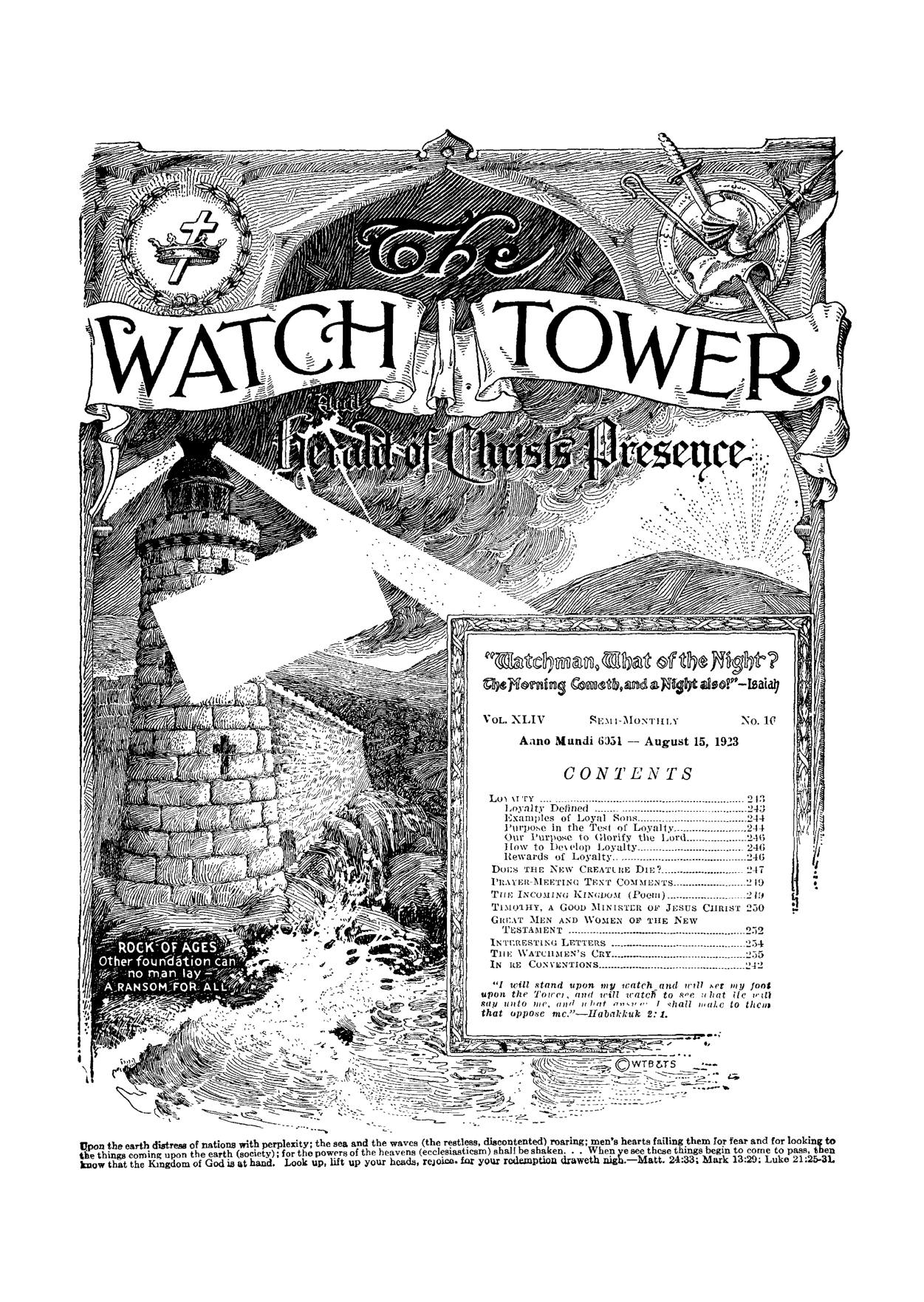
to
iWCHKTOWF
'< ROCK’OF ACES;
Otherfouriclation can'%
A RANSOM FOR ALL
Qwtbsts
THIS JOURNAL AND ITS SACRED MISSION
THIS Journal Is one of the prime factors or instruments in the system of Bible instruction, or “Seminary Extension”, now being presented In all parts of the civilized world by the Watch Tower Bible & Tract Society, chartered A. D. 1884, “For the Promotion of Christian Knowledge”. It not only serves as a class room where Bible students may meet in the study of the divine Word but also as a channel of communication through which they may be reached with announcements of the Society’s conventions and of the coining of its traveling representatives, styled "Pilgrims”, and refreshed with reports of its conventions.
Our “Berean Lessons” are topical rehearsals or reviews of our Society’s published Studies most entertainingly arranged, and very helpful to all who would merit the only honorary 'degree which the Society accords, viz., Verbi Dei Minister (V. D. M.), which translated into English is Minister of God’s Word. Our treatment of the International Sunday School Lessons is specially for the older Bible students and teachers. By some this feature is considered indispensable.
This journal stands firmly for the defense of the only true foundation of the Christian’s hope now being so generally repudiated —redemption through the precious blood of “the man Christ Jesus, who gave himself a ransom [a corresponding price, a substitute] for all”. (1 Peter 1:19; 1 Timothy 2:6) Building up on this sure foundation the gold, silver and precious stones (1 Corinthians 3: Ills ; 2 Peter 1: 5-11) of the Word of God, its further mission is to “make all see what is the fellowship of the mystery which . . .has been hid in God, ... to the Intent that now might, be made known by the church the manifold wisdom of God”—“which in othe. ages was not made known unto the sous of men as it is now revealed”.—Ephesians 3 :5-9,10.
It stands free from all parties, sects and creeds of men, while it seeks more and more to bring its every utterance into fullest subjection to the will of God in Christ, as expressed in the holy Scriptures. It is thus free to declare boldly whatsoever the Lord hath spoken—according to the divine wisdom granted unto us to understand his utterances. Its attitude is not dogmatic, but confident; for we know whereof we affirm, treading with implicit faith upon the sure promises of God. It is held as a trust, to be used only in his service; hence our decisions relative to what may and what may not appear in its columns must be according to our judgment of his good pleasure, the teaching of his Word, for the upbuilding of his people in grace and knowledge. And we not only invite but urge our readers to prove all its utterances by the infallible Word to which reference is constantly made to facilitate such testing.
TO US THE SCRIPTURES CLEARLY TEACH
That the church is “the temple of the living God”, peculiarly “his workmanship” ; that its construction has been in progress throughout the gospel age—ever since Christ became the world’s Redeemer and the Chief Corner Stone of his temple, through which, when finished, God’s blessing shall come “to all people”, and they find access to him.—1 Corinthians 3:16, 17; Ephesians 2:20-22; Genesis 28 :14 ; Galatians 3 : 29.
That meantime the chiseling, shaping, and polishing of consecrated believers in Christ’s atonement for sin, progresses; and when the last of these “living stones”, “elect and precious,” shall have been made ready, the great Master Workman will bring all together in the first resurrection; and the temple shall be filled with his glory, and be the meeting place between God and men throughout the Millennium.—Revelation 15 : 5-8.
That the basis of hope, for the church and the world, lies in the fact that “Jesus Christ, by the grace of God, tasted death for every man,” “a ransom for all,” and will be “the true light which lighteth every man that cometh into the world”, “in due time”.— Hebrews 2:9; John 1: 9 ; 1 Timothy 2:5, 6.
That the hope of the church is that she may be like her Lord, “see him as he is,” be partaker of»the divine nature,’ and share his glory as his joint-heir.—1 John 3:2; John 17:24; Romans 8:17; 2 Peter 1:4.
That the present mission of the church is the perfecting of the saints for the future work of service; to develop in herself every grace; to be God’s witness to the world; and to prepare to be kings and priests in the next age.—Ephesians 4:12: Matthew 24: 14 ; Revelation 1: 6 ; 20 : 6.
That the hope for the world lies in the blessings of knowledge and opportunity to be brought to all by Christ's Millennial kingdom, the restitution of all that was lost in Adam, to all the willing and obedient, at the hands of their Redeemer and his glorified church, when all the wilfully wicked will be destroyed.—Acts 3:19-23; Isaiah 35.
Published By
Watch tower, bible It tract SOCIETY
(8 CONCORD STREET D 0 BROOKLYN, NY. U.S A
Foreign • Offices : British: 34 Craven Teri ace, Bancastfer a... lC, London W. 2; Canadian: 270 Dundas St., W., Toronto, Ontario; Australasian: 495 Collins St., Melbourne, Australia; South African: 6 Lelie St., Cape Town, South Africa.
Please Address the Society in Every Case.
YEARLY SUBSCRIPTION PRICE: United States, $1.00; Canada and Miscellaneous Foreign, $1.50; Great Britain, Ai strai.asiv, and South Africa, 8s. American remittances should be made by Express or Postal Money Orders, or by Bank Draft. Canadian, Bril ' h. SouthAfrican, and Australasian remittances should be made to bian'h offices only. Remittances tiom scattered foreign territory may be m ■ 'a to the Brooklyn office, but by international Postal Money Ordeis ou-v. (Foreign translations of this journal appear in waul lant/ua -■ *).
Editorial Committee: This journal is published under the supervi.mm of an editorial committee, at least three of whom have read and approved as truth each and every article appearing in these colum The names of the editorial committee are: J. F. Ri tiivij W. E. Van Amrurgh, J. Hemery, G. H. Fisher, R. H. Barri.r. Terms to thel^o) d’s~Poor: All Bible students who, by reason < f old age or other infirmity or adversity, are unable to pay for this journal, will be supplied free if they send a postal card each May stating their case and requesting such provision. We are not only willing, but anxious, that all such be on our list continually and in touch with the Berean studies.________
Notice to Sul)scril)ersl~ViTe do not, as a rule, send a card of acknowledgment for a renewal or for a new subscription. Receipt and entry of renewal are indicated within a month by change in expiration date. as shown on wrapper label.
Entered as Second Class Witter at Brooklyn, N.Y Postoffice , Act of March 3rd 1879.
LOS ANGELES CONVENTION
Great zeal and enthusiasm are being manifested by the friends on the Pacific coast in preparation for the Los Angeles Convention. This promises to be the largest convention ever held in California. Many are signifying their intention of going. The greatly reduced railroad rates will make it possible for many more to attend. For instance, the round-trip excursion rate from Ogden, Utah, to Los Angeles is 44 cents less than the regular one-way ticket. Similar rates are in effect from all other points. The friends should make inquiry about this because this rate will be better than the certificate plan.
The convention will be for nine days; and Friday, August 24, will be service day, on which all the visiting friends, as well as the workers of the Los Angeles Class, will go into the field to canvass. This will also furnish an opportunity to advertise the great publie meeting expected to be held at the Coliseum on Sunday, the 2Glh. It is understood that the newspapers within :i ratlins of sexeral hundred miles of Los Angeles will carry notices of this public meeting, and a great multitude is expected to attend. The friends have expressed the desire to make this the most effective witness yet given on the Pacific coast for the King and his kingdom. Let us all daily present the matter to the throne of heavenly grace, that the Lord will be pleased to bless ti'' convention to his glory.
CONVENTION IN NEW YORK
The International Bible Students wiil hold a six--day convention in New York City October 19 to 24 inclusive.
For Sunday, October 21, Madison Square Garden, America’s greatest assembly hall, lias been taken. In the afternoon the public will be addressed there by Brother Rutherford.
Monday, October 22, will be a service day. All who attend the convention will be given an opportunity to participate in actual canvassing for the books. All who intend to engage in this service should file their names with the Service Director on or before October 19, and have their territory assigned. Address E. J. Lueck, 2416 Seymour Avenue, Bronx, New York.
For information concerning hotel and rooming accommodations please address T. M. Bedwin, S11S 95th Axenue, Woodhaven, L. I., New York.
AND HERALD OF CHRISTS PRESENCE
Vol. XLIV Avgust 15, 1923 No. 16
LOYALTY
"Be thou faithful unto death, and 1 will give thee a crown of life.”—Revelation 2:10.
Loyalty in a soldier is tested under adversity. It is not while he is at ease and faring well in camp that devotion to his commander is crucially tried. The test is on when the bugle sounds and he goes forth to battle. To think of yielding to the enemy would only lessen his zeal and his strength for the warfare and, if seriously entertained, would prove dangerous. Therefore he permits no seductive influence to draw him away from the objective. He fights on to victory. St. Paul used the life and experiences of a soldier to illustrate the course of a Christian.—2 Timothy 2:3,4; 1 Corinthians 16: 13.
LOYALTY DEFINED
’Loyalty may be defined as constant fidelity to a superior and to his cause. The word itself sprang into existence in the days of the feudal system. A vassal swore allegiance to his lord, and bound himself to serve and fight in the battles of his chieftain against surrounding enemies or other feudal lords. If in the performance of his duty the vassal proved himself faithful to his oath, he was said to be a loyal vassal. Thus worldly men by deeds of valor proved faithful devotion to a selfish cause. Honest men love loyalty above every other quality.
3The thought of loyalty abounds in the Scriptures. No disloyal creature was ever approved by the Lord. Our Lord Jesus Christ, in describing the battle of the saints against Satan, the common enemy, says: “Behold, the devil shall cast some of you into prison, that ye may be tried; and ye shall have tribulation ten days: bo thou faithful unto death, and I will give thee a crown of life.” (Revelation 2:10) Again the Master, referring to the warfare of the Christian, says: “He that shall endure unto the end, the same shall be saved.” (Matthew 24:13) Only those who endure unto the end will be saved.
4Members of the new creation are designated as “ministers of Christ and stewards of the mysteries of God.” We have the privilege of serving the Most High, to proclaim his message now due, and to show forth his praises in this time of darkness. The Apostle adds: “It is required in stewards, that a man be found faithful.” (1 Corinthians 4:1,2) An approved steward is not one who is faithful for a season and then becomes weary in well doing and lags back. He is one who possesses the kind of faith that endures to the end. St. Paul, himself a faithful and loyal soldier of the cross to the end, gave testimony of his loyalty when he said: “I have fought the good fight, I have finished my course, I have kept the faith.”—2 Timothy 4: 7.
6 At the outset we must make a clear distinction between loyalty and the term faith, which is a part of loyalty. Loyalty is a kind of faith, but it is not that kind once found in an individual who later gives up the fight. It is that faith which declares: “Though he slay me, yet will I trust him.”
6The proof is overwhelming that we are now at the end of all things pertaining to the end of the old order; and yet there are many who are losing faith, even in the strong evidences of this time, as St. Paul said that they would. “Now the spirit speaketh expressly, that in the latter times some shall depart from the faith, giving heed to seducing spirits, and doctrines of devils.” (1 Timothy 4:1) Can we doubt that faith may at times wane and even die, when again he speaks of some in his day “having condemnation, because they have cast off their first faith. And withal they learn to be idle, wandering about from house to house; and not only idle, but tattlers also, and busybodies, speaking things which they ought not. . . . For some are already turned aside after Satan.” (1 Timothy 5:12-15) Although some had faith at one time, yet by losing that faith they prove themselves disloyal to the Lord. A loyal spirit manifests a continued and unabated zeal for the Lord and his work until the very last.
’Loyalty is dependent upon faith, and is the result of the persistent application of God’s expressed will concerning us. Faith is an intellectual appreciation and a practical application to oneself of God’s expressed will and purposes. We see, then, that in order to have faith in an individual or confidence in his purposes it is necessary that we know something about his character and what he has already done. Says the Apostle;
“Faith [concerning God’s plans and purposes] cometh by hearing, and hearing by the word of God.” While the acquisition of knowledge is the initial step, yet unless that knowledge is applied according to the divine rule and has an effect upon our daily conduct it fails to bring forth the fruits of faith. One manifests his appreciation of the Lord at the outset of his Christian career by making a full and unreserved consecration to do the will of Jehovah. The merit of Christ Jesus having been applied to him, and he having been justified and begotten by the spirit of th° Lord, he has a standing before the Father and is able to comprehend the Word of truth as never before. If he continues properly to apply this knowledge, which is the result of diligent study of the Word, he grows in strength of character; and unswerving loyalty is the result.
EXAMPLES OF LOYAL SONS
80ur Lord Jesus demonstrated a noble spirit of loyalty. After the Master had fasted for forty days and forty nights, Satan determined to draw him aside by appealing to the desire of the flesh for food ; but Jesus met this suggestion by pointing to the Father as the provider of his food. When the adversary suggested that he jump from the pinnacle of the temple, the Lord met these words by saying, “Thou shalt not tempt the Lord thy God.” (Matthew 4:7) Then the strongest temptation was given to Jesus. Satan offered him the dominion of the world if he would fall down and worship the enemy. Jesus knew that this was not the way of the Father; and there was not th? slightest hesitancy in expressing his allegiance. Jesus said: “Get thee hence, Satan: for it is written, Thou shalt worship the Lord thy God, and him only shalt thou serve.”—Matthew 4: 10.
9After these temptations the Lord persists in his loyalty to the Father. He goes to Nazareth and propounds a portion of Isaiah Gl. Although his life is threatened on this occasion, yet there is not the slightest indication of discouragement.. Undaunted in spirit, he presses on into Galilee, which has been in darkness; and he lets his light shine. liven after hearing of the imprisonment of John the Baptist it is written concerning him: “From that time Jesus began to preach, and to say, Repent: for the kingdom of heaven is at hand.” (Matthew 4: 17) For three years the burden of his conversations and discourses is the message of the kingdom. Then as the night is closing down upon his ministry, an emissary of Satan would swerve him from his onward march; he is advised not to go up to Jerusalem. But heedless to all others except the Father’s voice he goes up to that city to give the final witness. On reaching Jerusalem he celebrates the Passover with his disciples in commemoration of the deliverance of the Israelites from Egypt, and then institutes a new thing which pictures his own death and the participation of his faithful followers therein. He is then suddenly betrayed, and brought before Caiaphas amid the hissing jeers of the enraged populace. He is mocked, and his life is demanded. But, oh, what a witness! A chance is given him before Pilate of recanting his kingship, but this he ignores. He is the true witness. The final sentence is pronounced, and he is crucified. Through all he is faithful; faithful unto death, loyal to the core.
10Christ Jesus our Lord has had a company of loyal followers throughout the Gospel age. Even a greater number have taken upon themselves the name of the Master and have been faithless in their witness to the truth and have disregarded Jehovah’s arrangements. It is the example of the loyal that aids us. Is not the heart of the true Christian quickened as he reads of the faithfulness of Stephen, who with radiant countenance counted it all joy to lay down his life as a pledge of loyalty? He gave a faithful and true witness by .his death, as well as by his devoted life.—Acts 7: 51-GO.
“The apostle Paul is stoned, then whipped, and later shipwrecked; but through all circumstances he is faithful to the cause of his Captain. He also fought valiantly in the Lord’s army until he was assured of victory.—-Acts 14: 19 ; 1G : 19-24; 27: 39-44; 2 Timothy 4: 7.
12Our dear Brother Bussell through storm and vicissitude loyally represented the Master, leaving the example of a victorious Christian. Those who now are endeavoring to conform their efforts to the Lord’s arrangements and who are bearing witness to the presence of the King of glory, if persistent, are assured of victory. It is the test of faith under adversity that determines the depth of loyalty to the Lord.
PURPOSE IN THE TEST OF LOYALTY
13The heavenly Father had a definite purpose in permitting his dear Son to demonstrate his loyalty under much opposition while here upon earth. The suffering was not required in order to pay the ransom price: for Jesus supplied the means at Jordan, and had he died immediately after his consecration the substitute for Adam’s penalty would have been provided. Jehovah did not say that death and suffering constituted the penalty for Adam’s disobedience, but death, only.
11 But Jehovah had designed an exalted position for his Son in which he might be favored to serve him in a particular manner in the future, in even a greater capacity and state than he had theretofore. In order to qualify for this office his obedience must be unquestioned ; he must demonstrate his loyalty even under adversity; and also that other beings operating under the Lord Jesus Christ in the future might have confidence in their Captain, who was counted worthy by the Father. Concerning Jesus it is written that he “made himself of no reputation, and took upon him the form of a servant, and was made in the likeness of men. And being found in fashion as a man, he humbled himself, and became obedient unto death, even the death of the cross. Wherefore God also hath highly exalted him, and given him a name which is above every name: that at the name of Jesus every knee should bow, of things in heaven, and things in earth, and things under the earth; and that every tongue should confess that Jesus Christ is Lord, to the glory of God the Father.”— Philippians 2: 7-11.
15The heavenly Father has also been testing the heart loyalty of the followers of the Lord Jesus in order that they, if faithful unto death, might share his Son’s glory and be joint-heirs with him in this office. “The spirit itself beareth witness with our spirit, that we are the children of God: and if children, then heirs; heirs of God, and joint-heirs with Christ; if so be that we sutler with him, that we may be also glorified together.” (Homans 8: 1G, 17) This privilege of becoming jointheirs of Christ Jesus was first granted to the Jews; and after they had spurned the offer, except for a few, the opportunity was granted to the Gentiles on an equal footing with the Jews. (Bomans 1: 16; Acts 15: 14-17) Happy and blessed are they who now seize every opportunity to show their loyalty to the Father.
16If we have a clear conception of the purpose of our present testing, it will act as a great stimulus to our faith. The present privileges of service are the means whereby Jehovah tries our obedience to him while in the school of practice. The real work of the saints lies in the future, beyond the vail; and we shall have a part in that great work only as we shall have stood the tests here below. If we look about us and consider the difficulties of the present circumstances, then discouragement, of course, results. If we contemplate the blessings of present service, we are encouraged. If we consider all things here below as a means of gaining Christ and serving the Lord in completeness, we have a sure anchor beyond the vail. (Hebrews G:18-20) The joy of serving the Father in glory was the stimulus to the faith of Christ our Captain; and this hope carried him on to victory.—Hebrews 12: 2.
17With this thought in mind, the capacity or station in which we now serve the Lord is not of primary importance. But are we serving faithfully in what has been assigned for us to do? Are we willingly and joyfully doing that work? If we answer yes, then we are learning the great lesson of submission, of working in accordance with the Father’s arrangements. This lesson of willing submission must be learned by all who will have a part in the service of the future. We are being prepared for future work. Our willingness to obey orders is being tested in the present. We are not to complain because somebody else is doing what we would like to do. In all probability the circumstances may have arisen to test our willingness to yield to the Lord at the expense of personal preference. Happy are they who delight in the Lord’s arrangements; for when faithful here below, they will serve him in glory.
18In developing a class of loyal sons the Father shows Wisdom in using them now as examples for each other. The unswerving loyalty of the Lord Jesus has been a stimulus to the faith of each member of the house of sons. “Wherefore, holy brethren, partakers of the heavenly calling, consider the Apostle and High Priest o± our profession, Christ Jesus; who was faithful to him that appointed him.” (Hebrews 3:1,2) We are to weigh carefully in mind the manner in which our Lora and Captain, who had a better appreciation of the Father than we have, endured all things that he might prove loyal. And the Father has made “Christ as a son over his own house; whose house are we, if we hold fast the confidence and the rejoicing of the hope firm unto the end.” (Hebrews 3:6) It is only as we shall have proved faithful that we shall share in the fulfilled hope in the Lord. And the Apostle warns us that unless we look ever unto the Lord Jesus for encouragement and strength of faith we shall faint in the battle. “Consider him that endured such contradiction of sinners against himself, lest ye be wearied and faint in your minds.” —Hebrews 12 : 3.
19The loyal spirit of continued fidelity in the Lord’s service on the part of an individual in an ecclesia is a spur to every other one who is led by the spirit of the Lord. The dear saints are influenced by the power of suggestion from their brethren to a remarkable degree. The Lord knew that the operation of his spirit would have such an effect, and he has indicated that they should meet often, relate their experiences, and give praises to him who has led them. Note the words of the Apostle on this point: “Let us hold fast the profession of our faith without wavering (for he is faithful that promised) ; and let us consider one another to provoke unto love ana to good wm-ks; not forsaking the assembling of ourselves together, as the manner of some, is; but exhorting one another: and o much the more, as ye see the day approaching.”—Hebrews 10: 23-25.
20We cannot doubt the fact that the continued obedience on the part of the Lord’s dear ones has a pleasing effect upon the angels and a good effect upon some men of the world to a limited degree at present. “We are made a spectacle unto the world, and to angels, and to men.” (1 Corinthians 4:9) The word translated spectacle literally means theater; so that the saints are an open show observed by men and angels. The angels, noting the progress of the saints under trial now, must be encouraged to a greater devotion to the heavenly Father. The faithful angels rejoice in the progress of the saint who serves while beset with much difficulty. Loyalty of the saints now will be an encouragement to men of the world in the future. The world notes but cannot now understand the zeal of the Lord’s people. When the spirit of the Lord is poured out upon all flesh the people will comprehend the loyalty of the saints. Will it be said of you in that day that you fought faithfully to the end in the army of the Lord? The people will then know. (1’salm 87:5, 6) The loyal devotion on the part of the saints will then be recalled, and will be a tremendous influence to bring the world into obedience to the new King.
OUR PURPOSE TO GLORIFY THE LORD
21 One of the chief purposes in the development of loyalty in the saints of the Gospel age is that they may be an everlasting glory to the Lord. Other individuals can appreciate the Lord as he manifests his character in his works. Thus an artist or sculptor gains worldwide recognition not by thinking, although that is necessary as the initial step, but by expression in his works; and the estimate on the part of others having the mind of appreciation is usually in proportion to the accomplishment.
22The Psalmist, in calling forth praises to the Lord, says: “The heavens declare the glory of God: and the firmament showeth his handiwork.” (Psalm 19:1) “All thy works shall praise thee, 0 Lord; and thy saints shall bless thee.” (Psalm 145:10) All beings and things in the universe will ultimately be a glory and praise to Jehovah. But the Christ is the masterpiece of all creation, and joyful is the lot of the saints to bring praises to the Lord forever.
23Those who do most for our lasting benefit are most worthy of our affection and devotion. The Lord has demonstrated time and again that he loves us. When we were yet in sin he provided the ransom in his dear Son. Of course Jehovah could have sent some other being to earth, but he wished to demonstrate that love of his by giving in sacrifice the treasure of his heart. He has taken us into his confidence by revealing to us his plans and purposes—a favor entirely unmerited on our part and granted only to a few; and he has also called us his sons—sons of the great Jehovah. What a favor! What should we do to prove to the dear Lord, then, that we appreciate his loving kindness? It is not by meditation alone and inactivity that we can make an acceptable offer to him. We must render unto him our reasonable service. (Romans 12:1) Let us demonstrate that we have faith in him and that we love him in the same manner in which he loved us. Let us serve him with a loyal spirit to the extent of our capacity.
HOW TO DEVELOP LOYALTY
’‘Unswerving continuance in the service of the Lord is the keynote in the development of loyalty. Service and loyalty are inseparable. Joyfully serving the interests of his kingdom results in loyalty. Willing service, faithfully performed by the Lord’s grace, in whatsoever place assigned, will prepare one to stand firm in the hour of trial. The little opportunities as well as the more favorable develop consistency and constancy in obedience, steadfastness in purpose, and stability of character. A person with uncertain or careless disposition will have great difficulty in standing, and must of necessity require an abundant measure of grace. Overcome carelessness by faithfully safeguarding the Lord’s kingdom interests.
25Jehovah could speak with assurance concerning the loyalty of his dear Son even before the Logos came to earth. Before coming here the Logos was undoubtedly the most active of all creatures in the Father’s service. The consistency of his sendee was never questioned over millenniums of time. The successful test as to loyalty was the only logical thing that might have been expected. The Lord at no time yielded to the adversary. He was persistent to the very end in declaring the truth, in being spent in loving service for others, and in praising the Father who led him.
26The Lord has overruled the circumstances for us that we also might demonstrate our loyalty. Many avenues of service are provided in proclaiming the message of the kingdom and of the presence of the King. By engaging in this witness the brethren must encounter obstacles and trials; but rejoice if you do, for these crucial testings when successfully met result in the transformation into the likeness of our Lord from one degree of character development to another. It will require strong characters to stand the final tests.
REWARDS OF LOYALTY
27The saints this side the vail are now having their opportunities increased in proclaiming the message of the presence of the King and his kingdom, and this is a test of loyalty. This is a special privilege; for by honoring earth’s rightful King we bring praise and credit to the Lord God, who arranged and approved this plan. Those who honor the Son, those who are zealously and continuously proclaiming the kingdom message, are honoring the Father. (Matthew 10:32, 33; 1 John 4:15,16) Happy are they now who amidst trials and difficulties can speak the Lord’s praises.
28A joyful lot is theirs who now have the Lord’s approval. We therefore should not seek our personal gratification, neither the smile of men nor that of angels, but the Lord’s pleasure and approval. If the Lord indicates that we should proclaim a certain message and we joyfully do so, great blessings will undoubtedly follow. If one fails or refuses to seize the opportunities to honor the King, and grows slothful, the service will be granted to another more zealous. We should, therefore, never grow weary in well doing, but be on the alert and active, that we might ever be found in the sunlight of God’i favor. May the burden of our song ever be,
"With ready hands and loyal heart I find my Lord’s approval.”
’’Those who are diligent in serving the Lord here will have the great privilege of continuing the work in glory. To each of this class the Lord says: “Well done, thou good and faithful servant: thou hast been faithful over a few things, I will make thee ruler ever many things: enter thou into the joy of thy Lord.” (Matthew 25: 21) Again he says: “To him that overcometh will I grant to sit with me in my throne, even as I also overcame, and am set down with my Father in his throne.” (Revelation 3:21) To them is granted the kingly privilege of reigning with Christ Jesus to bless mankind. They are to scatter the clouds of confusion that have blinded the minds of men and made them dupes of the wicked one. They will help the poor to come and joyfully worship at the feet of Jesus. They will be privileged to aid in the destruction of the house of Satan; and under the leadership of the great King they will say to the prisoners: “Go forth; and to them that are in darkness, Show yourselves.” (Isaiah 49:9) They will be privileged to open the blind eyes and to bring out the prisoners from the prison house and to enlighten them.—Isaiah 42:7.
■JUWhat a happy lot is now that of the saints to serve the Lord and show forth his praises! What a far more exceeding and eternal weight of glory will be theirs as coworkers with Christ in restoring man to the imago of God! Flow transcendently more wonderful will be the glory and blessings enjoyed by them when in all the endless ages God, in his kindness, shall show forth unto them his exceeding grace through Christ! The price of all these boundless blessings and glory is loyalty to the core.
QUESTIONS FOR BEREAN STUDY
How is loyalty tested9 What would lessen the zeal of a soldier? 1; 1. Env is loyalty defined? How is loyalty esteemed by honest mon9 i; 2-Why does loyalty abound in the Scriptures? What does Je»us say about endurance? U 3.
Who are stewards, and what is required of them? What is necessary to endurance? U 4.
How are faith and loyalty related? What is the difference between them? H 5.
Wliat does the spirit teach concerning the latter times? Where are we now? G.
Wliat is manifested by unalloyed faith, and should it he conserved? What is meant by applying knowledge according to the divine rule9 What is the fruit of faith9 U 7.
Who is our example of loyalty, and how shown9 <1 S, 9.
Were there opportunities for Jesus to swerve from loyalty? Did he waver for a moment? H 9.
How lune the loyal sons of God been helpful to us9 U 10-12.
Was-suffering a part of the ransom-price? What is the penalty for sin? f 13.
Why did the Father permit his beloved Son to suffer? Did Jesus’ suffering benefit him personally9 11 14.
Is the heart-loyalty of Jesus’ followers tested and are sufferings permitted with an object in view? If so, wliat is it? U 15.
What will stimulate our faith? What will weaken it? By what means may we have a sure anchor bejond the \ail9 If Hi
What is necessary to learn the great lesson of submission to the Father’s arrangement? Do we think the Father has anything to do with our present circumstances? 17.
Why should we weigh carefully the experiences of Jesus? What is Paul's admonition to us? lb.
How may our brethren be influenced to greater zeal in the Lord’s service? 1! 19.
Is our continued obedience under difficulties a blessing to angels? How? Why? When will the world come to know this fact? If 20. The crystallizing of the Christian’s character through suffering is for what purpose? 1| 21,22.
How did God specially demonstrate his love for us? What unmerited ho or has he shown us? Why and how should we respond? U 23.
What two things are inseparable? Wliat kind of service results in loyalty? Who requires more abundant grace, and should this be striven against? U 24.
Was the loyalty of Jesus to be expected? Why? How did he prove it? If 25.
Is it a special favor that God demonstrates our loyalty? How does he do it? If 2G.
How may we honor the Son and the Father? Is it a pleasure to announce the presence of earth’s new King? Why is this proclamation a test of loyalty? 1i 27.
Whose approval should we seek? This is done sometimes at the cost of what? 1i 2S.
Those who diligently and delightedly serve the Lord while tabernacling in the flesh will have what privileges in the future? 29.
Is it a happy lot now to sew. e the Lord? Will the future be glorious? Why? What is the price the Lord has placed on these boundless blessings? V 30.
DOES THE NEW CREATURE DIE ?
QUESTION: After one has been a faithful Christian for some time he dies. Is it proper to say that the new creature dies?
Ansiver: Yes. The person or creature whom you knew, with whom you walked and talked, and whom you understood to be a faithful Christian, was known as Brother John. Was he a new creature? The apostle Paul answers: “If any man be in Christ, he is a new creature.” (2 Corinthians 5:17) “Now are we the sons of God.” (1 John 3;-2) The Psalmist seemed to refer to the new creation when he wrote: “I have said, Ye are gods [mighty ones] ; and all of you are the children of the Most High. But ye shall die like men, and fall like one of the princes.” (Psalm 82: 6, 7) By this we understand that every new creature in Christ dies; and if he falls in death like Prince Lucifer, because of wilful sin, there is no resurrection for him. If he falls in death like Prince Jesus, being faithful unto death, then a resurrection for him is certain.
sIf we say that the new creature does not die, we get ourselves into the trap set by the devil long ago, when he induced many to believe that there is no death. A creature is either dead or alive. If alive, he must be conscious. A creature is a conscious, sentient, moving, breathing being. If these qualities are absent entirely, then he cannot be said to be alive. “The living know that they shall die; but the dead know not anything.” ■—Ecclesiastes 9 : 5.
“When John the Christian walked about in the earth his organism was of flesh and blood; and in this organism operated his will, mind, and heart. “Fle>h and blood cannot inherit the kingdom of God.” This tame question seemed to be troubling the early church. St. Paul addressed an epistle to the Corinthians, in which he makes it plain that the new creature must die. He says: “That which thou sowest is not quickened [made alive], except it die.” The Apostle then proceed; to show that the resurrection is the hope of the saints; and in order to make his proof strong upon this point, he first establishes beyond question that Jesus died and arose from the dead. Jesus was a new creature when he died. That he was dead there can be no doubt ; for he himself said: “I am he that liveth, and was dead; and, behold, I am alive for evermore.” (Revelation 1:
18) St. Paul then says: “Now is Christ risen from the dead, and become the firstfruits of them that slept. For since by man came death, by man came also the resurrection of the dead. For as in Adam all die, even so in Christ shall all be made alive.”
5 A creature that is not dead could not be resurrected. If the creature is resurrected, then it follows conclusively that the new creature must die. From the time of Pentecost until the beginning of the resurrection of the saints (which we understand began in 1878), many of the saints ceased to be on earth. Where were they? The Scriptures plainly answer that they were dead; they knew not anything, were unconscious, out of existence as completely as was Jesus during the three days that he was in the tomb, and waiting for the resurrection.
°It is true that the Apostle speaks of death as sleep; but it is death, nevertheless. The word sleep gives the thought that they will be awakened out of death; that is to say, be resurrected. Resurrection means a restanding to life; and if already alive somewhere, resurrection would be an impossibility. In his argument in proof of the resurrection of the dead saints the Apostle says: “It [meaning the creature, the being] is sown in corruption; it fthe creature, the soul, the being] is raised in incorruption. It is sown in dishonor; it is raised in glory. It is sown in weakness; it is raised in power. It is sown a natural body [that is to say, it goes into death thus] ; it [the crcaiv.ro the being] is raised a spiritual body.” Then says St. Paid: “As we have borne the image of the earthy, we shall also bear the image of the heavenly.” Then, in order to show a distinction in the length in time of suspended animation or death between those who died before the coming of the Lord and those who die after the resurrection begins, he says: “Behold, I show you a mystery; we shall not all sleep, but we shall all be changed, in a moment, in the twinkling of an eye, at the last trump; for the trumpet shall sound, and the dead shall be raised incorruptible, and we shall be changed.” Definitely he states that those who have gone before are dead; and the only difference between them and the saints who die now is, that the resurrection change of those dying at the present time is instantaneous. This is due only to the fact, however, that the Lord is present, taking unto himself the members of his body; and there would be no reason why any should sleep in death after the Lord is present. This does not change the matter, however; for the Christian John, who this day lives and tomorrow is not here, had to die in order to be clothed upon with a glorious body, even though that change was instantaneous.
’The Apostle speaks of those who were once new creatures, but who have repudiated the Lord, and who have sinned wilfully after they received a knowledge of the truth, saying that for these “there remaineth no more sacrifice for sins, but a certain fearful looking for of judgment and fiery indignation, which shall devour the adversaries.” (Hebrews 10: 2G. 27) St. Peter speaks of these as though they were brute beasts, made to be taken and destroyed. (2 Peter 2:12) St. John says: “There is a sin unto death” (1 John 5: 10) ; and by this we understand that there is no resurrection for such. These are they that fall like Prince Lucifer; that is to say, because of wilful and deliberate sin; and for such there awaits only eternal destruction without resurrection.
8Thc apostle Paul then makes it clear that he expected to die, but his great hope was to participate in the resurrection of Christ. He says: “I count all things but loss for the excellency of the knowledge of Christ Jesus my Lord; . . . that I may win Christ, and be found in him, not having mine own righteousness, which is of the law, but that which is through the faith of Christ, the righteousness which is of God by faith; that I may know him, and the power of his resurrection, and the fellowship of his sufferings, being made conformable unto his death; if by any means I might attain unto the resurrection of the dead.” (Phil-ippians 3: 8-11) Surely no one can raise the question successfully that St. Paul was not a new creature; and it being admitted that he was a new creature, that his great hope was in the resurrection, and that he must be made conformable to the death of Christ in order to be partaker of the resurrection, it follows that the new creature dies. If his death is conformable to the death of Christ, then he shall be like Christ Jesus in the resurrection. Thus he falls like Prince Jesus; and when he (Christ Jesus) shall appear, then those who participate with him in his resurrection shall be like him; for “we know that, when he shall appear, we shall be like him; for we shall sec him as he is.”—1 John 3: 2.
QUESTIONS FOR BEREAN STUDY
Is it proper to say that the tow creature dies? 1. 2.
Is It consistent to say that the new creature does not die? 1i 3.
Give two strong proof texts which show that the new creature does die. H 4.
Do Christians have a resurrection hope? To experience a resurrection one i.nist first do what? H 5.
What does “sleep" sometimes signify? Is the death of the saints real? 1i 6.
Who are they Mho fall like Prince Lucifer’ t 7.
Did St. Paul as a new creature expect to die? Did Paul fall like Prince Jesus? 1 S.
Thy will be done. And only this, Whatever else is left undone;
And let obedience and bliss
Through all our lives and natures run.
Thy will be done. And can we say This sweet acknowledgment of trust
In that sincere and humble way
Which every true believer must!
PRAYER-MEETING TEXT COMMENTS
TEXT FOR SEPTEMBER 19
"For through him we-have access by one spirit unto the Father.”—Ephesians 2:18.
IT HAS pleased Jehovah to employ many centuries and much work in the preparation of his house of sons, of which Jesus is the Head. This new creation is likened by the Prophet and the Apostle unto a beautiful building, Christ Jesus being the chief cornerstone, and all the members of the house being built upon the foundation of Christ Jesus, fitted, polished and transformed into his likeness. Each member of the building must be fitly framed together, all made into conformity to the Lord and grow up into a holy temple.
Before one can begin to be shaped and prepared for this glorious temple of God he must have access to the Father; and there is but one means of access, and that is by one spirit through Christ Jesus. After one has been justified, anointed, and begotten of his holy spirit, then the work of preparation begins. This work must be from that time forward continuous, unabating; and unless it is a continuous, progressive movement the creature will suffer a retrograde movement. The importance, therefore, of being occupied with things pertaining to the Lord’s kingdom cannot be overstated. Since the mind is the chief place of transformation, the mind must be employed, and therefore the hands, in things pertaining to the Lord’s kingdom, insofar as it lies within our power. In fact, everything should be done as unto the Lord.
There is nothing which can give a person so much satisfaction and joy of heart as co-laboring with our Lord in building ourselves into his glorious likeness.
The more fully we can appreciate that the Lord’s kingdom is here, that this kingdom will relieve mankind from suffering and establish the world that it cannot be moved, and that wo have partnership with the Lord in this glorious work, the more will our hearts be moved to joy and action, looking forward to this blessed result to the human race. This is the spirit of the Master, and it must be the spirit of each one who is to be made into his likeness.
TEXT FOR SEPTEMBER 26
“In whom ye also are builded together for an habitdr tion of God through the spirit."—Ephesians 2:22.
THE temple of God is aptly and beautifully pictured by the Great Pyramid, the capstone or chief stone representing our Lord. Until the builders of the Pyramid recognized that stone as a pattern for the entire structure, necessarily it would be rejected by them. Even so every one who has attempted to come into harmony with God and who has not understood his way through Christ has rejected Christ Jesus, not realizing that there is no other way whereby men can be saved. St. Peter, speaking of the temple of God, says that Christ Jesus is the chief cornerstone and that all others are likewise living stones, “built up a spiritual house, a holy priesthood, to offer up sacrifices acceptable to God by Jesus Christ.’’
When the Great Pyramid was completed, it was a beautiful building and the joy of all Egypt. Evon so, when this glorious temple of Jehovah is completed it will be the joy of the whole earth. (Psalm 48:2) It will constitute a habitation of God through his spirit; that is to say, his spirit there operating through the agency of the Christ will minister blessings to all the families of the earth. “For the Lord hath chosen Zion; he hath desired it for his habitation.” (Psalm 132: 13) “His dwelling place is in Zion.” (Psalm 76 : 2) Through Zion God will plant the heavens and lay the foundations of the earth, establishing mankind in peace and happiness. (Isaiah 51:16) It will be out from this temple that the waters of life will flow, bringing vitality, refreshment, healing and restoration of life to the human race. It will be from the Father and by his Christ, and will result in everlasting blessings to man.
This glorious temple of the Lord will be complete when the last member is fitted and polished and ]>ut into position. We are now nearing the time of completeness ; hence it behooves the prospective living stones therein to avail themselves of every opportunity and means the Lord has provided for this transformation into the glorious likeness of the Head, and to be made a part of this holy temple of the Lord.
THE INCOMING KINGDOM
“O Golden Age, whose light is of the dawn, And not of sunset, forward, not behind, Flood the new heavens anil earth, and with thee bring All the old virtues, whatsoever things Are pure and honest and of good repute.
But add thereto whatever bard has sung Or seer has told of when in heaven-sent dream He saw the Happy Isles of prophecy.
Let Justice hold the scale, and Truth divide Between the right and wrong; but give the heart The freedom of its fair inheritance.
“Let the poor prisoner, cramped and starved so long, At nature’s table feast Ids ear and eye With joy and wonder. Let all harmonies Of sound, form, color, motion, wait upon The princely guest, whether in soft attire Of leisure clad or in coarse frock of toil;
And lending life to the dead form of faith, Give human nature reverence for the sake Of One who bore it, making it divine With the ineffable tenderness of God, . . . And man more precious than the gold of Ophir.”
TIMOTHY, A GOOD MINISTER OF CHRIST JESUS
----September 23----Acts 16:1-3; ITiilippians 2:19-22; 2 Timothy 1:1-6; 3:14,15---■
TIMOTHY JOINS PAUL IN THE MINISTRY—TIMOTHY ENTERS RESPONSIBLE SERVICE--FAITHFUL SON TO THE END; DIES A MARTYR.
“Be thou an example to them that behere, tn iror/1, in manner of life, m lore, in faith, in purity.”
-1 Timothy 4: 12, It. V.
TIMOTHY has a well-merited place among the great men of the New Testament, though perhaps he lacked in the qualities which make a man great in the eyes of his fellow men. He had a fine spirit; and in the kingdom of grace miracles are wrought. Out of the little a man has God makes great things. It was, of course, his association with Paul winch God used to make Timothy great. History lias no record of anjthing more beautiful than Paul’s love and care and desire for Timothy and his advancement, both personally and in the life of the church. Paul’s heart yearned over 1dm as the heart of a father over a beloved child. Writing to him (2 Timothy 1: 2) Paul says: “To Timothy, my dearly beloved son,’’ and, “Unto Timothy, my own son in the faith.”—1 Timothy 1: 2.
2Paul first saw Timothy when he and Barnabas were at Lystra in Galatia. Very probably it was to the home of Timothy’s mother that Paul was taken when he was injured by the mob and left for dead. (Acts 14:19) In that case the youth would help to nurse Paul, and have the double privilege of waiting on him and enjoying his company. Already well versed in the Scriptures (for both his mother and grandmother had been diligent in training him —2 Timothy 1:5; 3:15), he would be drawn to the wonderful man who could tell him their meaning, and who was so full of grace, and so free from ill-feeling towards those who had injured him. And Paul would find a delight in explaining the truth about Jesus the Messiah. As Timothy was not circumcised it is clear that his father was not a Jew; and as no mention is made of him, it is probable that lie died when Timothy was young. Evidently well disposed, and while making no objection to the training of Timothy in the Jewish Scriptures, he had objected to circumcision. The Apostle and the youth would see each other again a few months later, when Paul and Barnabas were making their return journey to Antioch. After that time, about five years elapsed before they again met.
TIMOTHY JOINS PAUL IN THE MINISTRY
3Barnabas and Mark had gone to Cyprus; and Paul and Silas had crossed the Cilician mountains and again arrived at Lystra and Timothy’s home. By that time Timothy had arrived at early manhood Paul needed some one with him to render such service as Mark might have given. There were the parchments to attend to, and help was necessary in his letter writing, as well as in other things; for Paul’s sight was poor. And beyond these things, he felt the desire for one who could be as a son to him, and the need of one whom lie could train to his mind, and to whom later might be delegated some of the care of the churches. Paul wanted a son to be with him and to carry on his work. The proposal to join Paul was made and agreed to.
Hint Timothy was not circumcised; and as Paul’s first ministry in all the places he visited was to the Jews, he decided that Timothy should be circumcised; and this was done. It lias been said that Paul was inconsistent in this. There was no inconsistency. Paul was never opposed to circumcision in itself. He fought those who claimed that it was a necessity to acceptance with God, and who thereby placed it on an equality with faith, and thus denied that the death of Christ was the only means of salvation. This Paul would not allow lor a moment. In the case of Timothy Paul saw that, if he were to take him as he was, at every meeting of Jews they would refuse to allow Timothy to address them or to fellowship with them; and he himself would be under the necessity of spending a great portion of his time in arguing the matter of circumcision. It was therefore to avoid prejudice and waste of time, and because there was no trulli at stake that he caused Timothy to be circumcised. Some have said that Paul put aside his principles and took policy instead. He did not; he was consistent with the highest principle, that of doing good to all by the best means, and of gaining his end without fighting unnecessary battles. Probably Timothy was about twenlj-one to twenty-three years of age when he joined Paul.
6Leaving Lystra they went forward towards Trons and then, guided by Paul’s vision, on to Philippi, in Macedonia. There they had the pleasurable experience of finding a company ready for the truth, and Paul and Silas had the bitter experience of being beaten and cast into p. r on. Leaving Luke behind in Philippi, they went on to Thessn-loniea. There very soon the Jews made an uproar; and as danger threatened Paul and Silas, the brethren sent them by night into Berea. From Berea Paul went on to Athens, while Silas and Timothy stayed behind and helped the Bereans in their studies. Paul soon sent for the i«o brethren to come to Athens; but being disappointed in Athens, he went on to Corinth. There lie felt his loneliness, and his inability to make an impression upon the Europeans pressed upon his spirit. He was encouraged by rne arrival of Silas and Timothy from Berea; and the Lord also gave him encouragement by a vision. (Acts 18:9-11) Paul stayed there a year and six months.
TIMOTHY ENTERS RESPONSIBLE SERVICE
6Timothy was early put into responsibility. When Paul had been In Corinth for a time, he was distressed by news from Thessttlonica. Trouble had arisen in the church through false teachers. Paul sent young Timothy to help them. This was Timothy’s first separate work, though he already had some experience gained in the churches in Lystra and Iconium; for when Paul took him from home he was already well reported of by the brethren there. (Acts 16:2) Evidently Timothy helped the brethren in Thessalonica and was successful in his mission ; for he brought news to Paul in Corinth which cheered him much. (1 Thessalonians 3: 2, 6) He continued to labor with Paul in Corinth (2 Corinthians 1:19); and then for a time there is no record of him. This does not mean that he dropped out of the work; for Paul would see that Timothy was in service; and Timothy was so ardent a disciple, so wholly given to the Lord, that as a man witli the love of God and the brethren in his heart, he could not remain idle.
’Later Timothy labored with Paul in Ephesus, but was sent to Macedonia, and to go on to Corinth, a little time before Alexander the coppersmith stirred the populace in Ephesus, and the riot occurred which is recorded in Acts 19. In commending Timothy to the Corinthians, Paul said that the young man would put them in remembrance of his own ways in Christ. (1 Corinthians 4:17) This is a great commendation from the Apostle; it reveals much of Timothy’s earnest study, and his desire to fall into Paul’s ways. He would copy Paul not only because Paul’s ways commended themselves to him, but because he wanted to adjust himself to Paul's mind so that Paul might find in him such satisfaction as he sought. And Paul’s heart was made glad.
8Assuredly it was a delight to Paul to be able to commence so many of his letters to the churches with “Paul and Timothy.” (2 Corinthians 1:1) These are things specially to be noted In Paul’s references to Timothy. He says of him: “I have no man likeminded, who will naturally care for your state; for all seek their own.” (Philippians 2: 20) This cannot be taken as a general condemnation of all the other faithful helpers who were associated with Paul; but it tells its own truth; for Paul had none with him who looked at the Lord’s work just as Timothy did. He continues: “Ye know the proof of him, that, as the son with the father, he hath served with me in the gospel.” (Philippians 2:22) Again Paul says of him: “He worketh the work of the Lord, as I also do.” (1 Corinthians 16:10) Evidently Timothy well deserved the affectionate word of Paul—“Timothy, mine own son in the gospel.”
“But Timothy was timid, not fearful of trials and difficulties, as perhaps Mark had been, but of persons, and also as to his capabilities. This is not surprising; for his youth had been spent in the highlands of Galatia, and he had not been thrown into the company which city life afforded. He was readily abashed, and he felt his youthfulness. Paul tells the Corinthians to see- that Timothy has no cause for fear when coming amongst them, and that they are nof to despise him. (1 Corinthians 16:11) Paul himself could stand up to the greatest, whether in Antioch, or Ephesus, or Corinth, or Athens. (2 Corinthians 10:13,14) But Timothy had neither the education to enable him thus to emulate his leader, nor that forward disposition of the pioneer which Paul had in so large a measure.
1 “Little is said In the Scripture of the work which Timothy did, but his place is a large one. Because in his Epistles to Timothy Paul gives much counsel to him, it has been suggested that Paul was somewhat disappointed in him. They suppose that Paul wrote to correct mistakes or a lack which Timothy manifested. We suggest that these words of counsel are to be looked at from an altogether different point of view, and that Paul was not disappointed In Timothy. When Paul took Timothy to be with him he knew that he was not choosing a robust young man, nor one who was of a pushing, determinate character. Paul knew temperament well enough to know that while he was taking Timothy to minister to him he himself would need to have care over Timothy. We suggest that Paul chose Timothy for the gentle spirit he already manifested, and because he saw in Timothy the disposition of a caretaker. The exhortations in the two Epistles to Timothy are consistent with this. Paul took the occasion to give instruction to him, and through him to the many, and especially the young men who would read his words and be guided by them. Timothy provided Paul with an outlet for his heart Also he had much to say to the church, and for its guidance In general affairs; and to guide the servants of the church at all times, as well as to guide a young man in his way, he gave this specific counsel to Timothy.
FAITHFUL SON TO END; DIES MARTYR
11These things could not well be given In the epistles to the churches; for those were primarily intended to set forth doctrines either directly, as In Romans, or by correction, as in the Corinthian epistles, or of experience, as in the captivity epistles—Ephesians, Philippians, and Colos-slans. Using a familiar illustration, we might say that the Epistles to Timothy and the one to Titus are to the general church what the sixth volume of the Scripture Studies is to the church of this day. Here is a fatherly care, advice which will guide the church In the many things which affect its life. Here Is instruction for the young man to guide his way through life, that he may help himself to the things of God and at the same time that he may know how to conduct himself in the church of God. His exhortations to Timothy to be brave may have been prompted by a measure of timidity on Timothy's part; for as we have suggested, being lowly in mind he would be apt to be overborne by loud-spoken and pushful brethren. It does not follow that Timothy was specially lacking any more than the five Injunctions given to Joshua to be strong and of a good courage are intimations that he was too timid for his task. The words in both cases were given to strengthen the servant of God.
12Paul enjoined Timothy to stir up the gift that was In him (2 Timothy 1:6) and to give himself to reading, to diligence, gravity, and sobriety of demeanor. These things are those which really help in the Christian life. So many seem to want to use the spare moments not specially set apart for meetings and work as occasions for mirth and even frivolity. This course, however innocent the mirth may seem, does not tend to help the servant of the Lord to make increase; it does not pay. Timothy was somewhat inclined to asceticism; and Paul told him not to confine himself to water to drink, but to take a little wine for his stomach’s sake and for his often infirmities.—1 Tim 5 : 23.
…