The Watchtower, June 15, 1922
Download: PDF — The Watchtower, June 15, 1922
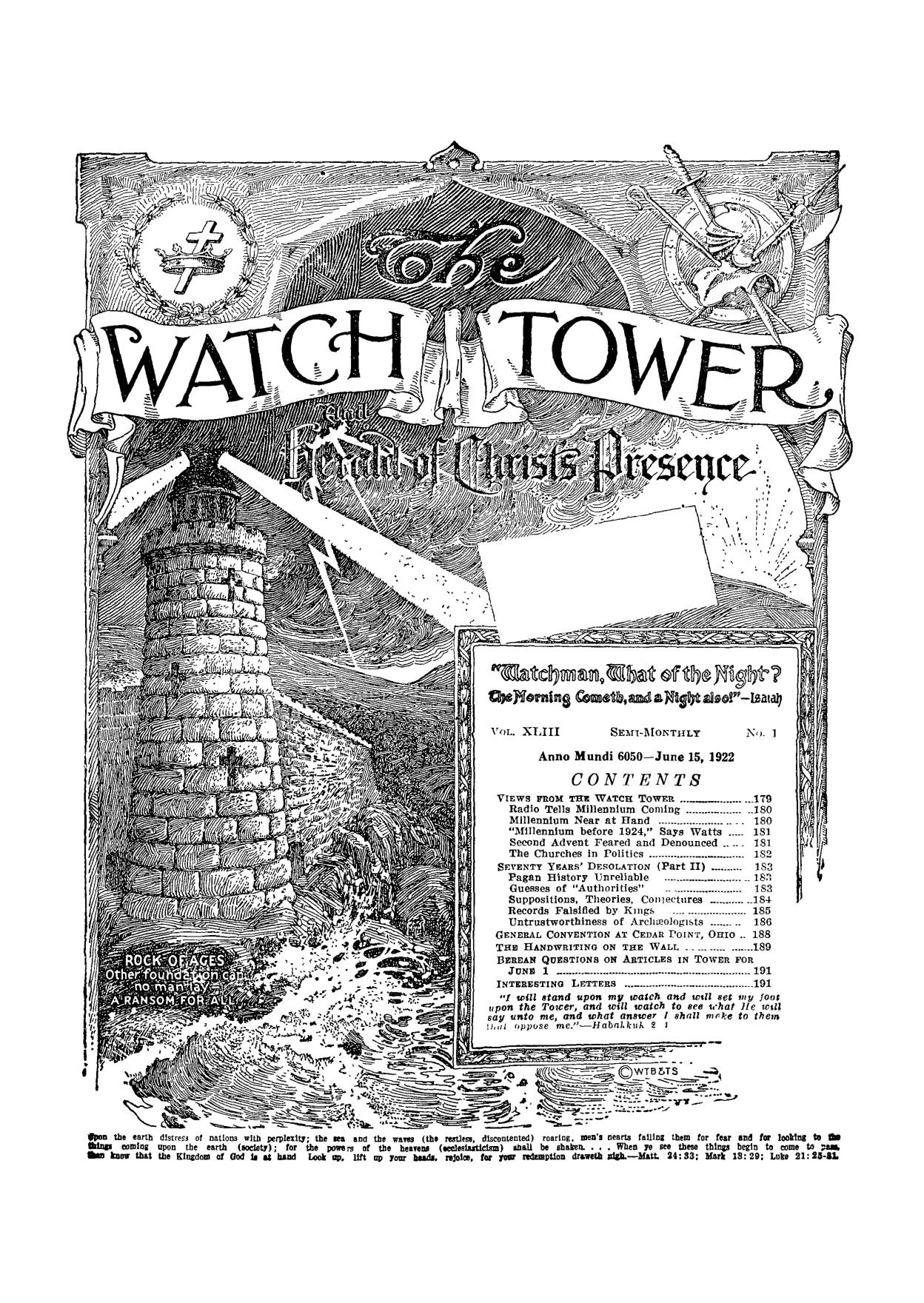
■Wirt
The Handwriting on the Wall ....
.189
to tbo
•pon the earth tMno earning An know that
distress of nations with perplexity; the sea and the wares (the restless, discontented) roaring, men’s Hearts falling them for fear and for looking . upon the earth (society); for the powers of the heavens (eecleslastlclsm) shall be shaken. . . . When ye see these things begin to come to pa* the Kingdom of God is at hand Look up. Lift up your beads, rejoice, for year redemption draweth nigh.—Matt. 24:33: Mark IS: 29: Lake 21:20-81*
C^Kdming S5m«®,aHdaWigl^aJs@!”-l2a(al)
Vol. XLIII
Semi-Monthly
Anno Mundi 6050—June 15, 1922
CONTENTS
Views from the Watch Tower......
Radio Tells Millennium Coming
Millennium Near at Hand
“Millennium before 1924,” Says Watts
Second Advent Feared and Denounced
The Churches in Politics
Seventy Years" Desolation (Part II)
Pagan History Unreliable
Guesses of “Authorities”
Suppositions, Theories, Conjectures -
Records Falsified by Kings
Untrustworthiness of Archaeologists
General Convention at Cedar Point, Ohio .. 188
ROCK
ALR AN SO MLFOft<
Berean Questions on Articles in Tower for
June 1 -.......-
Interesting Letters ....................-
•'I will stand upon my watch and will set my foot upon the Tower, and will watch to see what fie will say unto me, and what answer 1 shall mrke to them '.lull oppose me.”—Habakkuk 2 1
©WTB5TS
T0IS JOURNAL AND ITS SACRED MISSION
THIS Journal !s one of the prime factors or instruments in the system of Bible instruction, or “Seminary Extension”, now being presented in all parts of the civilized world by the Watch Tower Bible & Tract Society, chartered A. D. 1884, “For the Promotion ot Christian Knowledge”. It not only serves as a class room where Bible students may meet in the study of the divine Word but also as a channel of communication through which they may be reached with announcements of the Society’s conventions and of the coming of its traveling repiesentatives, styled “Pilgrims”, and refreshed with reports of its conventions.
Our “Berean Lessons” are topical rehearsals or reviews of our Society’s published Studies most entertainingly arranged, and very helpful to all who would merit the only honorary degree which the Society accords, viz., Fe?b» Dei Minister (V. D. M.), which translated Into English is Minister of God’8 Word. Our tieatment of the International Sunday School Lessons is specially for the older Bible students and teachers. By some this feature is considered indispensable.
Thu journal stands firmly for the defense of the only true foundation of the Christian’s hope now being so generally repudiated —redemption through the precious blood of “the man Christ Jesus, who gave himself a ransom [a corresponding price, a substitute] for all”. (1 Peter 1:19; 1 Timothy 2:6) Building upon this sure foundation the gold, silver and precious stones (1 Corinthians 3: 1115; 2 Peter 1:5-11) of the Word of God, its further mission is to “make all see what is the fellowship of the mystery which. . .has been hid in God, ... to the intent that now might be made known by the church the manifold wisdom of God”—“which in other ages was not made known unto the sons of men as it is now revealed”.—Ephesians 3:5-9,10.
It stands free from all parties, sects and creeds of men, while it seeks more and more to bring its every utterance into fullest Bubiection to the will of God in Christ, as expiessed in the holy Scriptures. It is thus free to declare boldly whatsoever the Lord hath spoken—according to the divine wisdom granted unto us to understand his utterances. Its attitude is not dogmatic, but confident; for we know whereof we affirm, treading with implicit faith upon the sure promises of God. It is held as a trust, to be used only in his service; hence our decisions relative to what may and what mav not appear m its columns must be according to our judgment of his good pleasuie, the teaching of his Word, for the upbuilding of Ins people in grace and knowledge. And we not only invite but urge ouc readers to prove all its utterances by the infallible Word to which reference is constantly made to facilitate such testing.
TO US THE SCRIPTURES CLEARLY TEACH
That the church is “the temple of the living God”, peculiarly “his workmanship” ; that its construction has been in progress throughout the gospel age—over since Christ became the world’s Redeemer and the Chief Corner Stone of his temple, through which, when finished, God's blessing shall come “to all people”, and they find access to him.—1 Corinthians 3:16, 17; Ephesians 2:20-22; Genesis 28:14; Galatians 3 : 29.
That meantime the chiseling, shaping, and polishing of consecrated believers in Christ’s atonement for sin, progresses ; and when the last of these “living stones”, “elect and precious,” shall have been made ready, the great Master Workman will bring all together in the first resurrection ; and the temple snail be filled with his glory, and be the meeting place between God and men throughout the Millennium —Revelation 15.5-8.
That the basis of hope, for the church and the world, lies in the fact that “Jesus Christ, by the grace of God, tasted death for every man,” “a ransom for all,” and w ill be “the true light which lighteth every man that cometh into the world”, “in due time”.— Jleorews 2:9; John 1.9 ; 1 Timothy 2:5, 6.
That the hope of the church is that she mav be like her Lord, “see him as he is,” be “partakers of the divine nature’,’ and share his gloiy as his joint-heir.—1 John 3.2, John 17.24, Romans 8:17; 2 Peter 1:4.
That the present mission of the church is the perfecting of the saints for the future work of service; to develop in herself every giace , to be God’s witness to the world , and to prepare to be kings and puests in the next age.—Ephesians 4 .12 ; Matthew 24: 14; Revelation 1:6; 20:6.
That the hope for the world lies in the blessings of knowledge and opportunity to be brought to all by Christ’s Millennial kingdom, tha restitution of all that was lost in Adam, to all the willing and obedient, at the hands of their Redeemer and his glorified church* when all the wilfully wicked will be destroyed.—Acts 3:19-23; Isaiah 35.
Published ay
WATCHTOWER BIBLE TRACT SOCIETY
18 CONCORD STREET O O BROOKLYN, AI Y U-S’A
Foreign Offices: Btitish: 34 Craven Terrace, Lancaster Gate, London W 2; Canadian. 270 Dundas St., W., Toronto, Ontario; Austtalasian 495 Collins St, Melbourne, Australia; South African: 123 riein St, Cape Town, South Africa.
Please Address the Society in Every Case.
YEARLY SUBSCRIPTION PRICE: United States, $1 00 ; Canada and Miscellaneous Foreign, $150, Great Britain, Austrvlasia, and South Africa, 8s. American remittances should be made by Express »r Postal Money Orders, or by Bank Draft. Canadian, British, South African, and Australasian remittances should be made to branch offices only. Remittances from scattered foreign territory may be made to the Brooklyn office, but by International Postal Money Orders only.
(Foreign translations of this journal appear in several languages)
Editorial Committee: This journal is published under the supervision of an editonal committee, at least three of whom.have read and appioved as truth each and every article appearing in these columns. The names of the editorial committee are. J. F. Rutherford, W. E Van Ambdrch, J Hemery, G. H. Fisher, E. W. BreniseM. Terms to ilia Dord’s Poor: All Bible students who, by reason of old age or other Infirmity or adversity, are unable to pay for this journal, will be supplied free if they send a postal card each-May stating their ease and requesting such provision. We are Dot only willing, but anxious, that all such be on our list continually and in touch with the Berean studies.
Notice to Suhacrihera • We do Dot, as a rale, eend a card of acknowledsraent for a renewal or jwuce iu ouosenoera. fop a new Bubscriptfon. Receipt and entry oTrenewel are Indicated within a month by change In expiration date, as Mown on wrapper label.
~ '-r-—■ ——
Entered cm Second Class Matter at Brooklyn, N.Y, Poctofflec under tho Act of March frd, H79.
CONVENTION OF COLORED FRIENDS AT WASHINGTON
The date of the convention for colored friends at Washington, D. C , hub been changed to September 1 to 4 inclusive, instead of the date pi0M0u«ly announced This affords the colored brethren in the East the opportunity to take advantage of Saturday afternoon, Sunday and the Labor Day holiday on Monday. Washington is the most convenient point for this convention as the greater part of the colored friends reside in the East and the Eastern South For hifoimation about arrangements for the Washington Convention, communicate with R. E. Wesley, 1300 W. St., N. W., Washington, D. C.
STUDIES IN THE SCRIPTURES
ThC'-e Studies ate ' viOhiinended to students as veutable Bible keys, discussing topically every vital doctrine of the Bible More than eleven million copies are in circulation, in nineteen languages Two sizes are issued (in English only) : the regular maroon cloth, gold stamped edition on dull finish paper (size 5"x7j"), and the maroon cloth pocket edition on thin paper (size 4"x6Q") , both sizes are printed from the same plates, the difference being in the maigins; both sizes aie provided with an appendix of catechistic questions for convenient class use Both editions uniform in puce.
Si.Rics I, The Divine Vlun of the Ages, giving outline of the divine plan revealed in the Bible, relating to man’s ledemptiou and iestitution 350 pages, plus indexes and appendixes, 50c Magazine edition 20c. Also procuiable in Arabic, Armenian, Dano-Noiweuiau, Finnish. French, Geiman, Gieek, Hollandish, Hungarian, Italian, Polish. Roumanian, Slovak, Spanish, Swedish, and Ukrainian; regular cloth style, puce 75c
Series II, The Time is at Hand, treats of the manner and time of the Lord’s second coming, considering the Bible testimony on this subject: 333 pages, 50c. Obtainable in Arabic, Dano-Norwegian. Finnish, French, German, Greek, Polish, and Swedish 75c a copy.
Series III, Thy Kingdom Come, considers prophecies which mark events connected with “the time of the end”, the glorification of the church and the establishment of the Millennial kingdom , it also contains a chapter on the Great Pyramid of Egypt, showing its corroboration of certain Bible teachings: 380 pages, 50c. Furnished also in Dano-Norwegian, Finnish, French, German, Greek, Polish, and Swedish, 75c.
Series IV, The Battle of Armageddon, shows that the dissolution of the present order of things is in progress and that all of the human panaceas offered are valueless to avert the end predicted in the Bible. It contains a special and extended treatise on our Lord’s great prophecy of Matthew 24 and also that of Zechariah 14:1-9: 656 pages, 55c. Also in Dano-Norwegian, Finnish, French, Greek, German, Polish, and Swedish. 85c
Series V, The Atonement Between God and Man, treats an all important subject, the center aiound which all features ot divine grace revolve. This topic deserves the most careful consideration on the part of all true Christians: 618 pages, 55c Procurable likewise in Dano-Norwegian, Finnish, French, German, Greek, Polish, and Swedish. S5c
Series VI, The New Creation, deals with the creative week (Genesis 1, 2), and with the church, God’s new creation.lt examines the personnel, organization, ntes, ceremonies, obligations, and hopes appertaining to those called and accepted as members of the body of Christ: 730 pages, 55c Supplied also in Dano-Norwegian, Finnish, French, German, Greek,, Polish, and Swedish, 85c
Series VII, The Finished Mystery, consists of a verse-by-verse explanation of the Bible books of Revelation, Song of Solomon, and Ezekiel: 608 pages, illustrated, 55c in cloth, 25c in magazine edition—latter treats Revelation and Ezekiel only. Dano-Norwegian, Finnish, French, Greek, Polish, and Swedish, 85c.
AND HERALD OF CHR1S10 PRESENCE
Vol. XLIII
June 15, 1922
No. 12
VIEWS FROM THE WATCH TOWER
BIG BUSINESS and the politicians are approaching the frantic in their endeavors to save themselves and their prestige. Having “propaganded” the world into the war that they might make huge profits, they have been vainly endeavoring to propaganda it back to a condition of docility and recognition of their leadership. The wails of woe coming from the Genoa Conference have been bitter indeed. Their first hope was to catch the people with the slogan “to end war and make the world safe for the common people— Democracy”. Second, the late lamented League of Nations failed to bring forth to the birth. Third, the Washington Disarmament Conference was an abortion. Thus hope after hope vanished like the will-o-the-wisp before the rising sun. With one accord their hopes were centered in the Genoa Conference. But their cries of pain have been louder than before. The world refuses to respond. They are like the boy who played with his fellows by crying “Wolf! Wolf!” in order to see them run to his assistance. But he played the game too often. When the wolf did come, his companions refused to believe him and he was left to fight his own battle. So these have been crying “Peace! peace!” and their fellows have followed them. But the people have no further faith in them, and they are left to follow their own schemes, which are surely leading into the ditch.
In order to lead the world to adopt the League of Nations, the cry was made that the failure of it would ‘break the heart of the world’ if it were not adopted. As each succeeding hope was offered, it was painted in dark colors and lugubrious terms that if the world should fail to adopt it, the result would be certain destruction. They mean, of course, the destruction of their own leadership, precedence and opportunities for the shearing the sheep. God is left out of their plans entirely. Thus, he is permitting them to demonstrate their own foolishness and weakness. The duplicity and hypocrisy of those who engineered the disastrous Treaty of Versailles have been brought to light and the public has lost confidence in them.
Few politicians are sincere; they have no intention of taking the common people into their confidence; and all of their utterances must be considered with the proper allowance for the fact that a politician rarely says what he thinks, and that his words are framed with the purpose of enlisting public opinion for some intended later action. With an understanding of the fact that there are many last hopes to come, and that the British money power and bankrupt Europe cast envious eyes upon America’s financial resources, the expressions of Lloyd George are interesting. As reported in the New York Times, Mr. George says:
PERILOUS TIMES HAVE COME
“ ‘I wish America were here. . . . America exercises a peculiar authority. . . . America could exercise an influence no other country could command. She could come heie free and disentangled; and with the prestige which conies from her independent position, she would come with the voice of peace. But America is not here; so Europe must do her best to solve the problems in her own way.
“ ‘We triumphed in the war, but our triumph will not last forever. If our victory develops into oppression, vengeance will follow, just as Germany’s action which started the World War, was followed by vengeance.
“ ‘We must be just and equitable and show strength. We must realize that Europe is not on good tei ms, and that storms are arising which we must deal with We had hoped that the end of the great war meant the end of brute force, but unless Europe’s problems aie solved, there is no assurance that force has given way to light
“ ‘You are here,’ he continued, nddiessing the Confeience, ‘to instruct, to sustain, to guide, and I beg of you in the interests of the woikl’s future, not to add to the obstacles which are in the way, but to use your influence to help in the solution of difficulties which are full of peril.’
“He compared Europe,” says the Times, “to seething racial lava, which like the earth’s crust was seeking a proper level This adjustment was full of peril He emphasized that Europe must take cognizance of hungry Russia, which would be equipped by an angi y Germany.
“Mr. George gave it as his opinion that the disorganization of Europe would affect the entire world, including the United States. He wras amazed at people who ignored the portentous fact facing Europe today. Unless Europe reorganized—in other words, unless the Genoa Conference succeeded in arranging a compact of peace-—he was confident that in his own life, certainly in the life of the younger men present, Europe would again welter in blood ”
The two-homed beast of Revelation — British imperialistic business, church and politics — beholds itself challenged by the antitypical Chaldeans of the land of the north. Its hitherto sole power imperiled from without and undermined by discontent from within, the beast growls out forebodings for others that are especially for itself; for imperialism is one of the fea-179
turos of the empire of Satan, and is close to its end. The fall of imperialism will mean a prodigious step toward liberty for the common people, but the forebodings of the imperialists are set forth as those of the people. Soon light will dawn upon benighted Christendom, and all will behold these matters in their right, the divine aspect.
RADIO TELLS MILLENNIUM COMING
An ancient prophecy finds fulfillment in a modern electro-magnetic device. Ages ago, contemporaneously with Abraham, Jehovah asked the prophet Job: “ Can st thou lift up thy voice to the clouds? . . . Canst thou send lightnings [electricity] that they may go, and say unto thee, Here we are?” (Job 38:34, 35) Today, forty centuries after Job, the Lord has enabled puny man to perform something like this wonderful feat. The story of how the message of present truth goes forth broadcast, on the wings of the lightning, is related in the following account from the Philadelphia Record for April 17, 1922 :
“Radio Tells the World Millennium is Coming. Judge Rutherford’s Lecture Broadcasted from Metropolitan Opera House. Talks into Transmitter. Message is Carried Over Miles of Bell Telephone Wiies to Howlett’s Station.
“The millennium sets in in the jeur 1925, human woe will then start to vanish, and disease and sickness, and death itself will be no more, was the message pronounced thiough a ladio-transmitter by ex-Judge J F. Rutheiford, of the New York City Bar, standing on the platform of the Metropolitan Opera House yesterday afternoon.
“The house was packed from oichestia to roof, and these thousands weie but a mere handful to the many thousands moie who heard the Judge’s voice broadcasted for miles around. It was the first time, for most of those present, to be confronted by a public speaker holding an instrument to his lips and constantly changing it from side to side because one arm after the other would get too tired to keep it up.
“Judge Rutherford delivered his lecture, ‘Millions Now Living Will Never Die’. His voice was picked up by a supersensitive microphone transmitter and transferred to the local private wires of the Bell Telephone Company, located on the stage, through a system of voice amplification. Having thus transferred the highly amplified voice waves to the local telephone wires it was canned electrically to the radio telephone broadcasting station of WGL on North Broad street.
“The highly amplified voice signals passed through the Bell Telephone exchange and out over three to four miles of wiie, and proceeded on until it arrived at the radiotelephone broadcasting station and there again passed through a system of voice amplification similar to that at the opposite end of the line.
VOICE WAVES CHANGE THEIR NATURE
“These ultra-amplified electrical voice waves were then transferred over to the transmitting circuit of the radio telephone broadcasting equipment and there were changed from an electrical nature to an electro-magnetic nature of an extreme high frequency, oscillatory in action. The voice waves were then passed on to the antenna, where they were discharged out into atmospherical space in the form of electro-magnetic waves having a wave length of 360 meters. It was this 360-meter electro-magnetic wave, having a frequency of approximately 875,000 oscillations per second and travelling over the earth’s surface at the race of 300,000,000 meters or 186,000 miles per second, carrying with it the voice signals, that the radio enthusiasts received on their receiving sets during the course of this lecture.
“This radiotelephonic feature was made possible by the cooperation of the managing and engineering executives of the Bell Telephone Company of Pennsylvania, working in conjunction with the high-power radiotelephone broadcasting station operated and controlled by Thomas F. P. Howlett, at 2303 North Broad street, working under supervision of H C. Kuser, radio telephone expert, representing Judge Rutherford.
WARNS AGAINST FAKERS
“Mr. Kuser recalled that recently the newspapers published an article compiled by a prominent minister and scientist, which stated that possibly on Easter Sunday, yesterday, some of the angelic spirits of the celestial realm would communicate with mankind through the system of radio telephony. He said such a thing is far beyond reason and belief.
“Any individual or company or coiporation oilering ladio telephone equipment for sale 1or the puipose of communicating with the spirits of the depiuted is a farce, lie said, and people should not look upon the radiophone as anything but a practical, woi kaday invention on a par with wire telephony and wire telegraphy.
MANY LISTEN IN AT HOME
“Many persons in this city who have vvneless sets in their homes called up Mr Howlett on the icgul.u telephone alter the lecture to compliment him on the clearness with winch they heard Judge Rutherford's nddiess transmitted thiough the air by means of his bioadcasting station. All said Unit there was a little difhcultj in healing the Judge's voice distinctly for about five minutes after he started, but that after the wire trouble was rectified the iest of the address for an hour and a half came as clear and distinct as if they were seated in the front seats in the Metropolitan Opera House and they could easily distinguish eveiy intonation of his voice. Mr. Howlett claims that his apparatus will transmit the human voice through a space over a radius of 1200 miles.”
It is estimated that fully 50,000 people living in Pennsylvania, New Jersey, and Delaware thus heard the lecture over the wires while sitting in their own homes.
MILLENNIUM NEAR AT HAND
At the time of the Lord’s birth ‘all men were in expectation of him’, but at his coming as Messiah to his people only the few Israelites indeed still maintained their immediate hope of the promised One. In dispen-sational parallel there was a world-wide expectation of Christ’s second presence fostered by the Miller movement of 1844; but at the present time when the revelation to the world of the second presence is imminent, few proportionally speaking look for him soon.
Among those that look for his appearing is Frederic Booth Tucker, commissioner of the Salvation Army in India, who is reported in the Pittsburgh Press as saying:
“No real peace can come unless someone holds the ‘big stick’ of authority. There is no earthly pow’er big enough fcr this, but Christ will come and come soon. Orders then will be given from Joi ir-.ilein, anil it w ill bring the only kind of peace po-^ibk', :i peace which will be cleaned by everj body, a peace w iihoui jv.ilous.v, for lie will be supieine.”
Mr. Tucker expressed the belief that the beginning of the Millennial Age, the 1,000 jcais of Christ’s reign to bring in the perfect peace foretold in the Scriptures, the actual second presence of Christ is near at hand. He added some remarks about the devil worshipers of India which arc in accoidance with the Scriptures (1 Corinthians 10: 20) :
“Talking of Ins work the last thirty-nine yean. in India Commissioner Tucker told some veiv inteiesting things. He sa.is m.mv of the natives are given to ‘devil worship’, and quite louic.illv They «.iy the.v need not worship good gods, for tliov won't hurt them. The natives worship, or rather propitiate, evil spoils. They say “What is the use of being a god it one is not evil? There is no fun in being a good god. Then if the gods are evil, then priests are the same, and the people may as well be like Ilie priests.’”
An old adage says, “Like pnest, like people,’’ and Mr. Tucker tells of criminality as the profession of large numbers of the people of India. He says nothing, however, about the chai actor of the ctei nal-torture God whom the Salvationists teach, but he does touch on the character of those bi ought up under such teachings and believers m such a God:
Commissionei Tuckei savs the Christian religion in India . . would glow moie i.ipidly if it were not for
some Christi,ins J’lie natives sav. ‘you pioach jour Christ; yet the Cinistians get iliunk. lie. steal, dance, male and female togeihei which is an abomination. In what are they better than we?’”
“MILLENNIUM BEFORE 1924,” SAYS WATTS
A Maivland evangelist. Reverend D. L. Watts, is reported in the Pittsburgh Dispatch, as saying that the Millennium will dawn before 1'12-1:
“All the indications are that < .'hint's second coining is only a mattei ol a lew vein's Indeed leading theologians agree upon it 'The Biblical piopheeies are being fulfilled to the letter. I doubt veiy much it another President of the United States will be elected. ... If some morning we should awake to find, Unit Christ had come, business and social lite would stop with the suddenness of a tram collision. Spring stv les would he the least of woman’s cares. The stock ni.uket would not inteiest a single man. Salvation then would be uppermost in the minds of all.”
It is doubtful whether Reverend Watts has considered the economic and social effect of such a coming of Christ as he and other “orthodox” clergymen speak of. The stoppage of business and industry for only a week would result m extieme difficulty m starting it up again, and might plunge the world into chaos. Jehovah’s infinite wisdom, as icvealed in the plan of the ages, and in the manner and purpose of the Lord’s return, has provided a kindly and merciful order of events connected with the Lord’s second advent. Some day, a not distant day, the clergy vv ill awaken to the fact that the Lord has come, and that the second advent has been an accomplished fact since 1874; and then they will echo the question one to another, “Why are we the last to welcome back the King?”
SECOND ADVENT FEARED AND DENOUNCED
The hope and belief in the imminent coming of the kingdom of heaven is stirring some of the clergy to renewed zeal and others toward a repressive attitude toward their more wide-awake brothers. Those that look for an early second advent are teaching that it will be characterized by scenes of the utmost bloodshed and horror. In this they are partially in accoi d with the truth on the subject; but they look for tribulation which will practically eliminate humankind from the earth, to a far greater extent that the Scriptures indicate. This teaching is known among their opponents as “fundamentalism” and is vigorously opposed by those of the clergy that have lost much of their faith in an inspired Bible and are advocates, rather, of the pseudo-science of evolution higher criticism, and materialism, or in some instances of a “spiritual” application of the Bible along lines not unfamiliar to New Thought and other doctrines akin to spiritism. One of the opposers of “fundamentalism” is Reverend Albert C. Dieflenbach, editor of the Christian Register, who, according to the Baltimore News, spoke as follows at the Arlington .Street, Boston, Unitarian Church:
“Teaching of a second coming of Christ ‘in the blood of his foes’, which he said was contained in books being distributed ‘by the thousands’ in this country by certain Bible institutes, was coi oiniied by Dr. Albert C. Dieffeubach. . . The doctrine <d the second coining of Christ as a spiritual hope is one thing, in which many good men believe,’ he said, ‘but the Prussian militarism of these teachers who delight to call Jesus ‘Kaiser Jesus’, slaying and destiojing the world, is another thing. A religious conviction is the most powerful thing in the world. This belief w ill lead people to act Let tins preaching of the second coming continue, and the doctune of ‘trampling the bodies of men will assuiedly lead the believers under powerful fanatics lo go foi th on a nuuderous career against men, women and childien. I call for the flaying of this monstrous iniquity which threatens even our colleges and gathers fienzy with its proof-texts.’”
It is part of a propaganda against truth, and things resembling the truth, to create an evil impression against the believers in “fundamentalism”, which appeals to be separating the more sincere believers in the Bible from the tares. The papal-empire press readily takes up the sword against the truth about the early downfall of their system and publishes the foregoing item under such headlines as: “Christ Will Not Come in Anger, Editor Asserts,” “Bloody Outbreak of Fanaticism Feared, Boston Divine Warns Against Lurid Teachings,” and so on. No mention is made in the press dispatches whether Reverend Dieflenbach and other clergy now taking a stand against bloodshed, took an active part in the 1917-1919 campaign for all the bloodletting possible, and thus helped on the fulfillment of the veiy catastiophe they now profess to fear. The clergy as a class are under the contiol of big business. When the war-whip ciacks they pi each war; and when the time comes for unctuous platitudes, they favor peace. War on a huge scale is for a certain class the most profitable line of business possible, but it has resulted in a condition where the great financiers are experiencing the utmost difficulty in patching up a badly splintered world. Some of the “higher” clergy consciously obey and abet the financial interests, but the majority are doubtless deceived and blindly follow whatever propaganda may be current from Threadneedle or Wall Street. The financiers, however, in their war greed have loosed the dread powers of commotion that are destined to bring to an end the existing order of things, and that cannot be halted by the opposition of the clerical partners of big business. Jesus foretold the time of trouble due at the end of the world. Christians will not participate in such trouble, but will continue to point the people to the great Prince of Peace who will bring order out of chaos.
THE CHURCHES IN POLITICS
The polluting power of politics is only too well known by those at all acquainted with politicians. No person, however high the character to begin with, can enter politics without experiencing a progressive deterioration culminating in moral degeneracy more or less marked. Yet through a mistaken theory about the kingdom of God the church systems have all gone into politics. The Roman Catholic system is adept in the matter, and is openly or secretly m politics according to the temper of each particular com tiy The Piotestant daughters of Romish perverseness (Revelation 17 4-6) boldly proclaim their presence in the political world, little reckoning on the libei tv-loving cla^s that is determined that in America at least there shall be permitted no union direct or indirect of church and state
At the hands of lovers of freedom the prophetic words are soon to be fulfilled upon all religious sWcms. Papal ai d Protestant alike, that have intruded upon the domain of the state: “A mighty angel took up a stone like a great millstone, and cast it into the sea |"present-da\ turbulence], saying, Thus with violence shall that groat city, Babylon, be thrown down, and shall be found no more at all”. (Revelation 18:21) Nevertheless, in spite of warning voices, the Protestant churches in the United States are blatantly publishing the fact that they are in politics and propose to enter that field more and more. This is illustrated in an item in the Pittsburgh Gazette Times:
“Participation by adult Bible class members in political affairs, especially those having to do with the coming primaries in Pennsylvania, was urged by the three principal speakers at the afternoon session of the annual conference of the Adult Division of the Allegheny County Sabbath School Association in the Smithfield Street Methodist Episcopal Church.... All organized Bible classes were urged in resolutions to form a committee to see that members of the classes were properly qualified as voters, and to see that those so qualified go to the polls and vote.... The church and state were declared to have a common object, the wellbeing et the people, In an address by Dr. Urmy. They may differ somewhat in motives and methods, but churchman-Mnp and cm/enship are allied forces in a great and common can1-!' Tlie cliuidiman must prove himself a good citizen, or deny his religious faith.”
Editorials in church magazines have long since declared that the Anti-Saloon League is nothing more nor less than the Protestant churches in politics. Qualified observers have pronounced this League the most efficient political machine operating in the United States. That this organization is the political arm of these apostate systems is evident from the political activities of temperance men in chinch gatherings. Confirming this, Reverend Doctor Urmy said:
“The enforcement of the prohibition law is an outstanding issue in the coming election, both from the standpoint of the church and the state. Every Christian voter must see to it that the moral judgment, conscience, and faith of the church are registered definitely and with conviction both at the primaries and the general election.”
Wily politicians are not slow to strike attitudes calculated to draw a constituency, and in a speech at the foregoing gathering Repiesentative John AV. Vickcrman, speaking on ‘The Crisis on Our Commonwealth’, emphasized something he perhaps did not intend to stress, namely, the existing union of church and state engineered by the Protestant churches:
“The people of Pennsylvania who are members of organized Bible classes must get behind a program which is for the best of our state. I am glad that we have the women to help us in tills. We need an outraged public sentiment against violators of the Eighteenth Amendment. We need to demand of the motion picture industry a constructive progiam of proper amusement'’
Thus does icligion in politics meddle in things that Christ and the apostles would emphatically reject as none of the church’s business; for a union of church and state is unscriptural and unnatural, and is a perversion of the proper function of the church of God to keep itself unspotted from the world. (James 1:27) The daik-age union of Romanism with the governments resulted m a millennium of misery; and the well-intended religious regulations of the Pilgrim forefathers of America had their outcome in the brutal burning of “witches”at Salem, Massachusetts, during Colonial days.
However, there is great hope in the statement by H. \V. D. English at the meeting that “more than fifty-one percent of the population was indifferent or opposed to the church as shown in the church-membership census recently made”. It augurs well for religious and political liberty that this percentage is rising as the American people gain a growing understanding of the determined effort being put forth by both Papal and Protestant political machines to control the country and make the rest of the people bow to the will of fanatical religionists. The time has almost come for the religious politician to forever cease his operation of another dark age or another burning of witches under governmental authority.
SEVENTY YEARS’ DESOLATION (PART II)
"Them that had escaped from the sword carried he [Nebuchadnezzar] away to Babylon, where they wen servants to him and his sons until the reign of the kingdom of Persia: to fulfill the word of the Lord by the mouth of Jeremiah, until the land had enjoyed her sabbaths; for as long as she lay
desolate she kept sabbath to fulfill threescore and ten years.”—2 Chronicles 36: 20, 21.
A FEW of our readers have been somewhat confused in their understanding of present-truth chronology by the claim that it does not agree with ancient secular history. This carries the inference that the chronology cannot be correct unless it is in agreement with secular-pagan history and chronology, and that this agreement is desirable and indispensable. We present some considerations from which the reader may judge whether it is desirable to attempt to rely upon prehistoric pagan records derived from gentile “history'’ and from the inscriptions on Assyrian monuments.
EARLY PAGAN “HISTORY” UNRELIABLE
A change was made some two hundred years ago from the ancient and true belief in seventy years’ desolation of the land to seventy years’ captivity. This was done by ecclesiastics to make the Bible record agree with pagan records, and was in thorough harmony with the spirit of compromise that has possessed ecclesiasticism since the time (325 A. D.) when Constantine, under demon influence, transformed the independent true church of God into a servile religious department of the pagan government—which it is today. It is nothing to be surprised at that a churchianity composed largely of pagans and demon worshipers, should prefer pagan and demon influenced records to the straightforwaid and truthful records of the Word of God and of Jewish history.
The pagan historical records, especially of date as early as the seventy years’ desolation, are extremely obscuie, contradictory, and unreliable, so much so as to fall outside the domain of history into the realm of surmise, guesswork, hearsay, and conjecture. It is upon such a secular prehistoric basis that the error rests that the seventv years began nineteen years earlier than they actually did.
We wall illustrate the unreliability of early pagan records concerning affairs prior to Cyrus, 536 B. C. Milman in his “History of the Jews” (Volume 1, page 460) speaks of “the intricate and inextricable labyrinth of Assyrian history and chronology”.
The uncertainty of those early pagan records cannot be shown better than by giving the facts about the sources of information. The entire so-called pagan “history” of antiquity is a mass of guesses, and furnishes no sound basil for so important a step as discrediting the divinely-made prophecy and the divinely-recorded fulfillment of the seventy years’ desolation. Tl i three ancient pagan “historians” from whom data aie taken are the Greek writers Herodotus (450 B. C.) and Ptolemy (150 A. D.) and the Chaldean writer Berosus (260 B. C.). Concerning Herodotus as a “historian” the facts are as follows:
In the article on “Medes” “Smith’s Bible Dictionary” says:
“That the chronological elates [of Herodotus] are improbable, and oven contradictory, has been a frequent subject of complaint. . . . Recently it has been shown that the whole [Herodotus] scheme of dales is aitiflcial, and that the very names of the kings, except in a single instance, are unhistorical. . . . The Median kingdom did not commence so early as Herodotus imagined. . . . The Deioces and Phraortes of Herodotus are removed from the list of historical personages altogether.”
Dr. Francis Brown, D. D., of Union Theological Seminary, comments thus on the relative accuracy of the unconscientious Greek “historians” and the writers of the Bible:
“The Greeks told fairy-tales that entertained their readers, but were largely untrue The Hebiews, with their nearer position, and more frequent memorable contact, had also a conscientiousness and skill in annalistic writing which made their evidence in regaid to the history of their neighbors important and trustworthy.”—"Assyriology: Its Use and Abuse,” p. 50.
GUESSES OF “AUTHORITIES”
When almost any bit of “history” of the prehistoric pagan events of the seventy years is traced to its origin it is found to be a guess or conjecture, based by “authorities” (well-paid guessers) upon some scraps of uncertain tradition. The ecclesiastically-received history of Babylon of this period originated in a guess by an “authority”. This appears in the article on “Belshazzar” in McClintock & Strong’s “Biblical Cyclopedia,” and shows the uncertain and conflicting tales on which was based originally the now discredited notion of seventy years “captivity” beginning in 625 B. C. First in the article are given the differing and contradictory accounts of Babylon’s fall as recorded in the Bible, in Xenophon, a Greek writer (400 B. C.), in Berosus, a native '‘historian”, and in Herodotus; then “it appears” so and so from the Assyrian monuments; and finally a conjecture is made by a modern “scholar” (guesser), which is the basis of the present utterances of “authorities” (highest-salaried guessers) on the pagan history of the seventyyear period. There are, indeed, other quite different ancient records, but these are resolutely ruled out or ignored by the “authorities”—as liable to let the common people into the fact that the matter is largely a guess.
The history of Babylon, as published by the “authorities,” includes a certain definite list of kings, but other
"authorities” guess that there may have been other kings who failed to get into the history or into the inscriptions on the monuments. How the “authorities” differ is illustrated in the article on “Belshazzar” in McClintock & Strong’s “Biblical Encyclopedia”:
“A totally different view is taken by Marcus Niebuhr, who considers [guesses] Belshazzar to be another name for Evll-merodach, the son of Nebuchadnezzar. ... He considers [guesses] that the capture of Babylon described in Daniel was not by the Persians, but by the Medes, under Astyages (l.e. Darius the Mede), and that between the reigns of Evll-merodach, or Belshazzar, and Neriglassar, we must insert a brief period during which Babylon was subject to the Medes.”
Thus the “authorities” disagree in their conjectures on even the number and list of these prehistoric kings of Babylon. Not even the names of the Babylonian kings are certain, as appears in another extract from the same article:
“Belshazzar (Hebrew and Chaldean Belshatstsar) is the name given in the Book of Daniel to the last king of the Chaldeans. . . . Herodotus calls this king, and also his tether, Labynetus, which is undoubtedly a corruption of Nabonnedus, the name by which he was known to Berosus in Josephus’ ‘Contra Apion I. 20 ’ Yet in Josephus (‘Antiquities’ X, 11: 2) Ibis stated that Baltasar was called Naboandel by the Babylonians. Nabonadius in the Canon of Ptolemy, Nabo-nedus in Eusebius, and Nabonnidochus in Eusebius are evidently other varieties of his name.”
Ptolemy, ancient Greek “historian”, made up a list called “Ptolemy’s Canon” like a chronological table, which has been much used. This list, however, is unreliable in the dates of all events except those marked by an eclipse or other astronomical phenomenon which can be checked as to date by astronomical calculation. It was not compiled for 600 years after 485 B. C., and is highly inaccurate. For example, it says that Xerxes reigned twenty-one years. He actually reigned eleven years. It makes the date of Artaxerxes’ reign nine years too late—465 B. C., when it was 474 B. C.—the pagan record thus supplying an inaccurate date from which to calculate the “seventy weeks” of the Jews. Comparing Daniel 9: 24, 25 and Nehemiah 2:1, it is seen that the twentieth year of Artaxerxes was 454 B. C. His first year was 474 B. C. It is upon Ptolemy’s Canon, and not upon the Bible, that the prevalent chronology of the seventy years is based. The “authorities” here attempt the impossible of transmuting guesses into certainties—and any Bible student is unwise to follow their leadership instead of that of the inspired Bible writers.
SUPPOSITIONS, THEORIES, CONJECTURES
The obscurity of pagan records and “histories” of those ancient times prior to 536 B. C., and their unreliability as a basis for belief, appear also in the following brief excerpts from articles in “Smith’s Bible Dictionary”. The words indicating uncertainty are italicized, and show the entire matter to be a mass of guesses and conjectures.
From the article on “Medes”:
“Cyaraxes must have been contemporary with the later years of that Assyrian monarch ” etc.
“The struggle with these tribes may be the real event represented by Herodotus,” etc
“Possibly his [Herodotus’] may contain a still larger amount of truth.”
“It was undoubtedly after this,” etc.
“The Babylonians, who were perhaps commanded by Nebuchadnezzar on the occasion.”
“With regard to the nature of the government established by the Medes over the conquered nations, we possess but little trustworthy evidence."
“Herodotus in one place compares somewhat vaguely the Median with the Persian system.”
“It is perhaps most probable that the Assyrian organization was continued by the Medes.”
“This seems certainly to have been the case in Persia.”
“The conquest of the Medes by . . . the Persians ... is another of those indisputable facts [What is a disputable fact?] of remote history, which make the inquirer feel that he sometimes attained to solid ground."
“According to some writers [Herodotus] there was a close relationship between Cyrus and the last Median monarch.”
“According to Herodotus, the Median nation was divided into six tribes, called Buste, Paretaceni, Struchates, Ari-zanti. Budii, and Magi. It is doubtful, however, m what sense these are to be considered as ethnic divisions.”
“I\ e may perhaps assume from the order of Herodotus’ list,” etc.
“The original religion of the Medes must undoubtedly have been that simple creed which is placed before us in the earlier poitions of the Zendavesta.”
“The customs of the Medes are said to have nearly resembled those of their neighbors.”
From the article on “Persians”:
“There Is reason to believe that the Persians were of the same race as the Medes.”
“The religion . . . seems to have been of a very simple character.”
“Neither do they appear to have had any priests.”
“They were probably brought into contact with a form of religion very different from their own.”
“Herodotus tells us that the Persians were divided into ten tribes, of which three were noble, three agricultural, and four nomadic.”
“In remote antiquity it would appear that the Persians dwelt in the region east of the Caspian or possibly in a tract still nearer India.”
“The first Fargard of the Vendidad seems to describe their wanderings.”
“It is impossible to determine the period of these movements ; but there can be no doubt that they were anterior to B. C. 880, at which time the Assyrian kings seem to have come in contact with Aryan tribes east of Mount Zagros.”
“It is uncertain whether they are to be identified with the Bartsu or Partsu of the Assyrian monuments.”
“If so, we may say that from the middle of the ninth to the middle of the eighth century B. C. they occupied southeastern Armenia.”
“The leader of' this last migration would seem to have been a certain Achferneries.”
“Very little is known of the history of Persia between this date (B. C. 700) and the revolt and accession of Cyrus the Great nearly a century and a half later.”
“Of the circumstances under which this revolt took place we have no certain knowledge.”
BOASTFUL, LYING INSCRIPTIONS
Considerable reliance is placed by modern higher-critic “authorities” on the inscriptions on pagan monuments and on Assyrian clay tablets to help them correct the inspired Word of God!
The inscriptions were made by men, and are no more reliable than the men themselves. The degree of trustworthiness of even the modern oriental aristocrats and monarchs is generally estimated at a low figure. Who, for instance, would take the unsupported word of an oriental sultan on anything today, or of an occidental diplomat? The ancient sultans were even less trustworthy; their word could not be depended upon. A statement was a means to an end; a lie was as good as a truth, if it accomplished the desired purpose. Pagan monarchs were universally the tools of demons and, almost universally, children of their mental- and characterfather the devil, the inventor and perpetuator of lies.
The Assyrian inscriptions were made by demon-controlled devil-worshipers, and are just as trustworthy as might be expected under the circumstances; for in unreliability they closely resemble the ancient pagan “histories” v ritten by men of like character with the rulers. Occasionally these “histories” tell the truth, but generally speaking they relate a mass of fairy tales; and the monuments are first cousins to the histories.
Most of the inscriptions considered of historical value by the “authorities” (guessers) are the boastful statements of pagan kings—worshipers of the heathen gods Bel, Nabu, Marduk, etc. Cyrus was used by Jehovah to help the Je\\«, and may have been better than some, but the following extract from a monumental inscription serves to contrast this best of the boastful pagan rulers with David, the best of Hebrew kings:
“I am Cyrus, king of the world, the great king, the mighty king, king of Babylon, king of Sumer and Akkad, king of the four quarters of the world, son of Cambyses, the great king, king of Anshan, grandson of Cyrus, the great king, king of Anshan, great-gi andson of Teispes, the great king, king of Anshan ; and everlasting seed of royalty, whose government Bel and Nabu love, whose reign in the goodness of their hearts they desire. When I entered in peace into Babylon, with joy and rejoicing I took up my lordly dwelling in the royal palace Marduk, the great lord [through the priests] moved the understanding heart of the people of Babylon to me, while I daily sought his worship. ... To Ashur and Susa, Aeade, Eshmunak, Zamban, Meturnu, Deri, to the border of Gutmin, the cities beyond the Tigris, whose sites had been founded of old—the gods who dwelt in them I returned to their palaces, and caused them to settle in their eternal shrines. . . . And the gods of Sumer and Akkad, whom Nabonnid, to the anger of the lord of the gods, had brought into Babylon, at the command of [the priests, who wanted a monopoly] Marduk, the great lord, I caused in peace to dwell in their abodes, the dwellings In which their hearts delighted. May all the gods, whom I have returned to their cities, pray before Marduk and Nabu for the prolonging of my days, may speak a kind word for me and say to Marduk, lord of the gods, ‘May Cyrus the king,’ ” etc. ~-Bai ton’s “ Archaeology and the Bible”, pp. 385,386.
The superstitious Cyrus evidently wished to propitiate all the gods within sight, and his desire to please also Jehovah the God of the Hebrews .may‘have occasioned his unexpected leniency to the chosen people. But the contrast is sharp between the foregoing and the reverential meekness of the following:
“The Lord is my shepherd; I shall not want. He maketh me to He down In green pastures; he leadeth me beside the still waters. He restore th my soul; he leadeth me in the paths of righteousness for his name’s sake. Yea, though I walk through the valley of the shadow of death, I will fear no evil: for thou art with me; thy rod and thy staff they comfort me. Thou prepares! a table before me in the presence of mine enemies; thou anolntest my head with oil; my cup runneth over. Surely goodness and mercy shall follow me all the days of my life; and I will dwell in the house of the Lord for ever.”—David in the Twenty-Third Psalm.
This brings out in the sharpest possible contrast the difference between pagan demon-worshipers and the servant of Jehovah. Which is the more trustworthy—Cyrus or David? It is to the records of the former that the advocates of the new and improved chronology appeal. We continue to rely upon the inspired Word of Jehovah.
RECORDS FALSIFIED BY KINGS
The pagan kings did not hesitate to falsify the monumental inscriptions. They left out whatever did not suit them, and altered the record of facts when that pleased their arrogant boastfulness. Two kings reigned together, but the inscriptions are written as though the reigns were successive. Some of the inscriptions make boasting claims as to the lengths of reigns—thousands of years to a reign.
An inscription exists in which in boastful language Sennacherib describes his disastrous campaign against Hezekiah (2 Kings 18:19; Isaiah 36,37), but he says not a word about the miraculous obliteration of his army by the destroying angel. “Assyrian kings,” says Dr. Brown, “never record their failures; but Sennacherib’s admission that he did not take the city was held to be confirmation of 2 Kings 19: 35-37, which describes a great destruction of the Assyrian army and a signal deliverance of Jerusalem”.
The entire reigns of kings are omitted in the inscriptions at the option of succeeding monarchs. After the fall of Babylon in 538 B. C. the city was ruled by the “Darius the Mede” mentioned by Daniel. (Daniel 6: 9, 11) Darius is considered to be Cyaraxes II, a king of the Medes, who reigned at Babylon for two years until succeeded by the boastful Cyrus, but the inscriptions are silent regarding his brief reign. His reign was the fulfillment of Daniel’s vision of the Medo-Persian empire to the effect that the Medes would reign first and after them the more powerful Persians. (Daniel 7: 5; 8: 3, 4) Those that rely on the monuments for the facts will never know anything about “Darius the Mede” or his two-year reign.
“Take the new Cyrus inscription,” says Dr. Francis Brown, himself an interpreter of the Inscriptions. “I mention only one of the points of difficulty which arise when these inscriptions are compared with the statements In the Book of Daniel. They sem to leave no place for "Darius the Median.* . . . The Darius who from Daniel 5:31; 6:1-28; etc., would appear to have followed the last Babylonian king, and preceded Cyrus, seems not to exist, according to the Inscriptions.”—“Assyriology; Its Use and Abuse,” pp. 37,38.
The fact is that Cyrus the braggart simply left Darius out of his inscriptions; but Dr. Brown takes the prehistoric pagan record seriously and continues in a way calculated to throw a little doubt upon the Bible:
‘‘Now here is a historical problem of the first order. It needs no amplification. The issue is clear. I do not know what adequate solution can be offered for the difficulty. Theie is some solution, under which the Bible will suffer no damage, I am sure, but who can tell us what it isf”
A footnote throws a little more doubt upon the Bible by suggesting that the whole book of Daniel is a legend: "A current answer [by a clergyman, of course] affirms the legendary chaiacter of the book of Daniel. But this is not enough The origin of the legend is still to be explained.”
Extracts like these display the fact that "authorities”, who have invested much in their training to read difficult inscriptions and whose salaries depend on great reputations, prefer to regard the monumental inscriptions as more reliable than the Bible. Such are some of the “defenders of the faith” in the modern theological seminaries, and it is under their leadership that are unwittingly enrolled those that doubt’ the Scripturally and historically well-proved chronology of present truth.
UNTRUSTWORTHINESS OF ARCHAEOLOGISTS
Dr. Brown, however, is more cautious than some of the more ardent Assyriologmts. In an address to young theological students he, though a teacher of Assyriology, warns the students against the misuse of archaeology. We quote snatches of his address:
“Scientific, advance is through guesses, more.or less rash. . . . Assyriology has its guesses. . . . Great and infectious enthusiasm, but a sad lack of cool judgment and scholarly patience. . . . Overhaste in its employment. . . . The As-syriologists themselves have been guilty of many sins of excessive haste.- . . . The Biblical scholar has not only, to his own undoing, taken the hasty conclusions of the specialists, and worked them into his expositions, but he has himself drawn hasty conclusions from them. . . . There has been in some quarters an unseemly voracity; everything has been swallowed ; the simplest rules of critical inquiry have been forgotten. There has been blind trusting to authority, without weighing it, and an assumption of fact upon the mere say so of some presumably honest scholar . . . There Is a wide difference between expecting a discovery and making one . . . The Assynologists, it must be admitted, huse rather a slender basis for their date. . . . The blameworthy thing is that there has been no adequate care to guard against mistakes. . . A constant and enforced shifting of ground. . . . Conclusions must not be jumped at. . . . He must not treat the hypothesis as an established fact, and build a dogmatic exposition upon it. . . . They ought to demand that fact be sharply distinguished from guess; that definite and intelligible leusons be assigned for opinions. ... A complete list would give us a secure chronological basis for Assyrian history. In fact, we li.ive no one complete list, but six or seven partial lists overlapping each other. ... A respectable number of chronologists have assumed a break of forty-six years. . . . The vice of this method of handling the inscriptions lies here: that it involves a playing fast-and-loose with well-attested historical documents ; hailing them eagerly when they say at once what you want them to say, but discrediting them with all your might when their utterances are troublesome to you. . . . unwilling to wait. . . not courageous enough to be candid,” etc.—Brown’s “Assyriology: Its Use and Abuse”.
The foregoing are some of the varieties of unreliability in the presentation by “authorities” of the monumental records of antiquity. They could not be much worse. The Bible student following them is in a maze. He cannot tell what is true and what false in the inscriptions themselves, nor can he tell whether the “authorities” are dealing honestly and conscientiously with him in their presentation of what in their opinion they guess at or carelessly or willfully misrepresent.
DOUBTS, AND MORE DOUBTS
An ancient king once built a great labyrinth of intricate passages, and tradition has it that when he wished to get rid of someone he would have him turned loose in some remote corner of the labyrinth. So confusing were the passages that practically everyone starved to death without finding the way out. Prehistoric pagan chronology and “history” are a mental labyrinth in which the believers of any other than present-truth chronology find themselves. Every step of study brings new problems which take long study for solution, if thej' can be solved at all, and the unfortunate student finds himself “ever learning [something], and never able to come to a knowledge of the truth”.—2 Timothy 3: 7.
As Dr. Brown says:
“Assyriology is not a mere key to unlock doois. It olt’eis a i.ist and complicated series of facts. It tbiows clear light on some things, and paitial light on others, and repeals dun outlines of yet others. If we put ourselves in that light, we must be willing to see all it shows us. Assjuology is not simply an interpreter that stands outside and explains our Bibles to us. It makes its way into our Bibles, and even while it smooths over some of the.old difficulties, it sometimes unearths new. ones no less troublesome. It is the imperative duty of those who study—most of all those who teach, or expect to teach—the Bible, to recognize these new problems in all their gravity and far-reaching import. . . . We ought to be looking forward to a time, and preparing for it, when the average membership of our churches shall have a faith so full of living nerves and muscles that it will hold itself upright beneath even such searching inquiries [doubts] as these. . . . Whosoever undertakes to make use of Assyriology in behalf of the Old Testament cannot shun them [the doubts thus created].”—“Assyriology: Its Use and Abuse,” pp. 29, 30.
…