The Watchtower, June 1, 1922
Download: PDF — The Watchtower, June 1, 1922
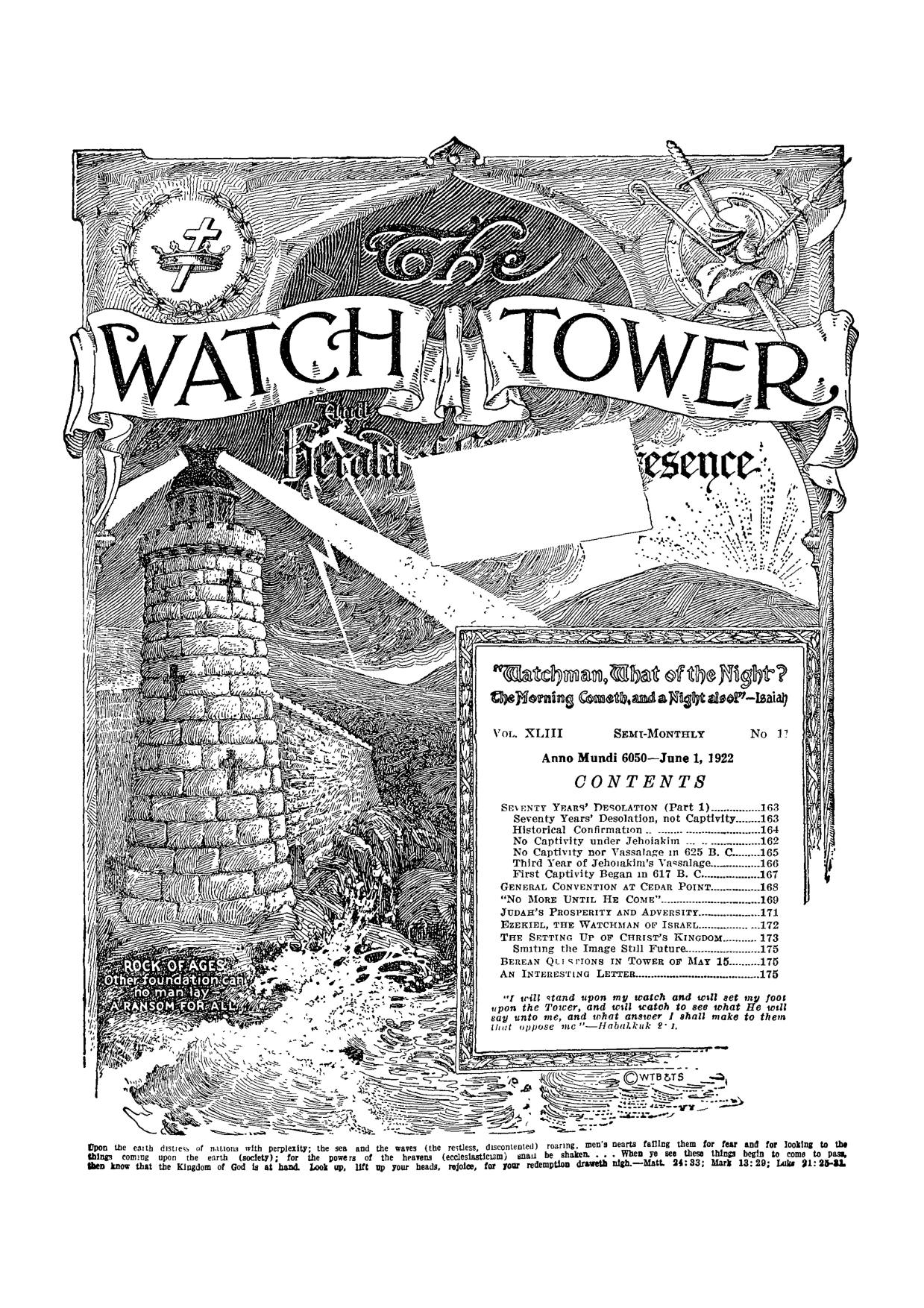
Interesting Letter.
An
No r
Upon the eat th distiess of nations with perplexity; the sea aad the waves (the restless, discontented) roaring, men 8 neJ^ n£an4 ^°.r looking to tho things coming upon the earth (society); for the powers of the heavens (ecclesiartlcism) snail be shaken. . • .T*611,/8, 868,7^ »< ? io no >COmni^n?o?’ then know that the Kingdom of God is at hand. Look up, lift up your heads, rejoice, for your redemption draweth nigh.—Matt 24.33, Mark 13:29; Luks 21:2541
^SCUCC*
©jefwmwg wim®W,aiada)siglljtal»©!?’-l2aiai?
Vol. XLIII
Semi-Monthly
Anno Mundi 6050—June 1, 1922
CONTENTS
Seventy Years' Desolation (Part 1).........
Seventy Years’ Desolation, not Captivity. Historical Confirmation.....................—
No Captivity under Jehoiakim .............
No Captivity nor Vassalage in 625 B. C.. Third Year of Jehoiakim’s Vassalage________
First Captivity Began in 617 B. C............
General Convention at Cedar Point.........
“No More Until He Come”........................
Judah’s Prosperity and Adversity............
Ezekiel, the Watchman of Israel.............
The Setting Up of Christ’s Kingdom.....
Smiting the Image Still Future.................
Berean Qlisi’ions in Tower of May 15—
..163 ..163 ..164 ..162 ..165 ..166
..167 ..168 ..169 ..171 ..172 . 173 ..175 -175 .175
••I trill stand upon my watch and will set my foot upon the Tower, and will watch to see what Be will say unto me, and what answer 1 shall make to them Unit oppose mcl>—Habakkuk S' i.
WTB&TS
THIS JOURNAL AND ITS SACRED MISSION
THIS Journal !s one of the prime factors or instruments in the system of Bible instruction, or "Seminary Extension”, now belnf presented in all parts of the civilized world by the Watch Tower Bible & Tract Society, chartered A. D. 1884, “For the Promotion of Christian Knowledge”. It not only serves as a class room where Bible students may meet in the study of the divine Word but also as a channel of communication through which they may be reached with announcements of the Society’s conventions and of the coming of its traveling representatives, styled “Pilgrims”, and refreshed with reports of its conventions.
Our “Berean Lessons” are topical rehearsals or reviews of our Society’s published Studies most entertainingly arranged, and very helpful to all who would merit the only honorary degree which the Society accords, viz , Vcibi Dei Minister (V. D. AI ), which translated into English is Minister of God’s 'Word. Our treatment of the International Sunday School Lessons is specially for the older Bible students and teacheis. By some this feature is considered indispensable.
This journal stands firmly for the defense of the only true foundation of the Christian’s hope now being so generally repudiated •—redemption through the precious blood of “the man Christ Jesus, who gave himself a ransom [a corresponding price, a substitute] for all”. (1 Peter 1:19; 1 Timothy 2 : G) Building up on this sure foundation the gold, silver and piecious stones (1 Corinthians 3: Ills; 2 Peter 1:5-11) of the Word of God, its further mission is to “make all see what is the fellowship of the mjstery which. . .has been hid in God, ... to the intent that now might be made know’n by the church the manifold wisdom of God”—“which in other ages was not made known unto the sons of men as it is now revealed”.—Ephesians 3:5-9,10.
It stands free from all parties, sects and creeds of men, while it seeks more and more to bring its every utterance into fullest subjection to the will of God in Christ, as expressed in the holy Scriptures. It is thus free to declare boldly whatsoever the Lord hath spoken—according to t^e divine wisdom granted unto us to understand his utterances. Its attitude is not dogmatic, but confident; for we know wheieof we affirm, treading with implicit faith upon the suie promises of God. It is held as a trust, to be used only in Ins service; hence our decisions lelative to what may and what may not appear in its columns must be according to our judgment of his good pleasuie, the teaching of bis Word, for the upbuilding of his peonle in grace and knowledge. And we not only invite but urge ouc readers to prove all its utterances by the infallible Word to which reference is constantly made to facilitate such testing.
TO US THE SCRIPTURES CLEARLY TEACH
That the church is “the temple of the living God”, peculiarly “his workmanship” ; that its construction has been in progress throughout the gospel age—ever since Christ became the world’s Redeemer and the Chief Corner Stone of his temple, through which, when finished, God's blessing «=hall come “to all people”, and they find access to him.—1 Corinthians 3:16, 17; Ephesians 2:20 22; Genesis 28 : 14 ; Galatians 3 : 29.
That meantime the chiseling, shaping, and polishing of consecrated believers in Christ’s atonement for sin, progresses; and when the last of these “living stones”, “elect and precious,” shall have been made ready, the great Master Workman will bring all together in the fust resurrection and the temple shall be filled with his glory, and be the meeting place between God and men throughout the Alihenmum.—Revelation 15:5-8.
That the basis of .hope, for the church and the world, lies in the fact that “Jesus Christ, by the grace of God, tasted death for every man,’\ “a ransom for all,” and will be “the true light which lighteth every man that cometh into the world”, “in due time”.—• Ilcbiews 2:9; John 1.9 ; 1 Timothy 2:5, G.
That the hope of the church is that she may be like her Lord, “see him as he is,” be “partakers of the divine nature’,’ and share his gloiy as his joint-heir—1 John 3.2; John 17:24; Romans S.17, 2 Peter 1:4.
That the present mission of the church is the perfecting of the saints for the future work of service; to develop in herself every giace to be God’s witness to the world; and to prepare to be kings and pnests in the next age.—Ephesians 4 :12 , Matthew 24: 14 , Revelation 1 : G ; 20 G.
That the hope lor the world lies in the blessings of knowledge and opportunity to be brought to all by Christ’s Millennial kingdom, the restitution of ail that was lost m Adam, to all the willing and obedient, at the bands of their Redeemer and his glorified church, when all the wilfully wicked will be destroyed.—Acts 3:19-23; Isaiah 35.
Published By
WATCH TOWER.Bl BLE G-TRACT society
18 CONCORD STREET O D BROOKLYN, N-Y U-SA
Foreign Offices : 'British: 34 Craven Terrace, Lancaster Gate, London W 2, Canadian 270 Dundas St, W , Toronto, Ontario; Australasian 495 Collins St, Melbourne, Australia, South African. 123 I’lein St, Cape Town, South Africa
Pt ease Address the Society in Every Case.
YEARLY SUBSCRIPTION PRICE'; United States; $1 00 ; Canada and Miscellaneous Foreign, $150, Great Britain, Australasia, and South Africa, Ss American remittances should be made by Expiess or Postal Monev Orders, or bv Bank Draft Canadian, British, South African, and Australasian remittances should be made to brant h. offices only. Remittances from scattered foreign territory may be made to the Brooklyn office, but by International Postal Money Orders only.
(Foreign tianslations of this journal appear in several languages)
Editorial Committee: This journal is published under the supervision of an editoridl committee, at least thiee of whom, have read and approved as truth each and every article appearing in these columns. The names of the editorial committee are: J. F Rutherford, W. E VanAmburgh, .t r mery, G. H Fisher, E. W. Breniser Terms to the Lord’s Poor: AH Bible students who, by reason of old age or other tn-firmity or adversity, are unable to pay for this journal, will be supplied free if they send a postal card each May stating their case and requesting such provision, We are not only willing, but anxious, that all such be on our list continually and in touch with the Berean studies.
Nnfirv tn Ruharrikprii' We do not. as □ rule, send a card of acknowledrment for o renewal op * el OUOSCrlOCro. n rcw 6ubscriplion Receipt and entry of renewal are indicated within a month by change in exp ration date, as shown on wrapper label.
Entered at Second Claee Matter at Brntiklvn, N 'Y., Poetoffice under the Aet of March 3rd. 3879
IBSA BEREAN BIBLE STUDIES
By Means of “The Plan, of the Ages”
Chapter VIII: The Day of Judgment
Week of August G.......Q 8-14 Week of August 20......Q. 22-27
Week of August 13.. .Q. 15-21 Week of August 27. ..... Q. 1-7
Question boyks qb “The Bivins Flan”, 15c postpaid
STUDIES IN THE SCRIPTURES
The^e Studies me i ^commended to 'indent-, n-. v eatable Bible keys, discussing topically every vital doctune of the Bible. More than eleven million copies are iu circulation, in nineteen languages. Two sizes are issued (in English only) the regular maroon cloth, gold stamped edition ou dull finish paper (size 5"x7|"), and the maroon cloth pocket edition on thin paper (size 4"x6i") , both sizes are punted from the same plates, the difference being in the margins , both sizes are provided with an appendix of catechistic questions foi convenient class use. Both editions unifoim in price
Series I, The Divine Plan of the Ages, giving outline of the divine plan revealed in the Bible, relating to man’s’icdemption and restitution 350 panes plus indexes and appendixes, 50c Magazine edition 20c Also piuctuab’e in Aiabie. Atinenian, Dauo-N’oivvegian, Finnish, French. Geiman, Gicek Uollandish Hungaiian, Itai.an, Polish, Roumanian, Slovak, Spanish, Swedish, and Ukiaiman; legular cloth stvle, puce 75c
Series II The Time is at Hand, tieats of the niannei and time of the Lord second coming, consideniu' the Bible testimony on this subject 333 pages. 50c Obtainable in Aiabie, Dano-.Xor-vv egian, Finnish, Fremh, Geiman Gieek, Polish, and Swedish 75c a enpv
SlriLS III, Thy Kingdom Come, considers prophecies which mail: events connected with “the time of the erd ’ the gloi ification of the church and the establishment of the Millennial kingdom Jt also contains a chaptei on the Great Pyianud ot Egvpt showing its corroboration of certain Bible teachings 380 page- 50e 1 in m died also in Dano-Norwegian, Finnish, French, Geiman, Greek, Polish, and Swedish, 75c
Serifs IV, The Rattle of Armageddon, shows that the dissolution of the present order of things is in piogiess and that all of the human panaceas offeied are valueless to avert the end predicted in the Bmle It contains a special and extended treatise on our Lord’s great propheev of Matthew 24 and also that of Zechaiiah 14 1-9 G56 pages, 55c Also in Dano-Norwegian, Finnish, French, Greek, Geiman, Polish, and Swedish, S5c
Series V, The Atonement Between God and Man, treats an all impoitant subject the eentei mound which all featuies of divine grace revolve This topic deserves the most careful consideration on the part of all true Christians. 618 pages, 55c Procurable likewise in Dano-Norwegian, Finnish, French, German, Greek, Polish, and Swedish, 85c.
Series VI. The New Creation, deals with the creative week (Genesis 1, 2), and with the church. God’s new creation.lt examines the personnel, organization, rites, ceremonies, obligations, and hopes appertaining to those called and accepted as members of the body of Christ* 730 pages, 55c. Supplied also in Dano-Norwegian, Finnish, French, German, Greek, Polish, and Swedish, 85c.
Series VII, The Finished Mystery, consists of a verse-by-verse explanation of the Bible books of Revelation, Song of Solomon, and Ezekiel: 608 pages, illustrated, 55c in cloth, 25c in magazine edition—latter treats Revelation and Ezekiel only Oano-Norwegian* Finnish, French, Greek, Polish, and Swedish, 85c.
AND HERALD OF CHRISTS PRESENCE
Vol. XL1II
June 1, 1922
No. 11
SEVENTY YEARS’ DESOLATION (PART 1)
"Them that had escaped from the sword carried he [Nebuchadnezzar] away to Babylon, where they were servants to him and his sons until the reign of the kingdom of Persia: to fulfill the word of the Lord by the mouth of Jeremiah, until the land had enjoyed her sabbaths; for as long as she lay desolate she kept sabbath to fulfill threescore and ten years."—2 Chronicles 36: 20, 21.
FROM time to time Bible students who quite evidently are either unfamiliar with all the teachings of present truth or unappreciative of the thoroughgoing convincingness of what has been brought out through the Society, “discoxer" some “error” m proved present truth. Without waiting to communicate with the Society, which could help them, and without making a thorough search, and xx ithout properly ascertaining the weight of evidence published and the insubstantiality of their own “findings” (1 Timothy 3 : 6; 2 Timothy 4:4), they rush to communicate their “new” ideas to others. A few others, no better grounded in the truth than these mistaken leaders, follow their injudicious course, and are led into a state of uncertainty and doubt; and some of them, especially of the leaders, forsake the way of present truth, abandon the opportunities and privileges of co-working with God (2 Corinthians 6:1) and of suffering with Christ (Philip-pians 1:29), separate themselves from those in present truth, lightly leave their crowns to others (Revelation 3:11), and make shipwreck of their glorious hopes. (1 Timothy 1:19) The uniform experience in all such abandonments of the faith and in the divisions so inaugurated is that they start out with a loud noise of professions of loyalty to abstract truth and soon diminish in numbers and zeal until either wholly scattered or settled down into a state of inactivity—of “waiting upon the Lord”, as they are pleased to term their sloth fulness in service.
On account of their smallness of numbers, each of these groups regards itself the “little flock”. There are a dozen such schismatic “little flocks”, characterized by an increasing littleness and by an absence of the predicted glorious activity in the warfare of the Lamb with the beast. (Isaiah 61:2; Revelation 17:14) The result is a slight temporary diminution of the amount of work done in his name, with a more than compensating increase of zeal among those holding the faith.
These occurrences are the periodic siftings and shakings which the Lord has foreknown and which are evidently necessary to cleanse and purify the church; for “there be divisions among you. . . . There must also be
heresies among you, that they which are [divinely] approved may be made manifest among you.” (1 Corinthians 11:18, 19) If any finally decide that they do not desire to remain with us in our service of the Lord, they must follow their own consciences; but we may rest in the Lord, assured that, whoever they may be that leave us, “they went out from us, but they were not of us; for if they had been of us, they would no doubt have continued with us: but they went out, that they might be made manifest that they were not all of us". (1 John 2:19) These are the promised shakings which will shake everything except that which cannot be shaken. (Hebrews 12:27) However, let the church fear not the siftings and shakings; for these are part of the divinely-promised work of the complete cleansing of the church as it approaches the end of the way. (Matthew 13:41; Revelation 1:15) Rather let the church of God rejoice at these evidences of the Father’s attention to its welfare.—John 15: 2.
WHEN DID THE SEVENTY YEARS BEGIN?
This time it is the matter of the date of the beginning of the seventy years’ desolation of Judea and of whether it was all desolation or all captivity. This is testing the faith of some. This has been fully and adequately covered by Pastor Russell in “The Time Is at Hand”, pages 51, 52, and m great detail in Dr. John and Morton Edgar’s “Great Pyramid Passages”, Volume 2, pages 29-37, to both of which works we refer our readers. But for the benefit of those not having all the information at hand we will review the salient points, to bring them again clearly to remembrance.—2 Peter 3:1.
SEVENTY YEARS’ DESOLATION, NOT CAPTIVITY
Concerning the desolation Pastor Russell says: “Usher dates the seventy years’ desolation eighteen years earlier than shown above. ... He evidently makes the not uncommon mistake of regarding those seventy years as a period of captivity, whereas the Lord expressly declares them to be seventy years of desolation of the land, that the land should lie 'desolate, without an inhabitant’.”
The seventy years were years of desolation, not cap-
tivity. This is shown in the Scriptural historical record, which cannot be otherwise understood, and according to which the seventy yoais did not begin until after the overthrow of the last king, Zedekiah, in 606 B. C.: “Them that had escaped from the sword carried he [Nebuchadnezzar, m 606 B. C.]away to Babylon, where they were servants [for seventy years] to him and to his sons, until the reign of the kingdom of Persia [under Cyrus, 536 B. C.] to fulfill the woid of the Lord by the mouth of Jeremiah, until the land had enjoyed her sabbaths for as long as she lay desolate she kept sabbath, to fulfill threescore and ten years'". (2 Chronicles 36 20, 21) This pas-age peaks, of simultaneous desolation, servitude and captivity.
Other passages showing th.it desolation means “'without an inhabitant” are as follows:
“To make thy land desolate. and thy cities shall be laid waste without an inhabitant. '—Jeremiah 4: 7.
“I will make the cities of Judah desolate, without an inhabitant" --Jeremiah 9: 11
“In this place, which ye say shall be desolate, without man and without bea^t, even in the cities of Judah, and in the streets of- Jei usalcm.’’—Jeremiah 33:10.
“I will make the cities of Judah a desolation without an inhabitant."—Jeremiah 34: 22.
Others that might be quoted -are Jeremiah 2:15; 44:22; and 51: 37, all showing that the predicted seventy years’ desolation meant -a period of that length in which the land should be “without au inhabitant’’. This state was never reached, or even begun, until after the overthrow of Zedekiah, the removal of the people to Babylon, and the flight of the small remnant into Egypt for fear of the Chaldeans (Jeremiah-43: 1-7), leaving the land, as divinely predicted, “desolate, without an inhabitant,” for “threescore and ten years”.
HISTORICAL CONFIRMATION
The Jewish historian Josephus, writing after the occurrence and expressing the knowledge of all Jews— who certainly were conversant.with the facts—say's that the seventy years were years of desolation after the fall of the city under Zedekiah: “He [Nebuchadnezzar] reduced them all, and set our temple which was at Jerusalem on fire [2 Chronicles 36:19-21], nay, removed our people entirely out of their own country, and transferred them to Babylon; when it so happened that our city was desolate during the interval of seventy years, until the days of Cyrus king of Persia”.—Apion 1:19.
In another place Josephus reiterates his statement as to the seventy years of desolation: “But the king of Babylon, who bi ought out the two tribes [Judah and Benjamin], placed no other nation in their country', by which means all Judea and Jerusalem, and the temple, continued to be a desert for seventy years".—Ant. X, 9:7.
It ia quite obvious that a Jewish historian, even though not inspired, would not record the seventy years as a "desolate” or “desert” state which began after the destruction of Jerusalem, had this not been the actual condition, as generally known by Ins people. It may have been possible for Josephus to be unceitain m some details of obscure dates, but it is beyond the bounds of possibility for him to have been mistaken about such an important, outstanding fact of his people’s history. The Jews of that time were far more likely to know the simple fact, whether those were seventy years of desolation or of captivity', than is some over-zealous but less informed or misinformed scholar, doctor of divinity, or student of the present day. For our part, we prefer to take our stand with the divinely directed mediator, Moses, the inspired prophet Jeremiah, and the ancient lu=torian of the Jewish nation, all of whom agree that these “seventy years” were years of desolation, rather than of captivity—the captivity beginning at an earlier date and being a different thing.
o o
DETAILS OF PROPHECY AND FULFILLMENT
In the inspired prophecy of Moses one of the important sabbath rests was the fiftieth year: “A jubilee [sounding of silver trumpets] shall that fiftieth year be unto you: ye shall not sow, neither reap that which gioweth of itself m it, nor gather the grapes in it of thy vine undressed. For it is the jubilee; it shall be holy uuto you; ye shall eat the increase thereof out of the field.”—Leviticus 25: 11.
The Jews, through unbelief in God’s promised abundance, failed to give the land its sabbath rest on even one of the nineteen jubilees which transpired between their entrance into Palestine (1575 B. C.) and the overthrow of Zedekiah (606 B. C.). God foreknew this unbelief, and foretold, through the prophet Moses, that if they failed to keep the law of the jubilee the land was destined to have its divmely-appoinfod jubilee rest through a coming desolation, during which he would scatter them among the nations, a year of desolation without an inhabitant for each neglected jubilee sabbath year: “And I will scatter you among the heathen, and will draw out a sword after you: and your land shall be desolate, and your cities waste. Then shall the land enjoy- her sabbaths, as long as it lieth desolate, and ye be in your enemies’ land; even then shall the land rest, and enjoy her sabbaths. As long as it lieth desolate it shall rest; because it did not rest m your sabbaths, when ye dwelt upon it.”—Leviticus 26: 33-35.
The accurate Bible student will not overlook that the prophesied sabbath rest for the land combined a desolation of the land with absence of the Jews from that land. This combined requirement never began until after the overthrow of Zedekiah m 606 B. C. It would be a denial of the prophecy of Leviticus to assert that the mere captivity of some of the Jews, their mere servitude as a tributary nation, met the divinely-foretold “'desolation without an inhabitant”. The prime requirement was desolation, not captivity or servitude— desolation combined with captivity and servitude was the divine penalty. To insist that this seventy year prophecy means servitude without desolation of the land is to ignore the Word of God given thiough Moses, and no such idea can be true nor can those adhering to it have God’s blessing on their course. As will be shown, this notion lest; upon pagan and demonistic support and leads into other errors, a moiass of doubts, and ultimately into higher criticism and infidelity.
PROPHECY AND FULFILLMENT
As the appointed time for the desolation and sabbatic rest of the land approached, the Lord, m harmony with his policy of informing of evils to come, revealed through Jeremiah, without’stating when, that the period of contemporaneous desolation, servitude, and captivity was to be seventy years, thus also indicating the total length of the jubilee system as 50 x 70, or 3,500 years: “And this whole land shall be a desolation, and an astonishment; and these nations shall serve the king of Babylon seventy years. And it shall come to pass, when seventy years are accomplished, that I will punish the king of Babylon, and that nation, saith the Lord, for their iniquity, and the land of the Chaldeans, and will make it perpetual [lasting] desolations” — as Mesopotamia still is.—Jeremiah 25 : 11, 12.
“After seventy years be accomplished [by the entire nation] at Babylon I will visit you, and perform my good word toward you, in causing you to return to this place.”—Jeremiah 29 : 10.
The historic record of fulfillment of seventy years desolation is plainly stated in the Bible, as well as m Jewish history: “As long as she [the land of Palestine] lay desolate she kept sabbath, to fulfill threescore and ten years”.—2 Chronicles 36 : 21.
It would be a quibble to assert that this does not mean seventy years of sabbath rest in desolation.
The date for the beginning of the seventy years’ desolation of Jeremiah’s prophecy was not understood clearly at the time by either the Prophet or the people. It was not until the first year of Darius the Mede, (538 B. C.) that Daniel began first to understand from a study of the Books of Jeremiah and Leviticus that the seventy years of desolation were then up: “In the first year of his [Darius’, 538 B.. C.]reign, I Daniel understood by books the number of the years, whereof the word of the Lord came to Jeremiah the prophet, that he would accomplish seventy years in the desolations of Jerusalem”. (Daniel 9:2) As usual, the prophecy was not understood until its fulfillment.
Daniel, as a wise and successful governor, came at once into high favor with Darius the Mede (Cyaraxes II—538 B. C.) and then with Cyrus (536 B. C.), and doubtless did something toward influencing the Persian monarch’s mind favorably toward the Jews, in bringing to an end the seventy years’ empty desolateness of their land. Cyrus pennitted part of the Jews to return that year. Part of them remained captive and did not return till the seventh year of the reign of Artaxerxes (Lzia 7—467 B. C.) and others till the twentieth year of the same king. (Nehemiah 2—454 B. C.) So long were some still m captivity that, according to later history, they wondeied if the “seventy years” were not figurative, and many never returned from captivity. If the captivity of some of the Jews and not the desolation of Jerusalem and of Judea constituted the chief feature in the seventy-years prophecy, then the question might be properly asked, Has the period yet ended?—for some never returned to their own land. Such considerations show how the neglect or perversion of some part of the Biblical statements both makes the Word of God of none effect and leads off into endless doubts and confusing questions. This is characteristic of the deceptive methods of demons.
NO CAPTIVITY UNDER JEHOIAKIM
Bishop Usher, and others following his lead, have fathered an unscriptural idea that there was a captivity of the Jews by Nebuchadnezzar in the fourth (or third) year of Jehoiakim (625 B. C.) 18 (or 19) years before the seventy years’ desolation began at the fall of Zede-kiah (606 B. C.). They nnagine that the seventy years’ desolation were seventy years’ captivity, dating from the fourth (or third) year of Jehoiakim, and consisting of 18 (or 19) years’ captivity alone plus 52 (or 51) years’ captivity and desolation combined. The fact is, as seen from the above mentioned Scriptures, that there were seventy years of captiv ity coincident with seventy years’ desolation.
The effect of this misconception upon the chronology of the Bible would be to show that the desolation was nineteen years shorter than it really was, or that we count the nineteen year period twice, and thus make the period of time prior to the desolation nineteen years too long.
NO CAPTIVITY NOR VASSALAGE IN 625 B. C.
A doctrine should never be based on a passage of doubtful meaning, reading, or authenticity. This error is based upon the reading of a passage which is inharmonious (1) with the rest of the Scripture record of the attacks by Nebuchadnezzar upon Judea and Jerusalem, and (2) with other Scriptures.
A little scrutiny of Daniel 1:1, 2 shows that there is something the matter with it. The passage in our Common Version reads: “In the third year [626 B. C.] of the reign of Jehoiakim king of Judah came Nebuchadnezzar king of Babylon unto Jerusalem, and besieged it. And the Lord gave Jehoiakim king of Judah into his hand, with part of the vessels of the house of God, which he carried into the land of Shinar, to the house of his god; and he brought the vessels into the treasure h'mse of his god.”
These events, as we shall see, actually took place in 617 B. C.—Jehoiakim’s eleventh year—and included (1) the attack by Nebuchadnezzar three years after Jehoiakim began paying tribute (620 B. C.) ; (2) the taking of some of the Temple vessels to Babylon in 617 B. C. when Jehoiakim’s eleventh-year and Jehoia-chm’s three-months reigns were forcibly ended by Nebuchadnezzar (617 B. C.) ; and (3) the first taking of the first captives to Babylon at the same time. This was eleven years before the final captivity and the beginning of the “desolation” of the land.
The foreign relations of Jehoiakim were briefly as follows:
For eight years (628-620 B. C.) he was tributary to Egypt or at least non-tributary to Bain Ion : “And Phar-aoh-nechoh made Eliakim the son of Josiah king in the room of Josiah his father, and turned his name to Jehoiakim. . . . And Jehoiakim gave the silver and the gold to Pharaoh; but he taxed the land to give the money according to the commandment of Pharaoh: he exacted the silver and gold of the people of the land, of every one according to his taxation, to give it unto Pharaoh-nechoh.”—2 Kings 23: 34, 35.
In his eighth year Jehoiakim was forced to begin paiing tribute to Balnlon. During his eleventh and last war. which would be the third year of his vassalage to Nebuchadnezzar (617 B. C.), he attempted an alliance vv i+li Eg\pt. and refused to pay the promised tribute to B.ibvlon. This course brought upon him the wrath of Nebuchadnezzar, a Chaldean invasion, his own death, and the captivity of Ins successor, Jehoiachin, many Jews, including Daniel. (2 Kings 24:12) Zedekiah vas then placed upon the throne as Nebuchadnezzar’s vassal, and reigned eleven year?, until dethroned in 606 B. C.
THIRD YEAR OF JEHOIAKIM’S VASSALAGE
A discrepancy in Daniel 1:1, 2 is manifest in the date, “the third year of Jehoiakim” (626 B. C.); for this would have been one year prior to the beginning of Nebuchadnezzar’s reign,'which began in the fourth year of Jehoiakim (625 B. C.), when Nebuchadnezzar defeated Pharaoh-nechoh of Egypt: “Against the army of Pharaoh-necho king of Egypt, which was by the river Euphrates in Carchcmish, which Nebuchadnezzar king of Babylon smote in the fourth year of Jehoiakim”. (Jeremiah 46:2) “The fourth year of Jehoiakim, the son of Josiah king of Judah, that' was the first year of Nebuchadnezzar king of Babylon.”—Jeremiah 25:1.
Carchemish is by the river Euphrates in the land of Mesopotamia or Babylonia. The king of Egypt had passed by Judea and was some 400 miles to the east. Babylon at this time was not a world power but this victory by Nebuchadnezzar broke the power of the king of Egypt, and Nebuchadnezzar was quick to follow his advantage and drove the king of Egypt back to his own mnntry, thus changing the nominal control of Palestine from Egypt to Babylon. Pharaoh-necho was probably three or more years on this campaign.—Compare 2 Chronicles 35 : 20; 36 : 1.
The two dates—third and fourth years—cannot be reconciled; and as the fourth year was the first year of Nebuchadnezzar, we must conclude that the “third year” mentioned in Daniel 1: 2 refers to another third year than the third year of Jehoiakim’s reign proper— the third year of his vassalage to Babylon, which began in 620 B. C. and ended with his rebellion and death m 617 B. C.
According to the Jewish historian Josephus, the reign of Jehoiakim included no Chaldean attack on Jerusalem in'the first year of Nebuchadnezzar (Jehoiakim’s fourth year—625 B. C.), but the first attack came four years later, in Nebuchadnezzar’s fifth year (Jehoiakim’s eighth year—621 B. C.), and the vassalage of Jehoiakim’s country dated from that or the next year (620 B. C.). This clarifies Daniel 1:1, 2, showing “the third year” to refer to the third of Jehoiakim’s relations with Babylon, and not to the third year of his elevenyear reign. Josephus says:
“Now in the fourth year of the reign of Jehoiakim [625 B. C.] one whose name was Nebuchadnezzar took the government over the Babylonians, who at the same time went up with a great army to the city Carchemish, which was at Euphrates, upon a resolution he had taken to fight with Neco, king of Egypt, under whom all Syria then was. . . . The king of Babylon passed over Euphrates, and took all Syria, as far as Pelusium, excepting Judea.
“But v hen Nebuchadnezzar had already reigned four years [621 B. C.] which was the eighth of Jehoiakim’s government over the Hebrews, the king of Babylon made an expedition with mighty forces against the Jews, and required tribute of Jehoiakim, and threatened, upon his refusal, to make war against him. He was affrighted at his threatening and bought his peace with money, and brought the tribute he was ordered to bring /or three years [until Jehoiakim’s eleventh and last year, 617 B. C.J
“But on the third ycai [Daniel 1:1], upon hearing that the king of the Babylonians made [or probably planned] an expedition against the Egyptians, he did not pay his tribute; yet was disappointed of his hope, for the Egyptians durst not fight at this time.”—Ant. IX, 6:1, 2.
The Bible record of this is in 2 Kings 24:1—25: 7. Josephus makes no mention of an attack on the Jews by Babylon in 625 B. C., but specifically says that Judea was excepted then from the general attack. The Jews, on account of their numbers and the strength of their inland and easily defended mountain position, were let alone for four years (until 621 B. C.), after which their vassalage to Babylon began. There was no captivity of the inhabitants until the fall of Jehoiakim and of Jehoiachin in 617 B. C. This is according to Jewish records, but the commonly accepted idea ignores Jewish history for the reason that it cannot make them agree with the notoriously untrustworthy pagan records.
The “third year of Jehoiakim” (Daniel 1:1) was therefore the third full year of his vassalage to Nebuchadnezzar which was the end of his eleven-year reign (617 B. C.). The Daniel 1:1 record was written in Babylon and took the Chaldean viewpoint of the third year of Jehoiakim’s relationship with Babylon. The events which then took place agree with the Scriptural record of the taking of some of the Temple vessels and of many Jews captive into Babylon in 617 B. C., eleven years before the desolation;
FIRST CAPTIVITY BEGAN 617 B. C.
The record of the historian Josephus of the captivities of the Jews m 617.B. C.—the first of the captivities— is as follows:
‘■Now a little time afterwards [617 B. C.], the king of B.ibj Ion made an expedition against Jehoiakim, whom he lecened [into the city], and this out of fear of the foregoing predictions of tins prophet [Jeremiah], as supposing that he should suffer nothing that was terrible, because he neither shut the gates nor fought against him; yet, when he was come into the city, he did not observe the covenants which he had made, but he slew such as were in the flower of their age, and such as were of the greatest dignity, together with their king Jehoiakim, whom he commanded to be thrown before the walls, without any burial, and made his son Jehoiachin king of the country and of the city: he also took the principal persons in dignity for captives, three thousand in number, and led them away to Babylon, among whom was the prophet Ezekiel, who was then but young.”—Ant. N, 6 : 3.
The Bible record of this captivity at the close of Jehoiakim’s reign is given in 2 Kings 24: 2-6; 2 Chronicles 36: 6; Daniel 1:1, 2; and Jeremiah 22:13-19. In this matter many writers on this subject have been misled by attempting to harmonize these events with unreliable pagan records. The pagans in all their affairs were under demomstic influence, and to attempt to follow them in doubtful matters is to fall into error and entanglement.
In the same year (617 B. C.), three months later, took place the second part of the initial captnity of the Jews, under Jehoiachin, to Babylon. (Jeremiah 52: 28) This is described by Josephus as follows:
“But terror seized on the king of Babj Ion, who had given the kingdom to Jehoiachin and that immediately; he was afraid that he should bear him a grudge, because of his killing of his father, and thereupon should make the country revolt for him; wherefore he sent an army and besieged Jehoiachin in Jerusalem ; but because he was of a gentle and just disposition, he did not desire to see the city endangered on his account, but he took his mother and kindred, and delivered them to the commanders sent by the king of Babylon, and accepted of their oaths, that neither should they suffer any harm nor the city, which agreement they did not observe for a single year; for the king of Babylon did not keep it, but gave orders to his generals to take all that were in the city captives, both the youth and the handicraft men, and bring them bound to him; their number was ten thousand eight hundred and thirty-two; as also Jehoiachin, and his mother and friends; and when they were brought to him, he kept them In custody, and appointed Jehoiachin’s uncle Zedekiah to be king”.—Ant. X, 8:1.
The Bible record of this is in 2 Kings 24:10-17; 2 Chronicles 36: 9, 10; and Jeremiah 52: 28.
After the departure of Jehoiachin and the Jewish captives to Babylon, some false prophet? among them at Babylon kept the minds of the captives in unrest by predicting only a brief captivity. To quiet this unrest Jeremiah, in 617 B. C., in a letter (Jeremiah 29:1-23) counseled the captives to settle down and make themselves as comfortable as possible in anticipation of a long period away from home, because the seventy years —to begin in 606 B. C.—-were surely to be accomplished at Babylon. (Jeremiah 29:10) No one knew then when the seventy years were to begin. This was not understood by Daniel till the first year of Darius. (Daniel 9:1, 2) It is asserted that Jeremiah’s letter (617 B. C.) marked the beginning of the “seventy years”; but this is not the case. As a matter of fact, the Prophet had uttered this very warning in 625 B. C. (Jeremiah 25:1-38; 29:11,12), eight years before there was any captivity at all; for Judea and Jerusalem were not molested in 625 B. C. nor until four years later, when Jehoiakim, under fear of Nebuchadnezzar’s threats, became a tributary vassal to Babylon.
The various nations also were to serve Babylon seventy years, but the servitude of different nations began at different times, from Philistia in 625 down to Tyre in 606 (or 605) B. C., the latter city’s preliminary siege beginning (618 B. C.) thirteen years before its fall (605 B. C.) according to the article on Nebuchadr nezzar in “Smith’s Bible Dictionary”. The predicted seventy years’ servitude of all the nations was, however, practically coincident with the seventy years’ desolation of Judea, though some served more than seventy years. No one date prior to 606 B. C. can be set as meeting all the requirements of the prophecy of Jeremiah 25: 13-28. A seventy-year period upon Tyre had been prophesied by Isaiah (23: 15-18) ; and as this agrees in terms with the Jeremiah prophecy (Jeremiah 25: 11, 22), the seventy years’ servitude of Tyre to Babylon could not have begun earlier than 606 or 605 B. C. Any close examination then of the facts shows that not even the prophecy of seventy years’ servitude or captivity upon the nations began to be fulfilled on all of them in 625 B. C. nor earlier than 606 B. C. The expression of Isaiah 23:15 is that “Tyre shall be forgotten seventy years [as an independent people], according to the days of one king [kingdom, empire]”. Knowing that in prophecy “king” is often used for “kingdom” (Daniel 11:11-14, etc.), the “one king” evidently refers to the seventy-year dominion of Babylon from 606 to 536 B. C. No other explanation of these passages meets all the conditions of prophecy and fulfillment.
A further difficulty comes to light in comparing Daniel 1 with Daniel 2. In Daniel 1 the statement is that the four Hebrew lads were given three years training before presentation to the king. (Daniel 1: 5, 18-20) In Daniel 2:1 it is stated that Daniel was brought before the king and revealed and explained the image dream in Nebuchadnezzar’s second year, which would thus have been a year or two before they were present"! to the king as recorded in Daniel 1:181 The Variorum Bible foot-note reading for “second” is “twelfth”, the “second” being evidently a slip of a copyist's pen, like the slip of the pen from eighteen to eight in 2 Chronicles 36: 9 and 2 Kings 24: 8.
The “twelfth” year of Nebuchadnezzar agrees with the facts. It would be in the year 614 B. C. (625 minus 11 equals 614), three years after the captivity of Daniel and the other three Hebrew lads, Ezekiel and others, and the expiration of their three years’ training — three years after 617 B. C., or 614 B. C. (Daniel 1: 5, 19) Thus the disclosure of the truth about Daniel 1:1 and 2: 1 removes the entire foundation for the notion that the Hebrew captivity began in 625 B. C. and that 625 B. C. was the beginning of the 70 years.
No one knew better than the captive Jews in Babylon when their captivity began. They never dated the initial captivity from the first year of Nebuchadnezzar (625 B. C.), but from the end of Jehoiachin’s three-months’ reign and the beginning of Zedekiah’s (617 B. C.) a date which by no method of reckoning can be made the beginning of a seventy years’ captivity. References to this are numerous in Ezekiel, as, “the fifth year of king Jehoiachin’s captivity” (Ezekiel 1:2), “in the five and twentieth year of our captivity”(Ezekiel 40:1), and numerous other verses. The captive Jews knew nothing of a captivity beginning in Jehoiakim’s fourth year, or Nebuchadnezzar’s first year. If there had been such a captivity it would naturally have been mentioned elsewhere than in the doubtfully-dated Daniel 1:1. These facts dispose of the assertion that the seventy years’ captivity began in 625 B. C., and show that so far as the Bible and Jewish history are concerned our chronology, which places the beginning of the “seventy years” in 606 B. C., is correct.
GENERAL CONVENTION AT CEDAR POINT
DURING the past two years there has been a great demand for another geneial convention. The high cost of transportation and of hotel accommodations has been the chief cause for not holding such a convention. But realizing the importance of a general assembly of the Lord’s consecrated ones for a season of fellowship together, an effort has been put forth to arrange for a general convention for 1922.
The convention held at Cedar Point, Ohio, m 1919, is generally conceded to have been the greatest ever held during the harvest period, and frequently the brethren are heard to say that they long for another such convention. We are glad to announce that arrangements are practically complete for holding another general convention at Cedar Point on beautiful Lake Erie, beginnmg September 5 and continuing for eight, and possibly ten, days.
TO BE AT CEDAR POINT, OHIO
Cedar Point is situated on a narrow peninsula jutting out from the Ohio mainland into Lake Erie. It has the advantages of the lake from three sides. For quietness and seclusion we know of no better place. The friends can be practically alone during the convention and have sweet fellowship together. The grounds are situated some two miles across the bay from Sandusky, Ohio, which is reached by ferry, as well as by a roadway; and those who will attend from the outside will be people who are truly interested in knowing something about God’s Word, and it will be a real joy to have them present and render any assistance we can to them in understanding the divine plan.
The Boeckling Company, desiring to show its appre-cii tion of the Bible students, has arranged to let the Association have the exclusive use of the hotels, halls, grounds, etc., of Cedar Point for its contention, which will begin September 5 at noon. On this peninsula are situated two good hotels, The Breakers and The Cedars, which accommodate approximately 3800 people. Good accommodations can also be had at Sandusky. A flat-i ate of $2.00 per day has been made to all of the brethren attending the convention. This will include room and three meals, to be served of first-class food. When the capacity of the hotels and other accommodations on the peninsula are exhausted, the overflow will be placed m Sandusky in private homes and hotels; and the management of Cedar Point has agreed to provide these quarters at the same rate, and to transport by boat all who will necessarily have to go from Sandusky to Cedar Point, back and forth, free of charge.
We shall have the exclusive use of the auditoriums, which have been improved since we were there before. The weather is usually ideal in the first part of September; and we may find it advantageous to hold outdoor meetings, as was the case m 1919.
There are a number of colporteurs and others of the Lord’s dear consecrated ones who may find it difficult to get to the convention and pay their expenses. Hence an arrangement has been made that the management of Cedar Point will employ approximately two hundred to assist in taking care of the rooms, checking the linen, assisting in the dining room and the kitchen. Ablebodied brothers and sisters can engage in this service if they so desire, and for this assistance will receive their room and board free. Those who wish to engage in this work should make application to our Convention Committee in advance of the time of the convention. It is the Association’s desire to have all the colporteurs in the United States and Canada to attend this convention, if possible.
MEETINGS FOR FOREIGN FRIENDS
In addition to the English-speaking brethren, it is the desire to have the foreign brethren attend this convention, also; and they will have their separate meetings in their separate tongues, addressed by able brethren in their respective languages. It is our hope to have every Pilgrim brother in the United States and Canada attend, and probably some from foreign countries.
We make this early announcement of the convention in order to enable the friends to begin to make preparation for their vacations, etc., that they may attend this general contention. Because of the expense, we are not encouraging local conventions to be held between now and September 1, but believe it would be pleasing to the Lord for us to concentrate our efforts toward making the Cedar Point Convention the greatest ever held.
The Society has provided a regular committee on arrangements, who will have charge of the details for the convention. Those desiring special information should address the Convention Committee, 18 Concord Street, Brooklyn, New York.
Transportation facilities for Cedar Point are first-class. Three trunk railways, through Sandusky, besides electric railroads and steamship companies, operate lines there. This year we have succeeded in getting a special rate from the railroad companies without the necessity of the certificate plan, and the friends will be enabled to buy their round-trip tickets at their home station; so there will be no loss of time or confusion at Cedar Point in validating certificates and purchasing tickets. The special rate without certificate is obtainable under rules which must be exactly observed. The rules will be published in detail.
In addition to the Bible Students, all Christians who believe in the Lord Jesus as our great ransom-sacrifice, and who love the Lord, will be welcome to this convention.
And now, dear brethren, let us one and all present the matter before the throne of heavenly grace, and ask the Lord to make this convention one of great blessing to all who shall attend and a splendid witness for his cause. The kingdom of heaven is here! Let us rejoice and be glad, and with gladness tell it out to others.
"NO MORE UNTIL HE COME”
--June 18 — 2 Kings 25:1-21--
ZEEEKIAH LAST TYPICAL KING-TYPICAL KINGDOM OVERTHROWN—BEGINNING OF THE “TIMES OF THE GENTILES”-JERUSA
LEM BURNED, TEMPLE DESTROYED, LAND LAID WASTE — PBOPHECIES OF JEREMIAH AND EZEKIEL LITERALLY FULFILLED.
“Be not deceived; God is not mocked; for whatsoever a man soweth, that shall he also reap."—Galatians 6:7.
, On' many valuable lessons in life might be learned i j by observation! It seems to be a trait of fallen humanity to give little or no heed to the lessons that might be drawn from the experiences of others, no matter how similar the conditions may be. “Others were foolish ; I’m too wise to be caught in that way” seems to be ingrained in human nature. Many in present truth, even, are slow to learn valuable lessons by observation. Doubtless the adversary is quick to foster such a spirit of self-reliance and disdain for advice.
SCHOOL OF EXPERIENCE NEEDED
For nearly one thousand years God had been dealing with the Israelites as his people, administering punishments oi siioweung blessings, aci-c.’Uing to their disobedience or loyalty. Zedekiah must have been familiar with these records of national history. The recent experiences of his own brother, Jehoiakim, and his nephew, Jehoiaelun, must still have been fresh in his mind. Jehoiakim had broken faith with King Nebuchadnezzar and b id lost both his throne and his life. Jehoiachln was then languishing in a Babylonian prison. Yet in the face of all these known facts, Ezekiel informs us that Zedekiah had deliberately broken his covenant with King Nebuchadnezzar, and that this was the immediate cause of his downfall. God would not hold him guiltless for breaking a solemn covenant even with a heathen king. (Ezekiel 17:11-17) How deeply this lesson should be impressed upon the minds of all who have made a covenant with Jehovah! He assures us he will be faithful to keep his part of the covenant and expects us to keep our part to the very best of our ability—perfectly in heart at least.
Zedekiah had treacherously entered into a league with the king of Egypt with a view to throwing off the Babylonian yoke. When Nebuchadnezzar learned of it he determined to bring Zedekiah to his senses. God had foretold that the Israelites would have to serve the king of Babylon, but apparently Zedekiah had as little faith in the Word of God, as do many today nue n'utess with their lips to be his followers, but whose beans are far from him.
WARNINGS UNHEEDED ' l.vi-T.ER FOLLOWS
Nebuchadnezzar besiege''. Jei.salem for about eighteen months before it capituluied Famine and pestilence weakened the defenders and the c'ty was taken and destroyed. God’s time tor pun.sliment had come ami n, thing could stay it ionger. (Jeremiah 37:6-10) Zedeki.d: e.’ii'.we'ed to escape, but was soon captured. He and the rei hinder of the Israelites who had been left from the ou« de-n-.rtaiion e’ en years before, were taken to Br., ■ with the exception of a few of the poorest or the peoph Ged-aliah wiin appointed ruler over this remnant, but he was assassin.i'ed within two months by one of Zedekiah’s cousins Fearing the wrath of Nebuchadnezzar, those who were lett fled into Egypt thus leaving the land "desolate, without an Inhabitant,” as God had spoken through his prophets.
PROPHECIES FULFILLED LITERALLY
Jeremiah had said: “Thine eyes shall behold the eyes of the king of Babylon, and he shall speak with thee mouth to mouth, and thou shall go to Babylon,” (Jeremiah 34:3); while Ezekiel had foretold: “I will bring him to Babylon, to the land the Chaldeans; yet shall he not see it; though he shall die there”. (Ezekiel 12:13) If he had been inclined to doubt these prophecies at first, no doubt he had good reason and opportunity to remember and believe them later, as he languished in a Babylonian prison. He had seen Nebuchadnezzar and spoken to him “mouth to mouth”, had seen his own sons slain before him, and then had had his own eyes put out. Our Lord says that there will be others who have professed to be his followers, but who, having failed to heed his advice, will be found weeping and gnashing of teeth when it will be too late to change their course We rejoice to know that in no case will it be an endless torment. It was not in Zedekiah’s case. Death later relieved linn of his sufferings. When he awakens at the call of the Lord he will be more attentive to admonitions.
CRUELTY TO PRISONERS
We digress a moment to notice the terrible' cruelty to which man can descend.
“Tn the has reliefs lepresentmg the capture of Lachish by, Sennacherib, the pusoners are shown, some pegged down to tha ground to be flayed alive—others having then eves put out. In one of the sculptures at Khosabad, Sargon lepiesents himself in person as holding a prisoner by a thong attached to a ring passed through his under lip. The.Mctiui kneels before him, while with a spear he pierces his eyes. Otheis are chained and, with hooks through their lips, are held awaiting their turn In other cases the king slays, the prisoner with his own spear. In another an executioner flays a captive chained to a wall It was especially in Persia that the cruel practice of blinding prisoners prevailed, and it is mentioned by most Greek historians. In Tin key it was formerly the custom for the Sultan on his accession, either to slaughter or blind his half-brothers that he might have no rnals or dangerous ones near his throne In modern Persia the Shahs have invariably, even up to the present century, put out the eyes of all their brothers who did not escape in time to distant provinces.”—Canon Tristam.
The heart of man has not altered much during the past two thousand years. Modern treatment of prisoners is a trifle more considerate than the above; but public sentiment, not change of heart, appears to be the restraining influence. During the World War, almost unbelievable atrocities were committed against Christian conscientious objectors. Some were subjected to semi-starvation ; others to confinement in freezing cells in midwinter; others were hand-cuffed with “figure-of-eight” handcuffs with their hands behind the back. Some were kicked; others were clubbed and beaten with fists; and still others were drenched with ice cold water in zero weather and were denied toilet privileges ; some were manacled to cell doors; and others were swung by the feet with head down into the filthy latrines.
According to our latest information there are still nearly a hundred political prisoners in American prisons whose only crime was that they objected to war. The pendulum is now swinging to the other extreme; and everybody is rushing to be foremost in disclaiming war, declaring that they never did believe in it. How fickle is public sentiment! We recall the experiences of our Lord. One day they were acclaiming him as king; five days later they cried: “Crucify him”. This will continue until “he whose right it is” shall have fully established his kingdom.
ZEDEKIAH THE LAST TYPICAL KING
At the request of the children of Israel, God had told Samuel to anoint Saul to be their king. Various ones were permitted to occupy this throne for a period of several hundred years, but God claimed that the real throne belonged to him. (1 Chronicles 29:23) He would determine who should represent him typically. Both kings and people continued to manifest stubbornness and disloyalty. God frequently sent them messages of reproof, coupled with promises of blessings if they would even endeavor to live up to their covenant, made through Moses. But they would not listen, and persecuted and ill-treated his prophets and messengers. Finally God declared he would no longer permit any one to represent him as king even in a typical sense. His declaration through the prophet Ezekiel was: “Thou profane and wicked prince of Israel whose day is-come, when iniquity will have an end, thus saith the Lord God, Remove the diadem, and take off the crown; this shall not be the same: exalt him that Is low, and abase him that is high. I will overturn, overturn, overturn it: and it shall be no more until he come whose right it is, and I will give it him.”—Ezekiel 21: 25-27.
TIMES OF THE GENTILES
God had foreknown what course his people would take and had recorded it prophetically by his servant Moses. He had even mentioned a time limit during which he would severely chastise them for their disobedience and disloyalty, namely “seven times”—2520 years. In order that his people at this time might have a sure understanding of the ‘times and seasons’ he marked this feature of his dealing with his typical people very prominently, both the beginning and the end, 606 B. C. and 1914 A. D. Later he had sent word by Jeremiah that the land must have its appointed rest, viz., the seventy sabbath years that had been pi muled for in the law gnen at Mt. Sinai, to which they had agieed, but which they had not kept. We will not enter into the details of these chronological features here, as they are more tully covered by current articles bearing more directly upon that point. We merely remark that the times of the gentiles and the seventy years of desolation of the land begin at the same time, viz., 606 B. C.
PROPHECIES TO BE FULFILLED
These records were not kept merely to satisfy curiosity or for ancient history. The Apostle informs us there was a divine purpose in it. “All scripture is given by inspiration of God, and is profitable for doctrine, for reproot, foi correction, for instniction in righteousness; that the man of God may be perfect, thoroughly furnished unto all good works.” “For whatsoever things were written aforetime were written for our learning, that we through the patience and comfort of the scriptures might have hope.” “Now' all these things happened unto them for ensamples [types] : and they are written for our admonition, upon whom the ends of the wo are come.” (2 Timothy 3:16, 17; Romans 15:4; 1 Corinthians 10:11) There are many prophecies covering the end of this age, and they are as sure of fulfillment as wrere those referring to Zedekiah and the children of Israel. Every child of God should therefore give careful attention “to the things which we have heard, lest at any time we should let them slip”. The fact that retribution—reward or penalty—is often delayed, is frequently presumed upon by the foolish, who vainly think they can sow' wild oats and never reap a harvest. Both individuals and nations have long ventured to act upon this hazardous and vain hypothesis. Well would it be if they would hearken to the Apostle’s warning: “Be not deceived: God is not mocked; for whatsoever a man soweth, that shall he also reap”.
The operation of this divine law is more manifest upon classes and nations first, because their prominence gives them world-wide publicity; second, because their harvest must of necessity be in the present life, since as nations they will have no existence hereafter. A glance at the pages of history reveals the fact that all the nations of the past have reaped a bitter harvest. They had their rise, their struggles for existence, and their periods of flourishing. Then pride and fullness of bread caused them to become careless in their fancied security, only to sink in the scale of morals, until decline was followed by their complete fall.
All the nations of the world are now' approaching the most terrible crisis of their existence. It is a time of unparalleled and still increasing trouble. They are reaping w hat they have sown. Claiming to be God’s people, they have disregarded his Word, violated their own solemn vow's as written in their constitutions and laws. The results are manifest. God’s sentence has been given, and step by step the execution of it is being carried out Let every true child of God lift up his head and look up, realizing the dangers and the special blessings of this day of the Lord.
JUDAH’S PROSPERITY AND ADVERSITY
•--June 25 — Quabtebly Review--
EFFECT OF Jeremiah’S IMPRISONMENT-- PBOLONOATION OF GENTILE BULE--THE LAND OF PROMISE DESOLATED--THE TIMES 0
THE GENTILES--THE PROPHET DANIEL’S TESTIMONY.
"Blessed is the nation whose God is Jehovah."—Psalm 33:12.
THE lessons of the past quarter have sketched some of the prominent characters of the latter, part of the reigns of the kings of Judah, which kings alone were in any sense Jehovah’s kings and which nation alone was his nation, ending with Judah’s oierthrow in tile days of King Zedekiah and the inaugui.ition of the seventy jears desolation of the land. These lessons have brought before us features of the reigns of the good kings Asa, Joash Hezekiah, and Josiah, and the ill-fated Uzziah and Zede kiah , they have presented Isaiah’s visions of Jehovah and of the Millennium; and they have concluded in logical order and sequence with Jeremiah’s bold message of Jerusalem’s impending doom, his trial for sedition, the mutilation and destruction of his prophecy, his impi nonment and the ruin of the whole land.
…