The Watchtower, May 1, 1922
Download: PDF — The Watchtower, May 1, 1922
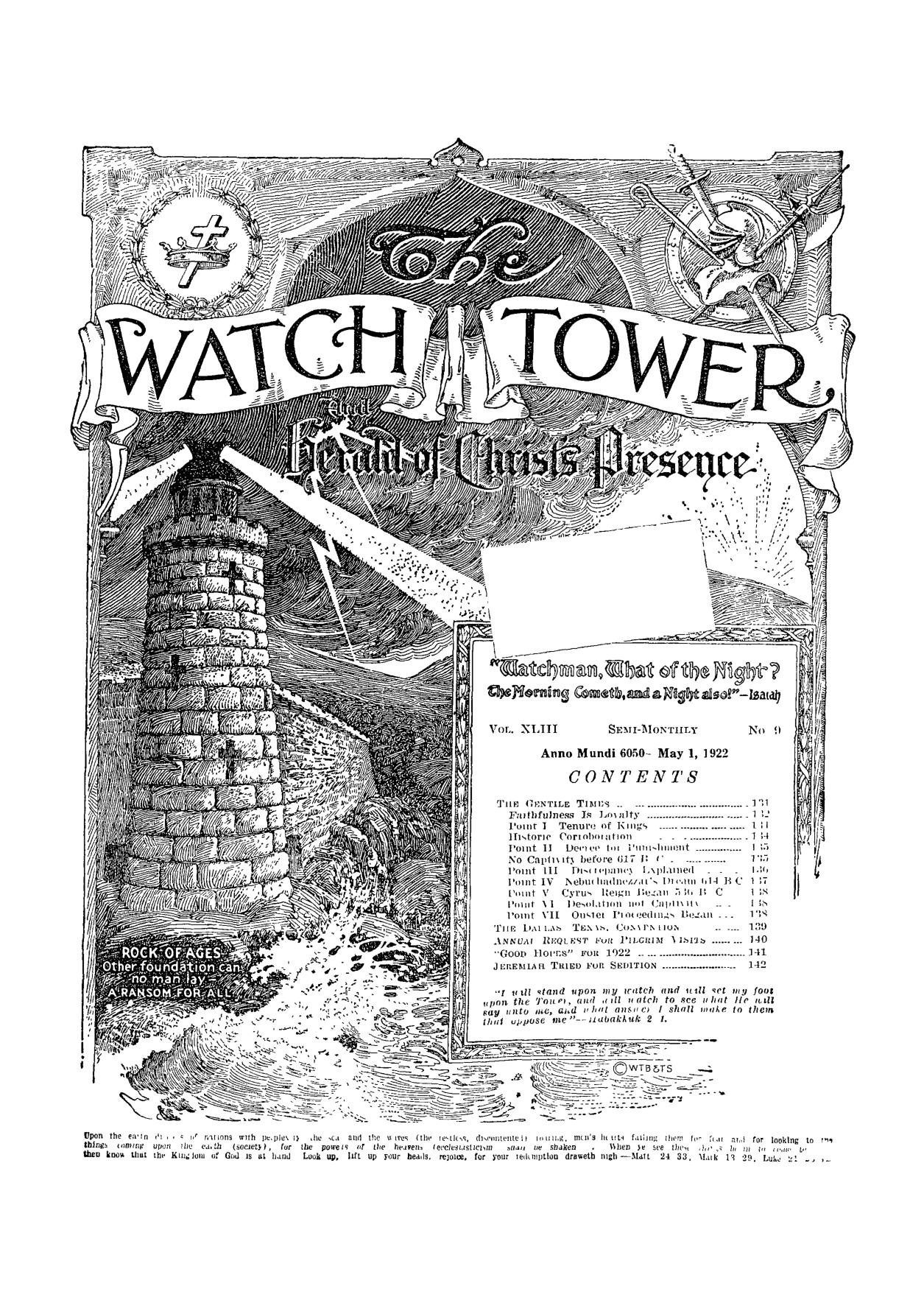
ANNILU RKQLKST L-'alt I'lLGUlM ••Good Horns” for 1922 .....................
Jeremiah Tried fur Sedition ...............
.nJ for looking to t*,
When ye see the-
nigh— Matt 24 33, Maik 13 29. Luke
. 140
.. 141
Upon the e.vfn </ rations with pe.plex ly Jie >ca and the wives (Hie ie- .
things <oDung upon Jie ea.th (society I, fur the poweis ft Jie heaveth fecclwiasliciim stian w shaken . then know Unit the Kingloiu of God is at band Look up, hft up your heads, rejoice, for your lediniptiou drawetb
Vol. XLTII
Semi-Monthly
No (I
Anno Mundi 6050- May 1, 1922
CONTENTS
iM.
ROCKrOFAGES?^
Other fpunegation cant" jAbisoM^oAjAiLr^y;
The Gentile Time Faithfulness Is Imnlty Point I Tenure of King' Historic Corioboration
1‘oint II
Deri cm1 tm
No Captnitj before 617 J
Point
Point
III IV
VII
Nebui hadnez/.i Cyrus Reign I
OuMet Pio<e<
'•I util stand upon my watch and util set my foot Kin the Tou.pi, and << ill natch to see it hat He ivill I p hat ansa c> I shall make to them iiabakkufc 2 1.
THIS JOURNAL AND ITS SACRED MISSION
THIS journal Is one of the prime factors or instruments iu the system of Bible instruction, or “Seminary Extension”, now bo‘n* presented in all paits of the civilized world by the Watch Tower Bidte & Tract Society, chaiferod A. D. “Lor the Promotion of Christian Knowledge”. It not only serves as a class room where Bible students ma> meet in the study ol .ie thine Word but also as a channel of communication through which they may be reached with announcements of the Society’s contentions and of the coming of its tiaveling icpresentatives, styled “Pilgrims”, and refreshed with reports of its conventions.
Our “Berean Le*son*” are topical rehearsals or reviews of our Society s published Studies most entertainingly arranged, and very helpful to all who would meiit the only honorary degiee which the Society accoidb, viz, Veibi Dei Minister (V. D. AI.), which translated into 1 nghsh is Minister of God’s Word. Our treatment of the International Sunday School Lessons is specially for the older Bible students and teacheis. By some this feature is consideied indispensable.
Tin* journal stands fiimly for the defense of the only true foundation of the Christian’s hope now being so generally repudiated —redemption through the precious blood of “the man Chnst Jesus, who gave himself a ransom [a corresponding price, a substitute] tor all’. (I Peter 1:19; 1 Timothy 2 : C) Building up on this sure foundation the gold, silver and precious stones (1 Corinthians 3: 1115, 2 L’eter 1:5-11) of the Word of God, its fuither mission is to “make all see what is the fellowship of the mystery which. . .has been hid m God, ... to the intent that now might be made known by the church the manifold wisdom of God”—“which in other ages was not made known unto the sons of men as it is now revealed”.—Ephesians 3:5-9,10.
It stands free from all parties, sects and creeds of men. wIdle it seeks more and more to bring its every utterance into fullest subjection to the will of God in Christ, as expressed in the holy Scriptures. It is thus free to declare boldly whatsoever the Lord hath spoken—according to the divine wisdom granted unto us to understand his utterances. Its attitude is not dogmatic, but confident; for we know wheicof wc affirm, treading with implicit faith upon the sure promises of God 31 is field as a trust, to be used only in his service: hence our decisions relative to what may and what may not appear in its columns hum be according to our judgment of Ins good pleasure, the teaching of his Word, for the upbuilding of his people in grace and knowled’e. And we not only invito but urge oug readers to prove all its utterances by the infallible Word to which referente is constantly made to facilitate such testing.
TO US THE SCRIPTURES CLEARLY TEACH
That the church is “the temple of the living God”, peculiarly “his workmanship” ; that its construction has been in piogress throughout the gospel age—ever since Christ became the world’s Redeemer and the Chief Corner Stone of his temple, through which, when finished, God’s blessing shall come “to all people”, and they find access to him.—1 Corinthians 3 : 1G, 17; Ephesians 2:20-22 ; Genesis 2S : 14 ; Galatians 3:29.
That meantime the chiseling, shaping, and polishing of consecrated believers in Christ’s atonement for sin, progresses; and when the last of these “living stones”, “elect and precious,” shall have been made ready, the great -Master Workman will bung all together in the first resurrection : and the temple shall be filled with his glory, and be the meeting place between God and men throughout the Millennium—Revelation 15:5-8.
That the basis of hope, for the church and the world, lies in the fact that “Jesus Christ, by the grace of God, tasted death for every man,” “a ransom for all,” and will be “the true light which bgbteth every man that cometh into the woild”, “in due time”.— Hebrews 2:9; John 1:9 ; 1 Timothy 2:5, 6.
That the hope of the church is that she may be like her Lord, “see him as he is,” be “partakers of the divine nature’/ and share his gloiy as bis joint-heir.—1 John 3:2; John 17:24; Romans 8:17; 2 Peter 1:4.
That the present mission of the church is the perfecting of the saints for the future work of service; to develop in herself every gi ace, to be God’s witness to the world; and to prepare to be kings and priest* in the next age.—Ephesians 4:12; Matthew 24: 14 , Revelation 1:6; 20:6.
That the hope for the world lies in the blessings of knowledge and opportunity to be brought to all by Christ’s Millennial kingdom, the restitution of all that was lost in Adam, to all the willing and obedient, at the bands of their Redeemer and Ins glorified churchy .when all the wilfully wicked will be destroyed.—Acts 3:19-23; Isaiah 35.
Published ay
WATCH TOWER-BIBLE &TRACT SOCIETY
18 CONCORD STREET O 0 BROOKLYN, N-y. U SA
Foreign offices: .Biittsh: 34 Craven Terrace, Lancaster Gate, London W. 2, Canadian 270 Dundas St., W., Toronto, Ontario; Austialasian 495 Collins St., Melbourne, Australia; South African. 123 Plein St , Cape Town, South Africa.
Plevse Address the Society in EveryCase.
YEARLY SUBSCRIPTION PRICE: United States, $1.00; Canada and M I SCKf.LAN EOL S FOREIGN $150, GREAT BRITAIN, AUSTRALASIA, and South Africa, 8s. American remittances should be made bv Express or Postal Monev Orders, or by Bank Draft. Canadian, Btitish, South African, and Australasian remittances should be made to bianeh offices only. Remittances from scattered foreign territory may be made to the Brooklyn office, but by International Postal Money Orders only.
(Foieiqn translations of this journal appear in several languages)
Editorial Committee: This journal is published under the supervision of an editorial committee, at least three of whom have read and approved as truth each and every article appearing in these columns. The names of the editoual committee are: J. F. Rutherford, W. F. Van Amborgh, J Hfmmu. G. IT. Fisher, E. W. Brenisen. Terms to the Lord's Poor: All Bible students who, by reason of old age or other in-firnity or edvp»-' are unable to pay for this journal, will be supplied free if they send a postal card e*cn May stating their ease and requesting such provision. We are not c"ly willing, but anxious, that all such be on our list continually and in touch with the Eerean studies.
Notice tn Sutwrihevn • W« do not, as a rate, seed a card of acknowledgment for a renewal or xvvtsce W auosenoen. for a new’aub8crintfon. Receipt and entry ofrenewai are Indicated wlthlo a month by ehanre In expiration date, as shown on wrapper label.
- — — ... — « . — . ——. . —,
Enured an Second Close Matter at Brooklyn, NY., Poetoffice under the Act of March frd, 1179.
KINEMO MACHINES AND PICTURES
As heretofore announced in The Watch Tower, Brother Driscoll has been perfecting a miniature moving picture machine for the purpose of projecting pictures in homes, school houses, etc. Agreeable to the former notice In The Watch Tower. we publish the following notice, which we lune recened from Brother Driscoll. All communications concerning" these machines and pictures should be addressed >is indicated
The Kinemo moving picture projection machine, intended for inexperienced persons to operate, has been completed and quantity production started. For illumination, the projector is equipped for connecting up with the ordinary house electric lighting service. In the country, or elsewhere, where no electric service is available, an extension cord can be connected with .my automobile headlight socket or storage battery and good illumination secured. When piojecting, the operator can stop indefinitely on any picture or title to make explanatory remarks.
The machine weighs only ten pounds and whether used exclusively at home or taken to the home of neighbors or friends in town or country, will well serve for witnessing the truth in a way that will be remembered and talked about. Films to be sent out with the projector, are:
Palestine, showing scenes taken in connection with Brother Butherford’s recent trip, proving the fulfillment of prophecies respecting the return of the Jews to Palestine.
The Imperial Valley, an excellent example illustrating how the desert sha'l blossom as the rose and yield ns increase.
The Gbeat Pyramid, with exterior scenes and animated art sketches visualizing the symbolic teachings of the passageways and chambers.
Other pictures, keeping abreast with Present Tbuth, will be available from time to time. Quote “Millions” book citations as reference when showing the pictures.
prices : Kinemo Projection Machine ..........................$30.00
Palestine Film—one reel _________
The Great Pyramid Film — one reel
Imperial Valley Film—one reel
Total ................-...............................
Address all orders direct to The Kinemo Kit Corporation, 2020 Dracena Drive, Los Angeles, Cal.
AND HERALD OF CHRISTS PRESENCE
Vol. XLI11
May 1, 1922
No..9
THE GENTILE TIMES
"And if ye will not yet for all this hearken unto me, then 1 will punvsh you seven times more for your sins."— Leviticus 26:18.
A NOTHER test is on. Who will weather the storm? X—\ It is a test of faith. “According to your faith be
^it unto you.” During the time of the harvest there have been special tests of faith at fixed intervals. Call to mind the shaking that came with the discussion, in this journal, of the covenants. Then came the shaking relating to the Vow ; then followed another shaking with the fuller discussion of consecration and justification; then follow ed the test concerning the Seventh Volume; and then another test in 1918 concerning the harvest and the work. From all these fiery tests the greater majority of the coir-eciated have emerged unscathed; but some, because of bitterness of heart, have become blind of vision, gone out of the truth and back into the world, being led away by the error of the w icked. There is a reason for this. Let us examine the facts concerning the reason.
Lucifer was a ci nature of light and power and of great beauty. Beholding his own beauty and being impressed with his own wisdom and ability, he concluded to put into operation a plan of his own, different from God’s arrangement and the earning out of which would make Lucifer great like unto Jehovah. In his heart he became disloyal to God, turned away from the light and truth, and became the wicked one. I’jobably Ins intentions were good when he first began to exercise his wisdom and to be impressed with his own importance. Ambition turned him blind and embittered his heart. Since then he has sought by fraud and deceit and other wrongful means to tinn all away from Jehovah. God has permitted this deflection of the great and brilliant creature Lucifer to be made prominent in his Word for some good purpose. The evident purpose is, that all of his other intelligent creatures might learn the proper lesson.
AMBITION’S FRUITAGE
Ever and anon there arises some one who has been following the Lord, for a time at least, who possesses a measure of beauty of mind and character, and possibly of person—one who takes himself too seriously. He succeeds in convincing himself that the Lord has appointed him to look after things divine and to lead God’s people out of the wilderness. As he goes on m this way, he becomes convinced m his ow n mind that the 1 ,ord mad° a mistake m selecting Brother Russell as that servant; and this doubt leads to the conclusion later on that Brother Russell was not “that servant” at all lie begins to doubt what Bi other Russel) wrote, and so expresses himself. Now he disregards the Lord's V. ord, which says: “Trust in the Lord with all tnine h; art; and lean not unto thine own understanding In .ill thy ways acknowledge him, and he shall direct thy paths.” Thus disregarding this admonition, and being led on by the subtle influence of the adversin. he convinces himself that it is his solemn duty to undo all the things that Brother Russell taught and to turn the church’s vision in the right waj. He prepares a manuscript and charts in support of same, setting foith his views. Submitting it to others and being advis'd that his thoughts are wrong, he constiues this to mi an a de-irc to prevent him from permitting hi- light to 'lune, and disregards such advice. So thoroughly i> he impressed that he mud thus teach the people and undo that which has been taught, that he begins the publication of his thoughts and to send these forth to the consecrated. His aigiiments seem plausible to those who make only a superficial examination, and especially to those who have ioigoltcn what they were taught. Doubt arises in the minds of some who thus read. Now the test is on.
QUESTIONS DISCUSSED YEARS AGO
About a year ago there began some agitation concerning chronology, the crux of the argument being that Brother RiuseU was wrong concerning chronology and particularly in error with reference to the gentile times. More than fifteen years ago these questions were raised and thrashed out, and so clearly did Brother Russell set forth the facts in Volume II of Studies in the Scriptures and in The Watch Tower, that it seemed a waste of time and space now’ to further discuss the matter m this journal; and the subject was dismissed on that ground.
Seeds of doubt once sown and permitted to gmminate in the heart grow until the doubter turns to ait ism
or positive opposition. If the person holding the doubt takes himself too seriously, thinking more highly of his own importance than he should think (Romans 12: 3), or where he permits bitterness to abide in his heart, darkness is almost certain to ensue.
Agitation concerning the error in chronology has continued to increase throughout the year, and some have turned into positive opposition to that which has been written. This has resulted in some of the Lord’s dear sheep becoming disturbed in mind and causing them to inquire, Why does not The Watch Tower say something? Is not its silence tantamount to an admission that our chronology is wrong?
From time to time the question of publishing something in this journal has been considered. Each time the Lord has seemed to interfere, until now. Why should such be the case? Our opinion is that the Lord has permitted the delay in the reviewing of the question of chronology since the agitation was begun in order to give those who had the wrong condition of heart an opportunity to manifest themselves, and to give the others an opportunity to have their faith tested.
FAITHFULNESS IS LOYALTY
To be faithful means to be loyal. To be loyal to the Lord means to be obedient to the Lord. To abandon or icpudiate Ilie Lord’s chosen instrument means to abandon or icpudiate the Lord himself, upon the prin-ciji'e that he who rejects the servant sent by the Master thoieby rejects the Master.
There is no one m present truth today who can honestly say that he received a knowledge of the divine plan from any source other than by the ministry of Brother Russell, either directly or indirectly. Through his prophet Ezekiel Jehovah foreshadowed the office of a servant, designating linn as one clothed with linen, with a writer's nikliorn by his side, who was delegated to go throughout the city (Christendom) and comfort those that sighed by enlightening their minds relative to God’s great plan. De it noted that this was a favor bestowed not by man, but by the Lord himself. But ni keeping with the Lord’s arrangement he used a man. The man who filled that office, by the Lord’s grace, was Brother Russell.
Jesus dearly indicated that during his second presence he would have amongst the church a faithful and wise servant, through whom he would give to the household of faith meat in due season. The evidence is overwhelming concerning the Lord’s second piesence, the time of the harvest, and that the office of "that servant” has been filled by Brother Russell. This is not manworship byr any means. It matters not who Charles T. Russell was—whether he was a doctor, a hod-carrier or a seller of shirts. St. Peter was a fisherman; St. Paul a lawyer. But these matters are immaterial. Above all, these men were the chosen vessels of the Lord. Regardless of his earthly avocation, above all, Brother Russell was the Lord’s servant. Then to repudiate him and his work is equivalent to a repudiation of the Lord, upon the principle heretofore announced.
FULL TEST OF FAITH
But every one who has a desire in his heart to shine at the expense of the reputation of the Lord’s chosen servant, or who meditates the building for himself of a reputation amongst men that it may be said of him that he was particularly wise — such a one is almost certain to have an opportunity to attempt to realize his desires. Every one of the consecrated who has the inclination of heart to follow such self-constituted leaders is almost certain to have an opportunity to have a full test of his faith. For this cause there arise from time to time conditions which operate as a test of the faith of God’s people.
Again the test is on. This time it is on chronology. And following this lead, it will be found that the road of doubt and opposition will carry one into doubting the second presence of the Lord, the time of the harvest, the office of “that servant” and the one who filled it, the evidences of the end of the world, the inauguration of the kingdom, the nearness of the restoration of man, and finally to a repudiation of God and our Lord Jesus Chn>t and the blood with which we were Ik,light.
The opening crevice for the enemy thus to blast at the Rock of Ag is is now made by the rai-nig of the qui -l ion concerning the gentile time-' Some thus nn-pre -cd with their own vi-dom begin to hold fcith the argument that the gentile Innes h'-gan w itli the beginning of the reign of Nebuel’adiie/.zai in the year 625 B. C.; hence could not end m 1914 ; hence the present work of the church is wiong, and the course of action should be reversed. The holding of such views blinds one to the present events, minimizes the importance of the tremendous-evidences of the end of the age, causes those who have been active to cease to be witnesses for the Lord, and being thus led away by the error of the wicked one, they fall away from st adhr-tiiess.—2 Peter 3: 17, 18. '
With giatitude to God lor what he has done for us, with supreme love for him. with a heart’s sincere desire to be led by him, with humble and sincere supplication that he bold us by the hand and keep us in the light, let us come to an honest examination of the facts.
“TIMES”
The word ‘ gentile” is a term used to distinguish the nations of earth aside from the Jews, the Jews being God’s cl-osen people, with whom he made a covenant. The “gentile times” is a period of time during which the gentiles shall exercise imperial or kingly power over the affairs of earth. God constituted Israel his chosen people above all other peoples. (Exodus 19:6) This favor they were to enjoy provided they remained obedient to the Lord Jehovah. For their disobedience he permitted them to be punished from time to time, the punishment being inflicted by other nations. (Judges 3:14; 4: 2, 3; 10: 7, 8; 13 : 1) Jehovah warned the nation of Israel that should they fail to profit by these chastisements thus inflicted, he would punish them seven times. “If ye -will not yet for all this hearken unto me, then I will punish you seven times more for your sms.”—Leviticus 26:18.
A “time”, as used in the Scriptures, has reference to a year, either symbolic or literal. Symbolic time is reckoned according to a lunar year of 360 days. (See A 89.) The rule for counting symbolic time is a day for a year. (Numbers 14: 33, 34; A-91) One time being 360 years in duration, seven times would be a period of 2520 years.
With Israel God established the true religion, commanding that the people should worship him and have no other god. (Exodus 20:1-3) Satan, the prince of devils and the ruler of the gentile nations, established vith those nations the false religion; and the gentiles were taught to worship devils, symbolized in various foims and images. Jehovah erected a shield for the children of Israel by providing in his law the severest penalty for worshiping dev iE. Time and time again Israel went off after the false religion, worshiping the demon gods; and for this they were punished.—Lev iti-Cib 26: 1-16.
It must be apparent to all careful students that the period of the gentile times would be a penod of great punishment to Israel, and that that period of time must begin with some specific punishment marking the beginning of the gentile times definitely and must continue for a definite period of seven times, or 2520 years. The question at issue is, When did this period of the gentile times begin and when is the end thereof? These facts cannot he proven by profane history, because such history is made by men who acted as agents of Satan’s empire and hence were unreliable; for Satan is the father of lies. (John 8:44) Let everyone who wishes to be bound by such authority do so : but surely all Christians will want to stand by the Bible.
Au absolutely safe rule to follow, therefore, is this: Wbeie the testimony of the Bible is clear and plain, follow that always. Where secular or profane history is corroborated by the Bible, such testimony may be considered for what it is worth as cumulative evidence. Where secular or profane history is contrary to the Bible, follow' it never.— Romans 4:3.
OPPONENTS’ CONCLUSIONS
To av oid auy confusion we will state that the dates B.C. in this article signify the number of years before Christ, as v\e have been accustomed to stating them; exactness might, however, sometimes call for the previous year, as the name of the year, as distinguished from the number of full years elapsed.
Those who have attempted in recent months to prove that the chronology as prepared and published by Brother Russell is wrong make statements not only contradicting Brother Russell, but contradictory in themselves. Some of the Lord’s dear children have permitted these contradictory and conflicting statements to disturb their minds. This has been the result of a failuie to study carefully the evidence as set forth in the Bible and in the Studies in the Sckh’tukes. We v]«jk of them here as opponents because opposed to or coni indicting the chronology we have. The conclusion of some of these is as follows, to wit: “That the divine base of power to the gentiles began with the accession of Nebuchadnezzar to the throne in the year 606 B. C : hence the accession of Nebuchadnezzar to the throne marks the beginning of the gentile times, and the 2520 years therefore would run out m 1914”. Again they .state that “Zedekiah was taken captive and Jerusalem fell in the year 587 B. C.; thus showing that the lull end of the gentile times and the fall of gentile governments is indicated to take place m 1934". (It v ill be obseiu.d that this position is contradictory within itself.)
Another of the opponents says that Nebuchadnezzar began his reign in the-fourth yeai of .Jehoiakim; that the servitude of Israel to Babylon began the same year; that the desolation began in the nineteenth year of Nebuchadnezzar; that the fourth year of Jehoiakim and the first year of Nebuchadnezzar was 606 B. G ; and that the desolation began nineteen years thereafter, which shows the overthrow of Christendom m 193,1.
Each of these opponents claims that the position taken is supposed, by secular history and that theielore Biother Russell vias mistaken m his conclusions about the chronology. They also admit that then method. of counting time changes the period of the l-ings from 513 years to 494 years.
BROTHER RUSSELL’S CONCLUSIONS
The conclusion of Brother Russell, reached from a careful examination of the Scriptures, is succinctly stated in Volume II of Studies in the ScRirTinms, page 79, as follows:
“The Bible evidence is clear and strong that the ‘tunes of the gentiles' is a period'of 2520 years, from the jear B C GOG io and including A. D 1914. This lease ot universal dominion to gentile governments, as we have already seen, began with Nebuchadnezzar—not when Ins reign bemih, but when (lie typical kingdom of the Lord passed away, and the dominion of the whole world was left in the hands of the gentiles The date for the beginning of the gentile times is, thereloie, definitely marked as at the time of the icmoral of Ilic iioiin of God's typical kingdom from Zeilcl. mil. their lasl king "
A carefid examination of the Biblical proof herein set forth demonstrates that in their position on chrono-ogy the opponents of Brother Russell are wrong, and that Brother Russell was right. In arriving at a conclusion, Brother Russell did not always state each Jop in detail; but his conclusions arc plainly and definitely stated and are based upon the Scriptures. Wo must indulge the presumption, therefore, that he pursued a sound course of reasoning in arriving at these conclusions if we find the conclusions are correct.
We now propose to prove that the gentile times, a period of 2520 years, began in the year 606 B. C. and ended in the fall of the year 1914; and that the ouster proceedings began promptly thereafter and on time. In making this proof we rely upon the Bible and not upon secular or profane history. We consider the points in the order numbered hereinafter, as follows, to wit:
POINT I: TENURE OF KINGS
The time and duration of the reign of the various kings of Israel is one of the Biblical methods of establishing the various dates in our chronology. Saul, Israel’s first king, began to reign in the year A. M. 3009. The total period of the tenure of the kings of Israel was, to wit, 513 years. The reign of the kings ended with the year A. M. 3522. No careful Bible students will dispute these facts. No other conclusion can be reached except by juggling the figures and ignoring the Bible statements.
In Tub Watch Tower of May 15, 1896, page 112, is set forth a statement of chronology from Adam to 1914. These figures are given in Anno Mundi time. According to this calculation it is proven by the Scriptures there cited that Jehoiakim’s reign began in the yeai A. M. 3500, which corresponds to the year 628 B. C. The beginning of the reign of Jehoiakim, being definitely fixed, gives us a starting point from which to count the time and by which to determine the universal reign of Nebuchadnezzar and to reach a proper conclusion relative to the gentile times.
The first year of the reign of Nebuchadnezzar, king of Babylon, was the fourth year of the reign of Jehoiakim. “The fourth year of Jehoiakim the son of Josiah king of Judah, that was the first year of Nebuchadnezzar king of Babylon.” (Jeremiah 25:1; see also Jeremiah 46: 2) Since Jehoiakim’s reign began in 628 B. C., it follows that the first year of Nebuchadnezzar’s reign was the year 625 B. C. There was no attack made upon Jehoiakim by Nebuchadnezzar in the year of 625 B. C., the first year of Nebuchadnezzar’s reign. There could have been no attack as a king made by him earlier than that. It was in that fourth year of Jehoiakim’s reign and the first year of Nebuchadnezzar’s reign, to wit, the year 625 B. C., that the prophet Jeremiah delivered the divine decree pointing out that it was God’s determination to leave the land of Palestine desolate as a punishment upon Israel.
THE FIRST ATTACK
In the fourth year of the reign of Nebuchadnezzar (and therefore the eighth year of the reign of Jehoiakim), Nebuchadnezzar made his first attack against Jerusalem; and in that year Jehoiakim became the servant or vassal to the king of Babylon. Three years later, to wit, in the year 617 B. C., the same being the eleventh year of the reign of Jehoiakim, Nebuchadnezzar took Jehoiakim a prisoner and put him to death. The record reads: “Jehoiakim was twenty and five years old when he began to reign [628 B. C.] ; and he reigned eleven years [617 B. C.jin Jerusalem. In his days Nebuchadnezzar king of Babylon came up, and Jehoiakim became his servant three years', then he turned and rebelled against him [Nebuchadnezzar].” (2 Kings 23: 36; 24:1) “Against him [Jehoiakim] came up Nebuchadnezzar king of Babylon, and bound him in fetters, to carry him to Babylon.”—2 Chronicles 36: 6.
The carrying away of Jehoiachin to Babylon was in the year 617 B. C. Jehoiakim’s reign having begun in 628 B. C., and he having reigned eleven years,' necessarily it ended in 617 B. C. At that time Nebuchadnezzar was in the eighth year of his reign. Thus the Scriptures prove beyond any question of a doubt that the captivity did not begin in the first year of Nebuchadnezzar’s reign; nor did the desolation begin there. It is therefore seen that it is utterlv impossible for the gentile times to have begun in the first year of Nebuchadnezzar’s reign, to vit, 625 B. C. No one claims that the gentile times began in 617 B. C., the year Jehoiakim vas taken and put to death, as indeed such a claim could not be successfully made in view of the evidence hereinafter set forth.
HISTORIC CORROBORATION
It is reasonable to suppose that the Jewish historian Josephus, being deeply interested in his own people, would be more reliable in fixing dates than would the historians of the gentile nations. We do not at all need the testimony of Josephus, but because it is corroborated by the Bible we cite it here for what it is worth. He plainly states that no attack was made upon Jerusalem at the beginning of Nebuchadnezzar’s reign. We quote from Antiquities of the Jews, Book X, Chapter VI, pages 365-367:
“In the fourth year of Jehoiakim, one whose name was Nebuchadnezzar took the government over the Babylonians; who at the same time went up with a great army to the city Carchemish, which x\as at Euphrates; upon a resolution that lie had taken to figlit with Necho king of Egypt, under whom all Syria then was. And when Necho understood the intention of the king of Babylon, and that this expedition was made against him, he did not despise his attempt: but made haste with a great band of men to Euphrates, to defend himself from Nebuchadnezzar. And when they bad joined battle he was beaten, and lost many thousands of his soldiers. So the king of Babylon passed over the Euphrates, and took all Syim, as far as Pelusium, excepting Judea. But when Nebuchadnezzar had already reigned iour years, which was the eighth of .Telioiakim's government over the Hebrews, the king of Babylon made an expedition with mighty forces against the Jews, and required tribute of Jehoiakim ; threatening upon his refusal to make war against him. He was affrighted at his threatening, and bought his peace with money ; and brought the tribute he was ordered to bring for three years.
“But on the thiid year, upon hearing that the king of Babylon made an expedition against the Egypt inns, he did not pay his tribute. . . .
“A little time ulterwaid, the king of Babylon made an expedition against Jehoiakim, who received him into the city; and this out of fear of the foregoing predictions of Jeieimah, as supposing he should suffer nothing tliat was terrible; because be neither shut the gates, uor fought against him. Yet when he was come into the city, he did not observe the covenants he had made; but he slew such as were in the flower of their age. and such as were of the greatest dignity, together with their king Jehoiakim, whom lie commanded to be thrown before the walls, without any bimal, and made his son Jehoiachin king of the country, and of the city; he also took the principal persons m dignity for captives, three thousand in number, and led them away to Babylon. Among these was the piophet Ezekiel, who was then but young And this was the end of king Jehoiakim, when lie had lived thirty-six years, and reigned eleven But he was succeeded in the kingdom by Jehoiachin, whose mother was Nehusta, a citizen of Jerusalem. He reigned three months and ten day's"’
Jehoiachin reigned only three months and ten days, and was succeeded by Zedekiah, whose reign began in the year 617 B. C. “Jehoiachin was eight years old when he began to reign, and he reigned three months and ten days m Jerusalem: and he did that which was evil in the sight of the Lord. And when the year was expired, king Nebuchadnezzar sent, and brought him to Babv Ion, with the goodly vessels of the house of the Lord, and made Zedekiah, his brother, king over Judah and Jerusalem. Zedekiah was one and twenty years old when he began to reign, and reigned eleven years in Jerusalem.’' (2 Chronicles 36:9-11) Thus it is clearly seen that the reign of Zedekiah, which began in 617 B. C.. lasted eleven years and ended in 606 B. C. He was the last king of Israel.
POINT II: DECREE FOR PUNISHMENT
A decree means a judicial detei inination by one having authority, defining w'hat must be done. It means a sentence pronounced that must be enforced. Necessarily decrees are always entered before they are enforced. Jehovah pronounced through Moses a divine decree or judgment that should be enforced against Israel as a punishment, and the decree is in these words: “I will make your cities waste, and bring your sanctuaries unto desolation, and 1 will not smell the savor of your sweet odois. Anil 1 will bring the land into desolation: and your enemies which dwell therein shall be astonished at it.'’—Leviticus 26:31, 32.
It must be conceded by all that the taking of certain of the Israelites as prisoner.-: and carrying them away to Babylon would not constitute an enforcement of this deciee. The putting to death of Jehoiakim m no wise fulfilled the decree. Besides after his death Zedekiah continued to be the king of Israel and reigned for eleven years. Surely during those eleven years the city was not in waste; nor were the sanctuai in desolation. Surely during that period the Jews oflcied their sacrifices in Jerusalem. When, then, in all the history of Israel do we find any record of the enforcement of this divine decree? The Scriptures answer that it had its fulfillment in the latter part of the reign of Zedekiah.
God had restated the decree of judgment against Israel through Jeremiah. Concerning Zedekiah the last king, we read: “He did that w'hich was evil in the sight of the Lord his God, and humbled not himself before Jeremiah the prophet speaking from the mouth of the Lord. And he also rebelled against king Nebuchadnezzar. . . . They mocked the messengers of God, and despised his words, and misused his prophets, until the wrath of the Lord arose against his people. . . . Therefore he brought upon them the king of the Chaldees [Nebuchadnezzar], who slew their young men with the sword in the house of their sanctuary, and had no compassion upon young man or maiden, old man, or him that stooped for age: he gave them all into his hand. And all the vessels of the house of God, great and small, and the treasures of the house of the Lord, and the treasures of the king, and of his princes; all these he brought to Babylon. And they burnt the house of God, and brake dov’n the wall of Jerusalem, and burnt all the palaces thereof with fire, and destroyed all the goodly vessels thereof. And them that had escaped from the sword carried he away to Babylon; where they were servants to him and his sons untd the reign of the kingdom of Persia: to fulfill the word of the Lord by the mouth of Jeremiah, until the land had enjoyed her sabbaths: for as long as she lay desolate she kept sabbath, to fulfill threescore and ten years.”—2 Chronicles 36 : 12,13,16-21.
NO CAPTIVITY BEFORE 617 B. C.
This occurred at the end of the reign of Zedekiah, to wit, in the year 606 B. C.
In corroboration of this we cite the further record dealing with the same subject matter, made by Ezekiel the prophet. Ezekiel counts the time mentioned in his prophecy from the date that he and other Jews were taken captive and carried away to Babylon. (Ezekiel 1: 1, 2; 8:1; 20:1) This captivity' began in the year 617 B. C. In the seventh year of that captivity, in the fifth month and the tenth day of the month, to wdt, about the first day of August, 610 B C., which was the fifteenth year of the reign of Nebuchadnezzar, the divine decree for the punishment of Israel was restated in other phrase by the prophet Ezekiel.—Ezekiel 20:1.
The same judicial determination of Jehovah as set forth in Leviticus 26:31-33 was restated by Ezekiel in the following words: “Therefore thus saith the Lord God Because ye have made your iniquity to be remem-beied. m that your transgressions are discovered, so that in ail your doings your sms do appear; because, I say. that ye are come to remembrance, ye shall be taken with the hand. And thou, profane wicked prince of Israel, whose day is come, when iniquity shall have an end, thus saith the Lord God: Remove the diadem, and take off the crown; this shall not be the same: exalt him that is low, and abase him that is high. I will overturn, overturn, overturn it; and it shall be no more, until he come whose right it is; and I will give it [to] him.”—Ezekiel 21:24-27.
'1'liis restatement of the divine decree occurred four years before its enforcement. Brother Russell says that the enfoi cement of this divine decree marks the begin-nine of the gentile times; and Brother Unwell i*- light. —B-19, Ufl 2, 3.
GENTILE TIMES BEGAN 606 B. C.
God had promised that the sceptic should not depart from Judah nor a lawgiver from between his feet until Shiloh come. (Genesis 49: 10) It will be observed that the decree of punishment did not include the removal of the sceptre. It merely states: “Remove the diadem, take off the crown”. The crown is a symbol of imperial dominion or rulership; while the sceptre is a symbol of imperial authority or right. The enforcement of this divine decree, therefore, took away from Israel the dominion, which dominion should be enjoyed by the gentiles until the coming of him whose right it is, namely, Shiloh, the Messiah. The gentile times, therefore, could not possibly begin until the enforcement of this divine decree. (Ezekiel 21: 24-27) And since it was pronounced by the prophet Ezekiel while Zedekiah was the king, it conclusively proves that the gentile times did not begin with the captivity of Jehoiaknn or of Jehoiachin. but did begin with the overthrow of Zedc-kiah.
About August 1,606[606f]B.C., Nebuchadnezzar the king of Babylon broke down the city of Jerusalem and destroyed it, took Zedekiah and put out his eyes, and desolated the city and the land. (Jeremiah 39:2-9) Thus from another line of proof is definit "h established that the divine decree was enforced m 606 B. C., ending the dominion of Israel and permitting the gentiles to establish a universal dominion. Here, at this time, it was that Jehovah, figuratively speaking, withdrew from the stage of action and permitted Satan, through his representative, Nebuchadnezzar, to establish a universal cm pne. Here it w’as that Satan became the ‘god of the whole world’; and from that time forward his rule through earthly representatives is symbolized by a wild bea<t.
POINT III: DISCREPANCY EXPLAINED
Opponents of Brother Russell’s conclusions on chronology attempt to show that the divine decree against Israel began to be enforced in the third year of the reign of Jehoiakim, and cite as authority Daniel 1:1, which leads: “In the thud year of the reign of Jehoiakim king of Judah came Nebuchadnezzar king of Babylon unto Jerusalem, and besieged it”. A careful examination of this text at once shows that there is a disci epancy. In the third year of Jehoiakim’s reign, as we have heretofore seen, Nebuchadnezzar was not yet l-in<i of Babylon. He did not become king until a year later (Jeremiah 25:1); and the plain Scriptural statements heretofore cited show’ that Nebuchadnezzar's first attack against Jerusalem began in the eighth year of the reign of Jehoiakim. Hence it was impossible for him to attack in the third year of Jehoiakim’s reign.
The proper and reasonable explanation of this Scrip-tuie (Daniel 1: 1) is tin.-,: That the “third .ycai" here means the third ye<u of the vassalage ol Jehoiakim to Nebuchadnezzar; or “th'' third year of Jehoiakim [as vassal king]”. It is plainly stated in the Scriptur s, as heretofore set forth, that in the eighth year of the reign of Jehoiaknn as king, Nebuchadnezzar came against him and Jehoiaknn became his seivant and paid tribute to Nebuchadnezzar thiee yeius and then rebelled against him. (2 Kings 24:1) Therefore, it was exactly three years later the beginning of his vassil.ige, to wit, the year 617 B. C., that Nebuchadnezzai besieged Jerusalem and took Jehoiakim, and at the nirne time carried away the prophets Daniel, Ezekiel, and others, including Hananiah, Mishael, and Azariah, whose names were changed by the king to Shadrach, Meshach, and Abcd-nego, respectively. Daniel wrote his prophecy while he was in Babylon; and it is quite apparent that he counted time from the date of the beginning of the vassalage of Jehoiakim as king. Manifestly, then, the aiguincnt of Brother Russell's opponents that the gentile times began during the reign of Jehoiakim must fall.
POINT IV: NEBUCHADNEZZAR’S DREAM
Again, opponents of the chronology as set forth by Brother Russell state that the beginning of the gentile times is marked by the accession of Nebuchadnezzar to the throne of Babylon, and m support of this contention cite Daniel 2: 1. This argument must likewise fall.
Daniel 2: 1 reads: “In the second year of the reign of Nebuchadnezzar, Nebuchadnezzar dreamed dreams, wherewith his spirit was troubled, and his sleep brake from him”. The dream itself is set forth in verses 31 to 35 of the same chapter. Nebuchadnezzar the king had brought before him magicians, astrologers, sorcerers, and Chaldeans to interpret his dream, and all of them failed. “Then Arioch [the captain of the king's guard] brought m Daniel before the king in haste, and said thus unto him. 1 have found a man of the captives of Judah, that w ill make known unto the king the interpretation The king answered and said to Daniel, whose name was Belteshazzar, Art them able to make known unto me the dream which I have seen, and the interpretation thereof?”—Daniel 2:25, 26.
It is utterly impossible for this transaction to have occurred in the second year of the reign of Nebuihad-nezzar for the following reasons, to wit: (1) because Daniel, in the second year of Nebuchadnezzar, was not in Babylon and could not then have been taken before the king: (2) because he was taken to Babylon in the year 617 B. C., which was the eighth year of the reign of Nebuchadnezzar; and (3) because Daniel was not permitted to appear before the king until after he had been m Babylon three years, according to his own testimony.
The facts heretofore set forth definitely establish the correctness of reasons (1) and (2). We proceed to the examination of (3):
In the eighth year of his reign Nebuchadnezzar carried a«m to Babylon many of the Jews, among whom were Daniel and the three Hebrew children. The king gave an order unto Ashpenaz, the master of his eunuchs, that he should bring certain of these Israelites ‘bn whom was no blemish, but well favored, and skilful in all w isdom, and cunning in knowledge, and understanding science, and such as had ability m them to stand in the king’s palace, and whom they might teach Ilie leaimng and the tongue of the Chaldeans”. In other words, those so selected were to be educated and framed. “And the king appointed them a daily provision of the king's meat, and of the wine which he drank; so nourishing them three years, that at the. end thereof they might stand before the Icing. Now among these were of the children of Judah, Daniel, Hananiah, Mishael, and Azariah. Now at the end of the days [to wit. three years] that the king had said that he should bring them in then the prince of the eunuchs brought them in be-foie Nebuchadnezzar. And the king communed with them; and among them all was found none like Daniel, Hananiah, Mishael, and Azariah: theiefore stood they before the Icing.”—Daniel 1: 3-6, 18, 19.
DATE OF DREAM WAS 614 B. C.
According to the king’s decree, this transaction of Daniel’s standing before the king could not have occurred until the end of the three years of instruction, which was, to wit, in the year 614 B. C. and in the eleventh year of the reign of Nebuchadnezzar. Evidently it was about one year thereafter that Nebuchadnezzar had the dream in question.
Now to remove all doubt as to the correctness of this conclusion, we find that the Variorum rendering of this text (Daniel 2:1) is: “And in the twelfth year of the reign of Nebuchadnezzar, Nebuchadnezzar dreamed dreams,” etc. The circumstantial evidence produced by Daniel himself proves that the Variorum rendering is correct.
The explanation of Daniel 2: 37, therefore, is that in the interpretation he told the king in substance that Jehovah had determined that he (Nebuchadnezzar) should be the head of the image observed. We are not left to guess about matters of this kind, because the apostle Paul plainly says that God “calleth those things which be not as though they were”. (Romans 4:17) Otherwise stated, Jehovah had determined that Nebuchadnezzar should occupy this position; but at that particular time Zcdekiah was the king, had been king for three years, and reigned thereafter eight years before Nebuchadnezzar really assumed the position as head of the image.
POINT V: THE REIGN OF CYRUS
The argument hereinbefore made proves that the gentile times as a period is based upon the tenure of office of the Jewish kings. This evidence shows that it was the year 606 B. C. when the crown (power to exercise dominion) was taken from Israel, and a gentile king peinutted to exercise that power. Now we introduce another line of proof by beginning at a later fixed date and counting back, measuring the time by unimpeachable Biblical testimony, which also shows the beginning of the gentile times to be 606 B. C. The latter line of proof is a complete corroboration of the former.
God had foretold through his prophet Isaiah (see chapters 44 and 45) that the kingdom of the Babvlon-ians under Nebuchadnezzar would be overthrown and that then Israel would be returned to her own land. the Lord prophet even named the victorious king, Cyrus. The date of the beginning of the reign of Cyrus therefore becomes important.
The reign of Cyrus is shown by the testimony of many secular or profane historians. This testimony is heie cited for two reasons: (1) because there is <-c.il cely a doubt about the correctness of the date as slated ; and (2) because the date is coiroborated by the Scriptural proof. Hence the secular history may be used as cumulative testimony under the i tile. We give below a number of these authorities.
REIGN BEGAN 536 B. C., SAY HISTORIANS
Smith's Bible Dictionary, under the title "Captiv liics of the Jews”, pages 99 and'100, says: “The B.ibv Ionian captivity was brought to a-close by the decree of Cyrus, B. C. 536”. ' ’
Bible Comments (Jamison, Faucett and Brown), Vol. 1, page 288, gives the date of the reign of C\ru< and the issuing of the decree as 536 B. C.
Swinton’s History, page 40. gives 536 B. C. as the date of the edict of Cyrus for the return of the Jews.
Historians’ History of the Woild. Vol. 2. page 27, gives 536 B. C. as the date of the decree of Cirii^ for the return of the Jews.
Universal Encyclopedia, ’Vol. 6. page 145. gi\e< 536 B. C. as the date of the leign of Cviih
Sanford’s Concise Cyclopedia of IUIujiohs Knon ledge, page 471. gives the date of the beginning of Cyrus’-reign as 536 B. C.
In the Scriptures we read: “Now in the first year of Cyrus king of Persia, that the word of the Lord spoken by the mouth of Jeremiah might be accomplished, the Lord stirred up the spirit of CvriH king of Persia, that he made a proclamation throughout all his kingdom, and put it also m writing saying, Thus saith Cyrus king of Persia, All the kingdoms of the earth hath the Lord God of heaven given me; and he hath charged me to build him an house m Jerusalem, which is in Judah. Who is there among you of all Ins people? The Lord his God be with him, and let him go up.” (2 Chronicles 36:22,23) “Then toso up the chief of the fathers of Judah and Benjamin, and the priests, and the Levites, with all them whose spirit God had raised; to go up to build.the,house of the Lord winch is m Jerusalem. . . . Also Cyrus the king htmi-H forth the vessels of the house of the Lord. wb-r- v-buchad-nezzni' had brought forth out of Jerusalem. . . . All these did Sheshbazzar bring up with them of the captivity that were brought up from Babylon unto Jeru-salem.”(Ezra 1: 5, 7,11)“And when the seventh month was come and the children of Israel were in the cities, the people gathered themselves together as one man to Jerusalem. . . . They gave money also unto the masons, and to the carpenters; and meat, and drink, and oil, unto them of Zidon, and to them of Tyre, to bring cedar trees from Lebanon to the sea of Joppa, according to the grant that they had of Cyrus king of Persia ”— Ezra 3 :1, 7; see also Ezra 5 :12-14.
This Scriptural proof shows that the Jews’ captivity to Babylon ended with the first year of the reign of Cyrus; and the secular historians above cited show that that year was 536 B. C. In the next succeeding point will be observed the Scriptural proof showing that the date 536 B. C. is correct, which proof also shows that the date 606 B. C. is the beginning of the gentile times.
POINT VI: DESOLATION NOT CAPTIVITY
Much confusion has resulted from using the words captivity, servitude, and desolation as synonymous terms. The Jews were m captivity more than once and for different periods of time; but there was only one period of desolation. It is true that the Jews were in captivity during the period of desolation, but such captivity was merely incidental to the desolation. Their first captivity to Nebuchadnezzar began in the year 617 B. C.. and not until eleven years thereafter was the land made desolate, without an inhabitant. What God intended for us to understand must be determined by the language employed in his decree for the punish -ment of Israel. Therein he said “I will make your cities waste, and bring \our sanctuaries unto desolation, and I will not .smell the «avor of your sweet odors. And I will bring the land into desolation: and your enemies which dwell therein shall be astonished at it.” (Leviticus 26:31, 32) Time and again the Lord restated the decree through the mouth of Jeremiah: “1 will make Jerusalem heaps, and a den of dragons; and I will make the cities of Judah desolate, without an inhabitant”. (Jeremiah 9:11; see also Jeremiah 33:10; 34:22) As heretofore seen, this divine decree was enforced with the overthrow of Zedekiah in the year 606 B. C.
The period of this desolation of the land is fixed by the Scriptures as seventy years. The purpose of the enforcement of the divine decree as set forth m 2 Chronicles 36: 18-20 was “to fulfill the word of the Lord by the mouth of Jeremiah, until the land had enjoyed her sabbaths; for as long as she lay desolate she kept sabbath. to fulfill threescore and ten years". (Verse 21) The prophet Jeremiah had said “This wdiole land shall be a desolation, and an astonishment; and these nations shall serve the king of Babylon seventy years”.—Jeremiah 25:11.
DESOLATE FOR SEVENTY YEARS
The proof heretofore adduced shows that the reign of Cyrus began in the year 536 B. C.; and that the first year of his reign marked the end of the desolation of the land, in which year he issued a decree for the rebuilding of Jerusalem. The Scriptures cited show that this period of desolation was to be seventy years in duration. Counting back, then, seventy years from 536 B. C. brings us to 606 B. C., completely corroborating the other line of proof showing that 606 B, C. is the date when the crown was removed from Israel, when the desolation began, and when the gentile times began.
Incidentally, here we remark that much has been said about the nineteen years of the reign of Nebuchadnezzar before the overthrow of Zedekiah; and an attempt is made to show that this indicates that there is a parallel of nineteen years to be fulfilled with reference to the close of the gentile times and the complete fall of gentile governments. There is absolutely no justification for any such conclusion. It is not warranted by reason nor by Scriptures. The nineteen years have nothing whatsoever to do with the gentile times, their beginning, end, or the overthrow of governments. It has merely been injected to confuse the minds of some. We might as well say that because a cat has “nine lives” it would take nine years to kill all the cats, as to say that, because Nebuchadnezzar reigned nineteen vears befoie he overthrew Zedekiah, theietoic the oveithiow ot gentile dominion would be nineteen year- after 1914. 'Ilie argument is unreasonable, unscriptiiral, and nonsensical.
POINT VII: THE END — OUSTER PROCEEDINGS BEGUN
Upon all the evidence there cannot be the slightest doubt about the gentile times. The Ica-e of universal dominion to the gentiles could not begin as long as there was a vestige of God’s typical kingdom. It matters not when the heathen king Nebuchadnezzar began his reign. The nineteen years of his reign so much spoken of are wholly mimalerial. foreign to the issue. The possession and exercise of imperial dominion by Israel, symbolized by the crown, ceased when that crown was removed, to wit, when the la=t ruler of Israel was dethroned. That occurred m 60(> B. C. There the dominion to the whole world was left in the hands of the gentiles, which date is by every line of proof fixed as 606 B. C. There the period of gentile dominion began. Being seven symbolic times in duration, to wit, 2520 years, it ended in 1914 A. I).
But, say those who oppose Brother Russell’s conclusions, what has happened to show that the gentile times have ended? Are not -the gentile governments still exercising ruling power’ Are not things going on they weie from the beginning?
We answer. Everything has happened that the Lord foretold would happen With the close of the (Jewish) year 1914, he whose light it is took unto himself his great power and began his reign; the nations were angry, and the day of God’s wrath began.— Ezekiel 21: 27; Revelation 11:17,18.
GENTILE TIMES ENDED IN 1914
On the first day of October, 1914, Brother Russell walked into the dining-room at Bethel and, elappmg his hands, announced m stentorian tones • “The gentile times have ended! The kings of earth have had their day 1” Brother Russell was right then. He was right when he wrote Volume II concerning the gentile times. If the contention of his opponents concerning chronology is right, then everything that transpired in 1914 and since must be disregarded as evidence of Messiah’s kingdom. It is admitted by them that the tenure of office of Israel’s kings must be changed in order to agree with some historians who were agents of Satan. Such a change would put out of joint all our chronology, and destroy the value of the dates 1874, 1878, 1881, 1910, 1914, and 1918. Such would be equivalent to saying, “Where is the proof of his presence?” “My Lord de-layeth his coming.”—2 Peter 3:4; Matthew 24:48.
Is any Christian so blind that he cannot see what happened in 1914 and thereafter, evidencing the end of the gentile times? By way of illustration: A tenant holds a piece of property under a lease, which lease expires January 1, 1914. The tenant refuses to vacate. The landlord, in order to legally obtain possession, must institute ouster proceedings. God granted to the gentiles a lease of dominion for a term of 2520 years, which term or lease ended about August, 1914. Then came forward the Landlord, the rightful Ruler (Ezekiel 21: 27), and began ouster proceedings. Tt is not to be expected that he would suddenly wipe erything out of existence, for that is not the way the Lord does things; hut that he would overrule the contending elements, causing these to destroy the present order ; and that while this is going on he would have his faithful followers give a tremendous witness in the moi Id, so that the teachable people might recognize the hideousness of Satan's empire and the blessedness ottered by the Messianic empire, to the end that many of these might be brought through the trouble and be ready for the restoiation blessings that are to follow.
To this end, exactly on time, the ouster proceedings began in the World War, followed quickly by famine, pestilence, and revolution, the rehabilitation of Palestine by the Jews, persecution of Christians in various parts of the earth, offenses amongst those who claim to be Jesus’ followers, while the love of many waxed cold. All of these things Jesus stated would constitute a trying time, a trial of faith and patience, which would be so severe that only ‘he that endureth to the end should be saved’. (Matthew 24: 7-13) While these ouster proceedings are in progress, he commands his followers to tell the people that Satan’s empire has ended; that the gentile times have ended; that the world has ended, and here is the proof of it; that the kingdom of heaven is at hand; that the time of restoiation is here; that millions now living will never die, and that “this gospel [good news] of the kingdom shall be preached m all the world for a witness unto all nations, and then shall the end eome”.
Are those who oppose the conclusions of Brother Russell concerning chronology obeying this command of giving the witness? Do we find those who are in harmony with his conclusions concerning the gentile times obeying this injunction and preaching the evidences of the kingdom and that millions now living will never die? Surely everything has happened exactly as the Lord said it would happen concerning the end of the gentile times.
What will transpire in 1925? Wait upon the Lord and see. Be faithful to present privileges. Every Christian’s faith is on trial. “According to your faith lie it unto you.”
TEXAS CONVENTION
A FOUR-DAY convention of the Bible Students was held at Dallas, Texas, March 9 to 12, Pilgrim Brother Edward Stark serving as chairman. The other speakers were Brothers V. C. Rice, S. H. Toujian, G. R. Pollock, 0. Magnuson. Scott Anderson, A. H. Macmillan, and Brother Rutherford. The convention was attended by friends from Texas, Oklahoma, Kansas, Arkansas, Louisiana, and Missouri, the largest number of friends attending on any one day being about five hundred. It was indeed good to be there, and on every face Mras observed the happy Christian smile. Frequently the remark was made: ‘This is the best convention I have ever attended’.
These conventions serve as a great uplift and strength to the friends, particularly the isolated ones. They have very little fellowship with others, and coming to a convention of several days is to them like transformation into an entirely different atmosphere. The testimony meetings gave strong evidence of this, the friends showing by their testimonies that they are not only rejoicing in the opportunities of service, but are growing in knowledge of the Lord’s plan and the fruits and giaces of the spirit.
…