The Watchtower, October 15, 1921
Download: PDF — The Watchtower, October 15, 1921
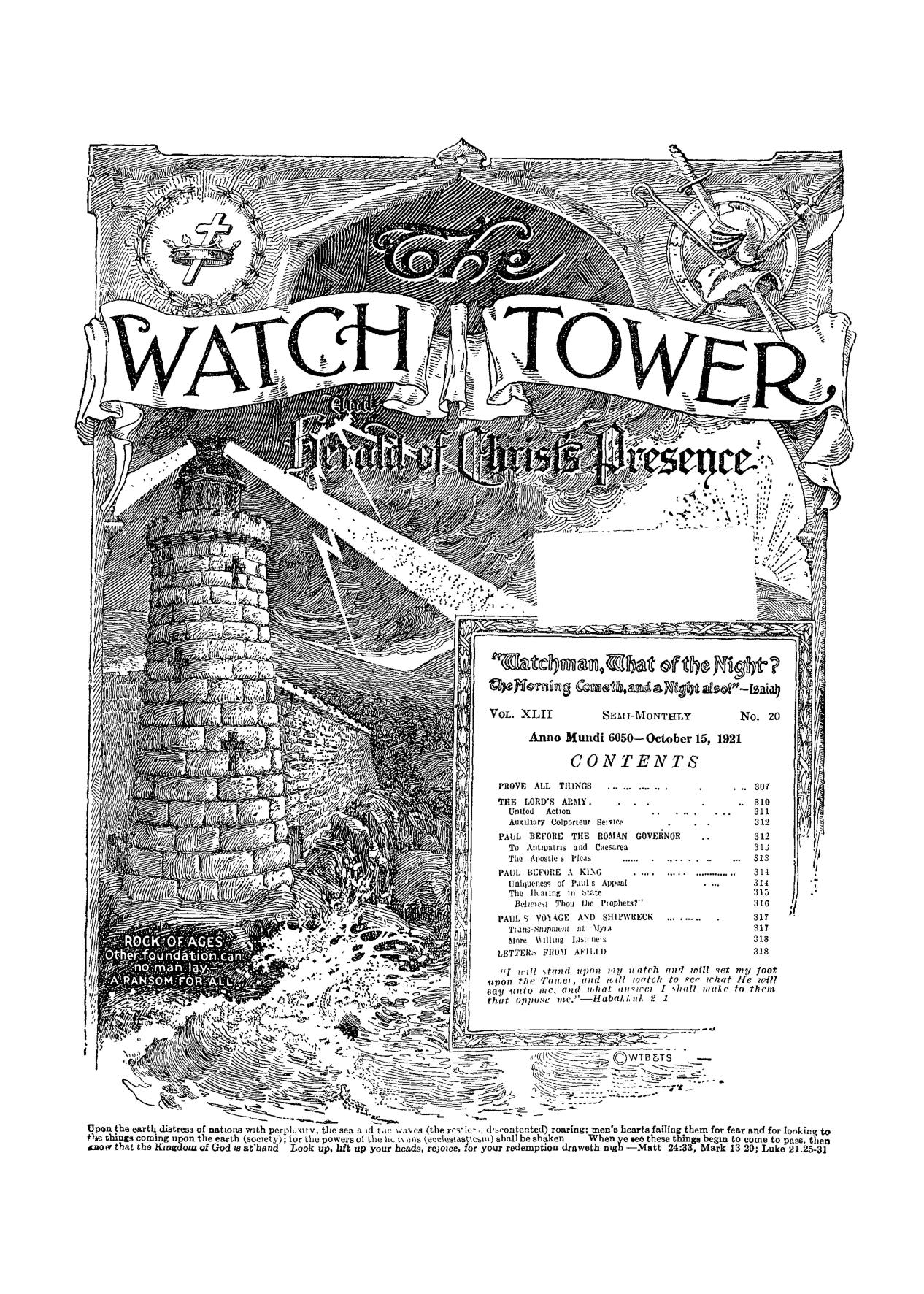
No. 20
vet my foot
feaiaj;
. .. 307
Upon the earth distress of nations with pcrpKxity, the sea a id tae waves (the res^e-Uncontented) roaring; men's hearts failing them for fear and for looking to the things coming upon the earth (society); for the powers of the ht ia ens (ecclesusticsm) shall be shjpcen When ye see these things begin to come to pass, then Know that the Kingdom of God is at’hand Look up, lift up your heads, rejoice, for your redemption draweth nigh —Matt 24:33, Mark 13 29; Luke 21.25-31
, Other-foundationcan?', no man
/ajiansom for ali3?%
Vol. XLII
Semi-Monthly
Anno Mundi 6050—October 15,
CONTENTS
PROVE ALL THINGS
THE LORD'S ARMY.
United Action
Auxiliary Colporteur
PAUL BEFORE THE To Antipatns and The Apostle s Picas
Semcc .
ROMAN GOVERNOR
Caesarea
PAUL BEFORE A KING .....
Uniqueness of Paul s Appeal
The Ikaiing in state
Believer Thou tJ»c Pi ophets?"
PAULS V01 AGE AND SHIPWRECK
Tians-Snipmynt at Myia More Willing Lisune's
LETTER^ FROM AF1LID
.. 310
312 31J
... 313
“I trill stand upon vty natch and trill ..
upon the Tou,et, and will watch to tee what He will unto me, and what anvire) I shall make to them
that oppose me.1'—HabaU.uk 2 1
©WTB5TS
THIS JOURNAL AND ITS SACRED MISSION
THIS journal Is one of the prime factors or instruments in the system of Bible instruction, or “Seminary Extension”, now being presented in all parts of the civilized world by the Watch Tower Bible & Tract Society, chartered A. D. 1884, “For the Promotion of Christian Knowledge”. It not only serves as a class room where Bible students may meet in the study of the divine Word bu also as a channel of communication through which they may be reached with announcements of the Society’s conventions and of the coming of its traveling representatives, styled “Pilgrims”, and refreshed with reports of its conventions.
Our “Berean Lessons” are topical rehearsals or reviews of our Society’s published Studies most entertainingly arranged, and very helpful to all who would merit the only honorary degree which the Society accords, viz., Verbi Dei Minister (V. D. M ), which translated into English is Minister of God’s Word. Our treatment of the International Sunday School Lessons is specially for the older Biblo students and teachers. By some this feature is considered indispensable.
This journal stands firmly for the defense of the only true foundation of the Christian’s hope now being so generally repudiated ■—redemption through the precious blood of “the man Christ Jesus, who gave himself a ransom [a corresponding price, a substitute] for all”. (1 Peter 1:19; 1 Timothy 2:6) Building up on this sure foundation the gold, silver and precious stones (1 Corinthians 3: Illa; 2 Peter 1:6-11) of the Word of God, its further mission is to “make all see what is the fellowship of the injstery which. . .has been hid in God, ... to the intent that now might be made known by the church the manifold wisdom of God”—“which in other ages was not made known unto the sons of men as it is now revealed”.—Ephesians 3: 5-9,10.
It stands free from all parties, sects and creeds of men, while it seeks more and more to bring its every utterance into fullest subjection to the will of God in Christ, as expressed in the holy Scriptures. It is thus free to declare boldly whatsoever the Lord hath spoken—according to the divine wisdom granted unto us to understand his utterances. Its attitude is not dogmatic, but confident; for we know whereof we affirm, treading with implicit faith upon the sure promises of God. It is held as a trust, to be used only in his service; hence our decisions relative to what may and what may not appear injts columns must be according to our judgment of his good pleasure, the teaching of his Word, for the upbuilding of his people in grace and knowledge. And we not only invite but urge oug readers to prove all its utterances by the infallible Word to which reference is constantly made to facilitate such testing.
TO US THE SCRIPTURES CLEARLY TEACH
That the church is “the temple of the living God”, peculiarly "his workmanship”; that its construction has been in progress throughout the gospel age—ever since Christ became the world’s Redeemer and the Chief Corner Stone of bis temple, through which, when finished, God’s blessing shall come "to all people”, and they find access to him.—1 Corinthians 3:16, 17; Ephesians 2:20-22; Genesis 28:14; Galatians 3 : 29.
That meantime the chiseling, shaping, and polishing of consecrated believers in Christ’s atonement for sin, progresses ; and when the last of these “living stones”, “elect and precious,” shall have been made ready, the great Master Workman mil bring all together in the first resurrection ; and the temple shall be filled with his glory, and be the meeting place between God and men throughout the Millennium.—Revelation 15 : 5-8.
That the basis of hope, for the church and the world, lies in the fact that “Jesus Christ, by the grace of God, tasted death for every man," “a ransom for all,” and will be "the true light which lighteth every man that comcth into the world”, “in due time”.— Hebrews 2:9, John 1:9 ; 1 Timothy 2:5, 6.
That the hope of the church is that she may be like her Lord, “see him as he is,” be "partakers of the divine nature’,’ and share his glory as bis joint-heir—1 John 3.2; John 17:24; Romans 8:17; 2 Peter 1:4.
That the present mission of the church is the perfecting of the saints for the future work of service; to develop in herself every gi ace, to be God's witness to the world; and to prepare to be kings and priests in the next age.—Ephesians 4.12; Matthew 24 : 14, Revelation 1:6; 20:6.
That the hope for the world lies in the blessings of knowledge and opportunity to be brought to all bv Christ’s Millennial kingdom, the restitution of all that was lost in Adam, to all the willing and obedient, at the bands of their Redeemer and his glorified church, alien all the wilfully wicked will be destroyed.—Acts 3:19-23; Isaiah 35.
Published ey
WATCH TOWER. BIBLE &■ TRACT SOCIETY
124COLUMBIA HEIGHTS n a BROOKLYN, NY U S A
Foreign Offices : British • 34 Craven Terrace, Lancaster Gate, London W. 2; Canadian. 270 Dundas St., \V., Toronto, Ontario; Australasian 495 Collins St, Melbourne, Australia; South African. 123 Plein St., Cape Town, South Africa.
Please Address the Society in Every Case.
YEARLY SUBSCRIPTION PRICE. United States, $1 00; Canada and Miscellaneous Foreign, SI 50. Gre\t Britain, Australasia, and Soi th /Vfrica. Sm. Ainenean remittances should be made by Expiess or Postal Money Orders, or by Bank Draft. Canadian, British, South African, and Australasian remittances should be made to branch offices only. Remittances from scattered foreign territoiy may be made to the Brooklyn office, but by International Postal Money Ordei& only
(Foreign translations of this journal appear in several languages)
Editorial Committee: This journal is published under the super\ision of an editorial committee, at least three of whom have read and approved as truth each and everv article appealing in these columns. The names of the editorial committee aie. J F. Rt-thprford, 1V_ E Van Avrurgh, r H Ro bison. G. H. Fisher, E W. Br e n i s en. Terms to the Dani's Poor: AH Bible students who, by reason of old age or other infirmity or ad zersity, are unable to pay for this journal, v, ill be supplied free if they send • postal card each May stating their rase and requesting such provision. We are not only willing, but anxious, that all such be on our list continually and in touch with the Berean stuc'ics.
Native tn Stirtwcriheina • We da not. as a rule, send a card of acknowlcdg-r.snt for a renewal or jvuitce IU ouuacriuers. for a new subscription Rert pt nnd -ntry ->f enewal are indicated within 8 month by eheuse In expiration date. as shown on wrapper label.
Entered a» Seetnd Close Walter at Brooklyn, W Y , PoatofRce under the Act of March Srd, 1879.
| I.B.S.A.. BEREAN BIBLE STUDIES
By Means of “The Plan, of the Ages”
Chapter II: An Intelligent Creator Chapter III: A Divine Revelation
Week of December 4 Q. 1-5 Week of December 18 . . Q. 1-7 Week of December 11 . Q. 6-11 Week of December 25 .. Q. 8- 14 Question books on “The Divine Plan of the Ages”, 15c Postpaid
STUDIES IN THE SCRIPTURES
These Studies are recommended to students as veritable Bible keys, discussing topically eveiy utai doctrine of the Bible. More than eleven million copies aie in cuculation, m nineteen languages. Two sizes are issued (in English only) : the regular uiaioou cloth gold stamped edition on dull limsii paper (stz.e 5"x7O. and the maroon cloth pocket edition on thin paper (size 4"x6g") ; both sizes are printed from the same plates, the difference being in the margins; both sizes are provided with an appendix ot catechiscic questions for convenient class use. Both edition* uniform in puce.
Series I, The Divine Plan of the Ages, giving outline of the divine plan repealed in the Bible, relating to man’s ledemption and restitution 350 pages, phis indexes and appond’xes. 75c. Magazine edition 20c Also piocurable in Arabic, Anneuian, Dano-Noiwegian, Finnish, French, Getman, Greek, Hollandisb, Hungarian, Italian, Polish, Roumanian, Slovak, Spanish, Swedish, and Ukiainian; regular cloth style, price umfoim with English
Series II, The Time is at Hand, treats of the manner and time of the Lord second coming, considering the Bible testimony on this subject 333 pages, 75c Obtainable in Dano-Norwegiau, Finnish. German, Polish, and Swedish.
Series III, Thy Kingdom Come, considers prophecies which maik events connected with the time of the end”, u c gioi ihuiuua ot the church and the establishment of the Millennial kingdom, it also contains a chapter on the Great Pyramid ol Egypt, showing its conoboration of ceitain Bible teachings 3S0 pages, 75c. Furnished also in Dano-Noiwegiaii, linni^h, German, Polish, and Swedish.
Series IV, The Hottie of Armngrddon. shows that the dissolution of the pre&ent older of things is in progress and that all of the human panaceas olTeied are valueless to avert the end predicted in the Bible It (ontains a special aud extended treatise on our Lord’s gieat prophecy of Matthew' 24 and also that of Zechariah J4 1-9 G5C» pages., 85c. Also in Dano-Noi w egian, Finnish, Greek, Getman, and Swedish
Series V, The Atonement Between God and Man, treats an all important subject, the center around which all features of divine grace revoke This topic deserves the most careful consideration on the pait oi ail true Christians: 618 pages, 85c. Piocurable likewise in Dano-Norwegian, Finumh, German, Greek, and Swedish.
Series VI, The Now Creation, deals with the creative week (Genesis 1, 2), and with the church, God’s new creation It examines the personnel, organization, rites, ceremonies, obligations, and hopes appertaining to those called and accepted as members of the body of Christ • 730 pages, 85c. Supplied also in Dano-Norwegian, Finnish, German, and Swedish.
Series VII, The Finished Mystery, consists of a verse-by-verse explanation of the Bible books of Revelation, Song of Solomon, and Ezekiel: 608 pages, illustrated, 85c. in cloth, 25c. in magazine edition—latter treats Revelation and Ezekiel only.
r
AND HERALD OF CHRISTS PRESENCE
Vol. XI JI Octobeb 15, 1921 No. 20
PROVE ALL THINGS
“1 charge thee before God, and the Lord Jesus Christ, and the elect angels, that thou observe these things without preferring one before another [without prejudice'] doing nothing by partiality.”—1 Timothy 5:21.
SUPPOSE that each word in every language had but one meaning, and that the meaning could be so easily defined that there could be no room for controversy; would it not simplify language and remove most of the cause® ‘’or misunderstanding? Could enough words be found or formed with which to build such a language? Undoubtedly. At present we have some words that have a dozen different meanings, and sometimes a half dozen that mean practically the same thing, with comparatively few that have no more than one meaning. The conveyance of accurate thought is thus rendered difficult by the generally bad condition of the road-bed of language, and the misconnected and sometimes doubled track and broken rails of words. The difficulty is multiplied when it comes to transferring thoughts from one language to another, and prompt delivery in good condition is often uncertain.
We may laugh at the squib told of a Frenchman who endeavored to translate a story for children from English into French. In the story a traveler v as said to dismount from his horse and to hitch it to a locust, meaning a locust-tiee. The word locust, as meaning tree, was a new one to the translator, so he consulted his dictionary. The only definition given there An insect much like a grasshopper, some species of which grow quite large It seemed preposterous to tie a horse to a grasshopper, but imagination was equal to the task. There was the dictionary. A happy thought struck him. ‘Some grew quite huge/ So he added a foot-note to the effect that m America locusts sometimes grow very large and may be domesticated and trained to be of service, much as watch-dogs. So the meaning was clear; the traveler had given the reins of his horse to a trained locust to hold, very much as to a dog.
Doubtless all will be glad when there is a perfect language; but that blessing is for the times of restitution. In the meantime we must needs use the best we have, and as much of the spirit of a sound mind as possible. No doubt the extra work necessary in searching is for our good, otherwise the Lord would have provided differently. If gold and diamonds were to be had for the picking up they would not be so prized; and we might not have learned their intrinsic value, and, additionally would have missed much knowledge and training acquired while searching for them.
The Bible, the Word of God, is given for the edification, sanctification, and perfection of the man of God. It is a mine of unfathomable wealth and joy, but it must be dug into and searched as thoroughly as possible. Divine assistance is promised, if requested. Directiojis and instructions are couched in the vernacular of imperfect languages, but by the assistance promised none need go far wrong, or go long without be mg abundantly rewarded for his pains. Patient seal clung will sooner or later reveal a key for each locked-up storeroom of knowledge- No one key seems to fit every lock. Sometimes we find similar treasures in different rooms, and we may be at first inclined to conclude that they are identical, only to find later that they are somewhat dissimilar, and doubtless intended by the maker for different purposes. At one time it was thought that Advocate and Mediator meant the same thing. Now quite a difference is observed.
To use a different illustration, two tools may very much resemble each other, and have the same name, but close scrutiny reveals the fact that very different work was intended. They may be carpenter’s planes, similar handles, same in general appearance, have the same name; but one is intended to smooth a board while the other is for cutting a groove. So often with words; they look alike, are spelled alike, yet are used in different ways in different sentences. The simple word ‘see’ as a verb is given seven different definitions; and as a noun is defined as ‘episcopal or papal jurisdiction, authority or rank; a bishop’s or pope’s office, sometimes the territory embraced within such jurisdiction’.
The Scriptures hold before each child of God the goal of absolute cleanness, holiness, God-likeness and perfection, and promises each successful runner very great rewards. The goal must be finally reached, but only beyond the vail, and then all imperfection will be a thing of the past. In the meantime some are mentioned as though already clean, holy, just, righteous, upright, and perfect. A child in the primary grade of school runs home and proudly announces: “I got one hundred percent; I was perfect; not a mark against me”. The goal of the child is graduation. Was the child perfect because the teacher gave it a credit of one hundred percent? No! It was counted perfect for the grade it was in; no more.
•or
God has schools for the training of his people. He opened one at Sinai, and started the children of Israel in schools. Some of those pupils were mentioned as ‘■'just” (Luke 2:25); others mentioned as “righteous before God, walking in all the commandments and ordinances of the Lord blameless”. (Luke 1:6) The Apostle makes a similar expression concerning himself m Philippines 3:6. 'The records mention others who seem to have constituted a sort of private school for individual training, as being “just”, “perfect,” and “upright”.—Genesis 6'9; Job 1:1-3.
Contrast the above v ith Bomans 3 : 10 : “There is none righteous [same Greek word as in Luke 1: 6], no, not one”. Can they refer to the same grade? Evidently not. Though the same word may be used, it is used to express a different thought. In other words, it becomes a different tool when placed in another handle, or setting. Electricity may become light, heat, or power, according to the handle or method used. The electricity is the same.
In interpreting Scripture some people are inclined to be unbendable. If a word has a certain meaning in one sentence, it should have the same meaning everywhere. Such people find difficulty in viewing a text from more than one standpoint. The first impression received must never be changed. If another offers a slightly different explanation which may clarify the text, and not only make it more luminous but also throw more light upon other passages, the suggestion is immediately repudiated as erroneous, and the one offering it looked upon as “a little off”. The first person is likely to measure the correctness of an interpretation by the first view which he accepted conscientiously. Conscious of honesty of heart and of a desire to serve the Lord, he wants the truth and nothing but the truth, and reasons that the Lord would not have permitted him to accept the first view if there were anything wrong with it. Therefore, because he accepted it at first, it must have been right. Consequently any other view must be wrong. There cannot be two rights. He is still conscientious. Why should any one desire to present anything different?
Two lines of thought are likely to present themselves : ‘Either the brother presenting the new view has done something to incur the disfavor of the Lord, and therefore the Lord is permitting him to become more or less dim of vision, and not able to see straight; or, there is a desire to “bring forth something new”, and if that be the case he will be apt to go “out of the truth” ere long. In either case it would be unwise to accept the view, especially as “I cannot see it that v ay”.’
Some go further and think they must immediately “put others on their guard” and thus soon become busybodies, and manifest a spirit of judgment, and are soon able to discern just where every one stands. They know who are of the little floek, who are of the great company, who arc of the Levite class, etc., etc. The Word of the Lord becomes secondary as their standard. They think themselves able to “judge” even though the Lord commanded his people not to exercise such judgment, and also said that whoever did not keep his commandments proved conclusively that he did not love him.— Matthew 7:1-5; 1 John 2-4.
Differences of opinion are bound to arise, when there are so many differently shaped heads among the Lord’s people. Nothing but the spirit of the Lord could weld such a mixture of mental differences into one body of mutual love But in ease of such differences of opinion, is tlieie any danger? What should be done? Some minds are progressive and move rapidly; others move very slowly, and even when they move make long halts after each move. Some are very contentious about the meaning of words. Apparently the same vas true in the Apostle’s day; for he wrote to Timothy: “Of these things put them in remembrance, charging them before the Lord that they strive not about words to no profit, but to the subverting of the hearers. Study to show thyself approved unto God, a workman that needeth not to be ashamed, rightly dividing the word of truth. But shun profane and vain babblings; for they will increase unto more ungodliness.” (2 Timothy 2:14-16) Paul further speaks of two “who concerning the truth have erred, saying that the resurrection is past already; and overthrow the faith of some”. We notice that the Apostle did not say they had “gone out of the truth”. We wonder why. We have frequently noticed some such expression among friends of present truth when speaking of some who used to walk with us, but for some reason do not at present. Are we able to judge that such a one has “gone out of the truth”?
The probabilities are that Hymenseus and Philetus and others thought Paul had departed from the truth and were endeavoring to persuade others to follow them, whereas the truth of the matter was they themselves were the ones in error. Apparently there was danger. To whom ? To those who had turned their eyes from the Lord to themselves or others.
How often the same has been true during the harvest can be vouched for by many who have been in the way for a number of years. Many can remember when it was held that the church was under the new covenant, and that Christ was representing us in the capacity of Mediator. As further light became due, it was clearly seen that the new covenant could not be in operation until all the atonement day sacrifices should be completed and the blood of the antitypical bullock and goat had been presented before the antitypical mercyseat- Further, no Scripture could be found to state that Christ was acting as Mediator for the church. When Brother Russell saw this clearly, he immediately gave it forth, and many at once concluded that he had “gone out of the truth”; he was “denying the ransom”; had become that wicked servant”, and other things.
At first it sounded strange to almost all, for they had taken the other view for granted, without discussion. Every honest-hearted consecrated one began to search diligently and prayerfully. It was not long before the Lord made it clear to all who earnestly desired it. Others thought it was one of the severe trials which would if possible, “deceive the very elect” and withdrew themselves that they might not be deceived. What has been the result? Has the Lord in any way indicated vhere his blessing has been bestowed? Let each decide for himself. The Lord places no constraint upon any except the “bond of love”. If one desires to withdraw he can do so, for the Lord has sufficient at the door to take the place of any who may wish to retire. Probably no one would withdraw willfully. Such usually think they are really pleasing the Lord by taking the step, or that they have new light, which others do not have; and to wait for the rest to catch up would so hinder their progress that they might be too late, so they must hasten ahead. How necessary it is for each to keep an eye upon the Lord continually. “Wait upon the Lord and he shall direct thy way” is still true to every saint of God.
We could mention many other incidents during the harvest period, but it would only recall sad memories. For the benefit of some who are now somewhat perplexed we refer to more recent experiences. In the June 1, 1920, Watch Tower there appeared an article “The Court—Type and Antitype”. The presentation is there set forth clearly, logically and Scripturally. About the same time some changes were suggested in the wording of the “Tabernacle Shadows”. In neither were there any doctrinal alterations. A more careful study, together with increasing light gradually coming due, clarified a number of minor points and they were presented, with full reasons therefor. Most of the friends have been greatly helped by the elucidations, and many have written or expressed their appreciation. A few, comparatively, have apparently found difficulty in grasping the changes. But most of these have not worried, as they realized it was not a doctrinal matter, and doubtless many had made their calling and election sure and passed on into the kingdom who could not have explained these points clearly before they reached the other side. They were doubtless glad their salvation did not depend upon their ability to comprehend all the details about the Tabernacle types, or which came first, justification or consecration. They knew they had made a full consecration, had been accepted, and they hurried on to advanced studies in character building. As long as they had been admitted they were too busy to stop long to argue over what was past. They used what knowledge was obtainable, kept seeking for more, knowing that perfect knowledge is a thing of the future. —1 Corinthians 13 : 12.
A few who have not been able to see these things clearly for themselves have worried over them considerably, and have worked themselves into a sort of fear, lest either they have come short somewhere, and the Lord will not grant them the understanding, or that the Lord has permitted the Society to take some sidestep to test the loyalty of the church, and that this may be another of those severe tests which is liable “if it were possible to deceive the very elect”- They desire to serve the Lord, but are perplexed. We offer a few suggestions which have been of assistance to different ones often, with the prayer that they may help still others. It is not our purpose to enter into controversy with any one. Much less shall we presume to judge any who may not be able to see these things clearly as “having gone out of the truth”. We do not know, nor should we presume to know. All are liable- to make mistakes. We recall the experience of the apostle Peter before the church at Antioch. (Galatians 2:11} What about the apostles when they all declared loyalty to the Lord and soon after denied him? (Matthew 26:35) Had they gone out of the truth?
We all know we must make a full consecration, and we all know we must be justified before we can make any progress towards the high calling. There is but one part for us to do, that is to consecratethe giving of justification is for God to do, if we exercise the faith. If we have passed these, what particular difference does it now make which one came first? The principal thing is: Are we in the race? How it would please the adversary to have us go back to the entrance and waste time trying to ascertain how we did get in! If we can see it clearly, let us be thankful, but if we cannot, let us not worry. It will in no way affect our present standing with the Lord unless we permit it to worry us, or cause us to be critical of others, or lessen our interest in the race. Let us “wait on the Lord” and he will sooner or later clear it fully. No one who has fully and faithfully waited upon the Lord has ever been or will be permitted to become deceived to the extent of losing out. A passing cloud or temporary lack of full understanding may be permitted to test our tenacity of faith, but the Lord is sure to send a greater blessing soon. Note the examples of Abraham, Jacob, Joseph, Daniel, and others along even temporal lines. These are examples for our encouragement. Hear the encouraging promise: “To him that overcometh will I grant to sit with me in my throne, even as I also overcame and am set down with my Father in his throne”. (Revelation 3: 21) Overcome in what? In full faith in him and in his ability to direct his work.
If anything appears in the Watch Tower that readers are not able to see at once, let them compare it carefully with the Scripture, noting the expressions of the article, then withhold their decision until they have had time to think it over. Lay it on the shelf, and pick it up occasionally and look at it again.
Some one was criticising Brother Russell upon his manner of conducting the Watch Tower. He listened closely and then replied, in substance: ‘I believe the Lord is still able to conduct his work without my assistance; but as he has placed me here, and cnti listed me with some lesponsibility, I shall endeavor to fulfill that trust to the extent of my ability, as he shall give me light. Any time he may desire to place the responsibility upon another, he can easily remove me within a few minutes, and appoint another, and I shall be the last to murmur or complain If he should desire to place you in control I shall not say a word, but will be anxious, to cooperate, to my full ability; for I would still desire above all else to be in his service, be it small or great/
The point’of greatest danger is the heart. It is very necessary that each saint guard his own heart above all else. To permit bitterness, fear, doubt, or carelessness to enter may prove fatal to the new creature.
This is not intended to imply that the Lord may not permit some inipeifect statements or cxnics-ior- or evc-n some incomplete views to be presented ]n the Watch Tower Tin is ^till working with imperfect instruments, and has done so all down through the Jiane=t; but sooner or later the light will shine out the clearer, even as the sun appears to be brighter after the parsing of a cloud. We may be sure he will not permit anything to remain that would really stumble his little ones- He has promised that nothing shall take them from his strong, loving, protecting hand. We suggest to any who may still have difficulty with any of the articles above referred to that they first ask for the wisdom promised in James 1: 5, and then reread them carefully. If still in doubt, do not worry. Follow the suggestion of the Apostle in Hebrews 6:1-3. “And the very God 6f peace sanctify you wholly.”
THE LORD’S ARMY
"And I saw heaven opened, and behold, a white horse; and he that sat upon him was called Faithful and True, and in righteousness he doth judge and make war .... And the armies which were in heavenfallowed him upon white horses, clothed in fine linen, white andclean.”—Revelation 19:11,14.
A-RE YOU a soldier of the army of the Lord? Are Z-k you doing your part as opportunity offers ? These are pertinent questions for the immediate consideration of every child of God.
St. John was given a vision of the overthrow of Satan’s empire and of the triumphant entry of the Messianic King. In symbolic phrase he records the vision. The time is fixed after the end of the Gentile lease of power. The iniquitous systems of the false heavens and wicked earth have reached the fullness. The day of God’s wi.ith has come. The Lord of heaven and earth takes control. He is described as having eyes as a flame of fire. His wisdom says the time has come to strike wrong and iniquity from the throne, to exalt truth and righteousness. “And on his head were many crowns;” symbols of authority, symbolizing here the complete right and authority to rule all the kingdoms of heaven and earth. “And out of his mouth goeth forth a sharp sword, that with it he should smite the nations,” for he is now the King of kings and Lord of lords, exercising his authority.
The Revelator then describes the armies that follow him. The fact that this body is described in the plural shows that the army of the Lord is in two divisions, one division resurrected and caught up with the Lord, as the Apostle describes, and the other division this side the mil finishing the work which the Lord has committed to them. “And the armies which were in heaven followed him upon white horses, clothed in fine linen, white and clean.” The Lord himself is described as riding on a white horse, which is symbolic of the teachings of truth now due to be given to mankind. His followers then, must likewise be engaged in the same work of proclaiming the message of truth. This message of the Messianic kingdom is a tremendous punishment to many. It is destructive of things iniquitous.
No such honor was ever before conferred upon earthly beings. These now participate with the great King of the universe in a great work to be done and done quickly. Who are these who are in the army of the Lord? The Psalmist says of them, these are “all his saints”, meaning those who have been purified through the blood of Jesus, begotten and anointed, enlisted under his banner, and following where he leads.
The world does not understand, as indeed it cannot understand, this army and its work. War from the human standpoint means to do injury to human beings, as well as to destroy property. Hence carnal weapons are used. The Christian uses not a carnal weapon, but he uses the message of truth, and it is mighty to the pulling down of the strongholds of error; and ultimately this warfare will result in good to all the human race, particularly to those who give heed early to the Lord’s message.
This great conflict will result in the destruction of the wicked heavens and wicked earth and in the full establishment of the new heavens and new earth wherein dwelleth righteousness. The wicked heavens reserved for destruction until this time is composed of Satan, the host of demons unseen to mankind, yet ruling in the minds of the humankind, and all other unseen agencies which Satan employs to carry on his work. The whole wicked earth consists of the unrighteous systems organized among men, and this specifically is symbolically described as the beast. It is to be noted that the instrument of warfare in the hands of the saints is the message of truth. This message is not man’s, hut the Lord’s, and the earthly division of the Lord’s army is commissioned and permitted to go forth and use this instrument or message of truth for the pulling down of the strongholds of error that the people might be released from their thraldom. Satan through his various emissaries has deceived millions and is deceiving many more millions of the people with the thought that the living are not dead but still alive, and that these dead can communicate with the living. The demons are the principal agencies used for the purpose of practicing fraud and deception, and with these are used earthly agencies in the way of mediums. These fallen angels must be judged, because their judgment time is here; and since the King of glory comes forth to judge as well as to make war, his armies have a part in this work. The Lord has placed in the hands of his soldiers on earth the message in booklet form, “Can the Living Talk with the Dead?” This exposes the deception being practiced by the demons and to that extent constitutes a judgment against this part of Satan’s empire.
Satan has employed many instruments in the earth to practice his deception, particularly gigantic and oppressive organizations financial and political, as well as ecclesiastical. The Lord has armed his saints with the weapon “The Finished Mystery”, which tears off the cloak, and exposes the fraudulent systems, thereby judging them and making war upon them.
Love is the motive that prompts the Lord of glory to take action now. Love is that which induces all of his followers to follow where he leads. Hence it is the purpose of the Lord that all of those who mourn and who desire to be comforted shall at this time have some comfort. To this end the Lord has placed in the hands of his people the comforting message that “millions now living will never die”, because his kingdom is here.
These three instruments are now in the hands of a division of the Lord’s army. The time is here to use them. Are you domg your part? Are you availing yourself of the opportunity thus granted by the Lord?
The children of the Lord can get some wisdom from things earthly. Before a general charge it is customary in earthly armies to “lay down a barrage”, as it is called. On the 25th of September last all the pilgrim brethren in the United States and Canada, all the elders of every one of the ecclesias that could speak, were asked to arrange and did arrange for public meetings. The result was thousands of meetings in the land, every one proclaiming the message “Millions Now Living Will Never Die”. On the 30th of September the Lord’s army moved out in solid phalanx, armed with their instruments and using them effectively. The reports from every quarter are gratifying and the blessings were great.
Arrangements are made that the same thing shall be repeated. Hence we call upon all the brethren who are able to deliver public discourses, be they pilgrims, elders, or others qualified, in ev^ry part of the United States and Canada (and we are asking also the foreign branches to take up the same work, and this is being done) to address a public meeting on Sunday, October 30. We ask all the ecclesias everywhere to jo n in arranging for these meetings, following out the wu te genei al methods of advertising as were used on the ‘ 5th of September. We ask the class secretaries evtr’.'/here to keep an accurate record of the numb»> of meetings held, the speaker, the attendance and the cost of the meet.ng, and report as quickly as p^-isible to the Service Department at this office. This is very important and ve hope everyone will observe it.
The subject of everv discourse on this occasion should be what it was before, “Millions Now Living Will Never Die”. De not think that because this has been used before it must not now be used. It is not the man or the ‘.peaker that we want to parade before the people, but it is the message that we want to get into their hands. It is the truth that we want them to hear. At each meeting place there will be a different speaker from the one who spoke there before, and he will have a different method of presenting the subject, of course. It will be just as entertaining to those who have heard once to hear it again. In the discourse delivered the combination of three books, “The Finished Mystery,” “Can the Living Talk with the Dead?” and “Millions Now Living Will Never Die”, should be exhibited to the people and the fact emphasized that these contain the message showing the cause of the trouble in the earth, the cause of the distress of nations, the cause of increased suicide and crime, and the divine remedy for it all. This combination, as before, will be sold for 78 cents (in the United States, 87 cents in Canada, and money equivalent m other countries), in order that it might get into the hands of as many people as possible.
UNITED ACTION
Remember that the chief purpose of these public meetings is to advertise the message of the truth contained in the combination of books above described. Immediately, then, there should be an organized and concerted movement on behalf of all the Lord’s consecrated who can do so in the sale and distribution of these books. The day following the public discourse, to wit, Monday, October 31, is the anniversary of Brother Russell’s change to glory. It would seem quite appropriate, then, for several reasons, that on that date the classes everywhere send out everyone who can participate in the united and concerted action of canvassing for the books. Will you go? Are you of the Lord’s army? and will you do your part? Remember, the purpose is to get the message to the people. “This gospel of the kingdom shall be preached in all the world as a witness unto all nations, and then shall the end come.”
A synopsis of the public discourse has heretofore been sent to all the classes. The copy should be prepared and as many of the papers as possible asked to publish this report. From the advertising of the meeting, from the meeting itself, and from the reports that follow on Monday morning, the people will be aware of the fact that there is a message extant for them. The canvassers, then, calling upon them can present the subject “millions now living will never die” and ask: 'Did you hear the lecture?’ or 'You saw about it in the paper? Well, here is the entire matter in amplified form giving the reasons for the hard times, for the distress amongst the people, for the great amount of unemployment, for so much suicide and crime which we see at present, and above all the happy and divine remedy for it. It has been placed in this form and at such a price that all may have it, and I have brought it to you.’ What greater honor could you have than this? Being an ambassador of the Lord, the king of glory, and a member of his army; with him you are going forth to make war and to judge the unrighteous things and to comfort those whose hearts desire to be comforted. You are a messenger of the kingdom.
Surely the angels of heaven rejoice as they behold this army, led by the great King of glory, knowing that it is marching on to certain victory and that soon righteousness will be established in the earth under the great Messiah and the period of reconstruction will be in full sway. This army is publishing peace, lasting peace to the people. It is bringing them a message of salvation. It is comforting their hearts. This is the mighty one whom the Prophet Isaiah in vision beheld. He saw the feet of him, the feet of the Christ, standing upon the kingdoms of this earth. In other words, he saw the earthly division of the Lord’s army engaged in service under their mighty leader. The feet of this mighty one were so beautiful to him that it filled his heart with gladness and his mouth with song, and he exclaimed: “How beautiful upon the mountains are the feet of him that bringeth good tidings, that publisheth peace; that bringeth good tidings of good, that pubhsh-eth salvation; that saith unto Zion, Thy God reigneth 1” ■—Isaiah 52: 7.
Begin to make preparation now for the 30th of October and for the 31st. If possible, get a day or even a half day’s vacation that you may go out in this work.
Be of good courage, and the Lord will strengthen your heart.
AUXILIARY COLPORTEUR SERVICE
In the Lord’s providence there has been a great quantity of the above mentioned books prepared. They should go into the hands of the people quickly, and it is the privilege of the consecrated to do this woi k. The Society has therefore determined that in order to give more opportunity to be more fully identified with the work there has been organized what we designate an “Auxiliary Colporteur Service”. Many of the Lord’s dear people are out of employment, yet cannot leave their homes. Some of them have other employment for part of the day, must sell something else, or have duties about home that require a part of their time. Others who are housewives are required to attend to their household duties and can give only two or three hours per day. Yet all of these are anxious to have a part in the work. The. arrangement of the auxiliary colporteur force, therefore, is for the purpose of enabling more to enter into this part of the service. To this end every one of the consecrated who will devote an average of two hours per day, or an average of ten hours per week to canvassing for the books and who will make application to the Society, stating this fact, will be placed on the auxiliary colporteur list and be granted special prices enabling them to sell the books at a reasonable profit and thus contribute to their material support. The elders and class leaders should bring this matter before the classes everywhere and let every one who feels that he or she could become an auxiliary colporteur under this special arrangement write the Society immediately, addressing your letter to the Watch Tower Bible & Tract Society, Service Department, 124 Columbia Heights, Brooklyn, New York, asking for a blank application to become a member of the auxiliary colporteur force and for the special prices to these members of this part of the Lord’s army.
Remember that this message must go into the hands of the people quickly. Pray the Lord to send more workers into the field. Pray the Lord that he may send you, that the opportunity for you may be opened. Enter it quickly, and may the Lord grant unto you a rich blessing to your good and to his glory.
PAUL BEFORE THE ROMAN GOVERNOR
--November 13 — Acts 23 : 25 — 24 : 27 --
“Herein I also exercise myself to have a conscience raid of offense toward God and men always."-—Acts 2^:16.
SAFE IN CiESABEA--TEBTULLUS’ FALSE CHARGES — PAUL’S NOBLE REPLY--THE PROCRASTINATION OF FELIX.
ON A balmy June evening, while the new moon visited the landscape with silver, there clattered forth from one of the north gates of the city of Jerusalem a cavalcade of four hundred seventy men, each bound by his duty as a Roman soldier to protect a man whose very name and works were anathematized throughout the Roman empire onlv u few shoit years thereafter. For those whose toes could see ordinarily well there was the hill Golgotha, lying in the greenish pallor of the moonlight, just beyond the exit gate. For those who could see them, there were stars, ail numbered and called by name, like the sheep of the Master’s fold.—Isaiah 40:26; John 10:3.
Behind the detachment lay the glistening and, despite its size, now quiet city, the city that had been stormed and besieged and pillaged and sacked for fifteen hundred years, but yet to be brought down to the dust and in other times to be exalted again unto the heavens. The city had just spurned its last opportunity for repentance, was feverishly pulsating with murderous designs against the Lord’s Apostle, as it had been some twenty years before against the Lord’s Anointed. From the moment the military escort with its peculiar ward, whose sole crime consisted in giving a personal testimony concerning a heavenly vision, passed out the city gate the fate of that city was sealed; the destruction v\ lucli had been foreseen and foretold was now foreordained. Paul’s preaching to the gentiles had not provoked the ruleis ot die city and nation to turn to Messiah. Instead, it piovoked them to murder.
TO ANTIPATRIS AND C/ESAREA
The detachment ot heavj and light infantry and cavalry must have proceeded at a steady gait, in order to reach Antipatris by morning. Antipatris was thirty-six miles awaj. and if it was reached by six o’clock the marchers made an average of four miles an hour. Tins is nothing remaikable. but it was a good night’s work. At this place the infantly returned, leating I’aul in charge of seventy cavalijmen who proceeded with him to Caesarea, twenty-six miles further on. Ilardlj more than a week had elapsed since i’aul had gone up the same road with the committee from the Asiatic, Macedonian, and Achaian churches, and with otliei brethien from Jerusalem and vicinity.
'When the pai tv arrived at Cmsarea Paul was taken to Governor Felix, and a letter of commitment from Lysias, the colonel m cliaige at Jerusalem, was delivered. Lysias had made the letter an occasion to play up his own prowess as a keeper ot law and order. He described the circumstances, condensed and abridged the facts, in such a way as to make it appear that he himself was to be commended for having rescued a Roman citizen from the fury of a moll In fact, Lysias knew nothing about Paul’s being a Roman citizen until after he had been arrested. But such are the customs of men in similar positions the world over.
Felix’ first question to Paul was concerning the place of his birth. This question was put with a view to ascertaining whether his case would fall under his jurisdiction or whether he should be transferred to some other governor. On being told that he was from Cilicia Felix accepted the case .is his own, for his authority evidently extended over all of Syria and Cilicia. The hearing was deferred until his accusers could be brought from Jerusalem.
After five days the high priest came down, together with some of the elders, or other members of the Sanhedrin. They brought with ‘hem a Roman attorney, who was to act as counsel for the prosecution. Tertullus, for such was his name, after the usual hypocritical palaver, entered his charges against Paul. These were divided into four counts: first, he was charged with being a pestilent fellow; second, it was claimed that he was a stirrer-up of sedition ; third, he was a ringleader of the sect of the Nazarenes; and fourth, he was said to have profaned the Temple. And having preferred these charges Tertullus retired.
THE APOSTLE’S PLEAS
Felix then gave Paul an opportunity to plead to the open Indictments. He passed over the first count entirely as it was too general to be worthy of an answer, and was understood by all to be brought up merely to lend atmospheric color to what followed. To the second count Paul pleaded •not guilty’. There was no proof of sedition; the facts were open and ascertainable by anyone. He alluded to the fact that only twelve days had passed since he had gone up to Jerusalem. Felix could ascertain the truth of this statement himself, if he were so disposed, by inquiry in the city of Caesarea, where Paul had been less than two weeks before and where he had landed from a ship, which ship would bear record of his passage. All of these means of information were open to Felix ; hence he was referred to them.
To the third count St. Paul put in a plea of nolle contendere—no contention. He would not plead guilty to the charge; for there was no guilt attached to it. But he would not contend against the truth of the statement made He did not waste tune by arguing about the piopriety of the nicknames attached to Christians he simply confessed that he was a Christian, but that, while being such, he inis worshiping his fathers’ God. That charge could not Lie made a basis for prosecution, either in RomaiRor Jewish law.
To the fourth count the Apostle pleaded ‘not .guilty ’. He proceeded to explain how his six days, or so, in Jerusalem had been spent. Nearly all of the time had been spent in the Temple in connection with the fulfillment of vows. The ones who had raised the tumult there were Jews from Asia. Evidently they had not taken the matter seriously, or they would have been present in Caesarea to press their charges.
The claim of profanation of the Temple died in its own tracks, for want of proof to feed it.
Reverting again to the underlying charge of sedition, the Apostle said that-there was no proof and that he had done nothing which could even vaguely be interpreted as approaching an outcry, unless it be the single statement of his made before the council, and in the presence of the soldiers, that ‘for the resurrection of the dead he was called in question’. That was the only statement concerning which the present witnesses could bear any testimony. They had seen none of the other things asseverated, and that even these bigoted elders should hope to sustain a charge of sedition on the slender bit of evidence which they were able to bear was not thinkable—so the undercurrent of the argument runs.
ACTION DEFERRED
Felix saw the point, and having report of the other side of the question from Lysias, he perceived that nothing but jealousy was behind the whole move. The prosecution was dismissed with a promise to look into the matter further. The defendant was retained in custody, though given great freedom. We may reasonably suppose that Philip and his four daughters, as well as other brethren in Ctesarea, visited him frequently and did everything in their power to contribute to his comfort.
Felix was a freedman, having been a slave of Antonia, mother of Claudius, the then emperor. He was notably unscrupulous, and this trait of character shows up in his dealings with Paul. Felix’ wife at that time was Drusilla, a Jewess, sister of Agrippa. She was interested in religious subjects, and Felix had Paul brought forth to explain something about the Christian religion. This was done with such clearness that Felix trembled, seeing the helpless state in which he was, and being brought face to face with the greater problems of life. But avarice was stronger than love of truth; so he sent Paul away until he could recovei his equanimity of mind.
After that he sent frequently for Paul and conversed with him, hoping that Paul would take the hint and arrange pecuniary considerations for his release. It is thinkable that Felix had had Paul’s family record looked up and had found that Paul’s father was about to die. This, Felix probably reasoned, would bring Paul into his patrimonj And w'ho would not be willing to share a little bit of ii for the privilege of freedom? But somewhere Felix’s reasonings failed to run parallel with the facts. No bub? was forthcoming, and no liberty either. Two years dragged along, and the time would probably have been longer had not complaints been made against Felix, and had not a new governor been sent In his place.
The character of Felix Is testified to by Josephus when he says that “when Porcius Festus was sent as successor to Felix by Nero, the principal inhabitants of Caesarea went up to Rome to accuse Felix; and he had been certainly brought to punishment, unless Nero had yielded to the importunate solicitations of his brother Palias, who was at that time had in the greatest honor by him”.—Antiquities, Bk. 20, Ch. 8, Art. 9.
PAUL BEFORE A KING
Novembeb 20 — Acts 25 : 1-26:32 --
PAUL’S TBTAL BEFOBE FESTUS--BEVIEW OF THE CASE BEFOBE AGBIPPA--AN INTEBBUPTION--A JUDICIAL OPINION.
“A’ow hath Christ been raised from the dead, the first fruits of them that are asleep.”—1 Corinthians 15:20.
THE Jewish question as a whole was acknowledged to be the most delicate and difficult in the whole Roman empire. And this was the reason why the Herods were so useful to and influential in Rome. Claudius had trouble with the Jews residing in Rome (Acts 18:2) and rashly expelled all of them from Italy. This was about the time of St. Paul’s second missionary tour. He met some of the refugees in Corinth. And during his third tour, toward the end of his three-year stay in Ephesus, Claudius died at the hand of his wife Agrippina. With him died his personal edicts; so the Jews were again at liberty to reside in Rome. It was then that the Apostle’s desire to go to Rome took shape and grew so on him that it became a constant subject of prayer. (Romans 1:10; 15:23) He would have no particular desire to go thither while such a thing was Impossible and while there were no Jews there to preach to. The lifting of this prohibition against Jews made it possible, also, for him to write his letter to the Roman church, the Jewish section of which had gone back upon Nero’s accession to the throne of his father. Aquila and Priscilla were evidently among the first to return; for they were saluted from Corinth some fifteen months after Nero was made emperor.
Nero succeeded his father on October 13. The Apostle left Ephesus the next Pentecost, and was in Jerusalem the second Pentecost, and was there taken prisoner by Lysias. This was Nero’s second year. Paul was held in Caesarea Under Felix two years, which would be about the middle r>f Nero’s fourth year and, naturally, in the early summer. It was then that, yielding to complaints from all over Judea, Nero removed Felix and put in his stead another freedman, Porcius Festus. Within two weeks after his arrival in his governorship Festus called up the case of Paul, having been urged to action when he was in Jerusalem’s bitter enemies there.
Nothing can exceed the zeal of religious bigotry. Many kinds of animosity would have died out in those two years; but not so religious hatred. Therefore, seeing the ruin it has wrought throughout the whole history of the church, should not each one strive to be humble and leave the judging of those who differ from them to the One who never errs? Seeing the mistakes that others have made. It is too much to expect that we would find no similar tendencies in ourselves. But tendency ought not to govern.
BEFORE FESTUS
Paul’s appearance before Festus was not notable in itself. Prominent Jews came down from Jerusalem and accused him in a manner similar to that of their first indicting. Festus was new in the pestiferous province and he desired to make a good impression upon the Jews. He saw that there was no sustainable charge, yet instead of dismissing the prisoner at once lie asked Paul if he would be willing to be tried in Jerusalem before him, with him as temporary president of the Sanhedrin. Paul was weary of the dilly-dallying which had already marked his case, so he declined to be a party to any such uncalled-for and extraordinary proceeding. Ctesarea was the place for trial, and why after detaining him unjustly for two years should he be moved back east when the Lord had shown him he was to go west to Rome? Festus surely knew that Paul would decline his proposition, and doubtless hoped that he would do so, for he wished to be rid of an awkward case right in the beginning of his tenure of office The proposition was merely a coup d’6tat, a move for political popularity.
Accordingly, Paul appealed to Csesar, to the imperial bench in Rome, which was the supreme court of the empire.
And why, may we suppose, would God allow his Apostle to languish two jears in prison in what might be looked upon as the most useful period of his life? Two reasons are justly supposable: first, that it might work for the Apostle’s own subjective good, and second, that conditions at Rome might be such that at least a favorable delay might allow the Apostle time for building up the believers there.
Had Paul arrived In Rome before the time when he did he would surely have encountered the vengeful Agrippina, who still had much influence with her son Nero. But during the time of Paul’s stay at Caesarea Nero was becoming acquainted with Poppiea, one of the many famously Infamous women at Rome. She became Nero’s minion a-t about the very time of Paul’s departure from Cresarea. Agrippina lost her power, and in the following year, after Paul had actually arrived in Rome, she was slain at the instigation of Poppcca but at the hand of Nero, her own son.
It was not that the all-powerful God of heaven and earth was dependent on these filthy intrigues of depraved and debauched humans, but rather that he chose to allow the contrast between the devil's doings and Ins own to stand out the more sharply when his great work shall finally be done.
UNIQUENESS OF PAUL’S APPEAL
Probably St. Paul’s appeal away from the Sanhedrin to the pagan judgment seat at Rome was the first of its kind in Jewish history. Possibly it was the only case of Its kind; for the Jews were strongly averse to being tried at all save by their own court. Why did the Apostle do this; did he not know' that Nero was the false messiah, the one before whom every knee at least on earth and, as the court flatterers were wont to say, in heaven too was supposed to bow, who not only bore the false title of Dominus, or lord, but who insisted that it be everywhere used? Did he not know that he w’ould be expected to worship this emperor, call him Dominus, and pronounce the word anathema (accursed) against Nero’s rival Jesus? Yes, St. Paul knew all this; he had written just three years before to the Corinthians of the courage necessary to stand one’s ground against the emperor-worship system: “Ye know that when ye w’ere gentiles ye were led away unto those dumb idols [among which was the emperor’s statue, particularly that of Julius Caesar in Corinth], howsoever ye might be led [whether by childish superstition or political compulsion]. Wherefore I make known unto yon that no man speaking in the spirit of God aalth. Jesua is anathema*', and no man can say, Jesus Is domtnus [moved by any human motive], but [can only do so] in the [power of the] holy spirit.”—1 Corinthians 12:2, 3.
But why did God’s Apostle appeal to a heathen tribunal surrounded by the fawning obsequiousness of the talented and the craven hypocrisy of the masses? The answer is that he desired above all things to preach the gospel, and God having shown him that he should go to Rome, he embraced the first opportunity which was offered to move in that direction, trusting to the guidance of that Lord whose he u as to sustain him and to accomplish through him his good purposes. And, to think, we read ere many years had passed of saints in that same Casar’s household! —Phiiippians 4: 22.
…