The Watchtower, August 1, 1921
Download: PDF — The Watchtower, August 1, 1921
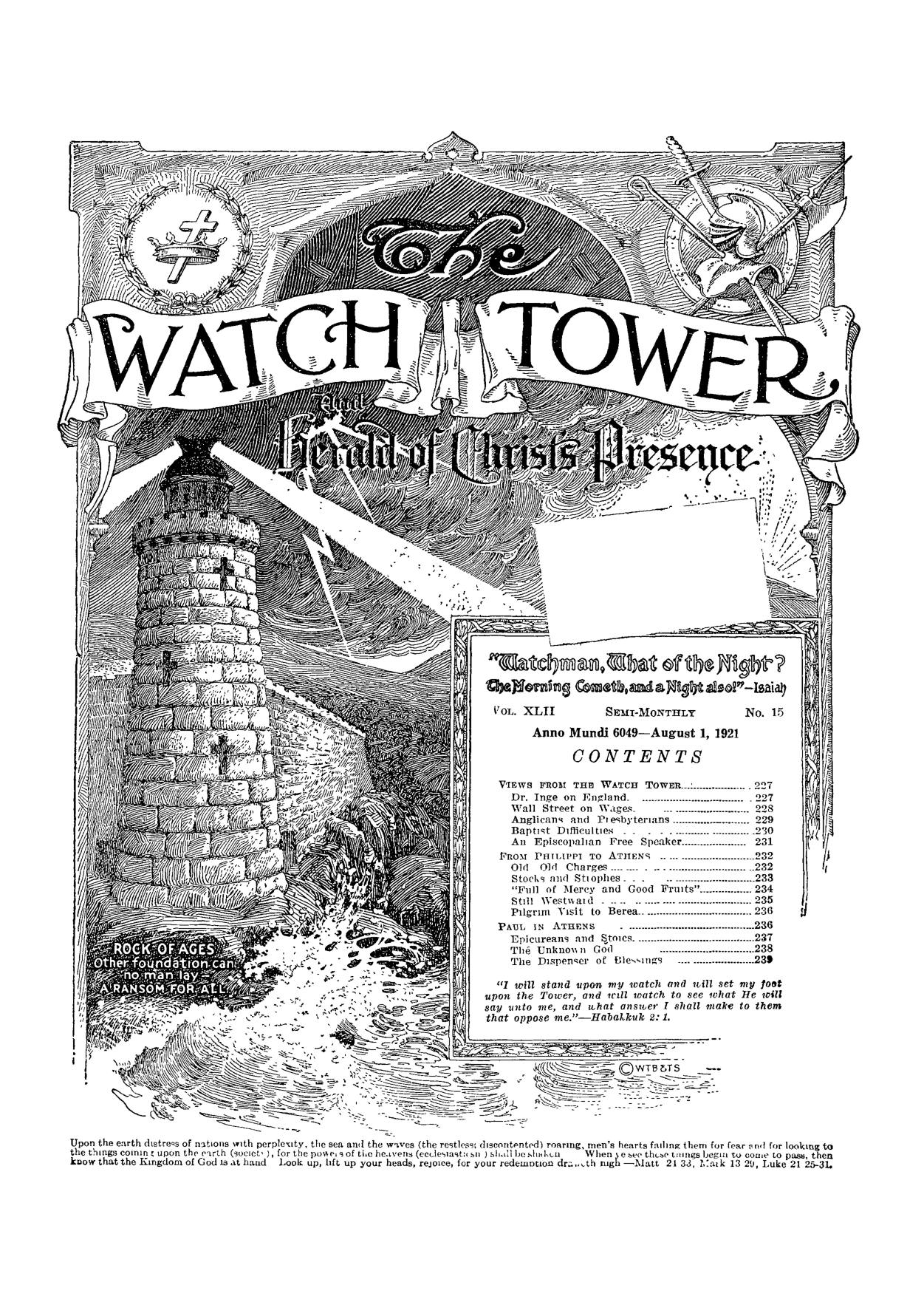
Upon the earth distress of nations with perplexity, the sea and the waves (the restless; discontented) roaring, men’s hearts failing them for fear and for looking to the things coinin ; upon the earth (socict* ), for the poweis of the heavens (ecclesiasta sn ) shall be shaken When >e see these tilings begin to come to pass, then know that the Kingdom of God is at hand Look, up, lift up your heads, rejoice, for your redemption dra.^th nigh —Matt 21 33, L'atk 13 29, Luke 21 25-3L
^IjieJSFeraiiimg Gna®tl&,aiadla^5gl^i al®©’”-laaiai?
Vol. XLII
Semi-Monthly
No. 15
Anno Mundi 6049—August 1, 1921
CONTENTS
R0CK1OR AGES.^^g^ " i. Other foundation.canc'ajj
A1RANSOM TOfi-A't L-rO^
Views from the Watch Tower...:...
Dr. Inge on England.....................
Wall Street on Wages. ............
Anglicans and Pi esbyterians..........
Baptist Difficulties ..............
An Episcopalian Free Speaker.......
From Philippi to Athens ............
Old Old Charges.......................
Stocks and Stiophes..............
“Full of Mercy and Good Fruits”.
Still Westvvaid ........................
Pilgrim Visit to Berea....................
Paul in Athens .........................
Epicureans and Stoics......................
The Unknown God ..............
The Dispenser of Blessings .......
. 229 . .230
...232 .232
...233 .. 234 . 235 . 236
...236
...237 ...238 ..23»
“I will stand upon my watch and will set my foot upon the Tower, and will watch to see what He will say unto me, and what answer I shall make to them that oppose me.”—Hahakkuk 2:1,
THIS JOURNAL AND ITS SACRED MISSION
THIS journal is one of the prime factors or instruments in the system of Bible instruction, or “Seminary Extension”, now being presented in all parts of the civilized world by the Watch Tower Bible & Tract Society, chartered A. D. 1884, “For the Promotion of Christian Knowledge”. It not odly serves as a class room where Bible students may meet in the study of the divine Word but also as a channel of communication through which they may be reached with announcements of the Society’s conventions and of the coming of its traveling representatn es, styled “Pilgrims”, and refreshed with reports of its conventions.
Our “Berean Lessons” are topical rehearsals or reviews of our Society’s published Studies most entertainingly arranged, and very helpful to all who would merit the only honorary degree which the Society accords, viz., Verbi Dei Minister (V. D. M.), which translated Into English is Minister of God’s Word. Our treatment of the International Sunday School Lessons is specially for the older Bible students and teactieis. By some this feature is considered indispensable.
This journal stands firmly for the defense of the only true foundation of the Christian’s hope now being so generally repudiated —redemption through the precious blood of “the man Christ Jesus, who gave himself a ransom [a corresponding price, a substitute] for all”. (1 Peter 1:19 ; 1 Timothy 2 : C) Building up on this sure foundation the gold, silver and precious stones (1 Corinthians 3: Ills ; 2 Peter 1:5-11) of the Word of God, its further mission Is to “make all see what is the fellowship of the mystery which. . .has been Ind in God, ... to the intent that now might be made known by the church the manifold wisdom of God”—“which in other ages was not made known unto the sons of men as it is now revealed”.—Ephesians 3 : 5-9,10.
It stands free from all parties, sects and creeds of men, while it seeks more and more to bring its every utterance into fullest subjection to the will of God in Christ, as expressed in the holy Scriptures. It is thus free to declare boldly whatsoever the Lord hath spoken—according to the divine wisdom granted unto us to understand his utterances. Its attitude is not dogmatic, but confident; for we know whereof we affirm, treading with implicit faith upon the sure promises of God. It is held as a trust, to be used only in his service; hence our decisions relative to what may and what may not appear in its columns must be according to our judgment of his good pleasuie, the teaching of his Word, for the upbuilding of his people in grace and knowledge. And we not only invite but urge our readers to prove all its utterances by the infallible Word to which reference is constantly made to facilitate such testing.
TO US THE SCRIPTURES CLEARLY TEACH
That the church is “the temple of the living God”, peculiarly “his workmanship” ; that its construction has been in progress throughout the gospel age—ever since Christ became the world’s r.edeemer and the Chief Corner Stone of his temple, through which, when finished. God’s blessing shall come “to all people”, and they find access to him.—1 Corinthians 3; 16, 17; Ephesians 2:20-22; Genesis 28 : 14 ; Galatians 3 : 29.
That meantime the chiseling, shaping, and polishing of consecrated believers in Christ’s atonement for sin, progresses; and when the last of these “living stone"-”, “elect and precious,” shall have been made ready, the great Master Workman will bring all together in the first icsuirection , and the temple shall be filled with his glory, and be the meeting place between God and men throughout the Millennium—Rev elation 15.5-S.
That the basis of hope, for the church and the world, lies in the fact that “Jesus Christ, by the grace of God, tasted death for every man,” “a ransom for all,” and will be “the nue light which lighteth every man that cometh into the world", “in due time”.— Ilebiews 2.9, John 1 9; 1 Timothy 2:5, 6.
That the hope of the church is that she may be like her Lord, “see him as he is,” be "partakers of the divine nature',’ and share his gloiy as bis joint-heir.—1 John 3 2, John 17.24; Romans 8:17; 2 Peter 1:4.
That the present mission of the church is the perfecting of the saints for the future work of service; to develop in herself every grace; to be God's witness to the woild; and to prepare to be kings and priests in the next age.—Ephesians 4 :12; Matthew 24: 14 ; Revelation 1:6; 20 : 6.
That the hope for the world lies in the blessings of knowledge and opportunity to be brought to all by Christ’s Millennial kingdom,,the restitution of all that was lost in Adam, to all the willing and obedient, at the hands of their Redeemer and his glonfiM church, when all the wilfully wicked will be destroyed.—Acts 3:19-23; Isaiah 35.
Published oy
WATCH TOWER. BIBLE (rTRACT SOCIETY/
124 COLUNWA HEIGHTS □ o BROOKLYN, NY. U SA
Foreign Offices British 34 Craven Terrace, Lancaster Gate, London \\ 2; Canadian 270 Dundas St., W„ Toronto, Ontario; Australasian 495 Collins St, Melbourne. Australia, South African 123 1'lein St, Cape Town, South Africa.
Pi ease Addrfss the Society in Every Case.
NEARLY SUBSCRIPTION PRICE; United States. $1 00 ; Canada and Miscellaneous Fourtgn, $150, Gncvr Drums. Australasia, and South Africa Ss Ameucan remittances should be made by E\i*re<s or Postal Money Ottiers, of bv Bank Draft. Canadian, British, South African, and Australasian remittances should be made to branch offices only Remittances from scattered foreign territoiv may be tnade to the Brooklyn office, but by International Postal Money Orders only
(Foreign ti anslations of this journal appear in several languages)
Editorial Committee: This journal published under the supervision of an oditoual committee, at least three of whom hate read and approved as trulli each and everv ai t icle appearing in those columns. The names of the editorial committee are J F Rutherford, W E Vv.x Ameurgh, F. H Rodisqn, G. H. Fisheb, E W Erenisen. Terms to the Lord's Poor: AH Bible students who, by reason of old age or other in-firmly or a J versify, are unable to pay for this journal, will be supplied free if they send a postal card each Moy stating their case and requesting such provision. We are not only willing, but anxious, that all such be on our list continually and m touch with the Berean stu_i*s.
Notire fo Stutwriher*- l$c not, as ornle. send a card of acknowledgment for a renewal or - pvr a ntw subscription Rccc pt and »ntry cnewal are loaivated
within a month bv rhantre fa exp’rat <>n date us simunon v.rapper label
Entered as t Clrsg al Flrookbrn N Y J’oftofTee wrtder c *ia Art of Aiarcn Srd, 18~S
HYMNS FOR OCTOBER
Sunday ..........
2 24G
9 99
Monday ..........
3 2 !3
10 44
Tuesday .......
4 232
11 177
IS
Wudnesdn v
5 326
12 °S3
.19
Thursday.....
6 2-->S
13 192
Fridnv
7 178
14 89
IS
Saturday 1 277
S 4S
15 21G
Alter the dose of the hymn the Bethel fanvlv listens to the reading of “Mv Vow Unto the' Lord”, then joins in prayer At the breakfast table the Manna text is consnleied
STUDIES IN THE SCRIPTURES
These biLDJEs are recommended to students as veritable Bible keys, dueusMiig topically every vital doctrine of the Bible Moi« than eleven million copies are in circulation, in nineteen language-Two sizes are issued (in English only) : the regular maroon cloth gold stamped edition on dull finish paper (size 5"x7
quot;), and the maroon cloth pocket edition on thin paper (size 4"xu3") ; both sizes are printed from the same plates, the difference being in the margins; both sizes are provided with an appendix of catechistic questions for convenient class use. Both editions unifoim in priceSeries I, The Divine Plan of the Ages, giving outline of the divine plan revealed in the Bible, relating to man’s redemption ami restitution 350 pages, plus indexes and appendixes, 75c Magazim-edition 20c Also piocurable in Arabic. Armenian. Dano-Norwegmn Finnish, French, German, Greek, Hollandish, Hungarian, Italia Polish, Roumanian, Slovak, Spanish, Swedish, and Ukrainian regulai cloth sfyle, price uniform wuh English
Series II, The Time is at Hand, treats of the manner and time of the Lord’s second coming, considering the Bible testimony on this subject: 333 pages, 75c. Obtainable in Dano-Norwegian, Finnish, German, Polish, and Swedish.
Series HI, Thy Kingdom Come, considers prophecies which mark events connected with “the time of the end”, the glorification uf the chuich and the establishment of the Millennial kingdom it also contains a chapter on the Great Pyramid ot Egjpt, showing its corroboiation of certain Bible teachings: 3S0 pages, 75c. Furnished aho in D.ino-Noi wegiaii, Finnish, German, Polish, aud Swedish
Series IV, The Battle of Armageddon shows that the dissolution of the present order of things is in piogiess and that all of the human panaceas ofteied are valueless to avert the end predicted in the Bible It contain', a special and extended treatise on our Loid’s gieat piophecv nt Matthew 24 and also that of Zechariah J4 1-9 656 pages, b5c Also in Dano-Norwegian, Finnish, Gieek, Geiman, and Swedish
Series V, The Atonement Between God and Man, treats an all impoitant subject, the centei atound which all features of divine giace revolve Plus topic deseives the most caieful consideration on the part of all true CVnistmns 61S pages, Sjc Procurable likewise in Dano-Norwegmn. Finnish, German, Greek, and Swedish.
Series VI, The New Creation, deals with the creative week (Genesis 1. 2) and with the chinch God’s new creation It examine^ the pei-onnel, organization rites, ceicmomes, obligations, and hopes upper taming to those called and accepted as members of the budv ot Uhust 730 pages, S5c Supplied also tn Dauo-Norwegmn, Finnish, German, and Swedish
Series VII, The Finished Mystery, consists of a verse-by-verse explanation of the Bible Looks of Revelation. Song of Solomon, and Ezekiel 60S pages illustrated ‘sSc in cloth, 25c. in magazine edition—It ttei tieats Revelation and Ezekiel only.
eaVAit'H f'OWEli
AND HERALD OF CHRISTS PRESENCE
Vol. XL1I August 1, 1921 No. 15
VIEWS FROM THE WATCH TOWER
WHOEVER has not discovered in himself streaks of dishonesty is either not candid enough to lace the facts or not discerning enough to see the facts. And in order to speak the truth one must have not only candor, but discernment. The most discerning people are those who discern not merely facts and incidents but also the principles underlying and influencing those incidents. One may be honest at heart, one may have a sincere desire to recognize and deal only with the tiuth, and still misrepresent a situation through faulty or prejudiced information. All of these points must be taken into consideration in judging of the statements of anyone. Others have a right, or even a duty, to bear these things in mind in judging of any statements which may be made in this journal. Especially is this true in respect to observational statements touching on world conditions, where the quantity and quality of information is so variable. The wish inclines to be father to the thought, and this sometimes leads one to expect more of a given occurrence or situation than that thing, in a state of fuller development, warrants.
This wish is not for the difficulty itself, but for the blessed times following the difficulty. Bible students are often accused of rejoicing in the discomfiture which is upon Christendom. Those who make such accusations are unable to distinguish between rejoicing in what seem to us marked signs of the times and rejoicing in the tribulation of other people. No one who has any measure of the spirit of the Lord rejoices to see suffering; but those who understand the purposes of the Lord know that suffering is necessary before the hearts of men are prepared for the blessings which are just beyond. The Lord’s people are therefore able to rejoice in spite of the suffering, rather than because of it
DR. INGE ON ENGLAND
Among ecclesiastics whose words find more ui less lodgment in the public press, there are some whose utterances give evidence of considerable discernment and candor. Few stand out in this respect more than Dean Inge of St. Paul’s Cathedral in London and Bishop Williams of the Episcopal Diocese of Michigan. Bishop Williams has been frequently quoted in these columns, as also m “The Finished Mystery”, page 212. We shall turn our attention again to him presently. Dr. Inge, who carries the heavy distinguishmcnt of The Very Reverend William Ralph Inge, is regarded in London as one of the clearest-sighted and least sensational of public men. He is associated in vision as well as in work with the venerable Prebendary Webb Peploe, whose observances of world and ecclesiastical conditions have been quoted at various times m these columns. Writing in the London Evening Standard, Dr. Inge says:
“In 1914 I prophesied that whateier might be the outcome of the war it would lose us our naval supremacy. If we won the war, I pointed out, America would take the lead, and if we lost, Germany.
“I believe our dominions probably will remain under the union jack, but they will also try to insure themselves with America and, as time goes on, they will lean more and more on what will then be the dominant English-speaking power.
“Our nation is not played out by any means, but now, in the time of peace, it is unwilling to pay the price which made our little island a great world power; and that chapter of our history, accordingly, is nearing its end.
“As soon as a civilized government is set up in Russia it will need the help of Germany, and we may expect such an alliance. Germany’s war indemnity will be repudiated in a very few years, and neither England nor France will be able to exact it.
“I do not think the Germans will wish to attack us—in plain terms, we shall not be worth it But the Russians will order us out of Mesopotamia, which, strategically, is quite indefensible, and we probably will be quite glad enough to quit Palestine.”
One of the probabilities intimated in the above quotation has developed into a fact, as shown by a Berlin dispatch in the Chicago Daily News:
“Germany has concluded a preliminary trade agreement with Soviet Russia, and the convention became effective on May 6, according to the official text, which has been made public here [Berlin]. The text shows the pact will continue to be operative until a commercial treaty is completed, and provision has been made that either party may terminate the agreement by giving three months’ notice"
BRITAIN, AMERICA, RUSSIA
Great Britain has also recently recognized the Russian Soviet Government. Formal recognition of that government by Great Britain opens the seven seas to Russian commerce and virtually validates every treaty which the Soviet Government has made with the surrounding countries of Europe and Asia. The Russian gold reserve is also released for world commerce. Great Britain has also gained access to the Baku oil fields, hoping, with these fields and those in Mesopotamia, to continue to control the world commerce by controlling its fuel The 227
fallacy of depending on coal is being heavily impressed upon the British at this time through the very rigid coal-strike situation in the British Isles.
America has not recognized the Soviet Government of Russia. But no one of even moderate experience thinks for one moment that the causes given for nonrecognition are the real ones. At no time in the past have the United States refused to trade with a people whose morals or religion or government did not suit them. They have traded for a long time with the Turk and the Chinaman. The American State Department has not bothered to inquire whether articles going to these oriental countries were designed for use by practic-ers of polygamy or by worshipers of idols. Whatevei the real reason for the hypocritical attitude is, no sensible person believes the reasons given out.
An editorial resume of one day’s ne\i=, contained in the Los Angeles Examiner states:
“The 'market' was heavy Speculate)paid -eren a half for money with which to gamble Foreign exchange heavy, almost ‘collapsed’ London is pessimistic, more worry about the coal stnke. England’s workmen present a problem more difficult than was the German pioblem.
“Judge Gary supplies a hopeful note. He believes tilings are getting better They need to get better. If they don’t get better soon, it Government doesn’t stop constant shipments of money from the United States, and persistent robbery of the people by profiteers, there will be troubles here not soon foigotten.
“It is all very well to be optimistic, but not about combination buiglary and incendiarism.”
Judge E. H. Gary, Chairman of the Board of Directors of the United States Steel Corporation, the steel trust, recently addressed the students at Syracuse University, in such language as to show why he feels optimistic. We may reasonably’ assume that the Wall Street Journal expressed his view when it said concerning economic conditions in this country:
V. ALL STREET ON WAGES
“When the real adjustment comes the unskilled worker finishes where he belongs—at the bottom of the list. He will be able to live on $2.00 a day when he is lucky enough to get that amount regularly. Wages which in the spring Before the panic of 1873 were $8.00 a day fell to $2.00 in the autumn of that year, -with employment bard to find. The cost of living will adjust itself. The Labor Bureau will give up publishing nonsense about $2600 a year minimum for a fr ed ‘family of five’. The unskilled workman will thank goodness that he has no tamily of five or indeed anybody but himself to support ; nor will any employer pay him on the basis of any such fatherhood, as the bankrupt and discredited Interchurch World Movement absurdly proposed in its gratuitous inquiry into the steel strike.”
“So far as immigration is concerned, we want more labor, as we shall rapidly discover when the people are reallotted to their proper jobs. This is particularly true of domestic service. Not all the munition workers have gone back to washing dishes. Not for long will the housekeeper pay the green hand $60.00 a month with board and lodging for learning her elementary business. This country can run best on the basis of the plentiful domestic service at $20.00 a month, with respectful and competent maids receiving $25.00 a month and glad to get it.”
If there can be said to exist such a thing as an arrogant capital (as distinct from an arrogant labor and common people) this surely is an example of it. The Richmond Times-Dispatch, in referring to statements of organized labor on the one hand and or'’-aniznd capital on the other, said.
•'There vve have the two cxnenie, in the American industrial system, and somewhere between them a common meeting ground must be found if capital and labor are to join hands in friendly cooperation and mutual helpfulness in bringing about an era of unprecedented piosperity and industrial peace to this country. If that mean is not found, it either capital or labor is too stiffnecked, too wedded to its own selfishness, to yield an inch here and an inch there, in the American spirit of give and take, then the conflict, of which the undercurrent now is running strong, will come to open warfare just as surely as it came to Russia. And the man does not live who can foretell the result.”
The same paper tn a news dispatch shoved how the failure to pay dividends on the part of large industrial concerns is causing much inconvenience and dissati-faction among the stockholders, many of whom a: people of only moderate means. One of the paraffin in that item reads:
“The parsing of dividend-, by industrial eompmue- i-getting under the skin of genuine investors who purchareJ preferred stocks solely for their income. In recent ye.us biokers have not hesitated to recommend seasoned preferred stocks which paid dividends for years as safe investment-, for women who were dependent upon the dividends for income. Brokers state that the number of women who hold industrial preferred stock is the greatest in history. Then ranks were swollen by the huge expansion in the cost of living which resulted from the war. Heretofore many women were satisfied with 4} and 5 percent on bonds, but the increased cost of the necessities of life prompted them to search for a higher return upon their invested fund-Becau.se of the better yield obtainable on preferred shares the investors were directed to sell then-bonds and reinvest the proceeds in industrial preferred stocks. Institutions are also large holders of preferred stocks.”
This stringency naturally extends to the smaller and moderate-sized banks. One such example is given in the Petersbuig (Va.) Progress, which we print not because it is distinguished, but because it is typical of many others:
“The Virginia State Bank of Hopewell, one of the two banks here that continued business after the unparalleled run of 1918, closed its doors last night after Bank Examiner F. B. Richardson had examined the books and been in consultation w-with the bank’s board of directors for several hours.”
“An official statement of the bank, posted on the front door, stated that owing to the fact that the bank had invested heavily in Liberty Bonds, which are now almost nnnegotiable, the bank had been closed and would be put in the hands of a receiver.”
“An official of the bank, who was interviewed early this morning, stated the following reasons for its closing: The bank had Invested heavily in Liberty Bonds, at present holding over $100,000 worth upon the belief that this forpt of security would be readily negotiable, but when the tim-came to borrow money on these bonds from the Feder Reserve Bank, full value is not allowed and 6 perce-ir interest was charged on the loan. The bank could mu continue business on this basis, as it could not make any profit by borrowing money at this rate.”
BRITISH UNEMPLOYMENT AND “NEXT WAR”
The situation m England is most complex and strenuous. The government has been issuing allowances to the unemployed, thus playing the role of a large trades union; This was operative in the shape of a tax on the employed and upon employers. An item published in the Providence Journal shows that these allowances are to be reduced:
“In the House of Commons tonight the Government introduced a bill reducing employment doles from 20 to 15 shillings weekly for men and from 1G to 12 shillings for women, and at the same tune increasing the contributions from both employers and employes.
“T J. MacNamarn, Minister of Labor, in introducing the bill, explained that o« mg to the enoi motis increase in unemployment through the coal strike this insurance scheme had become insolvent, the Government paying £2,000,000 weekly and receiving only ±350,000.”
While such strenuous conditions pievail inside the British Isles, experts of the British war machine continue to prepare for the next war. Field-Marshal Sir Henry Wilson, C. B., D. S., chief of the British general staff, recently encouraged a soldier audience at the Union Jack Club in London to keep themselves in fitness “for the time that is coming”. He said that the belief that the last war was a war to end war was based on delusion. In harmony with this view of the British Field-Marshal are some statements in the quarterly journal of the Royal United Service Institution—an aristocratic body of five thousand military, naval, and air experts. The meetings of this institution are not open to the public and its journal is issued only to its members and to a few non-members who are interested in the science of war. In a contributed article in the Detroit Free Press the current number of this publication is represented as remarking concerning Britain’s next great war:
“Four facts stand out plainly from these pages:
“(1) We are no nearer disarmament than ever we were.
“(2) The next war will completely eclipse the horrors of the last.
“(3) War will no longer be a matter of muscular force, but of mechanical energy, In which gas warfare, ray warfare (which utilizes forces similar to those utilized in the X-ray), and finally germ warfare, will be employed on a vast and scientific scale.
“(4) Non-romhatants will no longer be exempt from death and suffei
That the military type of mind can and must think of human butchery from the standpoint of scientific efficiency is shown by another quotation from the same article:
“Major-General Ernest Dunlop Swinton, C. D., D. S. O., controller of the inspection department of civil aviation in the British air ministry, finds great promise in the use of gas in the next war and believes that it will make possible the killing of men on a wholesale rather than on a mere retail scale.
“ ‘It has been our tendency up to the present,’ he says, ‘to look upon warfare from the retail point of view—of
killing men by fifties or hundreds or thousands. But when you talk of gas you must remember that you are discussing a weapon which must be considered from the wholesale point of view; and if you use it—and I do not know of any reason uliy you should not—you may kill hundreds of thousands of men, or, at any rate, disable them. When you consider the use of such weapons in the future which is certain to take place, the enclosure of men in steel vessels or tanks (they may be made of steel or any material which will give the men some protection which their own lungs cannnf- >ri-r, will be of vital importance. ”
WHAT WAR IS LIKE
A Bi itisli writer who had more experience in the trenches than any of these military experts writes about the effects of shell shock, and associated matters:
‘These badly shell-shocked boys clawed their mouths ceaselessly It was i common dreadful action Other sat in the field hospital- m a state of coma, dazed as though deaf, and actually dumb I hated to see them turned my eyes away from them, and yet wished that they might be seen by bloodyminded men and women, who. far behind the lines, still spoke of war Iighr,t as a kind of sport or heroic game, which brave boys liked or ought to like, and said ‘We’ll fight on to the la-t mam rather than accept anything less than absolute victoiy,’ and. when victory came, said: ‘We stopped too soon. We ought io have gone on for another three months.’ It was for fighting men to say these things, because they knew the things they suffered and risked. That word ‘we’ was not to be used by gentlemen in Government offices scared of air raids, nor by women dancing in scanty frocks at war-bazaars for the ‘poor dear wounded’, nor even by generals at G. H. Q., enjoying the thill of war without its dirt or danger.
“Seeing these shell-shock cases month after month during yeais of fighting, I, as an onlooker, hated the people who had not seen, and were callous of this misery, the laughing girls on the Strand greeting the boys on seven days’ leave; the newspaper editors and leading writers whose articles on war were always ‘cheery’; the bishops and clergy who praised God as the Commander-in-Chief of the Allied armies, and had never said a word before the war to make it less inevitable; the schoolmaster who gloried in the I'ngthening ‘Roll of Honor’ and said, ‘We’re doing very well,’ when more boys died; the pretty women-faces ogling in the picture-papers as ‘well-known war workers'; the munition workers who were getting good wages out of the war; the working women who were buying gramaphones and furs while their men were in the stinking trenches tbo .ivpfdful, callous, cheerful spirit of England at war
ANGLICANS AND PRESBYTERIANS
Turning to the more nearly religious fields of interest in Christendom, we find that there is some effort to respond to the proposition of the Lambeth Conference of Anglican Bishops held in London last summer. A definite basis for church union between Anglican and Protestant churches in Canada seems to have been laid by action of the Montreal Presbytery recently. The Presbytery deferred discussion of its formal report until about the date of this publication; consequently, we are unable to report the latest action. But authorized bodies from both religious movements have already agreed upon the following forms of commission:
“(1) I’lesby tei i.m lin.ii of Commitsum to Anglic.ins.
“A declaration will be made to the ellict that there m no repudiation of or rellection on the ministry to winch we have been set apart by the Holy Spirit, but that the authorization is given to enable us to exeicise the ministry in a wider sphere within the reunited church. The exact phraseology of this has not been determined
“Then the clergy of the Church of England will be admitted according to the form in the ‘Draft of the Book of Common Ordei of the I’lesbytenan Chinch in Canada’, pp. 35 3G, as follows:
“Now may be sung, 'Come, Holy Ghost, oui Souls Inspne,’ or other hymn of supplication for the presence of the Holv Spirit. Then shall the candidate kneel, and. olhei jn e.sbj tei s standing about him. the moderator shall sac : h 'Cc no man is of himself sufficient lor these things let us • .id i.,niii God in prayer.
“After prayei the model atoi and other .>> c'-o,, tet.s lay their hands on the head of the candid , and say, We admit you to a wider exercise of the nnuistiy of the Void and Sacraments.
“Following anothei piuyer Ilie minister shall use, and the moderator, addiessing him, shall say
“In the name of the Lord Jesus Clmst, the only King and Head of the Chinch, and bv authoi ity of tins piesby tery, I invite you to take part with us m Lius ministry, and admit you to all the lights and puvileges thereto pertaining.
“Then the members of the 1’iesbvtery shall give him the right hand of fellowship, the moderator saying:
“We give you the light hand of fellowship to take part with us in the nnuistiy.
“(2) Statement, Anglican form of Commission to Presbyterians.
“The candidates having been presented to the bishop, then shall the bishop say
‘Forasmuch as teims have been arranged between the Church of England in Canada and the Presbyterian Church in Canada, with the purpose of realizing, through visible and coipoiate union their common fellowship in the universal Church of Christ, and of their having that fellowship to tile v of hl, and forasmuch as it is necessary7 that there should be in this united church a ministry that shall be acknowledged in every part thereof it is our purpose now to give these our brethren, by the laying on of our hands, a commission to the office of priesthood, it being clearly understood that herein there is no repudiation of or i eflection on their past ministry to which they were set apart by the Holy Spirit, whose call led them to that ministry and whose power enabled them to perform the same.
“Invocation Then shall be said or sung ‘Come. HolyGhost.’ etc.
“Commission Then the candidates shall kneel, and the bishop with the priests piesenl, shall lay hands severally on the head of every one, the bishop sa-ying
“Take thou authority to execute this office now committed to thee by the imposition of our hands. And he Ihoti a faithful dispenser of the Word of God and of his holy sacraments In the name of the Father, and of the Son and of the Holy Ghost Amen ”
CHURCHES OF ENGLAND AND SCOTLAND
These are interesting because opening the way for similar action on the part ol othei 1 ingli«h-qieaking religious bodies, at least The Preslrv tei inn- in .Scotland are also philandering with the Anglican Chinch to an extent which would lune been remaikable a lew years ago. The Edinburgh (Scot.) Scotsman s.iy- concerning the recent General Assembly of the Chinch of Scctlai'd :
“When the Church ot Scotland General Assembly lesumed yesterday morning there was a large attendance Among those in the Throne Gallery, beside the Lord High Commissioner and the Duchess of Sutherland, were the Archbishop of Canterbury, the Bishop of Peterborough, and Bishop Itohberds, the Primus of the Episcopal Church in Scotland, who weie piesent as repiesentatives of the Lambeth Conference.
"Dr. Wallace Williamson moved that the visitors should be invited to enter the precincts of the House, and this having been cordially auieed to, the moderator welcomed them in the name of the Assembly, making special reference to the connection of the Aichbishop of Canteibury with Scotland ”
For the official head and representative of the Church ol England to appear on the floor of the General Assembly of the Church of Scotland would have been impossible a hundred or even fifty years ago. The Committee on Union at this Assembly moved the adoption of the Committee's lepoit as to the ways and means of accomplishing union. Inasmuch as union in Scotland is a more complex piobleni than m Canada, involving financial suppoit as well as the ordination question, the Report made seven recommendations calculated to make union an organic possibility. These are to be taken up by the British Parliament on behalf of the Church of England and by the next General Assembly after conference with representatives of the United Free Church of Scotland.
BAPTIST DIFFICULTIES
One of the Boston papers reports concerning Dr. Myers of Tremont Temple:
“The Itev. Dr. Cortland Myers, in his sermon yesterday morning at Tremont Temple, several minutes before his resignation had been read, characterized the leaders of the Baptist denomination as ‘little, picayune, pin-headed men'.
“He declared the denomination was ‘the most disintegrated religious body in America today’, and predicted that the next Baptist convention in the middle West ‘wdll go to pieces because its members will give in to the higher Bible critics'.
"Dr Myeis’s address yesterday grouped the Roman Catholic Church, the Jews, Christian Science, the colleges of the countiv. and. finally, his own denomination as arch-enemies of the Bible. The colleges are crowded, he said, with teacn-ers who aie ‘ambassadors of evil’.”
Tins is the same Dr. Myers who was so notably opposed to Baptist participation in the Interchurch World Movement. Indeed. Dr. Myers’ present action may be but a straw showing which way the wind is blowing inside of Baptist circles. Two factions are present: the one strongly influenced by temporal prosperity and the other more inclined to spiritual faithfulness. Onlv recently it has leaked out that an immense endowment fund was contributed to the Baptist Foreign .Mission Boaid some two years ago with the stipulation that the pioeceds of the fund be used to support only workers who taught those doctrines mentioned in the donation. Most Baptists would not object to the doctrinal stipulations as such ; but many of them (now that the bidden donation has come to light) do object strongly to any kind of strings being tied to mission contributions. Also, the more spiritually inclined Baptists are coming to realize the detrimental influence of the University of Chicago on the minds and lives of Baptist young people. There seems to be a rift impending vitlnn the Baptist camp
AN EPISCOPALIAN FREE SPEAKER
Bishop Williams is cpioted in the Nashville Tennessean as making some remarks concerning his resignation, tendered as a sequel to his speech made in the Cathedral of St. John the Divine in New York, a part of which was quoted in our last ‘‘Views”. On the Sunday following Bishop Williams’ remarks the newly chosen Bishop Manning of New York delivered as strong a rebuke as ecclesiastical dignity would permit against what Bishop Williams had said the Sunday preceding. Evidently no inconsiderable disturbance vas raised and Bishop Williams thought well to resign, according to the report above cited:
“ ‘It doesn’t seem right that the convictions of one man should shut off from the churches, hospitals, and educational institutions of the diocese a large measure of their support. So I have tendered my resignation, to take effect whenever or If ever the diocese sees fit*
“Thus the Right Reverfend Charles D. Williams, Episcopal Bishop in the diocese of Michigan, interviewed today for the first time in more than a year, explained the reason for his momentous step.
“ ‘Recent happenings had convinced me that my recent message on the relation of the church to industry would meet with denunciation, suppression, and withdrawal of support,’ said the Bishop.
“ Tn the first place there was the action of the Pittsburg Employers’ Association in withdrawing support from the Y. W. C. A. on account of Its investigation of industrial conditions.
" ‘Then there was the threat, made by the same employers’ association, that support would be withdrawn from the Federal Council of Churches unless it abandoned its “social creed of the Churches”.
“ ‘Everywhere there is evidence of a fatal and futile attempt at repression and suppression of ideas, of blind denial of freedom of thought and liberty of conscience.
“ ‘It is a day of hysteria and panic fear. Nerves are on edge everywhere. Men normally cool, sane, and balanced in judgment, are seeing red and are afraid of their own shadows. Men turn in wrath on all seers and prophets, and sometimes stone and crucify them.
“ Tn England, now, It's different. There’ll be no revolution over there, In spite of the alarmists' shouting.
“ ‘I took my wife down to Hyde Park in London. On one soapbox was a chap shrieking atheism. A few yards from him was the Bishop of London, delivering a sermon. Further on was a Bolshevist orator, and beyond him a half dozen radical speakers of varying convictions, each of them with his little audience.
“ ‘And up and down the line marched the London “bobbies”, as unconcerned as if at a picnic.
“ “Tliere’s no danger there That is the safety valve. It is in the suppression of Ideas that we find In America that danger lies.’ ”
“The cure Bishop Williams has for the ills of the world Is a gentle thing when heard from his own lips.”
“ ‘We all know that the minute an artist devotes himself entirely to the pursuit of money, his ait is commercialized. He produces only pot-boilers, not niastei pieces.
“ ‘And if a physician deserts his quest of scientific truth, and Ins mission of alletiating suffering, to follow the lure of gold, he is a failure. With the teacher and preacher it is the same
“'The piinciple underlying all tins is applicable to the imhisliml voi Id. In tact, the time has come for us to attack this last stronghold of the commercialized spirit— the spmt ahull bleed-, dishonesty and corruption, breaks men’s lives and produces the gieater pait of the nnsfoi tunes and troubles of out day.
“‘The work of the chin ch is ineiely to enunciate this principle, and to prepare men’s minds for the change by preaching Christian ideals.
“ ’Then we’ll leave it to the technicians to work out the details of the new order.
“ ‘Money is necessary for carrying on business, but in the new order, . . . service, not money, will be the paramount object.
" ‘And because I hold these views I am shouted at as a Bolshevist, a “red”, an insidious person who seeks to wreck society!'
“The Bishop believes the church is at the crossroads.
“ *The challenge is plain,’ he said. ‘Either the church must abandon the well-considered, sane, and fair message it has formulated, suppress her proclamation of It, a thing unthinkable for any who have a conscience and convictions, or—
" ‘She must enlarge and democratize the basis of her support, so as not to be dependent upon or subservient to any class, high or low, or—
“ ‘She must be content with more meager support and restricted operation.
“ ‘Her Master was poor and persecuted, but free, and Jt may be that he is now calling his church to follow in his footsteps.’
“The Bishop is confident that the church can be set free from dollar domination.
“ ‘The host of communications I have received from mep in all states of life,' he says, ‘lead me to believe that it would be easy to obtain many smaller subscriptions to our churches, to make up for the larger ones ve seem destined to sacrifice h\ adherence to our conviction^ ’ ”
WHO CAN OBJECT?
It is gratifying to note the action of one Christian church in St. Louis. Michigan, as reported by the St. Louis Leader, of that state:
“The Christian church of this place at a recent Sunday morning service decided to accept certain propositions suggested by the minister at the annual meeting In February. For a number of weeks the membership have been considering a move which Is considered more in keeping with the spirit of Its mission in the world.
“Following are the propositions as accepted without a dissenting vote:
“ ‘We stand before the world claiming to be Bible Christians. This is a great thing. Are we willing to make good? In the Bible we find no organization but just the church. No such methods as we have in these days. The church work was not done by societies in the church. It was just the church at work. Let us have a church of Christ indeed and in fact.
“ ‘No societies such as the Missionary Society, Ladles Aid Society, etc., but simply the church. No financial drives. No every-member canvass. No collections as usual.
No financial pledges. No church fairs. No more suppers for revenue. No salaried minister. No meetings that are not strictly Christian. No lectures on subjects foreign to the Word of God. No services taken up to unite in any meeting that has a political object.
“ ‘In the matter of the support of the work let us place everything on the honor basis, each one giving as God has prospered him, ever remembering that they who preach the gospel are to live of the gospel. Instead of passing the collection baskets, let us place two boxes in convenient places where each may deposit his or her offerings each week.’ ”
FROM PHILIPPI TO ATHENS
--September 4 — Acts 16:19-17:15--
RODS AND STOCKS-HYMNS AND EARTHQUAKE-JOY AND TRIUMPH—PAUL IN THESSALONICA—HIS ESCAPE TO BEKLA.
“T/ie angel of Jehovah encampeth round about them that fear him, and delivereth them.”~Psalm 34:7.
WHY did not the syndicate which owned the poor demon-possessed girl rejoice when they saw that slje was free from the domination of the evil spirit? Why did not their hearts respond In noble gratitude for the deed of genuine benefaction performed? Why did not they come to express their appreciation to the Apostle and Silas and say: We are astounded at the power which you display and we would like to know more about the message which you bring? The answer is that what Paul did affected business. It was going to affect the pocketbooks, the Income, the dividends of Phlllppians. It was rank radicalism, Bolshevism-; that's what it was I These ‘red’ Jewish agitators ought never to have been allowed to land; what ware the immigration officials thinking about anyway! This thing ought to be taken up by the Chamber of Commerce; we know their attitude toward anything not well and reputably established. Reasoning thus, The Amalgamated I'v tlion Soothsayers, Inc., closed their directors’ meeting, converted themselves into a vigilance committee, and arrested Paul and Silas without warrants, although the Constitution provided that the persons of citizens should be secure from violence, except by due process of law. And bow about this law? Oh, it was disregarded, just as similar commercial interests have ever since been in the habit of doing when they saw someone whom they thought they could blame for an interference with dividends.
The self-appointed vigilance committee dragged Paul and Silas into the market-place. Thus Saul had dragged off Christians in his persecuting days. (Acts 8: 3) We do not know how Luke and Timothy escaped from this assault, except that they may have been engaged in another part of the city The market-place to which the missionaries were taken «:is commonly called the forum; and it was the focus of city life. It was the equivalent of our modern newspapers. If this act were repeated now, reporters from the “best” papers would have been admitted to 'the directors’ meeting ot Soothsayers, Inc.; they would have been presented with a block of stock, and advised for the sake of ‘humanity, for the protection of their homes, their wives, their mothers, their noble Roman customs, and all they held dear’ to color up the account and give the public to understand that every one-hundred-percent Roman should be dead set against these alien fomenters and ready to defend the sacred Roman institutions if need be at the cost of life and limb—meaning the ollendeis’ lives and limbs, of course. All the ‘best people should get behind this movement, lest S-l’-Q-R.-i-in perish fi om the earth.
OLD, OLD CHARGES
But being handicapped somewhat by having no flaring “extras”, the prominent men ot atfans of that day did the best they <ould with the publicilj facilities at their dis-
• S P Q R was the llmn.in nni.-ii’.i meaning Seniitus Populusque
—the Itoman -eii.iie anil people posal. First they went to prominent members of what corresponded to the Chamber of Commerce and laid the matter before them. Then, having made sure of their moral backing and knowing that business interests are in the habit of dictating judgeship, directly or Indirectly, and, having decided on the time-worn, if not time-honored, charge of sedition, the aggrieved business ihen of Philippi proceeded to the-magistracy. The magistrates did just what they were expected to do, just what they were paid to do—protected business interests and property, rarely life.
Having the object in view of winning their point, rather than of telling the unbiased truth, these syndicate men did not fall to inculcate in their complaint a statement of the fact that these men were Jews. The Jews were widely and heartily hated. The Emperor Claudius had only recently expelled them from Rome, and Paul’s enemies here took advantage of this prejudice, although the point had really nothing to do with either the charge or the issue.
The missionaries’ accusers claimed that they were exceedingly troublesome in the city. From those words one would be led to think that Paul and Silas had been leading a riot, instead of merely preaching the gospel in a quiet and unobtrusive way. They were further accused of setting forth customs which were contrary to those commonly held. There was perhaps more truth in this point than in any of the others made. The customs referred to were religious. The driving out of the evil spirit was interpreted as a blow at the Roman religion. So it was; but this phase of the matter was brought in merely to appeal to the masses. In the minds of the freed girl’s masters, it was a question of talents and denarii, of dollars and cents, of pounds and pence.
When the multitude heard that these men were engaged in introducing new religious customs they waxed very indignant. The populace had a two-fold occasion for anger, (1) hatred for the Jews and (2) wrath at the loss of their favorite fortune-teller. Now they might have to assume some responsibility and do a little thinking for themselves. That was an offense worthy of the most stringent punishment
BEATINGS AND PRISONS
Seeing the tumult and being more interested in their popularity than in abstract justice, the magistrates commanded that the two men be stripped. The lictors, corresponding to our court bailiffs, were the ones who tore off their victims’ garments and who did the beating. For beating it was customary to strip the body naked to the waist: and it is no wonder that the Apostle spoke of himself as “shamefully treated”.—1 Thessalonians 2: 2.
First the hands of the brethren were tied to the whipping post and then their bare backs were beaten cruelly. Paul suffered this humiliation and agony three times (2 Corinthians 11:25), though, doubtless, he protested each time that he was a Roman citizen. On this occasion he received “many stripes”. The Jew's were accustomed to give thirty-nine stripes (2 Corinthians 11:24); but we do not know how many were laid upon the missionaries by these Roman colonial magistrates.
Those who think such Illegal beatings belong to the dim past are simply deluding themselves. The same things exactly occurred in many places during the Great War, with no more provocation than in this incident. Brethren were beaten by uniformed police inside the jail at Los Angeles, California, and only a few weeks ago twenty-eight brethren were arrested and beaten twice in the same night for meeting together and observing the Passover Memorial in Rou-mania. Exactly the same things occur in every part of Christendom—the feet to those sturdy Roman legs of Nebuchadnezzar’s vision.
St. Paul says that he was “in prisons more abundantly” than any other leader of the church ; and often reminded himself and others of the times alien he cast the early believers into prison. This time in Philippi was one of the occasions of his imprisonment. The magistrates' representatives who delivered the prisoners to the jailor made no recommendation for merciful handling of the missionaries. In modern parlance, the judicialy '-ent woid to the jailor to keep them ‘dead or alive', to ‘give them the limit’. Yes, these men had interfered with business and they were dangerous criminals. But what about these men being “servants of the Most High God”, as the spirit had said? Oh, well, they never put much faith in what that spirit said anyway; but the people liked it and it was a “good proposition”. If this “Most High God” were more powerful than they let him show it. Meantime they would proceed on the theory that he was merely a hallucination, a kind of ideal, as were their gods. Thus they thought; and, as though in defiance of God’s power, they urged the jailor to be unusually careful.
The jailor desired to fulfill the commission given him ; so he put Paul and Silas into the inner prison. Practically all prisons in the Roman Empire were constructed on the same lines, and we have rather minute descriptions given us by Christian writers of the second century. The main prison was a kind of court or vestibule around the edge of which were arranged cells which had the advantage of light and air. But from the back or side of this main vestibule there led oft a passage into a dungeon, which had no facilities (once the door was shut) for either light or ventilation. The darkness, the heat, and the stench of this miserable place are dwelt upon at length by these writers. Doubtless this jail at Philippi was of this kind. Many present-day prisons are not one whit better; and those which do have humane facilities are sometimes lowered in the scale by having ignorant and inefficient guards. Few prisons there are in this country which do not have just such a black hole for punishment inside the prison walls.
STOCKS AND STROPHES
Not only were the Lord’s ambassadors thrust into the foul dungeon, but they were made fast to the stocks, or, literally, the “timber”. The probabilities are that there were several sets of chains attached to a heavy beam and that the individual prisoners in this inner compartment were all separately chained, partly for safety to the prisoners themselves. Desperate characters would be put in there, and in the dark they might commit violence on the others, or turn into maniacs from lack of air and light.
But the dismal surroundings could not quench the spirit of devotion in the hearts of the Lord’s messengers. ‘They had learned in whatsoever state they were, therewith to be content.’ (Philipplans 4:11) About midnight they were praying and singing hymns to the Lord their Maker (Job 86:10), while the other prisoners in the dungeon were listening. With the heavy barred door the sound would hardly penetrate into the prison proper and would not disturb those who were there. As for the men in the dungeon, day and night were alike to them and they had nothing to do between meals but to sleep. There are some advantages to modern prisons; but there appear to have been some liberties in ancient times not now enjoyed. We submit that there is not a jail or penitentiary in the United States wheie prisoners in any part or division could sing hymns at midnight without getting into serious trouble.
Paul was a Jew, and as a keen student of the law he knew at least the Psalms by heart. Possibly the brethren were singing such passages as Psalms 120, 124, 129, 130, which were very familiar to all Jews. This is the only record we have of the'Apostle Paul’s singing; and we are led to wonder whether Silas did not start the tune. But the important thing about the situation is that neither of the Lord's prisoners said: Well, ae are in jail now; there is no use being devotional here; these men won’t know what we are talking about, they would rather have a big flagon of wine; anyway, God has forgotten us and abandoned us and we might as well be like the rest of the prisoners; if we evei get out, that will be time enough to take up our work agaiu. But no such fallacies as these were entertained by Paul and Silas.
The other men in the dungeon were doubtless well used to cursings and oaths and outcries; but this was something unique, songs of praise! No wonder the “prisoners were listening to them”. Prisoners are inclined to give serious things respectful attention and to note the difference between earnest Christians and religionists generally. In recent years one prisoner remarked concerning some of the Lord’s brethren who were fellow prisoners with him “Dissa place-a no like-a jail since you men here”. So in this case in Philippi: the zeal and faith of Paul and Silas were noted, and they, in turn, experienced the truth of the hymn lines:
“And prisons would palaces prove, If Jesus but dwelt with me there.”
EARTHQUAKES AND JAILOR-QUAKES
Earthquakes were not uncommon in and around Philippi at that time, according to ancient writers, but the eaith-quake which occurred about the time of the hymn singing was no small one. The seismic disturbance was so severe as to shake the foundations of the prison and dislodge the doors from their hinges or the bars from their locks. The walls being shifted or partly shattered, there was nothing to keep the doors in place. The same disturbance also loosened the bands of the prisoners. Either the beams to which their fetters were attached split, or the staples to which the chains may have been fastened in the wafts were loosened by the crumbling.
The jailor was sleeping at the main door in a position of advantage. Being awakened by the rumbling earthquake, the crunching of the masonry, and the clatter of doors, Ins first impression was that a general jail delivery had been effected. This would have been a very humiliating situation for him, to say nothing of the certain sentence of death which would come with the morning. Similar to this was the occasion for fear on the part of those soldiers who guarded the tomb of our Lord; and hence the Jews agreed to hush the matter up should it ever come to the ears of the military governor. (Matthew 28:14) This danger of death on account of failure to guard prisoners was an occasion for fear in the case of the soldiers of Julius. (Acts 27 : 42, 48) The guards of the prison from which Peter was delivered by the angel were executed by order of Herod. (Acts 12:19) So, knowing the stringency of Roman laws, the jailor drew his sword and was about to kill himself, supposing that the prisoners had all escaped.
But just at this juncture a “loud voice” from the inner prison shouted to the jailor to do himself no harm. The loud voice was necessary on account of the distance, but its loudness shows the eagerness which the Apostle had to warn the jailor before it vas too late. A less noble mind would have thought: I do not owe this jailor man anything. If he wants to find out whether we are heie or not. let him come back and look. Why should I exert myself? It is good enough for him anyway; he has no business being connected with an institution of this kind It he wants to get the truth, let him go out and get an honest job, and then I will be willing to talk to him Beside--, what would those refined ladies outside think of such a low personage as this should lie become a believer? This is a long waj from a riverside on a calm Sabbatic morning But Paul, the honored Apostle and bond sonant of Jesus Christ, did not give place to such reasonings he ciied out, saying. “We are all heie". If any of the prisoners had had the inclination to escape, it had probably been frightened out of them for the time being by the severity of the earthquake.
“SPRANG IN” “BROUGHT OUT”
The i nlor called for lights and went in to see who this remarkable person was who had thus reassured him. In his trembling, incoherent way the jailor was groping for the true light; and the loosing of the prisoners’ chains was as nothing compared to the chains of ignorance and superstition with which the jailor must have been bound.—Psalm 107:10-16.
The account says that- the jailor “sprang in”. This is the same eager word used when the historian describes Paul’s prompt action at Lystra, at the time the people were about to worship him and Barnabas. The jailor trembled because of the supernatural power which seemed to be favoring Paul and Silas. He fell down before the two men in a worshipful attitude. Our occidental backs and knees are entirely too stiff to fall down before anyone, and our occidental heads are too hard to feel like bowing before any man, even if half the eaith blew up But it is a very common and most natural tiling in- southeastern Europe, the Levant, and particularly the Far East.
The jailoi had a question uppermost in ins mind, but the first thing he did was to bring the two prisoners out He felt that tlieie was an inappiop:lateness m having those from whom lie deshed instruction to be lying in the squalid dungeon. On the other hand, the action of the missionaries is worthy of note They had been unjustly arrested, but they had been committed to prison by order of the magistrates and they did not try to escape They knew the Lord could do much more than they They trusted him, and waited for the jailor to bring them into the more decent part of the prison. Possibly, also, they did not come out of their own accord, feaiing to start a general movement on the part of the other prisoners, some of whom may have been dangerous. Once Paul and Silas were brought out, the jailor said: “Sirs, what must I do to be saved?” The term “Sirs” is one of respect, not customarily used by a jailor toward his wards, either then or now. The jailor was not inquiring how he could be saved from the Roman punishment, for there was no danger of that. His inquiry was a genuine one concerning his eternal salvation.
The response of the Apostle was to the effect that he should believe on the Lord Jesus Ohrist and thus be saved, he and his house. These words of Paul to the Philippian jailor are often Quoted to those who are not in the same condition as that jailor. God has joined faith with repentance ; and if God has joined them, no man can put them asunder without doing violence to the truth. So we can be suie that there was in the jailoi’s heart what our Methodist friends rightly call “conMdion of sin” before he was told to believe. The eye which could see him in the dark and which could discern what he was about to do and could speak to him through his servant was the eye to which he at once looked for guidance and to which he was willing to commit his interests. The light of these facts bad showed him up in his own sight -as being a sinner and in need of a savior. The expression, “thou and thy house.” does not signify that the jailor's f.-uth could save his household, but that the same way was open to them as to him
…