The Watchtower, July 15, 1921
Download: PDF — The Watchtower, July 15, 1921
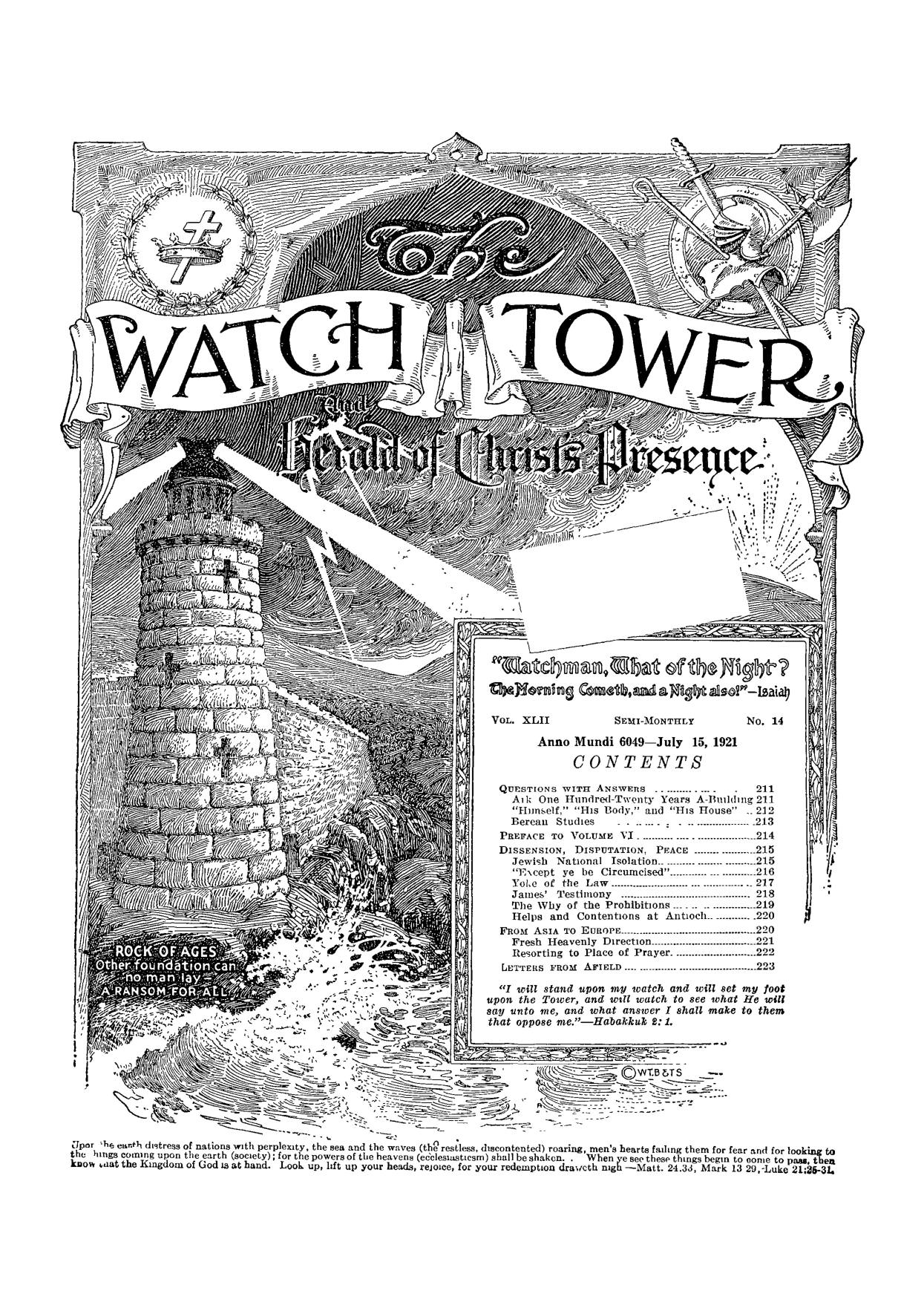
No. 14
th? hinX ™ distress of nations with perplexity, the sea and the waves (the restless, discontented) roaring, men's hearts failing them for fear and for looking to .?+ ?£ i?g u?On ®a*lth (society); for the powers of the heavens (ecclesiusticsm) shall be shaken. . When ye seo these things begin to come to passmen mow <,aat the Jungaom of Uod is at hand. Look up, lift up your heads, rejoice, for your redemption drawcth nigh —Matt. 24.33, Mark 13 29,-Luke 21:25-314
1^]roim5irag <S»^to,auad aMgljfc ^Ww- Isaiai?
Vol. XLII
Semi-Monthly
Anno Mundi 6049—July 15, 1921
CONTENTS
Questions with Answers ..
Aik One Hundred-Twenty Years A-Buildmg 211
“Himself,” “His Body Berean Studies . .
and “His House” ..212
< ROCK OF AGES fether.fou nciationcan
Preface to Volume VI....................
Dissension, Disputation, Peace .....
Jewish National Isolation...............
“Except ye be Circumcised”............
Yoke of the Law..............................
James’ Testimony .............................
The Why of the Prohibitions........
Helps and Contentions at Antioch.
From Asia to Europe.............................
Fresh Heavenly Direction...................
Resorting to Place of Prayer............
Letters from Afield..........................
... .213
.....214
.....215
.....215
.....216
... 217
... 218
.....219
... .220
.....220
.....222
.....223
“I will stand upon my watch and will set my foot upon the Toiver, and will watch to see what Ue will say unto me, and what answer I shall make to them that oppose me.”—Habakkuk 2:1,
THIS JOURNAL AND ITS SACRED MISSION
THIS Journal la one of the prime factors or instruments in the system of Bible instruction, or “Seminary Extension", now being presented in all parts of the civilized world by the Watch Tower Bible & Tract Society, chartered A.D. 1884, “For the Promotion of Christian Knowledge”. It not only serves as a class room where Bible students may meet in the study of the divine Word but also as a channel of communication through which, they may be reached with announcements of the Society's conventions and of the coming of its traveling representatives, styled “Pilgrims", and refreshed with reports of Its conventions.
Our “Berean Lessons" are topical rehearsals or reviews of our Society’s published Studies most entertainingly arranged, and very helpful to all who would merit the only honorary degree which the Society accords, viz., Verbi Dei Minister (V. D. M.), which translated into English is Minister of God’s TVord. Our treatment of the International Sunday School Lessons is specially for the older Bible students and teachers. By some this feature is considered indispensable.
This journal stands firmly for the defense of the only true foundation of the Christian’s hope now being so generally repudiated —redemption through the precious blood of “the man Christ Jesus, who gave himself a ransom [a corresponding price, a substitute] for all”. (1 Peter 1:19; 1 Timothy 2:6) Building up on this sure foundation the gold, silver and precious stones (1 Corinthians 3: Ills ; 2 Peter 1:5-11) of the Word of God, its further mission is to “make all see what is the fellowship of the mystery which. . .hag been hid in God, ... to the intent that now might be made known by the church the manifold wisdom of God”—“which in other ages was not made known unto the sons of men as it is now revealed”.—Ephesians 3:5-9,10.
It stands free from all parties, sects and creeds of men, while it seeks more and more to bring Its every utterance into fullest subjection to the will of God in Christ, as expressed in the holy Scriptures. It is thus free to declare boldly whatsoever the Lord hath spoken—according to the divine wisdom granted unto us to understand his utterances. Its attitude is not dogmatic, but confident; for we know whereof we affirm, treading with implicit faith upon the sure promises of God. It is held as a trust, to be used only in his service; hence our decisions relative to what may and what may not appear in its columns must be according to our judgment of his good pleasure, the teaching of his Word, for the upbuilding of his people in grace and knowledge. And we not only invite but urge ous readers to prove all its utterances by the infallible Word to which reference is constantly made to facilitate such testing.
TO US THE SCRIPTURES CLEARLY TEACH
That the church is “the temple of the living God”, peculiarly his workmanship”; that its construction has been In progress throughout the gospel age—ever since Christ became the world’s Redeemer and the Chief Corner Stone of his temple, through which, when finished, God’s blessing shall come “to all people”, and they find access to him.—1 Corinthians 3:16, 17; Ephesians 2:20-22; Genesis 28:14; Galatians 3 : 29.
That meantime the chiseling, shaping, and polishing of consecrated believers in Christ's atonement for sin, progresses; and when the last of these “living stones”, "elect and precious,” shall have been made ready, the great Master Workman will bring all together In the first resurrection; and the temple shall be filled with his glory, and be the meeting place between God and men throughout the Millennium.—Revelation 15 : 5-8.
That the basis of hope, for the church and the world, lies In the fact that “Jesus Christ, by the grace of God, tasted death for every man,” “a ransom for all,” and will be "the true light which hghteth every man that cometh into the world", "in due time”.— Hebrews 2:9; John 1:9; 1 Timothy 2:5, 6.
That the hope of the church is that she may be like her Lord, “see him as he is,” be "partakers of the divine nature’,’ and share his glory as his joint-heir.—1 John 3 2; John 17:24; Romans 8:17; 2 Peter 1:4.
That the present mission of the church Is the perfecting of the saints for the future work of service; to develop in herself every grace; to be God’s witness to the world; and to prepare to be kings and priests in the next age —Ephesians 4:12; Matthew 24: 14; Revelation 1:6; 20:6.
That the hope for the world lies in the blessings of knowledge and opportunity to be brought to oil Dy Christ’s Millennial kingdom, the restitution of all that was lost in Adam, to all the willing and obedient, at the bands of their Redeemer and his glorified church, »hen all the wilfully wicked will be destroyed.—Acts 3 :19-23 ; Isaiah 35.
■puBLlSH&D By
WATCH TOWER. BIBLE &-TRACT SOCIETY
124 COLUMBIA HEIGHTS a o BROOKLYN, NY U S A' Foreign Offices British 34 Craven Terrace. Lancaster Gate, London W 2: Canadian 270 Dundas St., W, Toronto, Ontario; Australasian 495 Collins St, Melbourne, Australia, South Afri* can. 123 Flein St, Cape Town, South Africa.
Please Address the Society in Every Case.
YEARLY SUBSCRIPTION PRICE. United States, $1 00 , Canada and Miscellaneous Foreign, $150. Great Britain, Alstralasia, and South Africa, £••> American remittances should be made by Express or Postal Money Orders, or by Bank Draft Canadian, British, South African, and /Australasian remittances should be made to bi anch offices only Remittances fioin scattered foieign terutory may be made to the Brooklyn office, but by International Postal Money Orders only.
(Foieign translations of this journal appear m several languages)
Editorial Committee: This journal is published under the supervision of an editorial committee, at least three of whom have read and approved as truth each and every ai tide appearing in these columns. The names of the editorial committee are J F Rcthfrford, W. E. Van Amburgh, F. FI Robison, G H. Fisher, E. W. Brenisen. Terms to the Eord*s Poor: AD Bible students who, by reason of old age or other infirmity or adversity, are enable to pay for this journal, will be supplied free if they send a postal card each May stating their case and requesting such provision. We are not only willing, but anxious, that all such be on our list continually and ux touch with the Berean studies.
A/a/im /zi • We do cot, ns a rule, send a card of acknowledgment for a renewal or
l c cu uUOSLriOtro, fQT B new subscription Receipt and -ntry nf -enewul ore Indicated within a month by ebanee to expiration date, na shown on wrapper label.
Entered aa Second Clou Hatter at Brooklyn, N. Y , Postoffice wider the Act of March 3rd, 1979 ^s=agi—। । ■ ' ■ j
I.B.S.A.. BEREAN BIBLE STUDIES
By Means of -TABERNACLE SHADOWS SACRinctsa
Chapter VIII: Other Significant Types
Week of September 4 . Q.15-20 Week of September 18 - Q. 26-35
Week of September 11 Q. 21-27 Week of September 25 . Q. 36-41
New Tabernacle Shadows, with questions and notes, 25c each
SPEAKERS’ CIRCUIT
Although written in the plainest phrase we know how to use, many seem to misunderstand what heretofore appeared in The Watch Tower under the title “Speakers* Circuit”. Again we define it
Where several classes appoint one member of a committee and this committee meets and makes up a list of speakers to be sent around regularly on this circuit to serve various classes, that is what Is meant by “speakers’ circuit”. Such an arrangement does not properly represent tLe classes and is not for their best interest.
This does not mean, however, that classes cannot Invite the elder of some other class to come and address them. Here the class is acting, whereas in the circuit proposition a committee is acting for the class. There are several classes that desire to invite speakers from neighboring- classes to come and address them every Sunday. This seems to be a mistake. If the brother Invited would conduct a Berean Study it would be much better, and have preaching say once a month; and the other Sundays have a Berean lesson In some places a Berean lesson study for beginners in the ‘'Millions” booklet has been found very advantageous; and after it is finished, it leads on into a first volume study.
Instead of a class sending its elders out to serve other classes on Sunday it would be much better for the classes to engage in extension work bv holding public meetings in suburban towns where there aie no classes. In this way after one or two public lectures the intoiost usually develops to such an extent that a Beiean clas*? can be started. It does not seem advantageous, however, to have too much preaching service for the consecrated. The classes adopting the Beiean lessons have always made the more progress.
CANADIAN CONVENTIONS
A senes of conventions of the International Bible Students Association has been arianged for Canada, as follows Winnipeg, August 5-7; Saskatoon, August 7,8: Edmonton August 9,10: Calgary. August 10,11: Vancouver, August 13,14 A number of the Pilgrim brethren will be at each one of these conventions and a public meeting will be held at each place address by the President of the Society. Friends desiring infoimotion about accommodations at these places will please communicate with the
respective secretaries, as follows Mi L W Burgess. 19 Evanston St ,.........-.........Winnipeg, Man.
Mi G P Naish 1025 Avenue B, North,.............. Saskatoon, Sask.
Mr H Looker. 10965 127th St,.........................Edmonton, Alta.
Mrs B F Cook. 609 Sixth St, West,................ Calgary, Alta.
Mr B Siblev, 1820 Seventh Ave , West,................Vancouver, B. C.
GERMAN, SPANISH, AND YIDDISH “MILLIONS”
We now have the “Millions” booklet in the languages mentioned in the above heading. They are unifoim jn size and style with the En6iWh edition The puce is also unifoim, 25c foi an individual copy postpaid—and other prices as announced to class secretaries and colporteurs.
AND HERALD OF CHRIST'S PRESENCE.
Vol. XLU
July 15, 1921
No. 14
QUESTIONS WITH ANSWERS
QUESTION: Is it correct to consider the scapegoat as having been taken into the Court, presented to the Lord, and later taken outside and sent into the wilderness'?
Answer: Strictly speaking, the scapegoat as such was not taken into the Court; for there was no scapegoat until after the casting of the lot. Both goats were taken m “foi a sin ottering’’. (Leviticus 16: 5) The same things happened to both goats and there was no difference whatever till the casting of the lot< It would be true to say that the goat which became the scapegoat was taken into the Couit just as the other goat was.
Aaron’s official ground was inside the Tabernacle enclosure. Outside of that he had no duties to perform, nor was he to step outside in his official garments. Whatever he did of an official nature was therefore done inside the Court. Lt was there he “took” the goats; it was there he “presented” them before Jehovah at the door of the tent of meeting; it was there he “cast lots”, one lot for Jehovah and the other lot for Azazel. As for the other details pertaining to the goats we quote from Alfred Edersheim, a converted Jew, in his work “The Temple” describing the Day of Atonement, in part as follows:
■’The first part of -the expiatory service — that for the priesthood—had taken place close to the Holy Place, between the poich and the altar. The next was performed close to the woishiping people. In the eastern part of the Court of Priests, that is, close to the worshipers, and on the north side of it [the brazen altar] stood an urn, called Calpi, in which were two lots of the same shape, size, and material—in the second Temple they were of gold; the one bearing the inscription ‘la-JEH0VAH’, for Jehovah, the other ‘la-Azazel’, for Azazel—rendered “scapegoat” in the Authorized Veision—These two goats had been placed with their backs to the people and their faces towards the sanctuary (westwards). The high-priest now faced the people [and the two goats] ;—he took the urn, thrust his two hands into it, and at the same time drew the two lots, laying one on the head of each goat [that in his right hand on the head of the goat at the right, and that in his left hand on the head of the goat to the left]. The two goats, however, must be altogether alike in look, size, and value; indeed, so earnestly was it sought to carry out the idea that these two formed parts of one and the same sacrifice, that it was arranged they should, if possible, even be purchased at the same time. The lot having designated each of the two goats, the high-priest tied a tongue-shaped piece of scarlet cloth to the horn of the goat for Azazel—the so-called ‘scapegoat’—and another around the throat of the
goat foi Jehovah, which was to be si..in. The goat that was to be sent forth was now turned round towards the people, and stood facing them, waiting, as it weie, till their sms should be laid on him, and he would carry them forth into ‘a land not inhabited'.”
Those expci lences which involve the specific dealings of the gieat High Priest are pictured in the Court where the High Priest is. But those experiences which are outside the high-priestly supervision are shown in the ihinga which happened to the scapegoat outside the Couit and outside the Camp also. This does not imply that the members of the scapegoat class have lost justification, otherwise God could have no further dealings with them., nor could they become the great-company class.
Hegarding the expression in Leviticus 16: 7, “at the door of the tabernacle of the congregation,” we note that the word “at” is in italics, therefore a supplied word. For further elucidation see page 142 of the new Tabernacle Shadows Appendix, note on paragraph 119.
ARK ONE HUNDRED-TWENTY YEARS A-BUILDING
Question: How do we know that it took one-hundredtwenty j ears to build the ark, as I do not find the Scriptures to state the time?
Answer: “Noah was a preacher of righteousness.” (2 Peter 2:5) He preached 'during the period before the flood. Another statement which implies much time in connection with this work of Noah is: “When . . . the longsuffering of God waited in the days of Noah, while the ark was a preparing”. (1 Peter 3: 20) Noah’s preaching would no doubt consist of telling the people about the coming flood and of showing them the advantages of cooperation with him in the work on the ark and in the work of declaration then so important. Information about this oncoming flood Noah had from God. (Genesis 6: 13) God said that his spirit of truth and righteousness, as exemplified m Noah and in the message which he preached, would not always strive with men, implying that it would strive as long as Noah was there and as long as there was anyone to be reached by the message. Since Noah was upright, he would surely begin to preach and build at once when the mission was given to him. He did not delay to declare the word of God by taking his own time about the matter or by deciding that the message was too
strong for the people and needed to be toned down and smoothed over a little. No: “Noah did according to all that God commanded him”. (Genesis 6:22) It is no wonder that “Noah found grace in the eyes of the Lord”.—Genesis 6: 8.
The longsuffenng of God ano the striving of his spirit, one hundred-twenty years, is thus identified with the work of preaching and of building the ark, clearly implying the same period of time.
GENDER OF THE SPIRIT?
Question: Does the expression “born of the spirit” in John 3:8 imply that the spirit is feminine?
Answer: No: that expression if it be taken to imply gender at all, would rather favor the masculine thought. Those words do not mean Torn out of the spirit'" as a child is born from a mother, but rather born as a result of the spirit begetting, in contradistinction to those who are born as a result of the human begetting. This idea is more clearly brought forth elsewhere: “As many as received him, to them gave he the right to become children of God, to them that believed on his name: who were engendered, not of blood, nor of the will of the flesh, nor of the will of man, but [engendered by the will] of God”. (John 1:13) “Having been engendered anew, not of corruptible seed, but of incorruptible, through the Word of God which liveth and abideth.” (1 Peter 1:23) Again: “Of his own will engendered he us by the word of truth”. (James 1:18) “That which is engendered of the spirit is spirit.”—■ John 3: 6.-
From a comparison of these texts it is indisputable that “spirit”, “word,” and “will” of God are used with practically the same meaning. Not that they have the same meaning under all circumstances but that in connection with this subject of spirit-begetting they represent only slightly different phases of the same operation. God’s will for us is expressed in his Word; therefore his will and his Word are bound together in their relationship to us. Also, he has chosen to exert his power (for the purpose of inspiring us to make a consecration and for the further purpose of encouraging us to be faithful in that consecration) through his Word. He has charged his Word as a great storage battery for the engendering and developing of a house of sons. Therefore it is plain that no thought of gender or sex need attach to the word spirit at all.
The begetting is in the nature of a contract on God’s part. The individual, by the aid of some elementary information from God’s Word, consecrates or dedicates or devotes himself to the ascertaining and doing of God’s will. God has made an arrangement in Jesus for accepting these consecrators and for bringing them into the divine family through the cutting off of the human life and its privileges (just newly accruing to them as a result of the work of Jesus on their behalf), and the authorizing for them of a new life, which new life is to be nurtured at the expense of the “outward [or ostensible] man” (2 Corinthians 4:16), but by the Word of God, as food, or strength and growthproducing regimen. When this contract, covenant, or solemn agreement by sacrifice is fulfilled, we shall have the new life without any trammels, and Jehovah will have the sacrificed humanity, never to be retracted.
“HIMSELF,” “HIS BODY,” AND “HIS HOUSE”
Question: In Tabernacle Shadows, paragraph 109, are found these words: “And Aaron shall offer his bullock of the sm-offering, which is for [represents] himself, and make an atonement for himself [the members of his body—the under-priests] and for his house [all believers, the entire “household of faith’— the Levites] . . . ’’etc. If “himself” covers the body members and “his house” the great company part of the true church, why is “and” stricken out twice in the suggested notes on paragraph 131, causing those places to read: “On behalf of his body, his house,” and “representatives of his church, his body, his house,” instead of “his body and his house”?
Answer: These changes were suggested because they seemed to be required by the facts. The church is our Lord’s body (Colossians 1:24), and it is also his house. (Hebrews 3:6; 1 Timothy 3:15) The only question is as to what ‘“himself” in Leviticus 16: 6 means. If it means the body of believers under the antitypical High Priest, then those believers are doubly represented in the same figure; an improbability. It cannot be thought that a separate atonement for the less faithful believers is intended to be pictured by the under-priests, for the Scriptures do not teach a separate atonement. Nor is it reasonable to suppose that the under-priests picture or stand for a class lower than themselves. The under-priests themselves represent the church, whether faithful or unfaithful. Who then is “himself”?
We answer that, with no adequate reason to the contrary, the Bible is to be read like any other book and words are to have their simple and literal meaning. If a literal meaning contradicts some other perfectly plain statement of Scripture then we are at liberty to look for a symbolic meaning. There is nothing in Scripture that forces a symbolic significance upon this word ‘himself’. If the house is literal, then himself is literal. No one doubts the literalness of his house. The literal house was made a picture of something else, but that does not change the fact that the house was there and that the word had its usual signification. Aaron’s house could not be Levi’s house. Aaron himself was of the house of Levi, but Levi’s house was not his house. ‘Aaron’s house’ was not the house to which he belonged, but the house of which he was the head. House means primarily household (Hebrews 11:7); but as that simple unit expands it conies to mean lineage. Witness, “Go thou, and all thy house into the ark”; “These be the heads of their fathers’ [not their] houses”; and “there was a man of the house of Levi’’.
Forgetting momentarily the antitype, the word “himself” in this passage certainly applies to Aaron as an individual just as surely as the words “his flesh” in Leviticus IS: 24 apply to Aaron’s own body of flesh. Now it is not claimed that “his flesh” in this passage refers to the church, but rather that the washing here u as a part of the ceremony for the cleansing the typical high priest. This cleansing of the typical high priest was not designed to picture any washing on the part of our Lord, but was designed to call attention to the fact that he, as the great High Priest, would himself be clean and unsullied by the sin-bearing work which he would have done. Evidently the atonement which Aaron made for himself as the head and as an integral part of his own house has a similar significance: to emphasize the fact that the great High Priest will himself be at one with the Father. This at-one-ment is made to extend to the members of his house, his followers during this age, even as Jesus in his high-priestly prayer for the church petitioned the Father that it might be.—John 17: 21.
We therefore suggest that, as an additional correction, the words m paragraph 109 of Tabernacle Shadows now following the word “himself” and reading, “[members of his body—the under-priests]” be stricken out. If “his house” includes “all believers” then manifestly some of them cannot be comprehended elsewhere. As a further alteration we suggest that the bracketed expression following “his house” be allowed to stand except that after the words “household of faith” in the same paragraph, 109, the word “Levites” be changed to “household of Aaron”. The word “house” in this passage is evidently intended to specify the underpriests; for the word priests is used in Leviticus 16: 33, there meaning both father and sons. This bullock was the kind of offering prescribed by the law to be made for the anointed priest in the case he sinned.—Leviticus 4: 3-15.
It is an erroneous conception, not founded on Scripture facts, to say that the tribe of Levi as a consecrated tribe existed before the priesthood. Exactly the reverse is true. A reading of Numbers 3: 1-4 in connection with 3: 12, 13 establishes the fact that the priesthood was authorized and inaugurated before the tribe of Levi ■was exchanged for the firstborn of all Israel. Numbers 3: 5-10 records the authorization for the giving of the Levites to be helpers of the priests. The account says: “And thou shalt give the Levites unto Aaron and to his sons: they are wholly given unto him on behalf of the children of Israel”. The priesthood, therefore, was not chosen from the tribe of Levi because it was different from any other tribe at that time; but the tribe of Levi was, in all probability, chosen to serve the priesthood and to take the place of the firstborn because Moses and Aaron and the priesthood all belonged to that tribe, and because it approximated the firstborn in number. These facts completely obliterate any foundation for the thought of justification prior to consecration.
BEREAN STUDIES
Question: Is it the best way when we meet for Berean studies to read a chapter from the Bible every time before we take up the lesson?
Answer: We believe that the best method, everything considered, for conducting a Berean study is outlined in the Sixth Volume of Scripture Studies, Chapter VI. In view of the shortness of time available in any Berean study, we see no advantage in reading at random a chapter in the Bible. The custom of reading the Bible in public arose at the time of the Reformation, because few could read for themselves and few were able to own a Bible. It is certainly no discourtesy toward God’s Word to spend the time in a Berean study on the specific subject for which the friends have come together. It is assumed that they know how to read and that they do read the Bible for themselves. Furthermore, it is quite appropriate that any parts of the Bible bearing directly on the study of the evening be read as they come up in connection with the study.
Few friends under the complex responsibilities of the present day have more than an hour to spend in a study. Indeed, it is seldom advisable to spend more time than this, because of different temperaments and because of early mental exhaustion on the part of many, causing them to forget the points first considered in a lesson, if it becomes too long.
ECCLESIAS’ AFFAIRS
A brother writes to know how the affairs of a local ecclesia should be conducted with reference to receiving and paying out money and keeping accounts. Our answer to this is that the Lord’s business requires a strict accounting, like all others. We learn all our economy from the great Jehovah. Everything is done orderly in his arrangement.
Our suggestion is, therefore, that each class should have a secretary that would keep the class records and do the correspondence, and if possible this should be done on a typewriter and letters should be brief and to the point.
Each ecclesia should have a treasurer, into whose hands all the money for the expenses of the class is paid; and for each bill he pays he should have a receipt and keep a proper account. Better still, if the bills are paid by check, then a record is kept which can be a check on the other account; and regularly an account should be rendered to the ecclesia that they may know how their affairs are being conducted. Each one who contributes is entitled to have the best service rendered in this behalf and to know that the money is spent for the best purpose. The system adopted by the Society is to account for even every postage stamp that comes into the office or goes out. We think this is a good way.
PREFACE TO VOLUME VI
IN 1916 Brother Russell rewrote the preface to Volume VI, and in this he states that he had changed concerning his view on justification. Because many of the friends have not this preface and have made request for it, we publish it in The Watch Tower as it appears in the latest edition of Volume VI.
THE AUTHOR’S FOREWORD
Much of the work of every servant of God Is done in the dark—that is to say, like the weaver of a beautiful carpet we stand at the back seeing little of the results of our labors, and trusting that in the Lord’s due time we shall hear his “Well done” and see some fruitage. “I shall be satisfied when I awake in his likeness.”
Nevertheless, the Lord has very graciously given us encouragement in respect to the influence of this volume iu various parts of the vvoild in the hearts of God's people. The pleasure has been ours of hearing from many respecting the blessings received from a better understanding of the justification, the sanctification, and the deliverance, promised to the church in God's Word Many otheis have told us of the blessings received from the Scriptural advice given to husbands and wives, parents and children, in respect to the ways of peace, iighteousness and growth in grace. Many also have informed us of great blessings and aid in respect to the duties, privileges and obligations of elders and deacons, and the Scriptural ordei in the ecclesm. We rejoice in these things and trust that the good woik will go on under divine guidance to the praise of out Loid and for the comfort and edification of his people
We call attention to the fact that since this volume was written the light has grown still clearer respecting God's great covenants We now see that the Law Covenant was a foreshadowing of the new (law) covenant, which is about to be established at the second coming of Jesus, by the great Mediator, Jesus the Mead and the church his body — the antitype of Moses, who wrote. “A prophet shall the Lord your God raise up unto you from amongst your brethren, like unto me”. Moses was merely the tvpe of this greater Prophet, and the law covenant which Moses mediated was merely a type or foreshadowing of the greater law covenant of the Millennial age.
God raised up Jesus the Head of this great Mediator first, when he raised him from the dead Since that time, he is raising up the church as a new creation, and when all the brethren of the body of Christ shall have been gathered from the world through a knowledge of the truth and sanctified by the holy spirit and been found woithy by faithfulness unto death, and all shall have been raised up by the power of God from the earthly conditions to the heavenly conditions as the body of Christ, the great antitypical Melchizedek w ill be complete, a priest upon his throne—the great Mediator of the New Covenant will be enthroned in divine power. Then the New Covenant will go into operation, as God said to Israel. “Behold the days come, saith the Lord, when I will make a new covenant with the house of Israel and with the house of Judah”.
The antitypical Mediator, after paying over to Divine Justice fully and forever the ransom-price for Adam and his race, will assume full control, and under that New Covenant, thus sealed, will begin the work of blessing and restoring all the willing and obedient of Adam’s race All who will come into harmony with the Lord will be counted as part of the earthly seed of Abraham, until finally, by the end of the Millennium, all exercising faith and obedience will be known to the Lord as the seed of Abraham. “In becoming that seed, shall all the families of the earth bless themselves.”
Inadvertently, the name new covenant, which belongs to God’s dealings with the world during the Millennium, has been used in respect to the covenant which is now in operation during this Gospel age with the church. Our covenant, of course, is a new covenant in the sense that it is different from the Jewish covenant of Mt. Sinai, but it is not the new covenant. The church’s covenant is referred to in the Bible as a “covenant by sacrifice”. The keeping of these matters in mind will be of benefit to the readers of this volume All of these covenants stand related to each other. All of them were represented and typified in Abraham and the covenant which God made with him. The church is styled Abraham’s spiritual seed and likened to the stais of heaven. The world of mankind as they come into haimon.v with God will become Abraham’s earthly seed—as the sands of the seashoie The spiritual seed will be the channel ot blessing tor the natural seed.
The subject of justification has not changed, but it has expanded and clarified It writing this volume today, the author would make some slight variations of language, but without any real change as respects the meaning and application of the word justification.
We now see that a justification to life is one thing, and a justification to more or less of friendship with God is anothei Abraham, for instance, and the faithful before Pentecost, were justified to fuendship with God and to have more or less communication with him by prayer, etc.; but they could not have full justification until the blood of atonement had been shed, and until it had been presented to and accepted by Divine Justice—the Father. Just so the sinnci today approaching God might be said to in the wav of justification—he would have more of God’s favor than if he faced toward sin.
M e once spoke of a sinner in this condition as being justified, because he believed in Jesus as his Redeemer and was leaching forward to a full consecration of himself Now we see that while the sinner’s attitude, like that of the ancient worthies, might be styled “tentative justification”, it would not reach the condition of a full, complete justification from sin until the sinner had fully presented himselt in consecration to our great High Priest, Jesus, and had been accepted of him in the name of the Father. Then, under the covering of the imputed merit of Christ’s saciifice, the sinner would be acceptable to the Father under Christ's robe and begotten of the holy spirit.
Fori unate it is for the masses who have heard of Jesus and p.u li.illy believed, that their standing with the Lord is not that of lull justification, that he refuses to fully justify any until they have become by covenant his disciples, his footstep followers. This is because justification can come only once to each individual, and if he should misuse that justification and fail to get eternal life, he would be in a worse state than if he had never been justified. If not justified and spirit-begotten in the present tune, he is not of the chuich, but will have a share in the merit of Christ’s sacrifice and in the justification which his kingdom will offer to every member of the human family—aside from the church—the church receiving that better tiling which God hath in reservation for them that love him—glory, honor, immortality, the divine nature.
To many it would not seem worth while to mention these fine distinctions upon the subject of justification; and yet, having received this clearer appreciation of the divine plan, we have pleasure in passing it on to all who hunger and thirst after righteousness—to all Bible students everywhere.
May the Lord continue to bless this volume to the good of his people, is the prayer of the author,
Brooklyn, N. Y., Oct. 1, 1916. Chables T. BussEI
DISSENSION, DISPUTATION, PEACE
--August 21 — Acts 15:1 —16:5--
THE D1SPU1E AL ANTIOCH — THE DECISION AT JERUSALEM — CONTRIBUTION.-* OF PETER, PAUL AND BARNABAS, AND JAMES—A LETTER OF CONSOLATION-—DISSENSION OVHl JOHN MARK— AGREEING TO DIFFER.
"Hut uc bcheic that ilc shall be saved tluouijh the <j>ace of the Lord Jesus"—Acts 15:11.
IN OUR lust lesson ne traced the return of the missionaries Pnul noil Ihirnnbns from the highlands of Galatia and Lje.ibni.i link to then brethren, and ours, in Syria.
Because «t> «.»•» see illustrated an important piinciple. it is north nluhi to comp.ue this joiiinex from Attalla to Antioch with another undei taken by "Christian warriors” eleven centuries later. Conrad and Louis, each with an army consist mg at hist of sexenty thousand men, marched through part ot the same districts ninth had been traversed by the first missionaries of Jesus Chrtst—Conrad and Louis, on an unauthorized mission, relying on the arm of flesh and the arms of steel; Paul and Barnabas, alone and unprotected by human aid; yet which were the greater? The French hosts are hardly lemembered save for their pillaging, their murders, their rapine, and for their encompass-ment with defeat and death They arrived at Attalia in disaster and disgrace, sailing thence a dispirited and broken army. But the true crusaders, of the first century, though they passed through much tribulation, went from victory to victory Their return to the place “whence they had been recommended to the grace of God for the work which they fulfilled”, was triumphant and joyful, for the reason that the weapons of their warfare were “not carnal”, and the victory was not theirs but God’s. The Lord himself was their Tower and Shield.
Then there was the arrival at Antioch: the cross-bearing army of the twelfth century was received In great pomp and magnificence by Raymond, “Prince of Antioch,” together with all the nobles and chief ones of the people, in the presence of a great assemblage of the clergy and popu-'ace; the cross-borne followers of Jesus entered Into the city and “gathered together the church, and told them how God had worked with them, and how he had opened “the door of faith to the gentiles”.
Thus is illustrated how that, regardless of numbers or worldly might, ‘without him they could do nothing,’ and how that, on the other hand, regardless of the fewness of the workers or of the seeming odds against them, ‘they could do all things through Christ who strengthened them’.
IMPORTANT QUESTION AT ANTIOCH
No period, however, of the gospel age, not even the earliest, has been without Its difficulties, controversies, and corruptions. The presence of Judas among the apostles, of Ananias and Sapphlra among the early believers at Jerusalem, show with what assiduity Satan seeks to arrest, to divert, to pervert, and to debauch the truth. The misunderstanding between “Hellenists and Hebrews” In the days of Stephen, the suspicion of the apostles and others against Saul when he came from Damascus to Jerusalem, the retirement of Mark from the first missionary trip, serve as Illustrations of the prejudice, Ignorance, and weakness with which the grace of God had to contend in the hearts of the early believers, even as it has to contend in us. But ours is the loss if we ‘quench the spirit’ and fall to ‘mortify the deeds of the body’.
So It transpired that some time after the arrival of the missionaries from Asia Minor there followed a troubled controversy which involved the most momentous consequences to the church, both then and since. But the same Lord who had promised to be with them all the way, even unto the consummation of the age, overruled and guided the situation for their blessing and ours. This controversy centered around circumcision, but was really regarding the relation
ship which gentile believers were to bear toward the Mosaic law and tifes generally.
It is exceedingly difficult, if not impossible, for us who have nexer kuoxx n the many and intricate obligations of the law to realize very keenly the point of the strife. The feeling betxveen Jexx- and gentile was strong. In Roman colonial cities the dxxellings of the txxo might be side by side, yet they were separated from each other by deep-rooted feelings of aversion and contempt. The "middle wall of partition” (Romans 2:14) was built up by very diligent hands on both sides. The Jews had their synagogues, and the heathen had their schools of philosophy for the intellectual and their shrines for the common people. Hence the Jews were surrounded in their foreign settlements not only by an idolatry which shocked their inmost feelings and by a shameless profligacy and licentiousness which was unforbidden by and even connected with that xvhich the gentiles called religion, but in addition to this by a proud and contemptuous philosophy xvhich alienated the more educated classes of society to as great a distance as the unthinking commoners.
JEWISH NATIONAL ISOLATION
This separation xvas both religious and social. The Lord had given the Jews a laxv xvhich sanctioned the principle and enforced the practice of national isolation. It was hard for these Jews to believe that that laxv with which all the glorious things of their history were associated was meant to endure for only a limited period of time; and in this they were partly right. The law has yet to see its greatest glory under Messiah’s reign.
We cannot but sympathize with the difficulties which presented themselves to the minds of the Jews (and consequently to the Jewish believers in the Messiahship of Jesus) at the thought of having a cordial union with the uncircumcised even though idolatry was abandoned and Christ was believed. The peculiarity of the ceremonial observances which were binding upon the Jews placed insurmountable difficulties in the way of social intercourse. They could not eat with other men, as a Hindoo cannot eat with a Pariah, a Parsee, or a Mohammedan. Similar restrictions had obtained in ancient times: ‘it xvas an abomination for the Egyptians to eat bread with the Hebrews’. (Genesis 48:32) So God placed a like prohibition upon the Israelites: they might meet gentiles in places of public resort, buying and selling, conversing and disputing; but then families were separate; in the domestic life it xvas “unlawful”, as St. Peter said to Cornelius, “for a man that Twas] a Jew to keep company or to come unto [1. e., visit] one of another nation”. (Acts 10:28) The same Apostle was taken to task by his fellow Christians of Jerusalem because he had “gone in to men uncircumcised, and had eaten with them”.
These genuine difficulties, which could not be blown away like dandelion bloom, formed the basis for the most serious dissention of the early church. They seemed actually to forbid the formation of one church in Christ Jesus IIoxx Jews and gentiles were to be religiously united without the enforced application of the whole Mosaic laxx bade fair to be a problem impossible of solution. And without the direct intervention of the Lord’s grace, and xxithout his ever-watchful guidance it would have been impossible But it was still true as it had been of old: “He watching over Israel slumbers not nor sleeps”.—Psalm 12i:‘4.
“SUBVERTING YOUR SOULS”
“Certain men,” “false brethren” (Galatians 2:4), had gone up from Jerusalem to Antioch in some such manner as to warrant describing them as ‘spies’. Possibly they had proceeded to Antioch by way of some other Syrian city and represented themselves as being newly-inteiested inquireis However it was, they were false as brethren; not by being non-beheveis (for they seemed to accede to the determination to take the question of dispute to Jerusalem), but by being false or untrue in the capacity of brethien. They came to Antioch with the deliberate purpose of “subveiting” (Acts 15:24), or, as marauders and robbers, of stealing away into the Jewish house the souls of gentile believers there They were of the Pharisaic school, but, unlike Saul, had not lost then superstitions and bigotry.
Persecution had failed to stop the progiess of the gospel, so the arch enemv of God and of God’s church sought to nullity its influence from within, even as he has often done in snnilai circumstances since. It may all be true that these Chustianized Pharisees weie conscientious It-may be tliev saw the drift Jewish nffans v.eie taki 'g. the corruption of the priesthood and of the whole lehgious system into one of politics. It may be that these considerations led them to believe thal aftei all. they had m ide a mistake in not accepting Jesus as the Messiah It may be that, as a lesiilt of these cogitations they determined to espouse the name of the Nazarene and to stai t a new holiness society among the Chnstians in and by winch f’e Jewish polity would be kept from utter nun and dissolution But if this was their piocess of thought and their object, it fin lushes only’ another case of nmie conscience than humility, of more eagerness to sacrdiie for what they thought ought to be done than willingness to submit humbly to the guidance of the Head of the church Had they had the spmt of the truth they would have been willing to leave such an impoitunt question to the divinely appointed apostles in the first place, rather than take matters into their own hands and go hundieds of miles to another city’ and tlieie play a false role
“EXCEPT YE BE CIRCUMCISED”
But, having made the descent from the hills of Judea to the distant planes of Sy nil, these Judaizmg men gradually insinuated their ideas as to what was necessary to salvation into I he minds ot gentile brethien m Antioch This gradual process is implied by the tense of the Gieek verb They said that cn cumcision was not merely an expedient thing, but that it was necessary to salvation. Tins was important, seeing that some of the brethien had been gentile believeis there for eight or nine years. What, could it be that they were all mistaken and that they were not in the way of salvation at all1 But Paul came quickly to their encouragement ; for he gave place to such doctrines, “no, not for one hour”. (Galatians 2:5) He promptly and steadfastly opposed these teachings as being unwarranted by and out of harmony with the facts. It is evident from this that Paul and Barnabas had not practised the rite of circumcision on gentile converts and that they intended, as the Lord intended, to found the Chustian church on the principle that the Jewish ceiemonies were to cease.
The Jew’s regaided circumcision as indispensable to salvation. All full proselytes to Judaism were circumcised. The grounds on which they would press, it on the attention of gentiles were doubtless made to appear very plausible. It would be maintained that the laws of Moses were the law’s of God, and were therefore unchangeable. It would probably’ be urged that the religion of the Messiah was only a completing and perfecting of the Jewish religion, that it was designed simply to carry out its principles according to the promises and not to destroy anything given. And if these arguments were well met, they could still say that the rite of circumcision was given four hundred thirty years berore Moses became the mediator for the people of Israel (the same kind of argument winch Seventh Day Adventists use respecting the Sabbath) ; and if this failed to impress, they could appeal to sentiment and say that not only had circumcision been ordained of God (Genesis 17:1-10) but that it was the badge of honor worn by the great and holy men of Jewish history, by those through whom Jehovah had given “the oracles of God”, that such served as a bauier to keep out the awful excesses and iniquities of heathendom, and that converted heathen would need such a help, etc , etc.
But St Paul, with the discernment that was granted him as an apostle and especially as “the apostle to the gentiles” sensed the fallacy and the danger of all this. He knew that love for Christ, for the truth, for the brethren, was a more effective guaianty of a pine and strong life than all the ritualism which Judaism could muster. He knew, too, because he had been over the mound himself. Accordingly, he argued the point stoutly with the mischief-makers from Jerusalem; but when it beenme^plain that a seiious rift in the chinch was imminent, and when it was shown him “by icvelation” (Galatians 2:2) that lie should do so, he agreed to tiansler the entire controversy to Jerusalem to be taken up by and before the apostles ami elders there.
PAUL NO POPE
Had Paul had the slightest inclination to be a pope he would have bilked at this ariangement as a lowering of his apostolic dignity. Was he not just as capable of settling such a question as anyone m Judea’ Yes. Was he not bettei able to do so than anyone m Jerusalem? He was; for it was he who explained something he never learned iu Jerusalem (Galatians 2- G), saying, “I do not frustrate the grace of God; for if iighteousness come by the law then Christ is dead in vain”. But the Apostle was willing to leave the matter of his own honor to the Lord; and his honor lias been taken care of much better than it would have been had he done differently in this case. The “revelation” was probably made to the whole ecclesia, as had been the case in the first sending forth of Barnabas and Saul. At all events, the whole ecclesia concurred in the determination to have a deputation go to Jerusalem.
It is quite probable that the opposing taction readily agreed to the change of venue, so to speak, to Jerusalem; because Jerusalem would be legarded by even them as a souice of authority ; because most of the apostles and the most experienced Christians lived there, who were all continuing as yet to attend the Temple services and to conform to the Jewish customs ; because these, who had come from Judea would hardly lecognize the apostleship of Paul; and because they had, doubtless, a very confident expectation that the controversy would be decided in their favor by those who were all Jews by birth.
Paul and Barnabas with other brethren (probably of each party) were not only sent forth to the apostles and elders of Judea, but they were actually accompanied part way by a goodly number of Syrian brethren, as was the custom in those times. Among those who accompanied the two special delegates all the way was Titus, a Greek believer, possibly taken along as “Exhibit A” in then defuse against the Judaising Pharisees, to show them what a noble and believing gentile was like—though, of course, Paul would be too tactful to call attention to Titus as such; he was merely there, and his presence itself spoke.
On the ten or twelve days journey to Jerusalem the little party passed through Phoenicia and Samaria, stopping long enough at the various towns to tell the brethren there of the blessings of God which had attended the missionary trip into Asia Minor. The brethren rejoiced at this. And this rejoicing was an evidence of their own deep interest in the cause of the gospel. Where believers are themselves awake and engaged in the Lord’s service they rejoice to hear of others becoming interested. Where they are cold they hear such news with indifference, with the utmost unconcern. We can safely judge of our own interest in the Lord’s matters by our emotions on hearing of new interest.
RECEIVED AT JERUSALEM
While the deputation was sent only to the apostles and elders of Jerusalem, still we find that the church received them first. Probably this was in the nature of an informal social reception, followed by a private conference (Galatians 2:2) with the other apostles and with the elders, at which the object of the visit was stated and the charges of the Pharisaic brethren were pieferred against Paul and Barnabas. Although the proposition of the Phansees was stated in difleient language, it amounted to a ehaige of renussness against Paul and Barnabas for their failure to insist upon the rite of circumcision and the keeping of the Mosaic law generally on the part of those gentiles who had believed during the Asian tour. It was a challenge of the legitimacy of all their operations during the past seven or eight years.
This tiip to Jerusalem was the third made by the Apostle Paul since ins conversion. Five visits are distinctly iecorded in Acts and two others clearly implied: (1) his first coming to Jerusalem from Tarsus when a lad; (2) his return to Jerusalem after our Lord’s ministry (everything argues for his absence from Palestine during that period) ; (3) his arm al after his escape from Damascus; (4) the time when he, with Barnabas, took the contribution from Antioch for the Jerusalem brethren in a season of famine; (5) the occasion now before us when he went up to the council or confeience, (G) one time between the conference about the gentiles and his last visit, when he kept the Passover memorial with the brethren there; (7) and his last known trip thither, when the uproar was made in the Temple and he was taken into the custody of the Roman garrison. While the first, third, and last of these visits seem to be the most impoitant in Paul’s individual experiences, the fifth (or third, counting from his conveision) bears more importance to the church as a whole, although he himself learned nothing at all at that confeience (Galatians 2: G) It was on the occasion of his first short visit after escaping from Damascus that, while piaying in the Temple, he was given an ecstatic vision of the age to come and told to depart from Jerusalem because the Jews would not hear his message.—Acts 22 : 17-21.
THE CONFERENCE
“The apostles and elders came together, to consider this matter.” They did so in accordance with the authority in Matthew IS 19,20, not to decide it arbitrarily, or in any other manner, without delibei ntion. There was no liocus-pocus, no stage play, it was a genuine problem and deserving ot careiul attention While there was a private conference connected with the visit, it seems evident tli.it that was merely one m which the situation w'as explained and the purpose of the visit stated One would incline to think that this meeting (veise G) of the apostles and elders was private, were it not for the statement in verse 12 about the multitude, which had nothing to do with the conference, but which was present and which did concur in the findings
Many questions arose in that meeting and there w'as evidently much difference of opinion. There was “much disputing”. But this word does not have its modern tinge of heat and anger. There is no evidence that there was undue warmth or strife. Those participating were men of strong convictions, and their experience had taught them to stand up for what they regarded as truth; but we have a right to assume that there was no infantile squabbling or petty fussing. While personalities were somewhat involved, it was not a personal question, but one of deepest moment to the church for centuries.
Finally, seeing that nothing especially constructive was being done, Peter, in all probability the oldest and the most accustomed to lead off, rose up and gave some real testimony, some indisputable facts. Aside from his age and experience there was a peculiar reason for Peter speaking here. Me had had evidence that God had accepted gentiles without the Mosaic rite. His testimony therefore was “competent”, “relevant,” and very “material”. He referred to the fact that God had long before made choice of him among the apostles to give the first message to the heathen. (Matthew 16: 18,19; Acts 10) His hearers were well aware, he said, that the converts in Syria and Cilicia were not the first from the nations to accept Christ and be accepted of him. The first instance ought to be significant Furthermore, a communication of the holy spirit was the true test of God’s acceptance; and God had shown that he w'as no longer a respecter of persons, as relating to the gospel, by shedding abroad the same miraculous gifts on Jew and gentile and purifying by faith the hearts of both alike.
YOKE OF THE LAW
And then St. Peter proceeded to speak in touching language of the yoke of the Jewish law. Its weight had borne heavily upon many generations of Jews. This was well known by those very Phansees who were listening at that moment. M liy then, should they tempt God, or piovoke him to displeasute, by ignoring the decision which he himself had already given on the point at issue God had already accepted the gentiles without Mosaic rites ot any kind; why piovoke him by attempting to impose upon his own people rites without his authority and against his own manifest will? It would be like going to another man’s servant and insisting, regardless of the washes of Ins master, that that servant wear a certain kind of clothing or have his hair cut so. The thing, as St. Peter argued, winch was before the assembly w’as not the duty of inventing laws and arrangements for the gentile believers but of discovering and recognizing those which the Lord had already made.
A joke is that winch is burdensome and oppressive The ceremonial laws and customs of the Jew’s are referred to as a “joke of bondage”. (Galatians 5:1) A joke is an emblem of slavery or bondage (1 Timothy G’l); or of aflliction (Lamentations 3:27); or of punishment (Lamentations 1:14) ; or of oppressive and burdensome ceremonies as in this place; or even of just and proper restraints and servitude under which the new creature woiks not onlj’ for but with his Master.—Matthew' 11 • 29,30
The Apostle closed his reinaiks bv stating that the expensive and painful and higldj inconvenient obligations of the Law had never been successfully borne bj’ any Jew’, ancient or modern, and that it was the view of the apostles, who had had lies! oppoitunity to obsene these things, that the gentiles were to be saved bj the grace of God just as was the case with the Jews. ‘So far from the Mosaic rites being a necessity for their salvation, tliey are leallj of no use m ouis We are to he saved not by these ceremonies, but by the grace of God in the Redeemer. They should not, therefore, be imposed on others ’
Everyone present was deeply impressed by the Apostle’s words. The company fell into a thoughtful silence. Why had they not thought of those things in the same light before? They all knew of them. But the conversion of Cornelius was years in the past, and persecution and famine had intervened, and there seemed to have been no more gentile conversions in Judea, so that the question had not been brought home to them. But their silent meditations were quickly broken by the address of Barnabas.
Here was another opportunity for Paul to get “miffed”, had he not realized that he was “the bond slave of Jesus Christ” and that it vias for him to speak at such time and in such order as Ins Lord indicated by providence. Anyway, there was a ceitain appropriateness in Barnabas speaking first. He was not only in all probability older, but he was also W’ell and favorably known in Jerusalem, whereas the two preceding visits ot Paul had been hurried and not such as to acquaint the brethren generally with him or with his Christian activities and spirit. Paul did not insist on having the preeminence, lie spoke neither first nor last; but the Lord completely vindicated his activities and practices among the gentiles not only then but thioughout eighteen subsequent centuries; that was enough.
After Barnabas had told something of the miracles which God had vvi ought among the gentiles, Paul addressed the friends in similar strain. He contented himself by a simple relation ot facts, letting the tacts speak for themselves. His testimony was, naturally, much like that of Peter. He related what had actually occurred and allowed the congregation to draw the necessary conclusions. God himself had unmistakably stamped his approval on the admission of uncircumctscd gentiles. To what purpose was it to say more, when the Lord had already spoken? “By their fruits ye shall know them” The evidence at Paphos (Acts 13; 11), at Iconium (Acts 14:3), and-at Lystra (Acts 14:8) could not well be regarded In any other light than as proofs of the same power with Paul and Barnabas as had been with Peter and John in Jerusalem and Judea.—Acts 2,5, and 9.
PETER NO POPE
But the view of another speaker remained to be given: that was James, either the half-brother or stepbrother of the Lord. This James was a son of Alpbseus, and Is called James the Less, the writer of the Jewish epistle bearing the name of James. This whole transaction shows that Peter had no such authority in the early church as is claimed by Romanists; for had he such authority his opinion would have been followed without debate. Indeed, any other word on the subject after he had spoken would have been lese-majesty—offense against sovereign power. But here were three others speaking after St. Peter, and at least two of them had equal authority with him. It was not really a question of authouty at all, but one of discernment of the Lord’s will, already indicated.
…