The Watchtower, June 1, 1921
Download: PDF — The Watchtower, June 1, 1921
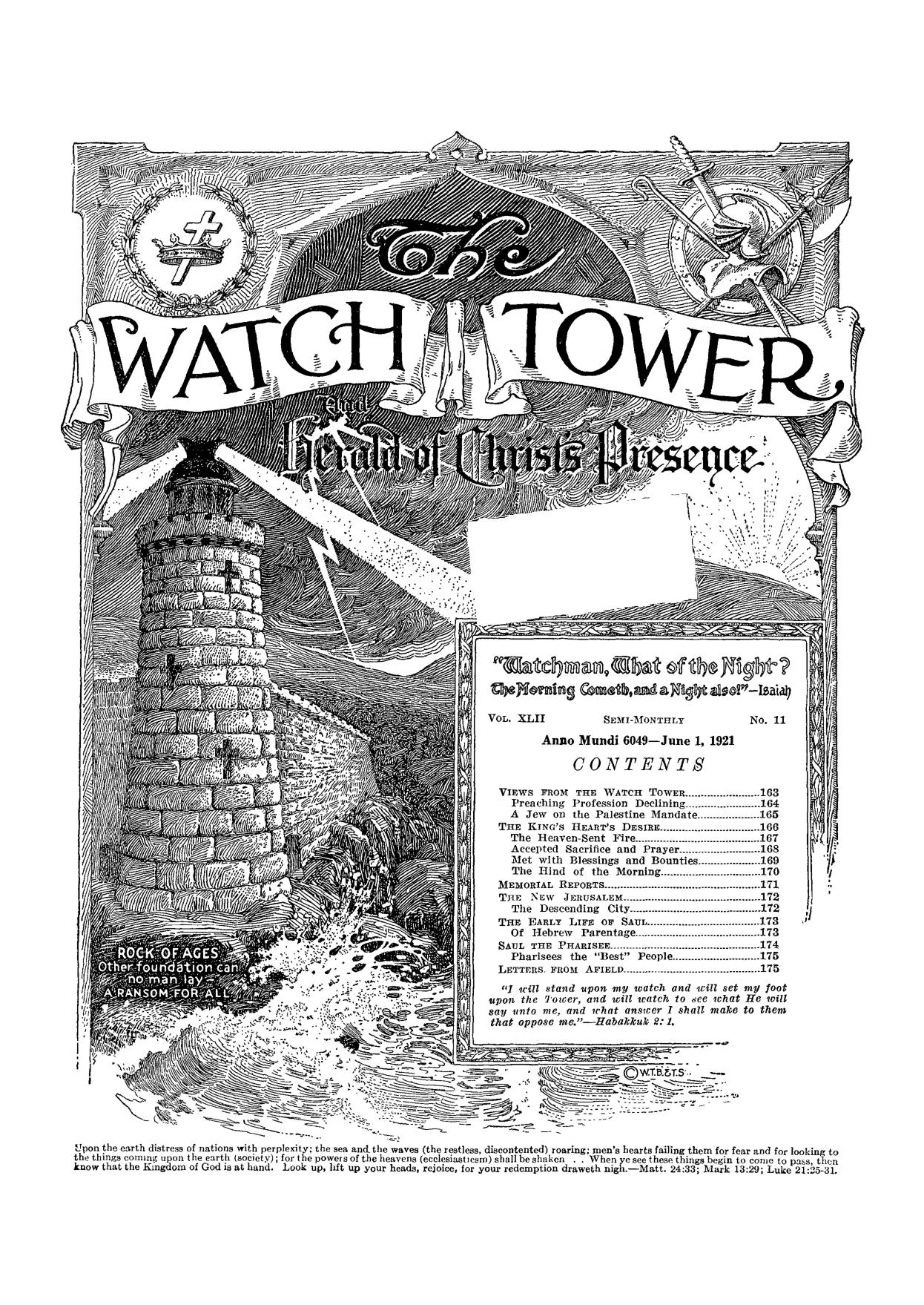
No. 11
|S
?
Upon the earth distress of nations with perplexity; the sea and. the waves (the restless, discontented) roaring; men’s hearts failing them for fear and for looking to the things coming upon the earth (society); for the powers of the heavens (ecclesiasticsm) shall be shaken . . When ye see these things begin to come to pass then know that the Kingdom of God is at hand. Look up, lift up your heads, rejoice, for your redemption draweth nigh.—Matt. 24:33; Mark 13:29; Luke 21:25-31.
Vol. XLII
Semi-Monthly
Anno Mundi 6049—June 1, 1921
CONTENTS
Other foundation cam Jno man lay -'M*,-.
?A_RANSOM’F:oRiALL%^«^
Views from the Watch Tower.....
Preaching Profession Declining.....
A Jew on the Palestine Mandate.
The King’s Heart’s Desire.............
The Heaven-Sent Fire.....................
Accepted Sacrifice and Prayer.......
Met with Blessings and Bounties. The Hind of the Morning.............
Memorial Reports...............................
The New Jerusalem.........................
The Descending City......................
The Early Life of Saul.................
Of Hebrew Parentage.....................
Saul the Pharisee.............................
Pharisees the “Best” People.........
Letters, from Afield.........................
.163 .164 .165 .166 .167 .168 .169 .170 .171 .172 .172 .173 .173 .174 .175 .175
“I win stand upon my watch and will set my foot upon the Tower, and. will watch to see what He will say unto me, and what answer I shall make to them that oppose me."—Hahakkuk 2:1.
THIS JOURNAL AND ITS SACRED MISSION
THIS journal is one of the prime factors or instruments in the system of Bible Instruction, or "Seminary Extension", now being presented in ail parts of the civilised world by the Watch Town Bible & Tract Society, chartered A. D. 1884, "For the Promotion of Christian Knowledge". It not only serves as a class room where Bible students may meet in the study of the divine Word but also as a channel of communication through which they may be reached with announcements of the Society's conventions and of the coming of its traveling representatives, styled "Pilgrims”, and refreshed with reports of its conventions.
Our "Berean Lessons” are topical rehearsals or reviews of our Society's published Studies most entertainingly arranged, and very helpful to all who would merit the only honorary degree which the Society accords, viz., Teibi Dei Minister (V. D. M.), which translated into English is Minuter of God’s 'Word. Our treatment of the International Sunday School Lessons is specially for the older Bible students and teachers. By some this feature la considered indispensable.
This journal stands firmly for the defense of the only true foundation of the Christian's hope now being so generally repudiated —redemption through the precious blood of “the man Christ Jesus, who gave himself a ransom [a corresponding price, a substitute] for all". (1 Peter 1:19; 1 Timothy 2:0) Building up on this sure foundation the gold, silver and precious stones (1 Corinthians 3: Ills ; 2 Peter 1:5-111 of the Word of God, its further mission is to “make all see what la the fellowship of the mystery which. . .has been hid in God, ... to the intent that now might be nmdc known by the church the manifold wisdom of God”—“which in other ages was not made known unto the sons of men as it ia now revealed”.—Ephesians 3:5-9,10.
It stands free from all parties, sects and creeds of men. while it seeks more and more to bring its every utterance Into fullest subjection to the will of God m Christ, as expressed in the holy Scriptures. It is thus free to declare boldly whatsoever the Lord bath spoken—according to the divine wisdom granted unto us to understand his utterances. Its attitude is not dogmatic, but confident; for we know whereof we affirm, treading with implicit faith upon the sure promises of God. It is held as a trust, to be used only in his scruce: hence our decisions relative to what nuij and wlint may not appear jn its columns must be according to our judgment of his good pleasure, the teaching of his Word, for the nnln>i|>Hng of Ids jaeople in grace and knowledge. And we not only invite but urge oug leaders to proie all Its utterances by the infallible Word to which reference is constantly made to facilitate such testing.
TO US THE SCRIPTURES CLEARLY TEACH
That the church is “the temple of the living God”, peculiarly "his workmanship”; that its construction has been in progress throughout the gospel ace—ever since Christ became the world's Redeemer and the Chief Corner Stone of his temple, through which, when finished. Gods blc-ing shall come "to all people", and they find access to him.—1 Corinthians 3:16, 17; Ephesians 2:20-22; Genesis 2s : 14; Galalians 3:22.
That meantime the chiseling, shaping, and polishing of consecrated believers In Christ's atonement for sin, progresses; and when the last of these "living stone-", “elect and precious,” shall have bccu made ready, the great Master Workman will bring all together in the firsi r<—urrc< non : and the temple shall be filled with bis glory, and be the meeting place between God and men throughout the Millennium.—Revelation 13:5-8.
fl'liat the basis of hope, for the church and the world, lies in the fact that "Jesus Christ, by the grace of God, tasted death for every man." “a ransom for all,” n..<l wi.l be "the true light which hgbteth every man that cometh into the world", "in due time".— Hebrews 2:9; John 1 : 0 ; 1 Timothy 2:5, 6.
That the hope of the church is that <-he may be like her Lord, “see him as be Is,” be "partakers of the divine nature',’ and share his glory as Ins Joint-heir.— 1 John 3.2; John 17:24; Romans 8:17; 2 Peter 1:4.
That the present mission of the church is the perfecting of the saints for the future work of service: to develop In herself every grace: to he God's witne-s io the world; and to prepare to be kings and priests in the next age.—Ephesians 4:12; Matthew 24: 14 ; Revelation 1:6; 20 : 6.
That the hope for the world lies in the blessings of knowledge and opportunity to be brought to all by Christ's Millennial kingdom, the restitution of nil that was lost in Adam, to all the willing and obedient, at the bands of their Redeemer and his glorified church, when all the wilfully wicked will be destroyed.—Acts 3:1923; Isaiab 35.
pUBLiSHE-O By
WATCH TOWER. BIBLE fr TRACT SOCIETY
124 COLUMBIA HEIGHTS n □ BROOKLYN. NY U S A
Foreign Offices: British: 34 Craven Terrace, Lancaster Gate, London \V. 2: Canadian: 270 Dundas St., W., Toronto, Ontario; Austfola^tan ■ 495 Collins St.. Melbourne. Australia; South African: 123 Plein St., Cape Town, South Africa.
Please Address the Society in Evert Case.
YEARLY SUBSCRIPTION PRICE. United States, $1.00; Canada and Miscellaneous Foreign, $1.50: Great Britain. Australasia, and South Africa, Ss. American remittances should be made by Express or Postal Monev Orders, or by Bank Draft. Canadian, British, South African, and Australasian remittances should be made to branch o/hre* only Remittances from scattered foreign territory mnv be made to the Brooklyn office, but by International Postal Money Orders only.
(Fareinn translations of this journal appear in several languages)
Editorial Committee: Titis journal is published under the supervision of an editorial committee, at least three of whom have read and approved as truth each and every article appearing in tho^e columns. The name« of the editorial committee nre: J. F ID therford, W. E Van Amdurgh, p, IL Rontso?;. G. IL Fisher, E. W. Brenisen. Termite the LonFe Poor: AD Bible students who, by ybmot of old arte or other in-Rnxuty or adversity, are unable to pay for this journal, will be ■opp'i'* J free if they send a postal card each May atatina their ease and recosatinff aaeh provision. Vn srs not only willing, bat auxioas. that all sueb be on our hat continoally and fa touch with the Berean stuciea.
NaHm Oa P.--1 ii?*ri - W* de wet, as erels. wed aeerd of aekwwMrment teenswil or notice to Buoecnoeroo 1or B Bew ,ObOCTipuco. RM«ipt and -ntry m t‘ --1 uxuMud vltblD a month toy chaaee la esptretiea data.aa sm*d oe wrapper ibtoei.
Caterad as Ssaowd Class IfaMsr at BraaHya, ft. Y„ ftostajWss wadsr tAs Ast •/ More* Ord.
DETROIT CONVENTION
A convention of the International Bible Student* Association will be held at Detroit. Mich., July 2.3 anil 4 Am almost everv place ba- a halt holiihn on Sniurilaj. anil Monday being the Fourth practically the entile lime of the conven’“>n will be free for the triends to attend. This will afionl an o;>|>ortunity for brethren in Michigan, northern Illinois, Indiana and Ohio to have a season of fellowship together. There will be a public meeting on Sunday afternoon, addressed by the President of the Society. A number of the Pilgrim brethren will be present. Address all communications to Dr. E. A. McCosh. 1427 West Grand Blvd., Detroit.
SWEDISH CONVENTION, I. B. S. A.
The brethren of the International Bible Students Association who sneak the Swedish language will hold a convention at Milford, Mass in the Swedish Congregational Church. Grant Street. July ■'-4. Communications should be sent to Brother Arthur Peterson, ifii Purchase Street, Milford. Mass.
STUDIES IN THE SCRIPTURES
These Studies are recommended to students as veritable Bible keys, discussing topically every vital doctrine of the Bible. More than eleven million copies are in circulation, in nineteen languages. Two sizes are issued (in English only) : the regular maroon doth, gold stamped edition on dull Lnish paper (size 5"x7J*), and the maroon cloth pocket edition on thin paper (size 4”’x6|*) ; both sizes are printed from the same plates, the difference being in the margins; both sizes are provided with au appendix of catechistlc questions for convenient class use. Both editions uniform in price.
Series I, "The Divine Plan of the Apes," giving outline of the divine plan revealed in the Bible, relating to man's redemption and restitution: 3511 pages, plus indexes and appendixes. 75c. Magazine edition 20c. Also procurable m Arabic. Armenian. Dano-Norwegian, Finnish, French. German. Greek. Hollandish. Hungarian. Italian, Polish. Roumanian. Slovak. Spanish. Swedish. and Ukrainian; regular cloth style, price uniform with English.
Series II. "The Time is at Hand," treats of the manner and time of the Lords second coming, considering the Bible testimony on this subject: 333 pages, 75c. Obtainable in Dano-Norwegian, Finnish. German. Polish, nnd Swedish.
Series HI. "Thu Ainodum ('nine.” considers prophecies which mark events connected with "the time of the end", the glorification <>f Ilie clntrcli ami the establishment of the Millennial kingdom; It also contains n chapter on the Great Pyramid of Egypt, showing its corroboration of certain Bible teacliiugs : 380 pages. 73c. Furnished also in Daso-.Xo' -.egiiin. Finnish. German. Polish, and Swedish.
Series IV. "The llattle of Armageddon.” shows that the dissolution of the present order of tilings is in progress and that all of the human panaceas oth-recl are valueless to avert tile end predicted in ilic Bible. It contains a si>eciiil and extended treatise on our Lords great prophecy of Matthew 24 and also that of Zechariah 14:1-0: r>,*>(> paces. s3c. Also in Dano-Norwegian. Finnish, Greek, German, and Swedish.
Sekihs V. "The Atonement Between God and Mun," treats an all im|H.riant subject, the center around which all features of divine grace reiohe. Tins topic deserves the most careful consideration on tile part ot all true Christians: 618 pages. 8oc. Procurable likewise in Dano-Norwegian. Finnish, German, Greek, and Swedish.
Seiiies VI. “The Ncir Creation." deals with the creative week (Genesis 1. 2). and with the church. God’s new creation. It exiiunnes the jiersonnel, organization, rites, ceremonies, obligations, and hopes appertaining to those called and accepted as members of the body of Christ : 730 paces, 85c. Supplied also in Dano-Norwegian, Finnish, German, and Swedish.
Series VII. "The Finished Mystery." consists of a verse-bv-verse CMilaii.ition of tile Bible books of Revelation. Song of Solomon, and Ezekiel: 608 pages, illustrated. 85c. in cloth. 25c. in magazine edition—latter treats Revelation anil Ezekiel only.
AND HERALD OF CHRISTS PRESENCE
Vol. XUU
June 1, 1921
No. 11
VIEWS FROM THE WATCH TOWER
GEORGES SCELLE, Professor of the Faculty of Dijon, France, in giving a spring review of the outlook in so-called Christendom, was reported by the San Antonio Express as saying:
"In 1921 there are more causes likely to provoke a general European war than there existed in 1914.
•‘The partition of Asia Minor has aroused hate and old enmities throughout Europe. Four or five nations are at each other’s throats over the division of the spoils. Quarrels in the Balkans are more lively than ever. In the future the Saar valley plebiscite may bring in a conflict. Revolution may break out at any moment in the Ruhr. The Polish question, the Dantzig corridor, the isolation of east Prussia, all are blocks in the way of final peace.
“Silesia is in a turmoil. Teschen is tire cause of a nearwar between Poland and Czechoslovakia which may become serious at any moment. Jugoslavia has failed to become a united nation and Montenegrin Serbs have already revolted, while Hungary is only waiting her hour to strike to commence war on her neighbors. Austria is at death's gasp. Bulgaria is meditating revenge on Greece. The greater Greece of the Sevres treaty is costing hundreds of lives daily and will cost many more. Roumania is menaced on one side by Transylvania and on the other by the Russians through Bessarabia.
“Remains the post-war rivalry between the United States and. England, already vitally serious, and the antagonism between America and Japan, which all the world expects to result in an armed conflict sooner or later. All the governments of the world, instead of trying to remedy matters, are making them worse by imperialistic policies born of the same motives that brought about the World War. Peoples and governments did nothing to avert the catastrophe of 1914 and they are doing worse than nothing to avert the crash that is coming.”
AN EXPECTED CRASH
Answers, a London publication, commissioned one of its representatives to interview men prominent in British commercial life and to put to them ths question, “When will the crash come?” The answer of one well known financier was very definite:
“ ‘Two or three years,’ he said with decision. ‘If things are allowed to drift, we shall then be utterly unable to purchase the bare necessities of life, and the bulk of our population will die of starvation. Useless to think about transporting them to the Colonies, America—anywhere; there will not be enough ships. Useless to think about appealing for- help to other countries; all Europe will be tottering to its fall. Starvation for most of us, emigration for the majority of the survivors, the setting of England’s sun as a commercial nation—this will be inevitable.
“ ‘There will, of course, be commercial crashes earlier,’ he added, ‘but the great danger is the complete and final shattering of our economic structure, and that will surely come about if we do not export sufficient manufactured goods to pay for the food that we must import to maintain our population.’
“I repeated the substance of this statement to an eminent economist.
“ ‘Yes, I agree,’ he remarked. ‘But the crash which is creating so much nervousness in business circles will, in my opinion, take place this year.’”
Mr. Lloyd George, British Premier, in a speech addressed to fellow Welchmen, incidentally reviewed some of the world’s problems and described its conditions. Coyly conscious of alluding to Scripture, he said:
“The world is reeling under the most terrible blows that have ever been struck. It is restless; it is demoralised.
“The machinery of trade is dislocated. New nations are rising up as on the morning of the resurrection, and the new light is dazzling them. They are reeling like drunk men.”
It is a very common declaration in these days that there must be something radically wrong with society, that millions of people should be out of work, and that millions more are unable to sell what they have produced. These remarks are usually made with an air of profundity. But it really requires no very keen insight to observe the facts; they are so apparent.
“TOO MUCH ORGANIZATION”
Among those who believe there is something wrong but few have any suggestion looking toward improvement. One of these few is the National City Bank of New York. In its monthly publication that institution says:
“It is admitted that something is radically wrong. It is wrong that great numbers of people should be so ill-informed about economic affairs that instead of acting in a manner calculated to secure cooperation and stability they use their influence to break down the delicately balanced industrial organization and create confusion and disorder. The modern industrial organization is dependent upon intelligent, voluntary, harmonious cooperation on the part of all the people. It requires that the people shall distribute themselves according to choice in the various industries, and so direct their individual policies as to keep the industries in balance and accomplish a ready exchange of products. If through mistaken ideas of self-interest they organize themselves into groups, either national groups, class groups, or occupational groups, and become so intent upon forwarding group interests that they lose sight of the necessity for general cooperation, the wliole modern system of highly-developed industry will break down. It will be strangled by too much organization. There is indeed something radically wrong with society, and this is It.”
While the above quoted ideas of the National City Bank seem plausible, they do not answer the very present question in the minds of less favored people. One of these, a railroad mechanic, writing in a conservative publication, says:
“ ‘I am earning $48 a month now. My rent is $35, gas $7, carfare $5, but why should I kick? I still have $1 left. Maybe that's the one the railroads want. A man doesn’t have to be a socialist,’ remarks the man drily, ‘to see that he is the goat’ ”
DISADVANTAGED FARMERS
If the mechanics are in an unfavorable situation then the farmers are in still a worse state. The Oklahoma Farmer is authority for the statement that it requires the hides from three carloads of cattle to purchase one set of farm harness. Careful inquiry produced the information that the buyer of hides would have to be convinced that a cowhide was something special before he would pay more than a dollar for it. At the hardware stores they found that it would take $95.00 to pay for a complete set of fair quality working harness. Only a few months ago the price of the same set of harness is said to have been $125.00. In addition to this, and in harmony with it. the Hattiesburg (Miss.) American sets forth the fact that the hides from twenty-two calves bring the farmer $13.20, reckoned at six cents a pound. That same farmer, if he desires to purchase a pair of shoes made from his own calf-skins, pays $12.00 for the pair, leaving him a balance of $1.20 in theory, but very much behind in fact.
When the price of wheat went down some months ago the large financial interests announced through the public press that the trouble was due to a falling off in foreign demand. The farmers started an investigation and found that more than two hundred million bushels had already been exported and one hundred million bushels had been purchased for future delivery. This was eighty million bushels more than the estimated surplus of wheat in this country. Then the great financial interests issued another explanation. This time they said that the purchases of wheat for export had been made largly for the British Royal Commission in such a way that competition was eliminated and prices held down. Thereupon some of the farmers’ organizations ferreted out the facts. They discovered that the export price of wheat during November, 1919, made an average of $2.81 per bushel; for the same month in 1920 the average was $2.61 a bushel. The average price received by the farmer in Nevember of 1919 was $1.70 a bushel; the average price received by the farmer in November, 1920, was about $1.00 a bushel. From these figures it is apparent that the European buyer paid thirty cents a bushel more for wheat in 1920 than he did in 1919. From the same set of figures it is equally apparent that the American producer received seventy cents less per bushel for his wheat than he did the year before. This leaves an extra dollar per bushel for all the wheat exported. A small percentage of this extra profit was eaten up by the increased freight rates, but the most of it found lodgment elsewhere.
PREACHING PROFESSION DECLINING
While it is not so profitable to be a farmer, the preaching business seems to be also on the decline, if we are to take seriously the words of the Bishop of London, as recorded by the Newcastle (Eng.) Daily Chronicle:
“ ‘The business men of London are not such fools as to put their sons to such a rotten profession as preaching,’ said Dr. Ingram, Bishop of London, in a speech here advocating better pay for clergymen.
“ ‘By their niggardly support of the church at the present time', he added, ‘the people of England are undermining the ministry itself.’ ”
It must be said in explanation of this Episcopal gentleman’s remarks that he does not mean to imply that actual putrefaction has set in. The word ‘rotten’ is merely a bit of English slang intended to suggest the undesirability, and withal unprofitableness of the preaching profession.
Bohemians are deserting the Roman Catholic faith by the hundreds of thousands and allying themselves with the new state church of Czecho-Slovakia. More than a million Bohemians have left the Romanist ranks, generally taking the church buildings and priests with them. The Baltimore American reports as follows:
“Priests of all orders, as well as those who during the Austrian regime contributed millions of crowns yearly to the Catholic treasury, have joined this formidable separatist movement, with the result that hundreds of churches are no longer celebrating masses, while the few remaining Roman Catholic priests are unable to find more than 10,000 of their fiocks in all Bohemia.”
The papal officials are considering making a formal complaint to the League of Nations in an effort to induce Czecho-Slovakia to pay for the churches which were taken without formalities, and also to indemnify former priests.
While this rather serious blow to Romanist prestige in Central Europe is recorded, papal adherents in other quarters believe that Rome is gaining ground. The Manchester (Eng.) Catholic Herald finds occasion for gratification in the increased observances of Good Friday on the part of Protestants. It remarks editorially:
“‘The Christian world was all Catholic once, and once again It will be Catholic.’
“Such is the statement that thoughtful men, men of no religion or of no creed, frequently make."
“We read that on Good Friday a Church of England clergyman gathered a number of ministers of various denominations to hold the Three Hour's Service, a custom now very widespread in the Church of England, but not, as far as we know, hitherto participated in by Non-conformists.
“There were present three Congregational ministers, also a Presbyterian, a Baptist, a Wesleyan, and a Primitive Methodist.”
CHRISTENDOM’S CONFIDENCE IN MONEY
The Churchman. an Episcopalian organ of this country. makes an interesting ami honest confession, which sc quote:
"Clear ns a fluming lieacon it is written in the Gosjiels dial we might 1<> line. Since the war there has been Riven to the Church of Christ the .....st romantic, chivalrous
adventure Jor humanity that ner tell to the lot of men.. What seared the romance in our hearts? Who have been talking loudest during the past two years? People who tire afraid. In tire h -.liel of merchants' associations, national civic federations, patriotic societies, not a whisjter has been heard that sounded like St. Francis or Ia>yoht. Those who should Ji: >e uttered the beatitudes were dumb.
"The next Bishop of New York must build the cathedral, we ure told. A cathedral is the last thing which tbi- great city needs. It is tided with stone, and brick, and mortar. Is there religion enough among us m !>■ housed in a mighty nave? If we have the gospel, a tent will serve our needs. If we do not trust Christ, cathedrals are only a mockery. And we do not trust him. We pm our trust where civilization is staking its conhdeuce—in th" |s>wer of moi'ct
GENERAL SMUTS ON THE LEAGUE
This power of money was attempted to be crystal.zed in the League of Nations. Those who are even moderately familiar with the bringing into being of the League know that it was formulated and that it has been most strenuously advocated by Great Britain. France has never had any use for it. nor has she ever paid any attention to it. Only Anglophiles in this country have .sought to bring about it- complete establishment. It is an interesting bit of substantial information which we take from a speech of General Smuts, made in Johannesburg. South Africa, and reported by the Rand Daily Mail of that city:
“’After all. it is useless talking about the league when you do not want to lie a member of the British Empire. [Applause] The League is very largely modelled on the unwritten working constitution of the British Empire. The people who gave most thought to the impression of the great plan worked absolutely with the British Empire before them—the League of Nations v. ns framed on that basis.
“‘I feel on this occasion, continued the Premier, when great issues are at stake, that I can do liest in the cause of the League of Nations by fighting the cause of the British Empire. (Prolonged applause]
“‘I^et me just say this: People who have not given great thought to the subject don't realize that in some curious way the fate of the British Empire will in the future be linked with the late of the league of Nations.’”
“ ‘Although it does not seem a very great result of all we hoped and fought for,’ said the Premier, ‘I feel certain that the League of Nations is the mustard seed, small today, diminutive and insignificant, but which will grow and expand, and in the i-enrurios i<> come will cover the face of the earth.’ "
A JEW ON THE PALESTINE MANDATE
But all witnesses are not agreed that the Britanno-Loague-of-Nations lias worked any weal for humanity. Israel Zangwill. the distinguished Jewish man of letters, in writing in the Boston Sunday Advertiser, says:
“ ‘Life caricatures our concepts,’ complained Dr. Herzl to me in the early days of his movement, nnd. indeed. history lias few' grimmer ironies to show than (that] his noble and pacific vision of the Jewish state should draw its hopes of realization from the bloodiest war of history, or that, on the embodiment of Mr. Balfour's promise in the Turkish conditions a Zionist ieadei in Jerusalem should have ordered the Shofar to be sounded as at the coming of the Messiah; and have thus officially identified a dubious political transaction with the ‘one far-off divine event’ for which Jewish mysticism has waited for nigh two thousand years. It is only another proof of the demoralizing effects of racial egotism and political faction.”
Just what Mr. Zangwill means by these words becomes more apparent from a reading of his contribution to the London Spectator, on the same subject:
“If the hack-word ‘amazing’ had really lieen put out at gruss. as ynv port suggests. 1 should have hnd to hale it back to cliar.icierize your .attitude on the Palestine question. You continue to gird at Sir Herbert Samuel's appointment, as though no duty rested u)hii> the Entente or the League of Nations to carry out the Zionist item of the Turkish Peace Treaty or the solemn promise which preluded it— a promise w Inch was ns dangerous to the Jews in enemy countries as it was valuable to the Entente nt a dark moment In its fortunes. I was not surprised to see the ,1/orn-ir.fl Post anxious to reduce Mr. Balfour’s pledge to ‘a scrap ot paper’—the Post is a militarist journal—but to find a re-s]>ectuble Christian organ, nay, the Christian family organ, backing and buttering up the Post, calls Indeed for the impugned epithet. The fact that the present Palestine plan is a disastrous defeat for the cause for which Dr. Herzl besought my services a quarter of a century ago, and that the appointment of Sir Herbert Samuel is r mere cover for the practical repudiation of the Balfour omi.se. adds to the audacity of the pretense that a ‘ himnosa hiereditas’ has been inflicted upon poor suffering Britain, already-staggering under the ‘too vast orb of her fate’. The .Vornt'np Post actually declares that the Jews get everything and England nothing. The truth is the exact reverse. Indeed, the acquisition of a buffer-state for the defense of Egypt has been the chief argument put forward by the Manchester Guarriian in its persistent plea for Zionism.
“The idea that without any special status or privileges a ‘Jewish National Home’ can emerge in Palestine in face of the present Arab preponderance—even though this is far smaller than the fifteen to one which you allege—is an illusion all the more pitiful because so many millions of homeless wandering Jews have been shamelessly buoyed up with a Messianic dream, the collapse of which cannot fail to be tragic. But a certain enrichment of population and fertility must as inevitably ensue in the new and largely derelict British possession under such an able administrator as Sir Herbert Samuel, especially with so much Jewish enthusiasm to exploit, and if he is as ‘timid and weak-hearted’ as you say, all the less chance of bis departing from the official British tradition in favor of his own race. The Arab will soon learn that Sir Herbert Samuel has not the remotest intention of enslaving or evicting him, and will as little justify your fears of a Jewish domination ns my hopes of a Jewish State. As for your idea that Mr. Lloyd George had to find him a good job, it is an open secret that he refused office under the present Premier, loyally sticking to Asquith. England is to be congratulated on so able and high-minded a servant, though his appointment is to Zionism proper a shorter way of spelling disappointment. The headship of a Jewish hero like Jabotinsky was necessary in Palestine, if Israel—like other beneficiaries of the war for the principle of mil tonalities—was to reenter the circle of nations: the real makers of history com? not from Cabinets but from prisons.”
THE KING’S HEART’S DESIRE
Thou hast given him his heart’s desire.”—Psalm 21:2.
PSALM 21 is the coronation psalm of Israel. In all probability it was written for the occasion of David’s own coronation, but being “a psalm of David”, it must be understood as bearing upon him who is David’s Son and David’s Lord. Its subject matter is very intimately connected with that of Psalm 20, which contains the prayer: “Grant thee thy heart’s desire, and fulfill all thy counsel”.—Psalm '20: 4.
In that Psalm either Jesus is represented as soliloquizing, and reassuring himself; or the divine purposes are personified, and thus speak. The time is the time of trouble, not primarily Christendom’s time of trouble but the time of distress and difficulty which was upon Jesus himself. In certain respects this trouble stretched over the whole three and a half years of his ministry, finding its culmination in the Garden of Gethsemane where “with strong cryings and tears” our Lord faced the most momentous questions of his whole existence. Indeed it would not be inappropriate to stretch the application of this time of trouble to the whole period of his humiliation, including the humiliation of his body (Philippians 3:21) and the closing time of trouble of this gospel age and to apply the final ‘setting up on high’ to the exaltation in the kingdom. But the simplest picture is to apply it to our Lord Jesus himself.
“SET THEE UP-ON HIGH”
1. “Jehovah answer thee in the day of trouble;
The name of the God of Jacob set thee up on high;
2. Send thee help from the sanctuary, And strengthen thee out of Zion;
3. Remember all thy offerings, And accept thy burnt sacrifice.”
Did Jehovah answer Jesus there in the Garden? Oh yes: Jehovah heard him always. (John 11:42) Jehovah answered Jesus because he knew and trusted in the name of Jehovah, the God of Jacob. The God of Jacob was he who had met Jacob (the people of Israel) when that nation was nothing and had nothing, and who yet promised them everything. This thought of God’s bounty is expressed in New Testament language by the words, “the God of all grace”.—1 Peter 5: 10.
This name of Jehovah, the God of Jacob, is very significant. It does not apply merely to the words God or Jehovah, but to the character which is back of those words. To praise God’s holy name means much more than shout ‘glory to God’; it means to approve and to laud the blessed character of our Creator and covenant God. Concerning Jesus it was promised: “Because he hath set his love upon me, therefore will. I deliver him: I will set him on high, because he hath known my name”. (Psalm 91: 14) To be ‘set on high’ evidently means to be assured of the appreciation and fellowship of Jehovah, communion with him who is the “High Tower” of the new creation. The margin uses the word support, instead of set on high. Although this prayer of Psalm 20 applies particularly to Jesus, there are
other statements which assure all the messiahs, or anointed ones, in a similar manner. As it is written: “Jehovah also will be a tower for the oppressed, a high tower in times of trouble; and they that know thy name will put their trust in thee”.—Psalm 9:9, 10; See also 46: 7, 11.
This prayer indicates expectancy that the name of Jehovah would set Jesus on high. How can this be? In this way: Jesus was in the character likeness of his Father. The possession of this character likeness made it possible for the Father to communicate with and convey messages to Jesus to an extent impossible with us, his imperfect followers. To him, for the same reason, was the spirit of God and of holiness given without measure. He knew what Jehovah meant when he said thus and so; he knew how Jehovah felt; he knew his Father’s desires, his preferences, his will. Therefore, the possession of a Godlike character made it possible for Jesus to reach up to his High Tower and ours, and to receive the uplifting and buoying assurances of the Father that all was well.
SUPPORT FROM ZION
Jehovah sent help from his sanctuary, from the Most Holy, from Zion, from the heavenly condition itself. Although there seems to be no adequate textual support for the story incorporated in the later manuscripts of Luke’s Gospel, to the effect that an angel from heaven ministered to and comforted Jesus in Gethesemane, still some such comfort was evidently given him; for he became convinced that death under the charge of blasphemy was a part of the Father’s plan for him, and seeing it to be the Father’s will, he was serene. Jehovah not only sent his Son help from his exalted sanctuary, but he strengthened or supported him in the trying hours following the Garden.—Psalm 3: 4.
God remembered the offering which Jesus had made of himself, as well as those offerings which were to come afterwards, but the acceptability of which depended on Jesus’ entire faithfulness and integrity. Yes, more than this: all the offerings of all mankind throughout the thousand years of Messiah’s reign depended upon the perfect conformity of Jesus to the will of the Father. No doubt these facts bore heavily upon our Savior in the Garden, for he was “exceeding sorrowful, even unto death”. (Matthew 26:38) But he was not more conscious of these facts than was Jehovah. He who “worketh all things according to the counsel of his own will” did not forget; he remembered all the High Priest’s offerings, both then present and to come.
THE BURNT SACRIFICE TURNED TO ASHES
Furthermore, the God of Jacob, the God of mercy and grace, did not only remember his Son’s interests, but he accepted the burnt sacrifice. All the things 166
which were burnt on the copper altar in the Court of the Tabernacle or of the Temple were burnt sacrifices. Every offering was in part a burnt offering, because, since fire was the chosen manifestation of God’s presence, the portion of each sacrifice specially dedicated to him was consumed by fire. But the term is generally restricted to that which was a whole burnt-offering.
In this passage, Psalm 20: 3, the Revised Version margin gives for “accept” the rendering “accept as fat”. The Common Version gives in the margin, “turn to ashes”. This is evidently the thought: ‘accept thy burnt-offering by turning it to ashes’; i. e., the fact that the broken body of the daily sacrifice was consumed on the brazen altar by the fire once sent from heaven and in accord with the directions once given from heaven was not only an assurance that the sacrifice was acceptable, but it was an indication to proceed with the other phases of the ceremony.
It was always by fire that a sacrifice was accepted. It was thus, probably, that God “had respect” to the offering made by Abel. (Genesis 4:4) That is how ‘God testified of his [Abel’s] gifts’. (Hebrews 11:4) It was thus that Abel “obtained witness that he was righteous”. No sacrifice which God specifically accepted or to which he wished to call particular attention was ever consumed by fire emanating from this earth. It was consumed by “fire from heaven”. (Leviticus 9: 24) When it so chanced that sacrifices were offered apart from the place which Jehovah had chosen and appointed and where he had set his name and where his miraculous fire already was, then the fire had either to fall specially from heaven or come by heavenly command.
THE HEAVEN-SENT FIRE
In connection with the dedication of the Tabernacle in the wilderness, of the priestly order, and of all the furnishments and utensils of the Tabernacle, we read of Jehovah’s promise that upon the completion of certain stipulated ceremonies ‘the glory of the Lord should appear’ (Leviticus 9:6), that is, God would give the most noticeable sign of his presence among them, of his approval of the Tabernacle, its officiators, and accoutrements, to show that everything had been done according to his instructions. (Exodus 24:17) And, in addition to the glory, a fire came out from before the Lord and consumed the burnt-offering, etc. This was the proof which God gave upon extraordinary occasions of his acceptance of a sacrifice. This was done, aside from the probable case of Abel (Genesis 4:4), in the case of Aaron (Leviticus 9:24); in the case of Gideon (Judges 6:21); in the case of Manoah and his wife (Judges 13:19-23); in the case of David dedicating the threshing floor of Oman (1 Chronicles 21: 26); in the case of Solomon dedicating the Temple (2 Chronicles 7:1); and in the case of Elijah.—1 Kings 18: 38.
'Jo express the accepting of an offering or sacrifice the verb dashan is used, winch signifies to reduce to ashes, that is, by fire from heaven. In such a case as the dedicating of the Tabernacle it was necessary that the fire be very apparently of divine origin, and that it should come in such a way as to preclude the supposition that any art or deceit had been practised on the occasion. It would not do for Moses and Aaron to bring this fire out of the Tabernacle with the claim that God had kindled it there for them; for then there might be ground for doubt as to its genuineness. The fire came out from before the Lord, and all the people saw it. The victims were consumed by fire which was quite manifestly of no human origin. Josephus says that “a fire proceeded from the victims themselves, of its own accord, which had the appearance of a flash of lightning”. An ethereal or electric spark or flash was sent immediately from the divine presence, either as represented in the glory light of the Most Holy or in the pillar of cloud above the tent of meeting.
The devil, in order to give credit to his worship among heathen peoples, imitated this miracle. The Romans claimed that Jupiter testified his approbation of the sacrifices offered to him by the sound of thunder and the show of lightning: to this the Latin poet Virgil alludes: “Audiat hsec genitor, qui feeders fulmine sancit” —Tet Jupiter hear, who sanctions covenants by his thunder’. Servius, a Latin commentator on Virgil, says of this passage: “To sanction the covenant signifies to confirm it; for when a covenant was made, if there were a flash of lighning, it was considered to be thereby confirmed: or rather because our ancestors lighted no fires, but obtained by their supplications divine fire,” etc. The expression about their ancestors shows that they could boast of no such fire then. Either Satan had at one time imitated the miraculous fire for them or they had simply borrowed the account from the Jews, as Virgil surely borrowed his description of the golden age from Isaiah. Solinus Polyhistor gives an account to the same effect; speaking of the Hill of Vulcan in Sicily, he says: “They who perform sacred rites in this place, put a bundle of vine tree wood upon the altar, but put no fire to it; for when they lay the pieces of the victim upon it, if the deity be present and he approve the sacrifice, the bundle, although of green wood, takes fire of itself and without any other means the deity himself kindles the flame”. These are noteworthy instances, for they show either how exactly the heathen writers have borrowed from the sacred records or how exactly the devil’s religion copied that of Jehovah. As a further imitation, the Romans had their perpetual fire in the Temple of Vesta, which they claimed to have descended at the first from heaven and which they kept with the most religious veneration.
FIRE AND THE “LIVING” SACRIFICE
The celestial fire which was sent by Jehovah to consume the sacrifices on the brazen altar in the first official Tabernacle is said by the Jews to have been scrupulously preserved up to the time of Solomon, when it was renewed by God. This seems unlikely at first thought; but it is quite possible that, in view of the lesson as to its sacredness which God gave in the deaths of Nahab and Abihu, the Jews, even in the midst of idolatry and unfaithfulness, kept this fire going out of superstitious fear. It was evidently going in the time of David; for, though the ark was at Zion, the brazen altar was at Gibeon, and Zadok, the priest, offered burnt offerings there. (1 Chronicles 16: 39, 40) Jewish rabbins and historians insist that the miraculous fire once kindled on the great altar in Solomon’s Temple was never allowed to go out until Manasseh tore down the altar. This was certainly the law on the subject. (Leviticus 6:13) But even the Jews admit that after the captivity there was no miraculous fire, no Shekinah light, and no tables of the law.
This divine fire was an emblem of the holy spirit. And as no sacrifice could be acceptable to God which was not salted, seasoned, or rendered pleasing by this fire, as our Lord says (Mark 9:49), so no one can offer acceptable sacrifices to God unless it be in the spirit of holiness—the love of righteousness and hatred of iniquity. Hence the command for the disciples to tarry in Jerusalem before beginning their antitypical "living sacrifices”, i. e., daily or continuous sacrifices. They should wait for the spirit under the emblem of fire (Matthew 3:11); and it did actually descend in this similitude on the day of Pentecost.—Acts 2:3, 4.
So, it was not possible for the priest in the type of Israel’s daily evening sacrifice to proceed into the Holy until God’s fire from heaven had started the consumption of the lamb’s carcase on the altar in the Court, for it was coals from this fire which was consuming the sacrifice in the Court which had to be carried along into the Holy and there used to kindle the incense which was burnt on the golden altar. At all events, regardless of the order, it had to be fire from off the altar.—Exodus 30:7; Numbers 16:46.
ACCEPTED SACRIFICE AND PRAYER
Incense is ever a symbol as well as a fitting picture of prayer; prayer in its broader signification of fellowship praise, service. Note the connection between incense and prayer in Psalm 141: 2 and Luke 1:10. Compare also Jonah 2: 7. Psalm 20 by its conjunctive Selah joins the thoughts of accepted sacrifice and prayer, even as they were joined in the type of the daily evening sacrifice contained in the ceremonial law of Israel. In the type, no incense could arise until the sacrifice had been accepted or salted by fire, so in the antitype there can be no true prayer apart from accepted sacrifice. The accepted sacrifice is the basis of prayer, and the prayer is the outcome of the accepted sacrifice. Dear Brethren, shall we not rejoice at the presence of the fire? Is it not a mark of divine approval; without which we cannot have fellowship with the Father and with his Son Jesus Christ; without which we know not to praise God aright; without which we know not to serve him ? The fire comes and, like a sizzling branding-iron, burns the vital truths of God’s Word into our very beings. Then we have something to talk over with the Father; then we have reason to praise him; then we have the impulse to serve him as he ought to be served, in spirit and in truth; then we can have acquiescence in the painful features of God’s purposes. On that bitter night in the Garden of Gethsemane the fire which had come from heaven in the shape of the fresh realization of and keener insight into God’s purposes for him, burned into our Lord’s consciousness until it was impossible for him to disagree with the Father, and the incense smoke rose up to heaven in a grand volume of amen and amen.
NO STRANGE FIRE EFFECTIVE
All other fire than that from the brazen altar was “strange fire”. (Leviticus 10:1, 2) It did not come from heaven, “from before the Lord”; and it was for this reason that it could not be used to kindle the incense upon the golden altar. Jehovah wanted the fire to be his own. So with the church of this gospel age: the fire must come from heaven, the suffering must be heaven-appointed, it must be The reproaches that fell upon him’, it must be the ignominy and shame which attach to faithful proclamation of the message of the gospel, if we are to have anything to pray about and any ground for acceptance of our' prayers through the great High Priest in the Holiest of all, even heaven itself.
Only the new creature can pray in this especially significant sense. Acceptable worship must be true and in the spirit of the petitioned. (John 4: 24) In preliminary ways, as well as in the final sense, is it true that “'that which is engendered of the flesh is flesh”. (John 3:6) The flesh cannot pray. That is, the spirit of the flesh as the flesh now is has nothing to pray about. The flesh represents self-will, as Adam followed the flesh instead of the spirit of God when he disobeyed. The flesh can “say prayers”, or offer prayer, but “it profiteth nothing”. (John 6: 63) For the flesh to pray is like offering strange or common fire.
The remainder of Psalm 20 describes the benefit which the church class receives form viewing the Father’s treatment of his Son. Psalm 21 then takes up the matter at the time of our Savior’s resurrection. The Selah between verses 2 and 3 leads the mind forward and shows what these heart’s desires were, which had been mentioned in Psalm 20: 4. Hence the Selah follows the answer to the prayer (Psalm 21: 2); and in giving the reason for the answer reveals to us what the petitions of the prayer were.
MET WITH BLESSINGS AND BOUNTIES
2. “Thou hast given him his heart’s desire, And hast not withholden the request of his lips.
Selah.
3. For thou meetest him with the blessings of good tilings;
Thou settest a crown of fine gold on his head.
4. He asked life of thee; thou gavest it him, Even length of days for ever and ever.
5. His glory is great in thy salvation:
Honor and majesty dost thou lay upon him.
C. For thou makest him most blessed for ever: Thou makest. him glad with joy in thy presence.” It will not be irreverential if we draw a comparison from human life. Who has not seen a wearied and perhaps weeping child fall asleep on Christmas Eve, howbeit hoping for the blessings of the morrow? The first thing it knows in the morning is the parent’s call and caresses, and armloads of presents to make it glad. So Jesus, Jehovah’s wearied and most-loved child, sorrowed to sleep on Calvary. With what tenderness the Father must have watched through the night of his Son’s death, waiting for the morning and conning over the coming happiness of his child. The next thing Jesus knew was the voice of his Father, saying, in effect and possibly in words: Jesus! it is time to wake up now; here is your wonderful new clothing which I have prepared for you and promised; here are the good things which your heart desired!
With what quivers of joy must not the opening eyes of Jesus have gazed upon the face of his Father, whose kindly features had so lately dimmed from view as the light of life flickered low and out. But now! Gone the night, the sorrows over, home at last!
In some such way did Jehovah "'bring the first-born again into the habitable’ (Hebrews 1: 6) and ‘meet him with the blessings of good things’.—Psalm 21:3.
What those good things were and are is implied by the following verses. There was endless divine life; there was glory, honor, and majesty; there was joy in the presence of Jehovah; there was eternal steadfastness and assurance that his own trial time was past; there was the needed discernment to hunt out all enemies and the power to destroy them as enemies in the fire of the world’s time of trouble,; there was power to praise God as he should be praised.
AN IMPORTANT CONFUSION
But there is something in connection with this satisfying of the desires of the king’s heart that may be overlooked in the Common Version account. A part of what now appears as the superscription to Psalm 22 belongs as the subscription to Psalm 21. There would be no way to determine for a certainty about this matter were it not for the fact that a detached psalm is given us in the third chapter of Habakkuk. Since this is a typical psalm standing by itself, with no other psalm proceeding or following it, we can see for ourselves what style was observed in the denoting of the psalms. There is (1) a superscription, (2) the psalm proper, and (3) a subscription. The superscription forms the title, not unlike the main headings of articles in this journal. In some cases the historical circumstances which gave rise to the writing of the psalm are given in the title, as a very appropriate subsidiary part of the heading. The subscription consists of the directions concerning the use of the psalm, when such were given. Whatever were the circumstances which occasioned the writing of the poem at first, or however prophetic its content, when it was formally handed over to the leader of the Temple choir it was so marked, with sometimes an intimation of the appropriate time for the using of such song.
We find the same three divisions in the “writing of Hezekiah” (Isaiah 38:9-20), which was that king’s psalm of praise and thanksgiving for recovery from his great sickness. In verse 9 there is the superscription or title; in verses 10 to 20 there is the psalm proper; and in verse 20 the subscription. King Hezekiah acted as his own musical director and ordered the psalm to be used in the Temple worship during the rest of his lifetime.
To demonstrate the ease with which the subscription of one psalm (not standing alone) may be confused with the title or superscription of the next psalm, we reproduce herewith a few lines covering the ending of Psalm 21 and the beginning of Psalm 22, from Ginsburg’s Massoretico-Critical Edition of the Hebrew Bible:
XXI 9—XXII 5 O'T-in
: tna-ba ji'br ncr-Oi ^•□•s-bob
xscan -Tp-p-
rob w its i 'arron
1: w Dboxni roba- nrr
■psn psn tapa
:DTX D»-m'
ii t
ron ^bp
tibipba nbra own
O3iP lOfWfl
:n.TjD"bj? pion Ynrraa
•^po .-rt-r nan
:Tlb •nb’x'-bp rwbb '' '
nab 'Scba
Al _ • jTT
J'roxtp 701 'roW'a pirn n?pn xbi nap xnpx ribx 3 :'b nwTtfbi nb'bi
»• 1 ji t • ~ :
tfnp .‘iriKi 4
'.bxnip' rnbpp±^b
>naD p r.
An example of the confusion which has arisen from assuming that the titled Psalms have two parts (the title and the body) instead of three (the title, the body, and the subscription) may be seen by looking at Psalm 88. As the Psalms are divided in our Common Version, and in every otner version back to and including the Hcptuagint, this one Psalm has two authors, lint the difficulty is at once removed by observing that the first part of the title belongs as an adscript to the preceding Psalm.
THE HIND OF THE MORNING
This matter bears upon the subject in hand in this way: the most of what now appears at the head ol Psalm 22 should be at the end of Psalm 21, which is under discussion. It reads: “For the chief musician, concerning Aijeleth hash-Shahar”. The “higher critics” see nothing in this but a possible allusion to some kind of musical instrument, although all seem to be agreed that the meaning of the actual words is “hind [or gazelle]of the morning”. (See Revised Version, margin) But we look for something more dignified and worthy of divine revelation than mere guesses about wind instruments. The words hind of the morning are a figure of speech not infrequently found in Eastern and NearEastern literature. The expression is found in Arabian poetry today.
Just as the horns of the hind may be seen above the rising ground before his body comes into view, so the timorous dawn, ere it is emboldened by the actual body of the sun, shoots up over the horizon its horns or rays of light, and becomes thus the harbinger of a new day.
The meaning therefore of Aijeleth hash-Shahar is clear. It refers to the rays of the rising sun, and may be well expressed in our language by the day dawn. Having gotten so far, the mind of the earnest Bible student will have no need to go down into Egypt for help, or to turn to the wise men of Babylon for their traditions. The Scriptures will prove our all sufficient guide.
Do we not read of the promised dawn of a day that will bring peace and blessing to a sin-di stressed and sorrow-distracted world? Do we not read of how “darkness covers the earth [Christendom] and gross darkness the people”—heathendom? (Isaiah 60:2) Do not the same sacred writings tell us that “the night is far spent” ? The memorable last words of David tell of this coming dawn of a better day, and how One, as the sun, shall cover all the earth with the glory of his light. In that prophetic utterance he reveals what Isaiah meant when he said:
“Behold, kings shall rule in righteousness,
And princes shall rule in judgment.”—Isaiah 32:1.
Not only do “the last words of David” refer to this coming glorious day (2 Samuel 7) but also his “prayers” end with the same reference:
“Blessed be Jehovah God, the God of Israel,
Who only doeth wondrous things :
And blessed be his glorious name for ever;
And let. the whole earth he illicit with his glory; Amen, and amen.
The prayers of David the son of Jesse are ended.”
—Psalm 72 : 18-20.
It is difficult to think of anything more to pray for when that prayer shall Ire answered.
THE LAST WORDS OF DAVID
“The last words of David, the son of Jesse,” already referred to as touching on the blessed theme, read :
[The Authority for Speaking]
“David the son of Jesse saith,
And the man who was raised up on high, The anointed of the God of Jacob, And the sweet psalmist of Israel, saith, The spirit of the Lord spake ny me And his word was upon my tongue. The God of Israel said, The Hock of Israel spake to me: One that ruleth over men righteously, That ruleth in the fear of God, [The Day Dawn]
He shall l>e as the light of the morning, when the sun riseth,
Even a morning without clouds;
As a tender grass springing out of the earth By clear shining after rain.
;The Righteous Rule]
For is not my house thus with God?
For he hath made with me an everlasting covenant, ordered in all things and sure.
For this is all my salvation and all my desire.
For shall not he make it to prosper?”
—2 Samuel 23:1-5.
In Hebrew each of these last four lines begins with the same word, for. The Authorized Version renders them “although”, “yet,” “for,” and “although”. The Revised Version, “verily,” “yet,” “for,” and “although”. But it is better to render the word uniformly as is done in the Revised Version margin.
Is not this the day dawn of which David prophesied and sang ? Is not this the day dawn for which creation groans and for which both spiritual and fleshly Israel wait? In another place this waiting for the morning is beautifully expressed:
“I wait for Jehovah, my soul doth wait, And in his Word do I hope. My soul waiteth for Jehovah, More than they that watch for the morning;
I say, more than they that watch for the morning.”
—Psalm 130: 5, 6.
This is “the hind of the morning”, this is the day dawn, the subject to which Psalm 21 relates. This is “the tender mercy” of God; this is “the dayspring from on high” whose visitation is celebrated in the prophetic song of Luke 1: 78.
THE SCOPE OF PSALM TWENTY-ONE
Having thus seen the general subject matter of the Psalm, let us look at the outline of its structure:
Jehovah Addressed
A 1. The King’s rejoicing in Jehovah’s power.
B a 2-5. Jehovah’s gifts to the King.
b 6. Jehovah’s appointments for the King.—R.V., margin.
c 7. Reason for the King’s establishment
The King Addressed
B a 8-10. The King’s judgment on his enemies.
b 11. His enemies’ devices against the King.
c 12. Reason for his enemies being driven away.
A 13. His • i»eop!e’s rejoicing in Jehovah’s migli.y deeds.
This great Messiah, the spiritual Seed of Abraham, the Ruler of men, will first put down his enemies, who are at the same time the real enemies of men. For while those enemies are active there can be no peace; while they rule there can be no blessing. Thon he will bring light and blessing and peace and glory to his fleshly people Israel and through them to all the families of the earth. This was and still is the King's heart’s desire.
And do we not long for this day to break more fully? Now we are living in the time when the morning cometh and a night also. Dawn still struggles with darkness, but its victory is sure. We still do well to take heed in our hearts to the divine prophetic Word that shines as a light in a dark place1 until the Millennial dawn fully break. This dawn is bieanuig and the day star is arising, although the clouds obscure him from the common vision. Higher critics, the wise men of Babylon, tell us that we do not well to take heed to the prophetic word either in our heads or in our hearts, and in this matter they practise exactly what they preach. But we believe that they will soon be ashamed at being found among those who “conceived a device which they are not able to perform”.—Psalm 21: 11.
MEMORIAL REPORTS
CLASSES of Bible Students have reported on their respective participants of the Memorial emblems as below listed—those having twenty and over. Besides these named 17 classes reported 19 participants each; 13 classes, 18 each; 14, 17; 16, 16; 20, 15; 23, 14; 20,13 ; 16,12; 20,11; 21,10; 37, 9; 28, 8; 34, 7; 27, 6; 17, 5; 17, 4; 19, 3; 7, 2; 9,1. Reports from many places have not been received at the time of this writing.
London, Eng.,
New York. N. Y
Glasgow, Scotland,
Chicago, III., (Polish)
Los Angeles, Cal.,
Chicago, Ill
Boston. Mass.,
Pittsburg, Pa.,
Cleveland, Ohio,
Detroit, Mich.,
Helsingfors, Finland,
Philadelphia, Pa.,
Vancouver. B. C
St. Louis, Mo.,
Liverpool. Eng.,
Toronto, Ont.,
Winnipeg. Man.,
Birmingham. Eng
Manchester, Eng.,-
Baltimore, Md.,
Calumbus. Ohio,
Washington, D. C
San Francisco, Cal.,
Seattle, Wash.,
Oakland, Cal
Copenhagen. Denmark,
Indianapolis. Ind
Buffalo, N. 1
New York City, (Colored) 173
…