The Watchtower, November 15, 1920
Download: PDF — The Watchtower, November 15, 1920
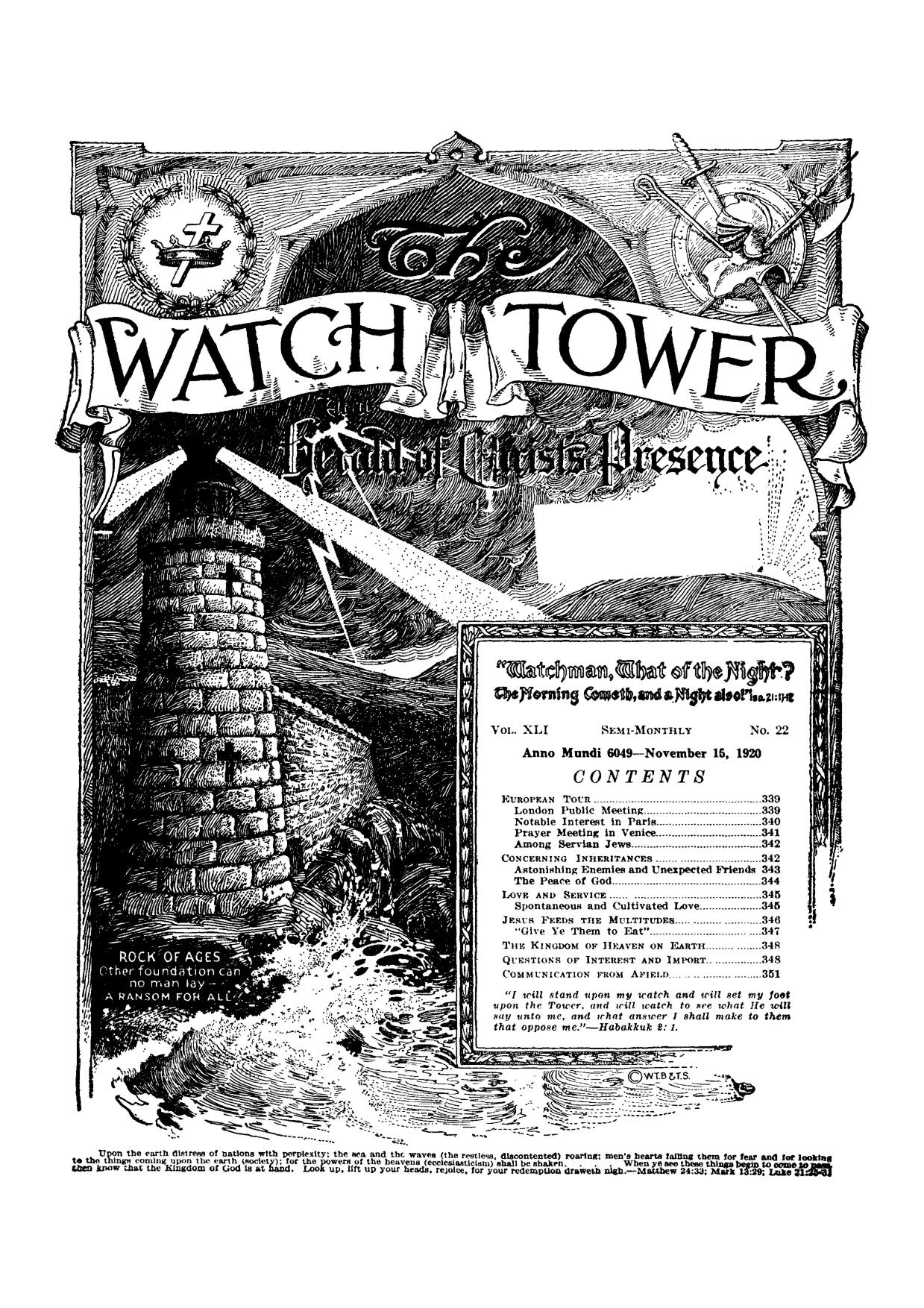
ROCK OF AGES
Other foun'dation can
no man lay - ■
RANSOM FOH ALL"
.342
Vol. XLI
Anno
European London Notable
Semi-Monthly
No. 22
Mundi 6049—November 16, 1920
CONTENTS
Tour.....................
Public Meeting.....
Interest in Paris.
Prayer Meeting in Venice.
Among Servian Jews.........
Concerning Inheritances.
.339 .339 .340 341 .342
Astonishing Enemies and Unexpected Friends 343
The Peace of God...............................
Love and Service ..............................
Spontaneous and Cultivated Love...
Jesus Feeds the Multitudes..........
“Give Ye Them to Eat”...................
The Kingdom of Heaven on Earth. Questions of Interest and Import. Communication from Afield__________
344 .345 .345 .346 .347 .348 .348
“I will stand upon my watch and will set my foot upon the Tower, and will watch to see what He will say unto me, and what answer I shall make to them that oppose me.”—Habakkuk 2:1.
perplexity; the sea and the waves (the restless, discontented) roaring: men’s hearts falling them for fear and for 1<
i ’ ior V*e P°wer?<2J heavens (ecciesiasticlsm) shall be shaken. . . When ye see these things begin U> come >
Cixd know that the Kingdom of God la at hand. Look up. lift up your heads, rejoice, for your redemption draweth nigh.—-Matthew 24:33; Mark 13:29; jj
THIS JOURNAL AND ITS SACRED MISSION
THIS journal is one of the prime factors or instruments in the system of Bible instruction, or "Seminary Extension”, now being presented in all parts of the civilized world by the Watch Tower Bible & Tract Society, chartered A. D. 1884, "For the Promotion of Christian Knowledge”. It not only serves as a class room where Bible students may meet in the study of the divine Word but also ns a channel of communication through which they may be reached with announcements of the Society’s conventions and of the coming of its traveling representatives, styled “Pilgrims”, and refreshed with reports of its conventions.
Our “Berean Lessons” are topical rehearsals or reviews of our Society’s published Studies most entertainingly arranged, and very helpful to all who would merit the only honorary degree which the Society accords, viz., Verbi Dei Minister (V. D. M.), which translated into English is Minister of God’s Word. Our treatment of the International Sunday School Lessons is specially for the older Bible students and teachers. By some this feature is considered indispensable.
This journal stands firmly for the defense of the only true foundation of the Christian’s hope now being so generally repudiated —redemption through the precious blood of “the man Christ Jesus, who gave himself a ransom [a corresponding price, a substitute] for all”. (1 Peter 1:19; 1 Timothy 2:6) Building upon this sure foundation the gold, silver and precious stones (1 Corinthians 3: Ills; 2 Peter 1:5-11) of the Word of God, its further mission is to “make all see what is the fellowship of the mystery which. . .has been hid in God, ... to the intent that now might be made known by the church the manifold wisdom of God”—“which in other ages was not made known unto the sons of men as it is now revealed”.—Ephesians 3:5-9,10.
It stands free from all parties, sects and creeds of men. while it seeks more and more to bring its every utterance Into fullest subjection to the will of God in Christ, as expressed in the holy Scriptures. It is thus free to declare boldly whatsoever the Lord Hath spoken—according to the divine wisdom granted unto us to understand his utterances. Its attitude is not dogmatic, but confident; for we know whereof we affirm, treading with implicit faith upon the sure promises of God. It is held as a trust, to be used only in his seriice; hence Our decisions relative to what may and what may not appear In Its columns must be according to our judgment of his good pleasure, the teaching of his Word, for the upbuilding of his people in grace and knowledge. And we not only invite but urge our readers to prove all Its utterances by the Infallible Word to which reference is constantly made to facilitate such testing.
TO US THE SCRIPTURES CLEARLY TEACH
tThat the church is “the temple of the living God”, peculiarly “his workmanship”; that its construction has been in progress throughout the gospel age—ever since Christ became the world’s Redeemer and the Chief Corner Stone of his temple, through which, when finished, God's blessing shall come “to all people", and they find access to him.—1 Corinthians 3:16, 17 : Ephesians 2 : 20-22; Genesis 28:14; Galatians 3 : 29.
That meantime the chiseling, shaping, and polishing of consecrated believers in Christ’s atonement for sin, progresses; and when the last of these “living stones”, “elect and precious,” shall have been made ready, the great Master Workman will bring all together in the first resurrection; and the temple shall be filled with his glory, and be the meeting place between God and men throughout the Millennium.—Revelation 15: 5-8.
That the basis of hope, for the church and the world, lies in the fact that “Jesus Christ, by the grace of God, tasted death for every man,” “a ransom for all,” and will be “the true light which lighteth every man that cometh into the world”, “in due time”.— Hebrews 2:9; John 1:9; 1 Timothy 2:5, 6.
That the hope of the church is that she may be like her Lord, “see him as he is,” be “partakers of the divine nature',’ and share his glory as his joint-heir.—1 John 3:2; John 17:24; Romans 8:17; 2 Peter 1:4.
That the present mission of the church is the perfecting of the saints for the future work of service; to develop in herself every grace; to be God’s witness to the world; and to prepare to be kings and priests in the next age.—Ephesians 4:12; Matthew 24 : 14: Revelation 1: 6; 20:6.
That tli'1 hope for the world lies in the blessings of knowledge and opportunity to be brought to all by Christ’s Millennial kingdom, the restitution of all that was lost In Adam, to all the willing and obedient, tit the hands of their Redeemer and his glorified church, when all the wilfully wicked will be destroyed.—Acts 3 : 19-23; Isaiah 35.
'PUQUSHE.D Oy
V/WATCH TOWER. BIBLE frTRACT SOCIETY 124 COLUMBIA HEIGHTSo BROOKLYN, NY, USA utoUiGN Offices : British: 34 Craven Terrace, Lancaster Gate, London W. 2; Australasian: 495 Collins St., Melbourne, Australia; South •African: 123 Plein St., Cape Town, South Africa.
Please Address the Society in Every Case.
ANNUAL SUBSCRIPTION PRICE $1.00 IN ADVANCE . CANADIAN AND FOREIGN SUBSCRIPTION PRICE $1.50 BEND MONEY BY EXPRESS OR POSTAL ORDER, OR BY BANK DRAFT
FROM FOREIGN COUNTRIES BY INTERNATIONAL POSTAL ORDERS ONLY (Foreign translations of this journal appear in several languages)
Mtttoritil Committee: This journal is published under the supervision ot ah editorial committee, at least three of whom have read and atorOved as truth each and every article appearing in these columns. The Eyes of the editorial committee are: J. F. Rutherford, W, Van Amburgh, F. H. Robison, G. H. Fisher, W, E. Page.
TWftiafO the Lord*» Poor: AU Bible students who, by reason of old ace or other fn« Artidty or adversity, are enable to pay for this joamal, will be supplied free if they send a postal Card each May stating their case and reauesting such provision. We are not enlv wflUna. but anxious, that all such be on our list, continually and in touch with the Bet ean studies._____
St^.*** ta Stuha&tbcr* • We do not. m a role, soed a eard of acknowledgment for a renewal ee IVWies to suoecnoere, j new TObecripdon. Receipt and entry oFrenewal are indicate! wttMa a month by change tn expiration date, as shown on wrapper label.
JiltwW a* Bieon^ MaUtr at Brooklyn. N. Y,, Pottojfiot mtitr Ute Aet of MareASrd,
CHOICE POST CARDS EXPECTED
Brer since the shutting off of the European supply of Scripture text post cards at the beginning of the World War we have experienced no small difficulty in securing desirable cards. But now we have in preparation twelve different designs on cards 5.1 x 31 inches (suitable for insertion in envelopes us well as for separate mailing^, provided with forty-eight texts in such a manner as to make four dozen-sets with texts all different. Naturally there are four repeat designs In every such grouping, with the exception that each of the four texts used in connection with each card design 1b printed in a different color, gray, black, light blue, or purple, so that every card among the forty-eight has a really different appearance, as also different text.
Effort has been made to choose the texts with a view to general utility, but some would serve well for special occasions, for condolences, etc. The designs are very tasteful and daintily printed by the rubber offset lithographic process. Delivery promised for December 5.
Price per four dozen, all different texts, 75c postpaid ; per single dozen, all different designs and texts 20c postpaid.
MOTTO PACKETS
Assortments of mottoes, conforming as nearly as possible to the assortments hi the packets of previous years, can be supplied as follows:
Packet Ma, 75c; Packet Mb, $1.50; Packet Me, $2.00; Packet Md, $2.50.
STUDIES IN THE SCRIPTURES
These Studies are recommended to students as veritable Bible keys, discussing topically every vital doctrine of the Bible. More than eleven million copies are in circulation, in nineteen languages. Two sizes are issued (in English only) : the regular maroon cloth, gold stamped edition on dull finish paper (size 5"x7g"). and the maroon cloth pocket edition on thin paper (size 4"x6
quot;) ; both sizes are printed from the same plates, the difference being the margins ; both sizes are provided with an appendix of catechistic questions for convenient class use. Both editions uniform in price.Series I, “The Divine Plan of the Ages," giving outline of the divine plan revealed in the Bible, relating to man’s redemption and restitution : 350 pages, plus indexes and appendixes, 75c. Magazine edition 20c. Also procurable in Arabic, Armenian, Dano-Norwegian, Finnish, French, German, Greek, Hollandish, Hungarian; Italian, Polish. Roumanian, Slovak, Spanish, Swedish, and .Ukrainian; regular cloth style, price uniform with English.
Series II, “The Time is at Hand,” treats of the manner and time of the Lord’s second coming, considering the Bible testimony on this subject: 333 frages, 75c. Obtainable in Dano-Norwegian, Finnish, German^ Polish, and Swedish.
Series III, “Thy Kingdom Come,” considers prophecies which mark events connected with ‘ the time of the end”, the gioriflcat ion of the church and. the establishment of the Millennial kingdom ; it also contains a chapter on the Great Pyramid of Egypt, showing its corroboration of certain Bible teachings : 3*<> pages, 75c. Furnished also in Dane-Norwegian, Finnish, German, Polish, and Swedish.
Series IV, “The Battle of Armageddon," shows that the dissolution of the present order of thihgs is iu progress and that all of the human panaceas offered are valueless to avert the end predicted in the Bible. It contains a special and extended treatise on our Lord’s great prophecy of Matthew 24 and also that of Zechariah 14 : 1 - 9: 656 pages, 85c. Also in Dano-N’orwegian, Finnish, Greek, German, and Swedish.
Series V, “The Atonement Between Cod and Man” treats an all important subject, the center around which all features of divine grace revolve. This topic deserves the most careful consideration on the part of all true Christians: 618 pages, 85c. Procurable likewise In Dano-Norwegian, Finnish, German, Greek, and Swedish.
. Series VI, “The New Creation,” deals with the creative week (Genesis 1, 2), and with the church, God’s new creation. It examines the personnel, organization, rites, ceremonies, obligations, and hopes appertaining to those called and accepted as members of the body of Christ: 730 pages, 85c. Supplied also in Dano-Norwegian, Finnish, German, and Swedish.
Series VII, “The Finished Mystery,” consists of a verse-by-verse explanation of the Bible books of Revelation, Song of Solomon, and Ezekiel: 608 pages, illustrated, $1.00 in cloth, 20c in magazine edition—latter treats Revelation and Ezekiel only.
AMD HERALD OF CHRISTS PRESENCE
V ,,i xi,i Noiembeb ]•>, 1920 No. 22
EUROPEAN TOUR
[Continued]
FOI? some weeks prior to the beginning of September the hearts and minds of the consecrated throughout Croat Britain were turned toward London, where the\ hoped lor a sea-on of sweet fellowship together and a. wide public witness to the truth. The\ came from Scotland, front Ireland. Irom Wale.-, and from all parts of England. Some came from Sweden and Denmark. Switzerland and France. They came to have a blessing and to be a blessing, and they were m no wist' disappointed. The convention was a season of great refreshment to every one who attended. About two thousand was the largest number in attendance at any one session of the meetings for the consecrated.
The convention began Friday. September 10. and was addressed by the following named brethren: Brother-Gillatt. Smedley. Lardent. Guiver, Sewter. Tait. Scott. McCloy. Binkele, Lundberg, Luttichau. Driscoll, Macmillan. Rutherford, and Brother Hemery. who served as Chairman. On Monday evening. September 13, following an addressbi Brother Rutherford, the convention concluded with a love feast. Many of the friends were heard to remark that this was the best convention they had ever attended. All went home thoroughly enthused and with a greater determination to enter the work with increased zeal.
In this connection we take occasion to saV that the general spiritual condition of the church throughout Great Britain seems to be better than it has been for many years. There i- a quiet, confident rejoicing in the Lord. Thore is an increased zeal and enthusiasm to carry forth the message concerning the establishment of Messiah’s kingdom. There is a keen appreciation of the fact that the old order is rapidly passing and that the new' is coming in, and the brethren are joyfully taking up the slogan: “Millions Now Living Will Never Die".
Some of the dear shoe]) throughout Great Britain were confused in a measure by the troublesome times that arose and the fiery experiences that came to the church in the past few years; but as a general rule, most of these are finding their wav back with the other brethren and rejoicing in their privileges of service. We venture the prediction that there will be a more active and zealous witness for the truth in the next few months than there has been for many months pa=t.
LONDON PUBLIC MEETING
The Royal Albert Hall had been taken for the public meeting to be held there on Sunday evening. September 12. 'Pho brethren distributed throughout London more than four hundred thousand small folders advertising the meeting. These attracted considerable attention
and the newspapers took it up and published several comments which served as good advertisements before the regular advertising campaign in the press began. The leading newspapers of London carried large adver-ti-ements of this public meeting. Several days prior to the meeting requests came to the office from many persons for reserved seats. Some of the elite of London, such as Lady-------, etc., drove to the London Taber
nacle office in their motor cars and sent in special requests for tickets. Among those who applied for seats were Princess K —------, and others of like
standing, ft was evident that the meeting was attracting all classes of people.
The Rmal Albert Hall was built more than fifty years ago by Queen Victoria as a memorial to her beloved husband. Prince Albert. It is reputed to be the largest and best appointed public hall in Great Britain, ft is built in a circle, one tier of galleries ri.-ing above another, there being seven in all. It has a capacity of thirteen thousand.
Shortly after four o'clock Sunday afternoon, people began to assemble outside' the hall, although announcement had been made in the advertisements that the doors would be opened at (i:!.~i and the lecture would begin at 7 :1 f> p. m. By <i\ o’clock there were four long queues extending for several blocks, the people standing closely in order and waiting for the doors to open. It wa< a wonderful sight to behold these people come. Brother Driscoll and Brother Soper, operating the moving picture camera, made ,-ome pictures of the great crowd. The people came on foot, on the large motor bu—es. in private motor cars and in taxicabs. Many elderly people were seen in the crowd, and, from their appearance these were doubtless of the very best class of London's citizenry.
THE MESSAGE OF COMFORT
When the doors were opened there was a rush of the great multitude and the ushers were powerless to handle the crowd, which shortly filled every available space, including all the standing room in this great auditorium ; and thousands still lined the streets, clamoring to get in. many more remaining on the outside than had gained admittance. The opinion was unanimously expressed that this was the greatest crowd that had ever assembled in Great Britain to hear the message of present truth.
The subject announced for this meeting was “Millions Now Living Will Never Die’’: and the coming of this great multitude is an evidence of the eagerness of the people to hear a message of comfort in this troublesome time. There is no message of comfort except that con-139
cerning Messiah’s kingdom, and the consecrated now have the blessed privilege of publishing to the world the message of peace and salvation, and declaring unto nominal Zion that the Lord reigneth. (Isaiah 52: 7) It seems quite clear from the Master’s words that these glad tidings must now go to all Christendom as a witness unto the nations before the final end of the present order.
It had been announced that Brother Rutherford would use the Magnavox, in view of the great number of people who were expected to assemble in order that all might hear without difficulty. He began his address by the use of the Magnavox; but it was soon demonstrated that this instrument is not suitable for use inside a building. There was too much echo and running together of the words. It was seen that the audience was having difficulty in understanding, so the Magnavox was discarded and Brother Rutherford spoke in the usual way and every one in the hall was able to hear and remained throughout the entire discourse. At its conclusion about thirty-four hundred left their names and addresses, and for some days thereafter still more requests for information concerning the subject continued to come through the mails to the office.
While Brother Rutherford was addressing the audience in the hall, Brother Macmillan addressed an open air meeting at the rear of the great building. No opportunity was given for names and addresses to be handed in at this gathering, for the reason that they had no means of leaving them. Many tarried, however, at the doors, hoping that some might leave the hall and they would gain entrance before the meeting concluded. It had been hoped that the new book, “Millions Now Living Will Never Die,” would be at hand for sale to the people at the close of this meeting; but delay in shipping rendered this impossible. However, the brethren throughout Great Britain will now make a vigorous campaign, holding public meetings throughout the provinces and selling especially the book “Millions Now Living Will Never Die” and the Studies in the Scriptures.
GOOD TIDINGS OF GOOD
It was gratifying indeed to see such wonderful interest manifested. All the brethren at the convention felt that they had a part in this meeting, which indeed they did have; and all went away rejoicing greatly that the wide witness was given in the greatest city of Europe. We hope that much good was done at this meeting, and that the interest will continue to increase, and that many hearts made sad because of the great war may be gladdened and that hope may spring afresh in the hearts of many who have been discouraged and dismayed. Precious is the privilege granted to the people of God at this time to act as ambassadors for Christ, bearing the message of peace and salvation to groaning humanity.
In this connection we are pleased to announce that the little book, “Millions Now Living Will Never Die” —which for short is called the “Millions” book— is being translated and published in the following languages in addition to the English: Swedish, Dano-Norwegian, Finnish, German, Hollandish, Swiss, French, Italian, Greek, Polish, Russian, Roumanian, Hebrew and Yiddish, and Arabic, and arrangements are being made to translate and publish it in many other languages. Our hope and desire is that this message, either in printed form or by word of mouth, may be given to all Christendom within a short time.
Following the great meeting in London, public gatherings at the following points were addressed on the same subject: Leicester, with an attendance of twenty-five hundred; Manchester, three thousand, and Bristol, thirty-five hundred. During this short campaign in Great Britain twelve public meetings were held and approximately fifty thousand people heard the message. Withal, the British campaign, though brief, was fraught with many blessings from the Lord. The friends were refreshed and lifted up. They were more closely united in love and in service, and many sad hearts made glad. The tour of the British Isles being completed, the party proceeded to the continent, in harmony with previously made arrangements.
NOTABLE INTEREST IN PARIS
Saturday noon, September 18, Brother Rutherford and Brother Driscoll boarded one of the Handley-Page transport aeroplanes and flew from London to Paris, while the remainder of the party went by train and boat. The distance from London to Paris by air is two hundred forty miles, and the trip is made usually in a little less than three hours; but on this occasion the winds were strong, the sky was clouded and rain fell part of the time. The air currents were such that detours were necessary to be made by the plane. Two of these planes left London about ten minutes apart, our brethren being in the second. The first one was required to land some distance from Paris, while the other sped safely through the air, alighted majestically and ran to its berth like a great bird. It was indeed a thrilling and enjoyable journey. To see London and the beautiful fields of England and France from an aeroplane is a sight much to be desired. It is both novel and thrilling to fly above the waters of the English Channel, over which part of the journey from London to Paris must be made.
Prior to the World War it was seemingly impossible for a public meeting to be held in Paris. Brother Russell on several occasions attempted to arrange for a meeting, but was refused permission to speak; and in 1913 he personally applied to the police for permission for Brother Rutherford to address a public meeting in Paris, which was also refused, on the theory that it might start an agitation. Conditions seem to have changed since the war. The brethren made an attempt to have a public meeting at Paris on Sunday evening, September 19. They were unable to get a hall seating-more than one thousand persons and, of course, did very little advertising, as they are not permitted to distribute handbills^ At the appointed hour fully one thousand persons assembled at the hall, packing every available space. They were addressed by Brother Rutherford for an hour and a half on the subject, “Millions Now Living Will Never Die”. Keen interest was manifested by those present, more than three hundred of whom turned in their names and addresses, desiring further information on the subject. This meeting was attended with such success that it was thought wise to arrange for another. Accordingly, arrangements are in progress to have a much larger meeting in Paris, to be addressed by Brother Rutherford on the same subject, November 25.
Pour of the brethren who left America were joined at Paris by Profiler Ilemerv of London and Brother Sharples of Thelwall. and Tuesday evening. September 21. they boarded the Simplon-Orient Express for Athens, Greece.
When we awoke the next morning we were on the shores of beautiful Lake Geneva, with the majestic Swiss Alps in the distance. Soon we were passing through these mountains, the scenery of which is unsurpassed for grandeur. Our route took us through the great Simplon Tunnel. This is the longest tunnel in the world, being twelve miles, five hundred thirty-seven yards from mouth to mouth. Our train entered on the Swiss side and came out in Italy, the international line being crossed about the center of the tunnel. At one point in this tunnel there are seven thousand feet of the mountain above the train. The remainder of the day was spent passing through the beautiful scenery of Italy.
PRAYER MEETING IN VENICE
Wednesday evening our party assembled in one of our compartments for a prayer meeting, the text for the occasion being: “The Lord will give strength unto his people: the Lord will bless his people with peace”. We thought of and remembered in prayer our dear brethren in America and Canada and were reminded of how appropriate was this text in connection with the work begun by them only the day before in a wide witness for the truth. The testimony of each one present was helpful to the others. To conclude, we all joined in prayer, especially in behalf of our brethren in the States and in Canada. While yet in prayer, and before we had finished, the guard knocked at our door and announced that our train would proceed no further, that heavy rains had destroyed the bridges ahead and we must remain in Venice overnight and take ship the next day on the Adriatic Sea for Trieste.
We were now in the historic and unique city of Venice, the streets of which are chiefly canals, which are bordered and dotted with gondolas as the means of transportation. Our party engaged one of these gondolas with two oarsmen and made an inspection of the ■city by night. The moon shone brightly when we started, but soon a shower caught us, while in the midst of one of the canals. Wo hurried to sho!tor as ■quickly as possible, but notwithstanding, some of us were pretty thoroughly sprinkled. The rain soon ceased, however, and we proceeded on our journey. We visited the Rialto, the ancient bridge made famous in poetry and song by Shakespeare, particularly in “The Merchant of Venice”. Concluding the inspection tour, we retired in our sleeping car.
Early the next morning we were aroused and with all our baggage proceeded to a gondola and were taken through the watery streets into the harbor. Here, amid great excitement and confusion caused by hundreds of like vessels laden with people and baggage, we were jostled, hurried and pushed about until our turn came to board the S. S. Gablonz. The steamer was scheduled to leave at eight a. m., but it took more than two hours to load. L!p« ards of three thousand people were crowded on the ship. We then ascertained that the crew had gone on a strike because three companies of soldiers were taken aboard to be transported to 'Trieste for the purpose of suppressing a strike of metal workers at that place. 'The crew sent a walking delegation to the officers of the ship and served an ultimatum that they would not take the ship out of the harbor until the soldiers were removed. The parley continued until early in the afternoon. Finally the ship’s officers yielded, the soldiers were removed, and the ship proceeded on its way across the Adriatic, landing in Trieste late that night. The unloading here was amid great confusion also.
CAMPING OUT IN TRIESTE
An unusual thing transpired in this connection. It is customary for ships to unload their first and second class passengers before the steerage. But for some reason (probably because the crew was dictating the terms) the steerage passengers were first unloaded, then the second class, and finally the first class.
We had received word that a new train was made up at Trieste which we could board and resume our journey at midnight. With our baggage loaded into a horsedrawn vehicle, most of us followed it on foot to the station, only to learn on arriving there that the train would not leave until next midnight. Then we set about to hunt a place to sleep. We visited the best hotels without success. We were turned away everywhere we went. After one o’clock, following vain attempts to secure accommodations in some private homes, we came to a third class hotel The manager informed us that the house was full, but he would be glad to entertain us if we would sleep in the beer garden on benches and tables. We agreed to that in preference to sleeping in the street. On entering, we found beds for two, in a room occupied by a gentleman who had not yet retired. Our British brethren were sent to the beds, and the other members of the party stretched themselves upon tables and benches in a large indoor garden, of which they had exclusive use. All slept soundly through the remainder of the night.
The next day was spent in Trieste, a city well built, clean, beautifully located, and a port of great importance. We made some moving pictures here which we believe will prove to be of great interest. Friday at midnight we again boarded the Simplon-Orient Express and continued our journey eastward through northern Italy and across Jugo-Slavia — the new kingdom of the Serbs. Croats, and Slovenes. We reached Nish Sunday afternoon. This was a town of considerable importance during the World War. For a short time it was the capital of old Servia. Almost all the stations along the railway in this part of the country were destroyed during the war. Some have been rebuilt and others are in course of reconstruction.
AMONG SERBIAN JEWS
At Nish we visited the Jewish quarter. Some of these people we found were able to speak the German language and through our German interpreter, Brother Goux, we were able to converse with them. We told them of our interest in Zionism, and how that we were going to Jerusalem for the purpose of getting information about Zionism and the setting up of Messiah’s kingdom that we might give it out to the people. This greatly pleased them, and especially two or three old Jews, who were very much delighted. These were men of faith in God and the prophetic promises; and when it was suggested to one of them that he was a good man, he pointed up and said: “God knows whether I am good”. They were very kind to us and rendered every assistance within their power to enable us to get some pictures of their settlement, their synagogue, and general conditions, all of which will be of interest when compared with the restoration of Israel in Palestine.
From this point the main part of our train proceeded to Constantinople, while our sleeping car was attached to a local, which is indeed very slow and proceeds with extreme caution over the road, much of which was destroyed during the war. Sunday and Monday (September 26 and 27) we passed over that area of Servia which was the scene of many terrific conflicts from 1914 to 1918. Within one day we passed over rivers where fourteen railway bridges were destroyed and the trains now creep over on temporary structures. The western and northern parts of Servia are very rich farming land, but the southern and eastern portions seem to be quite arid and mountainous. The people appear to be orderly and tending strictly to their own business. At Nish our dining car was removed and since then we have had to forage for food.
At the stations we go out and buy what we can in the way of fruits, nuts, melons, cheese, etc., but compared with the appearance, of the natives, we are faring exceedingly well and are thankful that the Lord makes such provision for us. Along the road that we are now traversing we see the havoc wrought by the war. Large numbers of wrecked locomotives, remains of burned and blown-up railway trains, destruction of roads, bridges and houses, some of the towns being literally shot to pieces. These are the silent witnesses of the great World War, "which was the beginning of the end foretold by the Lord many centuries ago. Happy will be the hearts of these people and all people when the kingdom of peace is forever established and when they will learn var no more! Happier will they be when this waste and desolate land is made fertile and a fit habitation for perfect man!
Tomorrow (Tuesday) we are due to arrive at Athens.
CONCERNING INHERITANCES
“77ie eyes of your understanding being enlightened; that ye may knoio . . . the riches of the glory of his inheritance in the saints.” “In whom also ice have obtained an inheritance.’’—Ephesians 1:18,11.
JEHOVAH’S inheritance is his people, and their inheritance is Jehovah. These are the two great inheritances of which the Scriptures speak. It was so in the time of fleshly Israel; it is so now with the church of God. Of Israel it was spoken:
“Jehovah’s portion is his people,
Jacob is the lot of his Inheritance.”—Dent. 32:9. And at least one of the Israelites indeed could and did say:
“Jehovah is the portion of mine inheritance, And of my cup.”—Psalm 16: 5.
Compare Numbers 18 : 20 ; Psalm 73:20; 119 : 57 ; 142 : 5 ; Jeremiah 10:16; Lamentations 3 : 24.
This matter of inheritance is the subject of the Fourth Psalm:
[Prayer]
1. “Answer me when I call, O God of my righteousness; Thou hast set me at large when I was in distress: Have mercy upon me and hear my prayer. [Expostulation] ■
2. “O ye sons of men,
How long shall my glory be turned into dishonor? [How long] will ye love vanity,
I How long will ye| seek after lies?
Selah
3. But know that Jehovah hath set apart one that is favored, for himself.
Jehovah will hear when I call unto him.
4. Be ye angry, and sin not:
Commune witli your own heart upon your bed, and be still.
Selah
5. Offer the sacrifices of righteousness, And put your trust in Jehovah.
[Prayer]
6. “Many there are that say, Who will show us good?
Jehovah, lift thou up the light of thy countenance upon us;
7. Thou hast put a gladness in my heart
Greater than [they have] when their corn and their new wine are increased.
8. In peace will I both lay me down and sleep;
For thou, Jehovah, alone makest me dwell in safety.”
A DUTILESS SON
Evidently this Psalm was written at the time of Absalom’s rebellion, which was doubtless the most crucial period of David’s life. This fact is established by Psalms 3 and 144, parts of which will be looked at presently. What now appears as a superscription to Psalm 5 should be the superscription of this Psalm, 4. It is the Hebrew word Nehiloth, and signifies “inheritance”. Psalm 5 is not an inheritance Psalm, but contrasts the righteous with the unrighteous. Psalm 4, on the other hand, is one in which the hounded King of Israel reminds himself of his inheritance in Jehovah and of Jehovah’s deep interest in him. He remembered that joy in Jehovah was better than the joy of harvest or vintage (Isaiah 9 ;3 ; Jeremiah 48:33) and the favor of Jehovah was much to be preferred over any earthly portion.
The time was the tragic night of David’s flight from Jerusalem. Absalom, a remarkable son of David, had killed his brother Amnon, as the culmination of a plot which lasted through two years. Absalom, fearing the paternal wrath, fled to the protection of a neighboring king and remained there three years. Finally, through a ruse of Joab, David’s major general, King David issued a permit for Absalom to return home, but denied him the privilege of converse with his renowned father. Smarting under the humiliation of thus being excluded from court life. Absalom seems to have spent the major portion of two years in plotting >ome way of accomplishing revenge. The greatest humiliation to which he could bring his father would be to supplant him in the throne, and keep the young Solomon, son of the beloved Bathsheba, out. But nothing could be done while he was openly in the king’s disfavor. He mud have a social standing and groundwork upon which to build his structure of rebellion. He must get back into the king’s favor, even if it should cost him a little humbling. Would he not make it all up later?
The resourceful and none too scrupulous Joab was finally forced to help him. and a reconciliation with Ins royal father was effected. With Datid it was genuine; for his heart was toward Absalom. (2 Samuel 11:1) But with Absalom it was mostly dramatic play: no tender conscience spoke under that massive bush of hair. No filial heart throbbed inside that faultless torm —for "in all Israel there was none to be so much praised as Absalom for his beauty". 2 Samuel 11:25.
ANCIENT BAIT OF PIOUS POLITICIANS
But, though there was no conscience m bis head, there were many cunning ideas there. No sooner had he gained bis point with the king than he set about winning the admiration and a Sections of the people. To catch the eve of those who would be dazzled by show he prepared him a splendid coach and horses with a precursor band of fifty men. To interest those who weie more matter-of-fact, he played the role of the judicial ami political reformer, as professional politicians are wont to do. He championed the cause of those who came to the king as to the supreme court of the land. By innuendo and fair speech he gave them all to understand that if he were just in a position of power and authority he would see that the poor, downtrodden average man had justice: the poor should want nothing, if only he were king. But (doubtless with a sigh of mock sorrow and resignation) of course such a thing could never be. Oh, no; that would be an improper thought. But just the same it would be nice for the poor man to have a friend. And. then, you know my father means well, but he is not so young as he once was and no doubt he finds it hard to keep abreast with the times. Yes, poor father means well, but I wonder sometimes whether the nervous strain of being chased so long by Saul has not begun to show on his mind. Things aren’t what they should be. If only—
Thus “Absalom stole the hearts of the men of Israel”. (3 Samuel 15: (i) And relying on his father’s confidence in him he staked all on one last ruse. He appealed to David for leave to go and pay a vow which he claimed to have made to Jehovah. O Jehovah, what nameless atrocities have been committed in thy name 1 N o wonder thy wrath is due upon many of them that name thee.
Spies were quickly sent out with instructions to advise the people to proclaim Absalom king in Hebron when they should hear the trumpets sound. “And the conspiracy was strong.” (2 Samuel 15:12) David loved his son, but he also knew his treachery. So when the news of the people’s deflection to Absalom reached the king's ears he made immediate preparations and fled from the city.
ASTONISHING ENEMIES AND UNEXPECTED FRIENDS
Great disasters and signal events always bring out many unexpected things. Those who have been relied upon -onietimes prove to he uncertain and independable; the-e I loin whom one has had no occasion to expect anv thing often show a refreshing amount of zeal, personal sacrifice, and loyalty. So it was with David. Absalom, w ho had every cause to be dutiful to his father, whose verv hie he owed to the clemency and native generosity of the king, was at the head of the ill-favored conspiracy. Ahithophel. the king's counsellor and i loses! friend, did what he could to fill up the role of a traitor. Ziba. a servant of the house of Saul, but long a benefit iarv of the king, lied and played the part, of a scheming, double-faced vidian. But Ittai, “a foreigner and also an exile." as well as a new comer to the city, said: "Surely m what place my lord the king shall be, whether for death or for life, even there also will thy seivant be". 2 Samuel 15: 1*1, 21. '
David, with his family, his retinue of servants and an eiitoiuvue ol Iriends and sy mpalhizers. passed up the slope of the Mount of Olives where, a thousand years thence, Jerusalem's eternal king, likewise spurned, likewise in strong cry ings and tears (2 Samuel 15:30; Hebrews 5:7). sought comfort from Ins covenant God, Jehovah.
That eventlul night, that night the day of which had seen his son'- rebellion, his closest friend turn traitor, his throne in jeopardy, bis own name cursed by the Saulite Shimei, and which had heard the tidings of Mephibosheth's doubtful stand, that night he wa< able to say: "Ju peace will 1 both lay me down and sleep". His inheritance was Jehovah and if that God's prov idence took away the things pertaining to his kingdom and his honor, he still had his inheritance, just as hi1 had had when as a fugitive but anointed stripling he lay down under the star-pierced roof of heaven and slept the sleep of buoyant youth.
Wo recall how that One who was David’s son but a ho is now David’s Lord was betrayed by Judas, of whom Ahithophel reminds us. and who in like manner “hanged himself”.—2 Samuel 17:23; Matthew 27:5-8; Acts 1: 1G- 19.
This desertion of Ahithophel is alluded to in I’salm 55:12-14:
“For it was not an enemy that reproached me;
Then I could have borne it:
Neither was it lie that hated me that did magnify himself against me;
Then 1 would have hid myself from him. But it was thou, a man mine equal, My guide and my familiar friend. We took sweet counsel together, And walked unto the house of God in companv."
TRUE BROTHER TO JUDAS
Is there not more, than mere passing similarity between the treachery of Ahithophel and that of Judas? Ahithophel said: “Let me now choose out twelve thousand men, and I will arise and pursue after David this night: I will come upon him while he is weary and weak handed, and will make him afraid; and all the people that are with him shall flee; and I will smite the king only”. (2 Samuel 17: 1, 2) On the other hand Judas led the posse which came to apprehend our Lord; he came upon him when he was weary and seemingly weak handed (having only two swords) ; true, he did not make Jesus afraid, but all those who were with him fled. (Matthew 26: 56) And can there be an allusion in our Lord’s words about ‘more than twelve legions of angels’ to this boast of Ahithophel to take twelve legions of soldiers? Only the King was smitten, as he himself explained: “Let these go their way: that the word might be fulfilled which he spake, Of those whom thou hast given me I lost not one”.—John 18: 8, 9.
Psalm 3 sheds additional light on this subject. Besides being a twin in structure to Psalm 4 it is linked to it by the closing Selah. There too David says:
2. “Many there be that say of me. There Is no help for him In God.
Selah
3. But thou, O Jehovah, art a shield about me, My glory, and the lifter up of my head.”
The contrast here is between God, the Creator, and Jehovah, the Covenant God. His enemies knew of Jehovah only as the mighty Creator (Elohim) but not as one having intimate interest in and guidance over the affairs of his covenant people; else they would not have undertaken the rebellion. But Jehovah was David’s Covenant God, his inheritance, and to him he turned in this hour of trial. His many adversaries did say: “The Lord hath returned upon thee all the blood of the house of Saul, in whose stead thou hast reigned; and Jehovah hath delivered the kingdom into the hand of Absalom thy son”.—2 Samuel 16: 8.
“But thou” emphasizes the blessed fact that, in spite of all appearances, in spite of the taunting of fickle enemies and the bitterer failings of faithless friends, Jehovah was his shield and would in due time restore his kingdom and lift up his head.
David’s trust in God was shown in his expression to Zadok, when that priest wished to bring the ark of God with him and follow David: “Carry back the ark of God into the city; if I shall find favor in the eyes of Jehovah, he will bring me again and show me both it and his habitation”.—2 Samuel 15: 25.
THE PEACE OF GOD
Certainly this is akin to God’s peace mentioned by the Apostle. David had made known his requests to God and the peace enjoyed in his heart “kept” him from being full of care and sleeplessness. “Be anxious for nothing; but in everything, by prayer and supplication, with thanksgiving, let your requests be made known unto God. And God’s peace (which passeth all understanding) shall keep your hearts and minds, through Jesus Christ.” (Philippians 4:6) God’s peace is such as reigns in the presence of him who knows the end from the beginning. That tranquility of mind is ours if we trust God’s wisdom and foresight only as much as he trusts himself. It is just because we do not see beyond ttie present moment that we are filled with care. Faith cannot pierce the future, but it can lay hold upon Omnipotence. Do we grasp it as firmly as did David?
4. “I cried unto Jehovah with my voice,
And he heard me out of his holy mountain.
Selah [i.e., that being so, mark Well what follows.]
5. I laid me down and slept;
I awakened; for Jehovah sustained me.”
David was awakened that night of his flight by the tidings sent from Hushai by Jonathan and Ahimaaz, the sons of Abiather, who said: “Arise and pass quickly over the water [the Jordan] . . . Then David arose, and all the people that were with him, and they passed over Jordan and by morning light there lacked not one of them that was not gone over Jordan.”—2 Samuel 17:21, 22.
It was all the affair of a night. David’s inheritance seemed to be in jeopardy. His glory appeared to be in danger of ceasing, his crown of being profaned, and his throne was threatened to be cast down to the ground. —Psalm 89: 39, 44.
Was Jesus comforted by these Psalms and by the historical facts back of them ? Was the example and word of David the “angel” (2 Samuel 14:17,20; 19:27) which thus ministered unto him in his hour of direst need? Surely these things helped him, to state it very safely. Jesus submitted to the curse of the cross and rebuked those who affirmed that it should not be so, even as David did.—2 Samuel 16:9-12; Mark 8: 33.
Jesus, like David, saw the horror of it all:
“My heart Is sore pained within me:
And the terrors of death are fallen upon me. Fearfulness and trembling are come upon me. And horror hath overwhelmed me.
And I said, O that I had wings like a dove!
For then would I fly away and be at rest.
Lo, then would I wander afar off, And remain in the wilderness.
I would hasten my escape from the stormy wind and tempest.”
—Psalm 55: 4 - 8.
THE EBON NIGHT OF DEATH
But finally Jesus lay down in the cold, dark night of death and slept, commending his very life to Jehovah as his shield, his guardian power. Jesus was awakened early in the morning and escaped from every enemy, every snare.
Shall the footstep followers of Jesus do less? Nay, though they have been betrayed and cursed and darkness has settled about them for nineteen hundred years, andthe “nighe also” of the severest time of trouble is even now settling down, they need have no fear; for “happy is the people whose God is the Lord”, and in the morning light, in the Millennial dawning, there will be not one of them lacking that has not passed over Jordan.
This inheritance alone is true happiness and real good. This is the only source of abiding joy and gladness for any people. Increase in earthly inheritances will not do it; increase of corn and wine will fail; but the light of Jehovah’s countenance will never fail. The multiplying of sheep and oxen will not bring blessedness. It is not those things which men put into their barns, but that “gladness” which Jehovah puts into the hearts of his people, that is the real inheritance.
“In peace will I both lay me down and sleep!
For thou, Jehovah, alone makest me to dwell In safety.”
LOVE AND SERVICE
"By love serve one another.”—Galatians 5:13.
10VE never calls to a hie of ease. Childish conceptions of love are to the effect that it will solve all problems. It will do nothing of the kind ; it w ill make more problems than we ever imagined were pos-ible before. Love calls to effort in the behalf of the loved object, calls to sen ice. Service i> at once a test mid a proof ol love; and there is no real love without a will to sei ve. He who seeks a life of ease had best let love alone; for it will draw him into difficulties and distresses that he would never choose.
In other words, love is a motive, a benevolent motive to be sure; but if it is not a motive it is nothing at all. Love is the spark igniting the gasoline of faith, with which we can get over the hills of life. Love makes us do things; if it does not make us do things it is not love. Through imperfections, shortcomings, weaknesses, we are not able to do much, but the will to serve is there just as surely as the germ of life is in every living seed. It has a certain potentiality for good. Given the opportunity it will grow, it will expand, it will spread out and produce fruitage for the benefit of others.
Our text leaves room for the thought that love itself is a service; for, as love is a motive, a mover to action in the, life, so the bare existence of good wishes, good will toward others, is a spur and a stimulus to them, as one storage battery can measurably charge another.
SPENDING, BEING SPENT, BEING SPURNED
But in addition to this, love moves the whole being into a spirit of service. The greatest love, God’s love, has performed the greatest service. (John 3:16) Some love, some service; more love, more service; much love, much service—much of the desire to spend and be spent for the loved one or ones. Some are willing to spend; all are not willing to be spent, which is the harder thing of the two. And harder yet than being spent is being spumed. One of the hardest trials of life and of love is to have one’s box of precious spikenard open, and one’s hair dowm, ready to anoint and to wipe the feet of a beloved one—and then to have that loved one up and walk away in apparent unconcern. But while such conduct measurably limits the field of one’s service it does not kill the will to serve. Often it is the starter to the acquisition of more wisdom; for service, to be real aervice, must not be either out of place or out of time.
But while love does not make life comfortable (self satisfaction does that) it does make it happy; while love does not make life easy, it does make it worth while. God’s love for humanity is traceable to his own inherent benevolence rather than to the excellencies in the human race, yet he served the best interests of mon. Likewise the,love of Jesus for imperfect beings must be mostly benevolence, good will. There cannot be. very much admiration in it; for the reason that there are not a great many things to be admired,
SPONTANEOUS AND CULTIVATED LOVE
This loving service of Jesus is used as an example for ua and also as an argument of how we should lay down our lives for the brethren. (1 John 3:16) But such love as inspires us to lay down our lives for the brethren does not spring spontaneously out of the soil of the human heart. Sacrificial love is not indigenous to any soil; it must be planted and cultivated with the greatest care. All love under normal conditions is spontaneous; hut we are not Ining in normal conditions. We are living in imperfection and surrounded by it; and for this reason the love leading to great service is to be cultivated. The wild-ilower phileo love, will wither in the ewe.'sive summer's heat, will fade and die down in the chilly dais of autumn, and will disappear altogether, even if not absolutely die out, when the icv blasts of winter blow. True, when the warm sun of the world's springtime shines love will spring up everywhere; it will always be wonderful but not always so costly. This is the world’s winter time now, and what is the church to do for love? She must cultivate it. Agapee love will not grow by itself. It must be warmed by a knowledge of God’s goodness and nourished by his various providences for the church. It must be watered with truth and dunged about with the refuse of relinquished earthly hopes.
True love seeks to serve, not the whims or foibles of the loved one, but his best interests. Therefore love does not inspire one to help another in an evil course. There can be no successful love that disregards justice in any way. Regard justice as we will, we cannot come up to its perfect requirements, but love will never overlook or spurn its righteous directions. Mawkish sentimentality will sometimes do that thing, but love will not. Heavenly love, like heavenly wisdom, is first pure. Nor does love contribute its service to the disturber of peace. Love may sometimes seem to be on the side of the sword, but it is not; for it has the best interests of the loved one at heart, and those best interests lie not in being merely peaceful, but in being on the side of right. Love to serve in righteousness and love to serve in peace can never produce a cantankerous disposition. Be one ever so right, love will never make him blatant about it. The dramatic lone-hand-play for righteousness, for which the Lord rebuked even Elijah, is not the pose of love; for ‘dove vaunteth not itself”, its own virtues and steadfastness, even while being truly steadfast. Love will not lend its service, its assistance, either moral or physical, to those schemes or devices which are calculated to ride roughshod over the feelings or judgments or rights of others. Love will help others to be not only pure and peaceable, but also gentle.
LOVE WORKING NO ILL
Love, in its service, will not encourage any one to be stubborn or obstinate. Its influence will be in the direction of easy entreatment on matters where specifically known righteousness is not involved. Again, the service which love inspires will not help a neighbor to plant seeds of hatred or envy or strife. But it will turn to and help clear the ground and plant and encourage the cultivation of the good fruits of mercy. True love will not lend moral assistance to another in a course of truckling, of wishy-washy variance. It will seek to aid others, by both practice and suitable precept, to a knowledge of how to set their sails so that the winds of life will not drive them aimlessly about, but will actually help them in a forward course. Neither will love give a moral helping hand to anything like hypocrisy. Love not only, does good, but it helps others to do good, without busybodying in their affairs. Love, therefore, must serve, it must work, but it never works harm. If harm is worked then some other force than love is active; for “love worketh no ill to his neighbor”.— Romans 13:10.
EVIL SURMISINGS AND SERVICE
Love suffers long, because it wills to accomplish something for the loved one. It is kind, because kindness serves the best interests of the other. It is the firelight, in the warm glow of which are not only the chills of worldliness and selfishness dispelled, but also the cheery spirit of fellowship and the encouraging smile developed. Yes, kindness does serve. Love does not inspire to envy, for envy would not serve. Instead of bringing blessings to the loved subject, envy robs of even those which one has. It lays the blighting hand of winter on the heart that ought to be warm with contentment and appreciation. Envy serves no adequate purpose.
Love does not vaunt itself, for to do so would be to stand one’s self in the way of opportunities for service. Self would loom so big that the needs of others could not be recognized. Love does not behave itself unseemly. If it does it may undo what has been done before. Love is not acquisitive of anything except opportunities to do good, to be helpful. Love is not easily provoked; for the hair-trigger temper does no one any good; it does not minister to the needs or to the comfort of any one. Love thinketh no evil, because it is wrong to do so. But one of the reasons why it is wrong to do so is the fact that evil surmising clouds the mind and corrodes the heart, so that opportunities of service might be overlooked, or, seen, have no appealing power. Love rejoices with the truth, not only because it is an appropriate and fitting thing to do, but also because such rejoicing radiates a helpful spirit and may encourage someone else to a deeper love for the truth. Love does not fail; for to fail would be to do no further good.
Thus love itself by its very existence serves, it does good, and never harm. And'it is a motive spurring oiie on to every possible good wdrk.
JESUS FEEDS THE MULTITUDES
--December 19 — Matthew 14 — —
ELIJAH, JOHN THE BAPTIST, AND THE CHUBCH — THE BITTERNESS OF JEZEBEL AND HEBODIAS — JOHN’S CANDOR AND HIS DEATH — JESUS* WITHDRAWAL TO A DESERT PLACE — THE MULTITUDE WILL MAKE HIM KING--FEEDING THE GREAT MULTITUDE.
"They have no need to go away; give, ye them to cat."—Matthew 14:16.
AS THERE is a striking resemblance between John the Baptist anil Elijah his type, so there is a strong k resemblance between the experiences of John and those of the faithful church—the greater antitype of Elijah. While Elijah fled from Ahab, his real persecutor was Jezebel, who sought his life. So John the Baptist was apprehended and finally executed by Herod, but his real opponent was Herod’s wife, Herodias. Similarly the greater Elijah, the faithful body of Christ in the flesh, has suffered and will yet suffer further at the hands of civil power, but the real persecutor behind the civil power has been the antitypieal Jezebel mentioned in Revelation 2:20—the antitypieal Herodias—the nominal church adulterously allied to the kingdoms of this world, while nominally espoused to Christ. All Bible students will recognize the various pictures of this apostasy In Revelation, whether they understand the resemblance distinctly or not.
John’s position in the future will not be that of a member of the bride, the heavenly kingdom class; but with Abraham, Isaac, and Jacob and all the prophets, among whom he was one of the chief, he will be privileged to participate as a member of the earthly phase of the kingdom, and be one of the “princes in all the earth”. (Psalm 45:16) And as a servant of the kingdom he will be greatly honored and blessed and used, In that position to which by the grace of God he was called.
HERODIAS’ GRUDGE AGAINST JOHN
John’s can^pr in reproving Herod for living In adultery with his brother Philip’s wife brought against him not only Herod’s ill-will, but especially the ill-will of the woman. It would seem indeed that it was the woman, Herodias, that was the instigator of Herod’s entire course toward John. We read: “Therefore Herodias hated him and wished to take his life, but could not; for Herod stood In awe of John, knowing him to be an upright and holy man, and he protected him. After listening to him he was in great perplexity, and yet he found a pleasure in listening.”—Mark 6:19- 25, Weymouth.
Herodias was therefore on the lookout for some opportunity to overcome Herod’s sympathy and fear and to-accomplish the death of John, who had now been imprisoned, at her instance, for over a year. Her opportunity came-when, at a birthday banquet, Herod, surrounded by his “lords and high captains”, and charmed by the dancing of Salome (the daughter of Herodias), promised that maiden whatever she might ask, even to the half of his kingdom. The wickedness and Intense malignity of the mother’s heart against John, simply because of his reproof of her wrong course, is fully shown by the fact that at her instance the daughter chose the death of John in preference even to half of Herod’s kingdom.
Incidentally, too, this narrative- shows how great an influence a wrong-minded woman can exercise. Herod was under her Influence to such an extent that he had put away his lawful wife to make room for this wicked woman; her daughter was under her influence so that she was willing to relinquish half a kingdom to fulfill her mother’s wicked’ will. One lesson here set before us is that, while women naturally are more sentimental than men, and under favorable circumstances dominated by good sentiments, yet, if they become evil-minded and vicious, they are correspondingly disposed to go to even greater extremes of wickedness-than their brothers. It is of absolute-importance to men that they should not only be emptied of the-evil spirit of selfishness and sin. but that they should be filled «with the spirit of Christ, the holy spirit: all this Is, if any difference, still more important as respects woman, with her more sentimental nature for either good or evil.
…