The Watchtower, November 1, 1920
Download: PDF — The Watchtower, November 1, 1920
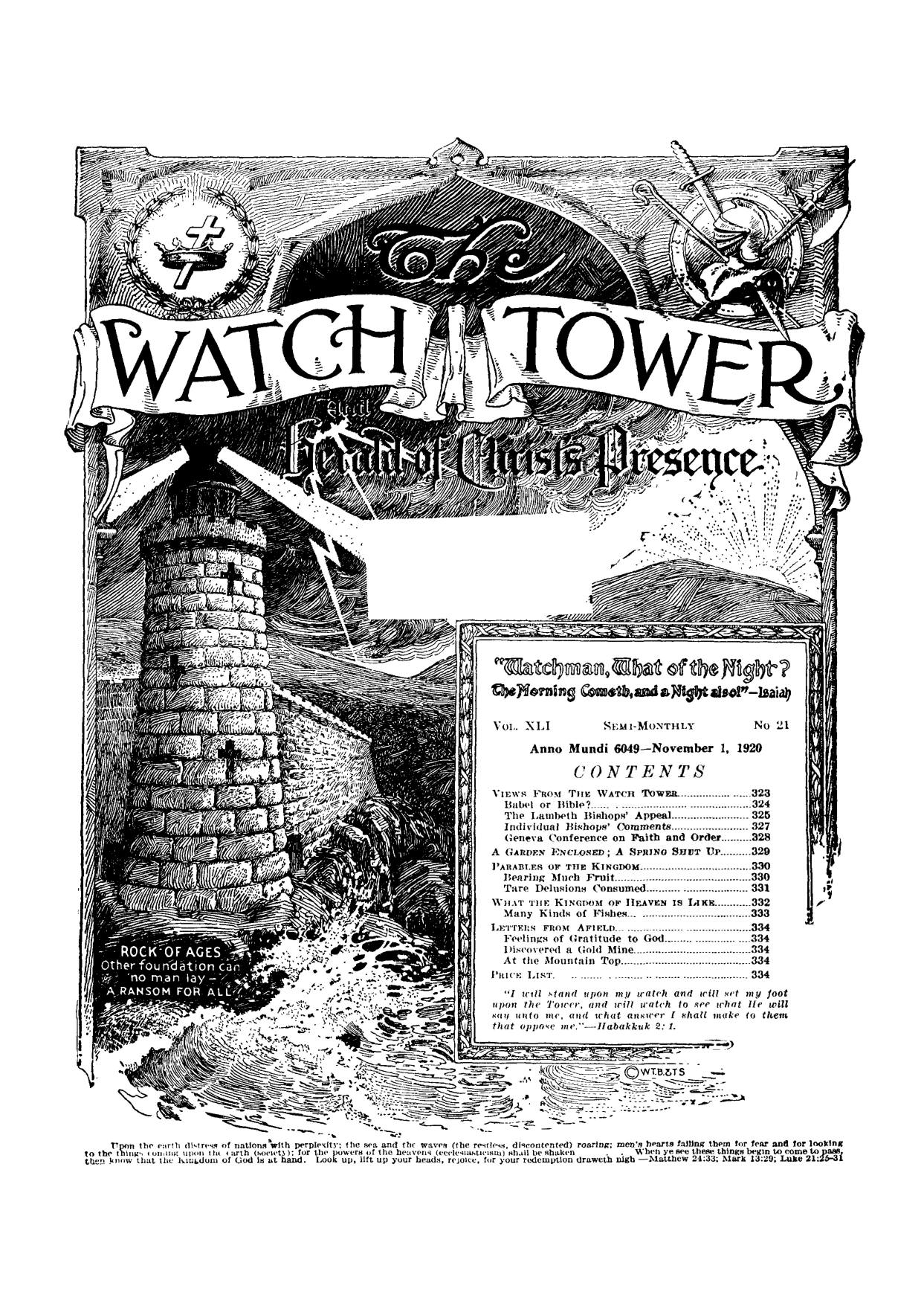
No 21
»
.329
...332 333
. 334
Vpon the earth distress of nations with perplexity; the sea and the waves (the restless, discontented) roaring; men’s hearts falling them for fear and for looking to the things loiidiiu upon t he < arth (society): for the powers of the heavens (eeclesiastirism) shall be shaken . . When ye. see these things begin to come U) MM.
th«>n know that the Kiubdum of (jod is ut band. Look up, lift up your heads, rejoice, for your redemption draweth nigh —Matthew 24:33; Mark 13:29; Luke 21;2&-dl
Semi-Monthly
Anno
Views From
Mundi 6049—November 1, 1920
CONTENTS
The Watch Tower.
ROCK OF AGES
Other foundation can ' 'no man lay-’<zif.
A.RANSOM FOR ALM*
Babel or Bible?.......................................
The Lambeth Bishops* Appeal.................
Individual Bishops’ Comments.................
Geneva Conference on Faith and Order.
A Garden Enclosed ; A Spring Sect Up.
Barabi.es of the Kingdom...........................
Bearing Much Fruit...................................
Tare Delusions Consumed........................
What the Kingdom of Heaven is Like...
Many Kinds of Fishes.............................
Letters from Afield.,...............................
Feelings of Gratitude to God..................
Discovered a Gold Mine.........................
At the Mountain Top.................................
.323 ...324 .. 325 .. 327 ...328
.330 .330
. 331
.334 .334 .334 .334
“I ictll stand upon my watch and trill set my foot upon the Tower, and trill watch to see what lie will «ni unto me, «nd icftat ansiccr I shall make to them that oppose me."-—Habakkuk 2: 1.
©WT.B.&TS
THIS JOURNAL AND ITS SACRED MISSION
THIS journal is one of the prime factors or instruments in the system of Bible instruction, or "Seminary Extension”, now being presented in all parts of the civilized world by the Watch Tower Bible & Tract Society, chartered A. D. Ibb4, "For the Promotion of Christian Knowledge”. It not only serves as a class room where Bible students may meet in the study of the divine Word but also as a channel of communication through which they may be reached with announcements of the Society's conventions and of the coming of its traveling representatives, styled “Pilgrims”, and refreshed with reports of its conventions.
Our “Berean Lessons” are topical rehearsals or reviews of our Society’s published Studies most entertainingly arranged, and very helpful to all who would merit the only honorary degree which the Society accords, viz., Verbi Dei Minister (V. D. JI.), which translated into English Is Minister of God’s Word. Our treatment of the International Sunday School Lessons is specially lor the older Bible students and teachers. By some this feature is considered indispensable.
This journal stands firmly for the defense of the only true foundation of the Christian's hope now being so generally repudiated —redemption through the precious blood of “the man Christ Jesus, who gave himself a ransom [a corresponding price, a substitute] for all”. (I Peter 1:19; 1 Timothy 2:6) Building up on this sure foundation the gold, silver and precious stones (1 Corinthians 3:11' 15; 2 Peter 1:6-11) of the Word of God, its further mission is to “make all see what is the fellowship of the mystery which. . .has been hid in God, ... to the intent that now might be made known by the church the manifold wisdom of God”—“which In other ages was not made known unto the sons of men as it is now revealed”.—Ephesians 3:6-9,10.
It stands free from all parties, sects and creeds of men. while it seeks more and more to bring its every utterance into fullest subjection to the .will of God In Christ, as expressed In the holy Scriptures. It is thus free to declare boldly whatsoever the Lord hath spoken—according to the divine wisdom granted unto us to understand his utterances. Its attitude is not dogmatic, but confident; for we know whereof we affirm, treading with implicit faith upon the sure promises of God. It is held as a trust, to be used only in bis service; hence our decisions relative to what may and what may not appear in its columns must be according to our judgment of his good pleasure, the teaching of his Word, for the upbuilding of his people in grace and knowledge. And we not only invite but urge our readers to prove all its utterances by the infallible Word to which reference is constantly made to facilitate such testing.
TO US THfc SCRIPTURES CLEARLY TEACH
mat the church Is “the temple of the living God”, peculiarly “his workmanship”; that its construction has been in progress throughout the gospel age—ever since Christ became the world’s Redeemer and the Chief Corner Stone of his temple, through which, when finished, God’s blessing shall come “to all people”, and they find access to him.—1 Corinthians 3:16, 17; Ephesians 2:20-22; Genesis 28:14; Galatians 3: 29.
That meantime the chiseling, shaping, and polishing of consecrated believers in Christ’s atonement for sin, progresses; and when the last of these “living stones”, “elect and precious,” shall have been made ready, the great Master Workman will bring all together in the first resurrection; and the temple shall be filled with his glory, and be the meeting place between God and men throughout the Millennium.—Revelation 16: 6-8.
That the basis of hope, for the church and the world, Ues in the fact that “Jesus Christ, by the grace of God, tasted death for every man,” “a ransom for all,” and will be "the true light which lighteth every man that cometh into the world", “in due time”.— Hebrews 2:9; John 1:9; 1 Timothy 2:5, 6.
That the hope of the chureh is that she may be like her Lord, “see him as he is,” be “partakers of the divine nature’,’ and share his glory as his joint-heir.—1 John 3 :2 ; John 17 : 24 ; Romans 8:17; 2 Peter 1:4.
That the present mission of the church is the perfecting of the saints for the future work of service; to develop in herself every frace; to be God’s witness to the world; and to prepare to be kings and priests in the next age.—Ephesians 4:12; Matthew 24 :
4; Revelation 1: 6; 20: 6. ev r .
That the hope for the world lies In the blessings of knowledge and opportunity to be brought to all by Christ’s Millennial kingdom, the restitution of all that was lost in Adam, to all the willing and obedient, at the hands of their Redeemer and his glorified church, when all the wilfully wicked will be destroyed.—Acts 3: 19-23; Isaiab 35.
Published ey
V/WATCH TOWER. BIBLE trTRACT SOCIETY 124 COLUMBIA HEIGHTS ‘n d BROOKLYN, NY, USA’ sfORElON Orncis: British: 34 Craven Terrace, Lancaster Gate, London W. 2 ; Australasian: 495 Collins St., Melbourne, Australia; South African: 123 Plein St., Cape Town, South Africa.
Please Address the Society in Every Case.
ANNUAL SUBSCRIPTION PRICE $1.00 IN ADVANCE CANADIAN AND FOREIGN SUBSCRIPTION PRICE $1.50 SEND MONET BT EXPRESS OR POSTAL ORDER, OB BT BANK DRAFT FROM FOREIGN COUNTRIES BT INTERNATIONAL POSTAL ORDERS ONLY (Foreign translations of this journal appear in several languages)
Kdttorial Commutes: This jou’nal is published under the supervision of an editorial committee, at least three of whom have read and approved as truth each and every article appearing in these columns. Tne dames of the editorial committee are: J. F. Rutherford, W. E. Van Amburoh, F, II. Robison, G. H. Fisher, W. E. Paoe.
Vsrmata tA* font's Poor: All Blida students who, by maon of oM ago or other tn-ftrndiy■or adversity, are unable to pay for this Journal, will bo supplied free If they send « petal card each Mar stating their ease and requesting such provision, we are not Onur willing, but anxious, that all each bo on onr list continually and In touch with the Berean stndloa._____________________________—
tUUeotoSuhmrib^:
•ftMaaMMriteb/chaavalaesplMtiMi data. Mibownoa wrapper
I'hfn-rf—Swrf CTy Jfattartlfr—WyMo N.T., ths/let of Marsh ttT9.
GOLDEN AGE ABC BOOK
For several years past the Society has contemplated the publication of some literature which would be particularly helpful to parents in teaching their children the basic points of Bible truth. We now have in near-readiness a booklet which Is calculated to be of Interest to children from, say, four to seven years of age, or even older.
On each right-hand page are two pictures of Bible subjects, and under each picture Is a short verse in rhyme, bearing on the picture—as, “A is for Adam,” etc. These verses are for memorizing. On the lefthand pages are .fuller treatises in simple language, to assist the parent in explaining the matter to the child.
Pictures and text are printed In black, initials in two colors ; strong cover printed in three colors ; 32 pages, 6i" x 9". Price, 30c each, postpaid; or 20c, carriage collect, in lots of fifty. Orders acceptable now, shipments made about November 15.
YEAR- AND WEEKLY-TEXT CALENDAR
For the year 1921 we will not publish a text card, as has been our custom. This time we have in preparation a calendar pad of fifty-four sheets—one for a cover and fifty-three for each of the weeks or fragments of weeks in the year 1921.
The year text, “I will triumph in the works . of thy hands” (Psalm 92:4), is at the top of each sheet and, in addition, each sheet carries as a central feature a text bearing on some one "work”, of Jehovah. It is suggested to use this text as a basis for the weekly prayer, praise, and testimony meetings. The Manna texts for this purpose have proven edifying, but nearly every text In the book has been used twice; and a change will doubtless be both acceptable and helpful. The Manna would continue to be used for daily food, as usual.
On the lower part of each sheet is a calendar for the week, with the seven hymns for that week shown under their respective days and dates. Altogether the calendar is a unique little compendium of devotional information—the year text constantly before one’s eyes, the week’s text in view during the time when it is most needed, and a full list of hymns for the whole year.
The whole is arranged for hanging on the wall, each sheet being separate and held in the pad by a suitable cord passed through perforations. The used sheets can be either turned back er torn off.
The paper is buff antique stock, and the printing is in orange and dark green. Price, 40c each, postpaid; 30c, carriage charges collect, in lots of fifty. Shipments about December 1.
That friends in distant parts may have the four January texts, we give them here in advance. Texts to form the basis of the testimonies at prayer meetings to be held:
January 5 : Jehovah Instructs ; "I will instruct and teach thee in the way which thou shalt go.”—Psalm 42 : 8.
January 12; Jehovah Redeems : "Fear not, for I have redeemed thee."—Isaiah 43:1.
January 19: Jehovah Justifies: “In Jehovah shall all the seed of Israel be justified.”—Isaiah 45 : 25.
January 20: Jehovah Sanctifies: “I the Lord do sanctify them.”—Leviticus 21 : 23.
November 1, 1920
VIEWS FROM THE WATCH TOWER
YEAH books of the churches, giving statistics for the year 1920. show the number of ministers, priests, ami rabbis as 195,315, and the members of the various church organizations as 44,788,306, in this country. The membership of the more prominent Protestant bodies is listed as follows:
Methodist Episcopal.................... — 4,17.>,402
Southern Baptist.. .... --------------- . .......2.887,428
Methodist Episcopal South............. 2,152,974
Presbyterian ............................................1,603.033
Northern Baptist..... ....... 1,502,341
Disciples of Christ. ...................... - .1,193,423
Protestant Episcopal ........ 1,065,825
Congregational ......... ................. —. 808.122
United Lutheran ....................... 782,807
The membership of the twenty Lutheran bodies in the United States is given as totaling 2,451,997. There are 4,191,257 in the four principal colored denominations. The number of Sunday School pupils for this year is stated at 21,291,987. There has been some increase in the number of schools, but a loss in the number of pupils •amounting to 596.534.
Prom the Sunday School Times we clip the following ■on the point of loss in church membership generally:
“Some startling statistics have just been made public in the Christian llcrahl. They show that the smallest annual increase in Protestant Church membership in the United •States for thirty years was recorded in 1919. The increase for that year was only 56.tMM) as compared with an average .annual increase for the ten years previous of 771,947. The drop started in 1918, a year that showed an increase of only 155,000. The hitherto most prosperous denominations in the United States showed the following decreases for the year: Methodist Episcopal, 69,940 ; Presbyterian (U.S.A. Northern), 32,305; Disciples of Christ, 17,645; Methodist Episcopal (South). 16,404: Northern Baptist Convention, 9.156; National Baptist Convention, 35,007; Presbyterian (U.S.A. Southern), 8,811: United Presbyterian, 2.98)1; Cumberland Presbyterian. 1,645; Welsh Calvinistic Presbyterian, 992; Norwegian Lutheran, 2,910."
Conditions are not different in Great Britain, if we •are to judge by the two following items from Scotland and England, respectively. The first is from the ■Glasgow Citizen and the second is a letter from a well informed correspondent:
CHURCH ATTENDANCE IN GREAT BRITAIN
“As a good deal is being heard just now about the ‘city’ •churches—the churches, that is, for which Glasgow Corporation is responsible—a return by the City Chamberlain should be of interest.
"The Cathedral shows the highest revenue, but even there, the cash amounts to only £398, the figures for the other •churches being as follows:—St. Andrew's. £250; Blackfriars, £218; St. David's. £172; St. Paul's, £157; Tron, £89; St. John's. £74: St. .James’s, £74; St. Enoch's. £56: St. George’s ■Church, as most readers are aware, has been closed for some time.
“With regard to sittings, there are nine thousand twenty-nine altogether, but ten hundred fifty-one must lie deducted owing to St. George's Church being closed. Of the remainder, thirty-nine hundred ninety-three are let. and five thousand thirty-six unlet.”
Referring to the action of Anglican Church authorities in demolishing nineteen London city churches occupying very vahtalile business sites, this correspondent says :
“I have been in communication with Church and laity. Both acknowledge sympathetically but have not sufficient feeling to make a conspicuous stand! The destroying party say: See what good we can do with this money elsewhere! You wbuld think that hungering crowds were waiting elsewhere for the Word from the inspired lips of a convinced teacher. I live in an agricultural-industrial district with a imputation of from five to seven thousand. A few Sundays ago, on a fine morning, I was in a chureh near me where the adult congregation, if you omit those officiating, was three (including myself). By what the natives say, one may write is three. As I have told those who are asking why London’s city churches are to lie destroyed : they might be saved for worship and preaching if the Bishop of London would invite sincere, convinced Christians to conduct a service in their own way—decent, but thoroughly unconventional."
It seems also that recruits to the ministry continue to fall off. The Virginian-Pilot and the Norfolk Landmark has this to say:
“In a recent nundX'r of the l{<H<)i<>lis Herald, the organ of the Baptist denomination in Virginia, the editor draws the attention of the pastors and laity of the churches to the fact that a recent investigation lias shown two hundred and fifty-nine of the Baptist churches in Virginia to be at present without pastors. At the same time, he says, ‘only nine preachers who have shown themselves capable and effective are found unemployed in the state.’ and further, that ‘if all nine unemployed preachers were immediately supplied with fields, there would still remain more than two hundred churches in Virginia for whom the Baptists of the state cannot furnish pastors'. The editor adits: ‘This is distressing and bewildering. Have we any good reason to be elated over our growth in numbers as long as we have among us such a dearth of men giving themselves to the ministry? There are churches in Virginia with long history and large membership that have never sent forth a preacher of the gospel.' ”
Possibly either the young men who might be taking up the ministry do not worship in the churches, or else they realize that most of the people who attend do not worship there. And quite possibly also they see uninspiring examples of infidelity and higher criticism before them in the pulpits. An item in the Sydney (N.S.W.) Evening News gives a hint of one reason why the ministry' is unattractive. A Romanist is quoted as saying on this point generally:
“ ‘The saddest thing of all to me.’ continued Monsignor Moynagh. ‘is that the public guides appear to be afraid of
divine principles. The commandments and holy precepts appear to be wholly ignored.’ ”
SIGN POSTS OBLITERATED
Other words by Dr. Thomas Martin, Moderator of the Church of Scotland, cast a little more light on the causes for the unpopularity of the ministerial profession. The Edinburgh (Scot.) Weekly Scotsman reports him as giving utterance to these remarks:
“ ‘With the end of the war,’ said Dr. Martin, ‘it is felt that the old epoch is closed and that a new epoch is opening up. . . . There is no doubt that organized Christianity stands at the cross-ways, with the sign posts somewhat obliterated and the paths not a little enveloped in uncertainty. The challenge to her in these days is the challenge of the world's evident need of a directing and driving spiritual power, and these days of uncertainty reveal the world’s need of God.’
‘‘Referring to the indifference of the people to the church. Dr. Martin said that the ‘dread of hell is dead; and the kind of people who hoped that by going to church they would lessen the risk of going afterwards to—a destination still more disagreeable, now feel quite easy in their minds and stay at home’.”
This worthy Doctor can see the face of the sky but he cannot discern its meaning; for the only constructive thing he has to offer is:
“Our places of worship must be more attractive; good music pust play a larger part. Well-to-do worshipers must not dress so finely and so frighten away people in plain clothes. The church must make better provision for amusement and social recreation.”
This is one outstanding view held by Protestant Nonconformists. Another view, finding considerable support in this country, is that the churches should be getting more deeply into politics and into the solution of economic problems. But there is no small contingent which believes that the former method is preferable.
"Unless entertainment is provided in the churches, young people will seek it out of them," said the Reverend Doctor C. E. Guthrie, President of the Epworth League, as reported by the Pittsburgh Gazette-Times.
A minister at Stirling, Scotland, has permitted an interval in his church service for smoking, the purpose being to induce soldiers to go to church. The result will be, of course, that his church will be lowered still more than it was, and the soldiers will do their smoking elsewhere just the same.
BABEL OR BIBLE?
A single newspaper church-announcement sheet in one of the larger American cities offers much in the way of entertainment. Without attempting to put them in any particular order, we read:
“West Eden Presbyterian: Dr. D. B. Armstrong of Massachusetts, on ‘Tuberculosis Control’.
“West Lake Presbyterian: Dr. G. A. Briegleb, ‘Floating in Ether with my Former Wives’.
“Immanuel Presbyterian ; Dr. Smith, ‘The New Testament Corrected by the Spirits’.
“Temple Baptist: Movies, ‘Marvels of Crater Lake’.
“St. Paul’s Pro-Cathedral: Dean MacCormack, ‘The Religion of the Presidential Nominees’.
“First Methodist Episcopal: Dr. Arthur S. Phelps, ‘Picking Your Chums’.
“First Congregational: Moving pictures, ‘The Pinch Hitter’.
“Plymouth Congregational: Moving pictures, ‘Thief or Angel’. ’
“Wilshire Boulevard Christian : M. Howard Fagan, ‘The Red Lantern'.
“Magnolia Avenue Christian: C. C. Sinclair, ‘A Live Dog or a Dead lAon’.”
Passing by the many admittedly unusual religions and religious gatherings which were also shown on the page and limiting ourselves to the older and more “respectable” bodies, we ask in all candor: If this is not a babel, where would we go on earth to find one ?
There are innumerable problems today. What do the churches say by way of solution ? There are wrongs and injustices and distresses. How do the churches purpose to supplant these evils with love and truth and happiness ? What do the churches offer to a racked, bewildered humanity, yearning for something to hold it erect, something to be its guide and bulwark. Do they point to the kingdom of Messiah?
The churches' have long worked on the theory that their duty was to make Christians of the children. If they did that, these children being Christians would make an un-Christian world a better place. But the children have not been made Christians, neither has the world been made a better place, and the children of these children are quitting the churches as spiritually unprofitable for modern existence. Those in the churches who are of a practical turn of mind seem to be trying for a more vigorous and dominant place in industrial America. Some workers hope to do this by politics. The Buffalo Evening News reported Mr. Baer, Moderator of the Assembly of the Presbyterian Church in the United States, as urging “churchmen to take an active part in the politics of the country, and especially to lend their efforts toward the movement for Americanization in its relation both to immigration and emigration”.
In rather notable’ contrast with this admonition are the ■words of Vice-President Marshall, also a Presbyterian, in opening a Southern-Baptist Conventon. After characterizing the churches as “one of the anchors of the Republic” he warned against the entry of the church into politics, as reported in the public press:
“ ‘I hope the clergy and laymen of this country will understand that their divine mission is to go out and preach the gospel and not to beat the bass drum In a political parade,* the Vice-President said. “There is enough for the church to do without trying to reform Congress. I am part of Congress, and I know.’"
Are we to understand that the Presbyterians should go into politics and the Southern Baptists should stay out?
CHURCH FEDERATION AND LABOR
The Federal Council of Churches of Christ in America, having lost a large measure of capitalistic sympathy and support in the Interchurch World Movement, is making a very strong bid for labor support, having at the same time, we believe, a genuine interest in the humanitarian phase of the economic problems confronting the toilers. At a recent conference in Cleveland the Church Federation came out quite strongly for the side of labor. Some of the utterances of its delegates and some of the resolutions adopted at that convention, taken somewhat at random, are as follows:
“The case is hopeless if employers will not allow collective action by their workers. The church must stand fdr the right of organization and collective action, under proper ethical restraints and safeguards for public welfare. It must do so not only for prudential reasons and because it is right, but because the manhood and freedom of the workers are at stake.”
“The law of struggle has pitted employer against employe, corporation against corporation, nation against nation. It was responsible for the great war, with its gigantic economic and human losses. It has pitted capitalist and employer against the workers and threatens another cataclysm and at least the temporary shattering of cix ilization.”—Labor.
“The platform was included in the social service report and calls for recognition by the united churches of:
“Fraternnl conferences of labor leaders and employers under Christian auspices.
“Community free speech forums.
“The cooperative movement of labor as a preparation for industrial democracy.
“Experiments in sharing in and control of industries by labor.”—St. Louis Weekly Globe-Democrat.
“Discussion of the treaty and the League of Nations and the propriety of the church’s entering polities held attention of delegates to the church and community convention of the commission of Federations of the Federal Council of Churches of Christ in America. Rev. Henry A. Atkinson, New York, urged the church to get into politics to save the country from selfish politicians. Colonel Raymond Robbins, investigator of conditions in Russia for the Red Cross, called the peace treaty a ‘treaty of vengeance’. Dr. D. F. Bradley, Cleveland, denounced the treaty as ‘rotten’, particularly in its provisions regarding Germany.”—Toledo News Blade.
“ ‘For the good of Christianity and the benefits accomplished by reconstruction, I have almost come to the conclusion that there should be a war every five years,’ Fred B. Smith, of New York, chairman of the commission on interchurch federation, said in opening this morning’s session.” —Toledo Times.
All these efforts to help out in the affairs of the working nian have been undertaken rather too late to secure the cooperation of many of the workers themselves. The Ferguson Forum, a labor paper of Temple, Texas, is of the opinion that the interest of the churches in labor is sinister. It says:
“The republican and democratic parties have ceased to stand for the fundamental principles wnlch caused their formation, and are each controlled by the same powers and influence, the Federated Church, with 140 aid societies (as boasted in recent Interchurch drives) and by Big Business.”
“The Federated I’rotestant Church was organized in Philadelphia, Pa., December 2 to 8, 1908, for the purpose of taking charge of the nation and state through the ballot box and courts.”
RESOLUTIONS IN AUSTRALIA
Similarly belated philanderings have been taking place in Australia, according to a report in the Sydney (N.S. W.) .Vorm'np Tieraid of a Methodist conference in that section :
“Wo declare it un-Christian to accept profits when laborers do not receive a living wage, or when capital receives disproportionate returns as compared with labor. We condemn that profiteering which takes out of business enterprise profits not justified by the value or cost of the service rendered.
“We believe a change in the present economic system to be necessary, which will ensure an equitable distribution of the rewards of industry, giving to the worker a share in the profits and risks of business, and that will abolish all forms of sweating, profiteering, and oppression of one section of the community by another, and thereby ensure ample opportunity for self-expression and the development of life in its fullness.”
The situation in England seems to be very well presented in a contributed article in the Philadelphia Press:
“Although it was freely predicted that a religious revival would follow the close of the World War, it would seem that actually a reaction against religion has set in in England. The crest of the wave of interest in spiritualism lias passed and the movement subsides in a counter current of disillusionment. The intellectualist religious movement which found expression in II. G. Wells’ ‘God the Invisible King' has not been sustained, and there is no great pulpiteer in London these days to take the place of Theodore Barker, It. .1. Campbell, and the fiery Campbell Morgan to whom all London (locks.
“The Lambeth conference of bishops has just been concluded and the series of resolutions that were adopted are not of a very startling character that would in any way indicate a revolution in their thought or that they have been shaken to their foundations by a reaffirmation of deep faith. . . . If England is rejecting the church today it is not on logical grounds, but more in a spirit of reactive doubt that has followed the terrible experiences of the war.”
This Lambeth Conference, a probably correct estimate of which is given in the above clipping, has received more publicity in this country than any other single religious event for some time. Before printing the appeal of the bishops made at that conference we quote from two periodicals which give some idea of the atmosphere in which the Lambeth Conference was held.
In the London Daily Chronicle Mr. Lloyd George, the British Prime Minister, is reported as saying in a speech to Welsh dissenters:
“I would like to Issue a word of warning to the Nonconformist Churches. Hitherto they have been of one mind on political matters. Majorities have been insignificent.
“Now the divisions in the Free Churches are deep, and I fear in some respects threaten to be permanent.
“Apart altogether from the unfortunate division in the Liberal party, the phenomenal rise of the Labour party is from this point of view a disturbing element. Large masses of the members of our churches now belong to that party.
“It is essential that in these conditions we should see to It that the Free Churches are not torn and paralysed by bitter feuds, and the only way to avert it is by all sections displaying a spirit of tolerance, forbearance, charity towards each other.
“The task of the churches is greater than that which comes within the compass of any political party. Political parties may provide the lamps, lay the wires, turn the current on to certain machinery, but the churches must be the power stations.
“If the generating stations are destroyed, whatever the arrangements and plans of the political parties may be, it will not be long before the light is cut off from the homes of the people.”
From the Philadelphia Public Ledger the following:
“Dr. Jowett, the Nonconformist clergyman of Westminster Chapel, occupied the pulpit and preached the sermon at evensong in Durham Cathedral recently to a congregation of about seven thousand persons, which was probably one of the largest in the history of the cathedral.”
“In an interview with a press representative, Bishop Welldon said of the service: ‘It is the greatest thing I have ever seen. It is a most remarkable reply to the people who have been opposed to this particular act of intercommunion. I think it shows that the opponents of such friendly action between the churches are not a very large body.’ ”
THE LAMBETH BISHOPS’ APPEAL
This seemingly unprecedented break in the reserve of the Anglican Catholic Church has been followed by a more general encouragement of such things in the appeal promulgated by the Anglican bishops. Our readers will remember that we recently intimated our belief that, the collapse of the Interchureh World Movement would not stop the unionizing activities of the churches, the major portion of which activities we believe to have been inspired by and measurably directed by the Church of England. It is the second Beast, he with the one head and two horns which came up out of the earth, which was to give life to (or direct the activities of) the Image of the Beast—as the head gives life and action to the body. We incline strongly to the thought that all of the principal activities of the Church Federation have been dominated by the Anglican power. Perhaps enough has already happened to fulfill Revelation 13. But we are looking for more. The Lambeth appeal is certainly significant. It is called by this name after the palace where the five weeks’ session was held—in Lambeth Palace, London town house of the Archbishop of Canterbury. • These conferences have occurred every ten years for the last fifty years, this being the sixth. At the risk of being tedious we copy the whole text of the appeal, as published in The British Weekly:
“We, Archbishops, Bishops Metropolitan, and other Bishops of the Holy Catholic Church In full communion with the Church of England, in Conference assembled, realizing the responsibility which rests upon us at this time, and sensible of the sympathy and the prayers of many, both within and without our own Communion, make this appeal to all Christian people.
“We acknowledge all those who believe tn our Lord Jesus Christ, and have been baptised into the name of the Holy Trinity, as sharing with us membership in the universal Church of Christ which is His Body. We believe that the Holy Spirit has called us in a very solemn and special manner to associate ourselves in penitence and prayer- with all those who deplore the divisions of Christian people, and are inspired by the vision and hope of a Visible unity of the whole Church.
“I. We believe that God wills fellowship. By God’s own act this fellowship was made in and through Jesus Christ, and its life is in His Spirit We believe that it is God’s purpose to manifest this fellowship, so far as this world is concerned, in an outward, visible, and united society, holding one faith, having its own recognised officers, using Godgiven means of grace, and Inspiring all its members to the world-wide service of the Kingdom of God. This Is what we mean by the Catholic Church.
"H. This united fellowship is not visible in the world today. On the one hand there are other ancient episcopal Communions in East and West, to whom ours is bound by many ties of common faith and tradition. On the other hand there are the great non-episcopal Communions, standing for rich elements of truth, liberty, and life, which might otherwise have been obscured or neglected. With them we are closely linked by many affinities—racial, historical, and spiritual. We cherish the earnest hope that all these Communions, and our own, may be led by the Spirit Into the unity of the Faith and of the knowledge of the Son of God. But in fact we are are all organized In different groups, each one keeping to Itself gifts that rightly belong to the whole fellowship, and tending to live its own life apart from the rest.
“HI. The causes of division lie deep in the past, and are by no means simple or wholly blameworthy. Yet none can doubt that self-will, ambition and lack of charity among Christians have been principal factors In the mingled process, and that these, together with blindness to the sin of disunion, are still mainly responsible for the breaches of Christendom. We acknowledge this condition of broken fellowship to be contrary to God's will, and we desire frankly to confess our share in the guilt of thus crippling the Body of Christ and hindering the activity of His Spirit.
“IV. The times call us to a new outlook and new measures. The Faith cannot be adequately apprehended and the battle of the Kingdom cannot be worthily fought while the body is divided, and Is thus unable to grow up into the fullness of the life of Christ. The time has come, we believe, for all the separated groups of Christians to agree in forgetting the things which are behind and reaching out towards the goal of a reunited Catholic Church. The removal of the barriers which have arisen between them will only be brought about by a new comradeship of those whose faces, are definitely set this way.
“The vision which rises before us is that of a Church, genuinely Catholic, loyal to all Truth, and gathering into its fellowship all ‘who profess and call themselves Christians’, within whose visible unity all the treasures of faith and order, bequeathed as a heritage by the past to the present, shall be possessed In common, and made serviceable to the whole body of Christ. Within this unity Christian Communions now separated from one another would retain much that has long been distinctive in their methods of worship and service. It is through a rich diversity of life and devotion that the unity of the whole fellowship will be fulfilled.
“V. This means an adventure of good-will and still more-of faith, for nothing less Is required than a new discovery of the creative resources of God. To this adventure we are convinced that God is now calling all the members of His Church.
“VI. We believe that the visible unity of the Church will' be found to involve the whole-hearted acceptance of:
“The Holy Scriptures, as the record of God’s revelation of Himself to man, and as being the rule and ultimate standard of faith ; and the Creed commonly called Nicene, as the sufficient statement of the Christian faith, and either it or the Apostles’ Creed as the Baptismal confession of belief;
“The divinely instituted sacraments of Baptism and the Holy Communion, as expressing for all the corporate life of the wholefellowship in and with Christ;
“A ministry acknowledged by every part of the Church as possessing, not only the inward call of the Spirit, but also the commission of Christ and the authority of the whole body.
“VII. May we not reasonably claim that the Episcopate is the one means of providing such a ministry? It Is not that we call in question for a moment the spiritual reality of the ministries of those Communions which do not possess the Episcopate. On the contrary we thankfully acknowledge that these ministries have been manifestly blessed and owned by the Holy Spirit as effective means of grace. But we submit that considerations alike of history and of present experience justify the claim we make on behalf of the Episcopate. Moreover, we would urge that it is now and will prove to be in the future the best instrument for maintaining the unity and continuity of the Church. But we greatly desire that the office of a Bishop should be everywhere exercised in a representative and constitutional manner, and more truly express all that ought to be Involved for the life of the Christian Family in the title of Father-in-God. Nay, more, we eagerly look forward to the day when through Its acceptance in a united Church we may all share in the grace which is pledged to the members of the whole body in the apostolic rite of the laying-on of hands, and in the joy and fellowship of a Eucharist in which as one Family we may together, without any doubtfulness of mind, offer to the one Lord our worship and service.
“VIII. We believe that for all the truly equitable approach to union is by way of mutual deference to one another’s consciences. To this end, we who send forth this appeal would say that if the authorities of other Communions should so desire, we are persuaded that, terms of union having been otherwise satisfactorily adjusted, Bishops and clergy of our communion would willingly accept from these authorities a form of commission or recognition which would commend our ministry to their congregations as having its place in the one family life. It is not in our power to know how far this suggestion may be acceptable to those to whom we offer it. We can only say that we offer it in all sincerity as a token of our longing that all ministries of grace, theirs and ours, shall he available for the service of our Lord in a united Church.
“It is our hope that the same motive would lead ministers who have not received it to accept a commission through episcopal ordination, as obtaining for them a ministry throughout the whole fellowship.
“In so acting no one of us could possibly be taken to repudiate his past ministry. God forbid tliat any man should repudiate ;i past exjierience rich in spiritual blessings for himself mid others. Nor would any of us be dishonoring the Holy Spirit of God, Whose call led us all to our several ministries, and Whose power enabled us to perform them. We shall be publicly and formally seeking additionally recognition of a new cal) to aider service in a reunited Church, and imploring for ourselves God's grace mid strength to fulfill the same.
“IN. The spiritual leadership of the Catholic Church in days to come, for which the world is manifestly waiting, depends upon the readiness with which each group is prepared to make sacrifices for the sake of a common fellowship, a common ministry and a common service to the world.
“We place this ideal first and foremost before ourselves and our own people. We call upon them to make the effort to meet the demands of a new age nith a new outlook. To all other Christian people whom our words may reach we make the same apjieal. We do not ask that any one Communion should be absorbed in another. We do ask that all should unite in it new and great, endeavor to recover and to manifest to the world the unity of the Body of Christ for which He prayed.”
By ‘‘episcopate" is meant a clergy ordained by “apostolic succession". Will this prove to be the mark, number, or designation of the Beast, without which no man may profier or receive spiritual ministrations in a public nay? It is worth watching.
INDIVIDUAL BISHOPS’ COMMENTS
This is a carefully worded appeal; but it becomes more perspicuous and more interesting in the light of comments of individual bishops, of whom there were two hundred fifty-two in attendance from all parts of the world.
The Asheville Citizen records the words of Bishop J. M. Horner, who only recently returned from the conference :
“One of the most significant actions of the bishops, he said, was the decision to permit ministers of all recognized churches to speak from the pulpit of the Episcopal church and to minister to the Episcopalian congregations, providing the ministers of the other churches have first been ordained by the bishop in charge of the Episcopal diocese in which the church is located. This decision will also permit Episcopal ministers to speak from the pulpits of other churches and to minister to the congregations of other churches, providing that they, too, have been ordained by the executive clergy of the particular churches from which they receive initiations.
“It is, he believes, a great step toward church unity—the great objective of the Inter-Church World Movement, fostered by the Episcopal, or mother, church.” [Emphasis ours. Ed’s.]
"Bishop Horner sees an unprecedented feeling of friendliness and cooperation gradually growing up among the various churches and creeds of the world. Narrow differences, he thinks, are disappearing rapidly among the Protestant churches, now that they are fully agreed on the three fundamentals of Christianity: first, that the Bible is the Word of God : second, the holy sacrament, and third, that the Apostles’ Creed is the orthodox confession of Christian faith.”
Bishop Lawrence, one of the Lambeth conferees, writes quite extensively in the Boston Evening Transcript. Among his remarks are the following:
"We of New England have lieen accustomed to think in terms only of Protestantism. We want the reunion of the different denominations, stopping the economic, moral and spiritual waste, and this is all well; but have we allowed our vision to take in the sweep of the whole Christian horizon and Christian churches? How is it possible for us to plan or hope for any adequate reunion of the Christian hutches without taking into our purview not only the Protestant and the Anglican communions, but the two history communions, which although they may have accretions witli which we have no part, arc surely Christian, and are to lune, as they have in the past, an immense place in the Christianizing of the world? Any statesmanlike step, therefore, toward the reunion of the churches must have this greater conception in mind—the reunion of all the churches —and no step should lie taken by churches towards reunion which will clearly endanger the reunion of all.”
Speaking more plainly, the Archbishop of Canterbury in an associated press statement explains that the scope of the appeal is
"directed to the orthodox churches of the east and to the great Boman communion of the west, no less than Io the free churches whicli have grown to maturity among the Anglo-Saxon races. Its scope is so wide that there can he no doubt large numbers of the bishops who issued it had in mind those of our kith and kin in the great Presbyterian, Methodist, Baptist, and Congregational communions, with whom, although they are separated from the church, the American communion has so much in common, both in faith and in practice.”
"The vision embodied here is new, even revolutionary. The plans of reunion whereby the Anglican church might hope to absorb other communions are frankly abandoned. What is needed is a new structure, simple enough to begin at once, but large enough to include all.”
Bishop Burch on his return to New York, had this to say to a New York Times reporter:
“The second great matter discussed was the question of reunion of all Christendom. The program adopted is the most advanced yet taken by any communion since the Reformation.”
Concerning the Bishop of Pennsylvania the Philadelphia North American recently reported:
“Bishop Rhinelander last night told of the definite working out of the plan for a world-wide church, so that when the goal is reached not only the Episcopal and other Protestant churches, but the Roman Catholic, Greek, Russian, and other eastern Christian churches will be subject to an Episcopal college, which may or may not have a president.”
“ ‘We appeal for a visible and organic unity more t han for a federation,’ said Bishop Rhinelander, . . . • a unity of faith, of order and of worship. Our ultimate goal is a Holy Catholic Church in full communion with the Church of England.’ ”
“With a Wilsonian phrase, the bishops ask: ‘May we not reasonably claim that the Episcopate is the one means of providing such a unity?’ ”
“With reference to the Protestant Episcopal Church in the United States, and the Church of England, from which it sprang, Bishop Rhinelander said that there now exists as full a unity as could be desired.”
Perhaps there is hidden truth in that last remark; and perhaps also Dr. Jowett received some kind of “blessing” before he was allowed to speak in Durham Cathedral, of which the under churchman who so vociferously objected to his presence in the pulpit was not informed.
IMPORTANT PROVISOS
Concerning the bishops’ appeal the Toronto Daily Star says editorially:
“Church union will do much. It will not, however, supply that spiritual dynamic which the world so sorely needs. To hope that Church union would supply this, springs from precisely that materialistic outlook which is the subtle and all pervading enemy of all spiritual values.”
In much the same strain an article in The Independent on “Church Union or Christian Union?” remarks:
“In the minds of many the two are Identical. In the minds of others there can be Christian union without church union. In this difference lies no little misunderstanding. The Catholic Christian wants a Church; Protestants want churches. Catholic Christians want orders which distinguish between the religious prerogatives and powers of the clergy and the laity. Protestants want no orders. To disregard these fundamentally different conceptions of the church Is to obscure something that prevents organizing church union, much less church unity.
“In the light of comparatively recent actions of the Anglican Church it is well to recognize these two great currents in church affairs. Whether they will continue to run parallel courses or, like the Missouri and the Mississippi, ultimately join is as yet a matter of conjecture. Time alone can tell. But time will be gained If each recognizes that it Is as yet Independent of the other. The ‘dissenting’ Protestant, whether he be Presbyterian, Baptist, Congregationalist, Methodist, or Disciple, will not recognize priestly orders or the sacraments as such. He uses the language of ecclesiasticism, but he gives the terms new definitions.
“That fact, for instance, lies at the bottom of the question of the validity of ordination. To the churchman who believes in a priesthood the distinction between those ordained and not ordained is as real as between the married and the unmarried. To the members of the other bodies, ordination is simply a formal recognition of a man’s vocation. With such differences In definition the two parties seem to have reached an impasse. Between their respective views as to the church there is, so far is I can see, no compromise possible. The proposals by a few Congregationalists that non-Episcopallans be reordained In the Episcopal church does not remove the fundamental antithesis. Either one believes in a Catholic Church with its orders, sacraments and apostolic succession, or he does not. Mutual courtesy is possible but not compromise.”
It may be that the Anglicans will concede even more than they have said, or it may be that their officiating archbishop will administer some kind of “absent treatment” ordination whereby all ministers of all trinitarian bodies will be recognized and ordained en masse regardless of any request on their part. If such were done the bishops of the various dioceses could be asked to instruct the rectors, priests, and vicars of their province to fraternize and exchange pulpits with the Nonconformist ministers. Only in some such way can we imagine very many of the Protestant churches as joining such a union as proposed. It is very difficult to think of the Southern Baptists as ever being identified with the movement.
The editor of The Churchman (Episcopalian), writing in the New York Evening Post, “definitely sets aside any hope of reunion with the Church of Rome at present”. We think his observations are astute. Nothing in the Scriptures sustains with any clarity the thought that the Anglican and Roman Catholic Churches will unite. The second Beast does his wonders ‘in the sight of or in the presence of the first Beast, but not as a part of it. The effect, however, upon the minds of the people of Christendom of the doings of the second Beast Is to make them acknowledge that the teachings and practices of Rome in its days of power differed not in any notable degree or direction from those of the second Beast.
GENEVA CONFERENCE ON FAITH AND ORDER
Another conference, held in Geneva, Switzerland, about the same time as the Lambeth Conference, was called by American church interests. It is the same conference which was just about to be held when the World War broke out, and in which Dr. Manning (Episcopalian) was then so much interested. An advance notice of it and comment on it we take from the Johannesburg (S.Af.) Star:
“In Johannesburg the ministers of the various churches have been working together with a view to reaching some definite conclusions as to the way in which they should go, so as to reach a closer fellowship and a more effective coordination of forces.
“The original impulse of this work came from America. In that home of spacious dreams there has been a movement afoot for several years to bring together representatives from all the churches of Christendom in a great Conference on Faith and Order. Checked by the war, the activities of those who are moving spirits in this enterprise broke out with gathered force at its close. Already they have sent men well-nigh round the world for the purpose of enlisting the sympathy and cooperation of all sorts and conditions of Christian folk; and, in consequence, a preliminary conference is to be held in Geneva within the next few weeks. With the exception of Rome, practically every church In the world will be represented.”
In other parts of this same article, written by a Presbyterian clergyman, the public is advised of action taken by the local Ministerial Association (presided over by an Anglican bishop) which pledged itself to the support of almost the precise points which were several months later incorporated into the Lambeth bishops’ appeal. Furthermore, when we come to the Geneva Conference, we find that it is headed by Bishop Brent. The New York Times reported the first session as follows:
“The World Congress of Christian Churches, known as the Faith and Order Congress, opened in Geneva today. Thirty-five countries were represented by over a hundred fifty delegates, including several well known United States clergymen, and bishops from Great Britain, Ireland, Sweden, Norway, Denmark, Russia, France, Germany, Armenia, Georgia, and Czecho-slovakia. Presbyterian churches, Methodist, the Society of Friends, and all Trinitarian churches are represented except the Roman Catholics, who were Invited to be represented, but declined.
“Bishop Brent of New York was elected President and Mr. Gardiner of Gardiner. Me., General Secretary.
“In his opening address as President Bishop Brent said that never in the history of Christendom had such a congress assembled. They hoped by this conference to attain greater unity of church government throughout the world and draw Christian communions closer together. The idea of the congress originated ten years ago in the United States, he said, but owing to the war it could not meet sooner.”
A later report in the same paper discloses a movement to bar “proselyting”:
“The congress adopted a resolution to form a league of churches whose object is to put an end to proselytizing between Christian churches and promote mutual understanding between them for Christian missions among nonChristian peoples; secondly, to promote an association and collaboration of churches to establish Christian principles; thirdly, to help the churches to become acquainted with one another; fourthly, to bring together smaller Christian communities and unite all churches on questions of faith and order.”
A GARDEN ENCLOSED; A SPRING SHUT UP
[The following account by a Christian traveler in Palestine is inteiestini) as blaring upon Canticles The visit
described was made in 1861.]
A NIGHT’S iv-t in the convent. a beautiful morning Z-k —and April here is like June— a hospitable breakfast furnished by the monks, all conspired to invigorate our spirits, and at the early hour <d six-o'clock we left, Bethlehem, and continued our journey towards Hebron. We passed part way down the hill on which Bethlehem stands, and then commenced a slight •detour from the main road to visit the celebrated reservoirs known as the Pools of Solomon.
“■Our course lay along the aqueduct leading from these pools, or reservoirs as they might more properly be ■called, to Jerusalem, the grading for which along the hillsides forms a comfortable horse and foot path. This ■old aqueduct, between Bethlehem and the pools, is in a good state of preservation, and in many places has been recently repaired. It is built of stone, the passage for water about 18 inches broad, and twelve to fifteen inches ■deep, and lined with a strong coat of water-proof cement. In the early days of the construction of these water works, the modern method of carrying water over hills and through valleys in pipes was not understood, or they had not the art of making pipes of sufficient strength to resist the pressure of the water; so this aqueduct is carried the whole distance upon a level, or nearly so, following the windings and sinuousities of the hillsides like a canal. Through this ancient channal the water was still flowing fresh and clear, as in the day* of the great monarch of Israel. Occasionally a hole was broken through the top of the passage, that the thirsty traveler might refresh himself from the inviting stream. We had occasion several times to try the quality of the v ater, and found it excellent.
“Although the pools are less than an hour’s ride from Bethlehem, we indulged ourselves in loitering along the way, stopping occasionally to rest, or to gather flowers, multitudes of which, of bright and varied colors, strewed our way, so that we did not reach the place until after half past eight o’clock. Upon entering a ravine between two high and rocky hills, these great works of antiquity were suddenly revealed to our view.
“They have so often been described in the letters of travelers it seems unnecessary to detain the reader by any minute description of them. They are partly excavated in the solid rock, and partly built up of hewn stone. Many of these stones are of great size, and bear the marks of great antiquity. There are three of these tanks, ranged along the ascent of the valley, one above and beyond the other, so constructed that the bottom of one lies as high as or higher than the top of the one next below it. Thus, when the lower one is exhausted the second can be emptied into it, and then the third through the second. The size of these reservoirs is as follows: Upper Pool....Length 380 ft., av. breadth 232} ft., depth 25 ft.
Middle Pool.... ” 423 ” ” ” 232} ” ” 39 ”
Cower Pool.... ” 582 177} ” ” 50 ”
“The supply of water is abundant as well as excellent, a large stream of waste water flowing down the valley from the lower pool after the aqueduct is supplied. The great curiosity connected with these pools is the fountain from which they are filled—a place generally overlooked by visitors. Mr. Barclay, author of ‘The City of the Great King’, whom we met in Jerusalem, had spoken to ns of this place, and told us how to find it, and advised Us bv all means to see it. llaxing examined the pools, n<> proceeded northward some forty rods, to an open field colored with barley. Here we found a small opening in the ground like the month o|J a well, nearly choked up with dirt and rubbish. It was a forbidding looking place, both from dirt and smallness of the aperture. My companions examined as well as they could from the top of the opening, and decided they would not attempt to enter. I told them 1 had come to sei' all that could be seen and I was going down if it was possible. So it was arranged I should first enter the well, and if I found anything worth seeing, I should call the rest. The descent was perpendicular for a little more than the length of one’s body, and then turned in an angle of about 45 degrees. There was scarcely room to crowd the body through, and I was soon involved in darkness. I slipped along a muddy inclined plane ten to fifteen feet, until I could stand erect. Then I drew my pocket matches and a candle and struck a light. Fifteen or twenty feet below me I saw an open chamber, and heard the gush of running waters. I clambered down over rocks and dirt until I saw the place was worth a visit, and then returned and called to my companions, and one after another they crept through the passage into the opening below. Throe or four candles were now lighted, and we were enabled to look about us and examine the wonderful place. We stood in a vaulted chamber upwards of forty feet long and near twenty-five broad, the sides and roof protected by stone masonry. Upon one side of this then' was an opening into another smaller apartment, walled in the same manner. This is the fountain head from whence the large reservoirs and aqueduct are supplied. The water springs up in copious streams from four different places, and is brought by smaller passages into a large basin, from whence it flows off in a broad subterraneous passage. This passage is walled and arched, and is large enough for three men to walk abreast. We did not care to follow it, but were told it was carried to the northwest corner of the upper pool; there it branched into two, a portion of the stream flowing into a vault twenty-four by five feet, and from thence into the upper pool. Another carried a portion of the water along the hillside by the pools, and was so arranged as to carry a part into the second and third pools, and the remainder directly into the great aqueduct below the pools, from whence it was carried by a winding course to Jerusalem. The wisdom of this arrangement, for the production of an unfailing supply, is at once apparent. In the time of freshet, when the fountain yielded more than was needed, the surplus passed into, and was preserved in the pools. In the time of drouth, when the supply from the fountain was inadequate, it was augmented from the pools. The entrance to this underground fountain was, no doubt, guarded with great care, and from it Solomon is sup posed to have drawn the beautiful comparison used in his song: ‘A garden inclosed is my sister, my spouse, a spring shut up, a fountain sealed;’ and hence th** place among the monks has the name of 'sealed fountain’. . . .
“These great reservoirs are now called El Burak, and that they were built by Solomon no one, I believe, questions. If they are the work of that great monarch, for near three thousand years they have been receiving and pouring out their inexhaustible supply of waters. They are not only ingeniously constructed, but are built upon a scale of magnificence that would be creditable to the art and enterprise of modern days. From this place the Holy City and Temple were supplied with water. Tire termination of the long aqueduct, it is said, may still be seen in the area of the harem upon Mount Moriah, where now stands the Mosque of Omar, but where once stood, in grandeur and glory, the magnificent Temple of God.”
…