The Watchtower, October 1, 1920
Download: PDF — The Watchtower, October 1, 1920
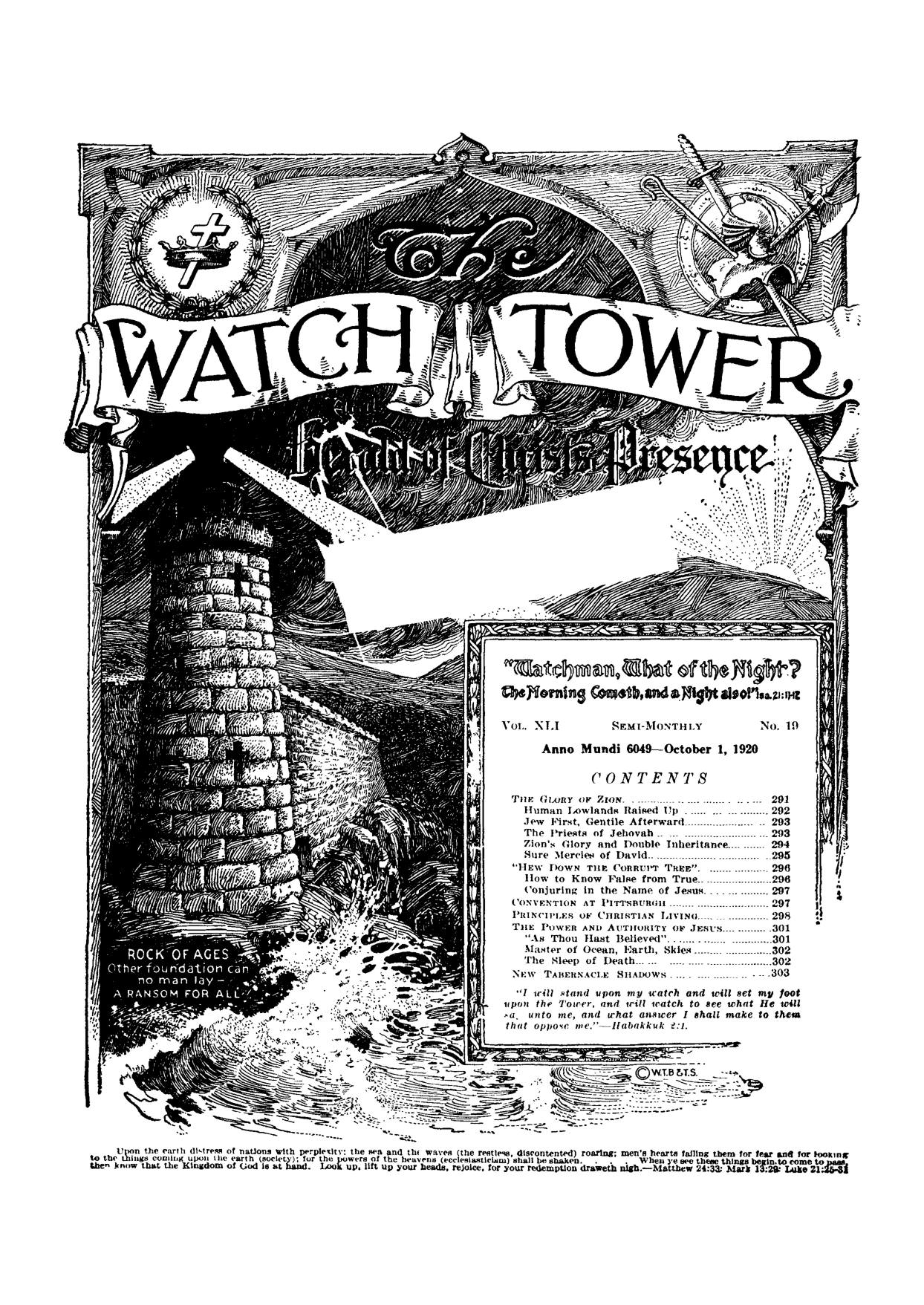
, t,hc e^rf11 dl*-treM of nations with perplexity; the sea and th< waves (the restless, discontented) roaring; men’s hearts falling them for fear and for fookinr
to the tilings coniiug upon the earth, (society); for the powers of the heavens (eccleslastlcism) shall be shaken. . . . When ye see these things begin.to come to pass,
then know that the Kingdom of God is at hand. Look up. lift up your heads, rejoice, for your redemption draweth nigh.—Matthew 24:33; Mart Luke
THIS JOURNAL AND ITS SACRED MISSION
PHIS journal is one of the prime factors or instruments in the system of Bible instruction, or “Seminary Extension”, now beinr presented in all parts of the civilized world by the Watch Tower Bible & Tract Society, chartered A. D. 1X84, “For the Promotion of Christian Knowledge". It not only serves as a class room where Bible students may meet in the study of the divine Word but also as a channel of communication ‘through which they may be reached with announcements of the Society’s conventions and of the coming of its traveling representatives, styled “Pilgrims", and refreshed with reports of its conventions.
Our “Berean Lessons” are topical rehearsals or reviews of our Society’s published Studies most entertainingly arranged, and very helpful to all who would merit the only honorary degree which the Society accords, viz., Verbi Dei Minister (V. D. M.), which translated into English is Minister of God’s Word. Our treatment of the International Sunday School Lessons is specially for the older Bible students and teachers. By some this feature is considered indispensable.
This journal stands firmly for the defense of. the only true foundation of the Christian’s hope now being so generally repudiated —redemption through the precious blood of “the man Christ Jesus, who gave himself a ransom [a corresponding price, a substitute] for all”. (1 Peter 1:19; 1 Timothy 2:6) Building up on this sure foundation the gold, silver and precious stones (1 Corinthians 3: Ills; 2 Peter 1:5-11) of the Word of God, its further mission is to “make all see what is the fellowship of the mystery which. . .has been hid in God, ... to the intent that now might be made known by the church the manifold wisdom of God”—“which in other ages was not made known unto, the sons of men as it is now revealed”.—Ephesians 3 : 5-9,10.
It stands free from all parties, sects and creeds of men. while it seeks more and more to bring its every utterance into fullest subjection to the will of God in Christ, as expressed in the holy Scriptures. It is thus free to declare boldly whatsoever the lx>rd hath spoken—according to the divine wisdom granted unto us to understand his utterances. Its attitude is not dogmatic, but confident; for we know whereof we affirm, treading with implicit faith upon the sure promises of God. It is held as a trust, to be used only in his service; hence our decisions relative to what may and what may not appear in its columns must be according to our judgment of his good pleasure, the teaching of his Word, for the upbuilding of his people in grace and knowledge. And we not only invite but urge our readers to prove all its utterances by* the infallible Word to which reference is constantly made to facilitate such testing.
TO US THE SCRIPTURES CLEARLY TEACH
That the church is “the temple of the living God”, peculiarly “his workmanship” ; that its construction has been in progress throughout the gospel age—ever since Christ became the world’s Redeemer and the Chief Corner Stone of bls temple, through which, when finished, God's blessing shall come “to all people”, and they find access to him.—-1 Corinthians 3:16, 17; Ephesians 2:20-22; Genesis 28:14; Galatians 3:29.
That meantime the chiseling, shaping, and polishing of consecrated believers in Christ’s atonement for sin, progresses; and when the last of these “living stones", “elect and precious,” shall have been made ready, the great Master Workman will bring all together in the first resurrection; and the temple shall be filled with his glory, and be the meeting place between God and men throughout the Millennium.—Revelation 15 : 5-8.
That the basis of hope, for the church-and the world, lies in the tact that “Jesus Christ, by the grace of God, tasted death for every man,” "a ransom for all,” and will be "the true light which lighteth every man that cometh into the world”, “in due time”.— Hebrews 2:9; John 1: 9 ; 1 Timothy 2:5, 6.
That the hope of the church is that she may be like her Lord, “see him as he is,” be “partakers of the divine nature’,' and share his glory as his joint-heir.—1 John 3:2; John 17:24; Romans 8:17; 2 1’eter 1:4.
That the present mission of the church is the perfecting of the saints for the future work of service: to develop in herself every grace; to be God’s witness to the world ; and to prepare to be kings and priests in the next age.—Ephesians 4 :12; Matthew 24: 14 ; Revelation 1: 6 ; 20 : 6.
That the hope for the world lies in the blessings of knowledge and o restitution of all that was lost In Adam, to all the willing and when all the wilfully wicked will be destroyed.—Acts 3 : 19-23;
iportunity to be brought to all by Christ's Millennial kingdom, the obedient, at the hands of their Redeemer and his glorified church, Isaiah 35.
'Published By
WATCH TOWER. BIBLE 6-TRACT SOCIETY> 124 COLUMBIA HEIGHTS a o BROOKLYN. NY, USA' .“OUIgn Orncas: British: 34 Craven Terrace, Lancaster Gate, London W. 2 ; Australasian: 495 Collins St., Melbourne. Australia; South African: 123 Plein St., Cape Town, South Africa.
Pleabn Apdbcss the Society in Every Case.
ANNUAL SUBSCRIPTION PRICE $1.00 IN ADVANCE
CANADIAN AND FOREIGN SUBSCRIPTION PRICE $1.50
SEND MONET BY EXPRESS OR POSTAL ORDER, OR BY BANK DRAFT
FROM FOREIGN COUNTRIES BY INTERNATIONAL POSTAL ORDERS ONLY (foreign translations of this journal appear in several languages)
BAttoriat Committee: This journal is published under the supervision of an editorial committee, at least three of whom have read and approved as truth each and every article appearing in these columns. The names of the editorial committee are: J. F. Rutherford, iv. R Van Amburgh, F. H. Robison, G. H. Fisher, W. E. Page.
fteanto the Lord’s Poor: All Bible itodenta who, by reason of old age or other tn-Irmity or edveralty, are onablo to pay for this journal, will be supplied free if they send A poatal card eeeh May statins their ease and requesting such provision. We are not only arinins. bat anxkxM, that all such be on oar list continually and in touch with the Berean studlea.____
dfoHeefoA^eriber*.* R
•ftMa • bp tn ravtotion date. *■ Mown on wrapper label.
fctorW M C3aee Metter t Brfklyn. N. Y„ ths Aoi of Marsh M, t»T».
BRITISH ORDERS
AH orders for Bibles, Studies in the Scriptures, or other literature furnished by the Society, destined for Great Britain 'must be sent to the London office. The home office will not fill any individual orders received from any one in Great Britain. British ifrienda please take notice.
PLEASE NOT “AFTER MANY DAYS”
Friends will assist us by returning newspaper cuts of the Pilgrim brethren immediately after they have been used. The price of electrotypes has increased more than a thousand percent over pre-war prices; and if the cuts are not returned at once we have to purchase new ones for advertising other meetings.
PILGRIM DEPARTMENT CORRESPONDENCE
Correspondence pertaining to prospective meetings, funerals, public lectures, should be marked on the envelope as for the Pilgrim Department. Failure to do this may occasion two or three days delay, while the mail is passing through the regular channels of correspondence.
STUDIES IN THE SCRIPTURES
These Studies are recommended to students as veritable Bible keys, discussing topically every vital doctrine of the Bible. More than eleven million copies are in circulation, in nineteen languages. Two sizes are issued (in English only) : the regular maroon cloth, gold stamped edition on dull finish paper (size 5"x7il"), and the maroon cloth pocket edition on thin paper (size 4"xGg") ; both sizes are printed from the same plates, the difference being in the margins ; both sizes are provided with an appendix of catechistic questions for convenient class use. Both editions uniform in price.
Series I, “The Divine Plan of the Afjet,” giving outline of the divine plan revealed in the Bible, relating to man’s redemption and restitution : 350 pages, plus indexes and appendixes, 75c. Magazine edition 20c. Also procurable in Arabic, Armenian. Dano-Norwegian, Finnish, French, German, Greek, Hollandish, Hungarian, Italian, Polish, Roumanian, Slovak, Spanish, Swedish, and Ukrainian; regular cloth style, price uniform with English.
Series II, “The Time is at Hand,” treats of the manner and time of the Lord’s second coming, considering the Bible testimony on this subject: 333 pages, 75c. Obtainable In Dano-Norwegian, Finnish, German, Polish and Swedish.
Series III, “Thy Kingdom Come,” considers prophecies which mark events connected with “the time of the end”, the glorification of the church and the establishment of the Millennial kingdom; it also contains a chapter on the Great Pyramid of Egypt, showing it» corroboration of certain Bible teachings : 380 pages, 75c. Furnished also in Dano-Norwegian, Finnish, Gorman, Polish, and Swedish.
Series IV. “The Battle of Armayeddon,” shows that the dissolution of the present order of things is in progress and that all of the human panaceas offered are valueless to avdrt the end predicted tn the Bible. It contains a special and extended treatise oh oar Lord's great prophecy of Matthew 24 and also that of Zechariah 14:1 - D : 656 pages, 85c. Also in Dano-Norwegian, Finnish, Greek, German, and Swedish.
Series V. “The Atonement Between God and Man,” treats an aB important subject, the center around which all features of divine grace revolve. This topic deserves the most careful consideration on the part of all true Christians: 618 pages, 85c. Procurable likewise in Daho-Norwegian, Finnish, German, Greek, and Swedish.
Series VI. “The AVir Creation” deals with the creative week (Genesis 1, 2), and with the church. God’s new creation. It examines the personnel, organization, rites, ceremonies, obligations, and hopes appertaining to those called and accepted as membere of the body of Christ : 730 pages, 85c. Supplied also in Dano-Norwegiau, Finnish, German, and Swedish.
Series VII, “The Finished Mystery,” consists of a verse-by-veree explanation of the Bible books of Revelation, Song of Solomon, and Ezekiel: 608 pages, illustrated, $1.00 in cloth, 20c In magazine edition—latter treats Revelation and Ezekiel only.
' WEk
a? v: hh;a’(j> or ch ii5?s !>ffisc:cs
Vol,, xi i
OCTOBER 1. 1921)
No. 19
THE GLORY OF ZION
Isaiah’s Rhapsody No. 2b
”/ trill tjreathj rejoice in the Lord, mi/ soul s’ half he joyful in
tn y Hod."--Ixauih 6'7. 10.
ZION'S mourners are not only to be given a garland for ashes and the oil of joy for the spirit of heaviness; not only are they to grow up into sturdy trees of righteousness for the glory of Jehovah, as is shown by Isaiah (il: 3 : but more than that, they ■are to be most useful in the divine economy. The church is not saved and exalted to the unparalleled plane of life merely for her own sake. No: as she is now being 'baptised into sSl(rifieial death for the sake of the dead world' (1 (’orinthians 15:29). so in the reconstruction •age just ahead her blest employ will be to scatter the illuminating rays of truth and to help a needy world to practice that truth in deeds of righteousness.
Just as the studies in a normal school are not arranged solely for the benefit of the prospective teachers learning there, but more particularly for the future pupils, so with the church: she learns obedience, as did her Lord ■and Head ; she learns to love, not merely God's creatures. but. even more so. his laws and his principles; she* learns to look to her Head for heavenly wisdom: and all this is that she might be fitted to be a consort and •companion of Christ Jesus in blessing the residue of men.
4 . “And they shall build the old wastes, And they shall raise up the former desolations. And they shall repair the waste cities, The desolations of many generations.
5 And strangers shall stand and feed your tiocks.
And foreigners shall lie your plowmen and vinedressers.
■ti “But ye shall be named the priests of Jehovah;
Men shall cull you the ministers of our (tod: Ye shall eat the riches of the gentiles, And in their glory shall ye lioast yourselves.
7. For your shame ye shall have double:
• And for confusion they shall rejoice in their portion: Therefore in their land they shall possess the double: Everlasting joy shall Ite unto them.
■$ “For I the Lord love judgment.
I hate robtxuy for burnt offering;
And 1 will direct their work in truth.
And 1 will make an everlasting covenant with them.
5) And their seed shall lie known among the gentiles, And their offspring among the people: All that see them shall acknowledge them, That they are the seed which tile Lord hath blessed.”
WASTE PLACES RECLAIMED
The outcome of the mission recounted in the first three verses of the chapter is here given. The waste places of the bygone age. the Jewish age, and in large
measure the whole present evil world, shall be built again. ’The Jewish polity shall be established on a trulv happv basis; because of the fact that the New Covenant shall be m operation m place of the old. ( Ezekiel 1G: 60) That the ancient worthies and those believing Jews wdio will cooperate with them are to have a share m this building work is shown by the statement; “And [the eh i Id ren | of thee shall build the old waste places;" but this all under the supervision of the Servant Class, the great Messiah, the Greater-than-Moses. as is elsewhere shown: "Thou shall raise up the foundations of many generations; and thou shall be called the repairer of the breach, the restorer of paths to dwell in". Isaiah 58: 12.
Again, this issue of the Servant’s work is the same as that depicted in 19; 8 “to establish the earth, to cause to inhabit the desolate heritages”. There can be no reasonable doubt that these promises involve literal and physical restitution for the land of Palestine; but the groundwork for all that is the restoration of the people, the restoration of faith and hope and supreme reverence for Jehovah as the one God, whose will. yes. whose slightest preference shall be their delight and law. As it is written: ‘‘It shall come to pass in that day, that the Lord shall stay his hand again the second time to recover the remnant of his people, which shall be left, from Assyria, and from Egypt, and from Pathros, and from Cush, and from Elam, and from Shinar, and from Hamath, and from the islands of the sea”.—11: 11.
Again, to the Servant Class it is promised : ‘‘Thou shalt break forth on the right hand and on the left; and thy seed shall inherit the gentiles, and make the desolate cities to be inhabited”. (54:3) That the building is bv divine authority is shown by the words addressed, more particularly, to Israel after the flesh: “Thus saith the Ix>rd God: In the day that I shall have cleansed you from ill! your iniquities [by both expiatory and substitutionary means] I will also cause you to dwell in the cities and the wastes shall be built. And the desolate land shall be tilled, whereas it lay desolate in the sight of all that passed bv. And they shall say. ’Phis land that was desolate is become like the garden of Eden ; and the waste and desolate and ruined cities are become fenced, and are inhabited. Then the heathen that are left round about you shall know that / the Lord build the ruined places and plant that that was desolate; I the Lord have spoken it, and I will do it.''—Ezekiel 3G :33-36.
THE DELIVERER DEVELOPED AND BORN
The extent of this work is implied by another prophet: “Jerusalem shall be inhabited as towns without walls for the multitude of men and cattle therein”. (Zechariah 2:4) In fact this New Jerusalem, this heavenly city, this dominion of earth exercised by a heavenly Sovereign, will expand so greatly from its starting point in literal Jerusalem that it will take in the whole world, “from the river even to the ends of the earth”. (Zechariah 9:10) “For thy wastes and thy desolate places, and the land of thy destruction, which even now be too narrow by reason of the inhabitants, and they that swallowed thee up shall be far away.”—Isaiah 49:19.
It was doubtless these very passages which the Apostle Paul had in mind when in writing to the Romans he said: “And so all [fleshly] Israel shall be saved: as it is written, There shall come out of Zion a deliverer and shall turn away ungodliness from Jacob; for this is my covenant unto them when I shall take away their sins” —their past sins, through the blood of the New Covenant. This great Deliverer Class has been in process first of development then of birth throughout this gospel age. The Head was born more than eighteen centuries ago; and now the body is being brought to the birth in the first resurrection. When the body is complete, all the members thereof shall, be established with Jesus, their Head, on Mount Zion (Revelation 14:1) and in due course shall issue forth from that impregnable fortress in the epiphany, or bright-shining. The effect will be a general reformation in the hearts and lives of Jacob. His ungodliness, his lack of reverence, his inclination to worship creatures or ambitions, rather than Jehovah, the one God worthy of worship, shall be turned aside, or supplanted, by a deep and abiding appreciation of the love of Jehovah.—Isaiah 26:13; 25: 9,1.
HUMAN LOWLANDS RAISED UP
If we look at the terms used, in this verse (61: 4) in a symbolic way, the wastes would seem to picture the barren state of human society, so often made mention of by this Prophet. This great barren expanse, the middle classes of mankind, need only the waters of truth, the sub-soiling by the plowman of trouble, the sowing of instructions in righteousness to make them fertile, productive, and refreshing. Furthermore, not only are the main desert expanses to be made fruitful but also the bog-land, the lowland, the swamp, slough, and morass classes of man are to be reclaimed and made not less glorious than their hitherto advantaged brethren. “Every valley [the low lands, just missing submergence by the sea, those of earth’s heathen inhabitants who have lived far below a reasonable average opportunity for exercising and developing their latent powers of mind and body, almost useless and non-productive in the forward-looking and larger efforts of men] shall be exalted”—or, more properly, lifted up, raised up to one full. fair, and complete opportunity for gaining all the blessings God has in store for men.—40: 4.
The most gladsome part of this message is the fact that the wastes belong to bygone days and the desolations to former times. What a sigh of relief it must bring when the inhabitants of the earth first realize that the imminence of death is past, that they need no longer fear disease and pestilence, unjust rents, the loss of their positions, or unrighteous application of judicial power; when the need for fearing evil men, evil angels, vicious animals, and dependent old age shall have passed for ever. With a gulp of emotion the keener-sighted of them will surely come to realize the situation and hasten to walk up the highway of holiness then open. (35: 8) Tears of godly sorrow will doubtless move the j uster ones as they remember the shameful treatment they have given both Christ Jesus and the church which is his body.—Zechariah 12:10.
UNDOING SIN’S HAVOC
In a word all this reconstruction, this restitution work, is a process of undoing the* havoc which sin and Satan have wrought in the world in the long years of destitution of nearly all things, which constituted man’s first princely endowment. The waste cities, the cardinal principles of wisdom, justice, love and power, which have become dilapidated, weather worn, and generally in ruins through the selfish misuse of generation often generation, shall be repaired. Correct knowledge and a spirit of unassuming discretion shall renew and perfect the intricate yet delightful passages of the sanctuary of wisdom, now broken down and largely abandoned. Truth, and the practice of it in righteousness, shall rear the stately walls and lofty buttresses of justice, now disintegrated and in desolate ruins. Good wishes, true kindness, and real helpfulness will rebuild, on no uncertain ground, the domicile of love. Mighty determinations and forceful strivings to conform themselves to the perfect will of God shall restore vigor, power, strength. Such is the work of the great Redeemer, Repairer, Restorer, among the ransomed of the Lord.
It will be noted that there are changes in the number and person of pronouns employed in this chapter. The passage opens with the first person singular (“The Lord hath anointed me”), the Servant Class as a unit; next the Word specifies mourners in Zion, referred to as they and them. In the fifth and sixth verses use is made of the second person plural; in the seevnth, eighth, and ninth verses return is made to the third person plural; while in the ninth verse the first person singular is again used. These differing pronouns seem to suggest that the unit or body, all of which can be spoken for by the Head, is really composite, or made up of many members. Moreover, since the Servant Class broadens out to include all those who have the true spirit of cooperation with the work of the kingdom, the Lord Jesus, the little flock, and the true fleshly Israel, the plural form is used in remarks which touch on the work. because that is shared in partitively, but the anointing and the clothing with garments (verses 1 and 10) are items of experience which apply exclusively to the body of Christ.
“Strangers shall' stand and feed your flocks.” No doubt the Jews looked for a fulfillment of this prophecy at the time of their return from Babylon in the first year of Cyrus. But any such fulfillment was too meager to satisfy even a highly colored imagination. Nor can we look for any very extensive fulfillment of this promise in the future; for one of the descriptions of earthly kingdom conditions implies that the people them-selies will plant lineyards and eat the Iruit thereof (65: 22), and one of the boons of the time to come is freedom from serxitnde and bondage of all kinds. But though there \\ ill bi1 no sen itude, there will be everextending activities of service; and such is the picture here. Service for others will be voluntary and entered into with a sense of appreciation of the privilege; "For the Lord will have merci on Jacob, and will yet choose Israel, and set them in their own land; and the strangers shall be joined with them, and they shall cleave to the house of Jacob.” —11: 1.
The menial offices which other nations are represented as filling on behalf of Israel must, therefore, be understood largely in a figurative way. The word “strangers” means gentiles, spiritual gentiles. The Hoeks of spiritual Israel will be the sheep of the Millennial age (Matthew 25: 32), the “other sheep , . . which are not of this [ gospel-age | fold”. (John 10: 16) While this work of feeding and nourishing the willing and obedient will be Messiah’s work and all part of Jehovah’s purpose (JO: 11), much of the detail will evidently be performed by those who are not members of that exalted body of Christ, or invisible kingly class. As it is expressed in the foregoing chapter: “And the sons of strangers shall build up thy walls, and their kings | the ancient worthies] shall minister unto thee. . . . 'File sons also of them that afflicted these shall come bending unto thee; and all they that despised thee shall bow themselves down at the soles of thy feet; and they shall call thee. The city of the Lord, the Zion of the Holy One of Israel."- 60:10,14.
JEW FIRST, GENTILE AFTERW ARD
Fleshly Israel had the first opportunity of becoming spiritual Israel, but most of that people spurned it. “Therefore say I unto you. The kingdom of God shall be taken from you, and given to a nation bringing forth the fruits thereof”. (Matthew 21:43) It was for this reason that the Apostle could say that he was “the minister of Jesus Christ to the gentiles” (Romans 15 :16), and could and did warn the gentile believers in Jesus: “Wherefore remember, that ye being in time past gentiles in the flesh, who are called Uncircumcision by that which is calk'd the Circuriicision in the flesh made by hands: that at that time ye were without Christ, being aliens from tile commonwealth of Israel, and strangers from the covenants of promise, having no hope and without God in the world: . . .now therefore ye are no more strangers and foreigners, but fellow citizens with the saints, and of the household of God”.---Ephesians 2: 11. 12. If).
Haling been themsehes aliens and strangers from God, ba\ mg gone through the experiences allotted to the fold of this age, all the members of Christ’s body, even a.- their Head (Hebrews 2:11). shall know how to appreciate the difficulties of the then gentiles. But their sympathy for the gentiles will not hinder them from teaching them and so dealing with them that all the appreciative ones xxill soon cease to be aliens, cease to be strangers, and become sons of the Everlasting Father.
These aliens haie a great deal to do with the ploughman experiences of the time of trouble. (Amos 9: 12, 13) The reason thev bring on the time of trouble is that they cherish the idea of a godless, fifth universal empire. All of the world who bold to such a thought are spiritual gentiles. The spirit-begotten ones who hold such a thought are drunk with the wme of Babylon's pollution. 'Flu' minds and hearts of Christendom have alreadv been ploughed somewhat. Many ol their supposediv basic ideas of life have been submerged by the troubles of the last six years. Mori1 will be necessary, until new and well-broken soil of the heart is laid open to the good seed of the1 kingdom.
STRANGE PLOWMEN AND VINEDRESSERS
Strangers are to be not only plowmen but also vinedressers. The vine of the earth is now ripe and the grapes are already being gathered and pressed. The fruitage of man’s efforts to govern the earth without God are all now very manifest. And because there was not the proper pruning of the vine to make it conform to the divine purposes, the fruit is bitter and unworthy of all the great labor and effort, the sweat and blood, that have been expended on its development. As in countries where extensive grape culture is carried on, the vines are cut down almost to the ground in order to produce' the most delicious vintage, so the vine of the earth will require much “dressing”, much pruning before' it can fit into the Lord’s arrangements. The wild, the unchecked, selfishly ambitious growth of woody vine will have to be' gotten rid of. And after the full establishment of Christ's kingdom little' primings, little chastisements will have to he’ administered, to keep down the self-will suckers and to encourage the God's-will fruit.
But while the1 offspring of spiritual gentiles have to elo with the causing anil with the carrying on of the' time of trouble which shall plow the hearts ami prune the' ideas of men, and erstwhile1 strangers to the divine* plan of the1 ages shall cooperate on the human plane toward the feeding of those1 “an hungered” (Matthew 25:35), the strictly priestly offices shall be performed only by the great High Priest, he after the order of Melchizedec. (Psalm 110:4; Hebrews 7:3) The participation of the church in the priestly work is not only shown here (Isaiah 61:6) by the plural pronoun, but it is clearly expressed elsewhere: "They shall be priests of God and of Christ, and shall reign with him a thousand years”. (Revelation 20:6; 1:6) Thus Israel, the true Israel, shall attain its original ideal and become "a kingdom of priests". (Exodus 19: 6; Ezekiel 41: 11 : 1 Peter 2: 5. 9) '1’lie now aliens, strangers and foreigners, shall call them this, and bring their offerings to them — even the offerings of “ a broken and a contrite spirit".— Psa. 51 :17.
This glorious anointed company, Jesus the Head and the church his body, are servants or messengers “m those things pertaining Io God". (Hebrews 2:17; 5:1- (>) As the typical priests ate of the “gifts" (howbeit not of the "sacrifices for sins" Hebrews 13:10) which were offered to Jehovah as tree-will and thankofferings, and as those offerings, whether of flesh or other food, were of the best which the people had, so this antitypical priesthood will accept in the name of Jehovah the best that mankind will have to offer—the treasures of the human hearts which will be throbbing and beating with gratitude and love. They make this acclamation of praise only after they have come to recognize Jehovah as "our God”.—Isaiah 25: 9.
These things will not be accepted as the unwelcome dole of cold charity, as to a half-mendicant and unauthorized priesthood, but they will be taken as of right; for those who are meek enough to follow in the Master’s footsteps during the humiliation and ignominy of this age “shall inherit the earth”. (Matthew 5: 5) Theirs shall be “the heathen for inheritance and the uttermost parts of the earth for possession”. (Psalm 2:8) Of course such gifts will not enrich these priestsJn a tempon J way ; for they will already have more than all the earth has to offer. (Isaiah 66:12) Nor will such tithing impoverish the world: it is love's miracle, the giving that is gaining.
ZION’S GLORY AND DOUBLE INHERITANCE
The Messiah, the Servant of the Lord, will succeed not only to the wealth of the gentiles, but also to their glory. Such glory and splendor as the gentiles have had are all discernible in the four preceding world dominions, the Babylonian, the Medo-l’ersian. the Grecian, the Roman. Babylon was the glory of the Chaldees’ excellency; Persia tried to govern by stable laws: the Greeks prided themselves on culture, and the generally more {esthetic things of life; Rome and all of her mongrel offspring have believed in and relied on force. True glory is the halo of true virtue: and the glorified church will have this glory, as well as all the best that man has known.—Revelation 21 : 4: Zechariah 2: 11; 1 Corinthians 3:21, 22.
“Instead of your shame [ye shall receive a] double [inheritance| ! (Rotherham') The thought of this word double seems to be duplicate. Their former shame shall be fully made up by their then present honor. Thus previous treatment is justified; for as their shame has been in double measure and ignominy their lot. they shall have a double portion of favor, the portion of the firstborn (Deuteronomy 21: 17), and everlasting joy.
“And instead of disgrace, they shall shout in triumph over their portion.” It has been a reproach in the eyes of the world to be associated with the Lord Jehovah and his work. (Psalm 44:15,16) So twisted are the minds of people that they think it a disgrace to worship the true God. All this shall be changed; for “the rebuke of his people shall he take away from off all the earth”. (Isaiah 25:8) “Whereas thou hast been forsaken and hated,... I will make thee an eternal excellency, a joy of many generations.”—60: 15.
In their own estate, when they have attained the divine nature and not before, they shall have this recompense. Immeasurable confusion has been wrought in the lives of the Lord’s people by trying to sidestep the cross phase of their experiences, by trying to obviate the ignominy of a sacrificial death, and by trying to gain some glory or approval in the eyes of the world. It cannot be done with honor to the Lord; for the gospel is now “with persecutions”. (Mark 10:30) Now is the cross; then is the crown. No cross ■ no crown. We cannot have the glory here and there too; for the stand1-ards are different.—2 Corinthians 4:17.
Insofar as this promise applies to the fleshly seed of Abraham, it spells for them happiness in the land of Palestine, and joy age-abiding.—Isaiah 35: 10; -51:11; Hosea 3: 4, 5.
THE INSINCERE BURNT-OFFERING
Jehovah is a lover of justice, and will allow no true sacrifice to go unrequited. Sacrifice is abnormal and does not enter into the requirements of normal conditions. Jehovah will not only not do any injustice himself, but he cannot and will not encourage iniquity by acceptance made with plundered substances. To do so-would be to make himself a party to the fraud. “The sacrifice of the wicked is an abomination to the Lord.”' (Proverbs 15 : <8) “Bor the righteous Lord loveth righteousness.” (Psalm 11:7) To the Jewish nation Jehovah said: “Ye brought that which was torn, and the lame, and the sick; thus ye brought an offering: I accept this at y-ur hand?” (Malachi 1:13) “Towhat purpose is the multitude of your sacrifices untome? saith the Lord.”—Isaiah 1: 11.
Since a burnt-offering was supposed to represent the-thankful prayer of the offerer, it follows that any insincere burnt-offering would be hypocrisy, the most inexcusable of crimes. (Jeremiah 9:24) Jehovah’s standards for the Jews were very high : “These are the things that ye shall do; Speak ye every man the truth to his neighbor; execute the judgment of truth and peace in your gates; and let none of you imagine evil in your hearts against his neighbor; and love no false oath: for all theseare thing.-, I bate, saith the Lord”—Zech. 8 :16,17.
'the hypocritical prayer of thanksgiving by the nominal spiritual Israelite would be: O Lord, I thank thee that thou hast not interfered with all of my rascality; that thou hast permitted me to oppress the weak, to-devour widows’ houses, to take advantage of the orphan, to bear false witness against my enemies, to make or to lobby through unjust laws for the preservation of exclusive privileges, to persecute them that love thee, to-make war in thy name for glory, for commerce, or for dominion, world without end, Amen.
Would such gratitude be acceptable to Jehovah, the God of righteousness and truth? Verily not. The weeping and wailing and gnashing of teeth of the greatest trouble time await with proper retribution the iniquitous offerers of such hypocritical burnt-offerings.
But returning to the happier theme, Jehovah promises that he will direct the work of the church in truth, or as one version has it: “Therefore will I give their reward with faithfulness”.'He who during the trial time of this gospel age has worked in them “both to will and to do his good pleasure” (Philippians 2:13), will still be with them and guide them that they may still work all things according to the counsel of his own will. (Ephesians 1:11) This in itself will be an exceeding great reward. (Genesis 15:1) “His reward is with him and his work before him.” (Isaiah 62:11) The privilege of doing the work of the Lord is a very considerable part of the-reward for previous faithfulness. “Thou hast been. faithful in a very little, have thou autnonty over ten cities."—Luke 19: 17.
SURE MERCIES OF DAVID
Another important part of the reward is the establishment of the everlasting covenant with them. In another passage this covenant is linked with the sure mercies of David. (Isaiah 5,5:3) “The sure mercies of David,” or the sure blessings offered to David, consisted in the promi-e: "I will set up thy seed after thee, which shall proceed out of thy bowels, and I will establish his kingdom.” (2 Samuel 7:12) This was restated in another place: “Jehovah hath sworn in truth to David; he will not turn from it: of the fruit of thy body will I set upon thy throne".—Psalm 132: 11.
The promise was understood to apply not only to Solomon hut to the everlasting phase of Israel's dominion. The Apostle Paul, under the guidance of the holy spirit, explained to the Pisidian Jews that this promise to David was still efiective and that it.- real fulfillment was found in the resurrection ot Jesu- Christ from the dead (Acts 13:34) There it became everlastingly secure, hence shown to be an everla-tmg covenant or agreement. becau-e it had passed from the stage of a promi-e to the i valuation of the fact. This one should sit "upon the throne of David.... to order it. and to e-tabli-h it.. . . for ever". (Isaiah 9:7) A.- lorn: a- the throne ot David, winch was the throne of Jehovah in re-peit to the earth (1 Chronicles 29:23). persi.-t-. it -hall !>■' occupied by the antirymcal David and >]iare<i in i>\ In- laithful as-ociate-.—Bev. 3:21.
Tin- age-abiding cotenant will be solemnized (Rotherham I a- soon a- the \\<>ik of tin- go-pel age i- complete. Then, all ciiie-tion- a- to the righttul dominion of the earth bemg -ettled—it v ill be neither Babylonian. Persian. Greek. Boman. German. British. Bolshevik, nor “Bed", but Chri-t will be all and m all—. the blessings made ]>o.--ibh’ b\ a peaceful reign will begin to ilow out to the bencficiarie- of that covenant. (Jeremiah 31:31 -3-1) Tin- dispensing of blessing- wa< pictured by the reign of Solomon.
A prominent pha-e of this covenant's opportunities which readies more particularly to the fleshly seed reads: “And I will make an everlasting covenant with them, that I will not turn away from them, to do them good; but I will put my fear m their hearts, that they shall not depart irom me”. (Jeremiah 32:40) And again to Abraham: "And I will establish my covenant between me and thee and thy seed after thee in their generations, for an everlasting covenant, to be a God unto thee and to thy seed after thee". (Genesis 17:7) To these Israelites "pertain the adoption, and the glory, and the covenant-, and the giving of the law. and the service, and the promises”.—Bomans 9: 4.
In the beginning of the gospel age the Jews had the first opportunity to receive all of the highest blessing promised to Abraham, namely, the privilege of being the spiritual seed, which seed is Christ. As Peter, “filled with the holy spirit”, said: “Ye are the children of the prophets, and of the covenant which God made with our fathers, saying unto Abraham, And in thy seed .-hall all the kindreds of the earth be blessed. Unto you first God, having raised up his Son Jesus, sent him to bless you. in turning away every one of you from his iniquitie.-.”—Acts 3 : 25. 26.
When this everlasting covenant is established it wiD not be long until the seed, the ancient-worthy and Jewish nucleus, shall become renowned among the other peoples, who shall have been greatly humbled and whose hopes of a godless world empire shall have been crushed in the time of trouble. The reason for this renown is that Jeho-ah'- blessing is upon them:
■ i "i 1 will pour water upon him that is thirsty, And Hoods upon the dry ground:
I will pour my spirit upon thy seed.
And my blessing upon thine offspring.”—Isaiah 44:3.
The blessings of knowledge, and acquaintance with the character of Jehovah, will have the effect of turning the fleshly seed away from iniquities, as it has already had the same effect with the members of the spiritual seed.—Acts 3 : 26 ; 2 Corinthians 7:1; Bom. 11: 26, 27.
The gentiles shall acknowledge this work of grace in the hearts and these tangible blessings in the lives of those who first grasp the idea of Messiah's kingdom. They shall be drawn into a cioser examination of the matter and into a keen desire for a knowledge of Jehovah’s ways (Isaiah 2:3) ; for Christ Jesus is “set to be a light of the gentiles, and for saltation unto the end- of the earth". (Acts 13:47) Some gent des are file—ed now (Galatians 3:14). but the most of them v ill be ble-.-ed in the future.
There i- a distinction made between the "seed" of the.-e priest- and ministers, and the “offspring” of them through the earthly representatives of the kingdom. The father-, the ancient worthies, are to be the children of ('hri-t. in the initial sense of that word. (Psalm 4" : 16) Xo human instrumentality assists in the bringing torth of the.-e fir.-t children of the covenant. But alter the earthly phase of the kingdom is present and m working order the remainder of men who are brought ioi’ i from the tomb and especially brought back to mllness of liie will be with the cooperation of the “princes” or human "kings”. (Bet elation 21:24) It is not m any physical sense that the nations will be their offspring but rather in a spiritual way. as converts, in the same way that the Jews were “children of the prophets” in the old days. (Acts 3: 25) These same “fathers” will change their relationship to the spiritual seed, but not to the natural seed nor to the gentiles. The native-born seed, and the proselyte offspring will be equally ble—ed (Isaiah 44:3) and renowned if equally filled with the spirit of their King.
STAKES STRENGTHENED, CORDS LENGTHENED
Gradually this seed shall expand so that the earlier limits of the Jewish polity will be entirely inadequate. They will stretch forth the curtains of their habitations (Isaiah 54:2) until they encompass the whole world; for that seed shall be as the sands upon the seasl.me for number.—Genesis 22: 17.
Then “he who blesseth himself in the earth shall bless himself in the God of truth; and he that sweareth in the earth shall swear by the God of truth, because the former troubles are forgotten and because they are hid from mine eyes,” saith the Lord.—Isaiah 65:16.
These spiritual descendants of Zion shall be so prosperous as respects divine favor that all nations shall recognize their preeminent blessedness.
10. “I will greatly rejoice in the Lord, "My soul shall be joyful in my God; For lie hath clothed me with the garments of salvation, He hath covered me witli the robe of righteousness, As a bridegroom decketh himself witli ornaments. As a bride adorneth herself with her jewels.
11. “For as the earth bringeth forth her bud,
And as the garden causeth the things that are sown In it to bring forth;
So the Lord God will cause righteousness and praise To spring forth before all nations.”
Finally, he who has spoken from verses 1-7 speaks again, Jehovah having ratified the work of this Servant and declared of it that it is conformable to justice. The Servant of the Lord rejoices that he is clothed with the garments of salvation which make him appear as a priestly bridegroom in wonderful union with his bride, to whom first his righteousness and then his glory by a vital and organic relationship are communicated. Now is the time for the robe of righteousness in the experiences of the church (Philippians 3:9); after a while will be the glory of the completed bride.
SALVATION AND RIGHTEOUSNESS
The Head speaks, both for himself and for the body, the appropriate division of the remarks being implied by the structure of the language:
“He hath clothed me with the garments of salvation,
| Bride: 1
With a robe of righteousness hath he enwrapped me. As a bridegroom decketh himself with a priestly headdress
And its a bride decketh herself with her jewels.”
The allusion of the head-dress is to the custom of Levantine bridegrooms to wear a special head-dress on the wedding day. (Canticles 3: 11) The same word is employed here as that used in describing the attire of the high priest. (Exodus 28: 2, 4) This is a beautiful fusion of both thoughts. The glorious Jesus is the antitypical High Priest and the Bridegroom of his church. No wonder Zion can rejoice, being clothed with deliverance and victory 1—Rev. 19:1, 7; Psa. 40:16.
Just as surely as the seed germinates in the soil under the warm sun of spring, so shall the triumph of sacred world dominion arrest the eyes of all nations; for true religion shall on longer be divorced from success and the pursuit of happiness. The ideas and ideals of righteousness and praise shall be sown as seed in the soil of human hearts. Under the behign and enlivening rays of the Sun of Righteousness these precepts will germinate into practices. Righteous practices will bring divine favor and consequent blessings; and the praise of Jehovah God, the Giver of every good and perfect gift, will be the fruitage.
“O scenes surpassing fable, and yet true, Scenes of accomplished bliss! which who can see, Though but in distant prospect, and not feel His soul refreshed with foretaste of the joy?”
“HEW DOWN THE CORRUPT TREE”
■--October 31 — Matthew 7:13-27--
THE IMPORTANCE OF OBEDIENCE-HOW TO DISTINGUISH BETWEEN FALSE TEACHERS AND TRUE — TWO CLASSES DEVELOPED IN THE
CHURCH CONJURING WITH THE NAME OF JESUS UNAUTHORIZED SECTS TO GO DOWN DURING THE TIME OF TROUBLE.
“Every tree that bringeth not forth good fruit is hewn dozen, and cast into the fire."—Verse 19.
THIS lesson Concludes the Sermon on the Mount, and was evidently intended to impress upon the minds of the Lord’s people the importance of heeding what they had heard. It sets forth the good results of careful obedience, in contrast with the unsatisfactory results to those who would fall to obey. It is evidently not evil surmising to be on the lookout for false teachers, who our Lord declared would come among his sheep to mislead them. Neither can it be evil speaking to call the sheep’s attention to such false teachers. The Master and the apostles foretold and forewarned against them, and so should all who are faithfully following the Master’s example.
But we are to distinguish false teachers in the manner which our Lord and the apostles clearly indicated. However smooth, polished, educated, gentle, they may be on the surface, we must learn to know them better than by surface indications before we dare trust them as leaders of the flock. We must become intimately acquainted with them, their motives, their ambitions, their private life. This our Lord Intimates by instructing us to beware of teachers if they are ravenous, greedy, selfish, even though outwardly they have a sanctimonious air. The Apostle Paul speaks of these, saying, “Grievous wolves shall enter in among you, not sparing the flock”. The Apostle Peter declares: “Through covetousness shall they with feigned words make merchandise of you:... even denying the Lord that bought them”. —Acts 20 : 29 ; 2 Peter 2: 3, 1.
We are to balance the matter, however; and while vigilant to detect and resist the wolves In sheep’s clothing, as well as out of it, we should remember our Lord’s teachings on the other side of it—that those who are not against us are on our part, and that we should neither reprove as wolves nor disown as brethren those whose hearts, whose characters, give evidence that they belong to the Lord, even though they follow not with us in respect to his special service of the harvest, the promulgation of his present message, etc. In other words, we are to love all and wish God-speed to all who love the Lord and manifest his spirit, whether they associate with us or not. In a word, the divine rule is very broad and. at the same time, very narrow. It is narrow as respects discipleship and character. Faith in the redeeming blood, consecration to the Master and a manifestation of his spirit are the lines of discipleship, broad within themselves, but narrow as compared to the lines of the world.
HOW TO KNOW FALSE FROM TRUE
Anticipating our inquiry as to how to know false from true our Lord says: “Ye shall know them ‘by their fruits”. He illustrates by suggesting that grapes are not to be
•expected on thorn-bushes nor figs on thistles, although it is said that in Palestine there is a thornbush with a fruit somewhat resembling grapes anil a thistle with heads shaped like figs. Nevertheless, no one is in serious danger of being deceived thereby. Nor should tut) among the Lord's people he in doubt respecting the character and the fruitage of the life of any follower of Christ.
The thought is that the Lord's true people are of such a kind that the fruit of their lives is nourishing and refreshing toward all who have fellowship witli them. On the other hand there are persons who. thistlelike, always scatter false doctrines. exit surmisings and errors, others, like thorn-bushes, are continually reaching out to impede, to irritate, to annoy, to vex, to poison, to injure, those with whom they come in contact. The intimation is that the Ixvrd’s people ought to have little difficulty in distinguishing between the false teachers who would mislead them and the unvier-sbepherds who would gladly lay down life in the service of the flock. The one class are continually mischiefmakers, underminers, destroyers. The other class are helpers, builders, strengtheners, peacemakers.
Not content with giving us a word-picture distinguishing between wolves and sheep, between injurious plants and fruitful ones, our Lord next institutes one. still more searching—contrasting a healthy fruit-tree with a diseased or evil one, contrasting a healthy Christian with a perverted and misguided one. He declares that a sound tree brings forth good trait, but a corrupt or diseased tree brings forth unde-airable, evil fruit. How we. have all witnessed this in nature.’ Sound apples come from good apple trees, that are in healthy condition. But knotty, wormy, unsatisfactory fruit comes from trees that are diseased, undernourished, uncared for, unpinned, attacked by worms, etc.
In this illustration our laird seems to refer to the fact that those who are his disciples, sound and proper enough to begin with, might become evil, might lose their spiritual strength and fruitfulness, their carefulness. So the Christian who wcntUd add to ins attainment in knowledge is liable to decline in spirituality unless he have spiritual nourishment of the right sort. As without pruning, a tree would develop suckers, which would corrupt it and ultimately destroy its fruitfulness, so the Christian needs the discipline, the pruning, that he may develop in character and in the graces of the holy spirit. Our heavenly Father is the great husbandman and has promised us the proper care. Yet it is not exactly with us as with the trees ; for because of our higher endowment, our godlike quality of individuality, will, we are dealt with differently.
CONJURING IN THE NAME OF JESUS
Continuing his discourse, our Lord implies eventually a great number of nominal followers devoid of his spirit, not bringing forth the fruitage lie desires, not members of his called and chosen and faithful class, though outwardly, nominally, all of these. Of this class he says that there shalt be many. He points down to our day, saying “in that day”, in the closing of the gospel age, in the testing time, in the time when he shall come to make up his jewels and to glorify this class as his bride, his associates in the kingdom. At that time, in our day. many will profess to know the Lord, claim to be prophesiers or teachers, to be casting out devils. opposing sin and multitudinous forms of evil, and to be carrying on mighty works, benevolent institutions, colleges, seminaries, etc., in his name. The Revised Version gives "by thy name", intimating that the name of Christ is used rather as a charm, to conjure by.
How true is this picture to the conditions of our day I How many take the Lord's mime in lain, associating it with their enterprises, which are often in direct conflict with the Master's word and spirit. Why do they use his name? Simply as a talisman to conjure by, to increase their own influence, to satisfy their own minds, to make themselves believe that in doing their own wills they are doing the will of God. How true this is in respect to nearly all the religious institutions of our day! Take the churches, for instance. Recognizing more or less clearly the divine opposition to their sectarian spirit, creeds, methods and organizations they nevertheless are not satisfied unless they somehow connect the name of Christ with their institutions and arrangements.
But the testing time is on. The Lord will inquire respecting the fruit of these systems. He will not be deceived; yea, he will expose the bad fruit, that all may see that his judgment was Just. It will be manifested that neglect of his Word has led to degeneracy, decay ; that the suckers of worldly ambition, pride, wealth, show, have been cultivated, notwithstanding all the trying experiences which might have served to prune these. It will be shown that many of Babylon's prophets are false prophets, whose teachings have misguided the people and, instead of blessing, have done injury; instead of enlightening, have blinded. It will be manifested that many of them are ravening wolves in sheep’s clothing, hungry with ambition for fame, prominence and honor of men, willing to barter the interests of the flock for their own personal aggrandizement. The day will declare it. will show it, will manifest it. The whole world shall be witness eventually that God’s name was dishonored and Ids Word misrepresented, because false teachers were looking every one to gain from his own quarter, his own denomination.—Isaiah 50: 11.
The Lord never knew the sects. He never recognized them. He never authorized them. They are of men and for men, not of the Lord nor for his glory. Claiming that all there is of Christianity is due to themselves, they are proud, boastful, not realizing that the laird’s true cause would have flourished far better without them in the simplicity of the early church, one in redemption through the precious blood and in consecration to the Redeemer. The gathering out of the bride class and the leaving of the remainder will in effect be saying, “I never knew you," never authorized you; and these sects will go down in the great time of trouble. We are glad, however, that the thousands and millions who have been deceived by these false systems will have a glorious opportunity during the Millennial age to come to a knowledge of the truth and to a right understanding of the character of God as revealed in the fulfillment of his gracious plan.
CONVENTION AT PITTSBURGH
THREE days of convention are arranged for in connection with the Annual Meeting of the Watch Tower Bible and Tract Society in Pittsburgh, Pa. As announced In our last issue the business session will be held on Monday morning. November 1. but the Saturday and Sunday preceding, namely October 30 and 31, are given over to a program calculated to be both enjoyable and edifying to all of those who are able to attend the meetings.
Eight speakers of experience are appointd to address the convention, the program beginning at 10:00 o'clock on Saturday and terminating Monday evening.
All of the regular convention sessions, including the business meeting on Monday, will be held in the Northside Carnegie Music Hall. Ohio Street, near Federal. The Sunday afternoon public meeting will be held in the Davis Theatre, Pittsburgh proper. Love feast will be held Monday e ening.
PRINCIPLES OF CHRISTIAN LIVING
--November 7 — Matthew 6:19 - 34--
INVESTMENT Of OCR ASSETS IN HEAVENLY INDUSTRIES-BOTH PRINCIPAL AND DIVIDENDS SECURE--THE APPROVAL OF JEHOVAH
AND JESUS THE MOST PRECIOUS TREASURE— THE LIGHT AND THE DABKNESS-LABORING FOB THE INCORRUPTIBLE MEAT.
"Seek lie first his kingdom, and ilia righteousness ; and all these things shall he added unto you."—Matthew 6:93..
TREASURE is something in which one takes special pleasure ami delight. It is in our thoughts and plans and hopes, an inspiration in our lives, and an incentive Io energy, perseverance, and endurance for the hope which it enkindles. There are few people in the world who have no treasures; yet they are generally such as yield little satisfaction, being earthly and therefore perishable. .Some find their treasures in wealth, fame, . social distinction, house and lands, friends, home, family, etc., and in these they center tlieir hopes. But all of these are subject to Change and decay, and may, if the heart be centered in them, at any moment desolate the life, plunging the heart at once into an abyss of sorrow which can be measured only by the former high tide of its joy when life was young and hope new, before shadows of disappointment crossed the way.
The wealth, laboriously gathered and husbanded with much care) may vanish in an hour; the fame, so dearly won, may change to censure at ‘the caprice of fickle public sentiment; the social distinction, which once hade to the uppermost seat, may bye and bye relegate to the lowest seat, as the despised and forsaken ; houses and lands may disappear under the sheriff's hammer; friends long trusted may suddenly turn the cold shoulder and prove untrue or even treacherous: the home one loves must sooner or later break up; the family will be scattered, or death will invade it, or even the love that glowed on the home-altar may flicker and become uncertain or extinct. So the high hopes of early life, centered in earthly treasures, may in a few short years turn to ashes. How many have found it so! The moth of wear and the rust of time corrupt the fair earthly blessings; and thieves break through and steal the treasures of out-possessions and our hearts, tint! desolation stud gloom tire the painful results. But it is not so witli those whose treasure is laid up in heaven.
- The all-important question then is, How can we lay up treasure in heaven, and what kind of treasures tire accepted in that sure and safe depository?
We have the assurance of the divine Word that everything that is pure and holy and good is acceptable there. The chiefest of all treasures there is tVe personal friendship and love of Christ, “the chiefest among ten thousand,” and the one "altogether lovely”. (Canticles 5:10,16) If we have gained this treasure we have gained One who never changes, One whose love never grows cold and from which nothing can separate us—neither tribulation, nor distress, nor famine, nor persecution, nor nakedness, nor peril, nor sword; for his love and friendship are not like those of the world, which forsake us in the hour of need. Neither can “death”, which often consigns to forgetfulness the friendships of this life; “nor angels,” even with all the superior charms of tlieir purity and glory ; nor the “principalities” and “powers” of darkness that are arrayed against us to separate the betrothed virgin of Christ from her beloved Bridegroom; nor any of the ‘things present or to come’; “nor height” of temporary exaltation, “nor depth” of trouble and sorrow, “nor any other creature” [thing] in heaven or earth, separate from his special love the Lord’s elect, who have found in him their chief treasure.—Romans 8:35-39.
Nor Mill any other creature in heaven or in earth receive from him those marks of special favor which are, and never will be, the chief joy of his beloved bride. Though the whole family of God in heaven and in earth (Ephesians 3: 15) will be blessed through him, his wife cooperating with him in the work will alone be his companion, his confidant, his treasure. This close relationship of the church to Christ was set forth in the Lord’s words to his typical people (Deuteronomy 14:2), which the Apostle Peter (1 Peter 298
2:9) shows belonged, not to them, but to their antitype, the elect church. To Israel he-said: “For thou are an holypeople unto the Lord thy God, and the. Lord hath chosen thee to be a peculiar people unto himself, above all the nations that are, upon the earth”. And the Apostle, after showing that the typical people of God' stumbled and proved themselves unworthy of such special favor, applies the promise to the gospel church, saying: “Ye- are a chosen generation, a royal priesthood, an holy nation, a peculiar people; that ye should show forth the praises of him who hath called you out of darkness into his marvellous light: which in time past were not a people, hut are now the people of God".
And to us God has made exceeding great and precious promises—promises not only of redemption and deliverance from sin and death, and recognition as sons and heirs of God through Christ to the inheritance of eternal life, but more: he has called us by his grace to be the bride of hi» only Son and heir, the “heir of all things” ; to be his intimate and eternal companion in all things; to be “joint-heirs” with him of all his possessions, so that ‘all things are ours’ also, ‘if we are Christ’s’; to be “partakers”, too, of the “divine nature” and glory and kingdom ; even to sit with him in his throne, and with him to constitute a “royal priesthood" in whom all the world shall be blessed.
…