The Watchtower, September 1, 1920
Download: PDF — The Watchtower, September 1, 1920
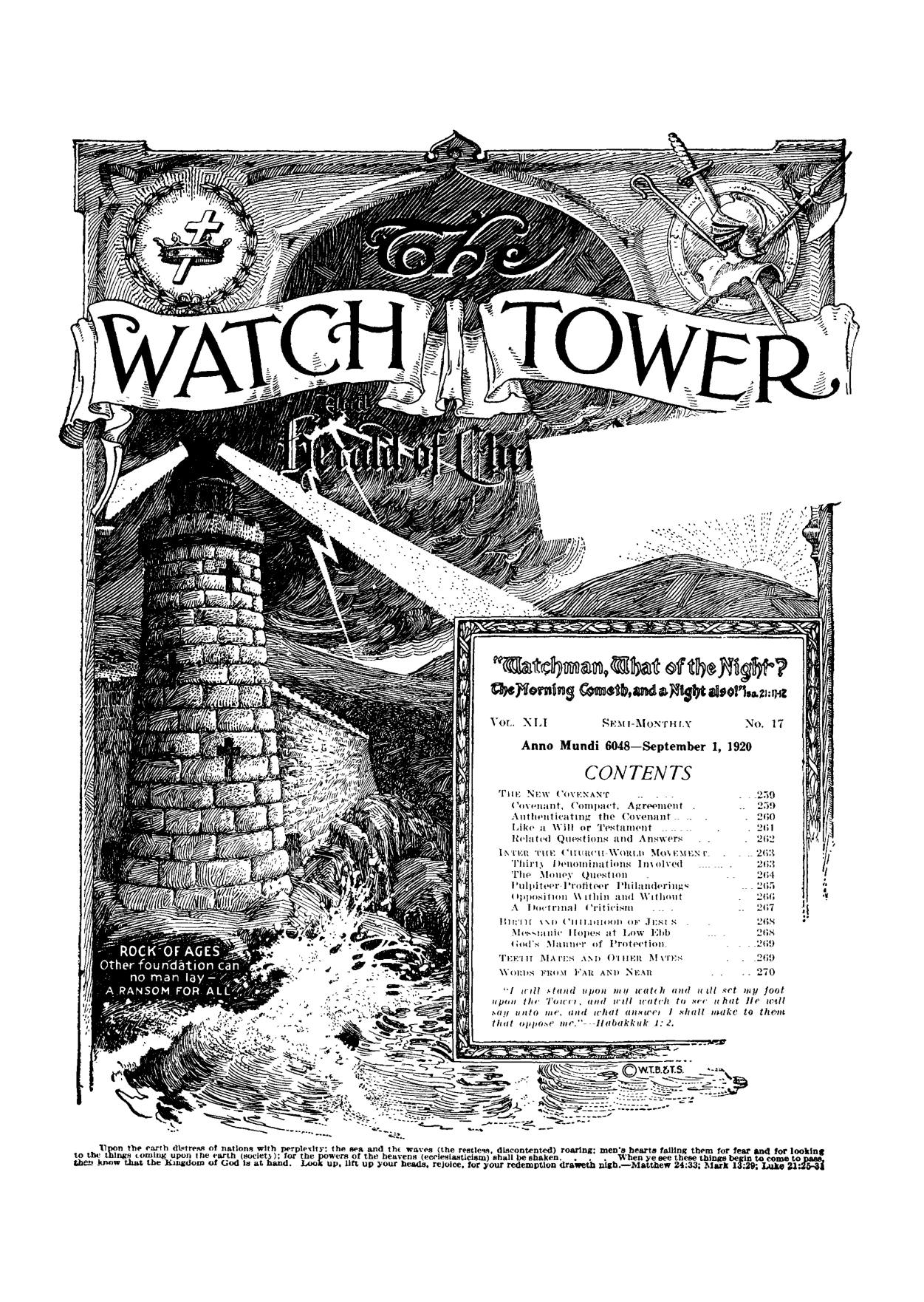
___..J1.??" ".a2lons th< waves (the restless, dlscontentrtl) roaring: men’s hearts railing them for fear and for looking to tbc things coming upon t he earth (society), Tor the powers of the heavens (ecclesiastlcism) shall be shaken. . . . When ye see these things begin to come to Dass, then know that the Kingdom of God is at hand. Look up, lift up your beads, rejoice, for your redemption draweth nighmatthe w 24:33; Mark 13:29; Luke 31;25~3i
THIS JOURNAL AND ITS SACRED MISSION
THIS journal is one of the prime factors or instruments in the system of Bible instruction, or “Seminary Extension” now belne presented in all parts of the civilized world by the Watch Tower Bible & Tract Society, chartered A.D. 1884 “For the Promotion of Christian Knowledge”. It not only serves as a class room where Bible students may meet in the study of the divine Word but also as a channel of communication through which they may be reached with announcements of the Society’s conventions and of the coming of its traveling representatives, styled “Pilgrims”, and refreshed with reports of its conventions.
_ , "Berean Lessons” are topical rehearsals or reviews of our Society’s published Studies most entertainingly arranged, and very “’e.rjt the only honorary degree which the Society accords, viz., Verbi Dei Minister (V. D. M.), which translated Into English is Minister of God s Word. Our treatment of the International Sunday School Lessons is specially for tHe older Bible students and teachers. By some this feature is considered indispensable.
This journal stands firmly for the defense of the only true foundation of the Christian’s hope now being so generally repudiated •—redemption through the precious blood Of 'th© man Christ Jesus, who gave himself a ransom [a corresponding price a substitute! for »*r’- <1 Pet<* I:™: ^Timottiy 2;«) Building upon this sure foundation the gold, silver and precious stones (1 Corinthians 3: 11 15; 2 Peter 1:5-11) of the Word ot God, itg further mission is to “make all see what is the fellowship of the mystery which. . has been hid in^God, ... to the intent that now might be made known by the church the manifold wisdom of God”—“which in other ages was hot made known iiEt? the OC men as it is now revealed”.—Ephesians 3: 5-9,10.
It stands free from all parties, seftS flnd creeds of men^ while it goekl more and pipje to bling its every utterance into fullest subjection to the will of God in Christ, as Expressed in the holy Scriptures. It Is thus free to declare boldly whatsoever the Lord hath spoken—according to the divine wisdom granted unto us to understand his utterances. Its attitude is not dogmatic, but confident; fei we know whereof we affirm, treading with implicit faith upon the sure promises of God. It ig held as a trust, to be used only in his Service; hence our decisions relative to what may and what may not appear in its columns must be according to our judgment of his good pleasure, the teaching of his Word, for the upbuilding of his people in grace and knowledge. And we not only Invite but urge our readers to prove all Its utterances by the Infallible Word to which reference is constantly made to facilitate such testing.
TO US THE SCRIPTURES CLEARLY TEACH
That the church is “the temple of the living God”, peculiarly “his workmanship” ; that its construction has been in progress throughout the gospel age—ever since Christ became the world’s Redeemer and the Chief Corner Stone of his temple, through which, when finished, God’s blessing shall come “to all people”, and they find access to him.—1 Corinthians 3 : 16, 17 ; Ephesians 2:20-22; Genesis 28 :14 ; Galatians 3 : 29.
That meantime the chiseling, shaping, and polishing of consecrated believers in Christ’s atonement for sin, progresses; and when the last of these “living stones”, "elect and precious,” shall have been made ready, the great Master Workman will bring all together in the first resurrection; and the temple shall be filled with his glory, and be the meeting place between God and men throughout the Millennium.—Revelation 15 : 5-8.
That the basis of hope, for the church and the world, lies in the fact that “Jesus Christ, by the grace of God, tasted death for every man,” “a ransom for all,” and will be “the true light which lighteth every man that cometh into the world”, “In due time”.— Hebrews 2:9'; John 1:9; 1 Timothy 2:5, 6.
That the hope of the church is that she may be like her Lord, “see him as he Is,” be “partakers of the divine nature’,’ and share his glory as his joint-heir.—1 John 3 :2 ; John 17:24; Romans 8 :17 ; 2 Peter 1:4.
That the present mission of the church is the perfecting of the saints for the future work of service: to develop in herself every grace; to be God’s witness to the world ; and to prepare to be kings and priests in the next age.—Ephesians 4 :12 ; Matthew 24: 14 ; Revelation 1:6; 20:6.
That the hope for the world lies in the blessings of knowledge and opportunity to be brought to all by Christ’s Millennial kingdom, the restitution of all that was lost in Adam, to all the willing and obedient, at the hands of their Redeemer and his glorified church, when all the wilfully wicked will be destroyed.—Acts 3 :19-23; Isaiah 35.
Published ay
WATCH TOWER. BIBLE TRACT SOGET> 124 COLUMBIA HEIGHTS n D BROOKLYN, NY. U S A j’orkign Officbs : British: 34 Craven Terrace, Lancaster Gate, London W. 2; Australasian: 495 Collins St., Melbourne, Australia; South African: 123 Plein St., Cape Town, South Africa.
Please Address the Society in Every Case.
ANNUAL SUBSCRIPTION PRICE $1.00 IN ADVANCE CANADIAN AND FOREIGN SUBSCRIPTION PRICE $1.50 SEND MONEY BY EXPRESS OR POSTAL ORDER, OR BY BANK DRAFT FROM FOREIGN COUNTRIES BY INTERNATIONAL POSTAL ORDERS ONLY (Foreign translations of this journal appear in several languages^
BtRtorlal Committee: This journal is published under the supervision of an editorial committee, at least three of whom have read and approved as truth each and every article appearing in these columns. The names of the editorial committee are: J. F. Rutherford, W. E. Van Amburgh, F, H, Robison, G. H. Fisher, W. E. Page.
Termo to the Lord's Poor: All Bible students who, by reason of old age or other in-ftrmity or adversity, are unable to pay for this journal, will be supplied free if they send a postal card each May stating their case and requesting such provision. We are not only willing, but anxious, that all such be on our list continually and in touch with the Berean studies. _____________________
srAflMfA .Quborrihm* We do not, as anile, seeds card of acknowledgment for a renewal or rimtcoioouoecnoen. tor B new ■uboeriptfon. Receipt and entry of renewal are indicated wtthln a month by chance In expiration date, as shown on wrapper label.
Entered <u Second Class Matter at Brooklyn, N. Y., Pootofficc under the Act of March trd, 1879.
GERMAN COMPOSITOR WANTED
The Society desires the services of some brother who is able to set German type by hand or to operate the linotype, and will be pleased to hear from any one who can perform this service, and is so situated that he could work in New York. •
BOOKLETS ON “MILLIONS NOW LIVING” READY
The 128-page booklet, “Millions Now Living Will Never Die,” is now ready for distribution and orders will be filled as rapidly as possible. This booklet is in the nature of a companion piece to “Talking With the Dead ? ? ?” Harmonious with the restitutionary character of the message the booklets are bound in a bluish green mottled cover stock, embellished with appropriate design. In addition to the 112 pages originally announced, we have given an addendum of hundreds of Scripture citations in substantiation of the everlasting-human-life-for-man message now due. An endeavor has been made to make this list complete.
These booklets are procurable at 25c postpaid for single copies. Wholesale prices for fifty or more copies on request.
CONVENTION AT INDIANAPOLIS
Indianapolis, Ind., October 1-3: A three day convention will be held in Indianapolis, Ind., October 1st to 3d. All meetings will be held at the K. of P. Auditorium, northeast corner of Pennsylvania. Street and.Massachusetts Avenue. For further information, address Edgar M. Ross, 349 Lesley Avenue, Indianapolis, Ind.
STUDIES IN THE SCRIPTURES
These Studies are recommended to students as veritable Bible keys, discussing topically every vital doctrine of the Bible. More than eleven million copies are in circulation, in nineteen languages. Two sizes are issued (in English only) : the regular maroon cloth, gold stamped edition on dull finish paper (size 5wx7i"), and the maroon cloth pocket edition on thin paper (size 4*x6i*) ; both sizes are printed from the same plates, the difference being in the margins; both sizes are provided with an appendix of catechistic questions for convenient class use. Both editions uniform in price.
Series I, “The Divine Plan of the Ages,” giving outline of the divine plan revealed in the Bible, relating to man’s redemption and restitution : 350 pages, plus indexes and appendixes, 75c. Magazine edition 20c. Also procurable in Arabic, Armenian, Dano-Norwegian, Finnish, French, German, Greek, Hollandish, Hungarian, Italian, Polish, Roumanian, Slovak, Spanish, Swedish, and Ukrainian; regular cloth style, price uniform with English.
Series II, “The Time is at Hand” treats of the manner and time of the Lord’s second coming, considering the Bible testimony on this subject: 333 pages, 75c. Obtainable in Dano-Norwegian, Finnish, German, Polish, and Swedish.
Series III, “Thy Kingdom Come,” considers prophecies which mark events connected with “the time of the end”, the glorification of the church and the establishment of the Millennial kingdom; it also contains a chapter on the Great Pyramid of Egypt, showing its corroboration of certain Bible teachings : 380 pages, 75c. Furnished also in Dano-Norwegian, Finnish, German, Polish, and Swedish.
Series IV, “The Battle of Armageddon,” shows that the dissolution of the present order of things is in progress and that all of the human panaceas offered are valueless to avert the end predicted in the Bible. It contains a special and extended treatise on our Lord’s great prophecy of Matthew 24 and also that of Zechariah 14 : 1 - 9 : 656 pages, M5c. Also in Dano-Norwegian, Finnish, Greek, German, and Swedish.
Series V, “The Atonement Between God and Man” treats an all important subject, the center around which all features of divine grace revolve. This topic deserves the most careful consideration on the part of all true Christians: 618 pages, 85c. Procurable likewise in Dano-Norwegian, Finnish, German, Greek, and Swedish.
Series VI, “The New Creation,” deals with the creative week (Genesis 1, 2), and with the church, God’s new .creation. It examines the personnel, organization, rites, ceremonies, obligations, and hopes appertaining to those called and accepted as members of the body of Christ: 730 pages, 85c. Supplied also in Dano* Norwegian, Finnish, German, and Sw’edish.
Series VII, “The Finished Mystery,” consists of a verae-by-verse explanation of the Bible books of Revelation, Song of Solomon, and Ezekiel: 608 pages, illustrated, $1.00 in • cloth, 20c in magazine edition—latter treats Revelation and Ezekiel only.
AND HERALD OF CHRISTS PRESENCE
Vol. xi r. September 1, 1920 No. 1"
THE NEW COVENANT
What Is It? Who Aki; the Parties to It?
When. How. and in Whom Is It Sealed? When Does It (io Into Operation?
THE word coxenant is the* solemn form for expressing the term contract, compact. or agreement. The essentials to any contract or compact an* these: hirst, parties competent to enter into a contract: second, a good ami sufficient consideration supporting it. Primarily covenants are of two kinds: Unilateral, that is to say. where then* is only one responsible party to it: and bilateral, where there are two parties upon whom rests an obligation. Thore may be more than two parties to a covenant or contract. The covenants prominently mentioned in the Scriptures are (1) the Abrahamic Covenant. which is unilateral. Jehovah being the only responsible party to it, the consideration being the immutability of his word and oath, the fulfillment of which will result in the blessing of the human race through the seed developing from the Sarah feature of that covenant; (2) the Law Covenant, between Jehovah and the nation of Israel, with Moses as mediator, made and instituted at Mount Sinai, the consideration being that Jehovah would grant blessings of life and blessings incident thereto upon performance of the promise made by the other party to the covenant, that they would fully perform their part of the agreement by keeping the law. Any Jew performing the terms of the covenant would have received the blessings Jehovah promised: and (3) the New Covenant, the one here under consideration.
COVENANT, COMPACT, AGREEMENT
The New Covenant is a compact, agreement, contract, or arrangement which Jehovah will put into operation as a means to accomplish the end, ton it. the blessing of the human race. His original promise was, "In thy seed shall all the families of the earth be blessed". The New Coxenant is the arrangement by which the seed performs Jehoxall’s w ill. which will result in the blessing-of life, liberty, and happiness to the members of the human race who will comply with the terms of the covenant. The consideration for the New' Covenant consists of the mutual agreements and acts to be performed by the parties to it.
II ho me the parties Io the iieie corenmit! Jehovah on the one hand, and Israel ami Judah, composing the whole house of Israel, on the other, as stated by the prophet: “Behold, the days come, saith the Lord, that I will make a new covenant with the house of Israel and with the house of Judah". (Jeremiah 31 : 31) The question immediately arises in our minds, then, How can Israel and Judah be a party to this covenant, seeing that thy whole house of Israel is incompetent, because imperfect? The Israelites are not justified, and Gori does not enter into coAenant relationship with any except the justified. What then is meant by the Scriptural statement that he will make a covenant with Israel? Appreciating the fact that it is absolutely necessary for both parties to the covenant to bi* competent before* they can enter into a direct covenant relationship, and observing the incompetency of Israel, wo at once sec* flu* necessity for a mediator.
The word mediator has a more* comprehensive significance than we often give it. Technically and strictly speaking, mediator means one* who interposes between parties who are at variance, for the purpose of bringing those* parties into a condition of reconciliation. Hence the mediator is called an intercessor, or go-between. With equal propriety we can use the term guardian, or curator, in the* sense those* terms are often used. A guardian is one* who has possession and control of the person, and sometime*.- the* property of his ward. When* a person has possession and control of the* property alone* of an incompetent he is called a curator. The guardian and curator therefore means the. office of a protector, or one who stands in behalf of an incompetent party and who possesses flu* authority and the* power, not only to have and control the person and property of his ward, but to act in behalf of his incompetent ward in the making of contracts. To illustrate this point, in almost all jurisdictions a minor child or an insane person has no power to enter into a contract concerning his property or anything else. The legal title to a piece of property is in the minor’s name. A competent person desires to lease that property and ('liters into a contract of lease, for the property. The minor or the insane person cannot sign the contract, however, because incompetent, but some competent person, acting as guardian or curator for the minor or insane, incompetent person, must sign on behalf of his ward, and tin* contract then is just as binding on the minor or insane person as if he had been competent to main* it and had made it himself. The guardian or curator acting, however, must be appointed to that office bv some competent legal authority, having tin* power so to appoint.
ISRAEL AN INCOMPETENT PARTY
'I'lie house of Israel is incompetent to ('liter into a contract. The same is true with reference to the entire human race: because all are imperfect. One of the chief purposes of the New Covenant is to bring mankind back io a condition where each will be competent to enter into a contract directly with Jehovah. That will mean back to the condition Adam enjoyed prior to his disobedience.
When Jesus was begotten to the divine nature at the time of his consecration at the Jordan, Jehovah appointed him to the offices of Advocate for the church, Mediator for the New Covenant, Prophet, Priest, and King for the world of mankind in general. The office of Advocate for the church he assumed when he ascended on high, and has performed the duties of that office since. The office of Mediator for the New Law Covenant he has not yet assumed, because the time has not arrived for that purpose. He will assume the duties of that office when the time comes to make and seal the New Covenant. The New Covenant will be in the nature of a last will and testament in this, that it will be necessary for Jesus Christ to use the value of his perfect human life for the purpose of making it possible for Israel to enter into this covenant with God. The Mediator of the New Covenant will consist not only of Christ Jesus the Head; but all the members of his body will constitute a part of the Mediator by virtue of being of the body of Christ. Hence, with propriety we can say that the Christ will constitute the Mediator of the New Covenant.
Israel being incompetent to enter into a contract or covenant, the Christ occupies and will occupy the relationship toward Israel of guardian, having the care, custody, control, and responsibility for the people, and the Mediator will therefore enter into a contract or covenant with Jehovah on behalf of Israel, because Israel is under the disability of imperfection, which disability renders it impossible for Israel to make the contract direct. Briefly answering the second question then, we would say that the parties to the New Covenant are Jehovah on the one side, and the Christ on the other, acting for and in behalf of Israel, the imperfect and incompetent ward of the Christ.
Keeping in mind the proper relationship of the parties to the covenant will enable us the better to understand what is meant by the sealing of the New Covenant, and when it will go into operation, and when it will cease to be operative. It has sometimes been suggested that the New Covenant will go into operation at the end of the Millennial age, but if that were true there would be no necessity for making it at all.
AUTHENTICATING THE COVENANT
U7ien, how and by whom is it sealed? The sealing of the New Covenant or contract is that which affirms, or ratifies, authenticates, and guarantees its performance. It is a solemn affirmation of the terms of the covenant, and forever stops the mouths of any of the parties thereto to dispute its terms or contents. For instance, a contract under seal is not subject to be disputed by either party to it. Neither one will be heard to say, I did not agree to those terms. Israel is a party to the contract or covenant, through the Christ as legal representative and Mediator, and in due course the whole world must come under the terms of that covenant. During the Millennial reign, then, no one will be heard to say, after having accepted the covenant, I did not agree to the terms stated in it. The mouths of all parties are forever stopped to deny any part or term contained in said covenant.
A contract or covenant need not necessarily be made in writing. We would not understand that Jehovah has been writing a document which will be signed by the parties to it, and which will be called the New Covenant; but we understand that this covenant will be entered into by the expressed will of Jehovah on the one side, and by the consent of the Christ on the other, in behalf of Israel. How then will it be sealed? It will be sealed by the merit of Christ’s sacrifice. The sealing will take place when the last spirit-begotten one has finished his course, and the merit of Christ is released from the obligation of keeping good the justification of all who have been spirit begotten. The sealing of the Old Law Covenant indicates how the New Law Covenant will be dedicated or authenticated, concerning which we read:
“Even the first covenant hath not been dedicated without blood: for when every commandment had been spoken by Moses unto all the people according to the law, he took the blood of calves and of goats, with water and scarlet wool and hyssop, and sprinkled both the book itself and all the people, saying, Behold the blood of the covenant which Jehovah hath made with you upon all these conditions. ... It was necessary therefore that the patterns of things in the heavens should be cleansed with these; but the heavenly things themselves with better sacrifices than these.”—Heb. 9 :18-23 ; Exod. 24:8.
These Scriptural statements show that the New Covenant will be sealed or authenticated by Christ, the greater than Moses, as soon as the better sacrifices are completed. We gather from them further that the sealing will be done by the Christ applying the value of his previously made sacrifice to divine justice, which was represented by sprinkling the book of the law, and by extending the privileges of restitution to Israel-and all who come under the terms of the covenant, which was pictured in the type by the sprinkling of the people. “So shall he sprinkle many nations.”—Isaiah 52: 15.
KNOWLEDGE A LATER THING
It seems entirely reasonable to conclude that the New Covenant will be made with or on behalf of the House of Israel without their knowing about that fact at the time it is made and sealed. By this we mean that the Christ will enter into the covenant in behalf of his incompetent wards, towit. Israel, before Israel is brought to the knowledge of that fact. As an illustration, suppose a minor child owns a building which Mr. A desires to lease. Mr. B is appointed to act as guardian in behalf of the minor and his property, and it is deemed for the best interest of the ward that the contract of lease be made, and the guardian or mediator therefore enters into a contract of lease, letting this building to the party who desires to lease it, and the minor may not come to a knowledge of that fact for some years afterwards. Nevertheless, the minor is bound by all the terms of the contract. When the minor reaches an age that it can know something about the terms of the contract, it would be informed of those terms. So with reference to the New Covenant. The ancient worthies will be the first fruits of the New Covenant. They cannot be resurrected until the New Covenant is made; and when made they will be the first ones awakened out of death, the first offspring of that covenant. Doubtless they will then be immediately informed of its terms and will agree to all of them, but Israel in general is not ready to accept the Messiah, and will not accept the Messiah until they come to some knowledge of the fact that he is their great Redeemer and Deliverer. It follows then that the New Covenant must be made on behalf of Israel before Israel knows about it. It must be sealed by the merit of Christ’s sacrifice.
This New Covenant, then, will be made between Jehovah on the one side and Christ on the other, technically .speaking, but in behalf of and for the benefit of Israel anil all of mankind accepting and obeying its terms. Let us suppose Jehovah would say to Christ, What assurance is given that this covenant will be carried into operation? and Messiah responds. I guarantee it will be carried out, and a< a basis of that guarantee 1 am sealing it with my own blood, the value of my sacrifice, the value of the human life that 1 laid down at Calvary. This guarantee, or authentication, or confirmation, by the presentation of the merit of Christ's sacrifice to divine justice, constitutes the sealing of the new Law Covenant. 'This sealing could not take place as long as any member of the body of Christ is in the llesh. It must take place after the day of sacrifice. “Cor this is the covenant that 1 will make with the house' of Israel after those days, saith the Lord.” (Hebrews 8: 10) Clearly the words ‘after those davs' refer to after the da vs of the sacrifice of the Christ." "
LIKE A WILL OR TESTAMENT
The Apostle Paul likens this covenant unto a last will and testament, saying. "For where a •testament is, there must also of necessity be the death of the testator. For a testament is of force after men are dead: Otherwise it is of no strength at all while the testator liveth.” (Hebrews 9: 15 -17) It is the humanity of those composing the Christ which constitutes the testator that must die. It is the Christ divine that administers this estate or valuable thing in behalf of mankind—first in behalf of Israel, and then all thereafter who comply with the terms. The estate that is left to be disposed of consists of the right to human life and the blessings incident thereto. That human life Jesus possessed in completeness, and he laid it down at Calvary, the value of which he took up when he arose from the dead. He has since permitted the members of his body to be made a part of the Messiah, counted in as a part of the Mediator and the one that will execute the trust of disposing of this devised estate. The sealing, therefore, constitutes a part of the covenant and takes place after all those beings composing the Mediator have died as human beings and have been resurrected as divine beings.
Then when does it go into operation? Within a reasonable time after the death and resurrection of those composing the Mediator. The death of the last member of the church completes the death of the testator class. Then the New Testament or New Covenant must be probated, or reviewed and declared valid. This probation or declaring it valid is involved in the sealing and establishment of the covenant as above mentioned. The merit of Christ must be released from all obligation with reference to the spirit-begotten ones before the New Covenant could be sealed and before it could go into operation. We should therefore expect the New Covenant to go into operation immediately after it is sealed.
ITS PURPOSES
The purposes of the New Covenant are to awaken out of death, to teach, to uplift and restore the human race and bring them back to the condition of at-one-ment with God. It will bless the people by recovering them from the tomb: ‘‘By the blood of thy covenant I have sent forth thy prisoners out of the pit’’. (Zechariah 9:11) It will bless the people with knowledge, for when it is completed it will no longer be necessary to preach, saying. "Know the Lord; for they shall all know me from the least of them unto the greatest of them, saith the Lord". (Jeremiah 31:34) It will bless the people by going them tender hearts: "Thus saith the Lord God: ... a new heart also will I give you. and a new spirit ’A ill I put within you ; and I will take away the -loiiy heart out of your llesh, and I will give you a heart of lle.-Ji”. ( Ezekiel 36: 22 - 27) It will bless Israel with vastly more supremacy than she has ever had: "Thou shall receive thy sisters [Sodom, Samaria, etc.], thine elder and thy younger ; and I will give them unto thee for daughters, but not by thy [old | covenant”. (Ezekiel 16:61) It u ill bless the obedient of mankind with life: "Hear, and your soul shall live’’ (Isaiah 55:3); “He . . . that hath withdrawn his hand from iniquity, hath executed true justice between man and man, hath walked in my statutes, and hath kept mine ordinances, to deal truly; he is just, he shall surely live, saith the Lord Jehovah".—Ezekiel 18:8.
The New Covenant is not a written document like unto an ordinary contract, but it is a solemn arrangement or compact of which Christ is the very essence. As an evidence that Christ is the real and essential party to this covenant and the purposes for which it is given, we read: “I the Lord have called thee in righteousness, and will hold thine hand, and will keep thee, and give thee for a covenant of the people, for a light of the Gentiles ; to open the blind eyes, to bring out the prisoners from the prison, and them that sit in darkness out of the prison house”. (Isaiah 42 : 6, 7 ) “Thus saith the Lord, In an acceptable time have I heard thee, and in a day of salvation have 1 helped thee: and I will preserve thee, and give thee for a covenant of the people, to establish the earth, to cause to inherit the desolate heritages; that thou mayest say to the prisoners, Go forth; to them that are in darkness, Show yourselves. They shall feed in the ways, and their pastures shall be in all high places. They shall not hunger nor thirst; neither shall the heat nor sun smite them: for he that hath mercy on them shall lead them, even by the springs of water shall he guide them.”—Isaiah 49:8-10.
EVERY HELP GIVEN
The Christ occupying the relationship of guardian or Mediator, for and in behalf of his incompetent ward, towit, the house of Israel and all who come into that house, will do everything that is necessary for the education and development to the point of perfection of such incompetents. He will open the graves and bring them out; he will teach them, nurse them, lead them, feed them, uplift and bless them. The Messiah, then, as the great Prophet will teach the people; as Priest will minister unto the people and bless them; as King, rule over them, direct and control them; therefore occupying the position of Prophet, Priest, King, and Mediator, or Guardian, having rule over and control of the human family to bring them back to a position of contractual relationship with Jehovah. Throughout the Messianic reign Jehovah does not deal with the human race directly, because of the incompetency of that race. He deals with the Guardian, the Curator, the Mediator, the Messiah, who acts in behalf of the world.
When a minor child reaches the age of maturity, or an insane person is restored to full sanity, the person who up to that time has been acting as guardian or curator surrenders the office and steps aside to let the one who has now become competent take charge of his own affairs. At the end of the Millennial age all of the wilfully wicked will be destroyed and the obedient ones brought up to the point of human perfection. The great Messiah, the Mediator and Guardian, will no longer need to act in that capacity, but will step aside and surrender the human race to Jehovah, and these being put to a last and crucial test, all who pass that test will then be in direct contractual or covenant relationship with Jehovah, no longer needing the intervention of a Mediator. Therefore the New Covenant will cease its operation at the end of the Millennial age.
So. then, we will say, briefly summing up, that the New Covenant is an arrangement between God on one side and Jesus Christ and his body members, the Messiah, on the other side, acting for and in behalf of the house of Israel and all mankind; that its sealing takes place at the end of the gospel age, when the church is glorified; that it goes into operation shortly thereafter; and that it is completed at the end of the Millennial age when the human race is brought up to a condition of direct contractual relationship with Jehovah.
RELATED QUESTIONS AND ANSWERS
Question. If God could not make a contract with any one that is incompetent, how then did he make a covenant with the Jews when he gave them the Law Covenant ?
Answer. In that instance he counted Moses as righteous in order that he might use him as a Mediator, thus typifying the greater Mediator, the Messiah, and he made the covenant with Moses, who acted on behalf of the nation of Israel.
Question. Will the restored human race at the end of the Millennial age be in covenant relationship with God ?
Answer. Yes, and not until then. Being then restored to human perfection, God can deal with them directly, as he did with Adam, and without the intervention of a Mediator. .
Question. Will God then enter into a covenant with each individual ?
Answer. There will then be an implied covenant between Jehovah and all the human family whereby each member agrees to do the will of God. Otherwise they could not continue to live.
Question. How will that covenant be made between. God and man?
Answer. The purpose of the New Covenant is to write into the hearts of the people the law of God. When this is accomplished an implied contractual or covenant relationship will directly exist between man and Jehovah. A contract does not need to be stated in terms in order to exist, but the relationship of the parties raises an implied contract or covenant between them. God having accepted man, then restored and delivered to him by the Mediator, there will be an implied relationship between God and mankind by which man agrees to obey the will of God. The covenant relationship arising between perfect man and Jehovah will continue forever. It will be an everlasting arrangement.
Question. Why is the Newr Covenant called the everlasting covenant? Does that mean age-lasting, or without end?
Answer. Evidently it means that it is one which lasts until the object for which the covenant is made be accomplished. It is not one that is to be renewed or patched up every year, as was the old Law Covenant. It keeps right on until the thing designed is accomplished. It will result in bringing the obedient ones of mankind into everlasting covenant relationship with Jehovah.
Question. If the blood for the sealing of the New Covenant is not released until all the spirit-begotten ones have finished their course, why is it that the great company class has no part in the sealing of the covenant ?
Answer. For the raason that the great company constitutes no part of the priesthood. No one could have a part in the sealing of the New Covenant unless such a one is a part of the priesthood; and no one is a part of the priesthood who does not participate in the sin offering; and none except the body of Christ participates in the sin offering and forms a part of the priesthood.
Question. Do we understand that individuals during the Millennial age will make a covenant with God?
Answer. No; individuals during the Millennial age will not make a covenant with Jehovah because they will not be competent. No man will be competent to make a contract or covenant with Jehovah until the Mediator turns him over to Jehovah and withdraws from the office of Mediator. The office of Mediator will then cease, and this will not be until the end of the Millennial age.
Question. The world being in covenant relationship with Jehovah at the end of the Millennial age, would it be proper to term them children of the covenant?
Answer. They will have received their life from Christ, the great Life-giver; therefore they get their life through the terms of the New Covenant. They are really children of the Christ; and being restored to life in perfection and delivered over to Jehovah, they will then be the sons of God, his children, the same as Adam was when he was perfect.
“Let doubt, then, and danger my progress oppose, They only make heaven more sweet at the close; Come joy or come sorrow, whate’er may befall, An hour with my God will make up for them all.
“A scrip on my back, and a staff in my hand, I inarch on in haste through an enemy’s land ; The road may be rough, but it cannot be long, And 1’11 smooth it with hope, and cheer it with song."
INTER THE CHURCH-WORLD MOVEMENT
“For flays beyond a //<<//' shall yr be troublfd, ye careless women; for the vintage shall fail, the ingathering shall not conic,”—Isaiah 82:10, K. I’.
Alittle more than a year ago there was launched in Neu York what was called the Interehurch k World Movement of North America. Now, if many newspaper advices are to be relied on, that movement is dead as a grand central organization. A few months back it looked Very much like an Jnter-the-Church-in-the-World-Movement. but now it seems that the Movement itself is interred or, at least, that its last obsequies are being conducted. Strange to say, one of the most creditable things about the movement was the inducing cause ot its hasty sickness and demise.
ft is hardly necessary to remark that any person or group of persons ba- both tin* ethical and the legal right to labor at their conception of (tod’s will. Neither should criticism be undertaken in any spirit of cant or small disagreement, but only wlien there is serious discrepancy between the avowed object of an avowedly Christian movement and the Bible st ipulat ions as to the real aim and purpose of the church. Any one w ho claims to be a Christian at all is subject to this kind of examination or criticism.
Was the Interehurch Movement tin1 only green thing that has grown up on the inert trellis of the Church Federation, and has the* worm of impeenniosity smitten this gourd which was the only protection that the Jonah prophets had from the disconcerting sun of unpopularity which has been shining on them because of their failure to exert any influence to keep the world out of war and to apply any but the most animal thinking to world subjects while the war was on? We shall see: time will doubtless make it more clear.
NO ORDINARY MOVEMENT
The Movement was no ordinary one, The Christian Herald declaring that it can “be compared with nothing in their [the churches’| history, with the possible exception of the Civil War, which caused a break in so many denominations”. A full history of the whole Movement is, of course, not yet obtainable by outsiders, but enough is available to make it of groat interest. From all th*1 information procurable at this time the conception and development of the Movement was something like this:
Early last year upwards of a hundred men and women who represented various charitable and missionary agencies of the so-called Evangelical Churches, met in the city of New York and. after “an extensive session of intercession, came unanimously to the conclusion that the time was ripe for the next great step in cooperative endcaxoi". A committee was appointed with instructions to prepare some kind of outline for a “platform of principles upon which the agencies might go forward’’.
'I'he propo-als of 1 ]iis committee were unannnouslv appioved when thev were presented before the six cooperative councils represented at the original conference wlmh were as follows: flu* Foreign Missions Conference ol Noithern America, the Home Missions Council, Ilie Council of Church Boards of Education, the1 Sunday School Council of Evangelical Denominations in the 1 nited States and Canada, the Council of Women for Home and Foreign Missions, and the Federal (’oinxil of Churches of Christ in America, Subsequent to this there was chosen a committee of one hundred from these various denominations; and this committee came to be known as flu1 Executive Committee.
THIRTY DENOMINATIONS INVOLVED
Before long the Interehurch World Movement was a banner under which were arrayed, with more or less closeness, fifty-eight Boards and Societies, representing thirty (latterly thirty-two) Protestant denominations. Ileie they are:
(1) Advent Christian Church.
(2) Northern Baptist Conference.
(3) National Baptist Conference.
(4) General Baptists.
(5) Church of the Brethren.
(til Brethren Church.
(7) Christian Church.'
(SI Congregational Churches.
(9) I Hseiples of i ’hi"<t.
(10) Evangelical Association.
(11) United Evangelical Church.
(12) Soviet v of friends in America.
(13) Society of Friends in California.
(14) Holiness Church.
(15) Lutheran Evangelical Synod of North America.
(1(> ) General Conference of Mennonites.
(17) Methodist Episcopal Church.
(IS) Methodist Protestant Church.
(Ill) Free Methodist Church of North America.
(20) African Methodist Episcopal Zion Church.
(21) Colored Methodist Episcopal Church.
(22) Reformed Zion Union Apostolic Church.
(23) Presbyterian Church in the United States of America.
(24) Presbyterian Church in the United States, South,
(25) Associate Reformed Presbyterian Synod.
(26) Reformed Presbyterian Church in North America.
(27) United Presbyterian Church.
(28) Reformed Church in America.
(29) Reformed Church in the United States.
(30) Church of United Brethren in Christ.
(31) ■> (32) 'I
ORGANIZED FOR CAMPAIGN
’I’he first undertaking of this extensive Movement was a survey of the entire world, with a view to acquiring laets which would afford a basis for coordinating the various activities of the churches and for the making out of a financial budget and plans for work that was later to be attempted m concert. This survey was quite comprehensive, embracing, as it did. the fields of foreign missions, home missions, American education, American religious educat mu. American hospitals and homes, American ministerial pensions and relief, and miscellaneous.
Tin1 published pneliminary survey which va- presented at tin1 Atlantic City Conference of the Interehurch Movement January 7 to 10. 1920, embraced some three hundred fifty pages of (carefully collected and concisely presented world statistics on the above-named subjects. T’his survey was essentially in harmony with the report made by the Foreign Missions Investigating Committee of the I. B. S. A. in the Hippodrome, New York, in the spring of 1912. 'Hie main tenor of it was to the effect that after nineteen hundred years the world is only faintly touched by either the precepts or the practices of Christ. It showed that
“For every convert made by Christianity advancing from the south in Africa, there are three converts to Mohammedanism in the north.”
“In India, with a population of 315,000,000, approximately three-fifths of one percent are Evangelical Christians; one-half of <?nc percent are Catholics.”
“One-tenth of one percent of China’s 417,000,000 population are Evangelical Christians; three-eighths of one percent are Catholics.”
“One-sixth of one percent of Japan’s population, or 360,000 persons, are Evangelical Christians; one-seventh of one percent are Catholics.”
Furthermore this report or survey demonstrated what Protestants were giving to their religious activities and what they could reasonably give if their interest were sufficient:
“The Protestant Church in 1918 cost each member two cents and seven mills per day for all purposes, local and benevolent. The total contributions for 1918 were $249,778835. By doubling the present giving the amount asked in the United Simultaneous Financial Campaign, to be paid in 1920, will be greatly oversubscribed.”
THE MONEY QUESTION
As one result, and, to judge from the newspaper headlines, the principal result of the Atlantic City Conference in January, came the plans for an immense and intensive drive to secure pledges for $1,320,214,551, which great sum was looked upon as requisite for the five-year program agreed upon. To the first of these five years a budget of $336,777,572 was apportioned and a great drive was started on May 15 last, which was called a United Simultaneous Financial Ingathering, or Campaign. If the vintage did not altogether fail it was certainly meager; for the drive netted only $176,000,000 in promises to pay, most of which was to go to the denominations comprehended in the Movement, and very little, namely, less than $3,000,000, to the central organization in New York, which was to have had about $40,000,000 if the drive had proved a success.
This central organization, the work of the general Committee, had in the collating and publishing of the world’s survey, in extensive newspaper advertising, in widespread Committee activities, etc., etc., entailed an expense of approximately $9,000,000, more than half of which was underwritten by influential interests through New York batiks. It was expected that in addition to the funds to be raised from church members and constituents for the religious, educational, and eleemosynary activities of the thirty participating church bodies, there would be no inconsiderable ingathering from “friendly citizens” living in “No Man’s Land”, that is, from sympathetic non-church-members.
NO NO-MAN’S-LANB
But this “No Man’s Land” proved to be more of a theory than a fact; for those moneyed non-church-members, who were sympathetic, had already been canvassed by and counted in as of the outer constituency of the various denominations, because such men had a wife, a mother, or a sister in that religious body. Other moneyed non-church-members were found cool and disinterested and, so to speak, passed by on the other side when they saw an Interchurch canvasser. The reason for this now apathy, now antipathy follows.
Cryptically stated by The Christian Herald, it was:
“Because some denominational leaders for one reason or another refused the measure of cooperation rightfully expected of them.”
Speaking in plainer terms, the Interchureb World Movement plunged onto the rock of industrial investigation and broke up there. An industrial program had been adopted in New York, October 3, 1919, which was not smiled upon by Big Business. The report of the committee which formulated an industrial platform expressed itself as strongly in favor of collective bargaining; that is, they sided with the working man rather than with the capitalist on the question of trade unions, the right to strike, etc. This committee also urged a thorough and complete investigation into the strike among the employes of the United States Steel Corporation. which was then on, the causes leading up to it, the measure of responsibility resting with the employers, and such other points as would lie germane to the situation. The Atlantic City Conference authorized the Movement to proceed with this phase of its activities and to gather its findings into a survey for the purpose of publication.
Now note the difficulty. The drive for funds had not yet taken place when this work was authorized, and the heavy operating expenses of the central organization were being met by funds advanced by large banks. But banks do not advance money without security. To procure these funds the thirty denominations which the Movement represented had put up collateral based on denominational assets and, in addition to this backing, some wealthy individuals interested in the Movement had lent their support in the shape of securities. It seems that the liabilities of the Movement were gradated so that one denomination and one individual had priority claims on the funds collected during the drive. That is, if only a part of the nine million five hundred thousand dollars current expenses of the Movement were to be collected during the drive this denomination and this individual would be paid back first, even if there were nothing left at all but debts for the other denominations underwriting or guaranteeing the scheme. Mr. John Willis Baer, prominent California banker and identified with the Presbyterian National Conference, is quoted in the Springfield (Mass.) Daily News on this point:
“ ‘There Is one denomination that has been named first, and an individual who has been named second as preferential creditors,’ Mr. Baer announced, a statement which astonished the commissioners.
"No names were mentioned on the platform, but In conversations in the hotel lobbies the denomination was said to be the Baptist Gliurch North, and the individual John D. Rockefeller, Jr.
“Mr. Baer stated that these ‘preferential underwritings amount to between $2,000,000 and $3,000,000,’ which would mean that if the Interchurch Movement failed as a business concern this ‘one denomination’ and this ‘one individual’ would have to be paid first, and that any other denominations or individuals who had dene any underwriting could divide what was left or perhaps get nothing.”
Early in the history of the Movement other big business men hal been watching to see what use they could make of it; but when the Movement was committed to any industrial program which might prove uncomplimentary to them, their ardor began to wane. Early in the year the Washington Herald ((noted Mr. John 1). Rockefeller, Jr., and Mr. Cleveland 11. Dodge as expressing sincere interest in the Movement and as willing to back it u]> with considerable financial help. Mr. Dodge is verv prominently identified with tin1 Dinted Stall's St<*eL Corporation.
GOLDEN STRAND, PREFERRED, BELOW PAR
When these and oilier “friends” in Big Business saw that the' investigation into the steel company's indu-trial dillieuHies wa> to be carried on with genuine vigor and evident efforts to get at all the facts they tantalizingly withheld such contributions as had been promised by them, or which officers of the Movement had been led to expect. The Steel Corporation did more than this. It employed any number of private detectives and some federal agencies to interfere with the thoroughness of the survey, hailing in this, they attempted to steal the report, which was looked upon by them as being damaging to the interests of the Steel Corporation, and Big Business generally. The report, including its exhibits, comprised about 25(1,000 words; but a digest was prepared of some1 9,000 words which was hoped to be widely published. At the date of this writing no metropolitan paper, saving the New York B'or/d, has published any part of this report.
Big Business did not like to have the affairs of the steel trust and coal industry pried into; and rumblings of this discontent were heard from financial centers, some of which found an echo in the religious press. Cries of “radical”, “red.” “Bolshevist.” were raised against those who thought, the Steel Trust affairs could well stand a little investigating; and finally, on June 15. a formal notice was served on the Interchurch World Movement that it must be a very nice boy if it was to have any Big Business candy. This warning was issued through Industry, the official organ of the Manufacturers’ Association:
“We have observed with apprehension a tendency on the part of certain religious denominations to exalt unionism and to exaggerate the hardships of employes, while at the same time employers and employers’ organizations are in many instances maligned and the handicaps of conducting business minimized.”
FAULT-FINDINGS WITH HINTS
This article says that the principal offenders in this direction are the Federal Council of Churches of Christ in America, enumerating separately the Methodist, Baptist, Presbyterian, Catholic, and Episcopal Churches. In addition to this the Young Woman’s Christian Association comes in for some special warning. As respects the Federal Council, they indict it with having wired Governor Sproul of Pennsylvania that
“in various steel towns in the State of Pennsylvania the right of assemblage and free speech, even within buildings, has been and is being denied by various authorities,” and with having declared that
“even in the danger of wartime the Federal Council of Churches holds that the abuse of free speech is not so dangerous as its suppression.”
Touching on the Y. W. C. A., it said:
“Business men in many cities have backed the Young Woman’s Christian Association in their worthy endeavors, giving financial aid as testimony of their respect for this great organization's history. Business men, however, should be credited with a sense of fair play and foresight. Should the Y. W. (I. A. fail to realize the critical situation and pass resolutions concerning industrial projects in accordance with the outline as set forth in I he treatise. ‘What is a Christian Order in Industry?' it is unlikelv that future financial drives will receive any considerable aid directly from men of business. Such a proposition would be unfeasible and utterly in opposition to good business tactics."
There tan be no mistaking the meaning of that plain-spoken threat.
"< if what ns' is H to preach on one hand brotherhood and sisterhood and the spirit of ('hrislmnit.v." asks Big Business, "and on (lit* ol her hand rejoice in a series of petty attacks upon so-called evils of industry''"
“Will yon cooperate, or will you antagonize?-’ the Y. W. ('. A. was asked. Will you take the hint or will you look lor your money elsewhere? This hint was not taken, and Mrs. Helen Gould Sheppard, large holder of steel, railroad, mute, and other Mocks, resigned as president of the organization.
The Interehureh World Movement (or evidently a forceful part of it) did not take the hint, did not recant from its industrial heresy, ami as a consequence the $ 10.()()().000 promised by “friends” was not forthcoming, tin1 notes given to big banks tell due and, since the central organization could not ]>ay the demands, were passed on to the denominations which had helped to guarantee payment. Big Business means to show its stiangle-hold upon the pocketbook of the nation, even though it cannot always dominate the public conscience.
PULPITEER-PROFITEER PHILANDERINGS
That at one stage of the Movement an open flirtation was on between Big Business and the forward, vivacious maiden can hardly be denied by any one who observes facts. Before the Walnut Hills Christian Church, of Cincinnati, a multi-millionaire officer in that church is reported to have said:
“This church cannot afford to go back on the moneyed interests of this city by opposing the Interchurch Movement.”
One of the paid Interehureh advertisements put as its first argument:
“Put a church in a town and all real estate values Increase.”
Roger Babson, retainer of Big Business, wrote:
“There is no doubt about it—Labor is beaten. . . . The war taught the employing class the secret and power of widespread propaganda. Imperial Europe had been aware of tills power. . . . We have the schools. We have the pulpit. The Employing Class Owns the Pkess. There is practically no important paper in the United States but is theirs.”
The American Defense Society thought it saw a way to use religion to help maintain good business, with dividends. As a concession it says:
“Recognize the unions, if they are unions of men who believe in our form of government. Try collective bargaining, if you please. If the majority of the men in a union are Catholics, put a Catholic priest into that union ; if the majority are Protestants, put a Protestant minister into that union ; if the majority of them are Jews, put a Jewish rabbi into that union.”
And then, as a sort of afterthought:
“Do the same with the Business lien’s Associations.”
An issue of the Interchurch Bulletin tells of efforts which were made by them to publish a new kind of religious tract. Here are the qualifications which these experts declare model tracts should possess:
“Should give readers a basis of intellectual reconstruction along the lines of modern social democracy; deal with social problems from the standpoint of the church, making the church’s position clear: deal with the care of the home and the child; take up the subject of vice from the standpoint of health, hygiene, and morality; deal biographically with the great heroes and leaders in constructive religious thought of every race, so that foreign-born children may realize that America appreciates the great men of all lands.”
At first thought this appears to be rather in contrast with the published purposes of the Movement, which were: (1) “To win men to Christ; (2) to deepen the loyalty of Christians to the world-winning program of Christ; (3) to bring to the whole church new inspiration, courage, and faith; (4) to enlist systematic financial support for the worldwide work of the church”. But it is not really in contrast; for the last of these objects was undertaken first, and the process of enlisting led them into all the devious and questionable bypaths of worldliness, wherewith their garments have become much spotted, and must needs be washed in the tribulation, the great one.
Not one of these objects was God-given, as respecting the church’s present activities, not even the winning men to Christ. The church is told to preach the gospel and to let the gospel do such work as the Lord intended it to do; but nowhere is the church commissioned to try to make sheep out of goats. In all these matters ‘they have turned things upside down’, even as the Lord foretold they would.—Isaiah 29:16.
OPPOSITION WITHIN AND WITHOUT
Toward the end of the Movement opposition within and without developed. Some of the objections were well taken and some of them seemed to have arisen, in part, from a sense of being overlooked or treated with less deference than had been thought due.
The Denver Post reports one objector:
“ ‘The rawest attempt to buy the church in the history of Christendom,’ was the charge of Rev. G. S. Lackland, pastor of Grace Methodist Church. ‘The profiteers are setting up a bogey of Bolshevism to keep the public mind off their own operations. They are seeking to get the church to accept a little of their profits of from 3,000 to 4,000 percent. I don’t believe there are three dangerous radicals in Denver. The question before us now is: Will the church sell out to Wall street interests in return for their support?’ ”
The New York World, in an editorial headed “God or Gary?” refers to some of the enemies of the Movement, which have already been alluded to, when it says:
“When the Interchurch Commission was found to l>e in sympathy with the steel strikers to the extent of indorsing their demand for collective bargaining, an Ohio organ of the Manufacturers’ Association denounced the Movement as ‘anarchistic’. Later on, when it was discovered that the report was to take a sympathetic view of the claims of the workingmen in the Pittsburgh district, many wealthy churchmen and possible contributors were suddenly convinced that the Interchurch Movement was devoting too much attention to human welfare and not enough to true religion as understood in Wall street.”
Dr. Charles R. Brown, Dean of the Yale School of Religion, is reported in the public press as saying:
“The Interchurch World Movement was a noble dream which ought to have become true. It did not, as ,we all> know now—it became to a large extent a nightmare.
“This was due mainly to the lack of wise heads to accom--pany the warm hearts, furnish more judicious plans and sounder financial methods. We cannot get far on the basis of a cold and worldly prudence, nor can we go far if we allow hollow enthusiasm to usurp the place or atone for the lack of sound judgment.
“If our recent unhappy ex(>erience stood alone, it might not deserve remark. But it is a symptom of tendency which,, in my judgment, has brought hurt and loss to our American, Protestantism.
“The Men and Religion Movement, the Laymen’s Missionary Movement, the Interchurch World Movement, and all' the others have resulted in disappointment. They all’ accomplisheil a certain amount of good. But they left a dark brown taste in the mouth of Protestant Christianity in this country. They all made more difficult rather than less the work of the regular pastors and discriminating laymen.”’
Long ago the Prophet Isaiah (26:11-18) spoke of this very time and these very conditions:
“Jehovah, thy hand is lifted up, Yet they see not;
But they shall see, and be put to shame at their Zeal for the heathen ; . . .
• Jehovah, in trouble have they looked for thee;
They poured out a prayer when thy chastening was upon them.
Like as a woman with child,
That draweth near the time of her delivery, Is in pain and crieth out in her pangs;
So have we been before thee, O Jehovah.
We have been with child,
We have been in pain,
We have as it were brought forth wind;
We have not wrought any deliverance in the earth;
Neither have the inhabitants of the world fallen.”
“CARELESS WOMEN” RUMINATE
These “careless women,” much too loose in their relations with the mighty ones of earth, too much given to philandering with the princes of Tyre, Egypt, and Ethopia, have been “troubled” for days beyond a year; and when they would bring in the kingdom of Christ, le, wind, only wind—and a few debts. This abortive attempt to bond the pearly gates and sell shares in the golden strand ought to make some of them think. Some are thinking. One newspaper says editorially:
…