The Watchtower, August 1, 1920
Download: PDF — The Watchtower, August 1, 1920
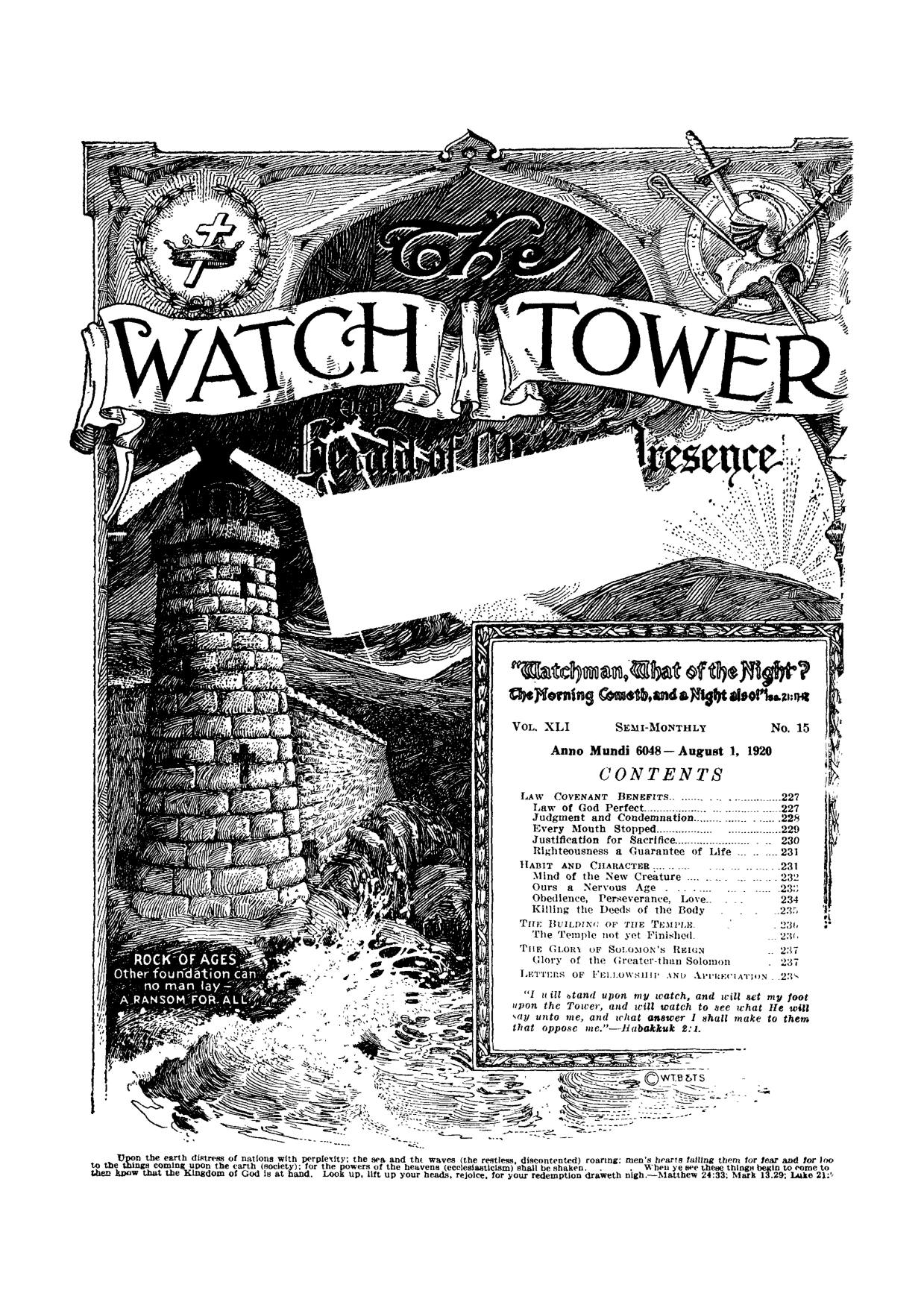
WT.B oT S
Vol. XLI
Semi-Monthly
Anno Mundi 6048 — August 1,
CONTENTS
No. 15
. .. t^le earth distress of nations with perplexity; the sea and the waves (the restless, discontented) roaring: men's hearts lulling them tor tear and for loo to the things coming upon the earth (society): for the powers of the heavens (ecclesiastlclsm) shall be shaken. . . When ye see these things begin to come to
then Know that the Kingdom of God is at band. Look up, lift up your heads, rejoice, for your redemption draweth nigh.'—Matthew 24:33; Mark 13.23; Luke 21;t
Sfyejfornfog Gra«tb,&nd&Jftgfyt ato^PUtZhrw
ROCK OF AGES ^
Other foundation can " no man lay-<
A RANSOM FOR. Abi
Law Covenant Benefits.................
Law of God Perfect..............................
Judgment and Condemnation................
Every Mouth Stopped........................
Justification for Sacrifice........................
Righteousness a Guarantee of Life ...
Habit and Character ....... . ... ... .
Mind of the New Creature ..... ... ...
Ours a Nervous Age ......... .
Obedience, Perseverance, Love.. . . Killing the Deeds of the Body . .
Tire Building' of the Temple. The Temple not yet Finished.
The Glory of Solomon’s Reign Glory of the Greater-than Solomon
.....227 ... .227 .....228 ......229 .. 230 .... 231
. . .231 .. . 232 .. .233
234 ..235
. 235
... 235
“/ Il ill stand upon my watch, and will set my foot upon the Tower, and will watch to see what He will ••ay unto me, and what answer I shall make to them that oppose me."—Habakkuk 1:1.
THIS JOURNAL AND ITS SACRED MISSION
THIS journal is one of the prime factors or instruments in the system of Bible instruction, or “Seminary Extension”, now being presented in all parts of the civilized world by the Watch Tower Bible & Tract Society, chartered A. V. ISM, “For the Promotion of Christian Knowledge”. It not only serves as a class room where Bible students may meet in the study of the divine Word but alM) as a channel of communication through which they may be reached with announcements of the Society’s conventions and of the coming of its traveling representatives, staled “Pilgrims", and refreshed with reports of its conventions.
our “Berean Le^on^" are topical rehearsals or reviews of our Society’s published Stidies most entertainingly arranged, and very aviplul to all Oo would merit the only honorary degree which the Society accord'., ml, Volu Dei Minister (V. D. Mj, which translated into English is Minister of God's "Word. our treatment of the International Sunday School Lessons is special)* lor the older Bible students and teachers. By some this feature is considered indispensable.
This journal stands firmly for the defense of the only true foundation of the Christian’s hope now being so generally repudiated —redemption through the precious blood of “the man Christ Jesus, who gave himself a ransom [a corresponding price, a substitute] tor ill’. (1 Peter 1 • P», 1 Timothy 2:6> Building up on tins sure foundation the gold, siher and precious stones d Corinthians 3. 1113, 2 Peter 1 : 5-111 of the Word of God. its further mission is to “make all see T*hat is the fellowship of the mvster* whuli . .has oeen hid in God. ... to the intent that now might be made known by the church the manifold wisdom of God"—“which in other ages ■was not made known unto the sons of men as it is now revealed".—Ephesians 3 : 5-9,1U.
Ji •'tantls free from all parties, sects and creed* of men. while it seeks more and more to bring its every utterance into fullest sulHcttim. to ttie will of God in Chrut, a* expressed in the holy Scriptures. It i* thus free tq declare boldly whatsoever the Lord hath *poken—according to the divine wisdom granted unto us to understand his utterances. Its attitude is not dogmatic, but confident; lor \u» know whereof we aflirni. treading with implicit faith upon the sure promises of God. It 1* held as a trust, to be used only in his sei \ uc; hence our decision* relative to what ma* and what may not appear in its columns must be according to our judgment of his good pleasure, the teaching of his Word, for the upbuilding of his people in grace and knowledge. And we not only invite but urge our reader* to pro*e all it* utterances by the infallible Word to which refereme i* constantly made to facilitate such testing.
TO US THE SCRIPTURES CLEARLY TEACH
That the church is “the temple of the living God”, peculiar!v “his workmanship" : that its construction has been in progress throughout the gospel age-—ever since Christ became the worlds Redeemer and the Chief Corner Stone of hi* temple, through which, v. ben finished, God's bles.*ing shall come “to all people", and they find access to him.—1 Corinthian* 3: IC. 17; Ephesians 2:20-22 ; Genesis 2> : 14 ; Galatians 3.29.
That meantime the chiseling, shaping, and polishing of consecrated believers in Christ’s atonement for sin. progresses : and when the last ot these “Imug stone*", "elect and precious." shall have been made ready, the great Master Workman will bring all together in the first resurrection: and the temple shall be filled with his glory, and be the meeting place between God and men throughout the Millennium —Revelation 15 : 5-b.
Tha; The basis of hope, for the church and the world, lies in the fact that “Jesus Christ, by the grace of God. tasted death for every man," “a ransom for all." and will be “the true light which hghteth every man that conieth into the world", “in due time’.— Hebrews 2:9; John 1 : 9 ; 1 Timothy 2 ; 5, 6.
Thu the hope of the church is that she may be like her Lord, “see him as he is,” be “partakers of the divine nature’,* and share his glory as his joint-heir.—1 John 3:2; John 17:24; Romans a : 17 ; 2 Peter 1:4.
- at the present mission of the church is the perfecting of the saints for the future work of service: to develop in herself every grace ; to be God's witue*s to the world ; and to prepare to be kings and priests in the next age.—Ephesians 4:12; Matthew 24 : 11 ; Revelation 1:6; 2U : 6.
That the hope for the world lies in the blessings of knowledge and opportunity to be brought to al! by Christ’s Millennial kingdom, the restitution of all that wa* lost in Adam, to all the willing and obedient, at the hands of their Redeemer and his glorified church, when all the wilfully wicked will be destroyed.—Acts 3:19 23; Isaiah 35.
■pUBL.ISKE.0 Oy
WATCH TOWER. BIBLE G-TRACT SOCIETY 124 COLUMBIA HEIGHTS 'n o BROOKLYN, NY. USA torsion Offices: British: 34 Craven Terrace. Lancaster Gate, London W. 2; Australasian: 495 Collins St.. Melbourne, Australia; South African: 123 Plcin St., Cape Town, South Africa.
Please Address the Society in Evert Case.
ANNUAL SUBSCRIPTION PRICE $1.00 IN ADVANCE CANADIAN AND FOREIGN SUBSCRIPTION PRICE $1.50 SEND MONET BY EXPRESS OR POSTAL ORDER, OR BY BANK DRAFT FROM FOREIGN COUNTRIES BY INTERNATIONAL POSTAL ORDERS ONLY fForeign translations of this journal appear in several languages)
Editorial Committee: This journal is published under the supervision of an editorial committee, at least three of whom have read and approved as truth each and every article appearing in these columns. The names of the editorial committee are: J. F. Rutherford, W. E. Van Amburqh, F. H. Robison, G. H. Fisher, W. E. Page.
Terms to the Lord's Poors AH Bible stodent* who. by reason of old age or other in-ornuty or adversity, are unable to pay for this journo), will be supplied free if they send a poetal eard each May stating their ease and requesting such provision. We are not ■only willing, but aauous. that all such be on our list continually and in touch with ths berean studies.
KmwW m Omb MaCMr *4 SrwMvn. N. F.. Fwtojto* UU Aet e/ 9rd, SST9.
YOUR SEIZED BOOKS—“FINISHED MYSTERY”
During the recent war some of the individual friends and several of the classes had their copies of “The Finished Mystery” seized by Federal agents. Some of these cases have been reported to us, and we now request that, if there are others which have not been reported, details concerning the seizures be sent us as soon as possible that the cases may be taken up with the Government.
It is desirable to know the date of seizure, the number of copies taken (even if only one), the name and official capacity of the one having in charge the seizure, and whether the seizure was conducted under the authorization of a warrant, or not.
RAILWAY RATES TO SCRANTON CONVENTION
At the time of going to press fare-and-a-third certificate plan rate* have been granted for the I. B b. A. convention at Scranton, Fa., by the Trunk Line Passenger Association (comprising territory east of Buffalo, Salamanca. Oil City, Pittsburgh, Wheeling, Kenova. Washington, and Norfolk—generally speaking, bounded on the south by the Ohio and Potomac Rivers—but not including New England States) and similar concessions are expected from the New England Passenger Association, the Central Passenger Association .covering territory west of cities above named as far as the Mississippi River) and the Southeastern Passenger Association—having control over territory south of the Potomac and Ohio and east of Ike Mississippi Rivers.
STUDIES IN THE SCRIPTURES
These Studies are recommended to students as veritable Bible keys, discussing topically every vital doctrine of the Bible. More than eleven million copies are in circulation, in nineteen languages. Two sizes are issued (in English only) : the regular maroon cloth, gold stamped edition on dull finish paper (size S"x7i'), and the maroon cloth pocket edition on thin paper (size 4"x 6j") ; both sizes are printed from the same plates, the difference being in the margins ; both sizes are provided with an appendix of catechistic questions for convenient class use. Both editions uniform in price.
Series I, "The Divine Plan of the Ages," giving outline of the divine plan revealed in the Bible, relating to man's redemption and restitution : 350 pages, plus indexes and appendixes, 75c. Magazine edition 20c. Also procurable in Arabic. Armenian, Dano-Norwegian, Finnish, French. German, Greek, Hollandish. Hungarian, Italian, Polish, Roumanian, Slovak, Spanish, Swedish, and Ukrainian; regular cloth style, price uniform with English.
Series If, “The Time ts at Hand," treats of the manner and time of the Lord's second coming, considering the Bible testimony on this subject: 360 pages, 75c. Obtainable in Dano-Norwegian, Finnish, German, Polish, and Swedish.
Series III, "Thy Kingdom Come," considers prophecies which mark events connected with “the time of the end”, the glorification of the church and the establishment of the Millennial kingdom; It also contains a chapter on the Great Pyramid of Egypt, showing its corroboration of certain Bible teachings : 380 pages, 75c. Furnished also in Dano-Norwegian, Finnish, German, Polish, and Swedish.
Series IV, "The Battle of Armageddon," shows that the dissolution of the present order of things is in progress and that all of the human panaceas offered are valueless to avert the end predicted by the Bible. It contains a special and extended treatise on our Lord’s great prophecy of Matthew 24 and also that of Zechariah 14 :1-9 : 056 pages, 85c. Also in Dano-Norwegian, Finnish, Greek, German, and Swedish.
Series V, “The Atonement Between God and Man," treats an all important subject, the center around which all features of divine grace revolve. This topic deserves the most careful consideration on the part of all true Christians -. 618 pages, 85c. Procurable likewise in Dano-Norwegian, Finnish, German, Greek, and Swedish.
Series VI, "The Neic Creation,” deals with the creative week (Genesis 1, 2), and with the church, God's new creation. It examines the personnel, organization, rites, ceremonies, obligations, and hopes appertaining to those called and accepted as members of the body of Christ: 730 pages, 85c. Supplied also in Dano-Norwegian, Finnish, German, and Swedish.
TRIBUNE OIL STOCKS
Inquiries regarding oil stocks being offered for sale by the National Labor Tribune, of Pittsburgh, have reached us. We are not informed as to the merits or dement* of the proposition and therefore cannot and do not advise purchasing.
AND HERALD OF CHRISTS PRESENCE
V<h„ XT.T August 1. 1920 No. 15
LAW COVENANT BENEFITS
Had the Jews been able to keep the law perfectly, would God have granted them everlasting life, and would there have been a necessity for a ransom sacrifice on their behalf? The two questions involved in this one, as stated, were discussed at the Bethel table for several weeks. The final summing up we believe will be helpful and profitable to the friends generally. For that reason we publish it here.
THE proper understanding of this question magnifies the ransom and clarifies justification; and without understanding it we cannot clearly understand justification. When we get into our minds the real reason why the Lord Jehovah gave this law to the Jewish people and what it really taught them, then we can see how ultimately all mankind, coming to a knowledge of this fact and appreciating it. will magnify Jehovah’s name and the name of Christ Jesus as the great Ransomer.
Of necessity the answer to the first part of the question is in the affirmative. The law that God gave to the Jews was a covenant, in the nature of a contract. God said to them. If you will keep my law you shall live. And they said, We will do it. Had they met their part of the contract and Jehovah failed in his. then he would have been unjust; and God cannot be unjust. He plainly stated in Ijeviticus 18: 5 that if they would keep the law they should live. “Ye shall therefore keep my statutes, and my judgments: which if a man do, he shall live in them.” “For Moses describeth the righteousness which is of the Law, That the man which doeth those things shall live by them.”—Romans 10:5.
It has been suggested that the two texts quoted in the preceding paragraph apply to Jesus and him alone. A careful examination of the text in the light of the facts will show, however, that the same could not apply to Jesus as a primary or original proposition. The reason is this: Jesus at all times was righteous: there never was a time when he was unrighteous; and the fixed and unalterable principle of God’s arrangement is that all righteous creatures are entitled to live. Being entitled to live, therefore, God could not consistently have said to him, If you keep my law you shall live. He already had the right to live. His keeping of the law proved that it requires a perfect man to do so. Therefore the law is the measure of a perfect man’s ability. It was a conditional contract made with the Jewish people involving eternal life to those who could keep its terms.
God having made this promise, he could not fail or refuse to perform it for the reason that justice is the foundation of his throne, and his promise must be kept. “Blessed be the Lord, that hath given rest unto his people Israel, according to all that he promised: there hath not failed one word of all his good promise, which he promised by the hand of Moses his servant.” (1 Kings 8 : 5G) The same thought is found in the words of the prophet Malachi, that God always keeps his promises. (Malachi 3:6) It follows then that God intended to grant life everlasting to any Jew who would perform the terms of the Law Covenant. If there be any doubt on this point, the Lord Jesus forever settled it in his answer to the lawyer, as recorded in Luke 10: 25 - 28. “And, behold, a certain lawyer stood up, and tempted him, saying, Master, what shall I do to inherit eternal life ? He said unto him, What is written in the law ? how readest thou ? And he answering said, Thou shalt love the Lord thy God with all thy heart, and with all thy soul, and with all thy strength, and with all thy mind; and thy neighbor as thyself. And he said unto him, Thou hast answered right: this do, and thou shalt live.”
God never demanded a sacrifice. Every sacrifice that is acceptable to the heavenly Father must be voluntary. Justice never demanded a sacrifice on the part of another. Obedience is more pleasing to the Lord than is sacrifice, and for this reason, that sacrifice must be voluntary. God did not demand the sacrifice of Jesus, but his sacrifice was induced by his love to do the Father’s will. He said: “I lay down my life, that I might take it again. No man taketh it from me, but I lay it down of myself. I have power to lay it down, and I have power to take it again. This commandment have I received of my Father.” (John 10:17,18) It was the will of God before the foundation of the world that his beloved Son should become the great sacrifice for mankind, but he did not demand that sacrifice: he offered it as a privilege, to be followed by the great prize which God granted to his beloved Son. Sacrifice was no part of the keeping of the Law’ Covenant, but sacrifice was a willing submission to the Father’s arrangement in order that mankind might be saved.—John 3: 16.
LAW OF GOD PERFECT
The promise God made to Abraham was, 'Tn thy seed shall all the families of the earth be blessed”. Thereafter he added the Law’ Covenant. Discussing this Law Covenant and the benefits resulting from it. St. Paul says: “Is the law then against the promises of God? God forbid : for if there had been a law' given which could have given life, verily righteousness should have been by the law”. (Galatians 3:21) The reason that life did not result from the Law' was not because the Law itself was defective. The law of God is perfect. If the Law could have given life, righteousness would have resulted by the Law, but it could not give life for the reason that Israel, with whom the Law Covenant was made, could not keep 227
it, and Moses, their mediator, was imperfect and could not make up that which the house of Israel lacked. Again,St. Paul, discussing this question in his epistle to the Romans, plainly lays down the proposition that the fault was not with the law but with the imperfect human race. (Romans 8:3) These texts show that had any man, aside from Adam, been able to obey the terms of the Law perfectly he would have come to the point of righteousness and .would have been entitled to live.
The rule was different with reference to Adam. Adam, a perfect man, was put on trial, and after an intelligent opportunity willfully violated the law of God and was sentenced to die. He was immediately expelled from Eden. Suppose the Law Covenant had then been in force and Adam had kept every part of it Could he have had life? The answer must be in the negative for the reason that justice demanded his life because he had violated God’s law, therefore must die. The only way of satisfying justice with reference to him was for him to die. His children were not yet born. Were they sentenced to death ? It is recognized as a fixed principle of God’s arrangement that no man can be tried and adjudged guilty and sentenced unless he has knowledge of the fact that he is on trial. It follows that Adam’s children, who were not yet born, could have had no knowledge that they were on trial; therefore could not have been sentenced to death. There is no Scripture which warrants the conclusion that they were sentenced to death. That does not mean that they were not in the condemnation. There is a distinction between sentence, or judgment, and condemnation, and this distinction shows a clear difference between the standing of Adam and that of his offspring.
JUDGMENT AND CONDEMNATION
Judgment means the act of determining what is conformable to law and justice. It is the sentence or judicial determination made and entered by the judge of a court or tribunal, having jurisdiction to hear and determine the cause. Condemnation means disapproval—that which is wrong, therefore not approved. When Adam sinned he was required to appear before Jehovah in Eden. He had a hearing before the great Judge and pleaded guilty to having disobeyed Jehovah’s law. Thereupon Jehovah proceeded to enter judgment and sentence against Adam, which judgment and sentence is set forth in Genesis 3:17-19. Eve, being a part of Adam, and a transgressor, was included, of course, in the judgment. Not so were their children, who were not yet born, who could not know of the transgression nor of their trial, and therefore they were not judicially included in the sentence.
A person may be disapproved without ever having been judicially sentenced. Anything that is wrong in God’s sight is disapproved. When Adam’s children were born they were born imperfect, unrighteous, therefore wrong, therefore condemned. Hence they came under the condemnation by reason of their father Adam’s disobedience, because had he not disobeyed they would not have been born imperfect. The Psalmist says: “Behold, I was shapen in iniquity; and in sin did my mother conceive me”. (Psalm 51:5) St. Paiil argues to the same effect in Romans 5:12; “Wherefore, as by one man sin entered into the world, and death by sin; and so death passed upon all men, for that all have sinned”. Clearly St. Paul made a distinction between the sentence of Adam and the condemnation resulting to his children when he wrote: “Nevertheless death reigned from Adam to Moses, even over them that had not sinned after the similitude of Adam’s transgression”. (Romans 5:14) In this he plainly states that the children had not sinned in the likeness of Adam; they had not committed the sin that their father Adam had. Notwithstanding they must die, because unrighteous, imperfect, disapproved, therefore condemned.
CONDEMNATION EXTENDING TO ALL
All the human race has been born imperfect, therefore every creature a sinner, and for this reason disapproved by Jehovah. In the King James or Common Version of our Bible, Romans 5:18 reads: “Therefore as by the offence of one judgment came upon all men to condemnation; even so by the righteousness of one the free gift came upon all men unto justification of life”. It is readily seen by examining this text that the word judgment is a supplied word. It does not at all appear in the original, and while the translator in the Common Version uses the word judgment, the context and the facts do not warrant its use. It would have been proper to say that the judgment upon Adam led to the condemnation or disapproval of all of his offspring, but it would not be proper to say that Jehovah judicially determined and entered his judgment whereby all of the offspring of Adam must die. St. Paul does not say that. Dr. Weymouth gives a better translation, which is: “It follows then that just as the result of a single transgression is a condemnation which extends to the whole race, so also the result of a single decree of righteousness is a lifegiving acquittal which extends to the whole race”. By the disobedience of Adam the judgment of death was entered against him, and thereafter while he was undergoing the sentence of death, judicially determined as disapproved and actually now imperfect because feeding upon the poisonous elements of the earth—God’s means of enforcing that judgment—it followed that his offspring were imperfect, unrighteous, therefore condemned or imperfect. For this reason we say that all of the race of Adam came under the condemnation.
It follows, then, that Adam must die because of his wrongful act, and his children have died and yet die because imperfect, unrighteous, disapproved, and condemned, which imperfection results from their father Adam’s sin. If his children who were not under judicial sentence, could keep the law perfectly, it would mean that they were perfect, without fault, righteous, therefore approved, and for that reason would have the right to live. But being imperfect by reason of the inherited imperfections, it is impossible for any of them to keep the terms of the Law Covenant.
RESULTING BENEFITS
Did not God know when he gave the Law to Israel that none of the nation of Israel could keep it? Of course he knew that. Why then did he give it to them ? Was he merely trifling with them ? Such would be beneath the dignity of Jehovah. He must have had a good and sufficient reason to make this Law Covenant; and when we see this reason it magnifies Jehovah and his law and makes clear to every one who does understand it the absolute necessity of the ransom sacrifice, and clarifies the question of justification.
Why then did God give the Law Covenant to the Jewish people ? St. Pau] answers that it was a schoolmaster or teacher to bring them and us to Christ. (Galatians 3: 24) God was dealing with a stiffnecked generation; in fact, the whole human race is hard-headed, stiffnecked, hard to teach.
Let us consider for a moment what lesson the Law Covenant taught. The time was to come in the development of Jehovah’s plan when mankind in general would learn that the original judgment of death was entered directly against Adam and that his offspring were imperfect because of his wrongdoing, and hence were under condemnation. Future generations might have said, as indeed some in their own wisdom now say, that a ransom is wholly unnecessary. Many might have said, as some already say, If we had a chance we would be able to live forever of our own efforts. The law is the measure of a perfect man’s ability. The Jews thought they could keep it and failed. Therefore the Law taught them, and through them will teach all others of mankind, (1) that every righteous creature is entitled to live, because Jehovah said so. and the keeping of the law is a determination of his righteousness; (2) that as a people they were unrighteous, therefore must die, for the reason that no unrighteous thing can live eternally in God’s realm; (3) their efforts to keep the Law Covenant demonstrated to them that they could not become righteous in their own ability or strength, therefore the absolute necessity for having tie help of another; (4) they were led as a people, son,- of them, to Jesus at his first coming, and ultimately all will be led to him and to the knowledge of the fact that it is the merit of the sacrifice of the perfect One and his resurrection from the dead to become the Mediator of whom Moses was a type, that will bring to them life everlasting. Hence the Jews must all ultimately come to a knowledge that he whom they crucified, and he alone, is able to act in their behalf and bring them to the point of righteousness where they can keep the terms of Jehovah’s law and therefore live.
EVERY MOUTH STOPPED
These great truths that Jehovah thus taught will forever stop the mouth of the Jews and every one else from saying. We could have lived without the benefit of a ransom sacrifice, if wc had had an opportunity. No man can ever be heard to say in any age of time that life could come without the ransom sacrifice; and except for the giving of the Law it would have been impossible to establish comph telv and definitely in the minds of men that the ransom sacrifice is absolutely necessary for every one in order to have life. There are many people in the world todai, such as Sir Conan Doyle and others, who are telling the people that the ransom sacrifice is wholly unnecessary; that too much is made of the death of Jesus and not enough of his life; but when Sir Conan Doyle and all like him come to a knowledge of the truth, the principles taught by the Law Covenant will demonstrate to them conclusively that the ransom sacrifice was an absolute necessity, because the Jews, under favorable conditions, for eighteen centuries and more, had an opportunity to get life by keeping the Law Covenant and their experiences demonstrated the absolute inability of man to gain that blessing for himself.
The evolutionists hold to the theory that the fall is a myth; that the ransom sacrifice is unnecessary and untrue. They say, We can create; we can produce life. But God will ultimately confound these and all others and show them the foolishness of their own wisdom and teach them the necessity for the ransom. When the New Law Covenant is put into operation all mankind must become Israelites, coming under the terms of their Covenant, and then all who will have life must know of the ransom, must know it was a necessity, and must accept the great ransom sacrifice as the only means of leading to life everlasting.
And thus the time will come when every knee shall bow and every tongue confess that Jesus is the Christ, that he is the great Life-giver, the only means of obtaining life everlasting.
God led the Jewish people down to the time of Christ and few of them were ready to accept him and did accept him. The mass of them said, We will not have him. They despised and rejected him, and were cast off. But the time will come, and is not fay distant, when they will look upon (discern) him whom they pierced and will mourn for him (Zechariah 12: 10), saying, Now we understand; that Law Covenant which we first had shows us our absolute inability to get life with an imperfect mediator. Now he, the great Messiah, is our Mediator, perfect, and is able to save us to the uttermost. All others of mankind coming to a knowledge of the truth will profit, if they profit at all. through the experiences of Israel and the knowledge they gain from the outwork-ings of God’s great arrangement. Then they will see the absolute necessity for a perfect Mediator to help them, lift them up, and bring them back to a condition of righteousness, and will perceive that the merit of Christ, resulting from his obedient sacrifice, is the only means whereby this help can come to them.
AS TO JUSTIFICATION
The Law Covenant, then, clearly teaches that every righteous creature is entitled to live. Hence every righteous creature is justified in God’s sight. When one is justified, he is free from all condemnation or disapproval, he stands approved before Jehovah and has the right to live. And since this justification cannot result from efforts on his own behalf, he must have some one to act for him. Had Moses been able to bring the Jewish people up to the point of righteousness they would have been entitled to live and would not have died, and that would have been true without the necessity of a ransom. But Moses was imperfect, and they were imperfect, all under disability, therefore impossible to he justified before God, actually made right and given the right to life. When the New Covenant is inaugurated Christ will have at his disposal for the benefit of mankind through the terms of the New Covenant the merit of his sacrifice, the value of a perfect human life. Therefore during his reign he will minister unto them, teach them, rule over them, and gradually bring them up over the highway of holiness back to human perfection, where Jehovah can receive them, approve them, and fully justify them. It will require the entire Millennial reign for the justification of the human race under the terms of the Law Covenant.
JUSTIFICATION FOR SACRIFICE
The Lord has, however, arranged for the justification of the church during the gospel age for a specific purpose ; namely, that those justified might become a part of the great sacrificial body of Christ. When Jesus arose from the dead and ascended on high he had the value of a perfect human life, which he had laid down at Calvary and which was to be used and has been used in harmony with the divine will. It was the will of God that 144,000 members of the body of Christ should be selected from among men and made perfect as new creatures, and in the selection of this number and bringing them to perfection many more would be justified, the greater number of whom would not finish their course as honor graduates and receive the highest reward.
None could be accepted as a sacrifice until first justified, because Jehovah cannot accept an imperfect sacrifice. This he clearly demonstrated by the terms of the Law Covenant, in which was provided that no blemished animal should be received for sacrifice on the Day of Atonement. Jesus deposited in heaven the merit or value of his human sacrifice, to be imputed to every one who would present himself in full consecration to do Jehovah’s will during the gospel age, or age of sacrifice. Justification means made right with God. Justification therefore means approved, which would mean relieved from condemnation, which condemnation resulted from the Adamic sin.
One coming to God first learns of his own imperfection and he begins to seek after God if haply he might find him. He is drawn to Jesus by Jehovah; he learns that Jesus, his Redeemer, is powerful to save him. He hears the words of Jesus, If you will be my disciple, deny yourself, take up your cross, and follow me; he counts the cost. That is to say, he considers that for him to deny himself he must give up his own will and henceforth do the will of the Lord, whatever that may be concerning him. He says in substance: T know that one who would make provision for me to live would will always for my best interest, and even though it costs me much of the pleasures of earth, I gladly surrender everything and agree to do the will of God, trusting in Christ Jesus my great Redeemer. Christ Jesus as the great Redeemer and High Priest receives him, imputes to him a sufficiency of his own merit to bring such a one up to the standard of one hundred percent perfection, therefore acceptable to Jehovah. God, in accepting him, justifies him, or counts him right, and there results to him the legal right to live as a human being, which legal right to live is immediately sacrificed and he is counted dead from that time on as a human being and is counted alive as a new creature in Christ Jesus. (Colossians 3: 3, 4; 2 Corinthians 5: 17) This justification is instantaneous and is granted by Jehovah for the purpose of making such a on& an acceptable sacrifice, and for that purpose only.
MERIT ON DEPOSIT
The merit of Christ Jesus has not yet been paid over for the release of Adam from the judgment of death. If it had been so paid over, then Jesus would have at that time parted with the possession and control over it and would not have it for the purpose of justifying those who come to God by consecration through Christ Jesus. But possessing this merit or value of his own human sacrifice, he imputes or credits to the one consecrating a sufficient amount thereof to bring such a one up to the standard of righteousness, therefore making him acceptable to Jehovah, who justifies him.
The Law Covenant magnifies the value of the ransom sacrifice. In that Covenant God said, If any man will keep this law he shall live. And it would follow that had he been able to keep it a ransom would have been unnecessary ; but since the law is the measure of a perfect man's ability, and since none of Adam’s race has been able to keep it, it proves the absolute necessity for a ransom sacrifice and forever stops the mouths of any from saying that they can be justified in any other way except through the merit of Christ Jesus.
Every one justified and accepted by Jehovah sacrifices identically the same thing, namely, the right to live as a human being; and this right results to those only who are justified, and none is justified except him who has imputed to him the merit of Christ’s sacrifice, and none is favored with having imputed to him the merit of Jesus’ sacrifice except those who make a consecration. Therefore consecration—the surrender of the human will, agreeable to doing God’s will—is first essential before any one can be justified.
ALL UNDER SIN
Adam was under condemnation by reason of the judgment entered against him directly. He was therefore disapproved of God and condemned to die. His offspring are under condemnation by the rule of inheritance ; that is to say, they inherited from their father imperfection, were born imperfect, therefore born sinners, hence disapproved and condemned and must die, and do die, because of that imperfection.
I n this connection consider the words of St. Paul: “But the Scripture hath concluded all under sin, that the promise by faith of Jesus Christ might be given to them that believe”. (Galatians 3: 22) This text does not say that the Scripture shows that God included them all in the judgment directly entered against Adam, but it does say they were concluded, which means shut up, under sin; that is to say, the sin of Adam was the cause of the imperfection of his offspring; and the promise is that all who have faith in the merit of Christ Jesus shall receive the benefits of the ransom sacrifice. In other words, the whole human race came under condemnation because of Adam’s disobedience, in order that the whole human family could ultimately receive the benefit of the one great all-sufficient sacrifice.
Before the Law Covenant was made Jehovah had not judicially determined that the Jews should die. By this we mean that there wa^ no direct judgment against the Jews which called for their death. Had such been the case God could not have put them on trial for life. It will not do to say that the Jews are under a double judgment. and twice sentenced to death, because such is repugnant to the principles of Jehovah. The Jews were disapproved; therefore under condemnation like all others of Adam’s offspring. But this condemnation was the result of inherited imperfection. God counted Moses righteous and through him made a covenant with Israel by which he agreed that if they kept his law they should live, and failing to keep that law they must die. They did fail to keep it and therefore death must result to them. They were therefore under a special condemnation or a judgment of death by virtue of failure to keen the contract which they had agreed to keep. But Christ Jesus was born a Jew. born under the Law. and kept the law of God perfectly, and being nut to death as a sinner necame the Redeemer, not only of all of Adam's offspring. i»ut especially for the Jew. “Christ hath redeemed us from the curse of the Law. being made a curse for us: for it is written. Cursed is every man that hangeth on a tree”. (Galatians 3: 13) Jesus was entitled to live as a perfect man without regard to the Law Covenant. He kept the Law Covenant perfectly, thereby proving that it is the measure of a perfect man’s ability.
RIGHTEOUSNESS A GUARANTEE OF LIFE
The conclusion therefore must be that every righteous creature is. according to the divine arrangement, entitled to life; that had the Jews kept the law perfectly they would have been entitled to live and would have needed no ransomer, for the reason that life would have resulted to them by virtue of coming up to the divine standard, they not being directly sentenced to death. Furthermore. not being able to keep the law themselves, being imperfect, disapproved and condemned, like all the rest of the human race, and under condemnation because of their inability to keep the law. the ransom sacrifice and the mediatorial work to follow by the great Mediator i. absolutely necessary. It teaches the Jew and all others of mankind that there is no other name under heaven given amongst men whereby man can be relieved from the condemnation or disapproval except by and through, the merit of Christ Jesus.
The proper understanding of the question, therefore, magnifies the ransom sacrifice and conclusively settles the question that justification, or approval from God. can come only to the one who ha= had imputed to him the merit of Christ Jesus’ sacrifice, and that during the gospel aee none is justified except those who have agreed to sacrifice by making a full consecration. Since justification can result only from the merit of Christ Jesus being imputed to the person, it follows that if this justification should come before a consecration and the party thereafter, being justified, would not make a consecration. second death could be the only result. Jesus is the Advocate throughout the gospel age only for those who are consecrated, justified, and spirit-begotten. His mediatorial work does not begin until the New Covenant is inaugurated, after the church's glorification, and is therefore the Mediator for no one until that time. Without an advocate or without a mediator not one of the human family can stand before Jehovah. These conclusions, therefore, enable us the better to understand that during the age of sacrifice justification results from the imputed merit of Christ Jesus, and the one justified is entitled to live, which right to live as a human being is granted only in order that such a right might be sacrificed and the sacrificer be given the promise of life everlasting on the divine plane.
HABIT AND CHARACTER
“Io de carnally minded is death: but to be spiritually minded is life and peace.”—Romans 8:6
IN THE text above quoted the Apostle draws a sharp contrast between the flesh and the spirit. Indeed he makes this same distinction in all of his writings, because such a distinction exists in fact. Note that the distinction is not drawn along moralistic lines. The contrast is not between fleshly-mindedness of low degree and fleshly-mindedness of high degree, between low worldly morality and high worldly morality; but it is between fleshly-mindedness, even the best, and spiritual-mindedness. of whatever grade.
In other words, the present native condition of the flesh is death. It is not necessarily uncomplimentary to sav that a person of the world is fleshly minded. That is the state in which all are born, and there is no opportunity of getting into any other state except by a consecration to the Lord, which all do not have the faith to make under present conditions. Among those who have the mind of the flesh are some who live lives very inconsiderate of their neighbors, and others who are commendable in many things.
We would not be able to agree with those who interpret this passage to mean that they who live a grossly immoral life are destined for eternal torment while they who live a reasonably decent life and who train their minds to dwell on aesthetic subjects, who attend Sunday School or church services on Sunday are bound straight for the pearly gates, and who believe this text to be proof positive that a good life is owed them now and eternal bliss and happiness in the ages to come. While it is certainly much preferable for the world to live on as high a plane as possible, that is not the subject matter of this text; for it applies to those who have been separated from the world by their consecration to and their acceptance by God the Father. Such are on trial in respect to their faithfulness, but not, primarily, in respect to their efficiency.
For these to be unfaithful in following after the spirit, for them to turn back and seek for, revel in, and dote upon the things of this evil world, or order of things, now in dissolution but still with us, for these to be thu» unfaithful would mean death, the second or other death. But for them to be spiritually minded, to center their minds on things relating to the heavenly program, to ‘speak of the glory of God’s kingdom and talk of his. power’, (Psalm 145:11) that means life future and peace present. For them to be faithful in this matter until death means that they shall have the crown or victor’s wreath of life.—Revelation 3: 21.
The Apostle says: “To be spiritually minded is life and peace”. What is it to be minded? What is it to .have a mind ? What is the mind ?
Some one says: The mind is the will. But this definition seems hardly satisfactory. Rather could it be said that the will is that factor which determines and controls the mind. Another might say: The mind is the brain. But no; we must say that the brain is that portion of the organism which is more specifically used by the mind —a tablet, so to speak, on which impressions are made. Neither of these definitions corresponds with all the facts.
The natural mind is the sum of those impressions made on the brain by the influences with which men have •come in contact, both before and after birth.
MIND OF THE NEW CREATURE
"But what is the mind of the new creature, the new ■mind ? We answer, There is no notable difference between the manner of forming the new mind and the manner forming the natural mind, except that the new mind must be formed intelligently and with particular determination and effort, whereas the natural mind may be so formed, of it may be merely a miscellaneous collection of items of no particular use or importance, a kind of jetsam of parsing experiences. The difference consists not in the method of formation but rather in the class of impressions made on the brain. The new mind, then, -shall we say. is the sum of those impressions made on the train, under the direction of the will, by those influences which the Lord has provided us through his Word. The Drain is the canvas, the will the artist. But no painting of worth is produced by chance. The artist must direct the application of the pigments onto the canvas in an intelligent and scientific manner. The result is a harmonious and pleasing arrangement of color and of light and shade which we call a picture.
So we say: That man has an admirable mind, and do not mean merely that he has an admirable will or that the cells of his brain are peculiar in their structure; but we do mean that the impressions which are on his brain manifest themselves in some way or another that is pleasing to us.
One of the important elements in the process of forming any mind, either natural or spiritual, is habit. Habit is that custom of the mind to think or to direct action along previously employed lines. AU of us recognize the fact that habit has had and still has a great deal to do with human experience; but it may be that we have not all rightly estimated its value as a help to the new creature, and its power for good as weU as for evil.
The physical capacity for habit depends on a quality of the brain which is caUed plasticity. Take this iUustra-tion: A piece of flat paper when being folded offers some resistance to the process. It requires some little effort to effect the change in its form, but when the change is made it inclines to stay. If we fold the mme piece of paper a second time in the same place we find it is quite easy. In fact it is difficult to fold it in another.
BRAIN PLASTIC AND IMPRESSIONABLE
The human brain is also plastic: it offers some considerable resistance to an initial change in its form, but when it is once changed it has a tendency to stay in that changed condition. Scientists teU us that each brain cell is reaUy a seven-lobed fiber, the first of which lobes is affected and deepened in color by a passing'observation or slight impression, the other six lobes of which are affected by the deeper and stronger impressions, the seventh being brought into use only by the things learned under great pressure or emotional stress. Whether this explanation be physiologicaUy correct or not we cannot say, but it harmonizes with aU the known outside facts.
It is not easy to make the brain receive some entirely new impression, because the brain ceUs resist the re-arrangement or chemical readjustment necessary to receive the new item. All of us know how hard it is to think along the line of some new truth. It is like ploughing among stumps. Now and then we strike a snag which offers great resistance.
The disinclination to examine a new thing or to think upon it we call prejudice. Prejudice is often but another name for mental indolence; at other times it is attributable to pride, and yet again to imperfect information. We remember Nathanael’s prejudice against Nazareth and how Philip did not argue but said: “Come and see”. (John 1: 4G) And when he did come he saw. While he had prejudice, it was not so strong as to govern his mind entirely. He came and was honest enough to accept the testimony of his senses, and received the great blessing open to him.
But some one may interpose: Can the new creature get bad habits ? Ah. the Bible corroborates our own experience that we are as prone to trouble “as the sparks [to] fly upward”. (Job 5:7) We may set it down as a self-evident fact that if we are not busy developing new and beneficial habits ve shall automatically take on bad ones. Therefore we ought to reduce the majority of our daily duties to habits of a helpful kind, so that the reserve force of the mind could be engaged in attacking new contingencies that arise day by day.
HABITS AND PRECISE WORK
It is sometimes said that the man who does things by habit is the man who can do nothing original, but this is merely an assertion without ground; for we can see on closer examination that advance in efficiency in any line depends on the presence of well established habits. Why ? Because the task which is done largely or wholly by habit is done to that extent automatically and leaves the will free for employment elsewhere. The first time an engineer goes over a new road he is under a tremendous strain. He must watch with unremitting effort for each sign, each paddle, each light, and at the end of his run he is exhausted. But when he “learns the road”, when he knows where every signal must be given and where every danger point lies, though his work is still weighty, it becomes more and more of a habit to him; he increases in efficiency and his mind is left more free to cope with unexpected situations which may arise.
Take the “raw recruit” in the army as an example. When he first enters the army he is the embodiment of awkwardness in the drill. So awkward is he that he cannot be allowed with the larger group. He, with a handful of comrades, is detailed to a special officer who gives painstaking care to inculcating the various commands and movements. When at first the recruit hears the word of command it is meaningless to his ears. He must take the time and trouble to analyze what he hears before he can respond, even imperfectly. It taxes every power he has so that at the end of two or three hours drill he is exhausted. It is also hard for the officer, who must watch with precision the every effort and false move of his pupil. He could manceuvre a thousand well trained men all day easier than he can drill those few men three hours. But when those same men by inexorable application acquaint themselves to the extent of extreme familiarity with every command, they can respond not only accurately but also instantly to what is heard, because they need not longer to analyze the whole matter. The habit is established, and a certain sound sets in motion a certain set of automatic responses; the deed is done without specially drawing on the will or the attention. The nerve energy is spared, and, what is more important, the soldier will obey even if he is stricken with fear or surrounded by distracting circumstances.
The extent to which habit may become automatism is shown by the story of the young lady who was playing the accompaniment and singing the score to a very difficult musical selection. She was observed by members of her family to go through the selection faultlessly and yet all the while to be in a state of intense excitement. When the song was ended she burst into tears; and first then it was noted that she had been watching the dying throes of her pet canary bird. She had been entirely oblivious to either the science or art of playing and singing. Habit had done its work; the attention was elsewhere.
OURS A NERVOUS AGE
We are living in a nervous age. The disposition is to strain and overtaxation. The easy methods of intercourse between place and place bring new ideals to both employer and employed and more is expected for a given time. If the employe finds no easier methods of doing his work than he formerly knew he is obliged to draw upon his reserve nervous energy in an effort to accomplish what he is not properly drilled to do. As time passes, this strain itself becomes a habit, though not a beneficial one, until it seems as though he is not working if he is not on a strain. At the same time, if he be conscientious, he will realize that he is not accomplishing what he ought. This double draw on his reserve nervous energy, if not interfered with, will bring nervous prostration and collapse.
The trouble often is, in part, that, instead of having so mastered the minute details of his oft-repeated tasks, he is forced to give them much the same amount of attention as he must at first. He does not realize that not only the old details of a thing may be habitualized but also one’s method of approach or attack upon a new duty.
Speed is always a des^able thing; but hurry never. Speed is acquired in proponn as we master the details of a thing in hand, otherwise not.
Take piano-playing or typewriting. One might memorize selections or write letters until he were gray-haired and never have a thorough intimacy with the keyboard. The only way to master either is to spend time and attention upon drills which have no other sense or object than to familiarize one with that keyboard. The keyboard must become a habit; it must become an extension, so to speak, of one’s brain. Then and then only can the instrument be used to real advantage, and the attention left free for rhythm, phrasing, etc.
When the child first learns to walk it is a very conscious procedure with him. It is far from a habit. He must direct his whole attention to the accomplishment of that single feat. But as years pass by, walking becomes such a habit that it is almost entirely subconscious with those in good health. And that this automatic walking requires less energy than if every step were felt is shown by the fact that if we walk several blocks, or half a mile, definitely willing each step, we are wearied.
HABIT AND PERSONAL MATTERS
Custom becomes particularly manifest in personal habits, in manner of dress, tone and accent of voice, etc., etc. As the poet says: “Habit oft betrays the man”. Walking is graceful with one and awkward with another largely because of the habits developed in early life. The true accent of a foreign tongue is seldom acquired after the age of twenty because the sounds of one’s mother tongue have become habitualized and anything else sounds strange and measurably undesirable. Untidy habits of dress are seldom changed after one is twenty; ior the mental indolence, termed prejudice, resists the suggestions made by the more careful attire of others. If one be slovenly in 3011th in respect to dress and manner he is almost sure to he sloven!) in age, because habit begets a fondness for the deed performed.
On the positive side of this subject the Scriptures tell us: “Train up a child in the way he should go; and when he is old lie will not depart from it’’. (Proverbs 22: 6) He will not wish to depart from it, because that way has become the easier way, the way requiring less effort and, hence, his preference.
In this connection it may not be out of place to quote an extract from a secular magazine, wherein one student of the mind said:
“The great thing, then, in all education, Is to make our nervous system our ally instead of our enemy. It Is to fund and capitalize our acquisitions, and live at ease upon the interest of the fund. For this we must make automatic and habitual, as early as possible, as many useful actions as we can, and guard against the growing into ways that are likely to be disadvantageous to us as we should guard against the plague. The more of the details of our dally life we can hand over to the effortless custody of automatism, the more our higher powers of mind will be set free for their own proper work. There is no more miserable human being than one in whom nothing Is habitual but indecision, and for whom the . . . drinking of every cup, the time of rising and going to bed every day, and the beginning of every bit of work, are subjects of express volitional deliberation. Full half the time of such a man goes to the deciding, or regretting, of matters which ought to be so ingrained in him as practically not to exist for his consciousness at all.”
On the negative side of habit the Scriptures place the query: “Can the Ethiopian change his skin, or the leopard his spots? then may ye also do good, that are accustomed to do evil”. (Jeremiah 13: 23) The Ethiopian’s skin and the leopard’s spots can both be changed by the use of powerful chemicals, though it would be very hard on the Ethiopian and the leopard. But, of course, these are merely figures of inborn imperfections. Man cannot eradicate his imperfections by denying their existence or by any system of self-perfection. But in his own due time will Jehovah wash away the vilest stains of even habitual sin, if the individual turns therefrom and avails himself of the privileges of Messiah’s kingdom.
Another quotation from an old Watch Tower reads:
“ ‘My reader, beware of habit! Habit is the most significant word to be found in the English vocabulary. Get an artist to paint it in letters of fire and hang it on the walls of your chamber, where your eye shall catch its message when you retire and where it may greet you again with the rising sun. Gaze upon it until it is deeply cut into the sanctuary of your inner being, just where the lamp of life may cast its ruddy light over it. Habit is to be your curse or benediction ; it is either to conquer you or enable you to conquer. Today it is transforming you into a sycophant or a prince of freedom. Today you are either girding your soul with fetters of sorrow or building a chariot that will conduct you to paradise. Good habits are as potent for emancipation as vile ones are for slavery and anguish. One may resolutely form habits of purity, honesty, fidelity, till he breathes the air of divinity as his native air;—as he eventually becomes expert and master of melody, by years of inexorable drill.’
“The power of habit Is unquestionably a great one, either for good or evil, but let us not forget that the human will, however strong or persistently exercised, can only reach its highest attainment and most favorable results when placed under discipleship to Christ—to be taught o'f God.”
HABIT’S USE FOR NEW CREATURES
But one may say: What has all this to do with us as new creatures ? The answer is that it is of vital importance to the new man. First, in that it can be applied to the performance of our daily duties, which are to be done as unto the Lord. (1 Corinthians 10:31) And second, we can apply them to our habits of thought, which are of prime importance in our preparation or lack of preparation for our heavenly home.—Philippians 4: 8.
At the beginning of our Christian course we find ourselves in possession of a certain stock of habits, the majority of which are bad, or at least unedifying. Some of them may appear well before the world but make a very poor showing in the light of the glorious goodness of God as it shines in the face of Jesus Christ. It is our duty as stewards of our influence and general powers to see to it that the Lord’s grace is sought to help us see our objectionable customs of mind and body, and to strive to overcome that evil with good. While we are not on trial for efficiency, but for faithfulness, our faithfulness will show itself in efforts not merely to will, but also to do of Jehovah’s good pleasure.—Philippians 2:13.
Our usefulness, our influence, our talents in general may thus be improved and enlarged. If we find ourselves in possession of a natural tendency to doubt, we can and must develop faith. And not only such faith as is forced upon the presentation of the last bit of evidence, but faith which triumphs over despair and which “can firmly trust Him, come what may”. Do we suppose that the perfect beings of heaven have habits of doubtmust they sit and wonder every day whether God is as good as his Word? Surely not. The faith which gains the victory is such as can ask the Father to give us more of his holy spirit and more of his heavenly wisdom, and to prepare us for that place which he sees to be best and which can rest in confidence that he will 'complete, that good work which he has begun in us’.—Phil. 1: 6.
OBEDIENCE, PERSEVERANCE, LOVE
If we have a natural habit of disobedience, we need to develop obedience. If we find that we have a disposition to rebel continuously at things previously proven to be of divine providence, or beneficial to us, we must force ourselves into obedience until it becomes easier and easier for us. It may require much effort and attention at first, but it will become more facile; even as much more power is needed to start an engine than is required to keep it going. Even if we should perchance allow some of our proper rights to be tampered with or to be taken from us in our practice of obedience, the practice will be of far more value to us than any little thing which might be lost.
…