The Watchtower, July 15, 1920
Download: PDF — The Watchtower, July 15, 1920
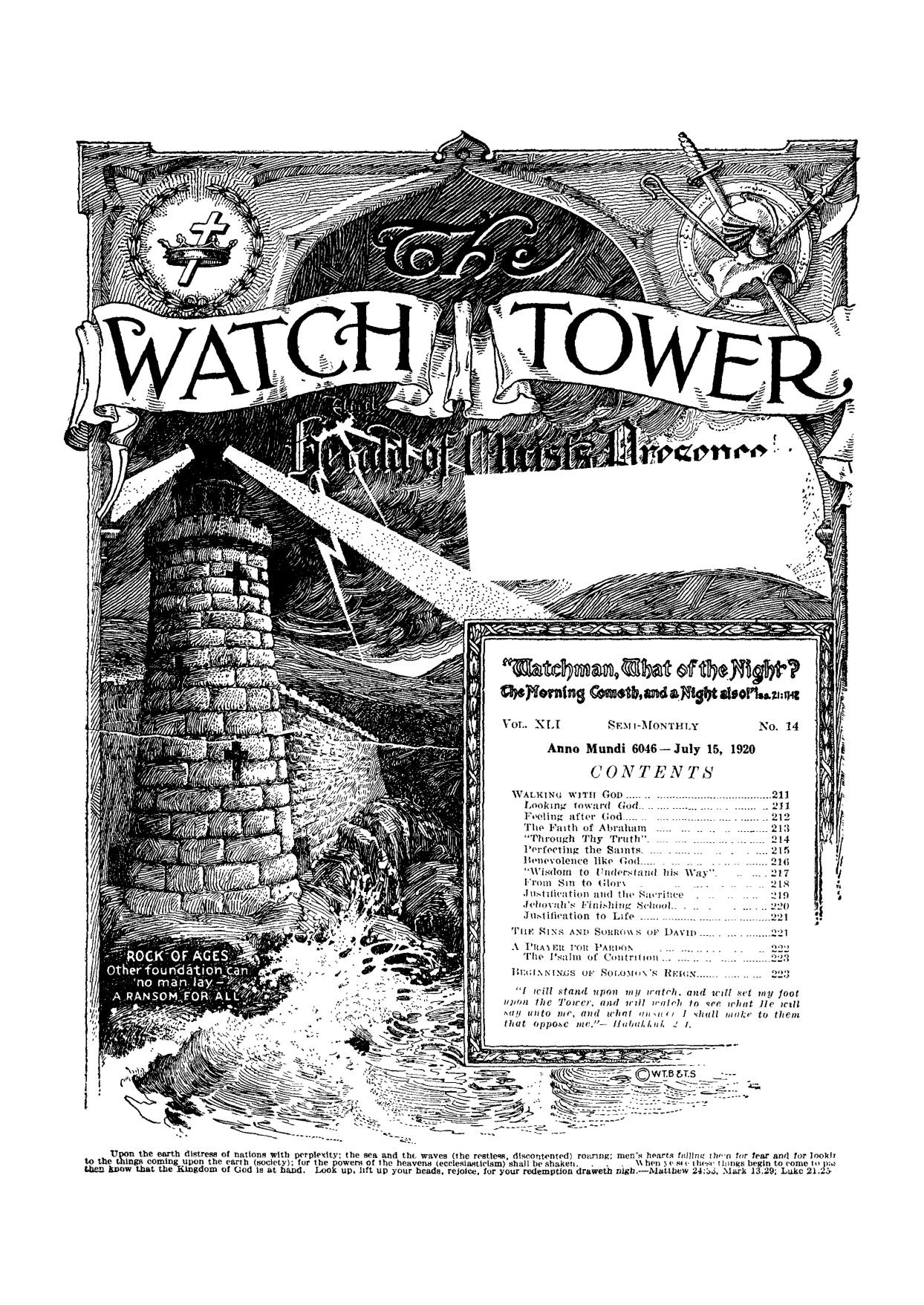
* *.*. the earth distress of nations with perplexity; the sea and the waves (the restless, discontented) roaring; men’s hearts fitilinu thc-n tor tear and for look Jr to the things coming upon the earth (society); for the powers of the heavens (ecclesiasticism) shall be shaken. . . , hen > e s< <■ these things begin to come to nj^
then know that the Kingdom of God Is at band. Look up. lift up your beads, rejoice, for your redemption draweth nigh.—Matthew 24:33. Mark 13.29; Luke 21.25-
THIS JOURNAL AND ITS SACRED MISSION
THIS journal is one of the prime factors or instruments in the system of Bible instruction, or •‘Seminary Extension”, now beinjf presented in all parts of the civilized world by the Watch Tower Bible & Tract Society, chartered A. D. 1884, “For the Promotion of Christian Knowledge”. It not only serves as a class room where Bible students may meet in the study of the divine Word but also as a channel of communication through which they may be reached with announcements of the Society’s conventions and of the coming of its traveling representatives, styled “Pilgrims”, and refreshed with reports of its conventions.
Our “Berean Lessons” are topical rehearsals or reviews of our Society’s published Studies most entertainingly arranged, and very helpful to all who would merit the only honorary degree which the Society accords, viz., Verbi Dei Minister (V. D. M.), which translated into English is Minister of God’s Word. Our treatment of the International Sunday School Lessons is specially for the older Bible students and teachers. By some this feature is considered indispensable.
This journal stands firmly for the defense of the only true foundation of the Christian’s hope now being so generally repudiated — redemption through the precious blood of “the man Christ Jesus, who gave himself a lansom [a corresponding price, a substitute] for all”. (1 Peter 1:19; 1 Timothy 2 : 6) Building up on this sure foundation the gold, silver and precious stones (1 Corinthians 3: Ilir, ; 2 Peter 1:5-11) of the Word of God, its further mission is to “make all see what is the fellowship of the mystery which. . .has boon hid in God, ... to the intent that now might be made known by the church the manifold wisdom of God”—“which in other ages wj- not made known unto the sons of men as it is now revealed”.—-Ephesians 3:5-9,10.
It stands free trom all parties, sects and creeds of men. while it seeks more and more to bring its every’ utterance into fullest subjection to the will of God in Christ, as expressed in the holy Scrip lures. It is thus free to declare boldly whatsoever the Lord hath spoken—according to the divine wisdom granted unto us to understand his utterances. Its attitude is not dogmatic, but confident; for we know whereof we affirm, treading with implicit faith upon the sure promises of God. It is hold as a trust, to be used only in his service ; hence our decision.*, relative to what may and what may not appear in its columns must be according to our judgment of his good pleasure, the teaching of his Word, for the upbuilding of his people in grace and knowledge. And we not only invite but urge our readers to prove all it* utterances by the infallible Word to which reference is constantly made to facilitate such testing-
TO US THE SCRIPTURES CLEARLY TEACH
Thar the church is “the temple of the living God”, peculiarly “his workmanship” . that its construction- has been in progress throughout Ilie gospel age—over since Christ became the world’s Redeemer and the Chief Corner Stone of Ins temple, through which,, when finished, God’s blessing shall come “to all people”, and they find access to him.—1 Corinthians 3 : Id, 17; Ephesians. 2:20-22; Genesis 28 : 11 ; Galatians 3 : 29.
"’hat meantime the chiseling, shaping, and polishing of consecrated believers in Christ’s atonement for sin. progresses: and when the-last of these “living stones”, “elect and precious," shall have been made ready, the great Master Workman will bung all togerher in the first resurrection; and the temple shall be filled with his glory, and be the meeting place between God and men throughout the Millennium.—Revelation 15:5-8.
That the basis of hope, for the church and the world, lies in the fact that "Jesus Christ, by the grace of God, tasted death for every man,” “a ransom for all.” and will be “the true light which lighteth every man that cometh info the world’, “In due time”.— Hebrews 2:9; John 1:9; 1 Timothy 2:5, 6.
That the hope of the church is that she may be like her Lord, “see him as he is,” be “partakers of the divine nature’/ and share his glory as his joint heir.— 1 John 3:2; John 17:24; Romans 8:17; 2 Peter 1 : f.
That the present mission of the church is the perfecting of the saints for the future work of service: to develop in herself every grace; to he God’s witness to the world; and to prepare to be kings and priests in the next age.—Ephesians 4:12; Matthew 2lz 14 ; Revelation 1:6; 20: 6.
That the hope for the world lies in the blessings of knowledge and opportunity to be brought to all by Christ’s Millennial kingdom, the restitution of all that was lost in Adam, to all the willing and obedient, at the hands of their Redeemer and his glorified church, when all the wilfully wicked will be destroyed.—Acts 3:19-23; Isaiah 35.
pUBLISHE.0 Oy
WATCH TOWER. BIBLE 6-TRACT SOCIETY
124 COLUMBIA HEIGHTS ‘a a BROOKLYN, NY.. USA'
Foreign Offices: British: 34 Craven Terrace, Lancaster Gate, London W. 2; Australasian: 495 Collins St., Melbourne, Australia; South African: 123 Plein St., Cape Town, South Africa.
Please Address the Society in Every Case.
ANNUAL SUBSCRIPTION PRICE .$1.00 IN ADVANCE CANADIAN AND FOREIGN SUBSCRIPTION PRICE >1.50 SEND MONEY RY EXPRESS OR POSTAL ORDER, OR BY BANK DRAFT FROM FOREIGN COUNTRIES BY INTERNATIONAL POSTAL ORDERS ONLY (Foreign translations of this journal appear in several languages)
Editorial Committee: This journal is published under the supervision of an editorial committee, at least three of whom have read and approved as truth each and every article appearing in these columns. The names of the editorial committee are: J. F. Rutherford, W. E. VanAmrubgh, F. H. Robison, G. H. Fisher, W. E. Page.
Term* to the Lord*» Poor? AD Bible students who, by reason of old age or other in* drrnity or adversity, are unable to pay for this journal, will be supplied free if they bend « postal card each May stating their case and requesting such provision. We are not only willing, but anxious, that all such be on our list continually and in touch with the Berean studies. ' ______
Neitin* tn • We do Dot, an a role, eeoda card of acknowledgment for a renew.) t or
VtOllCe KO OUOtCrlOert, jor a new subscription. Receipt and entry of renewal are indicated within a month by chanae tn expiration date, as shown on wrapper label.
AVUered tu Second Claee Matter at Brooklyn, N. Y., Poetojfiee under the Act of March 3rd, 1879.
GENERAL EASTERN CONVENTION AT SCRANTON
Arrangements have been made for a five-day convention for the benefit of friends living in Eastern and Northeastern States. This gathering is to be held in Scranton, Pennsylvania, a city of some 150.000 people, at practically the top of the Moosic Mountains. Pure air and good water are among its at tractions ; the streets are shady and the nights are cool. It has long claimed to be the best-lighted city in the world, and has what is probably the most beautiful railway station m America.
Wo quote an attractive description of the city’s environs •
•’The Elmhurst Boulevard rivals in scenic attractions the very finest scenery in the Fast. In a few minutes one rises from the comer of the city to the edge of the clouds, and below him is spread •* panorama of unexcelled civic beauty and industry, stretching aw iv from north to south within the mighty mountain walls as far a- the eye ran reach The boulevard encircles Lake Scranton by a four inile drive through the forest which reaches down to the edge of the lake throughout in entire length. Although the edge of this lake is vv itluri one and one-half mill’s of the center of the city, there is but one house in sight of the traveler as he encircles the I ike and this can he glimpsed for but tin instant.
“Cars run from the city to Moosic Lake, two thousand feet above, every thirty minutes. The nde is along the edge of the c inyon wall deep within which the Lackawanna climbs to the summit of Mount Poeono on its way to Delaware Water Gap and New' York. Scores of other lakes are within a short ride by trolley or automobile.”
All sessions of the convention will be held in the Town Hall, 315 Adams Avenue, August 4 to 8, inclusive.
Scranton is reached by through trains from New York, Philadelphia, Albany, Utica, Syracuse, Buffalo, (Teveland, Detroit, and Chicago, In addition to this excellent service, there are direct Pullman cars to and trom Wilkesbarre (only a few miles distant) and Pittsburgh, as also Hamilton and Port Huron. When purchasing full-fare one way ticket to Scranton secure certificate account of 1. B. S. A. Convention. If agent is not provided with certificate blanks, then procure a receipt. But before such a ticket is purchased inquiry should be made concerning any other possibly better summer-resort rate from your locality to, say, Chautauqua Lake, N. Y.. or Asbury Park, N. J. Scranton is distant from New York, 134 miles: from Boston. 364 miles; from Philadelphia, 164 miles; from Washington, 258 miles : from Pittsburgh, 312 miles ; from Cleveland, Detroit. Columbus, and Cincinnati, 445, 514, 503, and 573 miles, respectively; from Indianapolis and Louisville, 684 and 795 respectively ; and from Chicago and St. Louis, 797 and 924 miles. The best service from Western points is usually via Buffalo, 262 miles distant.
This convention promises to be one of the largest, if not the largest, of the year Scranton is well known among the readers of \\ vtch Tower publications as being the place not only where “The Finished Mystery”, under the Lord’s providence and guidance, was collated and written, but also where the first arrests were made in rlii< country for the selling of that book. It is a uniquely appropriate place for a convention for these reasons, in addition io those mentioned above.
Those desiring to have sleeping accommodations arranged for them will please address F. Kintner, 1505 North Sumner Ave, Scranton, Pa., stating price preferred to be paid, whether in hotel or private home; number, sex. and color in party. As far as possible such requests will be filled.
CONVENTION AT TORONTO
July 2'h 30, 31 and August 1 are the dates for a convention of the International Bibb’ Students Association at Toronto, Ontario, Canada. The first three days of the convention mootings will be held at the Masonic Temple. ssO onge Street : and the fourth day will be at Massey Hall, Shutor Street. 'This convention will furnish opportunity for fellowship and spiritual refreshing for the friends in Ontario, Quebec, and the bordering States. Communications concerning accommodations should be addressed to W. G. Brown, 51 Tnorton Avenue Toronto, Ont.
Friends from bordering States who plan 1o attend the convention at Toronto will doubtless be able to lake advantage of the usual low summer round-trip rates to Niagara Falls-—proceeding from there by tuun. or by trolley car and boat.
SPECIAL TRAIN TO COLUMBUS CONVENTION
The Cincinnati friends contemplate securing a special train via the B & O. Railroad to the Columbus. Convention. All the friends from Kentucky. Tennessee, and such points west of Cincinnati in Indiana and Illinois as arc reached by the B. & O., should communicate with IB-other II. Schultz, Box 754, Cincinnati. Ohio, in regard to the time the proposed special train will leave Cincinnati. In order to secure the advantages of fellowship on this train have jour tickets read via “Baltimore and Ohio Railroad”-—if not from the starting point, then from Cincinnati (o Columbus.
AND HERALD OF CHRISTS PRESENCE
Vol, XLI
Ji r Y 1.5, 1920
So. 14
WALKING WITH GOD
“As for Qod, his way is perfect."
Psalm 18:30
FROM sin to gloiy is an eventful and momentous, but not necessarily a long journey. In traversing this ground we make use of certain major and indispensable steps, as well a> many minor and, it must be feared, often unnecessary ones. Sometimes we wander a little because an attractive bypath has claimed our attention until we become confused as to the right direction. But the main steps must be taken if we are to have and retain the fjord’s approval. A brief review of these main steps or stages of our pilgrim's progress cannot be out of place for those whose eternal destiny hangs upon their faithfulness in the Ixird’s way.
The Bible is very plain in telling us that the most of men do not walk with God. Further than this, they do not even walk toward God with a view to attaining his fellowship and smile. “The whole world lieth in wickedness’’ (1 John 5: 19) is the clear word of the Apostle. He cannot mean that there is no good in the worldly; for often they possess very admirable traits. But he does mean that the world, as a whole, is dominated and ruled over by Satan, “the god of this world” (2 Corinthians 4: 4). who exercises dominion in the hearts of the children of disobedience (Ephesians 2:2) by encouraging the conditions which make selfishness appear easy and profitable.
NOT ALL SINNERS WILLFUL
But while it is true that “there is none righteous, no, not one” (Romans 3: 10), while no one is able to do perfectly because of his inborn lacks, all do not have the sime attitude of mind and heart toward their unrighteous condition. Probably the majority of people have found themselves in very good harmony with the way of the world, which means that they were in harmony with “'the prince of this world”, who is out of harmony with Jehovah, being hi< adversary, or opponent. (John 12 :31; 11:30) The Scriptures imply that there has been a measure of responsibility and willfulness in mankind in this matter. It is true that all were born imperfect, because of inherent death, but this would not account for willing cooperation with Satan.
That there is some willing cooperation is shown by the Apostle when he says that “knowing God, they glorified him not as God, neither were thankful : but became vain m their reasonings, and their foolish heart was darkened. . . . And even as they refused to have God in their knowledge, God gave them up to a reprobate mind, to do those things which are not convenient: being filled with all unrighteousness, wickedness, covetousness, maliciousness; full of envy, murder, strife, malignity; whisperers. backbiters, haters of God. insolent, haughty, boastful, inventors of evil things, disobedient to parents, without understanding, covenant breakers, without natural affection. unmerciful." Romans 1: 21. 2S - 31.
Not all imm have all these failings in a notable degree, but all these imperfections are easily discernible in men - some here, some there. These arc they who “walk after their ungodly lusts’’ (Jude 18) “with froward heart". (Proverbs (>: 12) Among those who are in harmony with the world’s way might be found many people who do not think that they have received their share of the world’s good things, but who do approve of the world’s method of getting those good things and who, as soon as an opportunity offers itself, will gladly make use of selfish methods for personal aggrandizement, even at the cost of another’s happiness, and feel that the method is quite all right. The world has their approval: they love both the world and the things that go to make up the world. “The ways of [such] a man are clean in his own eyes.’’—Proverbs 16: 2.
LOOKING TOWARD GOD
Occasionally, however, is one whose judgment has ceased to approve of the world’s way. To himself he thinks: There is something wrong about this; this system of doing things, this manner of acquiring advantage and prestige over others cannot bring real happiness. And is such a one a Christian? Oh, no; he is merely thinking. His condition is advanced in comparison with the great mass of people who do almost no thinking on matters higher than their mouths, but he is not walking with God as yet. though it may prove to be a step of walking toward God.
One who goes no further than this cannot be very pleasing to either Jehovah or the world. He will be a grouch, a faultfinder, an unwelcome member of human society. But this ceasing to approve the course of the world is repentance in its elementary sense; for repentance is a change of mind respecting one’s relationship to evil. What next can he do? He can either stay in the stream, continue to float along in the ordinary practices of the world, which he has ceased to approve, or he can determine to quit tho=e practices—he can be converted. Many of the so-called social and political “radicals” of the world are found in one of these two classes, probably more of them in the first than in the second class. They are able to see the discrepancies in the conduct of the “reactionaries” of earth (those who are well pleased with the world as it is), but seldom go far enough to do more than find fault.
HEATHENDOM AND CHRISTENDOM
Those whose minds and hearts are both in harmony with the world are heathen, no matter what their names, or where they were born. Those whose minds have ceased to approve of the world, but who love the things which the world has to offer—wealth, distinction, social emoluments—are in a condition comparable to “Christendom”, they are convinced of one thing and still love the thing they know to be wrong. It is a notable fact that a great deal of the preaching of Christendom is of the quit-your-meanness variety. But do we not all do imperfectly? Yes; but not all take unfair advantage of the imperfections of ourselves and others to further selfish ends.
Before our Lord’s first advent there was no special inducement held out by Jehovah to the Gentile peoples to abandon their course. “The times of ignorance God therefore overlooked; but now he commandeth men that they should all everywhere repent; inasmuch as he hath appointed a day in which he will judge the world in righteousness.” (Acts 17: 30, 31) While the appropriateness of repentance is thus made known, few have given the matter any heed, even as the Lord foreknew.
But surely when one has repented and is converted he is a Christian ? No, not yet. Christendom is full of confusion on this very point. If he were already in covenant relationship with Jehovah, had committed some sin, then had repented of that particular sin and had converted his course away from it, such conduct would bring him into contact with the cleansing arrangements the Lord has made for his church through Christ, and would restore such an one to the covenant privileges lost. We have an example of this in the words of the Apostle Peter to the Jews on the day of Pentecost. He told them: “Repent, therefore, and be converted that your sins may be blotted out”. (Acts 3:19) But neither repentance, nor conversion, nor both together, will bring the individual, in the first place, into relationship with God Jehovah. For that still further steps are necessary.
FEELING AFTER GOD
One whose mind has ceased to approve the course of the world and whose heart has ceased to be attached to the things of the world is in the condition mentioned by the Apostle of ‘seeking God, if haply he might feel after him and find him’. (Acts 17: 27) Both repentance and conversion, in their elementary meanings are negative steps. They are quitting something, presumably with a view to taking up something else more desirable. Something more definite than merely feeling after God must be attained if the individual approaches near enough to God to have his favor. Of course Jehovah looks with measurable approval upon repentance and conversion, because he has ordained both steps, but while approving the steps he cannot yet admit the searching one into his favor or fellowship. Faith, the condition of intelligent heart harmony with God, comes not by feeling but by hearing.—Romans 10:17.
There are several primary lessons concerning God which may be learned before one has a knowledge of the Bible. Indeed, some of these must be learned before the message of the Bible will appeal to one. Two of these lessons are: (1) to believe that God is; and (2) that he is a rewarder of them that seek after him. (Hebrews 11: 6) The secret of the ability to learn these lessons lies in the fragmentary faculties which men have. Alas, the fragments are too broken, too much subdued and overridden by more tangible interests in the minds of the great mass of earth’s inhabitants to make it possible for them to be very much convinced of godly things now. Many there are who still say in their heart, if not with their lips, “There is no God”.—Psalm 14: 1-4; 53 :1-4.
“THE TESTIMONY OF THE LORD”
But the one who is seeking God is invited to “forsake the foolish and live”. (Proverbs 9:6) To do this what does he need? He needs information, instruction. And for this “the testimony of the Lord is sure, making wise the simple”. (Psalm 19:7) To those who are feeling after God, he sends forth a message through Christ Jesus his Son. This message is: “Come unto me, all ye that labor and are heavy laden, and I will give you rest”.— Matthew 11:28.
But not many believe this report, and hence to but few is the power of the Lord revealed. (Isaiah 53:1) The one who repented has said concerning the world: I don’t like this condition of affairs. The one who is not only repentant but contrite, whose heart’s attachments have been converted away from the world, has said: I’m tired of this and I’m going to hunt for the Lord. He feels, as all such feel, that they “have given time enough in the past to doing the things which the Gentiles delight in”. (1 Peter 4: 3, Weymouth) On hearing the offer to supply his needs the honest seeker must come to Jesus, at least to the extent of examining the message and of finding out the ground for reconciliation with God.
“O hope of every contrite heart O joy of all the meek;
To those who ask, how kind thou art! How good to those who seek!
“But what to those who find? Ah! this, Nor tongue nor pen can show;
The love of Jesus what it is, None but his loved ones know.”
“’TIS ALL THAT I CAN DO”
To become the beloved of the Lord we must not only say that we do not like the world and that we are tired of it, but that (after some knowledge of God’s purposes is received) we are going to apply ourselves to the Lord’s way. We say: Blessed Lord; I commit myself to thy arrangements; here I am. Until such a determination is arrived at there is no opportunity for being benefited by anything more than the most generalized providences of the Lord, such as rain, sunshine, information, etc.
But, says one, is it not necessary for a believer to have a legal standing before Jehovah in order to make such a decision ? To this we reply that he could not have a legal standing before his case is taken up, and there is no case to take up until the consecration is made. As well say that a foreigner must have the standing of American citizenship before he can declare his intention to become an American citizen, as to say that justification must precede consecration. Why should the mighty Jehovah bother himself at all about one who still prefers his own way to the way of the Lord ? “God resisteth the proud.” (1 Peter 5:5) And those do still prefer their own way, do still lean to their own understanding, who have not forsaken their way for God’s way, who have not determined to commit themselves to the Lord’s arrangements in Christ Jesus.
But is it not necessary- for one to have the merit of Christ imputed to him before his consecration can be accepted by Jehovah? Yes, yes, surely; but our making of the consecration and God's acceptance of it are two very distinct matters, though usually closely connected in point of time. Suppose a man determines that it ito Ins best interests to have an audience with the King of Denmark. There is nothing to hinder him from making -ncli a determination right here in America: hi1 does not need an\ standing before the Danish court io make that decision. But whim he reaches Denmark he may find the need of various helps, to sav nothing of instructions, without which he cannot reach the King.
THE ACCEPTABLE TIME
What, then, happens when we make a consecration to the Lord? Why, our case is taken up to be decided according to the w isdom of the wisest Judge. God has not obligated himself to accept all consecrations unconditionally. They must he made in the •‘acceptable time'’ (Isaiah !!•: S) and must be made with an approvable motive. The acceptable day will soon pass (Hebrews 3: 13), and we have at least one example of a . enseera-tion made which was wrong in motive, and which was therefore rejected. This is the case of Simon Magiis. who was excluded from the privilege of divine favor be-< arise his ‘heart xvas not right before God'. Acts 8: 21.
The Master has promised: “Him that cmnetli unto m<' I will in no wise cast out". (John (>:3?) That is. he will not decline to present any genuine consecration before the heavenly Father. But. mark you, the consecration must be made before it can be presented, and it must bi1 presented before it can be either accepted or rejected. Jesus further said: “No one cometh unto the Father but by me”. (John 14: G) This is but another way of saying that some do come to the Father, and that they come through Jesus.
“And can I yet delay
My little all to Rive?
To wean my soul from earth away For Jesus to receive?"
Besides receiving or taking up the consecrator’s case, Jesus as the Advocate, for the consecrated, presents that case before Jehovah for his decision concerning its acceptability. Of course this presentation implies a guarantee on the part of Jesus that he will make good the bodily imperfections of the one whose case is being presented. Thus, if all the other conditions are met, the consecrating one is “accepted in the Beloved”.— Ephesians 1:6; 1 Peter 2 : 5.
“GOD THAT JUSTIFIETH”
At that stage, then, “it is God that justifieth ; who is he that eondemneth?” (Romans 8:33,34) No one, if he be well informed. God has stamped the organism of the consecrated with approval; for though that organism was inherently imperfect, it was made acceptable by the merit of Christ. What is the object of all this work; why does not God simply accept believers into his friendship when he sees their hearts are right, without all this insistence on certain standards? Did he not do just that thing before our Lord Jesus’ first advent?
That would be only a partial statement of the truth. In the first place, no one whose heart was not devoted to God ever had his friendship, and, in the second place, no one was admitted to the relationship of friend who did not acknowledge his imperfections of body, the customary manner of doing this being by offering slain sac-iitiees. For instance, it was not the hazy acceptance of a few facts on the part of Abraham which made him the friend of God. It does not say that he believed facts, bm that he "believed (toil" (Romans 1:3), he trusted Gud, he committed his cause and himself to the divine arrangements. His heart was shown to !><’ of righteous .■damp when ho so trusted God that he was willing to -aerifies his only .-on. And it wa.- this act. as attestation of his failh, St. James tells us. that called forth the div uh'approx al of his heart.- James 2: 21.
The smie degree of faith as was shown in all of the ancient woitbi"- would, if shown during this gospel age, lead the individual to the fullest consecration. How is it then, that arrangements are made for the justification of the organism of believers now, whereas there was no such arrangement then? The answer is that now- Jehovah i- not looking merely for friends, but (1) for joint-saerifieers with his Son Jesus and (2) for children to he associated with his Son in the great future work of restoriim mankind. As it is written. “Behold I and the children which God hath given me" (Hebrews 2:13) lor the purpose of destroying Satan and of delivering of>j111•--!■<I and fear-stricken humanity.- Hebrews 2 : 1
THE FAITH OF ABRAHAM
Even a free man may have a slave as a friend if there arc noble qualities of heart and mind in him. But the slave could not be adopted into the free man’s family until -onie arrangement had been made for the slave’s purchase. It is just so now between Jehovah and those who "walk in the steps of the faith of our father Abraham". ( Romans 4: 12) He seeks to make of them sons in his royal family, brethren of Christ Jesus. As the Psalmist-Prophet long ago said for Jesus: “I will declare thy name unto my brethren”.—Psalm 22: 22.
Since there, is no other purpose in accepting consecrations in this gospel age than the purpose of sacrifice, we have no reason to expect that any other thing will happen to our flesh, when we arc accepted through the merit of Christ, than that we shall be sacrificed. This means death : and it would mean immediate and total obliteration of the being were it not for the fact that the Lord starts a new life when the old one is slain.
True, there is no cessation of activity in the body and only faith can grasp the fact that the human life is gone for ever and that all hopes of future existence shall find their fulfillment, if at all. on some other plane than the earthly. And how is this new life started? The Apostle answers: “Of his [God’s] own will begat he us with the Word of truth". (James 1: 18; 1 Peter 1:23) What does this mean? Does it mean that if some one of the world takes up a Bible, reads it and gets a few ideas that he is thus begotten and that a new life has started in him, within the meaning of this text ? Oh no, it is not merely the Word, but the truth which is used by the Lord for this begetting.
A NEW LIFE STARTED
The new will (the resolve to commit one’s way unto the Lord and to take God’s will as the sole deciding factor in one’s life) is the ovum, so to speak, which is engendered and fructified by the truth. This new will, under the stimulus of the truth, gradually gathers around itself a set of new impressions. The only place these impressions can be retained is on the brain, exactly the same place where all other intelligent impressions are received, and where a good many old ones are retained which we could well afford to dispense with.
The new will, the new mind, coupled with the divine authorization for the new life, is all there is of the new creature in Christ this side the vail. This new life thus started by the spirit begetting is in a precarious position from every standpoint save that of faith. Viewed humanly, it stands about as much chance of prospering as a young bird would in a reptile’s den. But from God’s standpoint, all power in heaven and earth is pledged to the protection and nourishing of this priceless little life which is destined to be a prince of the royal line in glory.
And what does the Apostle mean when he speaks of walking “in newness of life”? (Romans 6:4.) Some light is shed on this question in the passage which says : “If any man is in Christ, he is a new creature; the old things are passed away; behold they are become new”. (2 Corinthians 5: 17) There is a newness of life which results not from being transferred to some other sphere, but from being given a new dominating factor in our lives—the will of God. We have new hopes, new aims, new ambitions, new aspirations, new ideals. The old ones are gone. And since these things, rather than environment, make up our lives, when they are changed our lives are new and different, as when one puts on yellow glasses there is an added buoyancy to the landscape, an increased cheerfulness in everything seen which we never saw with our unaided eyes.
OLD LIFE AND NEW
Again the Apostle tells us: “Ye died [as human beings] and your [new] life is hid with Christ in God”. (Colossians 3:3) This new life, the new man or creature, can be renewed, refreshed, invigorated, fed, and strengthened by knowledge. This is not ordinary knowledge. It is an intimate acquaintance with God’s will, a deep appreciation of his motives. (Colossians 1:9) Those who learn the charm of this special knowledge have something which the world does not know.
“Let worldly minds the world pursue: It hath no eharms for me;
Once I admired Its trifles too. But grace hath set me free.”
In another place we are admonished to “be not conformed to this world [the present world, which flieth in wickedness’]: but [to] be . . . transformed by the renewing of [our] minds”. (Romans 12: 2) What does this mean? How can we avoid being conformed to this world when we are in it and when our five senses are constantly open to the impressions coming to us from the world? In general, we see about the same things which the worldly see, we hear about the same things they hear, we touch, taste, and smell about the same things which they touch, taste, and smell. What then: are not these the very influences which go to make up the world ? Yes, with two important differences in the case of the new creature. One difference is the new will or new determination on our own part to do the Father's will; and the other difference is the holy determination on the Father’s part to cooperate with us in our new desire. By way of effecting this cooperation Jehovah exerts on our behalf his sacred influence, or holy spirit. This spirit, power, or influence is rightly called holy because it emanates from him who is holy, Jehovah God.
Then the Father has not left us alone in this great work of keeping the new creature alive ? Thank God. no. A reigning sovereign who is hoping for an heir to his earthly throne, after starting the little life, is very careful to see that it is nourished and that the best influences of his realm are brought to bear upon his unborn child. He will do this even if he does not love the mother of the child. We could not expect that the Emperor of the Universe would do less for his begotten children.
“THROUGH THY TRUTH”
The part which God plays in the care and development of the new creature is summed up largely by the word sanctification; and the Master indicates as much when, praying to the Father, he said: “Sanctify them through rhy truth, thy Word is truth”.
What does sanctify mean ? One answers that it means sinlessness in the flesh; another, that it means a tremendous exuberance of feeling, that when one becomes so excited in religious matters that he cannot keep his seat any longer, but feels obliged to jump up and throw his hat, that is sanctification.
But neither of these views has support in the Scriptures. Another and very common view in Christendom is that sanctification means a setting apart, and that it is practically synonymous with consecration. This view has had some little substantiation by the unfortunate usage of the English word sanctify to translate the Hebrew word kawdash in the Old Testament. The word kawdash really means to consecrate, to dedicate, to hallow, and would be more happily rendered by one of these words (as it often is) than by the word sanctify.
But if there is excuse for confusion in the Old Testament there is none in the New, as the word is used in relation to new creatures. Everywhere in the New Testament sanctify is used to translate the Greek word agiahzo, which means to make holy, or more literally, to holify. The Greek word is used twenty-eight times in the New Testament, usually translated sanctify, but twice hallow.
RIGHT THOUGHTS AND RIGHT WORDS
But some one suggests: What difference does it make what word is used so long as the thought is right? That is true in a sense; but if we use words which are more nearly expressive of given thoughts—and all words are only relatively expressive of thoughts—we are more likely to retain the right thought and more able to convey the right thought to others. If we call a duck a goose, it may lead to confusion,, though there is great similarity between the birds; if we say lend when we mean borrow v\e may get into trouble.
Consecration* is our part, as we have already seen. It is a thing which God will not do for us. He will never coerce the will. He has so much respect for even the fragmentary image of himself in man that he lets man do the deciding on matters touching his own destiny. Man may make a miserable choice, but the Lord lets him do it just the same. On the other hand, sanctification is God’s part, a thing which we cannot do for ourselves, because it requires superhuman wisdom and power.
Who of Christ’s followers, for even one hour, to say nothing of a lifetime, could guarantee that all things shall work together for his good? To do that it is necessary to have knowledge and foresight to an extent now impossible for us. How could we know what experiences to choose? We might choose some that would be too easy and some that would be too hard for ourselves. In no case could we be sure that all the influences which we would seek for ourselves would be such as to work to our eternal welfare. Furthermore, which of us has the power sufficient to hold back harmful influences, to divert them, or to counteract them, so that we would not be overwhelmed ?
PERFECTING THE SAINTS
Sanctification, then, refers to the great process of making us “meet to be partakers of the inheritance of the saints in light" (Colossians 1: 12), to the “perfecting of the saints”. (Ephesians 4 : 12) This is the great process which begins when Jehovah accepts our consecration, when he. begets or starts in us a new life, and it does not end until the termination of our Christian experiences, whenever or however that may be.
While there is considerable association between the ideas of .set apart and make holy, there is a clear distinction. One might set a chair apart, and to holy purposes too, but that would not imply any change in the chair itself. But when we say to make a thing holy, especially to make an individual holy who was not holy to start with, it does imply a change, a transformation in the mind and in the inmost life of the person.—2 Cor. 7: 1.
Consecration is a decision made in a moment, though one might be contemplating it for some time. Sanctification is an extensive process, as the Apostle implies: “The very God of peace sanctify you wholly”. (1 Thessalonians 5:23) He begins the good work in us when, having accepted us for the purpose, he impregnates our new wills with the truth, and he continues the good work under the same influence of the truth; this grand work as a whole being completed by the time the day of the Lord Jesus shall have fully dawned.—Philippians 1 : G.
PRAYER FOR THE CONSECRATED
It will be noted that the Master was praying on behalf of a class which was represented at that time by his dis-
*It is conceded that the word “consecrate” is sometimes used in the Authorized Version as indicating what the High Priest did respecting sacrifices already presented and accepted, but for this act of dedication or setting apart for sacrifice we have other words just as good or better. At all events, in this article, and in these columns generally, consecrate is used in the sens© defined on page 220, column 2. ciples, including the apostles. Sanctification, therefore, could not mean consecration: for the apostles were already consecrated. They were members of a consecrated nation, which had all been “baptized into Moses in the Red Sea and in the cloud” (1 Corinthians 10:2); they were faithful ones among that nation, being Israelites indeed in whom there was no guile; and. thirdly, they had especially consecrated themselves to follow the Master, and had done, so for three and one-half years. They surely were fully consecrated. In the same prayer the Master said: “I pray for them, I pray not for the world”. (John 17: 9) He was not praying that goats he made sheep, as many have mistakenly prayed during this gospel age, but he was praying for those who already believed in him, had faith in him. The scope of this prayer was extended when he said: “Neither pray I for these along [the individual disciples then present], but for them also which shall believe on me through their word”. (John 17: 20) He was not praying for those to be sanctified who had not already believed; and belief in its New Testament usage means to have more faith in the Lord than in one’s self.
But why should “saints”, holy ones, need perfecting ? If the divine influence which started their new lives is holy, how is it that they have to be made holy? It is true, the new creature is sinless at the time of spirit begetting, for “whosoever is begotten of God sinneth not” (1 John 5: 18), but there is a distinction between being sinless and being holy. Sinlessness is a negative ,'tate. It might be said that a stone or a tree is sinless, but they would hardly lie spoken of as holy.
ESTABLISHING IN HOLINESS
Holy as applied to persons means morally pure. As applied to inanimate things it sometimes means ceremonially clean, and hence acceptable. (Matthew 23: 19; 1 Timothy 4 : 5) It is true that the holy spirit starts a holy mind, but if that mind is to predominate over the natural tendencies of the body it must be not only started but added to. and it is this adding to. this ‘renewing’ (Romans 12:2; 2 Corinthians 4:16; Colossians 3: 10), this ‘changing’ (2 Corinthians 3: 18), this ‘stablishing, strengthening, settling’ (1 Peter 5:10) of the new mind, as well as the starting of it, which is included in the term sanctify. In short, it includes all the work of the holy spirit on the life of the new creature.
The Apostle tells us that he had been "made the messenger of Christ Jesus among the Gentiles, doing priestly duties in connection with God’s good news, so that the sacrifice—namely the Gentiles— may be acceptable to him, being as it is an offering which the holy spirit has made holy”. (Romans 15:16. Weymouth) Again: “Both he who sanctifies and those whom he i’,s sanctifying have all one Father; and for this reason he is not ashamed to speak of them as brothers”. (Hebrews 2: 11, Weymouth) It is not. therefore, simply that they were sanctified when first brought into contact with God’s holy power, but that that purifying, that holifying influence continues. If it does not continue, the cares of this life and the1 deceitfulness of riches will soon quench the little flame of now life which the spirit kindled.
If this holy life is quenched, this sacred group of impressions entirely displaced by earthly things and by willful sin, then there is no hope for that soul, or individuality to be perpetuated. The opportunity for human life which it had at one time was removed when that human life was slain as a joint sacrifice with Christ: so that if the life there started, and by which the individuality was intended to be preserved, dies out, there is nothing left for that individual but the “blackness of daikness , . . forever”. (Jude 13) He is “twice dead, plucked up by the roots” (Jude 12)—both roots, both his terrestrial and his celestial promises of life, having been discarded.
“YE SHALL BE HOLY”
We are. spoken of as new creatures and as new men but we are not spoken of in the Scriptures as having a new nature; for nature is determined by organism. If faithful we may become “partakers of the divine nature” (2 Peter 1:4); if less faithful we would not be worthy of it, but unless Unfaithful the new mind can be transferred to the kind of organism which pleases heavenly wisdom best.
'Going back to our Master’s prayer, “Make them holy through thy truth, thy Word is truth,” we are reminded of the word of the Lord through the Apostle Peter when, addressing the church, he said: “Not fashioning yourselves according to your former lusts in the time of your ignorance; but like as he who called you is holy, be ye yourselves also holy in all manner of life; because it is written, Ye shall be holy; for I am holy”. (1 Peter 1: 14- 1G) Here is our clue to the inspired usage of the word holy. Whatever it is, God is it. Holiness is the absolute and inherent state of Jehovah’s being. And when the Master prays “Make them holy”, he is praying in effect: ‘Make them like thyself, which art holy’. And how can the new creature be like God now, seeing that he has but an imperfect organism to practice with ? Manifestly we cannot be very'much like him in wisdom until we have new mental machinery, wherewith to gather complete knowledge and to apply it where most appropriate. We shall never be distinguished for our wisdom as long as we are in our trial state. Neither can we be like Jehovah in our conception or practice of justice; try as we will, we still come far short. And we are not much like God in power. We shall never have his attributes to the same extent as possessed by Jehovah, but when we have a perfect body we may have them in the same proportion as he has them. In the realm of wisdom, of justice, of power we shall find the Lord supplying us with what is necessary; but it is only in the realm of good will that we can be just like God. It does not require a perfect organism to wish another well, to have at heart the welfare of all mankind. Unless we do •wish them well we are not conformed to the image of ■God’s dear Son, we have not responded to the holy influences which the truth has brought us.
BENEVOLENCE LIKE GOD
This settling and establishing of benevolence as a habitual attitude of mind, as the customary motive of our lives, stamps us, more than anything else, as true sons of the Highest. On the other hand: “If any man have not the spirit of Christ he is none of his”. (Romans 8:9) If we are carrying and entertaining the least spirit of ill will or malice, the least desire for revenge or retaliation, we cannot be said to have the sanctifying work sufficiently done to be in the “image of him that hath created” us, as new creatures. (Colossians 3:10) Malice may arise under great stress, or under extraordinary circumstances, but if we have the spirit of the Lord Jesus we will not harbor it but will ‘commit our cause to him who judgeth righteously’.—1 Peter 2: 23.
It is the truth that is to do the sanctifying. Error never makes any one holy. It cannot. For error comes, directly or indirectly, from Satan, the great opponent of God. Satan is actuated by other than the holy spirit, and influences which emanate from him could not, therefore, lead one into closer conformity with God’s will and character. Are we, then, to expect that we shall be sanctified by the truth only after we have gotten rid of all error ? No: for if that wore so, none of us would have any chance at all. As long as we are in the flesh we shall be finding error there, as the light shines brighter and brighter toward the perfect day. We are sanctified by the truth which we see and love in spite of the error, but not because of it. Probably many a faithful saint has been sanctified by the truth that “God is love” even while he supposed that a part of God’s system of judgment was to torment sinners. His supposition about torture did not help him to appreciate Jehovah; it hindered him. But he believed that God is love in spite of his erroneous conception about some of God’s doings; and as a plant is .turned toward the sunlight, so his mind grew in the direction of love.
SPECIFIC SANCTIFYING TRUTH
It is not truth in its general sense that is apportioned for the work of making us holy. Doubtless if we were perfectly balanced, every item of truth, every fact in the universe, would deepen our devotion for and heighten our praise of Jehovah. But since we are very imperfectly balanced we find that extraordinary knowledge in any line tends rather to puff up than to build up (1 Corinthians 14:1), if there is not something humiliating connected with the possession of that truth.
It is not, then, truth about or in mathematics, for instance, which the Lord has provided for this purpose. He has not left us in doubt, for it is “Sanctify them through thy truth, thy Word is truth”. -The Vatican Manuscript has it: “Thy Word is the 'truth” i. e., thy Word is the truth apportioned for this special purpose of purifying and edifying the minds of those who are called to be partakers with Christ in his glory. If no qualification had been made of the word truth, there would be no common basis for fellowship among the followers of Christ, and only a very hazy and distant common hope. Some would be studying mathematics with the hope of being sanctified thereby; others would be studying history; others fine arts, etc.
And are we to understand that the Bible contains everything that God knows ? By no means. According to its own testimony the Bible is but a light that shineth is a dark place until the day dawn and the day star arise (2 Peter 1:19); it is but a lamp unto our feet and a lantern to our pathway. (Psalm 119:105) But it is truth; and it is such an apportionment of truth as has accomplished and will accomplish its intended purpose : and it has not accomplished much else. Englishspeaking peoples have a childish idea (or had) that Christendom has been wonderfully influenced by God's Word. The truth is that Christendom has gone out of its way to disregard, yes. to disdain every precept that Christ ever gave.
THE WORD AND THE TRUTH
It v ill be noted that the Master did not say that v e are to be sanctified by the Word, by the literary record of God’s doings and purposes, but that we are to be sanctified by the truth. There is a distinction between the Word and the truth, as made elsewhere by our Lord Jesus. On one occasion he said to those who already believed: “If ye abide in my Word, then are ye truly my disciples: and ye shall know the truth, and the truth shall make you free”. (John 8: 31, 32) It is the truth which is the active agency in God’s Word; it is the truth which does the sanctifying, and it is the truth which sets ns free, free from error, free from superstition, free from fear, and if followed, free from death; for Jesus himself is the Truth (John 14: 6), Jehovah’s most perfect lesson on heavenly justice and love.
The record we have of Jesus’ doings and of Jehovah’s purposes in and through him conveys, naturally, the holy influence of both Jehovah, the Supervisor of the work, and of Jesus, the principal Cooperator in the work. It conveys such impressions only if we are in harmony with them, only if our hearts respond to God’s goodness as manifested through Christ Jesus his Son. It is like the personal influence of a friend which permeates his letters. Unknown to us he may go to a distant city, he may write us on a strange typewriter and not sign his name, but if wo know him well we will easily know who the author is. That letter carries the stamp of our friend’s personality. It is permeated with his spirit; it lies between the lines and between the words, as much as in them, for it has a certain style, a certain manner of expression, a certain kind of subject matter which convey to us impressions not felt by even the most learned stranger or the most curious worldling.
CERTAIN PRINCIPLES INVOLVED
It is even so with God’s Word. Many of the wisest of the earth have known it in a literary way; some have known it by rote from beginning to end; and they were not always sanctified by it. To be sanctified, or to be made more like him who is holy, one must see back of all the incidents related, back of all the prophecies recorded, back of all the historical accounts, here an indication of divine wisdom, there some instruction on divine justice, now some manifestation of divine love toward a destitute and unworthy race, and again some show of divine power.
Like a friend’s face behind a lattice, only parts of the visage being visible, so the Lord lets only fragmentary conceptions of his glory in upon our minds row: but if we love him we recognize him. How often does it happen that we do not recognize those we love, even in the night ? “Now we see through a mirror [God’s Word] obscurely, but then face to face.” (1 Corinthians 13:12) For this happy time we await the spirit birth, the first resurrection.—Revelation 20 : 4.
Reviewing then, we find that “all people will walk every one in the name of his god” (Micah 4:5). and that those gods arc not Jehovah. Being Tools, they walk in darkness’. (Ecclesiastes 2:14) But some of "the people who [once] walked in darkness have seen a great light”. (Isaiah 9:2) The first glint of that light «as the realization of the condition of the world and their own condition with it; the next shimmer of light was an appreciation of the fact that “blessed is the man that walketh not in the counsel of the ungodly”. (Psalm 1:1) Another gleam of the same sacred lamination is a recognition of the principle that “ it is not in man that walketh to direct his steps” (Jeremiah 10: 23), but that the directing should be done by Jehovah and that the inquirer should “no longer walk as the Gentiles also walk”.—Ephesians 4: 17.
“WISDOM TO UNDERSTAND HIS WAY”
On behalf of such the promise is given: “The meek will he teach his way”. (Psalm 25: 9) It is “wisdom to understand his way” (Proverbs 14:8) and happiness to be able to say: “His way have I not declined” (Job 23: 11), having responded to the advice: “Delight thyself also in the Lord, and he will give thee thy heart’s desires; commit thy way unto the Lord; trust also in him and he will bring it to pass” (Psalm. 37: 5), because “the ways of the Lord are right”.—Hosea 14: 9.
The three requirements to walking with God are distinctly mentioned by the Prophet: “What doth the Lord require of thee, but to do justly, and to love mercy, and to humble thyself to walk with God”. (Micah 6 : 8) The least of justice we can do i« to recognize that the main tenor of the world’s course is not right, and to cease to approve it—to repent, to change our minds from the approval that we once had for the world. The least love of mercy we can show is to separate our hearts from those things and conditions which have incurred divine wrath (Romans 1: 18)—to be converted from the world. We can humble ourselves only when we ‘trust in the Lord with all our heart and lean not upon our own understanding’: when we ‘in all our ways acknowledge him’, only then will he ‘direct out paths’.—Prov. 3: 5, 6.
We cannot walk with God until we commit our way to him. Enoch walked with God; all the ancient worthies walked with God, though not all of them in as distinctive a manner as Enoch. But since God’s footsteps now lead through a little valley of sacrifice, therefore, all those who humble themselves to walk with him during this age are directed to the way of sacrifice, Jesus making their bodies acceptable as sacrifices. (Romans 12:1) There is no merit to cover defects of the heart; if the heart is not right in God’s sight the consecration is not accepted—and there an end.
THE WAY OF THE LORD
And what does walking with God mean ? It means to proceed as he proceeds; to go when he goes, to stop when he stops, to wait when he waits. It means to have the fellowship of the invisible One; and for this reason the world, who cannot see the Lord, thinks we are walking foolishly alone.
When the Lord accepts our consecration and slays us in sacrifice he starts a new life in us, a new life in Christ Jesus, and informs us that “there is therefore now no condemnation to them which are in Christ Jesus, who walk not after the flesh, but after the spirit”. (Romans 8:1) They find that not only is a clean heart created in them, but also that the Lord has provided agencies for the renewing of right spirits within them. (Psalm 51:10) They can expectantly pray: “Quicken thou me in thy way” and “Establish my footsteps in thy Word”. (Psalm 119: 37, 133) Of such it can be said: “The Lord directeth his steps”.—Proverbs 16:9.
Those who have started to walk with God and in the Master’s footsteps “ought also so to walk even as he walked” (1 John 2:6), and that was faithfully. “If we say that we have fellowship with him and walk in the darkness, we lie, and do not the truth; but if we walk in the light, as he is in the light, we have fellowship one with another, and the blood of Jesus his Son cleanseth us from all sin.” (1 John 1:6,7) Jesus promises: “He that followeth me shall not walk in darkness, but shall have the light of life”. (John 8:12) Being thus in the Lord’s family, we seek to “walk worthy of the Lord” (Colossians 1:10) and worthy of that salvation which is brought “through sanctification of the spirit, even belief of the truth”.—2 Thessalonians 2:13.
FROM SEN TO GLORY
The major steps from sin to glory, as presented in the holy Word, are therefore seen to be:
SIN
Repentance.._______. ..............— Acts 17:30
Conversion....................................Matt. 18:3; Acts 3:19
Consecration....... .........................Psaltn 37 : 5
Jr STI Fl CATION
Reception by Jesus. .. John 6:37
Presentation by Jesus John 14 : 6
Acceptance by Gou.
Acts 10 : 35 ; Romans 8 : 33 ; Ephesians 1: 6
Spirit-Begetting.....
Sanctification
Spirit-Birth ........
GLORY
James 1:18; 1 Peter ............1:23; 1 John 5:1
John 17: 17 ; 2 Thes-.................salonians 2:13
John 3:13; 1 Peter ................3:18; 1 Cor. 15:52, 53
PICTURES OF FACTS
Should we expect to find these New Testament facts pictured by God’s Tabernacle in the wilderness? That would be a very reasonable expectation, in view of the Apostle’s statement that these things were “for a testimony of those things which were afterward to be spoken”. (Hebrews 3:5) And do we find them so pictured? Yes, very plainly so. Attention has been called to this in a recent article in these columns but we mention some of the main points briefly again.
Outside of the camp of Israel were the great stretches of the wilderness, picturing heathendom, the world in general, which has been ‘made a wilderness’ by the influence of Satan. (Isaiah 14:17) Heathendom, whether in New York, in Jokjokarta, or in Soochow, is not expecting any benefit or any manifestation of divine favor as the result of the antitypical atonement sacrifices. Heathendom does not have divine favor and makes no» pretense of having it. When the Jews expelled some one from the camp it was a way of saying that they considered that person to be unworthy of and outside of God’s favor and blessing. This is clearly shown by the attitude which Judaism held toward Jesus and his followers, as it is written: “The bodies of those animals whose blood is brought into the holy places by the high priest are burned outside of the camp. Therefore Jesus also, that he might sanctify the people through his own blood, suffered without the gate. Let us, then, now go forth to him outside of the camp [i. e., beyond the pale of the camp’s esteem and commendation], bearing reproach on account of him”.—Hebrews 13:12,13.
THE CAMP PLATTED OFF
A part of the wilderness was platted off and was made into a camp, even as Christendom is charted off from heathendom. The camp considered itself in divine favor and had some basis for thinking so; it also hoped for blessings to be brought to it as a result of the sacrificial work of the atonement day. During this gospel age, and until 1881, Christendom was blessed and admonished and warned of God and had considerable basis for believing itself to be in divine favor, and it was still hoping for some special benefit to be derived from Christ’s sacrificial work. Since 1881 this idea has been less and less prominent. As one soldier remarked in the recent war: “If God is on our side he has left us to do all the fighting”. Christendom, even more than heathendom, is unsympathetic toward sacrifice and,like Job’s “friends” of old, considers unpopularity and suffering to be a mark of divine disapproval. Yet it vaguely desires and longs for the happiness which only atonement with God can bring.
In the midst of Christendom for many centuries has been God’s church, the spirit-begotten ones, antitypical under-priests, doing a work under the direction of their great High Priest. (Hebrews 3:1) In the midst of the camp of Israel was the Tabernacle where high priests and under-priests ministered on the atonement day—• once each year. All the ground outside the court of the Tabernacle was common or unhallowed ground; all inside that “wall of spotless white” was holy, sacred. As faith became less and less of a factor in the Israelitish life, the Tabernacle came to be regarded as a sort of tumor on their body national. They did not know exactly what to do with it; and, after many vicissitudes, it was finally almost in disuse, until David restored it and its services.
…