The Watchtower, November 1, 1919
Download: PDF — The Watchtower, November 1, 1919
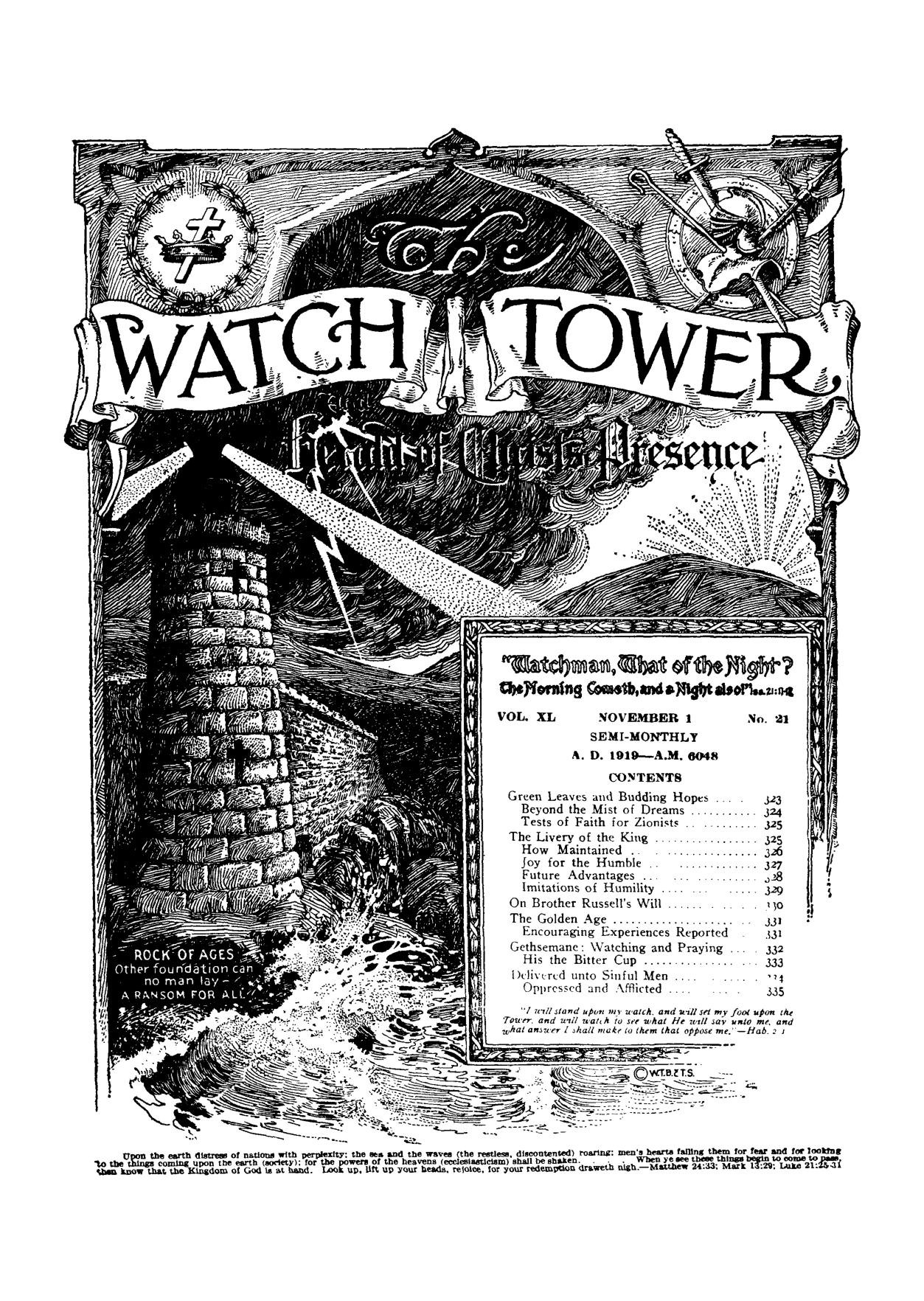
Upon the earth distress of nations with perplexity: the sea and the waves (the restless, discontented) roaring, men shearta ^thmt^lnS
Io the fVtingu coming upon the earth (society): for the powers of the heavens (eccleslastlclsm) shall be shaken. . . when ye see them things pewiato> come w pam. SmtnowSiat the Kingdom of God is at hand. Look up. Utt up your heads, rejoice, for your redemption draweth nigh.—Matthew 24.33. Mark 13.29. Luke 31.3»41
THIS JOURNAL AND ITS SACRED MISSION
THIS Journal is one of the prime factors or instruments in the system of Bible Instruction, or "Seminary Extension," now beln£ presented in all parts of the civilized world by the Watch Town Bible & Tract Society, chartered A. D. 1881, “For the Promotion of Christian Knowledge.” It not only serves as a class room where Bible Students may meet In the study of the Divine Word, but also as a channel ot communication through which they may be reached with announcements of the Society’s Conventions and Ol the coming of its traveling representatives styled “Pilgrims,” and refreshed with reports of its Conventions.
Our "Berean Lessons" are topical rehearsals or reviews of our Society’s published Studies, most entertainingly arranged, and very helpful to all who would merit the only honorary degree which the Society accords, viz., Verbi Dei Minister (V.D.M.), which, translated into English, is Minister oj the Divine Word. Our treatment of the International S. S. Lessons is specially for the older Bible Students and Teachers. By some this feature is considered Indispensable.
This Journal stands firmly for the defense of the only true foundation of the Christian’s hope now being so generally repudiated— Redemption through the precious blood of “the Man Christ Jesus, who gave Himself a Hansom [a corresponding price, a substitute] for *11." (1 Pet. 1:19; 1 Tim. 2:6.) Building up on this sure foundation the gold, silver and precious stones (1 Cor. 3:11-15; 2 Pet 1:5-11) of the Word of God, its further mission is to—"Make all see what is the fellowship of the Mystery which . . . has been hid In God, ... to the intent that now might be made known by the Church the manifold wisdom of God”—“which in other Ager was not made known unto the sons of men as it is now revealed.”—Eph. 3 :5-9, 10.
It stands free from all parties, sects and creeds of men, while it seeks more and more to bring its every utterance into fullest subjection to the will of God In Christ, as expressed in the Holy Scriptures. It is thus free to declare boldly whatsoever the Lord Hath spoken—according to the Divine wisdom granted unto us, to understand. Its attitude is not dogmatical, but confident; for we mow whereof we affirm, treading with Implicit faith upon the sure promises of God. It is held as a trust, to be used only in His service; hence our decisions relative to what may and what may not appear in its columns must be according to our judgment of His good pleasure, the teaching of His Word, for the upbuilding of His people in grace and knowledge. And we not only Invite but urge our readers to prove all its utterances by the Infallible Word to which reference is constantly made, to facilitate such testing
TO US THE SCRIPTURES CLEARLY TEACH
That the Church is “the Temple of the Living God”—peculiarly “His workmanship ;” that its construction has been in progress throughout the Gospel Age—ever since Christ became the world's Redeemer and the Chief Corner Stone of His Temple, through which, when finished, God’s blessing shall come "to all people,” and they find access to Him.—1 Cor. 3:16, 17 ; Eph. 2:20-22: Gem 28 :14 ; Gal. 3 :29.
That meantime the chiseling, shaping and polishing of consecrated believers in Christ’s Atonement for sin, progresses; and when the last of these "living stones,” "Elect and precious," shall have been made ready, the great Master Workman will bring all together In the First Resurrection ; and the Temple shall be filled with His glory, and be the meeting place between God and men throughout the Millennium.—Rev. 15 .5-8.
‘.Chat the Basis of Hope, for the Church and the World, lies in the fact that “Jesus Christ, by the grace of God, tasted death for evert, man," “a Ransom for all,” and will be “the true Light which lighteth every man that cometh into the world," “in due time.”— Heb. 2 :9 ; John 1:9:1 Tim. 2 :5, 6.
That the Hope of the Church Is that she may be like her Lord, “see Him as He is,” be “partaker of the Divine nature,” and share H1B glory as His joint-heir.—1 John 3:2; John 17:24; Rom. 8:17; 2 Pet. 1:4.
That the present mission of the Church is the perfecting of the saints for the future work of service; to develop in herself every grace J to be God’s witness to the world ; and to prepare to be kings and priests in the next Age.—Eph. 4 :12 ; Matt. 24 :14 ; Rev. 1:6; 20
That the hope for the World lies in the blessings of knowledge and opportunity to be brought to all by Christ’s Millennial Kingdom— the Restitution of all that was lost in Adam, to all the willing and obedient, at the hands of their Redeemer and His glorified Church—when all the wilfully wicked will be destroyed.—Acts 3 :19-23 ; Isa. 35.
i’l BiJSHf.n BX
WATCH TOWER BIBLE AND TRACT SOCIETY
119 FEDERAL STREET. PITTSBURGH. PA . U. S. A.
The Watch Tower Editorial Committee:
This journal is published under the supers ision of an Editorial Committee at least three of whom hase read and approved as truth each and every article appearing in these colums. The names of the Editorial Committee are: J. F. Rutherford. W E. Vas Amburgh, F. H. Rohi.son. Geo. H. Fisher. W. E. Page
ANNUAL SURSCRIPI ION BRICE $1.00 IN ADV ANCl’..
SEND MONEY BY EXPRESS. BANK 1»R\FT. POSTAL ORDER, OR REGISTERED
Terms to the Lord*® Poor as follows—All Bible Students who, by reason ot old age or other infirmity or adversity, are unable to j ay for this journal, will be supplied Free if the> send a Postal Card each May stating their case and requesting its continuance. We are not onl> willing, but anxious, that all such be on our list continual^ and in touch with the Studies, etc.
NOTICE TO ALL TOWER SUBSCRIBERS — Please remember that as a rule we no longer send a card ot acknowledgment lor a renewal or for a new subscription. Receipt and entry ot renewal are indicated within a month by change in date ot expiration of the subscription on the Tower wrapper
When requesting change of address, please give old address as well as new. This is verv important, saving us much tune and unnecessary correspondence.
ENTERED AS SECOX IH'I.\SS MXIll'R VI I’I I’1 S Bl Ri. H , J’A .. I’OSTOFEICE INDER J HE W1 < >}■ MXRCH ,;RD,
NOTICE OF ANNUAL MEETING OF THE SHAREHOLDERS OF THE WATCH TOWER BIBLE AND TRACT SOCIETY
Notice is hereby given that the annual meeting 01 the shareholders of the Watch Tower Bible and Tract Society "ill b. held at Carnegie Hall, City of Pittsburgh, Allegheny County. I’cniisylvania, on the 3rd day of Jarman. loco, at 10 o'clockin the forenoon, for the purpo-c- of electing director- and officer- for the ensiling year, and tor the tran-action ol -u.'h other bti-inc-- as may properly come before -aid meeting. Forms for proxies will lie -ent out with the 1 kcember 1st WviCH Tow EK.
\\ . E. Van Ambukch, Secretary.
LOCAL CONVENTIONS AT THANKSGIVING SEASON
Quite a number of local conventions will be held this year during the Thanksgiving season. Among the number already arranged for are:
Chicago, Ill., November 27-30. Brother Rutherford and several pilgrim brethren will be present. For further information address Entertainment Committee. 1305 Masonic Temple, Chicago, Ill.
Grand Rapids, Mich., November 27-30. Brother Rutherford hopes to be present on the 28th. For further information address S. C. DeGroot. 550 Lyon Street N. E., Grand Rapids, Mich.
Cincinnati, O., November 29. 30 Address Victor Schmidt. 545 West 7th Street, Cincinnati, ().. for information concerning’; this convention.
Boston, Mass., November 27-30. Swedish. For further information address Seth W. Blom, 135 P St., South Boston, Mass.
Toledo, O., November 27-30. For further information address C. W. Smith, 1021 Varland Ave.. Toledo, Ohio.
Evansville, Ind., November 27-30. For further information address Mts. Helen Forstmeyer, 210 Read St., Evansville, Ind.
St. Louis, Mo., November 27-30. J. B. Bernoudy. 7033 Lindell Ave., can be addressed for further information regarding this convention.
San Antonio, Texas, November 27-30. All meetings will be held in the I B. S, A, Hall, 117 N Floris. Friends wishing to attend notify Brother J. C. Cox, 124 Water Street.
Brother Rutherford will address the following local conventions. Paterson. N. -I.. November 9th: Reading. Pa. November 16th: Brooklyn. N. Y . November 23rd. Grand Rapids. Mich.. November 28th: and Chicago. III.. <>n November 30th.
NATIONAL LABOR TRIBUNE
Headers of The Watch Tower are familiar with the fearlessness of which the National Labor Tribune has put forth the message of Truth. Being an independent paper, many read the message in it who would not read it otherwise. It carries each week an article < omerning the Divine Plan. We earnestly recommend that the friends everywhere show their appreciation by getting the Labor Tri bune into the hands of as many readers as possible. This paper has served as a good medium for the volunteer message.
PRINTERS' DELAY IN SHIPPING TOWER REPRINTS
We are much chagrined in having to apologize for the long and unexpected delay* in getting the rir-t three volumes of old Watch Tower.k reprint- into the hands of those who have ordered and paid for them. We wish to assure the friends that everything in our power ha- been done to expedite the matter and to make good our promises of shipment. Urgent wire request as we go to press has brought the promise from our printers that they will begin shipment on November 15th. Strikes and other difficulties in trades involving binders' supplies seem to have been largely responsible for unexpected retarding of the work.
BETHEL HYMNS FOR DECEMBER
After the close of the hymn the Bethel family listens to the reading of ’My Vow I'nto the Lord,’’ then joins in prayer At the breakfast table the Manna text is considered. Hymns for November follow: (I) 95: (2) 14; (3) 125: (4) 91; (5) 180: (6) 119; (7) 267: (8) 328; (9) 218 (10) 219; (ID 130; (12) 198; (13) 145; (14) 296; (15)
288; (16) 114; (17) 315: (18) 293; (19) 44; (20) 205;
(21) 326: (22) 256; (23) 255; (24) 139; (25) 140; (26)
120; (27) 87; (28) 107; (29) 275; (30) 186; (31) 8.
WATCH TOWER.
AND HEPALD OF CHRISTS PRESENCE
Vol. xl November 1, 1919 No. 21
GREEN LEAVES AND BUDDING HOPES
".Vote learn a parable of the fig tree: when his branch is yet tender, and putteth forth leaves, ye know that summer is nigh.” Matthew 24 132. '
N THIS parable our Lord was speaking, evidently, of the Jewish nation and its revivescence after a long period of disfavor. This new life in matters Jewish was to be looked upon by the Lord's followers as one of the signs of the oncoming establishment of Messiah's kingdom for the blessing of all the families of the earth. Sometime before Jesus gave this
little parable he had cursed the fig tree because it was barren, and it had withered so quickly as to astound the disciples who watched it. The Master identified his little tableau with the Jewish nation when, using another figure of speech well known by all the ('Id Testament prophets, he said: erily I say unto
vou if ye have faith, and doubt not, ye shall not only do this to the fig tree, but also if ye shall say unto this mountain, be thou removed, and be thou cast into the sea ; it shall be done”.—Matthew 21 :2I.
Speaking under the direction of the holy Spirit, those disciples or their successors did subsequently “declare the whole counsel of God” (Acts 20:27), in which was included pronouncements of the utter overthrow of the Jewish polity. If they did nothing else in this connection some of them at least recorded the strong words of our Master respecting the destruction of the temple, the misery which would come upon the populace, and other like utterances. In thus doing they were announcing to the mountain, or kingdom, of Israel its removal and its dissolution in the distressing times which did actually come upon Jerusalem and Judea, terminating, respectively, in the years 70 and 73 A.D. Furthermore, the preaching of the disciples to the effect that the church “must through much tribulation enter into the kingdom of God” (Acts 14:22), thus become members of the Isaac class, and heirs according to the promise, had the effect of withering the natural hopes of Israel (the fig tree upon which our Lord found leaves of profession and expectation but no fruit worthy of their continuance in divine favor), for they had hoped that the Messiah would bring them worldly glory and material prosperity.
THE LAND TO ABRAHAM
They were not without basis for these expectations; for Jehovah had promised the “land” to Abraham and to his seed after him, and the prophets had held before them the picture of a refreshed and happy earth. Being weak in faith, and hence slow of heart to believe all that the prophets had spoken, they could not see the period of waiting during which the spiritual seed of Abraham was to be gathered out, first from the Jews and then from the Gentiles, which spiritual seed was to be “as the stars of heaven” in brilliancy and height of glory.
Since, then, the preaching of sacrifice dampened the earthly hopes of the Jews, as did also the destruction of its capital and national government, it follows logically that the proclamation of the earthly blessing and splendor, together with the restoration of its national capital, would cause the hopes of the fig-tree nation, Jewry, for centuries withered and barren, to -pring up anew. The curse which our Lord denounced against the fig tree is rather too strongly stated in our King James version. The Greek text says: “Let no fruit grow on thee to the [termination of the] age”. Now, at the termination of the age, we can see Jewish hopes springing forth like green foliage, and taking the shape of Zionist activities. Only twenty-five years ago the Zionist movement was practically unknown. When it first made its appearance it appealed only to the poor Jews. The rich and prosperous very generally sneered at the movement as impractical, foolish, visionary. Rabbis, editors, and other prominent Hebrews decried the thing, fearing that the burden of disesteem and blame for the actions of their poorer brethren would fall upon them.
But gradually Jewish sentiment has veered more and more toward Zionism, until today there are few even of the rich and prominent Jews who find it judicious to speak slightingly of it. The Annual Convention of Zionist Organizations of America was recently held in Chicago and was attended by prominent Jews from all over the country. The Chicago Daily Tribune, of September 13, carried an advance contribution by Judge Hugo Pam, outlining the general situation among the Jews:
“The world war has brought to light one after another the great latent social and national problems of the world. Among these is the establishment of Palestine as a homeland for the Jewish people.
“After eighteen centuries and a half since Titus took Jerusalem. house by house, and rendered its soil barren and sterile, the Jews and Palestine had been strangers to each other. Since that time they have lived in dispersion, but in the hearts of all Jews, save a few v ho desired to be known as assimila-tionists, there has been a longing for the return of the Jews to Palestine, not merely from either a religious or sentimental standpoint, but from a consciousness of national life which could best be expressed in the land of their fathers. Throughout these centuries the pious Jew has prayed morning and night for the day to come when once more the land of Paie--tine shall be restored to the Jewish people
FORCED BY POGROMS TO MOVE
“The year 1882 marked the beginning of serious programs in the pale, namely, in Russia. Poland, Galicia, and Roumani.i. As a consequence, the Jews were compelled to leave the pale. The main stream of emigrants turned to the west, attracted by the small, but wealthy and powerful Jewish communities in western Europe, who had enjoyed comparative emancipation.
“Thousands settled in England, hundreds of thousands crossed the Atlantic and came to our shores, finding here two sadly needed requirements, a friendly government and a growing land.
“While this emigration to western Europe and to our country was of a momentous consequence fbr those countries and for the Jews, yet it was not destined to be so important a factor in the development of the national life of the Jews as the tiny stream of pioneers which began at the same period to flow southeast from the pale to Palestine. This return to Palestine can be compared favorably in pioneering to the emigration of the Pilgrim Fathers to America.
“The struggle has been a hard one; the difficulties great, the odds tremendous, at times the outlook disheartening, but courage never forsook them, despair never enveloped them.
“In the great war just over, one of the great principles fought for was the right of self-determination. It was this same principle, living eternally in the heart of the Jew, wh;ch led to the beginning of the Zionist movement. The Zionists took up the cause of the colonists in Palestine who had made these great sacrifices; but the Zionist organization not only has for its purpose the restoration of Palestine as a homeland for the Jewish people, but the establishment of a government therein, which shall take its place side by side with those governments which for the last few years have been fightinc for the cause of humanity and justice.’’
Two days afterward the Chicago Evening American published a first report of the convention sessions, parts of which we quote as follows:
“ ‘Who will go to Palestine ?’
“Dr, Stephen S. Wise, head of the Zionists, who are now in convention at the Auditorium Theater, today answered this important question by saying:
“‘The question of who is to go to Palestine is one for the individual to decide. Palestine cannot now and never will be able to house all the Jews in the world. Maybe in a generation or two one-third of the world's Jewry may be able to dwell there. We now are endeavoring to retard immigration to Palestine until such time as the land can be made ready for those who desire to move there.’ ”
“The opening session yesterday was marked for its fervor and feeling in anticipation of the realization of years of longing and hope for the rebuilding of their homeland. There were cheers and tears, weeping and laughter as the great crowd was moved by the words of an array of powerful speakers.”
BEYOND THE MIST OF DEE AMS
On the same day, September 15, the Chicago Daily Tribune added the following items touching on the actual physical needs and development of Palestine :
“ ‘Palestine is now a nation, ready for its people. It has grown beyond the mist of dreams. It has the needs of a new nation—schools, bridges, railroads, house building, development of the soil, water power, and sanitation.
"Palestine needs the kind of men who will go there to make Palestine better—not the kind who will go to make themselves greater. We want men who will make sacrifices, not for profit, but for spiritual longing.
"The work will take time. And remember that we are not building for the present, not for a century, but for all time. We must build slowly and we must build well.’
“He [Judge Mack] closed his address with the statement that the enrollment of 150,000 Jews in the movement in the last year had proved that nine-tenths of the Jews in America are Zionists.”
"In a report of the activities of the organization for the last year Jacob de Haas, executive secretary, gave a detailed account of the complete reorganization of the movement in this country.”
“The report carried the information that through the Palestine bureau under Israel Goldberg, 4,961 prospective Palestine immigrants were registered with a joint capital of $3,994,385.
"According to the report, the Society of Zionist Engineers and Agriculturists acquired a membership of 354 persons who are devoting their scientific knowledge to the development of Palestine through the planning of railroads, harbors, hydraulic plants, and highroads.”
It seems that there was the most marked enthusiasm among all the delegates attending. An interesting item was mentioned by Professor Felix Frankfurter, confidential secretary to Secretary of War Baker during he war, and an attache at the peace conference:
“Among the members of the peace conference [in Parisi there was no dissent to the Zionist cause.”
The Scriptural aspect of the government which the Zionists hope to establish in Palestine was made very plain in this convention as reported by the Chicago Daily News, of September 16:
“There will be no profiteering in Palestine. The land is to be owned by the state. All its public utilities are to be owned by the people. As many as possible of its private industries are to be nationally operated.
“There will be no ‘loan sharks’ in Palestine. Banking will be in the hands of the people as a state. It will be impossible for individuals to speculate in land or commodities. In fact, it will be impossible in Palestine for any individual to acquire a large fortune.
“This sounds on the surface as if the new Jewish state of Palestine has had its government system specially arranged by Messrs. Lenin and Trotzky. To the contrary’, the social democracy on which Palestine as a nation will begin its existence is something like 3.000 years old. It incorporates the Biblical communist laws of the Jewish tribes, and adds to them the experience in practical democracy given the world by the United States.”
“ ‘Certain reforms we will introduce are radical in appearance, but they are no more than ordinary democratic reforms —the elimination of trusts, huge private fortunes and the like All these things will be possible under a British rule.
“ ‘The Jews in Palestine, instead of working to pile up individual fortunes for a small percent of their people, will work to pile up the state’s fortune, which in turn will be used for improvement of national conditions and the people’s welfare.’
“Supreme Court Justice Louis Brandeis spoke today in a private committee hearing at the Auditorium.
“ ‘Palestine is capable of accomodating a million more Jews than it has; of being developed into a prosperous state in which the Jews may live, work and develop their nationalism to a point where it will contribute vitally to the world’s progress and their own,’ he said.”
ANCIENT HEBBEW BEING REVIVED
The Hebrew language is expected to be used very generally in Palestine, as is shown by remarks in the Chicago Daily News, of September 17, reporting on another day of the Zionist Convention:
“Can Hebrew come back? Entombed for centuries among the rabbinical books of the race, almost as dead as the language the Babylonians and the Medes once talked, Hebrew is to be restored to the tongues of the Jews. At least the Zionists, assembled in their convention at the Auditorium theater, have made up their minds that it will.
“This restoration of the ancient Jewish language was voted today by the delegates as part of the program to renationalize Palestine. Every reference to Hebrew was cheered and applauded by delegates, a good half of whom are themselves unable to speak it. A motion to devote 25 percent of all funds raised for Palestine work to the Hebrew and Zionist education of American Jewish children and adults was passed enthusiastically.”
“Hebrew is one of the most passionate and resonant of languages. It is a speech fit for intense expression. Oscar Wilde’s Salome reads better in its Hebrew translation than in the original. So do countless English, French and German literary works.
“It is a language which in itself elevates its speaker. Its idioms almost make wisdom easy. There is no reason why Jews should allow a language so rich in attainment to die. When Palestine becomes established as the Jewish homeland, Hebrew must become established as the talk of the Jews."
In confirmation of this is the fact reported by The Maccabaean, for September, that a Hebrew daily is just being started- in Jerusalem, the first number appearing on June 18, 1919. The Maccabaean adds:
“This day should become a red-letter day in the annals of Jewish journalism.”
From other similar items we choose the following one at random from the Philadelphia Record, of September 7, which speaks of the interest manifested by Jews in Pottsville, Pennsylvania, in the re-establishment of Palestine. Parts of that news item we quote as follows:
“Foreseeing pilgrimages to Palestine which will rival in numbers and enthusiasm the Crusades of the Middle Ages, prominent Jews of this region, working in connection with others in Philadelphia. New York, and Chicago, are literally ‘selling ail they have' and are preparing to make their future home, for some years at least, in Jerusalem.
"Clinton B. Reed, a local real estate dealer, was astonished this week when a prominent Jew ordered all his houses in Pottsville placed on the market, so that he can have a free hand in going to Jerusalem. 'I expect to return to America, and will not give up my citizenship,’ said this man, ‘but I will be more or less out of touch with this country for several years and wish to have a mind free from investment worries.’ ’’
TESTS or FAITH FOB ZIONISTS
Of course we must expect that all will not be sunshine with the Zionist movement. Already prominent international politicians are beginning to realize the drift of the rehabilitation of Palestine. They begin to realize that with Palestine as a separate state, and especially with the Biblical principles of theocratic democracy in operation, their own sordid schemes for dominion and often unholy commercial aggrandizement will not show up in an advantageous light. Some have gone so far as to say that the greatest peril to the peace of Palestine is Zionism. They fear that that little war-ridden country will see another war unless Zionism is arrested. The following paragraph taken from the Buffalo Illustrated Express, and written by one of the many pro-British journalists, shows how Zionism's possibilities are viewed by some politicians:
“Given peaceful development under British direction, it will develop into the peak of the British Empire, the keystone of the Cape-Cairo-Calcutta arch. But given the continued menace of Jewish immigration, its population will break out into an anti-Zionist war, which quite conceivably may bring down Egypt, Mesopotamia, Persia. Afghanistan and India and involve the world in a new chaos.”
It should not be expected by either Christians or Zionists that so stupendous a matter as the fulfillment of the earthly phases of God’s promise to Abraham would come unnoticed or unchallenged by the god of this world and by his colaborators in high worldly places. Jehovah intends that the return of Israel to Palestine shall be accomplished in such a way as to develop the faith of his fleshly people. If all went swimmingly along, with no great obstacles to be overcome, the Jews might think that it was their own astuteness and sagacity, coupled with inborn energy and industry, which accomplished the restoration of their ancient homeland.
But it is not likely that room will be left for any flesh to glory in Jehovah’s presence. All the glory will belong to him. Zionists need not be discouraged or fear even though all the powers of the world should combine against them. The Scriptures intimate that some such difficulty as pointed out in the last foregoing quotation may be encountered a few years hence and that in the midst of this, “Jacob’s trouble”, God will appear and lend them assistance, fighting their battles as in the days of old. Probably this help will be rendered by the reappearance of such eminent worthies as Abraham, Isaac, and Jacob, who as princes in all the earth will be empowered to take hold of Israel and reestablish peace and order and gradually, with the assistance of others of the same class, spread the knowledge of the change of rulership from Satan, the god of this present order, to Messiah, the Anointed of God, who shall usher in the kingdom of righteousness and fulfill the desire of all nations.
All the prophets have spoken glowingly of that time. Isaiah points out that “of the increase of his government and peace there shall be no end, upon the throne of David and upon his kingdom, to order it, and to establish it with judgment and with justice from henceforth even for ever. The zeal of the Lord of hosts will perform this.”—Isaiah 9:6, 7.
THE LIVERY OF THE KING
"Be ye clothed with humility.’1—1 Peter 5:5.
HE mighty ones of earth invest their servant class with such raiment as they choose; and livery thus chosen is intended to comport with the respective stations, powers, and honors of the masters whom those servants serve. Not less so has Jehovah, the Mighty of all mighty ones, decreed the habiliments of those who are his voluntary slaves. (Titus 1 :i; Philip-pians t;i) That vesture is humility. As the attendant of an earthly potentate could not hope to do the duties of his office clothed in raiment of his own choice, so the servant of the King of kings cannot expect to render service to his Master without the garments which his Lord has prescribed for him.
Since the inspired Apostle uses the figure of clothing there must be some points of favorable comparison or analogy between clothing and its relationship to human experiences on the one hand and humility and its uses in the Christian life on the other. There may be others, but there are at least three proper uses which clothing serves in the economy of the human race:
First, it serves as a covering;
Second, as a protection;
And thirdly, as an ornament.
Attire which serves the first of these three purposes without the latter two is inadequate, as well as crude; clothing which serves as a covering and as a protection and yet is in no degree ornamental seems inappropriate to the finer structure of the human frame; and trappings, however gorgeous or ornate, which cover and adorn, but which do not protect, are lacking in practicality. All three uses seem to be legitimate.
So too with those who are in Christ; humility makes up the vestment which (1) covers us, or hides from view our selfish selves; (2) which protects us as new creatures from many a brunt and hurt felt by the proud and over-sensitive; and (3) serves the whole being as adornment, enhancing every other Christian grace—“the ornament of a meek and quiet spirit, which in God’s sight is of great price”. (1 Peter 3 :q) The one who has humility will not be expecting so much in the way of deference to his position or ability and is, therefore, not disappointed when it is not forthcoming. But if he be hurt, he will be able to mollify the pain greatly by thinking that the affront was not intended, or, being intended in a measure, the offender did not realize how much the offense hurt.
Clothes do not necessarily hamper one in his liberty of body; nor does the wearing of clothing narrow the sphere of usefulness. Quite to the contrary, clothing broadens the sphere of usefulness; and while it may hide the person, it does not hide the personality. And so it is with humility; it works nothing but advantage in the Christian life. Without it we could not be used at all by our heavenly Lord and King.
The best dressed man is the one whose clothing is so fitting to his general self that, after he is gone, one does not remember what he wore, but merely retains an impression of his general personality. And certain it is that humility can be no conscious grace. The mantle of our humbleness must be, though noted by all other eyes, “unworthy in cur own”.
A DEFINITION
For purposes of Christian practice we may define humility as being a willingness to occupy one’s appropriate position in respect to the Lord, his people, his providences and his work. Or, in other words, it is the disposition, or preference, to do God’s will and to follow his judgment rather than one’s own.
No more notable example of this spirit can be found than that of our Lord himself, who was “meek and lowly of heart”, and who prayed in the hour of his greatest grief: “Not my will but thine be done”. He had a will, a decided natural preference, not to suffer unnecessarily, or, possibly, as a blasphemer, but he had another and still higher desire and that was to follow the supreme will and wisdom of his Father.
Another instance may be cited in the conduct of the Apostle Peter at the time of the conversion of Cornelius. Peter’s previous experience, everything that he had been taught throughout his life, inclined away from the thought of preaching to the Gentiles. Yet when a special vision was given him indicating that God’s will was different from his own judgment, he humbly laid aside his own thoughts, and gladly followed the vision, went to Cornelius’ home and delivered the message. That he had not fully seen through the whys and wherefores of the situation is manifest by his uncertainty on the selfsame subject years afterward.
Thus it will be seen that humility lies at the very root of obedience. The haughty spirit that went before the fall of Satan now “ruleth in the hearts of the children of disobedience”. But we who would “follow the Lamb whithersoever he goeth” are invited to “learn of him, for he is meek and lowly of heart”.
HOW ATTAINED
As far as humility relates to imperfect creatures, it carries with it the thought of conscious inferiority— perhaps in comparison with fellow creatures, but certainly in comparison with God. Usually the inclination of mind favorable to humility is produced by a long chain of circumstances, the effect of which is to break confidence in one’s own ability to plan and carry out his life to his own satisfaction. The individual comes to a point in life where he or she is willing to occupy his appropriate position in respect to the Lord and his providences, divine wisdom, as expressed through God’s Word, to be the standard of decision.
There are various circumstances, influences, and experiences which contribute toward bringing this willingness into the hearts of some people. Those who do not possess this disposition at one time in life may possess it later on, when failure of their ideals or endeavors have led them to see their own situation more nearly in its true light. Those who never have this disposition of humility will not be looking for divine favor because they are still filled with their own feeling of self-importance and self-superiority. “The wicked through pride will not seek God.” (Psalm 10:4) But with the Lord’s people, those who are already in relationship with God through Christ and walking in the narrow way, the question is not so much how humility is originally attained or produced, but how it can be maintained. Those who stand in the relationship of sons to God may be sure that their humility was of an acceptable quality at the time of their consecration; otherwise God would have resisted them, as he does all the proud. The great question, then, with the Lord’s people is how to maintain the same attitude which they bore toward God’s will at the time of their consecration, and maintain this throughout all the changes of their Christian way.
HOW MAINTAINED
There are a number of influences which help to maintain humility in the Christian heart. Among these we mention the influence of sentiment, the force of reason, and the encouragement of divine instructive providences.
Some of the Lord’s people might be inclined to exclude sentiment from this field. But the trouble with sentiment is not that it is wrong in itself but that it is sometimes allowed to be the deciding factor in our lives. The whole realm of sentiment and emotion is one which furnishes excellent motive power, but it will never do to take the place of justice and to direct our conduct. The trouble with father Adam, and the trouble with hundreds of millions of his progeny, is that they allow sentiment to rule. Fire is an excellent thing and is indispensable as God has constitued human affairs; but it must always be kept within proper bounds. So also with sentiment.
Under the heading of sentiment we have (a) appreciation, (b) gratitude, and (c) thanksgiving. Appreciation might be termed an intellectual sentiment. We get a view of God's greatness and of some of the beauties of his character as revealed in his Word; our minds reach out for these desirable conceptions and we appreciate the qualities of Jehovah which have prompted his wisdom to devise a plan whereby his justice can remain inviolate and still allow his power to effect the salvation of a sin-cursed and imperfect race. Many people see thus far, but do not allow their appreciation to sink deeper than their intellect.
When appreciation percolates more deeply into the life and consciousness of the individual, when it goes as far as the heart, we call it gratitude. Gratitude is nothing more nor less than heart appreciation. We not only appreciate God's great plan as our minds might appreciate the design and workings of an intricate piece of machinery, but we realize that his beneficent designs will work blessing for us and for those we hold dear. We therefore become grateful to God. Both of these degrees of appreciation are powerful influences to the maintenance of humility on our part. They assist us in keeping our proper relationship to Jehovah in mind; which means that we will be very, very small and he very, very great. It would almost seem that, if our appreciation were sufficiently keen and our gratitude to God sufficiently genuine, there would be no room for pride.
But “out of the abundance of the heart the mouth speaketh”. If the heart is full of gratitude, some of it will find expression in thanksgiving. Thanksgiving is the expressing by word, act, or general conduct the gratitude which dwells within our hearts. The expressing of this gratitude tends to clarify- in our own minds our vision of the causes for gratitude. This increases our original appreciation, the appreciation increases our gratitude, and so the whole cycle of sentiments is more or less self-perpetuating, if fed on the right kind of knowledge. The difficulty is that very-small and comparatively insignificant influences in the earth tend to displace and to render obscure our understanding of God's plans and purposes. It is for this reason that we are admonished to meet together with those of like precious faith that we may be refreshed and invigorated, fed and strengthened by a knowledge of God’s will, and brought into conformity with the image of him that hath created us as new creatures.—Colossians 3:10.
REASON DOES THE DECIDING
The faculty with which the Lord has endowed us and which enables us to decide or to determine the right or wrong course, the advantageous or disadvantageous way of life, is reason. Reason is a process of comparing. By it we compare the things which we have with the things which we do not have but need, in order to perfect our happiness and to make us acceptable in the sight of God. Reason looks at the matter of humility purely from the standpoint of advantage and disadvantage. Reason says that no matter how strongly sentiment might incline toward humility, that quality must not be exercised unless the proposition is worth while. Reason looks with cool calculation, first, at the present advantages, and second, at the future advantages.
Under the present advantages reason finds, first, divine favor. This in a sense includes all the other advantages. He "giveth grace to the humble”. (2 Peter 5:5) Divine grace, or favor, cannot be purchased with gifts of worldly value, but the sacrifice of a humble and contrite heart is ever acceptable to him. Men have waded through fire and blood over half a world to attain or maintain their favor with some very fallible earthly potentate. How much more willing ought we not be to secure the favor of the King of kings and Lord of lords!
But this is more than a matter of sentiment; it is a matter in which our vital interests are bound up. In Psalm 30:5 we read that in (Kiel’s “favor is life”. If his favor is withheld from the proud, then the proud have no prospect of life—in his disfavor is death, as is shown by the experience of the world for six thousand years. Our very eternal existence is bound up with our possession of divine favor. This is to be had and is had by the humble, now.
The necessity for humility explains many of the divine providences which would otherwise be quite inexplicable. When the Lord spoke to Moses of old he intimated to him that the experiences which would be his portion would be to "humble [him] and to prove [him]”. (Deuteronomy 8:2) If we are unable to locate the cause of some particularly trying experience, w-e may at least be sure that it will serve the purpose of either humbling us or proving us, and possibly both purposes at the same time. It may produce in us a greater degree or finer quality of humility than we possessed before, or it may merely put to the test the humility which we did actually possess. We may have been previously willing to occupy our appropriate position in respect to the Lord and his providences, and this given experience merely demonstrated that fact to the Lord, to the brethren, and to us. Thus we have peace as a second present advantage from humility in heart and life.
JOY FOR THE HUMBLE
A third present advantage which we have from humility is joy. “The humble shall hear thereof [of God's message] and be glad.” (Psalm 34:2) The whole world is seeking joy, gladness, happiness, but very few of them find it. Those who find it in some measure are soon confronted by the fact that the causes which gave it birth are subject to change and decay. Only those whose joy has its source in the glories set before us in God’s Word can have assurance of its continuance. The proud are not glad to hear of God’s arrangement for the future because it suggests a change from their present selfish practices and institutions.
Another present advantage of humility in the heart is the assurance of divine assistance and encouragement. He dwells “in the high and holy place ...to revive the spirit of the humble and. . .the heart of the contrite ones”. (Isaiah 57:15) Jehovah, he who is from everlasting to everlasting, has taken upon himself the responsibility of furnishing refreshing and reviving influences to those who are humble and contrite of spirit. Nothing we could do would ever give us the right thus to call upon Omnipotence for our own blessing and refreshment. But he stands willing to give it without money and without price to those who have such a sense of the fitness of things that they are willing to stay where they belong, be what they should be, do what they should do, or go where they should go, as indicated by God's Word.
“The meek will he guide in judgment: the meek will he teach his way.” ( Psalm 25:9) Whether the word judgment here be taken as referring to our individual power of judgment and discernment of thing’s or whether it be taken as referring to our judgment or trial period as new creatures makes no great difference, because we will be guided in both respects if we are meek and humble before him. Meekness is merelv the manner of conduct inspired by humility—humility being the inward disposition.
Surely all of us need guidance. People in the world who have legal difficulties are very glad to secure the advice and counsel of a competent advocate before the law. Here is Jehovah, the very Author of wisdom and judgment, standing ready to guide us and to direct us in our efforts to decide and to pursue a rightful course. One of the ways he uses in guiding our judgment is to call our attention to the instructions of his Word. He shows us the advantages of his wav and the disadvantages of a selfish course. We would have very poor judgment indeed to refuse or to decline to enter the way which is fraught with so much of advantage, even in the present time.
Favor, peace, joy, refreshment, guidance: these are some of the present advantages deriving from the possession of humility. There are doubtless many others, but if there were not it seems apparent that the present advantages alone of a humble walk with the Lord are much greater than any loss which we could possibly encounter. Indeed, the disadvantages are very few: a willingness to occupy our appropriate position in respect to God and his providences may cut us off from intimate association with the great ones of the earth. But that loss is only a seeming one, since “the whole world lieth in the wicked one”, (i John 5:19) and friendship or intimate companionship with the world means nothing to the child of God.
FUTURE ADVANTAGES
The Master informs us that “he that humbleth himself [now] shall be exalted”—then. (Luke 14:11; 18:14) He shall exalt us “in due time”. There is a great system of compensation which the Lord inaugurates to the advantage of his people whereby the small inconveniences, discomforts, and privations of the present time which they encounter because of faithfulness to him and his Word shall be much more than paid for in the glories and beauties of the future. If faithful, we shall be exalted from conditions of sorrow, sickness, suffering, death; exalted to happiness, health, peace and life.
The Wise Man informs us: “By humility and the fear of the Lord are riches, and honor, and life”. (Proverbs 22:4) There will be riches of divine favor, even beyond anything which we are now able to ask or think. There will be perfectness of mind. The Apostle assures us that “in him [in Christ] are hidden all the treasures of wisdom and knowledge”. (Colos-sians 2:3) So that if we but win Christ and be found in him we shall have the key to this storehouse of unsearchable wealth. It will mean perfection of memory, of judgment, power to reason abstractly or concretely on any subject without the possibility of error in the process of reasoning. It will mean the power to balance things in our own minds, to see and to maintain their proper relationship and to understand the differences of things. Those riches will also include our bodily perfection on the most glorious of all planes, the divine plane. It will mean a body so wonderfully constructed that it will not be dependent upon sustenance from any outside source. Then too there will be perfection of environment, of life, and of dominion. Those riches will also include riches of fellowship with Jehovah, with Christ Jesus, and with all the faithful saints of the Gospel Age. It will mean riches of opportunity, as well as capacity for blessing “the residue of men”.—Acts 15:13-17.
THE BRIDE'S CHIEF HONOR
By humility and the fear of the Lord we are to have not only riches, but also honor. All of God’s perfect creatures have the honor of divine favor, and all of them have glory in the sense of having perfect balance of character, even as God has. The bride has the honor of sharing the throne with her Lord and King; but this promised honor, we may assume, is something special. Surely it would, at least, include the honor of being where our Lord and Master desires us to be. There is a statement that implies such an honor for the church, and it is one of the most encouraging statements made by Jesus when he said, near the close of his earthly career, praying to the Father concerning the church: “Father, I will that they also, whom thou hast given me, be with me where I am”. (John 17:24) From this we gather the thought that we are not to be merely tolerated by our glorious King; he is not merely conforming himself to the Father’s wishes in the matter without the inspiration of his own desire. He really wants the church to be with him in glory; and to be desired by that heavenly Bridegroom is a great, a special honor coming to the bridal class.
Another future advantage of present humility is life. Life, not in the small, flickering measure in which we now possess it, not even life as perfect human beings; nor is it life on the angelic, seraphic, cherubic, or archangelic planes. Our Lord informed us at his first advent that he went away to prepare a new, a unique and distinct place for the church. Theirs is to be life in such inexhaustible supply that they can use it for the benefit of the nations of earth and still have more than enough for all eternitv. It will be immortality, incorruptibility.
Life in any measure is a blessing. Life is included in the “blessings” given to the animate creation of Jehovah. (Genesis 1 .-28) This animate creation includes some small forms of organism which live only a few hours under the bark of a tree. If life in that small and constricted sphere is a blessing, how much more of a blessing is it on the highest of all planes, with no limitations, save those imposed by wisdom and justice? Surely there is no comparison. It is no wonder the prophet said that “the meek shall eat [of God’s Word] and be satisfied”. (Psalm 22:26) They are satisfied now to the extent that that is possible: they are filled full, but their capacity is very limited. Then they shall be filled with all the fulness of him that filleth all in all.
DIVINE INSTRUCTIVE PROVIDENCES
The means or agencies for the maintainance of humility in our hearts thus far considered have been means which we ourselves can apply. It would seem that they should be sufficient. There is all the advantage of sentiment on the one hand and of reason on the other. The coldest calculation with which it is possible for us to approach the subject of humility shows us that it is worth infinitely more than it can ever cost—worth more in the present life, to say nothing of eternity. But apparently these means are not always sufficient; otherwise it would not be necessary for the Lord to give us humiliating experiences. We may be following all the dictates of the Lord’s Word as best we are able to discern them, when suddenly some particularly difficult and quite unforseen experience comes our way. It is humiliating. But if we are willing to occupy the awkward position which the Lord’s providence has indicated for us under those circumstances we will have demonstrated the presence of true humility in our hearts. We will not fume or fret because of the painful thing—the thing painful to our pride or sense of self-respect.
These divine instructive providences may properly fall under the heading of chastisements. And the Scriptures assure us that chastisements are not necessarily marks of divine disfavor but are intended to be for our blessing and for the purification of our motives and conduct. The humble heart will rejoice that the great Emperor of the Universe has had sufficient interest in that heart’s welfare to give it instruction though the process of that instruction may sorely grieve the flesh of the new creature.—Hebrews 12:11.
THE FOES OF HUMILITY
The enemies of humility are two: pride and vanity. In the minds of many people these qualities are the same, but in reality they are alike only in that they are both detrimental to the exercise of humility. Pride is a condition of heart found in those who are possessed of a disproportionate amount of self-esteem. The person who is proud may not be particularly interested in other people’s conception of him; his own estimate of himself is a very good one, and that is sufficient for him. Vanity is more likely to be found in those of small self-esteem but of correspondingly large appro-bativeness. Approbativeness is not the quality which satisfies one with self-approval; but it is that attribute which reaches out and desires the approval of others, pre-eminently. Pride relates more to our own opinion of ourselves, vanity to what we would have others think of us. Pride is a feeling of elation or exaltation on account of what one is £r has or is connected with. It is an inordinate self-esteem or unreasonable estimate of one’s own superiority, which manifests itself in lofty airs, reserve, and often in contempt of others. It is doubtless for these latter reasons that the Wise Man said: “Pride goeth before destruction and a haughty spirit before a fall”.—Proverbs 16:18.
The person in whom vanity resides may actually feel in his or her private thinking that he is no one, has nothing worthy of special approval, and can do nothing extraordinary; but at the same time the effort of such a person may be to create the impression in the minds of others that he is someone, has something, and can do many wonderful things. It is difficult to say whether the one whose natural inclinations are toward pride or the one whose troubles are with vanity has the more difficult time in the narrow way. One may be very much given to contempt of his fellow man and appear very self-sufficient in dealing with them, but at the same time have a deep reverential feeling toward God. Of such would likely be those who claim to love the Lord and yet who do not love them whom the Lord has begotten. (1 John 4:20) Such a disposition would have to be overcome if progress in the Master’s footsteps be made, foi he was both "meek and lowly of heart” and “he is not ashamed to call them [his followers] brethren”.—Matthew 11:29; Hebrews 2:11.
IMITATIONS OF HUMILITY
On the other hand, the person who finds himself endowed with large approbativeness is much the more pleasant of the two individuals to be associated with. But he might not be truer or more faithful to the Lord. He might incline to “run well for a time” (Galatians 5:7), when such running would not incur a strong disapproval of anyone standing highly in his esteem. The one with large approbativeness instinctively feels what will meet with the approval of those about him and will bend to meet their wishes, not altogether out of desire to bless them, but with some measure of consideration for his own comfort. Of the two diseases vanity is much the harder to detect, even in one’s own self, because it inspires a course of conduct filled with consideration for other people and approaching very closely in outward appearance to the conduct prompted by love.
Some people naturally desire to be in the limelight of prominence. They consider themselves well qualified to occupy such a position. They may have either a disproportionate idea of their own importance, or their judgment may be in some measure correct—they may actually be possessed of superior endowments and may be merely recognizing the facts in the case, to this extent. To be humble does not necessarily mean to falsify to one’s self about what one can do or cannot do. Humility means a willingness to occupy the position which the Lord points out for us, whether we think it commensurate with our powers and dignities on the one hand, or much too great for what we consider our very limited capacities on the other.
Some people naturally prefer to remain in the shadow, and their desire is often inspired by a fear lest they might not appear to sufficiently good advantage if brought into prominence or special activity. What might seem to be a very meek, retiring disposition under such circumstances would be nothing more nor less than vanity. On the other hand, a person who finds satisfaction in self-approval feels that a serious mistake is being made if he is not given a prominent position of some kind. If the person who prefers the limelight stays willingly in the shadow because God’s providence puts him there, then he is developing and manifesting the grace of humility; and most admirable it is. On the other hand, if a person naturally prefers the shadow and the Lord’s providence leads him out into the limelight and he is willing to endure the humiliating consciousness of his own deficiencies and shortcomings because the Lord placed him there and has not seen fit to remove him, if this be his attitude toward God’s will irrespective of and in spite of his natural choice and predilections, that is humility. This retirement of self-will has been well exemplified by a prisoner of Christ Jesus, who, after years of incarceration, was able to write :
“Well pleased a prisoner to be Because, my Lord, it pleaseth thee.”
FEAR OF FAILURE DECEPTIVE
Here is a circumstance which came to our attention some years ago: A brother in a fairly large class had for several years declined a nomination as deacon, always stating as a cause for his withdrawal the fact that he believed himself incapable of rendering acceptable service. Granted that this was his real, genuine conception of his capacity for service as a deacon, would it not have been the more humble way to let the Lord’s providence be indicated by a vote of the class, rather than to trust to his own judgment in the matter? Looking behind his cause given there may have been a fear that he could not discharge his duties in such a manner as to call forth the approval of all, and to spare himself the humiliation he would sidestep the responsibility. If he had said to himself, as he subsequently did: It is my honest judgment that I am not endowed in such a way as to perform the services of deacon in a proper manner; but if the Lord’s providence through the vote of this ecclesia indicates that I shall try, then I will not withhold my hand, but do the best that is within my power. If the class votes me down, I will have every assurance that my original judgment was good and no one will be injured in any manner by the vote. If the class votes me in, it will not necessarily change my conception of my powers but it will be an indication to me that the Lord wishes me to attempt the duties, and if I am not able to discharge them as creditably as I would like, the very humiliation connected with my failures may work a greater blessing for me than I would be able to choose for myself. Furthermore, it may work a blessing for the class in that they will have learned how to choose better the next time. Such a course, finally pursued by the brother, did, we believe, retrieve for him the blessing which his former course of conduct would have lost him. The only means for ascertaining the Lord’s will under the circumstances was not to consult his own choice, but to submit to a vote.
Suppose an experience of this kind: Some good but tactless brother in a testimony meeting says to himself : There are few here who are capable of giving a testimony as good as mine. I therefore feel justified in taking more than my share of the time; for while I am talking the time is at least not being wasted by someone incapable of expressing himself. The brother gets up in the meeting and consumes an entirely disproportionate amount of the time. Of course, the leader should not usually permit such a transgression upon the rights of others but. assuming that he did, the brother who disregarded the Golden Rule in this respect might be perfectly honest in his own heart ■about the value of his usage of the time. He might be conceited, it is true; but he might be honest.
While he is thus expatiating some other brother might sit in the group and say to himself: I am sure I would never do any such thing as that as long as I live. He might be speaking the truth; perhaps he would not thus encroach upon the rights of others. But his motive for avoiding such conduct might not be either pure love for the brethren or a keen sense of justice and right toward them. It might simply be due to a sharp discernment of the fact that such conduct would bring upon him such criticism as he was even then leveling at the le<s considerate brother. While the conduct c>i such an one would be much more admirable and much more conducive to happiness on the part of the other friends present, his motive might not be any better in God’s sight than that of the other brother. The motive of the one in that instance would be pride; the motive of the other would be vanity. Neither would be humility.
…