The Watchtower, September 1, 1919
Download: PDF — The Watchtower, September 1, 1919
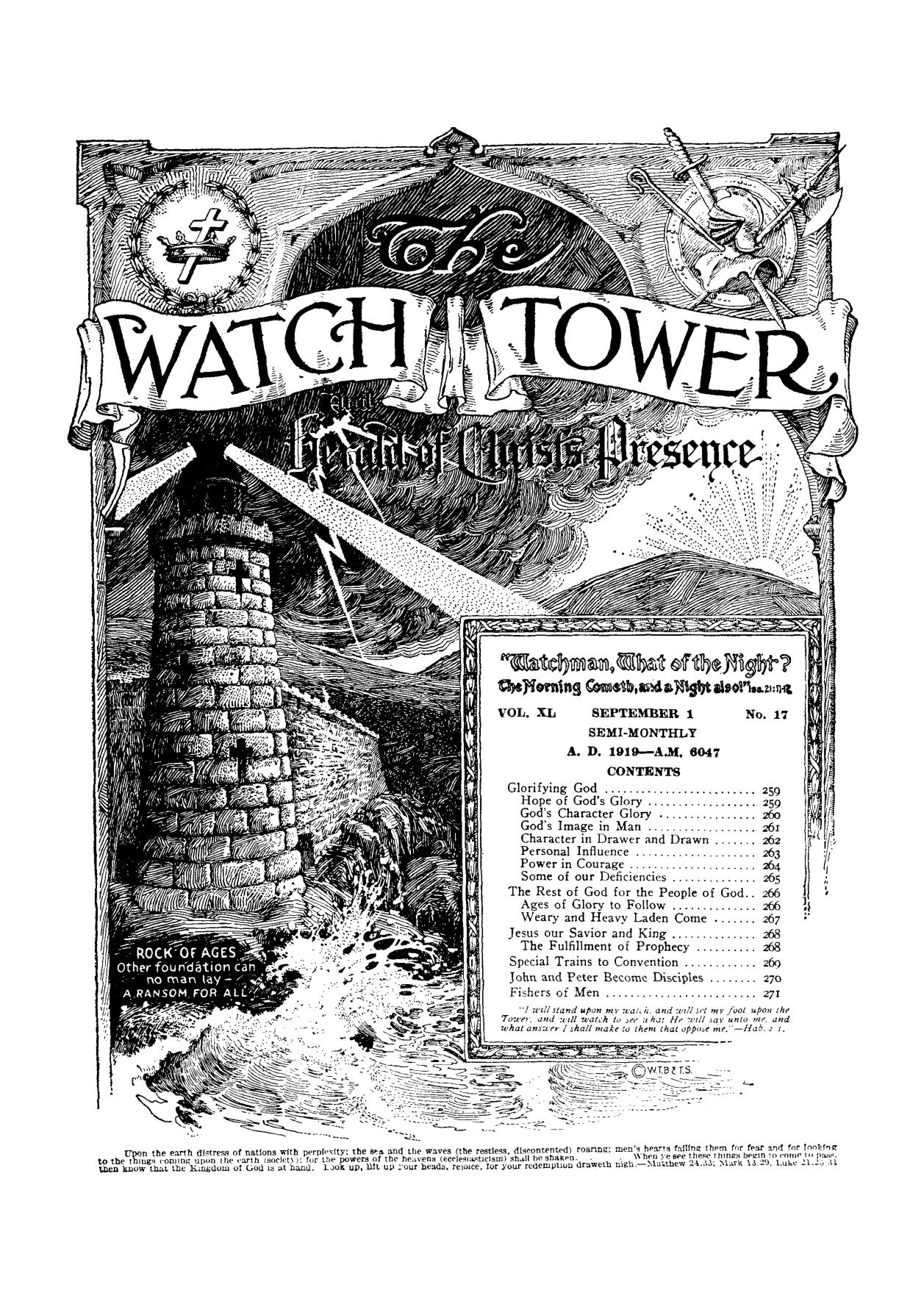
(Wwgrogg
VOL. XL SEPTEMBER 1 SEMI-MONTHLY
No. 17
A. D. 1919—A.M. 6047 CONTENTS
Glorifying God .........................
Hope of God’s Glory..................
God's Character Glory ................
God’s Image in Man ..................
Character in Drawer and Drawn.......
Personal Influence ....................
Power in Courage.....................
Some of our Deficiencies..............
The Rest of God for the People of God..
Ages of Glory to Follow..............
Weary and Heavy Laden Come .......
Jesus our Savior and King..............
The Fulfillment of Prophecy ..........
Special Trains to Convention............
John and Peter Become Disciples........
A.RANSOM. FOR ALL'z<"<*^i
Fishers of Men .........................
‘7 will stand upon mv zvat<.h. and will set mv fool upon the Tower, and will watch to see ithat He will sav unto me. and zvhat answer I shall make to (hern that oppose nie."—Hab. 2 1.
Upon the earth distress of nations with perplexity: the sea and the waves the restless, discontented) roanng. men s hearts Mine
to the things coming upon the earth (society: for the powers of the heavens (ecclesixstjcism) shall be shaken . . W 04eT\ \\frk 11 Luke '1 ’31
then know that the Kingdom ot God is at hand. Look up. Hit up your heads, rejoice, for your redemption drawetb mgh.—Matthew -4.33. Mark 13.-J. Luke -1..0 .st
THIS JOURNAL AND ITS SAGRED MISSION
THIS Journal is one of the prime factors or Instruments in the system of Bible Instruction, or "Seminary Extension,” DOW beinfc presented in all parts of the civilized world by the Watch Tower Bible & Tract Society, chartered A. D. 1881, “For the Promotion of Christian Knowledge." It not only serves as a class room where Bible Students may meet in the study of the Divine Word, but also as a channel of communication through which they may be reached with announcements of the Society’s Conventions and of the coming of its traveling representatives styled “Pilgrims,” and refreshed with reports of its Conventions.
Our "Berean Lessons" are topical rehearsals or reviews of our Society’s published Studies, most entertainingly arranged, and very helpful to all who would merit the only honorary degree which the Society accords, viz., Verbi Dei Minister (V.D.M.), which, translated into English, Is Minister of the Divine Word. Our treatment of the International S. S. Lessons Is specially for the older Bible Students and Teachers. By some this feature Is considered indispensable.
This Journal stands firmly for the defense of the only true foundation of the Christian's hope now being so generally repudiated__
Redemption through the precious blood of “the Man Christ Jesus, who gave Himself a Ransom [a corresponding price, a substitute] for all." (1 Pet. 1:19; 1 Tim. 2:6.) Building up on this sure foundation the gold, silver and precious stones (1 Cor. 3:11-15; 2 Pet 1:5-11) of the Word of God, its further mission is to—“Make all see what is the fellowship of the Mystery which . . . has been hid in God, ... to the intent that now might be made known by the Church the manifold wisdom of God”—“which In other Agee was not made known unto the sons of men as it is now revealed.”—Eph. 3 :5-9, 10.
It stands free from all parties, sects and creeds of men, while it seeks more and more to bring its every utterance into fullest subjection to the will of God in Christ, as expressed in the Holy Scriptures. It is thus free to declare boldly whatsoever the Lord hath spoken—according to the Divine wisdom granted unto us, to understand. Its attitude is not dogmatical, but confident; for we know whereof we affirm, treading with Implicit faith upon the sure promises of God. It is held as a trust, to be used only In His service ; hence our decisions relative to what may and what may not appear In its columns must be according to our judgment of His good pleasure, the teaching of His Word, for the upbuilding of His people in grace and knowledge. And we not only Invite but urge our readers to prove all its utterances by the Infallible Word to which reference is constantly made, to facilitate such tearing
TO US THE SCRIPTURES CLEARLY TEACH
What the Church Is “the Temple of the Living God”—peculiarly “His workmanship;” that its construction has been in progress throughout the Gospel Age—ever since Christ became the world’s Redeemer and the Chief Corner Stone of His Temple, through which, when finished, God’s blessing shall come “to all people,” and they find access to Him.—1 Cor. 3 ;16, 17 ; Eph. 2 :20-22; Gen. 28 :14 ; Gal. 3 :29.
That meantime the chiseling, shaping and polishing of consecrated believers in Christ’s Atonement for sin, progresses; and when the last of these “living stones," “Elect and precious,” shall have been made ready, the great Master Workman will bring all together In the First Resurrection ; and the Temple shall be filled with His glory, and be the meeting place between God and men throughout the Millennium.—Rev. 15 :5-8.
That the Basis of Hope, for the Church and the World, lies in the fact that “Jesus Christ, by the grace of God, tasted death for every man," “a Ransom for all,” and will be “the true Llgbt which lighteth every man that cometh into the world,” “in due rime,"— Heb. 2 :9 ; John 1 :9 ; 1 Tim. 2 :5, 6.
That the Hope of the Church is that she may be like her Lord, “see Him as He is,” be “partaker of the Divine nature,” and share Hla glory as His joint-heir.—1 John 3:2; John 17:24; Rom. 8:17; 2 Pet. 1:4.
That the present mission of the Church is the perfecting of the saints for the future work of service; to develop In herself every grace;
to be God’s witness to the world: and to prepare to be kings and priests in the next Age.—Eph. 4 :12; Matt. 24 :14 ; Rev. 1 :6; 20 :6-That the hope for the World lies in the blessings of knowledge and opportunity to be brought to all by Christ’s Millennial Kingdom—
the Restitution of all that was lost in Adam, to all the willing and obedient, at the hands of their Redeemer and His glorified Church—when all the wilfully wicked will be destroyed.—Acts 3 ; 19-23; Isa. 35.
PUBLISHED BV
WATCH TOWER BIBLE AND TRACT SOCIETY
118 FEDERAL ST., PITTSBURGH, PA„ U. S. A,_________
The Watch Tower Editorial Committee:
This journal is published under the supervision of an Editorial Committee at least three of whom ha\e read and approved as truth each and every article appearing m these columns. The names of the Editorial Committee are: J. F. Rutherford. W. E. Van Ambcrgh, F. H. Robison. Geo. H. Fisher. W. E. Page.______________________________________________
ANNUAL SUBSCRIPTION PRICE $1.00 IN ADVANCE.
SEND MONEY BY EXPRESS. BANK DRAFT, POSTAL ORDER. OR REGISTERED
Term* to the Lord’i Poor a* follows—All Bible Students who. by reason of old age or other infirmity or adversiB , are unable to pay for this journal, will be supplied Free if they send a Postal Card each May stating their case and requesting its continuance. We are not onlv willing, but anxious, that all such be on our list continually and in touch with the Studies, etc.___________
NOTICE TO AT.t, TOWER SUBSCRIBERS—PJease remember that as a rule we no longer send a card of acknowledgment for a renewal or for a new subscription. Receipt and entry of renewal are indicated within a month by change in date of expiration of the -ub-scription on the TOWER wrapper.
When requesting change of address, please give old address as well as new. This is very important, saving us much t me and unnecessary correspondence.
ENTERED AS SECOND-CLASS MATTER AT PITTSBURGH, PA.. POSTOFFICE UNDER THE ACT OF MARCH 3RD. l?79-
{Continued from second column )
It is important that those who want them should order now, cash with order, as we know not whether another edition shall be printed. Paper consignments have been slow, but it is expected that the fir.>t three volumes will be delivered early in September.
RETAIL PRICES Carriage charges prepaid by us to any part of the world
Style A: Half leather, gilt top, stamped in gold:
Complete set (7 volumes) .................$18.50
Single volumes, each ....................... 2.70
Style B: Green cloth, plain edges, stamped in Oriental gold: Complete set (7 volumes) ........... $14.00
Single volumes, each ....................... 2.00
WHOLESALE PRICES: For the convenience of class secretaries, cr others, who can send orders for fifty volumes (or seven complete sets), or more, the following prices will apply, carriage collect:
Style A: Complete set (7 volumes) ...........$18.00
Single volumes, each
Style B: Complete set (7 volumes)
Single volumes, each
These prices bring the forty ye^rs of Towers, including binding, to about one-third the original subscription price-
Watch Tower Reprints
in Seven Volumes
In times past readers of The Watch Tower have gone to great trouble and considerable expense in trying to secure back numbers of our journal. This is no longer necessary. Here they are in compact form, with old page numberings for looking up references. Six of the volumes pictured above are shown in half-leather, and the one in the foreground in all-cloth binding. Each book is 8%xiixi% inches in size and the type is the same as that used for the Sunday School lessons in this issue. Each volume contains a full-page frontis-piece portrait of Brother Russell at ages varying from 27 to 64, according to the years covered by the volume. Volume I contains the reprints of the years 1879-1887; Vol. II, 1888-1895; Vol. Ill, 1896-1900; Vol. IV, 1901-1905; Vol. V, 1906-1910; Vol. VI, 1911-1915; Vol. VII, 1916-1919 (June), and a Topical and Scripture Index.
AND HERALD OF CHRISTS PRESENCE
Vol. xl September I, 1919 No. 17
GLORIFYING GOD
“Ye are not your own; for ye are bought with a price: [therefore! glorify God in your body”.—I Corinthians 6:19, 20, Sinaitic Text.
T HAS been well said that “man’s chief end is to glorify God and to enjoy him forever”. The word in our text translated glorify conveys the double thought of to honor and to beautify; and these ideas must be borne along in order to catch the significance of the various passages in which it is employed. The word in its primitive signification meant simply to think, to believe, to entertain an opinion concerning a matter; but in later times it took on the meaning of to magnify, extol, to render glorious, to raise to glory. And in the New Testament the meaning is one of the last four, though one time the word is translated honor. It requires no proof to show that we cannot add to God’s glory in the sense of contributing to his personal beauty or perfection; but we can extol his gloiy as we learn of it and we can exalt that glory of perfection in our own minds by setting it up as a proper standard for our own conduct and by setting our affections so thoroughly on things above, that God occupies the highest place in all our thoughts. But before we are able to extol God’s glory or to exalt it in our own minds we must have some fairly clear conception of what that glory is.
“THE GLORY OF THE LOBE”
In practically all places where “the glory of God”, “the glory of the Lord,” “God’s glory,” and similar expressions are used the evident reference is not to some mystic halo or light surrounding the divine person—great though such brightness must be—but rather to the harmony, the symmetry, the beauty, the balance existing between the attributes of God’s perfect character. For instance there is the statement in Isaiah 40:5: “The glory of the Lord shall be revealed, and all flesh shall see it together”. This refers to the outcome of the work of the Millennial age. That whole period will be given over to the revealing of God’s glory, to instructing mankind regarding the principles of Jehovah’s character and in surrounding man with exemplifications of the harmony of those principles. These things, now so obscure in the minds of the majority of people, will then be revealed or made perfectly plain, so that the humblest wayfarer on the highway of holiness will understand them.
Moreover, the Apostle in his second letter to the Corinthians (3:18) shows the relationship of this glory to our own character development. He there says: “We all [the church], with open face [having the eyes of our understanding opened] beholding as in a mirror [God’s Word] the glory of the Lord, are changed into the same image from glory to glory, as by the Spirit of the Lord”—i. e. just such transformation as one would expect to be accomplished by the personal influence of the Lord Jehovah. In other words: through the anointing of the Spirit, in response to our consecration to the Lord, we have been separated from the great majority of mankind, whose minds are blinded by the god of this world, and have been granted the power of seeing something in God’s Word which the casual reader does not and can not see. The light of the glorious gospel of Christ, who is the image of God, has shone unto us, reflected from the mirror of his Word. Behind all of the historical facts recorded, back of all the incidents related, underneath all of the prophecies therein contained, we see not merely the literary wording of the text but, what is vastly more important, we see God’s wisdom, God’s justice, God’s love, and God’s power working in beauty, in harmony, in glory. In this incident his wisdom stands out prominently; in that prophecy his love or his power or his justice is shown. And what effect does this vision have upon our own minds and characters? It impresses those principles upon our attention; it centers our minds on things above and, in proportion to our responsiveness, changes or transforms us into harmony with the image or ideal seen. This vivifying or refreshing influence works the cnange in us.—Romans 12 :2.
HOPE OF GOD’S GLOBY
Again in the fifth chapter of his letter to the Romans Brother Paul makes mention of the “hope of the glory of God”. The prospect of divine glory can well be a cause for rejoicing, whatever the word glory may mean. While this glory may very properly include the thought of exalted nature, it surely comprehends the idea of character, for we are being renewed by knowledge into harmony with the image (Christ) of him (God) that hath created us, as new creatures. (Colossians 3:10) This glory which may be attained by the faithful followers of the Lord during the acceptable time will be a far more exceeding and eternal preponderance of glory (2 Corinthians 4:17) over what will be received by the remainder of the children of Adam. Their character glory will preponderate not in balance, for all of God’s creatures will have perfect balance or poise of character, but rather in the extent of their capacity, which difference will be attributable to their more exalted nature.
It is written: “My glory will I not give to another”. (Isaiah 42:8; 48:11) How then can we hope to attain to divine glory? The answer is: He will not give the full extent of his glory to anyone. Although all of his intelligent creatures will finally have the glory of his character beauty, none will have the illimitable measures of his nature, nor the scintillating glory of his person, nor yet his authority. But “his glory shall be seen upon thee”, in that each one shall be a character image of the Creator.—Isaiah 60:2.
GOD’S CHARACTER GLORY
Perfect character is perfect balance, or nicety of poise between the qualities of a perfect being. Wisdom, justice, love, and power have long been recognized by careful students of the Bible as being the cardinal principles or characteristics of God, the Father. Some students of God’s Word have magnified his justice unduly—they have treated of it in such a way as to imply a dearth of wisdom and love. Others have talked of his love as though justice were not coextensive. Still others, by intimating the failure of his “efforts”, slander his wisdom and power.
The grand scope of God’s plan for human redemption gives us a beautiful panoramic view of Jehovah’s character. His wisdom is most sublimely displayed in allowing his creature, man, to enter the school of experience with sin. Experience may keep a dear school, but divine wisdom foresaw that the great lessons thus learned would be most effective, not only towards demonstrating the folly of sin, but also towards revealing the amazing depths of riches which inhere in the Father. Furthermore, when the whole race of men is held in mind, the permission of evil is an economical course in training, for with one tuition price—one man condemned—thousands of millions learn the desired lesson.
His way is wise, too, because of the respect it shows to his own image in man—to his freedom of choice. Practically all the period from Adam’s fall to the giving of the Law was used to demonstrate the wisdom of non-intervention in man’s course, save in his utter extremity at the time of the flood. During the first age God wisely allowed the angels to try their hand at blessing a cursed race. Their failure will be a lesson for all eternity of the foolishness of attempting any undertaking without Jehovah’s direction, or before his due time has arrived.
Then came the Law. Evidently the cardinal principle most thoroughly revealed or exemplified in God’s dealings with the Jews is justice. The very multiplicity of ceremonies, of laws and penalties, emphasizes the immutability, the unalterableness of divine justice. Every transgression, every trespass offering, every sin offering, every peace offering, every thank offering, every Atonement Day sacrifice acknowledged the existence of an unchanging law. God purposes to show truth and righteousness as the foundation of his throne; for only when his creatures realize that a sentence against sin is unchangeable (cannot be eradicated without satisfaction of the judgment upon that sin) can they be sure that his oaths and promises for good are likewise unchangeable. God’s justice is the foundation of our faith in him; for integrity is the foundation of faith.
EXCEEDING RICHES OF HIS GRACE
The Gospel age has been used to reveal to all saints something of the breadth, and length, and depth, and height of the love of God. Solomon tells us that “love is strong as death” (Canticles 8:6); it has reached down to us, “dead in trespasses and sins” (Ephesians 2:1), has laid hold on us by Christ Jesus, and is in process of lifting us up to the very pinnacle of glory, to the divine nature itself—like him who is “the express image of [the Father’s] person”.—Hebrews i :3-
We are assured that the church is to stand as an eternal memorial of God’s goodness during this love, or grace dispensation. The Apostle says: “God being rich in mercy, because of the intense love bestowed on us, caused us, dead though we were through our offenses, to live with Christ—it is by grace that you are saved—raised us with him from the dead, and enthroned us with him in the heavenly realms as being in Christ Jesus, in order that, by his goodness to us in Christ Jesus, he might display in the ages to come the transcendent riches of his grace”.—Ephesians 214-7.
But of all God’s attributes, power is the least known by the world in general. He has chosen to reveal his might now only to the eye of faith—and even to faith it sometimes seems obscure. One of the Lord’s servants of old gave voice to the feelings of many people since that time, when he cried: “O God, how long shall the adversary reproach? Shall the enemy blaspheme thy name forever ? Why withdrawest thou thy hand [from activity], even thy right hand? Pluck it out of thy bosom.”—Psalm 74:10,11.
God’s hand, or power, as exercised through Christ Jesus, was withdrawn from general human activity and held in his bosom. The Son throughout the Gospel age was in intimate retirement and fellowship with the Father. The Psalmist prays that God will show his power and vindicate his name in the earth.
This Son of Man will be seen, however, coming at the time of the troublous clouds over earth’s social system. His coming will be in power and great glory. (Matthew 24:30) That is, power being the divine characteristic least revealed in the history of man, that power when it is shown forth will complete the unfinished picture, so to speak, and turn on a blaze of splendor such as earth has never known. People will begin to say: That is the thing that seemed lacking in God’s character all the time; now we see his power.
“TO SEE THY POWER AND THY GLORY”
Power will be the outstanding attribute of God displayed during the Millennial age. On every hand mighty forces will be let loose and events too stupendous for the worldly mind to think possible, and too complex for even the consecrated mind now to know, will be quite the order of the day. All the machinery of human endeavor will be converted from serving self to serving the King of kings for the blessing of mankind and the beautifying of the earth. The seemingly exhaustless “flood of years”, pouring humanity into the tomb, will be reversed and the mighty stream of the ransomed will flow forth from death.
Even the most hardened skeptic will then be obliged to acknowledge that Jehovah is a mighty God, to bring back the dead to life. But while they cannot doubt his power, many may doubt his motives or his justice or his wisdom in the matter. They may say to themselves : Yes, God is powerful, there is no question about that: here we are living again when we know that we died and have the proof of many witnesses that we were buried centuries ago. But maybe God’s purpose in bringing us back to life is merely to let us go through some more suffering just as we did before. With many people it will probably be some time before they realize that the motive was a beneficent one; still more time will be required for the average man to see that the whole procedure has been one in perfect harmony with justice; and lastly a grateful mankind will be wise enough to acknowledge the supreme wisdom of Jehovah God in devising a plan so wonderful and so kind.
WISDOM, JUSTICE, LOVE, POWEE
In the perfect life love prompts, wisdom devises, justice directs, and power performs every act. Wisdom, justice, and love are readily discernible as being abstract principles, but power seems just a little different. It is largely the capacity for performance on the part of the other three attributes; it is more like the thumb to a three-finger hand: without it none of the other character elements can come into action.
Each of these basic qualities of character has an abstract and a concrete, a theoretic and a practical phase. The inert or inactive phase of wisdom is knowledge; but when wisdom is called upon to consider a problem it cannot do so without the co-operation of power. Discretion is applied wisdom and every application of it calls for effort, is not possible without it. Truth is the precept or theory of justice; but its practice become righteousness—and for that practice power must lend a helping hand. Benevolence is passive love. The very least that one can do toward a loved object is to wish it well, and benevolence is nothing more nor less than well-wishing; but when love becomes active it passes over into the stage of beneficence, or of doing good. Even power itself may be latent, or inactive, and in such a case we call it might; or it may be kinetic, or active, and in such case the word force is used. Jehovah is spoken of as the “Almighty”; that is, he has all the reserve forces of power at his command, and throws them into action at his will.
It is also interesting to bear in mind that not only is power necessary for the exercise of each of the character elements, but also that no one of these three other principles can be brought into action without measurable contributions from the remaining two. That is to say, wisdom could not be wisdom that were deaf to justice and love; love cannot exist in all its fullness in the presence of injustice and folly; justice cannot ignore either wisdom or love, for man is not just at all until he loves his neighbor as himself.— Luke 10:27.
GOD’S IMAGE IN MAK
In Jehovah all the cardinal principles work in perfect balance and accord. And we read: “God created man in his own image”. (Genesis 1:27) In man’s noble character God put the same constituent elements as compose his own glorious being; and he put them there in the same relationship and proportionate strength, though of course all of man’s powers were limited in scope and in the field of their operation. Man was made a god, or mighty one, in respect to earth’s affairs as Jehovah is God in respect to the affairs of the universe.
In the eighth Psalm these same facts are put into this language (verses 5-8) : “Thou hast made [man] a little lower than the angels, and hast crowned him with glory [of character perfection and capacity] and honor [of appointed rulership]. Thou madest him to have dominion over the works of thy hands; thou hast put all things under his feet: all sheep and oxen [domestic animals], yea, and the beasts of the field [w’ild animals too] ; the fowl of the air, and the fish of the sea, and whatsoever passeth through the paths of the sea.” In commenting upon this passage the Apostle Paul says: “In that he put all in subjection under him, he left nothing that was not put under him”—his dominion over the earth was absolute and complete.—Hebrews 2:8.
But though man was a glorious being he was at the same time a dependent creature. His happiness and very life were made dependent upon the maintenance of that perfect image with which he was endowed, of that glory which God had given him. And we can see why this was made so: Our capacity for loving God depends largely upon our ability to appreciate him, and we can appreciate him best when we have much in common with him. That is, the greater our own perfection of character, the more shall we be able to respond to and adore the wonderful beauties of God, our matchless Maker.
If such things are true with us imperfect creatures what must it have been like with Adam, earth’s first prince ! With him love answered to love divine; wisdom could appreciate wisdom; justice approved God’s justice; and power worked in perfect accord. His worship of Jehovah engrossed to the fullest capacity every power of mind and body.
“In their looks divine
The image of their glorious Maker shone;
Truth, wisdom, sanctitude severe and pure (Severe, but in true filial freedom placed), Whence true authority in men”.
THE IMAGE MABBED
God had set Adam and Eve to take care of the Garden of Eden. They were allowed to eat freely of all the fruits that were in it excepting that which grew on the tree of the knowledge of good and evil. They lived in childlike innocence until the serpent tempted Eve to take the fruit of the forbidden tree, and Eve in turn tempted Adam. They sinned. As they had been warned, they now found that they knew both good and evil; good lost and evil got.
There “all did sin and [consequently] are come short of the glory of God”. (Romans 3:23, Young') Adam came short of the glory which God had given him in that he did not live up to his full capacity for pleasing his Lord and Maker. He ignored his sense of right and duty. Instead of letting justice direct his course, he let love not only prompt but determine what he should do. It was an unwise decision; it was unjust to God, to himself, and to his erring mate; it was really unloving, for that his highest love should have been given his Creator; it was impotent and weak, because he had the power to resist and “was not deceived”.—1 Timothy 2:14.
With one unhappy move Adam marred the image of his God in him; he disturbed the balance and the harmonious relationship which had existed in his perfect character. And all the misery, all the trouble, all the heartaches and sighs in the earth have come because of that broken image. Man sought to retain the love and companionship of his wife at the expense of his fellowship with God—and he lost even that which he thought to retain. Conjugal, as well as all other, relations and ties were either sundered or sadly disarranged. Like the delicate workings of a clock whose parts are wrongly assembled: it may run for a time, but with labored effort and with inaccuracy, unreliability on its dial.
“Nor only tears Rained in their eyes, but high winds worse within Began to rise, high passions, anger, hate, Mistrust, suspicion, discord; and shook sore Their inward state of mind, calm region once And full of peace, now tossed and turbulent”.
CHARACTER IN DRAWER AND DRAWN
While we are not now perfect, and while none of mankind is perfect, there are still enough fragmentary traces of original perfection in many men to enable them to appreciate these noble qualities of God, and to admire their beauty.
Our Master said: “No man can come unto me, except the Father which sent me draw him”. (John 6:44) How is this drawing power exercised? We believe all of our readers will agree that it does not mean an arbitrary exercise of power over an individual, irrespective of his choice or responsiveness in the matter. Our Lord precluded any such view as this when he said: “The Father seeketh such to worship him.... [as] worship him in spirit and in truth”. (John 4:23) Manifestly the drawing is effected by appealing to that measure of harmony which already exists between the character of certain individuals and the character of Jehovah. This drawing power would, of course, be strongest in a perfect man; but, on the other hand, such responsiveness as we do have is intensified by the extreme lack of harmony in the elements of the world about us. The dearth of wisdom, justice, love, and power in the ideas and ideals of humanity whets our appetites for the perfect state.
We might take an illustration on this point. Suppose a man were born and reared in the State of Ohio; and the vicissitudes of life found him shipwrecked on a Pacific island. Would there be any drawing power exercised upon him from his old home in Ohio? Beyond doubt there would be a strong drawing, even if he had no communication from there. The more distasteful the conditions on the island, the more intense would be his desire to get back home. Such a drawing we would usually call longing, or it might be as strong as homesickness; but all his yearnings for the former conditions would not serve to transport him there. For that purpose some practical means or agency is necessary.
Let a ship heave in sight and the yearning which he has felt all along moves him to action. He hails the ship; avails himself of the privileges which the ship offers, and in due course of events arrives back at the desired home-land.
In like manner some of mankind are either born with certain qualities which enable them to appreciate their need of Jehovah, or else a long series of experiences in life has fitted them for such appreciation. They long for greater balance of character and instinctively turn their minds and hearts to Jehovah. They learn that Christ is the only way whereby they can attain to fellowship with God. If their longing has been anything more than mere childish fancy they put forth every effort to avail themselves of the privileges in Christ. They give themselves wholly to him and in due course of events, if they do not turn back or loiter by the way, they arrive through many experiences at that condition of perfect balance and perfect poise—“like him,” heavenly beings.
GLORIFYING GOD NOW
But the Apostle’s admonition in our main text seems to imply that we should glorify God now, even though our bodies are imperfect. How can this be done? We answer that this can be done even as a very humble stick, stone, or piece of dirt can reflect the glory of the sun. It may, because of its very nature, not be able to reflect as much light as a diamond, but it can at least acknowledge the existence of the sun by reflecting all within its power.
Wisdom is the luminous, the brilliant feature of God’s character; and Christ Jesus is described as "being the brightness of [God’s] glory” (Hebrews 1 4)— the wisest and most effulgent revelation ever made of Jehovah’s glorious character.
We can acknowledge the Father’s wisdom, then, by obeying our Lord’s commands. He said: “If ye love me, keep my commandments”. (John 14:15) Furthermore, we can glorify God’s wisdom now by keeping before our minds as a perfect pattern the image of himself which he has given us in his Son, and by being conformed to that image, even as he has predetermined for the overcoming class. (Romans 8:29) But perhaps most of all can we glorify God’s wisdom by our attitude in trial. He has told us that fiery trials would be necessary for our sanctification and purification: why then should we think it strange when they come upon us ? Do we murmur and say in word or by act: I can’t see why the Lord lets me suffer like this. But it was all right for our Lord and the apostles to suffer; it was all right for that noble band of his faithful followers in the first, second, third, fourth, fifth, tenth, eleventh, twelfth, fifteenth, and sixteenth centuries to suffer. Then why not all right for us?
Complaint calls his wisdom in question, for it implies that we could have chosen a better way. There was no spirit of this kind in our Lord who said: “The cup which my Father hath given me, shall I not drink it?” (John 18:11) His three closest friends had failed him in his hour of greatest need, but he did not complain at the Father’s wisdom in permitting it. Had we been there would we have bowed before God’s wisdom, or used worldly wisdom and with superior air have said to the Master: It serves you right; you had no business coming out here and getting yourself into this trouble, and us into this compromising situation with the authorities.
Much better to say concerning life’s trials and disappointments :
“I will not doubt, though all my ships at sea come drifting back
With broken mast and tattered sail. I will believe the hand Of him who never fails, through seeming ill, to work some good for me.
And though my ships at sea return with sails all tattered; While at my feet my best hopes all lie, shattered;
My heart will say: I will believe in thee”.
PAYING HOMAGE TO HIS JUSTICE
We can glorify God by acknowledging the majesty of his justice—by acknowledging it not merely in word, but also in deed, by being faithful and true to the Lord, to the brethren, and to every obligation. If we were merely faithful to those things or to those persons closest by, or which seem the most convenient and reputable, we are not following very closely in the footsteps of our Lord and Master, for it would certainly have been a much more convenient way for him to have stayed in the heavenly glory and never have come to earth at all.
We can acknowledge the desirability of his justice and reflect something of its glory by being just and faithful in the use of all our talents. The practical outworking of justice in the character produces stability. Stability, reliability, loyalty, faithfulness, trustworthiness, constancy, steadiness, fidelity, staunchness, devotion, fealty, and other similar qualities, are all traceable to justice in the character. And where these manifestations are wanting in the life we may be sure either that that individual’s conception of justice is very deficient or that he is not living up to all that he knows.
As children of God and ambassadors for Christ we can do honor to our Father and King by faithfulness in the use of our time. It is not that the Lord begrudges us any good thing, nor that there is a shortage of time with the heavenly Father. From everlasting to everlasting he is God: he has all the time there is. But our trial time is limited and he purposes to see how we conduct ourselves in this brief trial period. The use of our time, therefore, constitutes one of the important means of demonstrating to the Lord what we would do with eternity, whether we would be feverishly trying to please ourselves or to accomplish something to the Lord’s glory. It is useless to say that we have no time, for we all have exactly the same amount —twenty-four hours each day. “But,” says one, “my time is so taken up with other matters”—but there are no other matters; everything, great or small, stands in some relationship to our eternal destinies.
We require so much sleep (each must determine for himself how much he really needs to keep himself in a fair state of efficiency) ; we require some time for proper eating; still other time is necessary for cleansing and caring for the body so that, as ambassadors for Christ, we will not misrepresent him. Practically every one has certain responsibilities to other members of the family, which take up no small amount of time. These things all occupy a great deal of the time which we have; but what if they do? If they are things really necessary to be done and bear some relationship to our stewardship as servants of the great King of kings, we can be faithful in such use of our time and do even those things “as unto the Lord”. But every one has some time which can be called spare time. With some who have a multiplicity of duties it may be only a few minutes each day; with others it may be even several hours. No matter what the amount; how is it being spent ? In ways that are selfish or in ways that contribute to our uplifting or to the upbuilding of others in the most holy faith ?
FAITHFUL IN ENERGY AND IN MEANS
We all have some strength, some vitality which will be used either in ways pleasing or displeasing to God, and hence glorifying or dishonoring to him. At best most of us have very little strength, and for that reason, if no other, it is important that such energy as we have be used in unselfish directions.
Financial means is another talent which practically all possess in greater or less degree. L’nquestionably, all that we have is the Lord’s and we have to render an account just as certainly as a bank official has to submit to an accounting from a government inspector, and with far greater issues involved. The Lord’s great favor bestowed upon his people precludes the thought that God is parsimonious; for he showers his blessings abroad so that many of them fall not only upon the just, but also upon the unjust. But with all his wealth and liberality he is not wasteful. He does not invest wealth or means of any kind where there is no adequate and reasonable return. The returns may not be in the same kind, frequently they are not, but they will be something to make the investment worth while. So with the Lord’s people, there should be no false investments, no spending of money for that which is not bread, and labor for that which satisfied! not. (Isaiah 55 :j) The dividends from the investment may be in the shape of largeness of heart, of expanded sympathy, of deepened love,'or of other intangible but equally valuable things.
A story is told of the man who, passing a blind beggar on Christmas morning, turned from him in disdain, not even giving a compassionate thought. Walking on a few paces the man realized his smallness in the matter and he determined to return and give the unfortunate one something, for his own good if not for the beggar’s. His first impulse was to give him a dime; then the thought: No, you won’t feel a dime, and in this instance you need some punishment for your lack of kindly feeling; you give him a dollar. The subject of charity giving is somewhat complex in our day, but who can doubt that that man got more than a dollar's worth of unselfishness and magnanimity out of the experience? Responsibility to others might easily make the exact repetition of that particular incident unwise for many men, but the princ;ple can be applied by all.
“He that is faithful in that which is least is faithful also in much: and he that is unjust in the least is unjust also in much. If therefore ye have not been faithful in the unrighteous riches, who will commit to your trust the true riches? And if ye have not been faithful in that which is another man’s [Christ's], who shall give you that which is your own?”—Lk. 16:10,12.
PERSONAL INFLUENCE AND OTHER TALENTS
There is one talent which we all have, and that is our personal influence. Sometimes this important item is overlooked by the Lord’s people. The influence of some may be small and that of others very large, but each is responsible for his own. “To whomsoever much is given, of him shall be much required.” (Luke 12:48) After we have determined the rightness or wrongness of a given course of conduct, there are still other considerations to be kept in mind. Many things are “lawful” which are not “expedient”. (1 Corinthians 6:12; 10:23) And that Christian has advanced very poorly indeed who has not learned to take into consideration the effect of his conduct, that is, in matters where he has the power to choose his course. There are certain basic things from which he may not depart, no matter what their effect on others.
We are ambassadors for the heavenly King; and an ambassador must give final consideration to the effect of his personal conduct on the dignity of the realm which he represents. He could waive his own dignity and perhaps enjoy doing many undignified things in public, but he could not waive the dignity and honor of his king.
We all have some mental capacity, not much in comparison with what a perfect being would have, it is true, but we do have some. Is that mental capacity being employed in such ways as will win for us the “Well done, good and faithful servant; enter thou into the joys of thy Lord”? There is probably no endowment or group of endowments which can not be employed directly or indirectly in the Lord’s service. It may be years before certain powers are so pruned or controlled that they can be safely used; but our observation is that such time will come.
All the Lord’s people have some education. By education we do not mean specified courses in certain organized schools, but rather information gathered from whatever source, coupled with the thought of exercising, practising, or putting into use that infoima-tion. A great many of the things which we have learned either from books (which are merely recorded experiences) or from our own experiences will be found to be negative in their nature. That is, they are good things not to use in the Lord’s service; excellent things to avoid. But all real information bears a certain relationship to the Lord’s great purposes, and it is for us to be faithful in using, or not using, what we have. Of course by far the bes* education any of us has is the acquaintanceship which the heavenly Father has been pleased to grant us in connection with his Word; no worldly education, however extensive, can give one insight into the plans and purposes of God. The Pharisees and Doctors of the Law in Jesus’ day did not have it, nor have the wise ones of the earth now such insight. “The meek [whether otherwise well educated or not] will he guide in judgment; the meek will he teach his way.”
■—Psalm 25 :g.
Additionally, nearly all of us have some power of utterance, some power of speech, which is also a talent to be used to the glory of God. Some could well talk more, because their speech is with grace, seasoned with discretion. (Colossians 4:6) Others could with profit talk less, until better control of their speech is gained. (Ephesians 4:23) Man’s power of speech is one of the unique points which differentiate him from the irrational creation. It ought to be one of his chief glories; it is one of his chief responsibilities.
It is to answer as to our faithfulness upon these points that we are to appear before the judgment seat of Christ. (2 Corinthians 5:10) God is faithful, who will not suffer us to be tried above that which we are able. (1 Corinthians 10:13) He will therefore do his part and it is required of us, as stewards, to be found faithful in our part.— 1 Corinthians 4:2.
CALLING ATTENTION TO GOD’S BEAUTY
We can further glorify God by calling attention to his beauty. His beauty and warmth are most directly connected with his love. “Whoso offereth praise glorifieth me.” (Psalm 50:23) And what is praise but reviewing the Lord’s points of grace and goodness? A hymn is a song of praise addressed to Jehovah; and hence a proper hymn would glorify him. Do we praise God; or do we refrain from praising him, or from telling of his beauty, merely because our lips are stammering?
Emulation is the highest praise. Our Master said: “He that hath seen me hath seen the Father”. (John 14:9) Those who saw him, saw the fullest manifestation of God which was possible for them to see; they saw the same balance of character. Likewise when we see Jesus approving childlike innocence, we know that God would approve the same thing. When we see him angry at hypocrisy, we know that God would be angry at the same thing. Can we say, 'He that hath seen me hath seen the Father’? It ought to be true of us; we ought to show forth his praises by emulating his benevolence so thoroughly that others could gain some conception of God’s goodness by beholding our kindness to church and world.
“Herein is mv Father glorified, that ye bear much fruit; so shall ye be my disciples,” said the Master. (John 15:8) Doubtless some of the most acceptable fruit is that of mercy and magnanimity. “If ye forgive men their trespasses, your heavenly Father will also forgive you. But if ye forgive not men their trespasses, neither will your Father forgive your trespasses.” (Matthew 6 :t4, 15) “Anew commandment I give unto you, that ye love one another; as I have loved you, that ye also love one another. By this shall all men know that ye are my disciples, if ye have love one to another.” (John i3‘-34,35) “Be ye kind one to another, tender-hearted, forgiving one another, even as God for Christ’s sake hath forgiven you.” (Ephesians 4:32) “Forbearing one another, and forgiving one another, if any man have a quarrel [cause of complaint, Diaglott] against any: even as Christ forgave you, so also do ye.” (Colossians 3:13) If these Scripture passages inculcate anything at all it is certainly the spirit of magnanimity, largeness of heart.
Many and subtle are the reasons which the fallen flesh presents to the new mind, pleading speciously for permission to hold just this one precious grudge; trying in fact to induce the new mind to look upon this particular grudge as a sort of sacred duty. The flesh seeks to confuse in our minds the issues of personal dignity and the Lord’s work, making the one appear to be the other. We are not satisfactory to our own selves; then we need not be surprised if other people do not fully measure up to our expectations. But though we are not satisfactory to ourselves, we crave divine mercy and forgiveness. Why not give as much to others?
POWEB NOW LARGELY IN COURAGE
It might be argued that the child of the Lord can do nothing now to glorify God in the realm of power. And surely we are weakest in this direction, if by power is meant capacity for performance. Even the honored Apostle said of himself: “To will is present with me, but how to perform, I wot not”. (Romans 7:18) Now is not the time for power of that kind; though we have a little power in the shape of self-control. Now we are merely practising with “that which is least”. We cannot be trusted with much outside power until we have justice, wisdom, and love in perfection. The world’s long experience in striving for and in usurping power is one sad commentary on man’s inability to exercise that quality without the proper balance wheels.
Bur there is a kind of strength which all the Lord’s faithful people have, and a strength that is glorifying to the heavenly Father, and that is moral strength, or courage. Moral courage is a very rare article indeed; and the world with all its boasted fierceness has never been able to equal the courage displayed in the footsteps of the Lamb of God. And those who walk in his footsteps must have and do have much of the same courage. If they are standing for the Lord or for his Word ( which is the same in his eyes) they are bound to encounter the inertia represented in the world, if not its active persecution. Surely they will encounter the world’s disesteem and reproach, as also suffer from the contumely which the divergent ideals of the world will throw upon them. They may not be strong in themselves, but, having faith, they are “strong in the Lord, and in the power of his might”.
“It takes great strength to live where you belong. When other people think that you are wrong;
People you love, and who love you, and whose Approval is a pleasure you would choose, To bear this pressure, and succeed at length
In living your belief—well, it takes strength— Courage, too. But what does courage mean Save strength to help you face a pain foreseen; Courage to undertake this life-long strain Of setting yourself against your grandsire’s brain: Dangerous risk of walking alone and free, Out of the easy paths that used to be;
And the fierce pain of hurting those we love, When love meets truth, and truth must ride above!”
SOME OF OUR DEFICIENCIES
With our present imperfect powers such glory as we may be able to direct towards the Lord will be necessarily deficient. We were all born as natural beings with certain warps of mind, certain penchants which may have seemed very good to us then, but which now we recognize to be far from desirable. These tendencies we carry with the old body when it is taken over by the new will, under the direction of the Lord, as a house in which to practise. The Scriptures therefore make clear what both reason and experience substantiate, viz., that “when I would do good, evil [imperfection] is present with me”.—Romans 7:21.
Here is one group of people, let us say, in whom wisdom and justice are predominant, in comparison with love and power. That is, they are deficient in all, but less deficient in wisdom and justice than in the other two cardinal qualities. Such people would have some appreciation of Jehovah’s character in these two directions and would hence be able to praise and glorify him somewhat. Wisdom and justice co-operating produce a cast of mind in which reason is dominant. The only conception many very able minds have of our heavenly Father is that of a vast Some-thing-or-other of Reason.
They cannot understand or appreciate the fact that he has an emotional side as well. According to the Scriptures his fatherly love exceeds that of the fondest parent: “Like as a father pitieth his children, so the Lord pitieth them that fear him” (Psalm 103:13); and his motherly care is in no wise equalled by the tenderest nurturer of babes: “Can a woman forget her sucking child, that she should not have compassion on the son of her womb? Yea, they may forget, yet will I not forget thee”.—Isaiah 49:15.
On the other hand are many people who are deficient in both wisdom and justice, but in whom love and power predominate. Emotion, and' very strong emotion at that, would be the outstanding quality of such characters. Such people would not be able to glorify. God as fully as if they had all the four attributes well balanced, as was the case with our Lord Jesus. People of this type would not be so much interested in the rightness or wrongness of a question; they would much prefer to depend upon emotion. Exact reasonings would tend to irritate and vex them.
• THAT WHICH IS IN PART”
There is another group of people who are able to appreciate God along the lines of wisdom and love, but who are quite deficient in both justice and power. Wisdom -and love co-operating make a very splendid character, but one not well founded, lacking in stability, ballast. Such people are much more interested in who’s right than in what’s right—more taken with personalities than with principles. Of such, apparently, were the Galatian brethren: “O foolish Galatians, who [not what] hath bewitched [deluded, Dia-glott] you?” (Galatians 3:1) Of such are the brilliant but shallow hearers, who, when tribulation or persecution arises because of the Word, are soon offended.—Matthew 13:20,21.
There is still another group of characters in which justice and power are more active, but in which wisdom and love are wanting. Justice and power cooperating produce authority. Many people’s conception of God has been built largely along these lines. “They magnify his justice with a zeal he will not own.” They magnify it out of proportion to other qualities, and make a sadly distorted image of God.
Those people who are sensitive to justice and injustice may not be actually more just in their dealings with other people; they may be even much less so, for they have more conscience than common sense. In proportion to the smallness of their love they are hypersensitive to slights and offenses against themselves.
A very large percentage of those whom we have known to turn aside from a closer following of the Lord have turned aside on this very point. Some offense, either real or fancied, has happened to them, and instead of being able to occupy their minds with other things, that one offense grew larger and larger until it finally eclipsed their whole power of vision. They lost their balance; hence if they glorify God at all, it is not as fully as they might.
Still another group of people are those in whom wisdom and power are both strong, but justice and love weak. Sagacity and force are the outstanding features of such characters. There would be small inclination to wait on the Lord, or to search his counsels. Their principal request of Jehovah would be to be let alone; they feel quite capable of doing the rest. Action 1 is their motto. They are apt to be captains of industry, or otherwise prominently connected with earth’s ambitious, and “somebodies”.
Is it any wonder that but few of the true followers of Christ have been chosen from the wise and mighty ones of earth ? (1 Corinthians 1:26) Even Satan has wisdom and power.
FRAGMENTARY GLORY PERFECTED
On the other hand are people in whom justice and love predominate and in whom natural wisdom and power are deficient. The Apostle practically eliminated the wise, mighty, and noble, after the flesh, from the groups of people likely to be interested in God’s present callings. But he did not say: ‘Not many just, not many loving ones’—for from this group probably the majority of the Lord’s humble followers of the Gospel age are drawn. They must have some conception of justice as the basis of God’s operations and plans and also of the loving motive which prompted the Father to devise the great plan of redemption for a sin-cursed and dying race.
The world has not known much about these humble ones, because it does not care to know about them. In times past those of similar stamp have hidden in dens and caves of the earth, been stoned, been sawn asunder, and slain with the sword. In this age their blood has been shed on crosses, it has sotted the sands of the Roman Coliseum and Circus; and in similar and much less conspicuous ways they have suffered martyrdom at the hands of the wise and mighty.
Now, if we find traces of these various unbalances in ourselves (and who will not) we know they are traceable to the flesh and not to the new will, or yet the new mind. The Lord knew we had these shortcomings before he called us and that fact should keep us from getting discouraged, but it should not be used as an excuse for carelessness. It is a tragic mistake to suppose that character is necessarily a fixed thing. It is not so; for we have the Apostle’s promise: “My God shall supply all you need, according to his riches in glory”. (Philippians 4:19) No matter what the individual character was, or is now, it can be made more nearly balanced and hence more glorious in the Father’s sight, “according to that working whereby he is able to subdue all things even unto himself”.— Philippians 3:21.
When that which is sown in dishonor is raised in glory, then we shall be able to glorify God perfectly; and this should be one of our chief incentives so to run as to obtain the far more exceeding and eternal weight of glory, even as our Master prayed: “Father, the hour is come; glorify thy Son, that thy Son also may glorify thee,” with a vastly more extensive measure of character perfection, capable of reflecting more wonderfully the beauty of its Giver.—John 17:1.
Now all of our shortcomings fall under one of these four heads: wisdom, justice, love, power; that is, we are either unwise, unjust, unloving, or weak, and very often all of them together. While we strive to glorify God in fact with our imperfect bodies, as the Apostle exhorts, this can be done satisfactorily to Jehovah only through the assistance given us in Christ in response to our faith. Note the word of cheer through the Apostle, given long before we were born:
“But of him are ye in Christ Jesus, who of God is made unto us wisdom, and righteousness [justice in action], and sanctification [the fruitage of love], and redemption”—the trophy of power. Thus are we accepted in the Beloved. And why thus ? “That no flesh should glory in his presence,” but “he that glorieth, let him glory in the Lord.”
Finally, when God’s work through Christ shall be complete in the earth the whole planet shall resound with paeans of praise, and down through the ages of eternity shall reverberate the mighty anthem of the redeemed:
“Holy, holy, holy is the
Lord God of hosts;
The whole earth is full
Of thy glory.”—Isaiah 6:1.
THE REST OF GOD FOR THE PEOPLE OF GOD
"There remaineth therefore a rest to the people of God, for he that hath entered into his rest, he also hath ceased from his ozon works, even as God did from his.”—Hebrews 4:9, to.
IVING as we do at the close of the Gospel age, when the “secret of the Lord” in his wonderful plan is reaching its consummation, our subject has special value to the partakers of the heavenly calling.
God’s rest is first called to our attention in Genesis 2:2,3 when it is said that he rested from all his work which he had created and made and blessed this “day” and sanctified it. Unless we discern the kind of day God blessed and sanctified, and the kind of rest he entered into, we will miss the fulness of blessing for us in the Apostle’s argument on the subject in Hebrews.
We have learned that in Biblical usage, as is the custom in our own time, the word “day” is used to designate any set or specified period for the carrying on and completion of any purpose. In the picture in Ezekiel 4:4-7 the Lord says: “I have appointed thee a day for a year”, and this usage is the key to the location of the time of the Lord’s first and second presence, the period of the Church’s desolation in the wilderness in the symbolism of Revelation, and other items of interest and moment to us.
Then there was the day of temptation in the wilderness to fleshly Israel when God tested and tried them forty years long and they tempted him by their unbelief. Again we learn from Peter (2 Peter 3:8) that a day is with the Lord as a thousand years and a thousand years as a day; and the Psalmist also says that a thousand years with God is but as yesterday.
CREATION' IN ONE GREAT DAY
From previous study we have seen that the successive creative days were not the brief periods from sun to sun, but a specified time sufficient for a specific work, and also that the first six creative days are summed up by the Lord as the day in which he made the earth and the heavens. (Genesis 2:4) Genesis 2:2,3 tells us that it is during the seventh of these creative days that God rests from all his work and that his wonderful plan is brought to completion. This rest of God therefore began when God, having created the earth and the heavens and the physical things in and of them, turned over the outworking of their moral features to the Lord Jesus to finish according to God’s purpose regarding them.
Six thousand years of this period is in the past, as we have learned from Bible chronology; from prophecy we also learn that a thousand years yet remain before the moral realm will be cleansed and perfected, and all God’s purposed work completed. Thus we judge that each of these creative days were seven thousand year periods. We now understand that we are entering the last thousand years of the seventh great day whose completion will find every tongue in heaven and in earth singing a paean of praise and glory to him who sits on the throne of the universe because of his truth and righteousness and justice.
…