Watch Tower Bible and Tract Society v. City of Allegheny (Decision, 1905)
Download: PDF — Watch Tower Bible and Tract Society v. City of Allegheny (Decision, 1905)
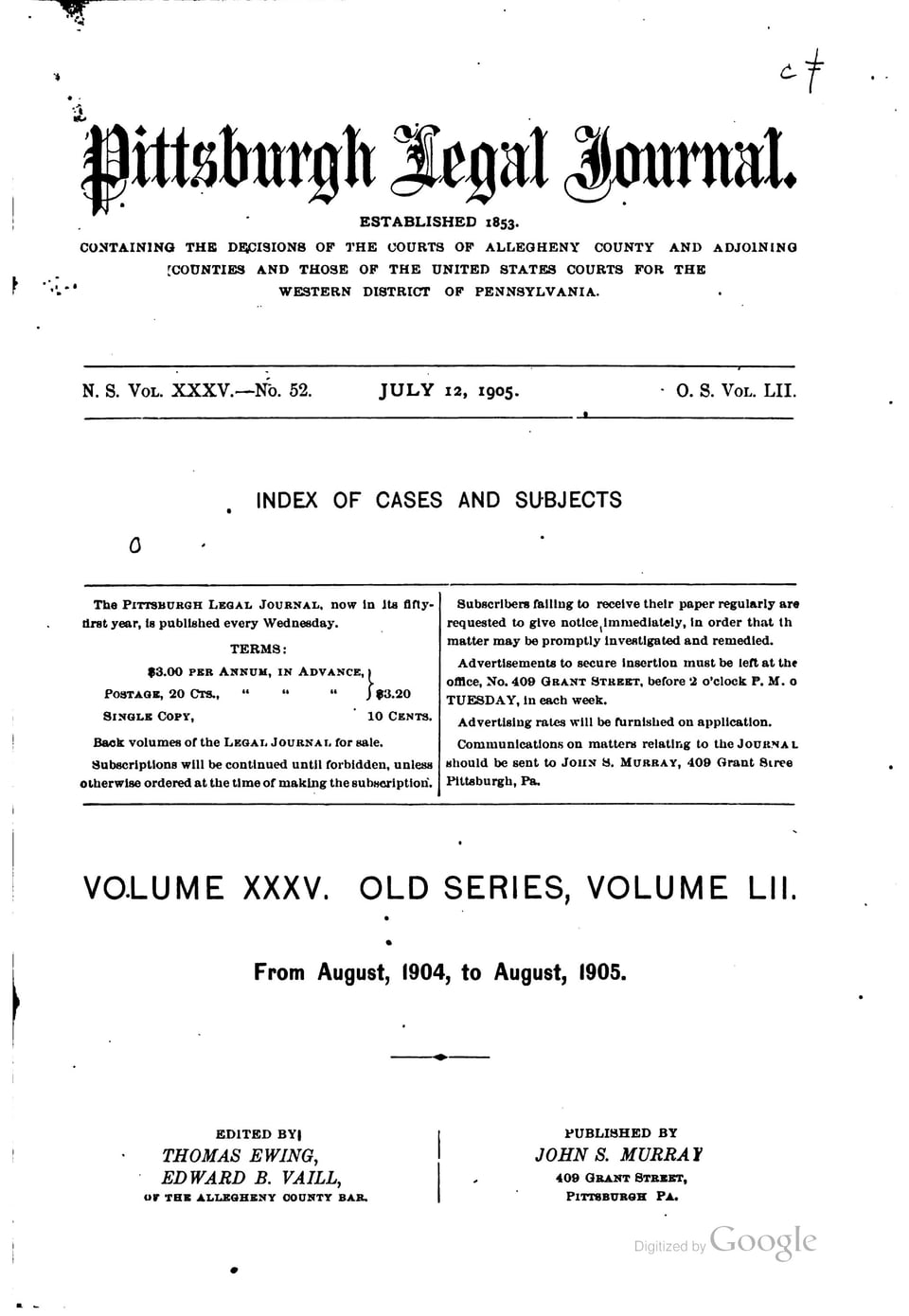
Pittsburgh Legal Journal.
ESTABLISHED 1853.
CONTAINING THE DECISIONS OF THE COURTS OF ALLEGHENY COUNTY AND ADJOINING [COUNTIES AND THOSE OF THE UNITED STATES COURTS FOR THE WESTERN DISTRICT OF PENNSYLVANIA.
N. S. Vol. XXXV.—No. 52.
JULY 12, 1905.
O. S. Vol. LII.
. INDEX OF CASES AND SUBJECTS
The PITTSBURGH LEGAL JOURNAL, now in its fifty-first year, is published every Wednesday.
$3.00 PER ANNUM, IN ADVANCE,
POSTAGE, 20 CTS., " " "$ 3.20
SINGLE COPY, 10 CENTS.
Back volumes of the LEGAL JOURNAL for sale.
Subscriptions will be continued until forbidden, unless otherwise ordered at the time of making the subscription.
Subscribers falling to receive their paper regularly are requested to give notice immediately, in order that th matter may be promptly investigated and remedied.
Advertisements to secure insertion must be left at the office, No. 409 GRANT STREET, before 2 o'clock P.M. O TUESDAY, in each week.
Communications on matters relating to the JOURNAL should be sent to JOHN S. MURRAY, 409 Grant Stree Pittsburgh, Pa.
Advertising rates will be furnished on application.
VOLUME XXXV. OLD SERIES, VOLUME LII.
From August, 1904, to August, 1905.
EDITED BY
THOMAS EWING,
EDWARD B. VAILL,
OF THE ALLEGHENY COUNTY BAR.
PUBLISHED BY JOHN S. MURRAY 409 GRANT STREET, PITTSBURGH PA.
a full and careful examination. The petition also has the approval of the judges of the quarter sessions. A careful examination of the proceedings had in the quarter sessions fails to disclose any irregularity sufficient to render the proceedings had there void. While perhaps the report of the grand jury made at the June session might have been somewhat fuller, yet when considered in connection with the petition of the commissioners, it seems to us the provisions of the Act of 1883 have been complied with, and that by those proceedings the commissioners of the county were authorized to acquire the property of Mrs. Smith for the purposes named in the petition. Those proceedings being regular, it follows that this court had jurisdiction to appoint viewers as prayed for in the petition of the commissioners.
And now, to-wit, November 3, 1904, the motion to quash or vacate the proceedings for appointment of viewers is overruled.
In re SAME.
County seal-Form-Act of April 17, 1834.
Exceptions to bond.
Under the act of 1834, P. L. 537, the seal adopted by the county commissioners is the seal of the county. The act does not set forth any requirements as to the form of the seal.
Opinion by FRAZER, P. J. Filed November 28,1904.
The sole exception to the bond is that the seal attached thereto is the seal of the commissioners of Allegheny county, and not the seal of the county. This exception is based upon the fact that the words "commissioners' seal of Allegheny county," appear upon the seal. The exception, in our opinion, is without merit. The Act of 1834, P. L. 537, provides, "There shall be a county seal for each county of this state, which shall be in the custody of the commissioners thereof, and the official acts of the commissioners shall be authenticated therewith." In the absence of any requirement as to the form of the seal, or of the inscription to be contained thereon, it is optional with each county to adopt whatever form and inscription that may be desired. In this case the seal
used was in the custody of the county commissioners, had been used by those officers for many years, and was attached to the bond by them in attestation of an official act. Under these circumstances, and in the absence of evidence to the contrary, we must assume it to be the legally adopted seal for authenticating the official acts of the commissioners.
And now, November 28, 1904, exceptions dismissed.
For county, Thomas B. Alcorn.
For Caroline Smith, Morton Hunter and John D. Brown.
Court of Common Pleas No.1, ALLEGHENY COUNTY.
"WATCH TOWER BIBLE AND TRACT SOCIETY" v. CITY OF ALLEGHENY.
Municipal corporations—Taxation—Charitable organizations-Exemption.
A corporation not for profit owning real estate in a city which is used in furtherance of the purposes of the corporation in the publication of a religious paper from which no profit is derived and which is supported partly by contribution, is not liable for the city taxes assessed on its real estate as such property is used as public charity and is exempt.
In this case a portion of the building was occupied by a teanant from whom a revenue was derived. Held, that this portion was not exempt, and amount of the assessment for it should be determined by the assessors.
No. 347 June Term, 1904 MACFARLANE, J.
FINDINGS OF FACT.
First. The plaintiff is a corporation of the first class, not for profit, under the act of April 29, 1874, and its supplements, and the purpose of its incorporation under its charter is "the dissemination of bible truths in various languages by means of the publication of tracts, pamphlets, papers and other religious documents, and by the use of all other lawful means which its board of directors, duly constituted, shall deem expedient for the furtherance of the purpose stated." The plaintiff corporation has a board of directors, which manages its business.
Anyone contributing ten dollars to the association or society becomes a member of the corporation, entitled to a vote in the election of directors.
Second. The plaintiff is the owner of a lot of ground situate on Arch street of the First ward of the city of Allegheny in this county, having a front on the easterly side of said street of forty-five feet, more or less, extending back sixty feet, more or less, on which is erected a four-story brick building, occupied and used by it in the conduct of the work or business hereinafter described, except that at the time of the filing of the bill, and for some time prior thereto three of its rooms had been leased to and were occupied by a charitable organization, which there conducted a restaurant which supplied lunches to working girls and other women at a moderate price, at a rental of fifty dollars per month. This lease terminated on April 1, 1903, and at the time of the trial of this case this organization was a tenant-at-will. No other income is derived from said building, and the rent so received is used with the other income and revenues of the plaintiff in the conduct of its work and business as hereinafter specified. The entire property was donated to the corporation free of cost.
Third. The principal business of the corporation is the publication of a weekly religious paper called Zion's Watch Tower and of religious pamphlets, tracts and books, some of which are sold at a very slight profit above the cost of publication, and the sale of bibles, which are purchased by it and which are sold at less than the price usually charged by merchants; the subscription price of Zion's Watch Tower being one dollar per year. It has also sold some mottoes and similar merchandise which have been donated to it for that purpose. From all of its sales and from the paper there is no profit over and above the cost of conducting the business. In addition to its sales, a very considerable amount of its publications are given away. The persons engaged in the work receive an allowance of one hundred and twenty dollars per year, with the exception of one, who receives forty dollars per month; and those engaged in the work
of publication, sale and distribution live in the building, eat at a common table supplied by the corporation and receive no other compensation except allowances for actual expenses when traveling in the interests of the society. A number of persons, and especially the president of the corporation, travel extensively from place to place holding religious meetings and acting as evangelists or missionaries, receiving only actual expenses, which are made low by reason of their being generally entertained by friends of the society. The revenues received as above mentioned are entirely consumed in the work of the society and are insufficient, and are added to by voluntary contributions, some of which are expended in the same way, and the remainder are used in the expenses of evangelists and the free distribution of literature.
Fourth. All of the publications of the corporation and books, pamphlets and papers sold or distributed by it are religious in their character, most of them, other than the bibles and Bible helps, containing, in addition to general religious teaching, discussions or teachings along the line of the theological beliefs of the members of the society; but it is not a denomination or church, and has not been called by any distinctive name. Its evangelists promulgate the theological doctrines of the society, as well as preach on general religious subjects.
Fifth. The city of Allegheny has made an assessment of the real estate and premises above described and levied a tax thereon for the year 1904, and declared its purpose to collect the same as other taxes are collected.
Sixth. At the hearing of the case it was left open for further testimony, but counsel for plaintiff and defendant have since notified the court that the testimony was closed.
CONCLUSIONS OF LAW.
The property of the plaintiff is used in the conduct of a public charity, which is supported in part by contributions, and is exempt from taxation except for three rooms which are in actual use and occupation for other purposes and from which an income is derived.
The assessment made by the defendant is illegal and void, except so far as the same relates to the three rooms of the plaintiff, which are rented and occupied by a third party.
A decree should be entered restraining the defendant from collecting taxes upon all of plaintiff's real estate described in the bill, except three rooms which are rented to and occupied by a third party, so long as no income is derived by it from the contributors or by the corporation other than that necessary to make the charity self-sustaining, and directing the defendant to exempt from taxation said real estate with the said exception. The costs of litigation to be divided.
OPINION. Filed January 21, 1905.
The recent case of Harrisburg v. Harrisburg Academy, 26 Supr. Ct. 252 (Advance Reports for December 30, 1904,) renders an extended discussion of this case unnecessary. We are of opinion that the principles laid down in that case and in Sunday School Union v. Philadelphia, 161 Pa. 307, support the conclusions of law. This society was founded by private charity in the gift of the property occupied by it. Its revenues do not make it self-supporting in the conduct of the work done upon that property, and it appears that about eleven thousand dollars of contributions are used in the conduct of that work. The free distribution of literature and the maintenance of missionaries is supported by the remaining nineteen thousand dollars; and while the revenues and donations are together used in the conduct of both classes of work, it is clear that without these donations the work of publication would not be supported. This is not a case of carrying on a bookstore and the publication of a paper for profit.
Under the proviso of the act of May 14, 1874, P. L. 158, "that all property real or personal other than that which is in actual use and occupation for the purpose aforesaid and from which any income is derived, shall be subject to taxation, except where exempted by law for state purposes, and nothing herein contained shall exempt the same therefrom;" the portion of this building occupied by a tenant and from which a revenue is derived is not exempt. The proportion must be determined by the assessors, as has been done
in a number of instances cited in the Sunday School Union case. It does not appear whether this claim was made before the assessors or whether an opportunity was given to make the exemption, so it seems fair to divide the costs of the litigation.
Let a decree be drawn as indicated in the conclusions of law.
For plaintiff, J. McF. Carpenter.
For defendant, Steephen G. Porter.
Orphaus' Court,
ALLEGHENY COUNTY.
In re Estate of A. D. SCORER, Deceased.
Decedents' estates—Failure to file an account Payment of debts—Presumption.
Next of kin entitled to administration in Ohio deposited in 1898 money in a bank here as indemnity for suretyship there, and afterward upon administrator's representation that he had settled his accounts, was permitted to withdraw the deposit, and died without filing any account. Held, that in the absence of proof of unpaid debts or claims of distribution, the presumption was that they had in fact been settled, and refunding bonds would answer as a substitute for an account.
No. 40 January Term, 1904. Petition of the Duquesne National Bank for order on executor to redeposit
HAWKINS, P. J.
STATEMENT.
The real question now before this court is whether or not J. F. Kepler, executor, shall be ordered to file an account of his testator's administration of the estate of W.C.Scorer, deceased, in Cleveland, Ohio.
The facts are these:
In order to enable A. D. Scorer to take out letters on the estate of his son, W. C. Scorer, deceased, who had died in 1898, a citizen of Cleveland, Ohio, the Duquesne National Bank, upon the deposit with it of $1,200 indemnity, guaranteed certain parties who thereupon went on his bond. Upon Mr. Scorer's subsequent representation that he had settled his son's estate, that bank allowed him to draw the deposit; but after his death it appeared that he had filed no