The New Testament in an Improved Version (1808)
Download: PDF — The New Testament in an Improved Version (1808)
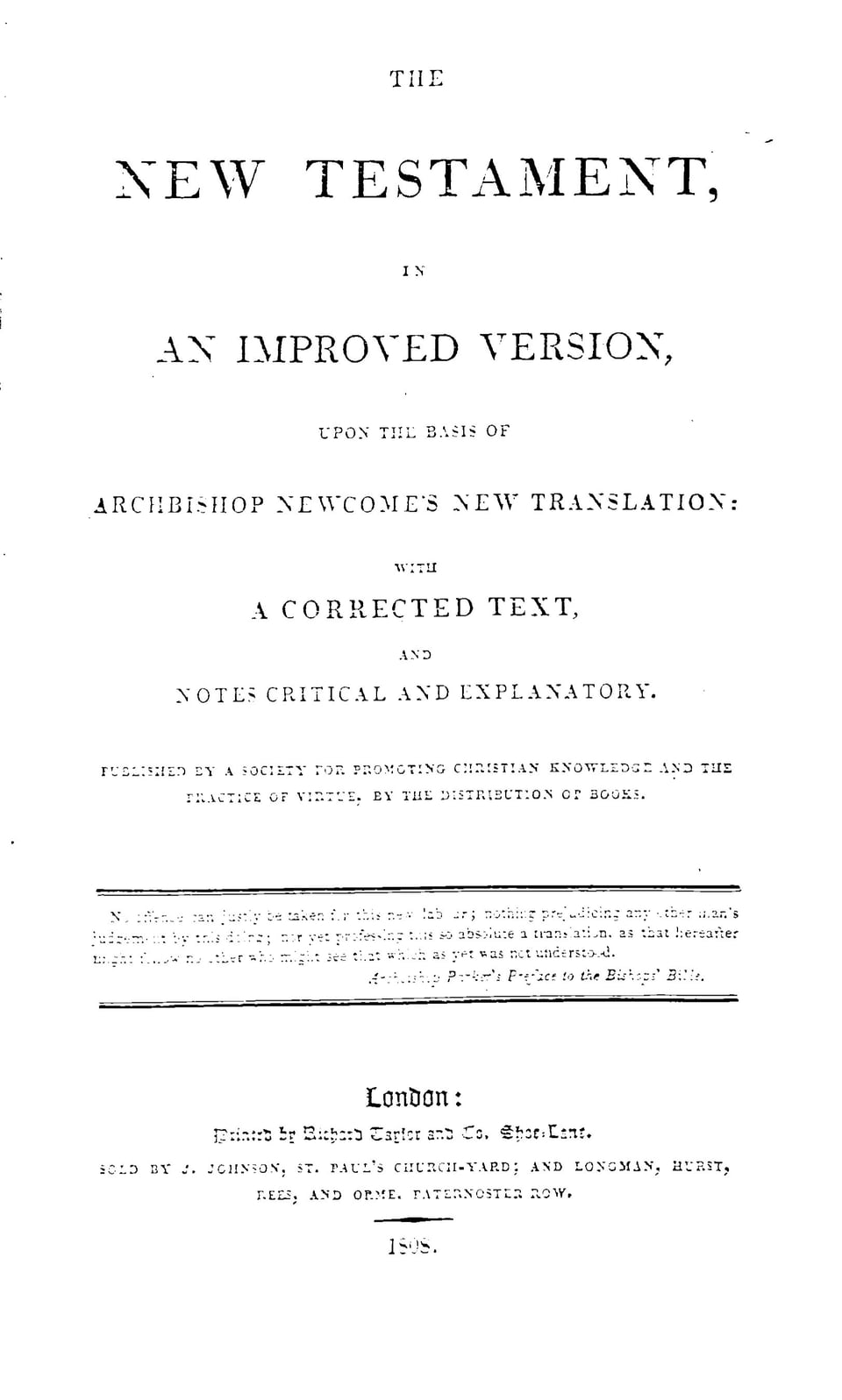
THE
NEW TESTAMENT,
IN
AN IMPROVED VERSION,
UPON THE BASIS OF
ARCHBISHOP NEWCOME'S NEW TRANSLATION:
WITH A CORRECTED TEXT,
AND NOTES CRITICAL AND EXPLANATORY.
PUBLISHED BY A SOCIETY FOR PROMOTING CHRISTIAN KNOWLEDGE AND THE PRACTICE OF VIRTUE, BY THE DISTRIBUTION OF BOOKS.
No offence can justly be taken for this new labour; nothing prejudicing any other man's judgement by this doing; nor yet professing this so absolute a translation, as that hereafter might follow no other who might see that which as yet was not understood.
Arthroschip Parker's Preface to the Bishops' Billie.
London:
Printed by Richard Taylor and Co. Shoe Lane.
SOLD BY J. JOHNSON, ST. PAUL'S CHURCH-YARD; AND LONGMAN, HURST, REES, AND ORME. PATERNOSTER ROW.
180S.
INTRODUCTION.
SECTION I.
Origi, Progress, and Design of the Work.
IN the year 1761, a Society was formed in London, the professed design of which was to promote religious knowledge and the practice of virtue by the distribution of books. Of this Society, from its first origin, it has always been a principal object to publish an Improved Version of the Holy Scriptures, and particularly of the New Testament. With this view a deposition of the Society was commissioned about twelve years ago to wait upon the late plums and learned Gilbert Wakefield, to request his permission to republish and to circulate his new and accurate Translation of the New Testament at the expense of the Society; to which that gentleman most readily expressed his assent, and at the same time promised to revise his translation with great care, and to give it to the Society in its most perfect state. It appeared, however, in the sequel, that the engagement into which he had entered with his bookseller upon the publication of his second edition precluded him from fulfilling his promise to the Society till that edition was disposed of. In the mean time those unfortunate events took place which are but two well known to the public; and, to the great and irreparable loss of religion and literature, the life of that eminent scholar was closed in the midst of its career.
After the decease of Mr. Wakefield, it being found impracticable to make use of his Translation, the design for some time lay dormant, till it was re- sent by another Society in the West of England, which was formed upon the same principles with the Society in London. This effort proved abortive in consequence of the sudden and much lamented removal of that active, zealous and persevering advocate of pure and uncorrupted Christianity, the late Rev. and learned Timothy Kenrick of Exeter.
The design, however, of publishing an Improved Version of the New Testament was never totally abandoned; and it was resumed with great unanimity and spirit at the annual meeting of the London Society. In April 1800, when a Committee was appointed, consisting of all the ministers who were members of the Society, together with some gentlemen of the laity, to carry the intentions of the Society into effect with all convenient dispatch. To this Committee it appeared on many accounts more eligible to adopt as the basis of their Work known and approved translation already existing, than to make a new and original Version. And Mr. Wakefield's being unattainable, they fixed their choice upon the excellent Translation of the late most reverend Dr. William Newcome, Archbishop of Armagh, and Primate of all Ireland, a worthy successor of the venerable and learned Archbishop Usher.
And to this choice they were induced not only by the general accuracy, simplicity, and fidelity of the Primate's Translation, but principally because he professes to have followed the text of Griesbach's edition, which, having been formed from a careful collation of many manuscripts and versions, exhibits a text by far the most correct of any which have been published since the revival of learning in the fifteenth century.
Having selected Archbishop Newcome's Translation as their basis, it became an object with the Committee to guard as much as possible against giving their improved Version a motley appearance by departing unnecessarily from the Primate's text. To this end they assumed it as a principle, that no alteration should be made in the Primate's Translation but where it appeared to be necessary to the correction of error or inaccuracy in the text, the language, the construction, or the sense. And so closely have they adhered to this rule, that, in some instances, they have rather chosen to place what appeared to them the more eligible translation, at the foot of the page, than to alter the Primate's text where some judicious readers might think it unnecessary. In justice to the Archbishop, they have placed the words of his Translation at the bottom of the page wherever they have deviated from it in the Improved Version; and where it was thought necessary a short note has been subjoined, assigning the reasons for the alteration, which, to the candid and discerning, they flatter themselves will generally appear satisfactory. Also, in every instance in which either the Primate's Version or their own differs from the Received Text, they have placed the words of the Received Text at the foot of the page: and in all important cases they have cited the authorities by which the variation is supported.
The Committee have also added Notes for the illustration of difficult and doubtful passages, which are chiefly collected from critics and commentators of the highest reputation. They cannot flatter themselves with the expectation that these Notes will be equally acceptable to all readers: but they hope that they will be of use to the inquisitive, the liberal, and the judicious. These notes, having swelled to a greater number and magnitude than was originally expected, have considerably increased both the labour of the Committee, and the expense of the Work;—but, it is hoped, not without a duo equivalent.
Two very correct and highly finished Maps have been added to this Version; one of Palestine, and the other of the countries bordering upon the Mediterranean, which were the principal scenes of the journeys and the labours of the first Missionaries of the christian faith.
The encouragement which this Work has received from the subscriptions which have been raised to defray the expense of carrying it through the
press has far exceeded the most sanguine expectations. The exemplary liberality and the active zeal of some generous individuals would well deserve to be entered upon record. But they seek not honour from their fellow-creatures. The consciousness of their own pious and benevolent views and feelings, and the hope that whatever they have contributed to this important object may be a sacrifice of grateful odour to that Being who is witness to all that passes within the temple of the heart, is to them of far greater value than human applause. The great liberality of the subscriptions has enabled the Society to print two editions with Notes, one in royal octavo, and the other in royal duodecimo, and a third, a small pocket edition without Notes for popular use.
The design of the Committee, and indeed of the Society, in the publication of this Improved Version, is to supply the English reader with a more correct text of the New Testament than has yet appeared in the English language, and to give him an opportunity of comparing it with the text in common use. Also, by divesting the sacred volume of the technical phrases of a systematic theology which has no foundation in the Scriptures themselves, to render the New Testament more generally intelligible, or at least to preclude many sources of error; and, by the assistance of the Notes, to enable the judicious and attentive reader to understand scripture phraseology, and to form a just idea of true and uncorrupted Christianity, which is a doctrine worthy of all acceptance, and is able to make us wise to everlasting life.
In this Version verbal criticism has not been attended to in the degree that some might wish and expect. It has not, however, been wholly neglected: but, in general, the judgement of the learned Primate has been adopted in difficulties of this nature; the design of the Committee not being to exhibit a version critically correct in every minute particular, but generally perspicuous and intelligible. Their professed object was an improved, not a perfect Version. But, though they cannot expect to satisfy the fastidious critic, they are not without hope that their labours may be acceptable to serious and inquisitive Christians, and particularly to those by whom their trust was delrgated, and to the numerous and liberal Subscribers by whom the work has been encouraged. And this, next to the approbation of conscience and of Heaven, is the only reward to which they aspire.
SECTION II.
Canon of the New Testament.—Distinction between the Disputed and the Undisputed Books.
The Canon of the New Testament is a collection of books written by the apostles, or by men who were companions of the apostles, and who wroto under their inspection.
11...
These books are called the Canon from a Greek word which signifies a rule, because to a christian they constitute the only proper and sufficient rule of faith and practice.
These books are also called The Scriptures, or The Writings, because these Writings are held by Christians in the highest estimation. They are the scriptures of the New Testament, or, more properly speaking, of the New Covenant, because they contain a complete account of the Christian dispensation, which is described as a covenant by which Almighty God engages to bestow eternal life upon the penitent and virtuous believer in Christ. For this reason the christian scriptures, and particularly the books which contain the history of Jesus Christ, are called the Gospel, or Good news, a literal translation of the word συγγελιον, as these sacred writings contain the best tidings which could be communicated to mankind.
The Canon of scripture is either the Received Canon or the True.
The Received Canon comprehends the whole of that collection of books which is contained in the New Testament, and which are generally received by christians as of apostolical authority. The True Canon consists of those books only the genuineness of which is established upon satisfactory evidence.
When, or by whom, the received Canon was formed is not certainly known. It has been commonly believed that it was fixed by the council of Laullicca A.D. 361, but this is certainly a mistake. The first catalogue of canonical books which is now extant was drawn up by Origen A.D. 210. It leaves out the Epistles of James and Jude.
The genuineness and authority of every book in the New Testament rests upon its own specific evidence. No person, nor any body of men, has any right authoritatively to determine concerning any book that it is canonical and of apostolical authority. Every sincere and diligent inquirer has a right to judge for himself, after due examination, what he is to receive as the rule of his faith and practice. The learned Jeremiah Jones on the Canon, and Dr. Lardner's laborious work upon the Credibility of the Gospel History contain the most accurate and copious information upon this subject.
The most important distinction of the books of the New Testament is that mentioned by Eusebius bishop of Cesarea in the third book of his Ecclesiastical History. He distinguishes them into the books which were universally arknowledged, δμωγυμας , and those which though generally received were by some disputed, α\tri{τ}λωυμας .
The books universally acknowledged are, the four Gospels, the Acts of the Apostles, thirteen Epistles of Paul, the first Epistle of Peter, and the first Epistle of John. "These only," says Dr. Lardner * ,"should be of the highest authority, from which doctrines of religion may be proved."
The disputed books, αντλαγόμενα, are the Epistle to the Hebrews, the
INTRODUCTION.
Epistle of James, the second of Peter, the second and third of John, the Epistle of Jude, and the Revelation. "These," says Dr. Lardner, "should be allowed to be publicly read in christian assemblies, for the edification of the people, but not be alleged as affording alone sufficient proof of any doctrine."
These distinctions prove the great pains which were taken by the primitive christians in forming the Canon, and their solicitude not to admit any book into the code of the New Testament of the genuineness of which they had not the clearest evidence. It is a distinction of great importance to all who desire to appreciate rightly the value and authority of the several books which compose the received Canon.
SECTION III.
Brief Account of the Received Text.—Editions of the Greek Testament by Cardinal Ximenes, by Erasmus, Robert Stephens, Bexa, and Elxevir.
If this Version of the Christian Scriptures possesses any merit, it is that of being translated from the most correct Text of the Original which has hitherto been published.
A text perfectly correct, that is, which shall in every particular exactly correspond with the autograph of the apostles and evangelists, is not to be expected. We must content ourselves with approximating as nearly as possible to the original. The utility of this is too obvious to need either proof or illustration.
Previously to the Reformation in the sixteenth century, the Greek copies were grown into disuse: the priests used an imperfect Latin translation in the public offices of religion, and all translations into the vulgar tongue for the use of the common people were prohibited or discouraged.
The Received Text of the New Testament is that which is in general use.
The degree of credit which is due to the accuracy of the Received Text will appear from the following brief detail of facts.
The New Testament was originally written in Greek: perhaps with the exception of the Gospel of Matthew, and the Epistle to the Hebrews, of which books, however, the earliest copies extant are in the Greek language.
In the beginning of the sixteenth century Cardinal Xlmenes printed at Alcala in Spain a magnificent edition of the whole Bible in several languages. In this edition was contained a copy of the New Testament in Greek, which was made from a collation of various manuscripts which were then thought to be of great authority, but which are now known to have been of little value. This edition, which is commonly called the Complutensian Polyglot, from Complutum the Roman name for Alcala, was not licensed for publication till A.
D. 1522, though it had been printed many years before. The manuscripts from which it was published are now irrecoverably lost, having been sold by the librarian to a rocket-maker about the year 1750*.
A. D. 1516, Erasmus residing at Basle in Switzerland for the purpose of superintending the publication of the works of Jerome, was employed by Proben the printer to publish an edition of the Greek Testament from a few manuscripts which he found in the vicinity of that city, all of which were modern and comparatively of little value. Erasmus was not allowed time sufficient to revise the publication with that attention and care which the importance of the work required; he complains that the persons whom he employed to correct the press, sometimes altered the copy without his permission, and he acknowledges that his first edition was very incorrect. He published a fourth edition A. D. 1527, in which, to obviate the clamour of bigots, he introduced many alterations to make it agree with the edition of Cardinal Ximenes.
A. D. 1560, Robert Stephens, a learned printer at Paris, published a splendid edition of the New Testament in Greek, in which he availed himself of the Complutensian Polyglot, and likewise of the permission granted by the king of France to collate fifteen manuscripts in the Royal Library. Most of these manuscripts are to this day in the National or Imperial Library at Paris, and are found to contain only parts of the New Testament: and few of them are either of great antiquity or of much value. They were collated and the various readings noted by Henry Stephens the son of Robert, a youth about eighteen years of age. This book, being splendidly printed with great professions of accuracy by the editor, was long supposed to be a correct and immaculate work: but upon closer inspection it has been discovered to abound with errors. The text, excepting the Revelation, in which he follows the Complutensian edition, is almost wholly copied from the fifth edition of Erasmus, with very few and inconsiderable variations +.
A. D. 1689, Theodore Beza, professor of theology at Geneva, and successor to John Calvin, published a critical edition of the Greek Testament, in which he made use of Robert Stephens's own copy, with many additional various readings from the manuscripts collated by Henry Stephens. Beza was also in possession of two most ancient and most valuable manuscripts; one of which, containing the Gospels and the Acts in Greek and Latin, ho
afterwards gave to the University of Cambridge: and the other, called the Clermont manuscript, which contained the Epistles of Paul, was transferred to the Royal Library at Paris. Beza took but little pains, and exercised but little judgment, in the correction of the text and the selection of the best reallings. Nevertheless the text of Beza being esteemed the most accurate of those which had been then published, who selected as the standard of the English version published by authority. Beza's text however appears In fact to be nothing more than a republication of Robert Stephens's with some trifling variations.
A. D. 1021, an edition of the Greek Testament was published at Leyden at the office of the Elzevirs, who were the most eminent printers of the time. The editor who superintended the publication is unknown. This edition differs very little from the text of Robert Stephens. A few variations are admitted from the edition of Beza, and a very few more upon some unknown authority; but it does not appear that the editor was in possession of any manuscript. This edition however, being elegantly printed, and the Elzevirs being in high reputation for correctness of typography, it was unaccountably taken for granted that it exhibited a pure and perfect text. This therefore became the standard of all succeeding editions, from which few editors till very lately have presumed to vary: and this constitutes the "Received Text."
Thus it appears that the Received Text stands upon the authority of the unknown editor of the Elzovir edition, who copled the text of Robert Stephens, introducing a few variations from that of Beza. The edition of Beza was also taken from that of Robert Stephens, with a few trilling and sometimes even arbitrary alterations. But Robert Stephens's famous edition of A. D. 1550 is a close copy of the fifth edition of Erasmus, with some alternations in the book of Revelation, from the Complutensian Polyglot, and the addition of a few various readings collected by a youth of eighteen from fifteen manuscripts of little value. And, finally, Erasmus's edition itself, which is the prototype of them all, was formed hastily and negligently from a few manuscripts of little authority, which accidentally came into his possession at Basle, where he was engaged by Froben in editing the works of Jerome, and where he had no further assistance than what he could derive from the Vulgate Version, and from inaccurate editions of some of the early ecclesiastical writers.
From the few advantages which were possessed, and from the little care which was taken, by the early editors, it may justly be concluded, not only that the Received Text is not a perfect copy of the apostolic originals, but that it is still capable of very considerable improvement by the same means which are adopted by men of learning and sagacity for correcting and restoring the text of other ancient writers *.
See Griesbach's Prologomena, sct. I.; Dr. Marsh's Michaelis, vol. ii. chap. xii. sect. I.
SECTION IV.
Means of improving the Received Text.—Ancient Manuscripts.—Vatican, Alexandrine, Cambridge, Clermont, Ephrem.
The books of the New Testament having been more highly valued, more generally circulated, more attentively studied, more accurately transcribed, and more frequently cited than the works of any other ancient author, tho Text is consequently less corrupted, and the means of correcting and restoring it are far more abundant than of any other work of equal antiquity.
The first and best source of materials for improving the Text is the collation of Ancient Manuscripts.
The early editors of the New Testament possessed but few manuscripts; and those of inferior value. Those of the Complutensian editors are destroyed, but they were not numerous, nor of great account. Erasmus consulted only five or six; and R. Stephens fifteen. Beza indeed possessed two of the most ancient and valuable manuscripts now extant, the Cambridge and the Clermont; but he made very little use of them. So that the Received Text rests upon the authority of no more than twenty or thirty manuscripts, most of which are of little note.
But since the Received Text was completed by the Eizovlr edition of 1624, upwards of Three Hundred Manuscripts, either of the whole or of different parts of the New Testament, have been collated by learned men with much care, industry and skill. Of these manuscripts some are of far greater antiquity and authority than any of those upon which the Received Text is founded, Beza's manuscripts only excepted. From these manuscripts a vast number of various readings have been extracted, by the assistance of which the Received Text has been greatly improved.
Ancient manuscripts are found to consist of three distinct classes, or editions; the copies of each edition agreeing, in the main, in the readings peculiar to it. The first is the Alexandrine edition, which agrees with the citations of Clement and Origen in the second and third century. To this edition belong the Vatican, Ephrem, and some other valuable manuscripts; also the Coptic, Ethiopic, and other ancient versions. The second is the Western edition. It agrees with the citations of Terbullian and Cyprian, with the Vatican copy of the Gospel of Matthew, also with the Sabidic and old Italian versions, and was in use in Africa and Italy, and in the western provinces of the Roman empire. The third is the edition of Constantinople, and is supported by the Alexandrine and many other manuscripts: It agrees with the citations of the ecclesiastical writers in Greece and Asia Minor in the fourth and fifth centuries, and it is the edition which most nearly coincides with the modern Received Text*.
Griesbach Proleg. sect. iii. p. 72.
Ancient manuscripts are commonly written upon parchment. The most ancient are written in what are called uncial or square capital letters. In some copies the ink has been effaced, and the works of some later author have been written upon the same parchment; but the form of the original letters still remains distinguishable even under the more modern writing. Very few manuscripts contain the whole New Testament; and the most ancient are often mutilated and imperfect, and usually contain many corrections: but whether these corrections are improvements or otherwise, cannot easily be ascertained.
Those manuscripts which are most ancient, and of the highest reputation, are
The VATICAN manuscript, which was formerly preserved at Rome in the Vatican Library, but is now removed to the Imperial Library at Paris. The earliest date assigned to this manuscript is the third century; the last is the fifth or sixth. It is written in large uncial letters, and originally contained the whole of the Old and New Testament. Some of the last leaves are wanting. The ink in some places is soiled, and the letters have been retouched by a skillful and faithful hand. The various readings of this manuscript were published at the latter end of the last century, after a very careful collation by Professor Birch of Copenhagen, and form an inestimable addition to the treasure of sacred criticism.
The ALEXANDRINE Manuscript was presented by Cyril, patriarch of Alexandria and afterwards of Constantinople, to Charles the First, king of England, and is now deposited in the British Museum. A fac-simile of this manuscript was published by Dr. Woide, A. D. 1786. It was probably written in Egypt; it consists of four volumes, containing both the Old Testament and the New, in the large uncial character. Dr. Woide conjectures that it was written in the latter end of the fourth century, but some critics bring it down as low as the sixth.
The Cambridge manuscript, or Codex Beze, contains the four Gospels, and the Acts of the Apostles. It is written very fair, and in the large moral letters. This manuscript yields in antiquity to none but the Vatican, and is supposed to have been used as a public copy for reading in the church. Theodore Beza made some use of it for his edition of the New Testament, and afterwards gave it to the University of Cambridge; where it is now deposited in the public library. A splendid fac-simile of this manuscript was published A.D. 1796, under the auspices of the University, by Dr. Kipling.
The Clemmont Manuscript contains the Epistles of Paul; the Epistle to the Hebrews is written by a later band. This manuscript also belonged to Beza, who professed to have received it from Clemmont in Beauvaisia, and who made use of it in his edition of the Greek Testament. It is now deposited in the Imperial Library at Paris. It was long supposed to be a second volume of the Cambridge manuscript, but this is discovered to be a mistake.
It is written in the large uncial letters, and is assigned by critics to the seventh century.
The Ernaem manuscript is in the Imperial Library at Paris. It was written upon vellum in large and elegant characters, the ink of which was effaced with great care to make room for the works of Ephrem the Syrian, a writer of some note in the sixth century. The original characters are, however, in many places legible under the writing of Ephrem's Works. This, which Griesbach calls a most ancient and excellent manuscript, lay for many years unnoticed, and was first discovered by Dr. Allix in the beginning of the eighteenth century, since which time it has been repeatedly and accurately examined by the learned, and particularly by Wetstein. The Ephrem manuscript is of high antiquity, at least of the seventh century, and probably much earlier. It originally contained the whole Old and New Testament, but many leaves are lost; the rest are tacked together in great disorder, and many passages are totally illegible.
Besides these, about twenty other manuscripts, in large letters, of different portions of the New Testament have been collated, and some hundreds in small characters, many of which are in high estimation. But those described above are of the highest antiquity and repute, and are the only manuscripts explicitly referred to in the Notes of this Edition *.
SECTION V.
Means of correcting the Received Text continued.—Ancient Versions.—Ecclesiastical Writers.—Critical Conjecture.
The Received Text is corrected by the assistance of the ancient Versions.
The christian religion having been rapidly propagated through all nations, the writings of the Apostles and Evangelists were soon translated into different languages, and many of these versions are still extant.
Every new version became an additional security to the text. It is not to be imagined, whatever might be the inclinations of some individuals, or of particular churches, to corrupt the Scriptures, that all churches of all nations would agree in the same interpolations or omissions. Some of the countries where Christianity was professed were beyond the limits of the Roman empire; and it is not to be believed that the christians of these countries would suffer their versions to be altered to conform to the peculiarities of the church of Rome. The general agreement, therefore, of the ancient versions with the Greek copies which are now extant, forms a very strong presumption in favour of the genuineness of the books of the New Testament. Nevertheless, as the Received Text is not perfectly correct, the ancient versions are often of singular use in discovering the true reading of a doubtful passage.
Marsh's Michaelis, vol. ii. chap. viii. sect. 6; Griesbach's Symbolic Criticus, vol. 1.
They are sometimes preferable even to manuscripts themselves; for some of these versions were made from manuscripts which were more ancient and more correct than any which are now extant. They are not all of equal value, some being of greater antiquity, and more correctly translated than others. Some indeed are not original versions, but are merely translations of preceding versions.
Of all the ancient versions the Syrine is reckoned to be of the most remote antiquity and of the highest authority. There are two Syrine versions. The most ancient and valuable, called the Peshito, was brought into Europe A.D.1552, and printed at Vienna at the expense of the Emperor Maximilian. It contains only those books which according to Eusebius were universally acknowledged; together with the Epistle of James: and it is in general use among the Syrian christians of every sect. These are strong presumptive esilences of its great antiquity.
A later Syriac version, more literal, but less elegant, was made in the sixth century under the inspection of Philoxenus, bishop of Hierapolis, from whom it is called the Philoxenian Version. An edition of this was published at Oxford by Professor White, A. D. 1778,
Two very ancient versions of the New Testament, of high reputation, in the old Egyptian language, for the use of the Christians who abounded in Egypt, are still extant. One is called the Coptic, the other, the Sahilic. The former is the dialect of the Lower, the latter of the Upper Egypt. The Sahilic version has never yet been published. Two valuable manuscripts of it are in the British Museum, from which some curious readings were extracted by the late Dr. Woids, who conjectures that this version was made in the second century. The Coptic version is still real in the churches of Lower Egypt, thought it is not understood. It is accompanied with an Arabic translation which is more intelligible to the hearers.
The Ethiopic version is used in Abyssinia. It contains the whole of the New Testament, and is supposed to have been made in the fourth century. It agrees with the Alexandrine edition. This version was first published at Rome, A. D. 1548, by three Ethiopian editors. They had a very imperfect copy of the book of the Acts, the chasms of which, that is, as they acknowledge, the greater part of the book, they supplied by translating from the Greek and Latin into the Ethiopic. Similar liberties have probably been taken with other books, which greatly impairs the credit of the version; of which, if a genuine copy could be obtained, the authority would be very high. Mr. Bruce the celebrated traveller brought over a copy of the Old Testament, but he could not succeed in procuring the New*.
Many Arabic versions are extant, but it is believed that none of them is of greater antiquity than the seventh century. The Armenian version was made in the fifth century : it would be of great value if genuine copies could
Marsh's Michaels, vol. ii, chap. vii, sect. 17.
xvi
INTRODUCTION.
derable importance, have been suggested by men of great learning and sagacity, which, to say the least, merit very attentive consideration. See particularly John i. 1; vi. 4; and Romans ix. 5.*
SECTION VI.
Critical Editions of the Greek Testament.—Mill, Kuster, Bengel, Wetstein, Matthäi, Alter, Birch, Griesbach.
After the publication of the beautiful Elzevir edition of the New Testament in 1624, the learned world appeared to remain satisfied with the Received Text, as if it were absolutely perfect and incapable of improvement, till the commencement of the eighteenth century, when the text of the New Testament again became the object of diligent and accurate revision.
1: The first thing which roused the attention of the learned to this interesting inquiry was the appearance of the celebrated edition of Dr. John Mill, which was published at Oxford, A.D. 1707. It was the fruit of thirty years' laborious application; and the author survived the publication but fourteen days. He was encouraged and assisted in the work by Dr. John Fell, Bishop of Oxford. He took as his text the third edition of Stephens; and from ancient manuscripts, versions, and quotations, he has collected about thirty thousand various readings, which he has printed under the text. His collations are made with great diligence, sagacity, and fidelity. In his Prolegomena he introduces a description of the Canon of the New Testament, a history of the text, and an account of his own undertaking. He was the first writer who gave an accurate and clear account of the manuscripts and other authorities which be used. He made no alteration in the text; but his opinion on particular readings is contained in his Notes and Prolegomena. Micharlis says, that with Mill's edition commences the manhood of criticism, with respect to the New Testament; and that this work is absolutely necessary to every critic.
Ludolphus Kuster, A. D. 1710, published at Rotterdam a new and correct edition of Mill's Greek Testament, enriched with various readings from twelve manuscripts not collated by Mill, some of which were of considerable antiquity and value † .
John Albert Bengel published a critical edition of the Greek Testament at Tubingen, A. D. 1731. He was a man of great ability and learning, and of high character for integrity and piety. He made considerable improvements in the Received Text; but, that he might not be charged with arbitrary innovation, he made it a rule to introduce no alteration which had not been sanctioned by some printed edition, excepting in the Apocalypse. Select various readings he placed at the bottom of the page, distinguishing their various gradations of authority by the five first letters of the Greek alphabet—(α) expressing that the reading was, in his estimation, genuine, (β) probable, (γ) uncertain, (δ) improbable, and (ε) certainly spurious, though by some critics approved. The excellence of Bengel's character, and the orthodoxy of his sentiments, brought biblical criticism into repute among the German theologians. Bengel's various readings are chiefly taken from Mill, with the addition, however, of some valuable ones of his own collected from manuscripts and other authorities. His "Introduction in Crisin" contains a clear, concise and correct account of manuscripts and editions, together with some excellent critical rules.*
Marsh's Michaelis, iiid. ch. x.
See Mill's Prolegomena. Marsh's Michaclis, c. xil. sect. 1.
Koster's Pref. Marsh's Michaelis, ibid.
INTRODUCTION.
The celebrated edition of John James Wetstein was published at Amsterdam in two volumes folio, A. D. 1751, 1762. Of this edition Michaelis says, that "it is of all editions of the Greek Testament the most important, and the most necessary for those who are engaged in sacred criticism." And his learned and acute translator and annotator, Dr. Herbert Marsh, speaks of it as "a kind of standard in sacred criticism." It was the original intention of Wetstein to have printed his text from the Alexandrite manuscript; but the high estimation in which he at first held this manuscript being abated, he abandoned this design. He afterwards proposed to have published a new and improved text; but being dissuaded by his friends, lest it should excite the clamour of bigots, he at last determined to adhere to the Received Text, that is, to the Elzevir edition of 1021.
Immediately below his text he has placed those readings which he regards as genuine, and which in his judgment ought to be introduced into the text. Below these are arranged his collection of various readings with their respective authorities. In this respect, it is allowed that he has done more than all his predecessors together. He has collected most of the readings which had been published before, and has corrected many of the errors of Mill. To these he has added a great number of original readings from manuscripts and versions collated either by himself or by his friends. He was the first who collated the Philoxenian Syriac version from the manuscript at Oxford, and he examined with the most persevering assiduity the Ephrem manuscript in the Imperial Library at Paris. He has also introduced into his various readings the critical conjectures of others, but has added none of his own. Some inaccuracies have been detected in these collations, which in a work of such great extent it was impossible to avoid. But upon the whole Wetstein is entitled to the character of a laborious, sagacious, and faithful critic. A. D. 1763, an edition of the Greek Testament in quarto was published in London by Bowyer, the learned
Bengellii Apparatus Criticus. Marsh's Michaelis, vol. ii. c. xii. sect. 1. p. 464. + Michaelis, ibid. p. 470. Marsh's Notes, p. 859.
printer, in which those alterations are introduced into the text which were proposed by Wetstein as the true readings.
Underneath the various readings in Wetstein's edition are printed his notes. These are numerous and invaluable. They are philological, critical, and explanatory. They contain a great number of parallel passages from the classics, and of quotations from the Tulandists, which tend to elucidate the idioms of the language or the customs of the Jews. They are accompanied with many judicious observations, and supply an inexhaustible fund of theoretical and critical information. It is computed that the quotations in Wetstein's volumes amount to upwards of a million.
The Prolegomena are prefixed to the first volume. They are learned, copious, and judicious; but they are deficient in urbanity, and discover too much of an angry and contemptuous spirit towards his opponents. He first gives an interesting account of ancient manuscripts in general, and of the condition in which they are commonly found. After which he proceeds to describe briefly, but correctly, the manuscripts which have been collated to correct the text of the New Testament, distinguishing those which are written in uncial or capital letters, by the great letters of the alphabet, viz. A. for the Alexandrine, B. for the Vatican manuscript, &c. and marking the manuscripts which are in small letters by numeral characters. He then gives some account of ancient versions, and of the ecclesiastical writers of whose quotations from the New Testament critics have invailed themselves. After which follows a detailed description of former editions of the New Testament; and the whole concludes with an account of his own undertaking, and a defence of his character. These Prolegomena have been republished by Dr. Semler in an octavo volume, augmented with Notes by the learned editor.
Between A.D. 1782 and A.D. 1788, Christian Frederic Matthiil, formerly professor in Moscow, and afterwards in Wittenburg in Saxony, published an edition of the Greek Testament in twelve volumes octavo, with various readings from Moscow manuscripts, which had not been before collated : to which he has added critical remarks, and a copy of the Vulgate from a Demilovian manuscript. Some of these manuscripts are of considerable antiquity; they have been collated with great care, and contain some curious and important various readings*.
A. D. 1786-1787, Professor Alter of Vienna published a critical edition of the Greek Testament in two volumes octavo. The text of this edition is the Vienna manuscript, which is preserved in the Imperial Library: it contains the whole of the Old and New Testament, and is a manuscript of considerable reputation, though it is suspected of having been altered from the Latin copies. Where the text of this manuscript is evidently erroneous,
the professor has corrected it from Stephens's edition of 1546. And four chasms in the Book of Revelations he has supplied from another manuscript. He has collated this with others in the Imperial Library, and has noted their various readings, together with those of the Coptic, Slavonian, and Latin versions *.
A.D. 1788, Professor Birch of Copenhagen published a splendid edition of the four Gospels, in Greek, in folio and quarto. The text of this edition is taken from the third of R. Stephens, A.D. 1580, and the various readings were collected from a considerable number of manuscripts in France, Italy, Spain, and Germany, by Professors Birch, Adler, and Moldenhawer, who travelled for this purpose at the expense of the king of Denmark. It is a truly magnificent work, and of the highest importance to Scripture criticism. Its chief value consists in the copious extracts which it contains from the celebrated Vatican manuscript, which had never been thoroughly examined, but which was now completely and very carefully collated by Professor Birch himself. Its value is likewise enhanced by many extracts from an ancient version discovered by Professor Adler in the Vatican Library, to which he gives the name of the Jerusalem-Syriac, and the readings of which remarkably coincide with those of the Cambridge manuscript. The Vatican copy of this version is dated in the eleventh century, but the version itself is computed to have been made not earlier than the fourth, nor later than the sixth century. The second volume of this princely edition, which was expected to appear soon after the publication of the first, was prevented by a dreadful fire at Copenhagen†, which put a stop to the work. But in the year 1798 Professor Birch published his collection of various readings in a separate volume without the text‡.
The first edition of the Greek Testament by Dr. John James Griesbach, in two volumes octavo, was published A.D. 1775 and 1777. The second edition, vory much enlarged and improved, appeared A.D. 1796 and 1806.
This is an edition of unrivalled excellence and importance, the publication of which will constitute a memorable area in the history of Scripture criticism. In the construction of this admirable work the learned editor had two objects in view. The first was to exhibit to the public a text of the Greek Testament as correct, and as nearly approximating to its original purity, as it could be made by the assistance of that immense quantity of critical materials which had been accumulating during the last century. And, secondly, to compress a great mass of critical information into as narrow a compass as possible, in order to bring it within the reach of those who could not afford either the time, the labour, or the expense, which would be necessary to collect it from those numerous and expensive volumes in which it was diffused.
As the basis of his own edition, Dr. Griesbach has selected the Elzevir text, 1624, every minute variation from which he carefully notes. No alteration is admitted which is not fully warranted by the established laws of just and rational criticism. All conjectural exendations are excluded from the Text, though a few, by way of specimen, are admitted into the Notes. If any of the words of the Received Text are omitted or changed, these words are inserted in a large type, in what he calls his inner margin, which in the printed page is immediately below the text; and the authorities for every alteration are inserted in the collection of various readings at the bottom of the page. Where new words are introduced into the text, they are printed in a smaller type; and to some passages which are not expunged from the text he has presfixed marks expressive of their doubtful authenticity. Many various readings which, though probable in themselves, the learned author has not thought fit to introduce into the text, he has inserted in his inner margin, with signs presfixed to denote their greater or less degrees of probability. And he has noted with asterisks those passages in the text in which a variation in the punctuation produces a considerable change in the sense. After all, he does not presume to affirm that he has exhibited a perfect text; he only professes to have made the best use in his power of the materials in his possession, for correcting and improving the Received Text, fairly stating the grounds of his own decisions, and leaving others to form their own opinion.
The various readings, and the authorities by which they are supported, are placed below the inner margin. They are collected from nearly four hundred manuscripts, besides ancient versions and ecclesiastical writers. In the selection of these readings Dr. Griesbach has made use of the collections of all his learned predecessors, to which he has added a very considerable number extracted by himself from many of the most ancient manuscripts and versions, and from the early ecclesiastical writers, and particularly from the works of Origen. In his second edition he has greatly enlarged and improved his collection of readings and authorities from the valuable publications of Alter and Mattbai, but especially from the splendid edition of Birch. The learned editor does not form his judgement of the probability of a reading, solely from the number, or even from the antiquity of manuscripts by which it is supported; but he also takes into consideration the edition or family to which a manuscript belongs,—a circumstance which is of indispensable necessity to a right decision of the question. The readings exhibited by Griesbach are avowedly a selection of those only
which are of the greatest importance. But he has omitted none which could be of use either to ascertain the true reading, or to illustrate the sense or the phraseology of the sacred writer, or to settle the affinity of the manuscript. He adopts Wetstein's plan of distinguishing uncial manuscripts by great letters, and the rest by numeral characters; and to save room, where a reading is supported by a great number of copies, he specifies particularly only a few of the principal, to which he annexes the total number of the remaining authorities. By these methods he has contrived to compress within the limits of two octavo volumes as much critical information as is often contained in as many folios. Griesbach's edition, however, though it contains in a narrow compass a vast body of useful instruction, does not entirely supersede the labours of former editors, and particularly of Wetstein, whose learned and incomparable Notes still retain all their original value.
To the first volume are prefixed the Prolegomena, in which the learned editor gives a clear and succinct history of the origin of the Received Text, and ably justifies the exortions of himself and others to correct and improve it; justly alleging, that neither the Complutensian editors, nor Erasmus, nor Robert Stephens, nor Theodore Beza, nor the unknown editor of the Elzevir edition, made any pretensions to inspiration or infallibility, and that modern editors enjoy advantages for correcting the text far beyond the reach of the original publishers. He then states at large the design which he had in view in his edition of the Greek Testament: viz. to exhibit an improved text accompanied with a copious selection of various readings, condensed into as narrow a compass as could be done consistently with perspicuity, in order to furnish a manual for critical students of the sacred writings. He next lays down the rules to which critics by long experience have learned to adhere, in forming a judgment concerning the probability or improbability of a various reading; and here he introduces a brief, but perspicuous and curious account of the distinction of ancient manuscripts into different editions, classes, and families, according to their affinity with the copies which were in use at Alexandria, at Constantinople, or in the West of Europe; a careful attention to which distinction is an essential qualification in a Scripture critic. The learned Professor then proceeds to describe the method which he has pursued in compiling his edition of the Greek Testament, to which he adds the particulars in which the second edition differs from, and excels the first, which was published twenty years before; and that not merely by an improved arrangement, but chiefly by a very considerable addition of important various readings from the celebrated Vatican, Vienna, and Moscow manuscripts, the Sahilic, the Jerusalem-Syriac, the Coptic, the Slavonic, and the old Latin versions, and likewise from the works of the Fathers, and particularly of Orlgen, for which he is indebted to the learned labours of Alter, Matthiäi, Birch, Adler, Sahatier, Blanchini, Dobrowski, and others, together with his own renowed and indefatigable attention to the subxxii
INTRODUCTION.
ject. In consequence of which, he has been enabled to correct the errors of the former edition, to amend the text, and to enrich the notes. He concludes with a distinct enumeration of manuscripts and versions, accompanied with brief remarks. In his preface the learned editor expresses his gratitude to his Grace the Duke of Grafton for his liberal patronage of the work. This is one of the numerous obligations under which sacred literature has been laid to the munificence of that illustrious nobleman, and for which he is entitled to the cordial acknowledgments of every lover of truth and enlightened friend of the Christian Religion.
SECTION VII.
Great Number of Various Readings.—Inferences.—Propriety of editing a Correct Text.—Griesbach.—Newcome.—The present Version.—Conclusion.
The number of various readings collected by Dr. Mill is computed at thirty thousand. And it is reasonable to believe that since the publication of his celebrated edition, a hundred thousand at least have been added to the list, by the ludefatigable industry of those learned critics who have succeeded to his labours, and by the great extension of the hold of their operations in consequence of the additional number of manuscripts and versions which have been since discovered and collated.
These various readings, though very numerous, do not in any degree affect the general credit and integrity of the text: the general uniformity of which, in so many copies, scattered through almost all countries in the known world, and in so great a variety of languages, is truly astonishing, and demonstrates both the veneration in which the Scriptures were held, and the great care which was taken in transcribing them. Of the hundred and fifty thousand various readings which have been discovered by the sagacity and diligence of collators, not one tenth, nor one hundredth part, make any perceptible, or at least any material variation in the sense. This will appear credible if we consider that every, the minutest deviation, from the Received Text has been carefully noted, so that the insertion or omission of an article, the substitution of a word for its equivalent, the transposition of a word or two in a sentence, and even variations in orthography, have been added to the catalogue of various readings.
In those variations, which in some measure affect the sense, the true reading often shines forth with a lustre of evidence which is perfectly satisfactory to the judicious inquirer. In other cases, where the true reading cannot be exactly ascertained, it is of little or no consequence which of the readings is adopted, v. g. whether we read Paul the servant, or Paul the prisoner of Jesus Christ, Philem. ver. 1. Also, where the various readings are of considerable importance, consisting, for example, in the omission or addition of sentences or paragraphs, the authenticity of the rest of the book
INTRODUCTION.
remains wholly unaffected, whatever decision may be passed upon the passages in question. Thus the genuineness of the gospel of John continues unimpeached, whatever may become of the account of the pool of Hothesda, or, of the narrative of the woman taken in adultery.
xxiii
The various readings which affect the doctrines of christianity are very few : yet some of these are of great importance ; viz. Acts xx. 28; I Tim. III. 10; 1 John v. 7. Of those passages which can be justly regarded as wilful interpolations, the number is very small indeed : and of these the last-mentioned text, 1 John v. 7. is by far the most notorious, and most universally acknowledged, and reprobated.
Upon the whole we may remark, that the number and antiquity of the manuscripts which contain the whole or different parts of the New Testament, the variety of ancient versions, and the multitude of quotations from these sacred books in the early christian writers from the second century downwards, constitute a body of evidence in favour of the genuineness and authenticity of the Christian Scriptures far beyond that of any other book of equal antiquity.
Nevertheless, the immense number of various readings in the text of the New Testament, many of which cannot be satisfactorily settled by the most unwearied assiduity or the untest sagacity of critical investigation, demonstrates that no superstitions regard is due to the mere language of the Received Text, which, like the works of other ancient authors, is open to rational and liberal criticism. Ignorant and injudicious persons are sometimes apprehensive that men's regard to the christian religion will be impaired, and their veneration for the Scriptures diminished, if the infallibility of the Received Text is called in question. But intelligent and well-informed readers are apprised, that the great practical truths of the christian religion do not rest upon verbal niceties, but consist in obvious conclusions from notorious and well-established facts. The apostolic summary of the christian faith is, "that God will judge the world in righteousness by the man whom he hath ordained, whereof he hath given assurance to all men in that he hath raised him from the dead." This doctrine beams forth with unclouded splendour from every page of the New Testament, whatever becomes of the correctness and accuracy of the Received Text. And whether greater respect be shown to the writers of the Christian Scriptures and to their works by adopting us infallible the imperfect editions of Erasmus and Stopheas, of Beza and Elzervir, than by endeavouring to approximate as nearly as possible to the apostolic originals by a sober and judicious use of the ample materials which the labours of the learned have supplied for the purpose of rational criticism, let candour and good sense determine. In some few instances the alteration of the Received Text is indispensably requisite, in order to correct the erroneous impression conveyed by a false reading; and in all cases a change is desirable where the proposed alteration is supxxiv
ported by competent evidence. If it be justly regarded as a useful and an honourable office to publish a correct edition of the works of a classical author, it cannot surely be reckoned less important, or less honourable, to exhibit the text of the sacred writings in a form as nearly as possible approaching to the original standard.
Upon these principles Professor Griesbach undertook, and notwithstanding the loud clamours and malignant opposition of many, he persevered in, and completed, his great work of publishing a corrected Text of the New Testament, with the various readings and authorities subjoined, for which he is entitled to the warmest thanks of the whole Christian world. Upon the same principles the late Dr. Newcome, Archbishop of Armagh and Primate of all Ireland, printed what he modestly calls An Attempt toward revising our English Translation of the Greek Scriptures, in which he professes generally to follow the text of Griesbach: the publication of which was, however, deferred till after the decease of that venerable and learned prelate, in deference, as it has been rumoured, to the opinions of some persons high in authority and rank, who were fearful of disturbing vulgar prejudices. It is upon the same principles that the present Improved Version offers itself to the public, with the additional advantage of the corrections and improvements of Dr. Griesbach's Second Edition. To prevent, however, undue expectations, it is proper to state that the alterations of the text in the learned Professor's second edition are comparatively very few; much fewer, as he observes, than he had himself expected from the great additional treasure of critical materials with which he was supplied. But he adds, that the experience of twenty years had only confirmed him in his adherence to those rules of criticism by which his judgement had been originally guided; and that the best authorities which had occurred to him since the publication of his first edition had confirmed the testimony of those witnesses upon which he had from the beginning chiefly relied.
To conclude, The editors of the present work offer it to the public as exhibiting to the English reader a text not indeed absolutely perfect, but approaching as nearly to the apostolical and evangelical originals as the present state of sacred criticism will admit: neither do they hold it up as a faultless translation, but merely as an Improved Version, still no doubt susceptible of far greater improvement, which they will rejoice to see undertaken and accomplished by abler hands. In the mean time, having to the best of their ability completed their professed design, they commend this volume, which is the result of their labours, to the candour of their readers and to the blessing of Almighty God:
OTI EZ ATTOY, KAI ΔΙ' ATTOY, KAI EIΣ ATTON TA HANTA, ATTΩ
II ΔOΘΑ EIΣ TOΥΣ AIΩNAΣ. AMIIN.
APPENDIX.
Dr. Lardner's Plan of the Times and Places of writing the Four Gospels and the Acts of the Apostles. Supplement to The Credibility, &c. vol. i. page iv.
Gospels. Places.. A.D.
Matthew's. Index, or near it. About 64
St. Mark's. Rome. 61
St. Luke's. Greece. 63 or 64
St. John's. Epheus. 611
The Acts of the Apostles. Greece. 63 or 64
A Table of St. Paul's Epistles in the Order of Time; with the Places where, and the Times when, they were written. From Lardner's Supplement to The Credibility, &c. vol. ii. page iv.
Epistles. Places. A.D.
1 Thessalonians. Corinth. 52
Galatians. Corinth or Ephesus. { Near the end of 52 or the beginning of 53
1 Corinthians. Ephesus. The Beginning of 50
Titus. Macedonia, or near it. Before the end of 56
2 Corinthias. Maredonia. About October 57
. Romans. Corinth. About February 50
Ephesians. Rome. About April 6 t
2 Timothy. Rome. About May 01
Philippians. Rome. Before the end of 69
Colossius. Home. Before the end of 62
Philemon. Rome. Before the end of 62
Hebrews. Rome or Italy. In the spring of 63
A Table of the Seven Catholic Epistles, and the Revelation; with the Places where, and the Times when, they were written. From Lardner's Supplement to The Credibility, &c. vol. iii. page iv.
Epistle, &c. Plucca. A. D.
The Epistle of St. James. Julien. 61, or the beginning of 62
The two Epistles of St. Peter. Rome. 63
St. John's first Epistle. Epherus. About 80
His second and third Epistles. Ephesus. Between 00 and 00
The Epistle of St. Julie. Unknown. 64 nr 65
The Revelation of St. John. Patmos or Ephesus. 95 or 96 A Scheme of the Times, Places, and Occasions of writing the Gospels.
Subjoined to page 114 of Dr. Henry Owen's Observations on the Four Gospels. London. T. Payne. 1764.
Gospels.
St. Matthew's.
Places.
Jerusalem.
For the use of the Jewish converts.
A.D.
About 38.
St. Luke's.
Carinth.
For the use of the Gentile converts.
About 53.
St. Mark's.
Rome.
For the use of Christians at large.
About 63.
St. John's.
Ephesus.
To confute the Carinthian and other heresies.
About 69.
Titar St. Matthew was the first writer of a Gospel; that he composed it early for the instruction of the Jewish people, and published it in Julien; and that he was not only anterior to St. Mark and St. Luke, but wrote several years before either of them. Pages 23.104.
Dr. Townson's Opinion concerning the Evangelists. From his Discourses on the Four Gospels, 4to. Oxford. 1778.
…