The Last Times and the Great Consummation (1863)
Download: PDF — The Last Times and the Great Consummation (1863)
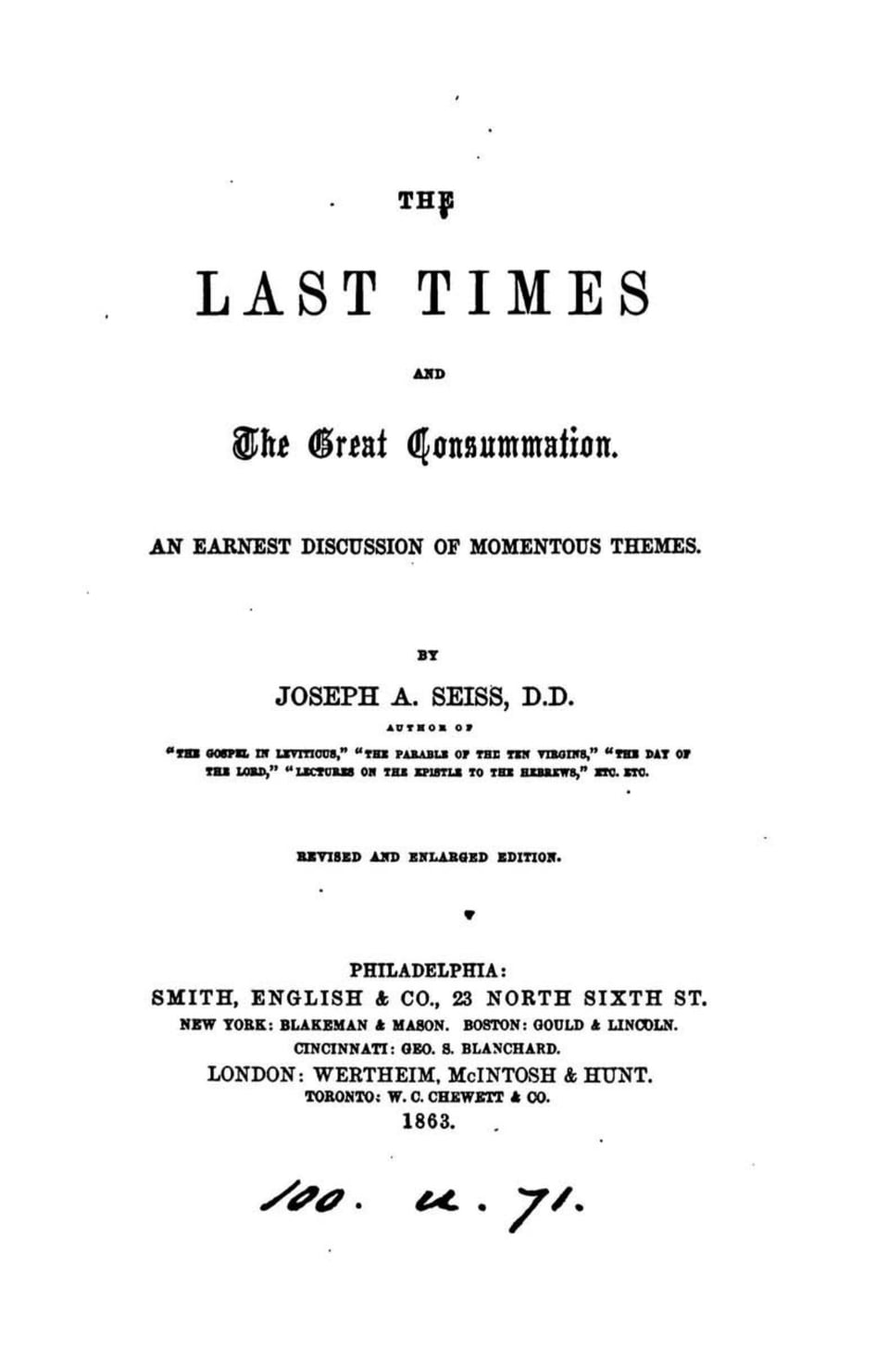
THE .
LAST TIMES
AND
The Great Consummation.
AN EARNEST DISCUSSION OF MOMENTOUS THEMES.
BY
JOSEPH A. SEISS, D.D.
AUTHOR OF
"THE GOSPEL IN LEVITICUS," "THE PARABLE OF THE TEN VIRGINS," "THE DAY OF THE LORD," "LECTURES ON THE KPISTLE TO THE HEBREWS," ETC. ETC.
REVISED AND ENLARGED EDITION.
PHILADELPHIA:
SMITH, ENGLISH & CO., 23 NORTH SIXTH ST. NEW YORK: BLAKEMAN & MASON. BOSTON: GOULD & LINCOLN. CINCINNATI: GEO. S. BLANCHARD.
LONDON: WERTHEIM, McINTOSH & HUNT. TORONTO: W.C.CHEWETT & CO. 1863.
u. 71.
Οιθέν ανθρωπψ λαβειν μειζον, οὐ χαρισασθαι θεῷ σεμνότερον, ἀλλη-
θείας.—Plutarch.
"Man cannot receive, nor God bestow, a greater blessing than THE TRUTH."
I claim that liberty, which I willingly yield to others, in subjects of difficulty to put forward as true such things as appear to be probable, until proved to be manifestly false.—Harvey.
My determination with myself is, to follow neither men nor their opinions, but God and his word.—Justin Martyr.
Distinguite tempora, et concordabunt Scriptura.
Entered according to Act of Congress, in the year 1863, by JOSEPH A. SEISS, in the Clark's Office of the District Court of the United States for the Eastern District of Pennsylvania.
PREFACE.
This book treats of the future destiny of the world and its population, as revealed in the holy prophecies. It was first published in 1856, since which time several editions and republications of it have appeared. It was originally designed to bear testimony against certain erroneous opinions extensively afloat in the popular mind, and to awaken attention to a subject too little appreciated and too much neglected by modern professors of Christianity. The favor with which it has met, and the blessing of God which has so largely attended it in many directions, together with the increased ominousness of our times, and the pressing importance of a right knowledge of what is coming upon the earth, have induced the author to revise, enlarge, and reissue it, and to enter into arrangements to bring it, in its revised form, simultaneously before the reading public of England, Canada, and the United States.
The views which it presents are somewhat in conflict with prevailing impressions and current opinions and prejudices; but they are the writer's honest convictions, produced by faithful study, and uttered under a full sense of the responsibility involved. They are also believed to be entitled to sober, candid, and careful consideration. They certainly have the sanction of high authorities, both ancient and modern, and are more and more commanding the belief of devout men of earnest hearts and eloquent tongues in all sections of the Church of Christ.
A few exceptions have been taken to former editions of this book. Its spirit was thought too positive, dogmatical, and severe. This criticism was not felt to be just. Strong, bold language was indeed employed; for it would be useless to think of making an impression in any other way; but as to dogmatical proscriptiveness, or disrespect to those entertaining different opinions, nothing was further from the author's feelings, or from the design of his book. Nevertheless, the revision has removed some passages, and modified others, which, perhaps, were liable to misconstruction in these particulars. If any thing remains which might reasonably disturb the most kindly feelings and relations with those who see things in a different light, the author is not conscious of it, and does not so intend it.
It has also been thought by some, that the book gave too unfavorable a picture of the present condition of the world, that the moral and spiritual state of things now is not worse, but better, than in former periods. Seven years of additional study and observation, however, have only deepened the writer's belief in the truthfulness of the representations he has given. The difference between him and his critics, upon this point, may also, after all, be more apparent than real. The truth is, that the world is both better and worse than at any time since the days of the Apostles, and that it will continue to become better and worse until the "end." As the light increases, the shadows deepen. There is upon earth a kingdom of evil, and a kingdom of good; and both are expansive and growing.
This is distinctly taught in the parable of the Wheat and the Tares. The great Lord of the field has said, "LET BOTH GROW TOGETHER UNTIL THE HARVEST; THE HARVEST IS THE END OF THE WORLD." Hence, Christ and Antichrist, holiness and iniquity, good and bad, are side by side, each advancing, the conflict between them increasing in intensity, the severest being the last, when the Lord of the harvest shall come with his reapers and make the everlasting separation. "The path of the just is as the shining light, that shineth more and more unto the perfect day," (Prov. iv. 18;) and yet "Evil men and seducers shall wax worse and worse, deceiving and being deceived." (2 Tim. iii. 13.)
The enlargements in this edition are considerable, amounting in all to more than one hundred pages. Some portions have been entirely rewritten. Notes have been added, to explain or further support the original text, and to bring up the work to the author's increased understanding of many important points. Pains have been taken and much labor bestowed to present a full analysis of Scripture References on the entire subject, and to give a full exhibit of the literature of the same from the days of the Apostles to the present. A complete Index to every thing important contained in the work has also been appended; all of which must materially enhance its value.
To appreciate this book as an argument for the system of doctrines concerning the future which it gives, it will be necessary to read all of it, and in the order in which it is presented. Its force is cumulative. Each part enters into the support of all the parts, and in its place contributes to the general conclusions of the whole.
It is only by attention to this fact that the reader can do justice to the author, to the subject, or to himself.
As remarked in the preface to the first edition, the author of this volume does not presume to speak for his Church, or for any party, but only for himself. Nevertheless, he is happy to be able to say, that he speaks with Justin Martyr, Irenaeus, Tertullian, and all the great divines of the first ages after Christ, as well as with many of the greatest lights of Protestant Christendom. And if he is to be censured or condemned for what he has here ventured to affirm, the Church of Christ itself, in the purest and brightest periods of its history, and in some of its most illustrious worthies, must also be censured and condemned.
With these remarks, the writer again sends out this volume, hoping that it may not be unfruitful of good, and praying that all who read it may be brought to share in the blessedness of those who shall have "part in the first resurrection."
PHILADELPHIA, U. S., March 18, A.D. 1863. } CONTENTS.
TWELVE DISCOURSES.
DISC. PAGES
I. THE SUBJECT PROPOUNDED—MATT. XXIV. APPLIED—CHRIST'S RETURN PROVEN—IMPORTANCE OF THE SUBJECT... 9-85
II. CHRIST'S COMING IN RELATION TO OTHER EVENTS— THE MILLENNIUM—WRONG VIEWS CORRECTED—THE ADVENT PRE-MILLENNIAL... 86-61
III. THE RESTITUTION OF ALL THINGS—“END OF THE WORLD”—PETER'S CONFLAGRATION—REPEAL OF THE CURSE 62-87
IV. THE RESURRECTION—REV. XX.—TWOFOLD RESURREC TION—HOPES CONNECTED WITH THE RESURRECTION OF THE JUST... 88-111
V. MESSIAH'S KINGDOM—HOW PRESENTED IN THE SCRIPTURES—IS NOT YET SET UP... 112-186
VI. THE JUDGMENT—DAY OF—IS PROGRESSIVE—CONNECTS WITH THE MILLENNIAL REIGN—HOW INTRODUCED ADMONITIONS 137-159
VII. ADMINISTRATIONS OF THE JUDGMENT—UPON NATIONS —RESULTS OF... 160-182
VIII. RESTORATION OF THE JEWS—OBJECTIONS TO—NEW TESTAMENT ON—ANCIENT PROPHECIES—FACTS—EXPLANATIONS 183-208
IX. THE WORLD TO COME—PICTURED IN THE TRANSFIGU RATION—BLESSED CHARACTERISTICS OF... 209-230
X. TESTIMONY OF THE CHURCH—SUMMARY—the FATHERS AUTHORITIES—THE REFORMERS—CONTRAST BETWEEN PAST AND PRESENT... 281-258 CONTENTS.
DISC. PAGES
XI. WHEN CHRIST WILL COME—WITH RELATION TO OTHER EVENTS—THREE METHODS OF COMPUTING THE TIME. 259-284
XII. RECAPITULATION—SIGNS OF THE TIMES WITH REFERENCE TO THE ADVENT OF CHRIST—SENTIMENTS OF DISTINGUISHED MEN—DESIRABLENESS OF CHRIST'S COMING ... 285-310
NOTES AND ADDITIONS.
NOTE PAGE
A. OPINIONS OF DISTINGUISHED MEN ON THE DAYS IN WHICH WE LIVE... 816
B. THE MEANING OF γevea—“GENERATION”—IN MATT. XXIV. 84... 828
C. THE AUGUSTAN AND HELVETIC CONFESSIONS AGAINST THE MODERN IDEAS OF THE MILLENNIUM... 826
D. DOES THE AUGSBURG CONFESSION CONDEMN CHILIASM?.. 827
E. MILLENARIAN VIEWS OF THE SPIRITUALITY OF CHRIST’S KINGDOM... 885
F. DECLARATION OF THE SAVIOR (JOHN XVIII. 86) IN REFERENCE TO HIS KINGDOM AND THIS WORLD... 838
G. THE PERSONAL ANTICHRIST—IS IT LOUIS NAPOLEON?... 841
H. THE TWO STAGES OF THE TRANSLATION OF THE SAINTS... 849
I. LUTHER ON THE MILLENNIUM... 854
J. THE SCRIPTURE CHRONOLOGY OF THE WORLD... 856
K. PROBABLE DATES OF THE SEVEN LAST VIALS... 862
AUTHORITIES, BOOKS, AND REFERENCES.
CHAP.
I. ANALYSIS OF AUTHORITIES FROM THE HOLY SCRIPTURES
II. REFERENCES TO THE OPINIONS AND WORKS OF THE FATHERS... 888
III. CLASSIFIED REFERENCES TO MORE RECENT WRITERS... 400
GENERAL INDEX... 488 The Last Times.
FIRST DISCOURSE.
THE SUBJECT PROPOUNDED—THE TWENTY-FOURTH CHAPTER OF MATTHEW APPLIED—CHRIST'S PERSONAL RETURN TO THE EARTH PROVEN—THE INTENSE IMPORTANCE OF THE THEME.
MATT. xxiv. 3: And as he sat upon the mount of Olives, the disciples came unto him privately, saying, When shall these things be? and what shall be the sign of thy coming, and of the end of the world?
FROM these words I begin a series of special discourses upon the holy prophecies concerning "The Last Times," and the winding up of the dispensation under which we now live.
It is agreed, by all believers in the Bible, that very mysterious scenes await our world. Christians and Jews concede, that we are approaching commotions and changes, such as never have been since time began. Indifferent to the future as we may be, and deep as are the church's slumbers upon the subject, God's purposes are fixed, and the wheel of his wonderful providence is rolling us on to the funeral of the "world" that now is. Every day we are coming nearer and nearer to a period, if we have not already entered within its margin, when the whole present arrangement of things shall be broken up and pass away.
No one acquainted with the existing aspects of the world, can have any doubt, that we have fallen upon very startling and critical times. All society, everywhere, with its politics, its philosophy, and its religion, is in a perturbed condition, indicating revolutions and occurrences which no mere human foresight can at all comprehend. The stream of earthly things is overflowing its old banks, and spreading out in every direction, in wild, disordered, ungovernable, and overwhelming volume. Old systems and modes of thought and belief, which have stood for ages, are everywhere tottering upon their thrones, and many of them reeling as for their final fall. Symptoms of a mysterious metamorphose meet us on every hand, causing some of earth's most far-sighted men, in church and state, to tremble with amazement and doubt. What these approaching changes are to be is differently given, according to the different points of observation which men occupy. But that changes are certainly coming, all admit.*
I propose, therefore, to enter upon a serious and honest effort to ascertain what light the Scriptures throw upon the momentous problem. Our heavenly Father has given us a "sure word of prophecy," and has been pleased mercifully to reveal therein what his great purposes are, and how things are to be ordered until those purposes are fulfilled; and it is my design to open the book of God, and to go with you to its unerring and inspiriting pages, to ascertain what the Lord hath made known concerning those "things which must shortly come to pass." I do not propose to take the prophet's chair, but to take the place of an humble student of the prophet's words. I am a learner, not a master—a seeker after what has been revealed, and not a revealer of what has hitherto been unknown. My purpose is, to keep close "to the law and the testimony." I will follow no guides but the inspired writers. And I ask of you to test carefully all that I may present, beseeching you to reject all that I may by mistake utter at variance with God's word.
I may err. I may not always hit upon the exact truth. All I claim of you is, to approach the subject with a prayerful and teachable spirit, ready to hear and weigh testimony without partiality or prejudice, sincerely desirous to learn what God the Spirit saith, and determined, at all hazards, to cleave to all that the blessed Scriptures really teach.
I know that there is in many a strong but morbid distaste for the discussion of these subjects. Some have even gone so far as to set it down to some mental defect for a man to touch the study of prophecy. But I suppose that there are among the men who have devoted their time, talents, and learning to this subject, some with quite as much soundness of mind and justness of taste as any of those who have decided not to open the seals which inexcusable neglect has put upon the prophetic Scriptures. Noah, also, was considered insane for his concern about what was coming upon the earth in his day. Jesus himself, with all his Divine gravity and wisdom, was pronounced a demoniac. And the apostle Paul, in the midst of some of his mightiest and brightest intellections, was branded as beside himself and mad. And who would not rather suffer reproach with such company, than to have that come upon him "which is spoken of in the prophets: Behold, ye despisers, and wonder, and perish: for I work a work in your days, a work which ye shall in no wise believe, though a man declare it unto you!" And those Christians assuredly have reason to blush and be ashamed to whom apology is necessary for an attempt to bring before them the wonderful and glowing prophecies of Scripture concerning things to come "in the latter days." Every thing dear and hopeful in the Christian faith stands inseparably connected with them. They include nearly all the grand motives to faith, obedience, watchfulness, and virtue.
God also tells us, that "All scripture is profitable, for doctrine, for reproof, for correction, for instruction in righteousness;" that we have "a word of prophecy whereunto we do well to take heed;" and that "Blessed is he that readeth, and they that hear the words of this prophecy, and keep the things that are written therein." Where, then, do men get liberty to ignore one-half of the Bible as useless? Who has authorized us to seal and bury in oblivion those grand Apocalypses of futurity which God has given, and in reference to which he says, "If any man shall take away from the words of the book of this prophecy, God shall take away his part out of the book of life, and out of the holy city, and from the things which are written in this book!" Hath "the Lord God of the holy prophets sent his angel to shew unto his servants the things which must shortly be done," and we be under no obligations whatever to seek to find out the meaning of the heavenly communications? Shall he solemnly proclaim "these sayings faithful and true," and him "blessed" that keepeth them, and we call it piety and wisdom to put them aside as loose fables, and repudiate them as unmeaning riddles which can only addle our brains? How could we adopt a course more criminally indifferent, arrogant, and unbelieving? Is not such conduct a placing of ourselves with the scoffers of the last days, who say, "Where is the promise of his coming?" Shame, shame, to the skepticism of many professing Christians.
Let me suppose a case. Suppose that the blessed Savior should now appear in this assembly, and take this stand, and begin to discourse to you about the last times. Would you feel justified in stopping your ears to his words because he struck upon this particular theme? Would you not regard any one who should act thus as under some strange infatuation of the devil, and deserving of severe rebuke? But where is the difference, whether Jesus should thus come in person, or come to us in the written word, every sentence of which he has dictated, inspired, or delivered to us for our learning?
And if you would feel bound to give him a reverent hearing in the one case, why not feel equally bound in the case which actually exists? Christ is here with his word to instruct us upon these very subjects; and it would not be worse to stop your ears to his personal voice, than it is to refuse to hear and consider his written truth.
Prophecy, it is true, is a somewhat difficult theme. Peter tells us, that it is "a light that shineth in a dark place." We must not expect everything to be as obvious and plain as in the noonday when all is luminous. Especially in unfulfilled prophecy, there must needs be some obscurity in the particular details of circumstances, "times and seasons." But, there are difficulties to be encountered and wildernesses to be traversed just as great and discouraging in other departments of learning; yet, instead of being deterred by them, men are rather the more stimulated to meet them, and are accustomed so constantly to triumph over them, that we cease to be surprised at the most astonishing strides of human genius. Does the astronomer cease to study and survey the heavens, because, with all his aids, he never can fully take in the tremendous sweep of God's universe, or tell what sort of inhabitants are in the sun, moon, and stars? Does the geologist cease to dig and bore into the bowels of the earth, or give over the study of its rocks and fossils, because he cannot find out all that lies hidden in its unknown centre, or tell how the strata of its crust were formed, or describe the appearance and habits of those monsters whose bones lie entombed under its surface? Does the physician throw aside all further inquiry into the anatomy and physiology of man, because he cannot discover "how the bones are formed in the womb," what life is, and in what part of the body the soul is? Why, then, should the Christian shun the study of the predictions which God has given, because there are some depths and mysteries about them which we cannot fathom?
Nay, these very obscurities and difficulties, which deter so many from examining the prophetic word, are not without their wholesome effects. It is a real pleasure to the mind to know that something has been left for it to do. It luxuriates, and has its highest life in the exercise of overcoming obstacles, and bringing up the truth from regions which lie under the surface of ordinary observation. Only furnish to the human faculties the assurance of success, and it is their highest happiness and purest virtue to labor and to wrestle with difficulties. And so the glimmering twilight which hangs about prophecy, is just what we might expect, and what we need. There is light and plain certainty enough to guide, cheer, quicken, and excite; and just darkness enough to check the pride of speculation and the boasts of confidence, and to make us prayerful, humble, and inquiring. The difficulties are not insurmountable. They are not as great as many have agreed to regard them. They are more imaginary than real, and proceed rather from our slothfulness than from the prophecies themselves. People do not understand prophecy, simply because they do not study it; and then they refuse to study it because they do not understand it. There is no part of Scripture richer or more munificent in rewards for the faithful inquirer. It is a garden of flowers—a cabinet of wondrous jewelry. It is a vast and varied landscape, filled with beauty and grandeur, the horizon of which is fringed with the bright dawning glories of eternal day. Here, and here alone, we can see the real scope and magnificence of man's redemption. Here, and here only, we can trace God's providential plans to their ultimate consummation, and learn the real majesty of his counsels of love. At every step there is something to encourage and comfort us under the fatigues and trials of life, something to confirm our faith and to fill us with glorious anticipations.
And if the limits of our knowledge can be extended, and the sum of human good augmented, by the study of rocks, and bones, and beasts, and birds, and stars, how can it be unprofitable to bend our attention a little more than we have done to what our Savior has revealed concerning "the signs of his coming, and of the end of the world"?
That the Lord Jesus, the Son of the Virgin Mary, will certainly return again to this earth, is a doctrine written in all the creeds, and sung about by Christians every week. It is an event the sublimest in coming time, the most largely treated in the Scriptures, and the most deeply involving all that relates to the destiny of our world. As Christ is the centre of history, his second coming is the centre of prophecy, which is history written beforehand. I have accordingly fixed upon this final advent of the Lord as the central thought of these investigations, and as the point from which to survey the great scenes of the last times. To attempt to prove to you that the Son of man will really and personally come again to this world, may seem quite superfluous. It is a doctrine which orthodox Christians universally admit. And yet, perhaps, there is not another article of Christian faith so coldly and indefinitely apprehended. Few men embrace it as a reality. Few men lay hold of it as an efficacious truth. People deny it not, but neither do they feel it. They have so much preoccupied their minds with imaginary figurative comings of the Savior, in providence, in his Spirit, in his word, and in his church, that his only real coming has well-nigh become obsolete—a mere dead letter: It no longer comes upon the heart and conscience with its proper awakening and commanding power. We recite it, and sing it; but we do not effectually receive it. It is in our creed, but it cannot be said to be our faith. If we entertain it at all, it is at a great distance off. It cannot therefore be a matter of small importance for us to review our position, and to endeavor to ascertain where we stand in regard to this great doctrine.
If we have been unconsciously saying to ourselves, "the Lord delayeth his coming," it is time that we should wake up to the fact, lest that day should come upon us unawares. Christ bids us "Watch; for in such an hour as ye think not, the Son of man cometh." "The day of the Lord so cometh as a thief in the night." "As a snare shall it come on all them that dwell on the face of the whole earth." And amid the tremendous heavings of society in our day, we are the most solemnly admonished to look well to our hearts, and to keep close to the directions of our Lord.
The great original prophecy concerning the second advent, the principal storehouse from which the apostles and first Christians drew their faith and illustrations upon the subject,—is that glorious discourse of the Savior which he gave to Peter, James, John, and Andrew, in answer to the questions propounded in the text. Next to the sermon on the mount, that discourse is the longest and the most momentous of all that has been preserved of the Savior's communications. And yet, there is, perhaps, no part of Scripture that has been so much abused, confused, and obscured by professed interpreters. Though the Bible nowhere so pointedly, directly, literally, and plainly asserts and describes the final advent of the Lord, there is scarcely a commentary in existence which does not so Jerusalemize, spiritualize, and allegorize it, as to leave it the most indefinite and unmeaning of all the Savior's teachings. The prevailing impression is, that the twenty-fourth chapter of Matthew is a mixed prophecy, referring primarily to the destruction of Jerusalem by the Romans, and, perhaps, by a sort of typical implication, remotely touching upon the scenes of Christ's final personal coming. But what relates to Jewish troubles, and what relates to the transactions of the last times, no commentary in the hands of the people has told. Others, again, apply the whole to the taking of Jerusalem only, and consider the coming of the Son of man nothing but the coming of the Roman legions into Palestine.
That there are difficulties connected with the exposition of this important portion of Scripture, is admitted; but that they are of a character to prevent us from using it as a basis of doctrine, or from understanding what the Savior in the main meant to teach by it, I am not willing to concede. The simple reading of it, with a few explanatory remarks, is all that is needed to exhibit its meaning with ample clearness for our present purposes.
That the passage, in part at least, was intended to foreshow the fate of Jerusalem, with the signs and accompaniments of the same, is not to be questioned. That the predictions which it contains were not meant to be limited to these particulars, but to include the last times and the period of Christ's personal return to the earth, appears to be equally well founded. And that the Savior does not speak first of the one application only, and then exclusively of the other, in regular historic and chronological order, is also pretty clear, from the difficulty of showing exactly where the point of transition is. The true key to the passage, and which relieves it of most of the troubles which expositors have found with it, I take to be this: that the fate of the ancient Jewish economy and its accompaniments was the commencement of a system of administrations which is at length to involve all nations,—a sort of first-fruits of the end,—the enactment on a limited scale of what is finally and more fully to be enacted on the theatre of the world at large.
It is a fact that history is continually repeating itself, and that the future is perpetually foreshadowed in the scenes and occurrences of the past. There is also a "latitude which is agreeable and familiar to Divine prophecies, being of the nature of their Author, with whom a thousand years are as one day, and therefore they are not fulfilled punctually at once, but have springing germinant accomplishments throughout many ages, though the height or fullness of them may refer to some one age."
So in the case before us. The close of the Jewish economy was the earnest of a general closing up of the same sort for all nations. The destruction of Jerusalem, and the attendant particulars, constituted the starting-point; but the meaning of the prophecy goes quite beyond these, and grasps a much ampler scene of fulfilment. Both are embraced in one field of view, whilst the stress and fulness of the predictions reach the last times and the great consummation, and presently settle entirely in them.
The occasion of the discourse is set forth in these words :—
"And Jesus went out and departed from the temple: and his disciples came to him, for to show him the buildings of the temple. And Jesus said unto them, See ye not all these things? Verily, I say unto you, [the days will come in the which] there shall not be left here one stone upon another, that shall not be thrown down."
"And as he sat upon the Mount of Olives, the disciples [Peter, and James, and John, and Andrew] came unto him privately, saying, TELL US, WHEN SHALL THESE THINGS BE? AND WHAT SHALL BE THE SIGN OF THY COMING, AND OF THE END OF THE WORLD, OR AGE?"
I emphasize these last words, because they are the stemwords upon which the whole discourse is framed. Christ had spoken only of the destruction of the temple and the Jewish state. But with this the disciples associated the end of the whole earthly order of things, and the Messiah's entrance upon his glorious and heavenly dominion. Their inquiry, accordingly, had two leading subjects: first, the overthrow of the Jewish temple; and, second, the coming of Christ in his kingdom at the great consummation. They wished to know two things concerning these subjects; first, when these things should come to pass, and second, what signs should mark the time and manner of their occurrence.
And, as they asked two questions in one, the Savior proceeded to answer them in the same double form.
"And Jesus answered and said unto them, Take heed that no man deceive you; for many shall come in my name, saying, I am Christ, and shall deceive many. [And the time draweth near; go ye not, therefore, after them.]”
The indication is here given, in the very first words, that the minds of the inquirers were in a somewhat confused and exposed condition. They expected the setting up of the Messiah's kingdom in connection with the fall of the Jewish temple, and hence were in great danger of being deluded by impostors, and of accepting antichrists and pseudo-christs for Christ himself. One of the punishments of the people of Israel for the rejection of the true Christ, was the relinquishment of them to false saviors and deliverers. In every period of corruption and consequent calamity, this symptom of lying consolations and promises repeats itself. It was so in the period of the captivity. (Jer. xxix. 8, 9, xiv. 13; Ezek. xiii.) It was so in the period of Jerusalem's overthrow, as Josephus has very fully shown. And it is elsewhere abundantly foretold that it shall be still more remarkably so in the end of the present dispensation. Hence the caution, to guard against deceivers and false hopes, which applied not only to the Christians of that time, but applies equally to us.
"And ye shall hear of wars, and rumors of wars: see that ye be not troubled: for all these things must come to pass; but the end is not yet. For nation shall rise against nation, and kingdom against kingdom, and there shall be famines, and pestilences, and earthquakes in divers places; [and fearful sights, and great signs shall there be from heaven.] All these are the beginning of sorrows."
How literally and completely all these things were fulfilled in the period of Jerusalem's fall, may be seen in Josephus, and the commentaries upon these verses.
But they are equally predictions of what is to mark the period of the end. Indeed, they are here called "the beginning of sorrows," as if specifically to make known that their occurrence in the case of Jerusalem's trouble was but the commencement or first-fruits of a fulfilment which is to be still more amply realized by the world at large.
"[But before all these, they shall lay their hands on you, and persecute you.] Then shall they deliver you up [to councils, the synagogues, and into prisons], to be afflicted, and shall kill you. [And ye shall be brought before rulers and kings for my sake, for a testimony against them;] and ye shall be hated of all nations for my name's sake. And then shall many be offended, and shall betray one another. And many false prophets shall arise, and shall deceive many. And because iniquity shall abound, the love of many shall wax cold."
That these things literally came to pass in the times of the apostles themselves, may be seen in Acts iv. 1-3, v. 17, 18, 27, 40, 41, vii. 59, xii. 1-4, xvi. 19-23, xvii. 6, xxvi. 10, 11, xxviii. 30, 31, xx. 29; 30; 2 Tim. i. 15, iv. 10, 14; 2 Peter ii. 1; Jude 4; 1 John iv. 1, ii. 18; 2 John 7. They are also more or less fulfilling continually, preparatory to the still more complete fulfilment under the Antichrist of the last days. (See Dan. vii. 25; 2 Thess. ii. 3-8; Rev. xiii. 15.)
"But he that shall endure unto the end, the same shall be saved. And this gospel of the kingdom shall be preached in all the world for a witness unto all nations; and then shall the end come."
There is a threefold "end" spoken of in these words: the end of suffering, in the case of the individuals encouraged to endure; the end of the Jewish polity, as the first point inquired about; and the end of the whole present order of things, as connected with the coming of Christ, concerning which they also wished to be informed. That the gospel was very generally promulged before the fall of Jerusalem, is a fact of which we have very reliable testimony.
Eusebius says of the apostolic age, "Under a celestial influence and cooperation, the doctrine of the Savior, like the rays of the sun, quickly irradiated the whole world." And if Eusebius should not be sufficient authority, hear what Paul says on the subject. He died years before Jerusalem was destroyed; and yet he writes the Colossians, (i.16,) "The word of the truth of the gospel is come unto you, as it is in all the world." "Be not moved away from the hope of the gospel which ye have heard, and which was preached TO EVERY CREATURE WHICH IS UNDER HEAVEN." (i. 23.) "Have they not heard? yes, verily, their sound went into all the earth, and their words unto THE ENDS OF THE WORLD." (Rom. x. 18.) But that was only the type of a publication of the gospel which is now ever more and more going on, and which shall receive a still more marked and miraculous fulfilment as the end approaches and the judgment comes. (See Rev. xiv. 6.)
"[And when ye shall see Jerusalem compassed with armies, then know that the desolation thereof is nigh. Then let them which are in Judea flee to the mountains, and let them which are in the midst of it depart out, and let not them that are in the countries enter thereinto. For these be the days of vengeance, that all things which are written may be fulfilled. But woe unto them that are with child, and to them that give suck in those days; for there shall be great distress in the land, and wrath upon this people. And they shall fall by the edge of the sword, and shall be led away captive into all nations, and Jerusalem shall be trodden down of the Gentiles, until the times of the Gentiles be fulfilled.]”
It is remarkable that both the end of the Jewish economy, and the great consummation, are connected with the coming of foreign powers against Jerusalem, and disaster to the holy city; as also with a flight to the mountains on the part of those who are to escape destruction.
(See Zech. xiv. 1-5.) The paragraph from Luke, which I have just given, seems to describe more especially the first, and the following from Matthew seems to describe more especially the second.
"When ye therefore shall see the abomination of desolation, spoken of by Daniel the prophet, stand in the holy place, (whoso readeth let him understand,) then let them which be in Judea flee into the mountains. Let him which is on the housetop not come down to take any thing out of his house: neither let him which is in the field return back to take his clothes. And woe unto them that are with child, and to them that give suck in those days. But pray ye that your flight be not in the winter, neither on the Sabbath day: for then shall be great tribulation, such as was not since the beginning of the world to this time, no, nor ever shall be. And except those days should be shortened, there should no flesh be saved: but, for the elects' sake [whom he hath chosen], those days shall be shortened."
The quotation from Daniel, respecting the desolating abomination, was understood by the Alexandrine Jews as referring to the profanation of the temple by Antiochus Epiphanes, as described in 1 Maccabees i. 43-60. And some have supposed a corresponding profanation under the bloody and sacrilegious zealots at the period of Jerusalem's overthrow. But, as the passage stands in Daniel, it connects with the scenes of the judgment and the end of the world. The Savior does not seem to quote it, either, in any other sense, or with any other application, than that which it has in its original connection. It is therefore altogether safest to understand it as referring above all to the terrible desecrations to be perpetrated by the Antichrist when his own image shall be set up for worship in the place of the services of God; for it is in connection with the setting up of that image that the great tribulation in its proper fulness is to begin. Hence its name, "the abomination of desolation," or, that maketh desolate.
As to "the elect," or "chosen," different classes are perhaps meant. There were some, even unbelieving Jews, saved at Jerusalem's destruction; and not a Christian perished. Both these classes were therefore in some sense the elect. And there will be a corresponding election when these predictions come to their ultimate fulfilment in the great tribulation of the last days. Some shall pass through the terrible affliction, and entirely survive it; and others shall be caught up to their Lord in the air at the very commencement of these great woes, and thus entirely escape them, (Luke xxi. 36; Rev. xiv. 1-5,) being the elect of God to be the Bride of Christ. And when these straits and sorrows come,—
"THEN if any man shall say unto you, Lo, here is Christ, or there; believe it not. For there shall arise false Christs, and false prophets, and shall show great signs and wonders, insomuch that (if it were possible) they shall deceive the very elect. [Take ye heed.] Behold, I have told you before. Wherefore, if they shall say unto you, Behold, he is in the desert; go not forth: behold, he is in the secret chambers; believe it not. FOR AS THE LIGHTNING COMETH OUT OF THE EAST, AND SHINETH EVEN UNTO THE WEST: SO SHALL ALSO THE COMING OF THE SON OF MAN BE. FOR WHERESOEVER THE CARCASS [BODY] IS, THERE WILL THE EAGLES BE GATHERED TOGETHER."
Though the Savior may perhaps still have Jerusalem's overthrow somewhat in view, it is plain that the principal stress of this paragraph falls in the last days, and refers above all to what is to transpire in connection with the false pretences and lying wonders of the Antichrist and his minions, (2 Thess. ii. 3-12; Rev. xvi. 13, 14, xix. 20,) from which the people of God shall then be in peculiar peril. The last verses, particularly, do not refer to the Jerusalem troubles, but to Christ's literal and personal return, in contrast with all pretended saviors and usurpers of his place, whether coming as his rivals or in his name, in the days of Jerusalem's distress, or in the last days.
Four things are contained in these verses: first, that false Christs and false prophets shall come; second, that the true Christ is also to come; third, that the coming of the true Christ will be after a manner and with demonstrations very different from those of usurpers and deceivers; and fourth, that we need give ourselves no anxiety about making our way into the presence of Christ when he comes, for that we shall as naturally find ourselves with him as eagles are where their prey is. To say that this coming of Christ as the lightning shineth, refers to his providential coming by the Roman armies, would require the invention of a similar fiction to correspond with the coming of the false Christs, and, indeed, divest the entire passage of meaning. The gathering of the eagles might be interpreted of the coming of an army which bore the eagle on its standards; but when we compare it with Luke xvii. 34-37, Isaiah xl. 31, Rev. iv. 7, xii. 14, the reference seems rather to be to Him who "was dead" but is "alive for evermore," and to the gathering of his redeemed people to himself in the clouds at his literal coming, according to 1 Thess. iv. 16, 17. So Theophylact, Euthymius, and many of the ancients took the passage; and Luther paraphrases it as if Christ had said, "As the eagles are gathered where the carcass is, so shall my people be gathered where I am."
It is also very noticeable how the subject of Jerusalem's overthrow, with which the discourse begins, gradually fades into the greater and more absorbing theme of Christ's coming and the end of the world. Especially from this on, it is quite lost in the intenser sharpness of the back part of the picture. It is of the judgment period that we now read,—
"Imediately after the tribulation of those days shall the sun be darkened, and the moon shall not give her light, and the stars shall fall from heaven;"—or, as Luke has it,— " [There shall be signs in the sun, and in the moon, and in the stars, and upon earth distress of nations with perplexity, the sea and the waves thereof roaring, men's hearts failing them for fear, and for looking after those things which are coming on the earth;] and the powers of the heavens shall be shaken."
It is no longer Jerusalem that we see in these graphic words. What is here spoken concerns all the families of man, and relates to the judgment-times in immediate connection with the glorious revelation of the returning Lord.
"And THEN SHALL APPEAR THE SIGN OF THE SON OF MAN IN HEAVEN: and THEN shall all the tribes of the earth mourn, and they SHALL SEE THE SON OF MAN COMING IN THE CLOUDS OF HEAVEN, WITH POWER AND GREAT GLORY."
What a shame, that learned men should spend their pains and talents in attempts to tie down this language to the destruction of Jerusalem by the Roman armies!
I take it as an axiom,—a settled verity which demonstrates itself,—that two events which are specifically described as successive—the one as coming after the other—cannot be the same. But, if this axiom had always been observed in the interpretation of this twenty-fourth chapter of Matthew, the students of the Scriptures might have saved themselves much inconsistency and confusion, and many a misapprehension of God's word. If we ask most of our popular commentators what is meant by "the tribulation of those days," described in the twenty-ninth and preceding verses, the answer given is, that it means the calamities and sufferings of the Jews, induced by the siege and overthrow of their city and state. And if we ask them, again, what is meant by the mourning of the tribes of the earth "after the tribulation of those days," the answer is about the same,—the calamities and sufferings of the tribes of Israel in connection with the fall of their city and state! If we inquire of them what is meant by the coming of the Son of man as the lightning in the clouds of heaven, with some twinges of uncertainty they nearly all finally agree upon the reply that it means the flashing judgments which were brought upon the rebellious people of Israel by the coming of the Roman armies against Jerusalem!
The coming of which the Savior speaks was to be "out of the east" towards the west, and the coming of the Roman armies was out of the west and north towards the east and south; but the reply is, no matter for that; we are not to expect all the particular circumstances to hold! The coming of which the Savior speaks is specifically said to be "after" the tribulation induced by the invasion of Palestine by the Romans, as well as "after" that great unparalleled tribulation of which the Jewish troubles were the commencement and first-fruits; but no matter for that, we are told; as though effect could go before its cause, and as if priority or succession were nothing in the interpretation of a book such as the word of God! I question, indeed, whether the annals of learning can furnish a parallel to the absurdities which characterize the great mass of our popular disquisitions upon this portion of the inspired record. No wonder that the doctrine of Christ's personal return to our world has lost so much of its weight, certainty, and rightful importance in the minds and hearts of the Church, when its great foundation-text is thus sacrificed to a false and supercilious erudition.
One of the strangest things in the world is the manner in which some people read the Bible. It would almost seem as if they turned it upside-down, and read it backwards. "Eyes have they, but they see not." They praise it, and hold it in holy regard, and insist that everybody ought to have it; yet they look into it only as some recondite volume, which is a good text-book for preachers, but which is quite beyond the reach of their understanding. They adore it more for the unknown mysteries which they attribute to it, than from their personal appreciation of what their own eyes have beheld upon its pages.
Many seem to view it as a sublime riddle-book, full of mystic poetry and unsearchable wisdom, rather than as a plain piece of information and advice given by a Father to his inexperienced and exposed children. And many who sit down to write commentaries upon it seem to be continually haunted with the idea that there is something recondite in every word, or that the real mind of the Spirit is not to be found in the plain import of the letter, but in some abstruse or mystic analogy which it is their business to dig after. I hold that the Bible is a book for everybody, in which God speaks for the purpose of being understood by everybody; that its language is conformed to the ordinary uses of speech; and that it is to be interpreted in the same common-sense way in which we would interpret the will of a deceased parent, or ascertain the meaning of a letter on business. It was not written to tax our ingenuity, or to test men's skill at learned exposition. Its design is to instruct, and in the most familiar way to express to men the mind and will of God. When Christ speaks of "the Son of man," he means the Son of man, and not the Roman armies. When he speaks of his "coming in the clouds of heaven," he means his coming in the clouds of heaven, and not the sailing of warships on the Mediterranean, or the march of soldiers over the fields of earth. When he says "after" the Jewish tribulations are ended, he means "after" those tribulations, and not before they began, or while they were yet in their incipiency. And when he says that all the tribes of the earth "shall see the Son of man coming in the clouds of heaven with power and great glory," expositors might as well attempt to demonstrate to me that day is night, or that white is black, as to attempt to make me believe that he means the march of an army of boorish heathen soldiers. Christ knew what he wished to say, and how to say what he meant; and I feel myself bound to understand him to mean just what he says.
And what he here predicts respecting his coming in the clouds at the close of the tribulation no more refers to the coming of the Roman armies into Palestine than to the flight of Mahomet, or the next eclipse of the moon. He is describing the scenes of the judgment-period, and nothing else.
"And then he shall send his angels with a great sound of a trumpet, and they shall gather together his elect from the four winds, from one end of heaven to the other."
The elect, in this paragraph, I understand to be the same as the multitude which no man can number, described in Rev. vii. 9-17; the harvest of the earth described in Rev. xiv. 14-16.
"Now learn a parable of the fig-tree; when his branch is yet tender, and putteth forth leaves, ye know that summer is nigh: so likewise ye, when ye shall see all these things, know that it [the kingdom of God] is near, even at the doors. Verily I say unto you, THIS GENERATION SHALL NOT PASS, TILL ALL THESE THINGS BE FULFILLED."
Some have groundlessly supposed that this last remark requires the application of this whole prophecy to the times of the apostles, and consequently to Jerusalem's destruction. They take the word "generation" as meaning those who live in the same thirty years; thirty years being reckoned to a generation. But if this be the sense, then how shall we reconcile the prophecy with facts? Jerusalem was not destroyed until about forty years after the Savior uttered these words. And if he meant that a generation of thirty or even thirty-three years should not pass away till all these things should be fulfilled, his prediction cannot be verified. It is gratuitous, however, to insist upon that sense of the word generation. The original is γ ε ν α—a race, a class, a family of people; as where it is said, "the children of this world are wiser in their generation than the children of light." The plain meaning of the Savior is, that the family of Abraham, the Israelitish people, should not pass out of existence, as a distinct class or race, before all these predictions should be verified.
That the word will bear this sense must be admitted. Many of our most valuable critics and interpreters so understand it. The surroundings also seem to demand that we should here take it as meaning the Jewish people as a race. They are this fig tree which is to have a long winter of leafless barrenness, but which is to bud again when the summer-time of the kingdom approaches. And in this sense above all have the Savior's words thus far been most exactly and marvellously fulfilled, showing the truth of what follows,—
"Heaven and earth shall pass away, but my words shall not pass away."*
It is therefore as plain as language can make it, that this prophecy of the Savior runs through all time, from its delivery down to the end of the world that now is. Men may try to believe that he spoke only of the fall of Jerusalem and the Jewish constitution, but they deceive themselves; they distort, depreciate, and wrest the clear meaning of his words; and they bring endless confusion into one of the plainest, most literal, and most straightforward prophecies in God's word. The disciples asked him very important questions, and he answered them all that they inquired about. They wished to know when and how Jerusalem and the temple should be brought to desolation, and he told them when and how these things should be, tracing down the consequences upon the Jewish race to his final coming and kingdom. They wished to know what should be the signs and form of his final coming in glory and triumph, and he explained to them the whole matter with a fullness of detail which constitutes the great fund from which his followers ever afterward drew their information upon the subject. They wished to know when, and amid what circumstances, the end should come; and he answered them on that point too, as far as it was for them to know the facts; teaching them to look and watch for his coming in the clouds of heaven with power and great glory.
In this remarkable discourse, we are accordingly taught, and have the doctrine certified to us in a very peculiar and unmistakable manner, that our Lord Jesus Christ is to come again into our world. It is not only stated in various forms of language, but it is made the subject of a whole chapter of circumstantial particulars which connect with it, and is the central point in a vast field of predictions, many of which have already passed into historical facts. And one of the prominent reasons, perhaps, why the destruction of Jerusalem and the final consummation were embraced in the same prophetic view, was, that in looking back, and seeing how literally and fully the first part of it has already been fulfilled, we might be confidently assured that what remains to be fulfilled is just as certain as an unalterable fact of history. As part has already become history, so the remaining part shall also become. And thus, with a degree of certainty which excludes all possibility of mistake, the Savior has assured his church that he will come again to this disordered world. It is no mere fancy,—no poet's dream,—no mere fabulous device,—but immutable reality, as sure as the desolations which have been upon Mount Zion for these eighteen hundred years. Though men may think but little of it, and put it far away from them, it is one of the infallible verities of Almighty God. As the angels at his ascension said, so we may be satisfied, that "This same Jesus which is taken up into heaven shall so come, in like manner as ye have seen him go into heaven." Henceforward, therefore, could his followers say, "The Lord himself shall descend from heaven,"—"Our conversation is in heaven, from whence also we look for the Savior, the Lord Jesus Christ."
"Behold, HE COMETH WITH CLOUDS; and every eye shall SEE him, and they also which pierced him." Henceforward could the disciples go forth, "looking for that blessed hope, even the glorious appearing of the great God our Savior Jesus Christ," and beseech men "by the coming of the Lord Jesus Christ and our gathering together unto him," and exhort their fellow-believers "to wait for his Son from heaven," and proclaim the glad "rest, when the Lord Jesus shall be revealed from heaven with his mighty angels," and encourage the fond hopes of the persecuted and desponding with the assurance that "when he shall appear we shall be like him, for we shall SEE HIM AS HE IS."
No, no; "We have not followed cunningly-devised fables, when we made known unto you the power and coming of our Lord Jesus Christ." As certainly as the words of Jesus are true, as surely as the pillars of the Eternal throne are steadfast, Jesus himself, in glorified humanity, shall return again to this very world of ours. All the prophets have predicted it. All the pious, from the foundation of the world, have in some shape expected it. Jesus declared it, both before his death and after his resurrection. And the very last words in the holy Testament which he left us are, "He that testifieth these things saith, SURELY I COME QUICKLY. AMEN." Even apart from what the Scriptures contain upon the subject, with the account of his humiliation before us, reason itself might almost anticipate his return. We cannot suppose that such a glorious personage will always remain under the reproach and stigma of the cross. Natural justice seems to demand that he should come again, in the majesty that appertains to him, in order to sweep away the infamy which wicked men in every age have sought to heap upon him. As He whose right it is to reign, will reign; and as He whose "is the kingdom, the power, and the glory," will not forever leave his enemies to usurp his place; so we are driven to expect him yet to come, "glorious in his apparel, and triumphing in the greatness of his strength."
It must, therefore, be a matter of absorbing interest to every man, how, and when, and with what antecedents and results, the Son of man shall come. "This," says Charles Beecher, "is the question now in the providence of God first claiming the solemn attention of the churches." What can be more momentous than the closing up of this whole present scene of things—the passing away of the world's present fashion and administration? What revolutions in government—what subversions of present social arrangements—what destruction of empires, thrones, principalities, and powers—and what shakings of the heavens and of the earth—are involved! What new and strange experiences shall pass over men when once the glorious King and Judge of quick and dead shall blaze forth his startling presence in the clouds, and summon the earth to answer for all its deeds! And shall we not seek to understand the revelation of God concerning these amazing scenes? Shall we not awake from our dreams of peace, and open our eyes to the startling things that are crowding thick around us, and our ears to what God has said about them? Have we not been allegorizing, and spiritualizing, and Jerusalemizing the prophetic word, until we hardly know where we are, or whether there is anything more to be expected or not? Let us, then, rouse up upon this momentous subject. We have mighty interests staked upon it. There is more said about it in the Scriptures than upon any other single theme. And yet Christians now hardly cast a thought forward to the mighty occurrences which it involves. We say the prayer, "Thy kingdom come!" but so cold and lifeless is the petition on our lips, that we scarcely know what we are asking. Jesus says, "Behold, I come quickly;" but we fold our arms and answer, No, no; it will yet be a thousand years or more. He says "Watch;" but we say, There's no danger that he will come in our day.
The midnight cry is being raised in every region and city of Christendom, "Behold, the Bridegroom cometh; go ye out to meet him!" but multitudes deride, and say, It is the raving of enthusiasts; it is the cry of fanaticism; and they heed it not. Alas, whose heart now thrills to the startling announcement, "The Lord cometh"? Who looks, and sighs, and prays now, for the return of the Savior to our world? Who is waiting for, as he is hastening unto, the coming of the day of God? Who is keeping himself in readiness for its solemn revelations?
My brethren, if the Son of man should come this week, this month, or this year, would he find faith on the earth? Would not the church itself be taken by surprise? Would not such an event now come upon the overwhelming majority of Christ's professed followers unawares? And yet, what guarantee have we that the chariot-wheels of the coming King are not already rumbling over the distant worlds? Has he not said, "In such an hour as ye think not, the Son of man cometh"? "the day of the Lord so cometh as a thief in the night"? and "as a snare shall it come upon all them that dwell on the face of the whole earth"? Who can say that we are not liable to have the great scenes of the judgment precipitated upon us at any moment? And shall we not be concerned to have our minds familiarized with what may any day occur, and which must occur sooner or later? Is there not something inconceivably dreadful in the thought of having that day come upon us at the very time we are saying, "My Lord delayeth his coming"? Would it not be better to be a little beforehand with our anticipations, and to bear the taunts that may be heaped upon us for our concern, than to accommodate ourselves to the wisdom and sobriety of this erring world, and be finally taken by surprise and perhaps lose our eternal all? Jesus says, that "the Lord of that servant" who shall be found faithless, sleeping, or scoffing, "shall cut him asunder, and appoint him his portion with hypocrites, amid weeping and gnashing of teeth."
Of what avail will his worldly wisdom and his fruitless profession be to him then? What good will all his knowledge then do him? Better that we had never known the way of righteousness,—better that we had never been born,—than amid all our high privileges thus to come short of the approbation of the coming Judge.
And if judgment first begin at us, and many professing Christians lose the honors of the kingdom, "what shall the end be of them that obey not the gospel of God? If the righteous scarcely be saved, where shall the ungodly and the sinner appear?" With what surprise and discomfiture shall the day of Christ's coming overtake them!
My dear friends, these are solemn thoughts. It will not do to trifle with them. Momentous issues are involved. And we know not how soon the irrevocable decision shall be made. Let us, then, enter upon the study of this mighty subject with serious and prayerful hearts, anxious to know what God has been pleased to reveal, and earnestly set upon preparing to meet our God. And especially let us carefully lay to heart those impressive words of the Lord Jesus himself:—
"Of that day and hour knoweth no man, no, not the angels of heaven, but my Father only. [Luke: Therefore take heed to yourselves, lest at any time your hearts be overcharged with surfeiting and drunkenness, and cares of this life, and so that day come upon you unawares. For as a snare shall it come on all them that dwell on the face of the whole earth. Watch ye, therefore, and pray always, that ye may be accounted worthy to escape all these things that shall come to pass, and to stand before the Son of man:] [Mark: for ye know not when the time is.] But as the days of Noe were, so shall also the coming of the Son of man be. For as in the days that were before the flood, they were eating and drinking, marrying and giving in marriage, until the day that Noe entered into the ark, and KNEW NOT until the flood came, and took them all away: so shall also the coming of the Son of man be.
Then shall two be in the field; the one shall be taken, and the other left. Two women shall be grinding at the mill; the one shall be taken, and the other left. WATCH, THEREFORE, FOR YE KNOW NOT WHAT HOUR YOUR LORD DOTH COME. But know this, that if the good man of the house had known in what watch the thief would come, he would have watched, and would not have suffered his house to be broken up. Therefore, BE YE ALSO READY: FOR IN SUCH AN HOUR AS YE THINK NOT, THE SON OF MAN COMETH. Who, then, is a faithful and wise servant, whom his Lord hath made ruler over his household, to give them meat in due season? Blessed is that servant, whom his lord, when he cometh, shall find so doing. Verily I say unto you, That he shall make him ruler of all his goods."
…