John Dorman v. Jehovah's Witnesses — Court Documents (2012)
Download: PDF — John Dorman v. Jehovah's Witnesses — Court Documents (2012)
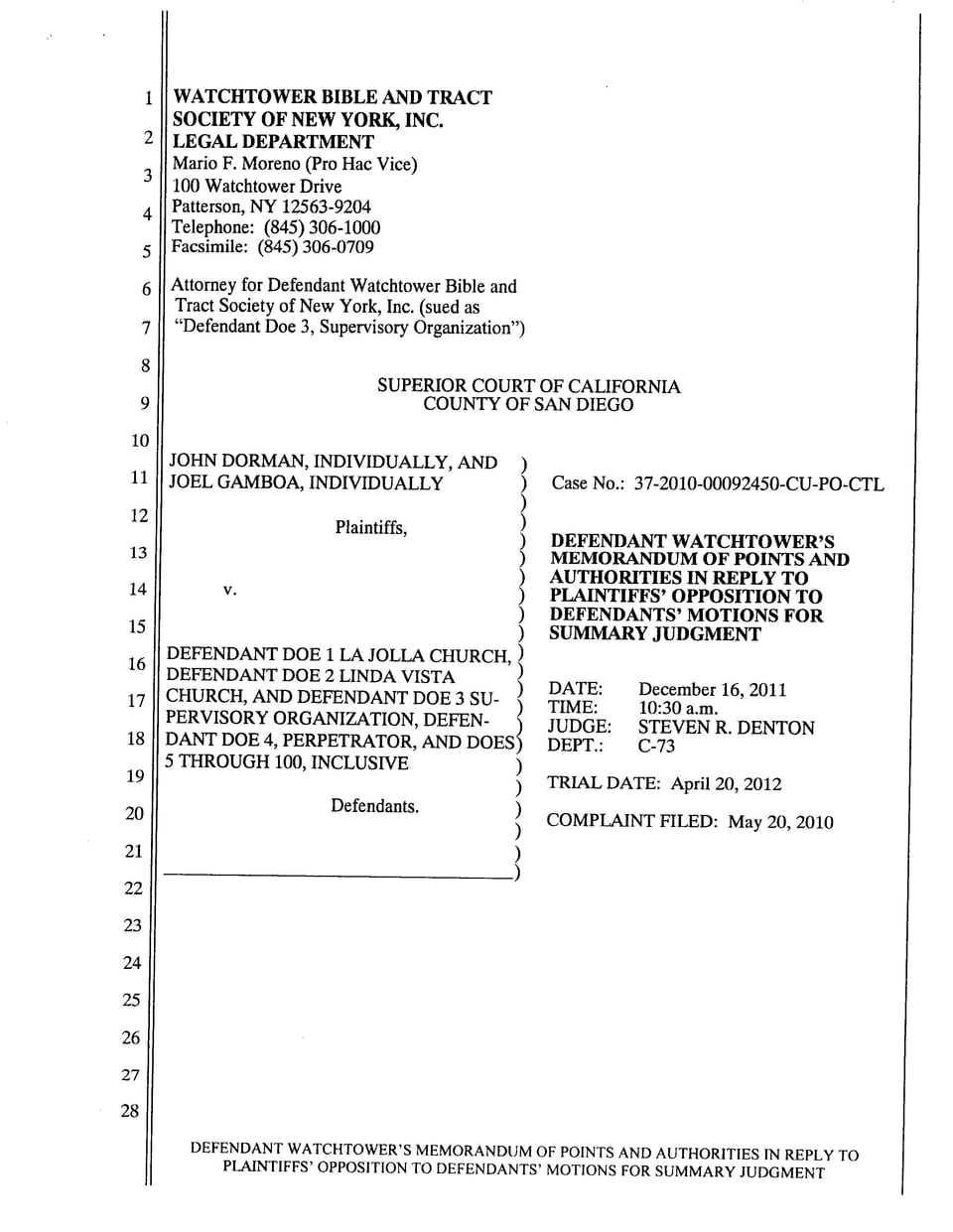
WATCHTOWER BIBLE AND TRACT SOCIETY OF NEW YORK, INC.
LEGAL DEPARTMENT
Mario F. Moreno (Pro Hac Vice)
100 Watchtower Drive
Patterson, NY 12563-9204
Telephone: (845) 306-1000
Facsimile: (845) 306-0709
Attorney for Defendant Watchtower Bible and Tract Society of New York, Inc. (sued as "Defendant Doe 3, Supervisory Organization")
SUPERIOR COURT OF CALIFORNIA COUNTY OF SAN DIEGO
JOHN DORMAN, INDIVIDUALLY, AND JOEL GAMBOA, INDIVIDUALLY
Plaintiffs,
DEFENDANT DOE 1 LA JOLLA CHURCH, DEFENDANT DOE 2 LINDA VISTA CHURCH, AND DEFENDANT DOE 3 SUPERVISORY ORGANIZATION, DEFENDANT DOE 4, PERPETRATOR, AND DOES 5 THROUGH 100, INCLUSIVE
Defendants.
Case No.: 37-2010-00092450-CU-PO-CTL
DEFENDANT WATCHOWER'S MEMORANDUM OF POINTS AND AUTHORITIES IN REPLY TO PLAINTIFFS' OPPOSITION TO DEFENDANTS' MOTIONS FOR SUMMARY JUDGMENT
TIME: 10:30 a.m.
DATE: December 16,2011
JUDGE: STEVEN R. DENTON DEPT.: C-73
TRIAL DATE: April 20, 2012
COMPLAINT FILED: May 20, 2010
DEFENDANT WATCHTOWER'S MEMORANDUM OF POINTS AND AUTHORITIES IN REPLY TO PLAINTIFFS' OPPOSITION TO DEFENDANTS' MOTIONS FOR SUMMARY JUDGMENT TABLE OF CONTENTS
TABLE OF AUTHORITIES ...ii
I. INTRODUCTION ...1
II. BACKGROUND FACTS OF THE CASE ...1
A. Defendant Gonzalo Campos ...1
B. Plaintiff John Dorman’s Claim ...2
C. Although An Individual Becomes a Congregation Member, Publisher, and Ordained Minister Upon His Baptism as One of Jehovah’s Witnesses, This Does Not Mean That All Jehovah’s Witnesses are Agents of their Congregation or of Watchtower ...3
III. DISCUSSION ...5
A. Gonzalo Campos Was a Congregation Member, Not Watchtower’s Agent, When He Abused John Dorman ...5
A Rank-and-File Member of a Congregation of Jehovah’s Witnesses is Not an Agent of Watchtower or the Congregation with Whom He Associates ...6
Gonzalo Campos Never Served as a Regular Pioneer or Auxiliary Pioneer in the Linda Vista Spanish Congregation ...6
B. An Examination of John Dorman’s Claim that Campos was Acting as an Agent of the Defendants Would Impermissibly Entangle the Court in Adjudicating Matters of Religious Doctrine, Contrary to the Prohibitions of the First Amendment to the United States Constitution ...8
The Ecclesiastical Abstention Doctrine, Based on the First Amendment to the United States Constitution, Prohibits Judicial Evaluation of Jehovah’s Witnesses’ Religious Practices, Beliefs and Internal Government ...8
California Courts Also Abstain From the Evaluation of Religious Practices, Beliefs and Internal Government ...10
C. There is No Legal Duty To Aid a Third Party Absent a “Special Relationship” ...10
Neither the Facts Nor the Law Support Finding a Special Relationship That Gives Rise to a Duty ...11
The Facts in This Case Do Not Support the Existence of a Duty to Protect Dorman Under Rowland v. Christian ...13
IV. CONCLUSION ...13 TABLE OF AUTHORITIES
CASES:
Berry v. Watchtower Bible and Tract Society of New York, Inc.
(N.H. 2005) 879 A.2d 1124...5, 8
Bryan R. v. Watchtower Bible and Tract Society of New York, Inc.
(Me. 1999) 738 A.2d 839 ...5, 8
Catholic Charities of Sacramento, Inc. v. Superior Court
(2004) 32 Cal.4th 527...10
Committee of Missions v. Pacific Synod
(1909) 157 Cal. 105...10
Eric J. v. Betty M.
(1999) 76 Cal.App.4th 715...11
Garcia v. Superior Court
(1990) 50 Cal.3d 728...11
Gillet v. Watchtower Bible & Tract Society of Pennsylvania, Inc.
(Fla. Dist. Ct. App. 2005) 913 So.2d 618...5, 8
Hooks v. Southern Cal. Permanente Medical Group
(1980) 107 Cal.App.3d 435...10-11
Horsman v. Allen
(1900) 129 Cal. 131...10
Juarez v. Boy Scouts of America
(2000) 81 Cal.App.4th 377...13
Mallory v. Fong
(1951) 37 Cal.2d 356...6
Meyer v. Lindala
(Minn. Ct. App. 2004) 675 N.W.2d 635 ...5, 8
Nally v. Grace Comty. Church of the Valley
(1988) 47 Cal.3d 278...13
New v. Kroeger
(2008) 167 Cal.App.4th 800...10
Richelle L. v. Roman Catholic Archbishop
(2003) 106 Cal.App.4th 257...12
Romero v. Superior Court
(2001) 89 Cal.App.4th 1068...11
ii
DEFENDANT WATCHTOWER’S MEMORANDUM OF POINTS AND AUTHORITIES IN REPLY TO
PLAINTIFFS’ OPPOSITION TO DEFENDANTS’ MOTIONS FOR SUMMARY JUDGMENT Rowland v.
Christian
(1968) 69 Cal.2d 108...13
Seo v. All-Makes Overhead Doors
(2002) 97 Cal.App.4th 1193...11
Serbian Eastern Orthodox Diocese v. Milivojevich
(1976) 426 U.S. 696...9-10
Wallace v. Der-Ohanian
(1962) 199 Cal.App.2d 141...13
Watson v. Jones
(1871) 80 U.S. 679...8-9, 9
OTHER:
U.S. CONST. amend. I ...8
Rest.2d Torts, § 314 ...10
Rest.2d Torts, § 314, com. c...11
Matthew 28:19-20 ...3-4 I.
INTRODUCTION
Plaintiffs each filed separate Responses to Watchtower's Motion for Summary Judgment. In Reply, Watchtower further shows that Plaintiff John Dorman (hereinafter "Dorman") has failed to demonstrate the existence of sufficient evidence to overcome the arguments put forward in Watchtower's Motion for Summary Judgment, namely: 1) During the time Gonzalo Campos (hereinafter "Campos") abused Dorman, Campos was simply a member of the Linda Vista Spanish Congregation, not an agent or employee of the Linda Vista Spanish Congregation or Watchtower, and thus, Watchtower is not liable for Campos' abuse of Dorman under any theory of liability; and 2) Even if this court were to accept Dorman's assertion that Campos was a pioneer at the time of Dorman's abuse as true for the purpose of Watchtower's Motion for Summary Judgment, Watchtower is not liable for Campos' abuse of Dorman at a private home or while Campos was driving Dorman to and from Campos' secular landscaping jobs.
II. BACKGROUND FACTS OF THE CASE 1
A. Defendant Gonzalo Campos
Campos was baptized as one of Jehovah's Witnesses in 1980, at age 17, and he continued as a baptized publisher in the Linda Vista Spanish Congregation. (U M F2 No.4 9; P U M F^{3} No.32) Campos never served in any appointed position as an Elder, a Ministerial Servant, a Regular Pioneer, or an Auxiliary Pioneer while he was associated with the Linda Vista Spanish Congregation. (UMF Nos.52,53,56;OPDMF 4 No.1) By 1986, the Linda Vista Spanish Congregation had grown larger in number and in November 1986, a separate congregation known as the La Jolla Spanish Congregation was formed as an offshoot of the Linda Vista Spanish Congregation.
(UMF No.50; PUMF No.57) At that same time, Campos ceased his association with the Linda Vista Spanish Congregation and he began to associate with the newly formed La Jolla Spanish Congregation. (UMF No.51) When Campos began associating with the La Jolla Spanish Congregation, he was still only a baptized publisher (i.e., congregation member) (UMF Nos.52, 53, 56; OPDMF No.1). It was not until after Campos moved to the La Jolla Spanish Congregation that he was first appointed to serve as a Ministerial Servant in the La Jolla Spanish Congregation on December 22, 1988. (UMF No.53) Campos was never a member or employee of Watchtower. (UMF No.57)
B. Plaintiff John Dorman's Claim
John Dorman, born on September 7, 1977, was sexually abused by Gonzalo Campos on two or three different days from 1983 to 1984, when he was in first or second grade and about 7 to 8 years old. (UMF No. 43; PUMF No. 92, 100) At the time of the abuse, Dorman and Campos were both associated with the Linda Vista Spanish Congregation. (UMF No. 43)
Dorman's first abuse took place when Campos took him on a landscaping job and touched him inappropriately while traveling inside of Campos' van to-and-from the worksite. (UMF No. 44; PUMF No. 100) Dorman's second abuse was within twelve months when Campos abused him on the way to a different landscaping jobsite. (UMF No. 45) Dorman was also abused by Campos at a home where Campos' mother worked as a housecleaner. (UMF No. 45) C.
Although An Individual Becomes a Congregation Member, Publisher, and Ordained Minister Upon His Baptism as One of Jehovah's Witnesses, This Does Not Mean That All Jehovah's Witnesses are Agents of their Congregation or of Watchtower
When a man, woman, or child is baptized as one of Jehovah's Witnesses, he or she is considered a congregation member, publisher, and an ordained minister. (UMF No. 3; DOPUMF 5 No.19,34) Within the faith of Jehovah's Witnesses, the terms 'member,' 'publisher,' and 'ordained minister' are interchangeable, although 'publisher' is the term most often used when referring to a baptized Witness. (DOPUMF No.19) While baptism and 'ordination' denote the newly baptized one's role as a Witness of Jehovah God, this 'ordination' is limited. It does not give the newly baptized one authority to take the lead in teaching, providing pastoral care, or supervising and organizing a congregation. (UMF No.16,17; DOPUMF No.19) Such authority is exercised only by a male Witness appointed to serve as an Elder. (UMF No.16,17; DOPUMF No.19)
The public preaching (i.e. 'field ministry,' 'field service,' 'public ministry') for which Jehovah's Witnesses are well known is not controlled or monitored by the Elders, the congregation, or Watchtower. (DOPUMF No. 23, 24, 29, 30) An individual publisher's field ministry activity, including the time and manner it is carried out, is a personal matter between the publisher and his God. (UMF Nos. 5-7) There is no hour or literature placement requirement imposed on publishers. (Id.) Jehovah's Witnesses do not engage in the field ministry as representatives or on behalf of Watchtower or any congregation of Jehovah's Witnesses. Rather, they engage in their field ministry as a personal response to Jesus' command at Matthew 28:19-20, 6 not a command from Watchtower or any congregation of Jehovah's Witnesses.
(DOPUMF No.15)
Before Jehovah's Witnesses engage in their field ministry, they generally meet for about 10 to 15 minutes with a small group of other congregation members. This brief meeting is known as a "meeting for field service" and it is generally conducted by an Elder or a Ministerial Servant. (DOPUMF No.25) On those limited occasions when an Elder or a Ministerial Servant is unavailable, any baptized male (or even a baptized female, if a baptized male is unavailable) can conduct the brief meeting for field service. (DOPUMF No.17) The purpose of the meeting for field service is to provide encouragement and share a helpful suggestion related to the public ministry. (PUMF No.26) Jehovah's Witnesses are not required to attend a meeting for field service before participating in the public ministry. (DOPUMF No.26)
Regular Pioneers and Auxiliary Pioneers are baptized Jehovah's Witness men, women, or children who are active in the public ministry. (UMF No.31) During the 1980's Regular Pioneers averaged 90 hours per month in field service, and Auxiliary Pioneers averaged 60 hours per month in field service. (UMF No.32) While both Regular Pioneers and Auxiliary Pioneers have a greater privilege and responsibility of field service, neither is considered a position of authority within the religious organization of Jehovah's Witnesses, as in the case of an Elder or a Ministerial Servant. (DOPUMF No.9) Furthermore, Regular Pioneers and Auxiliary Pioneers are all volunteers and they receive no compensation or reimbursement. (UMF No.33)
III. DISCUSSION
A. Gonzalo Campos Was a Congregation Member, Not Watchtower's Agent, When He Abused John Dorman
Dorman attempts to create a question of material fact as to Campos' status in the congregation by suggesting that Campos was more than a just a rank-and-file congregation member because 1) Campos was a male member who could take the lead in field service, and 2) Campos was purportedly a pioneer during the 1980's.
Neither the facts nor the law support Dorman's assertions.
Courts across the country have held that Watchtower and/or local congregations of Jehovah's Witnesses are not liable for the negligence or intentional acts committed by a congregation member. (See Berry v. Watchtower Bible and Tract Society of New York, Inc. (N.H. 2005) 879 A.2d 1124; Gillet v. Watchtower Bible & Tract Society of Pennsylvania, Inc. (Fla. Dist. Ct. App. 2005) 913 So.2d 618; Meyer v. Lindala (Minn. Ct. App. 2004) 675 N.W.2d 635; Bryan R. v. Watchtower Bible and Tract Society of New York, Inc. (Me. 1999) 738 A.2d 839.) In this case, both Watchtower and Campos have presented clear evidence that Campos was a congregation member, never a Regular Pioneer or Auxiliary Pioneer in the Linda Vista Spanish Congregation. Since Campos was simply a rank-and-file congregation member at the time of Dorman's abuse, by law, Campos was not an agent of Watchtower.
As noted above, any congregation member (including a female congregation member, if no male congregation member was present) can take the lead in field service when an Elder or Ministerial Servant is not available. Further, pioneers are not in a position of authority in the congregation, they are simply congregation members with a greater privilege and responsibility of field service. Thus, at the time of Dorman's abuse, Campos was simply a rank-and-file congregation member and, by law, he was not an agent of Watchtower.
A Rank-and-File Member of a Congregation of Jehovah's Witnesses is Not an Agent of Watchtower or the Congregation with Whom He Associates
Campos was not an agent of Watchtower or any of the other Defendants during the time Dorman says Campos abused him. "The existence of the right of control and supervision establishes the existence of an agency relationship." (Mallory v. Fong (1951) 37 Cal.2d 357, 370.) At the time of Dorman's abuse, Campos was in charge of nothing for Watchtower or any congregation of Jehovah's Witnesses. Campos' field ministry was not subject to control or supervision by Watchtower.
Campos was able to choose whether to engage in his ministry. He could choose when and where to do so and whether to do so alone or with others. He paid his own expenses, unreimbursed by Watchtower or any Congregation of Jehovah's Witnesses. His field ministry was not done for or on behalf of Watchtower or any congregation of Jehovah's Witnesses. It was his personal response to Jesus' command at Matthew 28:19-20, not a response to any command from Watchtower or any Congregation of Jehovah's Witnesses. (DOPUMF No.5)
Gonzalo Campos Never Served as a Regular Pioneer or Auxiliary Pioneer in the Linda Vista Spanish Congregation
Notwithstanding the overwhelming evidence to the contrary, Dorman attempts to create a question of fact as to whether Campos was a pioneer during the time of the abuse by submitting last minute affidavits from his mother, Manuela Dorman, and from Plaintiff Joel Gamboa's grandmother, Bertha Gomez. (PE No. 6 and 27) These affidavits run counter to the affidavit of Ralph Schaefer (the record custodian of all Regular Pioneers in the United States), the affidavit of the Elder who studied with Campos, and the sworn testimony of Campos himself, which clearly establish that Campos was never a pioneer in the Linda Vista Spanish Congregation. (UMF Nos. 52, 56; Defendant's Opposition to Plaintiffs' Disputed Material Fact No.1)
Mrs. Dorman and Ms. Gomez's affidavits are not only inaccurate, but inadmissible as hearsay and lack foundation. For example, Ms. Dorman's affidavit states:
Many of the women in the congregation spoke about Gonzalo with respect. They mentioned that Gonzalo was a Pioneer and that he spent many hours in service. Gonzalo was very involved with the Linda Vista Congregation from the time I began attending meetings at the Congregation until my family moved away from California. Based upon what I was told by members of the congregation, the number of hours that Gonzalo spent in Field Service and other congregation activities, and the deference he received from Congregation members, I knew he was a Pioneer in the Linda Vista Congregation, which means that he committed to spend a certain amount of hours in service in a particular month. In fact, it was widely known at that time that Gonzalo Campos held this position in the Linda Vista Spanish Congregation.
(PE No. 6, 2,3)
Mrs. Dorman's affidavit testimony that " [m]any women in the congregation mentioned that Gonzalo was a Pioneer and that he spent many hours in the field service" and that "[b]ased upon what [she] was told by members of the congregation members of the congregation ... [she] knew he was a Pioneer" is inadmissible hearsay from congregation members. (PE No. 6, 2, 3) (emphasis added.) Mrs. Dorman's affidavit testimony also lacks foundation to create any question of fact as to whether Campos was a pioneer since it is based on hearsay and "the number of hours Gonzalo spent in Field Service, and other congregation activities, and the deference he received from the congregation members." (PE No. 6, 2, 3)
Ms. Gomez's affidavit states that she thinks she met Campos between 1982 and 1984 and that during the time she knew Campos she "heard an announcement during a meeting of the Linda Vista Spanish Congregation that Campos served as a pioneer in the congregation." (PE No. 27, 2,3) However, Dorman presents no affidavit testimony as to who made this alleged announcement. Therefore, this affidavit testimony of "an announcement she heard during a meeting of the Linda Vista Spanish Congregation that Campos served as a pioneer in the congregation" that Ms. Gomez claims she heard is inadmissible hearsay and lacks foundation to create any question of fact as to whether Campos was a pioneer. (PE No. 27, 2,3) Furthermore, even if Campos was a pioneer at the time he abused Dorman, as noted above, pioneers are not in a position of authority in the congregation, they are simply congregation members with a greater privilege and responsibility of field service.
Since there is no credible evidence that Campos was a pioneer at the time of the abuse and pioneers are not agents of Watchtower because they are not in a position of authority, Watchtower cannot be held liable for the abuse of Dorman, during non-congregation activity and on non-congregation property, by Campos, a mere congregation member. (UMF Nos. 44, 45) (See Berry, supra, 879 A.2d 1124; Gillet, supra, 913 So.2d 618; Meyers, supra, 675 N.W.2d 635; Bryan R., supra, 738 A.2d 839.)
B. An Examination of John Dorman's Claim that Campos was Acting as an Agent of the Defendants Would Impermissibly Entangle the Court in Adjudicating Matters of Religious Doctrine, Contrary to the Prohibitions of the First Amendment to the United States Constitution
In an effort to establish that Campos was an agent of Watchtower, Dorman invites the court to study and evaluate the religious beliefs, practices, and internal government of Jehovah's Witnesses with respect to the control and supervision of the field ministry of individual Jehovah's Witnesses and the standing and authority of a pioneer in the congregation. Since such an evaluation would entail a constitutionally impermissible intrusion into the religious beliefs, practices, and governance of Jehovah's Witnesses, the court should reject Dorman's attempts to entangle this court in an examination and evaluation of the religious organization of Jehovah's Witnesses in violation of the First Amendment.
The Ecclesiastical Abstention Doctrine, Based on the First Amendment to the United States Constitution, Prohibits Judicial Evaluation of Jehovah's Witnesses' Religious Practices, Beliefs and Internal Government
It is well-settled that "civil courts exercise no jurisdiction" over disputes "which concern[] theological controversy, church discipline, ecclesiastical government, or the conformity of the members of the church to the standard of morals required of them[.]" (Watson v. Jones (1871) 80 U.S. 679, 733.) The United States Supreme Court has recognized that secular tribunals must accept "as final, and as binding on them" the decisions of ecclesiastical institutions on such matters and observed
[I]t would be of a vain consent ... if any one aggrieved by one of [an ecclesiastical institution's] decisions could appeal to the secular courts and have them reversed. It is of the essence of these religious unions, and of their right to establish tribunals for the decision of questions arising among themselves, that those decisions should be binding in all cases of ecclesiastical cognizance[.] [A]s [ecclesiastical institutions] are the best judges of what constitutes an offence against the word of God and ...
of matters of faith, discipline, and doctrine; and civil courts, if they should be so unwise as to attempt to supervise their judgments ... would only involve themselves in a sea of uncertainty and doubt[.]
(Id. at pp. 727, 729, 732.)
Under the doctrine of ecclesiastical abstention, it is beyond the purview of a secular court to evaluate ecclesiastical matters concerning the religious beliefs, practices and internal government of Jehovah's Witnesses. Nevertheless, Dorman would like this court, and eventually a jury, to examine the conflicting religious evidence regarding the beliefs, practices and internal government of Jehovah's Witnesses to determine whether their field ministry is controlled and supervised, so as to make his case for agency. But neither this court nor a jury may hear conflicting testimony about religious beliefs, practices and internal government to resolve this conflict and decide what the religious beliefs, practices and internal government of Jehovah's Witnesses really are. Such an inquiry would entangle this court and a jury in an examination of the religion of Jehovah's Witnesses in violation of the First Amendment. As the Supreme Court explained in Serbian Eastern Orthodox Diocese v. Milivojevich (1976) 426 U.S. 696, the doctrine of ecclesiastical abstention dictates that:
[W]here resolution of the disputes cannot be made without extensive inquiry by civil courts into religious law and polity, the First and Fourteenth Amendments mandate that civil courts shall not disturb the decisions of the highest ecclesiastical tribunal within a church of hierarchical polity, but must accept such decisions as binding on them, in their application to the religious issues of doctrine or polity before them.
(Id.at p.709.)
This Court is precluded from considering Mr. Dorman's agency argument, because it would have to scrutinize and evaluate Jehovah's Witnesses' religious beliefs, practices, and internal government to decide whether the control required for agency is present, and what is the standing and authority of a pioneer in the congregation. Such an examination would impermissibly entangle the court in an evaluation of Jehovah's Witnesses' religious beliefs, practices, and internal government in violation of the First Amendment.
California Courts Also Abstain From the Evaluation of Religious Practices, Beliefs and Internal Government
The Supreme Court of California has repeatedly held that ecclesiastical and theological controversies, including "matters of faith, discipline, and the general polity and tenets of the church," are issues beyond the jurisdiction of secular courts. (Horsman v. Allen (1900) 129 Cal. 131, 138-139; see Committee of Missions v. Pacific Synod (1909) 157 Cal. 105, 128; Catholic Charities of Sacramento, Inc. v. Superior Court (2004) 32 Cal.4th 527, 541-542; New v. Kroeger (2008) 167 Cal.App.4th 800, 816-817.) Thus, for the reasons noted in section B.1 above, the court should reject Dorman's request that the court study and evaluate the religious beliefs, practices and internal government of Jehovah's Witnesses with respect to the control and supervision of field service and the standing and authority of pioneers as the California Supreme Court has held that such inquiries are barred by the First Amendment.
C. There is No Legal Duty To Aid a Third Party Absent a "Special Relationship"
It is axiomatic that a person does not have a legal duty to come to the aid of another. (Rest.2d Torts, § 314.) This is true irrespective of the gravity of the danger to which the other is subjected and the insignificance of the trouble, effort or expense of giving aid or protection. (Rest.2d Torts, § 314, com. c.) "A determination that as a matter of law no duty is owed to the Plaintiff is particularly common in situations in which the defendant's responsibility for the activities of third persons is involved." (Hooks v. Southern Cal. Permanente Medical Group (1980) 107 Cal.App.3d 435, 443.) However, this general "no duty" rule is subject to an exception in certain situations where a "special relationship" exists between the parties. (Rest.2d Torts, § 314A.)
Neither the Facts Nor the Law Support Finding a Special Relationship That Gives Rise to a Duty
The Court of Appeal noted that " [a] person is ordinarily not liable for the actions of another and is under no duty to protect another from harm in the absence of a special relationship of custody or control." (Romero v. Superior Court (2001) 89 Cal.App.4th 1068, 1078-1079 (emphasis in original) (citations omitted); see Garcia v. Superior Court (1990) 50 Cal.3d 728, 734 ("A special relationship is a prerequisite for liability based on a defendant's failure to act.").) Furthermore, "[a]bsent a 'special relationship,' one cannot be held liable for mere nonfeasance, such as not protecting another from a criminal attack by a third party." (Eric J. v. Betty M. (1999) 76 Cal.App.4th 715, 727.)
According to the Court of Appeal, "the common law concept of special relationships covers: landowner or possessor and person coming on the land; manufacturer or supplier of goods and buyer or user; vendor, lessor, or contractor and purchaser, lessee or owner of 'real property.'" (Seo v. All-Makes Overhead Doors (2002) 97 Cal.App.4th 1193, 1203 (citations omitted).) Additionally, affirmative duties may arise in relationships such as those of a "common carrier and passenger ... innkeeper and guest...," a possessor of land and invitee, and "a person who is required by law to take, or who voluntarily takes, custody of another under circumstances that deprive the other of his normal opportunities for protection." (Id.; see also Rest.2d Torts, § 314A(1)-(4).) In this case, there is no special relationship based on any of the above.
Furthermore, Plaintiffs realize that an alleged "special relationship" between the Linda Vista Spanish Congregation or Watchtower and a congregation member or meeting attender cannot be the basis of a new duty under California law. In considering whether a "special relationship," existed between a priest and a sexual abuse victim, the Court of Appeal in Richelle L. v. Roman Catholic Archbishop (2003) 106 Cal.App.4th 257, reasoned that the priest "cannot be liable to appellant [the victim] for breach of a duty arising out of a special relationship" because it would be the equivalent to a prohibited clergy malpractice claim.
(Id. at p. 270.) With respect to the duty of the Archdiocese, the court stated: "Appellant does not attempt to hold respondent Archdiocese vicariously liable under the theory of respondeat superior, but directly liable for breach of a fiduciary duty and for negligence in hiring and supervision. In order to prevail against the Archdiocese, however, appellant must show, among other things, that she suffered an injury the law recognizes. For the reasons we have explained, appellant cannot make such a showing; accordingly, there is no need to inquire whether the Archdiocese can be subjected to any duty." (Id. at pp. 282-83.) Thus, the court summarily affirmed the demurrers granted to the Archdiocese as the supervisory organization over the Defendant priest.
The Plaintiffs therefore turn to the relationship between the Defendants Linda Vista Spanish Congregation and Watchtower and the perpetrator, Campos. They claim that the two defendants breached a duty of care to the Dorman, as a third party, based on the alleged special relationships between the defendants and the perpetrator. Dorman claims Watchtower had the ability to control Campos by imposing restrictions on him, expelling him from the congregation, reporting him to the police, or issuing a warning to the congregation. However, the imposition of a standard or model for expulsion or restrictions upon Watchtower, or the setting judicial standards that require Watchtower to report to police or warn congregation members, when there is no law that requires such action, advocates for unconstitutional clergy malpractice claims. (Nally v. Grace Comty. Church of the Valley (1988) 47 Cal.3d 278, 299 (California law does not recognize clergy malpractice claims, holding that it is unconstitutional to impose a duty of care on a church for counseling).)
The Facts in This Case Do Not Support the Existence of a Duty to Protect Dorman Under Rowland v. Christian The Plaintiffs seek to use Rowland v. Christian (1968) 69 Cal.2d 108, and particularly, as this case was later applied in Juarez v.
Boy Scouts of America (2000) 81 Cal.App.4th 377, to create a broad legal duty between Watchtower, a corporate religious entity, and Dorman, a minor child associate of the church, that has not been recognized under California law.
But it is important to note that the Juarez decision, to the extent that it imposed a duty on the Boy Scouts, concerned a case where the children were placed in the care, custody, and control of their adult caregivers. "Consequently, California courts have frequently recognized special relationships between children and their adult caregivers that give rise to a duty to prevent harms caused by the intentional or criminal conduct of third parties." (Juarez, supra, 377, Cal.App.4th at 410 (emphasis added).) The other case relied upon by Dorman, also involved a minor placed in the care, custody, and control of a camp owner. (Wallace v. Der-Ohanian (1962) 199 Cal.App.2d 141)
However, this is not a case dealing with a church daycare or similar setting where a group of minor children are entrusted to the care of a particular adult or adults, like the Boy Scouts or a camp for minors.
IV. CONCLUSION
The evidence submitted in support of Plaintiff John Dorman's Response to Watchtower's Motion for Summary Judgment does not state a triable claim against Watchtower because: (1) Gonzalo Campos was not Watchtower's agent at the time Plaintiff John Dorman's abuse occurred; and (2) consideration of Campos' status as an agent of Watchtower based on his being a rank-and-file congregation member contravenes the First Amendment of the U.S. Constitution and the California Constitution analog. Therefore, Watchtower's Motion for Summary Judgment against Dorman should be granted and Dorman's claims against Watchtower should be dismissed.
DATED: December 8,2011
Watchtower Bible and Tract Society of New York, Inc., Legal Department
Attorney for Defendant Watchtower Bible and Tract Society of New York, Inc. (sued as "Doe 3, Supervisory Organization")
By: Mario F. Moreno
Attorney for Defendant Watchtower Bible and Tract Society of New York, Inc. (sued as "Doe 3, Supervisory Organization")
DEFENDANT WATCHTOWER’S MEMORANDUM OF POINTS AND AUTHORITIES IN REPLY TO PLAINTIFFS’ OPPOSITION TO DEFENDANTS’ MOTIONS FOR SUMMARY JUDGMENT PROOF OF SERVICE DORMAN et al.
v. DOE 1, LA JOLLA CHURCH et al. Case No. 37-2010-00092450-CU-PO-CTL
STATE OF CALIFORNIA, COUNTY OF SAN DIEGO:
I work in the County of Putnam, State of New York. I am over the age of 18 and am not a party to the within action; my business address is 100 Watchtower Drive, Patterson, NY 12563.
On December 9, 2011, I served the following document(s) on all interested parties to this action as follows:
DECLARATION OF MARIO F. MORENO IN SUPPORT OF DEFENDANT WATCH-TOWER'S LODGMENT OF EXHIBITS IN SUPPORT OF SEPARATE STATEMENT OF FACTS IN REPLY TO PLAINTIFFS' OPPOSITION TO DEFENDANTS' MOTIONS FOR SUMMARY JUDGMENT
DEFENDANT WATCHTOWER'S LODGMENT OF EXHIBITS IN SUPPORT OF SEPARATE STATEMENT OF FACTS IN REPLY TO PLAINTIFFS' OPPOSITION TO DEFENDANTS' MOTIONS FOR SUMMARY JUDGMENT
DEFENDANT WATCHTOWER'S LODGMENT OF FOREIGN CASES IN REPLY TO PLAINTIFFS' OPPOSITION TO DEFENDANTS' MOTIONS FOR SUMMARY JUDGMENT
DEFENDANT WATCHTOWER'S OBJECTIONS TO EVIDENCE CITED BY PLAINTIFFS' IN THEIR SEPARATE STATEMENT OF FACTS IN OPPOSITION TO DEFENDANTS' MOTIONS FOR SUMMARY JUDGMENT
DEFENDANT WATCHTOWER'S OPPOSITIONS TO EVIDENCE CITED BY PLAINTIFFS' IN THEIR SEPARATE STATEMENT OF FACTS IN OPPOSITION TO DEFENDANTS' MOTIONS FOR SUMMARY JUDGMENT
DEFENDANT WATCHTOWER'S OPPOSITION TO PLAINTIFFS' SEPARATE STATEMENT OF UNDISPUTED MATERIAL FACTS
By placing the original a true copy thereof enclosed in sealed envelopes addressed as follows: PLEASE SEE ATTACHED SERVICE LIST.
BY MAIL: By placing a true copy thereof in a sealed envelope addressed as above, and placing it for collection and mailing following ordinary business practices. I am readily familiar with Watchtower Legal Department's practice of collection and processing correspondence for mailing. Under that practice it would be deposited with U.S. postal service on that same day with postage thereon fully prepaid at Patterson, New York, in the ordinary course of business. I am aware that on motion of party served, service is presumed invalid if postal cancellation date or postage meter date is more than one day after date of deposition for mailing in affidavit.
□ BY OVERNIGHT COURIER: I caused the above-referenced document(s) to be delivered to ___ for delivery to the above address(es).
BY PERSONAL SERVICE: I caused such envelope to be delivered by hand to the addressee(s).
[State] I declare under penalty of perjury under the laws of the State of California that the foregoing is true and correct.
[Federal] I declare that I am employed in the office of a member of the bar of ___ this court at whose direction the service was made.
Executed on December 9, 2011 at San Diego, California.
DEFENDANT WATCHTOWER'S MEMORANDUM OF POINTS AND AUTHORITIES IN REPLY TO PLAINTIFFS' OPPOSITION TO DEFENDANTS' MOTIONS FOR SUMMARY JUDGMENT SERVICE LIST DORMAN, et al.
v. DOE 1, LA JOLLA CHURCH, et al. CASE NO.37-2010-00092450-CU-PO-CTL
The Zalkin Law Firm, P.C.
Devin M Storey, Esq.
12555 High Bluff Drive, Suite 260
San Diego, CA 92130
Telephone: (858) 259-3011
Facsimile: (858) 259-3015
(ATTORNEYS FOR PLAINTIFFS)
The McCabe Law Firm, APC James M. McCabe 4817 Santa Monica Avenue San Diego, CA 92107 Telephone: (619)224-2848 Facsimile: (619)224-0089
(ATTORNEYS FOR DEFENDANT DOE 1 LA JOLLA CHURCH)
Rocky K. Copley, Esq.
Law Office of Rocky K. Copley
225 Broadway, Suite 2100
San Diego, CA 92101
Telephone: (619) 232-3131
Facsimile: (619) 232-1690
(ATTORNEYS FOR DEFENDANT DOE 2 LINDA VISTA CHURCH)