Inquiry Into the Handling of Child Abuse by Religious and Other Organisations (Victoria, 2013)
Download: PDF — Inquiry Into the Handling of Child Abuse by Religious and Other Organisations (Victoria, 2013)
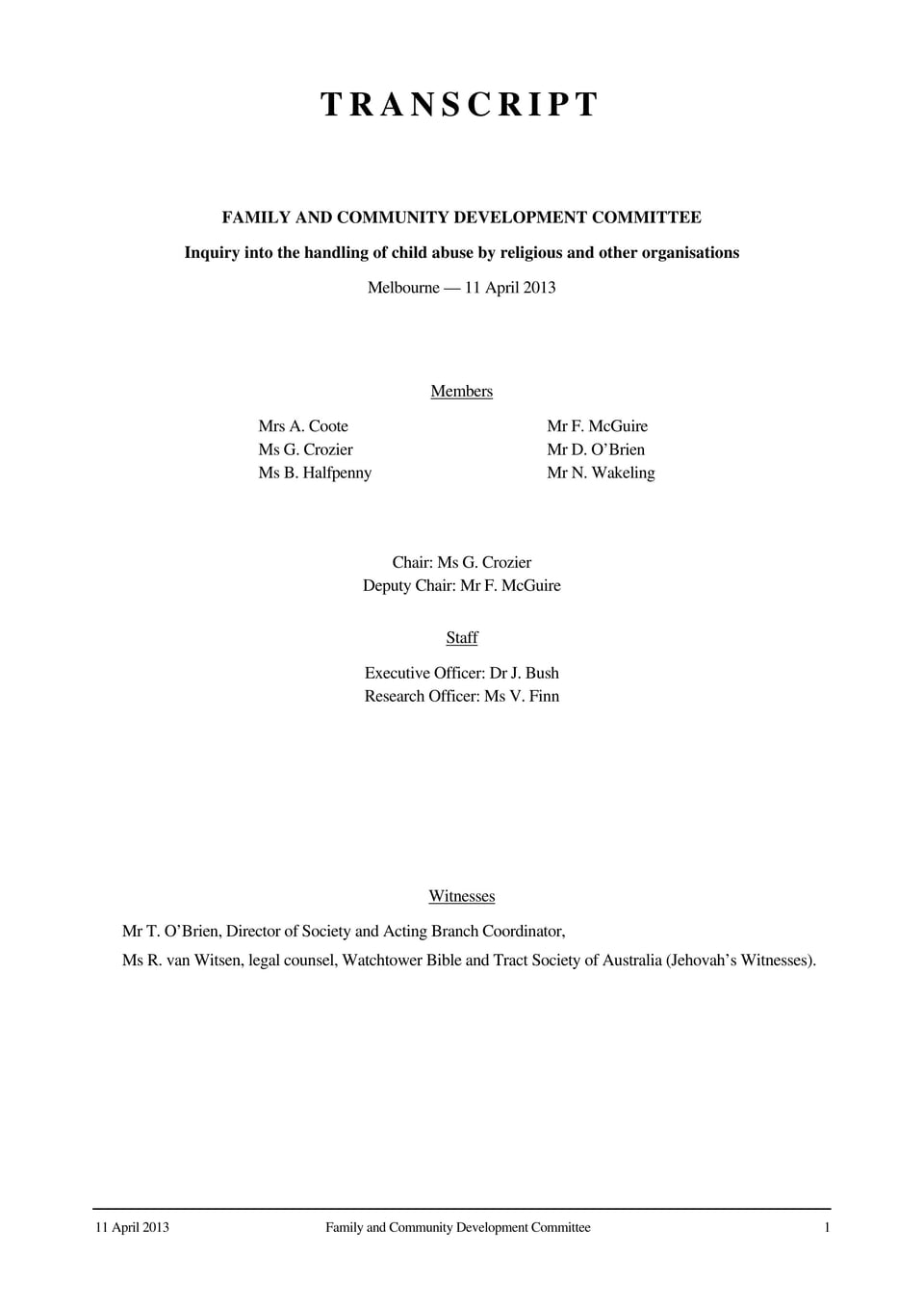
TRANSCRIPT
FAMILY AND COMMUNITY DEVELOPMENT COMMITTEE Inquiry into the handling of child abuse by religious and other organisations Melbourne — 11 April 2013
Members
Mrs A. Coote
Mr F. McGuire
Ms G. Crozier
Ms B. Halfpenny
Mr D. O'Brien
Mr N. Wakeling
Chair: Ms G. Crozier Deputy Chair: Mr F. McGuire
Staff Executive Officer: Dr J. Bush Research Officer: Ms V. Finn
Witnesses
Mr T. O'Brien, Director of Society and Acting Branch Coordinator,
Ms R. van Witsen, legal counsel, Watchtower Bible and Tract Society of Australia (Jehovah's Witnesses).
The CHAIR — Good afternoon. On behalf of the committee I welcome Mr Terrence O'Brien, director of the Society and Acting Branch Coordinator from the Watchtower Bible and Tract Society of Australia (Jehovah's Witnesses), and Ms Rachel van Witsen, legal counsel, also from the Watchtower Bible and Tract Society of Australia, also known as Jehovah's Witnesses. I welcome both of you this afternoon. All evidence taken by this committee is taken under the provisions of the Parliamentary Committees Act, attracts parliamentary privilege and is protected from judicial review. Any comments made outside the precincts of the hearings are not protected by parliamentary privilege. Witnesses may be asked to return at a later date to give further evidence if required. All evidence given today is being recorded. Witnesses will be provided with proof versions of the transcript. Please note that these proceedings are not being broadcast.
The committee is particularly interested in asking questions in relation to this inquiry surrounding child abuse preventive measures and leadership aspects, and we are very keen to hear from you in relation to the organisation you represent. I believe you have a statement that you would like to make at the end, if we could go to that. I would like to open up the questioning to you and ask you: do you maintain records on the number, nature, extent and outcomes of allegations of any criminal abuse within your church?
Mr T. OBRIEN Sorry. Could you just repeat that? I did not quite catch that.
The CHAIR My question is: does the church maintain records on the number, nature and extent as well as the outcomes of any allegations of child abuse?
Mr T. O'BRIEN Yes, they do.
The CHAIR If so, what does that data tell you? Can you explain a little bit more about those records, the nature of the abuse and what you actually do about that?
Mr T. O'BRIEN The purpose in retaining the records is, one, to make sure if a person has been disfellowshipped or disciplined in the past for child sexual abuse, then it would be extremely unlikely they would qualify to be used as a minister in the organisation. If there is even a report of an accusation, we maintain a record of that, because if someone was to move to another congregation, for example, and a similar accusation came from there, even if it is only based upon one witness, there are two accusations from two different witnesses. That would be sufficient for us to act further.
The CHAIR — What does that mean in relation to acting further? What would you do?
Mr T. O'BRIEN If there were two independent witnesses to the same type of offence say child sexual abuse of some kind then a judicial committee would be formed.
The CHAIR Do you report that to the police? Sexual abuse is of a criminal nature; would you report that to the police?
Mr T. O'BRIEN As we understand, that is within the decision making of the victim, not the minister. We would encourage the victim, if they want to report it to the police, to certainly do that. The elders would cooperate fully with the police, and we would never discourage anyone from reporting it to police, but without mandatory reporting we do not feel that as ministers of religion that is our obligation to do that.
The CHAIR — Could you tell the committee how many numbers we are talking about — how many numbers your legal service has received in relation to abuse of any kind?
Mr T. O'BRIEN — With regard to Victoria, I made an inquiry just before I left, because I anticipated the question. I asked to search our records over the last 40 years since we have had elders as an arrangement, and there have been two cases two ministers who were reported and investigated. They were immediately removed as ministers, and both were disfellowshipped and they are no longer Jehovah's Witnesses.
The CHAIR I am sure other members have questions relating to that aspect, but one final question from me, if I may. How far back do you retain your records?
Mr T. O'BRIEN Possibly there are records beyond 40 years, but prior to that I am not sure of the year it would have just been noted as porneia, or fornication. It would not have differentiated 40 years ago, because it was such a rare occasion that someone committed child sexual abuse in the congregations anyway that we are aware of.
The CHAIR — That you are aware of.
Mr T. O'BRIEN — Yes. But in possibly the last 20-25 years child abuse is something that has become more on the radar that we have been observing, looking for, so we have kept records accurately.
The CHAIR And from those records you have highlighted only two cases in Victoria?
Mr T. O'BRIEN Two in the last 40 years, yes, who were ministers.
The CHAIR Is that in relation to any abuse? Can you clarify for me again, is that just in relation to sexual abuse or was that any abuse?
Mr T. O'BRIEN That was particularly sexual abuse.I cannot speak without looking at the records, but I doubt there would be elders or ministers who were judicially dealt with for another form of abuse of a minor.
The CHAIR The point is that abuse comes in different forms. It can be physical or emotional as well as sexual, so we are just talking about two cases of sexual abuse that you are aware of?
Mr T. O'BRIEN — Yes.
The CHAIR Thank you.
Ms HALFPENNY I just wanted to talk a little bit about the guidelines and policies for dealing with allegations of child abuse and also prevention of abuse. As I understand it, you issued a letter to elders dated 1 October 2012. Was that an update of other guidelines?
Mr T. O'BRIEN — Yes.
Ms HALFPENNY I am not sure how your system works. Could you explain how you came about that policy and how it gets distributed, how it works?
Mr T. O'BRIEN — Yes, sure. Jehovah's Witnesses are governed by a central governing body which oversees the worldwide work, and then there are around about 100 different branches throughout the world, and they are overseen by what we term a branch committee, which I am a member of here in Australia, who may then oversee the work in a number of countries. But specifically to the elders in Australia and the laws here, that policy letter was very much in line with the governing body letter. I think you have a copy of both there with very few adjustments.
Ms HALFPENNY — So what were the changes from, say, the 24 May 2010 policy to the October policy?
Mr T. O'BRIEN Just to illustrate, one of the references there shows that it has only been refinements. It has not been major changes. One of the things in your annexure 2, where it has a number of different articles I think it is the seventh page in or seventh reference is from a Watchtower article entitled 'Let Us Abhor What is Wicked'. That is in annexure 2.
The CHAIR You gave us some information we only received yesterday, so I am wondering if you are referring to the information that the committee received only yesterday?
Mr T. O'BRIEN — Yes.
The CHAIR Thank you. Have you got that, Ms Halfpenny?
Ms HALFPENNY I have got that one. Is that 'When a dedicated Christian sins'? Is it the one with that heading on it down the bottom?
Mr T. O'BRIEN — Yes, that is the heading, so just above that. If you look at the paragraph above that. This is a 1997 Watchtower, so well earlier than 2010. It states: For a man who was a child molester before he was baptized, there may be another consequence.
When he learns the truth —
becomes one of Jehovah's Witnesses, that means
he repents and turns around, not bringing that cruel sin into the congregation. He may thereafter make fine progress, completely overcome his wrong impulses, and even be inclined to 'reach out' for a responsible position in the congregation. What, though, if he still has to live down notoriety in the community as a former child molester? Would he 'be —
and then the references here are to the qualifications for an elder in a congregation.
Would he 'be irreprehensible ... have a fine testimony from people on the outside ... [be] free from accusation'?
Cited are those scriptural references. The answer is:
No, he would not. Hence, he would not qualify for congregation privileges.
Ms HALFPENNY — Okay. But in terms of your guidelines and policies to prevent child abuse from occurring, what is that policy? Could you outline what it is that you do?
Mr T. O'BRIEN — Yes, sure.
Ms HALFPENNY I understand that there is some reference to parents. Is it just the parents who are to organise that, or is there a responsibility within the church to do it within the Jehovah's Witnesses?
Mr T. O'BRIEN Certainly, yes. The cover letter that we provided to the committee, if you have a look there no, sorry, it is in that policy letter to elders.
Ms HALFPENNY — Could you just give me the steps from start to finish?
Mr T. O'BRIEN An outline, yes; I am happy to. What happens is that if there is a report made to an elder, an accusation of some form of child abuse, whether it is a minister ---
Ms HALFPENNY — What about prior to a report? What sorts of policies are in place to prevent ---
Mr T. O'BRIEN — To protect children?
Ms HALFPENNY Yes, to protect children.
Mr T. O'BRIEN Jehovah's Witnesses have no separation or segregation of children from parents. We do not have crèches, kindergartens, Sunday schools, camps. anything like that. All of our congregation activity is family based, and parents are given training in how to assist their children. There are many articles in some of the reference material there which assist parents on how to educate their children against child abuse. Then within the framework of the congregation itself, elders are alerted on how they could deal with anyone who may be suspected of that.
Ms HALFPENNY — How are the sorts of policies developed? How have they come to be? Is it based on past experience or information about the nature of abuse? How are the policies developed?
Mr T. O'BRIEN I guess it is very much like Parliament in Victoria. Over the years morals have degenerated in the world. Remember that the majority of Jehovah's Witnesses did not grow up as Jehovah's Witnesses. Many people who become Jehovah's Witnesses may bring with them a past background of an immoral lifestyle, so all of that we presume is corrected then. We educate people to make sure that they have left that behind. There is no place amongst Jehovah's Witnesses for that, whether they are a member or a minister.
Ms HALFPENNY You referred to the Shepherding textbook and that there are conditions in there that are part of the policy. How does that relate to the guidelines? What is that?
Mr T. O'BRIEN That is a textbook that is provided to every man when he is appointed as an elder. It does not only cover judicial matters; it covers the whole range of the responsibility of an elder, which is principally as a shepherd. That is why it is called Shepherding. That is providing for his teaching in the congregation and his caring for the members of the congregation, but it also includes judicial matters such as a small section on child abuse, and how to deal with that.
Then periodically, every year over the last three years we have an actual school where elders attend, and that is the basis of the discussions and the curriculum, so that elders are educated in that.
Mrs COOTE Thank you, Mr O'Brien and Ms van Witsen, for being here today. There is some confusion because I think you originally gave us in the submission that you posted in to us 'To all bodies of elders', a document of the Christian Congregation of Jehovah's Witnesses from Patterson, New York. The information you gave us yesterday is the Melbourne, Australia, one. So I am dealing with the Melbourne, Australia, one.
Mr T. O'BRIEN That is right.
Mrs COOTE Just as a matter of interest, how different are they,and why did we get the New York one instead of the Melbourne one?
Ms VAN WITSEN Certainly. The New York one was not provided by us but perhaps in a previous submission that was made about Jehovah's Witnesses that was provided.The one that is applicable to Australia is the one contained in annexure 1, and in annexure 1 there is just red underlining. That would be the only difference between the two letters.
Mrs COOTE I will deal with this one that you have given us most recently, which is the one from Ingleburn, New South Wales
Ms VAN WITSEN — Yes.
Mrs COOTE I would like to also pick up on what Ms Halfpenny was referring to, which was the Shepherding textbook. You say there is much fine direction in the Shepherding textbook, and right through the document you refer to the Shepherding textbook. Could you give me some indication of what else is actually in the Shepherding textbook? It seems to obviously have quite a number of paragraphs and footnotes et cetera, so could you explain it to me in greater detail?
Mr T. O'BRIEN — Yes, certainly. As I said, it is a textbook provided to congregation elders. It covers the primary responsibilities of an elder, which is their role as a teacher, as a shepherd and in matters of judging. It provides within the textbook direction on how to handle various situations: how to teach effectively, what the responsibilities are in shepherding others, and things of that nature. There are probably five or six paragraphs in the entire book of about 180 pages that have to do with child abuse, because child abuse is not something that Jehovah's Witnesses have a great deal of problem with.
Mrs COOTE It seems to me quite confusing because in some respects you talk about the Shepherding textbook and yet then it goes on to talk about scriptures and goes into detail, and some of these guidelines then are not very clear at all. There seems to be a great differential between some of the work in the scriptures and what seemed to be in the Shepherding textbook. Could you explain why it is not a little clearer?
Mr T. O'BRIEN — Could you give me an example? I am just not
Mrs COOTE It is very difficult for us because we have not got a copy and the public are not able to see the Shepherding textbook. Is there a reason that we are not able to see that?
Mr T. O'BRIEN It is a confidential textbook provided to elders, but if you requested it, I am sure we could provide a copy.
Mrs COOTE I think that would be particularly helpful if you could do that. Obviously we would treat it with respect. For example, on page 3 in section 11 it states:
In addition, the elders should investigate every allegation of child sexual abuse. When elders learn of an accusation, in addition to this letter, they should carefully review the direction outlined in the Shepherding textbook, chapter 12, paragraphs 18-21. However, in evaluating the evidence for internal congregational purposes, they must bear in mind the Bible's clear direction: 'No single witness should rise up against a man respecting any error or any sin. ... At the mouth of two witnesses or at the mouth of three witnesses the matter should stand good.' (Deut. 19:15) What I would like to know is that once somebody has read the Shepherding textbook, had a look at that and then gone to have a look at Deuteronomy and the scripture, what happens?
Who has the upper hand here? The Bible or the Shepherding textbook?
Mr T. O'BRIEN But I do not see the difference, sorry. The direction there in the scripture, that it must be two or three witnesses, is what the Shepherding book—Mrs COOTE As I say, it is very hard for us. So the Shepherding textbook would have this sort of quote in it as well?
Mr T. O'BRIEN — It is exactly what is in the Bible. Yes.
Mrs COOTE — Therefore why is it confidential?
Mr T. O'BRIEN Because it is provided to elders. But the Shepherding textbook has been illegally put online, so it is available for them.
Mrs COOTE — Did you say illegally?
Mr T. O'BRIEN — Yes, it was not put up there by the Watchtower Bible and Tract Society; it is a copyrighted textbook. But somebody has taken the liberty of putting it up there for them.
Mrs COOTE — Okay, so the one that is online is exactly the one that the elders get, is it?
Mr T. O'BRIEN — It was the one that was released at the date it was put up there, yes.
Mrs COOTE — Could I ask a further question along this issue, particularly here? If you do not get two witnesses, what happens?
Mr T. O'BRIEN — So if there is the one witness further on in that paragraph it does explain that. It says, after Matthew 18 verse 16:
Thus, although they investigate every allegation, the elders are not authorised by the Scriptures to take congregational action unless there is a confession or there are two credible witnesses. However, even though the elders are not authorised to take congregation action when there is only one witness, the elders should remain vigilant with regard to the conduct and activity of the accused.
Then it refers to paragraph 12. That reference, if you go half-way down paragraph 12, shows you what sort of vigilance the elders should take:
They should also ensure that newly appointed elders are made aware of this caution
to the individual —
It would be appropriate for elders to talk kindly but very frankly to individuals who have manifested a weakness in this regard —
or, in this case, the application is also to somebody who has been accused by one witness —
strongly cautioning them to refrain from displaying affection for children, to avoid hugging or holding children on their lap, never to be alone with a child (other than their own), not to allow children to spend the night in their home, not to work alone in field service —
that is our public ministry —
(hence, they should always be accompanied by another adult), and not to cultivate friendships with children. This not only serves to protect children but will help to prevent those who have sexually abused a child from putting themselves in the way of temptation ---
If that was ignored, the very last sentence in that paragraph shows you the action the elders still will take if a person has only had one accusation, and then they are given this counsel on how they are now to conduct themselves because of the accusation. It says:
If the individual does not follow this direction from the elders, the elders should immediately call the Service Department for assistance.
And the person would be subject to a judicial case and disfellowshiped.
Mrs COOTE Does this include elders and staff and volunteers? Who have to be these witnesses?
Mr T. O'BRIEN No, any member of the congregation. It mentions that in paragraph 5 - 'anyone who hears a report'.
Mrs COOTE Does it deal with all complaints, or only those regarded as established by the volunteers?
Mr T. O'BRIEN No, every accusation the elders will investigate.
Mrs COOTE — So you are actually saying, then, that the Shepherding textbook and the Scripture are as one?
Mr T. O'BRIEN — Yes.
Mrs COOTE — So the Scripture does not suggest — well, I am not really up-to-date on the Scripture, I might add, but I would imagine it does not talk about going to the police. So how, therefore, do you justify going to the police if the Scripture does not tell you to?
Mr T. O'BRIEN Right. That is, looking again at the point, is: what authority do elders have in the congregation? Their authority is only what the Scriptures provide; they do not have any authority legally. And so that is a matter, then, for the law or Parliament to decide, I think. As we mentioned, if Parliament determined that ministers of religion should not be exempt from mandatory reporting, we would comply 100 per cent with that.
Mrs COOTE Should not be exempt? So if we had mandatory reporting for ministers of religion, that would pick up these elders and therefore they would comply with criminal mandatory reporting?
Mr T. O'BRIEN — Yes.
Mrs COOTE — Regardless of whatever the Bible does or does not say?
Mr T. O'BRIEN — Yes. The same as the police, the same as - police, doctors, schoolteachers.
Mrs COOTE — Okay.
Mr T. O'BRIEN But at the moment that is not ---
Mrs COOTE — Would you envisage that this Shepherding textbook could be revised to deal with that? Is that the sort of thing that would happen?
Mr T. O'BRIEN — It would — depending on each state. See this is the difficulty.
Mrs COOTE — No, I am talking about Victoria.
Mr T. O'BRIEN — Yes, so in Victoria that direction would be given to elders to make the adjustment in their copy of the textbook, yes, the Shepherding book.
Mrs COOTE — Okay. Thank you very much indeed. Thank you.
Mr D. O'BRIEN Thank you.I just want to recapture some of what you have said to the chair, Mr O'Brien.
Mr T. O'BRIEN — Right.
Mr D. O'BRIEN You have indicated that you do not presently mandatorily report allegations in Victoria, and you expect that that is the task of the child if it is going to be reported.
Mr T. O'BRIEN — Or the parent; the victim, if it is an adult.
Mr O'BRIEN Or the parent. Can I just take you to your actual practices on that, because, if I am right, in a summary sense, it is set out at section 4, where you have stated, and I quote you the first paragraph at section 4:
Some states have child-abuse reporting laws that, depending on the facts, mandate elders to report an accusation to the authorities. Thus, when elders learn of an accusation of child abuse, two elders from their congregation should immediately call the Legal Department for legal advice.
Then it goes on and explains various things. That is the process that you have adopted in relation to where you are required to mandatorily report, is it?
Mr T. O'BRIEN No, not only. In every state in Australia, upon hearing an accusation two elders will contact the Legal Department.
Mr D. O'BRIEN I put it to you that that is actually a departure from potentially how a mandatory reporting obligation is understood outside your organisation in that and you use the word 'thus' when there is an obligation to report to authorities, you have the elders contacting the Legal Department, and that is your internal legal department, not the authorities. Do you accept that?
Ms VAN WITSEN If you are wondering why that direction is to contact the Legal Department, it is because of the varying laws in each state. Elders are not expected to know the laws of every state, so immediately on contacting the Legal Department they are directed to comply with those laws. I refer you to page 1 of the covering letter.
Mr D. O'BRIEN Yes.I am going to take you through the rest of the process in a second, but please do that.
Ms VAN WITSEN Under the subheading 'Our Letter to Bodies of Elders dated October 1,2012', if I quote the third paragraph it may answer the question. It says:
Elders are directed in that letter to contact the branch office immediately when they learn of an allegation of child abuse.
As Mr O'Brien says, whether or not it is in a state with mandatory reporting requirements, that is the direction. It continues:
This is done to ensure that elders fully comply with any legal requirements that may be applicable in the state in which they reside, as well as to ensure that the matter is fully dealt with according to theocratic procedures.
If in Victoria there was mandatory reporting, the immediate advice would be to report that immediately, in accordance with the law, and to fully comply with that.
Mr D. O'BRIEN Thank you for that answer. If I can take you through the step-by-step process that you set up, I want to test it a bit if I could. What your process in paragraph 4 states is that you have two elders immediately call the Legal Department. Is that correct?
Mr T. O'BRIEN Yes, upon hearing an accusation.
Mr D. O'BRIEN Then two elders provide the Legal Department with the accuseds' dates of birth and baptism as well as the alleged victims' dates of birth and baptism.
Mr T. O'BRIEN If they are baptised, yes in either case.
Mr D. O'BRIEN — Then they need to get the advice from the Legal Department.
Mr T. O'BRIEN—As to what their legal obligations are.
Mr D. O'BRIEN — And then the reporting elders are directed by the Legal Department to what is called the Service Department. I will ask you a small question. What is the Service Department?
Mr T. O'BRIEN The Service Department is the department of the branch office that cares for many aspects of the congregation activity, but in this case it would be ensuring that the elders followed the theocratic procedure as outlined by our governing body.
Mr D. O'BRIEN That is what it says. It says it is for assistance with questions regarding theocratic or judicial aspects of the case regarding how to protect children.
Mr T. O'BRIEN — Separate to the legal.
Mr D. O'BRIEN You have based this on an assumption that there are not any mandatory reporting obligations, in answer to Ms Crozier's question, in relation to ministers. Are you aware of the situation that applies in relation to schools?
Mr T. O'BRIEN Schools? I am not saying that there is no mandatory reporting, but for ministers of religion——Mr D. O'BRIEN As an exempt class you are correct, but with schools are you aware of the obligations
there?
Mr T. O'BRIEN — Yes, mandatory reporting. And doctors.
Mr D. O'BRIEN — Who to?
Mr T. O'BRIEN I guess to the government authority. They would report to DOCS.
Mr D. O'BRIEN I understand your answer that the Legal Department will, in a sense, look after everything, and as a committee we will have to take that at face value.Do you accept that overall these guidelines focus on an internalised process, for example, that mandatorily reports to external authorities only when advised to by the lawyers or when required to by the statute?
Mr T. O'BRIEN As I understand it, it is the prerogative of the victim to determine whether they wish to have it reported, not the minister to whom the accusation was made, even if it was a confession.
Mr D. O'BRIEN That is one reason why you might not choose to report.I will accept that answer and ask you another question just to get things moving. You have said that there are very few child abuse allegations
in your organisation, and, again taking it at face value, that is a commendable thing. However, when you make statements like that, do you accept that there is an aspect in relation to child abuse that it is extremely embarrassing for an organisation and obviously disturbing to victims and families?
Mr T. O'BRIEN — Yes.
Mr D. O'BRIEN Do you accept the principle that perhaps an overly internalised process that reports to authorities only when the lawyers tell people to do so is potentially prone to a lack of reporting for reasons that are not so good, because they are not what the child wants but are in order to protect the reputation of the organisation?
Mr T. O'BRIEN — Perhaps I could clarify that. If elders in a congregation felt that the welfare of a child was threatened by their parents or anybody else, regardless of whether things were told in confidence, we would feel the obligation to report that to the appropriate authorities because the protection of the child would still take priority over some internal procedure.
Mr D. O'BRIEN I will pick a worse example; I am sorry, Chair. If those elders were part of the abuse or for some reason were embarrassed themselves, if it were a potential quasi-blackmail situation and they felt
for some reason were embarrassed themselves, if it were a potential quasi-blackman situation and they felt unable to deal with the situation, do you accept that the process you have put in place does not encourage everyone involved to immediately go to an external authority?
Mr T. O'BRIEN Of course. That would be true of any organisation-
Mr D. O'BRIEN What I put to you is that your process does not really account adequately for a situation where it is the elder himself or herself who is the cause of the problem.
Mr T. O'BRIEN — And no other elder is aware of it?
Mr D. O'BRIEN — That may be the case, yes.
Mr T. O'BRIEN That would be a difficulty for any organisation if it is not reported.The precept was that we act upon any accusation proven, confession, accusation whatever it is immediately.
Mr D. O'BRIEN — Within your internal process. You said that, if you were required to mandatorily report in all cases, not just in education, you would comply with that. I am just asking, and you do not have to agree whether you would accept that that provides a level of independence for this very serious crime, which has had issues of cover-up maybe not in yours but in other organisations in the past, and that it is a better process to have that level of independence from an internalised procedure.
Mr T. O'BRIEN I don't follow. How would that become known? Like, if the elder does not come and confess to the other body of elders ---?
Mr D. O'BRIEN They went straight to the authorities.
Mr T. O'BRIEN They could do that. We would not discourage them.In fact, when we meet,the instruction the Legal Department gives to the elders who ring up and inquire is that they are told, explicitly, that it is a matter for the parents now, or if the victim is maybe an adult who is talking about former abuse,if they wish to report it to the authorities,we will support them. We will cooperate with police. We will never discourage a person from reporting it. We are about stopping child abuse, if it does exist. We feel the same as you.
Mr D. O'BRIEN We are looking at organisational practices, and I will leave it at this: would you accept that at the moment you place a lot of faith in the work of the individual elders who receive a report and also in the lawyers who provide that advice?
Mr T. O'BRIEN — Yes.
Ms VAN WITSEN On that, if I may add, as part of giving that advice, our instructions are that first and foremost is the protection of children in the organisation, whatever that takes. At the moment, because there is no mandatory reporting for ministers of religion in Victoria, then the victim, who has very often had their dignity removed, is then put in the driver's seat. It is entirely their absolute right, and the elders are directed to tell the victim and their family that it is their absolute right, to report to the authorities, that they would be fully supported whichever decision they made and that the elders are also directed in that advice to fully cooperate with any police investigation.
Mr D. O'BRIEN Thank you.
Mr McGUIRE If there is one witness to child sexual abuse, do they currently go to the police?
Mr T. O'BRIEN We have had instances where they have, yes.
Mr McGUIRE Is that a mandatory thing, a uniform thing, or is it just that some do and some do not?
Ms VAN WITSEN Once again, perhaps if I could address that, because it is the victim's absolute right they are advised, as they are in every case of child abuse, that that is their absolute right and therefore they may definitely refer to any authority. Although there is no mandatory reporting on ministers of religion,the victims have that absolute right, and they will be fully supported in that choice,and in fact the elders are directed that they are to support them.
Mr McGUIRE If the victim is a child, what do they do?
Ms VAN WITSEN — That is the victim or the victim's family.
Mr McGUIRE But that becomes a difficult proposition. What do you do with the child if the child is a victim? We know in a lot of these cases that predators are cunning and manipulative, and we are trying to get to the heart of this, so that happens with the child?
Ms VAN WITSEN First and foremost, the instructions that we have are the protection of the children absolutely. So whatever it takes to protect the child, whatever steps, be that divulging information which would otherwise be confidential if a child is at risk and the victim's family is unable to, then whatever that takes.
Mr McGUIRE Can you explain how the child is directed?
Ms VAN WITSEN Not the child, obviously, but those who are responsible for the child's welfare.
Mr McGUIRE — So the parents?
Mr T. O'BRIEN — From a theocratic process, if a child approached an elder or anyone in the congregation with an accusation of sexual abuse or some kind of abuse to them, that person would speak to an elder, if it was not an elder. The elders would then talk to the parents. They would ensure the parents were immediately informed of the accusation by the child.
Mr McGUIRE I am just trying to get to the point of getting this to an independent assessment and to the police as the most appropriate authority. How does that actually happen? How does that next step occur?
Ms VAN WITSEN Once the parents are cognisant of the problem the accusations that would be up to them. If the elders in the congregation, as I mentioned earlier, felt that the parents were negligent maybe the abuse was coming from a parent to protect the child would still be our priority and then the elders would feel obliged to report it to the police.
Mr McGUIRE — So the elders would report it at that stage?
Mr T. O'BRIEN They would contact the Legal Department, but direction would be given: no.1, protect the child. Yes, definitely.
Mr McGUIRE You said earlier that you do not feel that as ministers of religion it is mandatory to report child sexual abuse to police. Why not? Given that, you know, child rape is a heinous crime.
Mr T. O'BRIEN — Sorry, can you repeat the question? I am not following your line.
Mr McGUIRE You said earlier that you do not feel that as ministers of religion it is mandatory to report child sexual abuse to police. What I am saying is: why not, given that child rape is a heinous crime?
Mr T. O'BRIEN — Yes, but it is the act of Parliament. It is not an act of our theocratic society. If Parliament legislated that ministers of religion in every case should mandatorily report to the police, we would cooperate.
Mr McGUIRE You do not think that as a matter of course you should do it anyway?
Mr T. O'BRIEN There are different issues, I guess, that come out with the victim. Why Parliament chose to follow the course they did we are not sitting in judgment on that, but we know there would be victims who would rather not have the matter brought before the public forum, so rather than the minister take on that responsibility or that right from the person-
But having said that, as we said earlier, if they did choose to report it, we would support them fully.
Mr McGUIRE I guess there is just a gap there that I am trying to work out in terms of why you do not think you should do it. Do you just support that this change should occur that it should be made mandatory?
Mr T. O'BRIEN Again, we do not want to presume to take the responsibility of Parliament.
Mr McGUIRE I am happy for you to presume.
Mr T. O'BRIEN If Parliament did do that, then we would support it, as we do in countries where it is mandatory. Unfailingly. We see benefits in it. We see, obviously the same as Parliament has to date, some drawbacks too.
Mr McGUIRE — Even though your church has congregations in all Australian states and territories, your guidelines are issued from New York and there is no specific advice to elders on local Victorian laws and mandated organisational responsibilities in respect to child protection. Why is this?
Ms VAN WITSEN That is precisely why the direction: it is a general direction, as you can see, and that is why the advice is given to immediately call the Legal Department. The reason for that, as I quoted earlier, is that they are to comply with whatever relevant laws there are in the state in which they reside.
Mr McGUIRE — Okay. Religious personnel are not mandated reporters in Victoria. What is your church's policy on reporting allegations of child sexual abuse to police or to child protection?
Mr T. O'BRIEN I missed a bit of the question again, sorry.
Mr McGUIRE Religious personnel are not mandated reporters in Victoria. What is your church's policy on reporting allegations of criminal child abuse to police and child protection?
Mr T. O'BRIEN I did not quite understand. On mandatory reporting and police reporting, we have tried to make the point that mandatory reporting is within the purvey of Parliament, not us, but as far as police reporting, if we felt that the role of the protector of the child was deficient or negligent, then we would report to police because the priority is the protection of the child, not an internal procedure, but our internal procedure tries to support both the rights of the victim if they want to have it reported but also the protection of children.
Mr McGUIRE I just want to go to one other issue. In your affidavits you have a statement on an individual in your organisation who has confessed to a sexual abuse offence. Did you provide that information to the police? Just in this case I think it is probably better if we do not name any names at this stage, but if you could just address that issue.
Ms VAN WITSEN Certainly. In annexure 4 there are certain affidavits provided.The reason for that is we understand that some information has been provided either directly or indirectly as part of the submission from —. We do not have any copies of that submission, as I am sure you are aware. However, as explained in the Society's covering letter on page 4, this particular individual has over a course of time misrepresented and maligned the organisation. The sworn testimony speaks for itself. However, I think your question is referring to the Evidence Act and the position under the Evidence Act prior to the introduction of the uniform Evidence Act. Is that correct?
Mr McGUIRE I am just trying to get to the point. Have you taken this issue to the police, and if not, why not?
Ms VAN WITSEN Right. This is once again in relation to this particular matter. You are no doubt aware that under the previous Evidence Act the privilege belonged to the confessor, or the penitent, when they disclosed certain information. That particular information was not to be disclosed without the consent of the penitent. That situation has now changed under the Evidence Act 2008, whereby the privilege can be waived by the minister, in this case. I am instructed that Jehovah's Witnesses will do whatever is necessary to protect a child. As I understand it, in this particular case police contacted elders in relation to this particular matter, and, because of the Evidence Act as it then was, they were prevented from disclosing, without the consent of the penitent, that information. So that is the situation as it stands.
Mr WAKELING Thank you very much to you both for your attendance and your presentation. Can I firstly just come back to this issue Mr McGuire has been talking about in regard to the confession? Can I put that it would appear on the evidence that has been put by Mr O'Brien that he has indicated that your organisation does not report incidents of child abuse because of legislation? Do you agree with that position?
Mr T. O'BRIEN If the victim or the parent of the victim chooses not to, it is not our right to do that because the right is with the victim to either report it or not.
Mr WAKELING Can I confirm that it is your position that you are saying that under legislation you cannot report these matters to police?
Mr T. O'BRIEN No, I did not say that.I said earlier that we feel the protection of the child is paramount and if it were required to report it,if there were no other recourse I use the example there of,if maybe the father is the abuser in this situation,now the child is clearly at risk,so in that case we would not feel that we were bound by that and we would report it to police.
Mr WAKELING I am trying to be very clear here. If there was evidence of child abuse within the church that you are aware of, would you report that to the police?
Mr T. O'BRIEN — Not if the victim did not want it reported.
Mr WAKELING No, I am not asking you about the victim. I am asking: would you as an organisation report that to the police if you became aware of child abuse within your organisation?
Mr T. O'BRIEN We do not have the authority to do that.
Mr WAKELING — And why do you not have the authority?
Mr T. O'BRIEN Because of the mandatory reporting act.
Mr WAKELING — And why do you say that?
Mr T. O'BRIEN Because the minister does not have the priority over the victim. It is the victim's absolute right and privilege to decide whether they want the matter-
Mr WAKELING Mr O'Brien, if I may take you to the Evidence Act which we are talking about, section 127 of the Evidence Act states:
(1) A person who is or was a member of the clergy of any church or religious denomination is entitled to refuse to divulge that a religious confession was made, or the contents of a religious confession made, to the person when a member of the clergy.
The law does not prevent the church from providing information. The law provides an exemption for the church, but the law does not prevent a church in this state from providing information. It is clearly within the province of the Jehovah's Witnesses, if child sexual abuse is such a significant issue, for you as an organisation to waiver that and to report that.
Ms VAN WITSEN — Absolutely.
Mr WAKELING — So I put to you, Mr O'Brien, that actually under the Evidence Act you as an organisation can mandatorily report today. Do you agree with that position?
Ms VAN WITSEN If I may respond to that on the Evidence Act. That is very valid, because since it has been revised there is no longer a statutory impediment. It can be waived, absolutely. I am instructed that Jehovah's Witnesses will do whatever is necessary to protect a child, even if it involves information which is normally confidential during their established religious practice of confession. That certainly would be waived in that case.
Mr WAKELING — Could I put to you, Mr O'Brien, the evidence that you have presented thus far is that you have indicated to us that because of the legislation your organisation will not report, and your legal counsel has just indicated that you will now report. For the purpose of this inquiry, can you please clarify what in fact is the position of the Jehovah's Witnesses church here in Victoria? When your organisation becomes aware of child abuse, not only morally, but is your organisation proactively going to report these incidents?
Mr T. O'BRIEN — Would you be asking us to do that if the victim did not want it reported?
Mr WAKELING What I am asking is if your organisation became aware of child abuse within your organisation that has been perpetrated by a member of the clergy or a member of the church, is your organisation committing here to report such incidents to the police?
Mr T. O'BRIEN — In every instance, you are asking?
Mr WAKELING — Yes or no?
Mr T. O'BRIEN I do not think it is a fair question, to be honest, because I do think there would be victims who would not want us to report it.In fact, I know there are victims who do not want the matter made public.
Mr WAKELING But if I may ---
Mr T. O'BRIEN — Would you tie the hands of every minister to do that if legislation does not require that?
Mr WAKELING But if I may, Mr O'Brien, I am trying to understand the position of the church. In my own questioning you have indicated to me that you would not be reporting, that you will report particularly as your legal counsel indicated and now you are saying that you may or may not. We are looking at this exact issue of child abuse within religious organisations of a systemic nature and how those organisations deal with those matters. You have the right to waiver that exemption. You have the capacity as a church to report these matters, and for the purpose of our inquiry we need to know how you would be dealing with those issues.
Mr T. O'BRIEN I would like to take further legal advice on that particular question.
The CHAIR — Would Ms van Witsen answer then?
Ms VAN WITSEN If I could. Yes, certainly. To date the government has stipulated in the Children, Youth and Families Act 2005 section 182(1)(a) to (e) who should be mandated to report, so that is under the mandatory reporting. As we all know ministers of religion are not currently there. If that list were expanded to include them, my instructions are that we are to direct elders to comply immediately — fully comply. That is no question, and the organisation would certainly comply. Those are my clear instructions.
However, in the meantime as solicitors we have been instructed to specifically direct all elders who contact the Legal Department immediately on hearing of any allegation of child abuse and you may refer to the covering letter of the organisation on page 3 they are to advise the victim and/or the victim's family that they are completely free to report this matter to the police or other appropriate authority. Not only that, regardless of what decision they make, the elders will continue to fully support them. Thus it is the victim and the victim's family whose absolute right it is to report any allegation to the police. It is their choice; they will be fully supported in any way.
However, there is a proviso on that. That proviso, if I may explain that, is there is obviously information that is learnt as part of the confidential dealings of elders with penitents and what have you. No longer is there a statutory impediment, no longer is the consent of the penitent required to disclose information, as you correctly identified. We have now got a uniform Evidence Act which allows that to be waived. In what conditions is that waived? My instructions are that whatever is necessary to protect a child, even if it involves the disclosure of information which is normally confidential, it would be done — be that reporting to the police or other relevant child protection authorities. What would ordinarily be considered confidential would be reported.
Mr WAKELING Do you have a confessional arrangement within your church similar to that which has been discussed inside the Catholic Church?
Mr T. O'BRIEN No. An individual can come and confess any sin to elders. If it is a serious sin, it needs to be, not just child abuse but what the scriptures indicate are serious sins.
Ms VAN WITSEN — It is what we call 'according to established religious practice'.
Mr WAKELING I will finish on this point. The question I have put is very clear in regard to what future action the church will be taking. Mr O'Brien has indicated that he will take that on notice, and we wait to see what the church's response will be.
Mr D. O'BRIEN Just a follow-up question.In one of the answers did I hear you say that you are aware of some instances of child abuse that have occurred where the child does not want to report it to police?
Ms VAN WITSEN I think it was the victim.
Mr D. O'BRIEN I am sorry, I have asked Mr O'Brien that question if I could.
Mr T. O'BRIEN — Yes, a theoretical question that there would be.I do not know of any particular, specific incidents.
Mr D. O'BRIEN I just want you to be very clear. Although we have not sworn you in, obviously you are aware of the contempt.I am not wanting to have a go at you.I am trying to recall what you said.I thought you said that you were aware of some instances where the child did not want to report it to police.I am not necessarily going to put you on the spot here; I just would like to know if that is what you said and if that is the situation.
Mr T. O'BRIEN It may have been.I may have used those words but it was not the intent, because personally in my role in the branch I do not have any involvement with child abuse matters whatsoever. That is handled by our Legal Department and our Service Department. I care for coordinating the work in other areas, so I am not familiar with ---
Mr D. O'BRIEN I will turn to the counsellor.Are you aware of cases where the child has not wanted to? That process you have identified.
Ms VAN WITSEN I am not. If I may, I think Mr O'Brien may have meant, when he said, 'I could be aware of instances or examples or potential circumstances where someone would not want it to be reported', that is a victim.
Mr D. O'BRIEN — It may be helpful to clarify that once you have checked all your records if you could Without having a go, it is about us understanding the system and processes in each of these organisations to the best that we can.
Ms VAN WITSEN Certainly.
Mr D. O'BRIEN — We would appreciate your cooperation. Thank you.
Mrs COOTE — Apropos of the deliberations we have just been going through with Mr Wakeling, I am a little unclear, Mr O'Brien, particularly on the answer that you gave to me about the Shepherding textbook and the scriptures being the first port of call. If in fact the elders, when they went to the Shepherding textbook, did not get the sort of guidelines that they needed, how does that relate to the statements that Ms van Witsen has just been talking about with regard to mandatory reporting? I just want to say to Mr O'Brien that I have a problem here with the moral aspect of the scriptures and the Shepherding textbook versus the legal obligations and principles that we have just been discussing with mandatory reporting. Could you just give me a very clear answer as to what those elders in that dilemma would do? Would they support the guidelines in the scriptures, in the Shepherding textbook, or would they adhere to the criminal mandatory reporting?
Mr T. O'BRIEN The very reason that in that textbook and in this letter the guidelines to elders encourage or direct them to contact the Legal Department upon hearing an accusation is so that they are instructed in the correct legal procedures. That is separate to the theocratic or congregational activity which the congregation would still look too. So, for example, in a country where maybe there is no child abuse law some Third World countries for example Jehovah's Witnesses still follow the same strict guidelines for keeping the congregation clean and protected.
Mrs COOTE — So the process would be that the child speaks to the elders or their family speaks to the elders, the elders go and have a look at the Shepherding textbook for guidelines and they have a look at the scriptures for guidelines, and somewhere in between those two it explains that what they should do next is go to the legal counsel, and that is where the legal counsel comes in and you advise about mandatory reporting or going to the police. Is that the process?
Mr T. O'BRIEN No, the first step is they contact the Legal Department.Before they have any meeting with anybody, before they look at the Shepherding guidelines and before they handle it as a congregational matter, they contact the Legal Department for the correct legal proceedings. That is the instruction every elder has.
Ms VAN WITSEN — Perhaps if I could explain the background. This is a letter that is provided obviously to all the elders, and there is training that is provided on this letter as well. The Shepherding textbook, as I understand it, is background. The scriptures are the basis and the principles upon which this textbook is based. Therefore the specific guidance is provided in this particular policy letter, and that guidance is: no.1, contact the Legal Department immediately.
Mrs COOTE — Thanks. That is still not all that clear, because I do not know how they can go to the legal people when they do not know the abuse has happened. The child has to go to the elders, from what you are telling me, to tell them that they have been abused, yes?
Mr T. O'BRIEN — Yes.
Mrs COOTE Then they go to the legal counsel before they go to the guidance in the scriptures.
Mr T. O'BRIEN When there is an accusation, the matter is handled correctly legally.
The CHAIR I think Mr O'Brien wants to ask for some clarification.
Mr D. O'BRIEN Just a final question on the process. You mentioned the family a lot. What is the situation in relation to what I might call whistleblowers or people who wish to report on any deficiencies or systemic practices in your church, including people who wish to depart from the church? How are they treated? Again I appreciate the sensitivity of the question, but I would like you to answer it. It is not an attack on your religion; it is about the processes for people bringing these issues of child abuse to the fore. If we could have Mr O'Brien and then Rachel to answer secondly.
Mr T. O'BRIEN People are free to be Jehovah's Witnesses, or if at any time they wish to discontinue for whatever reason, that is a personal choice. If the person simply decides to become inactive and no longer associate with Jehovah's Witnesses, then they are just viewed as they were before they became one of Jehovah's Witnesses. But if somebody is, what we refer to as being disfellowshipped, or if they disassociate themselves because of whatever reason their activity, their disagreement with scripture or whatever the case that puts them in a situation that the scripture has outlined where we would disassociate with them and they would come into the category of what we refer to as 'disfellowshipped' or 'disassociated'. But they are free to believe whatever they like. If they want to challenge the teachings of Jehovah's Witnesses, there are plenty who do. You only have to browse the internet to see that. People are free to express themselves against any religion or any organisation.
Mr D. O'BRIEN — Would that include criticism of some of these practices, perhaps relying on the Shepherding textbook at that point? Is that the sort of thing that you would encourage people to make internally, or is that something that could be grounds for disfellowship?
Mr T. O'BRIEN People can come and question teachings or procedures. They are quite at liberty to approach the elders to talk about that.
Mr D O'BRIEN — Sorry to interrupt, but I am conscious of getting to the point. Are they able to make public statements criticising the practices and, in a sense, the democratisation of the rules and practices of your religion?
Mr T. O'BRIEN — People do; they are entitled to do that. That does not mean that we will become a democracy because some individuals do not like it. They are free to come and go, as we all are.
Mr D. O'BRIEN — Can that be grounds for disfellowship if they are seen to criticise the practice for some reason? It is a whistleblowing activity I am particularly directing my attention to.
Mr T. O'BRIEN If it was teaching against scripture, then that would be a basis for disfellowshipping, but it would not necessarily be disfellowshipping that would be their decision. They would be disassociating themselves from the organisation of Jehovah's Witnesses because they no longer agreed with the teachings.
Mr D. O'BRIEN There is a fundamental question then that I should have asked at the start, and I would appreciate Mr O'Brien's answer to this.In your honest view, in relation to the prioritisation of your guidance where would you primarily get your guidance from: the scripture or the laws of the land, assuming they were to be in conflict?
Mr T. O'BRIEN If they were in conflict, we would follow the account in Acts, chapter 5 the apostles said "We obey God as ruler,rather than man". But there are not that many principles, in a country like Australia anyway, which the law is in conflict with.
Mr D. O'BRIEN You need to be careful, because there have been instances where the state has been particularly cruel to religions. It is a call for your evidence I need, not some guided answer. Your answer is that you will be fundamentally guided by your scripture and your religion but you feel comfortable that Australia and Victoria's laws do not presently conflict with that?
Mr T. O'BRIEN Yes.
Mr D. O'BRIEN — Subject to the details and qualifications you will be answering to Mr Wakeling.
The CHAIR I think Ms van Witsen would like to make a comment.
Ms VAN WITSEN Yes. My instructions are that in this area of child abuse, there is not an issue of conflict at all. This is, children come first; there must be the protection of children.
The CHAIR Thank you. I do not believe there are any further questions, but Mr O'Brien or Ms van Witsen, do you have concluding remarks or a statement that you would like to make to the committee?
Mr T. O'BRIEN Just very briefly, yes. We appreciate the opportunity to come and present what we regard as a factual presentation of our beliefs. Much has been written that maligns Jehovah's Witnesses by ones who are really not knowledgeable about our internal workings, but we want to assure the committee that Jehovah's Witnesses absolutely abhor child abuse of any kind, not only sexual abuse. We believe it is a heinous act, as we mentioned in our submission.
We believe that our policies and procedures for the protection of children are probably second to none in the religious community. The reason we say that is that our policies for bringing accountability to a child abuser are not limited to ministers but apply to everyone who associates with the congregation of Jehovah's Witnesses, so not even limiting it to baptised members. In paragraph 5 of that Letter to Elders it says when elders hear an accusation from anyone associating with Jehovah's Witnesses they will contact the Legal Department.
Jehovah's Witnesses do not tolerate child abuse under any circumstances, we do not shield those who commit child abuse from the authorities, and we do not protect anyone guilty of child abuse from the consequences of their actions. When it comes to appointed ministers especially, we demand the highest standards of morality. For example, if an appointed minister abuses a child, without exception he is immediately removed from his position of trust and stripped of all responsibility in the congregation. As we mentioned earlier, if the Victorian Parliament extends mandatory reporting to include ministers of religion, then Jehovah's Witnesses want to assure the committee that, without hesitation, we would support that.
The CHAIR Thank you. Ms van Witsen, would you like to make any remarks?
Ms VAN WITSEN — No, nothing further.
The CHAIR — On behalf of the committee, I thank you both very much indeed for appearing before us this afternoon. We do appreciate your time, and your evidence has been most helpful. Thank you very much.
Ms VAN WITSEN We also appreciate your efforts.
Mr T. O'BRIEN Thank you very much.
The CHAIR The hearing now stands adjourned.
Committee adjourned.