Cobb v. Brede (2012)
Download: PDF — Cobb v. Brede (2012)
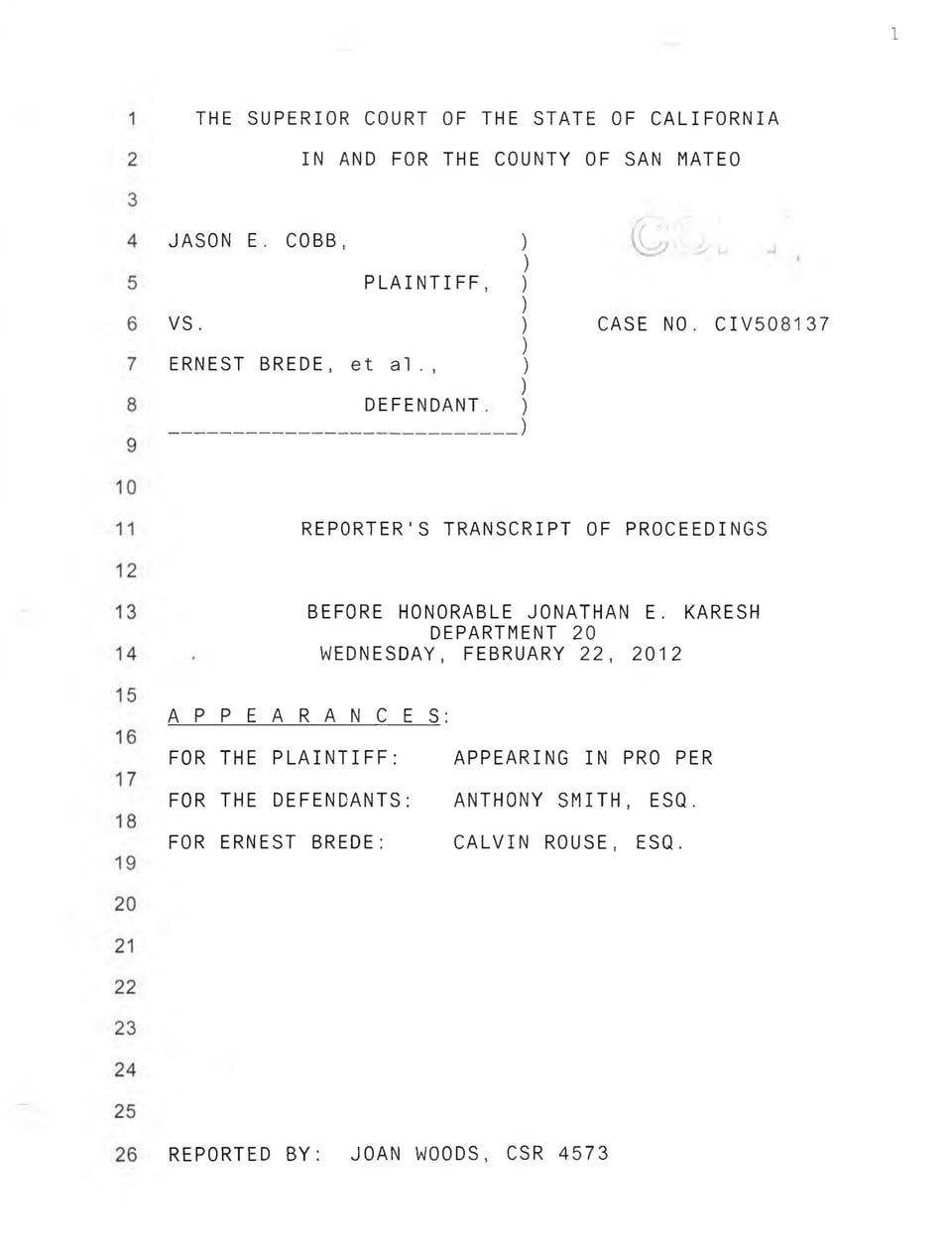
THE SUPERIOR COURT OF THE STATE OF CALIFORNIA IN AND FOR THE COUNTY OF SAN MATEO
JASON E. COBB,
PLAINTIFF,
VS.
ERNEST BREDE, et al.,
DEFENDANT.
CASE NO. CIV508137
REPORTER'S TRANSCRIPT OF PROCEEDINGS
BEFORE HONORABLE JONATHAN E. KARESH DEPARTMENT 20 WEDNESDAY, FEBRUARY 22, 2012
FOR THE PLAINTIFF: APPEARING IN PRO PER
APPEARANCES:
FOR THE DEFENDANTS: ANTHONY SMITH, ESQ.
FOR ERNEST BREDE: CALVIN ROUSE, ESQ.
REPORTED BY:JOAN WOODS,CSR 4573 WITNESSES FOR THE PEOPLE
ARLEN ST. CLAIR
Page
DIRECT EXAMINATION BY MR. COBB 44
JONATHAN DAVID COBB, SR.
DIRECT EXAMINATION BY MR. COBB 46
CROSS EXAMINATION BY MR. ROUSE 61
REDIRECT EXAMINATION BY MR. COBB 67
ERNEST BREDE
DIRECT EXAMINATION BY MR. ROUSE 90
CROSS EXAMINATION BY MR. COBB 103
REDIRECT EXAMINATION BY MR. ROUSE 129
RECROSS EXAMINATION BY MR. COBB 132 PROCEEDINGS
THE COURT: Good morning, everybody. Calling the matter sent to us from Master Calendar, Cobb versus Brede.
MR. SMITH: Good morning, Your Honor. Anthony Smith appearing on behalf of defendants.
MR. ROUSE: Calvin Rouse on behalf of one of the defendants, Mr. Brede.
THE COURT: And where is Mr. Cobb?
MR. COBB: I am Mr. Cobb. I am appearing pro per plaintiff.
THE COURT: Did you have a chance -- taking a position on whether or not Mr. Rouse can come in and participate in this hearing, did they file an application pro hoc vice?
MR. SMITH: That was granted this morning by Judge Swope. I do have a copy of the order if you would like to see it.
THE COURT: Not at all. I didn't see it in the file. So, he must have it. I was prepared to grant it. So, that's not an issue.
The issue that I have for the hearing is how you wish to proceed. Who wants to argue this, Mr. Rouse or Mr. Smith? Maybe educate me a little bit on how this hearing is suppose to go.
MR. ROUSE: I will do it if you want me to, Your Honor.
MR. SMITH: I was going to say, we do have two witnesses here. We have parties here, but we do have two individuals who are non-parties who may be called as witnesses at some point. I imagine they would need to step outside however the Court deems appropriate.
THE COURT: When there is testimony we will send them out.
MR. ROUSE: Your Honor, a complaint was filed against these three named party defendants who are ministers in a local Menlo Park Congregation of Jehovah's Witnesses. They are the current ministers of the congregation. And the complaint was filed by our ex-minister, one that has been removed by the organization.
And I say "organization." I am general counsel for the National Organization of Jehovah's Witnesses out of Brooklyn, New York. Ordinarily, I wouldn't be here, but this is one of our 13,000 congregations in the United States. We are a hierarchal religion structured just like the Catholic Church. And when the order from the Pope comes down in the church defrocking a priest and kicking him out, he no longer has any say in any matter in the local parish priest -- in the parish.
The same situation as here. In his complaint he brings one claim. He claims that he wants to be reinstated as a director and an officer in the Menlo Park Congregation. This is contrary to our church rules and regulations and bylaws.
We brought our organizational bylaws book, our rule book here, and we are prepared to present witnesses that this is a hierarchal organization. It is governed from the top down. We are protective of property rights and office holding rights of any degree at all in any of our churches.
And I am representing the presiding minister, Mr. Brede here. And so we challenge that. We say that that is a matter of First Amendment constitutional law. He can't do an end run as a defrocked minister and try to get his toe back in the administrative structure of our religion and by means of a court order. So, that's one point we are going to show through the evidence.
The other is that he let the statute of limitations run clearly in regard -- even under California law for a bringing a challenge like this.
THE COURT: Mr. Cobb, do you want to tell me anything before we start the hearing?
MR. COBB: Well, I will do the best I can under the circumstances, Your Honor. I am proper. It was not my expectation that there would be a hearing today.
So, I am only partially prepared. Ideally there would be a continuance or consideration given on that basis.
THE COURT: That is something that should have been done in front of the presiding judge. I am here to hear the hearing. That continuance request is denied.
MR. COBB: No problem.
So, I will be prepared to speak to the points as represented today as best I can. I have evidence that I can share. I too may call upon any number of witnesses to the extent that they can cooperate and support points provided herein.
THE COURT: Okay. That is fine. Let me just set up my computer, which I use to take notes.
MR. COBB: May I retrieve something from my seat?
THE COURT: Sure. Please.
Mr. Rouse or Mr. Smith, which one of you wants to call the first witness? Who will be doing the examination?
MR. SMITH: Well, it is my understanding that Mr. Cobb has the burden here.
THE COURT: Right.
MR. SMITH: So, we were kind of going to see how he was going to present his case. And then Mr. Rouse will handle the direct of Mr. Brede I would imagine. But it is somewhat dependant upon plaintiff's case.
That raises another housekeeping concern, Your Honor. Mr. Cobb is in proper. And so as to not try to get the hearing -- unnecessarily delay the hearing, is there a way you would suggest we handle any objections that may be presented? There is a possibility being he is not trained in the law that could be an issue.
THE COURT: I will leave it to whoever one of you wants to object. But I prefer to just one. So, you can make that decision.
Mr. Cobb, did you have any evidence you wanted to present about what's going on here? Who do you wish to call as a witness?
MR. COBB: Well, I would like to begin my initial statement in response to what was presented by Mr. Rouse.
THE COURT: Do you want to testify yourself basically?
MR. COBB: I will need to do that at some point in the morning.
THE COURT: That is fine, but if you essentially want to present an opening statement, please do.
MR. COBB: So, in reviewing the defendant's hearing brief we are identifying arguments that have been presented previously through any number of venues,
circumstances, points that has been presented previously at the constitutional law defense citing the organization is a religion organization, Jehovah's Witnesses as being a hierarchal organization or a hierarchy.
So, certainly the Court is probably familiar with the fact that the term "hierarchy" is one of any number of forms of church government. And they have a particular implication as it relates to legal matters.
The reality of the situation is that Jehovah's Witnesses as a religious organization are not a hierarchy. Jehovah's Witnesses do not use that terminology in any area relative to its beliefs. The beliefs that we hold as individuals are beliefs we promote by virtue of our preaching and teaching work in our community.
Presbyterian, hierarchy, congregational, all three of these terms are irrelevant when it comes to the organization known as Jehovah's Witnesses. The term that is utilized to describe the manner of structure and government, if you will, is theocratic. So, in some respects that might be more akin to congregational for a lay person to immediately embrace.
But one of the things that we will address is the reality that Jehovah's Witnesses are not a hierarchal religious organization. There is an 1 organizational structure with different points of responsibilities.
But we do not view ourselves as a hierarchy and I do have evidence to present from the flagship journal of Jehovah's Witnesses in the entire world, The Watch Tower magazine, which will clearly
support the statements I have just made. The next point, too, that we will want to consider in the proceeding is the point of ecclesiastical abstention. That concept does not apply in this particular case. There is no question of religion belief or doctrine, so forth. What we have here at the most basic level is two different considerations. There are the religious
considerations and everything that Mr. Rouse stated is correct. I and others were removed from positions of spiritual oversight in the congregation. However, as we all know, corporation is a separate legal entity. And the only way to create a marriage between any philosophical or religious point of view and that legal entity would be by and through the bylaws. So, one of the key points here is that there were no bylaws that
had ever been formed for our corporation in existence. We have articles of incorporation from 1980, but we never had any bylaws. So, in the absence of bylaws California Corporations Code repeatedly establishes time and again throughout that in the absence of bylaws essentially all considerations default to the letter of the law.
The letter of the law establishes a process to remove directors from office. The letter of the law establishes a process for directors to be voted in and those rules, regulations and formalities were not adhered to.
There is a recognition of that fact on the part of the defendants, but their attempt here today is to essentially take advantage of the Court's ignorance, if I may use that expression, so that you will default to the frame work of decision making based on the term "hierarchy" over and above reality of the structure that exists for Jehovah's Witnesses.
So, we will speak to that. And to a great extent if hierarchy is not used as a basis to invoke privilege, then their argument largely fails.
As far as the last point, statute of limitations, there was an attempt to hold a corporate meeting again without the benefit of having the former directors removed by law and without the benefit of them really having the basis since the actual directors, myself, Mr. St. Clair, and Mr. Stock, removed.
The meeting held on September 16th was not legally viable. They voted themselves into a nonexistent legal entity. They did not employ the actual name of the legal entity for the corporation.
And they recognized that themselves. So, it is interesting to note that the paperwork that they represent as being valid from September 16th never was filed with the State of California because they knew they had made certain errors in how they went through that process and document process.
I have a copy of the actual restatement of articles that they did file with the State of California, which will establish a recognition on their part that they did not vote themselves into the correct and legal existing entity. They had to make that adjustment. They made the adjustment December 16th and filed those documents pursuant to the meeting on December 30th.
So, my challenge is timely because it is predicated on the fact that they had a corporate meeting or an attempt to conduct a corporate meeting on December 16th, 2010, which was essentially a do-over because of their errors from September 16th, 2010.
THE COURT: Do you have some witnesses to present or testimony from yourself?
MR. COBB: I will present testimony primarily from myself. Again, I'm not well prepared today. I am not exactly sure if I would call upon these individuals here. Do I have to give that answer right now?
THE COURT: Well, no, but they should stay outside while you are testifying just because there is a general witness exclusion order in cases. So, you don't need to decide, but if there is a possibility they will be called as a witness, they need to be outside.
MR. COBB: Okay. Then I better protect myself.
THE COURT: Okay. So, I guess we will have you step on out.
THE COURT: Any witnesses who may be testifying should be waiting outside.
Mr. Cobb, do you wish to testify as yourself right now and tell me what's going on?
MR. COBB: Yeah. I mention --
THE COURT: We need to swear you in before you actually testify. So, please stand and raise your right hand.
(Plaintiff sworn.)
THE COURT: Mr. Rouse, enlighten me a little bit. What exactly has to be proved here by the plaintiff?
MR. ROUSE: Well, the plaintiff in his complaint essentially says he is challenging the validity of the appointments of Ernest Brede, Luis Contreras and Larry Laverdure as directors and officers in the Menlo Park Congregation of Jehovah's Witnesses. So, it would seem to me that he has to prove that these people that he is challenging here are not the proper officers and directors in this church.
If it is -- if the case law structures two types of churches in the United States, there is only two types of churches talked about in case law, congregational churches and hierarchal churches. A hierarchal church is governed by one set of first amendment laws, and congregational structured churches are governed by another set of case law that is applicable to them.
So, he is saying here Menlo Park Congregation of Jehovah's Witnesses. So, I think he needs to establish what law entitles him to get these men -- challenge the appointment of these men, what law is going to govern here. Is it First Amendment going to govern or is it California Corporate Code going to govern? If California Corporate Code is going to be supreme, then maybe he has got a point. But if this is a hierarchal church, then this is governed by church law. Church law determines. Then I think he needs to evaluate that and disprove that.
THE COURT: I see in the file -- I don't see the outcome -- there was a summary judgment motion filed at some point.
MR. ROUSE: There was a federal case that they brought that is parallel to this and the motion was 1.
filed in that and that was dismissed. A federal case
ruled in our favor.
3 THE COURT: So, there's not been a summary judgment in this particular --
MR. ROUSE: Not in this one, but we wanted to benefit this Court with a ruling by a federal judge in this case. So, I mean, the same principles apply in that case as this.
THE COURT: All right, Mr. Cobb, why don't you go ahead and testify.
MR. COBB: The first statement is simply to create the base line. I have a letter from the Watch Tower Bible and Tract Society of New York, Incorporated, dated January 1st, 1980 to all congregations in the State of California.
I won't burden the Court by reading it. I am happy to reference it if you like, but essentially this letter was sent in anticipation of reformation of the Corporations Code for California.
MR. SMITH: Your Honor, he is referring to a document that he is reading into evidence. So, we have a hearsay objection. We perhaps have a foundational issue with regards to its admission. And so he is not testifying from his own personal knowledge. He is reading from a document.
THE COURT: That is hearsay, Mr. Cobb. So, unless you have a way to authenticate it and get around the hearsay exception, I can't receive that as evidence now that there is an objection.
MR. COBB: Well, I can speak to it based on my knowledge. It is something that was furnished directly
from the agency as stated. And it helps to establish
the recognition of corporate law within the parameters
of our activities engaging in our religious activity.
THE COURT: There is still the hearsay problem,
Mr. Cobb. You are trying to prove the content of the
document. That document would be hearsay. So, if I am
to consider the substance of the documents there has to
be a hearsay exception. And just because you are
familiar with it, that's not a hearsay exception. MR. COBB: Well, this is a letter that was maintained within the files of policy letters and directives and that was maintained at the congregation itself. It is a copy of a document maintained in the file and readily viewable with all pertinent information at that point in time from which it was sent. And we even have some subsequent actions were performed
even have some subsequent actions were performed relative to what was being called for.
The significance of it is that there were changes to corporate law in California in 1980 that necessitated filing of statements of information. And this letter essentially is confirming our compliance Again, we have to maintain the distinction between when we talk about the Menlo Park Congregation of Jehovah's Witnesses, a religious agency, or if we are talking about Menlo Park Congregation of Jehovah's Witnesses Incorporated, a legal entity in the State of California.
So, the letter here establishes that state law is not subject to our religious views, but rather our religious views taking into consideration the laws of the land. And we are here is a discussion that we will comply with the corporate formalities and requirements.
THE COURT: When was that document made?
MR. COBB: January 1st -- when was it made?
THE COURT: Right.
MR. COBB: The date for the letter is January 1st, 1980. This is a photocopy of the document. If given the opportunity, I can produce the original.
THE COURT: No. I will trust you. The problem is it still is a hearsay document. So, I will sustain the objection.
MR. COBB: Okay.
THE COURT: It's been improperly authenticated -- insufficiently authenticated.
Please, continue with your testimony.
MR. COBB: So, what we are referring to here is that we have statements of information from 2008, also 2010, that show positions of officers being maintained in the Menlo Park corporation.
Is it all right for me to refer to the Menlo Park corporation in short?
THE COURT: Okay.
MR. SMITH: Your Honor, same objection.
Hearsay objection. He appears to be reading from a document and it has not been properly authenticated.
THE COURT: That is true. It hasn't been authenticated at this point. I will give you the chance to try to authenticate it.
That's unfortunately one of the draw backs of your being in proper. You are not familiar with the Evidence Code which I am bound to follow. There are all these rules that can't be just waived away just because you represent yourself. So, unless you can properly authenticate that document, it is hearsay.
MR. COBB: Would you be willing to consider a short continuance so I can do that?
THE COURT: No. I'm not prepared to do that. That should have been done at the presiding judge this morning. We are here to hear the case. Mr. Rouse is already here from New York City. I am not going to make him come back.
MR. COBB: This is a document certified by Deborah Bowling.
It is a certified document from the Secretary of State.
THE COURT: Let me take a look at it.
I will allow this in because it is a certified government record.
Counsel, do you have an objection?
MR. SMITH: I haven't had a chance to see it.
THE COURT: Please approach.
MR. SMITH: Well, same objection. I don't think he met the hearsay exception.
THE COURT: That one is overruled. It's a government document.
You can refer to that, Mr. Cobb.
MR. SMITH: Do you have an extra copy of that?
MR. COBB: I don't know if I do. Give me one moment. I don't think I have an extra copy.
THE COURT: We will deal with it as best we can.
MR. COBB: I am willing to share it. I want to refer to it briefly.
Basically this is the statement of information form that is used in California. Very typical. It establishes that I was serving as a chief executive officer for the Menlo Park Congregation of Jehovah's Witnesses Incorporated.
We should enter into the record entity number for the corporation is C0983980.
So, as of this filing, dated March 30th, 2010, I served as the CEO of the corporation. W. Arlen St. Clair served as secretary for the corporation. And George T. Stock served as the chief financial officer. THE COURT: Could you spell his last name, please.
MR. COBB: S-T-O-C-K.
So, this is significant -- thank you for accepting it, Your Honor -- because whether they held a corporate meeting September 16th, 2010 or whether they held a corporate meeting December 16th, 2010, both of those meetings where they endeavored to appoint themselves as directors and then officers of the corporation, occurred within the tenure, the established tenure for myself, Mr. St. Clair and Mr. Stock.
So, in the absence of bylaws the term for any director is one year -- forgive me, I can't refer to the specific code on that. But I believe that is fairly common knowledge. In the absence of bylaws the term of any director is one year.
So, their initial attempt, which was erroneous in September 16th, was within the year, their follow-up attempt to make up for their errors was December 16th within the same year.
So, the only basis according to law for them to proceed forward with appointments and so forth, is to formally remove the existing directors, which is something that can be done by a vote of the members at any time of their choosing.
But that never occurred. The directors were never removed. They did not abandon the corporation. And they did not resign from their positions as directors of the corporation.
So, that is a prerequisite for any subsequent activities of the corporation and those formalities were never performed or satisfied.
So, the fundamental point that we have --
THE COURT: You said vote of --
MR. COBB: Section 5034 of the Corporations Code. I mentioned that within the first couple of pages of the complaint. Again, I apologize. I am not well prepared today. But I believe that it is section 5034 that establishes a vote of members being required to execute such decisions and actions.
So, there would need to be a specific motion presented to the members that the existing directors, myself, Mr. St. Clair and Mr. Stock be removed from their standing positions as directors.
THE COURT: So, you are saying it has to be the members of the Menlo Park Congregation as opposed to the national organization?
MR. COBB: That is absolutely correct.
THE COURT: Okay. Anything else you want to tell me?
tell me?
MR. COBB: Just that that never took place. That requirement was never satisfied. We have established that we held those positions as directors and we have established that the two meetings that they attempted to execute for voting purposes were within the one year tenure as established by law for each of the directors. So, they would have had to remove the existing directors as a prerequisite for any subsequent voting activity and they did not do so.
THE COURT: Okay.
Do you have any other witnesses you want to present or evidence before we hear from the other side.
MR. COBB: I can call -- yes. I would like to call Arlen St. Clair. And I would actually call John Cobb as well.
THE COURT: Who do you want to call first?
MR. COBB: I will call Arlen St. Clair first.
MR. ROUSE: Your Honor, if I may to the extent that he just testified we have a chance to cross examine him?
THE COURT: That's a great point. You have testified. So, you have to be cross examined.
So, Mr. Rouse, I will leave it to you.
CROSS EXAMINATION BY MR. ROUSE MR. ROUSE: Thank you.
May I see the document?
Q. Now, I am referring to -- I don't think it has been marked but --
THE COURT: Let's mark it as Plaintiff's 1.
MR. ROUSE: For the record I am referring to Plaintiff's 1 that has been handed to me by Mr. Cobb.
Q. Mr. Cobb, isn't it true that this document has a filed stamp date March 30th, 2010?
A. Correct.
Q. And at the time of March 30th, 2010 you occupied the position of an elder in the congregation in Menlo Park?
A. Correct.
Q., You occupied that position because a letter came to the congregation from who appointing you as an elder in the congregation?
A. A letter was sent from the Christian Congregation of Jehovah's Witnesses Incorporated, Patterson, New York.
Q. Yes. And from the time that letter was received through the date of this form, you still occupied that position as an elder; isn't that true?
A. True.
THE COURT: What was date that you were appointed?
MR. COBB: 2003.
A.
Yes. Yes.
Q.
Now, do you recognize this green book right here?
A.
Yes.
Q.
What's the name of this book?
A.
Organized To Do Jehovah's Will.
Q.
Isn't that the rule book of all 13,000 congregations of Jehovah's Witnesses in the United States?
A.
I am not sure I would call it a "rule book," but generally speaking it provides direction for how to keep things organized.
Q.
Doesn't the book say on the opening remarks that it is a direction, an organizational direction for the congregations in the United States; doesn't it say that?
A.
It says that.
Q.
You are familiar with it; aren't you?
A.
I am.
Q.
And the book also plainly states that unless
A.
Can you restate that, please?
Q.
Doesn't the book say, that organizational book say -- well, let me strike that.
Let me put it like his: Who published this book? Do you know who published the book?
A.
Published by Watch Tower Bible and Tract Society of Pennsylvania.
Q.
Yes. Isn't this book used by all 13,000 congregations in the United States as a guide for organizations?
A.
It is.
Q.
Didn't you at one time take an oath to be submissive to those organizational arrangements?
A.
In being baptized I made a dedication of my life to do Jehovah's will.
Q.
Didn't you take a vow to be submissive? Doesn't this book say you in fact took a vow to be submissive to those organizational arrangements?
A.
That is a byproduct of my dedicating myself and my life to the doing of Jehovah's God's will.
Q.
Doesn't it -- let me give you a copy of the book just so I make sure you understand. We might give
one to the judge, too.
THE COURT: Let's mark this as Defense A.
MR. ROUSE: Q. Doesn't it state, Mr. Cobb, on Page 121 of the book that an elder or -- I am quoting now on Page 121 if you want to look at it.
A. 121 the paragraph?
Q. Paragraph 2 in the middle of the paragraph doesn't it say, "An elder or a ministerial servant is usually assigned to see that necessary work is cared for." Does the book state that?
A. Are you confirming -- what chapter --
Q. I am talking about Page 121 where it talks about the Kingdom Hall.
A. So, that would be Chapter 11, "Arrangements for places of worship"?
Q. Yes.
A. It is my understanding this chapter is addressing matters of doctrinal belief, scriptural teachings and the role of the Kingdom Hall or church buildings in that overall arrangement; is that correct?
Q. Mr. Cobb, would you answer my question. It says here under section "Kingdom Hall" -- what is the Kingdom Hall?
A. Is this still Paragraph 2?
Q. Now I'm asking you the question: What is Kingdom Hall?
A. Kingdom Hall is the name that is used specific to places of worship.
Q. Doesn't it say directly under the word "Kingdom Hall" on Page 121, "It is a principal meeting place of Jehovah's Witnesses"? Doesn't it say that?
A. It says that.
Q. Do you believe that to be true?
A. I do.
Q. Directly across from that on the next page, does it or does it not say directly across from the word, "Kingdom Hall," running your finger across the next page, doesn't the rule book say, "An elder or ministerial servant is usually assigned to see that necessary work is cared for." Now, is that true or not?
A. The reference -- the truth of the reference is amplified by the contents. Here it is talking about arrangements to clean the Kingdom Hall, to care for the maintenance of the Kingdom Hall. And so there are any number of responsibilities that are needed to get that done. So, when it talks about an elder or ministerial servant being assigned to see that necessary work is cared for or done, it is within the context of the maintenance and general administrators of the building.
Q. Who's it that does the assigning, Mr. Cobb?
A. That is done by the local overseer, spiritual overseer, body of elders -- go ahead.
Q. Isn't it true it's the appointed elders? That's what it is talking about here, the appointed elders in the congregation appointed by the national organization. That's true; isn't it?
A. Appointed theocratically by means of Jehovah's Holy Spirit.
Q. The letter comes from where, Mr. Cobb?
A. The letter comes from the corporation, but the governing body of Jehovah's Witnesses stated time and again that the appointments are not by and through the corporation. Individuals are appointed by the Holy Spirit as emanating from Jehovah God. So, the functional execution of that is supported and facilitated by and through the entity referenced, but the appointments do not come from that entity.
Q. Isn't it true, Mr. Cobb, that the true understanding of this and the actual wording of it is this: A member of the congregation cannot even sweep the floor in the Kingdom Hall without being assigned by an arrangement controlled and managed by the elders; isn't that true?
A. Well, I have --
Q. Isn't that -- isn't that what it says?
A. Well, let me be clear about what you are referring to, please. If you want to pull out the sentence.
1 Q. Mr.Cobb, I just got you to read, "An elder or ministerial servant is usually assigned to see that necessary work is cared for." Then it has -- it can be a list of things, anything; isn't that true? Anything in the congregation?
A. Cleaning, maintenance, things of that nature.
So, you follow that up by saying, "Isn't it true that a person would not be able to sweep the floor without first receiving direction"
Q. Yes. And ultimately controlled by elders.
A. It is an expression of their faith in God and their appreciation for them to contribute to the well being and maintenance of the Kingdom Hall. As a person
who has been born and raised in our religious organization, it's not consistent with my experience that if a 60 year old sister in congregation of her own free will picked up a broom to sweep the floor that she would be reprimanded or that she would be in violation of some protocol.
Q. All right. I don't want wear this out, but I
want you to go up to the last sentence in the first paragraph about Kingdom Hall ownership. It starts with the sentence "elders." Do you see that, Mr. Cobb? A. I do. THE COURT: What page is that, Mr. Rouse? MR. ROUSE: Page 121, Paragraph 1, the last sentence.
Q. It says -- who's it -- Mr. Cobb, Page 121, Paragraph 1, the last sentence. Who is it, directors and officers, or who's it that is generally familiar with information regarding ownership and operation of the Kingdom Hall?
A. It says elders are generally familiar with information regarding ownership and operation.
Q. Where do they get their information? Besides this book, where else do they get their information?
A. The information will be made available through any number of publications.
Q. No, but the rule book says where do they get it? The sentence tells you there. Where do they get it?
A. It says here "hierarchy ministries," which is an organization of publications, memorandums and letters provided by the branch office.
Q. Provided by who?
A. The branch office.
Q. Where is the branch office?
A. United States branch office is located in
Patterson, New York.
Q. Yes, and that's the same office that the letter comes from appointing you or deleting you as an elder;
isn't that true?
1 A. That is true.
Q. Now, did you respect the elder that the letter
that came from them deleting you as elder?
A. Did I respect it?
Q. Yes.
A. Yes.
Q. So, why did you file this lawsuit trying to get yourself appointed as a director again?
A. The reason why that was done was pursuant to the adjustments in the spiritual oversight in the congregation.
There's been a concern with unlawful, dishonest and/or criminal activity. And the objective in filing the action has been to reestablish the basis to have visibility to the banking accounts in question where there is concern of efforts to evade taxes, money laundering. There is also concern as far as misappropriation of funds, conversion, things of that nature.
So, in order to have practical basis to identify the problems therein and have them addressed lawfully, then I would need to reaffirm my standing legally to do so.
Q. Mr. Cobb, isn't it true -- isn't it true these reference works that are cited here as well as this book, isn't it true that they say and, in fact you know,
A.
No.
Q.
Don't you know that to be true?
A.
I do not know that to be true. There's actually a dual line of responsibility relative to, No. 1, occupying a position of spiritual oversight in the congregation.
And it should be noted, too, that any number of references from the branch office have outlined that an elder can hold standing relative to the legal entities employed by the congregation or ministerial servant -- that's the lower rank for you, Your Honor, and the Court -- can hold that. So, it's not tied into being an elder per se.
The other thing that is true here as well is there is an effort to represent points of policy and procedure pursuant to the erroneous assertion that Jehovah's Witnesses are a hierarchal religious organization. That is being done to essentially obscure a very important fact which has been alluded to time and
again in my filings with the Court for this action.
The reality of what occurs is when a person is removed as an elder they are just that. Removed as an elder. They are removed from a position of spiritual oversight. That does not automatically address, resolve or terminate their legal standing relative to the corporation.
Do they have a basis according to the beliefs, views or philosophies employed within the religious organization to hold office, that can be argued. But being removed from a position of spiritual oversight of and in itself does not remove a person from a legal -- from their standing in a legal entity. And the reality of what occurs here for the benefit of the Court, who will not be familiar with the inner workings of Jehovah's Witnesses or customs, the reality is if individuals are identified for removal pursuant to the desire to effectively assume operational control of the corporation, and by extension of that, operational control of the property. Let's be real. That's what we are talking about here, property value of two point five million dollars.
So, the process to go ahead and pursue that is accomplished by and through removals at a spiritual level or spiritual capacity. And what occurs thereafter is one of two things -MR. SMITH: Your Honor, I'm not -- MR. ROUSE: I think he has answered my question.
I am about to wrap this up. Q. Isn't it true at the same time the letter came removing you that a letter also came appointing the three defendants as elders in Menlo Park Congregation? Isn't that true? The letter came from national head-quarters appointing the three persons that you named as defendants in this lawsuit, Ernest Brede, Luis Contreras and Larry Laverdure.
A. The letter was sent appointing them to positions of spiritual oversight in the English Menlo Park Congregation of Jehovah's Witnesses. However, that letter did not by the same virtue provide legal standing in the corporation of a separate entity under the laws of provisions of State of California. The governing body of Jehovah's Witnesses would be first to say that.
Q. Isn't it true that if the letter had come instead of stating the names of the defendants, Ernest Brede, Luis Contreras and Larry Laverdure, suppose the letter said "John Doe, Henry Smith." If the letter had said that instead of these present defendants being named as parties in your suit, you would have named whoever else the national headquarters appointed as elders? You would have probably named them; wouldn't you?
The point has been made within the memorandums and notifications that an elder or a ministerial servant and at times in view of the history of the organization even non-servants have occupied positions within the corporations that are utilized by local congregations to maintain ownership of property. So, it's not a given that if it said "John," "Joe" or "Sally," that they would be the ones standing here today. It could be that way if in fact they proceeded to occupy those legal positions. But it's not automatic that they would. We have two disparate lines of responsibility.
Q. You don't deny that they are currently more than 45,000 appointed elders in the United States branch? You don't deny that; do you?
A. I have no basis to approve or deny your -- you are at the branch. So, I will defer to your knowledge.
Q. You can't name right now -- the 45,000, you can't name a single person, can you, that is in violation of the rule in this book that you have to be an appointed elder to be a director in a congregation?
Out of 45,000 people you have been associated with them 20 years, you can't call a name right now; can you?
A. I want to make sure I am understanding your question.
Q. My question is: With more than 45,000 people 1 appointed in these 13,000 congregations,and considering your20year--excess of20yearassociationwiththis group,you can'tname a single person that is in violation of the rule that I have cited here today;can you?
You can't call a single name; can you?
A. Please help me be clear of the rule you are citing today.
8 Q. That if you are not an appointed elder in the congregation you cannot serve any time, anywhere, in any congregation in this branch as a director, an officer or hold any position of fiduciary trust. It has not happened, it will not happen and you can't call the name sitting here today.
A. . There are elders that have held positions and there are ministerial servants that have held positions and there are individuals who have had neither station hold position of corporate responsibility for legal entities employed by local congregations of Jehovah's Witnesses. That's a fact.
Q. Mr. Cobb, do you know what the rule is and you can't give us a name except that you want to be that
can't give us a name except that you want to be that, though; don't you? You want to be reinstated; don't you? A. I'm not viewing the rule as an absolute. I am speaking from my experience. And my experience establishes to your point that elders have occupied positions with corporations.
Ministerial servants have occupied positions with corporations. And publishers, individuals who are neither public or private have occupied positions with corporations.
Is there a point of custom? I think any group you can have that, but that in and of itself doesn't dictate points of law. There are still realities to deal with from the standpoint of corporate law. That is accepted in the organizations.
MR. ROUSE: I am through with cross, Your Honor.
MR. SMITH: I would like to move Defendant's 1 in evidence.
THE COURT: Defendant's A. Objection, Mr. Cobb, this being received?
MR. COBB: No.
THE COURT: It will be received then.
Did you have anything else to say, Mr. Cobb?
MR. COBB: May have a moment, please?
THE COURT: Of course.
MR. COBB: Am I permitted to ask questions of counsel?
THE COURT: No, not unless they are witnesses.
So, you either tell me some more stuff or you can call another witness or you can rest and leave it up to them to call their witnesses.
MR. COBB: Thanks. I will refer to Page 22 of the book that you have been handed. I didn't catch number.
THE COURT: Exhibit A.
MR. COBB: So, Page 22, second paragraph, under the heading, "Organized theocratically." This will help provide a basis for the term that I used earlier when I contrasted the terms Presbyterian, hierarchal and even congregational.
So, it says there Christian congregation was established in 33 C. E. and the Congregation as they function today operate within the same structure.
The structure is identified in this paragraph, and you will not find the word "hierarchy" or "hierarchal" in this paragraph. What it says in this paragraph is congregation was organized and governed theocratically. So, the question is: What does that mean "theocratically"? It's not an everyday term.
Here it says under Greek the word "theos" means rule -- sorry. "Theos" means God. The word "cratos" means rule. So, these terms establish the frame work of how Jehovah's Witnesses as a religious organization are governed.
And when they talk about the top down, they are not referring to anyone in New York City. The top down is Jehovah God as the supreme universal sovereign, his son the Chris Jesus, and delegated authorities of varying levels of responsibility from that point.
But the term "theocratic" means a rule by God. That means the standards that are contained in the bible which forms the basis of all of our beliefs, those standards are from God. They are not from men. They are not from anyone in New York or Nebraska or anywhere else. So, each individual has the responsibility to God to adhere to his standards and his directives. So, we do not have a hierarchal arrangement.
And it should be noted that the term "hierarchy" is not viewed in a good light within Jehovah's Witnesses -- or among Jehovah's Witnesses. The reason for that is that's a term that is associated with "aposes," the term associated with false teachings that do not conform to the foundational teachings of Christ.
I won't burden the Court further on the point but I wanted you to be to clear that in the book that Mr. Rouse is referring to validates the initial statement that I made as far as the form of government that is employed in reality in the religious organization known as Jehovah's Witnesses. It is not hierarchal.
THE COURT: Well, let me just clarify and get sort of what I think is the heart of the matter.
How did you get to be in the position in the first place. Because it is the national organization that appointed you; was it not?
MR. COBB: The direct answer to the question is that I or anyone else who occupies such as position is appointed by the Holy Spirit, by God. That becomes apparent to individuals who --
THE COURT: Well, I understand that, but who's the person that appointed you? Obviously if -- God doesn't come out and specifically tell you you are appointed. Somebody appointed you. Wasn't that the national organization?
MR. COBB: The governing body of the Jehovah's Witnesses or any individuals associated with it. Not to be a stickler, but they wouldn't be able to say "yes" to that. We are not appointed by any organization.
THE COURT: How did you get on the board then? How did you get this position?
MR. COBB: So, that's two different questions. How did I become an elder?
THE COURT: Yes. How did you become an elder? Because you were appointed by the top down by the national organization; isn't that true?
MR. COBB: I am sorry, Your Honor. I can't say "yes" to that because that's not the reality based upon my beliefs and based on our beliefs based on the
scriptures.
Individuals are appointed by God's Holy Spirit and that becomes manifest by virtue of how they are living their life. That becomes the indication to individuals here within the organization that they are fit to serve.
THE COURT: How did you find out you were appointed?
MR. COBB: To Mr. Rouse's point, a letter sent. There was a recommendation made and a letter sent establishing that.
THE COURT: By whom?
MR. COBB: From the Christian Congregation of Jehovah's Witnesses.
THE COURT: That is the national organization, correct?
MR. COBB: That is the United States branch office.
THE COURT: Right.
Is there anything else you wanted to add?
MR. COBB: Yes. The thing to add is being appointed an as elder is a spiritual or congregational appointment.
That's it.
THE COURT: Did the local congregation have anything to do? Do they confirm it or vote on it at a11?
The local congregation -- thank you for that question. The local congregation, the members who equate to the members of the corporation, they will in turn vote individuals in as directors of the corporation. That is not done by the United States branch office. That is not done by the governing body of Jehovah's Witnesses. The appointment is to spiritual position of oversight, aka "elders." That is done by and through the branch office. And once that is done, whomever is in turn appointed to positions in the legal corporation, that's handled at a local level by the members under the laws of a particular state in question, in this case California.
THE COURT: Anything else you want to tell me? MR. COBB: To round that point out, I just wanted to clarify or amplify the point that a person being appointed as an elder of and in itself does not appoint them as an officer or director of the corporation. That is an entirely separate process. The only point that can be made as a matter of custom, there may be a statement made that individuals occupying certain spiritual positions have a leading basis of eligibility to occupy legal positions in corporations. But the appointments of individuals to spiritual 1.
positions of oversight of and in itself is not
unequivocally equate to establish standing in a legal entity. It's a process governed by the State of
California and that is a process that Jehovah's
Witnesses are submissive to.
THE COURT: Okay. Did you want to call in any witnesses at this point or are you resting?
MR. ROUSE: Your Honor --
THE COURT: Do you have more cross exam?
RECROSS EXAMINATION BY MR. ROUSE
MR. ROUSE: I just want to recross him on this one point here.
Q. Turnover to Page 26. It says under the
14 sub-heading, "Structure of branch organization." You understand what it is talking about here, structure of branch organization?
A. I believe I do.
Q. The second paragraph under there says, "Local congregations under each branch are organized into circuits, and a number of circuits make up districts."
Then skip a sentence and then it says, "A circle overseer is appointed to serve the congregations in each circuit. A district overseer visits the different circuits and serves circuit assemblies," etc. You understand that to be the truth; don't you? A. I do.
Q. Now, the beginning of the -- drop down to the last paragraph. Isn't it true, Mr. Cobb, that the rule book says that, "All in the organization recognize God's administration the congregations acknowledge and conform to organizational arrangements that are outlined for the benefit of all." And then it says they accept the appointment of older men who oversee the work in branches, districts, circuits and congregations.
Now, you know that to be the practice of Jehovah's Witnesses; don't you?
A. I do.
Q. And the book is true when it says that; doesn't it?
A.. I believe that it is true when it says that, but I would like to clarify.
Q. But the book says "appointed older man oversee the work"; doesn't it say that?
A. Uh-huh.
Q. "Appointed." Men who are not appointed or men who have been removed do not do that; do they?
A. They do not provide spiritual oversight and direction congregation, you are correct.
Q. It doesn't say that, Mr. Cobb. It says "the work." It says the work in the branches, districts, circuits and congregations.
A. By "the work," I am understanding the pursuit of our spiritual vocations and activities, preaching,
teaching, baptizing. And on that basis I would agree
with your point.
THE COURT: Anything else, Mr. Cobb? Anything
that you want to tell me?
MR. COBB: No.
THE COURT: What is your next step? Do you
wish to call somebody as a witness or do you wish to
rest and give them a chance to call their witnesses?
MR. COBB: I would like to call Arlen St. Clair
first of all.
(Witness sworn.)
THE CLERK: Would you state and spell your name
for the record, please.
THE WITNESS: Walter Arlen St. Clair,
A-R-L-E-N, S-T period C-L-A-I-R
MR. COBB: Am I at liberty to approach and hand
that exhibit to Mr. St. Clair?
THE COURT: Sure. You can do that.
DIRECT EXAMINATION BY MR. COBB
MR. COBB: Q. Have you ever seen that document
before?
A. Many times.
Q. Do you see your name on the document?
A. Yes, I am the second one, secretary.
Q. Can you confirm the name of the corporation 1 please?
Near the top.
2 A. Yes.
3 Q. Can you read it.
4 A. Menlo Park Congregation of Jehovah's Witnesses Incorporated.
Q. Can you confirm the date of the filing of the document?
8 A. Yes.
9 Q. Read it.
10 A. March 30th, 2010.
12 resign from your position in the corporation?
11 Q. At any time after March 30th, 2010 did you
A. I never resigned.
14 Q.. Were you voted out? Were you specifically removed by a vote of the members in accordance with Corporations Code 5034? Were you removed by a vote of the members of director and officers?
A. No.
Q. Very good. Have you ever formally joined a different congregation?
A. No.
Q. Do you recall a statement from myself in and around the time when defendant, Brede, et al., began associating or attending the Menlo Park congregation? It would be around May, late May. There was a statement made that there was a desire to have a meeting with Paul Kohler.
There was a desire for all of these individuals to be present, all of the new appointed elders and all of the former elders to come together and have a meeting. Does that ring a bell with you?
A. No, it doesn't.
Q. It has been a while.
A. Yes. I have been there two years.
MR. SMITH: Excuse me, Your Honor. Can we have Mr. Cobb speak up a little bit.
THE COURT: Yes. Both of you speak up.
MR. COBB: I would like to strike the last question as far as his recollection.
THE COURT: Overruled. That is denied.
MR. COBB: I think that's good for now. No further questions.
THE COURT: Mr. Rouse, do you have any questions for this gentleman?
MR. ROUSE: No, Your Honor.
THE COURT: Thank you, sir.
MR. COBB: And I wanted to call John Cobb (Witness sworn.)
THE CLERK: Would you state and spell your name for the record, please.
THE WITNESS: Jonathan David Cobb, Sr.,
J-O-N-A-T-H-A-N C-O-B-B, Sr.
DIRECT EXAMINATION BY MR. COBB MR. COBB: Was the exhibit returned?
THE COURT: Please approach.
MR. COBB: I may not need it.
Am I permitted to ask a question about something that has yet to be admitted?
THE COURT: Sure.
MR. COBB: Q. How long have you been one of Jehovah's Witnesses?
A. I was baptized in 1955, July 20th. So, however many years that is.
Q. From 1955 to present have you belonged to any other religious organizations?
A. No.
Q., So, you have been one of Jehovah's Witnesses your entire life?
A. Yes.
Q. I would like to present a question to you that was presented earlier. When we reflect on the importance of maintaining the Kingdom Halls that we use, general maintenance and so forth, there are different lines of responsibility to get that done. Are those responsibilities, for example, to trim the shrubs, do those assignments come from the United States branch office?
A. No.
Q. If a person were to pick up a broom and begin sweeping at a local Kingdom Hall would they be in violation, would they be overstepping their bounds in doing so?
A. Not at all.
Q. There is a statement that was referred to in this publication Organize To Do Jehovah's Will. Are you familiar with it?
A. Yes.
Q. On Page 121 it says, "An elder or a ministerial servant is usually assigned to see that necessary work is cared for in accord with the list of things to be done each week." In that statement being read does it appear to you that only the elders or ministerial servants are able to care for the facility as an act of faith?
A. No. That responsibility is shared by the entire membership.
THE COURT: Entire what?
THE WITNESS: Entire membership.
THE COURT: Move forward and speak into the mike, please.
MR. COBB: Q. How are elders and ministerial servants appointed?
A. The understanding I have is they are appointed by the Holy Spirit, which means that recommendations are sent in, but they have to be qualified by adhering to the spiritual qualifications.
And then the elders recommending them are the individuals that are letting the branch know that they are qualified. And generally their recommendations are accepted and they are appointed.
Q. Isn't it true that when individuals at the branch office review these recommendations do they vote?
MR. SMITH: I couldn't hear that.
MR. COBB: Q. When individuals at the branch office receive these recommendations as far as appointments of elders, do members at the branch vote?
MR. SMITH: I will object to the question as lacking foundation.
THE COURT: Sustained.
MR. COBB: Q. The thrust of it is how -- what in turn will individuals at the branch office do once they receive any recommendation that an individual serve as an elder or ministerial servant?
MR. SMITH: Same objection, Your Honor.
THE COURT: See if he can answer if he has knowledge enough to do that.
Can you answer that question?
THE WITNESS: As far as I know they would consider those qualifications, generally accept the recommendation of the elders, and comply with appointing them.
MR. COBB: Okay. Thank you.
THE COURT: Let me ask this: In your experience as a member of Jehovah's Witnesses has there ever been a time when an elder has been appointed or recommended by the national organization where the local organizations has thrown that out or disagreed with it?
THE WITNESS: You mean overriding the local --
THE COURT: Where the local congregation ever overridden national recommendation when it comes to the appointment of an elder in your knowledge?
THE WITNESS: Not that know of.
MR. COBB: Q. To run out the previous point, what do we typically understand as far as the process of appointments with individuals at the branch. They will review the recommendation, they will read it obviously. But what important step do they complete prior to making or reaching a conclusion in view of the fact that the organization is a theocracy, a rule by God?
MR. SMITH: I will object to the question as ambiguous.
THE COURT: Sustained. Sustained.
MR. COBB: Q. Before they complete their review of any recommendation for an elder ministerial servant, what will brothers at the branch typically do?
MR. SMITH: Object again for lack of foundation.
THE COURT: Overruled.
THE WITNESS: They would take into consideration the recommendation that has been made. The understanding I have is they will pray over the matter in order to -- at least that's what has been stated -- pray over the matter to make the recommendation -- accept the recommendation that has been made.
THE COURT: What you call a "recommendation," does it come in the form of a letter or a piece of paper from the national?
THE WITNESS: Yes.
THE COURT: Have you read these before?
THE WITNESS: Yes.
THE COURT: Does the language in these documents, do they say an elder is appointed or do they say, "We recommend to the local organization that this person be accepted in as an elder"? What does it say?
THE WITNESS: It says we are recommending him to be appointed as an elder and then the appointment comes from --
THE COURT: You have actually seen that in the document using the word "recommendation"?
THE WITNESS: Yes.
THE COURT: Okay.
MR. COBB: Let me re-gather myself. I am sorry.
MR. COBB: Q. Why would individuals at the branch office pray before approving any recommendation? MR. SMITH: Your Honor, I will object because it calls for speculation.
THE COURT: Sustained.
MR. COBB: Q. Do you feel based on your knowledge of the scriptures and your experience as one of Jehovah's Witnesses, do you feel that it is appropriate for individuals at the branch office to pray before approving any recommendation?
A. Yes. I think it is. I know it is in fact.
Q.. Are you familiar with the term "theocratic"?
A. Yes.
Q. Can you define it, please.
A. It is rule by God.
Q. Do you see churches of Christendom who would come under the designation of Presbyterian or hierarchal or even congregational as being theocratic
organizations?
A. No.
MR. SMITH: I will object as vague and ambiguous.
THE COURT: Sustained. The answer is stricken MR. COBB: Q. Do you recognize -- what would be the primary difference between hierarchal religious organization and the organization known as Jehovah's Witnesses as far as governance and structure and practice?
MR. SMITH: Your Honor, I will object. It is almost seeking an expert opinion.
THE COURT: Yes, it is. And there is no foundation for it.
Have you ever been an elder, sir, in one of the congregations?
THE WITNESS: Yes.
THE COURT: Okay.
MR. COBB: Q. Do you believe based on your years of experience as one of Jehovah's Witnesses that Jehovah's Witnesses are a hierarchal religious organization?
MR. SMITH: Again, objection. Asking for a legal conclusion.
THE COURT: Yes. Sustained.
MR. COBB: I will make a different reference here. Am I permitted to have him read something?
THE COURT: What is it?
MR. COBB: It's a -- I will show it to you. It's an excerpt from one of the documents I filed for the action.
THE COURT: It is hearsay. So, no.
MR. COBB:
Would I be able to read a brief statement and ask a question pursuant to that?
THE COURT:
You can ask the question, but they may object to it. So, we will see what it is.
MR. COBB:
Q. There is a statement here from January 15th, 2001 Watch Tower. It says, "Jehovah's Witnesses do not decide for themselves the form of spiritual government under which they operate the sincere Christian endeavor to stick to Jehovah's standards. Overseers among them are not put into office by some congregational, hierarchal or Presbyterian form of church government."
Is that statement taken from the Watch Tower, which is the flagship publication for the organization known as Jehovah's Witnesses?
MR. SMITH:
Object. Calling for hearsay.
THE COURT:
Sustained.
MR. SMITH:
Lack of foundation.
THE COURT:
Sustained.
MR. COBB:
Q. Is that statement as read consistent with your beliefs?
MR. SMITH:
Same objection, Your Honor.
THE COURT:
Sustained.
MR. COBB:
Personal beliefs, Your Honor?
THE COURT:
That is even less relevant.
MR. COBB:
Q. Another reference. This
reference is from the January 15th, '94 Watch Tower.
THE COURT: The same thing, Mr. Cobb. It will be hearsay and no foundation. So, I'm not going to let you do it.
MR. COBB: Q. Do you feel it is appropriate for members of the branch to pray prior to approving recommendations for elders?
A. Yes.
Q. Why is that?
MR. SMITH: Objection, Your Honor.
THE COURT: Sustained.
MR. COBB: Q. Do you feel that appointments are made by the Christian Congregation of Jehovah's Witnesses as a legal entity, are they the individuals or that entity that appoints elders or ministerial servants?
MR. SMITH: Objection. Lacking foundation.
THE COURT: Sustained.
MR. COBB: Q. When -- we will shift.
Do you recall approximately when defendant Brede, et al., began attending the Menlo Park congregation?
A. Yes. It was about sometime before July 1st, approximately a month before.
Q. Late May? Early --
A. Uh-huh.
Q. About that time frame.
Do you recall being advised of a meeting that was called by Paul Kohler after their arrival in late May, early June?
A. I do.
Q. Did you ever speak to Paul Kohler in regards to this meeting?
A. I was called and he asked me was I going to attend.
MR. SMITH: I will object as hearsay.
THE COURT: Overruled.
MR. SMITH: Also relevance.
THE COURT: What's the relevance?
MR. COBB: The relevance, Your Honor, is Mr. Rouse was endeavoring to create an unequivocal association between being appointed as an elder and thereby by extension being designated to serve or have legal standing in the corporation.
The line of questioning here is to simply call out the practical considerations that came to the floor subsequent to their being appointed as elders.
The point here is that when they were appointed as elders to positions of spiritual oversight in the congregation, that in and of itself did not resolve and address the legal considerations.
THE COURT: But this witness can't qualify as 1 to that.
That's something you can argue from the evidence itself. But you are trying to get him to be an expert witness it seems.
MR. COBB: Well, I am wanting him to speak to the fact that there was an effort on the part of the
defendants to address the reality that there were legal considerations of the corporation.
THE COURT: How did they try to address that?
MR. COBB: In calling the meeting. The purpose of the meeting was to facilitate a smooth transition, I believe was the phrasing that was used by Ernest Brede, defendant Brede. And Mr. Cobb spoke directly to Paul Kohler on the phone.
THE COURT: Who's Paul Kohler? MR. COBB: Paul Kohler is an individual who's one of the -- he occupies a position of traveling elder in the organization. So, he will make semiannual visits to the congregations in San Francisco Bay Area as an example.
THE COURT: Let me try to cut to the chase. What do you recall happening at that meeting?
THE WITNESS: I didn't attend the meeting. He was trying to get me to attend that meeting so as to sign over responsibility of the corporation.
THE COURT: Okay. This is Mr. Kohler that did that?
THE WITNESS: Yes.
THE COURT: Why would he ask you to sign that over? What was your position at the time that you could sign something --
THE WITNESS: I wasn't one of the officers. I had since transferred that responsibility to Mr. St. Clair. He wanted me at the meeting maybe to give support.
…