The Bible Examiner — Article by C. T. Russell (1876)
Download: PDF — The Bible Examiner — Article by C. T. Russell (1876)
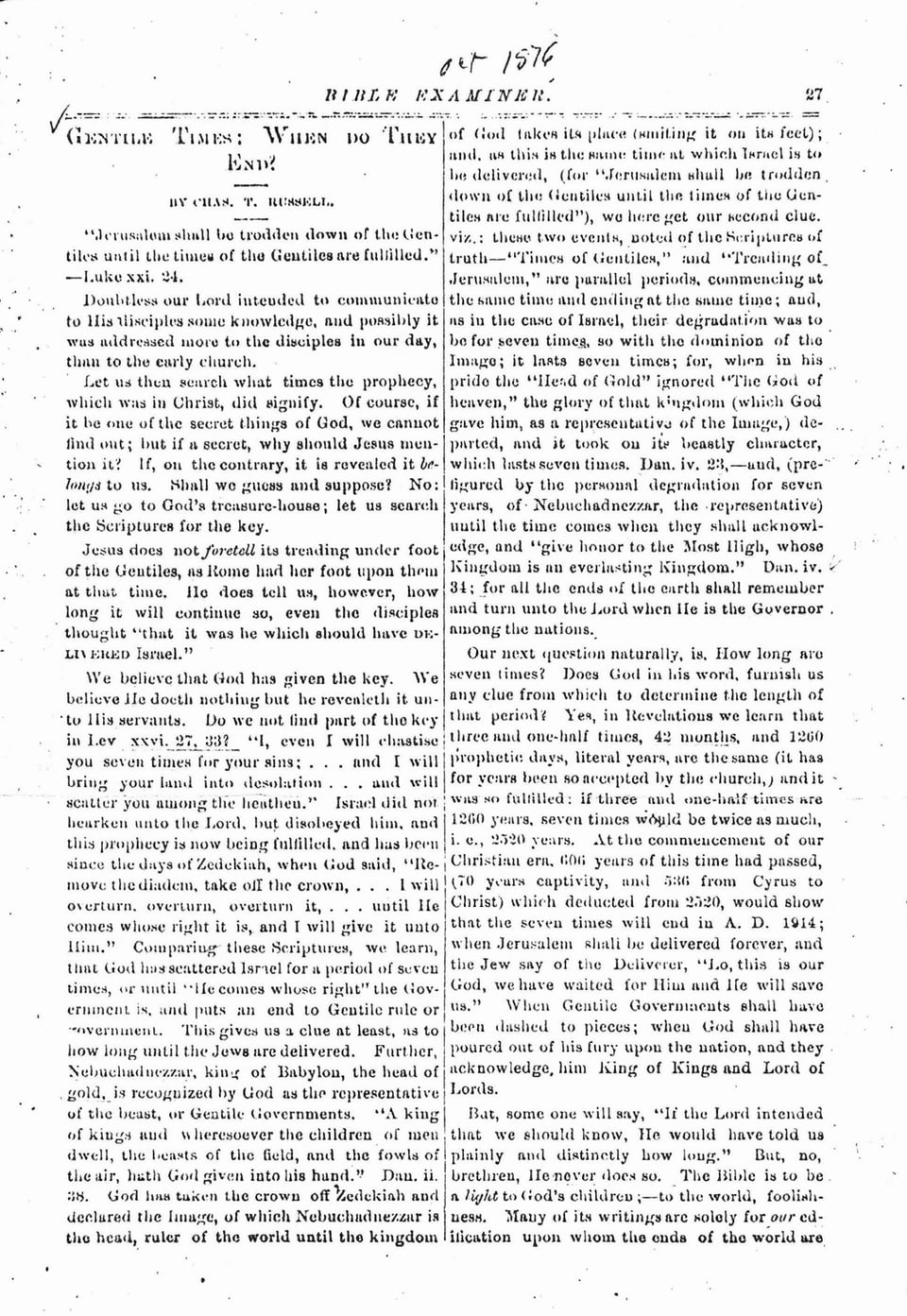
GENTILE TIMES: WHEN DO THEY END?
BY CHAS. T. RUSSELL.
"Jerusalem shall be trodden down of the Gentiles until the times of the Gentiles are fulfilled." —Luke xxi. 24.
Doubtless our Lord intended to communicate to His disciples some knowledge, and possibly it was addressed more to the disciples in our day, than to the early church.
Let us then search what times the prophecy, which was in Christ, did signify. Of course, if it be one of the secret things of God, we cannot find out; but if a secret, why should Jesus mention it? If, on the contrary, it is revealed it belongs to us. Shall we guess and suppose? No: let us go to God's treasure-house; let us search the Scriptures for the key.
Jesus does not foretell its treading under foot of the Gentiles, as Rome had her foot upon them at that time. He does tell us, however, how long it will continue so, even the disciples thought "that it was he which should have DELIVERED Israel."
We believe that God has given the key. We believe He doeth nothing but he revealeth it unto His servants. Do we not find part of the key in Lev xxvi. 27, 33? "I, even I will chastise you seven times for your sins; . . . and I will bring your land into desolation . . . and will scatter you among the heaten." Israel did not hearken unto the Lord, but disobeyed him, and this prophecy is now being fulfilled, and has been since the days of Zedekiah, when God said, "Remove the diadem, take off the crown, . . . I will overturn, overturn, overturn it, . . . until He comes whose right it is, and I will give it unto Him." Comparing these Scriptures, we learn, that God has scattered Israel for a period of seven times, or until "He comes whose right" the Government is, and puts an end to Gentile rule or government. This gives us a clue at least, as to how long until the Jews are delivered. Further, Nebuchadnezzar, king of Babylon, the head of gold, is recognized by God as the representative of the beast, or Gentile Governments. "A king of kings and wheresoever the children of men dwell, the beasts of the field, and the fowls of the air, hath God given into his hand." Dan. ii. 38. God has taken the crown off Zedekiah and declared the Image, of which Nebuchadnezzar is the head, ruler of the world until the kingdom
of God takes its place (smiting it on its feet); and, as this is the same time at which Israel is to be delivered, (for "Jerusalem shall be trodden down of the Gentiles until the times of the Gentiles are fulfilled"), we here get our second clue. viz.: these two events, noted of the Scriptures of truth—"Times of Gentiles," and "Treading of Jerusalem," are parallel periods, commencing at the same time and ending at the same time; and, as in the case of Israel, their degradation was to be for seven times, so with the dominion of the Image; it lasts seven times; for, when in his pride the "Head of Gold" ignored "The God of heaven," the glory of that kingdom (which God gave him, as a representative of the Image,) departed, and it took on its beastly character, which lasts seven times. Dan. iv. 23,—and, (prefigured by the personal degradation for seven years, of Nebuchadnezzar, the representative) until the time comes when they shall acknowledge, and "give honor to the Most High, whose Kingdom is an everlasting Kingdom." Dan. iv. 34; for all the ends of the earth shall remember and turn unto the Lord when He is the Governor among the nations.
Our next question naturally, is. How long are seven times? Does God in his word, furnish us any clue from which to determine the length of that period? Yes, in Revelations we learn that three and one-half times, 42 months, and 1260 prophetic days, literal years, are the same (it has for years been so accepted by the church,) and it was so fulfilled: if three and one-half times are 1260 years, seven times would be twice as much, i.e., 2520 years. At the commencement of our Christian era, 606 years of this time had passed, (70 years captivity, and 536 from Cyrus to Christ) which deducted from 2520, would show that the seven times will end in A. D. 1914; when Jerusalem shall be delivered forever, and the Jew say of the Deliverer, "Lo, this is our God, we have waited for Him and He will save us." When Gentile Governments shall have been dashed to pieces; when God shall have poured out of his fury upon the nation, and they acknowledge, him King of Kings and Lord of Lords.
But, some one will say, "If the Lord intended that we should know, He would have told us plainly and distinctly how long." But, no, brethren, He never does so. The Bible is to be a light to God's children;—to the world, foolishness. Many of its writings are solely for our edification upon whom the ends of the world are come.
As well say that God should have put the gold on top instead of in the bowels of the earth it would be too common; it would lose much of its value. So with truth; but, "to you it is given to know the mysteries of the kingdom.
We will ask, but not now answer, another question: If the Gentile Times end in 1914. (and there are many other and clearer evidences pointing to the same time) and we are told that it shall be with fury poured out; a time of trouble such as never was before, nor ever shall be; a day of wrath, etc., how long before does the church escape? as Jesus says, "watch, that ye may be accounted worthy to escape those things coming upon the world."
Brethren, the taking by Christ of His Bride, is evidently, one of the first acts in the Judgment; for judgment must begin at the house of God.
W. Philadelphia.
RAGGED TOM AND HIS SURETY.
One Sunday afternoon a big boy stood at the door of a Sabbath-school. He was so bad that he had been turned out of school the Sabbath before. His father and mother had brought him, and begged that he might be received again. The Superintendent said,
We should be glad to do him good, but we are afraid he will ruin all the other children. It is very bad for a school when a big boy sets a wicked example."
"We know he is a bad boy at school, sir," said the parents, "but he is ten times worse at home; he will be lost if you do not take him back."
"We would take him back if we could secure his good behavior. I will see," said the Superintendent.
So he stepped back into the school, and rang the bell for silence: All listened while he said, "That boy wants to come into the school again, but we cannot take him back without making sure of his good behavior. Will any one be surety for him?"
A pause followed; the elder boys shook their heads. They said they knew him so well. The others did not care for him.
But one little boy pitied the big bad boy, and was very sorry that no one would be surety. The little boy went by the name of "Ragged Tom." it was not his fault that he was ragged, for his his mother was very poor. The Superintendent soon heard his little voice saying, "If you please, sir, I will, sir."
"You, Tom! a little boy like you! Do you know what it means to be surety, Tom?"
"Yes, sir, if you please; it means that when he is a bad boy again I'm to be punished for him."
"And are you willing to be punished for that big boy?"
"Yes, sir, if he's bad again."
"Then come in," said the Superintendent, looking to the door; and the big boy, with downcast face, walked across the room. He was thinking as he walked, "I know I'm a bad boy, but I'm not so bad as that. I'll never let that little fellow be punished for me--never!" I think God had put that thought into the big boy's mind. He was graciously helping Tom's work as the surety.
As the children were leaving the school, the Superintendent saw this big boy and little Tom walking and talking together. He said to himself, "I am afraid that boy will do Tom harm I must go and look after them."
When he reached the cottage where Tom lived, he said to the mother, "Where is your son Tom?"
"O, he is just gone up stairs with a great boy that he brought with him. I don't know what they are doing."
"May I go up?"
"O yes, sir."
The Superintendent went slowly and gently up the stairs, and as he reached the top he could see through the door that Tom and the big boy were kneeling together. He soon heard Tom's voice saying, "O Lord, make this boy that has been the worst boy in the school, O Lord, make him the best boy."
The Superintendent kneeled by Tom's side, and they all prayed together.
God heard them. The big bad boy became one of the best boys in the school. God raised up friends for "Ragged Tom," who put him to school, and after that sent him to a missionary college. He is now a missionary, and is preaching to the Africans about Jesus, who became the surety for sinners. —Church Union.
THE LIGHTS IN THE TUNNEL. I was travelling upon a road which I had never passed over before. There was a long train of cars crowded with passengers. In the afternoon, while there yet remained an hour of daylight, I noticed the lamps were being lighted. We journeyed on, and I watched their faint glimmering flames; scarcely could they be distinguished in the bright light of day. I wondered why they were lighted so early. Suddenly we passed into darkness. Then the lights shone with a strong, steady ray.