Letter to All Bodies of Elders, 1977-07-08: Literacy classes
Download: PDF — Letter to All Bodies of Elders, 1977-07-08: Literacy classes
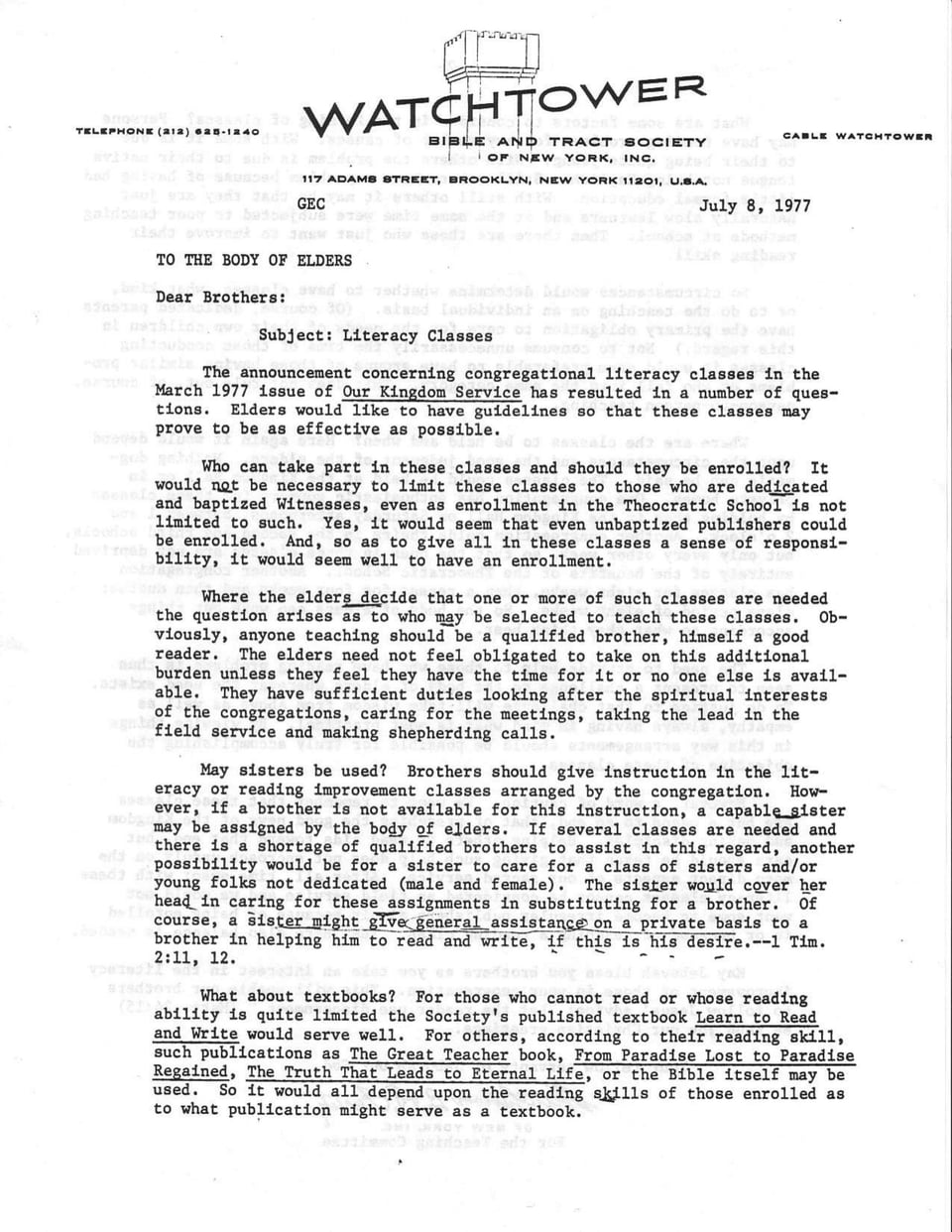
July 8,1977
TO THE BODY OF ELDERS
Dear Brothers:
Subject: Literacy Classes
The announcement concerning congregational literacy classes in the March 1977 issue of Our Kingdom Service has resulted in a number of questions. Elders would like to have guidelines so that these classes may prove to be as effective as possible.
Who can take part in these classes and should they be enrolled? It would not be necessary to limit these classes to those who are dedicated and baptized Witnesses, even as enrollment in the Theocratic School is not limited to such. Yes, it would seem that even unbaptized publishers could be enrolled. And, so as to give all in these classes a sense of responsibility, it would seem well to have an enrollment.
Where the elders decide that one or more of such classes are needed the question arises as to who may be selected to teach these classes. Obviously, anyone teaching should be a qualified brother, himself a good reader. The elders need not feel obligated to take on this additional burden unless they feel they have the time for it or no one else is available. They have sufficient duties looking after the spiritual interests of the congregations, caring for the meetings, taking the lead in the field service and making shepherding calls.
May sisters be used? Brothers should give instruction in the literacy or reading improvement classes arranged by the congregation. However, if a brother is not available for this instruction, a capable sister may be assigned by the body of elders. If several classes are needed and there is a shortage of qualified brothers to assist in this regard, another possibility would be for a sister to care for a class of sisters and/or young folks not dedicated (male and female). The sister would cover her head in caring for these assignments in substituting for a brother. Of course, a sister might give general assistance on a private basis to a brother in helping him to read and write, if this is his desire.--1 Tim. 2:11, 12.
What about textbooks? For those who cannot read or whose reading ability is quite limited the Society's published textbook Learn to Read and Write would serve well. For others, according to their reading skill, such publications as The Great Teacher book, From Paradise Lost to Paradise Regained, The Truth That Leads to Eternal Life, or the Bible itself may be used. So it would all depend upon the reading skills of those enrolled as to what publication might serve as a textbook.
What are some factors to consider in the forming of classes? Persons may have reading problems for any number of causes. With some it is due to their being quite young. With others the problem is due to their native tongue not being English. Still others have a problem because of having had little formal education. With still others it may be that they are just naturally slow learners and at the same time were subjected to poor teaching methods at school. Then there are those who just want to improve their reading skill.
So circumstances would determine whether to have classes, what kind, or to do the teaching on an individual basis. (Of course, dedicated parents have the primary obligation to care for the needs of their own children in this regard.) Not to consume unnecessarily the time of those conducting classes it would seem preferable to have groups of those having similar problems or who fall into the same category. This does not rule out, of course, person-to-person teaching.
Where are the classes to be held and when? Here again it would depend upon the circumstances and the good judgment of the elders. Nothing dogmatic can be said. The classes could be held at the Kingdom Hall or in private homes. One congregation has enthusiastic support for these classes by holding them in the Kingdom Hall on Saturday afternoons, between 1 and 2 o'clock. Another congregation holds theirs in the second and third schools, but only every other week, so that the ones in these classes are not deprived entirely of the benefits of the Theocratic School. Another congregation has classes for eight weeks, then a recess for four weeks and then another class period of eight weeks. So the body of elders can work out things according to what they think best.
The need to provide help to those who have reading problems is thus seen to present a challenge to the body of elders wherever the need exists. To do justice to that challenge will take wisdom from above as well as empathy, always having in mind what is most practical. By viewing things in this way arrangements should be possible for truly accomplishing the objective of these classes.
However, a word of caution. We want to remember that these classes are but a means to an end, that of preaching the good news of the Kingdom and making disciples. Helping others to read aids toward that end, but care should be taken that giving such help does not encroach unduly on the more direct aspects of our sacred service. After all, time spent with these literacy classes cannot be considered as field service and we would not want some to become irregular publishers simply because of being enrolled in or because of teaching a reading class. Yes, here also balance is needed.
May Jehovah bless you brothers as you take an interest in the literacy improvement of those in your congregation. This will enable our brothers to follow Jesus' advice: "Let the reader use discernment." (Matt. 24:15) We send you our Christian greetings.
Your fellow servants of Jehovah our God,
Watchtower B.V. Society
OF NEW YORK, INC. For the Teaching Committee