The greatest man who ever lived (1991)
Download: PDF — The greatest man who ever lived (1991)
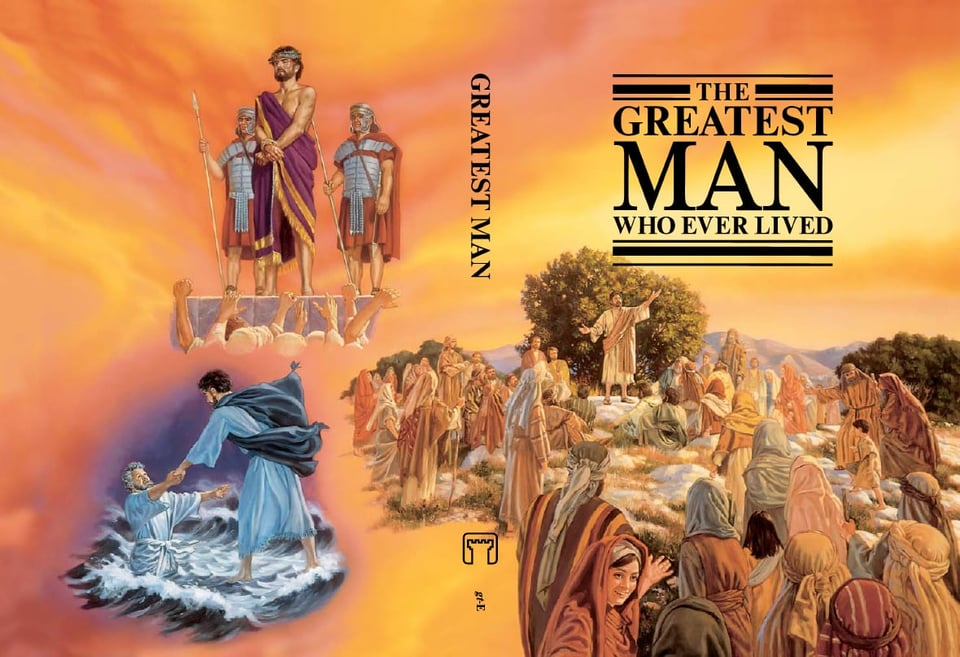
GREATEST MAN
THE GREATEST MAN WHO EVER LIVED
© 1991
WATCH TOWER BIBLE AND TRACT SOCIETY
OF PENNSYLVANIA
All Rights Reserved
Publishers
WATCHTOWER BIBLE AND TRACT SOCIETY
OF NEW YORK, INC.
Brooklyn, New York, U.S.A.
2006 Printing
This publication is provided as part of a worldwide Bible educational work supported by voluntary donations.
Scripture quotations are from the modern-language New World Translation of the Holy Scriptures, 1984 Edition
The Greatest Man Who Ever Lived English (gt-E)
Made in the United States of America Contents
1 Messages From Heaven
2 Honored Before He Was Born
3 The Preparer of the Way Is Born
4 Pregnant but Not Married
5 Jesus' Birth—Where and When?
6 The Child of Promise
7 Jesus and the Astrologers
8 Escape From a Tyrant
9 Jesus' Early Family Life
10 Trips to Jerusalem
11 John Prepares the Way
12 Jesus' Baptism
13 Learning From Jesus' Temptations
14 Jesus' First Disciples
15 Jesus' First Miracle
16 Zeal for Jehovah's Worship
17 Teaching Nicodemus
18 John Decreases, Jesus Increases
19 Teaching a Samaritan Woman
20 Second Miracle While in Cana
21 In Jesus' Hometown Synagogue
22 Four Disciples Are Called
23 More Miracles in Capernaum
24 Why Jesus Came to Earth
25 Compassion for a Leper 26 Back Home in Capernaum
27 The Calling of Matthew
28 Questioned About Fasting
29 Doing Good Works on the Sabbath
30 Answering His Accusers
31 Plucking Grain on the Sabbath
32 What Is Lawful on the Sabbath?
33 Fulfilling Isaiah's Prophecy
34 Choosing His Apostles
35 The Most Famous Sermon Ever Given
36 An Army Officer's Great Faith
37 Jesus Dispels a Widow's Grief
38 Did John Lack Faith?
39 The Proud and the Lowly
40 A Lesson in Mercy
41 A Center of Controversy
42 Jesus Rebukes the Pharisees
43 Teaching With Illustrations
44 Silencing a Terrifying Storm
45 An Unlikely Disciple
46 She Touched His Garment
47 Tears Turned to Great Ecstasy
48 Leaving Jairus' Home and Revisiting Nazareth
49 Another Preaching Tour of Galilee
50 Preparation to Face Persecution
51 Murder During a Birthday Party
52 Jesus Miraculously Feeds Thousands 53 A Desired Superhuman Ruler
54 "True Bread From Heaven"
55 Many Disciples Quit Following Jesus
56 What Defiles a Man?
57 Compassion for the Afflicted
58 The Loaves and the Leaven
59 Who Really Is Jesus?
60 A Preview of Christ's Kingdom Glory
61 Possessed Boy Healed
62 A Lesson in Humility
63 Further Corrective Counsel
64 A Lesson in Forgiveness
65 A Secret Trip to Jerusalem
66 At the Festival of Tabernacles
67 They Fail to Arrest Him
68 Further Teaching on the Seventh Day
69 The Question of Fatherhood
70 Healing a Man Born Blind
71 Pharisees' Willful Unbelief
72 Jesus Sends Out the 70
73 A Neighborly Samaritan
74 Counsel to Martha, and Instruction on Prayer
75 The Source of Happiness
76 Dining With a Pharisee
77 The Question of Inheritance
78 Keep Ready!
79 A Nation Lost, but Not All 80 The Sheepfolds and the Shepherd
81 Further Attempts to Kill Jesus
82 Jesus Again Heads for Jerusalem
83 Entertained by a Pharisee
84 The Responsibility of Discipleship
85 Searching for the Lost
86 The Story of a Lost Son
87 Provide for the Future With Practical Wisdom
88 The Rich Man and Lazarus
89 A Mission of Mercy Into Judea
90 The Resurrection Hope
91 When Lazarus Is Resurrected
92 Ten Lepers Healed During Jesus' Final Trip to Jerusalem
93 When the Son of Man Is Revealed
94 The Need for Prayer and for Humility
95 Lessons on Divorce and on Love for Children
96 Jesus and a Rich Young Ruler
97 Workers in the Vineyard
98 The Disciples Argue as Jesus' Death Nears
99 Jesus Teaches at Jericho
100 The Illustration of the Minas
101 At Bethany, in the House of Simon
102 Christ's Triumphal Entry Into Jerusalem
103 Visiting the Temple Again
104 God's Voice Heard a Third Time
105 Beginning of a Crucial Day
106 Exposed by Vineyard Illustrations 107 Illustration of the Marriage Feast
108 They Fail to Entrap Jesus
109 Jesus Denounces His Opposers
110 Ministry at the Temple Completed
111 Sign of the Last Days
112 Jesus' Final Passover Is At Hand
113 Humility at the Last Passover
114 The Memorial Supper
115 An Argument Erupts
116 Preparing the Apostles for His Departure
117 Agony in the Garden
118 Betrayal and Arrest
119 Taken to Annas, Then to Caiaphas
120 Denials in the Courtyard
121 Before the Sanhedrin, Then to Pilate
122 From Pilate to Herod and Back Again
123 "Look! The Man!"
124 Handed Over and Led Away
125 Agony on the Stake
126 "Certainly This Was God's Son"
127 Buried Friday—An Empty Tomb Sunday
128 Jesus Is Alive!
129 Further Appearances
130 At the Sea of Galilee
131 Final Appearances, and Pentecost 33 C.E.
132 At God's Right Hand
133 Jesus Finishes All God Asks The Greatest Man Who Ever Lived
CAN any man unquestionably be called the greatest man who ever lived? How do you measure a man's greatness? By his military genius? his physical strength? his mental prowess?
The historian H. G. Wells said that a man's greatness can be measured by 'what he leaves to grow, and whether he started others to think along fresh lines with a vigor that persisted after him.' Wells, although not claiming to be a Christian, acknowledged: "By this test Jesus stands first."
Alexander the Great, Charlemagne (styled "the Great" even in his own lifetime), and Napoleon Bonaparte were powerful rulers. By their formidable presence, they wielded great influence over those they commanded. Yet, Napoleon is reported to have said: "Jesus Christ has influenced and commanded His subjects without His visible bodily presence."
By his dynamic teachings and by the way he lived in harmony with them, Jesus has powerfully affected the lives of people for nearly two thousand years. As one writer aptly expressed it: "All the armies that ever marched, and all the navies that ever were built, and all the parliaments that ever sat, all the kings that ever reigned, put together have not affected the life of man upon this earth as powerfully."
A Historical Person
Yet, strangely, some say that Jesus never lived—that he is, in effect, a creation of some first-century men. Answering such skeptics, the respected historian Will Durant argued: "That a few simple men should in one generation have invented so powerful and appealing a personality, so lofty an ethic and so inspiring a vision of human brotherhood, would be a miracle far more incredible than any recorded in the Gospels."
Ask yourself: Could a person who never lived have affected human history so remarkably? The reference work The Historians' History of the World observed: "The historical result of [Jesus'] activities was more momentous, even from a strictly secular standpoint, than the deeds of any other character of history. A new era, recognised by the chief civilisations of the world, dates from his birth."
Yes, think about it. Even calendars today are based on the year that Jesus was thought to have been born. "Dates before that year are listed as B.C., or before Christ," explains The World Book Encyclopedia. "Dates after that year are listed as A.D., or anno Domini (in the year of our Lord)."
Critics, nevertheless, point out that all that we really know about Jesus is found in the Bible. No other contemporary records concerning him exist, they say. Even H. G. Wells wrote: "The old Roman historians ignored Jesus entirely; he left no impress on the historical records of his time." But is this true?
Although references to Jesus Christ by early secular historians are meager, such references do exist. Cornelius Tacitus, a respected first-century Roman historian, wrote: "The name [Christian] is derived from Christ, whom the procurator Pontius Pilate had executed in the reign of Tiberius." Suetonius and Pliny the Younger, other Roman writers of the time, also referred to Christ.
In addition, Flavius Josephus, a first-century Jewish historian, wrote of James, whom he identified as "the brother of Jesus, who was called Christ."
The New Encyclopaedia Britannica thus concludes: "These independent accounts prove that in ancient times even the opponents of Christianity never doubted the historicity of Jesus, which was disputed for the first time and on inadequate grounds at the end of the 18th, during the 19th, and at the beginning of the 20th centuries."
Essentially, however, all that is known about Jesus was recorded by his first-century followers. Their reports have been preserved in the Gospels—Bible books written by Matthew, Mark, Luke, and John. What do these accounts say regarding the identity of Jesus?
Really, Who Was He?
Jesus' first-century associates pondered that question. When they saw Jesus miraculously calm a wind-whipped sea with a rebuke, they wondered in astonishment: "Who really is this?" Later, on another occasion, Jesus asked his apostles: "Who do you say I am?"—Mark 4:41; Matthew 16:15.
If you were asked that question, how would you answer? Was Jesus, in fact, God? Many today say that he was. Yet, his associates never believed that he was God. The apostle Peter's response to Jesus' question was: "You are the Christ, the Son of the living God."—Matthew 16:16.
Jesus never claimed to be God, but he acknowledged that he was the promised Messiah, or Christ. He also said he was "God's Son," not God.
(John 4:25, 26; 10:36) Yet, the Bible does not say Jesus was a man like any other man. He was a very special person because he was created by God before all other things. (Colossians 1:15) For countless billions of years, before even the physical universe was created, Jesus lived as a spirit person in heaven and enjoyed intimate fellowship with his Father, Jehovah God, the Grand Creator.—Proverbs 8:22, 27:31.
Then, about two thousand years ago, God transferred his Son's life to the womb of a woman, and Jesus came to be a human son of God, born in the normal manner through a woman. (Galatians 4:4) When Jesus was developing in the womb and while he was growing up as a boy, he was dependent upon those whom God had selected to be his earthly parents. Eventually Jesus reached manhood, and he was granted full remembrance of his previous association with God in heaven.—John 8:23; 17:5.
What Made Him the Greatest
Because he carefully imitated his heavenly Father, Jesus was the greatest man who ever lived. As a faithful Son, Jesus copied his Father so exactly that he could tell his followers: "He that has seen me has seen the Father also." (John 14:9, 10) In every situation here on earth, he did just as his Father, Almighty God, would have done. "I do nothing of my own initiative," Jesus explained, "but just as the Father taught me I speak these things." (John 8:28) So when we study the life of Jesus Christ, we are, in effect, obtaining a clear picture of just what God is like.
Thus, even though the apostle John acknowledged that "no man has seen God," he could still write that "God is love."
(John 1:18; 1 John 4:8) John could do this because he knew God's love through what he saw in Jesus, who was the perfect reflection of his Father. Jesus was compassionate, kind, humble, and approachable. The weak and downtrodden felt comfortable with him, as did people of all kinds—men, women, children, the rich, the poor, the powerful, even gross sinners. Only those with wicked hearts did not like him.
Indeed, Jesus did not merely teach his followers to love one another, but he showed them how. "Just as I have loved you," he said, "you also [should] love one another." (John 13:34) Knowing "the love of the Christ," explained one of his apostles, "surpasses knowledge." (Ephesians 3:19) Yes, the love Christ demonstrated ascends above academic head knowledge and "compels" others to respond to it. (2 Corinthians 5:14) Thus, Jesus' surpassing example of love, in particular, is what made him the greatest man who ever lived. His love has touched the hearts of millions through the centuries and has influenced their lives for the good.
Yet, some may object: 'Look at all the crimes that have been committed in the name of Christ—the Crusades, the Inquisition, and the wars that have seen millions who claim to be Christian kill one another on opposing battle lines.' But the truth is, these people belie their claim to be followers of Jesus. His teachings and way of life condemn their actions. Even a Hindu, Mohandas Gandhi, was moved to say: 'I love Christ, but I despise Christians because they do not live as Christ lived.'
Benefit by Learning About Him
Surely no study could be more important today than that of the life and ministry of Jesus Christ. "Look intently at . . . Jesus," urged the apostle Paul. "Indeed, consider closely [that] one." And God himself commanded regarding his Son: "Listen to him." This is what the book The Greatest Man Who Ever Lived will help you to do.—Hebrews 12:2, 3; Matthew 17:5.
An effort has been made to present every event in Jesus' earthly life that is set forth in the four Gospels, including the speeches he delivered and his illustrations and miracles. To the extent possible, everything is related in the order in which it occurred. At the end of each chapter is a list of the Bible texts upon which the chapter is based. You are encouraged to read these texts and to answer the review questions that are provided.
A scholar from the University of Chicago claimed recently: "More has been written about Jesus in the last twenty years than in the previous two thousand." Yet there is a vital need to consider personally the Gospel accounts, for as The Encyclopaedia Britannica stated: "Many a modern student has become so preoccupied with conflicting theories about Jesus and the Gospels that he has neglected to study these basic sources by themselves."
After a close, unprejudiced consideration of the Gospel accounts, we feel you will agree that the greatest of all events in human history occurred in the reign of the Roman Caesar Augustus, when Jesus of Nazareth appeared in order to give his life in our behalf.
1 Messages From Heaven
THE entire Bible is, in effect, a message from heaven, having been provided by our heavenly Father for our instruction. However, two special messages were delivered nearly 2,000 years ago by an angel who "stands near before God." His name is Gabriel. Let us examine the circumstances of these two important visits to earth.
The year is 3 B.C.E. In the Judean hills, probably not too far from Jerusalem, lives a priest of Jehovah by the name of Zechariah. He has grown old, and so has his wife, Elizabeth. And they have no children. Zechariah is taking his turn at priestly service in God's temple in Jerusalem. Suddenly Gabriel appears at the right side of the incense altar.
Zechariah is very much afraid. But Gabriel quiets his fears, saying, "Have no fear, Zechariah, because your supplication has been favorably heard, and your wife Elizabeth will become mother to a son to you, and you are to call his name John." Gabriel goes on to proclaim that John "will be great before Jehovah" and that he will "get ready for Jehovah a prepared people."
However, Zechariah cannot believe it. It seems so impossible that he and Elizabeth could have a child at their age. So Gabriel tells him: "You will be silent and not able to speak until the day that these things take place, because you did not believe my words."
Well, in the meantime, the people outside are wondering why Zechariah is taking so long in the temple. When he finally comes out, he cannot speak but can only make signs with his hands, and they realize he has seen something supernatural.
After Zechariah finishes his period of temple service, he returns home. And soon afterward it really does happen — Elizabeth becomes pregnant! While she waits for her child to be born, Elizabeth stays at home away from people for five months.
Later Gabriel appears again. And to whom does he speak? It is to a young unmarried woman by the name of Mary from the town of Nazareth. What message does he deliver this time? Listen! "You have found favor with God," Gabriel tells Mary. "Look! you will conceive in your womb and give birth to a son, and you are to call his name Jesus." Gabriel adds: "This one will be great and will be called Son of the Most High; . . . and he will rule as king over the house of Jacob forever, and there will be no end of his kingdom."
We can be sure that Gabriel feels privileged to deliver these messages. And as we read more about John and Jesus, we will see more clearly just why these messages from heaven are so important.
2 Timothy 3:16; Luke 1:5-33.
What two important messages are delivered from heaven?
Who delivers the messages, and to whom are they delivered?
Honored Before He Was Born
AFTER the angel Gabriel tells the young woman Mary that she will give birth to a baby boy who will become an everlasting king, Mary asks: "How is this to be, since I am having n intercourse with a man?"
"Holy spirit will come upon you," Gabriel explains, "and power of the Most High will overshadow you. For that reason also what is born will be called holy, God's Son."
To help Mary believe his message, Gabriel continues: "And, look! Elizabeth your relative has also herself conceived a son, in her old age, and this is the sixth month for her, the so-called barren woman; because with God no declaration will be an impossibility."
Mary accepts Gabriel's word. And what is her response? "Look! Jehovah's
slave girl!" she exclaims. "May it take place with me according to your declaration."
Soon after Gabriel leaves, Mary gets ready and goes to visit Elizabeth, who lives with her husband, Zechariah, in the
mountainous country of Judea. From Mary's home in Nazareth, this is a long trip of perhaps three or four days.
When Mary finally arrives at Zechariah's house, she enters and offers a greeting. At that, Elizabeth is filled with holy spirit, and she says to Mary: "Blessed are you among women, and blessed is the fruit of your womb! So how is it that this privilege is mine, to have the mother of my Lord come to me? For, look! as the sound of your greeting fell upon my ears, the infant in my womb leaped with great gladness."
At hearing this Mary responds with heartfelt gratitude: "My soul magnifies Jehovah, and my spirit cannot keep from being overjoyed at God my Savior; because he has looked upon the low position of his slave girl.
For, look! from now on all generations will pronounce me happy; because the powerful One has done great deeds for me." Yet, despite the favor she is shown, Mary directs all honor to God. "Holy is his name," she says, "and for generations after generations his mercy is upon those who fear him."
Mary continues praising God in inspired prophetic song, proclaiming: "He has performed mightily with his arm, he has scattered abroad those who are haughty in the intention of their hearts. He has brought down men of power from thrones and exalted lowly ones; he has fully satisfied hungry ones with good things and he has sent away empty those who had wealth. He has come to the aid of Israel his servant, to call to mind mercy, just as he told to our forefathers, to Abraham and to his seed, forever."
Mary stays with Elizabeth for about three months, and no doubt she is a big help during these final weeks of Elizabeth's pregnancy. It is indeed fine that these two faithful women, both carrying a child with God's help, can be together at this blessed time of their lives!
Did you notice the honor that was paid Jesus even before he was born? Elizabeth called him "my Lord," and her unborn child leapt with gladness when Mary first appeared. On the other hand, others later treated Mary and her yet-to-be-born child with little respect, as we shall see. Luke 1:26-56.
The Preparer of the Way Is Born
ELIZABETH is almost ready to have her baby. For these past three months, Mary has been staying with her. But now it is time for Mary to say good-bye and to make the long trip back home to Nazareth. In about six months she too will have a baby.
Soon after Mary leaves, Elizabeth gives birth. What joy there is when the birth is successful and Elizabeth and the baby are in good health! When Elizabeth shows the little one to her neighbors and relatives, they all rejoice with her.
The eighth day after his birth, according to God's Law, a baby boy in Israel must be circumcised. For this occasion friends and relatives come to visit. They say that the boy should be named after his father,
Zechariah. But Elizabeth speaks up. "No, indeed!" she says, "but he shall be called John." Remember, that is the name the angel Gabriel said should be given to the child.
Their friends, however, protest: "There is no one among your relatives that is called by this name." Then, using sign language, they ask what his father wants to name the boy. Asking for a writing tablet, Zechariah, to the astonishment of all, writes: "John is its name."
With that, Zechariah's speech is miraculously restored. You will recall that he lost his ability to speak when he did not believe the angel's announcement that Elizabeth would have a child. Well, when Zechariah speaks, all those living in the neighborhood are amazed and say to themselves: "What really will this young child be?"
Zechariah is now filled with holy spirit, and he exults: "Blessed be Jehovah the God of Israel, because he has turned his attention and performed deliverance toward his people. And he has raised up a horn of salvation for us in the house of David his servant." This "horn of salvation," of course, is the Lord Jesus, who is yet to be born. By means of him, Zechariah says, God will "grant us, after we have been rescued from the hands of enemies, the privilege of fearlessly rendering sacred service to him with loyalty and righteousness before him all our days."
Then Zechariah foretells regarding his son, John: "But as for you, young child, you will be called a prophet of the Most High, for you will go in advance before Jehovah to make his ways ready, to give knowledge of salvation to his people by forgiveness of their sins, because of the tender compassion of our God. With this compassion a daybreak will visit us from on high, to give light to those sitting in darkness and death's shadow, to direct our feet prosperously in the way of peace."
By this time Mary, who evidently is still an unmarried woman, has arrived home in Nazareth. What will happen to her when it becomes obvious that she is pregnant? Luke 1: 56-80; Leviticus 12:2, 3.
How much older is John than Jesus?
What things happen when John is eight days old?
How has God turned his attention to his people?
What work is John foretold to do?
Pregnant but Not Married
MARY is in the third month of pregnancy. You will remember that she spent the early part of her pregnancy visiting Elizabeth, but now she has returned home to Nazareth. Soon her condition will become public knowledge in her hometown. She, indeed, is in a distressing situation!
What makes the situation worse is that Mary is engaged to become the wife of the carpenter Joseph. And she knows that, under God's law to Israel, a woman who is engaged to one man but who willingly has sexual relations with another man is to be stoned to death. How can she explain her pregnancy to Joseph?
Since Mary has been gone three months, we can be sure Joseph is eager to see her. When they meet, likely Mary breaks the news to him. She may do her best to explain that it is by means of God's holy spirit that she is pregnant.
But, as you can imagine, this is a very difficult thing for Joseph to believe.
Joseph knows the fine reputation Mary has. And apparently he loves her dearly. Yet, despite what she may claim, it really seems she is pregnant by some man. Even so, Joseph does not want her to be stoned to death or to be disgraced publicly. So he makes up his mind to divorce her secretly. In those days, engaged persons were viewed as married, and a divorce was required to end an engagement.
Later, as Joseph is still considering these matters, he goes to sleep. Jehovah's angel appears to him in a dream and says: "Do not be afraid to take Mary your wife home, for that which has been begotten in her is by holy spirit. She will give birth to a son, and you must call his name Jesus, for he will save his people from their sins."
When Joseph wakes up, how grateful he is! Without delay he does just what the angel directed. He takes Mary to his home. This public action serves, in effect, as a marriage ceremony, giving notice that Joseph and Mary are now officially married. But Joseph does not have sexual relations with Mary as long as she is pregnant with Jesus.
Look! Mary is heavy with child, yet Joseph is putting her on a donkey. Where are they going, and why are they making a trip when Mary is about ready to give birth? Luke 1:39-41, 56; Matthew 1:18-25; Deuteronomy 22:23, 24.
What public action serves as Joseph and Mary's marriage ceremony?
Jesus' Birth
—Where and When?
THE emperor of the Roman Empire, Caesar Augustus, has decreed that everyone must return to the city of his birth to be registered. So Joseph travels to his birthplace, the city of Bethlehem.
A lot of people are in Bethlehem to register, and the only place that Joseph and Mary can find to stay is in a stable. Here, where donkeys and other animals are kept, Jesus is born. Mary wraps him in strips of cloth and lays him in a manger, the place that holds the food for the animals.
Surely it was at God's direction that Caesar Augustus made his registration law. This made it possible for Jesus to be born in Bethlehem, the city the Scriptures had long before foretold be the birthplace of the promised ruler.
What an important night this is! Out in the fields a bright light gleams around a group of shepherds. It is Jehovah's glory! And Jehovah's angel tells them: "Have no fear, for, look! I am declaring to you good news of a great joy that all the people will have, because there was born to you today a Savior, who is Christ the Lord, in David's city. And this is a sign for you: you will find an infant bound in cloth bands and lying in a manger." Suddenly many more angels appear and sing: "Glory in the heights above to God, and upon earth peace among men of goodwill."
When the angels leave, the shepherds say to one another: "Let us by all means go clear to Bethlehem and see this thing that has taken place, which Jehovah has made known to us."
They go in a hurry and find Jesus just where the angel said they would. When the shepherds relate what the angel told them, all who hear about it marvel. Mary safeguards all these sayings and cherishes them in her heart.
Many people today believe that Jesus was born on December 25. But December is a rainy, cold season in Bethlehem. Shepherds would not be out in the fields overnight with their flocks at that time of the year. Also, the Roman Caesar would not likely have required a people who were already inclined to revolt against him to make that trip in the dead of winter to register. Evidently Jesus was born sometime in the early autumn of the year.
Luke 2:1-20; Micah 5:2.
Why do Joseph and Mary travel to Bethlehem?
What marvelous thing happens the night Jesus is born?
How do we know that Jesus was not born on December 25?
The Child of Promise
INSTEAD of returning to Nazareth, Joseph and Mary remain in Bethlehem. And when Jesus is eight days old, they have him circumcised, as God's Law to Moses commands. It is apparently the custom also to give a baby boy his name on the eighth day. So they name their child Jesus, as the angel Gabriel had directed earlier.
More than a month passes, and Jesus is 40 days old. Where do his parents now take him? To the temple in Jerusalem, which is only a few miles from where they are staying. According to God's Law to Moses, 40 days after giving birth to a son, a mother is required to present a purification offering at the temple.
That is what Mary does. As her offering, she brings two small birds. This reveals something about the economic situation of Joseph and Mary. The Law of Moses indicates that a young ram, which is much more valuable than birds, should be offered. But if the mother could not afford this, two turtledoves or two pigeons would suffice.
In the temple an old man takes Jesus into his arms. His name is Simeon. God has revealed to him that he will not die before he has seen Jehovah's promised Christ, or Messiah. When Simeon comes to the temple on this day, he is directed by holy spirit to the child carried by Joseph and Mary.
As Simeon holds Jesus he thanks God, saying: "Now, Sovereign Lord, you are letting your slave go free in peace according to your declaration; because my eyes have seen your means of saving that you have made ready in the sight of all the peoples, a light for removing the veil from the nations and a glory of your people Israel."
Joseph and Mary are amazed when they hear this. Then Simeon blesses them and says to Mary that her son "is laid for the fall and the rising again of many in Israel" and that sorrow, like a sharp sword, will pierce her soul.
Present on this occasion is the 84-year-old prophetess named Anna. In fact, she is never missing from the temple. In that very hour she comes near and begins giving thanks to God and speaking about Jesus to all those who will listen.
How Joseph and Mary rejoice over these events at the temple! Surely, all of this confirms to them that the child is the Promised One of God. Luke 2:21-38; Leviticus 12:1-8.
When was it apparently the custom to give a baby Israelite boy his name?
What was required of an Israelite mother when her son was 40 days old, and how does the fulfilling of this requirement reveal Mary's economic situation?
Who recognize the identity of Jesus on this occasion, and how do they show this?
7 Jesus and the Astrologers
ANUMBER of men come from the East. They are astrologers—people who claim to interpret the position of stars. While they were at home in the East, they saw a new star, and they have followed it hundreds of miles to Jerusalem.
When the astrologers get to Jerusalem, they ask: "Where is the one born king of the Jews? For we saw his star when we were in the east, and we have come to do him obeisance."
When King Herod at Jerusalem hears about this, he is very upset. So he calls the chief priests and asks where the Christ is to be born. Basing their reply on the Scriptures, they answer: "In Bethlehem." At that, Herod has the astrologers brought to him and tells them: "Go make a careful search for the young child, and when you have found it report back to me, that I may go and do it obesance." But, actually, Herod wants to find the child to kill him!
After they leave, an amazing thing happens. The star they had seen when they were in the East travels ahead of them. Clearly, this is no ordinary star, but it has been specially provided to direct them. The astrologers keep following it
until it stops right above the house where Joseph and Mary are staying.
When the astrologers enter the house, they find Mary with her young child, Jesus. At that they all bow down to him. And they take out of their bags gifts of gold, frankincense, and myrrh. Afterward, when they are about to return and tell Herod where the child is, they are warned by God in a dream not to do that. So they leave for their own country by another way.
Who do you think provided the star that moved in the sky to guide the astrologers? Remember, the star did not guide them directly to Jesus in Bethlehem. Rather, they were led to Jerusalem where they came in touch with King Herod, who wanted to kill Jesus. And he would have done so if God had not stepped in and warned the astrologers not to tell Herod where Jesus was. It was God's enemy, Satan the Devil, who wanted Jesus killed, and he used that star to try to accomplish his purpose.
Matthew 2:1-12; Micah 5:2.
What shows that the star the astrologers saw was no ordinary star?
Where is Jesus when the astrologers find him?
Why do we know that Satan provided the star to guide the astrologers?
Herod is about to search for the young child to destroy it."
Quickly, the three of them make their escape. And it is just in time because Herod has learned that the astrologers have tricked him and have left the country. Remember, they were supposed to report back to him when they found Jesus. Herod is furious. So in an attempt to kill Jesus, he gives orders to put to death all the boys in Bethlehem and its districts who are two years of age and younger. He bases this age calculation on the information that he obtained earlier from the astrologers who had come from the East.
The slaughter of all the baby boys is something horrible to see! Herod's soldiers break into one home after another. And when they find a baby boy, they grab him from his mother's arms. We have no idea how many babies they kill, but the
great weeping and wailing of the mothers fulfills a prophecy in the Bible by God's prophet Jeremiah.
In the meantime, Joseph and his family have safely made it to Egypt, and they are now living there. But one night Jehovah's angel again appears to Joseph in a dream. "Get up, take the young child and its mother," the angel says, "and be on your way into the land of Israel, for those who were seeking the soul
of the young child are dead." So in fulfillment of another Bible prophecy that says God's Son would be called out of Egypt, the family return to their homeland.
Apparently Joseph intends to settle in Judea, where they were living in the town of Bethlehem before they fled to Egypt. But he learns that Herod's wicked son Archelaus is now the king of Judea, and in another dream he is warned by Jehovah of the danger. So Joseph and his family travel north and settle in the town of Nazareth in Galilee. Here in this community, away from the center of Jewish religious life, Jesus grows up. Matthew 2:13-23; Jeremiah 31:15; Hosea 11:1.
Jesus' Early Family Life
WHEN Jesus is growing up in Nazareth, it is a rather small, unimportant city. It is located in the hill country of an area called Galilee, not far from the beautiful Jezreel Valley.
When Jesus, perhaps about two years old, is brought here from Egypt by Joseph and Mary, he is evidently Mary's only child. But not for long. In time, James, Joseph, Simon, and Judas are born, and Mary and Joseph become parents to girls also. Eventually Jesus has, at the very least, six younger brothers and sisters.
Jesus has other relatives too. We already know about his older cousin John, who lives many miles away in Judea. But living closer by in Galilee is Salome, who apparently is Mary's sister. Salome is married to Zebedee, so their two boys, James and John, would be Jesus' cousins. We do not know whether, while growing up, Jesus spends much time with these boys, but later they become close companions.
Joseph has to work very hard to support his growing family.
He is a carpenter. Joseph raises Jesus as his own son, so Jesus is called "the carpenter's son." Joseph teaches Jesus to be a carpenter too, and he learns well. That is why people later say of Jesus, "This is the carpenter."
The life of Joseph's family is built around the worship of Jehovah God. In keeping with God's Law, Joseph and Mary give their children spiritual instruction 'when they sit in their house, when they walk on the road, when they lie down, and when they get up.' There is a synagogue in Nazareth, and we can be sure that Joseph also regularly takes his family along to worship there. But no doubt they find their greatest enjoyment in regular trips to Jehovah's temple in Jerusalem. Matthew 13:55, 56; 27:56; Mark 15:40; 6:3; Deuteronomy 6:6-9.
Trips to Jerusalem
SPRING has arrived. And it is time for Joseph's family, along with friends and relatives, to make their yearly springtime trip to Jerusalem to celebrate the Passover. As they leave on what is about a 65-mile journey, there is the usual excitement. Jesus is now 12 years old, and he looks forward with special interest to the festival.
To Jesus and his family, the Passover is not just a one-day affair. They also stay for the following seven-day Festival of Unfermented Cakes, which they consider part of the Passover season. As a result, the entire trip from their home in Nazareth, including the stay in Jerusalem, takes about two weeks. But this year, because of something that involves Jesus, it takes longer.
The problem comes to light on the return trip from Jerusalem. Joseph and Mary assume that Jesus is in the group of relatives and friends traveling together. Yet he does not show up when they stop for the night, and they go hunting for him among their traveling companions. He is nowhere to be found. So Joseph and Mary go all the way back to Jerusalem to look for him.
For a whole day they hunt, but without success. The second day they cannot find him either. Finally, on the third day, they go to the temple. There, in one of its halls, they see Jesus sitting in the midst of the Jewish teachers, listening to them and asking questions.
"Child, why did you treat us this way?" Mary asks. "Here your father and in mental distress have been looking for you."
Jesus is surprised that they did not know where to find him.
"Why did you have to go looking for me?" he asks. "Did you not know that I must be in the house of my Father?"
Jesus cannot understand why his parents would not know this. At that, Jesus returns home with his parents and continu-
ues subject to them. He goes on progressing in wisdom and in physical growth and in favor with God and men. Yes, from his childhood on, Jesus sets a fine example not only in seeking spiritual interests but also in showing respect to his parents. Luke 2:40-52; 22:7.
What springtime trip does Jesus regularly make with his family, and how long is it?
What happens during the trip they make when Jesus is 12 years old?
What example does Jesus set for youths today?
11 John Prepares the Way
SEVENTEEN years have passed since Jesus was a child of 12 questioning the teachers in the temple. It is the spring of the year 29 C.E., and everybody, it seems, is talking about Jesus' cousin John, who is preaching in all the country around the Jordan River.
John is indeed an impressive man, both in appearance and in speech. His clothing is of camel hair, and he wears a leather girdle around his loins. His food is insect locusts and wild honey. And his message? "Repent, for the kingdom of the heavens has drawn near."
This message excites his listeners. Many realize their need to repent, that is, to change their attitude and to reject their past course of life as undesirable. So from all the territory around the Jordan, and even from Jerusalem, the people come out to John in great numbers, and he baptizes them, dipping them beneath the waters of the Jordan. Why?
John baptizes people in symbol, or acknowledgment, of their heartfelt repentance for sins against God's Law covenant. Thus, when some Pharisees and Sadducees come out to the Jordan, John condemns them. "You offspring of vipers," he says. "Produce fruit that befits repentance; and do not presume to say to yourselves, 'As a father we have Abraham.' For I say to you that God is able to raise up children to Abraham from these stones. Already the ax is lying at the root of the trees; every tree, then, that does not produce fruit is to be cut down and thrown into the fire."
Because of all the attention John is receiving, the Jews send out priests and Levites to him. These ask: "Who are you?"
"I am not the Christ," John confesses.
"What, then?" they inquire. "Are you Elijah?"
"Are you The Prophet?" "No!"
So they become insistent: "Who are you? that we may give an answer to those who sent us. What do you say about yourself?"
John explains: "I am a voice of someone crying out in the wilderness, 'Make the way of Jehovah straight,' just as Isaiah the prophet said."
"Why, then, do you baptize," they want to know, "if you yourself are not the Christ or Elijah or The Prophet?"
"I baptize in water," he answers. "In the midst of you one is standing whom you do not know, the one coming behind me."
John is preparing the way by getting people in a proper heart condition to accept the Messiah, who will become King. Of this One, John says: "The one coming after me is stronger than I am, whose sandals I am not fit to take off." In fact, John even says: "The one coming behind me has advanced in front of me, because he existed before me."
Thus, John's message, "the kingdom of the heavens has drawn near," serves as a public notification that the ministry of Jehovah's appointed King, Jesus Christ, is about to begin.
John 1:6-8, 15-28; Matthew 3:1-12; Luke 3:1-18; Acts 19:4.
What kind of man is John?
Why does John baptize people?
Why can John say that the Kingdom has drawn near?
Jesus' Baptism
ABOUT six months after John begins preaching, Jesus, who is now 30 years old, comes to him at the Jordan. For what reason? To pay a social visit? Is Jesus simply interested in how John's work is progressing? No, Jesus asks John to baptize him.
Right away John objects: "I am the one needing to be baptized by you, and are you coming to me?" John knows that his cousin Jesus is God's special Son. Why, John had jumped with gladness in his mother's belly when Mary, pregnant with Jesus, visited them! John's mother, Elizabeth, no doubt later told him about this. And she would also have told him about the angel's announcement of Jesus' birth and about the appearance of angels to shepherds the night Jesus was born.
So Jesus is no stranger to John. And John knows that his baptism is not for Jesus. It is for those repenting of their sins, but Jesus is without sin. Yet, despite John's objection, Jesus insists: "Let it be, this time, for in that way it is suitable for us to carry out all that is righteous."
Why is it right for Jesus to be baptized?
Because Jesus' baptism is a symbol, not of repentance for sins, but of his presenting himself to do the will of his Father. Jesus has been a carpenter, but now the time has come for him to begin the ministry that Jehovah God sent him to earth to perform. Do you think John expects anything unusual to happen when he baptizes Jesus?
Well, John later reports: "The very One who sent me to baptize in water said to me, 'Whoever it is upon whom you see the spirit coming down and remaining, this is the one that baptizes in holy spirit.'" So John is expecting God's spirit to come upon someone he baptizes. Perhaps, therefore, he is not really surprised when, as Jesus comes up from the water, John sees "like a dove God's spirit coming upon him."
But more than that happens as Jesus is baptized. 'The heavens are opened up' to him. What does this mean? Evidently it means that while he is being baptized, the memory of his prehuman life in heaven returns to him. Thus, Jesus now fully recalls his life as a spirit son of Jehovah God, including all the things that God spoke to him in heaven during his prehuman existence.
In addition, at the time of his baptism, a voice from heaven proclaims: "This is my Son, the beloved, whom I have approved." Whose voice is that? Jesus' own voice? Of course not! It is God's. Clearly, Jesus is God's Son, not God himself, as some people claim.
However, Jesus is a human son of God, even as was the first man, Adam. The disciple Luke, after describing Jesus' baptism, writes: "Jesus himself, when he commenced his work, was about thirty years old, being the son, as the opinion was, of Joseph, son of Heli. . . . son of David. . . . son of Abraham, . . . son of Noah, . . . son of Adam, son of God."
As Adam was a human "son of God," so is Jesus. Jesus is the greatest man who ever lived, which becomes evident when we examine Jesus' life.
However, at his baptism, Jesus enters into a new relationship with God, becoming also God's spiritual Son. God now calls him back to heaven, as it were, by starting him off on a course that will lead to his laying down his human life forever in sacrifice in behalf of condemned humankind. Matthew 3:13-17; Luke 3:21-38; 1:34-36, 44; 2:10-14; John 1:32-34; Hebrews 10:5-9.
Why is Jesus no stranger to John?
Since he has committed no sins, why is Jesus baptized?
Learning From Jesus' Temptations
IMMEDIATELY after his baptism, Jesus is led by God's spirit into the Judean wilderness. He has a lot to think about, for at his baptism "the heavens were opened up," so that he could discern heavenly things. Indeed, there is much for him to meditate on!
Jesus spends 40 days and 40 nights in the wilderness and eats nothing during this time. Then, when Jesus is very hungry, the Devil approaches to tempt him, saying: "If you are a son of God, tell these stones to become loaves of bread." But Jesus knows it is wrong to use his miraculous powers to satisfy his personal desires. So he refuses to be tempted.
But the Devil does not give up. He tries another approach. He challenges Jesus to leap off the temple wall so that God's angels will rescue him. But Jesus is not tempted to make such a spectacular display. Quoting from the Scriptures, Jesus shows that it is wrong to put God to the test in this way.
In a third temptation, the Devil shows Jesus all the kingdoms of the world in some miraculous way and says: "All these things I will give you if you fall down and do an act of worship to me." But again Jesus refuses to yield to temptation to do wrong, choosing to remain faithful to God.
We can learn from these temptations of Jesus. They show, for example, that the Devil is not a mere quality of evil, as some people claim, but that he is a real, invisible person. The temptation of Jesus also shows that all the world governments are the Devil's property. For how could the Devil's offering them to Christ have been a real temptation if they were not really his?
And think of this: The Devil said he was willing to reward Jesus for one act of worship, even giving him all the kingdoms of the world. The Devil may well try to tempt us in a similar way, perhaps placing before us tantalizing opportunities to obtain worldly wealth, power, or position.
But how wise we would be to follow Jesus' example by remaining faithful to God whatever the temptation may be! Matthew 3:16; 4:1-11; Mark 1: 12, 13; Luke 4:1-13.
What are the things Jesus apparently meditates on during his 40 days in the wilderness?
How does the Devil try to tempt Jesus?
What can we learn from Jesus' temptations?
14 Jesus' First Disciples
AFTER 40 days in the wilderness, Jesus returns to John, who had baptized him. As he approaches, John apparently points to him and exclaims to those present: "See, the Lamb of God that takes away the sin of the world! This is the one about whom I said. Behind me there comes a man who has advanced in front of me, because he existed before me." Although John is older than his cousin Jesus, John knows that Jesus existed before him as a spirit person in heaven.
Yet, a few weeks earlier, when Jesus came to be baptized, John apparently did not know with certainty that Jesus was to be the Messiah. "Even I did not know him," John acknowledges, "but the reason why I came baptizing in water was that he might be made manifest to Israel."
John goes on to explain to his listeners what happened when he baptized Jesus: "I viewed the spirit coming down as
a dove out of heaven, and it remained upon him. Even I did not know him, but the very One who sent me to baptize in water said to me, 'Whoever it is upon whom you see the spirit coming down and remaining, this is the one that baptizes in holy spirit.' And I have seen it, and I have borne witness that this one is the Son of God."
The next day John is standing with two of his disciples. Again, as Jesus approaches, he says: "See, the Lamb of God!" At this, these two disciples of John the Baptist follow Jesus. One of them is Andrew, and the other is evidently the very person who recorded these things, who was also named John. This John, according to indications, is also a cousin of Jesus, apparently being a son of Mary's sister, Salome.
Turning and seeing Andrew and John following him, Jesus asks: "What are you looking for?"
"Rabbi," they ask, "where are you staying?"
"Come, and you will see," Jesus answers.
It is about four o'clock in the afternoon, and Andrew and John stay with Jesus the rest of that day. Afterward Andrew is so excited that he hurries to find his brother, who is called Peter. "We have found the Messiah," he tells him. And he takes Peter to Jesus. Perhaps John at the same time finds his brother James and brings him to Jesus; yet, characteristically, John omits this personal information from his Gospel.
The next day, Jesus finds Philip, who is from Bethsaida, the same city Andrew and Peter were originally from. He invites him: "Be my follower."
Philip then finds Nathanael, who is also called Bartholomew, and says: "We have found the one of whom Moses, in the Law, and the Prophets wrote, Jesus, the son of Joseph, from Nazareth." Nathanael is doubtful. "Can anything good come out of Nazareth?" he asks.
"Come and see," Philip urges. When they are coming toward Jesus, Jesus says about Nathanael: "See, an Israelite for a certainty, in whom there is no deceit."
"How does it come that you know me?" Nathanael asks.
"Before Philip called you, while you were under the fig tree, I saw you," Jesus answers.
Nathanael is amazed. "Rabbi [meaning Teacher], you are the Son of God, you are King of Israel," he says.
"Because I told you I saw you underneath the fig tree do you believe?" Jesus asks. "You will see things greater than these." Then he promises: "Most truly I say to you men, You will see heaven opened up and the angels of God ascending and descending to the Son of man."
Very soon after this, Jesus, along with his newly acquired disciples, leaves the Jordan Valley and travels to Galilee. John 1:29-51.
Who are the first disciples of Jesus?
How is Peter, as well as perhaps James, introduced to Jesus?
What convinces Nathanael that Jesus is the Son of God?
15 Jesus' First Miracle
IT HAS been only a day or two since Andrew, Peter, John, Philip, Nathanael, and perhaps James became Jesus' first disciples. These now are on their way home to the district of Galilee, where all of them originated. Their destination is Cana, the hometown of Nathanael, located in the hills not far from Nazareth, where Jesus himself grew up. They have been invited to a wedding feast in Cana.
Jesus' mother too has come to the wedding. As a friend of the family of the ones getting married, Mary appears to have been involved in ministering to the needs of the many guests. So she is quick to note a shortage, which she reports to Jesus: "They have no wine."
When Mary thus, in effect, suggests that Jesus do something about the lack of wine, Jesus at first is reluctant. "What have I to do with you?" he asks. As God's appointed King, he is not to be directed in his activity by family or friends. So Mary wisely leaves the matter in her son's hands, simply saying to those ministering: "Whatever he tells you, do."
Well, there are six large water jars, each of which hold over ten gallons. Jes instructs those ministering: "Fill the water jars with water." And the attendants fill them to the brim. Then Jesus says: "Draw some out now and take it to the director of the feast."
The director is impressed by the fine quality of the wine, not realizing that it has been miraculously produced. Calling the bridegroom, he says: "Every other man puts out the fine wine first, and when people are intoxicated, the inferior. You have reserved the fine wine until now."
16 Zeal for Jehovah's Worship
JESUS' half brothers—Mary's other sons—are James, Joseph, Simon, and Judas. Before these all travel with Jesus and his disciples to Capernaum, a city near the Sea of Galilee, perhaps they stop at their home in Nazareth so that the family can pack the things they will need.
But why does Jesus go to Capernaum rather than carry on his ministry in Cana, in Nazareth, or in some other place in the hills of Galilee? For one thing, Capernaum is more prominently situated and is evidently a larger city. Also,
most of Jesus' newly acquired disciples live in or near Capernaum, so they will not have to leave their homes to receive training from him.
During his stay in Capernaum, Jesus performs marvelous works, as he himself testifies some months later. But soon Jesus and his companions are on the road again. It is spring, and they are on their way to Jerusalem to attend the Passover of 30 C.E. While there, his disciples see something about Jesus that they have perhaps not seen before.
According to God's Law, Israelites are required to make animal sacrifices. So, for their convenience, merchants in Jerusalem sell animals or birds for this purpose. But they are selling right inside the temple, and they are cheating the people by charging them too much.
Filled with indignation, Jesus makes a whip of ropes and drives the sellers out. He pours out the coins of the money changers and overturns their tables. "Take these things away from here!" he cries out to those selling the doves. "Stop making the house of my Father a house of merchandise!"
When Jesus' disciples see this, they remember the prophecy about God's Son: "The zeal for your house will eat me up." But the Jews ask: "What sign have you to show us, since you are doing these things?" Jesus answers: "Break down this temple, and in three days I will raise it up."
The Jews assume that Jesus is talking about the literal temple, and so they ask: "This temple was built in forty-six years, and will you raise it up in three days?" However, Jesus is talking about the temple of his body. And three years later, his disciples remember this saying of his when he is raised from the dead.
John 2:12-22; Matthew 13:55; Luke 4:23.
Teaching Nicodemus
WHILE he is attending the Passover of 30 C.E., Jesus performs remarkable signs, or miracles. As a result, many people put their faith in him. Nicodemus, a member of the Sanhedrin, the Jewish high court, is impressed and wants to learn more. So he visits Jesus during the darkness of night, probably fearing that his reputation with other Jewish leaders will be damaged if he is seen.
"Rabbi," he says, "we know that you as a teacher have come from God; for no one can perform these signs that you perform unless God is with him." In reply, Jesus tells Nicodemus that in order to enter the Kingdom of God, a person must be "born again."
Yet, how can a person be born again? "He cannot
enter into the womb of his mother a second time and be born can he?" Nicodemus asks.
No, that is not what being born again means. "Unless anyone is born from water and spirit," Jesus explains, "he cannot enter into the kingdom of God." When
Jesus was baptized and holy spirit descended upon him, he was thus born "from water and spirit." By the accompanying declaration from heaven, 'This is my Son whom I have approved,' God announced that he had brought forth a spiritual son having the prospect of entering into the heavenly Kingdom. Later, at Pentecost 3 C.E., other baptized ones will receive holy spirit and will thus also be born again as spiritual sons of God.
But the role of God's special human Son is vital.
"Just as Moses lifted up the serpent in the wilderness," Jesus tells Nicodemus, "so the Son of man must be lifted up, that everyone believing in him may have everlasting life." Yes, as those Israelites bitten by poisonous snakes had to look at the copper serpent to be saved, so all humans need to exercise faith in God's Son to be saved from their dying condition.
Stressing Jehovah's loving role in this, Jesus next tells Nicodemus: "God loved the world so much that he gave his only-begotten Son, in order that everyone exercising faith in him might not be destroyed but have everlasting life." Thus, here in Jerusalem just six months after beginning his ministry, Jesus makes clear that he is Jehovah God's means for saving humankind.
Jesus goes on to explain further to Nicodemus: "For God sent forth his Son into the world, not for him to judge the world," that is, not to judge it adversely, or condemn it, sentencing the human race to destruction. Rather, as Jesus says, he was sent "for the world to be saved through him."
Nicodemus has fearfully come to Jesus under cover of darkness. So it is interesting that Jesus closes his conversation with him by saying: "Now this is the basis for judgment, that the light [which Jesus personified in his life and teachings] has come into the world but men have loved the darkness rather than the light, for their works were wicked. For he that practices vile things hates the light and does not come to the light, in order that his works may not be reproved. But he that does what is true comes to the light, in order that his works may be made manifest as having been worked in harmony with God." John 2:23-3:21; Matthew 3:16, 17; Acts 2:1-4; Numbers 21:9.
What prompts Nicodemus' visit, and why does he come at night?
What does it mean to be "born again"?
How does Jesus illustrate his role in our salvation?
What does it mean that Jesus did not come to judge the world?
FOLLOWING the Passover in the spring of 30 C.E., Jesus and his disciples leave Jerusalem. However, they do not return to their homes in Galilee but go into the country of Judea, where they do baptizing. John the Baptizer has been doing the same work for about a year now, and he still has disciples associating with him.
Actually, Jesus does not do any baptizing himself, but his disciples do it under his direction. Their baptism has the same significance as that performed by John, it being a symbol of a Jew's repentance of sins against God's Law covenant. However, after his resurrection, Jesus instructs his disciples to do baptizing that has a different significance. Christian baptism today is a symbol of a person's dedication to serve Jehovah God.
At this early point in Jesus' ministry, however, both John and he, although working separately, are teaching and baptizing repentant ones. But John's disciples become jealous and complain to him regarding Jesus: "Rabbi, . . . see, this one is baptizing and all are going to him."
Rather than being jealous, John rejoices in Jesus' success and also wants his disciples to rejoice. He reminds them: "You yourselves bear me witness that I said, I am not the Christ, but, I have been sent forth in advance of that one." Then he uses a beautiful illustration: "He that has the bride is the bridegroom. However, the friend of the bridegroom, when he stands and hears him, has a great deal of joy on account of the voice of the bridegroom. Therefore this joy of mine has been made full."
John, as the friend of the Bridegroom, rejoiced some six months earlier when he introduced his disciples to Jesus. Certain ones of them became prospective members
of Christ's heavenly bride class to be made up of Christians anointed with the spirit. John wants his present disciples also to follow Jesus, since his purpose is to prepare the way for Christ's successful ministry. As John the Baptist explains: "That one must go on increasing, but I must go on decreasing."
Jesus' new disciple John, who earlier had also been a disciple of John the Baptizer, writes re-
garding Jesus' origin and His important role in human salvation, saying: "He that comes from heaven is over all others.
. . The Father loves the Son and has given all things into his hand. He that exercises faith in the Son has everlasting life; he that disobeys the Son will not see life, but the wrath of God remains upon him."
Not long after John the Baptizer discusses the decrease of his own activity, he is arrested by King Herod. Herod has taken Herodias, the wife of Philip his brother, as his own, and when John publicly exposes his actions as improper, Herod has him put in prison. When Jesus hears about John's arrest, he leaves Judea with his disciples for Galilee. John 3:22-4:3;
Acts 19:4; Matthew 28:19; 2 Corinthians 11:2; Mark 1:14; 6:17-20.
What is the significance of baptisms done under Jesus' direction prior to his resurrection? And after his resurrection?
How does John show that his disciples' complaint is unwarranted?
Why is John put in prison?
Teaching a Samaritan Woman
ON THEIR way from Judea to Galilee, Jesus and his disciples travel through the district of Samaria. Tired from the journey, about noon they stop to rest by a well near the city of Sychar. This well was dug centuries before by Jacob, and it remains even down until today, near the modern-day city of Nablus.
…