Awake!, October 8, 1980
Download: PDF — Awake!, October 8, 1980
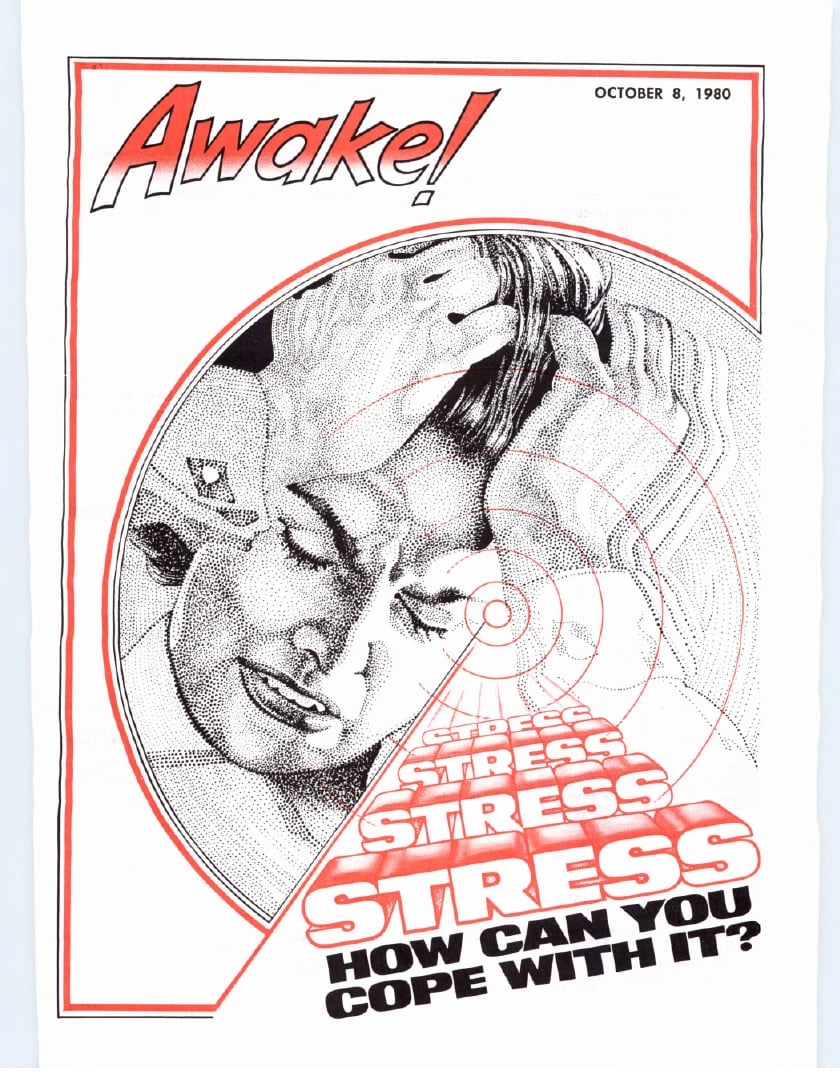
Awake! — October 8, 1980
Source: jw.org
Contents
Page Two
Stress—A Modern Epidemic
What Is This Thing Called “Stress”?
You Can Cope With Stress—But How?
Relief From Stress—Presently and Permanently
The Future Can Be Foretold!
Do You Recognize the Meaning of What You See?
Crossword Puzzle
As a News Editor Sees It—Report from Argentina
Keeping My Music in Its Place
Watching the World
Dating—Does it work?
Many Now Living Will Never Die
Page Two
Page Two
Everyone is affected by stress. Tens of millions of persons each year pay a high price because of it. But there are a few basics that can help you to cope with it successfully. Now is the time to learn how to apply them
3 STRESS—A MODERN EPIDEMIC
4 WHAT IS THIS THING CALLED “STRESS”?
8 YOU CAN COPE WITH STRESS—BUT HOW?
13 RELIEF FROM STRESS—PRESENTLY AND PERMANENTLY
Stress—A Modern Epidemic
Stress—A Modern Epidemic
HAVE you been infected?
It would be surprising if you haven’t, for it is a worldwide epidemic. Famous heart surgeon Dr. Denton A. Cooley has said that the problem “affects every twentieth-century man or woman.”
But this “infection” is not one that you can fight with antibiotics or have cut out on an operating table. Nor does the remedy lie in pills.
Stress has been likened to a dangerous virus that has infected modern man. You probably have noted its symptoms, even felt them yourself—The knot of tension in your stomach. The splitting headache caused by the pressures of life. The feeling that ‘you’re going to explode,’ that you ‘just can’t take it anymore.’ The constant exhaustion.
The South African newsmagazine “To The Point” observed: ‘Beginning in the middle of the 14th century, the plague rampaged through Europe, killing a quarter of the population. But today, six centuries later, Europe and the West are facing a less dramatic but equally devastating and more insidious epidemic. Today’s disease manifests itself in many forms, but all are rooted in a single poison: stress. Dubbed the “Twentieth Century Killer,” stress arises mainly from the psychological demands of life.’
A Killer Epidemic
But is stress really so serious as to be called a “killer”? And should you personally be concerned about it, for yourself as well as for your family? YES!
Researchers are discovering that the modern epidemic of stress has contributed to or caused much disease and death. The same report in “To The Point” continued: “The physical ills [stress] generates now contribute to a vast number of hospital cases and deaths each year—at least tens of millions.”
Recently “The Wall Street Journal” published a front-page article, “Research Is Indicating that Stress Is Linked to Physical Illness.” In part, the report said “that severe or prolonged stress can make the body more vulnerable to ailments ranging from skin rashes and the common cold to heart attacks and cancer.”
Oh, we might feel that a few rashes or colds are not too serious. But all of us can appreciate the seriousness of something that could give us heart attacks or cancer. If we have not been touched by those terrible maladies, we likely know individuals who have.
Some persons may imagine that the epidemic of stress, with its resulting damage, affects only adults in certain high-pressure jobs. But if that were so, why would Dr. Cooley have said that it affects us all? No, stress today afflicts young and old, including many persons whom we might not think would be affected.
In the article “Stress Gives Children Diseases of Adults,” Japan’s “Daily Yomiuri” reported that stress is causing many youths to fall victim to ulcers, heart ailments, diabetes, obesity and exhaustion.
Also, many adults who have to deal with today’s youths are suffering ill effects from stress. An Ontario, Canada, study showed “that teachers die four years earlier than members of other professions and stress is one of the contributing factors.” Many mothers can easily believe that. With just one or two children, mothers today often are under so much stress that they feel frazzled constantly.
Children come into the picture in another way, too. After years of research in Europe and Canada, Dr. Dennis Stott concluded: “Stresses on pregnant women—particularly the tensions of unhappy marriage—are causing widespread physical, mental and emotional damage to children in the womb.”—Toronto Star.
Even if you are well aware of today’s stresses—feeling that this epidemic has already hit you or your loved ones—could you explain what “stress” actually is? How does it affect your body? And, perhaps of greatest interest and importance to you, what, in practical terms, can you do to cope with stress?
What Is This Thing Called “Stress”?
What Is This Thing Called “Stress”?
YOUR boss yells at you, even though it was someone else who made the mistake.
The teacher at school laughs at you in front of the class.
While you are busy cooking the supper meal your child knocks over a vase and the phone starts ringing.
Yes, you know what stress is—at least to some extent.
When we think of stress, many of us have in mind such pressures of life, or more severe ones such as loss of a mate or mounting bills. But how many of us know what goes on in our body during stress? How can these bodily changes affect our health? What are the symptoms of damaging stress? And how can we best cope with the stress we face, so as to find more happiness and peace?
What Is It?
“Stress” means different things to different people. The term conveys to many the thought of tension or pressure. But that is only part of the picture.
In newspaper accounts of some airplane crashes you may have read that stress led to metal fatigue, causing a part to fail and the plane to crash. That stress was a force on a piece of metal that tended to strain or distort it. It snapped. The plane crashed.
In some ways it can be similar with human stress. It is some physical or emotional thing that affects our body, to which we need to adapt or else we may be harmed. Some examples: You are out in the sun on a hot day. Your body heats up. That is a form of stress. Or you exert yourself in a ball game or when hoeing the garden. Your muscles get tired, because there is a temporary chemical imbalance in them. That is stress, too. Yet you have regulating devices to counteract such stress and restore a healthy balance. One is perspiration to cool your body. Another is a good night’s sleep, which allows your muscles to restore themselves. The stress passes.
But today it is common to think of stress in connection with emotional pressure or tension, which also can produce bodily changes. When we do not appreciate what changes are occurring in us, we may not know how to cooperate with our body’s efforts to adapt.
“Fight or Flight”
Without intending to put you under any tension, we invite you to imagine yourself in this situation: You are walking down a dimly lit street one evening. Up ahead you see three young toughs crossing the street toward you. What happens inside you?
Sensing a possible danger, you feel as if an alarm goes off. You tense and begin breathing more deeply. The hormone adrenaline surges into your bloodstream. Your liver releases stored sugar. The sugar and fat (cholesterol) levels in your blood rise, fueling you for peak performance. Your heart beats faster. More blood flows to your muscles. You are alert, prepared for swift action or decisions. This “fight or flight” response is triggered by emotions such as fear or anger.
However, this response is not of itself bad or harmful. In this case it might ready you to run faster than you thought you could. Or it might help you to control yourself and give a mild answer if insulted. (Prov. 15:1; Matt. 5:39) But the same response also readies you for productive work or play, as in an exciting ball game. Suddenly the ball is coming at you! You must catch it and throw it back quickly. You are keyed up and ready to act.
What, though, if you are under prolonged emotional strain so that you are constantly in this alerted, excited state, with no relieving action for which your body is ready?
For instance, a man has to inspect parts on a rapidly moving assembly line, or he feels that his boss dislikes him, or he must endure at a task that bores or frustrates him. Or a woman has been deserted by her mate. She feels rejected, yet now she must battle the pressures of a secular job, while caring for the children and home in the evenings.
When someone is regularly in such a tense state, with little relief or understanding of how to cope, stress is common. In fact, some authorities term that state “distress,” for it is harmful, prolonged, severe stress that can easily damage the body.
This constant, excessive stress threatens the body’s normal equilibrium. Among other things, it can cause cholesterol to accumulate in the arteries or produce hardening of the arteries. The lymphatic system and white blood cells can be affected, hindering the body’s ability to fight disease and react to foreign substances.
Symptoms You Can Look For
You may feel that no one needs to tell you when you are under stress. But are you sure? It is true that sometimes you can feel the tension or pressure. Yet in many cases persons fail to link certain symptoms with stress. Hence, they may at best take action to deal just with the symptom, never really touching the underlying cause. That may be so with any of us.
For instance, a 39-year-old man got a particularly demanding job assignment, which for months required concentration and extra-time work in the evenings and on weekends. He began sleeping poorly and developed pain in his lower back that special exercises and treatments did not relieve. Was the troubled sleep caused by his back problem, or the other way around? Actually, when the period of intense work was past, both symptoms disappeared. Why? What do you think?
Some common symptoms of excessive stress or tension are:
Unusual irritability: Others notice and even comment that you are more easily angered or disturbed by petty things.
Troubled sleep: It takes you longer than normal to fall asleep, or you find yourself waking up and, for hours, unable to doze off.
Altered breathing: You catch yourself in a pattern of short, shallow breathing with no apparent reason.
Muscle stiffness: Not attributable to healthy work or exercise.
Uneasy or painful stomach: May be associated with loss of appetite or inability to eat more than small amounts at one time.
Excitableness: Change in normal patterns, so that one becomes a nonstop talker, easily begins shaking or trembling over small things.
We shouldn’t assume, of course, that the appearance of any one of such symptoms proves we are the victim of extreme stress that is damaging our health. A person may have back pains because of lacking sufficient exercise, or because he strained muscles due to improper lifting. Someone else may have trouble sleeping because he eats shortly before retiring or drinks coffee or tea in the evening. But if you have some of these symptoms for no accountable reason, you might consider whether you are becoming a victim of damaging stress.
Consider the Causes
No one likes to think about the various pressures on him. Why not just forget our troubles? many think. But since stress can have such harmful results, it would do us good to note a few of the common causes of stress today. If we are aware of these, and perhaps recognize that some of these are affecting us, we will be better equipped to counteract or cope with stress.
The accompanying chart identifies what researchers found to be among life’s most stressful problems or situations. Have you been involved in one of these? Then you likely have experienced stress.
Many persons find that their environment causes stress. They may live in a crowded city where they are always on the defensive, being jammed or squeezed. Steady loud or grating noise also causes stress. This should be noted especially by persons who must live or work under noisy conditions and who then “relax” by punishing their ears with shrill, pounding or blaring music. Poor air can add to one’s burden of stress, too.
We already mentioned some stressful aspects of many jobs. But what adds to the problem for many is the competitive spirit centered on ‘getting ahead’ or acquiring the luxuries that others have. (Compare Ecclesiastes 2:22-24; 4:4.) Doctors in the Federal Republic of Germany “blame most of the country’s stress on the ‘Leistungsgesellschaft’, or ‘performance society’, in which the pursuit of material achievement and conspicuous consumption, born with the German ‘economic miracle’, is still the major feature.”
While sleeplessness may be a symptom of stress, with some it is a cause. They push themselves, trying to squeeze too much in a day, and thus deprive themselves of needed sleep. Also, staying up late to watch TV news or programs, especially those that produce tension, can hurt in two ways—reducing the amount of sleep and hindering sound sleep.
Tense, competitive driving in heavy traffic; constant disharmony in the home or with in-laws; worry over inflation or the dwindling buying power of one’s money; a move to a new school or neighborhood; letting life’s minor irritations produce steady, even though suppressed, anger. These are additional causes of a stress problem for many persons.
While physically and emotionally we are equipped to recover from stress, the effects of stress tend to be cumulative. Complicating this is the fact that as we age (perhaps speeded up by stress itself) our ability to respond to stress diminishes.
But there is no reason for you to despair as if stress is just another burden you cannot escape or overcome. Studies reveal that some 25 percent of survivors of years in Nazi concentration camps—certainly an extreme in prolonged stress—displayed no resulting stress-related physical problems.
So you can do something about this thing called “stress.” And there are even reasons why you can look forward to permanent relief from the problem of stress in your life.
[Box on page 7]
LIFE’S MOST ‘STRESSFUL’ SITUATIONS
RANK LIFE EVENT
1 Death of spouse
2 Divorce
3 Marital separation
4 Jail term
5 Death of close family member
6 Personal injury or illness
7 Marriage
8 Fired at work
9 Marital reconciliation
10 Retirement
11 Change in health of family member
12 Pregnancy
13 Sex difficulties
14 Gain of new family member
15 Business readjustment
Based on research by Drs. T. Holmes and R. H. Rahne—“Modern Maturity.”
[Diagram on page 5]
(For fully formatted text, see publication)
YOUR BODY RESPONDS TO STRESS
Fear or anger produces the “fight or flight” response
HEART
beats faster
LUNGS
faster breathing
LIVER
sugar and fats into blood
STOMACH
digestion slows
EYES
pupils dilate
MUSCLES
tense, ready for action
ADRENAL GLANDS
powerful hormone released
You Can Cope With Stress—But How?
You Can Cope With Stress—But How?
YOU may realize that stress is now epidemic and that it can dispose you to serious illness. But what can you do about it?
As mentioned in the previous article, one of the most important steps is to identify the cause or source of your stress. Volume 1 of “Understanding Human Behavior” explains why this is so vital: “Remember that stress exists when a physical or psychological problem is keeping mind and body on constant if not necessarily high-level alert. In many cases the physical and psychological problems need only to be identified for them to be removed [and] the stress will inevitably disappear.” The point is, if you can isolate clearly in your mind what is putting you under stress, your response to it will likely be less severe even if the cause cannot be avoided.
Let us, though, focus in on some practical suggestions that certainly can help you to cope with stress that you may face.
Try to Adapt
Some persons strive to get away from much of what produces stress. For instance, they may change where they live or work so as to get away from tension-producing conditions, such as working where it is noisy or smelly, or living in a crowded, dirty city.
That may help, but such drastic measures are not always needed to reduce stress. For example, to reduce the stress of commuting on crowded buses or highways, some leave earlier or later. They profitably use the waiting time to read, study or write letters. But, more importantly, by adapting in this way they gain confidence that they are in control of their lives, which experts say is a key to coping with stress.
Adaption can help parents. Some parents seem to careen from one crisis to another. What may be needed to decrease the stress from this source is for them to establish firm, consistent guidelines for the children. The Bible has proved to be an excellent source of wise advice on living with and training children. (Compare Ephesians 6:1-4; Proverbs 29:15, 17.) Millions of Jehovah’s Witnesses who have applied that godly advice have benefited by facing less stress.
As another illustration, what could you do to adapt if noise is adding to your stress? At home, shutting the windows, putting up drapes to absorb sound or closing the door to a room where a radio or television is being used may help. Similar steps might be possible on the job, or you could consider using small ear protectors to reduce noise-produced tension. Similarly, keeping your living or working area neat and clean may cut down on stress by making your surroundings more pleasant for you.
Likely any adaptions of this sort that you make will not totally eliminate potentially harmful stress. But even if it just reduces the stress, your life will be healthier and happier.
Talk Out Stress
Don’t keep all your worries and stress bottled up inside. You will find much relief in ‘getting it off your chest.’ Discuss it with a sympathetic friend whom you respect and who may be able to help or advise. You naturally don’t want to be, and shouldn’t be, a complainer or whiner about troubles real or imagined. But you do not become that by confiding in a trusted friend.
Beyond just emotional relief, you may get a new view of your problems, benefiting from the practical suggestions of an experienced person. (Prov. 18:24; 20:5; Titus 2:3-5) Many have been helped with stress by pouring out their feelings to God, who hears the entreating cries and prayers of distressed ones.—2 Chron. 6:19.
Exercise Will Help You
Recall that your body often manifests the “fight or flight” response to stress; it is prepared for strenuous effort. Regular physical exercise will help you to use up the extra sugars and fats in your blood caused by stress, thus counteracting the biochemical effects of stress and restoring your body’s healthy balance.
So do you like to exercise, as when swimming, hiking or playing tennis? Then exercise. And if you are under stress but don’t like to exercise, exercise anyway. You’ll feel better, especially if you do some sort of energetic exercise daily, even as you daily feel stress.
The healthful exercise you choose may be the long walk to and from the grocery store, rather than taking the car or a bus. It might be walking up the stairs rather than using the elevator. Or you might ‘burn off stress’ in useful work such as spading a small garden, beating the dust out of the carpet or other useful deeds.
Balance Work and Play
Many persons view work and play as hostile enemies of each other, which view just adds to the stress they may feel.
It helps to appreciate that work is not an evil plague. It is physically and mentally good for you to be active and productive, such as in earning a living and the means to enjoy play. (Eccl. 3:12, 13) In “Stress Without Distress,” Dr. Hans Selye comments: “Your most important aim should not be to work [or be occupied] as little as possible. . . . For the full enjoyment of leisure, you have to be tired first, as for the full enjoyment of food the best cook is hunger.”
Even when you are working, take a few moments regularly to “play” by stretching. That can relieve the muscles of your face, neck, shoulders and back, lessening any buildup of stress.
But just as you make time for work, make time for relaxation. Yes, schedule some recreation, perhaps a hobby that will absorb you and divert you from the physical or emotional causes of your stress. Dr. Selye adds: “In most instances, diversion from one activity to another is more relaxing than complete rest.”
Get Enough Sleep
Some persons make a habit of staying up to socialize over a cup of coffee or to watch a TV program, maybe a comedy or a “talk show,” that they say helps them to unwind. Whatever claimed relaxing effect there might be must be weighed against the constant sleep debt that may be built up. A sleep deficiency is itself a stress on the mind and body, and makes one less able to cope with other stress.
Since stress causes physical changes in the body, you can see why it is vital to get enough rest and sleep. Sleep lets your body repair itself, restoring the balanced biochemical state. Well did Shakespeare describe it: “Sleep that knits up the ravelled sleave of care. The death of each day’s life, sore labour’s bath, Balm of hurt minds, great nature’s second course, Chief nourisher in life’s feast.”
So if you are a victim of stress, try getting more sleep, especially by forming a normal sleep pattern week in and week out.
Adjust Your Viewpoint
In your coping with stress, the most important thing is not where or how you live or work. Nor is it how much exercise or sleep you get. It is how you view life and its problems or stresses.
A three-year study of air-traffic controllers shows a very high incidence of hypertension. But not all suffered ill effects. Dr. Robert M. Rose found that ‘what seemed to increase the incidence of illness was the attitude the men had toward their work.’ Similarly, after decades of research in stress, Dr. Hans Selye wrote: “Rather than relying on drugs or other techniques, I think there’s another, a better way to handle stress, which involves taking a different attitude toward the various events in our lives.”
You need to learn to evaluate your priorities in life. Perhaps you face a situation that will involve stress—a new job, a social function, having another child, taking out a loan for a major purchase. Before deciding what to do or how to respond, ask, ‘Am I willing to accept the stress involved? Is it worth it? Just how important is this to my life?’ Such sane evaluation will help you to realize your limitations and priorities, resulting in your being a happier person.
Much of what the Bible says about one’s viewpoint toward money conveys this same idea. For example, the apostle Paul wrote: “Those who are determined to be rich fall into temptation and a snare and many senseless and hurtful desires, . . . The love of money is a root of all sorts of injurious things, and by reaching out for this love some . . . have stabbed themselves all over with many pains.” (1 Tim. 6:9, 10) Also, Jesus told of a man who exerted himself to accumulate much wealth, only to die suddenly. Christ concluded: “So it goes with the man that lays up treasure for himself but is not rich toward God.” (Luke 12:16-21) He urged us not to be anxious—to feel stress and worry—about food, clothing and shelter. ‘Not easy,’ you say. True. But the point is that we must begin working to have that outlook. Do not forget, a journey of a thousand miles begins with one step.
Jesus added in the Sermon on the Mount: “Never be anxious about the next day, for the next day will have its own anxieties. Sufficient for each day is its own badness.” (Matt. 6:25-34) That Biblical counsel comes to the very heart of the most up-to-date advice on how you can best cope with stress.
Lasting Relief from Stress?
It would be unrealistic to think that we could fully avoid stress today. No matter how we live or how fine our attitude is, there will be things that can cause us harmful stress. Crime still abounds. Prejudice and injustice bring grief. So we must learn how to cope with stress.
But could damaging stress—distress—be brought to an end someday? The answer based on evidence is, Yes. Your learning how and when that will be can affect your ability to cope with stress right now. The following article will examine this important matter.
[Picture on page 12]
TOWN BANK
Relief From Stress—Presently and Permanently
Relief From Stress—Presently and Permanently
WHAT answers would you get if you took a general survey, asking: “Will damaging stress ever be fully eliminated?”
Based on what they have experienced, or on what experts predict for the future, most would likely answer that harmful stress will always be with us.
A few, though, might blithely say that things will turn out fine, that man will solve the problems and eliminate damaging stress.
That view may, however, reflect an ineffective effort to cope with stress. Regarding this, Professor Irving Janis commented: “Another defective coping pattern [is], ‘defensive avoidance,’ which involves seeking relief from emotional tensions by engaging in wishful thinking.”—The New York Times, Sunday, May 18, 1980.
A sad thing is that many persons who are trying to cope with stress overlook realities that would help them to cope. These realities can help you to gain relief from stress and give you a solid basis for expecting permanent relief in the future.
A Universal Reality
Dr. Hans Selye, one of the giants in the study of stress, wrote: “No sensitive person can look at the sky on a cloudless night without asking himself where the stars came from, where they go, and what keeps the universe in order. The same questions arise when we look at the internal universe within the human body.”—The Stress of Life.
Have you taken the time to reflect on the marvels of the human body or thoughtfully to gaze at the stars? Doing so can be an important step in your coping with present stresses. Selye adds: “The capacity to contemplate . . . the harmonious elegance in Nature’s manifestations, is one of the most satisfactory experiences of which man is capable. . . . Looking at something infinitely greater than our conscious selves makes all our daily troubles appear to shrink by comparison. There is an equanimity and a peace of mind which can be achieved only through contact with the sublime.”
Centuries ago the poet-king David did what this expert on stress now recommends. Then David uttered this fundamental truth: “The heavens are declaring the glory of God; and of the work of his hands the expanse is telling.”—Ps. 19:1.
David recognized what millions of thinking persons since then have concluded also: A basic reality of the universe is that God, the Creator of the universe and of man, exists. Compared with Him and his handiwork, we humans are insignificant. David said of God: ‘When I see your heavens, the works of your fingers, what is mortal man that you keep him in mind?’—Ps. 8:3, 4.
Hence, when you realize that stress is—or might be—a problem for you, you should reflect more deeply on the existence of God, on the enormity of his works and concerns, and on your standing before him. You thus will not be employing ‘defensive avoidance’ but will be gaining perspective before the facts, universal realities.
It Works Now and Will Work
Your recognizing God will in many ways help you to cope with stress.
For one thing, it will increase your regard for his counsel in the Bible. From David’s own experience and what he saw with others, he could say: “The law of Jehovah is perfect, bringing back the soul. The reminder of Jehovah is trustworthy, making the inexperienced one wise.”—Ps. 19:7.
God’s counsel includes advice to avoid such things as adultery, pre-marital sex, drunkenness, stealing and lying. Persons who engage in those things often do so for pleasure, to ‘make life easier’ or to avoid some embarrassment. Yet, evidence shows that they usually have, as a direct or an indirect result, more stress—from a troubled conscience, from the ill will generated in others or even from health problems caused by their course. Conversely, following God’s advice means that a person avoids all such resulting stress, as well as promotes peace of mind and happiness.
Around the earth there are millions of Jehovah’s Witnesses who can testify that this has been so with them. Of course, no one today can have a totally stress-free life. But practicing true Christianity certainly has helped them. This agrees with what Jesus said: “Come to me, all you who are toiling and loaded down, and I will refresh you. . . . You will find refreshment [not stress] for your souls. For my yoke is [not stressful, but] kindly.”—Matt. 11:28-30.
There is another reason why present stress will decline as you draw closer to God. Your life will have more direction. You will see where you are headed, being committed to pleasing him. “Stress Without Distress” mentions:
History has repeatedly proved that “those who believed in the infallibility of their God or in their particular code of conduct were relatively well-balanced and happy, . . . Faith gave men direction, the basis for commitment, self-discipline, and work that is indispensable to prevent abnormal chaotic behavior.”—Pp. 2, 3.
Furthermore, in having this wholesome commitment to the Creator and his principles, you can be part of a congregation of happy Christians. Those in the Christian congregations of Jehovah’s Witnesses are pleased to accept and work with all who want to please God. They are willing to show others how applying Bible counsel is practical today and works to reduce harmful stress.
They sincerely try to practice love, in line with Jesus’ meaningful words: “By this all will know that you are my disciples, if you have love among yourselves.” (John 13:35) As you, through studying the Scriptures and being around loving Christians, learn to love and help other people, stress will diminish. Others will find that you are a more likable person. You will have fewer conflicts with your fellowmen, whose goodwill and respect you will have earned.—Matt. 5:40-48; Luke 6:38.
Nor is this help in coping with stress limited to the present; it also looks to the future. The volume “Religious Movements in Contemporary America” points out: “In their own congregational life Witnesses form a genuine community of trust and acceptance. . . . The Jehovah’s Witnesses offer [one] an alternative life strategy that gives its adherents a way to find identity and self-respect, a community of acceptance, and hope for the future.”
Permanent Relief from Stress
The Creator is the solid basis for having hope for the future. In his reliable Word he promises that he is going to intervene in human affairs, doing so in a way that will allow for permanent relief from harmful stress. Consider some of what God promises:
◆ He will permanently eliminate selfish, wicked persons, those whose actions now cause so much stress.—Ps. 37:28, 29, 34.
◆ Instead of there being persons with vicious, animalistic dispositions, the earth will be populated by peaceable individuals guided by the abundant “knowledge of Jehovah.”—Isa. 11:6-9; 35:9.
◆ Illness and death, which now cause so much stress, will be replaced with good health and long life.—Rev. 21:4.
◆ As a result of honest, healthful work, humans will have an abundance of food and life’s necessities.—Ps. 72:16.
◆ War will end, to be followed by peace and security.—Mic. 4:3, 4.
◆ All humans will practice the loving interest in others that is a mark of true Christianity.—John 13:35.
This is no dream. Looking forward to it is not a case of ‘defensive avoidance’ of stress. It is what the Creator of the universe promises. If it appeals to you, you should learn more about it by studying the Bible along with Jehovah’s Witnesses.
However, life under those conditions will not be dull or boring. On occasion your heart will still beat fast. You will become excited and alert for activity. But such will be normal and healthy responses to thrilling, happy events or emotions. What a delightful contrast that will be to the extreme, prolonged and harmful stress that we must cope with today!
[Box on page 15]
LOVE, HATE AND STRESS
In a “Reader’s Digest” interview, Dr. Hans Selye remarked: “The two great emotions that cause the absence or presence of stress are love and hate. The Bible makes this point over and over again. The message is that if we don’t somehow modify our built-in selfishness, we arouse fear and hostility in other people—not a very favorable environment in which to exist! Conversely, the more we modify that self-centeredness, the more we can persuade people to love us rather than hate us, the safer we are, and the less stress we have to endure.”
The Future Can Be Foretold!
The Future Can Be Foretold!
What did that mean for ancient Babylon?
What does it mean for you?
DO YOU want to know the future? Most people do—but how is it possible?
Many turn to astrology, a system of divination based on the stars that goes back to ancient Babylon. In the United States alone there are an estimated 200,000 astrologers doing $100 million worth of business yearly. Surveys show that churchgoers are just as likely to consult astrologers as are nongoers.
How about you? Where do you get your information about the future?
Ironic Example
It is one of the ironies of history that when the ancient city of Babylon was conquered in 539 B.C.E. her world-famous astrologers were unable to predict her fall, and helpless to prevent it.
But someone else did predict that fateful conquest of Babylon—almost 200 years in advance! Amazingly, even the name of the conqueror was predicted, long before his birth. That same source tells what the future holds for this generation, and what happened to Babylon has a bearing on it. Are you interested?
You should be, because the forces that contributed to Babylon’s downfall are still very much active in the world today. Ideas and institutions that flourish in the 20th century are rooted in ancient Babylon. Her fall has meaning for us.
Conquerors Identified by Name
The source of numerous unerring prophecies about Babylon is the Bible. The Bible book of Isaiah contains predictions of her fall written at least 193 years before it happened. But who would the conquerors prove to be? The Bible spelled it out:
“The pronouncement against Babylon . . . ‘Here I am arousing against them the Medes, who account silver itself as nothing and who, as respects gold, take no delight in it.’”—Isa. 13:1, 17.
In Isaiah’s day the Medes were a group of divided tribes on the outskirts of the powerful Assyrian Empire. (The term “Medes” was often used with reference to both the Medes and their relatives the Persians.) In the years following Isaiah’s prophecy, the power of the Medes grew steadily. As the Bible indicated, rich Babylon could not buy them off with gold!
The Bible further revealed the very name of the leader of the Medes and the Persians who would conquer Babylon:
“This is what Jehovah has said . . . ‘For [Israel’s] sakes I will send to Babylon and cause the bars of the prisons to come down,’ . . . ‘the One saying of Cyrus, “He is my shepherd, and all that I delight in he will completely carry out”’ . . . Cyrus, whose right hand I have taken hold of, to subdue before him nations.”—Isa. 43:14; 44:28; 45:1.
Two hundred years later that very Cyrus conquered Babylon and fulfilled that prophecy. Think about what that means: You likely have in your possession a book that has been proved by history to contain the most accurate prophecies ever written down. This book is also a valuable source of information about our future.
Of course, there are men who like to pooh-pooh the Bible and brag about their own predictions—but should this surprise us? The “wise men” of Babylon acted the same way 2,500 years ago, as history shows. Yet these Bible predictions began to be fulfilled when Cyrus became king of the Medes and the Persians—and they were fulfilled more and more rapidly as he moved toward Babylon. Consider:
Babylon Besieged
About harvesttime in 539 B.C.E. the long-predicted conqueror, Cyrus, arrived before the walls of Babylon. As the prophet Jeremiah had foretold, Cyrus besieged the city.—Jer. 51:11, 12.
Clearly, the Babylonians were paying no attention to the outworking of the unambiguous words of Jehovah’s prophets Jeremiah and Isaiah. They were not interested in the Bible of their Hebrew slaves. Their famous fortune-tellers did not see that the city would soon fall. Instead, they ‘made light of the siege,’ “in the belief that they had provisions enough for more than twenty years.”—Xenophon, Cyropædia, VII, v. 13.
It should not be surprising that the Babylonians felt that their defenses were invincible. Was not Babylon also known as “Šu-anna,” meaning “the high walled”? Ancient historian Herodotus reports that the walls of the city were over 300 feet tall, although this cannot be verified today. At any rate, we are told that the city’s defenses discouraged Cyrus, who reportedly told his staff officers, “I am sure I cannot see how any one could take by storm walls so massive and so high.”—Cyropædia, VII, v. 7.
“All Your Rivers I Shall Dry Up”
How could the city be taken? Significantly, the Bible did not simply name Cyrus as the conqueror of Babylon and leave out the details of his conquest. Rather, the very strategy used by Cyrus to take Babylon had been alluded to in the Bible prophecy that mentioned his name:
“This is what Jehovah has said . . . ‘the One saying to the watery deep, “Be evaporated; and all your rivers I shall dry up”; the One saying of Cyrus, “He is my shepherd.”’”—Isa. 44:24, 27, 28.
Aha! Babylon was surrounded by a network of canals and moats as well as by walls. Indeed, the river Euphrates flowed through the midst of the city. But what if the protection of those waters could be negated, ‘dried up’? First, Cyrus dug trenches to divert the river.
“Then, when he heard that a certain festival had come round in Babylon, during which all Babylon was accustomed to drink and revel all night long, Cyrus took a large number of men, just as soon as it was dark, and opened up the heads of the trenches at the river. . . . and the bed of the river, where it traversed the city, became passable for men.”—Cyropædia, VII, vss. 15, 16.
Even in this small detail—that Babylon’s fall would come during a drunken festival—Bible prophecy proved accurate:
“I will make her princes and her wise ones, her governors and her deputy rulers and her mighty men drunk, and they must sleep an indefinitely lasting sleep, from which they will not wake up.”—Jer. 51:57.
‘Mighty Men Cease to Fight’
Cyrus’ men were inside the city now, but were by no means out of danger as they crept along the riverbed. High walls flanked the river. Alert Babylonian sentries could close the bronze gates of those walls and the Persians would be trapped and subjected to a hail of missiles from above. But, distracted by their festival, the Babylonians had not secured those vital gates! Again, it was just as the Bible had foretold:
“This is what Jehovah has said to his anointed one, to Cyrus, whose right hand I have taken hold of . . . to open before him the two-leaved doors, so that even the gates will not be shut.”—Isa. 45:1.
Entering the city through the river gates, the invaders encountered very little resistance from the stunned Babylonians. The city was taken almost without a fight. This, too, had been predicted!
“The mighty men of Babylon have ceased to fight. They have kept sitting in the strong places. Their mightiness has run dry. They have become women.”—Jer. 51:30.
Where was the king? Bible prophecy indicated that he would be waiting helplessly in his palace, getting more bad news with the arrival of each messenger from outside:
“One runner runs to meet another runner, and one reporter to meet another reporter, to report to the king of Babylon that his city has been captured at every end.”—Jer. 51:31.
In perfect agreement, history records that the king was found and slain in his palace, along with his bodyguard. “Suddenly, in one day,” proud Babylon had fallen!—Isa. 47:9.
Now what could the haughty Babylonian diviners say? How could they refute the words written about them almost 200 years before and fulfilled in that very hour:
“You have grown weary with the multitude of your counselors. Let them stand up, now, and save you, the worshipers of the heavens, the lookers at the stars, those giving out knowledge at the new moons concerning the things that will come upon you. Look! They have become like stubble.”—Isa. 47:13, 14.
Compared with Bible prophecies written many years before, how accurate did the prophecies of the Babylonian astrologers prove to be? How much understanding did they prove to have? They proved to be literally unable to read the ‘handwriting on the wall’ on the very night of her capture!—Dan. 5:8.
“Babylon the Great”
“Granted that Bible prophecies were fulfilled in the past,” you might say, “what does that have to do with today?”
For one thing, there are still many things in the world today that originated in ancient Babylon. Take astrology:
“Astrology was based upon two Babylonic ideas: the zodiac, and the divinity of the heavenly bodies. . . . The Babylonians credited the planets with the influences that one would expect of their respective deities.”—Great Cities of the Ancient World, L. Sprague De Camp, p. 150.
Did you realize that such “modern” ideas as trial marriage and easy divorce were well known in Babylon? In the realm of politics, the notion of the divine right of kings has been traced to her. “It is hardly coincidence that British monarchs today go through coronation ceremonies so reminiscent of those of Mesopotamia.”—Cradle of Civilization, p. 160.
But above all, Babylon was a religious empire. Remains of over 50 religious temples have been found in her ruins. Her influence on the rest of the ancient world, and, hence, the modern world, was great.
“Mesopotamia became a cultural centre from which were propagated cosmological, mythological and scientific conceptions.”—Ancient Semitic Civilizations, p. 57.
Religious conceptions that got their start in Babylon include the idea of a trinity of gods, based on the Babylonian “supreme triad” of Anu, Enlil and Enki. The notion of the immortal soul was spread abroad from Babylon. Many modern religious rituals began there, just as did political rituals such as the British coronation.
If you are a religious person, it may surprise you to learn that much of what modern churches teach and do has been derived from ancient Babylon. Even if you are not religious, you may find yourself involved in political matters influenced by Babylon, or in such Babylonian exports as astrology. Should this concern you?
Yes, because Jehovah God’s hostility to Babylonian philosophy and religion did not end with the destruction of the city of Babylon. That is why the Bible book of Revelation speaks of a worldwide religious system founded on the ideas of ancient Babylon, and symbolically called “Babylon the Great.” (Rev. 17:3-6; 18:21-24) The book of Revelation includes prophecies about the destruction of Babylon the Great that will come true just as surely as did the Bible prophecies regarding the ancient city of Babylon. The Bible’s counsel is: “Get out of her, my people, if you do not want to share with her in her sins, and if you do not want to receive part of her plagues.” (Rev. 18:4) There is urgency to do so without delay!
Jehovah’s Witnesses will be glad to help you, free of charge, to learn how. In the process, you will gain truly reliable information about the future, from the best possible source, the Bible.
[Pictures on page 19]
What happened to Babylon has meaning for us
Do You Recognize the Meaning of What You See?
Do You Recognize the Meaning of What You See?
SCIENTISTS have called 1976 one of the worst years in history in terms of deaths from earthquakes. There were some 700,000 quake-related deaths. Each year, a few hundred or tens of thousands of persons may die in earthquakes. Did you know that?
Perhaps you heard about the earthquake alert in San Francisco on April 18, 1980. That was the 74th anniversary of the devastating 1906 quake there. Why the alert? Because scientists predict that the city may well experience another disastrous quake before the end of this century. In fact, in the United States during 1978, a total of 345 earthquakes were reported in 28 different states.
If you live in an area where there have been no earthquakes, you have reason to be grateful. But don’t be complacent. A study entitled “Earthquakes” published by the Munich Reinsurance Company, in Germany, reports: “Major quakes have made it clear in recent years that we are living in a period of increasing earthquake activity. . . . There are areas with a higher probability of earthquake damage and other regions where earthquakes are less probable. One is, however, well advised to remember that earthquakes may occur at any place. . . . It can, therefore, not be ruled out that even a major quake may originate from a place which did not give rise to suspicion.”
Just what is a “major” quake? Well, to the one whose property is destroyed or who loses a family member, it is a major earthquake regardless of what anyone else says. But perhaps the chart on the next page will help you to understand what scientists mean by the figures that they use.
Imagine, if you can, what it would be like if an earthquake were to strike where you live—RIGHT NOW! If it were of sufficient intensity, in a matter of seconds your car could be a hopeless wreck, your home an unrepairable shambles and you and your loved ones could be seriously injured—or worse. That is the sort of thing that happens each year to people in many parts of the earth, and with increasing frequency.
Has the frequency of earthquakes really increased? The Italian magazine Il Piccolo observed: “Our generation lives in a dangerous period of high seismic activity, as statistics show.” And then it produced figures for the past thousand years to prove it.
What does it all mean? Long ago the Bible foretold a time when, along with international wars and food shortages, there would be “earthquakes in one place after another.” (Matt. 24:7) This is now taking place on a scale unequaled in human history. The Bible mentions such earthquakes as part of a composite sign identifying the last days, the conclusion of the wicked world system of things. It also associates them with the invisible “presence” of Jesus Christ, the time when he would begin to exercise God-given authority as king over all mankind.
Although most persons are fearful of what they see coming upon the world, those who understand the significance of what they see have reason to rejoice. The Bible says: “As these things start to occur, raise yourselves erect and lift your heads up, because your deliverance is getting near. . . . When you see these things occurring, know that the kingdom of God is near.”—Luke 21:10, 11, 28-31.
A new government, the kingdom of God, is about to destroy all human governments and replace them with a righteous administration. What a blessing that will be for all who long for life free from oppression and corruption, in a world where people truly love one another!
So, when you hear reports of “earthquakes in one place after another,” remember that they are part of the foretold sign that worldwide change is near at hand.
[Diagram on page 21]
(For fully formatted text, see publication)
The open-ended Richter scale compares the amount of energy released by earthquakes. It is logarithmic, which means that a quake one point higher on the scale (5 instead of 4, for example) will release about 30 times as much energy as the quake rated one point lower.
“Every day more than 1,000 earthquakes with a reading of at least two are recorded across the world.”—Toronto Star, May 15, 1976.
A quake measuring four can cause moderate damage.
A quake measuring five can cause considerable damage.
A quake measuring six is considered severe.
The southern California quake of 1971 measured 6.5; in 1976 alone, there were 50 quakes world wide that measured as high or higher.
Japan, the Soviet Union, Taiwan, Costa Rica, Iran, Mexico and the Philippines were among the countries struck by 17 “major” quakes throughout the world during 1978.
A quake measuring seven is considered “major”.
A specialist in quakeproof engineering termed the 1976 China quake, which may have killed over half a million people, “the greatest earthquake disaster in the history of mankind.”
“Earthquake Strikes Indian Ocean,” read the headlines of the August 20, 1977, New York Times: “Monitoring stations around the world reported the strength of the tremor at between 7.7 and 8.9 on the Richter scale. Vienna seismologists . . . said . . . the quake was ‘one of the strongest in recorded history.’”
[Picture on page 20]
EARTHQUAKES
Crossword Puzzle
Crossword Puzzle
Clues Across
1. Herod ‐‐‐‐‐‐‐ ordered John the Baptist beheaded (Matthew 14:1-13)
4. In the tabernacle a dish, a snuffer or a fire holder was a holy ‐‐‐‐‐‐‐ (Exodus 25:29-40)
9. Disciple of Jesus who at first doubted Jesus’ resurrection (John 20:24-29)
10. Caesar ‐‐‐‐‐‐‐‐ ruled Rome at time of Jesus’ birth (Luke 2:1-7)
11. Because of his greed and deceit, 36 Israelites perished (Joshua 7:1-26)
14. Elderly prophetess (a palindrome) (Luke 2:36-38)
16. Town of Jehoiakim’s mother (2 Kings 23:36)
18. The Philistines came from here (Jeremiah 47:2-5)
20. A mighty man of David (2 Samuel 23:24-26)
21. “We also ‐‐‐‐‐‐‐ you not to accept the undeserved kindness of God and miss its purpose” (2 Corinthians 6:1)
23. The queen of ‐‐‐‐‐ came “to hear the wisdom of Solomon” (1 Kings 10:1-10; Luke 11:29-31)
24. Archaic English word for “you”
26. “‐‐‐‐‐ off the old personality” (Colossians 3:9)
30. Peter’s dialect (Matthew 26:69-75)
32. The ‐‐‐‐‐‐ viper pictured David’s enemies (Psalm 140:1-3)
33. Sixth son of Jacob’s wife Leah (Genesis 35:23)
34. In vision, Ezekiel saw this site (Ezekiel 47:13-15)
Clues Down
1. Persian king, name or title (Ezra 4:8-24; 7:1-28)
2. Paul departed from ‐‐‐‐‐ for Macedonia (Acts 16:11)
3. Nechoh was ‐‐‐‐‐‐‐ of Egypt (2 Kings 23:28-35)
5. Roman outer garment
6. First month of Jews’ sacred calendar (Esther 3:7)
7. Faithful spy Caleb’s son (1 Chronicles 4:15)
8. City where Samson died (Judges 16:21-31)
12. Simeon and Levi killed every male in a city of the ‐‐‐‐‐‐‐ because of Dinah their sister (Genesis 34:1-31)
13. One of seven men appointed to distribute food (Acts 6:1-6)
14. Paul quotes Psalm 140:3 using this word for “horned viper” (Romans 3:13)
15. Symbolic name for God’s war (Revelation 16:14-16)
17. The Oriental bed was often a ‐‐‐ of straw
19. To show that the priest would walk in Jehovah’s way, blood was put on the big ‐‐‐ of his right foot (Leviticus 8:22-24)
22. The first woman (Genesis 2:18-25; 3:20)
23. The Christian congregation is “a pillar and ‐‐‐‐‐‐‐ of the truth” (1 Timothy 3:15)
25. Young but wise, he spoke to Job and his companions (Job 32:1-10)
27. In God’s new order it will truly be said that “the ‐‐‐‐ of God is with mankind” (Revelation 21:1-4)
28. We now live in “the ‐‐‐‐‐ part of the days” (Isaiah 2:2-4; Micah 4:1-4)
29. He trampled Jezebel under his chariot horses (2 Kings 9:30-37)
31. What 22-down did with the fruit (Genesis 3:1-7)
CROSSWORD SOLUTIONS PAGE 28
Answers Across
1. ANTIPAS
4. UTENSIL
9. THOMAS
10. AUGUSTUS
11. ACHAN
14. ANNA
16. RUMAH
18. CAPHTOR
20. IRA
21. ENTREAT
23. SHEBA
24. THEE
26. STRIP
30. GALILEAN
32. HORNED
33. ZEBULUN
34. HETHLON
Answers Down
1. ARTAXERXES
2. TROAS
3. PHARAOH
5. TOGA
6. NISAN
7. IRU
8. GAZA
12. HIVITES
13. NICANOR
14. ASP
15. ARMAGEDDON
17. MAT
19. TOE
22. EVE
23. SUPPORT
25. ELIHU
27. TENT
28. FINAL
29. JEHU
31. ATE
As a News Editor Sees It—Report from Argentina
As a News Editor Sees It—Report from Argentina
JEHOVAH’S WITNESSES in Argentina continue to be under government ban. But not everyone agrees with what the government is doing.
Some members of the federal judiciary have gone on public record in behalf of the Witnesses. And on February 14, 1980, an editorial by James Neilson in the Buenos Aires Herald gave evidence that he was not afraid to state how he felt about the situation. He wrote:
“If official propaganda is to be believed Argentina is blessedly free of the religious problems that plague much of the rest of the world. This, however, is a highly questionable assertion. While it is true that the Argentine people is, on the whole, tolerant enough where religion is concerned and there is little danger of members of one faith sallying forth to massacre the members of another, the country is not without its bigots who do what they can to make life miserable for the denominations they dislike. . . .
“But even though the situation here is by and large fairly good by the dismal standards prevailing in some parts of the world, . . . it comes as a distinct shock to see the government taking such pride in it. It is not, after all, as though the government had made any contribution to the removal of religious discrimination. On the contrary, ever since assuming power it has done its considerable best to inject the dangerous virus of religious intolerance into the national bloodstream, devising compulsory confessionally-oriented indoctrination courses for the schools and energetically persecuting small and for the most part inoffensive dissident sects, Christian and non-Christian, for motives that have never been satisfactorily explained.
“Among the principal victims of the regime’s crusading zeal are the Jehovah’s Witnesses, of which there are thought to be about 30,000 in the country and over a million in the world as a whole. The Witnesses are not very popular anywhere. They form a prickly, indigestible denomination which is widely regarded as a public nuisance because its adherents persist in taking some biblical injunctions completely literally, a most disturbing thing to do from the viewpoint of those who think religion is a very fine thing as long as it does not affect people’s behaviour very much. When it does it gets labelled religious mania and is ridiculed. But although the Witnesses have an irritating habit of buttonholing others to lecture them on what they should believe they are generally tolerated. Certainly they live strikingly honest, abstemious, and hard-working lives and by all usual criteria can be regarded as model citizens.
“They would escape attention if only they took as flexible a view of their principles as most other people but, needless to say, they do not. They think the sixth commandment, ‘Thou shalt not kill,’ means what it says and is applicable in all circumstances. They also welcome Micah’s prophecy that ‘nation shall not lift up sword against nation, neither shall they learn war any more’. And they are absolutely adamant in refusing to render homage to such quasi-religious symbols as flags, preferring to obey God’s demand that they reserve their worship for Him alone. Such intransigence is unusual in the twentieth century where apparently straightforward principles can be stretched enough to encompass virtually everything and it has inevitably brought the Witnesses into many collisions with the secular authorities, who have their own very definite ideas about what is right and what is wrong.
“The Witnesses’ combination of pacifism and a refusal to do anything they think implies worship of national symbols naturally infuriates superpatriots who are professionally dedicated to cultivating the art of war. Their anger is understandable. What even full-time apologists for the government must find hard to understand, however, is the singleminded fervour with which the authorities hound the Jehovah’s Witnesses. Open season on the Witnesses was declared with the publication, on August 31, 1976, of decree number 1867 which pronounced their beliefs ‘contrary to the national character,’ whatever that may mean. Since then the government has subjected the Witnesses to a systematic campaign of persecution that has no parallel in the civilized West since the end of the Second World War, a campaign that has brought discredit to the nation and will be remembered with shame by later generations.
“Hundreds of Witnesses have been arrested for such ‘crimes’ as holding prayer meetings or Bible-study sessions. Many of them have been roughed up in the process and mothers have been forcibly separated from their infants. Hundreds of children have been expelled from school because they have obeyed their parents and refused to render homage to the flag, and they have been denied the right to sit for their examinations even after they have studied at home for them. Their literature, which consists of such doubtful works as the Bible or collections of biblical stories, has been seized. Provincial governments have rapaciously taken advantage of the situation to confiscate their property, which will, no doubt, be returned when Constitutional rule is restored. Young Witnesses have rotted in military jails for years on end, often in the company of thieves and vagabonds, because they have courageously refused to abandon their pacifist convictions. Foreigners, despite their lack of any criminal antecedents whatsoever, have been thrown out of the country for nothing but their religious beliefs. At present a young Peruvian, Pedro Brousset Massey, [is] fighting a lonely legal battle in Córdoba so he can stay and marry his Argentine fiancé[e]. Like so many other Witnesses, he is being deliberately given the runaround by the government departments with which he must come into contact. Not surprisingly the hapless Witnesses, most of whom are working or lower middle class, are comparing their plight to that of the early Christians in the pagan Roman Empire.
“This quite incredible regression into the past is taking place with hardly a word of protest coming from the press or from any other of the country’s representative institutions. None of the political parties, so gleefully willing to denounce the government’s economic policies, has bothered to raise its voice in defense of this small and unloved sect. The Church, despite the Pope’s unequivocal calls for religious tolerance, has remained silent, even though many will take it for granted that the driving force behind the persecution of the Witnesses is conservative Roman Catholicism and the main members of the government like to identify themselves as fervent practicing Catholics. The Church as such, however, appears to have nothing at all to do with this sorry affair. The Witnesses, of course, are not very numerous, not very rich, and not very influential, so there is precious little to be gained from trying to help them. But the wrong that is being inflicted is so evident, and the harm it is doing to the country is so great, that it would have been reasonable to expect some citizens at least to have the decency to speak up on their behalf.
“The government’s objective in treating the Witnesses in this shameful manner is hard for a rational mind to grasp. It cannot seriously expect to convert them. So far not one single Witness has renounced his beliefs as a result of the government’s heavy-handed campaign and, indeed, they are accustomed to outfacing far tougher and far more unpleasant enemies than the present authorities. The Jehovah’s Witnesses, a stiff-necked people if ever there was one, have survived the attentions of the likes of Hitler and Stalin and they will no doubt survive whatever President Videla has in store for them. Elsewhere they have gone to their deaths singing the praises of the Lord and they will be quite prepared to do the same here should it ever become necessary.
“If the government has no hope of converting them, what then? Perhaps it is seeking to discourage others from joining their ranks. If so it is going the wrong way about it, because the steadfast way in which the Witnesses have stood by their principles, a rare phenomenon these days, can only win them new adherents. It would not be at all surprising if their numbers actually grew as a result of the government’s efforts rather than the reverse.
“There is hardly a state in the Western world which has not had trouble with the Witnesses at some time or other. Everywhere else, however, supreme courts have eventually ruled in their favour. And the Argentine Supreme Court too has ruled that it is unconstitutional to prevent the children of Witnesses from attending school even though they persist in standing quietly still while homage is being rendered to the national flag. Throughout the world, moreover, military tribunals have come to the conclusion, despite their inevitable misgivings, that special consideration should be given to those who, like the Witnesses, harbour genuine conscientious objections to military service, and even the most blimpish have agreed that whatever else pacifists may be they are certainly not cowards: many have preferred the firing squad to the violation of their beliefs.
…