Awake!, February 22, 1980
Download: PDF — Awake!, February 22, 1980
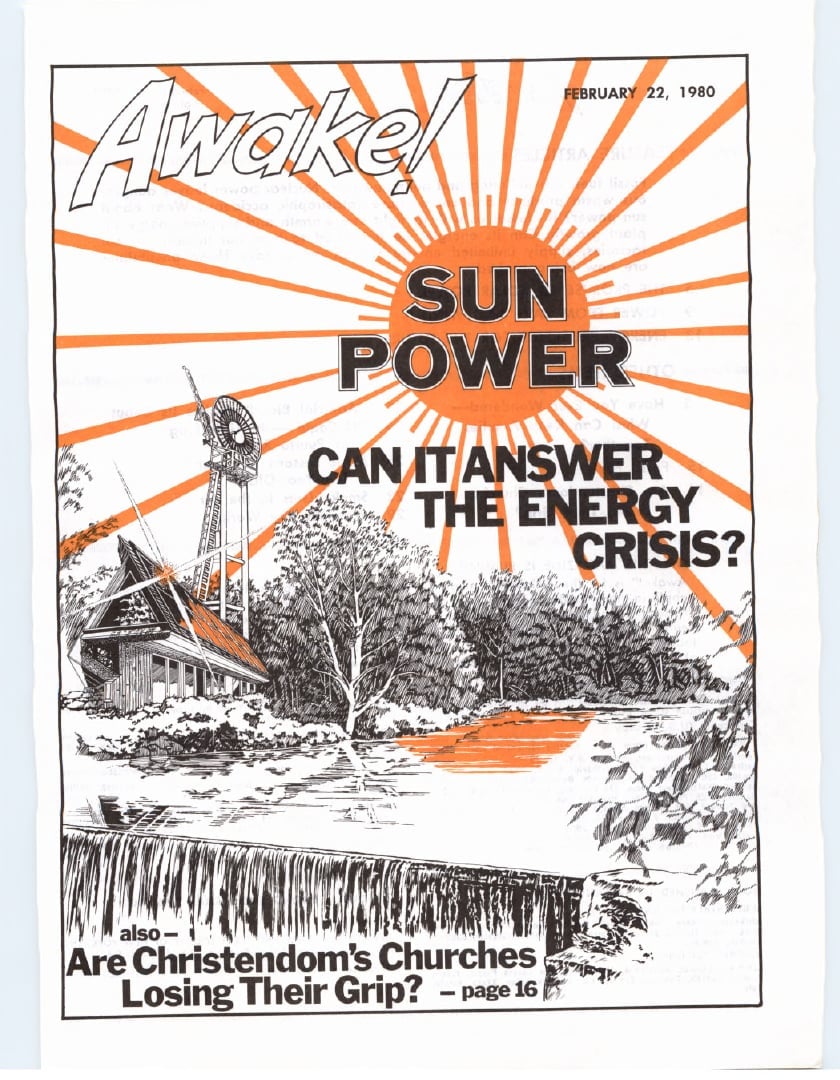
Awake! — February 22, 1980
Source: jw.org
Contents
Page Two
What Can Keep Families Together?
The Promise of Solar Power
Power From Rain and Wind
Energy Prospects for the Future
Fossil Fuels
Are Christendom’s Churches Losing Their Grip?
“Artificial Blood” Makes Its Debut
“El Coquí”—the Little Frog of Puerto Rico
Music Lessons for Your Two-Year-Old?
Smoke Gets in the Air
Watching the World
My Book of Bible Stories
How to Avoid 5 Major Pitfalls in Everyday Life.
Page Two
Page Two
Fossil fuels are polluting and nonrenewable. Nuclear power leaves dangerous waste products and could cause catastrophic accidents. What about sun power? It blesses us with its light and warmth and supplies energy for plant growth. Can its energies be harnessed to heat our homes, run our factories, supply unlimited energy for all our needs? These possibilities are now being probed
5 THE PROMISE OF SOLAR POWER
9 POWER FROM RAIN AND WIND
13 ENERGY PROSPECTS FOR THE FUTURE
What Can Keep Families Together?
Have You Ever Wondered—
What Can Keep Families Together?
FIFTY years ago an author described an ideal home in this way: “Home, sweet home; for there the heart can rest.” Don’t you agree that is what a home should be like? But, sadly, family life today is often no longer such a haven where a person’s heart and mind are at ease.
HOW SERIOUS IS THE PROBLEM?
Thousands of families are breaking up. In some countries, for every two marriages there is one divorce. Also, in many homes there is a lack of communication between husband and wife and a generation gap between parents and children. So even in some families that do not actually break up, the relationship is often cold or strained.
“The family used to be a place where you went to have stress alleviated. Now the family itself is becoming a source of stress,” said one authority on domestic life. How true are her words! In millions of homes, love, respect and family discipline have dwindled to the point that some even ask: “Can the family survive?”
Perhaps you have seen some of these things in your own neighborhood or among your own relatives. You may remember a time when family life was better and families stuck together. But things are different today.
WHY IS THIS HAPPENING?
We live in an age when persons have been taught to think of self first. This attitude has had devastating effects on family life. “Egotism, or self-centeredness,” said one study, “is one of the great wreckers of family life.”
Haven’t you noticed that many persons today are quick to put their own desires and feelings ahead of those of others? In years past people put the interests of the family group above their own. Now it’s different. In many places each member of the family views himself as an individual entitled to personal self-expression. To some extent this is good, but often it is not.
For instance, a husband may feel that his needs should be cared for first—“After all, I’m the breadwinner!” Yet, more and more women are working outside the home and becoming financially independent. They may reason that their needs are just as important. The children have likewise been influenced by today’s “Me Generation.” Selfishness disrupts many homes.
Did you realize that this attitude was foretold long ago in the Bible? It says: “In the last days critical times hard to deal with will be here. For men [and women] will be lovers of themselves, . . . self-assuming, haughty, blasphemers, disobedient to parents, unthankful, disloyal, having no natural affection.” (2 Tim. 3:1-3) The self-centered life-style of millions shouts convincingly that this Bible prophecy is coming true in our time. That means that we now live in the “last days” of a selfish world. We are now near the time when God is going to make needed changes for the better on our earth.—Ps. 37:10, 11.
Are there things we now can do to have a happy family? Many families do not split up. What makes the difference?
WHAT IS THE BASIS FOR A REALLY HAPPY FAMILY?
The Bible explains that marriage and family life were instituted by God. As its Designer, he knows what will keep it together. “Clothe yourselves with love,” says the Bible, “for it is a perfect bond of union.”—Col. 3:14.
This love that is a “perfect bond of union” provides added strength to romantic affection. It is an unselfish concern for the good of another, for the Bible counsels: “Let each one keep seeking, not his own advantage, but that of the other person.”—1 Cor. 10:24.
‘Each person seeking the good of the other’—such action is just the opposite of the selfishness that is wrecking many homes. This is the kind of love that, if applied, can really make a person’s family life happy.
Naturally, it is far easier to talk about showing unselfish love than it is to practice it. One housewife gave her opinion: “Anyone who says that it is easy to be married to one person for a lifetime is living in a dream world.” True, it may not be easy, but with love it can be done. But just how can you practice such love? What realistic steps can a family take to improve?
HOW CAN FAMILY LIFE BE MADE HAPPIER?
It requires knowing how to show genuine love and trying hard to do it. Many who say they want a warm homelife don’t seem to know what they can do to make it possible. The Bible gives positive direction that has helped millions of families. Notice a sampling of its practical counsel: “Let each one of you individually so love his wife as he does himself; on the other hand, the wife should have deep respect for her husband. Children, be obedient to your parents in union with the Lord, for this is righteous. And you, fathers, do not be irritating your children, but go on bringing them up in the discipline and mental-regulating of Jehovah.”—Eph. 5:33; 6:1, 4.
What a difference it would make in the life of many families if these suggestions were really applied! Yes—the husband treating his wife with the same tender care with which he treats himself; and the wife being always respectful and upbuilding to her husband; and children who are willingly obedient. Don’t you agree that such a homelife would be delightful?
We recognize that in two pages it is impossible to include all the answers to solve family problems. Whole books, such as Making Your Family Life Happy,a have been written containing excellent Bible-based suggestions. But what has been discussed here should show that Bible principles, if applied, can enrich family life. Why not ask Jehovah’s Witnesses to help you and your family to learn more of these principles? Your family has everything to gain by such an investigation.
[Footnotes]
Published by the Watchtower Bible and Tract Society.
The Promise of Solar Power
The Promise of Solar Power
An array of mirrors is focused on a spot on a 200-foot (61-m) “power tower.” It is capable of producing heat of more than 1,000 suns, reaching temperatures of 4200 degrees F (2300 degrees C)
IN AN ERA of energy shortages, it has not gone unnoticed that the sun is an unfailing source of energy, showering its beneficent light and warmth over all the inhabited earth. It maintains the earth at a comfortable average temperature. It furnishes the energy for plant growth, and thus for all life. These benefits are so obvious that many take them for granted.
But we have come to rely on other forms of energy for many uses for which the sun’s radiation is not directly useful. If other sources of energy dwindle and fail, would it be possible to heat our homes and factories with sunbeams? Could we transform the sun’s rays in some way to provide electricity for our lights, to run our motors, and for our radios and television sets? Could we bottle up the sun’s energy in tanks to fuel our automobiles and airplanes?
These possibilities are now being seriously considered. Scientists in many laboratories are doing basic research on ways to utilize the sun’s energy. There is no doubt that the potential is there. The sun’s radiation falling on an area only 16 miles (26 km) square in Arizona carries energy equal to that generated by all the electric power plants in the U.S. What, then, are the problems?
The first problem we face is that sunlight is inherently diffuse. Any collector of limited size receives relatively little energy. But even this diffuse power is sufficient for some uses. Buildings planned to admit sunlight can capture enough heat to save much of the fuel needed for heating. Water can be heated in roof tanks hot enough for bathing, for washing dishes, or for the laundry.
Another limitation inherent in solar power is that it is not always there when we want it. It is turned off at sunset. Clouds, too, shut off the sun’s power. The intensity of sunlight, the number of daylight hours and the amount of cloudy weather all vary with the latitude and the seasons. For many uses, acceptance of solar power will depend on finding ways to store up energy while the sun shines and to use it at night or on cloudy days.
One simple way to store solar energy is to heat water during the day and keep it in insulated tanks for use at night. The hot water can also be circulated through radiators to heat the house. During bad weather, such a system would have to be supplemented from another source. But as an auxiliary heating system, it is already being put to use to reduce the need for gas or electricity.
Going beyond this elementary application are more sophisticated ways to use the sun’s heat. By concentrating the sun’s rays, it is possible to reach much higher temperatures. Who has not tried the experiment of putting a piece of paper under a magnifying glass at the focus of the sun’s rays and watching it smolder and burst into flames? This principle is applied on a large scale, using curved mirrors, to concentrate the sun’s rays to a dazzling white heat on a small area, hot enough to melt the most refractory materials. In such a solar furnace in southern France, a boiler mounted at the focal point is used to generate electricity supplied to the national power system. The manufacturer offers to sell solar power plants with a 1,000-kilowatt capacity.
A more elaborate system of this kind has been built near Albuquerque, New Mexico, to study its economic potential for full-size power plants. An array of mirrors is focused on a spot on a 200-foot (61-m) “power tower.” Each mirror is four feet (1.2 m) square, and 25 of them are mounted in a square pattern on a “heliostat.” As the sun moves across the sky, the heliostat must be tilted in synchronism with the sun’s motion to keep its reflected beam on the target. There are 222 such heliostats set in a triangular field north of the tower. A computer guides each one separately, according to its distance and direction.
When they are focused together on the tower, all the sunlight falling on two acres (0.8 ha) is concentrated on an area of about five square feet (0.5 m2). The heat of more than a thousand suns reaches a temperature of 2,300 degrees C (4,200 degrees F). In early tests, the heliostat beams quickly melted a hole through a steel plate.
After tests with a water boiler in the tower, it is planned to build a 10,000-kilowatt solar power station at Barstow, California, where it can be tied into the power grid in southern California, perhaps as early as 1981.
Electricity from Sunlight
Meanwhile, other scientists are working toward the longer-range goal of converting sunlight directly into electricity. The principle itself is not new. We have been using devices based on the photoelectric effect for years. For example, a photocell in a camera tells the correct lens opening to use for the brightness of the scene before it. The light generates a tiny electric current, which moves a needle on a dial. To scale this up to enough current to do useful work is a formidable undertaking, but one that offers great rewards.
How can light generate electricity in a photocell? The secret lies in the use of a semiconducting element. An element that is a good conductor, such as most metals are, has its electrons very loosely attached to the atoms. They move about freely to carry current. In insulators, the electrons are tightly bound in their orbits, and are not free to move. Semiconductors are in between; the electrons are bound, but not tightly, so that just a little push will free them and let them move about.
Pure silicon is a poor conductor. However, slight amounts of impurities make it a much better conductor. For example, a trace of an element like arsenic, which has five outer electrons, one more than silicon’s four, supplies free electrons to the crystal. Or a little boron, which has only three outer electrons, causes a deficiency. The missing electrons are called holes. Another electron can easily jump into a hole from an adjacent atom, giving the same effect as if the hole were moving, and a positive current flowing.
The first kind of impure silicon is called n-doped silicon, because it has excess electrons (negative). The second kind is called p-doped, because it has excess holes (positive). If these two kinds of silicon are put face to face they form an n-p junction. Electrons will flow in only one direction across this junction. This is the basis of the transistor, which has replaced yesterday’s bulky vacuum tubes with today’s tiny silicon chips.
Now suppose we take two sheets, one each of n and p silicon, and put them together. Instead of the transistor chip, we now have a solar voltaic cell. If this is exposed to the sun, the energy in the photons, the individual packets of sunlight, is absorbed and serves to set electrons free from the silicon atoms. If the two sides of the cell are connected to form a circuit, electrons will flow from the n side to the p. This electric current can be put to work. It is electricity made from sunlight.
Not all the energy in the sunlight can be recovered as electricity. The energy in a photon of sunlight varies from 1.5 to 3.0 electron-volts, as the color ranges from red to violet. But it takes only about 1.0 electron-volt to free the electron in the silicon crystal, so the rest of the energy is lost as heat. The maximum theoretical efficiency of a single silicon cell is about 22 percent. The most efficient cells actually made so far are about 15 percent efficient. It is hoped that, by combining different elemental types of semiconductors in several layers, as much as 50 percent conversion of the energy in sunlight can be achieved.
Applications of Solar Cells
Solar electric cells have already found an important niche in modern technology, being used to supply power to space vehicles. They are ideally suited to this application. In interplanetary travel they are exposed all the time to full sunlight (in orbit, more than half the time). Clouds do not get in the way, and they are not battered by rain or wind. Their cost is absorbed in budgets for space research.
So we find that the most striking feature in the silhouette of the Skylab or the Vikings that went to Mars is the large solar vanes extended from them. The solar power cells have proved reliable and durable. The power plant in the Viking orbiter was still producing 600 watts two years after it arrived at Mars. Its performance in this demanding task certainly recommends it. The meticulous care and extravagant cost of manufacturing solar cells to guarantee such perfection can well be lavished on a Viking. But their present cost will have to be reduced to less than a 20th to make them economically attractive for electric power on earth. This might appear to put the prospect of solar electric power far in the future, but the tremendous cost reductions that we have seen in other semiconductor devices offer hope for earlier success. Workers in many laboratories are actively pursuing research toward automatic processes to make solar cells cheaper. Enthusiastic supporters claim that the sun could be supplying 20 percent of the energy needed in the U.S. by the year 2000.
Solar electric power has one feature that stands in sharp contrast to many other ways of producing electricity. It is inherently modular. That is, the basic unit of production is a single small module. To get more power, one merely joins more modules together. This is not true of steam-generated electricity. It takes a large plant to make power cheaply by burning oil or coal. This is also true with nuclear power, and it will be overwhelmingly true of fusion power. But sun-generated electricity promises to be just as cheap from small plants as from large ones.
This opens a provocative question: Might it be possible to do away with the extensive power networks that are essential in the present system? Perhaps the power plant of the future will be more of a community or neighborhood project, or even adapted to isolated individual dwellings. This thought is disturbing to those who have organized the production of electricity around huge regional, even national networks. It is understandable that industrial leaders who sense a threat to their vast investment in the present system might not be enthusiastic in support of such a radical innovation. If these were not dragging their feet, some claim, solar power could be developed more rapidly.
Other advantages of direct solar electricity are clearly attractive. It will be clean, noiseless and reliable. There are no moving parts and there is nothing to wear out. It is simple to use. It causes no pollution. Its power supply is free and as renewable as sunlight from one day to the next. Do you wonder that the promise of such an energy source stirs advocates to demand every effort to be directed toward its early fulfillment?
[Blurb on page 6]
The sunshine falling on 16 square miles in Arizona equals the energy generated by all the electric power plants in the U.S.
[Blurb on page 7]
Enthusiastic supporters claim that the sun could supply 20 percent of the commercial energy needed in the U.S. by the year 2000
[Blurb on page 7]
Advantages of direct solar electricity: no pollution, no noise, nothing to wear out, and the power supply as free and as renewable as sunlight from one day to the next
[Box on page 8]
Solar Power from Space
The most incredible idea of all to tap sunshine for electric power is one that might come out of a science-fiction movie. A huge array of solar panels, as much as 50 km2 (20 square miles) total in area, would be assembled out in space. This energy-collecting station would be put in orbit 36,000 km (22,300 miles) high, where it would be stationary over a selected point on the equator. The power generated would be beamed by microwaves to a receiving antenna on the ground, 10 km (6 miles) in diameter. The five million kilowatts produced would be about enough for New York city. This proposal offers one clear advantage over earthbound solar collectors. The space power plant would operate 24 hours a day, and cloudy weather would not interfere with either the collection of energy or its transmission by microwaves.
But such a gargantuan construction does not lie within the scope of present space-age technology. To develop the rockets and to transport the materials and workmen into space would cost many billions of dollars. And one wonders whether the stray microwaves would be a hazard to people near the receiving station. Also, what effect might it have on the ionosphere and the weather, on radio and television? Astronomers complain that these bright objects in the sky would permanently stop their exploration of deep space, because for this they need a dark sky. Utility executives might favor this scheme, because you would still have to depend on their distribution system.
But if you could store energy overnight, you might prefer to take your solar power direct from the sun as it shines on your house, avoiding this elaborately contrived detour. After all, by the time solar satellites become a reality, you may be able to collect enough sun power for your household use with as little as 30 square feet (3 m2) of solar cells on your roof.
Power From Rain and Wind
Power From Rain and Wind
BESIDES the direct methods of drawing on the sun’s energy, there are many ways to capture it indirectly. Running water has been used for more than 1,000 years to turn mills for grinding grain, thickening cloth, lifting water, and many other purposes. The water is carried back from the sea to the stream’s headwaters by the natural processes of evaporation and rainfall, all powered by the sun’s radiation. Thus it is continually renewable, a dependable source year after year.
The damming of large and small rivers has provided the means for a continuous supply of energy throughout the seasons, for generation of hydroelectric power. In some countries, running water is so abundant that it is the most important source of power. Norway gets almost all its electric power from falling water. But world wide, in comparison with other energy sources, it is less important. Only about 5 percent of mankind’s total consumption of energy is hydroelectric. In many parts of the world, much of the potential water power has already been harnessed, and not much can be added to quench the growing demand for energy.
The windmill is another age-old way of drawing energy from the environment. This also depends on the sun, because it creates the weather and the climatic differences that determine which way and how strong the wind blows.
Windmills used to be a familiar landmark in many parts of the world. The picturesque windmills of the Netherlands pumped water out of dike-enclosed lowlands. In the 18th century, they also supplied power for sawmills, grindstones, and for thriving industrial centers. Millions of windmills once dotted the plains of the central and western United States. They were used mostly to pump water from wells, but also as a source of electric power. In the 20th century, windmills were largely replaced by gasoline engines.
But now, with petroleum losing its dominant position, wind power bids to reclaim its popularity. Giving impetus to the renewed interest is the realization that the potential of the wind is much greater than had been believed. A University of California scientist claims, in a recent report, that, on a worldwide basis, man’s total need for energy could be supplied 20 times over with power only from the wind. Even in the United States, if the wind resources were fully exploited, there would be enough to supply 75 percent of the power now used. In many locations, the energy in the wind averages almost as much as that in the sunlight.
There is great variety in the form of machines being designed and tested to gain power from the wind. There are propellers with two or three blades, mounted on what looks like a small wingless airplane at the top of a tall tower. Such a machine with 63-foot (19-m) blades is now generating up to 200 kilowatts, enough for one sixth of the 1,300 homes in Clayton, New Mexico, when the wind blows—which it does 90 percent of the time. In 1978, the power cost three times as much as power from petroleum, but larger machines and mass production are expected to bring down the cost, even while petroleum is rapidly becoming more expensive.
Similar machines are being tested in several locations, and a 2,000-kilowatt generator, the largest yet, has been built on a mountaintop near Boone, North Carolina. A cluster of windmills is to be erected in a windy mountain pass in central California by a private firm. If it is an economic success, hundreds more will be set up at strategic locations.
Another type of windmill has curved blades attached top and bottom to a vertical shaft. Its appearance is something like a giant eggbeater. It does not have to be turned into the wind. As with other types, it works above a certain minimum wind speed, usually about eight miles (13 km) per hour, and can be shut off to prevent damage when the wind blows too fast.
Yet another unconventional machine has a stationary cylindrical tower with vertical vanes on all sides. These are opened at an angle on the windward side of the tower and closed on the leeward side. The wind entering the tower is directed into a spiral circulation pattern and moves upward, forming a miniature tornado. The low pressure in the center draws air in from the bottom through a relatively small-bladed turbine turning at high speed.
Still other designs are being invented and developed. The field is open for innovative ideas on how to get electricity from the wind, and no one can now predict which will finally produce the cheapest power. So vigorous research goes ahead on many competing designs.
One factor to be weighed in comparing wind power with other sources is the aesthetic one. An occasional windmill might be considered picturesque, but long rows of windmills could become a blemish on the landscape. There is also some concern that they may interfere with local television reception.
The present outlook is for wind power to come back at least to its former importance, and probably to share an even larger part of the energy picture. According to various estimates, between one and 10 percent of U.S. energy might be supplied by the wind by the year 2000.
Leveling the Peaks and Valleys
When the sun is not shining, or the wind dies down, the power from any device depending on them will be shut off. If this is an incremental part of another power system, say a hydroelectric or a coal-fired plant, this variability is no problem. The operators will simply adjust the output from the main generators to compensate for the varying solar or wind power in the same way as they do to meet changing demands during the day.
For some purposes, solar energy could be used by itself on a basis of “making hay while the sun shines.” If it is used to pump water into a reservoir, or in the electrochemical manufacture of aluminum, or the production of hydrogen, operations could proceed when the sun shines and be shut down when it does not.
But for many uses, some means of storing energy must be provided. Electricity can be stored in batteries, as we have long done in our automobiles. However, the number and bulk of the ordinary lead-acid cells needed to serve the power requirements of an average home would be cumbersome and expensive. Fortunately, recent research promises new types of solid-electrolyte batteries that may be able to store large quantities of electric energy in a small volume.
If such batteries become a reality, electric automobiles will be much more practical than they are today. The motorist would keep his car plugged into the power outlet at home or in the parking lot where he works or shops. With improvements in solar cells as well as in batteries, it may become practical to mount solar panes on the car top, to charge the batteries while the car is traveling as well as while parked. Such an automobile is now being tested in Florida. An enterprising inventor in California has even attached a battery to solar cells mounted in the wings of a light airplane, and demonstrated that it will fly on sun power.
For large power plants, it may be more practical to convert energy to other forms for storage. For instance, excess power generated during sunny days, or when the wind blows, could be used to pump water uphill into a reservoir. Then, by reversing the flow, the power could be used at night or during a period of calm. Another proposal is to pump air under pressure into natural underground spaces. Or mechanical energy could be stored in the rotational momentum of giant flywheels. This diversity of ideas indicates that there will be changes in the ways we use energy if solar and wind power become common.
Bottled Sunshine
Photochemical production of fuels by sunlight is another way to use solar energy. A natural process of this kind is photosynthesis. Green plants use the sun’s light to make energy-rich compounds such as carbohydrates. Man’s earliest use of solar energy was burning firewood to cook his food and warm his domicile.
By fermentation, another natural process, alcohol can be made from many plant materials and extracted for use as fuel. From 10 to 20 percent alcohol can be mixed with gasoline in automobiles without altering the engine. Engines can also be converted to burn pure alcohol. Up till now, alcohol has been more expensive than gasoline, but the picture is changing, and motorists have begun using the mixture called “gasohol.” Brazil has undertaken an intensive project to produce alcohol and become independent of petroleum imports. For commercial production, various kinds of quick-growing plants are being studied in a search for more economical processes. Such methods for using solar energy are classified under the term “bio-mass.”
Some forward-looking scientists would like to use sunlight to decompose water directly into hydrogen and oxygen. Of course, this can be done by electrolytic decomposition, but they are looking for a photochemical method. What is needed is a suitable catalyst for the reaction, something that will work the way chlorophyll serves to produce sugar from water and carbon dioxide. If this can be found, compressed hydrogen may come to be used as a fuel for automobiles in the future.
Such fuels as alcohol or hydrogen, produced with sunlight, have a great advantage over hydrocarbons. They do not pollute the environment. Furthermore, they do not disturb the balance of carbon dioxide in nature as do fossil fuels, because each year’s supply is cycled from and back to the atmosphere.
[Blurb on page 10]
One scientist claims that man’s total need for energy could be supplied 20 times over by the wind
[Blurb on page 10]
In some areas the energy from wind averages almost as much as that from the sun
[Blurb on page 11]
It may become practical to mount solar panes on the tops of electric cars, to charge batteries while the car is being driven or while parked
[Blurb on page 11]
Alcohol can be made from plant materials and used as fuel; it burns without polluting
[Box on page 12]
Power from Inside the Earth
Besides nuclear energy, there is another source of energy that does not come from the sun, either now or in the past. It is the earth’s own internal heat. It has long been known by those who drill deep holes into the earth that the deeper you go the hotter it gets. There are also local hot spots near the surface. The spectacle of a volcanic eruption, spewing molten rock down its sides, is the most dramatic demonstration of this. A lesser manifestation is that of geysers, which spurt steam and boiling water high into the air. Milder yet are the hot springs that attract people to spas.
Scientists believe that the earth’s heat resulted from the gravitational compression of the metallic and rocky materials of which it is made. Presumably all parts of the earth have been molten at one time or another; the crust cooled off but the interior is still hot. The remaining heat is always flowing toward the surface, faster in some places than others. This primordial heat is augmented by the radioactive decay of such elements as potassium, uranium and thorium in the earth’s crust.
At those places where the earth’s heat is accessible, it provides a useful source of energy. At Larderello, Italy, there are steam vents that have been harnessed to electric generators since 1904. A larger plant near Geyserville, California, generates over 500,000 kilowatts from dry steam.
Superheated water drawn from a bed of hot rocks is also a source of steam when it is piped to the surface and the pressure is relieved. New Zealand and Mexico have tapped hot water for power production. The first plant of this kind in the United States is now being built near El Centro, California. It is to produce 50,000 kilowatts, and it is estimated that the geothermal field there will support expansion to 10 times that capacity.
Geothermal energy is so vast that it is practically limitless in comparison with man’s needs. But it can be tapped at relatively few locations. Its useful potential at present is quite small compared with the thousand times greater potential of sunlight and wind, which are available over all the earth’s surface.
Energy Prospects for the Future
Energy Prospects for the Future
WHAT does the future hold for an energy-hungry world? Which of the many sources we have looked into will we be using in the years to come?
The answer to the question depends on how far ahead you want to look. We must have in mind, too, that mankind now stands on the brink of a “great tribulation” that will bring far-reaching changes to human society.
If you are an older person, you may be most interested in what the next decade or so will bring. On the near time scale, there is no escape from increasing shortages. The era of cheap, plentiful energy is gone. You may not expect to see it again in your lifetime. The petroleum is running out. Nuclear energy might have been ready to fill much of the gap, but political disputes have held it back. Coal offers the only immediate relief, but reluctance to act to open new mines and provide transport means that the crisis can only worsen.
The desperate scramble to get a bigger share of the dwindling supplies of petroleum is aptly symbolized by the quarrels and violence among individuals lining up at filling stations. This same attitude prevails in confrontations between nations. Angry accusations are exchanged between oil-producing countries, exploiting their newfound wealth, and frustrated industrial countries. Each blames the other for the accelerating spiral of inflation. On the producers’ side, leaders meet and argue about how much to raise the price. On the users’ side, allies meet and quarrel about how to divide a pie that is not big enough for all. No remedy appears. It would appear that the situation can only become worse.
If you are a younger person, you may be interested to look farther ahead. What is the outlook for energy 25 or 50 years from now? From the information in the foregoing articles, you may well conclude that the energy picture will be bright again by then. If the problems that beset nuclear energy can be solved, it is possible that it may fill a large part of the need. But it seems more likely that solar power, whether collected directly as heat or electricity, or acquired indirectly through wind machines, may be a major source of energy in the next century.
But when we speak of the 21st century, you may wonder whether mankind can survive through the 20th century to enjoy the promised bounty. You see lawlessness increasing at every level of human society, sometimes to the brink of anarchy. Each narrow-interest group clamors for its asserted rights in disregard of broader national interests. Nations find it more difficult to make agreements and easier to abrogate them.
In this setting, the energy crisis aggravates further the “anguish of nations, not knowing the way out” of the problems that Jesus Christ foretold would overwhelm the world in this century. (Luke 21:25) Faltering efforts by national leaders to solve the energy problem wane into paralysis. Their failure confirms indisputably the Bible’s statement that man does not have the ability to govern himself. (Jer. 10:23) The problems are too big for him. Only through the rule of the earth by God’s kingdom will come the solution to man’s problems, including the question of energy.
The Bible shows that the “fear and expectation of the things coming upon the inhabited earth” are well founded. (Luke 21:26) These coming things include the complete end of man’s political, economic and religious organizations, making way for the rule of the earth by Jehovah’s kingdom under Christ.
Energy in Paradise
If you are one who accepts the Bible’s point of view, the question about future sources of energy has a meaning for you that goes far beyond the immediate crisis. You are interested in what man will use for 1,000 years ahead, yes, on into eternity.
It is not our purpose here to speculate on details that only the future will disclose. However, reasoning on Bible principles indicates that some forms of energy are more compatible than others with the life-style we expect to prevail in the new system of things.
First, consider that the earth is to be made a paradise. Nothing will be allowed to mar the beauty or cause pollution of that worldwide Edenic garden.—Luke 23:43; Rev. 11:18.
We have seen how the widespread use of coal defaces the countryside, both where it is mined and where it is burned. Also, commercial mining of coal is physically dangerous and deleterious to the health of the miners. The present-day fouling of the air is caused largely by excessive use of petroleum fuels. Chemists have discovered that the great variety and complexity of hydrocarbon molecules in petroleum provide a starting point for the synthesis of all kinds of useful and marvelous substances. It really shows an utter lack of appreciation for this natural treasure to destroy it by ruthlessly burning it.
Remember, too, that nothing will be allowed to cause harm or even the fear of disaster to earth’s inhabitants. (Mic. 4:4) The potential for harm inherent in the use of nuclear power would seem to make it undesirable for the new earth.
Considering that man is to live forever upon the earth, we would expect his energy to be drawn from sources that will not be used up faster than they are formed. (Ps. 37:29; Eccl. 1:4) This also would preclude the extensive burning of coal or oil, as well as the fission of uranium. It favors instead the use of renewable energy sources. In Ecclesiastes 1:5-7, the cycles of nature are highlighted, by which everything is maintained and renewed. Man’s energy should logically be secured from things that fit in with these natural cycles, things that will never run out. Note that in these verses of Ecclesiastes, sunlight, wind and running water are each specifically mentioned as things that are continually available. (Note also Job 38:24-27.) Each of these can be used as sources of power that are constantly renewed. Moreover, they are clean. They do not pollute the natural surroundings. The means of using them can be blended harmoniously into the landscape.
Another point to consider is that commercial exploitation of natural resources for profit will not survive the end of this system of things. The incentive to develop various sources of energy will be, not the love of money, but love for fellowman. (1 Tim. 6:10; Matt. 22:39) This principle will put an entirely different outlook on the comparative desirability of various energy sources from that which prevails in the present economic system.
Finally, and above all, everyone alive will acknowledge his dependence on Jehovah for life and for all the good things that make life enjoyable. Jehovah is the ultimate Source of every kind of energy, and this source is infinite and inexhaustible. (Isa. 40:28-31) As “the Father of the celestial lights,” he is the Creator of the sun, which provides light and heat unceasingly as his loving gift to mankind.—Jas. 1:17; Ps. 74:16.
Jehovah invented the nuclear process that gives the sun its power. He understands and controls it perfectly. He has fueled it for billions of years ahead. Before the fuel burns out, he can replace it just as easily as we take off an old garment and put on a new one. (Ps. 102:25, 26) There would be no crisis in solar energy.
Because Jehovah is eternal, his promise of eternal life to his obedient subjects is not an empty one. He can sustain his creation to time indefinite, even forever. (Ps. 104:5) Under his beneficent rule, we will never have to worry about where we will find energy for the future.
[Blurb on page 14]
The incentive to develop various sources of energy will be, not the love of money, but love for fellowman
[Blurb on page 14]
Jehovah is the ultimate source of every kind of energy, and this source is infinite and inexhaustible
Fossil Fuels
Fossil Fuels
PETROLEUM and coal are called “fossil fuels” because they are believed to have formed from the remains of plants that grew long ages ago. It appears that the organic material of the buried plants, screened off from atmospheric oxygen that would promote ordinary decomposition, was converted into hydrocarbon compounds. The great pressure and elevated temperatures under the earth’s surface, operating over many millenniums, are probably the essential factors in the formation of petroleum and coal.
The hydrocarbons vary greatly in hydrogen content. The highest is in methane, the chief constituent of natural gas. There is less hydrogen in the complex liquid hydrocarbons that make up petroleum, and less yet in asphalt, which is solid. Finally, in coal, all but a few percent of the hydrogen has been squeezed out by more extreme temperature and pressure. These chemical reactions must have been going on in the earth long before man’s creation.
If this understanding of the origin of petroleum and coal is correct, the energy they contain came in the first place from the sun, being fixed in organic compounds by photosynthesis in green plants. However, if the formation of these fuels is continuing now, it is certainly not keeping pace with man’s use of them.
Are Christendom’s Churches Losing Their Grip?
Are Christendom’s Churches Losing Their Grip?
By “Awake!” correspondent in Brazil
A CLOSE look at the churches of Christendom reveals a crumbling empire. Centuries ago a powerful Church dominated much of the world. Her emperors and kings ruled by “divine right.” Then came the Reformation and there was a split in power. After the Thirty Years’ War the peace treaty of Westphalia, in 1648, curtailed the Catholic Church’s influence. Protestant powers gained strength. The French Revolution ushered in an era of reaction against Church rule. Before long, liberal movements sprang up on every side. In quick succession came the industrial revolution, the evolution theory, higher criticism, modernism and materialism.
World War I struck the world like a lightning bolt. The Orthodox Church in Russia crumbled under the onslaught of Bolshevism. Communism lapped up other countries, determined to eliminate religion, which it called “the opium of the people.” In view of all of this, Pope John Paul II recently raised these questions: “What is the destiny Our Lord has in store for his Church in the coming years? What direction will Mankind take while nearing the year 2000? These are burning questions and the only answer is: ‘God knows.’”
God knows. That is true. A look at different churches in different parts of the world will be interesting and perhaps revealing.
AFRICA
Nigeria:
Presbyterian clergyman James Ukaigbu bemoaned the fact that “today the church seems to have lost its sense of identity like someone suffering from amnesia and is asking who am I and what am I here for?”
The New Nigerian said: “Many religious dignitaries have not set any high standard of morality for their followers but they will expect the members to set it.”
However, religion in Nigeria, whether Moslem, Christian or tribal, is still widely practiced. But as a moral or educational force the churches are losing influence. Crime and immorality are on the increase. During the civil war the churches took sides, and after the war the missionary-run schools were taken over by the government. Additionally, materialistic and evolutionary teaching in high schools and universities has produced a far less religious generation.
South Africa:
Dr. Jan Karel Coetzee, lecturer at the University of Pretoria, took a survey among members of the Dutch Reformed Church. Of those questioned, 28 percent did not believe that man inherited sin, 19 percent doubted the creation account, and 23.8 percent doubted the account of Adam and Eve. Nearly 70 percent believed that salvation can be achieved without Christ Jesus.
ASIA
Hong Kong:
Hong Kong’s Asiaweek magazine reflected the Oriental’s thinking when it stated: “Right-wing Western prelates have blessed the bombs of the Establishment. Long-haired Fathers in Latin America have hurled [bombs] of the Left. . . . Its wealth can be the Roman church’s most damaging advertisement. . . . In 100 slums, the ornate cathedrals erected to its God loom over the palpable miseries of man. . . . In the histories of many nations, the Catholic church has been a force of feudal conservatism, often sacrificing the potential for comfort in this life for docile ignorance that sent souls to happiness in the next. Churches burned with many a dictator’s palace.”
Japan:
Aoyama Gakuin University, founded by Methodist missionaries in Tokyo, decided to abolish its theology course in 1973 because of a decline in applicants and a deficit in its operation. A significant sidelight in the Orient is the fact that Buddhism is going through the same corroding forces as the Western churches.
AUSTRALIA
In this continent and country of some 13.5 million inhabitants, the Roman Catholic Church has 2,000 fewer nuns and 400 fewer “religious brothers” and priests than it had in 1966.
A report from Melbourne shows that Protestants are not doing any better: “One in five of Australia’s Protestant clergy doubts the existence of God and heaven, an official church survey has indicated. The survey found that a third of Protestant churchgoers have doubts about God.”
EUROPE
British Isles:
In July 1978 the archbishop of Canterbury told four hundred bishops at the Lambeth conference: “God forgive us. We would not admit it; it would shock our congregations if we did. But we have stopped listening and our spiritual life has died on us, though we keep up appearances and go through the motions.” The number of ministers is declining.
A correspondent of The Times said that “all the mainstream churches are plagued by falling numbers and severe financial difficulties, but they are most worried by the increasingly wide gap that seems to have opened between institutional religion and the younger generation.”
France:
Monsignor Gabriel Matagrin, bishop of Grenoble, is quoted, in Alain Woodrow’s book L’Eglise déchirée (The Split Church, 1978), as saying: “It is undeniable that the Church is going through a crisis. Religious practice is on the decrease, there is a fall in those baptized and catechized, and there are less and less priests and religious vocations.”
In a Lenten sermon at Notre Dame, priest Bernard Bro said: “Specialists estimate that practicing Catholics will decrease from 16% to 7% [in France]. For my part, I retain the example given by the Northern countries which taught me that we could very well descend to 1%. In thirty years it will all be over.”
Germany:
The Süddeutsche Zeitung, in reporting on debates at a Catholic conference, stated: “The Church and its institutions appear alien to the hopes of modern man and always behind the times. It makes the impression of not understanding what people want and what their true needs are.”
A shattering testimony to the churches’ losing ground in Germany was a poll reported in the magazine Bunte: “Only 17% of Germans under 35 believe that God exists.”
Greece:
Until recently the Greek Orthodox Church has been all-powerful. Now her dealings and objectives are coming under direct fire. Commented the Athens daily To Vima: “Today the Church, that is the clergy, especially the highest clergy, is very often a den of scandal, a source of foolishness and nonsense. So much so, that for some time now, the great majority of the Greek people looks on most clergymen, not as a respectable, spiritual institution, but as a swarm of agitators and scandalmakers, radicals and exploiters, who rather than ‘guide their flock,’ amuse it with their prattle and deliria, when the flock is not disgusted by their feats.”
Turkey:
Across the Bosporus from Greece, in ancient Constantinople, resides the “Ecumenical Patriarch and Archbishop of the ‘New Rome.’” Demetrios I is the symbolic leader of the world’s 85 million Orthodox members. Said Time magazine: “Yet when His Holiness Demetrios I presides over the Sunday Eucharist at the Church of St. George in Istanbul, the giant chandeliers cast their feeble light across ranks of empty pews. The congregation numbers only a dozen worshipers, most of them elderly. The historic see, once the center of half the Christian world, is dying.”
Italy:
In an open letter to Pope Paul VI, Archbishop Pintonello said: “The seminaries and the Pontifical Atheneums, as everybody knows, have changed into schools, and from there to marxism and atheism, already having infected more than 90% of the young clergy.” La Difesa del Popolo said concerning priests: “In 1871 there were in Italy 152,000, . . . in 1973 there were 47,000. It should be noted that in the meantime the Italian population had gone up from 27 million to 54 million inhabitants.”
Portugal:
In 1977 the magazine Opção stated: “The situation is such that some priests feel they are the survivors of a species on its way to extinction. A great number of these simply celebrate mass on Sunday and during the week go to university or have regular jobs. They fear that from one minute to the next they may be obligated to find a new way of life.”
On Easter Sunday, 1978, the Cardinal Patriarch of Lisbon complained of the sins of Portuguese society, but Opção charged that the Catholic Church was not innocent politically and was responsible for the growth of these sins during the dark reign of dictator Salazar.
Spain:
There have been radical changes in religious traditions. A few years ago, Holy Week was a religious celebration staunchly supported by the masses. Now it is a signal for a mass exodus from the cities to the countryside and to the mountains. Also in Spain many seminaries are down to a handful of theology students. The situation is worsened by the number of those leaving the priesthood and the convents.
Sweden:
The church in Sweden does not have much influence in people’s lives. On the average, the Swede visits a church less than three times a year. A commentator said: “It seems that the Swede, after all, is satisfied with his church and is willing to pay what it costs to retain it, although he does not attend it.”
THE AMERICAS
United States:
In a cover story, Time magazine reported that, “nationally, the Episcopal Church has lost a member every 15 minutes over the past decade.” A schism arose in that church over having women priests. In January 1978 four new bishops were consecrated for the new “Anglican Church of North America.” One of them said that remaining in the Episcopal Church “is like giving mouth-to-mouth resuscitation to a corpse.”
Rabbi Alvin J. Reines has claimed that “American Jewry is in a desperate state of crisis.” According to Time, he “is convinced that by the year 2100 the American Jewish community could dwindle from today’s 5.8 million to fewer than 1 million—below the point of significance.” Reines is said to argue that “American Jews simply do not accept the teachings of traditional Judaism. And without some religion, Jewry will vanish.”
Evangelism seems to be flourishing, as the more staid religions fail to satisfy. However, Human Behavior magazine reports that all may not be what it seems at the famous Billy Graham crusades. The claim is made that many among the throngs who come forth for the usual “altar calls” are planted ahead of time “to create the impression of a spontaneous mass outpouring.”
A recent Gallup Youth Survey revealed that only 25 percent of the youths polled expressed high confidence in organized religion. Numerous comments were: “Bingo, bazaars, and bad sermons—that’s what church is all about,” and churchgoers “are spiritually shallow.” Many commented on the hypocrisy of churches and churchgoers and the fact that churches do not teach about God or the Bible.
Brazil:
Unheard of in the past, now “Brazil has sharply curtailed the immigration of foreign missionaries, both Roman Catholic and Protestant.” (Arkansas Gazette) But does Brazil produce the priests it needs? The percentage of population increase is much greater than the percentage of increase of priests. Actually, O Estado de S. Paulo said that “from 1968 on, the number of the religious clergy began to decline slowly.”
Dying influence of Catholicism is also noticeable in attitudes toward life. A University of São Paulo team found that one woman in two uses some form of contraception, and that in spite of Church orders. A Brazil Herald headline draws this revealing conclusion: “The Church in Brazil: The light that failed.”
Maybe your church is not having the problems typical of Christendom’s churches in general. Maybe it is prospering, with good attendance and a minister you enjoy listening to and working with. Still, there can be a difference between thinking we are right and being right, and even true Christians are admonished to “keep testing whether you are in the faith, keep proving what you yourselves are.”—2 Cor. 13:5.
When Jesus was on earth he showed that the Jewish religions of that day were not serving God, and some of the early Christian congregations also failed to pass some of the tests. Here are some of the tests that those worshipers of God failed, and that both individuals and churches still fail today. As we examine this partial listing, let each of us examine ourselves and the congregations we are affiliated with.
[Blurb on page 18]
“Some priests feel they are the survivors of a species on its way to extinction”
[Blurb on page 18]
“Remaining in the Episcopal Church is like giving mouth-to-mouth resuscitation to a corpse”
[Blurb on page 19]
“The Church in Brazil: The light that failed”
[Box on page 20]
WHAT ABOUT YOUR CHURCH?
Religious traditions or accurate knowledge?
“It is in vain that they keep worshiping me, because they teach as doctrines commands of men.” “They have a zeal for God; but not according to accurate knowledge.”—Mark 7:7; Rom. 10:2.
Doers of God’s word, or lip service, or for show?
“Become doers of the word, and not hearers only.” “Faith without works is dead.” “Not everyone saying to me, ‘Lord, Lord,’ will enter into the kingdom of the heavens, but the one doing the will of my Father.”—Jas. 1:22; 2:26; Matt. 7:21.
Flattering titles?
“They like the most prominent place . . . and to be called Rabbi by men. But you, do not you be called Rabbi . . . all you are brothers. Moreover, do not call anyone your father on earth, for one is your Father, the heavenly One.”—Matt. 23:6-9.
Favoritism?
“Showing favoritism, you are working a sin.” “God is not partial.”—Jas. 2:9; Acts 10:34.
Spiritual persons?
“Brothers, I was not able to speak to you as to spiritual men. . . . There are jealousy and strife among you.” “The fruitage of the spirit is love, joy, peace, long-suffering, kindness, goodness, faith, mildness, self-control.”—1 Cor. 3:1-3; Gal. 5:22, 23.
Public praisers of God and Christ?
“Offer to God a sacrifice of praise, that is, the fruit of lips which make public declaration to his name.” “Make disciples of people of all the nations.” “You will be witnesses of me [Jesus Christ] . . . to the most distant part of the earth.”—Heb. 13:15; Matt. 28:19; Acts 1:8.
Love God?
“This is what the love of God means, that we observe his commandments.”—1 John 5:3.
Believe in God?
“The senseless one has said in his heart: ‘There is no Jehovah.’”—Ps. 14:1.
Christ the ransom?
“There is no salvation in anyone else [Christ].”—Acts 4:12.
Love neighbor?
“‘Love your neighbor as yourself.’ Love does not work evil to one’s neighbor.” “All things, therefore, that you want men to do to you, you also must likewise do to them.”—Rom. 13:9, 10; Matt. 7:12.
Love among yourselves?
“By this all will know that you are my disciples, if you have love among yourselves.”—John 13:35.
Love of the world?
“Do you not know that the friendship with the world is enmity with God?” “Do not be loving either the world or the things in the world. If anyone loves the world, the love of the Father is not in him; because everything in the world—the desire of the flesh and the desire of the eyes and the showy display of one’s means of life—does not originate with the Father, but originates with the world. Furthermore, the world is passing away and so is its desire, but he that does the will of God remains forever.”—Jas. 4:4; 1 John 2:15-17.
“Artificial Blood” Makes Its Debut
“Artificial Blood” Makes Its Debut
This article does not constitute an endorsement of the blood substitute PFC (perfluorochemicals). It presents information as to its development and certain advantages it has over many other blood substitutes. It also stresses that much more research needs to be done before PFC can be accepted as completely safe. It is still in the experimental stage, and there is a calculated risk in its use. Its long-term effects are not yet known.
SINCE early last year, a new liquid began flowing through the veins and arteries of certain blood-starved hospital patients. This amazing oxygen-carrying fluid was used, first in Japan, and then in the United States, for emergency situations where, for medical or religious reasons, patients could not receive human blood transfusions. Many of these cases had rare blood types, for which there was no blood immediately available. But a number of Jehovah’s Witnesses, who do not accept transfusions because of the Biblical command to “abstain from . . . blood,” also received this “synthetic blood.”—Acts 15:20, 29.
One such case was a 67-year-old Witness from Minnesota who, according to Science News, “received two liters [4.2 pints] of the chemicals, constituting about 25 percent of his total blood volume. After that, his condition improved, the artificial blood was slowly excreted from his body . . . and his bone marrow produced enough natural blood to correct the anemia.” He was last reported to be feeling fine. In California, a 65-year-old man received three pints (1.4 L) of the same “synthetic blood” in connection with extensive stomach surgery. He was released from the hospital five days later.
By the end of the year, scores of such emergency cases in Japan and in the United States had been treated with the new blood substitute. News of these developments was headlined in the public press and medical journals around the world. Why is this considered such a medical breakthrough? To understand why, it is necessary to know some of the problems associated with the use of human blood transfusions.
World wide, thousands of tons of human blood are used each year to satisfy the demands of hospitals and medical research facilities. In Sweden alone, with about eight million inhabitants, hospitals annually consume about 220,000 L (465,000 pints) of blood. Keeping this enormous river flowing creates problems everywhere. Scarcity of donors makes it necessary for many countries to import great quantities of blood, often from underdeveloped countries. Such donors may be poor, underfed and even diseased. Prices are high.
Then there are complications arising from using human blood for transfusions, such as hepatitis and various immunological disorders. Furthermore, blood is difficult to handle without damaging and it can be stored for only a limited time, normally about three to five weeks. As much as one third may be wasted because it becomes outdated.
No Easy Task
In view of such problems, medical authorities find it very desirable to have an adequate substitute for natural blood. But it is no easy task to copy such a highly complicated fluid. Here is a partial list of the very complex makeup and functions of blood components:
Makeup and Functions of Blood Components
Red cells Transport oxygen to cells and carbon dioxide
back to lungs
White cells Combat infections, produce antibodies
Platelets Promote clotting
Proteins (about Help maintain plasma volume; carry fats and
30 types, such as fatty acids, antibodies, etc.
albumin, globulins)
Sodium, potassium Help maintain constant concentration of salts
and other ions
Enzymes Promote chemical reactions
Hormones Modify enzymatic reactions
Clotting factors Prevent blood loss
These are only a few of the many known components of human blood. And even the functions of these components are not fully understood. More components, as yet unknown, may also exist, since the precise formula of human blood is still the secret of our all-wise Creator. One American researcher prominent in the field of “synthetic blood” is quick to admit that there can never be a true substitute for blood.
…