Awake!, January 8, 1980
Download: PDF — Awake!, January 8, 1980
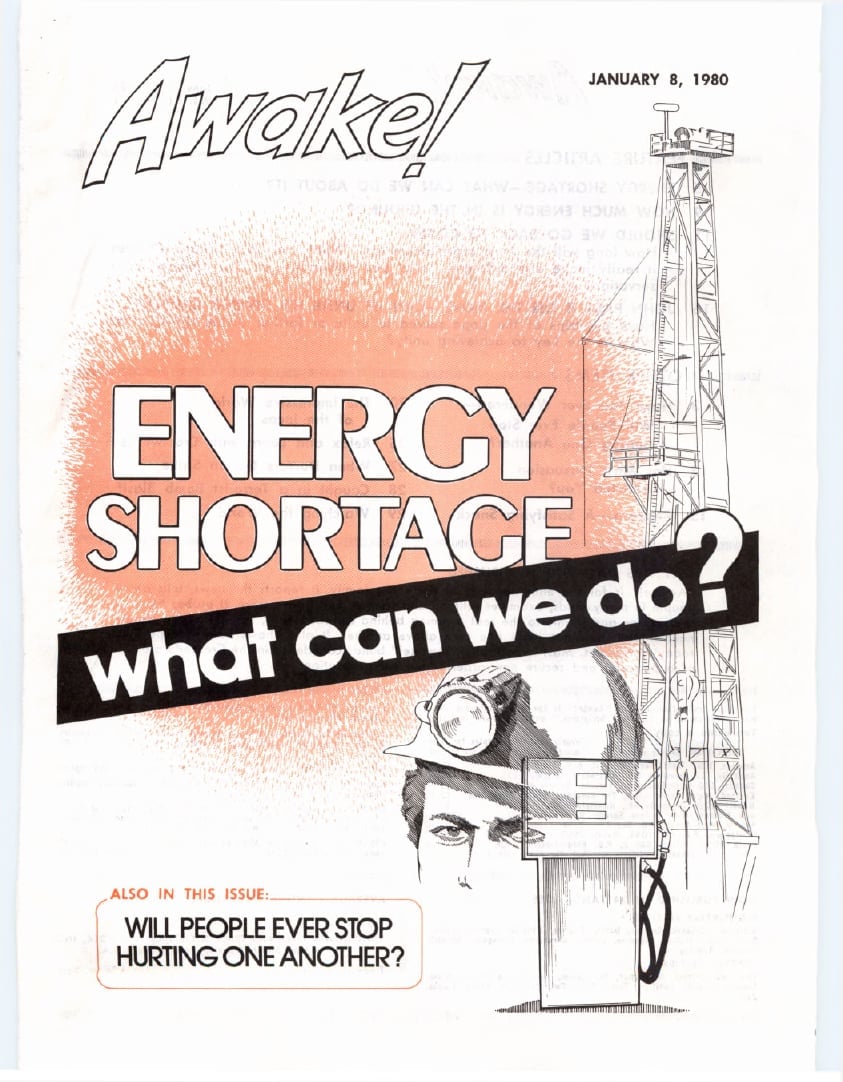
Awake! — January 8, 1980
Source: jw.org
Contents
Page Two
Will People Ever Stop Hurting One Another?
Energy Shortage—What Can We Do About It?
How Much Energy Is in the Ground?
Should We Go Back to Coal?
Has Mass Persuasion Affected You?
Popcorn—A Satisfying Snack
John Paul II on the Move—Can He Unite His Divided Church?
The Impressive World of the Incas
Relax and Learn With Crosswords
When Doctors Go on Strike
Caught in a Terrorist Bomb Blast!
Watching the World
Your Youth—Getting the Best out of It
Jews and Arabs Uniting
Page Two
Page Two
5 ENERGY SHORTAGE—WHAT CAN WE DO ABOUT IT?
9 HOW MUCH ENERGY IS IN THE GROUND?
11 SHOULD WE GO BACK TO COAL?
How long will the earth’s petroleum last? What are the alternatives? Does it really make any difference what you personally do about energy conservation?
16 JOHN PAUL II ON THE MOVE—CAN HE UNITE HIS DIVIDED CHURCH?
Have the trips of the pope served to unite or further divide the Church?
What is the key to achieving unity?
Will People Ever Stop Hurting One Another?
Have You Ever Wondered—
Will People Ever Stop Hurting One Another?
IT’S not uncommon to hear that someone’s feelings have been hurt. That kind of hurt often lasts even longer than when the injury is physical. Perhaps it seems that life will always be like this. But there is sound reason to believe that something better is possible. To appreciate how that can be, it’s helpful to consider first—
WHY DO PEOPLE HURT ONE ANOTHER?
Usually it’s because a person is thinking strictly about himself and his own feelings. He may not really want to hurt anyone, but, for the moment, selfishness crowds out any concern for others.
For instance, a man may work all day under a disagreeable boss. His frustrations boil, but he needs the job so he keeps quiet. But what happens when he gets home? All he can think about is his own hurt. He lashes out at his wife, who also may have had a difficult day. She, in turn, may take her hurt out on the children.
If a person is overly sensitive, he can allow the smallest incident to cause him to hurt another. In a large city one family’s clothesline pole fell into a neighbor’s backyard causing some damage. This sparked two years of hostility between the families, and finally the couple who owned the pole was mercilessly gunned down by the neighbor. Imagine, all because of a broken window and a few crushed shrubs! Touchiness and self-centeredness crowded out any feelings of compassion.
So pressure from others, frustrations, being touchy—all of these can cause us to strike out against others. Sadly, so often those we hurt are our own loved ones.
WHAT CAN HELP US TO OVERCOME THE PROBLEM?
There are a lot of ideas about this. But who really knows us better than anyone else? Isn’t it our Creator? What practical advice does he give?
“Finally, all of you be like-minded, showing fellow feeling, having brotherly affection, tenderly compassionate, humble in mind, not paying back injury for injury or reviling for reviling.”—1 Pet. 3:8, 9.
The need to have “fellow feeling” is stressed. Put yourself in the other person’s shoes. Isn’t this often the answer? Before you speak, ask yourself, ‘How would I feel if someone said the same thing to me? Would it hurt?’ If so, then why say it?—Luke 6:31.
Having “fellow feeling” will enable us to realize that those who treat us harshly may be under pressure, tired or ill and may not intend to irritate. Such empathy on our part can enable us to avoid returning injury for injury.
Though the Bible’s counsel is good, those who have tried it realize that it’s not always easy to apply. Why is this?
IS SOMETHING ABOUT THE HUMAN MAKEUP INVOLVED?
If we’re honest, we have to admit that we all have a tendency to do bad. As the Bible explains, we are born with an inheritance of sin.—Ps. 51:5.
“That’s just it,” some will argue. “We are all born sinners. We’re weak and naturally do bad. There’s nothing we can do about it. It’s just the way we are!” Quite to the contrary, we can avoid being overwhelmed by our sinful tendencies. In fact, knowledge of our sinful condition can make it easier to avoid hurting others. How so?
If we realize that we are sinners like everyone else, we hardly can feel superior to others. Recognizing this makes it easier to follow the Bible counsel: “Clothe yourselves with the tender affections of compassion, kindness, lowliness of mind, mildness, and long-suffering. Continue putting up with one another and forgiving one another freely if anyone has a cause for complaint against another. [Why?] Even as Jehovah freely forgave you, so do you also.” (Col. 3:12, 13) Such a person remembers that he has often begged forgiveness from God and been freely forgiven. This enables him to put up with the weaknesses of others, even if he has a legitimate “cause for complaint.”
WHAT ABOUT A WHOLE WORLD WITHOUT HURTFULNESS?
Such is possible—indeed, certain—for God promises to destroy all who are unwilling to live at peace with their fellowmen. After describing the “destruction of the ungodly men,” the apostle Peter writes: “There are new heavens and a new earth that we are awaiting according to his promise, and in these righteousness is to dwell.”—2 Pet. 3:7, 13.
The warm condition that now exists among those who follow Bible principles will prevail earth wide. People who formerly displayed beastlike dispositions will manifest gentleness. The prophet Isaiah describes this figuratively, saying:
“And the wolf will actually reside for a while with the male lamb, and with the kid the leopard itself will lie down, and the calf and the maned young lion and the well-fed animal all together; and a mere little boy will be leader over them. . . . They will not do any harm or cause any ruin.”—Isa. 11:6-9.
Just imagine, no one will “harm” or hurt another! God will see to it that sin is wholly eliminated, taking with it all the emotions that incite strife.
Energy Shortage—What Can We Do About It?
Energy Shortage—What Can We Do About It?
HOW will the impending global shortage of energy affect you? Is it real? Or is it a hoax? Will it strike soon? Or is it only something for our children and grandchildren to worry about?
During the past year, the world found that these questions were thrust upon it. Energy suddenly became the number one concern of many millions of people.
In Greece, motorists were restricted to driving only on alternate weekends. Tanzania introduced gasoline rationing. Waits of several hours in long gas lines became commonplace in Turkey, Ireland and the United States.
“Pulling into a service station is beginning to seem like entering a combat zone,” said Time magazine in May. “Frazzled and angry drivers are starting to boil over.” In California, a frustrated man drove into a station ahead of a quarter-mile (.4-km) line of cars and used a pistol to keep other angry customers at bay while he pumped gas into his tank. Two New York motorists were killed in gas-line disputes. And a few beleaguered service-station attendants even took to carrying guns to keep the peace.
Dizzying Price Hikes
Added to the scarcity were staggering price jumps in many lands. By mid-1978, motorists in Turkey were paying more than three times as much as they paid for gasoline just a year before. Their price of about $2.80 per gallon ($.75 per L) was equaled by France, and in other countries the price actually passed $4 ($1 per L) by late 1979. Philippine drivers had to pay about two thirds more for gasoline than they did the previous year, as did Americans, who had long been spoiled by low fuel prices. And by late summer, Britons were paying almost 50 percent more for gas than they did last January. Even Japan’s already high prices climbed about 40 percent in a year.
Truck drivers particularly felt the crunch as diesel-fuel prices kept pace with gasoline. As one Ohio trucker complained: ‘When you get only three or four miles to the gallon (80 or 60 L/100 km) that’s rough.’ And, of course, such increases in transportation costs affect the price of almost everything you purchase.
The price increases for home heating oil world wide are especially disconcerting because they have their greatest impact on the poor. People must have heat, even though they do without a car. Starting last winter, the average price for heating oil in the nations of the European Economic Community rose over 60 percent by fall and was still growing rapidly. The Swiss and the Germans had experienced a near doubling of oil prices by late summer. It is said that many canceled vacation plans for this reason.
In the United States, where heating oil prices were expected to rise sharply by this winter, the New York Times stated: “The average low-income family that uses oil (as do most families in the Northeast, whatever their income) is going to see its home-heating bill increase by $400 or more, a major financial blow.” Since heating costs for businesses go up at the same rate, prices of foods and other necessities get a boost as well.
All these price rises are pushing developing countries, many already enormously in debt, even farther toward the brink of bankruptcy, with ominous consequences for the world economic system. Badly needed modernization programs must be slowed or stopped.
All of this is making energy limitations more of a reality to the world. Is there anything that we personally can do about it, at least to ease the effect on our own lives and thereby contribute to overall energy conservation?
Ways That You Can Conserve
The fact that there is a great deal of energy being wasted world wide shows that there is room to make adjustments. According to World Bank figures, the average American uses more than twice as much energy as do individuals in the other industrialized countries.
Of course, some persons may feel that there is not really much point in trying to conserve energy. After all, how much difference will the frugality of a few people make? Regardless of what others do, there can be benefits to the one who conserves—not only financial savings, but benefits in terms of health and safety.
Aside from owning more fuel-efficient autos, those who wish to conserve energy can reduce fuel consumption in any car. A major gas waster is speed. It is claimed that as much as one fifth or more of the gas can be saved by driving 55 miles per hour (89 km/h) instead of 70 mph (113 km/h). And there is another real benefit to those who drive more slowly—safety. Though some do not agree that dropping the U.S. speed limit to 55 mph in 1974 was the entire reason, nevertheless, more than 10,000 fewer people died on American highways that year than in 1973. Also, the number of fatalities per 100 million miles (161 million km) driven dropped from 4.11 to 3.52. The Federal Republic of Germany, with no speed limit on superhighways, has more than twice this fatality rate.
In addition to the major energy savings from efficient autos and lower speeds, there are numerous small things that you can do to save gas. Though each may produce only small savings, if taken together the total can be significant. The chart on page 6 lists some of these ways to conserve.
Another method of saving energy is to avoid overheating homes and businesses in the winter and overcooling them in the summer. The benefits are more than financial. “One of the commonest causes of ‘catching cold,’” says Dr. Harry Johnson in Invitation to Health, “is the overheating of homes, shops, offices, schools, and almost every other place where people gather.” He notes that very warm overdry air “tends to dry out the air passages of the nose and throat and to lower their resistance to infection.” And lowering a home thermostat by just 6 degrees F (3.3 degrees C) may save 35 to 40 percent on fuel bills. Often it could be lowered even more if warmer clothing were worn indoors.
Even greater benefits can be gained by cutting back on the use of air conditioning. Most air-conditioned buildings have been kept colder than necessary for comfort. Of course, some persons like it cooler and some like it warmer, but tests show that 97 percent are comfortable at 78 degrees F (26° C). And it takes 60 percent more energy to cool a home to 72 degrees than to 78. As an energy-saving measure, the United States government issued a directive in July making it illegal to cool public buildings below 78 degrees. Dr. Stephen Rosen, an expert on weather and health, says: “Air conditioning probably postpones our acclimatization to summer heat,” and, as a result, “workers in air-conditioned quarters tend to have more ailments, feel more uncomfortable, have more headaches than those who work in non-air-conditioned spaces.”
There are many other things that you can do to conserve home heating fuel. The chart on page 7 lists some that, when combined, can significantly reduce your costs. For example, in many homes, adequate insulation alone can cut heating bills by as much as half.
Changes Ahead
Regardless of what people do in the way of conservation, the way of life to which many are accustomed may be in for a change. Will they finally have to give up traveling in the family automobile and go back to public transportation to save fuel? Will they be forced to cut back on their free-and-easy use of air conditioning, stop heating their backyard swimming pools, and dim streets now brilliantly lighted by advertising signs?
“But,” they may object, “not so fast. Before you take away all our laborsaving appliances, our electric can openers and carving knives, our electric shavers and toothbrushes, our electric lawn mowers and hedge clippers, our gasoline motorboats and snowmobiles—what about some of the other sources of energy? Aren’t there other things we can fall back on if the oil runs out?”
Others protest that the shortage is not so bad as it is made out. They hear about the oil glut on the West Coast in the United States because of more oil coming in from the new Alaskan field than can be fed into Western refineries or transported to the East. There is said to be still a large surplus of natural gas, tied up in political wrangles about how much to charge for it. Mexico reports discovery of an oil field that may be larger than that on the Arabian Peninsula. What does all of this indicate?
In recent surveys in the United States, two thirds of the people voiced the opinion that the fuel shortage is a hoax. Some believe it was foisted on the public by conniving oil companies to fatten their profits. The situation is surely confused, and confusing. Nonetheless, we need to face the realities of the immediate future. Every one of us is concerned, because our daily lives will be affected by the outcome of the fuel crisis.
Other Sources of Energy
It is true there are many possible sources of energy to which we might turn to lessen our dependence on petroleum. Coal is still abundant in many parts of the earth, enough for a long time to come. Already energy from nuclear fission has become an important part of the electric power supply in several countries. The reserves of uranium appear likely to outlast the petroleum, but they are becoming more expensive to mine and refine. Looking farther ahead, we are told that nuclear fusion promises unlimited energy drawn from the oceans’ water.
The energy in sunlight is constantly supplied from an inexhaustible source. Man has long used power from the sun indirectly, by burning wood, and through water-powered generators and windmills. It may be possible now to generate electricity from the sun’s heat and light. Any practical system for getting power from the sun would provide an ideal solution to the energy problem, because the sun shines everywhere.
Of course, when we talk about replacing one kind of energy with another, we recognize that not all kinds are equally useful. Coal can replace oil to drive electric turbines or locomotives, but not to run automobiles. Nuclear power is practical only in very large power plants, but solar power might be found useful in units small enough for individual homes. Hydroelectric power must be carried on high-power lines from river dams to cities. Geothermal heat is useful in volcanic regions, but not everyone lives next to a volcano.
Also, some energy sources cause pollution, which becomes intolerable on a large scale. Coal furnaces put smoke and soot into the air and ash heaps on the ground, hydrocarbon fuels are responsible for smog, and nuclear energy worries us with its radioactive emissions and long-lived wastes. Wind, water and solar power are free of such handicaps.
Financial interests rooted in the present economic system also have to be considered. Large investments of capital in power plants and extensive distribution networks might become obsolete with some foreseeable shifts in energy sources. There will be resistance to change, even a change that might be clearly desirable or inevitable in the long run.
[Box/Picture on page 6]
Fuel saving when you drive
DO
Inflate tires 3 to 5 pounds (0.2 to 0.35 kg/sq cm) over
recommended pressure [up to 32 pounds per square inch (2.25
kg/sq cm)]
Use radial tires
Use “low friction” or synthetic oil
Keep engine in tune
After starting, get car moving immediately (slowly for first few
minutes)
Avoid complete stops at temporary obstructions such as stoplights
by slowing down well ahead
Stop engine when necessary to wait 30 seconds or more
DO NOT
Use snow tires any longer than necessary
Carry unnecessary items in trunk (reduce weight)
Start car moving in “jackrabbit” fashion
[Box/Picture on page 7]
Fuel saving at home
DO
Add insulation to ceilings and walls
Install double-pane or storm windows and weather-strip all outdoor
openings
Shut off heating in unused rooms and close doors
Keep drapes and furniture from blocking heat outlets
Lower hot-water temperature (Many hot-water heaters use more
energy than an airconditioner, refrigerator, freezer and TV set
combined)
Wash and rinse laundry in cold water
Take more showers than tub baths (Showers use about half the hot
water)
Use low-wattage or fluorescent bulbs where possible
Shut off lights not being used
Close fireplace or wood-stove damper when not in use
DO NOT
Use pilot light on gas stove (pilot lights use up to half of all
cooking gas); install electric igniter
Keep fire high after food on stove reaches boil (will cook no
faster than steady simmer)
Rinse dishes with running hot water (Use cold water or dip in pan
of hot water)
Let hot water run while wet shaving
How Much Energy Is in the Ground?
How Much Energy Is in the Ground?
COAL and petroleum have been main sources of energy since the beginning of the Industrial Revolution in the early 19th century. But they are energy sources that are generally classed as not renewable. So the burning question for us today is, How long can we depend on these fossil fuels before they are all used up?
Coal was the first to be exploited as Europe and the United States plunged into the industrial age. It came to be used in great quantities in the manufacture of steel and cement. Coal supplied power to railway locomotives on land and steamships at sea. We burned it to heat our dwellings and workshops. Beginning in the late 1800’s, coal was also used to run electric generators in central power plants.
When petroleum became available, its abundance and low cost led to its use in place of coal for many purposes. Importantly, the convenience of liquid fuel and the ease of igniting it promoted the rapid proliferation of automobiles for private use, trucks for hauling freight, and airplanes for rapid travel. Industrialized nations came to rely heavily on petroleum as an indispensable source of energy.
Profligate Use of a Resource
The promise of fabulous profits prompted enterprising oil drillers to get the first foothold in rich new oil fields. The natural gas that blew out of many wells was considered only a by-product, sometimes almost a nuisance. At the wellhead, its value was rated so low that it was often burned off merely to get rid of it. But with networks of pipelines, it could be profitably delivered to industrial plants and ordinary homes at very low cost.
In oil-rich countries the profligate use of energy was encouraged in every way. It was so cheap that waste was condoned, and conservation was not worth thinking about. Forward-looking persons realized that this could not go on forever; sometime the pools of petroleum must become exhausted. But the known reserves of petroleum at a given time were sufficient for many years’ use, and discoveries of new fields kept adding to the reserve faster than it was depleted.
Mass production of automobiles brought their price within the reach of nearly everyone, and automobile manufacturers grew to be giant corporations, vying to outsell one another with alluring gadgets added to each new year’s models. Governments taxed the sale of cheap gasoline and built superhighways everywhere. Cars were sold by the tens of millions to people eager to travel ever faster and farther. Oil companies followed the policy of looking for maximum immediate profits, and little concern was shown for the shortages that were bound to fall on a future generation. But now that generation has arrived.
Determining How Much Is Available
Earlier optimism about how long the petroleum would last was shattered by the political embargo imposed by the Arab nations in 1973. An international panel of experts in 1978 warned that the supply of oil would fail to meet the increasing demand at the latest within 20 years, and perhaps in as few as five. Recent events have prompted alarm that a permanent world shortage is likely by the early 1980’s.
Serious problems are suddenly upon us. The supply of oil is no longer determined solely by the technological ability to find and produce it. It is affected even more by political maneuverings. Governments have imposed complex tax structures and artificial price controls. Oil executives complain that there remains little incentive to undertake expensive drilling to find new fields or to build the new refineries needed to supply the relentlessly growing demand.
Multinational corporations have promoted the production of oil in once backward countries for export to industrial countries. Now the most plentiful supplies of oil and the largest consumers of oil are found in different, often antagonistic, political domains. The OPEC nations, complaining that they had been exploited by more powerful nations, banded together to restrict the supply and thus raise prices and enforce political demands. To stave off the threat of new embargoes, political leaders talk about conservation and alternate energy sources. However, their proposals to reduce speed limits on the highways, to turn down the thermostat on heaters, and greatly to increase the price of fuels meet with indifference and even indignant resistance.
But the fact must be faced. No matter what steps are taken to conserve and stretch out the supply, the world’s petroleum is already falling short of the demand. It is tantalizing to be told that the rock pores of exhausted oil pools still retain two to three times as much oil as has been pumped out, but this can be recovered only in small part by expensive methods. Even the discovery of large new fields, such as those in Alaska and in Mexico, can do no more than postpone for a few years the ultimate depletion of the world’s petroleum. It will inevitably run out in the next few decades. What then?
[Chart on page 10]
ENERGY FROM: USE PER YEAR: WHAT’S LEFT:
U.S. WORLD U.S. WORLD
Petroleum 38 107 175 3,300
Natural Gas 20 37 200 1,500
Coal 13 94 11,000 35,000
Hydroelectricity 3 12 Renewable
Nuclear Fission 3 5 230 670
TOTAL 77 255
The numbers in this table are in terms of the relative energy equivalent of each source. The units are quadrillion (1015) of British thermal units. One Quad is 1,000,000,000,000,000 B.T.U. One Quad is equivalent to 170 million barrels of oil, or one trillion cubic feet of natural gas, or 40 million tons of coal, or 2100 tons of uranium oxide and is sufficient to generate 100 billion kilowatt-hours of electricity. The numbers in the first column are fairly exact. Those in the last two columns are estimates.
Should We Go Back to Coal?
Should We Go Back to Coal?
UNTIL 1940, coal was the world’s chief commercial source of energy. Since then the amount of coal mined has changed but little, but the use of petroleum and natural gas has grown so fast that coal now supplies only 30 percent of the world’s energy. This has not been because of any problem of supplying coal, but basically because petroleum was cheaper. If oil comes to be too expensive and finally runs out, can we not switch back to coal?
There is certainly plenty of coal. There is enough in known deposits to supply all the energy needed for at least 150 years. Many new mines would have to be opened, and transportation facilities by railroad and steamship would have to be expanded to match, but the coal is there.
For generating electricity and for manufacturing, coal is a practical substitute for oil. But to heat the home, it has obvious drawbacks.
Heating Our Homes
Many of our older readers will recall the daily wintertime chore of shoveling coal into the furnace out of a black, dusty bin, and later shoveling the even dustier ashes into barrels to be taken to the dump. And some skill and patience were needed to kindle a bed of coals after the fire had gone out. When these onerous chores are compared with the convenience of simply adjusting a thermostat that automatically turns on the gas or oil-injection device and ignites it from the pilot light, few would relish a return to the “coal age.”
Remember, too, how in towns or cities where everyone heated with coal, a freshly fallen blanket of snow was quickly darkened by the soot falling from hundreds of chimneys. A generation accustomed to the cleanliness and convenience of petroleum fuels will be reluctant to make room again for a coal bin in the house.
What About Automobiles?
When it comes to running our automobiles without gasoline, coal is out of the question. Only liquid or gaseous fuels will work in an internal-combustion engine. But, as mentioned above, coal differs from petroleum largely in its hydrogen content. Coal can be hydrogenated to convert it to a liquid or gaseous fuel. This was done on a large scale to supply Germany’s need for gasoline in World War II, and the process is used in South Africa today. However, it will require a major mobilization of the petroleum and chemical industries, probably with government subsidies, to produce synthetic fuels on the scale needed to replace oil. In the near future, such fuels will be available only in small quantities and at very high prices.
A more immediate possibility is to power automobiles with electric storage batteries. The electric automobile is already fairly common in some cities, providing local transportation for individuals or families. The batteries are kept charged by plugging them into a utility outlet in the garage. However, the speed, range, and capacity of such cars are much less than today’s average motorist demands.
Larger electric-powered cars or trains are well suited to mass transportation. Electric trolley cars, drawing power from an overhead wire, were common in city and interurban travel before automobiles and buses displaced them. High-speed electric trains are still common in Europe and Japan, as well as in metropolitan subways. All of this is compatible with power generated in central plants from coal, but it implies a shift from the individual motorcar back to mass transportation.
Pollution Problems Continue
By a change from oil to coal, air pollution will be changed, but not eliminated. One of the principal contributors to smog, the partially burned hydrocarbons from automobile exhausts, will cease to be a problem, but the oxides of nitrogen and sulfur may be as bad or worse with coal. More efficient combustion will have to be achieved to avoid a return to the smoke-laden atmosphere of industrial cities of 50 years ago.
Another kind of pollution is unavoidable and irreversible as long as any kind of fossil fuel is burned. This is the buildup of carbon dioxide in the atmosphere. Since the beginning of the Industrial Revolution, we have taken so much carbon out of the earth and put it into the atmosphere as carbon dioxide that its global concentration has increased by 5 percent. Some scientists believe that the climate may be delicately balanced at the normal concentration, and if this is disturbed too much the whole earth may be warmed enough to melt the Arctic and Antarctic ice caps. There is even concern that it could get too hot to support life.
While other sources of energy may ultimately supply the bulk of man’s needs, it appears that none of them can be developed soon enough to compensate for the rapidly vanishing reserves of petroleum. The only energy source that can be exploited soon enough to fill the gap is coal.
But could the use of coal, then, really be the “solution” to the energy problem? The Bible shows that God’s purpose is for all this earth to become a paradise. Dependence on an energy source that pollutes the environment is not consistent with that. Furthermore, the Scriptures state that God made the earth to be inhabited forever, with God-fearing people enjoying eternal life on it. (Isa. 45:18; Ps. 96:10-13; John 17:3) Surely, then, he must have made available stores of suitable energy that would last beyond the 1980’s—yes, beyond the next 150 years.
What energy sources fit such a description? How can they be utilized? Future issues of Awake! will consider these questions, as well as what men are doing to cope with their immediate problem.
Has Mass Persuasion Affected You?
Has Mass Persuasion Affected You?
by “Awake!” correspondent in Australia
DURING World War II, the term “brainwashing” was introduced to describe methods employed by one group to force its ideas upon another group. An individual’s previous ideas would be “washed” from his brain and replaced with new ideas and beliefs. The techniques used and the reasons for their use give some insight into the workings of the human brain and how it can not only be “washed” but also be persuaded to adopt viewpoints held by the majority.
When the brain is subjected to abnormal stress, it sets up an inhibitive reaction for protection against brain damage. This process involves three stages: (1) A leveling of responses. Response to important and trivial matters becomes the same. Feelings do not vary greatly. (2) Trivial things cause greater disturbance than matters of real importance. (3) A complete reversal sets in. Likes become dislikes and vice versa. At this stage the “brainwasher” implants his point of view. Then the brain will accept ideas previously hated.
The person most easily brainwashed is the “normal,” average individual. Such a one is already conditioned to accept opinions of others rather than to form strong convictions of his own. On the other hand, those hardest to brainwash are ones with unconventional ideas and strong convictions and who are not afraid of what others think.
The Making of “Heroes”
An example of effects from mass persuasion concerns Australian bushranger Ned Kelly. He is often depicted now as a courageous “Robin Hood” and fighter against social injustices. He did, indeed, appear to be a remarkable man—handsome, tough in physique, clever and a good organizer.
But police records show charges against him that include assault, highway robbery, bank robbery, indecent behavior, drunkenness, horse stealing and multiple murders.
Are You Affected?
Often propaganda is indirect and can cause a change in thinking without one’s being aware of it.
In The Hidden Persuaders, author Vance Packard opens by saying: “[This book] is about the way many of us are being influenced and manipulated—far more than we realize—in the patterns of our everyday lives.” He later quotes Dr. Ernest Dichter, president of the Institute for Motivational Research, as saying that the successful ad agency “manipulates human motivations and desires and develops a need for goods with which the public has at one time been unfamiliar—perhaps even undesirous of purchasing.”
Mr. Packard shows how psychological consultants are employed to investigate even our baser motives. Among the studies that he cites is one done for a fountain pen company “on the sensuality and sexual connotations of pens.” He labeled an investigation by another corporation as “a classic example of the way motivation analysts found merchandising possibilities in our deeper sexual yearnings.” Packard further notes that certain advertisements use “overtones of masochism, body exhibitionism, and so on.”
You Can Protect Yourself
How can you protect yourself against such subtle persuasion? The following five points can be helpful:
1. Have strong convictions: As noted above, the person most easily brainwashed is the one quickly swayed by others. Do not go along with an idea just because your associates accept it. Make sure that the views you adopt are truthful. The best way to do that is by comparing them with the inspired Word of God, which is ultimately “the truth.”—John 17:17; 2 Tim. 3:16.
2. Find the reason: Inadvertently we often accept attitudes without knowing what is behind them. For instance, people in your community may have a negative view of certain races or ethnic groups. But why? If you find the reason unconvincing, why adopt the viewpoint?
3. Resist improper thoughts: A dry sponge when immersed in liquid absorbs quite a lot. Even after it has been wrung out several times, some of the liquid remains. As for our minds, it is hard to avoid seeing, hearing or otherwise experiencing improper thoughts. But must we soak our minds full of them? Doing so will adversely affect our judgments and actions. How much better to resist improper thoughts and to dwell upon things that build up!—Eph. 5:3-5.
4. Speak up for what you know to be right: This will give you opportunity to test what you believe and more firmly entrench the truth in your life. If you are convinced of the truth of a matter after thorough search, do not be disconcerted by ridicule from others. The Bible shows that Noah was convinced there was going to be a worldwide flood and he talked to others about it. (2 Pet. 2:5) Indifference on the part of Noah’s contemporaries did not change the facts. There was a global flood.—Gen. chaps. 6-8; Matt. 24:37-39.
However, with regard to speaking up for what is right, it is important to keep in mind this Scriptural guideline: “He that is correcting the ridiculer is taking to himself dishonor, and he that is giving a reproof to someone wicked—a defect in him. Do not reprove a ridiculer, that he may not hate you. Give a reproof to a wise person and he will love you.” (Prov. 9:7, 8) No good purpose is served by debating or wrangling with someone bent on defending his personal opinion regardless of whether it is right or wrong.
5. Live the truth: Do not look for excuses to compromise what you know to be right. Remember, if something is right and proper, it will work out for your good. Do not be tricked into thinking that you are missing out on something or that you are unduly restricted because you conform to what is right.
In some respects our minds are like a container of water. If one adds just a drop or two of ink, all the water quickly becomes colored. Do not allow mass persuasion by popular opinions to sway you into accepting viewpoints that the Scriptures show to be wrong. Rather, obey the inspired counsel: “Whatever things are true, whatever things are of serious concern, whatever things are righteous, whatever things are chaste, whatever things are lovable, whatever things are well spoken of, whatever virtue there is and whatever praiseworthy thing there is, continue considering these things.”—Phil. 4:8.
Popcorn—A Satisfying Snack
Popcorn—A Satisfying Snack
POPCORN is no “junk food.” It is a nutritious whole-grain snack.
The kernel is practically all hard starch, but inside it there is a tiny amount of moisture that turns into steam when heated and explodes into a fluffy, fragrant, white ball 30 to 40 times its original size. At the same time that warm, tantalizing aroma fills the room.
Its Value as a Food
Nutritionist Kay Munsen of Iowa State University says: “Plain popcorn is an ideal snack. It is not sugary, sweet, fatty, too salty, expensive, or fattening.” And Dr. Betty Alford, chairman of nutrition and food sciences at Texas Women’s University, has stated that one big advantage of eating popcorn is that “it’s filling but you’re not ingesting a lot of calories.” In fact, one cup of unbuttered popcorn has 23 calories compared to 230 calories in one cup of corn chips.
If you don’t drink anything the whole time you’re eating it, the dry popcorn draws the fluids out of your system and gives your saliva glands a healthy workout. Besides, it is like swallowing a sponge that soaks up stomach acids, and does away with heartburn and indigestion.
According to the U.S. Department of Agriculture, popcorn is 77 percent carbohydrate, 12 percent protein, 5 percent fat and 2 percent minerals. The tiny kernels contain the B-complex vitamins—niacin, thiamine and riboflavin, as well as vitamin E.
The American Dental Association recommends popcorn as a snack because it is crunchy, not sticky, and contains no sugar. So much chewing has to be done to break it up that eating popcorn is good exercise for teeth and gums and has a certain amount of cleansing action.
Popcorn was introduced to early American settlers by the Indians. Today it is popular at movies, ball parks, zoos, the circus and all sorts of sporting events. in the United States, however, about 85 percent of popcorn consumed is prepared at home.
Some Tips on Preparing It
Popping the small roundish kernels is so simple that children delight in doing it. It can be popped in a wire basket shaken over the fire, in a skillet, automatic frypan, Dutch oven, or a more elaborate electric popper.
Watch that you don’t put too much corn in the popper! About one half cup of kernels with three tablespoons of oil (butter will burn) will fill a four-quart popper heaping full.
A good way to test a container is first to put in the oil and one kernel. When it pops you knows the oil is heated properly. Add the rest of the corn and cover. Be careful not to scorch it. And be sure the steam can escape or else it will make the popped corn tough and soggy. Salt, added before popping, tends to toughen the corn too. If you are not using an electric popper, shake the container constantly to make sure every kernel is heated equally and none is allowed to scoot off to the side.
If the popcorn you purchase comes in a glass jar or other airtight container, it is good to keep the container closed tightly to preserve just the degree of moisture that comes in the corn. Do not refrigerate but keep at room temperature. If low in moisture content because it is old or has not been vacuum sealed, then put it in a cheesecloth bag, submerge it in water, drain and hang up in a cool cellar for at least 24 hours before popping.
Freshly popped corn, warm and fragrant, is hard to improve on. But if there is a bad aspect, it might be that it can be served in so many combinations that make it a confection. Who can resist caramel or molasses popcorn balls? There are recipes for making peanut-butter nougat bars, popcorn mint chocolate bars, even popcorn pies. Or, if you prefer, it is easy to add to buttered popcorn a pinch of garlic and onion salt and some shredded Cheddar cheese, melted and gently stirred to create a mouth-watering snack!
This is far afield from the simple bowl of lightly buttered popcorn with which we started. But, however you serve it, a big bowl of popcorn can be a fragrant, hunger-satisfying snack.
John Paul II on the Move—Can He Unite His Divided Church?
John Paul II on the Move—Can He Unite His Divided Church?
NEVER has a pope traveled so much in such a short period of time. Mexico, Poland, Ireland, the United States—John Paul II visited them all within the first year following his election on October 16, 1978.
Judging from the enthusiastic receptions he received in each country, a person might conclude that the Catholic Church is enjoying the best of times. In Poland, the pope’s homeland, there was a special welcome. About half of the country’s 35 million population were said to have seen him during his visit in June.
Does such interest in John Paul II reflect a strong Catholic Church, or something else? How have peoples been affected by his visits?
The Church in Crisis
Rather than being strong and enjoying the best of times, the Catholic Church is experiencing difficult times. “Our church,” wrote U.S. theologian Edward J. Foye, “is in a dangerous and unhealthy state.” (National Catholic Reporter, Oct. 19, 1979) “We’re in anguish,” said Monsignor John Tracy Ellis, dean of American Catholic historians. “There is not a seminary that is not divided between the right and the left and the status quo.”
In the United States alone, some 10,000 priests have left the priesthood since the mid-1960’s, and few persons any longer are choosing the priesthood as a profession. In 1965 there were 49,000 U.S. seminarians; in 1978, only 11,200. The situation with the nuns is even worse. In 1966 there were 181,421 of them, but the number has dropped by more than 50,000. Catholic schools in the U.S. close at the rate of almost one a week because of a lack of nuns.
In other countries visited by the pope the situation is perhaps even more critical. Reporting on last January’s trip to Mexico, the New York Times noted:
“Pope John Paul II will arrive in Mexico this week on a delicate mission—to forestall an open rift between the conservative and progressive wings of Latin America’s Roman Catholic Church. . . .
“His decision to go to Mexico reflects the gravity of the situation . . . Since 1968, the Latin American church has become deeply involved in politics, and progressive priests are rebelling against the traditional discipline of their bishops.”
“Profoundly Moved”—How?
During the pope’s visit to their countries, news commentators said the crowds were “profoundly moved.” But in what way? Editor-in-chief of The Observer of London, Conor Cruise O’Brien, wrote:
“If I could see any sign that people are behaving better, after watching and seeing the Pope, I would feel that they had indeed been ‘profoundly moved,’ and I would rejoice . . . Unfortunately, I can see no sign at all of such improvement. . . .
“The Pope condemned violence, repeatedly and in strong terms. The [Catholic] Irish Republican Army then gave a press conference in which it announced its intention of carrying on as usual.”
Six days after John Paul II appealed to Catholics in Ireland ‘to turn away from violence and return to the ways of peace,’ terrorists shot dead a 38-year-old Protestant dock worker. Apparently in retaliation, Protestants the next day killed a Roman Catholic man. “And so it all continues, just as we knew it would,” said an Irish parish priest.
Nevertheless, crowds were visibly moved by the pope’s presence. But it was in a way similar to that in which crowds are moved by the presence of a famous movie star or politician. Indeed, the pope would arrive with the colorful pomp and ceremony of a member of royalty—a spectacle to behold!
The pope’s training as an actor obviously helped him in his rapport with the crowds. He had toured Poland with a theatrical company before entering the priesthood. Kissing the ground on arrival, joking and singing with the people in their own languages, kissing babies and reaching out to clasp hands, the pope quickly became a popular figure in the countries he visited. Time magazine noted that he displayed “a deft politician’s hand that would have shamed Lyndon Johnson,” the late American president.
But despite the pope’s personal popularity, the U.S. Catholic of November 1979 observed: “We aren’t even listening, much less applying what he says to our lives.” Why not?
Why the Pope Is Not Heeded
There are a number of reasons. A fundamental one is loss of credibility. A Catholic from Philadelphia said of John Paul II’s visit to his city:
“He drove the parade route protected by the guns of hundreds of police, walked up the red carpet to the pinnacle of the $200,000 platform surrounded by the military plumage of the Knights of Columbus. Later he dined at one of the most luxurious mansions in our city, the cardinal’s home, accepted priceless art treasures from Caesar and then asked the St. Charles Borromeo seminarians to keep the Word of God pure. . . .
“And then this happy, friendly, gentle man who captured our emotions returned to Rome to his Castle Gandolfo, to his Temple St. Peter’s, to his armed Swiss Guards and to his library and museum of priceless treasures. . . .
“He told us of the greater responsibility of rich nations to redistribute their wealth to the poor. Should not that responsibility extend to the Vatican also?”—“National Catholic Reporter,” Oct. 26, 1979.
Virginia M. Rickmeier of Chicago, no doubt speaking for many Catholics, said: “Listening to the Pope, particularly about ‘worldly matters,’ would be easier if he practiced what he preached. It is somehow difficult for a family, struggling to meet day-to-day expenses, to think of giving to the poor when the pope lives in grandeur. How many of the laity can boast a summer residence? . . . How can one truly compare today’s papacy with all its pomp to the humble, yet strong and venerable Saint Peter?”—U.S. Catholic, November 1979.
Indeed, what a contrast between the splendiferous life-style of Catholic leaders and that of Christ and his apostles! Yet it is not because of this contradiction that most Catholics are not heeding the pope.
Birth Control
Perhaps the main reason that they are not heeding the pope is his view on birth control. As one person said: “When you believe the Pope is dead wrong on an issue, as in ‘Humanae Vitae,’ it is difficult to put much stock in further statements.”
About 50 years ago Pope Pius XI asserted in an official pronouncement that “those who indulge in [artificial birth control] are branded with guilt of a great sin.” Pope Paul VI did not want to put the Church’s doctrine of papal infallibility in question. So, in 1968, he issued his famous encyclical Humanae Vitae (Of Human Life), in which he affirmed that for Catholics “each and every marriage act must remain open to the transmission of life.”
It was this position that most Catholics were hoping John Paul II would change. A poll released on the eve of his visit to the United States showed that 66 percent wanted him to approve artificial methods of birth control. But what happened? On October 5 the pope told an assembly of U.S. bishops in Chicago:
“You rightly spoke against both the ideology of contraception and contraceptive acts, as did the Encyclical Humanae Vitae. And I myself today, with the same conviction of Paul VI, ratify the teaching of this encyclical, which was put forth by my predecessor ‘by virtue of the mandate entrusted to us by Christ.’”
Yet relatively few Catholic couples agree with the pope. And since neither do many priests, his directives go unheeded. “Who is the Pope to come into my bedroom?” demanded one Catholic mother years ago. “It seems to me all a matter of conscience.”
John Paul II would have done well to heed the apostle Paul’s advice at First Corinthians 4:6, as rendered by the Catholic Jerusalem Bible: “Remember the maxim: ‘Keep to what is written.’” By going beyond what is written in God’s Word, the pope has prolonged the tremendous dissent and division within his Church.
Celibacy
The long-existing Church decree prohibiting members of the clergy to marry has caused many of them also to turn a deaf ear to the pope. Literally hundreds of thousands of priests and nuns have quit since the 1960’s, largely due to this decree. Yet, on October 4, in Philadelphia, John Paul II restressed the need for priests to remain celibate.
However, this is not what the Scriptures teach. The Bible shows that even the apostle Peter and other apostles of Christ were married. The following day, October 5, Catholic columnist Gary Wills noted this in the Chicago Sun-Times, citing Mark 1:29-31 and 1 Corinthians 9:5. He then raised the question as to why the Church has covered up the existence of Peter’s wife, and explained:
“The answer, of course, is that Rome’s celibate priests tried to ignore the scriptural evidence for Peter’s married apostolate. They have assumed or asserted that only a celibate priesthood is worthy—thus calling Peter’s priesthood unworthy. The apostolic norm is denied . . .
“I find it odd that Pope John Paul, traveling as the successor of Peter, will emphasize in America the importance of a celibate priesthood when Rome is forever emphasizing the importance of St. Peter among the apostles, though he exercised that apostolate in the company of his wife.”
Thus, because of feeling unjustly forced to submit to a man-made law, many priests and nuns have left. Some have left the Catholic Church altogether, no doubt being reinforced in their decision by discovery of the Bible warning: “Now the Spirit manifestly saith, that in the last times some shall depart from the faith, giving heed to spirits of error, and doctrines of devils, . . . forbidding to marry.”—1 Tim. 4:1-3, Catholic Douay Version.
A Uniting or a Dividing?
Of course, the pope hoped by his visits to heal and unite the Church. But it seems the opposite has occurred. “We were beginning to speak to one another and to heal the wounds of the ’60s” said Monsignor John E. Egan of Notre Dame. “We were beginning to listen again, to hear other people’s views. We have now opened the wounds again. While we are all united in our admiration of the Pope, we are once more divided on the issues of the church.”
Yet more than merely the pope’s views on religious teachings are causing division and concern. A case in point is his handling of a scandal involving his friend, Polish priest Michael M. Zembrzuski, as reported in the National Catholic Reporter of September 21, 1979. Zembrzuski headed the monastic religious order Pauline Fathers (Order of St. Paul, the First Hermit) in the United States. But breaking his poverty vow, Zembrzuski ‘wheeled and dealed’ financially, squandering, it was claimed, millions of dollars in charitable donations.
Bishop George H. Guilfoyle and the then head of the Passionist Fathers in Chicago, Paul M. Boyle, were appointed as Vatican investigators. In an investigation taking years because of its complexity, they found Zembrzuski’s style of living “immoral,” “insidious” and a “scandal.” Among other things, they wrote:
“Father Zembrzuski entertained lavishly, spending huge sums of money on himself and his friends. His friendship with a woman, whom he supported generously with monastery funds, gave rise to many rumors and accusations.”
Guilfoyle and Boyle, in their final report to the Vatican in February 1979, emphasized in the strongest terms possible that Zembrzuski and the priests loyal to him should be dismissed. But the recommendations went unheeded by the pope. To the contrary, Zembrzuski was honored by being included in the official entourage for the pope’s June visit to Poland.
Such actions cause many to wonder just what kind of man John Paul II really is. He seems to be a man of different faces, of contradictions. On the one hand he upholds unpopular, burdensome—even unscriptural—Church teachings that work hardships on his people. Yet, on the other hand, with the crowds, and especially the children, he appears compassionate and loving.
When convenient, the pope appeals to God’s Word and Christ’s example. Admonishing priests in Mexico to avoid revolutionary, subversive activities, he said: “The Gospels clearly show that for Jesus anything that would alter his mission as the Servant of Yahweh [Jehovah] was a temptation.”
Yet, does the pope practice what he here preached? Does he himself follow Christ’s example? How often have you heard him proclaim the name and purposes of “Yahweh, Most High over the whole world”? Yet Jesus said in prayer to Yahweh: “I have made your name known.”—Ps. 83:18; John 17:6, Jerusalem Bible.
The pope’s failure to make known God’s name and to stick faithfully by God’s Word, would suggest that John Paul II never will prove successful in uniting his divided Church, regardless of how many trips he makes.
The Impressive World of the Incas
The Impressive World of the Incas
LEAVING the city of Lima, our plane rapidly gained height in the direction of the Andes mountains. Soon we landed at Cuzco, the heart of the ancient world of the Incas!
The Inca Empire grew quickly from a tiny spot to an area the size of Belgium, Luxembourg, the Netherlands, France, Switzerland and Italy combined. Then, faster than its spectacular rise came a sudden fall at the hands of but a few Spanish adventurers.
Who were the Incas? What kind of life did they lead? What brought about their fall and disappearance?
Dawn of an Empire
Our Peruvian guide explained that the first Inca, Manco Capac, is said to have founded the city of Cuzco on a spot indicated by the sun-god. Historically, however, Inca history begins about 1200 C.E. At the time, the Incas were nothing but lords of Cuzco and one of the numerous Andean tribes. More specifically, “Inca” was the emperor’s title. In modern usage the people of the empire are understood by the term Incas as well, although they probably called themselves capac-cuna, that is, “glorious ones.”
The Inca war machine started slowly. In time, they met head on with the powerful Chanca tribe. But the Chancas were by no means willing to surrender. In fact, they made a surprise attack on Cuzco and invaded the city. Viracocha Inca escaped. But his son, Pachacutec, stood his ground. He organized the defense and routed the Chancas. Now the stage was set for the rise of Tahuantinsuyu (“the Four Quarters of the World”), the Inca Empire.
After his father’s death, Pachacutec (meaning “earth shaker”) was made Inca in 1438. Under him and the son who succeeded him the borders of the empire were pushed out until they embraced some 380,000 square miles (984,195 km2), largely in what is now known as Peru, Ecuador, Bolivia and Chile. Most of this expansion was accomplished in the space of a mere 30 years, between 1463 and 1493, and in some of the most rugged terrain on earth.
A Welfare State
Pachacutec excelled not only as a warrior but also as a civic planner and administrator. Commenting on the civic organization, our guide caused astonishment as he described the Inca Empire as a welfare state. No one went hungry, he explained, but on the other hand, no laziness was tolerated.
Every person belonged to an ayllu, a clan of families living in their assigned area. They shared land, crops and animals. The land was owned by the ayllu and was simply on loan to its members. Every year in the fall the land was reapportioned. According to the size of the family the land was either increased or decreased.
The mainstay of their culture was agriculture. The people had to plant for all: for the state, for the priesthood and for themselves. The crops from state lands were stored for use by the nobility, public servants and the army, as well as the people in times of crop failure.
As for taxes, these were exacted in the form of service on public works. Additionally, every able-bodied tax-paying Indian male was subject to do military service at any time.
What else was expected of the people? A notable Inca requirement was that every man should marry at the age of 20. And if he hesitated, the chieftain would select a wife for him.
While we pondered this form of regimentation, the guide touched on another aspect of it. Every 10 tax-paying workers were directed by a conka-kamayoc. Ten such groupings had a foreman over them. Ten foremen came under the jurisdiction of a superior, such as a village headman. A district governor was over 10,000 people. Ten districts fell under an apo, a governor of a quarter. The state itself had four quarters, divided naturally by the four roads that went out from Cuzco, the capital. The entire setup required 1,331 officials for every 10,000 people and provided control down to the last man in the state.
The “Divine” Inca
At the heart of Inca civilization was the emperor himself, who enjoyed maximum privileges as a “descendant of the Sun.” Usually a council of advisers chose as successor the most capable of the legitimate sons of the Inca’s coya, or principal wife. Although he had a harem of concubines, the coya was his real wife, and in most cases also his own sister.
The Inca was political ruler, head of the state religion and “divine” to the people. His rule was absolute and shrewd. How so?
The Inca’s many descendants occupied positions of trust as key administrators. For example, the governors of the four quarters were all blood relatives. And the Inca at the time of the Spanish conquest, Huayna Capac, is said to have had 500 male descendants.
Newly conquered populations were absorbed into the mainstream system of work service. However, suspicious sections of the subdued population were transplanted and loyal Quechua-speaking people called mitakona took their place and introduced Inca culture.
The Inca organization and integration was so well thought out that down to this very day it is in evidence. Some five million still speak Quechua, including the man who was acting as our guide. He compared the modern comunidades to the old ayllus. Agricultural practices, the character of the people, their music, all reflect the old Inca way of life.
Efficient Communication System
How was it possible to hold the vast empire together? Our guide pointed to the amazing network of roads and bridges and a courier system.
Mountain terrain making impractical the use of the wheel, the Incas never used it. So all roads were built for walking and llama transport. The 24-foot (7-m)-wide coastal road from Tumbes in the north to Purumuaca in Chile was 2,520 miles (4,056 km) long. The narrower Andean road was 3,250 miles (5,230 km) long, with 100 or more bridges.
Consider the efficiency of these highways. There was a system of distance markers every four and a half miles (7.2 km), and every 12 to 18 miles (19 to 29 km) there were rest stations. Additional smaller stations served the couriers or relay runners. Each runner, dressed in a distinctive checkered tunic, covered a mile and a half (2.4 km). In this way they could get a message over a 1,250-mile (2,012-km) stretch in five days!
Art and Architecture
In a local museum we discovered that Inca art was on the austere side. Their highly developed technique of weaving vicuña wool produced exquisite quality, but lacked imagination.
However, they excelled in the goldsmith trade. So highly prized was their art that goldsmiths and silversmiths lived in a separate district and were exempt from paying taxes. The Spaniards were thrilled with what they saw.
According to the way our guide described Cuzco, there was gold everywhere. On some of the buildings, there was gold plate. Strands of gold were woven into grass-thatched temple roofs. The Temple of the Sun and its enclosure were replete with golden objects everywhere.
But whatever other contribution the Incas made to culture, it paled beside their architecture and city planning. Their work with monumental rock masses remains unmatched in the Western world. The size and number of buildings are stupendous.
Sacsahuaman, the fortress for the protection of Cuzco, is claimed to be one of man’s greatest engineering feats. This structure is 1,800 feet (549 m) long. Three massive rows of stone walls, one above the other, reach up to a height of 60 feet (18 m). Some of the gigantic foundation stones weigh between 100 and 150 tons! The entire fortress is made up of some 300,000 stones.
Eagerly, we tested to see if we could insert a blade of a penknife between the rocks, but no! What system of polishing did they use to accomplish this? No one knows. What is more, these stones are locked in such a superb way that they have survived scores of earthquakes. And no one has been able to pry them out for other construction purposes!
…