Awake!, November 22, 1979
Download: PDF — Awake!, November 22, 1979
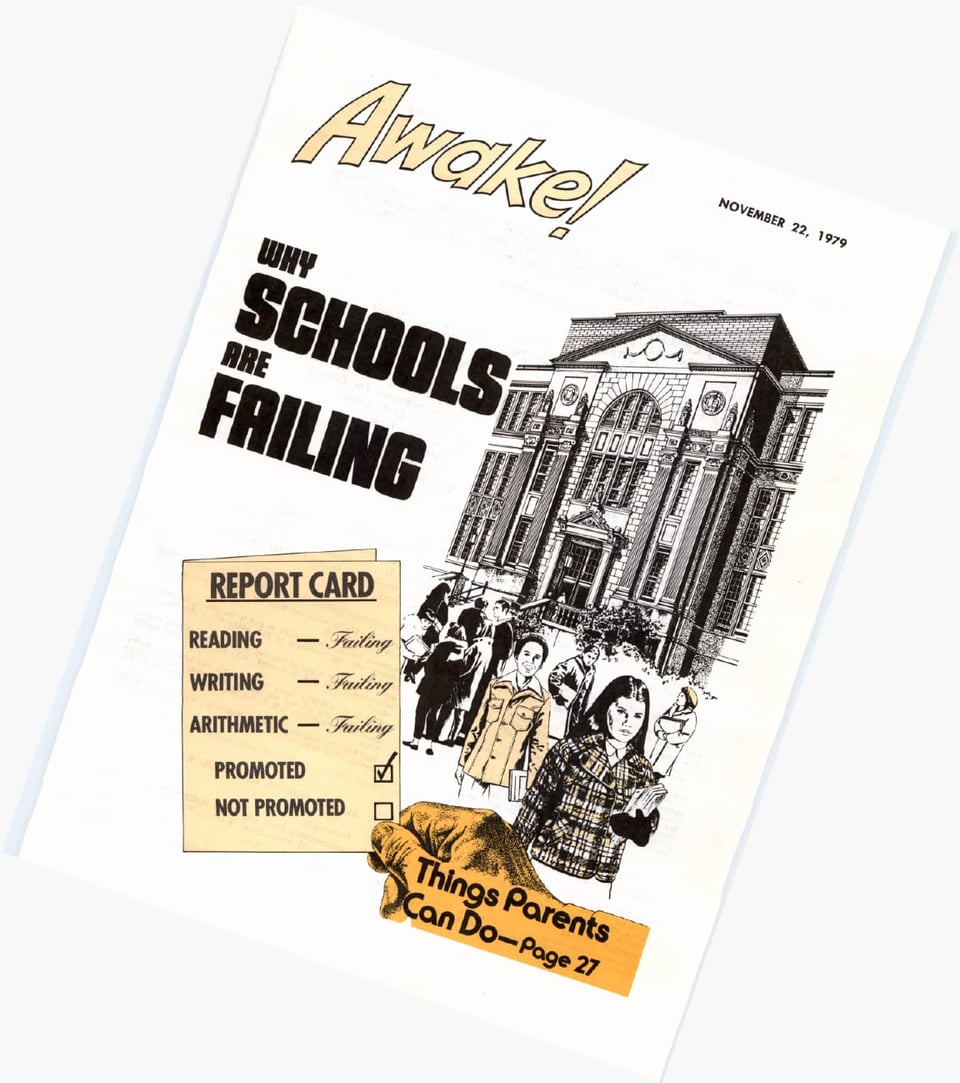
Awake! — November 22, 1979
Source: jw.org
Contents
Page Two
Today’s Children, Tomorrow’s World
The Schools Are Failing
Teachers Under Attack
Skills or Frills—Which Will It Be?
A Tale of Two Teachers—Why They Stopped Teaching
A Letter Revealing Youthful Integrity
Elementary Particles of the Atom’s World
College Admissions Tests Opened to Public
Amazonia—Center of Controversy
Insects Made It First!
Joyfully Serving with Constancy—Encouragement for Gilead School’s 67th Class
Parents—The Child’s First Teachers
Watching the World
What Happens to Us When We Die?
Bible Stories to Fascinate Children
Page Two
Page Two
If report cards were issued to public schools, many would receive failing grades. Some high-school graduates can’t read. Some teachers can’t teach. Some who can are quitting. Who is to blame? Any remedies? What parents can do
3 TODAY’S CHILDREN, TOMORROW’S WORLD
5 THE SCHOOLS ARE FAILING
7 TEACHERS UNDER ATTACK
9 SKILLS OR FRILLS—WHICH WILL IT BE?
11 A TALE OF TWO TEACHERS—WHY THEY STOPPED TEACHING
Today’s Children, Tomorrow’s World
Today’s Children, Tomorrow’s World
What will it be like?
“SCHOOLCHILDREN ADMITTED STRICTLY ONE AT A TIME.” This sign was on the door of a sweetshop in England. The children stole so much that the shopkeeper had to watch each one. The press release continued:
“From the surrounding schools, which are entirely typical, there emerges each day one of the most loutish, selfish and coarse breed of children ever produced, pushing and shoving their way on to buses, shouting obscenities across the road, and regarding pilfering as praiseworthy if they can get away with it.”
A teacher at one of England’s progressive “open classrooms” schools denounced the headmaster, saying:
“You have substituted a free-for-all atmosphere of total self-indulgence, self-pleasing do-what-you-want-for-the-moment. Chaos and anarchy are in possession. Discipline is frowned on as old-fashioned. Children are being seduced to behave in ways which are detrimental to them, both in their progress in learning anything and in producing antisocial behaviour. They are growing up ignorant, selfish, rude . . . lazy, effete.”
Those reports date back three and four years. A report this year shows no change. Under the heading “Britain’s Battered Schools,” it says the lack of academic achievements is frightening. Students “have not acquired a minimum acceptable standard in the fundamental skills of reading, writing, arithmetic, and communication.” It calls the progressive method with its clutter of ‘trendy’ subjects an “educational junkyard.”
In Canada the story of the schools is told in newspaper headlines: “Student reading skills are declining.” “Nobody fails now, high school diplomas called meaningless.” “If you want them to like you, pass them.” “Teachers tell of low morale, students’ lack of values.” “School vandals and violence stymie board.”
Reports from Australia: Discipline is a problem. Because of it teachers are leaving the profession. Incoming teachers are of poorer quality. Permissiveness and emphasis on individual rights, regardless of society’s needs, come first. Peer pressure, violent at times, forces hundreds of students to accept liquor and drugs.
Schools in the Soviet Union reveal partiality. The quality of schooling differs greatly—poor in the rurals, good in the cities. But everywhere the system produces cynics: “A typical high-school kid doesn’t believe in anything.” Bribes get students into the most coveted schools, and there is a thriving black market for books.
China seems remarkable. Visitors are impressed by the polite, disciplined behavior of the children. Students welcome visitors to their classes with a song and a dance. Recitations are impressive. Apparently there are no problems with drugs. However, the tours seem well planned and are carefully guarded. One reporter strayed from the tour route and found a gathering of children in the bathroom. One boy approached boldly, stood in front of him and urinated. All the others faced him and did likewise. After this, of the tours he concluded that “certain things are designed specifically for display.”
In Japan teachers complain that scholastic achievement is low. Violence and vandalism are widespread. One example: Thirty students, young teen-agers, five of them girls, beat six teachers with wooden bars and bamboo poles and smashed school windows and glass doors. But the outstanding element in Japanese schools is examinations. Public schools require students to take stiff ones to enter high schools and universities—and the quality school you get into depends on your grade. To get into quality private schools, examinations start with entering kindergarten. The examination to enter university takes days, is called “exam hell,” and results in several suicides every spring.
The most amazing university examinations occur in India. Indian students claim it is their birthright to copy and cheat. Last July, examinations at the University of Meerut resulted in riots. One press release said:
“Yesterday two students were killed and 40—including 30 policemen—injured as students and police fought pitched battles in the streets of Meerut and in adjacent college towns when armed police were deployed in examination halls to help invigilators [supervisors] to prevent cheating. Enraged at the deprivation of their ‘birthright’ the students went on a rampage.
“The present troubled examinations are a sequel to those in February which were declared invalid because of copying and cheating on a gigantic scale. At that time invigilators were threatened with knives and daggers while students copied from books and notes. Others took their question papers and answer books to nearby houses and restaurants where obliging friends were ready with answers. Outside the examination hall answers to questions were read out over the public address system at dictation speed.”
As a result, degrees from most universities are worthless, ignored by employers and institutions of higher learning. Literally illiterate graduates swell the ranks of the unemployed.
A survey in some 20 countries, involving 9,700 schools and 250,000 students, revealed a tremendous difference in achievement between students in industrial nations and those in less developed lands. As bad as reading and writing and arithmetic are in the industrial nations, they are worse in the less developed lands. In the latter places illiteracy is high and half the children who enter school drop out by the third year.
With many of today’s children as they are, what kind of adults will they become? Run by such adults, what will tomorrow’s world be like?
Think about that as you read the following—a report about what is going on in the schools of one of the world’s most prominent nations.
The Schools Are Failing
The Schools Are Failing
In the United States, society fails its schools. The schools fail their students. The students fail themselves. Their parents aren’t getting straight A’s either
“I WAS cheated!” exclaims a high-school graduate who did not realize it until he had to drop out of college after two years. “What went wrong? Why wasn’t I prepared?” he asks, and continues:
“I went to high school during the progressive era, when educational philosophers were talking about ‘joyous classrooms,’ and we were all demanding courses that were ‘relevant’ (whatever that meant). The problem, as I look back now, was that the educators all gave in to us too easily. . . . They tried to give us the ‘joy’ and the ‘relevance’ we were demanding and what we really needed was sentence structure and often a swift boot in the butt.”
Another student’s complaint was reported by a columnist:
“I am in the 10th grade and can’t spell worth a darn. The high school I attend is supposed to be one of the best in the state. I haven’t had a course in spelling since Grade Five. Every year our home room teacher asks us to list the subjects we would like to see offered. I have put down ‘spelling’ and ‘grammar’ five years in a row. So what do I get? Crazy movies which are supposed to be ‘educational.’”
The nation spends more than ever on its grammar and high schools—some $75,000,000,000 a year—and those schools are failing miserably. College entrance examination scores have dropped steadily for the last 15 years.
Grades Inflated and Promotions Automatic
Experts have investigated, and report: Progressive teaching methods and meaningless elective courses have crowded out the basics—reading, writing and mathematics. Not only is Johnny unable to read, but neither can he write, nor add, nor subtract. English courses have been replaced by science fiction and films. The writing of essays is out of vogue. Textbooks are less demanding—more pictures, wider margins, simpler words and shorter sentences. Half the homework of former days is required. Absenteeism, as high as 25 percent, is condoned. Grades are inflated. Promotion to the next grade is automatic, regardless of merit. Diplomas signify 12 years of attendance, not scholastic achievement.
Because of meaningless diplomas, the courts have become involved. The Wall Street Journal of May 9, 1978, said: “If a school graduates a student without regard for what he has learned, it can also be sued. Half a dozen lawsuits have been brought against schools around the U.S. essentially charging educational malpractice.” As a result, in many states “students are being required to prove that they have learned minimum skills, usually by passing tests of competency in the three R’s. Failure may mean denial of a high-school diploma.”
However, the same experts that reported the failings of the schools spread blame beyond the campus. Broken homes, single-parent homes, homes where both parents work, permissive parents—from such homes children come to schools disturbed and undisciplined, difficult to teach.
Television makes lazy minds, and “by age 16, most children have spent between 10,000 and 15,000 hours watching television, more time than they have spent in school.” One of the experts said: “Television has become surrogate parent, substitute teacher.”
Another educator spoke bluntly: “If you feel there’s a serious problem with literacy and you want children to be more literate, I suggest you turn off the television and radio, unplug the telephones and dictaphones, provide parents who are voracious readers and prolific writers and are reasonably affluent.”
That last quote introduces another factor—economics. “Where You Live Equals How You’ll Do,” headlined the New York Daily News, March 8, 1979, and this report followed:
“PS [Public School] 131 in Jamaica Estates, Queens, is surrounded by quiet streets, expensive, one-family brick homes, and people who smile and wave to each other when they pass on the street. Its students achieved the highest scores in the citywide reading tests.
“PS 75 on Faile St. in the Bronx is smack in the middle of a slum. Teachers and students alike have to worry about muggers and heroin junkies when they leave the school grounds. Students at PS 75 scored lowest in the reading tests.
“‘It should tell you something,’ said Evelyn Leakey, whose son is in the fifth grade at PS 75. ‘There ain’t no learning going on in that school, and I can’t afford to send him anywhere else.’”
“Society Is to Blame”
A former secretary of labor, Willard Wirtz, a member of the panel studying the declining test scores, noted that blacks scored lower than whites in proportion to their disadvantaged social and economic situations. “The responsibility,” he concluded, “cannot be centered on the schools. The entire society is to blame.”
Graduates who lack basic educational skills are handicapped in the job market. Businessmen conducting a seminar for teachers made these points:
“Let’s face it, if they can’t do the work, we can’t keep them.”
“Out of one group of 180 applicants that I reviewed, approximately 20 percent had to be thrown out because I couldn’t read the writing.”
“About 80 percent of personnel fired lose their jobs because of habitual absence or tardiness.”
“We try our best not to be influenced by appearances in job applicants, but if you could see some of the people we see, you’d understand that you can’t help but be influenced.”
Business spends $40,000,000,000 a year trying to make up for the schools’ failures. One company official complained:
“We’re doing what the educators ought to be doing. College graduates can’t write reports; high-school graduates can’t read, spell or write; typists can’t type more than 30 words a minute—and they all have poor vocabularies. Twelve years is a long time to spend in school and not come away with the basics.”
It is a sad commentary that a nation that has split the atom, sent men to the moon and back, and sent a spacecraft to Jupiter that returns pictures to earth, has not yet taught all its adults how to fill out job applications or to calculate change at a supermarket check-out counter. Surely there must be a remedy!
But what is it?
Teachers Under Attack
Teachers Under Attack
Some deserve failing grades, others suffer as scapegoats. All are exposed to severe occupational hazards.
“DICK and Jane can’t read, write or do arithmetic because their teachers can’t.” That’s the sweeping charge raised this year by The Wall Street Journal. In support it cited examples. In New Orleans picketing teachers carried a sign that read, “We are striking for descent wages.” In Virginia a printed study guide for third graders asks, “What did the sculpture told the archologists?” A teacher in Alabama wrote a parent, “Scott want pass in his assignment at all, he had a poem to learn and he fell to do it.” Another source tells of a girl coming home in tears. In a spelling test she wrote “blossom,” but her teacher corrected it to read “bolosom.”
The incompetence, although not involving all the teachers, is nation wide. The result in many states is pressure to force new teachers to submit to various tests of competency. Some teacher-union officials protest that teachers are being made scapegoats for the nationwide decline of test scores. There is validity to this protest. There are several factors behind the failure of many of the public schools, and there are many teachers who are competent professionals. However, there are many who are not; tests to keep them out are legitimate.
However, these tests are not much, even in the basic skills. “Mere child’s play,” is how the New York Post rated them. “The written English test for would-be city teachers is so easy to pass that high school students did almost as well as adults applying for the jobs, according to a research study.”
Occupational Hazards
Many industrial workers are exposed to cancer-causing chemicals that bring death 20 or 30 years later. Many teachers are exposed to dangers that bring immediate injury and sometimes death. The National Institute of Education estimates that, every month, 5,200 junior and senior high-school teachers are physically attacked and 6,000 are robbed by force. Every month, some 282,000 of their students are assaulted; monthly, 112,000 are robbed. Many of the violent acts are by nonstudent intruders.
U.S. News & World Report, May 21, 1979, highlighted some of the violence, as follows:
“While her second-grade class watched, a California teacher was forced by an intruder to undress at gunpoint, then was sexually assaulted. When he left, the assailant took the woman’s clothes and purse. The children covered her with their sweaters and jackets.
“A New Orleans teacher watched while two boys threw a smaller child off a second-floor balcony. She was afraid to interfere because she feared the boys might then attack her.
“High-school girls in Los Angeles, angry over low grades, tossed lighted matches at their teacher, setting her hair on fire. The teacher subsequently suffered an emotional collapse.
“In Alexandria, Va., student vandals slashed tires on a police car in a high-school parking lot, painted drug graffiti on library walls, ripped the front gates from the school, smashed windows, ruined a carpet with glue, detonated an explosive in a smoking area, snipped gaping holes in the school’s chain-link fence, poured motor oil on a hallway and cut down the school flagpole with a pipe cutter and rammed the pole through a window in the principal’s office. The school subsequently was closed after a devastating fire, believed to have been arson.
“In Austin, Tex., while 30 of his classmates watched, the 13-year-old son of former White House Press Secretary George Christian shot and killed his English teacher with a semiautomatic rifle. The teacher had given the boy a failing grade.”
For years teachers have been discouraged from reporting violence. It makes the school look bad, which, in turn, makes the school administrators look bad. A member of the New Jersey task force for reducing such crimes said: “Administrators do intimidate their staffs into forgetting violent incidents.” When students know that violence will bring police action, the violence decreases dramatically.
Exodus from the Battle Zone
Many teachers suffer from combat fatigue, with anxieties and neuroses similar to those that soldiers from war zones suffer. Some have started keeping tear-gas canisters, police whistles and even firearms in their desks. But most teachers tend to be passive, idealistic people, unsuited and unwilling to engage in such combat. So they opt to leave the field altogether. Resignations and early retirements in recent years have cut deeply into the numbers of experienced, dedicated teachers. It is the children’s loss, the parents’ loss, the schools’ loss, society’s loss. The blame for the loss is also theirs. All of them contribute to it.
Skills or Frills—Which Will It Be?
Skills or Frills—Which Will It Be?
On a cold night the man let the camel put its head in the tent. Then its neck. Then its shoulders. Soon the camel was in the tent and the man was out in the cold. So goes the fable. Similarly, as elective courses came into the school curriculum the three R’s were crowded out.
THE basic skills are sadly lacking in today’s schools and “showing enthusiasm for finger-painting is not an acceptable substitute,” a former teacher declared. “The schools have taken on any number of activities, none of which we asked for,” she said. “They’re concerned about students’ emotional needs, their social needs and last of all their educational needs. Discussions on family life, in most instances, are a euphemism for pornography in the classroom.”
Consistent with that last charge, the June 19, 1979, New York Post carried this front-page headline: “X-Rated Sex Lessons for School Kids.” Details followed:
“The Board of Education is preparing to overhaul its sex education program, discussing formerly taboo subjects as early as the fifth grade. Included in the new ‘X-rated’ material would be abortion, homosexuality, contraception and masturbation. . . . School officials feel earlier sex education is needed because of an alarming increase in unwanted teenage pregnancies and venereal disease. Officials are also proposing practical sex information in place of current material which stresses biological processes. For example, students as early as the fifth grade would discuss different methods of contraception.”
Sound familiar? Was not the same argument used when sex education was first introduced into the schools, namely, it will reduce promiscuity and pregnancies? The only thing reduced, the record shows, is skill in reading, writing and arithmetic.
Black English
Years ago a poor black girl who complained in class that “Dis boy, he be boverin me” would be corrected by her teacher for slovenly English. But in recent years some call this “black English,” and claim that it is an unwritten language and should be taught in school. Many black parents resisted, knowing their children must become fluent in standard English to compete in the job market.
Many school curriculums are loaded with these elective frills of little value but which make easy courses. Concerned teachers see this as a threat to academic skills. Typical is this statement by a teacher of social studies:
“The elective system which has evolved in many schools has a devastating effect on the learning habits of young students. Fifteen-year-olds have grown adept at shopping for the most convenient, least demanding courses in the ‘supermarket’ curriculum.
Back to Basics!
Dismay over the erosion of academic standards, from grammar school to university, has turned the back-to-basics movement into one of the most powerful forces in American education. In 1977 a Gallup poll asked Americans whether they wanted more emphasis on the basics—reading, writing and arithmetic. A big 83 percent said that they did. Private schools, including religious schools, have boomed because of the people’s discontent with the poor performance of public schools. When the state’s commissioner of education in Florida—which state has some 300 religious schools—was challenged as to why these schools were not forced to meet certain standards, he replied:
“We’re not in a position to talk about somebody else’s standards until we get the public schools in order. How do we have the nerve to call the kettle black?”
A survey was made of 34 high schools that had maintained or raised their scores on the college entrance examinations. They were scattered throughout the nation, from both affluent and blue-collar communities—a cross section socially and economically. These schools tended to have experienced teachers committed to high standards who did not subscribe to “such educational fads as the relaxed teaching environment typified by the so-called ‘open classroom’ concept.” The high-scoring students “take more academic courses—mathematics, foreign languages, English and physical science—than do examinees in the schools with severe decreases.” And the parents strongly support the teachers.
No Shortcut to Learning
Edward T. Hall taught English in America for 28 years. In 1974 he went to Botswana, Africa, to teach it. “I am teaching English,” he said, “to boys and girls for whom it is a foreign language. They are doing better at it than my American students did.” He disagrees with the permissive approach. In Botswana his program is rigid, with no room for frills.
“Old-fashioned? Repetitious? Boring?” he asks. Yes. “Boring drills are as necessary to the ability to speak and write correct English as piano scales are to the ability to play concertos.” In America, teachers fear that they will stifle the student’s “individuality” and “creativity” if they correct his English. He likens this to teaching netless tennis, and says: “We ought to stop playing tennis with the net down, and make students practice the language as they must practice sports or music.”
Hall makes those points in his essay “Why Americans Can’t Write,” published in Human Nature, August 1978. He gives concrete examples to prove his position—excerpts from homework assignments by a senior of a New York City high school and a 15-year-old African student. This paragraph is from the New York high-school senior’s report on the diary of the Jewish girl, Anne Frank:
“This is a idea of a tragedy the reason is that Anne Frank lived through a very hard live. Her family and Anne are German and Hitler doesn’t like germans, so Hitler passed a law for germans to be captured and put to work and maybe even killed.”
From 15-year-old African Mbuso’s essay on prejudice:
“The truth of the matter is that in Southern Africa racial prejudice has been established by a history of several centuries. In Botswana we have just come out of that long history only in the last 10 years of independence. For centuries the white in Southern Africa has been regarding the African as a subject, an inferior and as being unable to think and act in a civilised and cultured manner.”
Little wonder that one of New York city’s disillusioned English teachers said, “The educational yardstick could well be a six-inch ruler.” To make it a yardstick again, the joy of frills must give way to the learning of skills.
[Picture on page 10]
Some college graduates need a return to basics
A Tale of Two Teachers—Why They Stopped Teaching
A Tale of Two Teachers—Why They Stopped Teaching
“I reached the point that I met the class each day with dread, and I knew it was time to leave.”
FOR decades educators have attempted to find a solution to the problem, “Why Johnny can’t read.” Meanwhile Johnny, armed with “See Spot run. Run, Spot, run,” embarks on the arduous task of conquering the printed page. Too often Johnny meets with early defeat at having a change of two or three teachers his first year. So, while Johnny is struggling with “See Spot run,” educators are confronted with “See teacher run.” And also, “Why can’t teacher teach?”
What is happening in the educational field? Why are experienced, dedicated teachers leaving the profession for other careers? I, too, was asked that question, having left the teaching profession more than 10 years before retirement.
The Way It Was
I came from a family line of teachers. As a child playing school with my dolls I looked forward to the time when that row of rag dolls, teddy bears and china faces would come alive in my own classroom. Eventually they did, in the form of third-grade boys.
My teaching career began three months after the school year had begun, and I was the third teacher the class had had. This they triumphantly announced to me, one little voice piping up, “We chased the other two away.” I ignored his comment and began engaging them in conversation about themselves, which immediately revolved around their pets at home. I listened as each pet’s antics topped those of the previous one. Finally I asked one little boy, “When your dog jumps up on you and wants to play, but you don’t want to play, what do you do?”
“Oh, I just push him away.”
“But, what if you pushed him away and he never came back?”
“He wouldn’t do that.”
“Why not?”
“Because he likes me!”
In a voice just above a whisper, I said: “You know something? After listening to all of you, I just know I’m going to like you, too. I’m going to be just like that puppy. I’ll let you push me away once in a while; but, because I like you, I won’t let you chase me away. O.K.?”
In that moment I won them. That was in the early years following World War II.
As with all teachers, I had my favorite subjects to teach. Chief among them was “The Rise and Fall of World Powers” in sixth-grade social studies. I was amazed at how closely the textbook coincided with Bible history. Even the Teachers’ Annotated Edition of our textbook Living in the Old World suggested having the pupils read the story of Nebuchadnezzar and his dream from Daniel, chapter 2, concerning the rise and fall of world powers.
Those were happy days, and teaching was a joy. The time flew by and more than a decade had elapsed when I left the classroom to become a mother.
It was in the late sixties when I returned to the classroom. The joy that I once had in teaching should now be greater, as now my own child was in school. But things were different!
The Way It Is
The lack of respect on every level was appalling. Certainly there was little respect for teachers by students; but, the same attitude was reflected often by young teachers toward principals. Discipline that had once been so easily maintained was now almost unattainable. I gasped in sheer disbelief at expletives that rolled glibly off 11-year-old tongues. Soon I reached the point that I met the class each day with dread, and I knew it was time to leave.
I decided to interview former teachers and principals with whom I had taught. Also former students, many of whom were now parents of school-age children.
Discipline, or more correctly the lack of it, ranked highest among complaints. One teacher commented: “You feel you have a successful day if you can walk from one end of the hall to the other without getting involved in a skirmish.”
Their assessments as to the reasons for discipline breakdown varied, but all cited “lack of respect for authority” as the chief reason. One principal observed: “Many children learn before entering school that their parents have no respect for government, and many do not believe in a God. So, to the child the parents represent the highest authority. When children have no respect for their parents, where does that leave us, the teachers?”
I asked a current teacher with more than 25 years’ experience how much emphasis can now be placed on moral values. She noted that the younger teachers did not view the matter as the older teachers do, and the experienced teachers have to tread lightly for fear of bordering on the religious aspect. One made the remark: “When prayer was taken out of the schools, we teachers didn’t have a prayer.”
Many feel that the lowering of the dress-code standards was the death knell of discipline in the schools. An interesting comment was: “Then they began to think in the same manner as they dressed. When we thought it could get no worse, then they began to dress in the same manner as they thought.” Almost all teachers agreed that “the better the appearance, the better the student.” One teacher mused: “When they slouch in their seats in dirty blue jeans, with the top nine buttons of their shirts unbuttoned, you get the impression that the faces staring back at you reflect something short of eager anticipation for learning.”
The Way It Will Be
While these comments are negative, this is not to say that all students are rebellious. I must say to those dear ones who are a joy to their teachers: “Because of you, there are still teachers. You are all victims of a changing world.” A former student summarized: “In the early sixties the world was like a gyroscope that had lost its balance, and it has been reeling ever since. It makes you wonder whether it will ever regain its equilibrium.”
I was reminded of my sixth-grade social studies teaching of the march of the world powers, their rise and fall down to the present one—which is certainly reeling. How grand it will be when this one, too, gives way to the one not mentioned in current history books—the kingdom of God under Christ Jesus—but which is highlighted in man’s oldest textbook, the Bible. Then teaching again will be a joy.—D. B.
“It was time to stop trying to sweep back the tide of indifferent parents, apathetic teachers and neglected children.”
WHEN I graduated from a southern high school in the early 50’s, students still held their school principals and teachers in high esteem. There was maximum discipline in the classroom, and the very worst misdeed was committed by a few boys who sneaked behind a bush to smoke a cigarette. We were unaware of the problems that New York city already faced, until the movie “Rock Around the Clock” shocked us in disbelief. This kind of violence and disrespect could never happen here!
Over the years I continued to read of the growing rebellion of young people, and was so concerned that when my first child entered school, I decided to enter also as a teacher. There I could keep a finger on the pulse and have a voice in the educational system.
During the six years that I taught, I learned that many disappointing changes had taken place. Principals were all but stripped of their authority. They had no control over their personnel. The Board of Education sent them the teachers and they had to accept them. If a teacher proved unqualified in any or every way, the principal could do nothing. Many of our “old-fashioned” dedicated teachers retired and their replacements were unbelievable. Many of these teachers spoke a very poor quality of English—street vernacular. Some openly carried on feuds with other teachers and manifested their narrow attitudes on ethnic and religious issues.
Part-Time Parents
Over 90 percent of the mothers of children in our school—with kindergarten through seventh grade—worked outside the home, and at least 50 percent of these were broken homes. Many parents dropped their children off at school one hour before the doors opened so that they could get to work on time.
I also discovered that my students never had the opportunity to converse with adults. Their parents talked to them but not with them. Apparently, I was the only adult who ever listened to them and praised them. When I could arrange conferences with the parents—the few who ever came to the school—I encouraged them to spend at least 30 minutes in the evenings listening to their children, asking them how their day went, what happened in school, and so on. Many of these children of working parents saw them only two hours in the evening on weekdays, and some parents worked shifts that narrowed that time down to two days a week, the weekends.
Class Clowns from Broken Homes
I found that the class clowns or class disrupters were from broken homes and in the empty-house group. They just needed love and attention and did anything to get it. They were fiercely loyal to their parents and did a lot of bragging about them. I sensed that they were saying: “I want my parents to be what I am saying they are.”
Another thought: In the home, rules made by the parents were never enforced. As a result, the school rules were taken lightly because the children thought the school would not enforce its rules either—which was often true.
I never attempted to teach in high school. There have been several shootings, stabbings, rapes and daily occurrences of stealing and drug-pushing in the school buildings. Security officers are necessary in most of the high schools. But the educators and school police look the other way as far as the constant use of marijuana goes. Some students, in fact many, stay “stoned” most of the school year.
When I became frustrated and exasperated each day at school, bringing home my desperations, I knew it was time to stop trying to sweep back the tide of indifferent parents, apathetic teachers and neglected children. I quit the teaching profession and used those hours to fulfill my duties and privileges with my own family. Now I have time to teach a more rewarding and satisfying subject—God’s new system under Christ Jesus, the answer to all of mankind’s problems.—S. F.
A Letter Revealing Youthful Integrity
A Letter Revealing Youthful Integrity
Dear Brothers:
Enclosed you will find a small sum of money. This is a donation from my sons, Timmy and Michael, ages 12 and 5. I’m sure they would like you to have it to put it to use in whatever way you can to further the Kingdom work.
Timmy was an avid proclaimer of the Kingdom and had many hardships to overcome in so becoming. His mother and I were separated and very soon thereafter divorced when Timmy was seven and Michael only six months old. Their mother was bitterly opposed to my stand for God’s kingdom. Timmy, however, had a keen appreciation for the truth and strong desire to please Jehovah.
Their mother was granted custody of Timmy and Michael, therefore they were exposed to all the worldly customs and holidays. But Timmy’s early Bible training and faith in Jehovah enabled him to make a firm stand, even at his tender age, for God’s kingdom. And although I was not able to be on hand to teach Michael daily, Timmy, in the face of opposition from his mother, helped Michael to see and to understand that the customs and holidays that he was encouraged to participate in were displeasing to Jehovah. And due to Timmy’s persistence and Jehovah’s spirit, little Michael made his stand for Jehovah as well.
In due time, thanks to Jehovah, I found a mate, Ruth, with a young daughter, Holly—both loyal servants of Jehovah. And through the outworking of Jehovah’s spirit we were able to gain legal custody of Timmy and Michael. We spent many happy hours in service, at meetings and in wholesome recreation as a family. Timmy and Michael and their new sister, Holly, now nine, continued to progress spiritually; Timmy to the point of having dedicated his life to Jehovah, with plans of baptism at the “Living Hope” Convention this summer (1979). All three children have been a great encouragement to Ruth and me.
One evening as we were returning from a particularly upbuilding Christian meeting, having learned of the faithful endurance of our Christian brothers in Africa, Timmy remarked: “I wish I could have the opportunity to prove my faith in Jehovah like our brothers in Africa. I’d be faithful to the end.” I assured Timmy, “Just continue faithful to Jehovah in the small things—your meeting attendance and participation, your field service activity, incidental witnessing at school and obedience to your parents and authorities, and should you ever be faced with such persecution, Jehovah will enable you to remain faithful.”
And thanks to Jehovah all our children have remained faithful in these small things. Timmy’s goal was to “increase my service time now, so I’ll have a good record when I apply for Bethel service.”
When on occasional weekend visits to his mother’s home in Beaufort, a neighboring city, Timmy always made arrangements to attend the Christian meetings on Sunday mornings. Early on April 29, 1979, on just such a Sunday morning, I was walking alone in our garden before our meeting. I was noticing the deep impressions in the moist earth—little Michael’s footprints where just two days earlier he had walked through the middle of the garden to bury an earthworm that had somehow made its way to his room. It brought the thought of Timmy and Michael to my mind. They would be awakening soon to attend the meeting in Beaufort. I was hoping that Timmy had made arrangements.
But my thoughts were disrupted by a telephone call from their grandfather in Beaufort. He bore the bad news that little Timmy and Michael wouldn’t be coming home anymore. Their embittered mother had shot them both to death in their sleep just an hour earlier that morning.
Needless to say, our family was torn apart with grief over our tragic loss. But our faith in Jehovah and our hope in the promised resurrection have enabled us to endure. We eagerly await the time when we will once again be able to work together, doing whatever Jehovah will have us do in his coming new order.
Please accept this small gift from them. This is all that they had to contribute in a financial way, and I know it won’t go far, but their faith and the little works that they were able to contribute during their short term here have been deeply embedded in the hearts and minds of all those who knew them, and that goes a long way. If you had known them, and I’m sure that one day you will have that opportunity, I know that you would look forward to working alongside them in that coming new order too.
Christian love,
T. C.
Elementary Particles of the Atom’s World
Elementary Particles of the Atom’s World
AN ARMY of international detectives is hot on the trail of an elusive quarry—a quarry that is a master of disguise and quick getaway. There are clues aplenty: telltale tracks, a clear “modus operandi” and even photographs. The pursuing team’s technical weapons of detection steadily improve, but the subjects only seem to become more elusive and inscrutable.
They are not after Mr. Big; they are looking for the small fry—in fact, the very smallest. These detectives are atomic scientists, and their case is the search for the elementary particle, the building block of the material universe.
This investigation is at least as old as the fourth century B.C.E. Greek philosophers of that time mused over the result of repeated and successive divisions of matter. They decided it couldn’t be done indefinitely; eventually the result would have to be an indivisible piece of matter. Democritus gets the credit for coining the word “atom” to describe that smallest piece of matter. However, during the 20th century efforts have centered on finding out what makes up the atom itself.
The First “Elementary Particles” Are Found
J. J. Thomson sleuthed out the identity of the electron in 1897. He found that an electric current consists of these particles in great numbers. Electrons are so small that 6,000,000,000,000,000,000 pass through a 100-watt light bulb in one second. Least elusive of all the elementary particles, electrons are like fickle vagabonds that are easily transferred from place to place even by simple friction. When you walk across a carpet, your shoes may pick up billions of them that spread themselves over your body, only to gather and leap pell-mell through the air as a spark from your finger if you reach out to touch a light switch.
In 1911 Ernest Rutherford showed that all the positive charge of the atom and most of its mass resided in a region 1/10000 the size of the atom itself. That gave rise to the popular image most of us have of the atom: a small central core or nucleus surrounded by fast-moving electrons that orbit it like bees around a hive.
By 1932 the nucleus was found to be made up of protons and neutrons. Protons carry the positive charge of the atom—exactly equal in size but opposite in kind to the negative charge on the electron. The proton is about 1,800 times as massive as the electron, about the same ratio as a refrigerator to a biscuit. Only a little more massive than the proton, the neutron carries no charge. By the 1940’s experiments and theory had lifted the curtain on many additional particles playing a role in the nucleus. The scientists’ mental picture of the nucleus was getting much more complex.
Methods of Detection
Physicists “see” particles by examining the residue of their interaction with matter. These interactions could be compared to the path of a mischievous child who disrupts the neighborhood by running through flowerbeds and overturning trash cans. After a time the neighbors can recognize the pattern of evidence and identify the culprit. A charged particle in motion and free of its atom “home” behaves something like a child on a rampage. It bumps into other atoms and dislodges their electrons, leaving a residue of charged atoms.
The cloud chamber was an early detector of particles. Charged particles leave vapor trails in the chamber because of vapor condensation on disturbed atoms in the path, something like the trail of a high-flying jet airplane. More common today are bubble chambers that rely on a near-to-boiling liquid as a medium through which a stream of bubbles marks the path of the particle.
Getaway Experts
Particles travel at tremendous speeds. The photon shares the all-time speed record with the neutrino and the graviton. All three have no mass and therefore move at the speed of light (300,000 km/sec. or 186,000 mi/sec.), a rate that would take them around the earth more than seven times in one second.
Material particles (those with mass) can get up close to the speed of light but can never quite reach it. In fact, all the electron can muster when circling the nucleus is about one tenth of the speed of light. Its speed compared to that of the fastest particles is like an automobile on a highway compared to a supersonic jet airplane.
Fast-Change Artists
The time of existence of a particle is called its lifetime or simply its life. Electrons and protons are stable, which is another way of saying their lifetime is infinite. But most particles “live” only a very short time. For example, the muon, a particle produced by the interaction of cosmic radiation on the upper atmosphere, has an average lifetime of two millionths of a second. When it “dies,” an electron and two neutrinos suddenly appear in its place. This could be compared to a robber taking a few steps out of the bank and miraculously changing into three different people who run off in different directions.
This sudden changing of identity has given scientists no little problem when trying to study short-lived particles. In a few millionths of a second after its formation, a particle may disintegrate into two or more other lesser ones, which may, in turn, change to still other different and smaller particles. The process continues until it produces stable particles. When a particle changes its identity it is said to “decay.” But why are the electron and the proton the only particles with mass that do not decay? Because of what are called conservation laws.
Conservation Laws
Put simply, a conservation law says that if a conserved quantity is measured before an event, that quantity should total up to the same amount after the event.
To illustrate, imagine a complex of four tennis courts surrounded by a high fence to help keep balls inside. As the players arrive we give each set of players 10 identical balls and tell them not to worry about keeping track of the specific balls they start with. During simultaneous games the balls would likely fly into adjacent courts and get used there too. Some balls may eventually get used by all players. After all games are finished we collect the balls. We expect to get back the same number we handed out. If we have fewer we would conclude that some flew over the fence, were still in the courts, or had gone out with the players. No other explanation makes sense: tennis balls do not disappear into thin air. In this case, ‘tennis balls are conserved.’
Conservation laws rule the physical world. Nothing can happen that violates a conservation law: there are no lawbreakers among the citizens of the world of elementary particles.
The electron is stable because of conservation of mass and electric charge. It is the lightest charged particle. There are lighter particles than the electron but all of them are invariably neutral in electric charge. If the electron were to decay into one of these lighter particles it would have to get rid of its charge but it cannot because that would violate the law of charge conservation. It cannot decay into heavier charged particles because that would violate the law of mass conservation—as impossible as slicing a one-pound loaf of bread and getting slices that weigh two pounds. So the electron cannot decay because there is simply ‘no place to go.’
The proton is stable because it would need to violate a different conservation law to decay. On the other hand, the neutron is stable as long as it has a proton to snuggle up to. Put a neutron into “solitary confinement” and it decays in about 15 minutes.
Kenneth Ford, in his book The World of Elementary Particles, emphasized the importance of conservation laws in this way: “The ‘normal’ thing is for a particle to undergo decay and transmute itself into other lighter particles. For reasons which are not fully understood there are two ‘abnormal’ particles, the proton and the electron, which are prohibited from decaying. According to this larger view of the particles, there are certain rules of nature (conservation laws) which happen to prevent the decay of these two particles. Because of this chance, the construction of a material world is possible.
“Of course, since there is only one Universe, and one set of natural laws, it does not make much sense to say that a particular state of affairs in the world exists by chance. But this view of the multiplicity of particles continues the process, begun by Copernicus, of making man feel more and more humble when facing the design of nature. We and our world exist by the grace of certain conservation laws which stabilize a few particles and permit an orderly structure to be built upon the normal chaos of the submicroscopic world.”
Conservation Laws Predict the “Neutrino”
Early experiments in the study of subatomic particles suggested that the neutron decayed in a nonconserved way. Researchers noticed that as a neutron decayed into a proton and an electron the momentum and energy after the decay was much less than it had been before the decay. Since these were conserved quantities, the conservation laws seemed to be violated in this case. Nuclear physicists could not accept this conclusion.
To save these conservation laws, theorists invented the neutrino and anointed it with all the necessary qualities to make it an indivisible partner in the decay process of the neutron. It could not be “seen,” but the assumption of its existence was a product of the faith of scientists in the conservation laws they had learned to trust.
After 25 years of accepting the neutrino on faith, scientists captured it in 1956. No wonder it was so elusive; it has no charge, no apparent mass, and travels at the speed of light. So rarely do neutrinos interact with matter that most pass completely through the earth as easily as a bullet through tissue paper. In one try to verify the neutrinos’ existence, experimenters sent a calculated 100,000,000,000,000 neutrinos through 44 feet (13 m) of iron to a detection chamber that still recorded the capture of only 29 of them. That is comparable to passing the entire world’s population through a small room containing a bathroom scale, with the result that only one fifth of a pound (1/10 of a kg) is registered.
Classification Schemes
By 1960 so many particles had surfaced that scientists could feel like a shipwrecked zoologist washed up on an island having a great population of never-before-seen animal life. In an effort to bring some order into the variety of the particle population, physicists classified the particles into groups based on similar properties—similar to the way a zoologist would classify different animals into mammals, reptiles, and so forth.
Heavier particles are called hadrons. Extra-heavy hadrons are called baryons. Baryons (protons, neutrons, and so forth) are the “elephants” of the subatomic-particle zoo. Lighter hadrons are called mesons (pions, kaons, and so forth) and are more “tiger-sized.” Leptons (electrons, muons, neutrinos) are generally the “insects” of the particle world.
The actual system is not based on size and weight but on the likelihood of the members of each class to interact with one another. Elephants interact with other elephants differently from the way they interact with insects. In fact, insect and elephant may not notice each other at all except when the elephant munches a leaf already being dined on by the insect. The elephant-like hadrons interact with each other with what is called the strong force. The insectlike leptons are completely oblivious of the strong force: what does a grasshopper care if two elephants are fighting? But charged leptons are sensitive to the electromagnetic force and they will interact with the hadrons according to the rules of this force, just as both animals must notice if the smaller animal flies into the bigger one’s eyeball.
Is There a More “Elementary” Particle?
About 300 particles, mostly hadrons, have been discovered since man started probing the atom and picking it apart. The leptons seem to be truly “elementary”—that is, they have no discernible size and seem to have no internal structure. Furthermore, there are only six known leptons, a nice small number suggesting simplicity. Hadrons are not so simple. They have a measurable size and number in the hundreds. When a hadron decays, other hadrons come spitting out of the debris.
In the 1960’s Murray Gell-Mann and George Zweig proposed a new particle, the quark. Their theory stated that all hadrons were made up of two or three quarks in some combination. By attributing certain properties to their theoretical quarks Gell-Mann and Zweig could account for all known nuclear particles (hadrons) being constructed from just three different quarks named “up,” “down,” and “strange.” A bonus of the theory was the prediction of the existence of a previously undiscovered particle that was subsequently produced and found to have the anticipated properties. This greatly strengthened the theory’s acceptance. Recent experiments now strongly suggest the presence of three more varieties of quarks dubbed “charmed,” “truth” and “beauty.”
As of this writing, individual quarks have not been conclusively detected; some think they never will be isolated. But quarks are a firm theoretical basis for all particle physicists. As with the neutrino, scientists believe in them without seeing them because they can be used to predict what detectable particles of the atom will do under certain conditions.
Will the number of quarks making up the present theory continue to account for new particles yet to be discovered? Will more quarks be uncloaked? Will a quark ever be isolated? Are the quarks truly the ultimate “elementary particles” of the atom’s nucleus? If not, what is a quark made of?
“What is it made of?” may never be completely answered. Each time the probing of matter advances down a step, the so-called “elementary particle” seems to be made up of something more simple. (Now there’s talk of “gluons.”) Will the search never end? It may be that our curiosity will never be completely satisfied. For some, that prospect seems more tantalizing than discouraging. They feel as did the Christian apostle Paul: “O the depth of God’s riches and wisdom and knowledge! How unsearchable his judgments are and past tracing out his ways are!”—Rom. 11:33.
College Admissions Tests Opened to Public
College Admissions Tests Opened to Public
“Calling standardized admissions tests ‘imprecise and open to potential misinterpretation and misuse,’ Governor Carey announced yesterday that he had signed a bill requiring the services that administer the tests for colleges and graduate schools to open their examinations to public scrutiny for the first time. The law will allow students to see their graded tests and the correct answers and thereby confirm the grading.”
The New York “Times,” July 15, 1979, said: “The admissions-tests bill was the subject of intense lobbying by testing services and college and university administrators, who opposed it, and from student, parent, educator and consumer groups, which supported it. . . . Although the law applies only to tests given in New York State, it will have a major effect nationwide by making the validity studies and actual tests and answers—which have been closely guarded secrets—widely available.”
Amazonia—Center of Controversy
Amazonia—Center of Controversy
A sudden drive to open up the Amazon Basin has triggered one of the hottest ecological controversies of the century. Chunks of tropical rain forest are going up in flames. The rest of the world wonders what the long-range effects will be. Will the world’s largest green jungle become a red desert? Our correspondent went to Manaus, in the heart of the Amazon, for a firsthand look.
“BRAZIL is on fire,” exclaimed the Brazilian Special Environmental Secretary. Others join in his outcry. Reports about the possibility of the vast Amazon region being transformed into a “red desert” by the year 2000 have alarmed scientists, the common man and the Brazilian government.
Satellite pictures reveal that in one area of 136 million acres (55 million ha; the size of France), 10 million acres (4 million ha) have been deforested. That is an area larger than Holland. What is more, some renowned scientists express their belief that possibly as much as 10 percent of the Amazon rain forest is already gone.
On the other hand, Veja magazine states the opinion of many Brazilians: “It is also natural that Amazonia cannot indefinitely remain closed to economic exploitation as if it were a botanical garden—the country positively needs the region’s riches.”
Just what is at stake in the Amazon? What is the Amazon jungle really like?
World’s Largest Tropical Rain Forest
Amazonia, as the Brazilians call it, sprawls over territory in eight countries. Including the Tocantins, it is an area of 2,700,000 square miles (7,000,000 km2), or about the size of Australia. Brazil’s share is almost 2,000,000 square miles (5,000,000 km2). Although it is the world’s largest tropical rain forest, only about 65 percent of the entire area is more or less dense jungle. The rest is woodsy grassland, open country and shrubland. An incredible arterial network of 50,000 miles (80,000 km) of waterways crisscross this immense region. Over 14,000 miles (23,000 km) are navigable—equal to over half the earth’s circumference.
So diversified is its composition that researchers recently identified 179 species of trees with diameters over six inches (15 cm) on a mere two-and-a-half acres (1 ha) of land. All together, some 4,000 different species of trees grow in the forest. But so little is known about these trees and their potential that only six or seven are commercially exploited. Among the better known are sleek Brazil nut trees, mahogany, cedar and rubber trees.
In general terms, it is said that over 60,000 species of tropical plants are native to the Amazon Basin. That is nearly a quarter of all known plants. No other concentration of tropical plants on earth can match this. Even so, many thousands have never been classified. Nor have all the animals, birds, fish and insects been studied. For centuries the Amazon jungle has virtually been untouched.
Therefore, what might a mass clearing of the Amazon mean to mankind? According to scientists, complete knowledge of the Amazon flora and fauna could be lost before it ever came to light in its entirety. At a recent Endangered Species Conference in San José, Costa Rica, David Munroe, president of the International Union for the Conservation of Nature, said:
“There are enormously powerful arguments to be made in favor of preserving the rain forest. At the same time the leaders of developing countries believe there are equally powerful arguments to cut it down and use the money for the economic gain of their people. At some point you begin to reach another level of argument that is less materialistic. People are going to have to decide in their own minds what kind of world they want. One in which everything is convertible to economics and which looks to be pretty barren and dull. Or one where there is great value placed in the grand variety of things, where there is the excitement of surprise in the natural world and the beauty of many kinds of life all working together.”
Delicate Ecology
What other possible damage could be wrought? There is no simple answer. The Amazon forest is subject to a complex and, as yet, little understood ecology. For instance, only about half a dozen of the basin’s 1,100 rivers carry nutrient-rich sediments. Then, really, how rich is the soil? Wrote the Brazil Herald:
“The crux of the problem is that the Amazon’s appearance of eternal fertility masks one of the world’s most fragile ecological systems. In the words of American scientist Betty Meggers, the Amazon is a ‘counterfeit paradise’—a jungle whose lushness derives not from its soil base but from the continuous recycling of nutrients through dense forest cover.”
Actually, the soil of the Amazon is thin, highly acidic and far from fertile. So how is the jungle able to sustain itself? By the so-called direct-cycle nutrient system. Around practically all the taller plants and trees there is an intricate system of surface roots. The rainwater filters through the various foliage levels and removes mineral salts from leaves, branches and tree trunks. On its way down toward the humus layer on the ground, the nutrient-rich water is partially absorbed and stored. Parasite plants, fungi and insects also play their own part in the feeding of the forest.
Another crucial factor in the process of the forest’s survival is the yearly rainfall of up to 142 inches (3,600 mm). Said the Latin America Daily Post:
“The change in vegetation following deforestation could lead to alteration of local climates in some tropical regions. While these changes remain a matter of conjecture, one Brazilian research project has concluded that 50 percent of the rain in the Amazon basin is generated by water evaporation from the forest itself. If the rainfall is reduced significantly as a result of clearing, the entire natural balance of the basin could be upset.”
This discovery came as a surprise, for in other regions, such as along the Mississippi River, only 10 percent of the rains are caused by local evaporation, while the rest comes from the sea.
Amazon—the “Earth’s Lungs”?
Much has been written about the Amazon as being the “earth’s lungs.” But is that so? It is claimed that half the earth’s plant-generated oxygen does indeed come from the Amazon. But scientists also claim that this production is very small in comparison to the total volume of oxygen present in the atmosphere. The book Amazon Jungle: Green Hell to Red Desert? says it amounts to only about 0.05 percent of the annual production of the atmospheric and dissolved oxygen pool.
…